1. Introduction
Physiological assessment of intermediate coronary lesions using fractional flow reserve (FFR), the instantaneous wave-free ratio (iFR) and the resting full-cycle ratio (RFR) has become the standard method for the decision-making about revascularization in intermediate-grade stenoses assessed by angiography. The benefits of physiological evaluation have been documented in numerous published studies. Hyperemic assessment correlates well with noninvasive tests [
1] and helps identify patients who may benefit significantly from coronary revascularization [
2]. This benefit is defined as a reduction in clinical events in long-term follow-up, reduced angina, and a reduced rate of coronary revascularization compared to angiographically based revascularization [
3]. The next step in the development of physiological methods for assessing coronary circulation was the introduction of non-hyperemic methods, whose good correlation with the FFR assessment, but with a slightly different cut-off point, was proven in a number of clinical studies, both for the iFR [
4,
5] and the RFR [
6]. Both hyperemic and non-hyperemic indices are currently considered equivalent to guide revascularization decisions. Although these indices show high concordance, discrepancies between hyperemic and non-hyperemic methods are observed in approximately 20% of cases [
7]. Several factors influencing concordance have been identified, including age, sex, atrial fibrillation, type 2 diabetes, chronic kidney disease, diastolic dysfunction, aortic stenosis and a pattern of coronary artery disease [
8].
When the results of both indices are consistent, the clinical pathway is usually straightforward, and the lesion can be confidently treated or deferred. However, discordance between FFR and non-hyperemic measurements (iFR/RFR) presents a significant challenge. In such situations, it becomes essential to identify which index should be given priority. This requires consideration of the comorbid conditions that may influence these results and affect the interpretation of the physiological assessment. In such a situation, the use of intravascular imaging methods can also be considered for a more comprehensive diagnosis of coronary circulation and to support clinical decisions regarding the selection of the optimal treatment method for the patient. Previous studies have shown that diabetes is one of the factors that has a significant impact on the development of coronary heart disease [
9], but at the same time, it is a factor that influences the occurrence of discrepancies between hyperemic and non-hyperemic results [
7]. In this context, understanding the prognostic performance of hyperemic and non-hyperemic indices—and any potential differences in their predictive value between patients with and without diabetes—carries important clinical implications.
Given this background, we sought to determine whether hyperemic and non-hyperemic physiological indices differ in their ability to predict clinical outcomes in patients with and without diabetes.
2. Materials and Methods
Data were retrospectively collected on all consecutive patients with chronic coronary syndrome hospitalized in the Clinical Department of Cardiology and Cardiovascular Interventions of the University Hospital in Krakow between 2020 and 2021, where a physiological evaluation of borderline coronary stenoses was performed. Patients diagnosed with acute coronary syndrome were excluded from the analysis presented. The patients were enrolled irrespective of the assessed vessel, including lesions located in the left main coronary artery. Eventually, we analyzed 381 patients. Coronary angiography was performed via the radial or femoral approach according to a standard protocol. All procedures were performed by experienced operators. In cases of intermediate coronary artery stenoses (assessed visually of 50–90% in angiography), invasive functional assessment was performed to determine ischemia-induced stenoses. Both hyperemic and non-hyperemic (iFR or RFR) measurements were performed during the same procedure. FFR results were obtained after intracoronary administration of a bolus of 100–400 ug of adenosine. In general, a bolus of 200 µg of adenosine was administered intracoronary to assess FFR. If the operator had doubts about achieving complete hyperemia, the dose was sometimes increased to 400 µg. However, in exceptional situations, the operator decided to reduce the dose to 100 µg—most often in multivessel assessments—,when the patient responded with a prolonged complete block after the first 200 µg bolus. The choice of non-hyperemic method depended on the operator’s discretion and equipment availability. The non-hyperemic measurements were repeated three times, and the result was the average of the values obtained. Given the established equivalence of the iFR and RFR, their results were analyzed collectively as non-hyperemic measurements for the entire group. Values of ≤0.80 for FFR and ≤0.89 for the iFR/RFR were considered positive for ischemia.
The data obtained were updated to provide a 4-year follow-up of the included patients. The data were extended to include the implemented treatment based on the physiological assessment and the current patient’s vital status. The linking of hospital data with the national Health Fund allowed definitive verification of the patient’s vital status. However, information on the death of a patient does not include the cause of death. Therefore, the mortality data collected include all-cause mortality. The patients were divided into 2 groups depending on the diagnosis of DM during the initial hospitalization with the physiological assessment.
Ethics approval (approval number: 1072.6120.257.2022, 16 November 2022) was granted by the Institutional ethical Board of the Jagiellonian University Medical College for the retrospective registry that collects data on the physiological evaluation of the coronary circulation. Due to the retrospective nature of this study, the consent of the patient was not required for participation in the registry.
Statistical Analysis
Categorical variables were presented as numbers and percentages. Continuous variables were expressed as the mean, standard deviation (SD), or median with the first and third quartiles (Q1–Q3). Differences between groups were compared using Student’s t-test for normally distributed variables and the Wilcoxon test for non-normally distributed continuous variables. Categorical variables were compared using Pearson’s chi-squared test. Univariate analyses based on logistic regression for long-term follow-up predictors of death were presented. Factors identified by the whole-effect stepwise regression model with the p-value threshold and the forward direction (0.25 to enter and 0.1 to leave) were included in the multiple regression model. Two-sided p-values < 0.05 were considered statistically significant. All calculations were performed with JMP®, Version 17.2.0 (JMP Statistical Discovery LLC, Cary, NC, USA).
3. Results
Data were collected from 381 patients. Individuals with diabetes represented 40.4% (154 patients) of the studied population. All patients in this group were diagnosed with type 2 diabetes and were receiving pharmacological treatment at the time of admission for the initial diagnosis of coronary artery disease. Thirty-six percent of patients in this group were treated with insulin. The median glycated hemoglobin value was 7.8% (Q1–Q3: 6.3–9.4). Patients with diabetes have higher body weight (87 kg vs. 83 kg,
p = 0.0007), which translates into a significantly higher BMI (30.1 kg/m
2 vs. 27.8 kg/m
2,
p < 0.0001) compared to the non-diabetic group. Furthermore, patients with diabetes had a lower left ventricular ejection fraction at the time of enrollment (50% vs. 55%,
p = 0.0414). Diabetics were also on average two years older, but this difference was not statistically significant. Similarly, creatinine level was slightly lower in diabetics at the time of study entry, but this difference was also not statistically significant. The study groups did not differ in terms of gender distribution or analyzed comorbidities. The baseline characteristics of the study groups are presented in
Table 1.
In the analysis of initial diagnostic procedures with the physiological assessment of intermediate coronary stenoses, numerous significant differences were observed between the study groups. Patients diagnosed with diabetes had significantly more positive FFR results for ischemia, regardless of the assessed vessel. The non-hyperemic assessment revealed more frequently significant stenoses within the LAD in this group. After analyzing the non-hyperemic assessment as a continuous variable, significantly lower values of iFR and when iFR was combined with RFR were observed in the LAD. Patients diagnosed with diabetes had significantly more PCI procedures, including PCI of LAD. No significant differences were observed in the surgical revascularization rate, although this treatment method was chosen relatively rarely. The details of the initial procedure are presented in
Table 2.
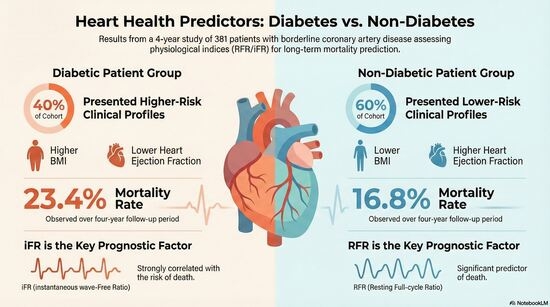
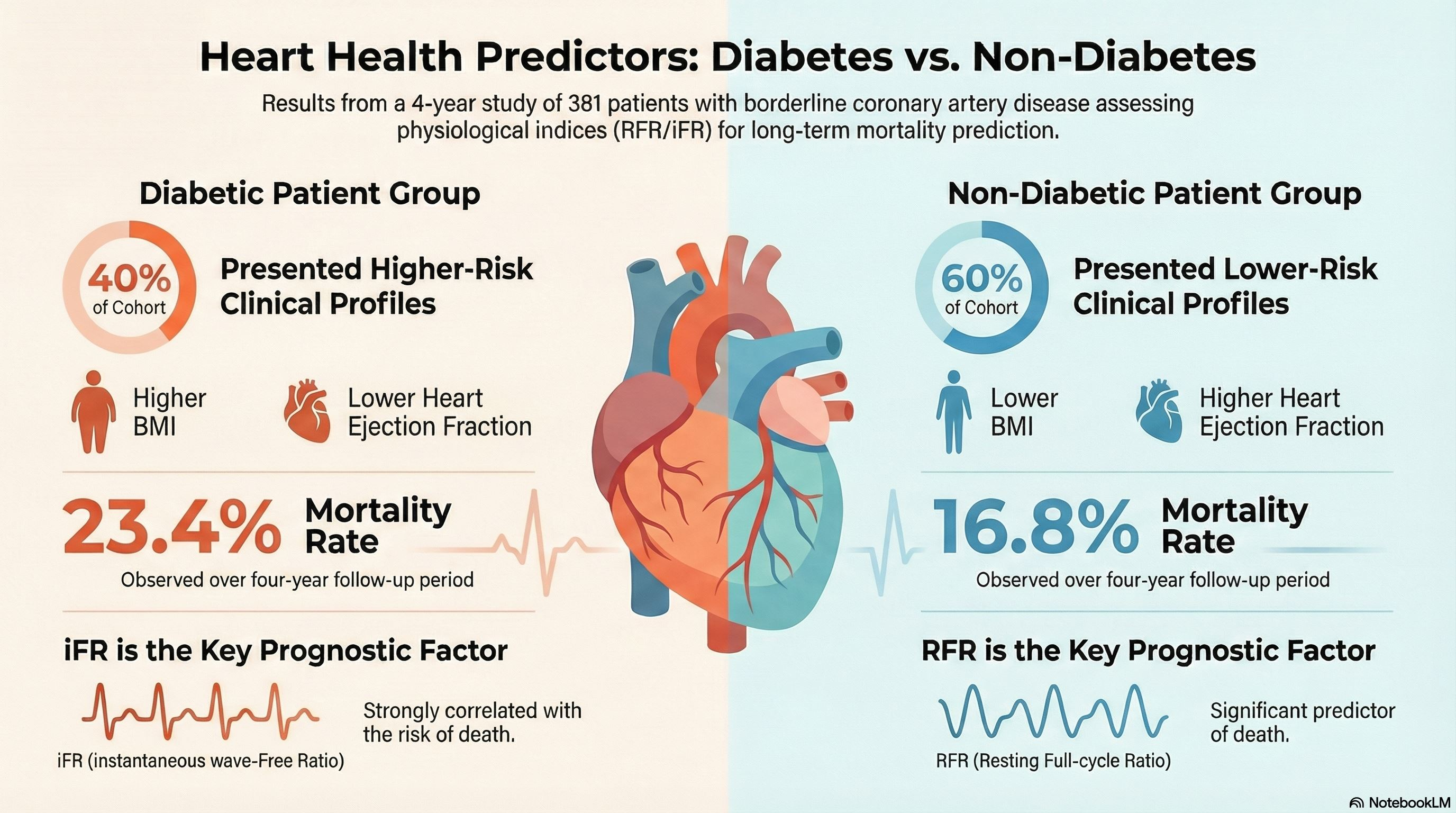
Both study groups were followed for more than four years. The mortality rate during this period among diabetics was 23.4%, while in patients without diabetes, it was 16.8%; this difference was not statistically significant. The clinical profile of deceased patients was largely comparable between groups, with the exception of BMI, which was higher in those with diabetes (median 28.7 vs. 26.2 kg/m
2;
p = 0.0184). Detailed data on the characteristics of patients who died during the long-term follow-up in both study groups are presented in
Table 3.
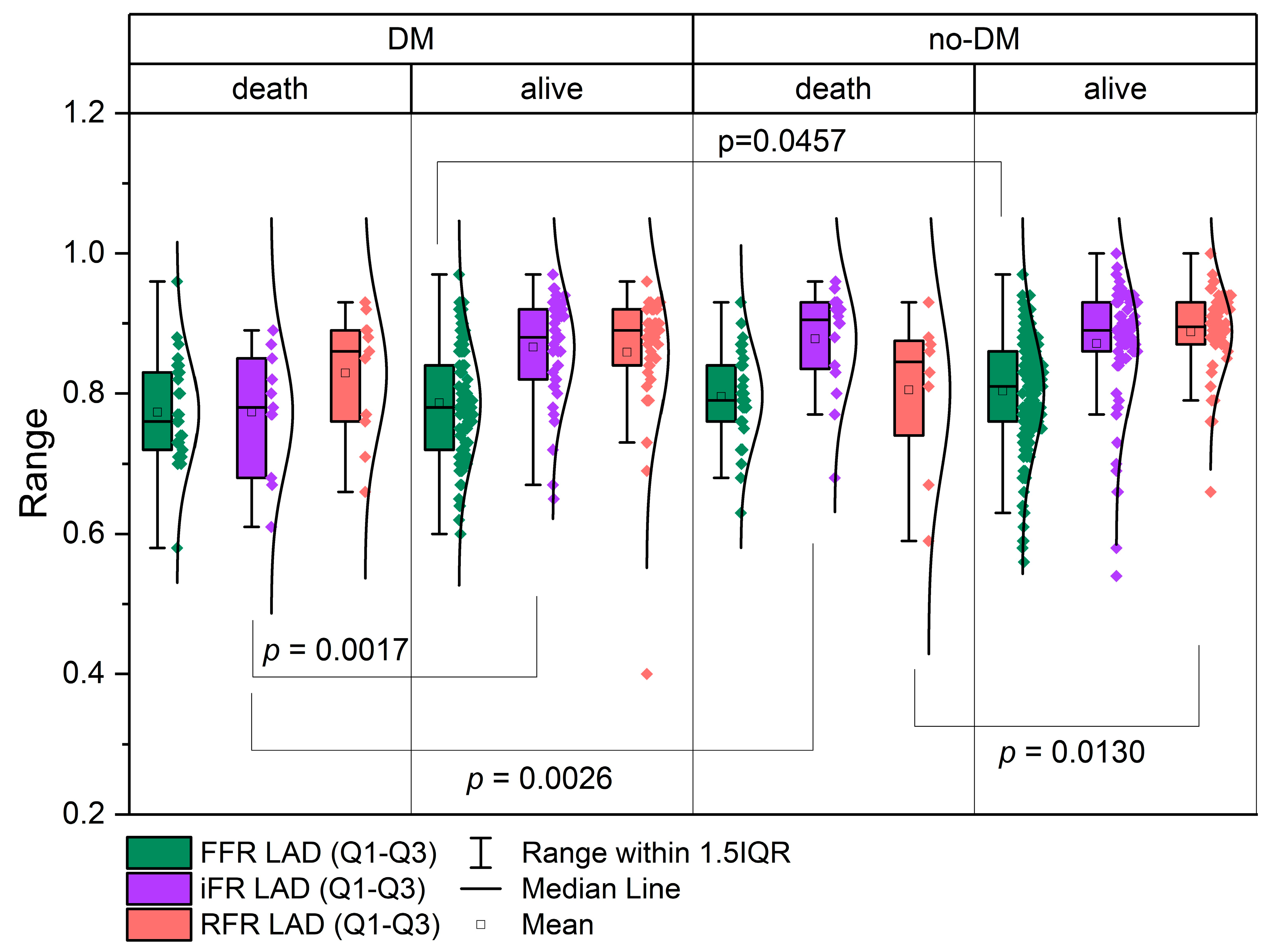
After analyzing the results of the physiological assessment of coronary circulation in both study groups in the context of long-term follow-up, we observed that in the group with baseline diabetes, patients who died had significantly lower iFR values compared to those who survived. Furthermore, these values were also significantly lower than those in patients without diabetes who died. However, in patients without a diagnosis of diabetes at baseline, significant differences were observed in RFR results: patients who died in this group had significantly lower RFR values at baseline compared to those who survived. Detailed data are presented in
Figure 1.
To identify risk factors for death in the respective groups during the long-term follow-up, univariate analyses were performed. Subsequently, a multivariate analysis model was created based on the risk factors that were statistically significant in the univariate analysis. In patients with diabetes, the coexistence of PAD and AF was associated with 5- and 4-fold higher risks of mortality, respectively. In the multivariate model, only atrial fibrillation remained significantly associated with a higher risk of death. Analysis of the results of the physiological evaluation revealed that non-hyperemic physiological evaluation was strongly correlated with the risk of death. The results showed that higher RFR/iFR values in LAD were associated with a lower risk of death. The mortality rate decreased twofold for every 0.1 increase in RFR/iFR and more than threefold for every 0.1 increase in iFR. When this analysis was repeated for each vessel assessed irrespective of the location of the coronary lesions, similar results are observed: a 0.1 increase in RFR/iFR reduced the risk of death by approximately one-third, while a similar increase in iFR reduces it by nearly half.
Univariate analysis in patients without diabetes identified more significant predictors of death than in those with diabetes. In addition to PAD, which increased the risk three times, age, left ventricular ejection fraction, and impaired renal function were also significant. In the multivariate analysis, age and left ventricular ejection fraction remained significant predictors of death. After analyzing the results of the physiological assessment in patients without diabetes, it was found that the non-hyperemic assessment using the RFR proved to be a significant prognostic factor. The risk of death in the long-term follow-up decreases threefold with an increase in the RFR result by 0.1 regardless of the assessed vessel. Detailed results of the univariate and multivariate analyses for selected risk factors in the diabetes group are summarized in
Table 4, and those for the non-diabetes group are shown in
Table 5.
Diagnostics of the multivariate regression models created showed that, based on McFadden’s pseudo-R2 (uncertainty coefficient U), which was 0.1401 for the model created for patients with diabetes and 0.1876 for the model created for patients without diabetes, both models demonstrated good variable fit. Detailed diagnostic data for the model analyzing data from patients with diabetes are as follows:
Whole model test: -LogLikelihood for the full model: 108.59; for difference: 10.59; p < 0.0001
Fit details: Entropy RSquare = 0.1401; generalized RSquare = 0.2099; mean -Log p = 0.4484; RASE = 0.3754; mean abs dev = 0.2835; misclassification rate = 0.1863
Lack-of-fit test: p = 0.2204; AUC for ROC = 0.75284
The data for the model analyzing data from patients without diabetes are as follows:
Whole model test: -LogLikelihood for the full model: 79.06; for difference: 18.26; p < 0.0001
Fit details: Entropy RSquare = 0.1876; generalized RSquare = 0.2619; mean -Log p = 0.3660; RASE = 0.3320; mean abs dev = 0.2230; misclassification rate = 0.1389
Lack-of-fit test: p = 0.9970; AUC for ROC = 0.78009
4. Discussion
The primary finding of this study is that non-hyperemic physiological indices demonstrated a strong prognostic value in both diabetic and non-diabetic populations. By analyzing the non-hyperemic assessment methods used in the study in more detail, we can see that in the case of patients with diagnosed diabetes, the iFR is a particularly important and prognostically significant indicator, while in the population of patients without diagnosed diabetes, the RFR is such an indicator.
The results of the hyperemic evaluation do not correlate as strongly with the long-term prognosis as those of the non-hyperemic evaluation. This observation may be due to various reasons. Although high-level recommendations support both indices, procedural strategies are more often based on FFR, especially in cases of disagreement with non-hyperemic methods [
7]. In patients with diabetes—who frequently exhibit microvascular dysfunction, endothelial impairment, and more diffuse coronary artery disease—the vasodilatory response to adenosine required for an accurate evaluation of the FFR can be lowered [
10]. Consequently, FFR measurements in this population can be falsely negative, suggesting the absence of significant stenosis. This diagnostic limitation is clinically important, as it can lead to an inappropriate delay in revascularization. In contrast, non-hyperemic indices such as the iFR and RFR, which do not rely on pharmacologically induced hyperemia, may provide a more stable and reliable physiological assessment in patients with diabetes. In studies comparing the anatomical image of atherosclerotic lesions obtained using optical coherence tomography (OCT) in a group of diabetic patients, the values of the minimal diameter and vessel surface area showed a clearly better correlation with the results of the non-hyperemic physiological assessment than with the hyperemic one [
11]. The results of our study support this concept, demonstrating that non-hyperemic indices retained a strong prognostic value in both diabetic and non-diabetic patients.
Another explanation for this fact may be as follows: due to the decisive importance of the hyperemic test in many cases and at the same time the definition of cut-off points for this assessment based on the clinical results of the treatment used, perhaps the benefit of revascularization in patients with a positive FFR result for ischemia and the simultaneous benefit of conservative treatment in patients with a negative result make the clinical effect of the treatment used similar regardless of the result of the hyperemic assessment. Although a comparable long-term effect of treatment can be expected in patients without diabetes, in the case of diabetic patients requiring revascularization, it seems likely that the configuration of risk factors will have a negative impact on the prognosis. However, there are also reports showing that diabetic patients have a poorer prognosis even when physiological evaluation indicates a benefit from conservative treatment [
12].
Analyzing the results presented in this study, we can also indirectly observe the significant impact of diabetes on the development of coronary artery disease. In this study, we selected a relatively homogeneous group of patients diagnosed with chronic coronary syndrome, whose angiography revealed borderline stenoses in the coronary arteries. Despite this angiographic homogeneity, patients with diabetes have more advanced coronary artery disease based on the physiological evaluation. Patients with diabetes are more likely to have a positive physiological assessment for ischemia and are more likely to be considered for coronary revascularization. Numerous previous reports have also reported a similar effect of diabetes on the development of coronary heart disease. Researchers from Denmark, who examined asymptomatic patients with newly diagnosed diabetes using fractional flow reserve derived from coronary CT angiography, found that one in six patients experienced hemodynamically significant lesions in the coronary circulation [
9]. In turn, researchers from Asia showed that among patients without obstructive coronary artery disease, myocardial ischemia associated with microcirculation disease was diagnosed three times more often in patients with diabetes compared to patients without this disease, and interstitial fibrosis was reported twice as often in patients with diabetes than in the control group [
13]. Among the reports that demonstrate the impact of diabetes on the development of atherosclerosis is a very interesting study by researchers from Asia, who observed more than 500 patients with chronic coronary syndrome and diabetes who initially underwent coronary revascularization and were then followed for four years. During follow-up, it was found that more than half of all major adverse cardiovascular events that occurred in this group were associated with a lesion other than the initial target lesion undergoing revascularization [
14]. This report demonstrates that atherosclerosis in patients with diabetes is usually diffuse.
A subanalysis of the PROSPECT II study presents very interesting data that demonstrate the complex impact of diabetic coronary artery damage, as well as the limitations of angiography and intravascular imaging in assessing this impact. Follow-up data of nearly a thousand patients over almost four years showed that although the baseline characteristics of the target lesion responsible for myocardial infarction as measured by angiography, intravascular ultrasound, and near-infrared spectroscopy did not differ significantly between diabetic and non-diabetic patients, in the long-term follow-up, diabetic patients had four times more major adverse cardiac events associated with the target lesion and almost three times more with non-target lesions [
15]. At the same time, the overall incidence of major adverse cardiac events was almost twice as high in the diabetic group as in the nondiabetic group. These observations may contribute important information to our results: the enhancement of diagnostic imaging with physiological evaluation resulted in a significant increase in the frequency of revascularization in the diabetic group. At the same time, the incidence of major adverse cardiac events was slightly higher in the diabetic group, although these differences were not statistically significant in our group of patients. A limitation of this comparison is that in our case, the assessment of major adverse cardiac events was limited to the incidence of all-cause mortality.
Given that diabetes significantly influences the development and progression of coronary heart disease and considering advances in diagnostic and therapeutic methods, we might expect that, over time, we should be able to treat patients with coronary heart disease concomitant with diabetes with greater efficiency. There are reports from Danish researchers that support and confirm these assumptions. Specifically, after observing nearly six thousand patients with diabetes and more than 23,000 patients without diabetes between 2004 and 2016, they found that the incidence of major adverse cardiac events during a two-year follow-up period decreased by 30% in the group of patients with diabetes [
16]. However, the decrease was also slightly greater in the group of patients without diabetes. Unfortunately, these optimistic figures do not mean that the problem is becoming less significant over time. Epidemiological studies show that 10 years ago, 56 million Europeans in Europe suffered from type 2 diabetes, and in the next 10 years, this number will likely increase by approximately 10 million. Furthermore, there are countries in Europe where the incidence of type 2 diabetes is expected to double over the next 10 years [
17]. These data show that the problem of coexisting diabetes with coronary heart disease is expected to increase in the near future. Therefore, efforts to develop diagnostics and treatment for patients with this clinical profile are justified and necessary because despite undoubted successes, current outcomes still appear to be somewhat worse than for people with chronic coronary syndrome but without comorbid diabetes.
5. Conclusions
Non-hyperemic physiological indices (RFR/iFR) demonstrated a strong prognostic value in both the diabetic and non-diabetic populations. Higher RFR/iFR values were consistently associated with a reduced risk of death. In the group of patients with DM, the value of the iFR can be considered a significant prognostic factor for long-term mortality. In the group without DM, the assessment of the RFR is such a factor. Diabetes has a significant impact on the progression of atherosclerotic lesions in the coronary circulation, causing a selected group of patients based on angiographic evaluation to indicate a more advanced disease that requires more frequent revascularization compared to patients without diabetes.
Limitations
Several limitations of this study must be acknowledged. First, this was a single-centre, retrospective registry analysis. Although this design reflects routine clinical practice in a tertiary referral centre, it inherently introduces selection bias. The decision to perform physiological assessment was based on the operator’s visual estimation of intermediate stenosis severity (50–90%), and the subsequent choice between revascularization and conservative management was non-randomized. Consequently, the external validity of our findings may be limited, particularly with respect to populations treated in community hospitals or managed within the framework of strictly controlled clinical trials.
Second, prognostic determinants were identified using logistic regression rather than Cox proportional hazards modelling. While logistic regression is appropriate for identifying factors associated with the occurrence of mortality, it does not incorporate time-to-event information and therefore may underexploit the temporal resolution of the long-term follow-up data. This methodological choice was dictated by the frequent unavailability of the exact date of death.
Third, the primary endpoint was all-cause mortality. Due to reliance on national administrative registries, we were unable to adjudicate specific causes of death (cardiovascular vs. non-cardiovascular). Although all-cause mortality constitutes a robust and unbiased outcome measure, it may obscure more specific relationships between physiological ischemia and fatal cardiac events, particularly in older patients in whom competing risks from non-cardiovascular comorbidities are substantial.
Fourth, results from distinct non-hyperemic pressure ratios (instantaneous wave-free ratio [iFR] and resting full-cycle ratio [RFR]) were aggregated into a single binary variable to maximize statistical power. Although current guidelines consider these indices diagnostically equivalent, subtle differences in their physiological derivation could, in principle, affect their prognostic performance. However, this study was not designed to conduct a head-to-head comparison of non-hyperemic indices, and the operator’s choice of physiological assessment system automatically determined the non-hyperemic method used. Each non-hyperemic assessment was thus performed with only one system, and no vessel underwent evaluation with multiple non-hyperemic indices. Accordingly, the observed differences between the iFR and the RFR may be attributable to random variation, a consideration that should temper the interpretation of these findings.
Finally, pharmacotherapy data were not systematically collected in the study database. Although patients with chronic coronary syndrome were generally managed with guideline-directed medical therapy, heterogeneity in pharmacological treatment may have arisen from the presence of comorbid conditions such as hypertension, heart failure, and cardiac arrhythmias, as well as from the performance of percutaneous coronary intervention (PCI) itself. These potential differences in pharmacotherapy could have influenced outcomes in the study cohort.
Author Contributions
Conceptualization, W.Z. and A.D.; formal analysis, W.Z.; funding acquisition, A.D. and S.B.; investigation, W.Z. and B.Z.; methodology, W.Z., B.Z. and A.D.; project administration, A.D.; resources, A.D.; supervision, A.D.; writing—original draft, W.Z.; writing—reviewing and editing, B.Z., B.B., A.K.-O., T.R. and A.D. All authors have read and agreed to the published version of the manuscript.
Funding
This work was supported by the Jagiellonian University Medical College (grant number N41/DBS/001013 to AD).
Institutional Review Board Statement
The study was conducted in accordance with the Declaration of Helsinki and approved by the Ethics Committee of the Jagiellonian University Medical College NAME OF INSTITUTE (approval number: 1072.6120.257.2022, 16 November 2022).
Informed Consent Statement
Due to the retrospective nature of the study, dedicated patient consent for participation in the registry was not required.
Data Availability Statement
The data presented in this study are available on request from the corresponding author.
Conflicts of Interest
The authors declare no conflicts of interest. The funders had no role in the design of the study; in the collection, analyses, or interpretation of data; in the writing of the manuscript; or in the decision to publish the results.
Abbreviations
The following abbreviations are used in this manuscript:
| AF | atrial fibrillation |
| BMI | body mass index |
| CABG | coronary artery bypass grafting |
| CI | confidence interval |
| COPD | chronic obstructive pulmonary disease |
| DM | diabetes mellitus |
| FFR | fractional flow reserve |
| FU | follow-up |
| GFR | glomerular filtration rate |
| iFR | instantaneous wave-free ratio |
| LAD | left anterior descending artery |
| LVEF | left ventricle ejection fraction |
| MI | myocardial infarct |
| OCT | optical coherence tomography |
| OR | odds ratio |
| PAD | peripheral arterial disease |
| PCI | percutaneous coronary intervention |
| Q1 | first quartile |
| Q3 | third quartile |
| RFR | resting full-cycle ratio |
| SD | standard deviation |
References
- Pijls, N.H.; De Bruyne, B.; Peels, K.; Van Der Voort, P.H.; Bonnier, H.J.; Bartunek, J.; Koolen, J.J. Measurement of fractional flow reserve to assess the functional severity of coronary-artery stenoses. N. Engl. J. Med. 1996, 334, 1703–1708. [Google Scholar] [CrossRef] [PubMed]
- Ahn, J.-M.; Park, D.-W.; Shin, E.-S.; Koo, B.-K.; Nam, C.-W.; Doh, J.-H.; Kim, J.H.; Chae, I.-H.; Yoon, J.-H.; Her, S.-H.; et al. Fractional Flow Reserve and Cardiac Events in Coronary Artery Disease: Data from a Prospective IRIS-FFR Registry (Interventional Cardiology Research Incooperation Society Fractional Flow Reserve). Circulation 2017, 135, 2241–2251. [Google Scholar] [CrossRef] [PubMed]
- Johnson, N.P.; Tóth, G.G.; Lai, D.; Zhu, H.; Açar, G.; Agostoni, P.; Appelman, Y.; Arslan, F.; Barbato, E.; Chen, S.-L.; et al. Prognostic value of fractional flow reserve: Linking physiologic severity to clinical outcomes. J. Am. Coll. Cardiol. 2014, 64, 1641–1654. [Google Scholar] [CrossRef] [PubMed]
- Maini, R.; Moscona, J.; Katigbak, P.; Fernandez, C.; Sidhu, G.; Saleh, Q.; Irimpen, A.; Samson, R.; LeJemtel, T. Instantaneous wave-free ratio as an alternative to fractional flow reserve in assessment of moderate coronary stenoses: A meta-analysis of diagnostic accuracy studies. Cardiovasc. Revasc. Med. 2018, 19, 613–620. [Google Scholar] [CrossRef] [PubMed]
- Petraco, R.; Escaned, J.; Sen, S.; Nijjer, S.; Asrress, K.N.; Echavarria-Pinto, M.; Lockie, T.; Khawaja, M.Z.; Cuevas, C.; Foin, N.; et al. Classification performance of instantaneous wave-free ratio (iFR) and fractional flow reserve in a clinical population of intermediate coronary stenoses: Results of the ADVISE registry. EuroIntervention 2013, 9, 91–101. [Google Scholar] [CrossRef] [PubMed]
- Svanerud, J.; Ahn, J.-M.; Jeremias, A.; van’t Veer, M.; Gore, A.; Maehara, A.; Crowley, A.; Pijls, N.H.J.; De Bruyne, B.; Johnson, N.P.; et al. Validation of a novel non-hyperaemic index of coronary artery stenosis severity: The Resting Full-cycle Ratio (VALIDATE RFR) study. EuroIntervention 2018, 14, 806–814. [Google Scholar] [CrossRef] [PubMed]
- Zdzierak, B.; Zasada, W.; Krawczyk-Ożóg, A.; Rakowski, T.; Bartuś, S.; Surdacki, A.; Dziewierz, A. Comparison of Fractional Flow Reserve with Resting Non-Hyperemic Indices in Patients with Coronary Artery Disease. J. Cardiovasc. Dev. Dis. 2023, 10, 34. [Google Scholar] [CrossRef] [PubMed]
- Nobre Menezes, M.; Francisco, A.R.G.; Carrilho Ferreira, P.; Jorge, C.; Torres, D.; Cardoso, P.; Duarte, J.A.; Marques da Costa, J.; Infante de Oliveira, E.; Pinto, F.J.; et al. Comparative analysis of fractional flow reserve and instantaneous wave-free ratio: Results of a five-year registry. Rev. Port. Cardiol. (Engl. Ed.) 2018, 37, 511–520. [Google Scholar] [CrossRef] [PubMed]
- Mrgan, M.; Nørgaard, B.L.; Dey, D.; Gram, J.; Olsen, M.H.; Gram, J.; Sand, N.P.R. Coronary flow impairment in asymptomatic patients with early stage type-2 diabetes: Detection by FFRCT. Diab. Vasc. Dis. Res. 2020, 17, 1479164120958422. [Google Scholar] [CrossRef] [PubMed]
- Fogelson, B.; Tahir, H.; Livesay, J.; Baljepally, R. Pathophysiological factors contributing to fractional flow reserve and instantaneous wave-free ratio discordance. Rev. Cardiovasc. Med. 2022, 23, 70. [Google Scholar] [CrossRef] [PubMed]
- Rivero, F.; Antuña, P.; García-Guimaraes, M.; Jiménez, C.; Cuesta, J.; Bastante, T.; Alfonso, F. Correlation between fractional flow reserve and instantaneous wave-free ratio with morphometric assessment by optical coherence tomography in diabetic patients. Int. J. Cardiovasc. Imaging 2020, 36, 1193–1201. [Google Scholar] [CrossRef] [PubMed]
- Ekmejian, A.; Sritharan, H.; Selvakumar, D.; Venkateshka, V.; Allahwala, U.; Ward, M.; Bhindi, R. Outcomes of deferred revascularisation following negative fractional flow reserve in diabetic and non-diabetic patients: A meta-analysis. Cardiovasc. Diabetol. 2023, 22, 22. [Google Scholar] [CrossRef] [PubMed]
- Yu, Y.; Yang, W.; Dai, X.; Yu, L.; Lan, Z.; Ding, X.; Zhang, J. Microvascular Myocardial Ischemia in Patients with Diabetes Without Obstructive Coronary Stenosis and Its Association with Angina. Korean J. Radiol. 2023, 24, 1081–1092. [Google Scholar] [CrossRef] [PubMed]
- Zhao, J.; Zhang, H.; Liu, C.; Zhang, Y.; Xie, C.; Wang, M.; Wang, C.; Wang, S.; Xue, Y.; Liang, S.; et al. Identification of vulnerable non-culprit lesions by coronary computed tomography angiography in patients with chronic coronary syndrome and diabetes mellitus. Front. Cardiovasc. Med. 2023, 10, 1143119. [Google Scholar] [CrossRef] [PubMed]
- Gyldenkerne, C.; Maeng, M.; Kjøller-Hansen, L.; Maehara, A.; Zhou, Z.; Ben-Yehuda, O.; Erik Bøtker, H.; Engstrøm, T.; Matsumura, M.; Mintz, G.S.; et al. Coronary Artery Lesion Lipid Content and Plaque Burden in Diabetic and Nondiabetic Patients: PROSPECT II. Circulation 2023, 147, 469–481. [Google Scholar] [CrossRef] [PubMed]
- Jensen, E.S.; Olesen, K.K.W.; Gyldenkerne, C.; Thrane, P.G.; Jensen, L.O.; Raungaard, B.; Poulsen, P.L.; Thomsen, R.W.; Maeng, M. Cardiovascular risk in patients with and without diabetes presenting with chronic coronary syndrome in 2004–2016. BMC Cardiovasc. Disord. 2021, 21, 579. [Google Scholar] [CrossRef] [PubMed]
- Tamayo, T.; Rosenbauer, J.; Wild, S.H.; Spijkerman, A.M.W.; Baan, C.; Forouhi, N.G.; Herder, C.; Rathmann, W. Diabetes in Europe: An Update. Diabetes Res. Clin. Pract. 2014, 103, 206–217. [Google Scholar] [CrossRef] [PubMed]
| Disclaimer/Publisher’s Note: The statements, opinions and data contained in all publications are solely those of the individual author(s) and contributor(s) and not of MDPI and/or the editor(s). MDPI and/or the editor(s) disclaim responsibility for any injury to people or property resulting from any ideas, methods, instructions or products referred to in the content. |




 ,
,