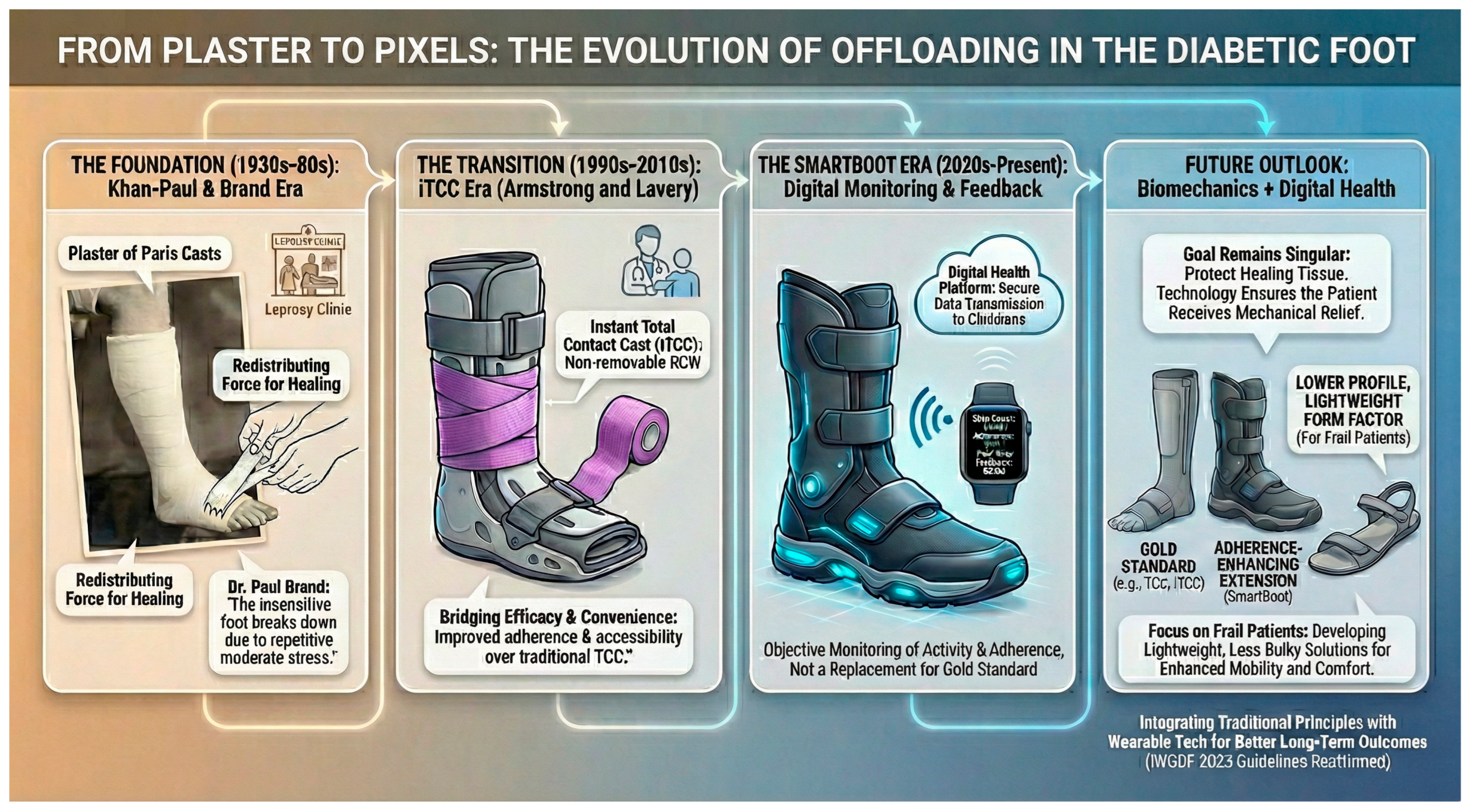


From Plaster to Pixels: The Evolution of Offloading in the Diabetic Foot




Abstract
1. Introduction
2. Methods
2.1. The Foundation: The Khan–Paul Era (1930s)
2.2. The Brand Era (1950s–1980s)
2.3. The iTCC/TCC RCT Era (1990s–2010s)
- Non-removable knee-high devices vs. removable: Non-removable offloading devices (TCC or iTCC) significantly increased the proportion of DFUs healed compared to removable devices (risk ratio ~1.24, 95% CI 1.09–1.41). In practical terms, making a device non-removable yielded roughly 24% more ulcers healed. Non-removable devices also likely improve patient adherence (since the device is always on) and were associated with fewer infections and better cost-effectiveness, albeit at the cost of more frequent new skin lesions from the device. This underscores the trade-off: enforcing adherence improves healing, but prolonged casting can cause mild skin breakdown elsewhere if not carefully managed.
- Knee-high vs. ankle-high removable devices: Surprisingly, removable knee-high boots showed no significant difference in healing rates compared to removable ankle-high offloading devices (RR ~1.00, 95% CI 0.86–1.16). The knee-high walkers reduce plantar pressure more than ankle-high walkers, but they also tend to reduce patient adherence (likely due to being bulkier and more cumbersome). Thus, the advantages of better offloading in a taller device may be offset by patients wearing them less. This finding suggests that in real-world use, a device’s effectiveness must consider both its biomechanical offloading capacity and the patient’s willingness or ability to use it consistently.
- Any offloading device vs. therapeutic footwear: Using any dedicated offloading device (casts, boots, etc.) was more effective than just using therapeutic shoes or insoles for healing ulcers. Pooled data showed a trend toward higher healing with offloading devices (RR ~1.39 vs. footwear), although the confidence interval crossed 1.0 in that analysis. Dedicated devices also tended to reduce plantar pressures and infection rates compared to standard diabetic footwear. In practice, this reinforces that while good shoes are critical for prevention, an active ulcer generally requires a purpose-built offloading device for optimal healing.
- Adjunctive surgical offloading procedures: The meta-analysis also evaluated interventions like Achilles tendon lengthening and digital flexor tenotomies (often used for recurrent forefoot or toe ulcers). For toe ulcers, adding flexor tenotomy to standard offloading significantly improved healing (one RCT showed RR 2.43, 95% CI 1.05–5.59), presumably by permanently reducing clawing and pressure on the toe apex [20]. For Achilles tendon lengthening aimed at reducing forefoot pressure, evidence suggested a modest increase in healing (RR ~1.10, CI 0.97–1.27)—a trend favoring surgery, though not definitive—and noted a potential trade-off of causing new ulcers at the heel due to altered gait. These surgical approaches can be “force multipliers” for offloading in select patients (e.g., recurrent ulcers due to rigid deformities), but they carry surgical risks and are reserved for specific cases [21].

| Off-Loading Modality | Key Features and Usage | Comparative Effectiveness & Considerations |
|---|---|---|
| Total Contact Cast (TCC) Non-removable knee-high cast | Custom-molded full cast encompassing foot and lower leg; changed ~weekly. Patient cannot remove. | Highest healing efficacy. Gold standard offloading; evenly distributes pressure and enforces near-100% adherence. Healing rates ~30–40% higher than removable. Requires specialized skill to apply; can cause new device-related lesions (e.g., skin rubs) in up to ~1 in 6 patients. Patient convenience and hygiene are challenges. |
| Instant TCC (iTCC) Non-removable RCW | Prefabricated walker boot rendered irremovable by wrap (casting tape or cohesive bandage). | Near-equivalent to TCC in healing. Simplifies application (no casting expertise needed) while forcing adherence like a TCC. Studies show iTCC heals ulcers significantly faster than a boot-worn removable. Shares the same limitations as TCC (patient cannot remove), though application is quicker. Widely adopted in centers aiming to improve outcomes without full casting. |
| Removable Cast Walker (RCW) Knee-high removable boot | Common offloading boots (rigid shell, rocker bottom) reaching just below knee; patient can remove for sleeping, bathing, etc. | Effective pressure relief when worn, but usage often poor. In trials, RCWs offload pressure nearly and TCC biomechanically, but patients often wear them inconsistently (average ~28% of daily steps in one study) [23]. Consequently, healing rates lag behind non-removable devices. Considered second-line if TCC/iTCC not possible, and only effective with strong adherence support. |
| Ankle-high Offloading Boots Half-shoes, ankle braces | Shorter offloading devices (e.g., healing sandal, forefoot offloading shoe, controlled ankle motion boot) not extending to knee. | Lower offloading intensity, but higher tolerance. Easier for patients to ambulate with, improving wear time relative to bulkier boots. RCT evidence found no significant difference in healing vs. knee-high removable boots, suggesting any offloading advantage of knee-high boots may be negated by worse adherence. Still, ankle-high devices generally do not reduce plantar pressure as much, so they are best reserved for patients who absolutely cannot use knee-high devices. |
| Therapeutic Footwear Custom diabetic shoes, insoles | Prescription diabetic shoes, custom insoles, or temporary sandal devices (often used for ulcer prevention or in less severe wounds). | Minimal healing benefit for active ulcers. While specialized footwear is crucial for preventing ulcers and protecting high-risk feet, it provides much less pressure relief than offloading devices. Studies indicate dedicated offloading devices trend toward higher healing rates than footwear alone (RR ~1.4). Thus, footwear alone is usually inadequate for treating a moderate-to-severe plantar ulcer, but it may be used when no other option is feasible (or in conjunction with other measures). |
| Smart Offloading “Boot” Removable sensor-enabled boot | New concept: a removable cast boot (often knee or mid-calf) integrated with sensors (inertial measurement unit, pressure sensors) plus a patient-facing app/interface. Provides real-time feedback and reminders. | Emerging approach—aims to improve adherence rather than raw offloading ability. Early systems (SmartBoot) include an IMU sensor that detects when the boot is on vs. off and sends alerts (e.g., vibration or smartphone notification) when the patient is walking without the boot. Gamified elements (like a “happy face” on a smartwatch when the boot is worn, and sad face when not) are used to encourage use. Data (step counts, weight-bearing time, gait metrics) stream to the cloud, allowing the care team to monitor adherence and mobility remotely. Clinical efficacy: Still being studied; early trials show improved compliance and patient satisfaction, but these devices should be seen as facilitating proper offloading use, not a replacement for the TCC in sheer pressure relief. |
2.4. The SmartBoot Era (2020s–2025)
2.5. Implementation Challenges and the Digital Divide
3. Conclusions
Author Contributions
Funding
Institutional Review Board Statement
Informed Consent Statement
Data Availability Statement
Conflicts of Interest
References
- Brand, P.W. The insensitive foot (including leprosy). In Disorders of the Foot; Jahss, M.H., Ed.; WB Saunders: Philadelphia, PA, USA, 1982; pp. 217–219. [Google Scholar]
- Bauman, J.; Girling, J.; Brand, P. Plantar pressures and trophic ulceration. J. Bone Jt. Surg. Br. Vol. 1963, 45B, 652–673. [Google Scholar] [CrossRef] [Scilit]
- Bauman, J.H.; Brand, P.W. Measurement of pressure between foot and shoe. Lancet 1963, 1, 629–632. [Google Scholar] [CrossRef] [Scilit] [PubMed]
- Armstrong, D.G.; Lavery, L.A.; Nixon, B.P.; Boulton, A.J.M. It’s not what you put on, but what you take off: Techniques for debriding and offloading the diabetic foot wound. Clin. Infect. Dis. 2004, 39, S92–S99. [Google Scholar] [CrossRef] [Scilit] [PubMed]
- Armstrong, D.G.; Tan, T.W.; Boulton, A.J.M.; Bus, S.A. Diabetic Foot Ulcers A Review. JAMA 2023, 330, 62–75. [Google Scholar] [CrossRef] [Scilit] [PubMed]
- Wu, Y.; Chen, Y.; Wang, H.; Dong, S.; Yan, H.O.; Xie, J. Comparison of the effectiveness and safety of different non-surgical offloading interventions for diabetic foot ulcers: A network meta-analysis of randomized controlled trials. Int. J. Low. Extrem. Wounds 2025, 15347346251329608. [Google Scholar] [CrossRef] [Scilit]
- Khan, J. Treatment of plantar ulcers in leprosy with plaster of Paris. Lepr. Rev. 1939, 10, 15–18. [Google Scholar]
- Paul, M.A. Quoted in: Practical Textbook of Leprosy; Cochrane, R., Ed.; Oxford University Press: Oxford, UK, 1947. [Google Scholar]
- Boulton, A.J.M. Diabetic foot—what can we learn from leprosy? Legacy of Dr Paul W. Brand: Diabetic Foot: Legacy of Dr Paul W. Brand. Diabetes Metab. Res. Rev. 2012, 28, 3–7. [Google Scholar] [CrossRef] [Scilit]
- Brand, P.W. The Diabetic Foot. In Diabetes Mellitus: Theory and Practice; Ellenberg, M.R.H., Ed.; Medical Examination Publishing Co., Inc.: Flushing, NY, USA, 1984; pp. 829–849. [Google Scholar]
- Coleman, W.C.; Brand, P.W.; Birke, J.A. The total contact cast. A therapy for plantar ulceration on insensitive feet. J. Am. Podiatry Assoc. 1984, 74, 548–552. [Google Scholar] [CrossRef] [Scilit]
- Gauna, C.; Romeo, F.; Scatena, A.; Miranda, C.; Uccioli, L.; Vermigli, C.; Volpe, A.; Bordieri, C.; Tramonta, R.; Ragghianti, B.; et al. Offloading systems for the treatment of neuropathic foot ulcers in patients with diabetes mellitus: A meta-analysis of randomized controlled trials for the development of the Italian guidelines for the treatment of diabetic foot syndrome. Acta Diabetol. 2024, 61, 693–703. [Google Scholar] [CrossRef] [Scilit]
- Ganguly, S.; Chakraborty, K.; Mandal, P.K.; Ballav, A.; Choudhury, S.; Bagchi, S.; Mukherjee, S. A comparative study between total contact casting and conventional dressings in the non-surgical management of diabetic plantar foot ulcers. J. Indian Med. Assoc. 2008, 106, 237–239, 244. [Google Scholar]
- Ludwig, K.; Homer, V.; Jensen, J. Ease of Application and Removal of Common Total-Contact Cast Systems Used in the Podiatric Medical Community. J. Am. Podiatr. Med. Assoc. 2019, 109, 445–450. [Google Scholar] [CrossRef] [Scilit]
- Armstrong, D.G.; Short, B.; Espensen, E.H.; Abu-Rumman, P.L.; Nixon, B.P.; Boulton, A.J.M. Technique for fabrication of an “instant total-contact cast” for treatment of neuropathic diabetic foot ulcers. J. Am. Podiatr. Med. Assoc. 2002, 92, 405–408. [Google Scholar] [CrossRef] [Scilit] [PubMed]
- Armstrong, D.G.; Lavery, L.A.; Wu, S.; Boulton, A.J.M. Evaluation of removable and irremovable cast walkers in the healing of diabetic foot wounds: A randomized controlled trial. Diabetes Care 2005, 28, 551–554. [Google Scholar] [CrossRef] [Scilit] [PubMed]
- Katz, I.A.; Harlan, A.; Miranda-Palma, B.; Prieto-Sanchez, L.; Armstrong, D.G.; Bowker, J.H.; Mizel, M.S.; Boulton, A.J. A randomized trial of two irremovable offloading devices in the management of plantar neuropathic diabetic foot ulcers. Diabetes Care 2005, 28, 555–559. [Google Scholar] [CrossRef] [Scilit] [PubMed]
- Armstrong, D.G.; Nguyen, H.C.; Lavery, L.A.; Van Schie, C.H.; Boulton, A.J.M.; Harkless, L.B. Offloading the diabetic foot wound: A randomized clinical trial (Abstract). Diabetes Care 2001, 24, 1019–1022. [Google Scholar] [CrossRef] [Scilit]
- Lazzarini, P.A.; Armstrong, D.G.; Crews, R.T.; Gooday, C.; Jarl, G.; Kirketerp-Moller, K.; Viswanathan, V.; Bus, S.A. Effectiveness of offloading interventions for people with diabetes-related foot ulcers: A systematic review and meta-analysis. Diabetes Metab. Res. Rev. 2023, 40, e3650. [Google Scholar] [CrossRef] [Scilit]
- Andersen, J.A.; Rasmussen, A.; Engberg, S.; Bencke, J.; Frimodt-Møller, M.; Kirketerp-Møller, K.; Rossing, P. Flexor Tendon Tenotomy Treatment of the Diabetic Foot: A Multicenter Randomized Controlled Trial. Diabetes Care 2022, 45, 2492–2500. [Google Scholar] [CrossRef] [Scilit]
- Frykberg, R.G.; Attinger, C.; Smeets, L.; Koller, A.; Bal, A.; Kavarthapu, V. Surgical strategies for prevention of amputation of the diabetic foot. J. Clin. Orthop. Trauma 2021, 17, 99–105. [Google Scholar] [CrossRef] [Scilit]
- Bus, S.A.; Armstrong, D.G.; Crews, R.T.; Gooday, C.; Jarl, G.; Kirketerp-Moller, K.; Viswanathan, V.; Lazzarini, P.A. Guidelines on offloading foot ulcers in persons with diabetes (IWGDF 2023 update). Diabetes Metab Res Rev. 2023, 40, e3647. [Google Scholar] [CrossRef] [Scilit]
- Armstrong, D.G.; Lavery, L.A.; Kimbriel, H.R.; Nixon, B.P.; Boulton, A.J.M. Activity patterns of patients with diabetic foot ulceration: Patients with active ulceration may not adhere to a standard pressure offloading regimen. Diabetes Care 2003, 26, 2595–2597. [Google Scholar] [CrossRef] [Scilit]
- Najafi, B.; Mishra, R. Harnessing Digital Health Technologies to Remotely Manage Diabetic Foot Syndrome: A Narrative Review. Medicina 2021, 57, 377. [Google Scholar] [CrossRef] [Scilit]
- Bus, S.A.; Reeves, N.D.; Armstrong, D.G.; Najafi, B. Offloading and adherence through technological advancements: Modern approaches for better foot care in diabetes. Diabetes Metab. Res. Rev. 2024, 40, e3769. [Google Scholar] [CrossRef] [Scilit] [PubMed]
- Park, C.; Mishra, R.; Vigano, D.; Macagno, M.; Rossotti, S.; D’hUyvetter, K.; Garcia, J.; Armstrong, D.G.; Najafi, B. Smart Offloading Boot System for Remote Patient Monitoring: Toward Adherence Reinforcement and Proper Physical Activity Prescription for Diabetic Foot Ulcer Patients. J. Diabetes Sci. Technol. 2022, 17, 42–51. [Google Scholar] [CrossRef] [Scilit] [PubMed]
- Cay, G.; Lee, M.; Armstrong, D.G.; Najafi, B. SmartBoot: Real-time monitoring of patient activity via remote edge computing technologies. Sensors 2025, 25, 4490. [Google Scholar] [CrossRef] [Scilit] [PubMed]
- Finco, M.G.; Cay, G.; Lee, M.; Garcia, J.; Salazar, E.; Tan, T.-W.; Armstrong, D.G.; Najafi, B. Taking a load off: User perceptions of smart offloading walkers for diabetic foot ulcers using the Technology Acceptance Model. Sensors 2023, 23, 2768. [Google Scholar] [CrossRef] [Scilit]
- Faye, K. Researchers Publish First Successful “Smart Boot” Study Regarding Diabetes-Related Wounds—HSC News. HSC News—News for USC’s Health Sciences Campus Community. Available online: https://hscnews.usc.edu/researchers-publish-first-successful-smart-boot-study-regarding-diabetes-related-wounds (accessed on 18 December 2025).
- Hong, A.T.; Luu, I.Y.; Deras-Guerra, B.; Han, S.; Shin, L.; Shih, C.-D.; Armstrong, D.G.; Tan, T.-W. Association between frailty progression and clinical outcomes in patients with diabetic foot ulcers. Surgery 2025, 186, 109599. [Google Scholar] [CrossRef] [Scilit]

Disclaimer/Publisher’s Note: The statements, opinions and data contained in all publications are solely those of the individual author(s) and contributor(s) and not of MDPI and/or the editor(s). MDPI and/or the editor(s) disclaim responsibility for any injury to people or property resulting from any ideas, methods, instructions or products referred to in the content. |
© 2026 by the authors. Licensee MDPI, Basel, Switzerland. This article is an open access article distributed under the terms and conditions of the Creative Commons Attribution (CC BY) license.
Share and Cite
Armstrong, D.G.; Najafi, B.; Homer-Vanniasinkam, S. From Plaster to Pixels: The Evolution of Offloading in the Diabetic Foot. Diabetology 2026, 7, 44. https://doi.org/10.3390/diabetology7030044
Armstrong DG, Najafi B, Homer-Vanniasinkam S. From Plaster to Pixels: The Evolution of Offloading in the Diabetic Foot. Diabetology. 2026; 7(3):44. https://doi.org/10.3390/diabetology7030044
Chicago/Turabian StyleArmstrong, David G., Bijan Najafi, and Shervanthi Homer-Vanniasinkam. 2026. "From Plaster to Pixels: The Evolution of Offloading in the Diabetic Foot" Diabetology 7, no. 3: 44. https://doi.org/10.3390/diabetology7030044
APA StyleArmstrong, D. G., Najafi, B., & Homer-Vanniasinkam, S. (2026). From Plaster to Pixels: The Evolution of Offloading in the Diabetic Foot. Diabetology, 7(3), 44. https://doi.org/10.3390/diabetology7030044