
Article

Extracellular Matrix—Key to Maintaining Function of Encapsulated Human Stem Cell Differentiated Islet Clusters Seeded into Scaffolds as a Diabetes Therapy


1
School of Life Sciences, Faculty of Science, University of Technology Sydney, Broadway, NSW 2007, Australia
2
Department of Surgery, University of Wisconsin, Madison, WI 53792, USA
3
Kadimastem Limited, Nes Ziona 7403630, Israel
4
Centre for Materials Science, Queensland University of Technology, Kelvin Grove, QLD 4059, Australia
5
Weizmann Institute of Science, Rehovot 7610001, Israel
6
Australian Foundation for Diabetes Research, Bondi Junction, NSW 2022, Australia
7
Department Diabetes, School of Translational Medicine, Monash University, Melbourne, VIC 3004, Australia
*
Author to whom correspondence should be addressed.
Diabetology 2026, 7(1), 5; https://doi.org/10.3390/diabetology7010005 (registering DOI)
Submission received: 24 October 2025 / Revised: 28 November 2025 / Accepted: 23 December 2025 / Published: 1 January 2026

Abstract

Background/Objectives: A stem cell therapy for type 1 diabetes (T1D) is experimentally available but only to those few humans in whom the use of systemic immunosuppression can be justified. For others with T1D, a means to deliver the islets needs to be perfected. We have previously bioengineered a removable device for this purpose and now wish to test the effect of adding extracellular matrix (ECM) derived from decellularised human pancreas to it. Methods: The complete device consists of encapsulated pluripotent stem cell differentiated islets seeded into tubular scaffolds of polycaprolactone made by melt electrospin writing and to which ECM was added. The seeded device was implanted either subcutaneously (SC) or intraperitoneally (IP) into streptozotocin diabetic immunodeficient mice. The outcome over the next few months was compared with that achieved in diabetic mice implanted IP with encapsulated islets alone. Results: The device seeded with encapsulated islets but not containing ECM functioned less well than encapsulated islets implanted alone, with lower human C-peptide production. However, when ECM was added to the seeded device and whether implanted SC or IP, islets functioned as efficiently as those implanted without use of a scaffold. Conclusions: These data provide optimism for the use of seeded scaffolds in diabetic humans in whom a single scaffold seeded with multiple encapsulated islets can more readily be removed if needed for safety reasons than can multiple encapsulated islets not seeded into a scaffold.

1. Introduction

Type 1 diabetes (T1D) is a life-threatening autoimmune disease caused by the depletion of functional insulin-producing islet β cells, and there is no cure [1]. Worldwide, there are estimated to be at least 8.4 million people with T1D, of whom 1.5 million are younger than 20 years of age [2]. For most T1D patients, multiple daily insulin injections or insulin administered by a pump is the means of meeting the body’s need for insulin [3]. However, the use of exogenous insulin for diabetes management is not a cure and does not prevent glucose variability that can result in hypoglycaemic coma and diabetic ketoacidosis.
Insulin-producing β-cells/islets or pancreas transplantation is the goal of the next generation of treatment for T1D. Whole pancreas and islet transplantation have been shown to be effective in controlling blood glucose levels (BGL) in patients with T1D, which decreased the dependence on exogenous insulin administration [4]. However, there is a limited source of allogeneic donors, and the need for the daily administration of immunosuppressive medication to prevent organ rejection results in significant side effects that severely affect life quality. To mitigate the undesired immune response following islet transplantation, alginate microcapsules have been adopted as an immune isolator, which prevents access of immune cells to transplanted β-cells/islets while allowing the release of insulin into the surrounding extracellular fluid to regulate BGL [5].
A possible transplant location for humans is the subcutaneous (SC) space, which allows retrieval of the implant when such needs arise, although the peritoneal cavity contains a larger volume of body fluids, which offers a better nutrient supply to capsules without additional angiogenesis. In our previous study, a custom-made scaffold was used to promote vessel growth around the transplanted encapsulated mouse islets which subsequently normalised BGL in recipient diabetic mice [6]. However, whether such an approach is also effective for encapsulated human pluripotent stem cell differentiated β-cell clusters is unclear. Furthermore, angiogenesis into the scaffold may not be fast enough to support the implanted encapsulated cells at an early stage after implantation.
It has been reported that extracellular matrix (ECM) derived from decellularised pancreas can promote the viability and function of human islets in vitro [7,8] and mouse islets after transplantation [9,10,11]. Thus, the addition of ECM to the scaffold offers an additional refinement option to improve the quality of encapsulated islets when implanted in the SC space [11]. Therefore, this study aimed to investigate whether a scaffold in combination with pancreas-derived ECM can boost the survival and function of human stem cell-differentiated β-cells when implanted into diabetic mice.

2. Materials and Methods

2.1. Differentiation of β-Cell Clusters from Human Embryonic Stem Cells

Clinical grade human embryonic stem cells HADC-100 (provided by Professor Benjamin Reubinoff, Hadassah Medical School, Jerusalem, Israel) were grown to confluent monolayers in essential E8 medium (Thermo Fischer Scientific, Waltham, MA, USA), in vitronectin-coated flasks (Thermo Fischer Scientific),. Dissociated single cells were then seeded into spinner flasks and placed on a stirrer at a speed of 70 rpm to produce cell clusters [12]. E8 medium was washed away and stage 1 differentiation medium added to the aggregates. Over the next 5 weeks, media was replaced using a seven-stage differentiation protocol as detailed in [12] to allow formation of islet clusters. At the end of the differentiation, an aliquot of the cells was analysed by flow cytometry for the pancreatic markers NKX6.1 (Becton Dickinson, Caesarea, Israel) and C-peptide (Developmental Studies Hybridoma Bank, Iowa City, IA, USA). The islet clusters were maintained in CMRL culture medium (Thermo Fischer Scientific) at 37 °C with 5% CO2 until used in experiments.

2.2. Human Pancreatic ECM Preparation

Human pancreata were obtained through the University of Wisconsin Organ and Tissue Donation program with consent obtained for research from next of kin and authorised by the University of Wisconsin-Madison Health Sciences Institutional Review Board as described previously [8,13]. The human pancreata were rinsed with phosphate-buffered saline (PBS) (Thermo Fisher Scientific) and homogenised in water until broken up. The homogenate was centrifuged and the pellet resuspended in 2.5 mM sodium deoxycholate/PBS (Sigma, Burlington, MA, USA). It was subsequently washed in PBS containing Penicillin/Streptomycin (Life Technologies, Carlsbad, CA, USA) to obtain decellularised pancreatic ECM, followed by lyophilisation into power form and kept at −80 °C. The ECM was reconstituted by sterilised cell culture-grade water and pH neutralised before use, as previously described with the final concentration being 8 mg/mL [14]. Key biochemical properties of the ECM have been described previously [8,15], including the use of mass spectrometry which identified a broad panel of matrisome proteins including multiple collagen subtypes, glycoproteins, and proteoglycans. The DNA content has been reported, [15] confirming effective cell removal. The method of preparation yields a reproducible hydrogel composition as determined by consistent proteomic profiles in ECM obtained from multiple donors.

2.3. Microencapsulation

Sterilised sodium alginate (UPMVG Pronova, FMC Biopolymer, Sandefjord, Norway) with a guluronic content of 67% was dissolved in water and 0.9% sterile saline subsequently added, creating a 2.2% solution. This was added to the islet cell clusters at a ratio of 1 µL alginate/10 clusters. The suspension was drawn into a 3 mL syringe, and this was attached to a droplet generator through which medical grade oxygen was passed at a rate of 6 L/min. The alginate suspension was passed through the generator at a rate of 1 mL/min, with the flowthrough collected in a sterile Petri dish containing 30 mL gelling solution (20 mM BaCl2, 10 mM MOPS and 120 mM NaCl). Microcapsules were formed once the flowthrough reached the gelling solution, as described previously [16]. The mean diameter of the microcapsules was 600 µm with an average of two clusters per microcapsule. Microencapsulated islet clusters were placed in culture medium at 37 °C with 5% CO2 for up to 72 h, until ready for use.

2.4. Melt Electrospin Written (MEW) Scaffolds

The tubular scaffolds were manufactured from medical grade poly(ε-caprolactone) (PCL, PC-12 Corbion Purac, Gorinchem, The Netherlands) of molecular weight 80 kDa via MEW using an in-house custom-built machine [6]. The tubular scaffolds were prepared by melt electrospin writing onto a tubular mandrel of 6 mm diameter. The fibres were printed onto the mandrel in 12 alternating layers of perpendicular and parallel fibres with 250 µm spacing between the fibres resulting in square porosity of 250 × 250 µm. The fibre diameters were in the range 20–30 µm. The microcapsules seeded in these structures have a diameter of 600 µm, and as such are contained in the devices. The scaffold is a substrate for capillary growth, which are normally of size 3–4 µm but can be up to 40 µm and can readily grow into the device through the pores, allowing for good oxygenation. The dimensions of the tubular scaffolds used in the mice were 2.5 cm in length and 6 mm internal diameter, with one scaffold implanted per animal.

2.5. Assembly of the Device

1750 microcapsules, containing 3500 islet clusters ±200 µL ECM to form a gel-like consistency at 37 °C, were transferred into scaffolds which were then heat sealed. The scaffolds containing capsules ± ECM were maintained in culture medium at 37 °C with 5% CO2 overnight until transplanted.

2.6. Viability Assessment

The viability of encapsulated islet clusters was assessed by incubating with 6-carboxyfluorescein diacetate (CFDA) to stain live cells and propidium iodide (PI) to stain dead cells. Cell clusters were washed three times in PBS (Sigma Aldrich, St Louis, MO) and visualised using an inverted fluorescence microscope (Sigma Aldrich, St Louis, MO); the percentage of live cells was quantified by the Java software program version 23 Image J.

2.7. Glucose-Stimulated Insulin Secretion

To test the ability of islet clusters to respond to changes in glucose concentration, aliquots of 5–10 clusters were handpicked and placed in 96 well plates before being washed in Krebs Ringer buffer (KRB) (Sigma Aldrich, St Louis, MO). Fresh KRB containing 2.8 mM glucose was then added and the clusters were placed in an incubator for 30 min at 37 °C. That medium was subsequently replaced with fresh KRB containing either 2.8 mM or 20 mM glucose for 1 h at 37 °C. Conditioned medium was collected, and 25 μL of supernatant was collected for the measurement of insulin using a human insulin ELISA kit with detection limits of 0.13–8.7 µg/L, following the manufacturer’s instructions (Mercodia, Uppsala, Sweden). A stimulation index was calculated comparing insulin production in the 20 mM group divided by that in the 2.8 mM group. Additionally, protein levels were measured using a Micro BSA Protein Assay kit (Thermo Scientific North Ryde, Sydney, NSW, Australia) and the amount of insulin expressed per µg protein.

2.8. Animal Model

The animal experiments were approved by the Animal Care and Ethics Committee of the University of Technology Sydney (ACEC no. ETH22-7096) and performed following the Australian National Health and Medical Research Council Guide for the Care and Use of Laboratory Animals. Male NOD/SCID gamma (NSG) [NOD.Cg-Prkdcscid Il2rgtm1Wjl/SzJ] or NODSCID mice [NOD.Cg-Prkdc^scid/SzJ] (7 weeks of age, Australian BioResources, Moss Vale, NSW, Australia) were injected with streptozotocin (STZ, 50 mg/kg/day, IP) for 3 consecutive days to induce diabetes, defined by blood glucose higher than 15 mmol/L on three separate occasions.
Three groups of mice were transplanted, each receiving 3500 encapsulated clusters: IP capsule group, IP scaffold group, and the SC scaffold group, with the scaffolds placed between the scapulae. ECM was added to the scaffold groups as described above in one set of experiments which was repeated three times in its entirety but not in the other which was repeated twice. Mice were anaesthetised with 2–3% isoflurane during the surgery. Betadine was applied after wound closure. 2 mg/kg Meloxicam and 0.05 mg/kg of Buprenorphine were given subcutaneously as analgesia for 3 consecutive days after the surgery. The blood glucose and body weight were measured twice a week. Tail blood was collected at 4, 8, and 12 weeks post-implant for human C-peptide measurement using an ELISA kit with detection limits of 5–280 pmol/L, following the manufacturer’s instructions (Mercodia, Uppsala, Sweden). IP glucose tolerance test was carried out at the end of the experiment, achieved by injecting 10 µL of a 200 mg/mL D-glucose solution per g of mouse weight into a fasting animal. Blood was collected from the tail vein for glucose measurement at times 0, 15, 30, 60, and 90 min.

2.9. Histology

Capsules were collected and fixed in 4% paraformaldehyde at 4 °C. Next, the capsules were washed in PBS and embedded in 1% agar in a mould. Then the capsules were embedded with wax after processing. The capsules were sectioned with 5 µm thickness on the slides. They were then stained with hematoxylin and eosin (H&E) and insulin (1:200 dilution, Abcam, Cambridge, UK).

2.10. Statistical Methods

Data are presented as mean ± SEM. Statistical analysis was performed using ANOVA followed by Tukey’s post hoc tests, GraphPad Prism 10 (GraphPad, San Diego, CA, USA). A p-value of <0.05 was considered statistically significant

3. Results

3.1. Characterisation of Encapsulated Islet Clusters

The viability of encapsulated islets prior to transplantation was 80–90%. They secreted insulin in vitro but were usually not glucose responsive, the stimulation index being 1.14. The molecular, morphologic, and metabolic profiling of the islet clusters have previously been published [13].

3.2. Blood Glucose Levels Normalised with IP Encapsulated Islet Clusters

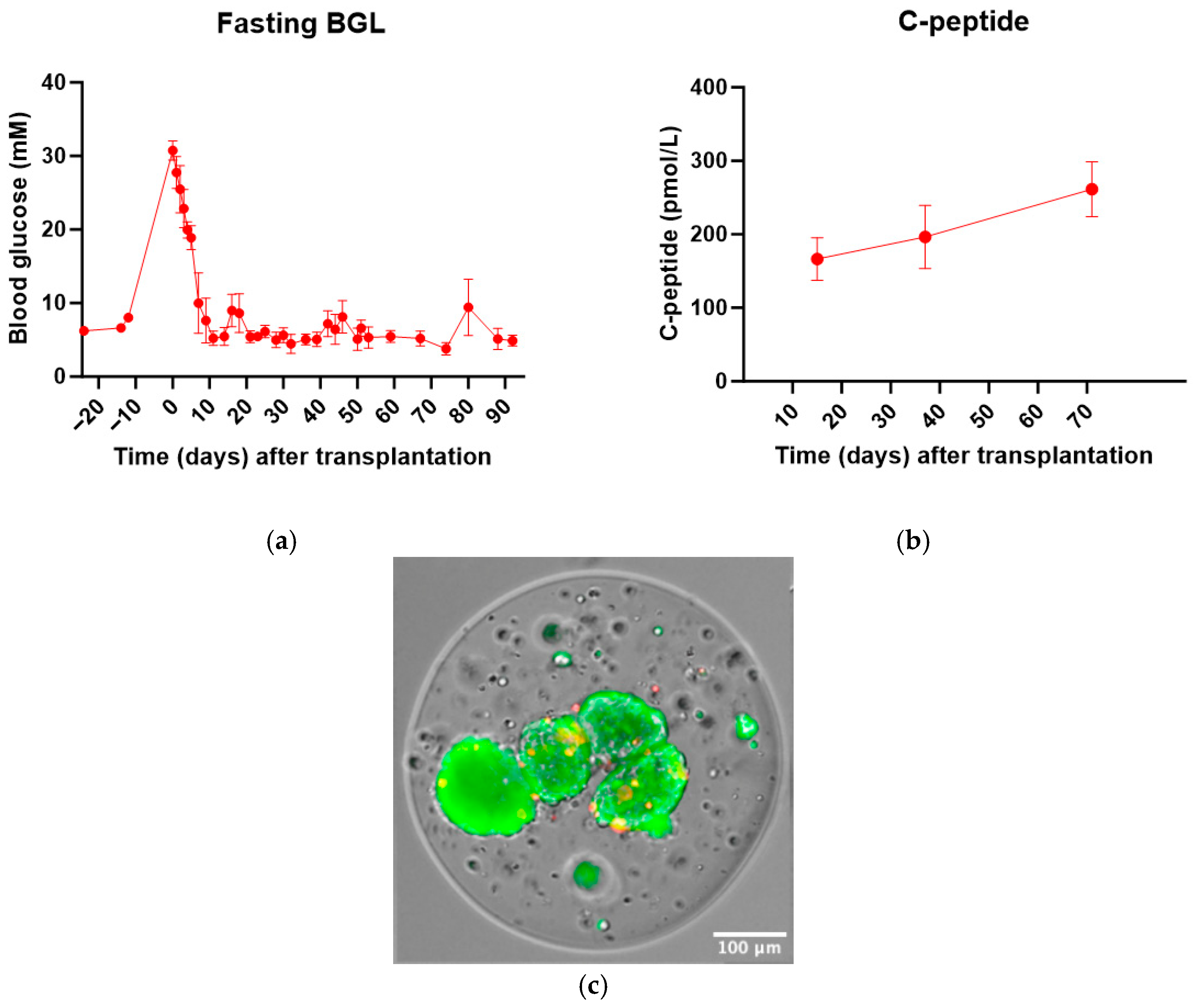
Despite the lack of glucose responsiveness in vitro, BGL of diabetic NOD/SCID mice implanted with 3500 encapsulated islet clusters were normalised within a week of the introduction of the cells (Figure 1a). Moreover, the BGL of the recipient mice remained normal for the 90-day duration of the experiment (Figure 1a). Human C-peptide was measurable throughout the experiment, increasing with time to values >200 pmol/L (Figure 1b). Explanted encapsulated islets were 90% viable (Figure 1c) and were glucose responsive, the stimulation index being 2.4.

3.3. Introduction of Scaffolds Fails to Achieve Normalisation of BGL in the Long Term

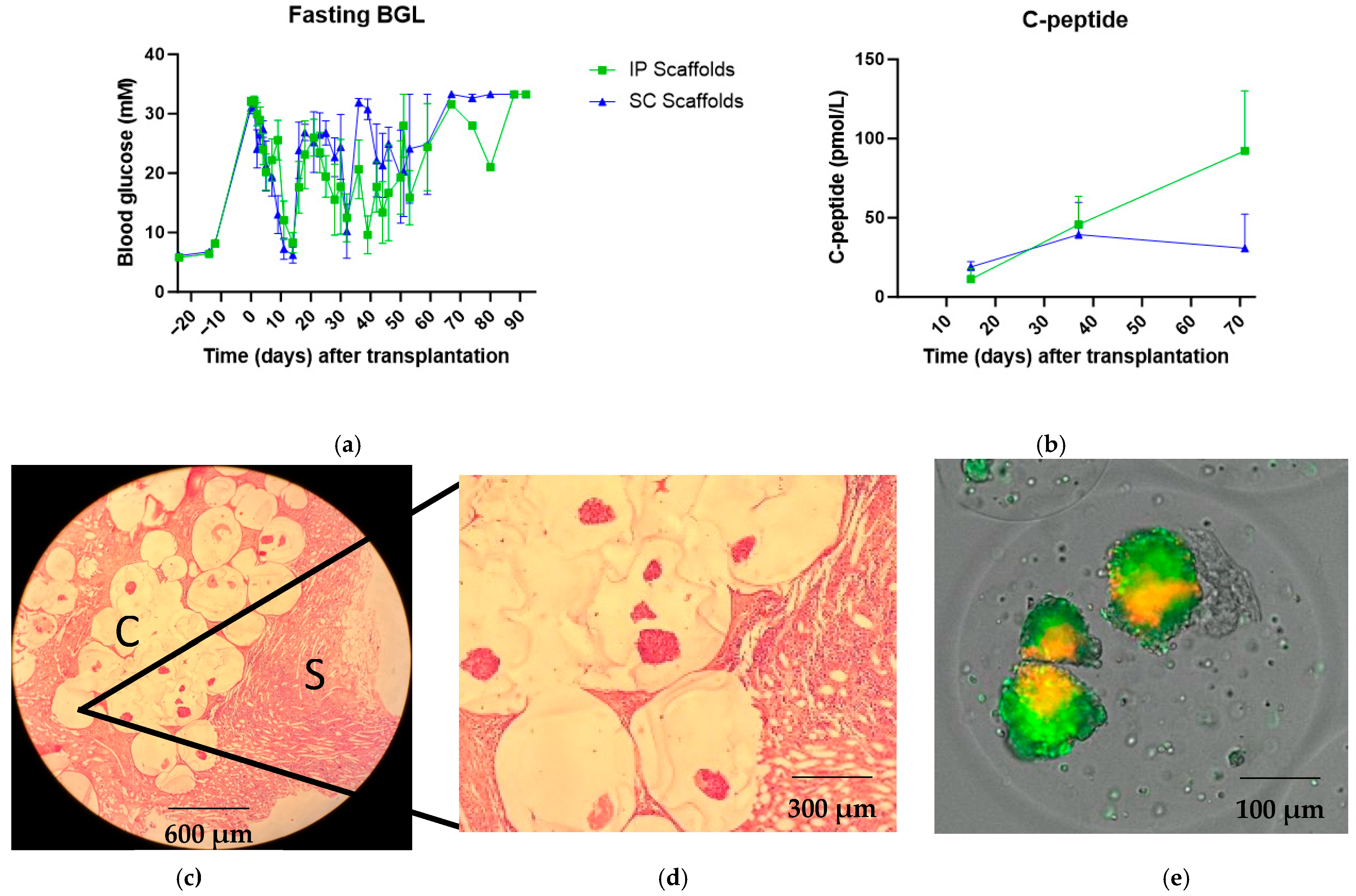
Tubular scaffolds containing encapsulated islets could readily be implanted IP or SC. BGL of recipient NOD/SCID mice did become lower in the immediate post-transplant phase but subsequently became elevated again and stayed this way for the 3-month duration of the experiment (Figure 2a). This outcome was the same regardless of whether the scaffolds were implanted SC or IP. Human C-peptide was measurable throughout the duration of the experiment but remained <100 pmol/L (Figure 2b), as compared to significantly greater values of >200 pmol/L for encapsulated islets without scaffolds (Figure 1b). The p value for ANOV of the three groups was <0.0001, and Tukey’s multiple comparison test showed that values for IP capsules were significantly greater than those for both scaffold groups at all time points: day 15: p ≤ 0.003; day 37: p ≤ 0.004; day 71: p ≤ 0.01. There was no pericapsular fibrosis (Figure 2c,d). Explanted encapsulated islet clusters showed 60% viability (Figure 2e) and were glucose responsive, the stimulation index being 2.4. In summary, the majority of human cells in the clusters within the scaffolds survived for 3 months and the ß cells were capable of secreting insulin when challenged with glucose, but insufficient insulin was released to normalise BGL.

3.4. Addition of ECM

Despite the capacity to survive and produce insulin, the ß cells in the scaffolds were not functioning to capacity since human C-peptide levels were lower than those in microcapsules placed directly in the peritoneal cavity (Figure 1b and Figure 2b). We had thought that confinement of the encapsulated islet clusters to a small space might have created physical limitations for the islets, because of factors including reduced oxygen, mechanical stress, and capsule compression. To compensate for this, we added ECM obtained from decellularised human pancreas [8] with its macromolecules that support and regulate pancreatic tissue. Initially, we demonstrated that the addition of ECM to encapsulated islet clusters in a scaffold had no adverse effect on insulin production over a period of 24 h in vitro, stimulation index: 3.2 ± 0.6 vs. 2.7 ± 0.2 ng/µg protein (ECM:no ECM).
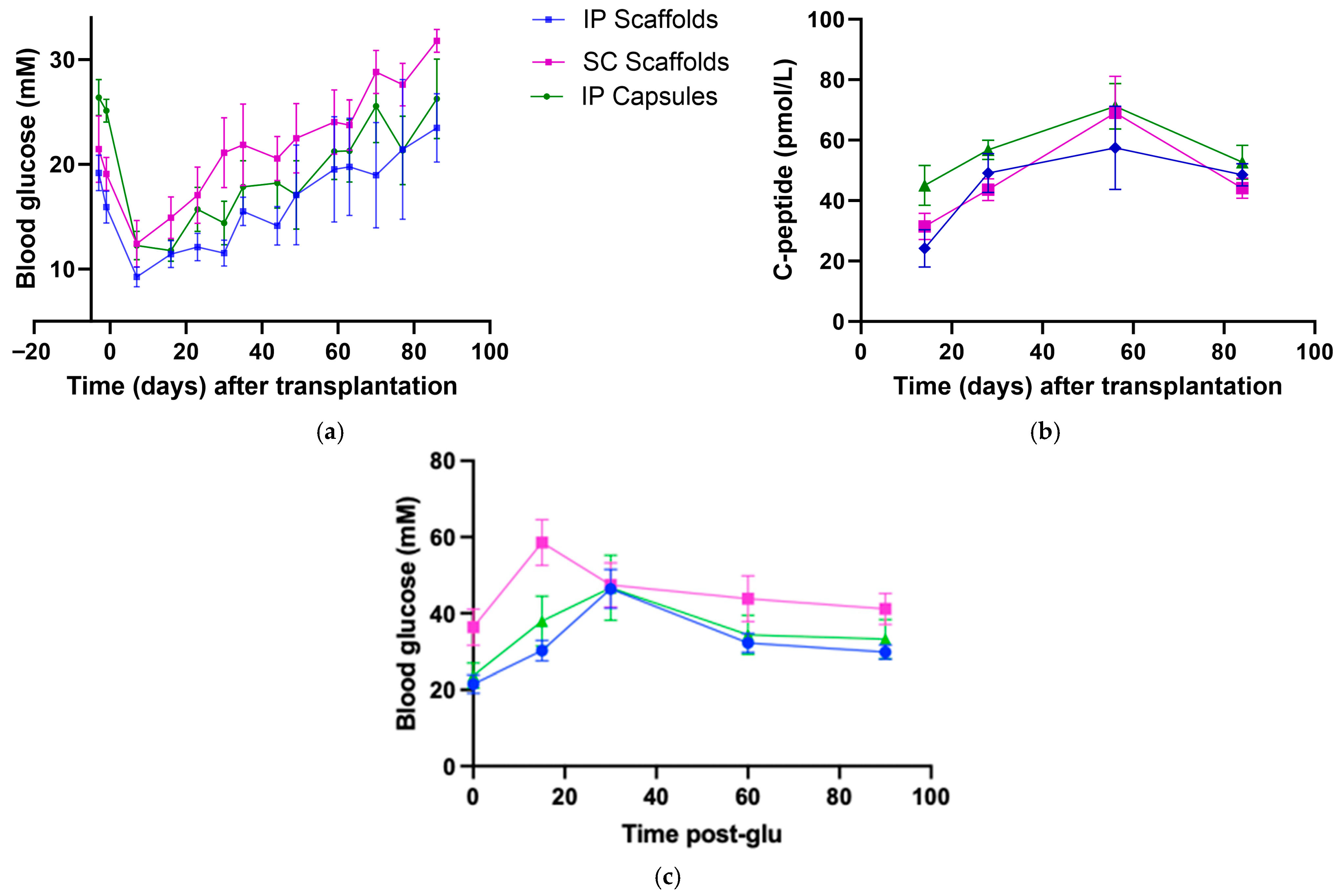
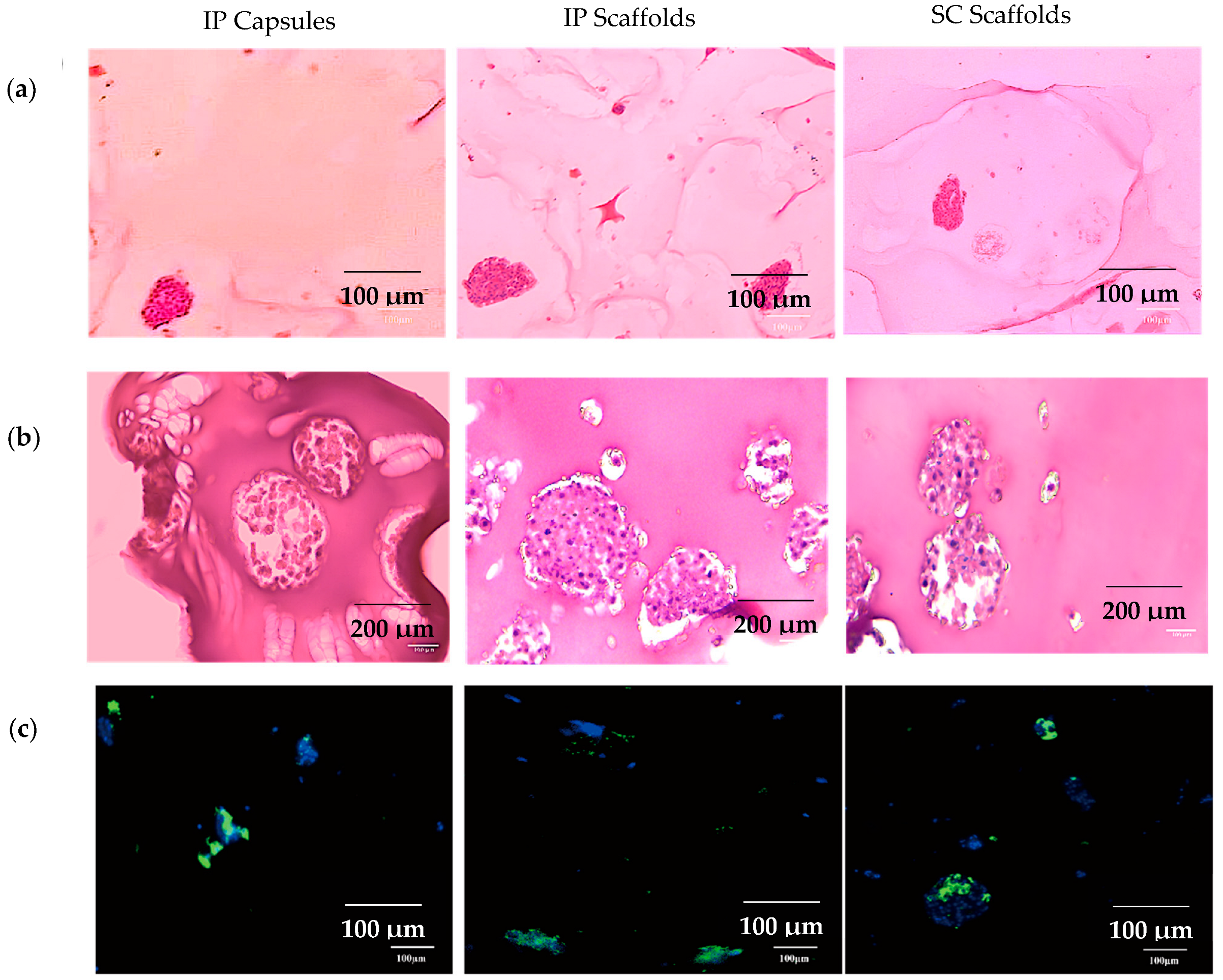
Subsequently, we implanted diabetic NSG mice with scaffolds, both SC and IP, containing encapsulated islet clusters embedded in ECM and compared human C-peptide production with that produced in mice receiving encapsulated islet clusters IP without scaffolds. There was no significant difference among the groups with values <70 pmol/L (Figure 3b). BGL of mice in all groups also were similar (Figure 3a), but the animals in all groups remained hyperglycaemic even in the mice that were implanted with encapsulated cells without a scaffold because the dose of islets implanted was subtherapeutic. IP glucose tolerance tests were similar in all groups (Figure 3c). The viability of the islet clusters ex vivo removed from the three groups after 3 months was similar at 45–54%. That these values were all lower than the 60–90% viability observed with the islets used in experiments without ECM (Figure 1 and Figure 2) is a reflection of the different stem cell preparations. The explanted ECM islets were glucose responsive (stimulation index IP scaffold: SC scaffold: IP capsules = 3.5 ± 0.5: 3.4 ± 1.3: 4.4 ± 0.8). Histological analysis confirmed the presence of islet clusters positive for insulin in the microcapsules from all three groups (Figure 4).

4. Discussion

The lack of insulin production from stem cell-differentiated islets when exposed to glucose as we reported has been well described by others [17] and is due to biochemical immaturity of the cells. It is also well established that these immature ß cells mature within a very short period of time after being implanted in diabetic recipients [17], just as we observed. This is similar to what occurs with human fetal pancreatic tissue, which is glucose unresponsive in vitro but becomes glucose responsive after being transplanted into diabetic recipients [18].
ECM is the body’s natural scaffold composed of many proteins and carbohydrates that surround and support cells in tissues, but by itself is acellular. The composition of ECM varies in different tissues, and includes components such as fibronectin, collagen, and proteoglycans. Its function is to support cell attachment and signal them to grow, divide, or die. ECM has been used to promote the remodelling of many tissue types, including the urinary tract, cartilage, and skin, using ECM harvested from different animals such as pigs, dogs, horses, and humans [19,20,21,22]. In islet biology, ECM is known to regulate development, differentiation, and proliferation of islet cells [10] and enhance insulin secretion from pancreatic islets, both in vitro [8,23] and in vivo [11,23]. Its use in a removable bioengineered device containing islets, as is reported in this study, is an extension of this concept. It was not surprising that the beneficial effect of the ECM we observed was with pluripotent stem cell-differentiated islets just as others have reported with pancreatic islets [8,13].
Our data extends that reported by others who have used human pancreatic ECM in vivo in that we have shown the benefit of this agent when added to a removable scaffold containing encapsulated islets. Others who have used ECM have applied this under the kidney capsule [11]. The benefit we observed in diabetic mice implanted with a scaffold device might be applied to diabetic patients who, for reasons of safety, will also need to receive these devices. This is because the stem cell-differentiated islets patients receive may need to be removed in the unlikely event of teratoma formation. Placement in a device allows them to be more easily removed from the patient if necessary. The same cannot be said if the islets were encapsulated and implanted in the peritoneal cavity as we have done previously [24].
The benefit of ECM on the function of the stem cell-differentiated ß cells occurs regardless of the site of implantation of the bioengineered scaffold device, whether SC or IP. Most stem cell-differentiated islets inside a bioengineered device have been implanted in humans SC [25] presumably for ease of access; likewise, with islets, derived from donor human pancreases, placed in such a device [26,27]. No free-standing devices seem to have been implanted IP in humans, although they have in rodents [28].
The factors in ECM responsible for the beneficial effects on islets are yet to be characterised but are likely to include collagen, as has been reported previously [11], although others such as fibronectin and laminin cannot be excluded. An advantage of using ECM in the transplant setting is its hypoimmunogenicity [13], a quality achieved because of the lack of cells which are mainly responsible for immunogenicity. ECM is thought to have another positive quality when used in a bioengineered device, namely the decrease in fibrous tissue that surrounds the alginate microcapsules in a scaffold [9]. Pericapsular fibrosis is a key factor in causing the death of encapsulated cells because of the blockage of the pores of the capsule [24], thereby preventing the entry of nutrients. Agents which may be responsible for this include fibronectin [29], collagen IV [30], laminin [31], some matrix metalloproteinases (MMP1 and MMP13) [32], and the glycosaminoglycans, heparan sulphate, and chondroitin sulphate [33]. We did not observe pericapsular fibrosis in the immunodeficient mice we transplanted, with the encapsulated islets alone or in islets seeded into a scaffold device, either SC or IP regardless of whether ECM was added (Figure 2c). Testing for this possible effect of ECM will need to be carried out in immunocompetent mice and other animals, such as rats.
Although the addition of natural ECM to bioengineered devices offers a biologically supportive environment for transplanted islets, its use in the clinic will need to overcome regulatory hurdles which require Good Manufacturing Practice compliance.

5. Conclusions

In summary, our preliminary data show that the addition of ECM, derived from human pancreas, to removable scaffolds seeded with encapsulated stem cell-differentiated islets provides a functional benefit when the scaffolds are implanted into diabetic immunodeficient mice. This conclusion is based on the human C-peptide levels in the transplanted mice and is regardless of whether the implantation site is SC or IP. The islets in the scaffolds function as efficiently as encapsulated islets implanted IP, without scaffolds. These data provide optimism for the use of seeded scaffolds in diabetic humans, as a single scaffold seeded with multiple encapsulated islets can more readily be removed from a diabetic recipient if needed for safety reasons than can multiple encapsulated islets not seeded into a scaffold.

Author Contributions

Conceptualization, H.C., J.O., and B.E.T.; methodology, H.C., C.C., K.M., T.R.D., and B.E.T.; validation, H.C. and B.E.T.; formal analysis, X.B., H.C., and B.E.T.; investigation, X.B.; resources, H.C., C.C., K.M., T.R.D., M.R., and B.E.T.; writing—original draft preparation, X.B. and B.E.T.; writing—review and editing, H.C., J.O., K.M.,T.R.D., and B.E.T.; visualisation, X.B. and B.E.T.; supervision, H.C., J.O., K.M., T.R.D., M.R., and B.E.T.; project administration, H.C., M.R., and B.E.T.; funding acquisition, M.R. and B.E.T. All authors have read and agreed to the published version of the manuscript.

Funding

This research was funded by the Australian Foundation for Diabetes Research and the National Stem Cell Foundation of Australia.

Institutional Review Board Statement

The animal study protocol was approved by the Animal Care and Ethics Committee of The University of Technology Sydney (ACEC no. ETH22-7096; date of approval 18 May 2022).

Informed Consent Statement

Not applicable.

Data Availability Statement

Data are contained within the article. Further inquiries can be directed to the corresponding author.

Acknowledgments

We thank Daniel Tremmel from Dept Surgery at University of Wisconsin for assisting in the provision of human extracellular matrix which was made there. We also wish to thank Research Assistants Iris Chen, Suganeya Rajan and Vamshikrishnan Malyla at the University of Technology Sydney for their technical support.

Conflicts of Interest

Author Kfir Molakandov was employed by the company Kadimastem Limited. The remaining authors declare that the research was conducted in the absence of any commercial or financial relationships that could be construed as a potential conflict of interest. The company Kadimastem Ltd. has provided no funds to the other institutions or organisations involved in carrying out the experiments; moreover, it has no say in what data are published.

Abbreviations

The following abbreviations are used in this manuscript:
T1DType 1 diabetes
ECMExtracellular matrix
SCSubcutaneously
IPIntraperitoneally
BGLBlood glucose levels
PBSPhosphate-buffered saline
CFDA6-carboxyfluorescein diacetate
PIPropidium iodide
KRBKrebs Ringer Buffer
ELISAEnzyme-linked immunosorbent assay
STZStreptozotocin
H & EHaematoxylin and eosin
NOD/SCIDNonobese diabetic/severe combined immunodeficiency
NSGNOD/SCID gamma
SEMStandard error of the mean

References

  1. Quattrin, T.; Mastrandrea, L.D.; Walker, L.S.K. Type 1 diabetes. Lancet 2023, 401, 2149–2162. [Google Scholar] [CrossRef]
  2. Gregory, G.A.; Robinson, T.I.G.; Linklater, S.E.; Wang, F.; Colagiuri, S.; de Beaufort, C.; Donaghue, K.C.; International Diabetes Federation Diabetes Atlas Type 1 Diabetes in Adults Special Interest Group; Magliano, D.J.; Maniam, J.; et al. Global incidence, prevalence, and mortality of type 1 diabetes in 2021 with projection to 2040: A modelling study. Lancet Diabetes Endocrinol. 2022, 10, 741–760. [Google Scholar] [CrossRef]
  3. Dovc, K.; Battelino, T. Evolution of Diabetes Technology. Endocrinol. Metab. Clin. North. Am. 2020, 49, 1–18. [Google Scholar] [CrossRef]
  4. Larson-Wadd, K.; Belani, K.G. Pancreas and islet cell transplantation. Anesthesiol. Clin. North. Am. 2004, 22, 663–674. [Google Scholar] [CrossRef]
  5. Vaithilingam, V.; Tuch, B.E. Islet transplantation and encapsulation: An update on recent developments. Rev. Diabet. Stud. 2011, 8, 51–67. [Google Scholar] [CrossRef] [PubMed]
  6. Mridha, A.R.; Dargaville, T.R.; Dalton, P.D.; Carroll, L.; Morris, M.B.; Vaithilingam, V.; Tuch, B.E. Prevascularized Retrievable Hybrid Implant to Enhance Function of Subcutaneous Encapsulated Islets. Tissue Eng. Part A 2022, 28, 212–224. [Google Scholar] [CrossRef] [PubMed]
  7. Johansen, C.G.; Holcomb, K.; Sela, A.; Morrall, S.; Park, D.; Farnsworth, N.L. Extracellular matrix stiffness mediates insulin secretion in pancreatic islets via mechanosensitive Piezo1 channel regulated Ca(2+) dynamics. Matrix Biol. Plus 2024, 22, 100148. [Google Scholar] [CrossRef]
  8. Tremmel, D.M.; Sackett, S.D.; Feeney, A.K.; Mitchell, S.A.; Schaid, M.D.; Polyak, E.; Chlebeck, P.J.; Gupta, S.; Kimple, M.E.; Fernandez, L.A.; et al. A human pancreatic ECM hydrogel optimized for 3-D modeling of the islet microenvironment. Sci. Rep. 2022, 12, 7188. [Google Scholar] [CrossRef]
  9. Kuwabara, R.; Qin, T.; Alberto Llacua, L.; Hu, S.; Boekschoten, M.V.; de Haan, B.J.; Smink, A.M.; de Vos, P. Extracellular matrix inclusion in immunoisolating alginate-based microcapsules promotes longevity, reduces fibrosis, and supports function of islet allografts in vivo. Acta Biomater. 2023, 158, 151–162. [Google Scholar] [CrossRef] [PubMed]
  10. Stendahl, J.C.; Kaufman, D.B.; Stupp, S.I. Extracellular matrix in pancreatic islets: Relevance to scaffold design and transplantation. Cell Transplant. 2009, 18, 1–12. [Google Scholar] [CrossRef]
  11. Yu, M.; Agarwal, D.; Korutla, L.; May, C.L.; Wang, W.; Griffith, N.N.; Hering, B.J.; Kaestner, K.H.; Velazquez, O.C.; Markmann, J.F.; et al. Islet transplantation in the subcutaneous space achieves long-term euglycaemia in preclinical models of type 1 diabetes. Nat. Metab. 2020, 2, 1013–1020. [Google Scholar] [CrossRef]
  12. Molakandov, K.; Berti, D.A.; Beck, A.; Elhanani, O.; Walker, M.D.; Soen, Y.; Yavriyants, K.; Zimerman, M.; Volman, E.; Toledo, I.; et al. Selection for CD26(−) and CD49A(+) Cells from Pluripotent Stem Cells-Derived Islet-Like Clusters Improves Therapeutic Activity in Diabetic Mice. Front. Endocrinol. 2021, 12, 635405. [Google Scholar] [CrossRef] [PubMed]
  13. Sackett, S.D.; Tremmel, D.M.; Ma, F.; Feeney, A.K.; Maguire, R.M.; Brown, M.E.; Zhou, Y.; Li, X.; O’Brien, C.; Li, L.; et al. Extracellular matrix scaffold and hydrogel derived from decellularized and delipidized human pancreas. Sci. Rep. 2018, 8, 10452. [Google Scholar] [CrossRef]
  14. Chamberlain, C.S.; Tremmel, D.M.; Khan, A.P.; Santos, E.A.; Kapadia, D.; Leavens, C.; Gorski, K.M.; Hamadeh, R.; Feeney, A.K.; Odorico, J.; et al. Protocol for decellularizing and delipidizing human pancreatic tissue into native hydrogel. STAR Protoc. 2025, 6, 103997. [Google Scholar] [CrossRef]
  15. Li, Z.; Tremmel, D.M.; Ma, F.; Yu, Q.; Ma, M.; Delafield, D.G.; Shi, Y.; Wang, B.; Mitchell, S.A.; Feeney, A.K.; et al. Proteome-wide and matrisome-specific alterations during human pancreas development and maturation. Nat. Commun. 2021, 12, 1020. [Google Scholar] [CrossRef]
  16. Vaithilingam, V.; Kollarikova, G.; Qi, M.; Lacik, I.; Oberholzer, J.; Guillemin, G.J.; Tuch, B.E. Effect of prolonged gelling time on the intrinsic properties of barium alginate microcapsules and its biocompatibility. J. Microencapsul. 2011, 28, 499–507. [Google Scholar] [CrossRef]
  17. Balboa, D.; Barsby, T.; Lithovius, V.; Saarimaki-Vire, J.; Omar-Hmeadi, M.; Dyachok, O.; Montaser, H.; Lund, P.E.; Yang, M.; Ibrahim, H.; et al. Functional, metabolic and transcriptional maturation of human pancreatic islets derived from stem cells. Nat. Biotechnol. 2022, 40, 1042–1055. [Google Scholar] [CrossRef]
  18. Tuch, B.E.; Jones, A.; Turtle, J.R. Maturation of the response of human fetal pancreatic expiants to glucose. Diabetologia 1985, 28, 28–31. [Google Scholar] [CrossRef] [PubMed]
  19. Chen, F.; Yoo, J.J.; Atala, A. Acellular collagen matrix as a possible “off the shelf” biomaterial for urethral repair. Urology 1999, 54, 407–410. [Google Scholar] [CrossRef] [PubMed]
  20. Dejardin, L.M.; Arnoczky, S.P.; Ewers, B.J.; Haut, R.C.; Clarke, R.B. Tissue-engineered rotator cuff tendon using porcine small intestine submucosa. Histologic and mechanical evaluation in dogs. Am. J. Sports Med. 2001, 29, 175–184. [Google Scholar] [CrossRef]
  21. Huber, J.E.; Spievack, A.; Simmons-Byrd, A.; Ringel, R.L.; Badylak, S. Extracellular matrix as a scaffold for laryngeal reconstruction. Ann. Otol. Rhinol. Laryngol. 2003, 112, 428–433. [Google Scholar] [CrossRef]
  22. Kropp, B.P.; Rippy, M.K.; Badylak, S.F.; Adams, M.C.; Keating, M.A.; Rink, R.C.; Thor, K.B. Regenerative urinary bladder augmentation using small intestinal submucosa: Urodynamic and histopathologic assessment in long-term canine bladder augmentations. J. Urol. 1996, 155, 2098–2104. [Google Scholar] [CrossRef] [PubMed]
  23. Krishtul, S.; Skitel Moshe, M.; Kovrigina, I.; Baruch, L.; Machluf, M. ECM-based bioactive microencapsulation significantly improves islet function and graft performance. Acta Biomater. 2023, 171, 249–260. [Google Scholar] [CrossRef]
  24. Tuch, B.E.; Keogh, G.W.; Williams, L.J.; Wu, W.; Foster, J.L.; Vaithilingam, V.; Philips, R. Safety and viability of microencapsulated human islets transplanted into diabetic humans. Diabetes Care 2009, 32, 1887–1889. [Google Scholar] [CrossRef]
  25. Ramzy, A.; Thompson, D.M.; Ward-Hartstonge, K.A.; Ivison, S.; Cook, L.; Garcia, R.V.; Loyal, J.; Kim, P.T.W.; Warnock, G.L.; Levings, M.K.; et al. Implanted pluripotent stem-cell-derived pancreatic endoderm cells secrete glucose-responsive C-peptide in patients with type 1 diabetes. Cell Stem Cell 2021, 28, 2047–2061.e5. [Google Scholar] [CrossRef]
  26. Bachul, P.J.; Perez-Gutierrez, A.; Juengel, B.; Golab, K.; Basto, L.; Perea, L.; Wang, L.; Tibudan, M.; Thomas, C.; Philipson, L.H.; et al. Modified Approach for Improved Islet Allotransplantation into Prevascularized Sernova Cell Pouch Device: Preliminary Results of the Phase I/II Clinical Trial at University of Chicago. Diabetes 2022, 71, 306-OR. [Google Scholar] [CrossRef]
  27. Carlsson, P.O.; Espes, D.; Sedigh, A.; Rotem, A.; Zimerman, B.; Grinberg, H.; Goldman, T.; Barkai, U.; Avni, Y.; Westermark, G.T.; et al. Transplantation of macroencapsulated human islets within the bioartificial pancreas betaAir to patients with type 1 diabetes mellitus. Am. J. Transplant. 2018, 18, 1735–1744. [Google Scholar] [CrossRef]
  28. Yao, X.; Gong, Z.; Yin, W.; Li, H.; Douroumis, D.; Huang, L.; Li, H. Islet cell spheroids produced by a thermally sensitive scaffold: A new diabetes treatment. J. Nanobiotechnol 2024, 22, 657. [Google Scholar] [CrossRef] [PubMed]
  29. Tiwari, A.; Kumar, R.; Ram, J.; Sharma, M.; Luthra-Guptasarma, M. Control of fibrotic changes through the synergistic effects of anti-fibronectin antibody and an RGDS-tagged form of the same antibody. Sci. Rep. 2016, 6, 30872. [Google Scholar] [CrossRef] [PubMed]
  30. Pehrsson, M.; Mortensen, J.H.; Manon-Jensen, T.; Bay-Jensen, A.C.; Karsdal, M.A.; Davies, M.J. Enzymatic cross-linking of collagens in organ fibrosis—Resolution and assessment. Expert. Rev. Mol. Diagn 2021, 21, 1049–1064. [Google Scholar] [CrossRef]
  31. Liu, P.; Zhang, D.; Huang, G.; Xue, M.; Fang, Y.; Lu, L.; Zhang, J.; Xie, M.; Ye, Z. Laminin alpha1 as a target for the treatment of epidural fibrosis by regulating fibrotic mechanisms. Int. J. Mol. Med. 2023, 51, 2. [Google Scholar]
  32. Giannandrea, M.; Parks, W.C. Diverse functions of matrix metalloproteinases during fibrosis. Dis. Model. Mech. 2014, 7, 193–203. [Google Scholar] [CrossRef] [PubMed]
  33. Anderegg, U.; Halfter, N.; Schnabelrauch, M.; Hintze, V. Collagen/glycosaminoglycan-based matrices for controlling skin cell responses. Biol. Chem. 2021, 402, 1325–1335. [Google Scholar] [CrossRef] [PubMed]
Figure 1. (a). Fasting BGL of diabetic NOD/SCID mice transplanted IP with encapsulated human islets; (b). human C-peptide levels in these mice; (c). explanted encapsulated islet clusters stained with CFDA (green) and PI (red), 90% viable. Data are mean ± SEM, n = 6.
Diabetology 07 00005 g001
Figure 2. (a). Fasting BGL of diabetic NOD/SCID mice transplanted with encapsulated human islets in tubular scaffolds; (b). Human C-peptide levels in these mice; (c). H & E of explanted scaffold on day 93 showing multiple capsules containing islets (C) surrounded by scaffold material (S); (d). Higher magnification of section of (c); (e). Explanted islet clusters stained with CFDA (green) and PI (red), 60% viable. Data are mean ± SEM, n = 6 in each group.
Diabetology 07 00005 g002
Figure 3. (a). Fasting BGL in diabetic NSG mice transplanted with encapsulated human islets seeded in tubular scaffolds, containing ECM, either SC (SC Scaffolds) or IP (IP Scaffolds), as well as IP without scaffolds (IP Capsules); (b). Human C-peptide levels in these mice; (c). IP glucose tolerance tests carried out day 88 post transplantation. Data are mean ± SEM, n = 6 in each group. ANOVA showed no overall differences among the groups, p > 0.05.
Diabetology 07 00005 g003
Figure 4. Histological analysis of the microcapsules removed from diabetic NSG mice at 3 months post transplantation. (a) Shows the clusters with H & E in 10×; (b) shows the clusters with H & E in 40×; (c) shows the clusters stained for insulin (green) and DAPI (blue). Viability assessment using CFDA and PI was 54% for IP Capsules, 48% for IP Scaffolds, and 45% for SC Scaffolds.
Diabetology 07 00005 g004
Disclaimer/Publisher’s Note: The statements, opinions and data contained in all publications are solely those of the individual author(s) and contributor(s) and not of MDPI and/or the editor(s). MDPI and/or the editor(s) disclaim responsibility for any injury to people or property resulting from any ideas, methods, instructions or products referred to in the content.