

Abstract
The species Psychotria densicostata Müll.Arg. is a shrub belonging to the Rubiaceae family, endemic to Brazil. So far, there are reports neither of phytochemical work on nor of biological evaluation of it. This study investigated its alkaloid profile and evaluated the inhibitory effects of extracts, alkaloid-enriched fractions and one of its major constituents on human neutrophil elastase (HNE). The monoterpene indole alkaloids (MIAs) strictosidine (1), (3α,5α)-5-carboxystrictosidine (2), strictosidine lactam (3), lyaloside (4), lyalosidic acid (5), 5-carboxystrictosamide (6), 3,4-dehydrostrictosidinic acid (7), and N-glucopyranosyl vincosamide (8) were characterized in mixture, in its leaves, and/or stems by using an integrated approach combining nuclear magnetic resonance (NMR) techniques, high performance liquid chromatography coupled to a tandem mass spectrometer with an electrospray ionization source (HPLC-ESI-MS/MS), and molecular networks. The crude leaf extract and an alkaloid-enriched fraction derived from it showed inhibitory activity against HNE. These results contribute to the chemical knowledge of the species and suggest its potential biological property.
1. Introduction
The genus Psychotria L. is the largest genus of flowering plants in the Rubiaceae family, comprising approximately 2000 species—primarily shrubs, but also vines, herbs, and epiphytes—distributed across tropical and pantropical regions [1,2]. Taxonomically complex, Psychotria belongs to the Psychotria alliance, a group of over 3100 species currently classified into the tribes Palicoureeae and Psychotrieae [1,2,3]. The genus has been characterized by the abundant presence of structurally diverse alkaloids and flavonoids, tannins, coumarins, terpenoids and cyclic peptides [3]. Psychotria spp. have demonstrated a wide array of biological activities, including cytotoxic, analgesic, antiviral, antifungal, anti-inflammatory, and central nervous system-modulating effects, many of which are attributed to their chemical constituents [1]. Monoterpene indole alkaloids (MIAs) represent a diverse and biologically significant class of secondary metabolites, predominantly found in plant species of the Apocynaceae, Loganiaceae, and Rubiaceae families. The genus Psychotria L. is widely recognized as an important source of MIAs. These compounds originate from the amino acid tryptophan and its decarboxylation product tryptamine followed by the condensation with the iridoid secologanin, leading to the formation of strictosidine (1), considered as the biogenetic precursor of their wide structural variety [3,4,5].
Psychotria densicostata Müll.Arg. is a shrub endemic to the Atlantic Forest in Rio de Janeiro State, Brazil [6]. Despite the great interest in phytochemical study and therapeutic potential of species of the genus Psychotria, no previous chemical or pharmacological studies have been reported on this species so far. This work aims to study the alkaloid composition of the species, contributing to expanding the chemical knowledge of the genus Psychotria and to investigate this species’ potential in acting on neutrophil extracellular traps (NET)-associated disorders.
In this work, the use of an integrated analytical approach combining 1D/2D NMR spectroscopy and HPLC-ESI-MS/MS allowed the dereplication of the MIAs (1–4) in alkaloid-enriched fractions derived from crude MeOH extracts of leaf and stem of P. densicostata. MS data when compiled and treated using Global Natural Product Social Molecular Networking (GNPS) platform, allowed us to expand the MIA profile on the species suggesting the additional presence of the compounds (5–8). The inhibitory effects of extracts, alkaloid-enriched fractions, and the isolated compound 2 were further assessed against human neutrophil elastase (HNE), a serine protease involved in inflammatory tissue damage and neutrophil extracellular traps (NET) [7].
2. Materials and Methods
2.1. General
The solid-phase extraction (SPE) in analytical scale was performed in C18 cartridges (500 mg, 3 mL) (Applied Separations, Allentown, PA, USA) and in semi-preparative scale was performed in a 30 mL plastic syringe filled with silica gel C18 (40–63 μm, Merck, Darmstadt, Germany) (2.0 cm i.d. × 7.0 cm bed height). Both systems were coupled to a 12 ports VisiprepTM SPE Vacuum Manifold DL (Supelco, St. Louis, MO, USA). TLC analyses were performed in pre-coated silica gel 60 F254 (Merck, Darmstadt, Germany) with butanol (BuOH) (Tedia, Rio de Janeiro, Brazil)/acetic acid (AcOH) (Tedia, Rio de Janeiro, Brazil)/H2O 40:10:10 v/v/v as mobile phase. Visualization of the spots was achieved by irradiation at 254 nm, followed by Dragendorff reagent. HPLC-ESI-MS/MS analyses of the leaf fractions (L1 and L2) were performed using a Nexera Prominence liquid chromatography system (Shimadzu, Kyoto, Japan) coupled to a Compact QTOF mass spectrometer (Bruker, Billerica, MA, USA) equipped with an electrospray ionization (ESI) source. Chromatographic separation was achieved on a C18 XBridge column (150 × 4.6 mm i.d., 3.5 μm particle size) (Waters, Milford, MA, USA). Analyses of the stem fractions (S1 and S2) were carried out using a Nexera X2 liquid chromatography system (Shimadzu, Kyoto, Japan) coupled to a QTOF mass spectrometer (Bruker, Billerica, MA, USA) equipped with an ESI source. Separation was performed on an ODS Hypersil C18 column (150 × 2.1 mm i.d., 3 μm particle size) (Thermo Fisher Scientific, Waltham, MA, USA). NMR spectra were recorded on Avance III HD 400 or Avance II HD 500 spectrometers (Bruker, Billerica, MA, USA) in deuterated methanol (CD3OD), with chemical shifts (δ) reported in ppm and coupling constants (J) in Hz. Major compounds 1 and 2 isolation was performed by semi-preparative HPLC-DAD using a LC-20AT chromatograph equipped with a fraction collector FRC-10A (Shimadzu, Kyoto, Japna). Separation was performed on an Ascentis C18 (5 μm, 250 × 10 mm i.d.) column (Sigma-Aldrich, St. Louis, MO, USA). The process was monitored at 254 nm.
2.2. Plant Material
A specimen of Psychotria densicostata Müll.Arg. was collected in October 2016 at the Botanical Garden of Rio de Janeiro, in the city of Rio de Janeiro, Brazil. A voucher specimen has been deposited at the Herbarium of the Universidade Federal do Rio de Janeiro, RJ, Brazil, under number RFA 40880. Legal access to the genetic heritage component was requested under application A9C4B8A at SisGen/MMA/Brazil.
2.3. Extraction
The leaves and stems of P. densicostata were dried separately at 40 °C for 24 h, ground, and sieved to obtain particles with sizes between 250 and 500 µm. Ultrasound-assisted extraction was then performed using 30 g of each material at room temperature (25 min per cycle), with methanol (MeOH) (10 cycles × 300 mL) as the solvent. The resulting methanolic extracts were concentrated under reduced pressure to yield the crude extracts of leaves (2.50 g) and stems (1.65 g), respectively.
2.4. Solid-Phase Extraction Experiments
The SPE method was optimized at the analytical scale based on the protocol previously described by Costa et al. [8] and involved the following steps: activation with 5 mL of 100% acetonitrile (CH3CN), conditioning with 5 mL of 10% CH3CN, sample application of 1 mL of crude extracts at 5 mg/mL in 10% CH3CN. The elution phases consisted of (F1) 6 mL of 10% CH3CN, (F2) 10 mL of 15% CH3CN, (F3) 8 mL of 30% CH3CN, and a washing step (F4) using 2 mL of 100% CH3CN. The organic solvent was evaporated from the collected fractions under low pressure at 35–40 °C, and the remaining water was removed by freeze-drying. For the semi-preparative scale extractions, a suspension of 10.0 g of the stationary phase was prepared in MeOH, with the pressure set to 50 kPa below atmospheric levels. The volumes of the mobile phases were adjusted as follows: activation with 50 mL of 100% CH3CN, conditioning with 50 mL of 10% CH3CN, sample application of 1 mL of crude extracts at 200 mg/mL in 10% CH3CN. The elution phases consisted of (F1) 180 mL of 10% CH3CN, (F2) 300 mL of 15% CH3CN, (F3) 240 mL of 30% CH3CN, and a washing step (F4) using 60 mL of 100% CH3CN. A total of 12 separate extractions were performed with the crude leaf extract and 6 separate extractions with the crude stem extract. The individual fractions obtained from the experiments were pooled, and the organic solvent was evaporated under reduced pressure at 35–40 °C. The resulting aqueous phases were freeze-dried, yielding 160.0 mg of fraction L1, 120.0 mg of L2, 83.6 mg of S1, and 44.1 mg of S2, from 15% CH3CN for L1 and S1 and 30% CH3CN for L2 and S2. In addition, 2.0 mg of compound 1 were obtained from 300 mg of the MeOH leaf extract by SPE in sequential experiments.
2.5. HPLC-ESI-MS/MS Analysis
The HPLC-ESI-MS/MS methodology was based on that described by Klein-Junior et al. (2016) [9] with a few modifications; the analyses were conducted using the following mobile phases: H2O with 0.1% formic acid (HCOOH) as solvent A and MeOH as solvent B. The elution was carried out with a linear gradient: 6% B for 4 min, from 6% to 46% B over 20 min, holding at 46% B for 3 min, increasing from 46% to 52% B for 3 min, maintaining 52% B for 3 min, ramping from 52% to 100% B over 7 min, maintaining 100% B for 3 min, decreasing from 100% to 6% B over 9 min, and finally returning to 6% B for 8 min. The flow rate was set at 1.0 mL/min, with the column temperature at 40 °C and an injection volume of 1 µL. Samples were prepared at a concentration of 2 mg/mL in MeOH and filtered through 0.22 µm DURAPORE PVDF centrifugal filters (Merck, Germany). Positive ESI-MS analyses of the leaf fractions (L1 and L2) were performed over a mass-to-charge (m/z) range of 100–1000. The capillary voltage was set to 4500 V, with a nebulizer pressure of 4.0 bar. The dry heater temperature was maintained at 200 °C, and the dry gas flow rate was set to 10 L/min. For the stem fractions (S1 and S2), positive ESI-MS analyses were conducted over an m/z range of 50–1500. The capillary voltage was maintained at 4500 V, while the nebulizer pressure was set to 2.0 bar. The dry heater temperature was 200 °C, and the dry gas flow rate was set to 8 L/min. Data acquisition and processing were performed using Bruker DataAnalysis software version 4.2 (Bruker, Billerica, MA, USA).
2.6. Data Processing and Molecular Networking
The LC-MS/MS data were converted to the .mzML format using the ProteoWizard toolkit (MSConvert v. 3.0.24338) and subsequently processed in MZmine (v. 2.53). The resulting feature tables, along with the converted .mzML files and a metadata table, were uploaded to the Global Natural Products Social Molecular Networking (GNPS) platform [10]. Default parameters for high-resolution data were employed for both feature-based data processing and molecular network construction. The resulting molecular network was downloaded and visualized using Cytoscape (v. 3.10.2). The parameters of the molecular networking can be found in the Supplementary Materials.
2.7. HPLC-DAD Isolation of the Major Compounds
Semi-preparative HPLC-DAD was used to isolate strictosidine (1) from fraction L2 and 5-carboxystrictosidine (2) from fraction S1. The mobile phase consisted of H2O with 0.1% HCOOH as solvent A and MeOH as solvent B. Elution was conducted using a linear gradient: 6% B for 6 min, followed by a gradient from 6% to 46% B over 30 min, maintaining 46% B for 4.5 min, then transitioning from 46% to 52% B for 4.5 min, holding at 52% B for 4.5 min, followed by a gradient from 52% to 100% B over 10.5 min, maintaining 100% B for 4.5 min, then returning from 100% to 6% B over 13.5 min, and finally holding at 6% B for 12 min. The flow rate was set to 3.0 mL/min, the column temperature was maintained at 40 °C, and the injection volume was 100 µL. Samples were prepared at a concentration of 20 mg/mL in MeOH and filtered through 0.22 µm DURAPORE PVDF centrifugal filters (Merck, Darmstadt, Germany). The chromatographic runs were monitored at 254 nm within an acquisition range of 190–800 nm. Following collection of the isolated compounds using a fraction collector, the organic solvent from the mobile phase was removed under reduced pressure at 35–40 °C, and the resulting aqueous phases were freeze-dried, yielding 1.6 mg of strictosidine (1) and 11.6 mg of 5-carboxystrictosidine (2).
2.8. Neutrophil Elastase Inhibition Assays
The assays were conducted using the Neutrophil Elastase Inhibitor Screening Kit (Sigma-Aldrich, St. Louis, MO, USA), according to the manufacturer’s protocol. Relative inhibition was determined for several concentrations by a relationship between fluorescence and time; hence the enzymatic activity is proportional to the formation of a fluorescent product, yielded by substrate hydrolysis. Concentrations tested ranged from 0.01 to 100 µg/mL for the crude extract and alkaloid-rich fractions of the leaves, and from 10 to 300 µg/mL for the crude extract and alkaloid-rich fractions from stems, as well as isolated alkaloids. All solutions were prepared using dimethyl sulfoxide (DMSO) (Merck, Darmstadt, Germany) as the solvent.
3. Results and Discussion
3.1. Alkaloidal Profile by NMR Techniques and HPLC-MS/MS in Mixture
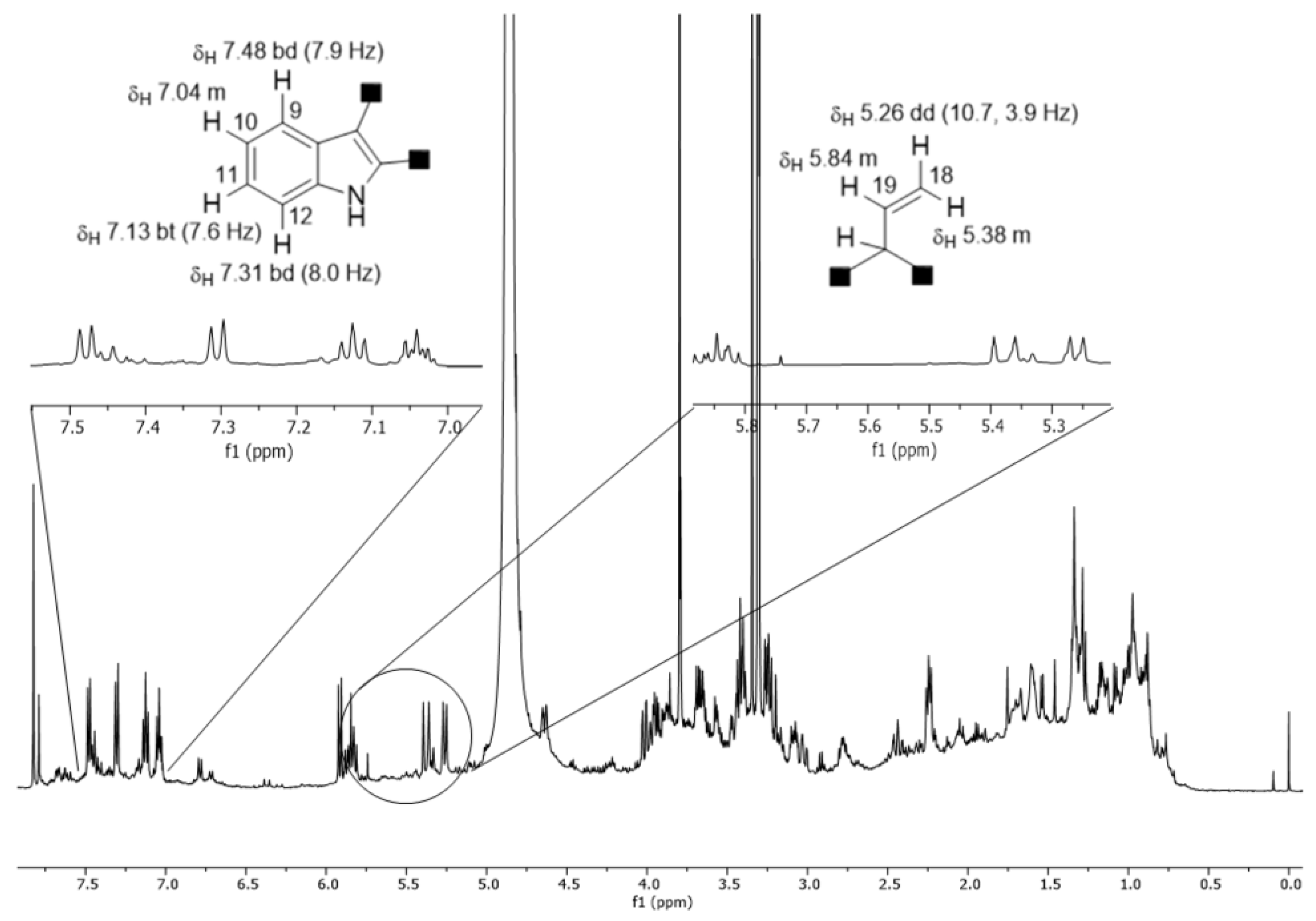
The presence of alkaloids in the crude MeOH extracts from the leaves and stems of P. densicostata was preliminarily detected by TLC staining with Dragendorff reagent. Alkaloid-enriched fractions from these extracts were obtained by adapting previously developed reversed-phase SPE methodology [8], used as an efficient alternative to the classical acid-base extraction. Four fractions: two from the leaves (L1, L2) and two from the stems (S1, S2) were yielded. The 1H NMR spectrum of the fraction L1 revealed key characteristic signals corresponding to the multiplicity pattern of ortho-disubstituted aromatic ring, such as the set of signals at δH 7.31 (br d, J = 8.0 Hz), 7.48 (d, J = 7.9 Hz), 7.13 (br t, J = 7.6 Hz), and 7.04 (m), and those characteristic to the vinyl group, such as the set of signals at δH 5.84 (m), 5.38 (m) and 5.26 (dd, J = 10.7, 3.9 Hz), both found in several MIAs (Figure 1) [2].
Figure 1.
1H NMR spectrum (CD3OD, 500 MHz) of the alkaloid-enriched fraction L1, highlighting key characteristic signals of monoterpene indole alkaloids.
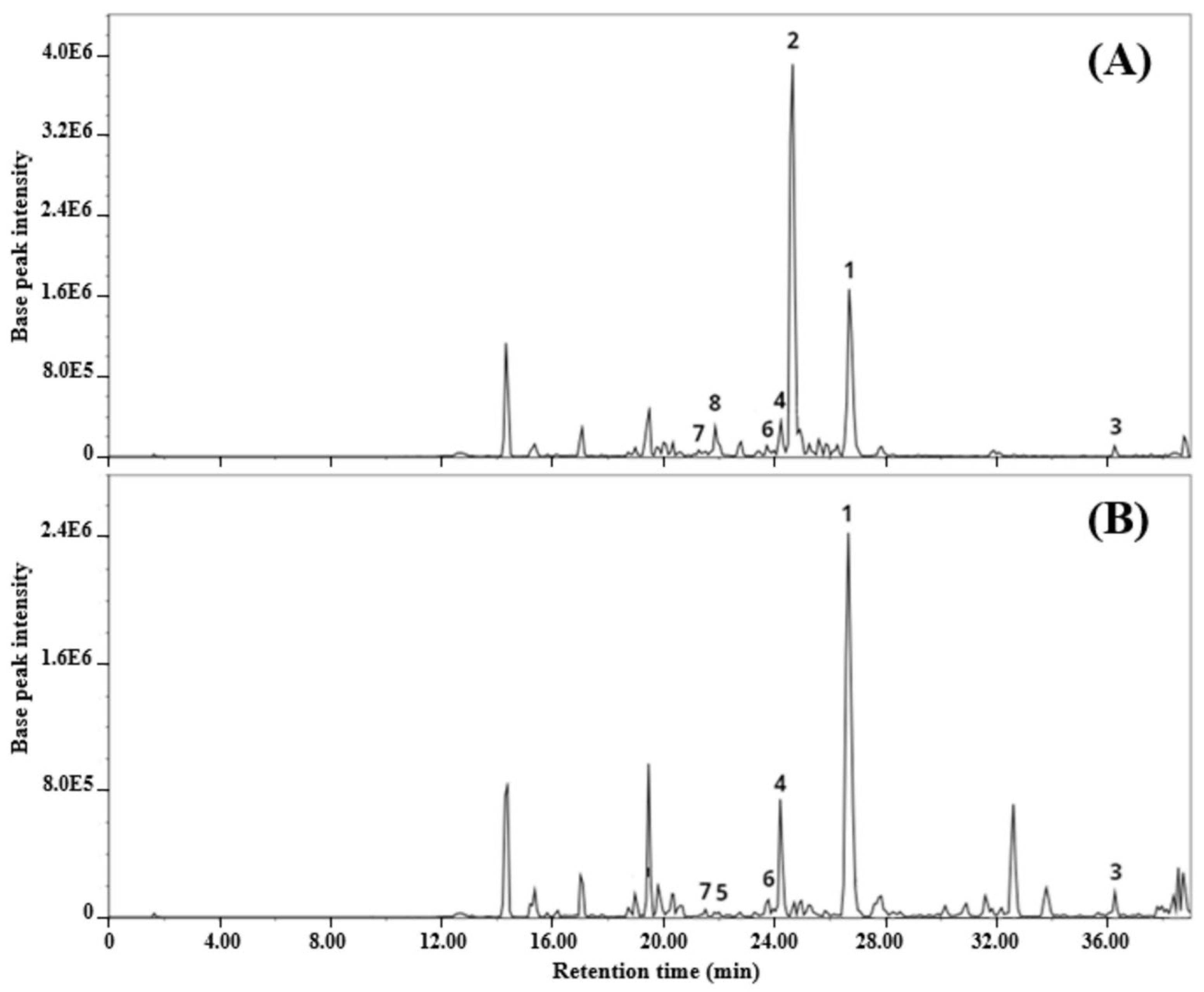
Careful extraction and compilation of the NMR signals and their 2D NMR correlations such as those from the 1H−13C HSQC spectrum between the methylene protons at δH 3.7 and 3.5 ppm and the carbon at δC 41.4 ppm, and between a metine proton at δH 3.9 ppm and the carbon at δC 58.1 ppm, with comparison to literature data [1,11,12] allowed two major compounds to be strongly suggested as the MIAs strictosidine (1) and 5-carboxystrictosidine (2). The total ion chromatogram (TIC) in positive mode of this alkaloid-enriched fraction L1 showed these two major compounds at RT 24.7 and 26.7 min with [M + H]+ (m/z 575.2230) and (m/z 531.2319), respectively (Figure 2A). The full scan product ion MS2 spectrum of the ion at m/z 531.2329 exhibited a neutral loss of ammonia (17.0294 Da, NH3) (m/z 531.2319 → m/z 514.2025), followed by the loss of glucose (162.0500 Da, C6H10O5) (m/z 514.2025 → m/z 352.1525). Furthermore, the spectrum showed an ion at m/z 144.0802, which corresponds to a fragment attributed to the indole portion of some MIAs [13,14]. A similar fragmentation pattern was observed for the ion at m/z 575.2230 (Table 1). The detailed analysis of NMR spectra, highlighting key signals together with the MS data, allowed confirmation the MIAs strictosidine (1) and 5-carboxystrictosidine (2) as the major compounds in fraction L1. The MS fragmentation analysis of the peaks with [M + H]+ ions at m/z 527.2069 (RT 22.5 min) and at m/z 499.2065 (RT 34.7 min) with comparison to data in the literature [14], allowed us to additionally characterize in the alkaloid-enriched fraction L1 the presence of the minor compounds lyaloside (4) and strictosidine lactam (3), respectively. MS2 spectra of both compounds revealed the same neutral loss of glucose (162.0500 Da, C6H10O5), but neither exhibited ammonia loss. The characteristic fragment at m/z 144.0808 was also observed for strictosidine lactam (3) but not for lyaloside (4), which can be explained by the stability of the aromatic system (Table 1). Similar MS analysis of the leaf alkaloid-enriched fraction L2 showed strictosidine (1) as its major compound, and strictosidine lactam (3) and lyaloside (4) as some of its minor compounds (Figure 2B).
Figure 2.
Total ion chromatograms (TIC) in positive mode of the leaf alkaloid-enriched fractions of Psychotria densicostata: (A) L1, (B) L2.
Table 1.
MS/MS data of the monoterpene indole alkaloids found in leaves and stems of Psychotria densicostata.
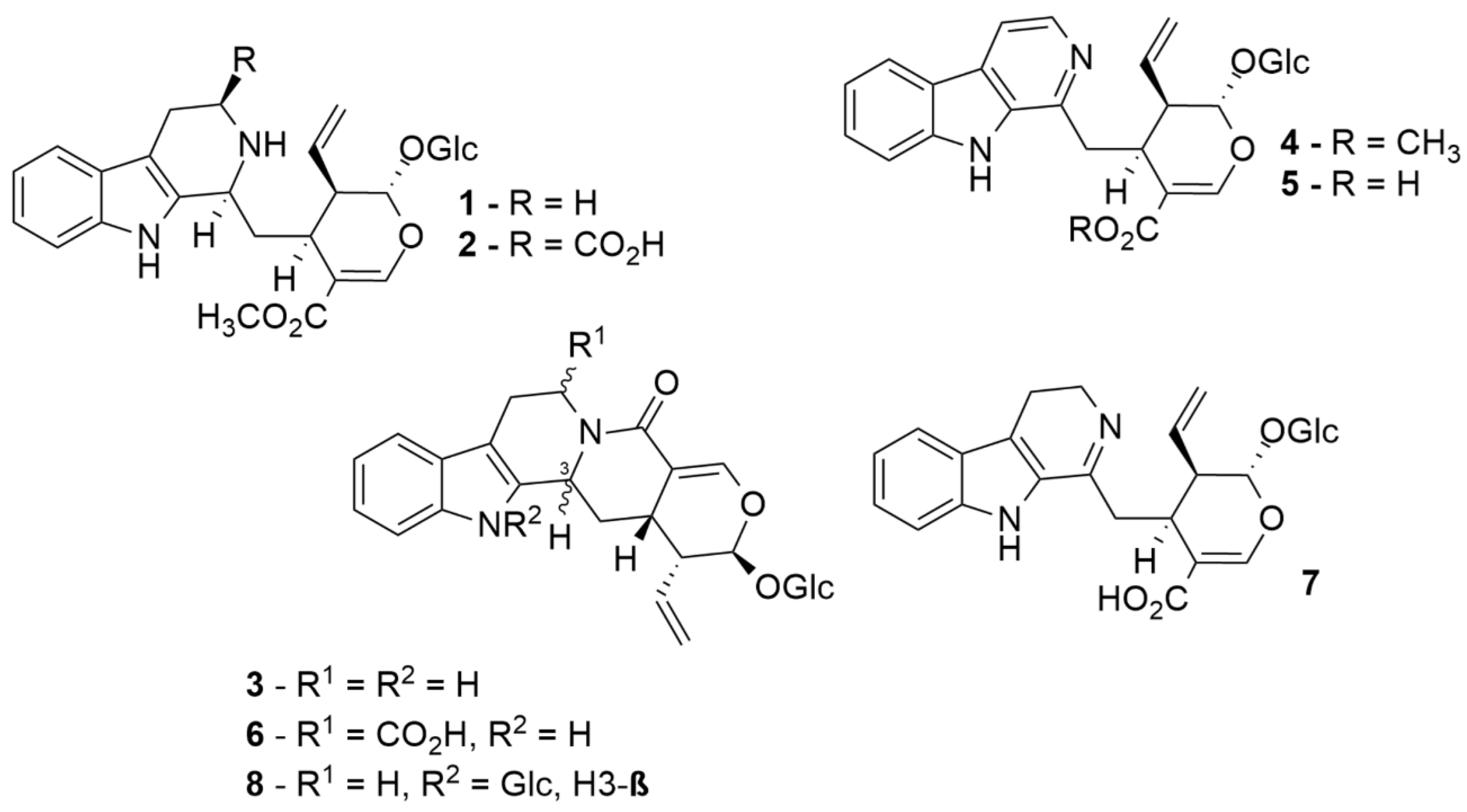
The stem alkaloid-enriched fraction S1 (Figure S11, Supplementary Materials) showed as the only major compound (by [M + H]+ at m/z 575.2230 and 1H NMR spectrum—Figure S12, Supplementary Materials) the MIA 5-carboxystrictosidine (2). The isolation of this compound by semi-preparative HPLC-DAD allowed us to complete the NMR analysis, including the 1H−1H spatial NOESY spectrum correlations. Comparison to data in the literature [15] and by biosynthetic evidence [4,5] showed compound (2) as the stereoisomer (3α,5α)-5-carboxystrictosine. The structure of the MIA strictosidine (1) was further confirmed by NMR analysis after its isolation by HPLC-DAD and also, by successive SPE experiments. Figure 3 shows the structures of the characterized compounds.
Figure 3.
Structures of the compounds found in leaves and stems of Psychotria densicostata.
3.2. Molecular Networking Analysis
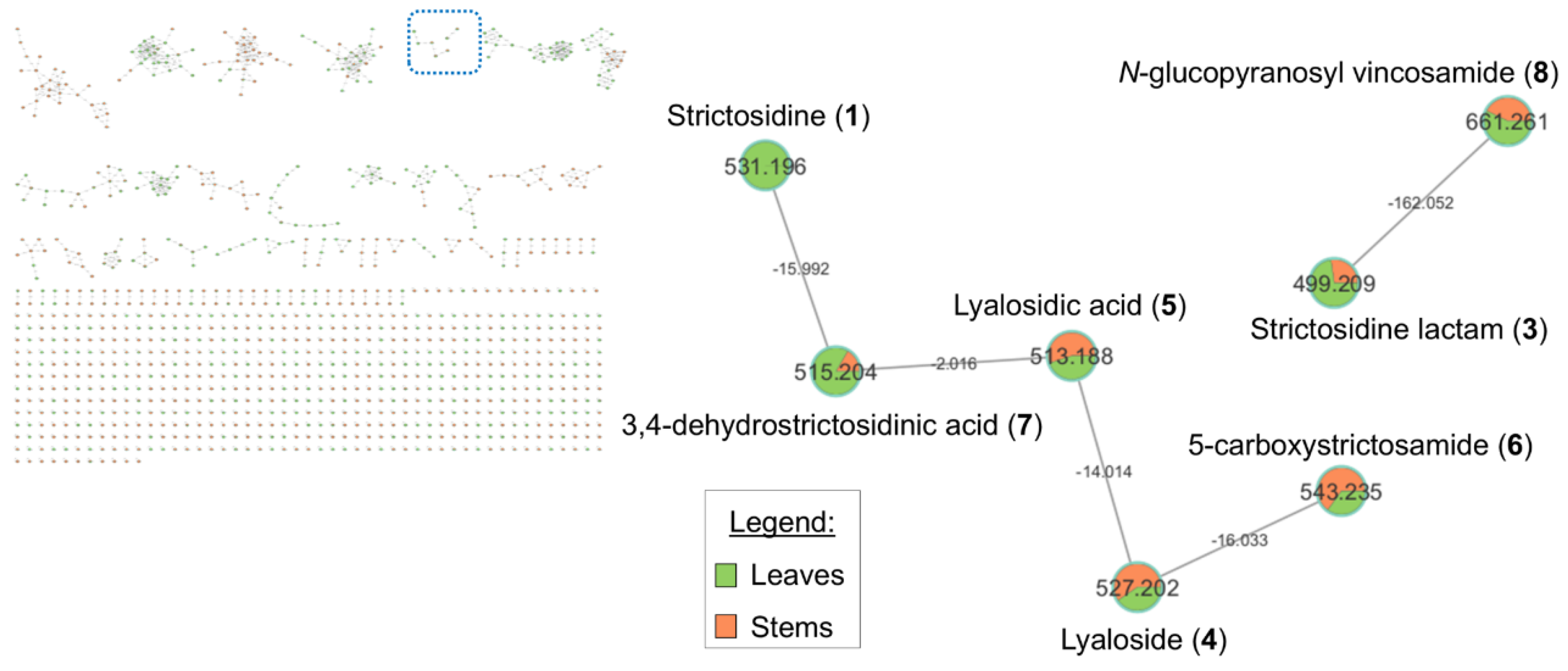
To further investigate and expand the alkaloid profile of the species, MS/MS data were analyzed using the Classical Molecular Networking and Library Search tools available on Global Natural Product Social Molecular Networking (GNPS) [16]. The raw data were initially converted to .mzML format using MS Convert and subsequently processed with MZMine under high-resolution settings. Several molecular networks were generated, highlighting the chemical complexity of the fractions. Library search results suggested, in addition to the alkaloids described above, the presence of lyalosidic acid (5) and 5-carboxystrictosamide (6). The network containing the nodes corresponding to these compounds (Figure 4) was further examined through mirror spectra, fragmentation pathways, and comparison with data in the literature [14]. The ion with [M + H]+ at m/z 513.1865, annotated as lyalosidic acid (5), appeared in the molecular network with a mass difference of 14.015 Da from lyaloside (4), corresponding to the substitution of a methyl ester (COOCH3) by a carboxylic acid (COOH). Its MS2 spectrum showed a neutral loss of glucose (162.0530 Da, C6H10O5), yielding a fragment at m/z 351.1335, followed by a water loss (18.0096 Da, H2O) to produce m/z 333.1239. The loss of a carboxylic acid group (43.9893 Da, CO2) was observed both from the protonated molecule (m/z 513.1865 → m/z 469.1972) and from the aglycone fragment (m/z 351.1335 → m/z 307.1439). The ion with [M + H]+ at m/z 543.1989, proposed as 5-carboxystrictosamide (6), displayed a fragmentation pattern closely resembling that of the strictosidine lactam (3), with an additional neutral loss corresponding to the carboxylic acid moiety at C-5 (46.0067 Da, CH2O2), observed in the transitions m/z 543.1989 → 497.1922 and m/z 381.1452 → 335.1392. Furthermore, the molecular network revealed a node corresponding to the ion with [M + H]+ at m/z 515.2027, displaying a mass difference of 2.0160 Da from lyalosidic acid (5), suggesting an additional double bond. The fragmentation profile supports its annotation as 3,4-dehydrostrictosidinic acid (7). A smaller molecular network, consisting of only two nodes, contained one corresponding to the ion [M + H]+ at m/z 661.2610. This ion shows a mass difference of 162.0520 Da relative to strictosidine lactam (3), indicative of an additional glucose moiety. The MS2 spectrum reveals the same fragment ions and neutral losses observed for strictosidine lactam (3), along with product ions at m/z 429.1661 and 333.1448, consistent with further fragmentation after the loss of a second glucose unit. Taken together, the mass spectrometric data support the annotation of this ion as N-glucopyranosyl vincosamide (8).
Figure 4.
Molecular network generated through HPLC-ESI-MS/MS data of the alkaloid-enriched fractions of Psychotria densicostata with emphasis on the networks containing ions consistent with the monoterpene indole alkaloids.
3.3. Human Neutrophil Elastase Inhibition Results
The inhibitory activity data of P. densicostata on human neutrophil elastase (HNE) are shown in Table 2. Results are expressed as relative inhibition (%RI). In addition to the positive (100%RI) and negative (0%RI) controls provided by the inhibition test kit, Sivelestat, a well-known commercial HNE inhibitor [17], was included as an additional reference, showing an IC50 of 0.02 µg/mL.
Table 2.
Human elastase inhibition results of crude extracts, alkaloid-enriched fractions and an isolated compound from Psychotria densicostata.
The crude leaf extract and the two alkaloid-enriched fractions L1 and L2 were evaluated at concentrations of 0.01, 0.1, 1, 10, and 100 µg/mL. At the highest concentration (100 µg/mL), the crude leaf extract and fraction L2 exhibited relevant HNE inhibition values of 54.1% and 54.7%, respectively. Fraction L1 did not show significant inhibition, suggesting that the active compounds might be concentrated in fraction L2. Due to the limited activity at lower concentrations, a refined assay was performed to determine IC50 values. In this assay, the crude stem extract, its fractions S1 and S2, and the isolated compound 2 were included. Fraction L2 dose-dependently inhibited HNE with an IC50 of 74.6 µg/mL, whereas crude stem extract, its fractions, and compound 2 showed negligible inhibitory activity. These results validate the observation that fraction L2 contains the main active compounds, while fraction L1, is inactive. Taken together, these findings suggest that the active compounds concentrated in fraction L2 could contribute to the modulation of HNE activity.
Neutrophils are the most abundant leukocyte in human peripheral blood, corresponding to 50–70% of the circulating defense cells, displaying an important role in innate immune responses against pathogens and interacting with the adaptive immunity by producing cytokines that modulate the functions of dendritic cells and lymphocytes. In dysregulated immune responses, massive neutrophil activation might be detrimental to the organism. Furthermore, toxic products resulting from neutrophil activation cause oxidative stress and can generate autoantigens like the citrullinated and carbamylated proteins which are related to chronic autoimmune diseases and aging [17]. As a first line defense of the organism against invading pathogens, neutrophils are rapidly recruited to damaged sites where they phagocytose microorganisms, produce reactive oxygen species (ROS) and release toxic antimicrobial proteins like proteolytic enzymes bound to extruded DNA web-like traps—the neutrophil extracellular traps (NETs)—to neutralize and destroy pathogens [18]. However, exacerbated NET formation can lead to tissue damage and is involved in the pathogenesis of several diseases like chronic inflammatory and autoimmune diseases, thrombosis, COVID-19 and cancer [7]. Thus, the modulation of this process might be beneficial to control inflammatory damage that can lead to death in some pathological conditions like the acute respiratory distress syndrome (ARDS) which is associated with sepsis, respiratory infections, among other causes [19]. NETosis is a well-controlled type of cell death that requires neutrophil activation resulting in NADPH oxidase (NOX2) ROS production, peptidilarginine deiminase 4 (PAD4) activation, and primary granules enzymes like human neutrophil elastase (HNE), cathepsin G (CTSG), proteinase 3 (PR3), and myeloperoxidase (MPO) mobilization [20]. All these proteins are important for NETosis, but elastase seems to play an essential role in different steps of the process resulting ultimately in tissue damage [20,21]. Therefore, inhibiting or reducing elastase activity may be protective in pathological conditions involving excessive NET production and neutrophil activation. Natural compounds, including some alkaloids, have demonstrated elastase inhibition in different assays [22,23]. Therefore, the inhibition of HNE by the crude leaf extract and fraction L2 may have therapeutic relevance in conditions characterized by excessive neutrophil activation, supporting the potential of P. densicostata as modulators of neutrophil-mediated inflammation.
4. Conclusions
The first chemical investigation of the species Psychotria densicostata was herein reported. Eight known monoterpene indole alkaloids were identified in its leaves and stems by integrating NMR techniques, HPLC-DAD-ESI-MS/MS, and Molecular Network, being the major compounds strictosidine (1) and (3α,5α)-5-carboxystrictosidine (2), and the minor strictosidine lactam (3), lyaloside (4), lyalosidic acid (5), 5-carboxystrictosamide (6), 3,4-dehydrostrictosidinic acid (7), and N-glucopyranosyl vincosamide (8). The crude leaf and stem extracts together with the alkaloid-enriched fractions derived from these extracts, and the isolated compound 2 when submitted to a HNE inhibition assay revealed a moderate activity for one of the leaf alkaloid-enriched fraction (L2).
Supplementary Materials
The following supporting information can be downloaded at: https://www.mdpi.com/article/10.3390/analytica7020031/s1, NMR and MS spectra, and other supplementary data.
Author Contributions
V.G.C. performed all experiments supervised by L.M.M.V. and M.R.R.T.; V.F.J. performed the first results on the species; R.S.B. supervised the SPE experiments; A.M. performed the NMR spectra; M.G. contributed to the collection, herborization and identification of plant material; L.N.S.: supervised the elastase assay; V.G.C., L.N.S., M.R.R.T. and L.M.M.V. contributed to the writing of the manuscript and its revision. All authors have read and agreed to the published version of the manuscript.
Funding
This work was supported by Fundação Carlos Chagas Filho de Amparo à Pesquisa do Estado do Rio de Janeiro (FAPERJ) (No. E-26/210.895/2024).
Data Availability Statement
Data is contained within the article or Supplementary Materials.
Conflicts of Interest
The authors declare no conflicts of interest.
References
- Calixto, N.O.; Pinto, M.E.F.; Ramalho, S.D.; Burger, M.C.M.; Bobey, A.F.; Young, M.C.M.; Bolzani, V.S.; Pinto, A.C. The genus Psychotria: Phytochemistry, chemotaxonomy, ethnopharmacology and biological properties. J. Braz. Chem. Soc. 2016, 27, 1355–1378. [Google Scholar] [CrossRef]
- Yang, H.; Zhang, H.; Yang, C.; Chen, Y. Chemical constituents of plants from the genus Psychotria. Chem. Biodivers. 2016, 13, 807–820. [Google Scholar] [CrossRef] [PubMed]
- Berger, A.; Valant-Vetschera, K.; Schinnerl, J.; Brecker, L. A revised classification of the sister tribes Palicoureeae and Psychotrieae (Rubiaceae) indicates genus-specific alkaloid accumulation. Phytochem. Rev. 2022, 21, 941–986. [Google Scholar] [CrossRef]
- De Luca, V.; Salim, V.; Thamm, A.; Masada, S.A.; Yu, F. Making iridoids/secoiridoids and monoterpenoid indole alkaloids: Progress on pathway elucidation. Curr. Opin. Plant Biol. 2014, 19, 35–42. [Google Scholar] [CrossRef]
- Szabó, L.F. Rigorous biogenetic network for a group of indole alkaloids derived from strictosidine. Molecules 2008, 13, 1875–1896. [Google Scholar] [CrossRef]
- Taylor, C.M.; Gomes, M.; Zappi, D. Psychotria in Lista de Espécies da Flora do Brasil, Jardim Botânico do Rio de Janeiro. 2015. Available online: https://floradobrasil2015.jbrj.gov.br/FB39108 (accessed on 29 March 2026).
- Zambrano, F.; Uribe, P.; Schulz, M.; Hermosilla, C.; Taubert, A.; Sánchez, R. Antioxidants as modulators of NETosis: Mechanisms, evidence, and therapeutic potential. Int. J. Mol. Sci. 2025, 26, 5272. [Google Scholar] [CrossRef]
- Costa, J.O.; Barboza, R.S.; Valente, L.M.M.; Wolff, T.; Gomes, M.; Gallo, B.; Berrueta, L.A.; Gavino-Leopoldino, D.; Assunção-Miranda, I. One-step isolation of the bioactive monoterpene indole alkaloids from Psychotria leiocarpa leaves by solid-phase extraction. J. Braz. Chem. Soc. 2020, 31, 2104–2113. [Google Scholar] [CrossRef]
- Klein-Júnior, L.C.; Viaene, J.; Tuenter, E.; Salton, J.; Gasper, A.L.; Apers, S.; Andries, J.P.M.; Pieters, L.; Henriques, A.T.; Heyden, Y.V. The use of chemometrics to study multifunctional indole alkaloids from Psychotria nemorosa (Palicourea comb. nov.). Part II: Indication of peaks related to the inhibition of butyrylcholinesterase and monoamine oxidase-A. J. Chromatogr. A 2016, 1463, 71–80. [Google Scholar] [CrossRef]
- Shi, J.; Knevela, R.; Suwannalai, P.; Linden, M.P.; Janssen, G.M.C.; Veelen, P.A.; Levarht, N.E.W.; Mil, A.H.M.H.; Cerami, A.; Huizinga, T.W.J.; et al. Autoantibodies recognizing carbamylated proteins are present in sera of patients with rheumatoid arthritis and predict joint damage. Proc. Natl. Acad. Sci. USA 2011, 108, 17372–17377. [Google Scholar] [CrossRef]
- Costa, R.A.; Pinheiro, M.L.B.; Oliveira, K.M.T.; Barison, A.; Salomé, K.S.; Iank, J.R.; Silva, N.G.; Cabral, T.S.; Costa, E.V. Structural, vibrational, and electronic properties of the glucoalkaloid strictosidine: A combined experimental and theoretical study. J. Chem. 2016, 2016, 1752429. [Google Scholar] [CrossRef]
- Han, Y.; Xi, J.; Zhan, P.; Gong, M.; Luo, T.; Shao, F.; Li, Y.; Zhong, L.; Quan, H. 5(S)-5-Carboxystrictosidine from the root of Mappianthus iodoides ameliorates H2O2-induced apoptosis in H9c2 cardiomyocytes via PI3K/AKT and ERK pathways. Planta Med. 2024, 90, 885–895. [Google Scholar] [CrossRef] [PubMed]
- Zhu, F.; Chen, J.; Wang, H.; Jia, X.; Wang, S.; Zhang, Z.; Zhai, X.; Xu, J.; Tan, W.; Ning, Q.; et al. Analysis of the chemical constituents and rats metabolites after oral administration of Nauclea officinalis by ultra-performance liquid chromatography quadrupole time-of-flight mass spectrometry. J. Chromatogr. B 2015, 1007, 54–66. [Google Scholar] [CrossRef] [PubMed]
- Santos, C.L.G.; Angolini, C.F.F.; Neves, K.O.G.; Costa, E.V.; Souza, A.D.L.; Pinheiro, M.L.B.; Koolen, H.H.F.; Silva, F.M.A. Molecular networking-based dereplication of strictosidine derived monoterpene indole alkaloids from the curare ingredient Strychnos peckii. Rapid Commun. Mass Spectrom. 2020, 34, e8683. [Google Scholar] [CrossRef]
- Rakumitsu, K.; Sakamoto, J.; Ishikawa, H. Total syntheses of (−)-secologanin, (−)-5-carboxystrictosidine, and (−)-rubenine. Chem. Eur. J. 2019, 25, 8996–9000. [Google Scholar] [CrossRef] [PubMed]
- Wang, M.; Carver, J.J.; Phelan, V.V.; Sanchez, L.M.; Garg, N.; Peng, Y.; Nguyen, D.D.; Watrous, J.; Kapono, C.A.; Luzzatto-Knaan, T.; et al. Sharing and community curation of mass spectrometry data with Global Natural Products Social Molecular Networking. Nat. Biotechnol. 2016, 34, 828–837. [Google Scholar] [CrossRef]
- Pan, T.; Tuoerxun, T.; Chen, X.; Yang, C.-J.; Jiang, C.-Y.; Zhu, Y.-F.; Li, Z.-S.; Jiang, X.-Y.; Zhang, H.-T.; Zhang, H.; et al. The neutrophil elastase inhibitor, Sivelestat, attenuates acute lung injury in patients with cardiopulmonary bypass. Front. Immunol. 2023, 14, 1082830. [Google Scholar] [CrossRef]
- Brinkmann, V.; Reichard, U.; Goosmann, C.; Fauler, B.; Uhlemann, Y.; Weiss, D.S.; Weinrauch, Y.; Zychlinsky, A. Neutrophil extracellular traps kill bacteria. Science 2004, 303, 1532–1535. [Google Scholar] [CrossRef]
- Bos, L.D.J.; Ware, L.B. Acute respiratory distress syndrome: Causes, pathophysiology, and phenotypes. Lancet 2022, 400, 1145–1156. [Google Scholar] [CrossRef]
- Thiam, H.R.; Wong, S.L.; Wagner, D.D.; Waterman, C.M. Cellular mechanisms of NETosis. Annu. Rev. Cell. Dev. Biol. 2020, 36, 191–218. [Google Scholar] [CrossRef]
- Groutas, W.C.; Doua, D.; Allistona, K.R. Neutrophil elastase inhibitors. Expert Opin. Ther. Pat. 2011, 21, 339–354. [Google Scholar] [CrossRef]
- Lai, Y.-W.; Wang, S.-W.; Hu, Y.-Y.; Hwang, T.-L.; Cheng, M.-J.; Chen, I.-S.; Sung, P.-J.; Chen, J.-J. Anti-inflammatory alkaloids from the root bark of Hernandia nymphaeifolia. Phytochemistry 2020, 173, 112326. [Google Scholar] [CrossRef]
- Siedle, B.; Hrenn, A.; Merfort, I. Natural compounds as inhibitors of human neutrophil elastase. Planta Med. 2007, 73, 401–420. [Google Scholar] [CrossRef]
Disclaimer/Publisher’s Note: The statements, opinions and data contained in all publications are solely those of the individual author(s) and contributor(s) and not of MDPI and/or the editor(s). MDPI and/or the editor(s) disclaim responsibility for any injury to people or property resulting from any ideas, methods, instructions or products referred to in the content. |
© 2026 by the authors. Licensee MDPI, Basel, Switzerland. This article is an open access article distributed under the terms and conditions of the Creative Commons Attribution (CC BY) license.