


Abstract
Background/Objectives: The objective of this study is to compare nerve-sparing (NS) and non-nerve-sparing (NNS) robot-assisted radical prostatectomy (RARP) techniques used to treat localized prostate cancer. Numerous studies have evaluated the impact of NS techniques on patient-reported outcomes. However, there are unaddressed methodological issues making interpretation of results difficult. Therefore, we performed a comparison of the two techniques, accounting for methodological threats, including patient selection and confounding. Methods: We sampled 120 patients with similar disease burden who underwent RARP by the same surgeon, either with NS (n = 84) or NNS (n = 36) and assessed changes in lower urinary tract (LUT) function and bother, and bowel function/bother using the Expanded Prostate Cancer Index Composite (EPIC) questionnaire and the six-item International Index of Erectile Function (IIEF-6) survey at 6 weeks and 12 months postoperatively. Multivariable linear regression models were used to adjust for differences in age, preoperative PSA levels, pathological tumor stage and Gleason-score of patients receiving either NS or NNS. Results: At 6 weeks postoperatively, the NNS group had a significantly larger decrease in LUT function compared to the NS group (−17.42; 95% Confidence Interval (CI): −31.31, −3.53; p = 0.0145). At 12 months, both groups recovered substantially, and no group differences were observed (p > 0.9). No significant differences were observed between the NS and NNS groups for the EPIC bowel subscores, whereas the IIEF-6 showed borderline significance at 12 months. Conclusions: The results suggest a small impact of NS vs. NNS RARP on important patient-reported outcomes when controlling for tumor biology, surgeon skill, and patient characteristics. These results need to be confirmed by larger studies using similar sampling strategies and design considerations.
1. Introduction
Prostate cancer (PCa) is the second most frequently diagnosed malignancy in males worldwide [1]. Currently established curative treatment options for localized PCa are surgery, radiotherapy (external beam radiation and brachytherapy) and active surveillance for low risk PCa to reduce the risk of overtreatment [2]. However, none of these options have demonstrated clear superiority over the others regarding oncologic and functional outcomes [3,4].
As cancer-specific survival rates for patients with PCa have improved [5], health-related quality of life (HRQOL) has become more and more important [6]. Every treatment option is accompanied by a distinct constellation of adverse effects affecting lower urinary tract (LUT), bowel, and sexual function, and thus having a negative impact on HRQOL [7,8,9,10]. Therefore, early- and late-onset sequelae of PCa treatment need to be carefully considered during treatment decision-making.
In 1983, Walsh et al. presented a nerve-sparing (NS) technique aiming to improve postoperative LUT and sexual function outcomes after radical prostatectomy [11]. The positive impact of neurovascular bundle preservation during prostate dissection on postoperative sexual function has been observed in earlier studies [10,12]. Opinions are divided regarding LUT-function [10,13,14] as existing evidence is heterogeneous due to the high variability in included tumors, surgeon’s experience, methods of data acquisition [15] and definitions of urinary continence [16]. Despite insights from large cohorts, the effect of nerve-sparing within RARP under standardized surgical conditions remains insufficiently evaluated.
Therefore, to address this gap, we performed a comparison of the two techniques, accounting for methodological threats, including patient selection and confounding. We sampled patients with similar disease burden, who underwent robot-assisted radical prostatectomy (RARP) as primary therapy for localized PCa, performed by the same surgeon to limit variability due to differences in surgical technique and experience.
2. Materials and Methods
2.1. Study Design and Study Population
We retrospectively identified patients with localized PCa treated with RARP (trans- or extraperitoneal) as primary therapy. All surgeries were performed by the same senior urological surgeon (H.J.) in the Clinic for Urology at the Kantonsspital Winterthur in Switzerland. Patients without available follow-up data or with >20% missing data in the Expanded Prostate Cancer Index Composite (EPIC) subdomains were excluded. A total of 120 patients were included.
The decision to perform the NS technique was based on patient age, preoperative erectile function, clinical tumor stage, distribution pattern of PCa-positive biopsies, multiparametric prostate magnetic resonance imaging (mpMRI) findings, and preoperative prostate-specific antigen (PSA) level. This study was conducted under an exemption granted by the Swiss Federal Office of Public Health, permitting the use of patient data without specific informed consent, provided that no documented refusal was recorded. In addition, this project has been approved by the Zurich Ethics Committee (BASEC number: KEK-ZH-NR: 2021-00569).
2.2. Outcomes
The primary outcomes are differences to baseline in LUT function at 6 weeks and 12 months. Secondary outcomes include differences to baseline in LUT bother, bowel function and bother, as well as erectile function at 6 weeks and 12 months. All patients were asked to complete routine surveys, which were sent by mail before and after surgery. If questionnaires were not returned on time, patients were reminded by mail and phone call. The survey included two questionnaires: the LUT and bowel domains of the 50-item EPIC questionnaire and the 6-item International Index of Erectile Function (IIEF-6).
2.2.1. Expanded Prostate Cancer Index Composite (EPIC)
The 50-item EPIC questionnaire was validated and published in English by an expert panel in 2000 [17]. Meanwhile, the questionnaire has been validated in various languages for PCa patients, including in German. In this study, only the LUT and bowel function domains were analyzed, as sexual function was assessed using IIEF-6 and hormonal symptoms were irrelevant for this study. The LUT and bowel function domains consist of 12 and 14 items, respectively. These domains are subdivided into domain-specific subscales, functional and bother. Both are reported on a 0–100 score scale with a higher score denoting a more favorable HRQOL.
2.2.2. International Index of Erectile Function-6 (IIEF-6)
The original 15-item IIEF, published in 1997, is an established diagnostic instrument for assessing male sexual dysfunction. It contains 15 questions, evaluating five relevant domains of male sexual function (erectile and orgasmic function, sexual desire, intercourse, and overall sexual satisfaction) [18]. In clinical studies, the shortened version with six items (IIEF-6; using questions 1, 2, 3, 4, 5 and 15 of the IIEF) has proven to be a relevant and feasible questionnaire [19]. However, the original and the IIEF-6 have not been specifically validated for use in patients with PCa particularly [20], and the IIEF-6 has not yet been validated in German [21]. The IIEF-6 survey comprises six questions, each evaluated on a Likert scale from 0 to 5, resulting in a maximum total score of 30. Based on the total score, erectile dysfunction (ED) can be classified into 5 categories: severe ED (1–10), moderate ED (11–16), mild-moderate ED (17–21), mild ED (22–25), no ED (26–30) [19].
2.3. Statistical Analysis
Data was checked for consistency and distribution. Differences in continuous variables were evaluated using t-test statistics and differences in categorical variables were analyzed using Fisher’s exact test or chi-square test as appropriate. Outcomes were analyzed using complete-case data at the available time points; no imputation was performed. Multivariable linear regression models were used to adjust for age, preoperative PSA levels, pathological tumor stage and Gleason-score. Case-wise diagnostics were performed to identify potential influential outliers using DFBeta residuals, with a cut-off of >2 for outliers to be considered influential. All reported tests were two-sided, and p values less than 5 percent were considered statistically significant. As secondary outcomes are considered exploratory, corrections for multiple testing were not applied. All statistical analyses were performed using R Statistical Software (R version 4.2.3; R Foundation for Statistical Computing, Vienna, Austria).
3. Results
Of the included 120 patients, 84 (70%) underwent NS (77 bilateral, 7 unilateral) and 36 (30%) non-NS (NNS) RARP. All surgeries were performed using a robot-assisted technique (trans- or extraperitoneal). No significant group differences were found regarding age, body mass index, smoking status, previous transurethral prostate surgery (TUR-P) or history of abdominal surgeries. Prostate tumors in the NNS group had significantly higher tumor stages and Gleason scores. Also, PSA values in patients treated with the NNS technique were significantly higher than in the NS group (13.4 ng/mL vs. 7.6 ng/mL, p < 0.001). See Table 1 for detailed patient characteristics. The response rate of the included 120 patients to the EPIC questionnaire was 94% at six weeks follow-up and 82% at one year postoperatively. The IIEF-6 questionnaire completion rate was 94% at six weeks and 62% at one year after treatment.
Table 1.
Patient and tumor characteristics.
3.1. EPIC Lower Urinary Tract Domain: Function
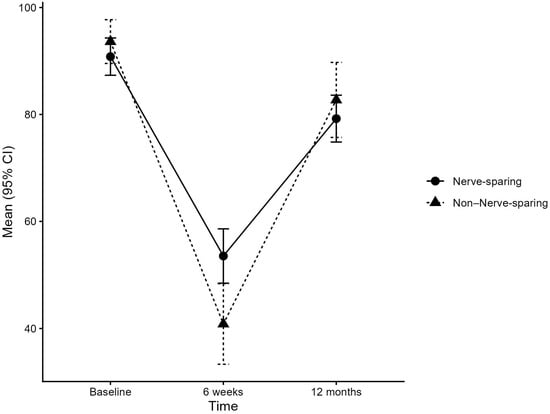
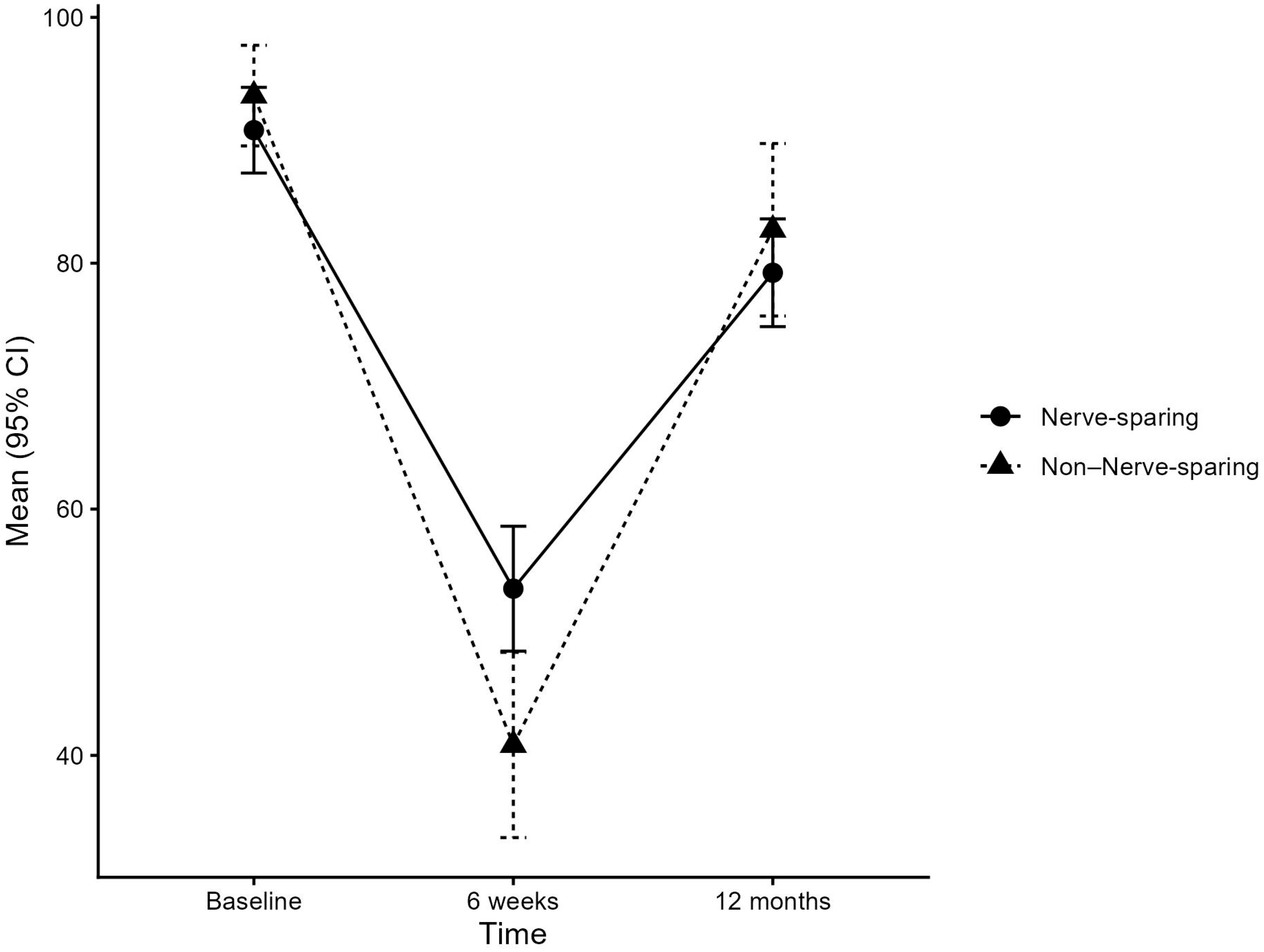
Patients in the NS and NNS groups had similar LUT function baseline values with mean LUT function scores of 90.8 (SD 16.1) and 93.6 (SD 12.1), respectively. Six weeks postoperatively, LUT function subscale scores decreased by 52.2 (SD 25.5) in the NNS group and 37.0 (SD 27.8) in the NS group (see Figure 1). When adjusted for confounding, the NNS group had a significantly larger decrease in LUT function compared to the NS group (−17.4; 95% Confidence Interval (CI): −31.3, −3.5; p = 0.0145). At 12 months, both groups recovered substantially, with differences to baseline of −11.2 (SD 18.9) in the NNS group and −11.9 (SD 23.2) in the NS group. In the multivariable analysis, there was no significant difference between the groups (p > 0.9). No influential outliers were identified. See Table 2 for detailed unadjusted and adjusted results for primary and secondary outcomes.
Figure 1.
Absolute LUT function scores at baseline, 6 weeks and 12 months, stratified by nerve-sparing technique (unadjusted).
Table 2.
Unadjusted and adjusted results for primary and secondary outcomes.
3.2. EPIC Lower Urinary Tract Domain: Bother
The LUT bother baseline values of the groups were comparable, with a mean bother score of 83.4 (SD 17.5) in the NS group and 83.6 (SD 18.5) in the NNS group. Six weeks postoperatively, LUT bother subscale scores decreased by 21.6 (SD 26.9) in the NS group and by 29.7 (SD 30.9) in the NNS group. After adjusting for confounding, patients in the NNS group had a stronger decrease in LUT bother scores, but this difference was not statistically significant (−11.0; 95% CI: −25.2, 3.2; p = 0.13). After 12 months, patients in both groups had similar LUT bother values as at baseline (NS group: 85.4 (SD 16.5); NNS group: 84.2 (SD 17.2)).
3.3. EPIC Bowel Domain
The NS group showed a smaller decrease in bowel function score compared to the NNS group at 6 weeks (−4.7 (SD 14.0) vs. −6.1 (SD 15.9)). After adjusting for confounders, patients in the NS group had on average 7.1 points higher bowel function scores (95% CI: −0.1, 14.2; p = 0.053). At 12 months, both groups showed higher bowel function scores than at baseline and there was no statistically significant difference between the two groups (p = 0.7).
Similarly, both groups showed a small decrease in bowel bother score, which was more prominent in the NNS group (−5.6 (20.0) vs. −3.6 (15.1)). At 12 months, both groups recovered to baseline levels, and when adjusted for confounding, no statistically significant group difference was observed.
3.4. Sexual Function Domain
Most patients had moderate levels of sexual dysfunction at baseline. Six weeks postoperatively, there was a severe decrease in erectile function in both groups (NS: −12.6 (SD 13.4); NNS: −13.3 (SD 12.8)). The nerve-sparing technique was associated with a 1.5-point smaller decrease (95% CI: −4.9, 7.8; p = 0.6) in the IIEF-6 total score in the adjusted analysis. At the 12-month follow-up, patients in the NNS group had borderline significantly better sexual function scores when controlling for confounders (p = 0.049).
4. Discussion
4.1. Main Findings
Outcomes between nerve-sparing and non-nerve-sparing techniques were comparable, with patients in both groups having similar HRQOL scores at the 12-month follow-up. However, in the early postoperative period, postoperative HRQOL differed between the two groups. Both groups showed a significant decrease in LUT function scores at six weeks postoperatively, but the NNS group experienced a significantly larger decrease in LUT function. Twelve months after surgery, both groups recovered to baseline levels with no group difference. This indicates a potential benefit of the nerve-sparing technique on early post-operative LUT function. The adjusted 6-week between-group difference in LUT function (−17.4; 95% CI: −31.3, −3.5) exceeds previously published minimal clinically important difference (MID) for urinary function of the German EPIC (MID = 10), ref. [22] suggesting clinical relevance. The bowel function at six weeks was lower in the NNS group compared to the NS group, although the difference did not reach statistical significance (p = 0.053).
4.2. Results in Context
Consistent with prior work, we observed a sharp decrease in the mean LUT subscales scores (function and bother) as well as mean sexual outcomes at six weeks after surgery in both study groups, followed by an improvement at 12 months postoperatively [10,23]. Based on prior literature, differences in perioperative pharmacotherapy (e.g., anticholinergics, phosphodiesterase-5 inhibitors, intracavernous prostaglandin-E1) and rehabilitation strategies (e.g., pelvic-floor training) may contribute to early postoperative patterns and recovery dynamics [24]. Adam et al. also described no significant differences in postoperative sexual function; however, patients who underwent NS were significantly more sexually active than those treated with NNS [25]. Despite this, when inspecting our individual participant scores, we noticed only a marginal difference in sexual inactivity between the two groups. Nevertheless, multiple reports have described better recovery of sexual function in patients who underwent RARP with NS technique [10,12]. Possible explanations for the discrepancy between these findings and ours include variation in surgical technique (e.g., extent/quality of nerve preservation and surgical planning strategies), which was not examined in this study [10,12,26]. Furthermore, a low 12-month questionnaire return rate with potential selection/response bias, measurement limitations (the IIEF-6 has not been validated in German or specifically in men with prostate cancer), and differences in instruments used to evaluate PCa-specific HRQOL may have contributed to these discrepancies.
Our finding of better early LUT function with nerve-sparing aligns with reports of faster early continence recovery after NS RARP, although long-term HRQOL converged between groups in our cohort [27]. The reasons for these findings remain unclear and require further investigations into the pathophysiology of post-RARP incontinence. Preoperative pelvic floor muscle exercises may contribute to improved urinary continence within the first six months postoperatively [28].
Multiple studies have shown that RP has less impact on bowel function compared to external beam radiation and brachytherapy in PCa patients [9,29,30]. We observed no benefits of NS technique regarding bowel outcomes at 12 months after surgery. Recently, Nishikawa et al. observed that bowel burden is affected differently depending on the degree of preservation of the neurovascular bundle, with better results in multistage NS [31]. Emerging alternatives such as focal therapy offer organ-sparing options that aim to preserve urinary and sexual function, yet appropriate patient selection and counseling remain critical in view of risks of oncologic recurrence [32].
4.3. Strengths and Limitations
Extensive research has been conducted on how NS and NNS during RP affect LUT, sexual and bowel function (short- and long-term effects). However, to our knowledge, this is the first study in which RARP was performed by the same surgeon and at the same clinic, applying the same standard perioperative procedures. This provides homogeneity in treatment and facilitates comparisons of outcomes between the two groups. However, there are limitations that need to be noted. Although laterality of nerve-sparing could be ascertained and was predominantly bilateral, the small unilateral subgroup and the lack of standardized documentation on preservation extent/quality precluded meaningful stratified analyses and may have masked an extent-outcome gradient in functional recovery. Further, the interpretability of the sexual function outcomes is limited by the questionnaire not being validated in German and by limited 12-month completion, with reduced precision and possible selection/response bias. In addition, several secondary comparisons (e.g., bowel function at 6 weeks, IIEF-6) showed small effects with wide confidence intervals that approached but did not reach statistical significance, indicating limited power (type II error risk), and limited temporal resolution from only two follow-up points, which may have missed intermediate changes and recovery dynamics. Conversely, the borderline IIEF-6 difference at 12 months favoring NNS should be interpreted cautiously as an exploratory finding (adjusted mean difference: −8.44 (−16.82, −0.05); IIEF-EF/IIEF-6 MCID = 4), [33] given multiplicity and the possibility of a type I error. Therefore, larger studies with similarly homogeneous study populations and procedures are necessary to evaluate the potential benefits of nerve-sparing RARP. Finally, whether patients were eligible for the NS technique depended on tumor biology and other clinical circumstances that we could not fully account for in the analyses. The observation that patients in the NNS group, despite biologically less favorable tumors, recovered to similar HRQOL levels at one year provides some reassurance that the observed early HRQOL advantage in the NS group is not solely driven by baseline differences. However, residual confounding inherent in non-randomized group comparisons cannot be excluded; accordingly, conclusions should be drawn with appropriate caution.
5. Conclusions
This single-center study provides evidence on the impact of NS compared to NNS RARP on important patient-reported outcomes. In our population, both groups experienced a similar pattern of early decline and recovery in lower urinary tract, bowel and sexual function. However, patients in the NS group showed significantly higher LUT function scores at 6 weeks, consistent with improved early urinary recovery after nerve-sparing. Patients in both groups showed recovery in all three domains during the first year after surgery.
Author Contributions
Conceptualization, D.M. and J.T.; methodology, D.M., L.M.B., N.S.B. and J.T.; software, N.S.B.; formal analysis, L.M.B. and N.S.B.; investigation, D.M.; writing—original draft preparation, D.M., L.M.B. and N.S.B.; writing—review and editing, J.N., B.F., H.J. and J.T.; supervision, J.T. All authors have read and agreed to the published version of the manuscript.
Funding
This research received no external funding.
Institutional Review Board Statement
The study was conducted in accordance with the Declaration of Helsinki, and approved by the Zurich Ethics Committee (BASEC number: KEK-ZH-NR: 2021-00569; 20 April 2021).
Informed Consent Statement
This study was conducted under an exemption granted by the Swiss Federal Office of Public Health, permitting the use of patient data without specific informed consent, provided that no documented refusal was recorded (035.0003-9/10).
Data Availability Statement
The data presented in this study are available on request from the corresponding author.
Conflicts of Interest
Nicolas S. Bodmer and Lucas M. Bachmann are affiliated with Medignition Inc., which provides methodological and statistical support for research projects. Medignition Inc. did not have any commercial or financial interest in the study outcomes. The authors declare that this affiliation did not influence the study design, the analysis and interpretation of the data, the reporting of the results, or the decision to submit the manuscript for publication. Hubert John was the surgeon responsible for performing the procedures and providing the clinical data for this study. He declares that he has no financial relationships that could have influenced the analysis, reporting or interpretation of findings.
Abbreviations
The following abbreviations are used in this manuscript:
| EPIC | Expanded Prostate Cancer Index Composite |
| HRQOL | Health-Related Quality of Life |
| IIEF-6 | International Index of Erectile Function-6 |
| LUT | Lower Urinary Tract |
| MCID | Minimal Clinically Important Difference |
| mpMRI | Multiparametric Prostate Magnetic Resonance Imaging |
| NNS | Non-Nerve-Sparing |
| NS | Nerve-Sparing |
| PCa | Prostate Cancer |
| PSA | Prostate-Specific Antigen |
| RARP | Robot-Assisted Radical Prostatectomy |
| TUR-P | Transurethral Prostate Surgery |
References
- Union for International Cancer Control (UICC). The Global Cancer Observatory—Globocan 2020. 2020. Available online: https://www.uicc.org/news/globocan-2020-global-cancer-data (accessed on 8 August 2024).
- EAU Guidelines. Edn. Presented at the Eau Annual Congress Paris 2024; EAU Guidelines Office: Arnhem, The Netherlands, 2024. Available online: https://uroweb.org/guidelines (accessed on 8 August 2024).
- Hamdy, F.C.; Donovan, J.L.; Lane, J.A.; Mason, M.; Metcalfe, C.; Holding, P.; Davis, M.; Peters, T.J.; Turner, E.L.; Martin, R.M.; et al. 10-year outcomes after monitoring, surgery, or radiotherapy for localized prostate cancer. N. Engl. J. Med. 2016, 375, 1415–1424. [Google Scholar] [CrossRef] [Scilit]
- Wilt, T.J.; Jones, K.M.; Barry, M.J.; Andriole, G.L.; Culkin, D.; Wheeler, T.; Aronson, W.J.; Brawer, M.K. Follow-up of prostatectomy versus observation for early prostate cancer. N. Engl. J. Med. 2017, 377, 132–142. [Google Scholar] [CrossRef] [Scilit]
- Trama, A.; Foschi, R.; Larrañaga, N.; Sant, M.; Fuentes-Raspall, R.; Serraino, D.; Tavilla, A.; Van Eycken, L.; Nicolai, N.; EUROCARE-5 Working Group; et al. Survival of male genital cancers (prostate, testis and penis) in Europe 1999–2007: Results from the eurocare-5 study. Eur. J. Cancer 2015, 51, 2206–2216. [Google Scholar] [CrossRef] [Scilit]
- Jang, J.W.; Drumm, M.R.; Efstathiou, J.A.; Paly, J.J.; Niemierko, A.; Ancukiewicz, M.; Talcott, J.A.; Clark, J.A.; Zietman, A.L. Long-term quality of life after definitive treatment for prostate cancer: Patient-reported outcomes in the second posttreatment decade. Cancer Med. 2017, 6, 1827–1836. [Google Scholar] [CrossRef] [Scilit] [PubMed]
- Adam, S.; Koch-Gallenkamp, L.; Bertram, H.; Eberle, A.; Holleczek, B.; Pritzkuleit, R.; Waldeyer-Sauerland, M.; Waldmann, A.; Zeissig, S.R.; Rohrmann, S.; et al. Health-related quality of life in long-term survivors with localised prostate cancer by therapy-results from a population-based study. Eur. J. Cancer Care 2019, 28, E13076. [Google Scholar] [CrossRef] [Scilit]
- Donovan, J.L.; Hamdy, F.C.; Lane, J.A.; Mason, M.; Metcalfe, C.; Walsh, E.; Blazeby, J.M.; Peters, T.J.; Holding, P.; Bonnington, S.; et al. Patient-reported outcomes after monitoring, surgery, or radiotherapy for prostate cancer. N. Engl. J. Med. 2016, 375, 1425–1437. [Google Scholar] [CrossRef] [Scilit] [PubMed]
- Gore, J.L.; Kwan, L.; Lee, S.P.; Reiter, R.E.; Litwin, M.S. Survivorship beyond convalescence: 48-month quality-of-life outcomes after treatment for localized prostate cancer. J. Natl. Cancer Inst. 2009, 101, 888–892. [Google Scholar] [CrossRef] [Scilit] [PubMed]
- Sanda, M.G.; Dunn, R.L.; Michalski, J.; Sandler, H.M.; Northouse, L.; Hembroff, L.; Lin, X.; Greenfield, T.K.; Litwin, M.S.; Saigal, C.S.; et al. Quality of life and satisfaction with outcome among prostate-cancer survivors. N. Engl. J. Med. 2008, 358, 1250–1261. [Google Scholar] [CrossRef] [Scilit] [PubMed]
- Walsh, P.C.; Lepor, H.; Eggleston, J.C. Radical prostatectomy with preservation of sexual function: Anatomical and pathological considerations. Prostate 1983, 4, 473–485. [Google Scholar] [CrossRef] [Scilit]
- Avulova, S.; Zhao, Z.; Lee, D.; Huang, L.-C.; Koyama, T.; Hoffman, K.E.; Conwill, R.M.; Wu, X.C.; Chen, V.; Cooperberg, M.R.; et al. The effect of nerve sparing status on sexual and urinary function: 3-year results from the ceasar study. J. Urol. 2018, 199, 1202–1209. [Google Scholar] [CrossRef] [Scilit]
- Hefermehl, L.; Bossert, K.; Ramakrishnan, V.M.; Seifert, B.; Lehmann, K. A prospective analysis of the effects of nerve-sparing radical prostatectomy on urinary continence based on expanded prostate cancer index composite and international index of erectile function scoring systems. Int. Neurourol. J. 2018, 22, 123–132. [Google Scholar] [CrossRef] [Scilit] [PubMed]
- Park, Y.H.; Kwon, O.S.; Hong, S.-H.; Kim, S.W.; Hwang, T.-K.; Lee, J.Y. Effect of nerve-sparing radical prostatectomy on urinary continence in patients with preoperative erectile dysfunction. Int. Neurourol. J. 2016, 20, 69–74. [Google Scholar] [CrossRef] [Scilit] [PubMed]
- Tzou, D.T.; Dalkin, B.L.; Christopher, B.A.; Cui, H. The failure of a nerve sparing template to improve urinary continence after radical prostatectomy: Attention to study design. Urol. Oncol. 2009, 27, 358–362. [Google Scholar] [CrossRef] [Scilit] [PubMed]
- Bossert, K.; Ramakrishnan, V.M.; Seifert, B.; Lehmann, K.; Hefermehl, L.J. Urinary incontinence-85: An expanded prostate cancer composite (epic) score cutoff value for urinary incontinence determined using long-term functional data by repeated prospective epic-score self-assessment after radical prostatectomy. Int. Neurourol. J. 2017, 21, 302–308. [Google Scholar] [CrossRef] [Scilit]
- Wei, J.T.; Dunn, R.L.; Litwin, M.S.; Sandler, H.M.; Sanda, M.G. Development and validation of the expanded prostate cancer index composite (epic) for comprehensive assessment of health-related quality of life in men with prostate cancer. Urology 2000, 56, 899–905. [Google Scholar] [CrossRef] [Scilit]
- Rosen, R.C.; Riley, A.; Wagner, G.; Osterloh, I.H.; Kirkpatrick, J.; Mishra, A. The international index of erectile function (iief): A multidimensional scale for assessment of erectile dysfunction. Urology 1997, 49, 822–830. [Google Scholar] [CrossRef] [Scilit]
- Cappelleri, J.C.; Rosen, R.C.; Smith, M.D.; Mishra, A.; Osterloh, I.H. Diagnostic evaluation of the erectile function domain of the international index of erectile function. Urology 1999, 54, 346–351. [Google Scholar] [CrossRef] [Scilit]
- Fode, M.; Frey, A.; Jakobsen, H.; Sønksen, J. Erectile function after radical prostatectomy: Do patients return to baseline? Scand. J. Urol. 2016, 50, 160–163. [Google Scholar] [CrossRef] [Scilit]
- Wiltink, J.; Hauck, E.W.; Phädayanon, M.; Weidner, W.; Beutel, M.E. Validation of the german version of the international index of erectile function (iief) in patients with erectile dysfunction, peyronie’s disease and controls. Int. J. Impot. Res. 2003, 15, 192–197. [Google Scholar] [CrossRef] [Scilit]
- Umbehr, M.H.; Bachmann, L.M.; Poyet, C.; Hammerer, P.; Steurer, J.; Puhan, M.A.; Frei, A. The german version of the expanded prostate cancer index composite (epic): Translation, validation and minimal important difference estimation. Health Qual. Life Outcomes 2018, 16, 36. [Google Scholar] [CrossRef] [Scilit]
- Yang, L.; Lee, J.A.; Heer, E.; Pernar, C.; Colditz, G.A.; Pakpahan, R.; Imm, K.R.; Kim, E.H.; Grubb, R.L., 3rd; Wolin, K.Y.; et al. One-year urinary and sexual outcome trajectories among prostate cancer patients treated by radical prostatectomy: A prospective study. BMC Urol. 2021, 21, 81. [Google Scholar] [CrossRef] [Scilit]
- Van Kampen, M.; De Weerdt, W.; Van Poppel, H.; De Ridder, D.; Feys, H.; Baert, L. Effect of pelvic-floor re-education on duration and degree of incontinence after radical prostatectomy: A randomised controlled trial. Lancet 2000, 355, 98–102. [Google Scholar] [CrossRef] [Scilit] [PubMed]
- Adam, S.; Doege, D.; Koch-Gallenkamp, L.; Thong, M.S.Y.; Bertram, H.; Eberle, A.; Holleczek, B.; Pritzkuleit, R.; Waldeyer-Sauerland, M.; Waldmann, A.; et al. Age-specific health-related quality of life in disease-free long-term prostate cancer survivors versus male population controls-results from a population-based study. Support. Care Cancer 2020, 28, 2875–2885. [Google Scholar] [CrossRef] [Scilit] [PubMed]
- Bignante, G.; Orsini, A.; Lasorsa, F.; Lambertini, L.; Pacini, M.; Amparore, D.; Pandolfo, S.D.; Del Giudice, F.; Zaytoun, O.; Buscarini, M.; et al. Robotic-assisted surgery for the treatment of urologic cancers: Recent advances. Expert Rev. Med. Devices 2024, 21, 1165–1177. [Google Scholar] [CrossRef] [Scilit]
- Reeves, F.; Preece, P.; Kapoor, J.; Everaerts, W.; Murphy, D.G.; Corcoran, N.M.; Costello, A.J. Preservation of the neurovascular bundles is associated with improved time to continence after radical prostatectomy but not long-term continence rates: Results of a systematic review and meta-analysis. Eur. Urol. 2015, 68, 692–704. [Google Scholar] [CrossRef] [Scilit]
- Centemero, A.; Rigatti, L.; Giraudo, D.; Lazzeri, M.; Lughezzani, G.; Zugna, D.; Montorsi, F.; Rigatti, P.; Guazzoni, G. Preoperative pelvic floor muscle exercise for early continence after radical prostatectomy: A randomised controlled study. Eur. Urol. 2010, 57, 1039–1044. [Google Scholar] [CrossRef] [Scilit]
- Frank, S.J.; Pisters, L.L.; Davis, J.; Lee, A.K.; Bassett, R.; Kuban, D.A. An assessment of quality of life following radical prostatectomy, high dose external beam radiation therapy and brachytherapy iodine implantation as monotherapies for localized prostate cancer. J. Urol. 2007, 177, 2151–2156; discussion 2156. [Google Scholar] [CrossRef] [Scilit] [PubMed]
- Resnick, M.J.; Koyama, T.; Fan, K.-H.; Albertsen, P.C.; Goodman, M.; Hamilton, A.S.; Hoffman, R.M.; Potosky, A.L.; Stanford, J.L.; Stroup, A.M.; et al. Long-term functional outcomes after treatment for localized prostate cancer. N. Engl. J. Med. 2013, 368, 436–445. [Google Scholar] [CrossRef] [Scilit]
- Nishikawa, R.; Honda, M.; Teraoka, S.; Shimizu, R.; Kimura, Y.; Iwamoto, H.; Morizane, S.; Hikita, K.; Takenaka, A. Effects of nerve-sparing procedures on bowel function after robot-assisted radical prostatectomy: A longitudinal study. Int. J. Med. Robot. 2020, 16, 1–10. [Google Scholar] [CrossRef] [Scilit]
- Lasorsa, F.; Biasatti, A.; Orsini, A.; Bignante, G.; Farah, G.M.; Pandolfo, S.D.; Lambertini, L.; Reddy, D.; Damiano, R.; Ditonno, P.; et al. Focal therapy for prostate cancer: Recent advances and insights. Curr. Oncol. 2025, 32, 15. [Google Scholar] [CrossRef] [Scilit]
- Rosen, R.C.; Allen, K.R.; Ni, X.; Araujo, A.B. Minimal clinically important differences in the erectile function domain of the international index of erectile function scale. Eur. Urol. 2011, 60, 1010–1016. [Google Scholar] [CrossRef] [Scilit] [PubMed]

Disclaimer/Publisher’s Note: The statements, opinions and data contained in all publications are solely those of the individual author(s) and contributor(s) and not of MDPI and/or the editor(s). MDPI and/or the editor(s) disclaim responsibility for any injury to people or property resulting from any ideas, methods, instructions or products referred to in the content. |
© 2026 by the authors. Licensee MDPI, Basel, Switzerland. This article is an open access article distributed under the terms and conditions of the Creative Commons Attribution (CC BY) license.