

Systematic Review

Effect of Preoperative Pelvic Floor Muscle Training on Erectile Dysfunction After Radical Prostatectomy—A Systematic Review
1
Division of Urology, Northern Ontario School of Medicine, Thunder Bay, ON P7B 6V4, Canada
2
Faculty of Medicine, University of British Columbia, Vancouver, BC V6T 1Z3, Canada
3
Fertility and Infertility Research Centre, Hormozgan University of Medical Science, Bandar Abbas 7916193145, Iran
4
Evolve Physiotherapy, Thunder Bay, ON P7B 5M4, Canada
5
Behavioral Medicine Laboratory, University of Victoria, Victoria, BC V8W 2Y2, Canada
*
Author to whom correspondence should be addressed.
Submission received: 17 October 2025 / Revised: 15 December 2025 / Accepted: 18 December 2025 / Published: 29 December 2025

Abstract

Background: The societal effects of prostate cancer are profound. Prostate surgeries remain one of the main treatment modalities in the care of prostate cancer, and one of the common complications associated with this procedure is postoperative erectile dysfunction (ED). ED can have a significant negative impact on men’s quality of life. The included articles from the last systematic review on effect of pre-operative pelvic floor muscle training (PPFMT) on ED after radical prostatectomy (RP) showed mixed findings but recommended the need for better exercise regime to witness better outcome. Therefore, this systematic review aims to provide further evidence from 2018 to understand the impact of PPFMT on postoperative ED and provide latest insights for future research. Methods: A systematic search was conducted on Medline, Embase, CINAHL, and Google Scholar from 2018 to June 2025, with the assistance of a subject-expert librarian. The inclusion criteria include articles which examine the effect of PPFMT on ED post prostatectomy from 2018 to June 2025 and have a minimum of two comparative groups (control vs. case). In addition, non-English articles were excluded from the study. The included articles were further assessed by two independent reviewers using Covidence, and disagreements were resolved by another independent reviewer. Results: A total of 344 articles were located and after removing duplicates, 250 articles remained. Following the abstract and title screening, nine articles were assessed for eligibility. Upon full-text review, three studies (two randomized control trials (RCTs) and one non-RCT) were ultimately included. The two RCTs showed no significant impact of PPFMT on post-operative ED. On the other hand, the non-RCT reported a significant difference in the post-operative ED rate in the case (5%) vs. control (48.6%) group. PPFMT was defined as ten pre-operative physiotherapy sessions in ten consecutive working days using anal biofeedback. Conclusions: The current study, since 2018, reveals mixed findings on the effect of PPFMT on postoperative ED. However, upon reviewing the evidence on the positive role of PPFMT in other fields (e.g., gynecology, general surgery), we noticed that the included studies may be lacking some major components like knowledge assessment, subjective and objective assessment, along with characteristics of sessions (number, duration, intensity, interval to surgery, and biofeedback) that play a crucial role in the effectiveness of the PPFMT in strengthening the pelvic floor muscle and improving the outcomes. Further research with robust designs is warranted.

1. Introduction

Erectile dysfunction (ED), defined as the inability to maintain an erection, is a common complication after prostatectomy procedures in patients with prostate cancer or benign prostate hyperplasia [1]. Despite advancements in surgical techniques, the post-prostate surgery ED incidence rate remains prevalent, reported to be 78.8% following 2 years post-radical prostatectomy and, along with the aging process, it increases to 87% in a time frame of 13 years [1,2]. Approximately one in nine men are diagnosed with prostate cancer in their lifetime [3]. Rapidly increasing cases of prostate cancer and, respectively, need for surgical treatment (e.g., radical prostatectomy) globally, roughly by a million annually, have drawn more attention toward the related complications (like ED) and the potentials for respective treatment [2]. In addition, men with ED have been shown to have overall poor quality of life, including relationship begrudging, mental well-being, and economic burden caused due to increase in absence days from work [4].
Current post-prostatectomy surgery treatment options for ED can be classified as non-invasive and invasive, which include oral medications, vacuum devices, sex therapy, penile injections, intraurethral alprostadil suppositories, and surgery (penile implant) [5]. Post-operative pelvic rehabilitation is one of the techniques that has proven to also be effective for other prostatectomy-related complications including urine incontinence [6]. Growing evidence supports the potential role of pelvic floor training and pelvic manual physical therapy in the post-operative ED improvement due to physiologic effect of pelvic floor muscle training (PFMT), i.e., increased blood flow, oxygen and nutrients supply to the pelvic floor muscles, nerves, and penile tissue that will impact on both the integrity of the penile tissue and the erection mechanism [7,8]. Therefore, PFMT could be considered as one of the first-line non-invasive treatment options for post-radical prostatectomy ED [9]. The included articles from the last systematic review on PFMT for ED after RP revealed mixed findings on ED improvement after PFMT, with further recommendations for the need for better exercise regime to witness substantial outcome [10]. Furthermore, there is no systematic review on the effect of pre-operative PFMT on ED following prostatectomy from 2018 to present. This systematic review aims to synthesize and add to the existing evidence on the effect of preoperative PFMT (PPFMT) on postoperative erectile function in men undergoing prostate surgeries.

2. Objective

Among patients undergoing prostate surgery, does the implementation of pre-operative pelvic floor muscle training result in a lower post-operative incidence rate of erectile dysfunction compared to those who do not receive such training?

3. Materials and Methods

3.1. Study Design

This study was designed as a systematic review conducted in line with PRISMA (Preferred Reporting Items for Systematic Reviews and Meta-Analyses) (Supplementary File S1) [11,12]. Accordingly, patient consent and ethical approval were not required. The protocol was registered in PROSPERO (International Prospective Register of Systematic Reviews) under Registration ID CRD42022376908.

3.2. Eligibility Criteria

In accordance with the PRISMA 2020 guidelines, the eligibility criteria were structured using the PICO framework (population, intervention, comparator, and outcome).
-
Population (P): Adult men scheduled to undergo radical prostatectomy (RP) for prostate cancer.
-
Intervention (I): PPFMT programs, with or without adjacent modalities such as biofeedback or physiotherapy supervision.
-
Comparator (C): Standard care or control group that did not receive pre-operative pelvic floor training prior to RP.
-
Outcome (O): Post-operative ED, assessed using validated tools such as IIEF-5
Based on the PICO framework inclusion criteria were as follows: (1) comparative studies from 2018 that had at least two groups (i.e., control and intervention); (2) studies on or after 2018 that assessed the impact of only PPFMT on post-operative erectile function in prostate surgeries. Exclusion criteria included other designs (i.e., case reports, case series, letters to editors, and conference papers) and non-English articles.

3.3. Information Sources and Search Strategy

A search strategy was developed with the assistance of a subject-expert librarian employing the following search engines: MEDLINE, EMBASE, CINAHL, Web of Science, and Cochrane Library, from January 2018 to June 2025. The search combined MEeSH words and free-text terms related to the key concept of preoperative care, pelvic floor muscle training, prostate surgery, and post-operative ED outcomes. The search strategy included [“pre-operative care”, AND “pelvic floor rehabilitation/muscle training/physiotherapy”], [“prostatectomy”, “prostate surgery”], and [“post-operative complication” AND “Erectile Dysfunction”]. The terms were adjusted according to each database. The reference lists of eligible studies were uploaded to the COVIDENCE for further screening.

3.4. Selection Process, Data Collection Process, and Data Items

Two reviewers (NB and DL) first screened titles and abstracts and then the full text independently. Upon identifying the eligible studies, the reviewers independently extracted the pertinent data of each study using standardized data collection form. Extracted data included the following: author and country, year of publication, research design, participants, intervention/exposure, comparators, outcomes, follow-up period, and conclusions. In instances of disagreement between the two authors, a third member of the study team (VM or WS) was consulted.

3.5. Risk of Bias (RoB) Assessment

The two reviewers (NB and VM) independently performed RoB assessment using Cochrane Risk of Bias Tool (Rob 2) (which includes seven questions about selection, ascription, performance, and reporting) for randomized control trials (RCT) and Newcastle-Ottawa Scale (NOS) (including eight questions about selection and comparability) for non-randomized clinical trials (non-RCTs) studies, respectively [12,13]. Cochrane Risk of Bias Tool (RoB 2) results are interpreted as Low, Some concerns, or High risk of Bias. Newcastle-Ottawa Scale assigns risk groups according to the stars or points to each the aspect as follows: Low risk (7–9 stars), Moderate risk (4–6 stars), and High risk (0–3 stars). Any disagreements were settled by a third member of the research team (WS).

3.6. Effect Measures

The primary effect measures across the included studies were the change in postoperative ED between participants who received PPFMT and those in control group. ED outcomes were assessed using IIEF-5 score. For continuous outcomes (IIEF-5), reported mean differences or change in score between baseline and follow-up period were noted. For dichotomous outcomes (e.g., presence or absence of post-operative ED), risk ratios (RR) or p-values were extracted when available.

3.7. Synthesis Methods

A descriptive synthesis was performed, structured according to PICO framework. Extracted data were summarized in a tabular form, including patient character, intervention characteristics, outcome assessment tool, and outcome measure (ED) and follow-up duration.
Due to heterogeneity in the study design, intervention intensity, and outcomes reporting, a quantitative meta-analysis was not conducted; instead, findings were synthesized narratively to highlight trends, methodological limitations, and research gaps across the included studies.

4. Results

4.1. Study Selection

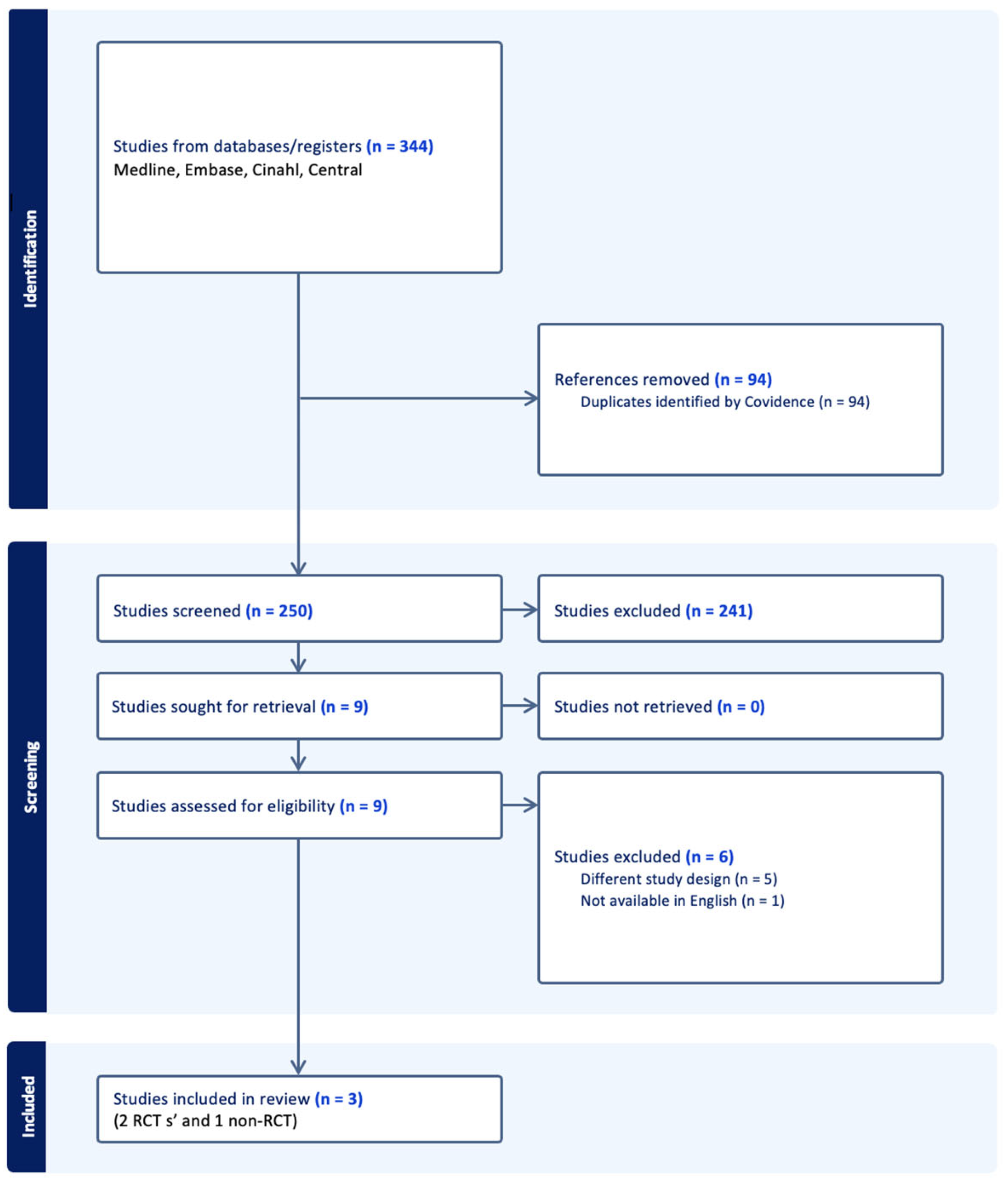
Of 344 search results, 341 studies were excluded (duplicates, irrelevant, and ineligibility, i.e., design, intervention, and language) (Figure 1).

4.2. Study Characteristics

The three included studies include two RCTs [14,15] and one non-RCT [16], as shown in Table 1; they were conducted in or after 2018. Two of them were from Brazil [14,16] and one from Australia [15].
Table 1. Summary of findings of included studies from 2018: Effect of preoperative pelvic floor muscle training (PPFMT) on post-radical prostatectomy (RP) erectile dysfunction.
Author (Year)CountrySample Size and DesignSurgical Approach and Nerve-SparingPPFMT Timing and DurationPPFMT CharacteristicsED Outcome Measure and Assessment TimeKey ResultsRisk of Bias
Milios et al. (2020) [15]AustraliaN = 97; RCT (Control n = 47; Case n = 50)Robotic RP; majority cavernosal nerve-sparing5 weeks pre-RP; 30 min/day6 sets/day; 120 contractions/day; 10 fast + 10 slow reps; education providedIIEF-5 at 2, 6, 12 weeks post-RPNo significant between-group difference (p = 0.45)Low
de Lira et al. (2019)
[14]
BrazilN = 31; RCT (Control n = 15; Case n = 16)Open RP: nerve-sparing not reportedPre-RP (timing NR); continued post-catheter removal for 3 months2 preoperative biofeedback-guided sessions; intensity increased per session; EMG usedIIEF-5 and EMG at 3 months post-RPNo significant difference (p = 0.745)Low
Perez et al. (2018)
[16]
BrazilN = 52; Non-RCT (Control n = 31; Case n = 20)Open retropubic RP; pudendal nerve-sparing reported10 sessions prior to RPBiofeedback-assisted PFMT; MVC-based; fast and slow contractions; rest intervals included physiotherapist guidanceIIEF-5 and NEBD at catheter removalED rate: 5% (case) vs. 53.1% (control), p = 0.0003Low
IIEF-5 = international index of erectile dysfunction, RCT = randomized control trial, EMG = Eeectromyographic recordings, NEBD = Neurodyn Evolution biofeedback device, MVC = maximum voluntary contraction.

4.3. Risk of Bias Assessment

All the included studies were assigned low risk of bias as per the Cochrane Rob 2 and NOS tool (Table 2 and Table 3) [12,13].

4.4. Results of Included Studies and Synthesis

All three studies included men between the ages of 45 and 75 who had been diagnosed with prostate cancer and underwent any kind of prostatectomy [14,15,16]. The PPFMT design varied among the three studies.
In the included RCT conducted by Milios et al. [15], the majority of the patients in the control and case group underwent robotic RP with cavernosal nerve sparing technique. During the intervention, participants were assigned two 30 min-sessions of PFMT starting five weeks prior to surgery with different posture and intensity for both case and control group, i.e., control group received three sets/day, with ten reps/set, performed in different postures (included being flat back, sitting, and upright position), while case (called “high-intensity”) group received six sets/day, with ten fast-paced (one-second duration) reps and then followed by ten slow-paced (10 s duration) reps per set; all were performed in a standing position. In addition, to optimize the efficacy of the training, verbal and written educational materials were provided to the participants during the PPFMT sessions. ANOVA test was conducted to report the continence score using expanded prostate Cancer Index Composite for clinical practice (EPIC_CP Qol) questionnaire, which showed a significant difference in between the group at 2-week point (p < 0.005) but not at 6- and 12-week interval. At last, Milios et al. [15] also reported routine use of post-operative PDE-5–I in all patients as a part of RP protocol.
In the other RCT study by de Lira et al. [14] all patients underwent open retropubic RP with no mentioning of nerve sparing technique. In terms of pelvic floor exercise regimen, the intervention group received two preoperative PFMT sessions guided by a physical therapist, including exercises and electromyographic biofeedback, and were instructed to continue performing the exercises throughout the preoperative period. The patients also resumed the exercises three times per day immediately after the urethral catheter removal following radical prostatectomy and increased the intensity per session for three months. The patients in the control group of this study also received usual post-prostatectomy physical therapist care [14].
In the non-RCT study conducted by Perez et al. [16] all participants underwent open RP with pudendal nerve sparing technique. Furthermore, the intervention group received ten physiotherapy training sessions guided by physiotherapists with the Neurodyn Evolution biofeedback device a few days prior to surgery. In this technique, the probe was inserted into the rectum while training in the right decubitus position, i.e., one leg is in extension and the other crosses over the first. The session started with a pressure taring set where volunteers performed a maximum of three voluntary contractions (MVCs), while observing the pressure on the screen. The highest reading on the Neurodyn monitor was recorded for each session. Following seven seconds of rest time after pressure taring set, the therapist progressed to set involving fast-paced contractions to target type II fibers. In this procedure, five triangular-shaped target waveforms are pre-programmed in accordance with a reference signal which varies by 0 to 40% from the patient’s MVC, and the participant is instructed to reproduce and keep the actual pressure in accordance with reference line by applying sufficient pressure to the probe. The set took 7 min to complete. Following rapid contractions, 1 min of rest interval was allotted before the start of a slow-paced set. Again, during the slow-paced contraction, slower target-shaped waveforms for sustained pressure are pre-programmed in accordance with reference signal which varies by 50% from the patient’s MVC, and the participant is instructed to reproduce and keep the actual pressure in accordance with the reference signal. The set took 6 min to complete and it targeted the type-I fibers. The patients in the control group of this study received usual post-prostatectomy care. The continence score was reported using ICIQ-SF questionnaire, which showed no significant difference between the two groups (p = 0.97).

4.5. Outcome Measuring Tool

The International Index of Erectile Function (IIEF-5) [17] questionnaire was used to assess ED in the included studies. The IIEF-5 is a five-domain, fifteen-question self-reported questionnaire that evaluates various dimensions of a person’s erectile function. The scores are classified as lowest to highest for severe, moderate, mild to moderate, mild, and no ED. The total score ranges from 5 to 25, with score range for severe ED (5–7), moderate ED (8–11), moderate to mild ED (12–16), mild ED (17–21), and no ED (22–25).

4.6. Outcome Measure (ED) and Follow-Up Period

According to Perez et al. [16], which was a non-randomized control trial (non-RCT) study, the ED incidence rate after prostatectomy was lower in the intervention group (5% of the patients) than in the control group (53.1% of the patients), precisely measured after the catheter removal post-RP.
In Milios et al. [15] study, there was no difference in ED rate improvement between the two groups at all follow-up time points (2, 6, and 12 weeks) (no comparative numbers were reported). Likewise, de Lira et al. [14] reported no significant difference in the IIEF-5 scores between the intervention and control groups (5.73 ± 7.43 vs. 6.70 ± 6.68, respectively) at the end of 3-month follow-up post-RP.

4.7. Certainty of Evidence

The certainty of evidence across the included studies was evaluated according to the Grading of Recommendations, Assessment, Development, and Evaluation (GRADE) approach (Table 4). Overall, the certainty of evidence was rated as low to moderate due to methodological limitations and variability in study findings.
Although all three studies demonstrated a low risk of bias based on the Cochrane RoB 2 and Newcastle-Ottawa assessment tools, the confidence in the overall evidence was downgraded because of inconsistency, imprecision, and indirectness. Both randomized controlled trials [14,15] reported no statistically significant improvement in postoperative erectile function between PPFMT and control groups, whereas the non-randomized study [16] demonstrated a significant reduction in ED incidence (5% vs. 53.1%, p = 0.0003). The observed inconsistency in results and the heterogeneity of intervention characteristics, including variations in frequency, duration, supervision, and timing, may have contributed to reduced comparability between studies. Furthermore, small sample sizes and short follow-up durations (ranging from immediate postoperative to 3 months) limited the precision and generalizability of the outcomes.
Based on these factors, the certainty of evidence regarding the effectiveness of preoperative pelvic floor muscle training (PPFMT) in improving postoperative erectile function following radical prostatectomy is low to moderate. Future well-powered randomized controlled trials with standardized training protocols, objective adherence measures, and longer follow-up periods are required to establish more definitive conclusions.

5. Discussion

Pelvic floor muscles, blood flow, and nerves play an important role in modulating normal erectile function. Prostatectomy can negatively impact erectile function by traumatizing the puborectalis muscles (PRMs) and ischiocavernosus muscle (ICM) of the pelvic floor muscles, along with vasculature injuries and nerves (especially cavernous nerve) damage [8,18].
This systematic review incorporated the findings after 2018 to look at the impact of PPFMT on the ED following prostate surgeries. The findings of three comparative studies were assessed. Only one non-RCT study by Perez et al. [16], which designed the intervention as PPFMT with biofeedback where participants performed ten sessions of PPFMT in 10 consecutive days prior to RP showed a significantly positive effect of PPFMT on postoperative ED recovery. They found that lower incidence of ED was more likely to be seen in patients receiving the PPFMT (5% in interventional vs. 53.1% in control) (Table 1). However, de Lire et al. [14] showed that two PPFMT sessions with biofeedback failed to produce a significant change in ED recovery (Table 1). Likewise, Milios et al. [15] reported no significant improvement following the two sessions of PFMT consisting of 120 contractions for 30 min five weeks prior to radical prostatectomy (Table 1).
The major limitation of this systematic review is the limited no. of studies included and inadequate description of the PPFMT intervention. Key details necessary for understanding the protocol were not provided, including number and duration of sessions, intervals, intensity, utilization of biofeedback or physiotherapy guidance, and the specific timing of the intervention. These gaps are substantial as they can be a significant source of intervention or implementation biases that have led to the current findings. In addition, the surgical techniques reported were heterogeneous (robotic assisted and open RP) among all included studies. Perez et al. [16] also did not reported on nerve sparing technique used during the RP, which might have led to mixed findings on the effect of ED. The Pentafecta outcomes were also not reported by any of the included studies. The study by De Lira et al. [14] and Perez et al. [16] did not mentioned about use of PDE-5 inhibitors while Milos et al. [15] reported it as positive post-RP, which can be another limitation to the included studies. Moreover, there is no rational or evidence-based design for PFMT sessions in the included studies. Accordingly, no solid conclusion can be made based on the results of the three included studies. The no improvement effect of ED in the outcomes of two studies can be attributed to their surgical technique, improper and ambiguous intervention, i.e., the characteristics of PPFMT were unclear and, possibly, insufficient to induce any effects. Upon searching the literature, we could find no valid or optimal PPFMT characteristics identified for radical prostatectomy care.
Secondly, nerve-sparing technique is a critical surgical determinant of erectile function recovery following radical prostatectomy and must be considered when interpreting the effects of PPFMT. The evidence consistently shows that bilateral nerve-sparing procedures are associated with earlier and higher rates of erectile function recovery, independent of adjunctive rehabilitation strategies [19,20]. Mechanistically, nerve sparing reduces neuropraxia and preserves nitric oxide-mediated neurovascular signaling essential for penile hemodynamics [21]. In the RCT by Milios et al. [15], where the majority of the participants underwent robotic RP with cavernosal nerve sparing and received routine postoperative PDE-5 inhibitor therapy, intensified preoperative PPFMT resulted in only transient functional improvement, with no sustained benefit at later follow-up. This finding suggests that when neural preservation and pharmacologic rehabilitation are already optimized, PPFMT alone may offer limited additional long-term benefit. In contrast, the RCT by de Lira et al. [14], which involved open RP without reporting nerve-sparing status, demonstrated no significant improvement despite biofeedback-guided PFMT, supporting the interpretation that insufficient or unreported neural preservation may constrain the efficacy of pelvic floor rehabilitation. Although Perez et al. [16] reported improved outcomes following intensive, biofeedback-assisted PPFMT, the lack of clear reporting on nerve-sparing technique introduces a major confounder, as these benefits may reflect preserved cavernous nerve integrity rather than an independent effect of PPFMT. Taken together, these findings support our interpretation that PPFMT functions as a supportive rather than determinant intervention, whose effectiveness is contingent upon surgical technique and neural preservation. Accordingly, conclusions regarding PPFMT efficacy remain limited without stratification by nerve-sparing approach, underscoring the need for future trials to incorporate standardized reporting of nerve preservation and control for pharmacologic rehabilitation to clarify the true additive role of PPFMT.
Moreover, the systematic review and meta-analysis by Chang et al. [22] compared the post-RP urinary incontinence in those who received vs. did not receive PPFMT. Upon reviewing the eleven included studies, they found that those who received PPFMT program significantly improved in post-operative UI rate by 36% at the 3-month follow-up, while no difference at the 6-month follow-up observed between case and control groups. Thus, they highlighted the fact that, although there is no long-term difference, those who received PPFMT may achieve improvement in their post-operative ED in a shorter duration compared to those who were not offered PPFMT. Some other measures can also be considered in PFMT programs, i.e., Yaacov et al.’s [7] narrative review on the effect of PFMT on sexual dysfunction and premature ejaculation found that sexual dysfunction could be improved when a combination of PFMT and manual physical therapy was employed. Another element that can be incorporated into the PFMT programs is the use of mobile apps to enhance compliance by sending notifications and providing feedback to increase the efficacy and motivation level of participants [23]. Consideration of co-morbidity before designing the intervention can be another initial step in having a homogeneous study population or to have a more individualized plan for participants that help evaluate the outcome of intervention in a less biased manner [24].
Yaacov et al. [7] has envisioned the future preoperative PFMT including the various modalities discussed by including education (anatomy and general tips), rehabilitation (manual therapy and muscle relaxation techniques), and the incorporation of additional tools with PFMT (biofeedback or stimulation or mobile apps).
Upon reviewing the relevant literature in other fields, we noticed that the included studies in this systematic review lack a proper design of the intervention, i.e., a clear outline of PPFMT. Effective sessions of PPFMT can be individualized and characterized in detail by identifying the target muscles, number of reps (exercise and rest intervals) per session, frequency of sessions per day/week, the interval or duration of the intervention, reasonably effective intensity, and can employ assisted modality (e.g., biofeedback). Evaluating progress and the outcome in a subjective and objective manner can also notably contribute to not only the effectiveness of intervention but also participant engagement.
Accordingly, a biopsychosocial model can define the components of a proper PPFMT intervention as mental preparation, access to health care, health literacy and cultural competence care, characteristics of sessions, and outcome measuring tools. It is undeniable that the health literacy of patients regarding PPFMT and its relationship with their disease has an undeniably profound impact on the outcome of PPFMT so that measuring health literacy and adopting measures to improve the health literacy level along with mental preparation before surgery should be incorporated into a proper design of an intervention. In addition, it helps to provide patients with culturally competent services. Considering access to health care systems can contribute to enhanced patient’s compliance rate to the intervention. Moreover, tele-mentoring or technology-assisted platforms like applications can also be employed for those who have difficulty accessing health care.
The findings of the current systematic review of three articles (two RCTs and one non-RCT) were not inclusive about the effect of PPFMT on the post-RP ED. Moreover, a solid conclusion cannot be derived due to improper designs of the intervention along with lacking detailed information on the characteristics of PPFMT session in the included studies. Continued PFMT treatment post-RP to review the exercise program and ensure proper activation of the pelvic floor and deep abdominal muscles could result in better management of ED [25]. More robust research with well-defined PPFMT session characteristics (frequency and interval of practice; reasonable duration and intensity; assisted modalities and muti-modal approaches; and subjective and objective measuring tool) incorporating access-assisted technology (mobile applications, tele-mentoring, or technology-assisted measures), while considering health literacy and cultural competence care of participants, is highly warranted.

Supplementary Materials

The following supporting information can be downloaded at: https://www.mdpi.com/article/10.3390/uro6010002/s1, File S1: PRISMA 2020 checklist. Ref. [11] is cited in Supplementary Materials.

Author Contributions

Conceptualization: W.S. (Walid Shahrour). and V.M.; Methodology: V.M., N.A.B. and D.L.; Validation: V.M. and W.S. (Walid Shahrour); Formal Analysis: V.M., D.L. and E.R.; Investigation: D.L. and N.A.B.; Data Curation: D.L., N.A.B., F.D. and E.R.; Writing—Original Draft Preparation: D.L., V.M., F.D, N.A.B. and W.S. (Waleed Shabana); Writing—Review & Editing: D.L., N.A.B., F.D., E.R., S.P., O.A., W.S. (Waleed Shabana) and W.S. (Walid Shahrour); Visualization: V.M., D.L. and O.A.; Supervision: W.S. (Waleed Shabana) and W.S. (Walid Shahrour); Project Administration: V.M. and W.S. (Walid Shahrour). All authors have read and agreed to the published version of the manuscript.

Funding

This research received no external funding.

Institutional Review Board Statement

Not applicable.

Informed Consent Statement

Not applicable.

Data Availability Statement

No new data were created or analyzed in this study. Data sharing is not applicable to this article.

Conflicts of Interest

Author Emmanuelle Rousseau is a physiotherapist at Evolve Physiotherapy, Thunder Bay, ON, Canada. All authors declare no conflicts of interest.

References

  1. Emanu, J.C.; Avildsen, I.K.; Nelson, C.J. Erectile dysfunction after radical prostatectomy. Curr. Opin. Support. Palliat. Care 2016, 10, 102–107. [Google Scholar] [CrossRef] [PubMed]
  2. Bratu, O.; Oprea, I.; Marcu, D.; Spinu, D.; Niculae, A.; Geavlete, B.; Mischianu, D. Erectile dysfunction post-radical prostatectomy-a challenge for both patient and physician. J. Med. Life 2017, 10, 13–18. [Google Scholar] [PubMed]
  3. Poirier, A.E.; Ruan, Y.; Walter, S.D.; Franco, E.L.; Villeneuve, P.J.; King, W.D.; Volesky, K.D.; O’Sullivan, D.E.; Friedenreich, C.M.; Brenner, D.R. The future burden of cancer in Canada: Long-term cancer incidence projections 2013–2042. Cancer Epidemiol. 2019, 59, 199–207. [Google Scholar] [CrossRef] [PubMed]
  4. Domes, T.; Najafabadi, B.T.; Roberts, M.; Campbell, J.; Flannigan, R.; Bach, P.; Patel, P.; Langille, G.; Krakowsky, Y.; Violette, P.D. Canadian Urological Association guideline: Erectile dysfunction. Can. Urol. Assoc. J. 2021, 15, 310. [Google Scholar] [CrossRef]
  5. Mobley, D.F.; Khera, M.; Baum, N. Recent advances in the treatment of erectile dysfunction. Postgrad. Med. J. 2017, 93, 679–685. [Google Scholar] [CrossRef]
  6. Hay-Smith, J.; Dumoulin, C. Pelvic floor muscle training versus no treatment, or inactive control treatments, for urinary incontinence in women. In Cochrane Database of Systematic Reviews; Hay-Smith, J., Ed.; John Wiley & Sons, Ltd.: Hoboken, NJ, USA, 2006. [Google Scholar] [CrossRef]
  7. Yaacov, D.; Nelinger, G.; Kalichman, L. The Effect of Pelvic Floor Rehabilitation on Males with Sexual Dysfunction: A Narrative Review. Sex. Med. Rev. 2022, 10, 162–167. [Google Scholar] [CrossRef]
  8. Rosenbaum, T.Y. REVIEWS: Pelvic Floor Involvement in Male and Female Sexual Dysfunction and the Role of Pelvic Floor Rehabilitation in Treatment: A Literature Review. J. Sex. Med. 2007, 4, 4–13. [Google Scholar] [CrossRef]
  9. Geraerts, I.; van Poppel, H.; Devoogdt, N.; de Groef, A.; Fieuws, S.; van Kampen, M. Pelvic floor muscle training for erectile dysfunction and climacturia 1 year after nerve sparing radical prostatectomy: A randomized controlled trial. Int. J. Impot. Res. 2016, 28, 9–13. [Google Scholar] [CrossRef]
  10. Wong, C.; Louie, D.R.; Beach, C. A Systematic Review of Pelvic Floor Muscle Training for Erectile Dysfunction After Prostatectomy and Recommendations to Guide Further Research. J. Sex. Med. 2020, 17, 737–748. [Google Scholar] [CrossRef]
  11. Page, M.J.; McKenzie, J.E.; Bossuyt, P.M.; Boutron, I.; Hoffmann, T.C.; Mulrow, C.D.; Shamseer, L.; Tetzlaff, J.M.; Akl, E.A.; Brennan, S.E.; et al. The PRISMA 2020 statement: An updated guideline for reporting systematic reviews. BMJ 2021, 372, n71. [Google Scholar] [CrossRef]
  12. Cochrane Handbook for Systematic Reviews of Interventions. Cochrane Training. Available online: https://training.cochrane.org/handbook (accessed on 17 August 2023).
  13. Stang, A. Critical evaluation of the Newcastle-Ottawa scale for the assessment of the quality of nonrandomized studies in meta-analyses. Eur. J. Epidemiol. 2010, 25, 603–605. [Google Scholar] [CrossRef] [PubMed]
  14. de Lira, G.H.S.; Fornari, A.; Cardoso, L.F.; Aranchipe, M.; Kretiska, C.; Rhoden, E.L. Effects of perioperative pelvic floor muscle training on early recovery of urinary continence and erectile function in men undergoing radical prostatectomy: A randomized clinical trial. Int. Braz J. Urol. Off. J. Braz. Soc. Urol. 2019, 45, 1196–1203. [Google Scholar] [CrossRef] [PubMed]
  15. Milios, J.E.; Ackland, T.R.; Green, D.J. Pelvic Floor Muscle Training and Erectile Dysfunction in Radical Prostatectomy: A Randomized Controlled Trial Investigating a Non-Invasive Addition to Penile Rehabilitation. Sex. Med. 2020, 8, 414–421. [Google Scholar] [CrossRef] [PubMed]
  16. Perez, F.S.B.; Rosa, N.C.; da Rocha, A.F.; Peixoto, L.R.T.; Miosso, C.J. Effects of biofeedback in preventing urinary incontinence and erectile dysfunction after radical prostatectomy. Front. Oncol. 2018, 8, 310102. [Google Scholar] [CrossRef]
  17. Rosen, R.C.; Cappelleri, J.C.; Smith, M.D.; Lipsky, J.; Peñ, B.M. Development and evaluation of an abridged, 5-item version of the International Index of Erectile Function (IIEF-5) as a diagnostic tool for erectile dysfunction. Int. J. Impot. Res. 1999, 11, 319–326. [Google Scholar] [CrossRef]
  18. Tai, J.W.; Sorkhi, S.R.; Trivedi, I.; Sakamoto, K.; Albo, M.; Bhargava, V.; Rajasekaran, M.R. Evaluation of Age- and Radical-Prostatectomy Related Changes in Male Pelvic Floor Anatomy Based on Magnetic Resonance Imaging and 3-Dimensional Reconstruction. World J. Men’s Health 2021, 39, 566. [Google Scholar] [CrossRef]
  19. Nilsson, A.E.; Carlsson, S.; Jonsson, N.M.; Onelöv, E.; Steineck, G.; Wiklund, N.P. Erectile function after robotic nerve sparing and semi-sparing of the neurovascular bundles. J. Robot. Surg. 2007, 1, 191–195. [Google Scholar] [CrossRef]
  20. Capogrosso, P.; Salonia, A.; Briganti, A.; Montorsi, F. Postprostatectomy erectile dysfunction: A review. World J. men’s health 2016, 34, 73–88. [Google Scholar] [CrossRef]
  21. Salonia, A.; Bettocchi, C.; Boeri, L.; Capogrosso, P.; Carvalho, J.; Cilesiz, N.C.; Cocci, A.; Corona, G.; Dimitropoulos, K.; Gül, M.; et al. EAU guidelines on sexual and reproductive health. Eur. Urol. 2021, 80, 333–357. [Google Scholar] [CrossRef]
  22. Chang, J.I.; Lam, V.; Patel, M.I. Preoperative Pelvic Floor Muscle Exercise and Postprostatectomy Incontinence: A Systematic Review and Meta-analysis. Eur. Urol. 2016, 69, 460–467. [Google Scholar] [CrossRef]
  23. Latorre, G.F.S.; de Fraga, R.; Seleme, M.R.; Mueller, C.V.; Berghmans, B. An ideal e-health system for pelvic floor muscle training adherence: Systematic review. Neurourol. Urodyn. 2019, 38, 63–80. [Google Scholar] [CrossRef]
  24. Feinstein, A.R. The pre-therapeutic classification of co-morbidity in chronic disease. J. Chronic Dis. 1970, 23, 455–468. [Google Scholar] [CrossRef]
  25. Siegel, A.L. Pelvic Floor Muscle Training in Males: Practical Applications. Urology 2014, 84, 1–7. [Google Scholar] [CrossRef] [PubMed]
Figure 1. PRISMA flow chart for the included studies.
Uro 06 00002 g001
Table 2. Risk of Bias assessment using the Cochrane Risk of Bias Tool.
Study IDReviewer NameSequence GenerationAllocation ConcealmentBlinding of Participants and PersonnelBlinding of Outcome AssessmentIncomplete Outcome DataSelective ReportingOther Sources of Bias
de Lira et al. (2019) [14] ConsensusLowHighHighLowLowLowLow
Milios et al. (2020) [15]ConsensusLowLowLowLowLowLowLow
Table 3. Quality assessment using the Newcastle-Ottawa quality assessment form for cohort studies.
StudyPerez et al. (2018) [16]
Representativeness1
Selection1
Ascertainment1
Demonstration1
Comparability2
Outcome assessment0
Follow-up1
Adequacy1
VerdictHigh quality
Table 4. Certainty of evidence (GRADE assessment).
DomainAssessmentExplanation
Risk of BiasNot seriousAll studies rated as low risk of bias (Cochrane RoB 2 and NOS).
InconsistencySeriousConflicting results between RCTs and non-RCT.
IndirectnessSeriousVariation in intervention design and timing.
ImprecisionSeriousSmall sample sizes and short follow-up periods.
Publication BiasUndetectedLimited number of studies (n = 3).
Overall CertaintyLow–moderateFurther research likely to influence confidence in the estimate.
Disclaimer/Publisher’s Note: The statements, opinions and data contained in all publications are solely those of the individual author(s) and contributor(s) and not of MDPI and/or the editor(s). MDPI and/or the editor(s) disclaim responsibility for any injury to people or property resulting from any ideas, methods, instructions or products referred to in the content.