Review

Linking Psychological Stress to Epigenetic Regulation via the Gut–Liver–Brain Axis in Irritable Bowel Syndrome and Metabolic Dysfunction-Associated Fatty Liver Disease


by
Annachiara Crocetta
1,2,
Maria-Anna Giannelou
3,
Agata Benfante
4,
Lorys Castelli
4 and
Lemonica Koumbi
1,2,4,*
1
Functional Neuroimaging and Complex Neural Systems (FOCUS) Laboratory, Department of Psychology, University of Turin, Via Verdi 10, 10124 Turin, Italy
2
Department of Psychology, GCS fMRI, Koelliker Hospital, University of Turin, 10134 Turin, Italy
3
Department of Nutrition and Dietetics, University of Thessaly, 42132 Trikala, Greece
4
Department of Psychology, University of Turin, Via Verdi 10, 10124 Turin, Italy
*
Author to whom correspondence should be addressed.
Livers 2025, 5(3), 43; https://doi.org/10.3390/livers5030043
Submission received: 2 July 2025 / Revised: 28 July 2025 / Accepted: 22 August 2025 / Published: 5 September 2025

Abstract

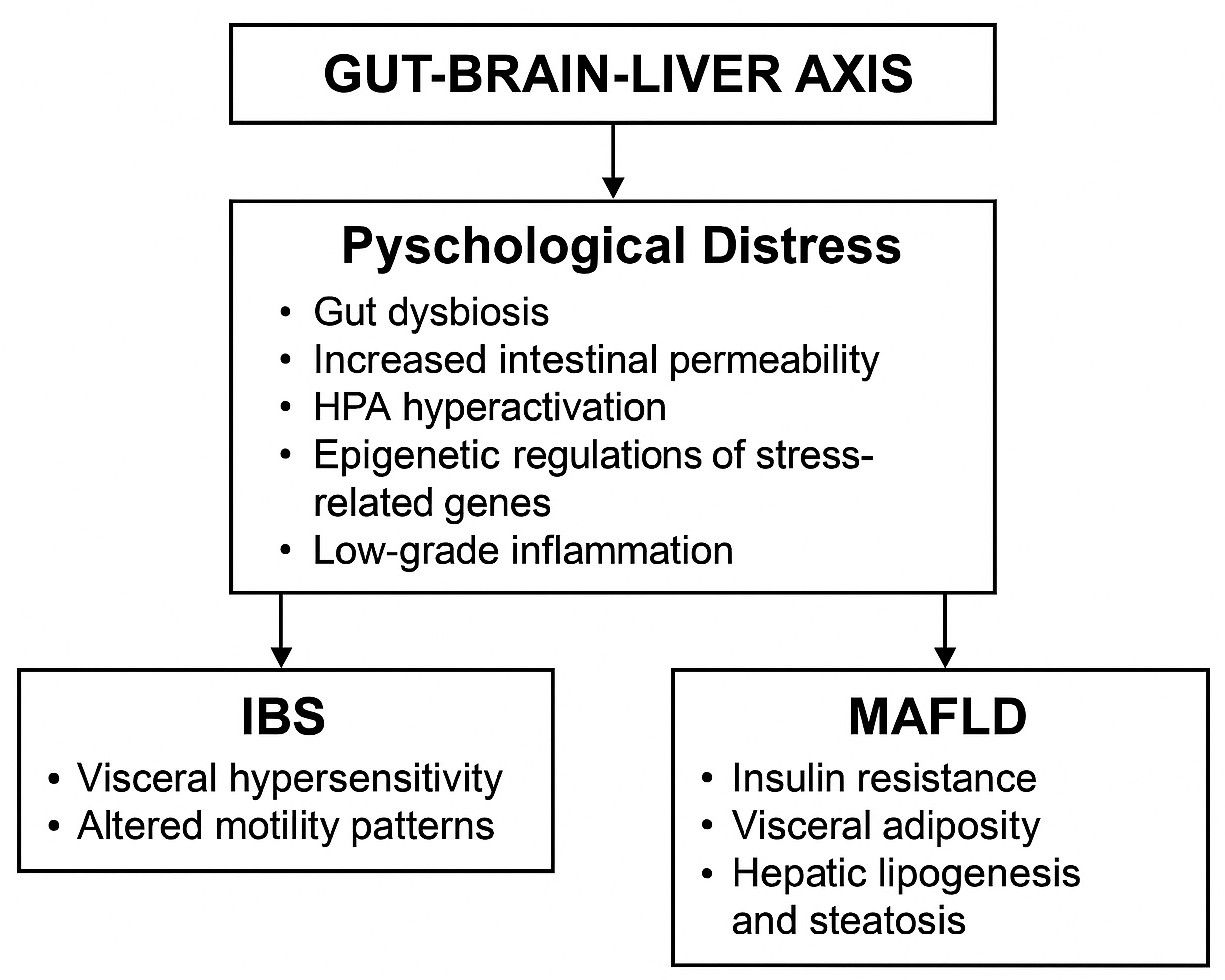
Irritable Bowel Syndrome (IBS) and Metabolic dysfunction-associated fatty liver disease (MAFLD) have traditionally been viewed as disorders of distinct organ systems. IBS is a gut–brain axis disorder characterized by abdominal pain, altered bowel habits, and psychological comorbidities. MAFLD, recently redefined to emphasize its metabolic underpinnings, is the hepatic manifestation of systemic metabolic dysfunction. Growing evidence suggests that these conditions share overlapping pathophysiological mechanisms linked through disruption of the gut–liver–brain axis (GLBA), including psychological stress, gut dysbiosis, impaired intestinal permeability, systemic inflammation, and altered neuroendocrine signaling. Neuroimaging studies further reveal functional alterations in brain regions responsible for interoception, emotional regulation, and stress responsiveness in both disorders. This narrative review explores how psychological distress influences the onset and progression of IBS and MAFLD via GLBA dysfunction and stress-induced epigenetic reprogramming. A targeted literature search of major biomedical databases, supplemented by manual screening, identified relevant observational, clinical, neuroimaging, and molecular studies. Findings indicate that chronic psychological distress activates the hypothalamic–pituitary–adrenal (HPA) axis, elevates cortisol, disrupts gut microbiota, and reduces vagal tone; amplifying intestinal permeability and microbial translocation. These changes promote hepatic inflammation and gastrointestinal symptoms. Stress-related epigenetic modifications further impair GLBA communication, while psychological and lifestyle interventions may reverse some of these molecular imprints. Recognizing the shared neuromodulation and epigenetic mechanisms that link IBS and MAFLD opens promising avenues for integrated therapeutic strategies targeting the GLBA to improve outcomes across both conditions.
Keywords: irritable bowel syndrome (IBS); non-alcoholic fatty liver disease (NAFLD); gut microbiota; Metabolic dysfunction-associated fatty liver disease (MAFLD); gut–liver–brain axis (GLBA); hypothalamic–pituitary–adrenal (HPA) axis; epigenetic mechanisms; psychological distress; short-chain fatty acids (SCFAs); DNA methylation irritable bowel syndrome (IBS); non-alcoholic fatty liver disease (NAFLD); gut microbiota; Metabolic dysfunction-associated fatty liver disease (MAFLD); gut–liver–brain axis (GLBA); hypothalamic–pituitary–adrenal (HPA) axis; epigenetic mechanisms; psychological distress; short-chain fatty acids (SCFAs); DNA methylation
Graphical Abstract