Article

Production of Diagnostic and Therapeutic Radionuclides with Uranium and Thorium Molten Salt Fuel Cycles


1
Department of Nuclear Engineering, University of Tennessee Knoxville, Knoxville, TN 37996, USA
2
Walker Department of Mechanical Engineering, University of Texas at Austin, Austin, TX 78712, USA
3
Oak Ridge National Laboratory, Oak Ridge, TN 37830, USA
*
Author to whom correspondence should be addressed.
J. Nucl. Eng. 2026, 7(1), 9; https://doi.org/10.3390/jne7010009
Submission received: 1 August 2025 / Revised: 20 December 2025 / Accepted: 5 January 2026 / Published: 23 January 2026

Abstract

Targeted radionuclide therapy (TRT) is an innovative and flexible approach for treating various forms of cancer, enabling selective delivery of cytotoxic radiation to cancerous cells while minimizing damage to healthy tissue. Although TRT has proven to be highly promising for treating even advanced-stage cancers, ensuring a stable supply of the radionuclides essential for its use remains a significant challenge today. This is also true for radionuclides utilized in nuclear imaging procedures, such as Positron Emission Tomography (PET) and Single Photon Emission Computed Tomography (SPECT). Liquid-fueled molten salt reactors (MSRs) are promising for producing large quantities of highly desirable radionuclides for imaging and therapy, offering the ability to recover these radionuclides online without the need for interruptions to power production. In this study, the production of numerous beta- and alpha-emitting radionuclides for use in TRT and diagnostic procedures was studied in two small, geometrically identical, thermal spectrum MSR models—one operating with LEU fuel, and the other with a mixture of HALEU and thorium—using a novel MSR refueling and waste management concept. For therapeutic alpha emitters such as 225Ac and 213Bi, the impact of thorium utilization on production yields was significant, facilitating greatly increased production.

1. Introduction

1.1. Targeted Radionuclide Therapy as a New Paradigm in Nuclear Medicine

Cancer remains the second leading cause of death in the United States, and is reported as the leading cause of death for individuals under the age of 85 years [1]. The American Cancer Society (ACS) predicts that, in the year 2025, 2,041,910 new cancer cases will arise in the United States, leading to 618,120 deaths [1]. Although a number of anticancer agents and cytotoxic technologies are currently available to patients and are clinically utilized, many of these are inherently limited by their lack of specificity [2]. Most conventional treatment approaches, such as chemotherapy and traditional external beam radiotherapy, focus on causing death in populations of cells which exhibit uncontrolled growth [2]. As a result, rapidly dividing healthy cells, such as those within the gut, may be destroyed alongside malignant cells [2,3]. This poses significant challenges in treating human cancers, often requiring the dosages of traditional anticancer drugs to be limited and resulting in impaired quality of life in treated patients [4]. As explained by Chen et al. (2007), for chemotherapeutic agents, oxidative stress, either directly or indirectly caused within noncancerous cells by these agents, is a primary underlying mechanism responsible for the toxicity of anticancer drugs in healthy tissues, including the heart and brain [4]. This collateral damage to healthy, noncancerous tissue by conventional anticancer agents is associated with severe negative side-effects in treated patients, both short- and long-term, with the latter being encountered later on during a patient’s lifetime following the completion of their treatment [4,5]. Accelerated aging is one example of a significant, long-term adverse effect which may be caused by traditional anti-cancer drugs, most notably chemotherapeutic agents, and is especially concerning for pediatric cancer patients treated with these methods [5,6,7,8]. These complications caused by treatment nonspecificity make managing late-stage, metastatic cancers with traditional anti-cancer agents particularly challenging, thus warranting increased research and development into alternative treatment approaches which can effectively destroy cancerous cells while minimizing damage to healthy tissues.
An alternative class of cancer therapies, known as “targeted therapies,” seek to cause damage to cancerous cells only while minimizing damage to healthy ones [2]. Targeted radionuclide therapy (TRT) is an example of one such treatment approach which has been studied extensively in recent years, showing great promise in treating a variety of cancers, including those which are resistant to other forms of treatment [9]. In TRT, a radionuclide with favorable nuclear decay properties for therapy (e.g., alpha, beta, or Auger electron emitters) is attached to a cancer cell-specific molecule which naturally seeks out and binds to antigens expressed on the surface of tumor cells [10,11]. The same principle approach may be used for nuclear diagnostic procedures like Positron Emission Tomography (PET) and Single Photon Emission Computed Tomography (SPECT), where a radionuclide suitable for imaging (a positron or gamma emitter, respectively) is attached to a targeting agent, enabling it to be sent to sites where cancerous cells are present and allowing them to be imaged. Suitable targeting agents come in a variety of forms, and can include monoclonal antibodies [12,13,14,15], peptides and proteins [16,17,18,19], small molecules [20], and nanoparticles [21,22,23,24].
While organic radionuclides, such as the nuclear imaging isotopes 11C and 15O, are typically conjugated to a targeting agent through a covalent bond, metallic radionuclides like 225Ac and 213Bi are conjugated via the use of a chelator, which binds to the metal ion and allows it to be attached to the targeting agent [25]. The use of targeting agents which selectively bind to antigens present on cancerous cells facilitates the targeting of these calls directly rather than rapidly dividing cells in general. In the case of TRT, this allows for the delivery of cytotoxic radiation directly to tumor sites while largely sparing noncancerous cells from damage, thus minimizing the adverse effects caused by collateral damage to healthy tissue.
A number of beta-emitting radionuclides are currently used clinically in human patients for TRT, with a few notable examples including 177Lu, 90Y, and 131I. Two 177Lu-based radiopharmaceuticals, 177Lu-DOTA-TATE (Lutathera®) and 177Lu-PSMA-617 (PluvictoTM) received approval from the U.S. Food and Drug Administration (FDA) in January 2018 and March 2022, respectively, for use in human cancer patients [26,27]. 177Lu-DOTA-TATE, as a 177Lu-labeled somatostatin analogue, is used worldwide for TRT of somatostatin receptor (SSTR)-positive gastroenteropancreatic neuroendocrine tumors (GEP-NETs) in adult human patients [28]. On 23 April 2024, the FDA approved 177Lu-DOTA-TATE (Lutathera®) for use in pediatric patients 12 years of age and older presenting with GEP-NETS, further extending the impact of TRT with 177Lu to treating pediatric in addition to adult cancers [27]. 177Lu-PSMA-617, on the other hand, is the first radiopharmaceutical to receive approval from the FDA for treatment of prostate cancer, combining the urea-based small molecule PSMA-617 with the cytotoxic payload, 177Lu [26]. PSMA-617 exhibits a high affinity for PSMA, which is commonly overexpressed on prostate adenocarcinomas though shows only limited expression in benign tissues, making PSMA an ideal target for TRT of prostate cancer [29]. 90Y-ibritumomab tiuxetan (Zevalin®) and 131I-tositumomab (Bexxar®) are two additional TRT radiopharmaceuticals which are approved by the FDA for use in human cancer patients, with both being used in the treatment of non-Hodgkin’s lymphoma [30,31].
Leveraging upon the success of TRT using beta-emitting radionuclides, recent research has highlighted the significant potential of alpha-emitters in providing safe, efficacious, and minimally invasive treatments for a variety of cancer types. With their high linear energy transfer (LET) and short range in tissue, equivalent to only a few cell diameters [32], alpha particles enable selective tumor targeting, with the cytotoxic effects of radiation being limited to the cancerous cells and the surrounding tumor microenvironment [33]. Damage to healthy tissue is minimized, and fewer particle tracks are needed to cause cell death compared with beta particles due to the significantly higher relative biological effectiveness (RBE) of alpha versus beta radiation [33]. This RBE has been observed to be 2- to 10-fold higher for alpha particle radiation when compared with beta particles [34]. Furthermore, due to its high LET, cell damage by alpha particle radiation exhibits a strongly reduced dependency on oxygenation [34]. This is a significant advantage of TRT with alpha-emitters compared with other forms of radiotherapy, as it allows for treatment of hypoxic tumors, which are challenging to treat with other forms of radiation due to the increased radiation resistance caused by the oxygen-deprived environment [34].
Today, only one alpha-emitting radioisotope, 223Ra, has received approval from the FDA for clinical use in cancer therapy [35]. 223Ra is used in the form of 223Ra dichloride (223RaCl2) for treatment of metastatic castration-resistant prostate cancer (mCRPC) patients who present with bone metastases, and has been proven to significantly extend the lives of treated patients [36]. Although it offers a safe and effective treatment option, 223RaCl2 is inherently limited to treating only osseous metastatic disease, thus necessitating the exploration of alternative therapeutic radiopharmaceuticals for treatment of other cancer types.
Various alpha-emitting radionuclides are highly promising for use in TRT [37]. Among these, 225Ac, 211At, 212Bi, 213Bi, 212Pb, 223Ra, 149Tb, and 227Th have been identified in the recent literature as the “hopeful eight” due to their favorable nuclear decay properties and the significant body of research available regarding their production and chemistry, positioning them as ideal candidates for continued study [37]. In particular, 225Ac has been at the forefront of many recent studies, both in preclinical animal models and in-human clinical trials, for TAT. Numerous different 225Ac radiopharmaceuticals have been successfully developed and investigated across clinical trials for use in treating prostate cancer, the most notable among these including 225Ac-PSMA-617, 225Ac-PSMA-I&T, and 225Ac-J591 [38]. Highly promising results have also been observed in using 225Ac-based radiopharmaceuticals for treating acute myeloid leukemia (AML) [39,40], breast cancer [41], and ovarian cancer [42]. Although 225Ac has demonstrated significant promise across a number of recent studies, both preclinical and clinical, production of this critical radioisotope remains challenging and presents a significant barrier to the development of TAT [38]. For TAT to be made clinically available to patients in need in the U.S. and worldwide, efficient strategies for producing high-purity samples of 225Ac and other TAT radionuclides must be established. The same is true for ensuring a stable supply of clinically utilized radionuclides for imaging (i.e., PET, SPECT) or therapy, including TRT and palliative therapies.

1.2. Molten Salt Reactors for Clean Power and Radioisotope Production

Although TRT with beta-, alpha-, or Auger electron-emitting radionuclides has been shown to be advantageous for managing advanced and late-stage cancers, ensuring a stable supply of these critical radionuclides for use in TRT, as well as positron- or gamma-emitting radionuclides for imaging procedures like PET and SPECT, remains a challenge [9,38]. Molten salt reactors (MSRs), where the nuclear fuel and coolant are both in the form of liquid molten alkali-halide salts, are advanced nuclear fission reactor designs which are highly promising for use in both clean electricity generation and the production of medical radionuclides [43]. These reactors were studied extensively during the 1960s as part of the Oak Ridge National Laboratory (ORNL) Molten Salt Reactor Program (MSRP) [44], with a landmark achievement of this effort being the development and successful operation of the Molten Salt Reactor Experiment (MSRE) [45]. The MSRE was an 8 MWth demonstration reactor which operated with 33% enriched 235U dissolved within molten fluoride salts at 1200 °F, which circulated throughout a core of graphite bars [45]. By March 1968, 9000 equivalent full-power hours were achieved with the MSRE using 235U [45]. Leveraging upon this success, 233U was added to the fuel salt to study its performance in an operating MSR, and 2500 equivalent full-power hours were achieved with this fissile fuel [45]. The MSRE was the first reactor in the world to be fueled with 233U [45].
Following the success of the MSRP, research into MSRs continued at ORNL, and commercial interest in these reactor designs has increased in recent years with their selection by the Generation IV International Forum (GIF) as one of the six most promising advanced reactor designs for future development [46]. In addition to the numerous advantages offered by the use of liquid molten salt fuels, including a more highly negative fuel temperature feedback coefficient (FTC) of reactivity, these unique reactor designs also boast the ability to operate with thorium-based fuels, employing the 232Th/233U fuel cycle. With this fuel cycle, fissile 233U fuel is bred from fertile 232Th, which is incorporated into the fuel salt alongside a startup fissile material (typically 235U). Following the capture of a neutron, 232Th undergoes beta decay to produce 233Pa, which subsequently beta decays to 233U. This is represented by Equation (1) below [47]:
Th 232 ( n , γ ) Th 233 β Pa 233 β U 233
In addition to clean power production, MSRs have recently gained research attention regarding their use in the production of desirable radionuclides for use in diagnostic and therapeutic medical procedures. With MSRs, valuable radioisotopes may be extracted online without interruptions to power production, with the liquid nature of the fuel enabling the use of chemical separation procedures such as evaporation/distillation, chemical reduction, electro-deposition, and/or chemical oxidation [43]. Furthermore, the use of thorium-based fuels enables the production of neptunium-chain radionuclides, which see only limited production in a traditional uranium fuel cycle. The production of medically desirable radionuclides in liquid-fueled MSRs has previously been explored with promising results in a number of different studies, particularly with Monte Carlo modeling tools like the SCALE [48] and Serpent-2 [49] codes.
Chen et al. (2021) used SCALE TRITON to study the production of 131I and 90Sr in a modular MSR model, specifically examining equilibrium times, yields, and cooling times for isotopic impurities [50]. This study showed significant production of both radionuclides, with high purity samples being capable of recovery in the MSR for medical use [50]. Using HF-H2 bubbling for transfer of 131I from the fuel salt to the off-gas system, it was shown that 3.49E5 TBq of 131I could be extracted from the salt each year, with 1296 TBq being available for extraction from the off-gas system using the electric field method of recovery [50]. Zhang et al. (2023) used the Serpent code to model the production of 99Mo in an LEU-fueled MSR design based on the MSRE, with the model being benchmarked against JMCT and historical MSRE data from ORNL design reports [51]. Additional studies modeling 99Mo production in MSRs have been performed with SCALE TRITON [52], with Cornejo et al. (2021) concluding that MSRs can supply 99Mo in quantities which far exceed global demand [53].
With their ability to employ both traditional uranium-based as well as thorium-based fuels, detailed analysis into the impact of fuel cycle choice on radionuclide production is desirable for MSRs which are to be used for this purpose. In this study, the production of both diagnostic and therapeutic radionuclides will be examined in two geometrically identical, small, 400 MWth MSR models: one operating with LEU fuel, and the other with a mixture of HALEU and 232Th. These MSR models both utilize a novel refueling and waste management strategy previously explored by the authors in neutronic studies using uranium and thorium fuel cycles [54,55,56] and which was first proposed by Wheeler and Chvala (2021) in [57]. Referred to as the “Sourdough” refueling and waste management strategy, this concept has demonstrated promise for use in liquid-fueled MSRs as a way to rapidly grow an MSR fleet and postpone the need to manage high-level waste (HLW). The prior work by the authors included modeling batch and continuous refueling with this novel refueling strategy in these MSR designs to assess its performance over extended operation, with long-term depletion being simulated with SCALE 6.3.1 TRITON. Recently, the production of diagnostic and therapeutic radionuclides was examined in these models in preliminary works by the authors of [58,59]; however, these studies were very limited in their scope, with only a small number of radionuclides being studied. Furthermore, in [58], radionuclide production was only tracked within the active fuel salt, with no consideration being given to the significant quantities of valuable radionuclides which are produced in the offgas system or are routinely removed as noble metal fission products. The present study will build upon the authors’ previous research to perform a detailed analysis of the production of 16 different diagnostic and therapeutic radionuclides using a revised modeling framework to include active tracking of radionuclides removed as gaseous or noble metal fission products. Additionally, this work provides a unique contribution to the overall study of modeling medical radionuclide production in MSRs, with it being the first detailed fuel cycle comparison study of radionuclide production using the novel Sourdough strategy.

2. Materials and Methods

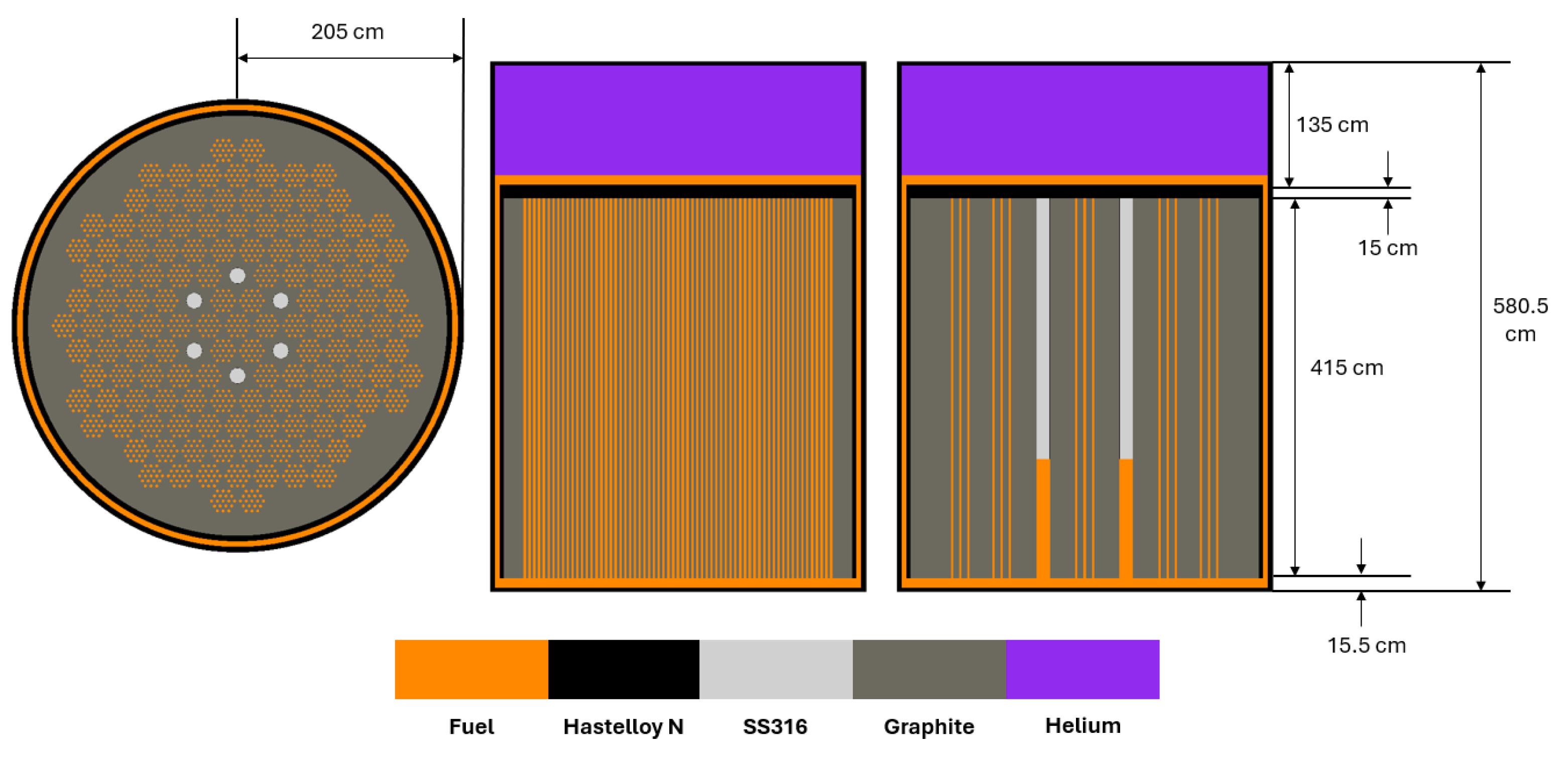
In this study, an MSR model previously developed and studied by the authors in the SCALE 6.3.1 code system, EIRENE, is utilized for modeling radionuclide production during simulated depletion. EIRENE (Example Integral REactor for Nuclear Education) is a small, 400 MWth, graphite moderated, thermal spectrum MSR model fueled by low enriched uranium (LEU). The fissile uranium fuel is incorporated in a FLiBe fuel salt with 63.333% LiF, 31.667% BeF2, and 5.000% UF4, with a nominal 235U enrichment level of 2.65% [54]. The fuel salt flows upwards through the fuel channels, with these channels existing in three separate regions: Region I (R-I), Region II (R-II), and Region III (R-III), each region containing fuel channels of a specific radius. Region I contains the smallest fuel channels, each having a radius of 1.1570 cm, whereas Region II fuel channels are slightly larger, with radii of 1.2198 cm [54]. The largest fuel channels are within Region III, each one having a radius of 1.3485 cm [54]. The fuel channel design and overall geometry of EIRENE is adapted from the Integral Molten Salt Reactor (IMSR) model developed by Carter and Borrelli in [60]. EIRENE additionally features six SS316 shutdown rods positioned symmetrically within the core, a Hastelloy-N reflector, core blanket, and vessel, and an upper plenum filled with pure helium gas. This upper plenum is positioned immediately above the outlet plenum, and exists to accommodate the growth of in-core fuel salt volume from refueling, a feature which was studied previously by the authors [54].
The EIRENE model was initially developed for the purpose of demonstrating a novel refueling and waste management concept, the “Sourdough” fuel cycle, in which fissile fuel salt is allowed to grow within the reactor core from routine refueling rather than maintaining a constant fuel salt volume. Chemically identical or compatible “refuel” salt is added to the core either continuously at a defined rate, or in batches at set time intervals [54,57]. While drainage of fuel salt from the core would typically be simulated alongside refuel additions in a typical MSR fuel cycle modeling approach, with the Sourdough fuel cycle, no drainage is implemented, with the total in-core fuel salt volume growing with each refuel salt addition [54,57]. After enough time, the total fuel salt volume will double with respect to its starting quantity, with the time at which this occurs being referred to as the “doubling time” [54,57]. With this refueling approach, the entire fuel salt volume maintains criticality throughout depletion, meaning that when doubling of the volume occurs, half of it may be removed and transferred to another reactor of identical design for use as startup fuel [54,57]. In this way, critical fuel salt is “grown” from an initial fuel “starter,” facilitating the rapid growth of an operating MSR fleet in addition to postponing the need to manage high-level waste (HLW) streams due to fuel salt simply being transferred from one reactor to another [54,57]. Further details on this fuel cycle and its applications, in addition to its implementation within EIRENE, may be found in a previous work by the authors, which examined the neutronic performance of the Sourdough fuel cycle with SCALE 6.3.1 TRITON [54]. The batch refueling procedure outlined in [54] is utilized in this present study with SCALE 6.3.1 TRITON; however, rather than simulating different refuel salt enrichment levels, only one enrichment level, 19.75%, is defined and used for refueling in this study. This enrichment level was chosen to allow for direct comparison between EIRENE and its thorium-fueled counterpart, Th-EIRENE.
Th-EIRENE is a structurally and geometrically identical model to EIRENE, with the only difference being its fuel salt. Fertile 232Th is incorporated into the FLiBe fuel salt of Th-EIRENE in the form of ThF4, with a salt molar composition of 61.333% LiF, 30.667% BeF2, 1.420% UF4, and 6.580% ThF4. A nominal 235U enrichment level of 19.75% is utilized for Th-EIRENE, which is significantly higher than the 2.65% defined for EIRENE to allow sufficient reactivity for breeding 233U from 232Th. Figure 1 includes a radial and axial side profile view of the EIRENE and Th-EIRENE models in SCALE 6.3.1, whereas Table 1 provides relevant design parameters for both models. All scripts used in developing these two models are made openly available in a public GitHub repository (Link to repository: https://github.com/cerikam/IMSR, accessed on 19 December 2025).
In the batch refueling simulations performed in this study, refuel salt with a 235U enrichment level of 19.75% is utilized for both EIRENE and Th-EIRENE. Using the same procedure presented in [54], fresh refuel salt is added to the core every 7 days, with a new SCALE 6.3.1 TRITON model file being created after each refuel salt addition to account for growth of the total fuel salt volume. As an update to the previously utilized Python framework in [54], an executable ORIGEN script is generated for each depletion step and used to mix the burned salt with the fresh refuel salt. Execution of this script results in the generation of three isotope composition .f71 data files: one for the active fuel salt, another for the off-gas system, and one for noble metal fission products removed from the fuel salt during simulated operation. This allows for tracking of the compositions of desirable radionuclides in not only the active fuel salt, but also those which are routinely removed online.
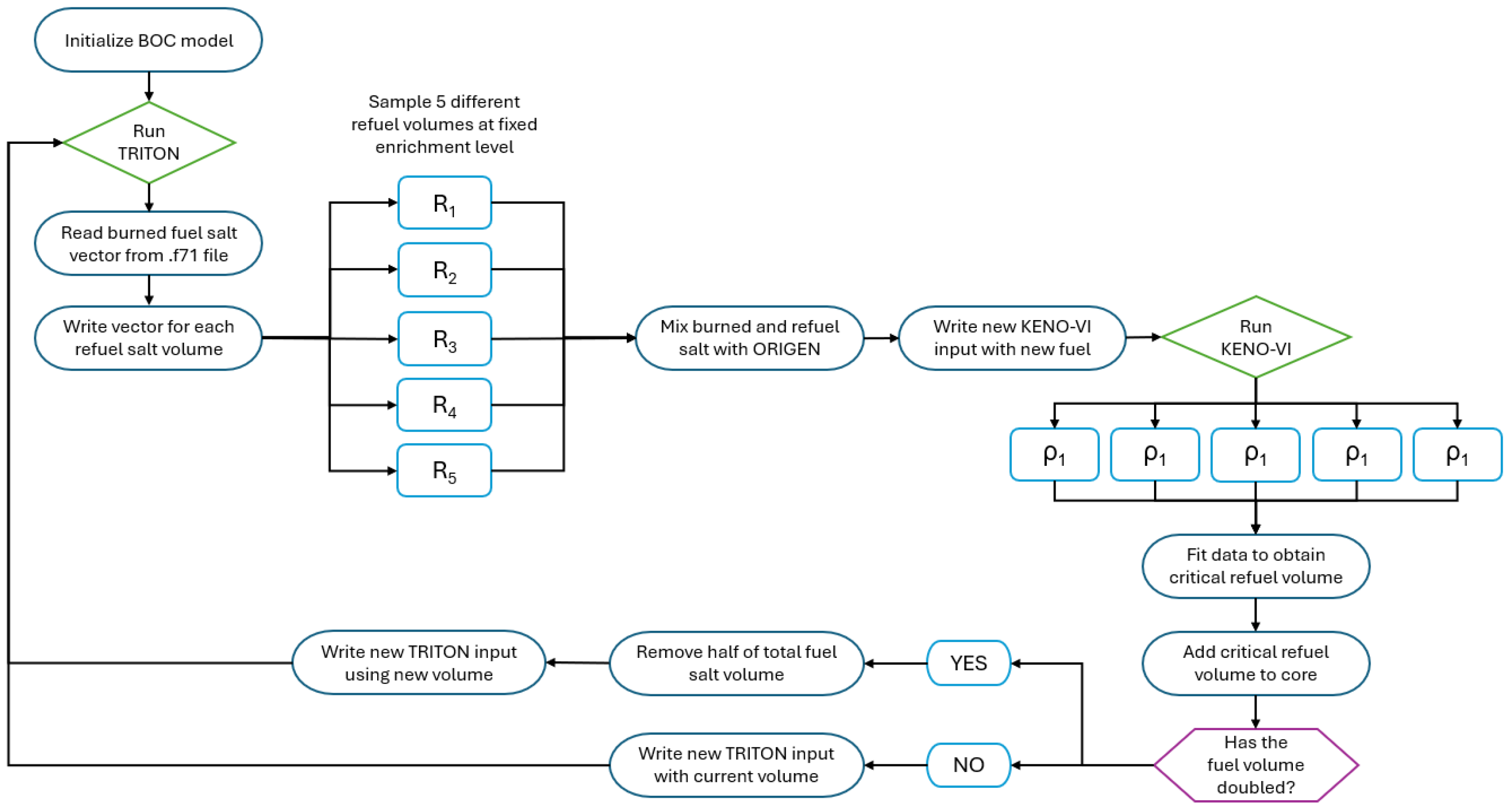
An overview of the Python-based simulation framework utilized in this work is provided in Figure 2. This flowchart is adapted from the one previously presented in [54], though it has been revised to include implementation of ORIGEN for salt mixing and nuclide inventory tracking. For modeling batch refueling in both EIRENE and Th-EIRENE, the simulation begins with initialization of the BOC model. TRITON is then executed for the defined depletion step length of 7 days, and the burned fuel salt vector is obtained from the active fuel salt .f71 data file. Python is then used to write fresh refuel salt vectors for various refuel salt volumes (5 in the current implementation) ranging from low to high to be mixed with the burned salt. A new KENO-VI input file is written and executed for each of these refuel salt amounts, and the resulting reactivity data are fitted with a linear regression model to determine the critical refuel volume which yields ρ = 0. This critical volume is then added to the core, and the new total fuel salt volume is compared with the BOC volume to determine whether or not volume doubling has occurred. In the instance that it has, half of the total fuel salt volume is removed, and a new TRITON input is created which reflects the new fuel salt volume. If doubling has not yet been attained, a new TRITON input is written which simply uses the current volume. The new TRITON file will then be executed, progressing to the next depletion step, the process repeating until the total simulation time defined by the user has been reached.
As was implemented previously in the EIRENE model in [54], gaseous and noble metal fission products are continuously removed at fixed rates during each depletion simulation. In the present work, noble metals are defined to include isotopes of Zn, Nb, Rh, In, Ga, Mo, Pd, Sn, Ge, Tc, Ag, Sb, As, Ru, and Cd, with each of these having a fractional removal rate of 1.15741 × 10 4 s−1 as specified in SCALE 6.3.1. Gaseous fission products, which are defined as including isotopes of xenon and krypton, are each removed at a fixed rate of 2.00 × 10 2 s−1. These removal rates are based on the Molten Salt Breeder Reactor (MSBR) SCALE model developed by Hartanto et al. (2024) in [62].
Whereas some gaseous fission products such as 135Xe act as neutron poisons and negatively impact neutronic performance, noble metals exist as insoluble species within the fuel salt and may deposit onto surfaces within the reactor primary loop [63]. Accumulated deposition of these noble metals can lead to significant adverse effects, including fouling of the heat exchanger or the creation of decay heat hot spots within primary circuit components [63,64]. Removal of noble metals can prevent this, and can be performed online without the need for interruptions to power production. Furthermore, a number of noble metal fission products are highly desirable for use in nuclear medicine, including (but not limited to) 99Mo. As these nuclides are being continuously extracted from the active fuel salt during reactor operation, their harvest may be simplified, making them more readily available for recovery. With this, the modeling of gaseous and noble metal fission products, in addition to active fuel salt nuclides, comprises a significant component of this study. A specific strategy for noble metal removal (e.g., helium bubbling) is not modeled in the current versions of EIRENE and Th-EIRENE, with this being beyond the scope of this study and left for future work.
Using the developed batch refueling methodology, the atom densities and masses for key nuclides of interest are recorded at each depletion step and actively tracked in both the EIRENE and Th-EIRENE depletion simulations. Table 2 contains the isotopes which were studied in this work, including relevant nuclear data and notable example radiopharmaceuticals for each. Production of these radionuclides within the active fuel salt of EIRENE and Th-EIRENE will be compared between both models, including the produced masses and maximum activity available for harvest, to reveal any potential advantages of traditional uranium- or thorium-based fuel cycles on the yields of these radionuclides. Radionuclides for which significant quantities are removed from the active fuel salt as gaseous or noble metal fission products, and/or exist as decay products of those which are, will also be studied, with the concentrations and masses of these being recorded using the ORIGEN off-gas and noble metal tracking framework. Radionuclides studied herein include a number of alpha- and beta-emitters which are highly desirable for use in TRT and/or nuclear imaging procedures, in addition to radionuclides such as 90Sr and 99Mo which are used as generators for key medical radionuclides.

3. Results

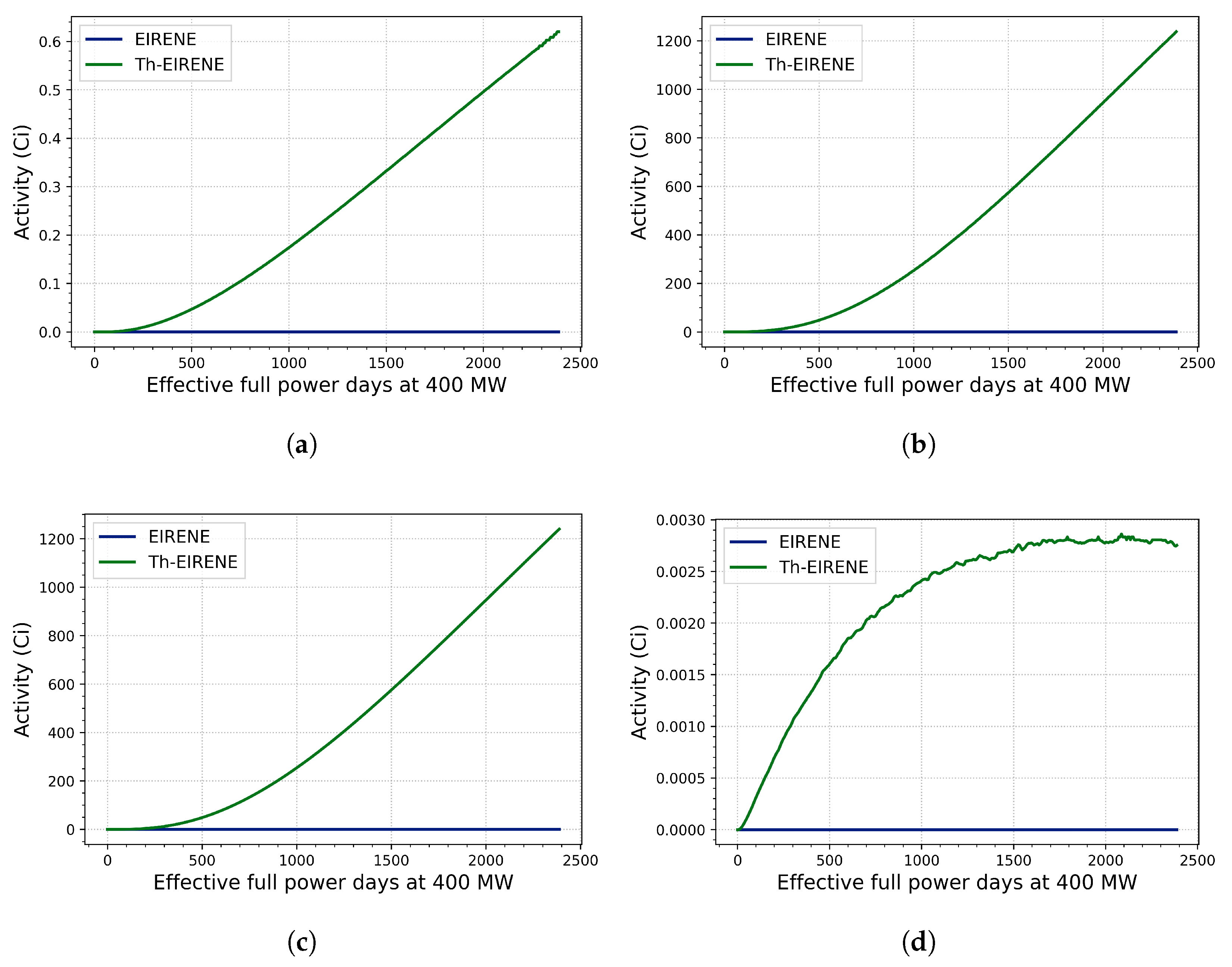
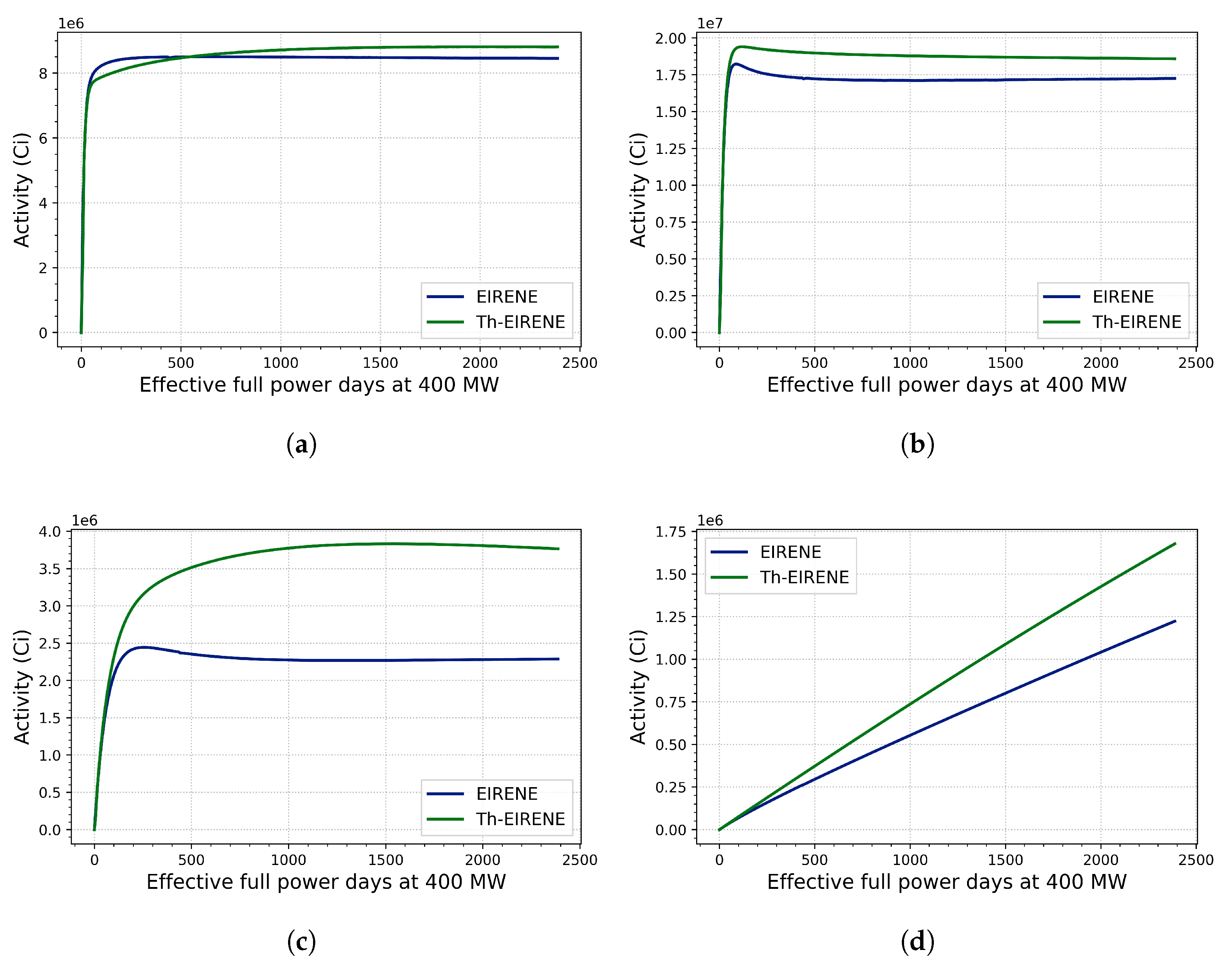
Depletion was simulated in SCALE 6.3.1 TRITON for approximately 2400 effective full power days (EFPD) at a reactor power level of 400 MWth in both the EIRENE and Th-EIRENE models, with 19.75% enriched refuel salt being added every 7 days. Mass quantities in grams for each of the radionuclides listed in Table 2 were tracked throughout each simulation, with these data being plotted for both EIRENE and Th-EIRENE with respect to EFPD to compare the production yields between the two models. Data for all radionuclides (including those which are removed as gaseous or noble metal fission products) were recorded within the active fuel salt, whereas the production yields of the radionuclides 103Ru, 106Ru, 99Mo, and 111Ag were additionally studied as removed noble metals outside of the active fuel salt. 133Xe, as a gaseous fission product, is tracked in the off-gas system, along with 89Sr and 90Sr, which are produced as decay products of 89Kr and 90Kr, respectively. Figure 3 shows the simulated activity data in Curies (Ci) plotted for the alpha-emitting radionuclides 225Ac (a), 212Bi (b), 224Ra (c), and 230U (d), whereas Figure 4 presents activity data for the beta-emitting radionuclides 131I (a), 143Pr (b), 89Sr (c), and 90Sr (d).
From examining the activity data for the alpha-emitting radionuclides in Figure 3, it can be seen that production of these radionuclides is significantly greater in the Th-EIRENE model when compared with EIRENE, highlighting the beneficial impact of 232Th inclusion within the fuel salt. For the beta-emitter 131I, similar activity values are observed between both EIRENE and Th-EIRENE, with slightly greater quantities being recorded early on in the depletion simulation for EIRENE before being exceeded by Th-EIRENE later on, as shown in Figure 4. For the beta-emitters 89Sr, 90Sr, and 143Pr, significantly greater production is seen in the Th-EIRENE model when compared with EIRENE, though large quantities of these radionuclides are available for harvest in both models.
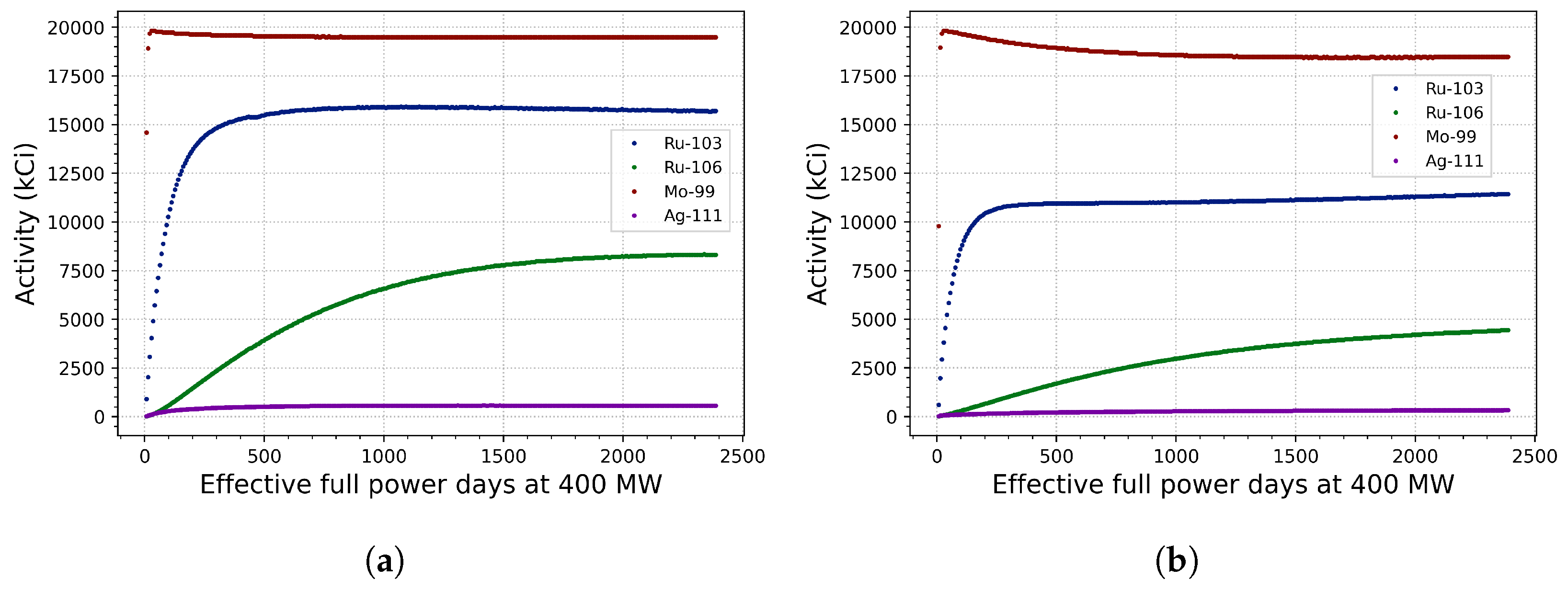
Activity data for the removed noble metal fission products 103Ru, 106Ru, 99Mo, and 111Ag were additionally recorded and plotted with respect to EFPD for both the EIRENE and Th-EIRENE models. These data are presented in Figure 5 for EIRENE (a) and Th-EIRENE (b), with activity values being plotted in kilocuries (kCi). From these data, large production yields are observed for 99Mo, 103Ru, and 106Ru for both reactor models, though overall yields are higher in EIRENE than in Th-EIRENE for these nuclides. 111Ag is produced in significant quantities in both models, though visibly much less when compared with 99Mo, 103Ru, and 106Ru when plotted on a kCi scale.
For 99Mo, due to activity data being sampled every 7 days in the current methodology and assuming no 99Mo is being extracted, decay of 99Mo is prevalent in the data. Maximum activity values for 99Mo reach a maximum value early on in the depletion simulations before gradually starting to decrease with respect to burnup in EFPD. However, even in later periods of the depletion simulation when the 99Mo activity has decreased with respect to its maximum value, 99Mo quantities available for harvest are still significant in both EIRENE and Th-EIRENE. The Organisation for Economic Co-operation and Development (OECD) estimated in 2012 that global 99Mo demand fell between 9500 and 10,000 6-day Ci per week, with a 6-day Ci representing the simulated 99Mo activity 6 days following its departure from the processing facility [96]. With 99Mo activities recorded in EIRENE and Th-EIRENE reaching nearly 20,000 kCi (20,000,000 Ci), with this representing only a single operating reactor and not considering any additional reactors which have been “grown” from the initial “starter” using the Sourdough refueling strategy, production of 99Mo with both uranium- and thorium-based fuels is shown to be highly promising with this fuel cycle concept.
From the recorded mass data, activities in Curies (Ci) for each of the studied radionuclides were additionally quantified at each depletion step in EIRENE and Th-EIRENE. These were used to determine the maximum activity of each radionuclide available for harvest. Table 3 compares the maximum activity data for all of the radionuclides within the active fuel salt for the EIRENE and Th-EIRENE models, whereas Table 4 and Table 5 present these data for the removed noble metals and radionuclides within the off-gas system, respectively.
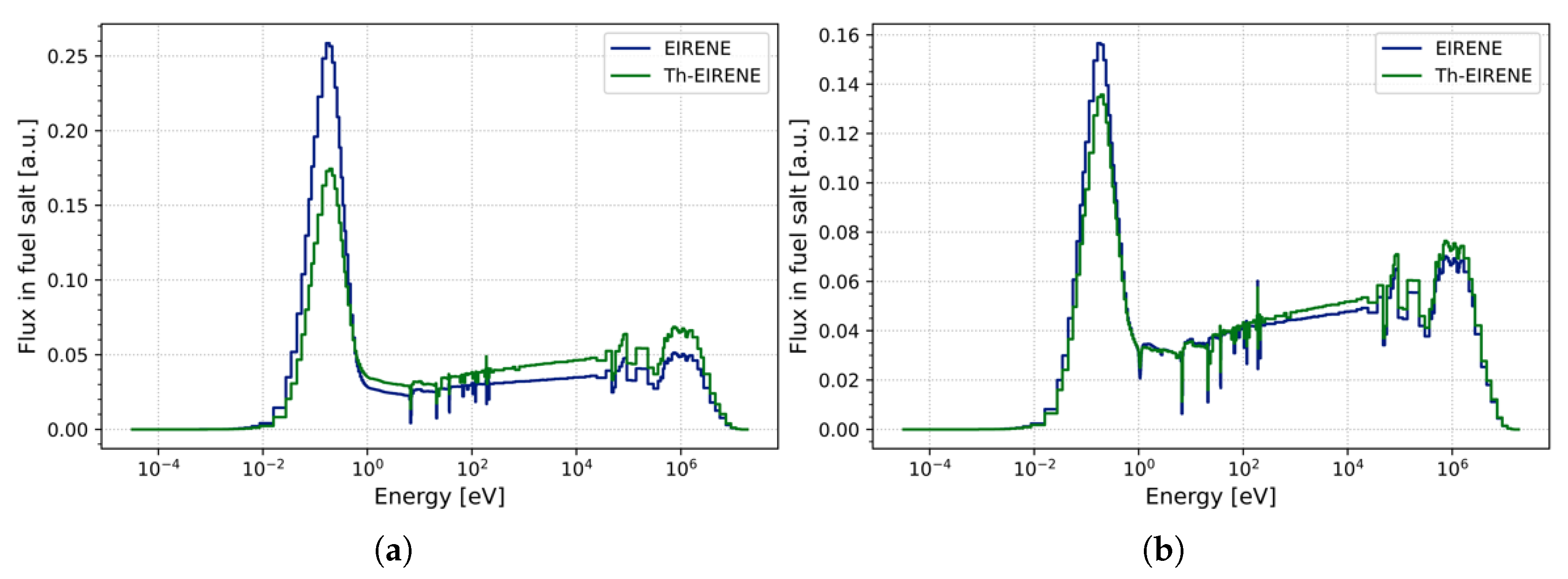
For further comparison of the EIRENE and Th-EIRENE designs, neutron flux spectra were obtained in the fuel salt of each model as a function of neutron energy in eV. Fluxes were sampled at the BOC and EOC with SCALE 6.3.1 KENO-VI and were normalized per unit lethargy. These results are presented in Figure 6 below, where the BOC and EOC fluxes for both models are shown in the left and right plots, respectively. These data reveal that EIRENE is more thermal overall at both the BOC and EOC, whereas the Th-EIRENE model exhibits a harder neutron spectrum.

4. Discussion

4.1. Comparison of Radionuclide Yields with Uranium and Thorium Fuel Cycles

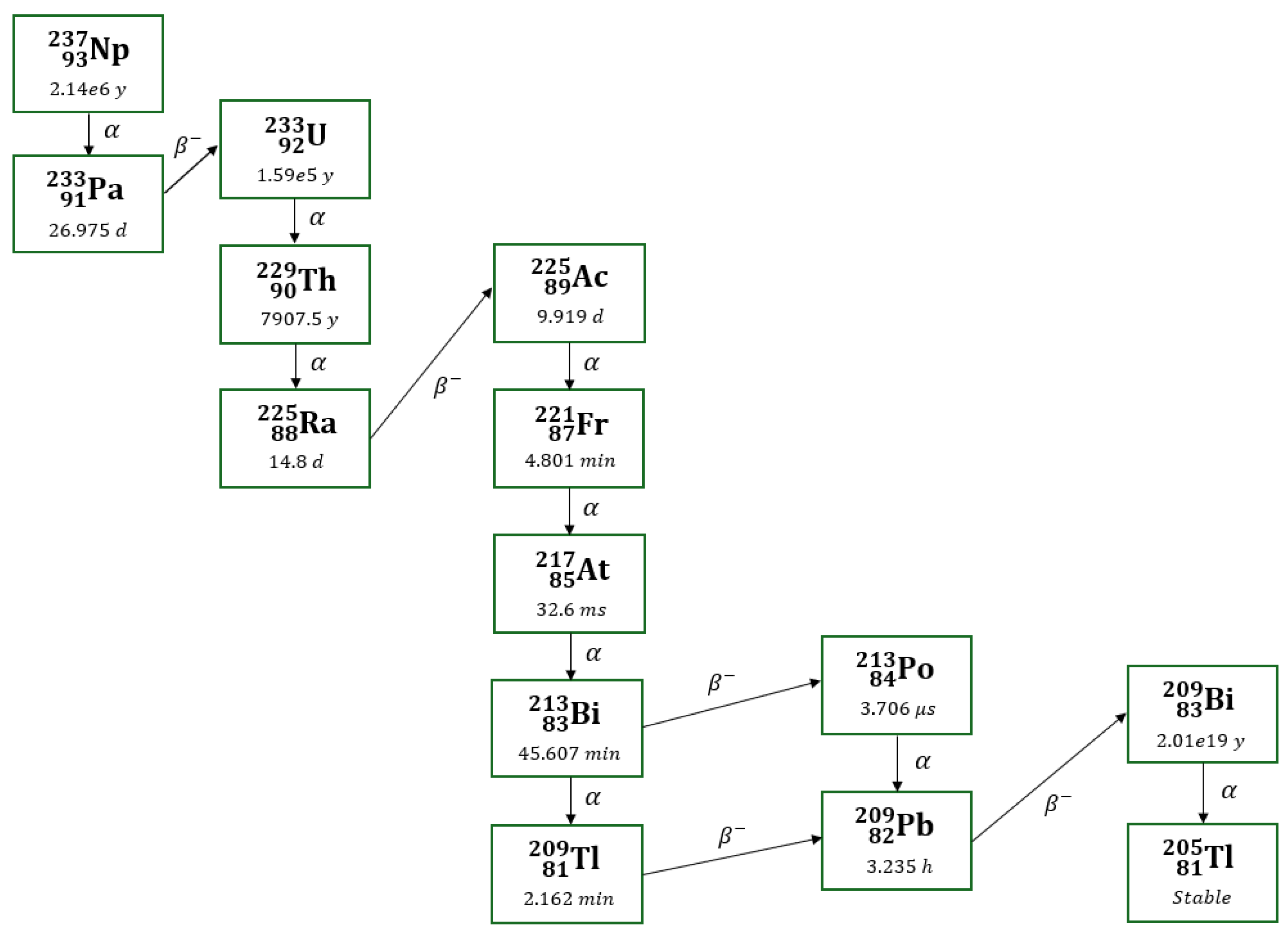
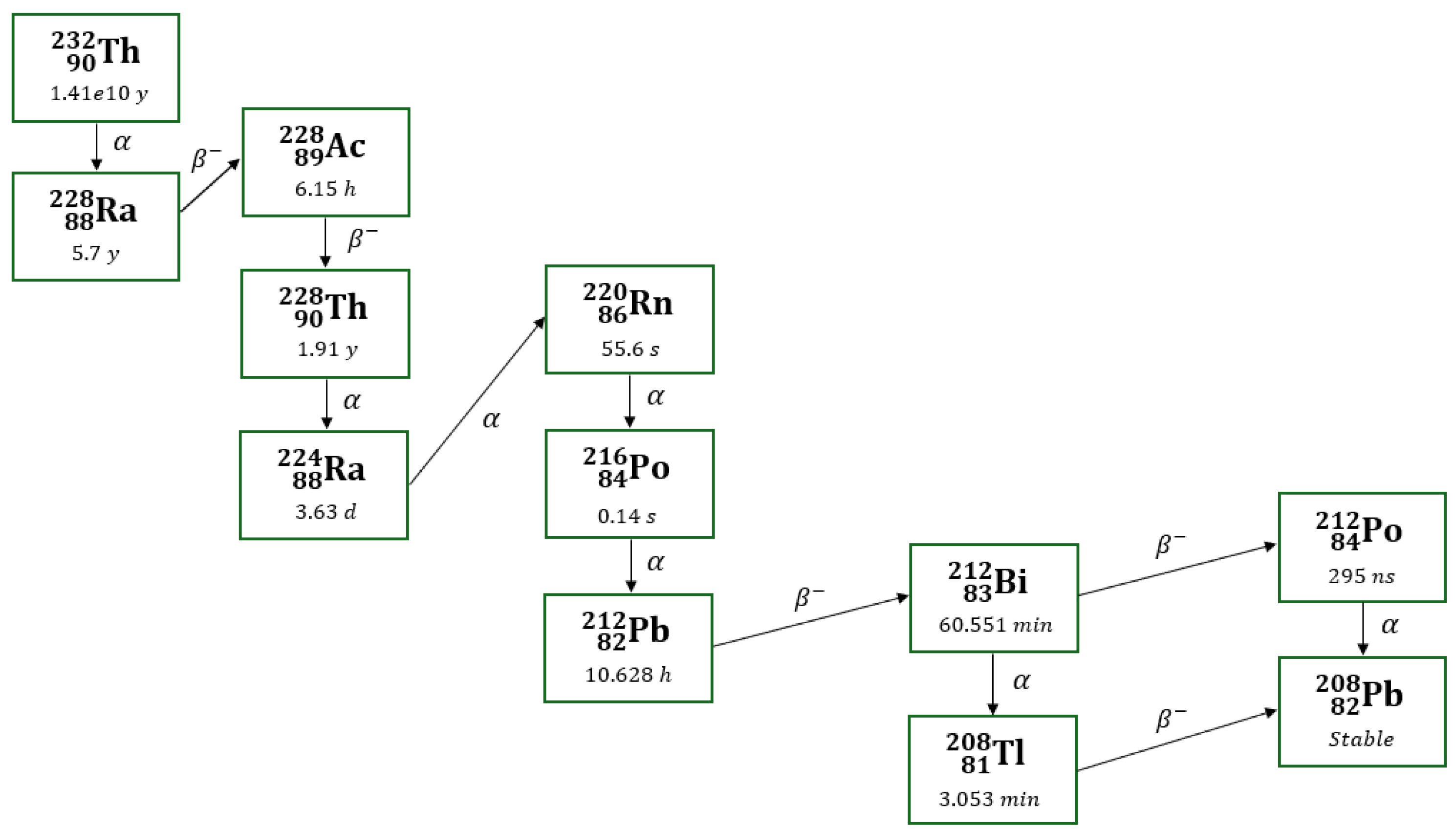
From examination of the results presented in Section 3, it is shown that the incorporation of 232Th within the fuel salt has a significant impact on the production quantities observed for each radionuclide, most notably the alpha emitters, with their yields in Th-EIRENE far exceeding those observed in EIRENE for the same depletion length. This is due to the presence of 233U in large quantities in Th-EIRENE, with its use of the 232Th/233U fuel cycle. The decay of 233U allows for the production of valuable radionuclides within the neptunium decay chain which would otherwise not be generated from traditional uranium-based fuel cycles, with the valuable alpha-emitting TRT radionuclides 225Ac and 213Bi being decay products of 233U [47]. Thus, the production of 233U, which is fostered within thorium-fueled MSRs where 233U acts as a primary fissile material, results in the generation of significant quantities of 225Ac and 213Bi. Other valuable alpha-emitting radionuclides such as 212Bi and 224Ra are members of the thorium decay chain, being produced from the decay series of 232Th itself. The presence of large quantities of 232Th within the active fuel salt of Th-EIRENE therefore allows for significant production of these radionuclides as decay products. On the other hand, due to the lack of 232Th in the LEU-fueled EIRENE, which translates to low quantities of 233U, radionuclides belonging to the neptunium and thorium decay series are generated only in very small quantities. Figure 7 and Figure 8 provide a representation of the neptunium and thorium decay series, respectively, to further illustrate the production of these radionuclides with thorium-based fuel cycles. As indicated by the results in Section 3, inclusion of 232Th within the active fuel salt is necessary for significant production of radionuclides like 225Ac, 212Bi, and 224Ra.
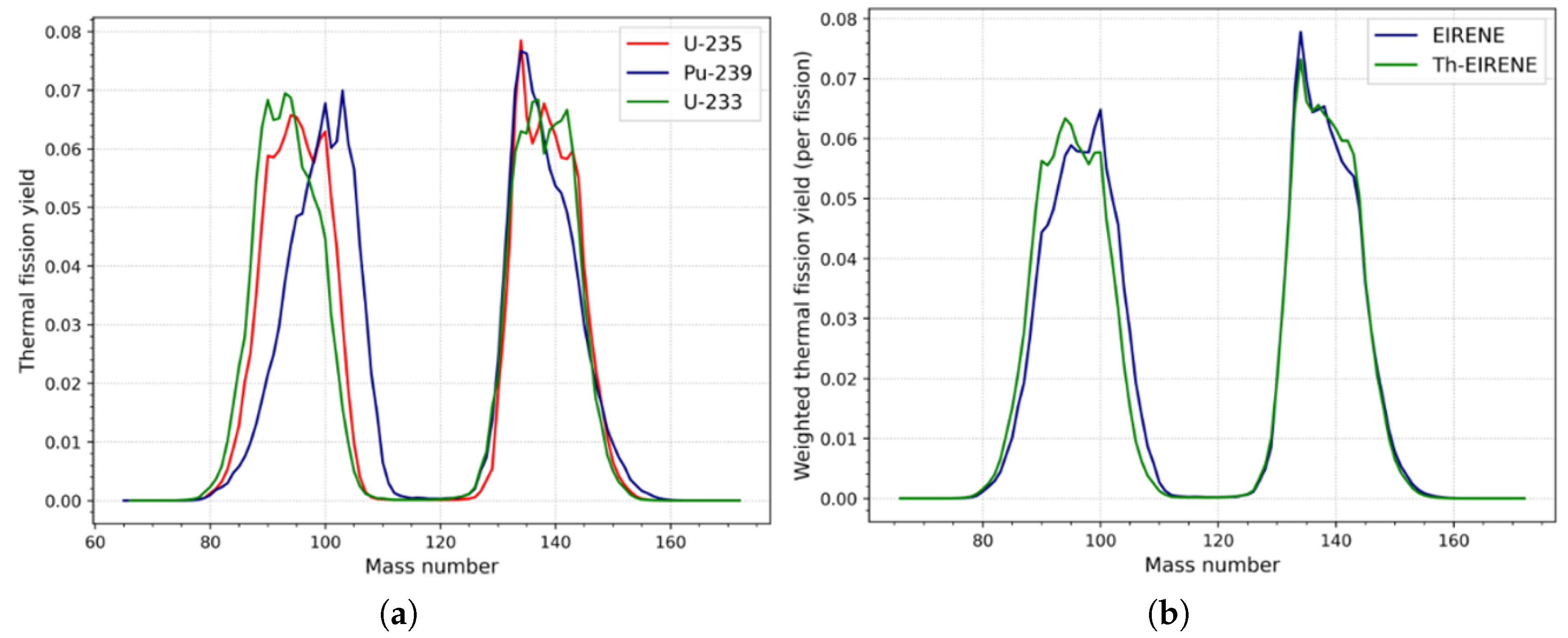
In comparing the production mass yields in EIRENE versus Th-EIRENE for 131I, 89Sr, and 143Pr in Figure 4, it is shown that, while larger quantities of both radionuclides are observed in Th-EIRENE overall, their production is still significant in EIRENE, with visible radionuclide yield quantities being observed with these data compared with the very small plotted mass quantities seen for 225Ac and 212Bi in EIRENE. For 131I, in particular, production yields within EIRENE and Th-EIRENE are observed to be very similar. Although significant quantities of 89Sr and 143Pr are produced with EIRENE, which was previously observed by the authors in [58], greater production is shown to be possible through 232Th incorporation. This is due to the lighter fission products, particularly those close to A = 90, having a higher yield from thermal fission of 233U compared to 235U and 239Pu. This is phenomenon is illustrated in Figure 9, which includes on the left a plot of fractional thermal fission yields with respect to nuclide mass number for each of the three primary fissile nuclides: 235U, 239Pu, and 233U. For plotting the individual thermal fission yields for each of these nuclides, the OpenMC ENDF/B-VII.1 depletion chain for a thermal neutron spectrum was utilized, with these data being publicly available for download on the official OpenMC website [97]. From these data, it can be seen that, for fission product nuclides around A = 140, differences in thermal fission yields are still observed for 233U, 235U, and 239Pu, though these differences are significantly less pronounced. In the EIRENE model, larger quantities of 239Pu are generated within the active fuel salt during reactor operation when compared with Th-EIRENE. For fission product radionuclides near A = 100, thermal fission yields are highest for 239Pu, whereas significantly smaller yields are observed for 235U and 233U. This can be seen in the recorded maximum activity data for the radionuclides 103Ru, 106Ru, and 111Ag in Table 3 and Table 4, where higher production of these radionuclides is observed in EIRENE when compared with Th-EIRENE.
To gain a greater understanding of the differences in the radionuclide yields observed in the EIRENE and Th-EIRENE models, total thermal fission yields were obtained for both models to include a sum of the yields from 235U, 239Pu, and 233U at a fixed time period during simulated depletion. The thermal yields from each fissile nuclide were weighted using the macroscopic fission cross-section in cm-1, with these cross-sections being obtained from the number density and microscopic fission cross-section of each nuclide. Microscopic fission cross-sections were obtained using the SCALE 6.3.1 OBIWAN command utility to analyze the .f33 ORIGEN library files generated for EIRENE and Th-EIRENE at a depletion time period of 1400 EFPD. The resulting weighted total thermal fission yields at 1400 EFPD are shown in plot (b) on the right in Figure 9 for EIRENE and Th-EIRENE. From this, it can be seen that significantly higher weighted total thermal fission yields are obtained with the Th-EIRENE model when compared with EIRENE, which corresponds with the overall higher production yields seen for most of the radionuclides studied in the Th-EIRENE versus the EIRENE model.
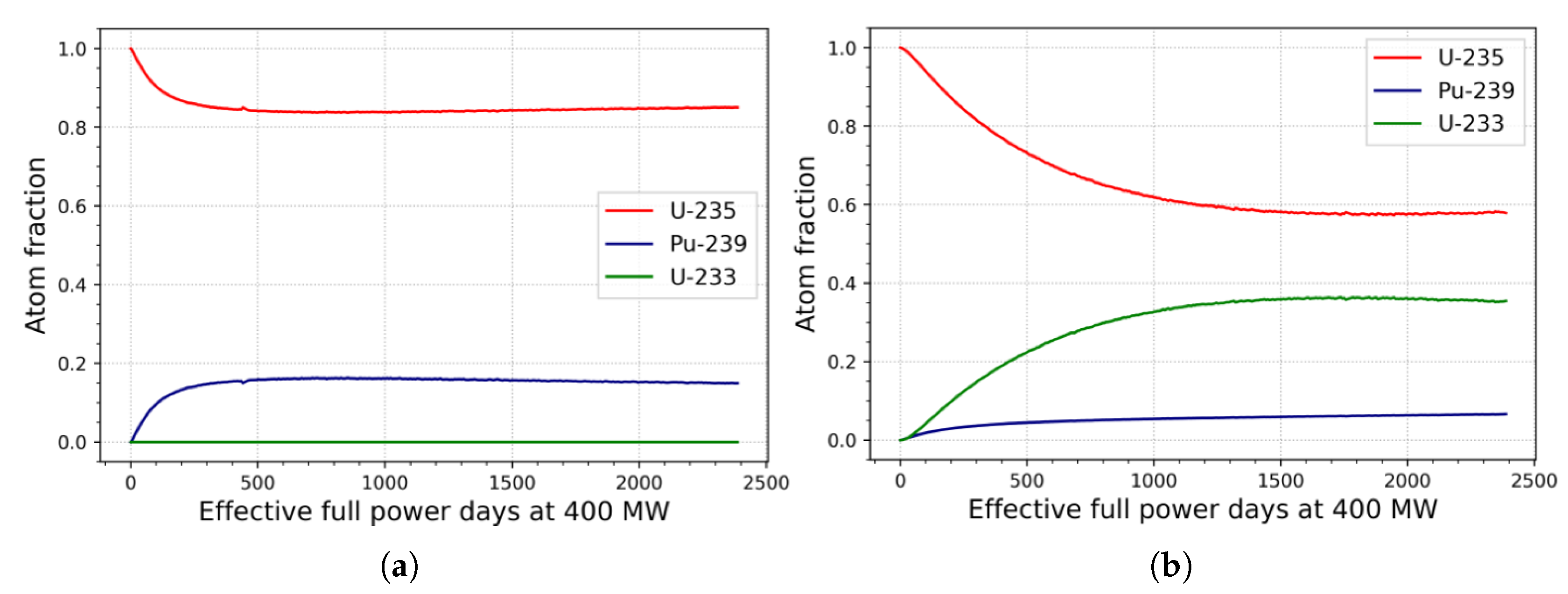
For a more detailed analysis of the quantities of fissile nuclides present within the EIRENE and Th-EIRENE models during simulated depletion, atom fractions for 235U, 239Pu, and 233U were calculated for both models with respect to burnup in EFPD. Each atom fraction represents the concentration of the given fissile nuclide over all three fissile fuels (e.g., 235U over the sum of all 235U, 239Pu, and 233U in the active fuel salt) at the current depletion step. Figure 10 illustrates the evolution of these atom fractions throughout simulated depletion in EIRENE and Th-EIRENE, with both 235U and 239Pu being shown to comprise a significantly larger portion of the fissile material within EIRENE compared to Th-EIRENE. Contrarily, in Th-EIRENE, limited 239Pu exists in the active fuel salt, with large quantities of 233U being present, whereas in EIRENE, 233U exists in only very small quantities.

4.2. Current Study Limitations and Areas for Future Work

This study, with its primary objective being to compare radionuclide production based on fuel cycle type using the EIRENE and Th-EIRENE models, is significantly limited in its scope, with modeling only being performed for radionuclide production and without consideration of radionuclide recovery methods. With their capability to provide a stable supply of these highly valuable radionuclides as a byproduct of clean energy production, radiochemical separation strategies for MSRs is an active field of study which draws upon the extensive body of prior research on molten salt-based electrochemical techniques for used fuel reprocessing [98]. Many recent works have been published on this topic which the reader is encouraged to review. Braatz et al. (2024) explore the promise and applications of electrolytic processes for directly extracting radionuclides of interest from fuel salts [99]. In their 2025 review, Choi and Lee discuss in detail the use of electrorefining and electrowinning, as well as the key technologies utilized in these processes and the significant advancements which have been made up until today [100]. Mirza et al. (2023) also examine in detail the design of electrochemical reactors to utilize electroreduction, electrowinning, and electrorefining technologies [98]. Specific to applications in medical radionuclide production, Moon et al. (2022) provide a comprehensive review of electrolytic processes for 99Mo recovery in MSRs, noting current technological challenges and the value of further study to gain a greater understanding of 99Mo behavior during reactor operation [101].
The investigation of radiochemical separation techniques such as these in the EIRENE and Th-EIRENE reactor designs is beyond the scope of the present work, though it represents a significant area of future study which would be valuable to provide a more complete understanding of the ability of these designs, and liquid-fueled MSRs in general, to be used in a commercial setting for radionuclide production to meet global clinical demand.
In addition to radiochemical separation strategies, radionuclide production yields observed in the EIRENE and Th-EIRENE designs, and their anticipated costs, are not directly compared with other production methods which are currently utilized, such as cyclotrons and research reactors. This is due to the limited nature of this study, with final production yields and costs being highly dependent upon the chosen method of extraction for a given radionuclide, as well as its desired purity. To perform a true comparison between the EIRENE and Th-EIRENE yields and current production methods, methods of radiochemical separation must first be studied. Cost analyses would additionally need to be performed separately for each radionuclide of interest to fully capture the impacts of purity requirements specific to their applications, which will also be a significant factor impacting the anticipated cost of production. For further details on current production routes for 225Ac and reported yields, Rahman et al. (2024) provide a valuable overview in their work [102].
Furthermore, as previously discussed, the current implementation of refueling in the Th-EIRENE model, with the refuel salt containing only HALEU and no fertile 232Th, significantly limits the production of neptunium-chain radionuclides such as 225Ac, and is a limitation of the present study. The inclusion of 232Th in the refuel salt would significantly bolster the production yields for neptunium chain radionuclides such as 225Ac, as well as yields for radionuclides belonging to the thorium decay series. In future work, implementing an active thorium feed, such as what was done by Rykhlevskii et al. (2019) in their MSBR model in [103], would be highly valuable to gain a greater understanding of the full potential of the Th-EIRENE model and other thorium-utilizing MSRs of similar design in producing sufficient quantities of 225Ac and other valuable radionuclides.

5. Conclusions

Radionuclides play a vital role in nuclear diagnostic and therapeutic procedures for patients with cancer, with TRT being a powerful form of targeted therapy expected to see increased clinical usage in the coming years. With the limited supply and availability of these radionuclides currently hindering the widespread usage of TRT, developing new production routes is essential for ensuring patient care. In this study, the production of therapeutic beta- and alpha-emitting radionuclides for TRT, as well as radionuclides valuable for diagnostic procedures and palliative therapy, was studied in two geometrically identical MSR models, each operating with a different nuclear fuel form: the uranium-fueled EIRENE, and the mixed uranium- and thorium-fueled Th-EIRENE.
In comparing isotope production in the EIRENE and Th-EIRENE models, it was shown that Th-EIRENE produced greater mass quantities of the radionuclides studied overall, with only 131I being observed to have a slightly larger production mass in EIRENE early on in the depletion simulations before being exceeded by Th-EIRENE. In a prior study by the authors examining the production of 89Sr, 90Sr, 131I, and 143Pr in the EIRENE SCALE 6.3.1 model [58], it was shown that significant quantities of these beta-emitting radionuclides were produced within the active fuel salt during simulated depletion. The results of the present study confirm this finding; however, the alpha-emitting radionuclides 225Ac, 212Bi, 213Bi, 223Ra, 224Ra, 227Th, and 230U were shown to be produced in only very small quantities in EIRENE. The incorporation of fertile 232Th within the active fuel salt in the Th-EIRENE model facilitated the production of significant quantities of these radionuclides, as indicated both in the mass quantities produced and the calculated maximum activities available for harvest. Further research into radionuclide production in liquid-fueled MSRs with uranium- and thorium-based fuel cycles is desirable, notably in chemical separation and purification processes which were not explored in the current work.

Author Contributions

Conceptualization, C.E.M. and O.C.; methodology, C.E.M. and O.C.; software, C.E.M., O.C. and D.H.; validation, C.E.M., O.C. and D.H.; formal analysis, C.E.M.; investigation, C.E.M.; resources, C.E.M., O.C. and D.H.; data curation, C.E.M.; writing—original draft preparation, C.E.M.; writing—review and editing, C.E.M., O.C. and D.H.; visualization, C.E.M.; supervision, O.C.; project administration, O.C.; funding acquisition, C.E.M. All authors have read and agreed to the published version of the manuscript.

Funding

This research was funded by the U.S. Department of Energy University Nuclear Leadership Program (UNLP), grant number DE-NE0009082.

Data Availability Statement

All scripts developed and utilized in this work are made freely available to the public in an open GitHub repository, which may be found at https://github.com/cerikam/IMSR (accessed on 19 December 2025).

Acknowledgments

The authors would like to express their gratitude to the U.S. Department of Energy University Nuclear Leadership Program (UNLP) for providing the funding which made this research possible, in addition to the reviewers who have taken the time to provide feedback on the original manuscript draft.

Conflicts of Interest

The authors declare no conflicts of interest.

Abbreviations

The following abbreviations are used in this manuscript:
MSRMolten salt reactor
TRTTargeted radionuclide therapy
TATTargeted alpha therapy
TBTTargeted beta therapy
PETPositron Emission Tomography
SPECTSingle Photon Emission Computed Tomography

References

  1. Siegel, R.L.; Kratzer, T.B.; Giaquinto, A.N.; Sung, H.; Jemal, A. Cancer statistics, 2025. CA Cancer J. Clin. 2025, 75, 10–45. [Google Scholar] [CrossRef]
  2. National Research Council (US); Institute of Medicine (US) Committee on State of the Science of Nuclear Medicine. Advancing Nuclear Medicine Through Innovation; National Academies Press: Washington, DC, USA, 2007. [Google Scholar] [CrossRef]
  3. Gao, Q.; Zhou, G.; Lin, S.J.; Paus, R.; Yue, Z. How chemotherapy and radiotherapy damage the tissue: Comparative biology lessons from feather and hair models. Exp. Dermatol. 2019, 28, 413–418. [Google Scholar] [CrossRef] [PubMed]
  4. Chen, Y.; Jungsuwadee, P.; Vore, M.; Butterfield, D.A.; St Clair, D.K. Collateral damage in cancer chemotherapy: Oxidative stress in nontargeted tissues. Mol. Interv. 2007, 7, 147. [Google Scholar] [CrossRef] [PubMed]
  5. van den Boogaard, W.M.; Komninos, D.S.; Vermeij, W.P. Chemotherapy side-effects: Not all DNA damage is equal. Cancers 2022, 14, 627. [Google Scholar] [CrossRef] [PubMed]
  6. Cupit-Link, M.C.; Kirkland, J.L.; Ness, K.K.; Armstrong, G.T.; Tchkonia, T.; LeBrasseur, N.K.; Armenian, S.H.; Ruddy, K.J.; Hashmi, S.K. Biology of premature ageing in survivors of cancer. ESMO Open 2017, 2, e000250. [Google Scholar] [CrossRef]
  7. Wang, S.; Prizment, A.; Thyagarajan, B.; Blaes, A. Cancer treatment-induced accelerated aging in cancer survivors: Biology and assessment. Cancers 2021, 13, 427. [Google Scholar] [CrossRef]
  8. Smitherman, A.B.; Wood, W.A.; Mitin, N.; Ayer Miller, V.L.; Deal, A.M.; Davis, I.J.; Blatt, J.; Gold, S.H.; Muss, H.B. Accelerated aging among childhood, adolescent, and young adult cancer survivors is evidenced by increased expression of p16INK4a and frailty. Cancer 2020, 126, 4975–4983. [Google Scholar] [CrossRef]
  9. Pallares, R.M.; Abergel, R.J. Development of radiopharmaceuticals for targeted alpha therapy: Where do we stand? Front. Med. 2022, 9, 1020188. [Google Scholar] [CrossRef]
  10. Gudkov, S.V.; Shilyagina, N.Y.; Vodeneev, V.A.; Zvyagin, A.V. Targeted radionuclide therapy of human tumors. Int. J. Mol. Sci. 2015, 17, 33. [Google Scholar] [CrossRef]
  11. Awad, R.M.; Meeus, F.; Ceuppens, H.; Ertveldt, T.; Hanssens, H.; Lecocq, Q.; Mateusiak, L.; Zeven, K.; Valenta, H.; De Groof, T.W.; et al. Chapter Six-Emerging applications of nanobodies in cancer therapy. In New Antibody Formats; International Review of Cell and Molecular Biology; Aranda, F., Berraondo, P., Galluzzi, L., Eds.; Academic Press: Cambridge, MA, USA, 2022; Volume 369, pp. 143–199. [Google Scholar] [CrossRef]
  12. Goldenberg, D.M. Targeted therapy of cancer with radiolabeled antibodies. J. Nucl. Med. 2002, 43, 693–713. [Google Scholar]
  13. Milenic, D.E.; Brady, E.D.; Brechbiel, M.W. Antibody-targeted radiation cancer therapy. Nat. Rev. Drug Discov. 2004, 3, 488–499. [Google Scholar] [CrossRef] [PubMed]
  14. Sharkey, R.M.; Goldenberg, D.M. Perspectives on cancer therapy with radiolabeled monoclonal antibodies. J. Nucl. Med. 2005, 46, 115S–127S. [Google Scholar] [PubMed]
  15. Vallabhajosula, S. Radiolabeled Antibodies for Imaging and Targeted Therapy. In Molecular Imaging and Targeted Therapy: Radiopharmaceuticals and Clinical Applications; Springer: Berlin/Heidelberg, Germany, 2023; pp. 533–575. [Google Scholar] [CrossRef]
  16. Correia, J.D.; Paulo, A.; Raposinho, P.D.; Santos, I. Radiometallated peptides for molecular imaging and targeted therapy. Dalton Trans. 2011, 40, 6144–6167. [Google Scholar] [CrossRef] [PubMed]
  17. Wangler, C.; Buchmann, I.; Eisenhut, M.; Haberkorn, U.; Mier, W. Radiolabeled peptides and proteins in cancer therapy. Protein Pept. Lett. 2007, 14, 273–279. [Google Scholar] [CrossRef]
  18. Mohtavinejad, N.; Ardestani, M.S.; Khalaj, A.; Pormohammad, A.; Najafi, R.; Bitarafan-Rajabi, A.; Hajiramezanali, M.; Amanlou, M. Application of radiolabeled peptides in tumor imaging and therapy. Life Sci. 2020, 258, 118206. [Google Scholar] [CrossRef]
  19. Weiner, R.E.; Thakur, M.L. Radiolabeled peptides in the diagnosis and therapy of oncological diseases. Appl. Radiat. Isot. 2002, 57, 749–763. [Google Scholar] [CrossRef]
  20. Goldsmith, S.J. Targeted Radionuclide Therapy: A Historical and Personal Review. Semin. Nucl. Med. 2020, 50, 87–97. [Google Scholar] [CrossRef]
  21. Ferro-Flores, G.; E Ocampo-García, B.; L Santos-Cuevas, C.; Morales-Avila, E.; Azorín-Vega, E. Multifunctional radiolabeled nanoparticles for targeted therapy. Curr. Med. Chem. 2014, 21, 124–138. [Google Scholar] [CrossRef]
  22. Hong, H.; Zhang, Y.; Sun, J.; Cai, W. Molecular imaging and therapy of cancer with radiolabeled nanoparticles. Nano Today 2009, 4, 399–413. [Google Scholar] [CrossRef]
  23. Varani, M.; Galli, F.; Auletta, S.; Signore, A. Radiolabelled nanoparticles for cancer diagnosis. Clin. Transl. Imaging 2018, 6, 271–292. [Google Scholar] [CrossRef]
  24. Koziorowski, J.; E Stanciu, A.; Gomez-Vallejo, V.; Llop, J. Radiolabeled nanoparticles for cancer diagnosis and therapy. Anti-Cancer Agents Med. Chem. (Formerly Curr. Med. Chem.-Anti Agents) 2017, 17, 333–354. [Google Scholar] [CrossRef]
  25. Sneddon, D.; Cornelissen, B. Emerging chelators for nuclear imaging. Curr. Opin. Chem. Biol. 2021, 63, 152–162. [Google Scholar] [CrossRef] [PubMed]
  26. Hennrich, U.; Eder, M. [177Lu] Lu-PSMA-617 (PluvictoTM): The first FDA-approved radiotherapeutical for treatment of prostate cancer. Pharmaceuticals 2022, 15, 1292. [Google Scholar] [CrossRef] [PubMed]
  27. U.S. Food & Drug Administration. FDA Approves Lutetium Lu 177 Dotatate for Pediatric Patients 12 Years and Older with GEP-NETS 2024. Available online: https://www.fda.gov/drugs/resources-information-approved-drugs/fda-approves-lutetium-lu-177-dotatate-pediatric-patients-12-years-and-older-gep-nets (accessed on 19 December 2025).
  28. Kamaldeep; Wanage, G.; Loharkar, S.; Das, T.; Basu, S.; Banerjee, S. Estimation of absorbed doses of indigenously produced “direct-route” lutetium-177-[177Lu] Lu-DOTA-TATE PRRT in normal organs and tumor lesions in patients of metastatic neuroendocrine tumors: Comparison with no-carrier-added [177Lu] Lu-DOTA-TATE and the trend with multiple cycles. Cancer Biother. Radiopharm. 2022, 37, 214–225. [Google Scholar] [CrossRef] [PubMed]
  29. Donin, N.M.; Reiter, R.E. Why targeting PSMA is a game changer in the management of prostate cancer. J. Nucl. Med. 2018, 59, 177–182. [Google Scholar] [CrossRef]
  30. Krasner, C.; Joyce, R. Zevalin TM: 90 Yttrium Labeled Anti-CD20 (Ibritumomab Tiuxetan), a New Treatment for Non-Hodgkin’s Lymphoma. Curr. Pharm. Biotechnol. 2001, 2, 341–349. [Google Scholar] [CrossRef]
  31. Wahl, R.L. Tositumomab and 131I therapy in non-Hodgkin’s lymphoma. J. Nucl. Med. 2005, 46, 128S–140S. [Google Scholar]
  32. Miederer, M.; Scheinberg, D.A.; McDevitt, M.R. Realizing the potential of the Actinium-225 radionuclide generator in targeted alpha particle therapy applications. Adv. Drug Deliv. Rev. 2008, 60, 1371–1382. [Google Scholar] [CrossRef]
  33. Parker, C.; Lewington, V.; Shore, N.; Kratochwil, C.; Levy, M.; Lindén, O.; Noordzij, W.; Park, J.; Saad, F.; Group, T.A.T.W.; et al. Targeted alpha therapy, an emerging class of cancer agents: A review. JAMA Oncol. 2018, 4, 1765–1772. [Google Scholar] [CrossRef]
  34. Miederer, M.; Benešová-Schäfer, M.; Mamat, C.; Kästner, D.; Pretze, M.; Michler, E.; Brogsitter, C.; Kotzerke, J.; Kopka, K.; Scheinberg, D.A.; et al. Alpha-emitting radionuclides: Current status and future perspectives. Pharmaceuticals 2024, 17, 76. [Google Scholar] [CrossRef]
  35. Sartor, O.; Sharma, D. Radium and other alpha emitters in prostate cancer. Transl. Androl. Urol. 2018, 7, 436. [Google Scholar] [CrossRef]
  36. Wissing, M.D.; van Leeuwen, F.W.; van der Pluijm, G.; Gelderblom, H. Radium-223 chloride: Extending life in prostate cancer patients by treating bone metastases. Clin. Cancer Res. 2013, 19, 5822–5827. [Google Scholar] [CrossRef]
  37. Eychenne, R.; Chérel, M.; Haddad, F.; Guérard, F.; Gestin, J.F. Overview of the most promising radionuclides for targeted alpha therapy: The “hopeful eight”. Pharmaceutics 2021, 13, 906. [Google Scholar] [CrossRef] [PubMed]
  38. Bidkar, A.P.; Zerefa, L.; Yadav, S.; VanBrocklin, H.F.; Flavell, R.R. Actinium-225 targeted alpha particle therapy for prostate cancer. Theranostics 2024, 14, 2969. [Google Scholar] [CrossRef] [PubMed]
  39. Jurcic, J.G.; Levy, M.Y.; Park, J.H.; Ravandi, F.; Perl, A.E.; Pagel, J.M.; Smith, B.D.; Estey, E.H.; Kantarjian, H.; Cicic, D.; et al. Phase I Trial of Targeted Alpha-Particle Therapy with Actinium-225 (225Ac)-Lintuzumab and Low-Dose Cytarabine (LDAC) in Patients Age 60 or Older with Untreated Acute Myeloid Leukemia (AML). Blood 2016, 128, 4050. [Google Scholar] [CrossRef]
  40. Jurcic, J.G. Clinical studies with bismuth-213 and actinium-225 for hematologic malignancies. Curr. Radiopharm. 2018, 11, 192–199. [Google Scholar] [CrossRef]
  41. Ballangrud, A.M.; Yang, W.H.; Palm, S.; Enmon, R.; Borchardt, P.E.; Pellegrini, V.A.; McDevitt, M.R.; Scheinberg, D.A.; Sgouros, G. Alpha-particle emitting atomic generator (Actinium-225)-labeled trastuzumab (herceptin) targeting of breast cancer spheroids: Efficacy versus HER2/neu expression. Clin. Cancer Res. 2004, 10, 4489–4497. [Google Scholar] [CrossRef]
  42. Borchardt, P.E.; Yuan, R.R.; Miederer, M.; McDevitt, M.R.; Scheinberg, D.A. Targeted actinium-225 in vivo generators for therapy of ovarian cancer. Cancer Res. 2003, 63, 5084–5090. [Google Scholar]
  43. Degueldre, C.; Findlay, J.; Cheneler, D.; Sardar, S.; Green, S. Short life fission products extracted from molten salt reactor fuel for radiopharmaceutical applications. Appl. Radiat. Isot. 2024, 205, 111146. [Google Scholar] [CrossRef]
  44. Briggs, R. Oak Ridge National Laboratory Molten Salt Reactor Program Monthly Report for July 1969; Technical Report; Oak Ridge National Lab. (ORNL): Oak Ridge, TN, USA, 1969. [Google Scholar] [CrossRef]
  45. Haubenreich, P.N.; Engel, J. Experience with the molten-salt reactor experiment. Nucl. Appl. Technol. 1970, 8, 118–136. [Google Scholar] [CrossRef]
  46. Kelly, J.E. Generation IV International Forum: A decade of progress through international cooperation. Prog. Nucl. Energy 2014, 77, 240–246. [Google Scholar] [CrossRef]
  47. Chvála, O.; Clarno, K.; Charlton, W. Production of Ac-225 and other Neptunium Chain Isotopes from Thorium Irradiation in NETL’s TRIGA. Trans. Am. Nucl. Soc. 2024, 131, 410–413. [Google Scholar]
  48. Wieselquist, W.A.; Lefebvre, R.A.; Jessee, M.A. SCALE Code System; Technical Report ORNL/TM-2005/39; ORNL: Oak Ridge, TN, USA, 2020. [Google Scholar] [CrossRef]
  49. Leppänen, J.; Pusa, M.; Viitanen, T.; Valtavirta, V.; Kaltiaisenaho, T. The Serpent Monte Carlo code: Status, development and applications in 2013. Ann. Nucl. Energy 2015, 82, 142–150. [Google Scholar] [CrossRef]
  50. Chen, L.; Yan, R.; Kang, X.Z.; Zhu, G.F.; Zhou, B.; He, L.Y.; Zou, Y.; Xu, H.J. Study on the production characteristics of 131I and 90Sr isotopes in a molten salt reactor. Nucl. Sci. Tech. 2021, 32, 33. [Google Scholar] [CrossRef]
  51. Zhang, Y.; Zheng, G.; Wang, J.; Chen, S.; Sun, S.; Chen, Z.; Liu, X.; Wang, W. Neutronic Study for Mo-99 Production in an Leu-Fueled Molten-Salt Reactor. In Proceedings of the International Conference on Nuclear Engineering (ICONE), Kyoto, Japan, 21–26 May 2023; The Japan Society of Mechanical Engineers: Tokyo, Japan, 2023; p. 1879. [Google Scholar] [CrossRef]
  52. Sheu, R.; Chao, C.; Feynberg, O.; Liu, Y.W. A fuel depletion analysis of the MSRE and three conceptual small molten-salt reactors for Mo-99 production. Ann. Nucl. Energy 2014, 71, 111–117. [Google Scholar] [CrossRef]
  53. Cornejo, L.R.; Betzler, B.R.; Myhre, K.; McFarlane, J. Modeling molybdeneum-99 production in molten salt reactors. Nucl. Eng. Des. 2021, 379, 111243. [Google Scholar] [CrossRef]
  54. Moss, C.E.; Chvala, O.; Hartanto, D.; Carter, J.P. A Batch Refueling Framework for Implementing the Sourdough Fuel Cycle and Waste Management Strategy in the EIRENE Novel Molten Salt Reactor Design. In Nuclear Technology; Taylor & Francis: Abingdon, UK, 2025; pp. 1–17. [Google Scholar] [CrossRef]
  55. Moss, C.E.; Chvála, O.; Hartanto, D.; Carter, J.P. Modeling a Thermal-Spectrum LEU-fueled Molten Salt Reactor Co-fueled with Thorium in SCALE 6.3.1 and Serpent-2. In Proceedings of the ANS Advances in Nuclear Fuel Management (ANFM 2025), Clearwater Beach, FL, USA, 20–23 July 2025; American Nuclear Society: Westmont, IL, USA, 2024; pp. 101–109. [Google Scholar]
  56. Moss, C.E.; Chvála, O.; Hartanto, D.; Carter, J.P. Modeling Continuous Online Refueling with SCALE 6.3. 1 and Serpent-2 in the EIRENE Novel Molten Salt Reactor Design. In Proceedings of the ANS International Conference on Mathematics and Computational Methods Applied to Nuclear Science and Engineering (M&C 2025), Denver, CO, USA, 27–30 April 2025; American Nuclear Society: Westmont, IL, USA, 2025; pp. 122–131. [Google Scholar]
  57. Wheeler, A.M.; Chvála, O. Molten salt reactor sourdough refueling and waste management strategy. J. Nucl. Eng. 2021, 2, 471–483. [Google Scholar] [CrossRef]
  58. Moss, C.E.; Chvála, O.; Hartanto, D.; Carter, J.P. Production of Medically Desirable Radioisotopes in the EIRENE Molten Salt Reactor. Trans. Am. Nucl. Soc. 2024, 131, 418–421. [Google Scholar]
  59. Moss, C.E.; Chvála, O.; Hartanto, D.; Carter, J.P. Production of Diagnostic and Therapeutic Radionuclides with Uranium and Thorium Molten Salt Fuel Cycles. In Proceedings of the 2025 ANS Annual Conference (American Nuclear Society), Nashville, TN, USA, 5–9 October 2025; pp. 399–402. [Google Scholar]
  60. Carter, J.P.; Borrelli, R. Integral molten salt reactor neutron physics study using Monte Carlo N-particle code. Nucl. Eng. Des. 2020, 365, 110718. [Google Scholar] [CrossRef]
  61. Moss, C.E.; Chvála, O.; Hartanto, D.; Carter, J.P. Implementation of the Sourdough Fuel Cycle and Waste Management Strategy in the EIRENE Novel Molten Salt Reactor Design. In Proceedings of the 2024 ANS Annual Conference on Advanced Reactor Safety, ARS 2024, Las Vegas, NV, USA, 16–19 June 2024; American Nuclear Society: Westmont, IL, USA, 2024; pp. 516–525. [Google Scholar] [CrossRef]
  62. Hartanto, D.; Bostelmann, F.; Betzler, B.R.; Bekar, K.B.; Hart, S.W.; Wieselquist, W.A. SCALE depletion capabilities for molten salt reactors and other liquid-fueled systems. Ann. Nucl. Energy 2024, 196, 110236. [Google Scholar] [CrossRef]
  63. Walker, S.A.; Ji, W. Species transport analysis of noble metal fission product transport, deposition, and extraction in the molten salt reactor experiment. Ann. Nucl. Energy 2021, 158, 108250. [Google Scholar] [CrossRef]
  64. Tanaka, R.S. Quantifying the Adhesion of Noble Metal Foulants on Structural Materials in a Molten Salt Reactor. Master’s Thesis, Massachusetts Institute of Technology, Cambridge, MA, USA, 2017. [Google Scholar]
  65. Sathekge, M.; Bruchertseifer, F.; Knoesen, O.; Reyneke, F.; Lawal, I.; Lengana, T.; Davis, C.; Mahapane, J.; Corbett, C.; Vorster, M.; et al. 225 Ac-PSMA-617 in chemotherapy-naive patients with advanced prostate cancer: A pilot study. Eur. J. Nucl. Med. Mol. Imaging 2019, 46, 129–138. [Google Scholar] [CrossRef]
  66. Kratochwil, C.; Bruchertseifer, F.; Rathke, H.; Bronzel, M.; Apostolidis, C.; Weichert, W.; Haberkorn, U.; Giesel, F.L.; Morgenstern, A. Targeted α-therapy of metastatic castration-resistant prostate cancer with 225Ac-PSMA-617: Dosimetry estimate and empiric dose finding. J. Nucl. Med. 2017, 58, 1624–1631. [Google Scholar] [CrossRef]
  67. Feuerecker, B.; Tauber, R.; Knorr, K.; Heck, M.; Beheshti, A.; Seidl, C.; Bruchertseifer, F.; Pickhard, A.; Gafita, A.; Kratochwil, C.; et al. Activity and adverse events of actinium-225-PSMA-617 in advanced metastatic castration-resistant prostate cancer after failure of lutetium-177-PSMA. Eur. Urol. 2021, 79, 343–350. [Google Scholar] [CrossRef]
  68. Zacherl, M.J.; Gildehaus, F.J.; Mittlmeier, L.; Böning, G.; Gosewisch, A.; Wenter, V.; Unterrainer, M.; Schmidt-Hegemann, N.; Belka, C.; Kretschmer, A.; et al. First clinical results for PSMA-targeted α-therapy using 225Ac-PSMA-I&T in advanced-mCRPC patients. J. Nucl. Med. 2021, 62, 669–674. [Google Scholar] [CrossRef]
  69. Ling, S.w.; van der Veldt, A.A.; Konijnenberg, M.; Segbers, M.; Hooijman, E.; Bruchertseifer, F.; Morgenstern, A.; de Blois, E.; Brabander, T. Evaluation of the tolerability and safety of [225Ac] Ac-PSMA-I&T in patients with metastatic prostate cancer: A phase I dose escalation study. BMC Cancer 2024, 24, 146. [Google Scholar] [CrossRef]
  70. Hooijman, E.L.; Chalashkan, Y.; Ling, S.W.; Kahyargil, F.F.; Segbers, M.; Bruchertseifer, F.; Morgenstern, A.; Seimbille, Y.; Koolen, S.L.; Brabander, T.; et al. Development of [225Ac] Ac-PSMA-I&T for targeted alpha therapy according to GMP guidelines for treatment of mCRPC. Pharmaceutics 2021, 13, 715. [Google Scholar] [CrossRef]
  71. Tagawa, S.T.; Thomas, C.; Sartor, A.O.; Sun, M.; Stangl-Kremser, J.; Bissassar, M.; Vallabhajosula, S.; Castellanos, S.H.; Nauseef, J.T.; Sternberg, C.N.; et al. Prostate-Specific Membrane Antigen–Targeting Alpha Emitter via Antibody Delivery for Metastatic Castration-Resistant Prostate Cancer: A Phase I Dose-Escalation Study of 225Ac-J591. J. Clin. Oncol. 2024, 42, 842–851. [Google Scholar] [CrossRef] [PubMed]
  72. McDevitt, M.R.; Thorek, D.L.; Hashimoto, T.; Gondo, T.; Veach, D.R.; Sharma, S.K.; Kalidindi, T.M.; Abou, D.S.; Watson, P.A.; Beattie, B.J.; et al. Feed-forward alpha particle radiotherapy ablates androgen receptor-addicted prostate cancer. Nat. Commun. 2018, 9, 1629. [Google Scholar] [CrossRef]
  73. Bidkar, A.P.; Wang, S.; Bobba, K.N.; Chan, E.; Bidlingmaier, S.; Egusa, E.A.; Peter, R.; Ali, U.; Meher, N.; Wadhwa, A.; et al. Treatment of prostate cancer with CD46-targeted 225Ac alpha particle radioimmunotherapy. Clin. Cancer Res. 2023, 29, 1916–1928. [Google Scholar] [CrossRef]
  74. Busslinger, S.D.; Tschan, V.J.; Richard, O.K.; Talip, Z.; Schibli, R.; Müller, C. [225Ac] Ac-SibuDAB for targeted alpha therapy of prostate cancer: Preclinical evaluation and comparison with [225Ac] Ac-PSMA-617. Cancers 2022, 14, 5651. [Google Scholar] [CrossRef] [PubMed]
  75. Kelly, J.M.; Amor-Coarasa, A.; Ponnala, S.; Nikolopoulou, A.; Williams, C.; Thiele, N.A.; Schlyer, D.; Wilson, J.J.; DiMagno, S.G.; Babich, J.W. A single dose of 225Ac-RPS-074 induces a complete tumor response in an LNCaP xenograft model. J. Nucl. Med. 2019, 60, 649–655. [Google Scholar] [CrossRef] [PubMed]
  76. Iikuni, S.; Tarumizu, Y.; Nakashima, K.; Higaki, Y.; Ichikawa, H.; Watanabe, H.; Ono, M. Radiotheranostics using a novel 225Ac-labeled radioligand with improved pharmacokinetics targeting prostate-specific membrane antigen. J. Med. Chem. 2021, 64, 13429–13438. [Google Scholar] [CrossRef] [PubMed]
  77. Kozak, R.W.; Atcher, R.W.; Gansow, O.A.; Friedman, A.M.; Hines, J.J.; Waldmann, T.A. Bismuth-212-labeled anti-Tac monoclonal antibody: Alpha-particle-emitting radionuclides as modalities for radioimmunotherapy. Proc. Natl. Acad. Sci. USA 1986, 83, 474–478. [Google Scholar] [CrossRef]
  78. Wesley, J.N.; McGee, E.C.; Garmestani, K.; Brechbiel, M.W.; Yordanov, A.T.; Wu, C.; Gansow, O.A.; Eckelman, W.C.; Bacher, J.D.; Flynn, M.; et al. Systemic radioimmunotherapy using a monoclonal antibody, anti-Tac directed toward the alpha subunit of the IL-2 receptor armed with the α-emitting radionuclides 212Bi or 211At. Nucl. Med. Biol. 2004, 31, 357–364. [Google Scholar] [CrossRef]
  79. Hartmann, F.; Horak, E.M.; Garmestani, K.; Wu, C.; Brechbiel, M.W.; Kozak, R.W.; Tso, J.; Kosteiny, S.A.; Gansow, O.A.; Nelson, D.L.; et al. Radioimmunotherapy of nude mice bearing a human interleukin 2 receptor α-expressing lymphoma utilizing the α-emitting radionuclide-conjugated monoclonal antibody 212Bi-anti-Tac. Cancer Res. 1994, 54, 4362–4370. [Google Scholar]
  80. McDevitt, M.R.; Barendswaard, E.; Ma, D.; Lai, L.; Curcio, M.J.; Sgouros, G.; Ballangrud, A.M.; Yang, W.H.; Finn, R.D.; Pellegrini, V.; et al. An α-particle emitting antibody ([213Bi] J591) for radioimmunotherapy of prostate cancer. Cancer Res. 2000, 60, 6095–6100. [Google Scholar]
  81. Ballangrud, A.M.; Yang, W.H.; Charlton, D.E.; McDevitt, M.R.; Hamacher, K.A.; Panageas, K.S.; Ma, D.; Bander, N.H.; Scheinberg, D.A.; Sgouros, G. Response of LNCaP spheroids after treatment with an α-particle emitter (213Bi)-labeled anti-prostate-specific membrane antigen antibody (J591). Cancer Res. 2001, 61, 2008–2014. Available online: https://aacrjournals.org/cancerres/article-pdf/61/5/2008/2491727/ch050102008.pdf (accessed on 19 December 2025).
  82. Nilsson, S.; Cislo, P.; Sartor, O.; Vogelzang, N.; Coleman, R.; O’Sullivan, J.; Reuning-Scherer, J.; Shan, M.; Zhan, L.; Parker, C. Patient-reported quality-of-life analysis of radium-223 dichloride from the phase III ALSYMPCA study. Ann. Oncol. 2016, 27, 868–874. [Google Scholar] [CrossRef]
  83. Coleman, R.; Aksnes, A.K.; Naume, B.; Garcia, C.; Jerusalem, G.; Piccart, M.; Vobecky, N.; Thuresson, M.; Flamen, P. A phase IIa, nonrandomized study of radium-223 dichloride in advanced breast cancer patients with bone-dominant disease. Breast Cancer Res. Treat. 2014, 145, 411–418. [Google Scholar] [CrossRef]
  84. Sartor, O.; Coleman, R.; Nilsson, S.; Heinrich, D.; Helle, S.I.; O’Sullivan, J.M.; Fosså, S.D.; Chodacki, A.; Wiechno, P.; Logue, J.; et al. Effect of radium-223 dichloride on symptomatic skeletal events in patients with castration-resistant prostate cancer and bone metastases: Results from a phase 3, double-blind, randomised trial. Lancet Oncol. 2014, 15, 738–746. [Google Scholar] [CrossRef]
  85. Westrøm, S.; Malenge, M.; Jorstad, I.S.; Napoli, E.; Bruland, Ø.S.; Bønsdorff, T.B.; Larsen, R.H. Ra-224 labeling of calcium carbonate microparticles for internal α-therapy: Preparation, stability, and biodistribution in mice. J. Label. Compd. Radiopharm. 2018, 61, 472–486. [Google Scholar] [CrossRef] [PubMed]
  86. Karlsson, J.; Schatz, C.A.; Wengner, A.M.; Hammer, S.; Scholz, A.; Cuthbertson, A.; Wagner, V.; Hennekes, H.; Jardine, V.; Hagemann, U.B. Targeted thorium-227 conjugates as treatment options in oncology. Front. Med. 2023, 9, 1071086. [Google Scholar] [CrossRef] [PubMed]
  87. Press, O.W.; Eary, J.F.; Gooley, T.; Gopal, A.K.; Liu, S.; Rajendran, J.G.; Maloney, D.G.; Petersdorf, S.; Bush, S.A.; Durack, L.D.; et al. A phase I/II trial of iodine-131–tositumomab (anti-CD20), etoposide, cyclophosphamide, and autologous stem cell transplantation for relapsed B-cell lymphomas. Blood, J. Am. Soc. Hematol. 2000, 96, 2934–2942. [Google Scholar] [CrossRef]
  88. Vose, J.M.; Wahl, R.L.; Saleh, M.; Rohatiner, A.Z.; Knox, S.J.; Radford, J.A.; Zelenetz, A.D.; Tidmarsh, G.F.; Stagg, R.J.; Kaminski, M.S. Multicenter phase II study of iodine-131 tositumomab for chemotherapy-relapsed/refractory low-grade and transformed low-grade B-cell non-Hodgkin’s lymphomas. J. Clin. Oncol. 2000, 18, 1316–1323. [Google Scholar] [CrossRef]
  89. Fisher, R.I.; Kaminski, M.S.; Wahl, R.L.; Knox, S.J.; Zelenetz, A.D.; Vose, J.M.; Leonard, J.P.; Kroll, S.; Goldsmith, S.J.; Coleman, M. Tositumomab and iodine-131 tositumomab produces durable complete remissions in a subset of heavily pretreated patients with low-grade and transformed non-Hodgkin’s lymphomas. J. Clin. Oncol. 2005, 23, 7565–7573. [Google Scholar] [CrossRef]
  90. Zechmann, C.M.; Afshar-Oromieh, A.; Armor, T.; Stubbs, J.B.; Mier, W.; Hadaschik, B.; Joyal, J.; Kopka, K.; Debus, J.; Babich, J.W.; et al. Radiation dosimetry and first therapy results with a 124I/131I-labeled small molecule (MIP-1095) targeting PSMA for prostate cancer therapy. Eur. J. Nucl. Med. Mol. Imaging 2014, 41, 1280–1292. [Google Scholar] [CrossRef]
  91. Tanabe, M. Clinical trials on tumor scanning with 103Ru. Radioisotopes 1976, 25, 10–3769. [Google Scholar] [CrossRef][Green Version]
  92. Happl, B.; Brandt, M.; Balber, T.; Benčurová, K.; Talip, Z.; Voegele, A.; Heffeter, P.; Kandioller, W.; Van der Meulen, N.P.; Mitterhauser, M.; et al. Synthesis and Preclinical Evaluation of Radiolabeled [103Ru] BOLD-100. Pharmaceutics 2023, 15, 2626. [Google Scholar] [CrossRef]
  93. Laing, A.; Ackery, D.; Bayly, R.; Buchanan, R.; Lewington, V.; McEwan, A.; Macleod, P.; Zivanovic, M. Strontium-89 chloride for pain palliation in prostatic skeletal malignancy. Br. J. Radiol. 1991, 64, 816–822. [Google Scholar] [CrossRef]
  94. Bakht, M.K.; Sadeghi, M.; Ahmadi, S.J.; Sadjadi, S.S.; Tenreiro, C. Preparation of radioactive praseodymium oxide as a multifunctional agent in nuclear medicine: Expanding the horizons of cancer therapy using nanosized neodymium oxide. Nucl. Med. Commun. 2013, 34, 5–12. [Google Scholar] [CrossRef]
  95. Chattopadhyay, S.; Vimalnath, K.; Saha, S.; Korde, A.; Sarma, H.; Pal, S.; Das, M.K. Preparation and evaluation of a new radiopharmaceutical for radiosynovectomy, 111Ag-labelled hydroxyapatite (HA) particles. Appl. Radiat. Isot. 2008, 66, 334–339. [Google Scholar] [CrossRef]
  96. Nuclear Energy Agency (NEA). A Supply and Demand Update of the Molybdenum-99 Market; Technical Report; Organisation for Economic Co-Operation and Development (OECD): Paris, France, 2012. [Google Scholar]
  97. OpenMC. Depletion Chains 2025. Available online: https://openmc.org/data/#depletion-chains (accessed on 19 December 2025).
  98. Mirza, M.; Abdulaziz, R.; Maskell, W.C.; Wilcock, S.; Jones, A.H.; Woodall, S.; Jackson, A.; Shearing, P.R.; Brett, D.J. Electrochemical processing in molten salts–a nuclear perspective. Energy Environ. Sci. 2023, 16, 952–982. [Google Scholar] [CrossRef]
  99. Braatz, J.; Myhre, K.; Andrews, H.; McFarlane, J. Opportunities for Radiochemical Separations of Radioisotopes from Molten Salt Reactors. In Proceedings of the 2024 AIChE Annual Meeting, San Diego, CA, USA, 27–31 October 2024. [Google Scholar]
  100. Choi, E.Y.; Lee, C.H. Review of Recent Advances in Electrochemical Processes in Molten Salt Electrolyte for Recycling Used Nuclear Fuel: E. Choi, CH Lee. Korean J. Chem. Eng. 2025, 42, 1249–1268. [Google Scholar] [CrossRef]
  101. Moon, J.; Myhre, K.; Andrews, H.; McFarlane, J. Potential of electrolytic processes for recovery of molybdenum from molten salts for 99Mo production. Prog. Nucl. Energy 2022, 152, 104369. [Google Scholar] [CrossRef]
  102. Rahman, A.R.; Babu, M.H.; Ovi, M.K.; Zilani, M.M.; Eithu, I.S.; Chakraborty, A. Actinium-225 in targeted alpha therapy. J. Med. Phys. 2024, 49, 137–147. [Google Scholar] [CrossRef]
  103. Rykhlevskii, A.; Bae, J.W.; Huff, K.D. Modeling and simulation of online reprocessing in the thorium-fueled molten salt breeder reactor. Ann. Nucl. Energy 2019, 128, 366–379. [Google Scholar] [CrossRef]
Figure 1. Radial (left), axial side (middle), and axial front (right) views of the EIRENE model in SCALE 6.3.1.
Jne 07 00009 g001
Figure 2. Flowchart illustrating the developed framework for simulating batch refueling with the Sourdough concept in SCALE 6.3.1.
Jne 07 00009 g002
Figure 3. Plotted activity data in Ci for (a) 225Ac. (b) 212Bi. (c) 224Ra. (d) 230U.
Jne 07 00009 g003
Figure 4. Plotted activity data in Ci for (a) 131I. (b) 143Pr. (c) 89Sr. (d) 90Sr.
Jne 07 00009 g004
Figure 5. Simulated activity data in kCi for the removed noble metal fission products 103Ru, 106Ru, 99Mo, and 111Ag in (a) EIRENE; and (b) Th-EIRENE.
Jne 07 00009 g005
Figure 6. Neutron flux per unit lethargy for the EIRENE and Th-EIRENE models at: (a) BOC and (b) EOC.
Jne 07 00009 g006
Figure 7. The neptunium decay series, beginning with 237Np and ending with 205Tl.
Jne 07 00009 g007
Figure 8. The thorium decay series, beginning with 232Th and ending with 208Pb.
Jne 07 00009 g008
Figure 9. (a) Fractional thermal fission yields with respect to nuclide mass number for the three fissile fuels 235U, 239Pu, and 233U. (b) Weighted fractional fission yields summed for 235U, 239Pu, and 233U in EIRENE and Th-EIRENE.
Jne 07 00009 g009
Figure 10. Atom fractions for the fissile nuclides 235U, 239Pu, and 233U in: (a) The EIRENE model. (b) The Th-EIRENE model.
Jne 07 00009 g010
Table 1. Key parameters for the EIRENE and Th-EIRENE SCALE 6.3.1 models, BOC fuel [61].
Parameter NameEIRENETh-EIRENEUnits
Fuel salt density2.54922.8405g/cm3
Graphite density1.84001.8400g/cm3
Control rod density2.7002.700g/cm3
Hastelloy N density8.89008.8900g/cm3
Helium gas density0.000178500.00017850g/cm3
UF4 in fuel salt5.01.420mol%
ThF4 in fuel salt0.06.580mol%
Operating temperature923.15923.15K
R-I fuel channel radius1.15701.1570cm
R-II fuel channel radius1.21981.2198cm
R-III fuel channel radius1.34851.3485cm
Inner core radius190.00190.00cm
Height of reactor vessel580.50580.50cm
235U enrichment level2.6519.75%
Table 2. Radionuclides whose production and recovery is studied in the EIRENE and Th-EIRENE models using 19.75% enriched refuel salt.
IsotopeDecay ModeHalf-LifePrimary UseExample Radiopharmaceuticals
225Acα, 100.0%9.919 dTargeted alpha therapy225Ac-PSMA-617 [65,66,67]
225Ac-PSMA-I&T [68,69,70]
225Ac-J591 [71]
225Ac-hu11B6 [72]
225Ac-YS5 [73]
225Ac-SibuDAB [74]
225Ac-RPS-074 [75]
225Ac-PSMA–DA1 [76]
212Biβ, 64.06%60.551 minTargeted alpha therapy212Bi-anti-Tac [77,78,79]
α, 35.94%
213Biβ, 97.872%45.607 minTargeted alpha therapy213Bi-J591 [80,81]
α, 2.128%
223Raα, 100%11.44 dTargeted alpha therapy223Ra-Cl2 [82,83,84]
224Raα, 100%3.63 dTargeted alpha therapy;224Ra-CaCO3 [85]
212Pb generator
227Thα, 100%18.69 dTargeted alpha therapy227Th-trastuzumab [86]
230Uα, 100%20.23 dTargeted alpha therapy;N/A
226Th generator
131Iβ, 100%8.0252 dDiagnostic imaging;131I-tositumomab [87,88,89]
targeted beta therapy131I-MIP-1095 [90]
103Ruβ, 100%39.247 dDiagnostic imaging;103RuCl3 [91]
targeted beta therapy103Ru-BOLD-100 [92]
106Ruβ, 100%371.8 dOccular brachytherapyN/A
89Srβ, 100%50.56 dPalliative therapy89Sr-Cl2 [93]
90Srβ, 100%28.91 y90Y generatorN/A (generator)
143Prβ, 100%13.57 dTargeted beta therapyPr2O3 [94]
99Moβ, 100%65.936 h99mTc generatorN/A (generator)
133Xeβ, 100%5.25 dDiagnostic imagingN/A
111Agβ, 100%7.421 dDiagnostic imaging;111Ag-hydroxyapatite [95]
targeted beta therapy
Table 3. Maximum activity available for harvest in EIRENE and Th-EIRENE (active fuel salt nuclides).
RadionuclideEIRENE Activity (Ci)Th-EIRENE Activity (Ci)
89Sr2.2884 × 10 6 3.7651 × 10 6
90Sr1.2230 × 10 6 1.6773 × 10 6
131I8.4543 × 10 6 8.8093 × 10 6
143Pr1.7250 × 10 7 1.8586 × 10 7
225Ac1.4451 × 10 5 0.62016
212Bi0.0811461237.7
213Bi1.4304 × 10 5 0.61550
223Ra2.0882 × 10 5 0.20166
224Ra0.0814151239.95
227Th2.1020 × 10 5 0.20097
230U3.2272 × 10 7 0.0028624
103Ru2.7421 × 10 4 1.9800 × 10 4
106Ru1480.9841.53
99Mo4.9447 × 10 5 4.9447 × 10 5
111Ag4327.42488.66
Table 4. Maximum activity available for harvest in EIRENE and Th-EIRENE (removed noble metal fission product nuclides).
RadionuclideEIRENE Activity (Ci)Th-EIRENE Activity (Ci)
103Ru1.5924 × 10 7 1.1434 × 10 7
106Ru8.3159 × 10 6 4.4396 × 10 6
99Mo1.9827 × 10 7 1.9827 × 10 7
111Ag5.7699 × 10 5 2488.7
Table 5. Maximum activity available for harvest in EIRENE and Th-EIRENE (offgas system).
RadionuclideEIRENE Activity (Ci)Th-EIRENE Activity (Ci)
133Xe2.0196 × 10 7 2.0009 × 10 7
89Sr8.3274 × 10 6 1.0562 × 10 7
90Sr7.7433 × 10 5 8.6923 × 10 5
Disclaimer/Publisher’s Note: The statements, opinions and data contained in all publications are solely those of the individual author(s) and contributor(s) and not of MDPI and/or the editor(s). MDPI and/or the editor(s) disclaim responsibility for any injury to people or property resulting from any ideas, methods, instructions or products referred to in the content.