Article

On Radiopharmaceutical Supply Production with Medium-Power Research Reactor: The Case of the Italian TRIGA RC-1 and the Theranostic 161Tb

1
DIEE—Department of Electrical and Energy Engineering, SAPIENZA—University of Rome, Via Eudossiana 18, 00184 Rome, Italy
2
ENEA, NUC-IRAD-CRGR, Nuclear Material Characterization Laboratory and Nuclear Waste Management, ENEA Casaccia Research Centre, Via Anguillarese 301, 00123 Rome, Italy
3
ENEA, SSPT-TIMAS-MADD, Technologies and Materials for Additive Manufacturing Laboratory, ENEA Casaccia Research Centre, Via Anguillarese 301, 00123 Rome, Italy
4
ENEA, NUC-IRAD-RNR, Research Nuclear Reactor Laboratory, ENEA Casaccia Research Centre, Via Anguillarese 301, 00123 Rome, Italy
5
ENEA, NUC-INMRI, National Institute of Ionizing Radiation Metrology, ENEA Casaccia Research Centre, Via Anguillarese 301, 00123 Rome, Italy
*
Author to whom correspondence should be addressed.
J. Nucl. Eng. 2026, 7(1), 16; https://doi.org/10.3390/jne7010016
Submission received: 23 December 2025 / Revised: 20 January 2026 / Accepted: 4 February 2026 / Published: 13 February 2026

Abstract

The global demand for medical radionuclides is rapidly increasing, driven by the expansion of diagnostic and therapeutic radiopharmaceuticals, and by recurrent vulnerabilities in international supply chains. While high-flux reactors remain the backbone of large-scale isotope production, low- and medium-power research reactors—such as TRIGA facilities—offer valuable opportunities for decentralised, flexible, and alternative radionuclide generation. Several studies have demonstrated their capability to produce emerging therapeutic or diagnostic isotopes, including 111Ag, 99Mo/99mTc, 64Cu, 177Lu, and 161Tb, although with yield limitations inherent to moderate neutron flux levels. In Europe, recent initiatives such as PRISMAP, SIMPLERAD, and SECURE aim to strengthen production capacity and diversify radionuclide availability. Within this framework, Italy—lacking operational power reactors—seeks alternative routes to ensure a resilient national supply. This work presents the investigation carried out within the SECURE project to assess the feasibility of an Italian production cycle for medical-grade 161Tb at the ENEA TRIGA RC-1 Research Reactor (Rome). The study integrates reactor-specific irradiation analyses, the development of chemical separation and target recovery processes, and a comprehensive economic evaluation within a full lifecycle perspective. The results highlight the potential and constraints of a TRIGA-based production for supporting future Italian theranostic needs.

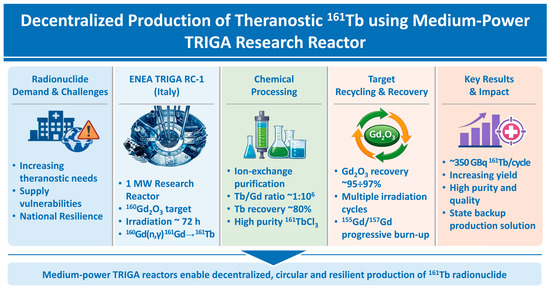
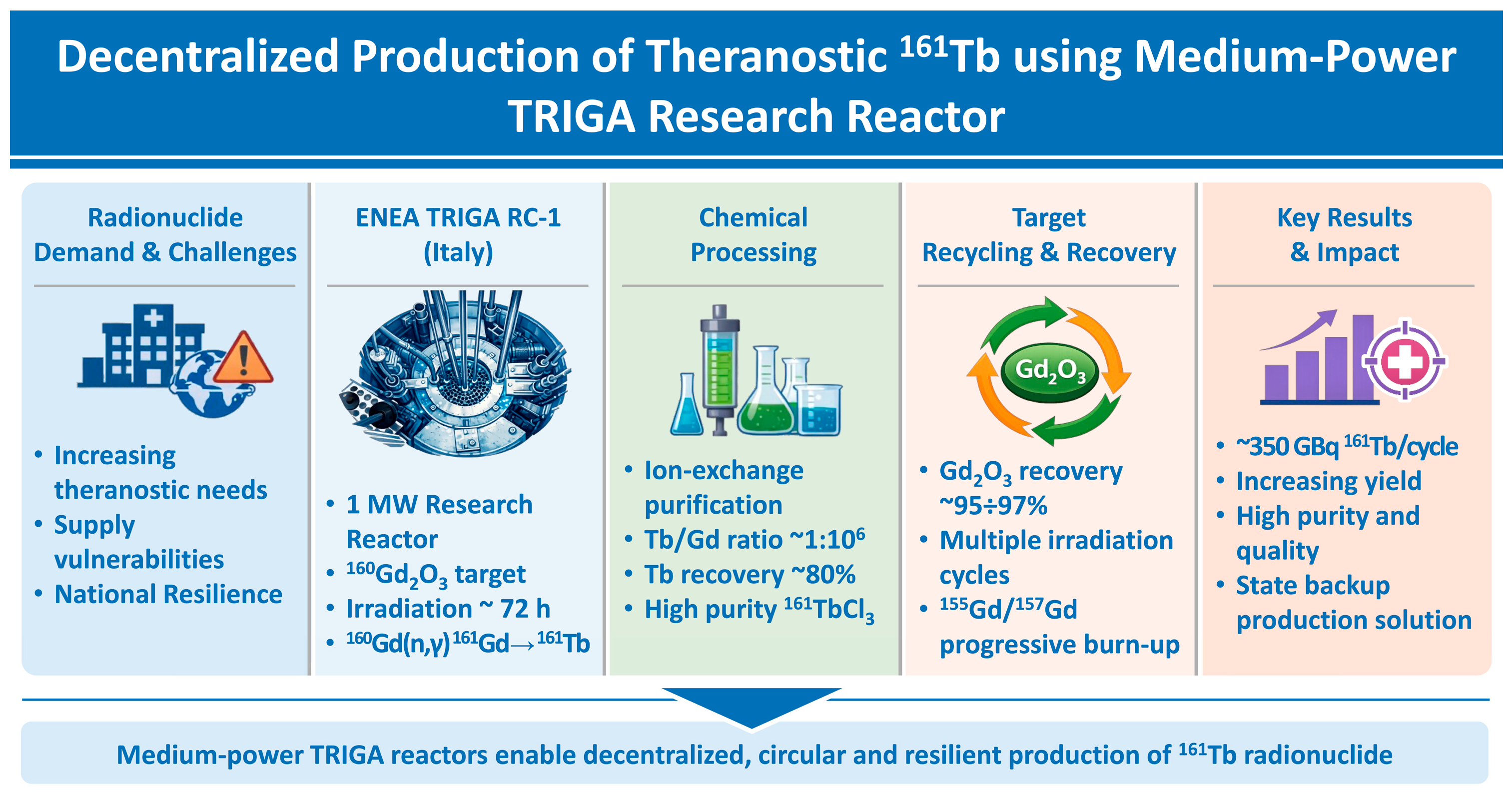
Graphical Abstract

1. Introduction

Over the past few years, medical radioisotopes have been used increasingly often for diagnostic and therapeutic applications aimed at detecting and treating tumors. Today, it is estimated that one hundred radiopharmaceuticals are in daily use in the nuclear medicine sector, most of them being labelled only with few radionuclides such as 99mTc, 18F, 123I, 68Ga, and 177Lu [1].
The use of radioisotopes in nuclear medicine is rapidly advancing, with significant market growth expected for innovative radiopharmaceuticals. Over 10,000 hospitals worldwide use about 100 nuclear medicine procedures, resulting in nearly 49 million interventions per year. In the European Union (EU), more than 1500 facilities treat around 10 million patients yearly [2]. Nuclear reactors are the main source of such medical radioisotopes, although technologies like cyclotrons and other accelerators are widely used also.
Even though a worldwide supply chain is well established today for such medical isotopes, the current market is interested in diversifying production using unexplored production routes, or identifying other radionuclides equally efficient for treating patients’ diseases, ensuring a diversification of the supply chain. Such aspects are crucial for the stability of nuclear medicine worldwide. For certain key isotopes, e.g., 99mTc, production is concentrated in only a handful of facilities globally, after which the radionuclide is distributed through international supply chains. This model entails two major risks: (i) the shutdown of even a single production center can lead to a worldwide shortage [3,4], (ii) external unexpected events—such as the COVID-19 pandemic—can disrupt or severely limit distribution channels. In both cases, the consequence is the same: patients may be deprived of essential diagnostic or therapeutic radiopharmaceuticals.
While the market for therapeutic isotopes is currently still small compared to the diagnostic radionuclides market, the use of radiopharmaceuticals in therapy holds great promises for advancing cancer treatment. This is driving a growing demand for a broader range of therapeutic isotopes, and maintaining a robust fleet of reactors becomes increasingly critical. Many existing reactors are up to 60 years old. Although new reactors are currently under construction, e.g., PALLAS in the Netherlands [5], they are not expected to become operational before 2030. In parallel, alternative isotope production methods not relying on reactors are being explored, and they are expected to provide additional capacity in the future [6].
Developing multiple, geographically well distributed production lines would therefore help in mitigating these vulnerabilities, safeguarding patient care. The possible local production of medical radionuclides with small research reactor facilities already present in countries today could become a key improvement.
Within the European Community framework, so as to ensure a secure and reliable supply of current and future radioisotopes for both therapeutic and diagnostic purposes, several research projects have been funded in recent years (PRISMAP, the European medical radionuclide programme [7], SIMPLERAD [8], and SECURE [9]) to enhance the expertise of member states and foster future collaborations. Such initiatives aim to reinforce currently working infrastructures, to explore diverse production routes and to study newly emerging or more production-resilient medical radionuclides.
In this framework, the Italian ENEA TRIGA RC-1 reactor joined the EU-funded SECURE Project (HORIZON-EURATOM-2021-NRT-01 call, Strengthening the European Chain of sUpply for next generation medical RadionuclidEs; October 2022–September 2025 [9]) investigating the feasibility of an Italian production of the terbium-161 (161Tb) medical supply to meet part of the national theranostic radionuclides demand in the future or to serve as a state backup solution.

1.1. The Role of Medium- and Low-Size Nuclear Research Reactor Facilities

Research reactors—both TRIGA-type and other designs—have long provided the scientific community with a controlled environment for experimental radionuclide production. TRIGA reactors, in particular, are widely used for feasibility studies thanks to their inherent safety features, flexible operation, and moderate neutron fluxes. The examples shown hereafter demonstrate how such facilities can support the development of emerging medical radionuclides, enabling irradiation tests, modelling validation, and initial radiochemical separations, confirming the value of these reactors as R&D platforms, exploring also the potential for production batches to meet local demands.
The paper [10] investigates the production of 111Ag, using the 250 kW TRIGA Mark II research reactor in Pavia (Italy). Researchers irradiated within the Central Thimble both natural and 110Pd-enriched Pd targets to produce 111Pd, subsequently decaying to 111Ag. Using this reactor, a 1-h irradiation of ∼60 mg of enriched Pd produced ∼120 μCi of 111Ag, and the study shows that with repeated daily irradiations (typical TRIGA duty cycle of 6 h/day), the reactor can reliably yield ∼1 mCi of 111Ag per day per 100 mg of 110Pd irradiated.
Within the paper [11], the 250 kW TRIGA Mark II reactor of Vienna (Austria) was used to study the feasibility of the production of 99Mo from MoO3 targeted with irradiation, namely with natural isotopic composition and enriched in 98Mo, using the neutron capture reaction. A technique for 99mTc production, which includes 120 h irradiation of natural or enriched MoO3 targets with masses 10.6 g (natural Mo) and 3.3 g (enriched 98Mo), respectively, in the central reactor channel and subsequent separation of 99mTc using an extraction generator with multiple cycles, was proposed. The expected volume activity of the separated 99mTc radiopharmaceutical would be sufficient for a 1-week work cycle of one or several (in case of enriched samples) diagnostic single crystal scintillation cameras, and therefore has a potential to ensure some local provision of 99mTc even with small power reactors such as TRIGA Mark II.
Also, the Slovenian 250 kW TRIGA Mark II reactor [12] was extensively used for the production of radioactive isotopes for medical purposes (18F, 85mKr, and 99mTc) in the past. Due to the relatively low neutron flux (1 · 10 13 [cm−2 s−1] in the central channel), the production was focused more on short-lived isotopes. Technetium was obtained from 99Mo, which was produced by the irradiation of natural isotopic composition 98Mo. The production was based on the irradiation of 80–85 g of MoO3 (four weeks in a flux of 4 · 10 12 [cm−2 s−1] and finally 48 h in a flux of 1 · 10 13 [cm−2 s−1]). The chemical processing allowed for a daily production of 50–70 GBq of 99mTc with a specific activity of about 4.8 GBq · mL−1. Also, 18F production from the reactor irradiation of 6Li2CO3 was experimented in the past although well-established solutions via cyclotron are available today.
The paper in [13] compared the 1 MW Portuguese Research Reactor (RPI) and TRIGA-type irradiation conditions to produce radiopharmaceutical radionuclides evaluating how such low-power research reactors can be effectively used to produce a range of therapeutic radionuclides despite their limited neutron flux. The study analyzes both direct (n and γ ) activation routes and generator systems to assess the feasibility of producing isotopes such as 64Cu, 153Sm, 168Ho, 177Lu, 185Re, 111Ag,199Au, and 77As. Detailed flux calculations and irradiation experiments at RPI (position 45, 1.6 · 10 13 [cm−2 s−1] thermal neutron flux) confirm that even small research reactors can reliably generate specific activities suitable for preclinical and early-stage radiopharmaceutical development, particularly when enriched targets are used to overcome self-shielding effects and radionuclidic contaminants. The comparison with TRIGA reactors shows that for certain isotopes (notably 64Cu and 77As), RPI’s higher thermal flux can outperform typical TRIGA systems, though both reactor types remain valuable for small-scale therapeutic radionuclide production or generator development. The work concludes that optimized irradiation schedules, enriched targets, and appropriate cooling times allow low-power reactors to support meaningful biomedical research, demonstrating their strategic relevance for cooperative programs in radiopharmaceutical development.
The paper [14] explored the capabilities of the Finnish TRIGA FiR 1 reactor for BNCT therapy and isotopes production. Several medical isotopes were produced, for R&D scopes mainly. No hospital supplies were produced.
The paper [15] faced the possibility of producing 64Cu with a 250 kW TRIGA reactor via the activation channel 64Zn(n,p)64Cu, as an alternative methodology to the current established 64Ni(p,n)64Cu accelerator pathway. Samples in tens of mg quantities were irradiated in neutron flux ranging from 2 · 10 12 [cm−2 s−1] to 1 · 10 13 [cm−2 s−1] for 8 h. The final product has been declared to meet adequate medical standards but the activity quantities produced are limited due to the intrinsic low value of the neutron flux.
Also, 177Lu production via TRIGA reactors have been explored. Preliminary experimental results in [16] conducted at a flux of 1.4 · 10 12 [cm−2 s−1] demonstrated that the direct neutron activation of natural lutetium oxide notably yielded a specific activity of 177Lu at 10.92 GBq · g 1 with a production yield of 44.8%, with projections reaching 222 GBq · g 1 after 40 days of neutron irradiation. In comparison, the indirect method, using natural ytterbium oxide as a precursor, achieved a maximum specific activity of 177Lu at 6.6 MBq · g 1 with a yield of 37.8% of a theoretical maximum of 17.6 MBq · g 1 after only 10 h of neutron activation. These results are declared to open to the possibility of a 177Lu local production in Thailand.
The paper [17] showed that the indirect production route of irradiating 176Yb at the In-Core Irradiation Tube (ICIT) is the only feasible route of 177Lu production in the Oregon State 1 MW TRIGA reactor, USA. The amount of material that can be irradiated at one time is limited to 10 g of target material at the ICIT tube, with a maximum neutron flux of 1.1 · 10 13 [cm−2 s−1]. 176Yb 96%-enriched Yb2O3 was irradiated for 15 days. For one gram of 176Yb, 23.71 μg of 177Lu can be produced. With the maximum limit of 10 g of the 176Yb target material, 0.269 mg of 177Lu can be produced. At a full load, and considering a 7-day decay period, about 60 doses of 177Lu (7 GBq each) can be obtained monthly.
Regarding 161Tb, production within a 2 MW TRIGA in Bandung, Indonesia, was tested and shown in [18]. A 98.4% enriched 160Gd 5 mg Gd2O3 sample was irradiated at 5 · 10 13 [cm−2 s−1] for 3 days. Chemical processing and purification demonstrated that the final 161TbCl3 product met the standard chemical and radiochemical purity established for 177Lu today.
The examples provided cover both current applications for the production of radionuclide quantities useful for scientific R&D and study cases regarding potential upscaling of facilities to possible medical supply productions.
Low- and medium-power research reactors, though currently used mainly for training and scientific studies, have the potential to diversify medical radionuclide production. With targeted upgrades—such as improved irradiation positions, better thermal–hydraulic management, automated transfer systems, and dedicated radiochemical processes—these facilities could become effective regional producers of medical isotopes. Although they are not yet integrated into the commercial supply chain, they represent a promising technological resource. With appropriate investment and focused R&D, such reactors could provide decentralised production capacity, reduce the dependence on a small number of ageing high-flux reactors, and support the development of emerging radionuclides requiring specialised experimental environments.

1.2. The Italian Context and the TRIGA RC-1 Use Case

In Italy there are few infrastructures dedicated to the production of medical radionuclides, and most of them are located directly inside hospitals running nuclear medicine procedures. Production devices are essentially accelerators, because of the lack of nuclear reactors within the country due to the national abrogative referenda about the utilisation of nuclear energy in Italy, the first held on November 1987 and the second on June 2011.
The necessity of developing a secured and reliable medical supply chain for well-established or novel radionuclides was felt by the Italian Government, promoting initiatives such as LARAMED, a project funded by the Italian Ministry of University and Research in 2014–2016 [19,20], i.e., after the sudden closure of the Petten High-Flux Reactor (HFR) in 2010 and the following 99mTc supply crisis in Europe.
With regard to the same concept, ENEA—the Italian National Agency for New Technologies, Energy and Sustainable Economic Development—in 2017 started a study about the Italian production of 99mTc via the neutron activation of 98Mo(n, γ )99Mo at the TRIGA RC-1, Casaccia Research Center, Rome, [21] showing a similar conclusion as in [11].
With the same aim, ENEA joined the SECURE Project in 2022, investigating the possibility of using the TRIGA RC-1 as a production facility for the emerging theranostic 161Tb isotope. 161Tb is a promising radionuclide for targeted radionuclide therapy (TRT) due to its favorable decay properties and chemical compatibility with 177Lu. It is obtained by the neutron activation of gadolinium target, highly enriched in 160Gd, exploiting the reaction channel 160Gd(n, γ )161Gd( β )→161Tb. The main challenge for large-scale production is the low specific activity concentration in the final irradiated target compared to commercial production methods. This is translated in a larger quantity of starting raw material to be irradiated per cycle, and the need to (i) optimize the irradiation condition, (ii) develop a chemical process to extract and purify the selected isotope, and (iii) recover and purify the high-cost raw material to start new irradiation batches.
It can be concluded that the potential contribution of low- and medium-size reactors to medical radionuclide market requires, for such facilities, to re-design the entire process together with its dedicated scaling-up, because currently established methodologies used in higher-neutron-flux reactors operating today cannot be applied directly.
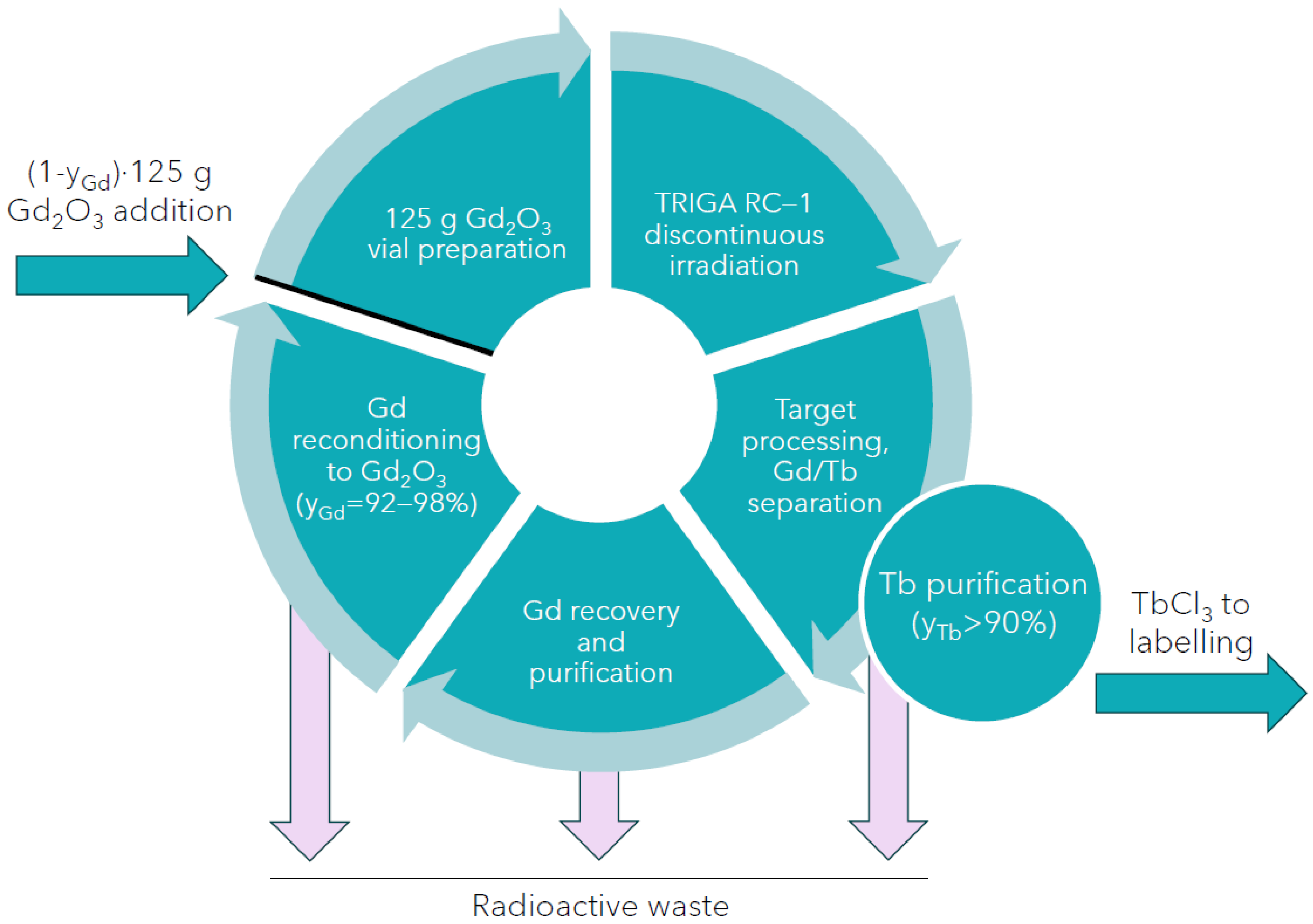
This paper presents the work conducted at the ENEA TRIGA RC-1 research reactor to design a potential Italian production cycle for 161Tb, integrating reactor-specific analyses, the definition of chemical processing workflows, and a comprehensive economic assessment encompassing the target recycling. Figure 1 outlines the main actions of such circular process, showing the material workflows.
Overall, the present work represents the combined outcome of theoretical assessments, dedicated irradiation experiments, and extrapolations derived from the achieved results. Taken together, these activities provide a coherent basis for evaluating the potential upscale of 161Tb production at TRIGA RC-1 and for outlining a realistic pathway toward a fully implemented production cycle. The study therefore offers not only an initial feasibility analysis, but also a technically informed framework that may support future decision making regarding the role of small research reactors in strengthening the national medical radionuclide supply chain.


1.3. The Role of 161Tb in Future Nuclear Medicine

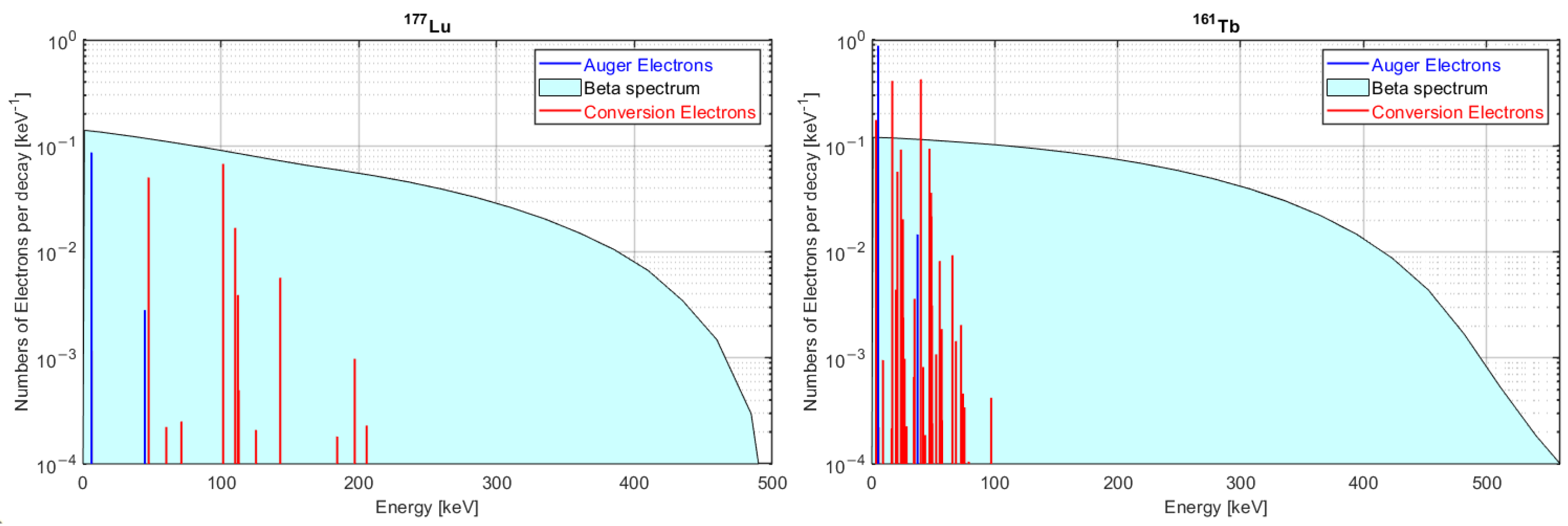
Table 1 summarizes the main physical, radiochemical, and medical characteristics of the therapeutic radionuclides 177Lu and 161Tb. Although both isotopes exhibit comparable physical half-lives and β -particle energies, relevant differences are observed in their emission of low-energy conversion and Auger electrons. In particular, 161Tb releases a significantly higher amount of short-range electrons, leading to enhanced energy deposition at the subcellular level. This distinctive decay profile results in higher absorbed doses in micrometastases and single tumor cells, suggesting a potential advantage of 161Tb for the treatment of minimal residual disease when compared with the clinically established 177Lu. Figure 2 shows the electron emission spectra for both radionuclides. 161Tb combines the favorable β properties of 177Lu with a substantially higher emission of short-range Auger and conversion electrons. Compared to 177Lu, 161Tb delivers the following:
  • ∼1.8 times higher absorbed dose in 100 μm metastases;
  • ∼3.6 times higher absorbed dose in single tumor cells.
These characteristics make 161Tb a strong candidate for next-generation targeted radionuclide therapy, especially in applications requiring effective control of microscopic disease.
Table 1. Comparison of physical, radiochemical, and medical properties of 177Lu and 161Tb [22,23].
Parameter177Lu161Tb
Physical Data
Decay mode β (100%) β (100%)
Half-life6.647 d6.906 d
Mean β energy133.3 keV154.3 keV
Total e energy/decay147.9 keV202.5 keV
Conversion e13.52 keV/decay39.28 keV/decay
Auger + CK e1.13 keV/decay8.94 keV/decay
γ for imaging208.4 keV (11%), 112.9 keV (6.4%)74.6 keV (10.2%)
Energy deposition range 90%∼0.62 mm∼0.63 mm
Energy deposition range 99%∼1.07 mm∼1.06 mm
Radiochemistry
Oxidation stateLu3+Tb3+
ChelatorsDOTA, derivativesDOTA, derivatives
In vivo stabilityHighHigh
Radionuclidic purityHighVery high
CostStandardComparable
Medical applicability
Clinical useNETs, PCa, lymphomasPreclinical/early
MicrometastasesLimitedSuperior
Single cellsLowHigh
Dose at 100 μ m24.5 Gy44.5 Gy
Dose at 10 μ m3.9 Gy14.1 Gy
Main advantage β therapyAuger + CE emission
Post-therapy imagingSPECTSPECT
Overall suitabilityMacroscopic tumorsMicroscopic diseases
Figure 2. Electron emissions of 177Lu and 161Tb. β -spectra are in light blue, CEs are in red, and Auger electrons are in blue. Data taken from [24,25,26].
Jne 07 00016 g002

2. Materials and Methods

The study of the entire process has been divided in three main aspects:
  • Reactor Calculations: Irradiation studies and experiments, reactor core reactivity cross-checking, and radiation protection;
  • Chemical Processing: Extraction of the 161Tb final product, recovery of 160Gd2O3 raw materials, and purification of streams;
  • Economic Assessment: Developing a global model for costs and revenues.
The first two aspects are targeted to demonstrate the technical feasibility of the 161Tb production cycle. The last point is to evaluate the economic sustainability of the entire process.

2.1. Reactor Calculation

2.1.1. The TRIGA RC-1 Research Reactor and 161Tb Activation

The Mark-II TRIGA RC-1 research reactor is a thermal neutron source (1 MW) located in the ENEA Casaccia Research Centre in Rome [27,28]. The initial assumptions made to develop a reliable production model for a sustainable cycle of 161Tb supplies—concerning aspects regarding the irradiation only—are as follows:
  • Raw target material characteristics: To maximise production, the chemical form selected is Gd2O3 and the Gd isotopic composition > 98% enriched in 160Gd. The maximum amount of Gd2O3 that can be loaded is 125 g to comply with the maximum reactivity insertion allowed for mobile experiments within the reactor core, i.e., 500 pcm. Also, the activation of natural isotopic composition Gd2O3 samples was performed to carry out preparatory experiments;
  • Irradiation position: Irradiation cavities useful for the intensive activation of materials are located inside or closer to the reactor core. In particular, the most intense one is chosen, the Central Thimble, where the maximum neutron flux at 1 MW is 5 · 1013 [cm−2 s−1] [27] with an irradiation volume of 140 cm3. The effective maximum Gd2O3 loading capacity of the channel is ∼400 g. Also, other irradiation channels have been used during the study, to gradually scale-up the irradiation experiments and calculation benchmarking.
  • Irradiation time: The irradiation time should be selected to be at least 1 ÷ 2 times the mean live time of 161Tb, i.e., 10 ÷ 20 days of continuous irradiation, for the optimal utilisation of the target material. Such a long period of irradiation is not possible at the ENEA TRIGA RC-1 reactor due to current technical and operational constrains. The selected schedule consist in average 6 h per day with 12 days of irradiation (except Saturdays and Sundays) that correspond to an overall—discontinuous—irradiation of ∼72 h;
  • Reactor schedule and maintenance: The potential establishment for a 161Tb production requires a tight schedule to be respected, resulting at increasing the utilisation factor of TRIGA RC-1 to about 0.7 yearly. The impacts on personnel, ancillary support structures, maintenance, and other vital aspects of the reactor’s operation have to be taken into account. Also, competition, or eventual concurrency, with other experiences and usages of the facility should be evaluated.
To date, the main challenge for research reactors such as the TRIGA RC-1 reactor is to establish a production cycle capable of handling large quantities of raw material (in the order of tens or hundreds grams of target material). Unlike the examples provided before in Section 1.1, the present work aims to develop a production cycle based on constant 125 g quantity of 98% enriched 160Gd2O3 raw material, enabling the highly efficient separation of 161Tb and the recovery of the irradiated target to start new irradiation batches.

2.1.2. Reactor Physics Modelling

The neutron flux at the Central Thimble was characterised experimentally through neutron activation analysis, with ASTM E262-08/E262-97 procedures [29] and complemented by spectral unfolding algorithms [27], using codes such as STAYSL [30], SAND II [31], or NLLSUP (ENEA-developed spectral unfolding code). The neutron flux spectrum was also calculated with the MCNP code [28] and compared to experimental data.
The reaction rates to 160Gd activation were estimated both with the ASTM E262 and MCNP methodologies. At the TRIGA RC-1 reactor, the ASTM formulation serves a dual purpose, being applicable both to the determination of the neutron fluence rate, e.g., via gold foils irradiation, and to the evaluation of the target activation rate and the corresponding final activity, once the neutron fluence rate is known. MCNPX v.2.5.0 [32] was used. Within the code, a flux tally (tally f4) is constructed within the input, to which the fm4 card (i.e., a multiplier card associated with the flux tally) is linked. The fm card allows us, through an appropriate choice of the tally’s multiplication factor (i.e., the number of atoms of the parent nuclide), to obtain the reaction rate, and, applying the irradiation schedule, the activity at the end of irradiation (EOI). Whatever the approach, the 161Tb final activity value (A) obtained at the end of irradiation could be estimated by A = R(1 − e λ t irr ), where t irr is the irradiation time (s), λ is the decay constant (s−1), and R is the reaction rate, calculated as follows:
R = N t σ ( E ) φ ( E ) d E = m N A θ P . M . σ ( E ) φ ( E ) d E
  • Nt is the number of atoms of the output radionuclide’s “father” within the sample;
  • m is the mass of the target element;
  • N A is the Avogadro Number;
  • θ is the isotopic atomic abundance of the output radionuclide’s “father”;
  • P . M . is atomic weight of target element;
  • σ (E) is the microscopic cross-section associated with the specific reactions;
  • φ (E) is the neutron flux.
Gadolinium samples exposed to neutron irradiation are particularly subjected to neutron self-shielding phenomena, due to the presence of 155Gd and 157Gd isotopes that show very high neutron capture microscopic cross-section values. Neutron self-shielding factors introduced in the ASTM E262 approach (Gth and Gres) have been evaluated via the MCNP code. Using an appropriate energy binning, the neutron spectra in MCNP were divided into two main groups: thermal neutrons (up to 0.55 eV) and higher-energy neutrons (0.55 eV–20 MeV). The reaction rates were calculated using the f4 and fm4 tally cards for the material at its nominal density. The simulation was then repeated with a reduced material density, set to one-thousandth of the nominal value, yielding a second set of f4–fm4 reaction rates. The ratio between the reaction rates obtained at nominal density and those obtained at one-thousandth density in the thermal neutron energy bin was defined as Gth. Similarly, the ratio between the corresponding reaction rates in the 0.55 eV–20 MeV energy bin was defined as Gres. The reaction rates calculated within MCNP directly take into account for such phenomena.
Several irradiation experiments involving natural and enriched gadolinium oxide have been carried out, and the irradiated samples have been characterised via gamma spectrometry. The experiments have been reproduced within the approaches before, to benchmark the calculation methodologies.
The cross-validation of calculation methodologies is particularly important, being real experiments realized in small scales, while extrapolation to higher masses, to assess a large-scale production, can be performed just by theoretical evaluation at this stage.
For completeness, the FISPACT-II v4.0 code [33] has also been used during the study for (i) radiation protection purposes (the code does not take into account neutron self-shielding phenomena properly, and the activity calculated is constantly overestimated), and (ii) inventory evolution purposes, with special regards to the species severely impacting on neutron self-shielding (155Gd and 157Gd) following their burning. In the first case, the information on the activated nuclides and the corresponding final activity levels was used by the Radiation Protection Expert to support the possible design of additional shielding or protective measures for the safe handling of the activated samples. On the other hand, a MCNP-FISPACT coupled calculation was used to assess the time-dependent reactivity trend introduced by the target material within the reactor, to demonstrate that reactivity over the irradiation time remains within the safe limits. It should be noted that codes have not been coupled in a traditional way in this work, as FISPACT constantly underestimates neutron self-shielding phenomena: this means that species are burned faster and the inventory evolution over irradiation can be considered an “accelerated” test. With regard to our purpose, to confirm the time-dependent reactivity by the target below the 500 pcm safety threshold (especially for multiple 160Gd2O3 recycling), such a coupled calculation was considered conservative and reliable.

2.1.3. Radiological Characterization

High-resolution gamma spectrometry was used for the radiological characterization of activated samples. Three different HPGe detection systems were used for both neutron flux experimental determination and for determining the final activity values achieved with the Gd2O3 irradiated samples. The detectors were calibrated via (i) certified reference activity 152Eu sources and (ii) LabSOCS (Laboratory Sourceless Calibration Software) developed by Mirion Technologies. All the detectors covered an energy range from 3 keV to 3 MeV with a spectral acquisition over 8192 channels. The signal processing and spectral analysis were managed by DSA-LX and LYNX devices, and spectral management softwares by Mirion Technologies.
To enhance measurement quality and reduce background radiation, the HPGe detectors are housed in a low-background well shield (100 mm of lead) with openable doors, which helps to the detector’s field of view and reduce the influence of external source.
Repeated measurements for irradiated samples have been carried out, acquiring several spectra at different times. All the radionuclide activity determined has been scaled to the End Of Irradiation (EOI) via decay correction. Calculation equations take into account radioactive decay during spectral acquisition [34,35,36,37].

2.2. Chemical Treatment

2.2.1. Materials

Gadolinium(III) oxide, terbium(III, IV) oxide, nitric acid (65%), hydrochloric acid (37%), ammonia (28%), ammonium chloride, and α -hydroxyisobutyric acid ( α -HIBA) were obtained from Merck (Darmstadt, Germany). All the used chemicals were of analytical grade. Dowex 50W X8 Ion Exchange Resin (200–400 mesh) was obtained from Merck (Darmstadt, Germany); LN resin was obtained from Triskem International (Bruz, France). ICP-MS standards of Gd and Tb were obtained from Inorganic Ventures (Christiansburg, VA, USA). Ultra-pure water, obtained from a Milli-Q system water purifier (Millipore Corp., Bedford, UK), was used for all the experiments. Additionally, for ICP-TQ-MS sample preparation SUPRAPUR nitric acid (65%) from Merck (Darmstadt, Germany) was used.

2.2.2. Characterization Method

All measurements of the quantitative determination of Gd and Tb were performed using an iCAP TQ ICP-MS (Thermo Scientific, Waltham, MA, USA). The instrument was operated using the Thermo ScientificTM QtegraTM Intelligent Scientific Data SolutionTM (ISDS) Software and was initially optimized using the supplied tune solution to improve the interface parameters for maximum sensitivity. Raman spectra of Gd2O3 compounds were generated in air by using a Raman InVia Reflex microspectrometer (Renishaw, Wotton-under-Edge, UK) equipped with a 532 nm laser in the presence of a 100× objective, a RenCam CCD detector in the range of 200–3500 cm−1, an encoded xyz stage (replacement precision: 100 nm), and 1800 L/mm grating. After obtaining the measurements, the spectra were analyzed using the Origin software to elaborate the spectra. XRD diffraction patterns have been performed on powders inside borosilicate diffraction capillaries (0.5 mm) using a Rigaku SmartLab diffractometer equipped with CuK α radiation. The diffractometer was operated at 40 kV and 30 mA. XRD patterns were acquired in the 2theta range from 5 to 100 °C with a step size of 0.02 and a time per step of 5 s.

2.2.3. Terbium and Gadolinium Separation Process

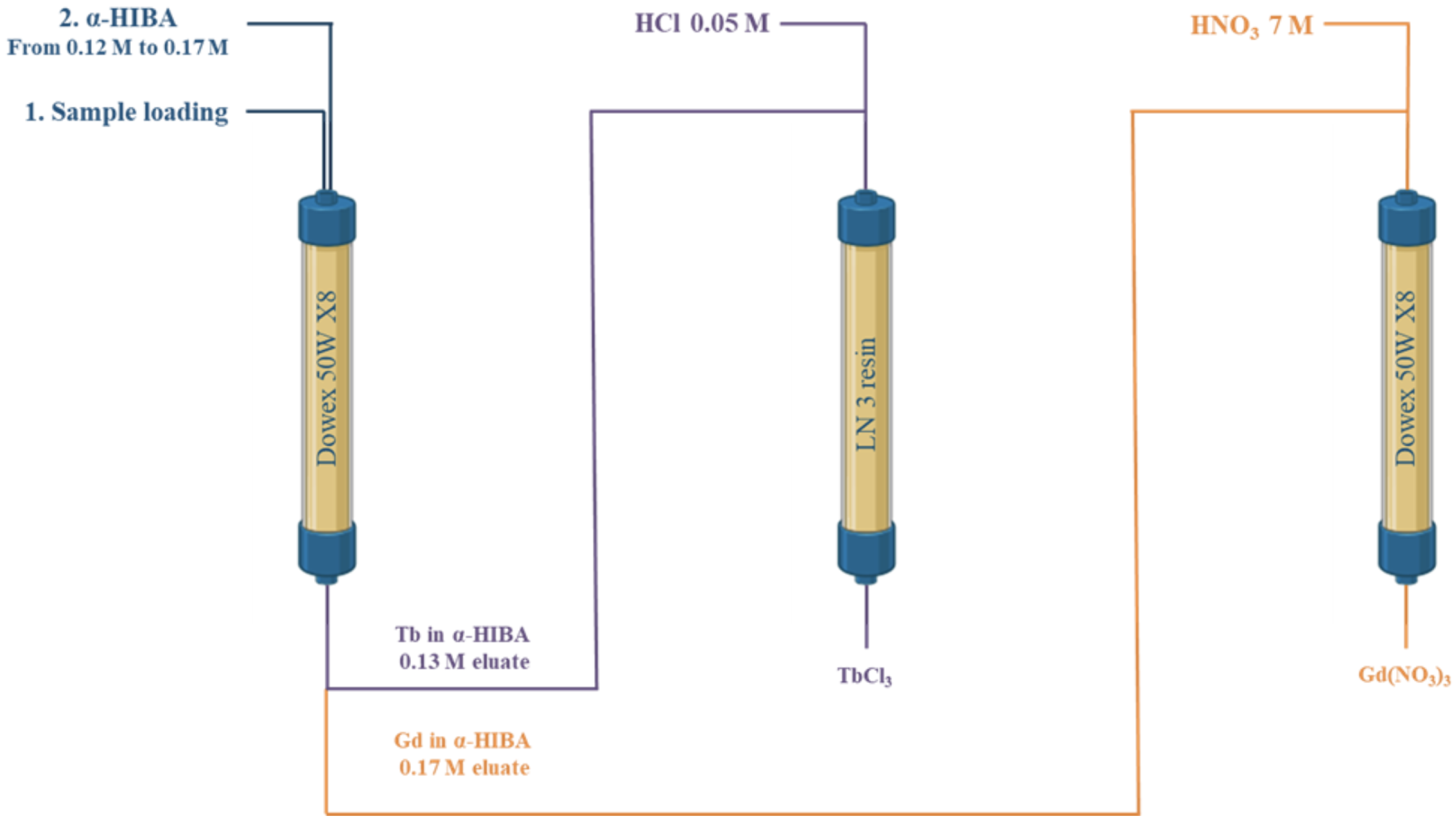
According to the chemical procedure described in the literature [38,39,40], a chromatographic column of 150 × 5 mm dimensions was packed with a suspension of Dowex 50W X8 resin (200–400 mesh) in NH 4 + form. The dissolved sample, consisting of a mixture of Tb 3 + and Gd 3 + of 1:106 (0.05 M NH4Cl solution at pH 3) was manually loaded on the column with a syringe. The column was connected to a peristaltic pump (Masterflex digital pump, dual channel, and 115/230 VAC) and washed with 3 mL of water. A gradient elution with α -HIBA solutions at different concentrations from 0.12 M to 0.17 M (pH 4.5) and a 0.2 mL/min flow rate was performed to separate and isolate Tb from the Gd matrix. After separation, the fractions with Tb-HIBA complex were collected and concentrated to around 10–20 mL and loaded onto a second purification column 6 × 5 mm packed with LN3 resins (Triskem International). The column was washed with 10 mL of water, then Tb was stripped from the column using 3 mL of 0.05 M HCl to obtain the pharmaceutically required form of TbCl3 for radiolabelling. The scheme of the chromatographic process is shown in Figure 3.
To recover the raw gadolinium from the starting sample matrix, the fraction containing the Gd-HIBA complex was collected and mixed. To the aliquot, HNO3 65% (14 M) was added until a pH of 1 was reached (around 200 μ L). The solution was loaded on a second Dowex 50W X8 column with 150 × 5 mm dimensions. The column was washed with 5 mL of HNO3 0.5 M, and then Gd was stripped with around 42 mL of HNO3 7 M with a flow rate 0.4 mL/min. Finally, the obtained gadolinium nitrate was reconverted to gadolinium oxide following the procedure described in Section 2.2.4.

2.2.4. Preparation of Gadolinium Oxalate and Oxide

Following the chemical procedure described in [41], gadolinium oxalate was prepared by reacting stoichiometric amount of 0.01 M gadolinium nitrate and 0.05 M ammonium oxalate at 40 °C. Then, 0.86 g of gadolinium nitrate hexahydrate was dissolved in 150 mL distilled water along with 10% glycerol, and was stirred for 20 min at 40 °C. After 20 min, 1.42 g of ammonium oxalate in 50 mL was added slowly with constant stirring. After a few minutes, the colorless cloudy precipitate was formed. The resulting precipitate was centrifuged and washed with de-ionized water to remove all the unreacted species from the product. The nano-crystalline Gd2O3 was obtained by decomposing the Gd2(C2O4)3 · 10H2O in air for 2 h at 700 °C. The obtained Gd2O3 were stored for analysis. The Gd2O3 compound was characterized using Raman and XRD techniques, as discussed in Section 3.2.2.

2.3. Economic Assessment

The TRIGA RC-1 reactor is not used in the regular production of the medical radionuclide supply today. Potential applications in this sense cannot exclude economic evaluation, taking into account costs and revenues. A first approach calculation model has been developed hereafter.
Since 161Tb is considered an alternative to the currently used 177Lu, such a radionuclide can serve as the reference framework regarding production, usage, availability, and pricing.
Table 2 reports the overall costs allocated to the irradiation and the chemical treatment of the irradiated target, within 125 g of the Gd2O3 hypotheses. Potential revenues from selling 161Tb to radiopharmacies for subsequent labeling were evaluated using the current market price for 177Lu, i.e., 22€/mCi.
The economic evaluation model is based on the subsequent recycling of the raw material recovered from the irradiated target after chemical processing—applying experimentally obtained chemical recovery factors—and considers the inventory evolution of target material, in particular the effect of 155Gd and 157Gd burning resulting in an increasing 161Tb activity production batch by batch of recycling.
Having defined yGd, the chemical recovery yield of gadolinium oxide from the previous batch (n − 1), with quantities (A), (B), and (C) defined in Table 2, the total cost for the irradiation and treatment of the n-batch can be defined as follows:
Costs n = 1 = A + C + M · B · f cost Gd 2 O 3
Costs n batch = A + C + 1 y G d · M · B · f cost Gd 2 O 3
where
  • M is the mass of the Gd2O3 involved in the cycle. It is assumed to be 125 g;
  • yGd at the first n = 1 batch is zero. For n > 1 batches, it is assumed as 95%;
  • f cost Gd 2 O 3 is a factor modifying the cost per unit gram of Gd2O3 (98% enr. 160Gd), increasing or decreasing such cost according to the availability of the raw material.
Revenues from the selling of 161Tb produced in the current n-batch can be estimated as follows:
Revenues n batch = M · D · n 2 + E · n + F · y T b · G · f selling Tb 161
where
  • yTb is the chemical recovery yield of terbium from the (n)-batch. It is assumed as 80%;
  • D · n 2 + E · n + F is the 161Tb production yield per unit mass Gd2O3 [mCi / g G d 2 O 3 ] vs. the (n)-batch number. The values of the coefficients calculated through the Monte Carlo simulation are D = 0.292 , E = 10.1 , and F = 28.4 . The activity values are 7 days after EOI. 161Tb production yield increases due to the 155Gd and 157Gd burning during Gd2O3 recycling;
  • G = 22 / m C i is the selling price of 177Lu at the moment of the study, assumed to a reference value for 161Tb;
  • fselling161Tb is a factor modifying the selling price per unit mCi of 161Tb, increasing or decreasing according to the market price.

3. Results

3.1. Reactor Calculations

The section covers (i) the main irradiation experiments carried out at TRIGA RC-1; (ii) extrapolations to the 125 g-based cycle, carried out by calculations; and (iii) reactivity verifications for the reactor core.
The activities presented in this section were undertaken to establish a robust and quantitatively grounded basis for assessing the feasibility of a 161Tb production cycle at the TRIGA RC-1 reactor. To this end, experimental irradiations were first performed to characterize the behavior of enriched 160Gd targets under representative operating conditions and to obtain benchmark data for validating computational predictions. Building on these measurements, extrapolations to a full-scale production scenario—corresponding to a 125 g target cycle—were carried out through dedicated neutronic calculations in order to estimate achievable yields, neutron economy implications, and operational constraints without the need for extensive in-core testing. Finally, reactivity evaluations were conducted to verify that the proposed irradiation configuration remains compatible with the reactor’s safety margins and does not induce unacceptable perturbations to core behavior.
Together, these activities provide an integrated methodological framework combining empirical evidence, analytical modeling, and reactor physics verification. The approach ensures that the feasibility assessment of a potential 161Tb production line is technically sound, scalable, and fully compliant with the operational and safety requirements of the TRIGA RC-1 facility.

3.1.1. Experimental Irradiation Campaign

The most significant experiments in the 2024 experimental irradiation campaign [42,43] were as follows:
  • Sample #1: 190 mg natural Gd2O3, for 2 h at 1 MW, in the Lazy Susan rotary rack;
  • Sample #2: 1.34 mg natural Gd2O3, for 2 h at 1 MW, in the Lazy Susan rotary rack;
  • Sample #3: 8.7 mg (98.2% 160Gd-enriched) Gd2O3, for 77 h, equivalent to 1 MW (discontinuous irradiation in 12 days, average 6–7 h/day), in the Central Thimble.
All the experiments listed were for benchmarking methodologies and calculations. The last one tested the effective maximum production capacity of the TRIGA RC-1, ∼15 GBq of 161Tb per gram of 160Gd, with an irradiation schedule compatible with the current plant management.
In Table 3, it can be seen that the MCNP code and ASTM standard give realistic results in cases #1 and #3. In case #2, the MCNP results have a significant deviation, being ∼55% higher than the measured and the ASTM E262. This is due to the representation of the actual geometry of the sample: the challenge is that such a small amount of powder does not fill the Eppendorf vial completely, and the allowed mobility of the material significantly affects the effective sample’s geometry during the irradiation and the corresponding self-shielding. Sensitivity analyses have been run via the Monte Carlo simulation considering the amount of material also spread on the inner wall of the Eppendorf vial instead of a sphere at the bottom, showing that self-shielding factors are varying significantly. Even found in simulation was a geometrical configuration of sample #2 matching the activity value experimentally determined; it was decided to report here the simulated value corresponding to the original configuration prepared—the sphere at the bottom of the vial—being uncertain about the true geometry that occurred under irradiation. Anyway, it can be seen that the results obtained using the MCNP and ASTM E262 methods are in good agreement with experimental data. With regards to the uncertainty values reported in Table 3, it should be noted that such values are strongly affected by the large uncertainties (about 17–25% for the microscopic cross-section [44] according to the selected neutron data library) in the 160Gd(n, γ )161Gd( β )161Tb nuclear reaction data and their propagation in calculation. Uncertainties in the experimental data involve error propagation from Poisson statistics in spectra and total efficiency calibration errors. With regards to calculated activity concentrations, uncertainties regarding sample masses are negligible if compared to other uncertainties. Given the combined and propagated uncertainties affecting MCNP and ASTM prediction methodologies, the high values reported in Table 3 clearly highlight the importance of benchmarking through experimental measurements, where reliability is not compromised by large nuclear data uncertainties. The similar uncertainty values obtained for the final activity of 161Tb using the ASTM and MCNP methodologies can be explained as follows. For the ASTM approach, the dominant sources of uncertainty are associated with the experimentally determined neutron fluence rate (approximately 7–13%, k = 1) and with the nuclear data for the 160Gd(n, γ )161Gd reaction (17–25%, k = 1, as told). For the MCNP methodology, the main contributors to the uncertainty arise from the total neutron source strength of the reactor, which is used to scale the fm4 tally results (about 10%; k = 1, based on reactor power instrumentation readings), as well as from the nuclear data uncertainties for the 160Gd(n, γ )161Gd reaction (17–25%, k = 1). In both cases, when all uncertainty components are combined, the overall uncertainty falls within the range of 37–39% (k = 1), obtaining the value in Table 3 when an expanded uncertainty with k = 2 is considered.
More details about experimental activation can be found in [42,43]. These experimental activities constitute the benchmark of the calculation codes and the starting point for subsequent extrapolations regarding the irradiation of bulky samples.

3.1.2. Upscaling Feasibility Study

To evaluate the maximum achievable 161Tb activity, it was decided to fill the aluminum capsule with the maximum amount of material that can be introduced (approximately 400 g of Gd2O3 enriched at 98.2% in 160Gd). To ensure a realistic simulation, the material composition input into the MCNP model was based on a commercially available formulation (the gadolinium oxide and its trace impurities), Table 4.
Putting the capsule at the core center, i.e., the highest neutron flux available, the negative reactivity introduced was ≃560 pcm. The maximum reactivity insertion allowed is 500 pcm. Gadolinium is known to be a neutron poison, so that a study on a lower quantity respecting established constraints was carried out.
The outcomes of the study, considering several geometrical configurations, showed that a 125 g sample placed in the same position led to a negative reactivity insertion of ≃450 pcm. The 125 g configuration has been elected as the maximum amount of raw material to be irradiated.
With this quantity of raw material, different types of configuration have been studied, in order to maximize the final activity and to minimize the neutron self-shielding effects: (i) 125 g contained in four vials inside the aluminum capsule and placed in the Central Thimble in dry configuration; (ii) 125 g contained in nine vials inside the aluminum capsule and placed in the Central Thimble in dry configuration; and (iii) 125 g contained in nine vials inside the aluminum capsule and placed in the Central Thimble in a light water flooded configuration. The results are shown in Table 5. It can be observed that neutron self-shielding factors, Gth and Gres, are comparable among all different 125 g configurations.
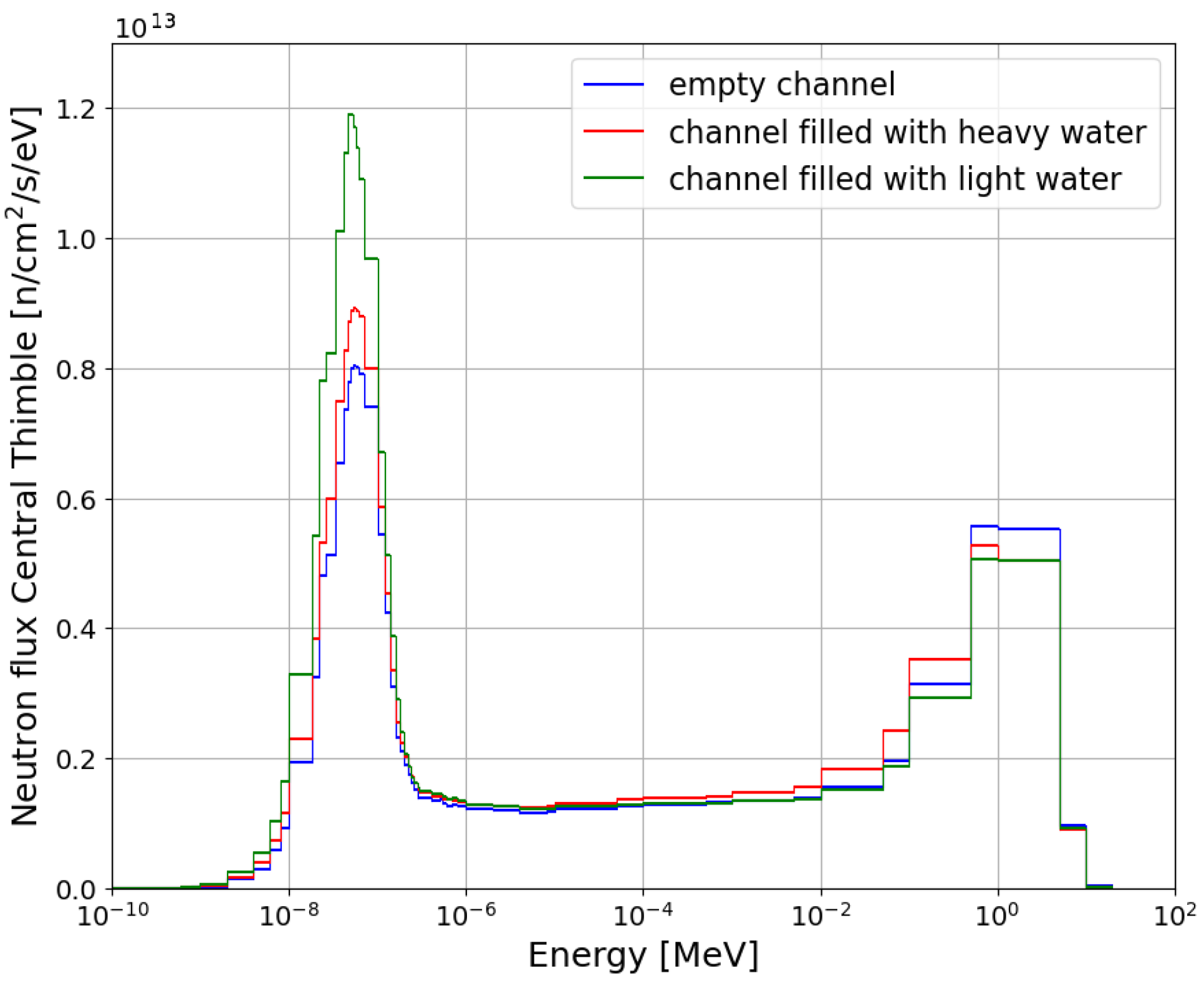
The rationale behind flooding the reactor Central Thimble channel is that water over-moderation is locally increasing the neutron flux. Such a feature has been demonstrated in calculations, with an increase in the integral value of the thermal component of the neutron spectrum by a factor 1.5 . Figure 4 shows the local increase in neutron flux, especially in the nominal 0.025 eV thermal region when the channel is flooded with light water. Unfortunately, the neutron self-shielding phenomena in the Gd samples are so strong that the gains obtained in neutron flux by flooding the channel are completely overcome by the strong neutron absorption features caused by 155Gd and 157Gd. Such a high microscopic neutron capture cross-sections make such isotopes burnable materials under irradiation.
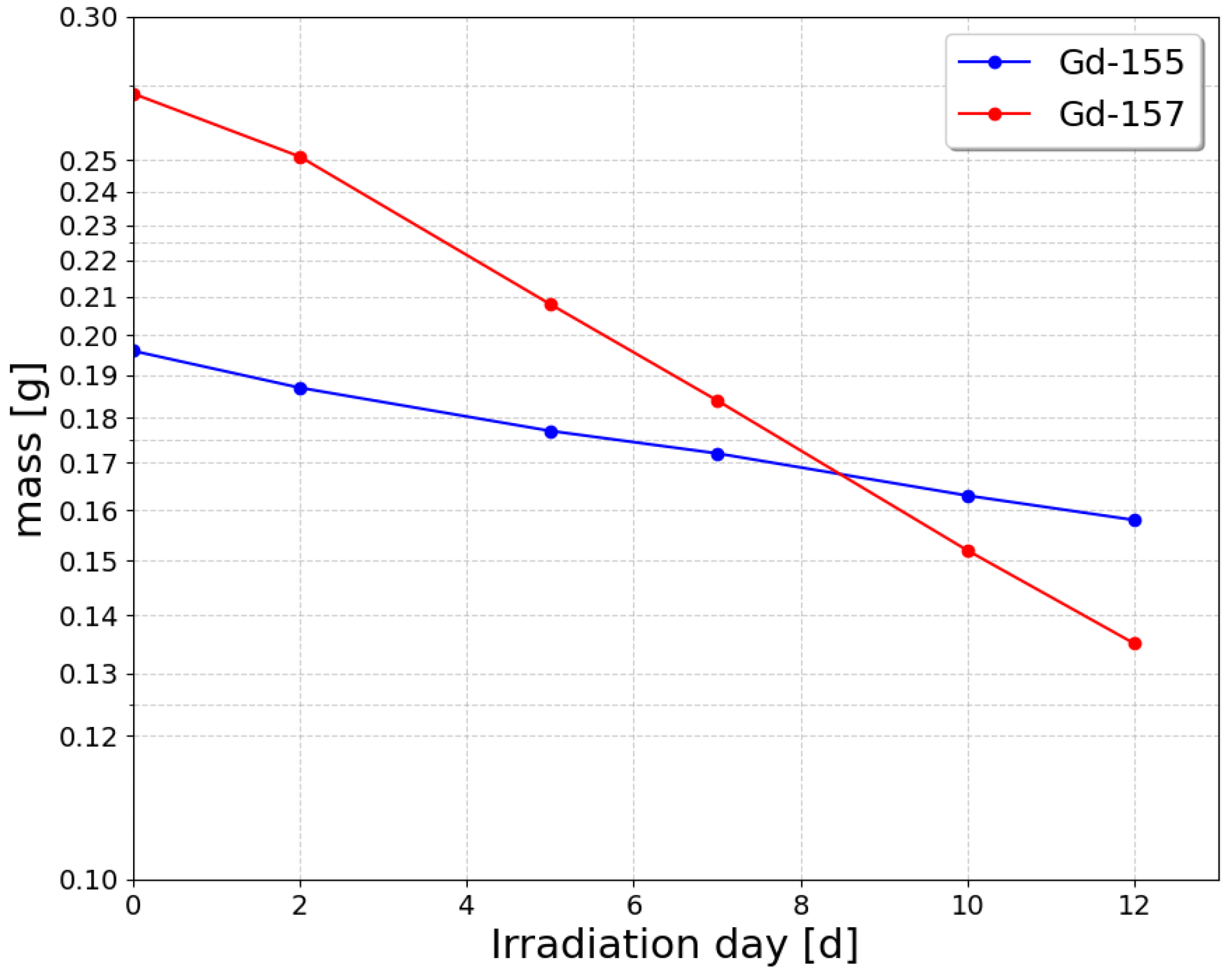
To obtain an order of magnitude, referring to 125 g of Gd2O3 in the “four vials empty configuration”, with the FISPACT-II code, it was calculated the inventory in cases of irradiating the initial batch for the established 12-day irradiation cycle, as shown in Figure 5. As can be seen, the 155Gd and 157Gd mass values in the inventory rapidly decrease under irradiation.
Supposing a multiple recovery of the Gd2O3 batch (as mentioned before, it is necessary to recover and re-irradiate the raw material in order to reduce costs) and repeating the FISPACT-II irradiation exercise for three times, the inventory with burned 155Gd and 157Gd was used as new target material in the MCNP code in order to calculate the final activity at the fourth cycle. The simulation shows the significant reduction in the 155Gd and 157Gd isotopes with a corresponding increases in the final 161Tb activity (and the corresponding activity concentration). With the established 77 h irradiation protocol of this fourth batch, the final obtained activity is 590 GBq of 161Tb (337 GBq in the first batch), corresponding to an activity concentration of 5.5 GBq/gGd−160 (3.2 GBq/gGd−160 in the first batch).
Reactor core reactivity evaluations also benefit from 155Gd and 157Gd burning during multiple recovery of the Gd2O3 batch, with a progressive reduction in negative reactivity insertion due to the massive sample (the maximum value to be ≃450 pcm for the 125 g Gd2O3 “fresh” sample).
Burning 155Gd and 157Gd during target recycling proves to be a key point in the optimal use of the raw material at a TRIGA-like facility, enhancing the final 161Tb production.
The effects of 155Gd and 157Gd progressive burning vs. target recycling are discussed in Section 3.3, which examines the impact of such results on the economical evaluations.

3.2. Chemical Treatment

3.2.1. Terbium Purification Process and Scale-Up Batch Studies

According to FISPACT II calculations, the 161Tb activity achieved after raw 98.2% Gd-160-enriched Gd2O3 target irradiation at ENEA TRIGA RC-1 reactor would be about 14.7 MBqTb−161/mgGd, corresponding to a Tb:Gd mass ratio in the order of magnitude 1:106.
In higher neutron-flux facilities with respect to TRIGA RC-1, such a ratio is higher by a factor of ten or more. Developing a chemical processing procedure adequate to establish the medical-grade production at TRIGA RC-1 means being able to separate and purify 161Tb in such disadvantaged conditions.
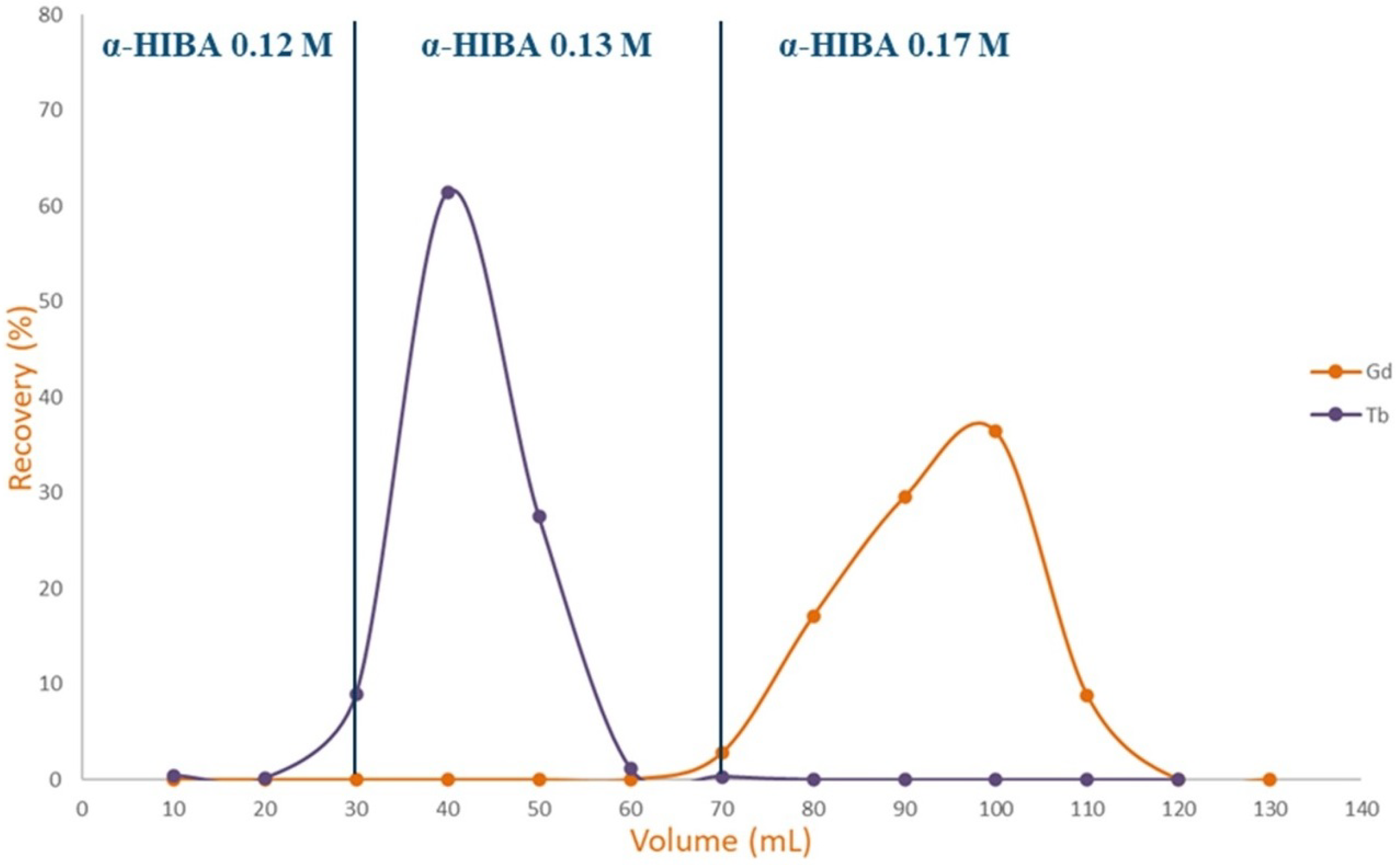
Based on these theoretically expected values, a purification process was investigated and developed employing “cold” samples. In agreement with the chemical dissolution procedures widely described in the literature, the samples were prepared by mixing natural Tb4O7 and Gd2O3 followed by the dissolution in 2 mL HCl 37% at 250 °C. The solutions were evaporated to dryness, and the obtained residues were dissolved in 2 mL of a 0.05 M NH4Cl solution and 1 mL of 0.1 M HCl (pH 3). Starting with a Tb:Gd ratio of 1:1 and a 40 mg batch, several α -HIBA gradients were tried to achieve the highest possible chromatographic resolution. For the target Tb:Gd ratio of 1:106, it was found that a gradient of α -HIBA from 0.12 M to 0.17 M led to better isolation of Tb from this massive amount of Gd. The chromatographic profile showing the efficiency of the process is reported in Figure 6. Pure terbium was eluted in about 30 mL of 0.13 M α -HIBA with a recovery of about 90%. The first conditioning and elution with 20 mL of 0.12 M α -HIBA turned out to be crucial to improve the chromatographic resolution of the Tb and Gd peaks. Gadolinium was eluted in 50 mL by increasing the concentration of α -HIBA to 0.17 M, with a recovery from 92% to 98%.
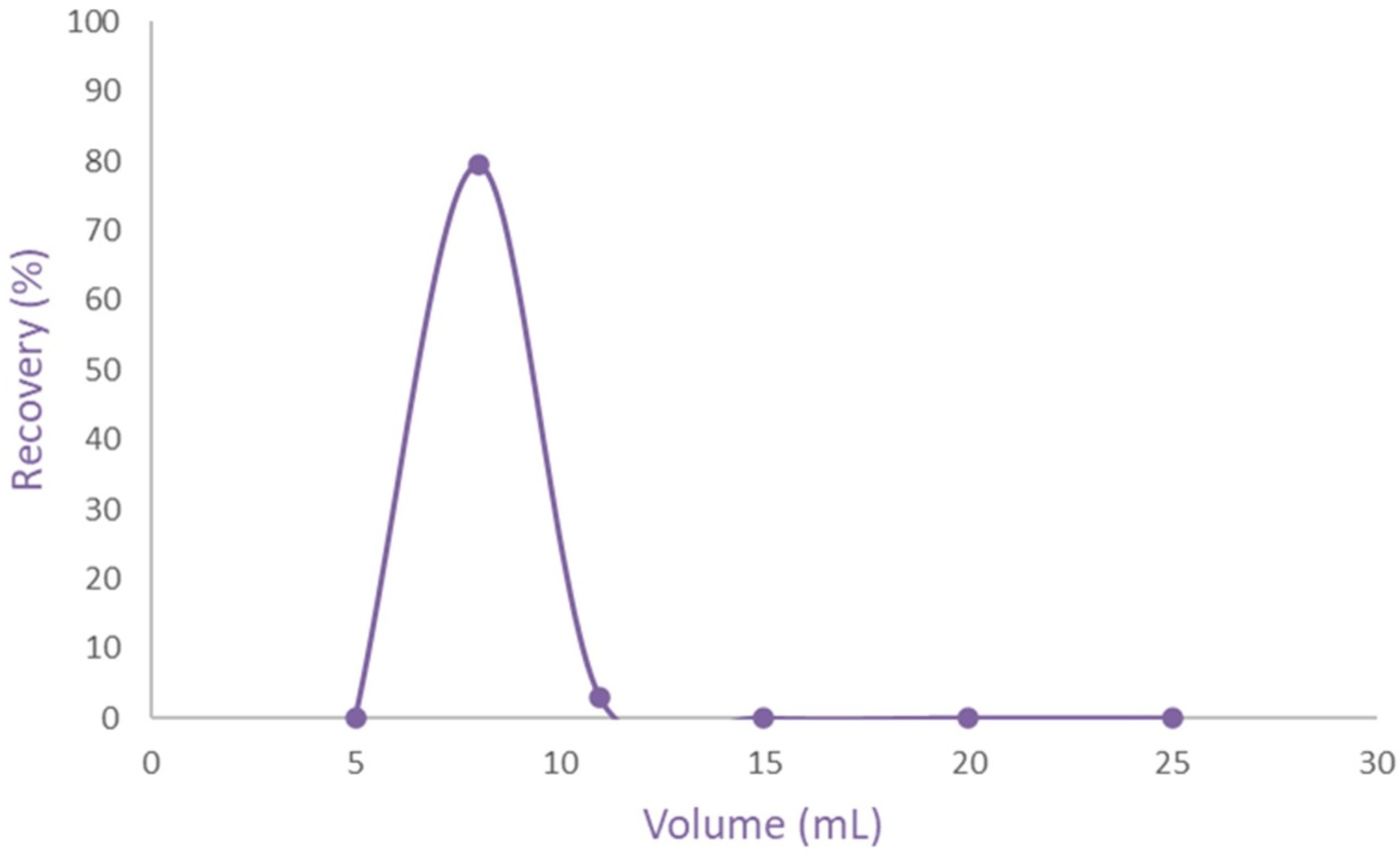
Tb fractions were collected and concentrated to 8/10 mL and eluted through an LN3 column, which is specific for lanthanides. LN3 resins can strongly retain Tb cations and not the residual α -HIBA that was therefore eluted and discarded with 5/10 mL of water, together with all the possible impurities from the previous Dowex column. Then, Tb was stripped from the column with 5 mL of 0.05 M HCl (Figure 7) to obtain the pharmaceutically required form of TbCl3. Tb total recovery after the whole separation process was about 80%.
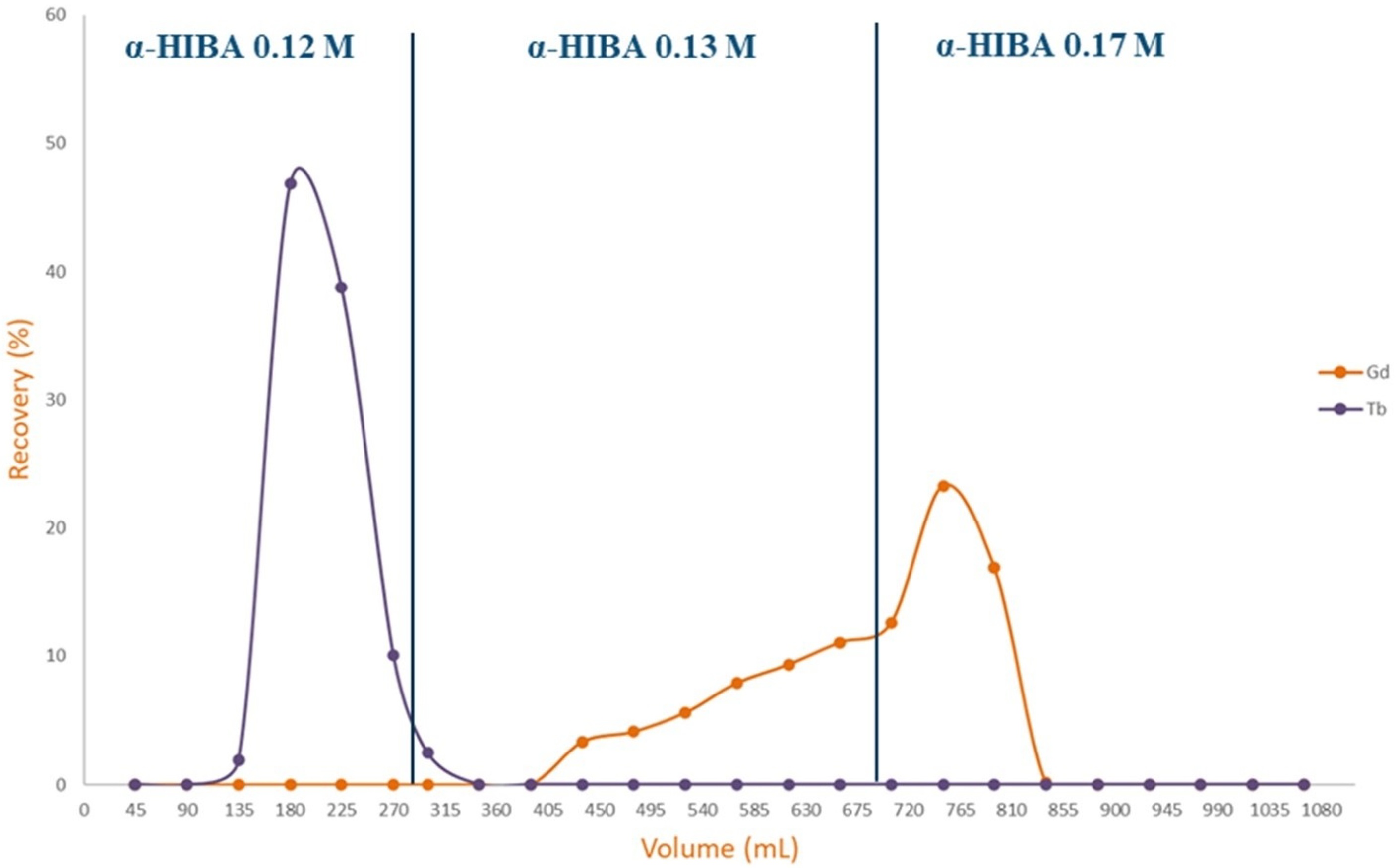
Finally, in order to explore the process robustness and the feasibility of Tb production employing ENEA TRIGA RC-1 facility, a scaled-up batch was performed on 400 mg. To improve the column capacity, it was decided to increase the diameter (from 0.5 to 1.5 cm) without changing the column height in order to keep the theoretical plates and the chromatographic efficiency constant. As shown in Figure 8, the scale-up improved the resolution of the Tb and Gd peaks even though the elution profile changed slightly. Terbium was eluted in about 200 mL of 0.12 M α -HIBA, while gadolinium started eluting in 0.13 M α -HIBA and was completely eluted in 0.17 M α -HIBA. The recovery of both terbium and gadolinium was in line with expectations (Tb recovery ≥ 90%; Gd recovery from 92 to 98%). It should be noted that α -HIBA may be degraded under irradiation caused by radioactive species in the columns, so that recovery values reported before may be revised thanks to future hot experiments.

3.2.2. Gadolinium Recovery Process

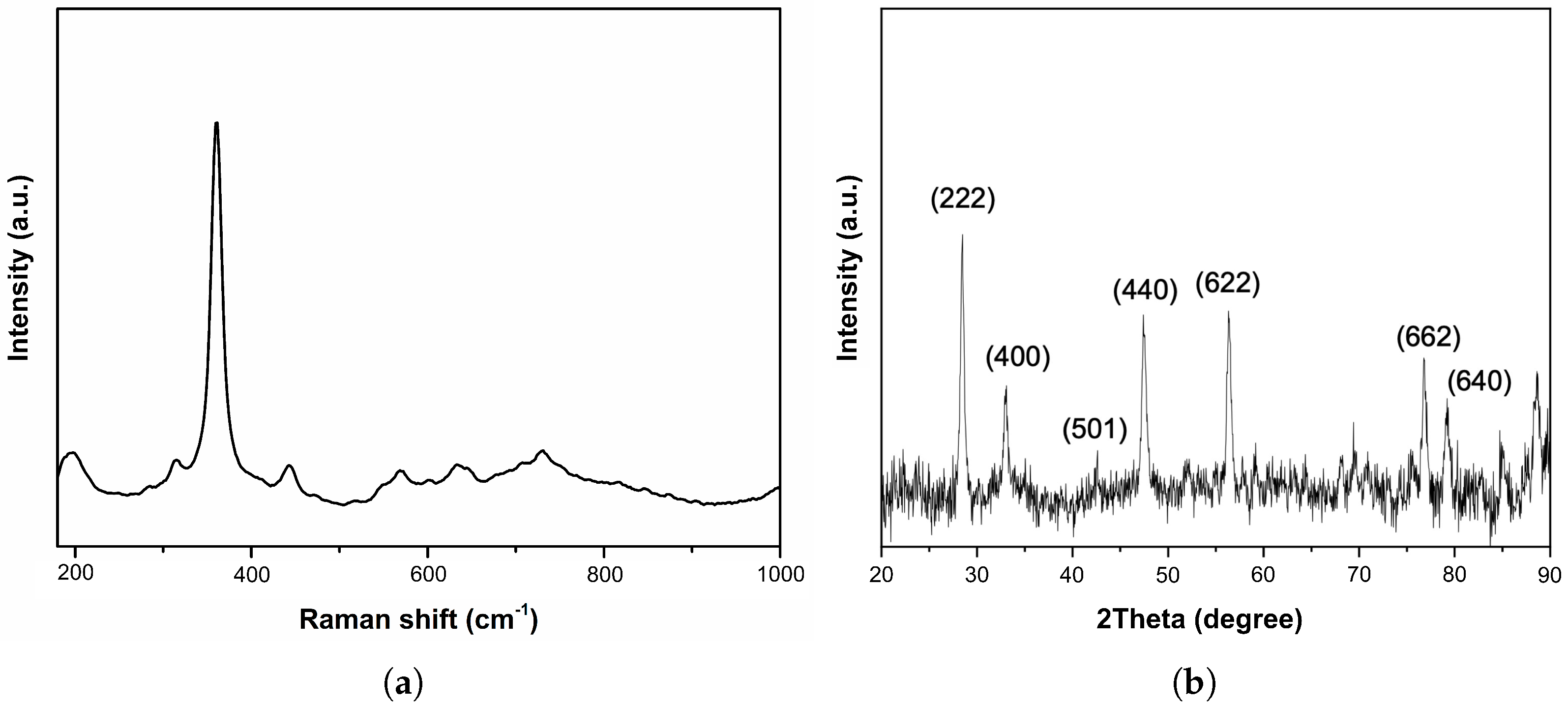
With enriched Gd2O3 being a very expensive raw material, the recovery and re-irradiation of raw materials are crucial factors to achieve a sustainable production process. The transformation of the Gd- α -HIBA complex to Gd2O3 was required to perform re-irradiation. To remove α -HIBA, a fast final purification on a second Dowex column was performed. Separated Gd fractions were collected, and ammonium oxalate was added to obtain a Gd-oxalate precipitate, which was subsequently centrifuged. The precipitate was heated in air to 700 °C for 2 h to decompose the Gd-oxalate to Gd2O3. The recovery of gadolinium was around 97%, and Raman and XRD analyses were performed to confirm the complete conversion of Gd-oxalate into Gd2O3. In Figure 9a, the Raman spectrum of the cubic Gd2O3 compound was recorded between 100 and 3500 cm−1 at room temperature. As shown, the Gd2O3 bands were located in the region of 100–1000 cm−1. The strong, intense peak at 359.0 cm−1 and some weak peaks at 195, 314, 442, 471, 568, and 727 cm−1 were attributed to the cubic C-type Gd2O3 structure. The strong, intense peak at 359.0 cm−1 has been assigned to the combination of Fg and Ag modes, and the weak intense peaks at 195, 314, 442, 471, 568, and 727 cm−1 are assigned, respectively, to a combination of the Eg and Fg modes and a combination of the Ag and Fg modes. The significant characteristic Raman bands indicate that Gd2O3 was crystallized into the cubic phase at 700 °C. The crystal structure and lattice parameters of the recovered sample were investigated by XRD analysis and the pattern is shown in Figure 9b. Although XRD data are strongly dominated by absorption, they still allow phase identification. The diffraction peaks of Gd2O3 were assigned to the body-centered cubic phase (JCPDS No. 065-3181), with an Ia-3 (206) space group. The lattice parameter calculated from the XRD pattern was a = b = c = 10.82 A ° . Pure Gd2O3 was demonstrated to be efficiently recovered.

3.3. Economic Assessment

According to the Italian Medicines Agency [45], the Italian consumption of 177Lu-based radiopharmaceuticals in 2023 [46] was as follows:
  • Total cost: 13 M€;
  • Average cost per patient dose (an activity value of 6 GBq is considered): about €13,000 per dose;
  • Average number of doses (an activity value of 6 GBq per dose is considered) delivered in 2023 in Italy: ∼1000;
  • Average number of patients covered (assuming a therapy of six doses per patient): ∼170.
The previous feasibility studies demonstrated that the activity produced in a single cycle corresponds to ∼300 GBq of 161Tb, taking the lowest yield, i.e., the activity produced from the first 125 g Gd2O3 irradiation batch. Considering that the extraction and the chemical processing of the irradiated targets takes about one week (about one half-life of 161Tb), the useful activity available for medical purposes is considered to be approximately 150 GBq. Given that a typical lutetium therapy involves six injections of 6 GBq each, administered at six-week intervals, the 161Tb activity level reached is sufficient to treat around 25 doses per month, and a total of 250–300 doses of 161Tb yearly, i.e., the 25 ÷ 30% of the annual needs. Such considerations are made only from the technical point of view, without considering the necessary investments and economic aspects, just to give an idea of the potential TRIGA RC-1 contribution.
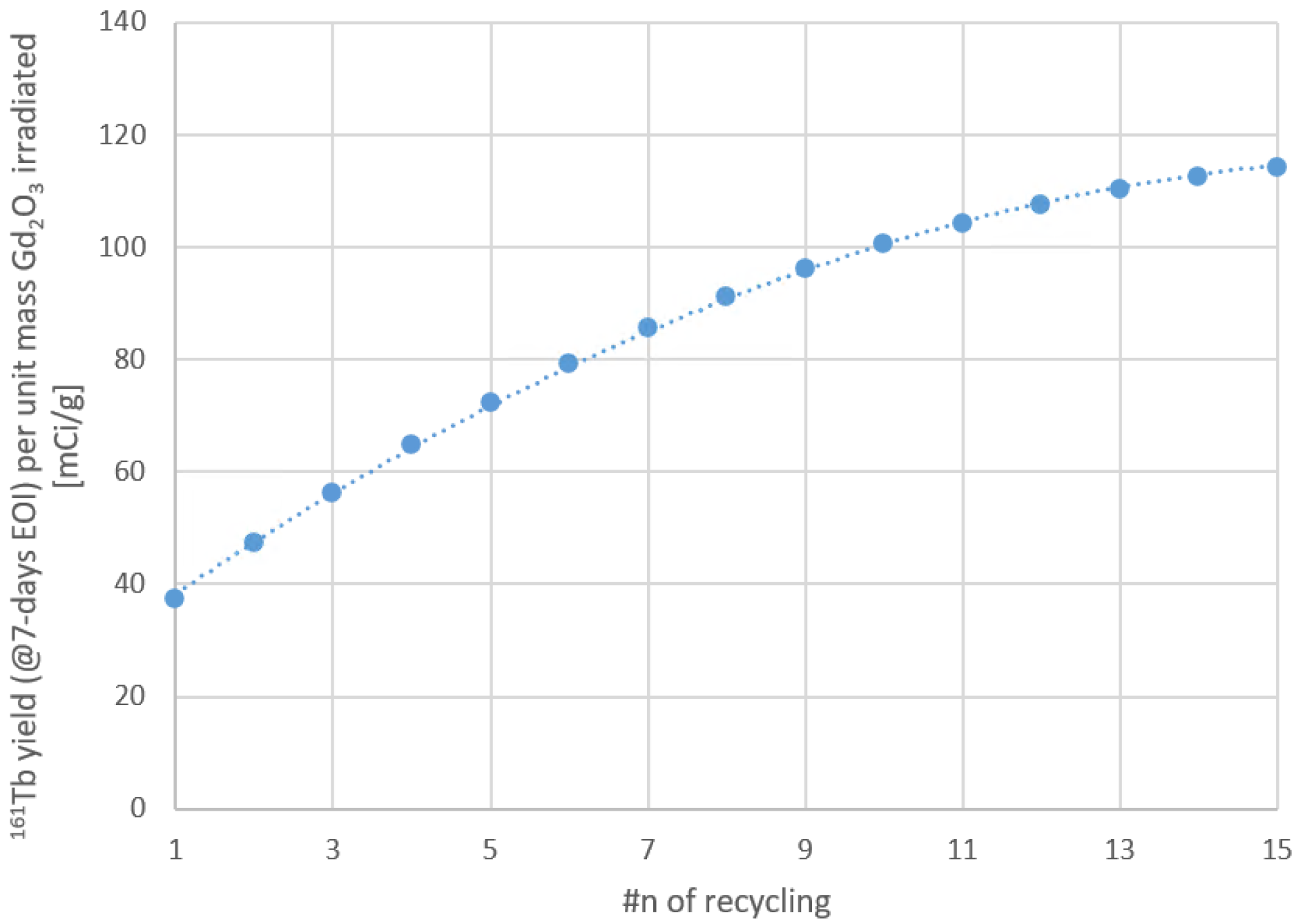
As told, the recovery and re-irradiation of Gd2O3 with 155Gd and 157Gd burned meant an increase in 161Tb during recycling. Taking the hypotheses of Gd recovery to be yGd = 95% from experimental chemistry performed, the 161Tb yield per unit mass of Gd2O3 irradiated vs. number of recycling, 7 days after EOI i.e., one decay time for 161Tb, is reported in Figure 10. This is the graphical representation of the group D · n 2 + E · n + F in Equation (4).
With the increase in 161Tb yield vs. the number of recycling of Gd2O3 it can be observed that the estimated contribution of TRIGA RC-1 in a total of 250–300 doses of 161Tb yearly can be increased by a factor of ∼2 thanks to the efficient recovery and reuse of Gd2O3, as shown in Figure 10.
The efficient reuse of Gd2O3 has two main benefits: (i) reduced quantities in 155Gd and 157Gd isotopes via neutron burning means increased 161Tb final values; (ii) efficient recovery of the irradiated Gd2O3 minimizes the integration needed for fresh Gd2O3 to complete the nominal 125 g quantity of the cycle.
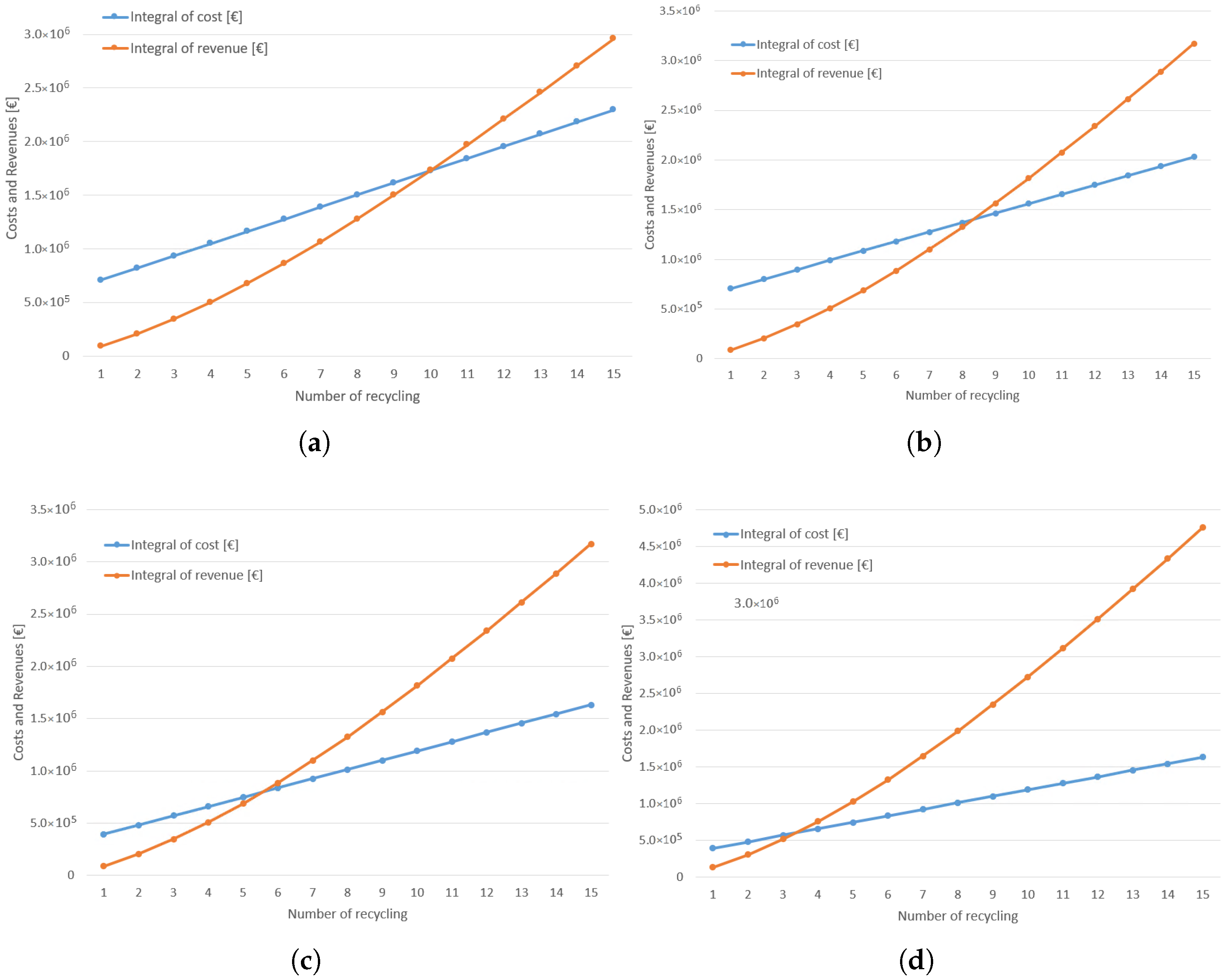
Assuming the yGd = 95% recovery rate of gadolinium following chemical purification, and yTb = 90% for terbium, considering values reported for coefficient in Equations (2)–(4), and assuming f c o s t G d 2 O 3 = 1 and f selling Tb 161 = 1 , it is possible to model the evolution of the integral values of the costs and revenues over multiple instances of recycling the raw material. As shown in Figure 11a, selling the produced 161Tb at a unit price equivalent to the current market price of 177Lu -€22/mCi- makes the breakeven point around the value of n = 10 batch recycling.
Playing with the model, it has been found that a slight increasein yGd = 98% has a significant impact, reducing the number of recycles for the breakeven point to be achieved to n = 8, as shown in Figure 11b. Assuming a reduction in the cost of the enriched Gd2O3 raw material by 50%, f c o s t G d 2 O 3 = 0.5 (i.e., from €5000/g to €2500/g); e.g., due to new availabilities in the market [47], the breakeven point moves at about n = 5, as illustrated in Figure 11c. Assuming also an increased selling price of 161Tb to radiopharmacies, f selling 161 Tb = 1.5 —from €22/mCi to €33/mCi—the breakeven point moves at about n = 3, as illustrated in Figure 11d.
Slight variations in Tb recovery yTb = 80% have less significant impact.
The data in the literature, shown in Table 6, demonstrate that several medium- and low-power research reactor have contributed and contribute today to successful R&D activities, preclinical studies, and prototypes for local medical supply. TRIGA-type reactors demonstrated to be able to support such activities, despite the limited neutron flux range.
In comparison, lower-power TRIGA reactors, such as the TRIGA Mark II units in Vienna and Pavia (250 kW) or the TRIGA FiR 1 in Finland (250 kW), have primarily been used for R&D and feasibility studies with limited production yields. These studies highlight the inherent trade-offs of low-power reactors: while they are sufficient for method development, radiochemical optimisation, and small-scale experiments, the total activity achievable is constrained by neutron flux.
Upper-power TRIGA reactors, such as the Indonesian TRIGA2000 (2 MW) and the Thai TRR-1/M1 (2 MW) can generate material adequate for preclinical testing and also clinical supply. For some selected radionuclides, medium-power reactors such as the Oregon State TRIGA (1 MW) can also play a significant role.
Within this context, the ENEA TRIGA RC-1 can represent a valuable platform with the study and the methodology proposed here. The goal is to strengthen the supply of medical radionuclides in Italy, although such potential cannot match the output of higher-power reactors.
Thus, TRIGA RC-1 and similar reactors occupy a strategic niche within some medical radionuclide production landscapes. They bridge the gap between fundamental laboratory experiments, often conducted in low-power TRIGA reactors, and the larger-scale production achievable in higher-power facilities. By enabling controlled experiments on irradiation conditions, target handling, and purification protocols, such reactors complement the global efforts documented in the literature, offering flexible platforms for advancing clinical research, and constituting a strategic alternative for local supply.

4. Conclusions

This work focused on evaluating the feasibility of producing medical-grade 161Tb at the ENEA TRIGA RC-1, developing a dedicated process within the frame of the SECURE Project, October 2022–September 2025.
Being a medium-scale research reactor with a neutron flux typically one order of magnitude below standard isotope production reactors, each step of the production cycle must be carefully optimized to maximize efficiency.
The experimental irradiation campaign performed has been used to benchmark activation calculation methodologies. Developed tools, including MCNP and ASTM E262 procedures, have been utilized to draw the following extrapolations regarding a 125 g 160Gd-enriched Gd2O3 production cycle, determining the effective 161Tb production capacity while respecting prescription regarding reactor’s operation.
Chemical processing studies on “cold” materials demonstrated that Tb and Gd can be separated efficiently even with the disadvantaged Tb:Gd ratio of 1:106 in case of TRIGA RC-1. The chromatographic separation and the following purification process developed to obtain the pharmaceutically required form TbCl3 resulted in a total percentile yield of ∼90%. The recovery process for Gd2O3 was confirmed with a percentile yield of ∼97%.
Translating the process to the 400 mg Gd2O3 “cold” batch sample has been conceived as the starting point of up-scaling studies. Subsequent steps of the study expected “hot” trials to be made prior to increasing the batch sample mass more and more. Unfortunately, in February 2025, the radiochemical laboratory experienced an unexpected shutdown, which lasted until November 2025. With proper safety conditions restored, chemical activities are expected to resume in February 2026.
Furthermore, an economical evaluation tool has been developed enlightening the most sensitive parameters to determine a breakeven point of the cost and revenue of the entire process.
The main conclusions regarding the feasibility of producing medical-grade 161Tb at the ENEA TRIGA RC-1 reactor to supply hospitals or nuclear medicine centres are as follows:
  • The process requires the irradiation of relatively large quantities of enriched raw material, the maximum being 125 g of Gd2O3 > 98% enriched in 160Gd to respect TRIGA RC-1 reactor core prescriptions;
  • The chemical separation method developed must be capable of handling such tens of gram-scale quantities of Gd2O3;
  • The high price of the enriched raw material necessitates its efficient recovery and reuse over multiple irradiation cycles;
  • 155Gd and 157Gd burning during neutron irradiation and recycling positively impact the 161Tb yield of the process;
  • The production route proposed has demonstrated to be promising. Effective technical feasibility needs to be further studied, especially regarding the Gd2O3 recovery;
  • The production pathway evaluated may serve as a strategic national alternative in cases where imported radiopharmaceuticals are unavailable, provided it is supported or subsidized by the National Health System;
  • Economic sustainability may be achievable in the future, conditional upon a reduction in the market price of 160Gd-enriched Gd2O3 and/or a general increase in the market price of 161Tb-based radiopharmaceuticals;
  • The developed process is a viable option for the production of small quantities of radionuclides intended for research purposes.
Studies are still open and ongoing, focusing on testing “cold” chemical processing routines established on “hot” samples in the near future. Further results achieved will be used to refine the entire process, with the aim to enhance target recycling, maximize 161Tb production, and optimize costs for the entire lifecycle.
The entire methodology developed can be utilised to study other radionuclides, e.g., 176Yb(n, γ )177Yb( β )→177Lu or 64Zn(n, γ )64Cu, with initiatives regarding the last radionuclide planned to start in 2026.

Author Contributions

Conceptualization, L.S. and L.L.; methodology, L.S., L.L., S.P., F.L. and A.P.; validation, L.S. and L.L.; investigation, L.S., L.L., S.P., F.L., A.P., T.G., F.V., L.F., V.F., D.F., A.R. and M.C.; data curation, L.L., S.P., F.L. and A.P.; writing—original draft, L.S., L.L., S.P., F.L. and A.P.; writing—review and editing, L.L., S.P. and M.C.; supervision, L.S., L.L. and S.P.; project administration, M.C.; and funding acquisition, M.C. All authors have read and agreed to the published version of the manuscript.

Funding

The publication was created within the project SECURE funded by the European Union under grant agreement No. 101061230.

Data Availability Statement

Public data from the SECURE Consortium are available at https://cordis.europa.eu/project/id/101061230/results (accessed on 22 December 2025). Other data could be made available upon request to the authors, with the agreement of partners in the Consortium.

Acknowledgments

We would like to thank Stefano Bellucci for providing the Raman spectrometer, which was essential for the characterization of the compounds.

Conflicts of Interest

The authors declare no conflicts of interest.

Abbreviations

The following abbreviations are used in this manuscript:
AIFAAgenzia Italiana del Farmaco (Italian Medicines Agency)
α -HIBA α -Hydroxyisobutyric Acid
ASTMAmerican Society for Testing and Materials
EOIEnd Of Irradiation
EUEuropean Union
ENEAItalian National Agency for New Technologies, Energy and Sustainable Economic Development
HPGeHigh-Purity Germanium
ICP-MSInductively Coupled Plasma Mass Spectrometry
MCNPMonte Carlo N-Particle
R&DResearch and Development
SECUREStrenghtening the European Chain of sUpply for next generation medical RadionuclidEs
TRIGATraining Research Isotopes General Atomics
TRTTargeted Radionuclide Therapy

References

  1. Mario, N.; Kolmayer, A.; Turquet, G.; Vallée, A.; Goethals, P.E. Co-Ordinated Approach to the Development and Supply of Radionuclides in the EU: Final Report; European Commission, Directorate-General for Energy; Publications Office of the European Union: Luxembourg, 2021; Catalogue Number MJ-09-21-436-EN-N. [Google Scholar] [CrossRef]
  2. Euratom Supply Agency, ESA Annual Report 2024. Available online: https://ec.europa.eu/euratom/observatoryradioisotopes.html (accessed on 22 December 2025).
  3. Ahmad, M.; Vandegrift, G.; Cristini, P. Molybdenum-99 (99Mo): Past, Present, and Future. Sci. Technol. Nucl. Install. 2014, 2014, 839369. [Google Scholar] [CrossRef] [Scilit]
  4. Youker, A.J.; Chemerisov, S.D.; Kalensky, M.; Tkac, P.; Bowers, D.L.; Vandegrift, G.F. A Solution-Based Approach for Mo-99 Production: Considerations for Nitrate versus Sulfate Media. Sci. Technol. Nucl. Install. 2013, 2013, 402570. [Google Scholar] [CrossRef] [Scilit]
  5. NRG PALLAS. PALLAS-Reactor. Available online: https://www.nrgpallas.com/pallas-programme/pallas-reactor (accessed on 22 December 2025).
  6. Ligtvoet, A.; Scholten, C.; Davé, A.; King, R.; Petrosova, L.; Chiti, A.; Goulart De Medeiros, M.; Joerger, A. Study on Sustainable and Resilient Supply of Medical Radioisotopes in the EU: Therapeutic Radionuclides; Publications Office of the European Union: Luxembourg, 2021; ISBN 978-92-76-37422-0. [Google Scholar] [CrossRef]
  7. Radzina, M.; Saule, L.; Mamis, E.; Pajuste, E.; Koester, U.; Cocolios, T.E.; Proskurins, J.; Kalnina, P.; Zabolockis, R.J.; Palskis, K.; et al. Novel radionuclides: Demand, production and distribution for translational research in Europe. EJNMMI Radiopharm. Chem. 2024, 9, 85. [Google Scholar] [CrossRef] [Scilit]
  8. Krause, B.J.; Lassmann, M.; Bardiès, M.; Gear, J.; Verburg, F.A.; Covens, P.; Decristoforo, C.; Herrmann, K.; Patt, M.; Peters, S.; et al. SAMIRA Study on the Implementation of the Euratom and EU Legal Bases with Respect to the Therapeutic Uses of Radiopharmaceuticals; Publications Office of the European Union, Directorate-General for Energy: Brussels, Belgium, 2025; ISBN 978-92-68-26298-6. [Google Scholar] [CrossRef]
  9. SECURE Project. Strengthening the European Chain of sUpply for Next Generation Medical RadionuclidEs. Available online: https://enen.eu/index.php/portfolio/secure-project/ (accessed on 22 December 2025).
  10. Morselli, L.; Donzella, A.; Arzenton, A.; Asti, M.; Bortolussi, S.; Corradetti, S.; D’agostino, G.; Di Luzio, M.; Ferrari, M.; Gandini, A.; et al. Production and characterization of 111Ag radioisotope for medical use in a TRIGA Mark II nuclear research reactor. Appl. Radiat. Isot. 2023, 197, 110798. [Google Scholar] [CrossRef] [Scilit] [PubMed]
  11. Matyskin, A.V.; Ridikas, D.; Skuridin, V.S.; Sterba, J.; Steinhauser, G. Feasibility study for production of 99mTc by neutron irradiation of MoO3 in a 250 kW TRIGA Mark II reactor. J. Radioanal Nucl. Chem. 2013, 298, 413–418. [Google Scholar]
  12. Smodis, B.; Sno, L. Utilization and Application of the Slovenian TRIGA Reactor. In Proceedings of the International Conference on Research Reactors: Safe Management and Effective Utilization, Rabat, Morocco, 14–18 November 2011. [Google Scholar]
  13. Neves, M.; Kling, A.; Lambrecht, R.M. Utilization of low power reactors on therapeutic radiopharmaceuticals. In Proceedings of the International symposium on research reactor utilization, safety and management, Lisbon, Portugal, 6–10 September 1999. [Google Scholar]
  14. Auterinen, I.; Salmenhaara, S. The 250 kW FiR 1 TRIGA Research Reactor: International Role in Boron Neutron Capture Therapy (BNCT) and Regional Role in Isotope Production, Education and Training. In Proceedings of the International Conference on Research Reactors: Safe Management and Effective Utilization, Sydney, Australia, 5–9 November 2007. [Google Scholar]
  15. Pressler, M.; Denk, C.; Mikula, H.; Rosecker, V. Fast and easy reactor-based production of copper-64 with high molar activities using recoil chemistry. Dalton Trans. 2025, 54, 15701–15704. [Google Scholar] [CrossRef] [Scilit]
  16. Ragchana, P.; Saengkaew, P.; Wetchagarun, S.; Tiyapun, K.; Dangprasert, M.; Khamwan, K. Preliminary experiments to produce 177Lu in the TRR-1/M1 Thai research reactor. Appl. Radiat. Isot. 2025, 218, 111708. [Google Scholar] [CrossRef] [Scilit]
  17. Lutetium-177 Production in the Oregon State TRIGA Reactor. Available online: https://events.engineering.oregonstate.edu/expo2022/project/lutetium-177-production-oregon-state-triga-reactor?utm (accessed on 27 November 2025).
  18. Aziz, A. Physico-chemical characterization of the 161Tb radioisotope through separation based on cartridge LN resin column from irradiated of enriched Gd2O3 target. J. Phys. Conf. Ser. 2020, 1436, 012097. [Google Scholar] [CrossRef] [Scilit]
  19. Pupillo, G.; Andrighetto, A.; Arzenton, A.; Ballan, M.; Bello, M.; Boschi, A.; Cisternino, S.; Corradetti, S.; De Dominicis, L.; Esposito, J.; et al. Cyclotron-based production of innovative medical radionuclides at the INFN-LNL: State of the art and perspective. Eur. Phys. J. Plus 2023, 138, 1095. [Google Scholar]
  20. Pupillo, G.; Boschi, A.; Cisternino, S.; De Dominicis, L.; Martini, P.; Mou, L.; Alvarez, C.R.; Sciacca, G.; Esposito, J. The LARAMED project at INFN-LNL: Review of the research activities on medical radionuclides production with the SPES cyclotron. J. Radioanal. Nucl. Chem. 2024, 333, 1487–1496. [Google Scholar]
  21. Dodaro, A.; Aronica, O.; Giorgiantoni, G.; Olivetti, M.; Pisacane, F. Radiopharmaceutical production through the utilization of TRIGA nuclear research reactor. In Proceedings of the European Research Reactor Conference, Munich, Germany, 11–15 March 2018. [Google Scholar]
  22. Hindié, E.; Zanotti-Fregonara, P.; Quinto, M.A.; Morgat, C.; Champion, C. Dose Deposits from 90Y, 177Lu, 111In, and 161Tb in Micrometastases of Various Sizes: Implications for Radiopharmaceutical Therapy. J. Nucl. Med. 2016, 57, 759–764. [Google Scholar] [CrossRef] [Scilit]
  23. Eckerman, K.; Endo, A. Nuclear Decay Data for Dosimetric Calculations. ICRP Publication 107. Ann. ICRP 2008, 38, 7–96. [Google Scholar]
  24. Kondev, F.G. Nuclear Data Sheets for A=177. Nucl. Data Sheets 2019, 159, 1–412. [Google Scholar] [CrossRef] [Scilit]
  25. Reich, C.W. Nuclear Data Sheets for A=161. Nucl. Data Sheets 2011, 112, 2497–2713. [Google Scholar] [CrossRef] [Scilit]
  26. National Nuclear Data Center. Information Extracted from the NuDat Database. Available online: https://www.nndc.bnl.gov/nudat3/ (accessed on 22 December 2025).
  27. Chiesa, D.; Carta, M.; Fabrizio, V.; Falconi, L.; Grossi, A.; Nastasi, M.; Palomba, M.; Pozzi, S.; Previtali, E.; Rancoita, P.G.; et al. Characterization of TRIGA RC-1 neutron irradiation facilities for radiation damage testing. Eur. Phys. J. Plus 2020, 135, 349. [Google Scholar] [CrossRef] [Scilit]
  28. Falconi, L.; Burgio, N.; Palomba, M.; Santoro, E.; Carta, M. A MCNPX TRIGA RC-1 Experimental Channels Model for the Design of a New Neutronic Diffraction Facility. In Proceedings of the Meeting on Research Reactors Fuel Management (RRFM 2016), Berlin, Germany, 13–17 March 2016; European Nuclear Society: Brussels, Belgium, 2016; ISBN 978-92-95064-25-6. [Google Scholar]
  29. ASTM Standard E262–97; Standard Method for Determining Thermal Neutron Reaction and Fluence Rates by Radioactivation Techniques. ASTM International: West Conshohocken, PA, USA, 1998.
  30. Perry, F.G. Least Square Dosimetry Unfolding: The Program STAY’SL; Report ORNL/TM-6062, ENDF-254; Oak Ridge National Laboratory (ORNL): Oak Ridge, TN, USA, 1977.
  31. Kelly, J.G. Neutron Spectrum Adjustment with SANDII Using Arbitrary Trial Functions . In Reactor Dosimetry: Methods, Applications, and Standardization; ASTM International: West Conshohocken, PA, USA, 1989; Volume 1001, p. 460. [Google Scholar]
  32. Briesmeister, J.F. MCNP™—A General Monte Carlo N-Particle Transport Code, Version 4C, LA-13709-M; Los Alamos National Laboratory: Los Alamos, NM, USA, 2000; Volume 2.
  33. Fleming, M.; Stainer, T.; Gilbert, M. The FISPACT-II User Manual; UK Atomic Energy Authority, Culham Science Centre: Abingdon, UK, 2018; UKAEA Report UKAEA-R(18)001; Available online: https://scientific-publications.ukaea.uk/wp-content/uploads/UKAEA-R18001.pdf (accessed on 22 December 2025).
  34. Knoll, G.F. Radiation Detection and Measurement, 4th ed.; John Wiley & Sons, Inc.: Hoboken, NJ, USA, 2010; ISBN 978-0-470-13148-0. [Google Scholar]
  35. Gilmore, G.; Joss, D. Practical Gamma-Ray Spectrometry, 3rd ed.; John Wiley & Sons, Inc.: Hoboken, NJ, USA, 2024; ISBN 978-1-119-89608-1. [Google Scholar]
  36. Mirion Technologies. Mirion—Radiation Detection, Measurement, Analysis & Monitoring Solutions. Available online: https://www.mirion.com/ (accessed on 22 December 2025).
  37. Mirion Technologies. LabSOCS Gamma Spectroscopy Calibration Software. Available online: https://www.mirion.com/products/technologies/spectroscopy-scientific-analysis/gamma-spectroscopy/gamma-spectroscopy-software/lab-applications/labsocs-calibration-software (accessed on 22 December 2025).
  38. Gracheva, N.; Müller, C.; Talip, Z.; Heinitz, S.; Köster, U.; Zeevaart, J.R.; Vögele, A.; Schibli, R.; van der Meulen, N.P. Production and characterization of no-carrier-added 161Tb as an alternative to the clinically-applied 177Lu for radionuclide therapy. EJNMMI Radiopharm. Chem. 2019, 4, 12. [Google Scholar]
  39. McNeil, S.W.; Van de Voorde, M.; Zhang, C.; Ooms, M.; Bénard, F.; Radchenko, V.; Yang, H. A simple and automated method for 161Tb purification and ICP-MS analysis of 161Tb. EJNMMI Radiopharm. Chem. 2022, 7, 31. [Google Scholar] [CrossRef] [Scilit]
  40. Olszewski, G.; Lindahl, P.; Frisk, P.; Eriksson, M.; Pettersson, H.B.L. Development of 148Gd analysis method using stable Gd. Talanta 2021, 229, 122295. [Google Scholar] [CrossRef] [Scilit]
  41. Manigandan, R.; Giribabu, K.; Suresh, R.; Vijayalakshmi, L.; Stephen, A.; Narayanan, V. Structural, optical and magnetic properties of gadolinium sesquioxide nanobars synthesized via thermal decomposition of gadolinium oxalate. Mater. Res. Bull. 2013, 48, 4210–4215. [Google Scholar] [CrossRef] [Scilit]
  42. Lepore, L.; Spagnuolo, L.; Cozzella, L.; Guarcini, T.; Limosani, F.; Placidi, S.; Pagano, A.; Falconi, L.; Fabrizio, V.; Formenton, D.; et al. ENEA TRIGA RC-1 reactor for medical radionuclide production within the EU SECURE project. In Proceedings of the RRFM European Research Reactor Conference 2025, Aix-en-Provence, France, 6–10 April 2025; pp. 78–85. [Google Scholar]
  43. Spagnuolo, L.; Lepore, L.; Cozzella, L.; Guarcini, T.; Limosani, F.; Pagano, A.; Placidi, S.; Falconi, L.; Fabrizio, V.; Formenton, D.; et al. The ENEA TRIGA RC-1 facility inside the SECURE project: Production of medical isotopes by neutron activation. EPJ Web Conf. 2025, 338, 09006. [Google Scholar] [CrossRef] [Scilit]
  44. Soppera, N.; Bossant, M.; Dupont, E. JANIS 4: An Improved Version of the NEA Java-based Nuclear Data Information System. Nucl. Data Sheets 2014, 120, 294–296. [Google Scholar] [CrossRef] [Scilit]
  45. Agenzia Italiana del Farmaco (AIFA). AIFA—Italian Medicines Agency. Home Page. Available online: https://www.aifa.gov.it/en/home (accessed on 26 November 2025).
  46. Agenzia Italiana del Farmaco (AIFA). L’uso dei Farmaci in Italia. Rapporto Nazionale Anno 2023. OsMed—Rapporto OsMed 2023, Roma, 2024. Available online: https://www.epicentro.iss.it/farmaci/rapporto-osmed-2023 (accessed on 22 December 2025).
  47. Orano. Stable Isotopes Laboratory. Available online: https://www.orano.group/en/nuclear-expertise/valuation-of-strategic-metals/stable-isotopes-production-laboratory (accessed on 22 December 2025).
Figure 1. ENEA TRIGA RC-1 potential 161Tb production cycle: flowchart of main actions and materials workflow.
Jne 07 00016 g001
Figure 3. Separation process developed for Tb and Gd isolation.
Jne 07 00016 g003
Figure 4. MCNP computational neutron fluxes at the TRIGA RC-1 Central Channel, with 1 MW thermal power, within different “dry” or “flooded” configurations. No samples within.
Jne 07 00016 g004
Figure 5. 155Gd and 157Gd burning during the 12-day irradiation cycle of the first Gd2O3 batch. Values calculated via the FISPACT-II code.
Jne 07 00016 g005
Figure 6. Chromatographic curves obtained for Tb:Gd separation in a ratio of 1:106. Batch size: 40 mg.
Jne 07 00016 g006
Figure 7. Terbium elution profile with LN3 resin with the 40 mg batch size.
Jne 07 00016 g007
Figure 8. Elution profile of Tb and Gd separation on a 400 mg batch.
Jne 07 00016 g008
Figure 9. (a) Raman spectrum ( λ = 532 nm) and (b) XRD pattern of the recovered Gd2O3.
Jne 07 00016 g009
Figure 10. 161Tb yield per unit mass of Gd2O3 irradiated vs. number of recycling, 7 days after EOI. This is the graphical representation of the group D · n 2 + E · n + F in Equation (4).
Jne 07 00016 g010
Figure 11. Cost and revenue evaluation for the irradiation of 125 g of Gd2O3 (98.2% 160Gd-enriched) at the ENEA TRIGA RC-1 reactor vs. number of recycling of raw material. (a) Case with yGd = 95%; (b) case with yGd = 98%.; (c) case with yGd = 98% and half of the Gd2O3 raw material price considered, €2500/g; and (d) case with yGd = 98% and half of the Gd2O3 raw material price considered, €2500/g, and 161Tb selling price increased from €22/mCi to €33/mCi.
Jne 07 00016 g011
Table 2. Costs for the irradiation and chemical treatment of 125 g of Gd2O3 enriched at 98.2% in 160Gd. Decimal digits has been rounded for easiness of reading.
ENEA TRIGA RC-1 operation costs
Overall reactor cost at full power per hours [€/h]435
N° hour irradiation at full power (1 MW) [h]76
(A) Total cost ENEA TRIGA RC-1 [€]33,090
Gd2O3 raw material costs
(B) Gd2O3 (98% enr 160Gd) [€/g]5000
Gd2O3 (98% enr. 160Gd) mass of the first batch [g]125
Total costs of Gd2O3 (98% enr 160Gd), 1st batch [€]625,000
Chemical extraction and purification costs
Total costs Gd-Tb separation per gram Gd2O3 [€/g]113
Total costs Gd recovery per gram Gd2O3 [€/g]15
Total costs Tb purification per gram Gd2O3 [€/g]148
Disposable items costs [€]1000
Chemical characterization costs [€]4000
Radiological characterization costs [€]1000
Personnel [€]4640
Radioactive waste [€]4000
(C) Total chemical costs for treating 125 g Gd2O3 [€]49,114
Table 3. Results of the 161Tb activity obtained during the experimental campaign in 2024 for three samples: #1 is 190 mg Gd2O3 in natural isotopic composition, #2 is 1.34 mg Gd2O3 in natural isotopic composition and #3 is 8.7 mg Gd2O3 enriched at 98.2% in 160Gd. Uncertainties are reported with a coverage factor of k = 2. To facilitate the easier reading of results, the relative uncertainty values on the activity concentrations are not reported, being the same values as for the activity results.
SampleMeasuredMCNPASTM
ActivityActivityActivityActivityActivityActivity
Concentration Concentration Concentration
[kBq][GBq/gGd−160][kBq][GBq/gGd−160] [kBq][GBq/gGd−160]
#111.6 ± 6%3.28 × 10 4 13 ± 73%3.6 × 10 4 11 ± 75%3.1 × 10 4
#217.9 ± 6%7.18 × 10 2 28 ± 73%1.1 × 10 1 18 ± 75%7.2 × 10 2
#3110 × 10 3 ± 6%14.9110 × 10 3 ± 75%15105 × 10 3 ± 78%14
Table 4. Weight isotopic distribution of enriched Gd2O3 raw material target, and impurities.
Isotope152Gd154Gd155Gd156Gd157Gd158Gd160Gd
content wt. [%]<0.010.010.180.360.25198.2 (± 0.1)
ElementKNaCaMgFeAlSi
content [ppm]<50<20<50<3<50<3<50
ElementCrNiCuPbSbSnPt
content [ppm]<5<1<1013<1<120
ElementSmHoDyEuNdTbEr
content [ppm]136<1<1<1<2<1
Table 5. Results of 161Tb activity obtained irradiating 400 and 125 g of Gd2O3 enriched at 98.2% in 160Gd in different configurations.
MaterialMCNPASTMGthGres
ActivityActivityActivityActivity
Concentration Concentration
[GBq][GBq/gGd−160][GBq][GBq/gGd−160]
400 g sample capsule685 ± 75%2.01692 ± 78%2.070.060.31
125 g sample in 4 vials (empty channel)337 ± 75%3.16337 ± 78%3.150.120.37
125 g sample in 9 vials (empty channel)343 ± 75%3.22341 ± 78%3.200.120.37
125 g sample in 9 vials (water channel)351 ± 75%3.29--0.090.38
Table 6. Overview of documented medical radionuclide production studies using TRIGA and similar low-power research reactors.
Reactor / CountryRadionuclideProduction DetailsPurpose
Espoo (Finland) TRIGA FiR 1 (250 kW) [14]64Cu, 153SmLow-power irradiation of several medical isotopes for R&D; no clinical-scale production achieved.R&D
Vienna (Austria) TRIGA Mark II (250 kW) [15]64Cu64Zn enriched target; medically compliant purity; and limited final activity due to flux constraints.R&D
Pavia (Italy) TRIGA Mark II (250 kW) [10]111AgNatural and enriched 110Pd targets irradiated; limited final activity due to flux constraints.R&D, preclinical feasibility
Lisbon (Portugal) RPI (1 MW) [13]64Cu, 153Sm, 166Ho, 177Lu, 186/188Re, 111Ag,199Au, 77AsEnriched targets used to overcome self-shielding; specific activities suitable for preclinical research;and RPI flux outperforming TRIGA for 64Cu and 77As.R&D, preclinical feasibility
Bandung (Indonesia) TRIGA2000 (2 MW) [18]161TbEnriched 160Gd targets; 161TbCl3 produced with radiochemical purity comparable to commercial 177Lu.R&D, preclinical feasibility
Bangkok (Thailand) TRR-1/M1 (2 MW) [16]177LuNatural isotopic Lu2O3 and enriched 176Yb targets irradiation.Feasibility studies for local supply
Ljubljana (Slovenia) TRIGA Mark II (250 kW) [12]99Mo/99mTcEnriched 98Mo 80–85 g MoO3 targets irradiated.Routine hospital supply (historical)
Vienna (Austria) TRIGA Mark II (250 kW) [11]99Mo/99mTcNatural or 98Mo-enriched 3–10 g MoO3 targets irradiated; post-processing via extraction generator; and activity for 1-week supply for several SPECT cameras.Feasibility for local supply
Corvallis (USA) Oregon State TRIGA (1 MW) [17]177LuEnriched 176Yb 10 g Yb2O3 target, 15-day irradiation;and 177Lu produced to ≃60 doses/month.Local supply prototype
Disclaimer/Publisher’s Note: The statements, opinions and data contained in all publications are solely those of the individual author(s) and contributor(s) and not of MDPI and/or the editor(s). MDPI and/or the editor(s) disclaim responsibility for any injury to people or property resulting from any ideas, methods, instructions or products referred to in the content.