Article

Factors Affecting Well-Being for Young Women in the Balkans

by
Georgios Laskaris
1,
Ioanna Spyropoulou
1,
Melika Mehriar
2,*,
Biljana Popeska
3,
Larisa Bianca Elena Petrescu-Damale
2,
Snezana Jovanova Mitkovska
3 and
Misko Djidrov
4
1
School of Rural, Surveying and Geoinformatics Engineering, National Technical University of Athens, 9 Iroon Polytechneiou Str., Zografou, 157 80 Athens, Greece
2
Center of Technology and Society, Technical University of Berlin, Kaiserin-Augusta-Allee 104, 10553 Berlin, Germany
3
Faculty of Educational Sciences, Goce Delcev University, Krste Misirkov 10-A, 2000 Stip, North Macedonia
4
Faculty of Mechanical Engineering, Goce Delcev University, Krste Misirkov 10-A, 2000 Stip, North Macedonia
*
Author to whom correspondence should be addressed.
Women 2025, 5(4), 40; https://doi.org/10.3390/women5040040
Submission received: 22 July 2025 / Revised: 20 October 2025 / Accepted: 27 October 2025 / Published: 31 October 2025

Abstract

This paper assesses the correlates of perceived well-being among young women aged 18 to 30 in five Balkan cities: Athens, Greece; Plovdiv, Bulgaria; Bucharest, Romania; Nis, Serbia; and Shtip, North Macedonia, by integrating urban, travel behavioural, and socio-economic features. A cross-sectional survey was employed using standard questionnaires including the Warwick–Edinburgh Mental Well-being Scale (WEMWBS), the short version of the International Physical Activity Questionnaire (IPAQ), and the adapted ALPHA environmental questionnaire. To answer research questions, linear regression models were developed to analyse predictors of well-being at both regional and national levels. Results show that neighbourhood and mobility features play a significant role in shaping mental well-being. Access to walkable sidewalks, green spaces, mixed land-use structure, and attractive local facilities (e.g., shops, recreational centres in the neighbourhood) were consistently associated with higher levels of well-being. Conversely, perceived insecurity, especially at night or regarding bicycle theft, significantly reduced well-being. Physical activity levels, particularly days of walking and vigorous activity, showed strong positive associations, underscoring the role of active lifestyles in promoting mental health. Socio-economic variables, including financial status, relationship status, and work status, were also found to be linked to perceived well-being. Cycling-related variables may affect Greek well-being up to 16.5 times. Perception of crime during the night may negatively affect both Bulgarian and Serbian well-being (up to 10 times), while Romanian well-being is mostly affected by the existence of shopping facilities. Finally, the most impactful factors for well-being in North Macedonia refer to cycling safety and scooter accessibility.

1. Introduction

The mental well-being of young women is increasingly recognised as a critical public health concern, particularly in regions undergoing rapid social, economic, and urban transformation, such as the Balkan region. Well-being encompasses more than the absence of mental illness; it encompasses good health, adequate material conditions for a safe life, the existence of satisfactory interpersonal relationships and the fulfilment of personal needs that change throughout the life cycle [1]. The World Health Organization (WHO) links well-being with mental health, understanding it not as the absence of stress, but rather as the ability to cope effectively. According to the WHO, “mental health is a state of well-being in which an individual realises their own abilities, can cope with the normal stresses of life, can work productively and is able to make a contribution to their community” [2]. The OECD’s document “How’s Life? 2024: Well-being and Resilience in Times of Crisis” provides a broader concept of well-being, stating that it encompasses material conditions, quality of life, and community relationships [3]. Its key dimensions are income, employment, housing, health, education, environmental quality, subjective well-being, safety, work–life balance, social connections, and civic engagement. These key dimensions are shaping well-being in the life span of both men and women in different ways based on their life roles and social expectations. For young women aged 18 to 30—a transitional period marked by academic, professional, and personal milestones—well-being is shaped by a complex interaction of individual, socio-economic, and environmental factors [4]. The study results from Smith & Wesselbaum [5] underline that health, education, income, and social relations have the greatest impact on well-being in a period of early adulthood (18–25) and young adulthood (26–35), confirming inequalities between males and females.
In Balkan countries, including Serbia, Romania, North Macedonia, Greece, and Bulgaria, young women navigate shifting gender norms [6], economic instability, and uneven urban development, all of which influence their subjective well-being. In Greece, the financial crisis led to drastic female unemployment, rising above 30%, including a rise to over 50% among young women, along with reduced state services that increased unpaid domestic burdens and financial insecurity [7]. Economic precarity also impacted young women’s life transitions, such as housing and family planning [7]. In Romania, persistent traditional norms, endorsed by over 80% of the population, coupled with low female labour market participation, reinforced economic dependency and gender inequality [8]. Across Serbia and North Macedonia, UN Women’s Voices of YOUth reports pervasive gender-based discrimination and reduced opportunities for young women, further undermining social cohesion and well-being [9]. While global research has addressed the broader determinants of mental health and well-being, there remains a gap in understanding how context-specific factors, particularly those related to socio-economic status and the built environment, affect young women in this region.

1.1. Socio-Economic Determinants of Well-Being

Multiple studies have shown that socio-economic conditions play a pivotal role in shaping mental well-being. Income level, employment status, and educational attainment are consistently associated with self-reported mental health and life satisfaction [5,9,10]. Higher income enhances access to essential resources, including quality housing, healthcare, leisure, and opportunities for self-development, thereby supporting emotional resilience and well-being [11]. An increase in income is associated with meaningful improvements in mental health and overall well-being, with the strongest effects observed when income lifts individuals out of poverty [12]. Conversely, women with low incomes often experience chronic stress and worse health and well-being than men, feeling more socially excluded due to the increased time spent in the household [13].
Employment contributes not only to financial security, but also to self-esteem, mental health benefits and social integration. While meta-analyses of longitudinal studies confirm that self-esteem increases strongly until the age of 30 [14], employment status comprises a significant contributory factor. Longitudinal research shows that entering full-time employment during young adulthood is linked to notable increases in self-esteem, reinforcing a sense of competence and social status [15]. Employment and financial independence, especially through social enterprises, support social networking and self-worth, fostering the sense of belonging [16]. Notably, the transition from housewife to employed woman is found to be associated with better mental health status [17]. However, in many Balkan countries, youth, particularly females, face high unemployment rates, precarious work conditions and limited upward mobility, exacerbating feelings of uncertainty and frustration.
Education has also been identified as a protective factor for well-being. Educated women tend to have higher self-efficacy and broader social networks. Studies have demonstrated that higher educational attainment is associated with increased self-efficacy, better quality of life, positive emotions and better mental health [18,19]. In terms of Balkan countries, for instance, a study conducted in Serbia with young adults aged 19–35 demonstrated that women with higher educational attainment reported significantly greater life satisfaction across personal and professional domains, and decision-making independence [20]. Similarly, research in Romania found that tertiary-educated individuals reported significantly higher life satisfaction and perceived control over life circumstances compared to those with lower education levels, highlighting education’s role in enhancing mental empowerment [21]. Similar results on the effect of education on well-being have also been reported in India [22] and Nigeria [23].
Other socio-demographic factors, such as marital status and family structure, also influence well-being. While marriage can provide emotional and financial support, it may also introduce stressors related to gender roles, caregiving, or restricted autonomy and the emotional labour expected from women within traditional family roles [24]. For instance, women at the verge of divorce or single mothers report higher depressive symptoms and stress, mediated by lower social support and heightened caregiving burdens [25,26]. Women are particularly vulnerable to marital stress. Traditional gender roles lead married women to manage emotion and family connections, while men benefit more from supportive dynamics, resulting in unequal emotional burdens [27].

1.2. Built Environment and Well-Being

The characteristics of the physical environment—urban design, access to public spaces, and availability of services—are increasingly recognised as determinants of mental health and well-being [28]. Well-designed built environments can promote social interaction, encourage physical activity and offer restorative settings that buffer against stress and anxiety [29]. Green spaces, such as parks and nature trails, have consistently been linked to improved mental well-being by providing opportunities for relaxation, physical activity and social engagement [28,30]. For women, especially, perceptions of safety and accessibility are key factors influencing the use of public spaces. Poorly designed environments, such as spaces with inadequate lighting, limited visibility, or neglected maintenance, lead to reduced outdoor activity and social engagement among young women [31]. Research shows that fear of harassment or unsafe infrastructure can significantly reduce outdoor activity and limit social participation among young women [32].
Disparities in urban planning and infrastructure across the Balkans contribute to unequal access to well-being-related resources. For instance, in Skopje, the capital of North Macedonia, traffic, noise, and inadequate pedestrian and green infrastructure have been strongly linked to feelings of powerlessness and social isolation, particularly among women who report limited access to sidewalks, parks, and calm outdoor spaces [33]. Meanwhile, evidence from Plovdiv, Bulgaria, demonstrates that low-quality green and blue space exacerbates noise exposure and diminishes social cohesion, leading to poorer mental health [34]. Similar trends are observed in the rural outskirts of Serbian cities, where women’s well-being is impeded by limited transport, poor infrastructural services and exclusion from urban planning processes [35].
The availability of facilities for sport and active transport, such as cycling and walking paths, also plays a crucial role in supporting both physical and mental health. However, in many Balkan regions, such infrastructure is either lacking or poorly maintained, disproportionately affecting young women who may already face mobility constraints. A comparative study of cycling attitudes in the Balkans found that lack of safe bike lanes and cultural barriers significantly inhibit women’s active transport usage [36]. Research in Novi Sad, Serbia, revealed that walking and biking still make up less than 10% of daily travel, reflecting ongoing infrastructural deficiencies [37].
Although research has explored some of these factors in Western European contexts, there is limited data examining the relationship between socio-economic status, built environment, and perceived well-being, specifically among young women in Southeast Europe. Understanding these relationships is essential for designing inclusive policies and interventions that promote equity and mental health.
This study aims to examine how various socio-economic and built environment factors, along with health-related habits, influence the perceived mental well-being of young women aged 18 to 30 in five Balkan countries: Serbia, Romania, North Macedonia, Greece, and Bulgaria. These dimensions are explored in relation to how they shape young women’s subjective perceptions of well-being within diverse national and urban contexts.
The objectives of the study are fourfold:
(1)
To identify factors affecting the perceived well-being of young women in the Balkans;
(2)
To identify cross-country patterns and regional differences in well-being experiences;
(3)
To provide evidence-based, gender-sensitive policy recommendations for enhancing well-being and urban planning across the Balkan region.
Guiding this investigation is the central research question: What are the key built environment, health-related habits and socio-economic factors that affect the perceived mental well-being of young women (aged 18–30) in Serbia, Romania, North Macedonia, Greece, and Bulgaria? By addressing this question, the study seeks to contribute to a better understanding of the intersection between gender, geography, and well-being in Southeastern Europe, helping to inform targeted interventions and inclusive urban development policies.

2. Methodology

2.1. Data Collection

A cross-sectional survey was conducted among young women aged 18 to 30 in five Balkan cities: Athens (Greece), Plovdiv (Bulgaria), Bucharest (Romania), Nis (Serbia), and Shtip (North Macedonia). The structured questionnaire captured multidimensional data across five domains: neighbourhood and mobility characteristics, physical activity, dietary habits, mental well-being, and socio-economic conditions. Validated instruments were employed, including the short form of the International Physical Activity Questionnaire (IPAQ) [38] and the Warwick-Edinburgh Mental Well-Being Scale (WEMWBS) [39], while perceived environmental factors were measured using items adapted from the ALPHA environmental questionnaire [40]. To ensure data integrity and analytical consistency, all responses were translated into the respective national languages and subsequently back-translated into English.
The mental well-being of young women aged 18 to 30 was assessed across the aforementioned Balkan cities, using the WEMWBS. This 14-item instrument captures a broad range of positive emotions, psychological functioning and interpersonal aspects over the previous two weeks. In particular, participants answered 14 questions regarding feelings of optimism about the future, usefulness, relaxation, having energy to spare, handling problems well, thinking clearly, self-satisfaction, feeling close to others, experiencing conflict, making independent decisions, feeling loved, being interested in new things and feeling cheerful. Participants rated how often they had experienced each feeling over the past two weeks on a scale from 1 to 5. The scores from all questions were then summed to generate a total well-being score.
Items from the IPAQ and the ALPHA environmental questionnaire were analysed individually, while the WEMWBS questionnaire was administered in its full form. All items from the three instruments were translated and culturally adapted for each country following standard forward–backwards translation procedures, and pilot testing to ensure that they were appropriately understood and relevant to local conditions. As no total or composite scores were computed for IPAQ or ALPHA, formal psychometric validation of these instruments was not required. The WEMWBS has already been validated for the general population in Romania [41] and Greece [42]. However, as the population sample in this study involved young women, the WEMWBS was tested in all countries to assess its reliability. Cronbach’s alpha values were 0.765 for Greece, 0.766 for Bulgaria, 0.766 for Romania, 0.769 for Serbia, and 0.762 for North Macedonia, indicating good internal consistency. Item–total correlations ranged from 0.508 (Serbia) to 0.705 (Romania), further supporting that the items coherently measured mental well-being within the explored sub-populations. These results demonstrate that the questionnaire, originally validated in the UK, shows satisfactory reliability for use in the Balkan context.
The analysis revealed notable differences across cities. Respondents in Shtip and Nis reported consistently higher well-being, frequently indicating that they felt energetic, relaxed, optimistic and useful. In contrast, participants in Romania showed lower levels of subjective well-being, with most responses clustering around lower or neutral frequencies. Responses from Plovdiv and Athens indicated more balanced levels of well-being, with a mix of moderate and positive evaluations. These cross-city variations may reflect differences in socio-economic conditions, employment status, marital dynamics, cultural norms, and access to support systems. The findings underscore the need for context-specific approaches when designing interventions aimed at enhancing the mental well-being of young women in different urban environments.

2.2. Sample Description

Young women from five Balkan cities participated in the survey. The participating cities are Athens, Greece, Plovdiv, Bulgaria, Bucharest, Romania, Nis, Serbia and Shtip in North Macedonia. The total sample size was 1222, with the following distribution: 11% (135) of the respondents were from Athens, 7.7% (94) from Plovdiv, 48.9% (597) from Bucharest, 16.8% (205) from Nis and 15.4% (188) from Shtip. The average age of the respondents was 22.4, with the oldest respondent reported in Bulgaria and the youngest in North Macedonia. The average household size is 2.4 members, with each participant in the survey having, on average, 0.3 children. The last can be explained by the fact that the majority of the participants were in their early 20s. Table 1 summarises the results regarding the work status of the sample. It can be observed that the majority of the respondents are students, followed by a substantial number who are on a paid job.
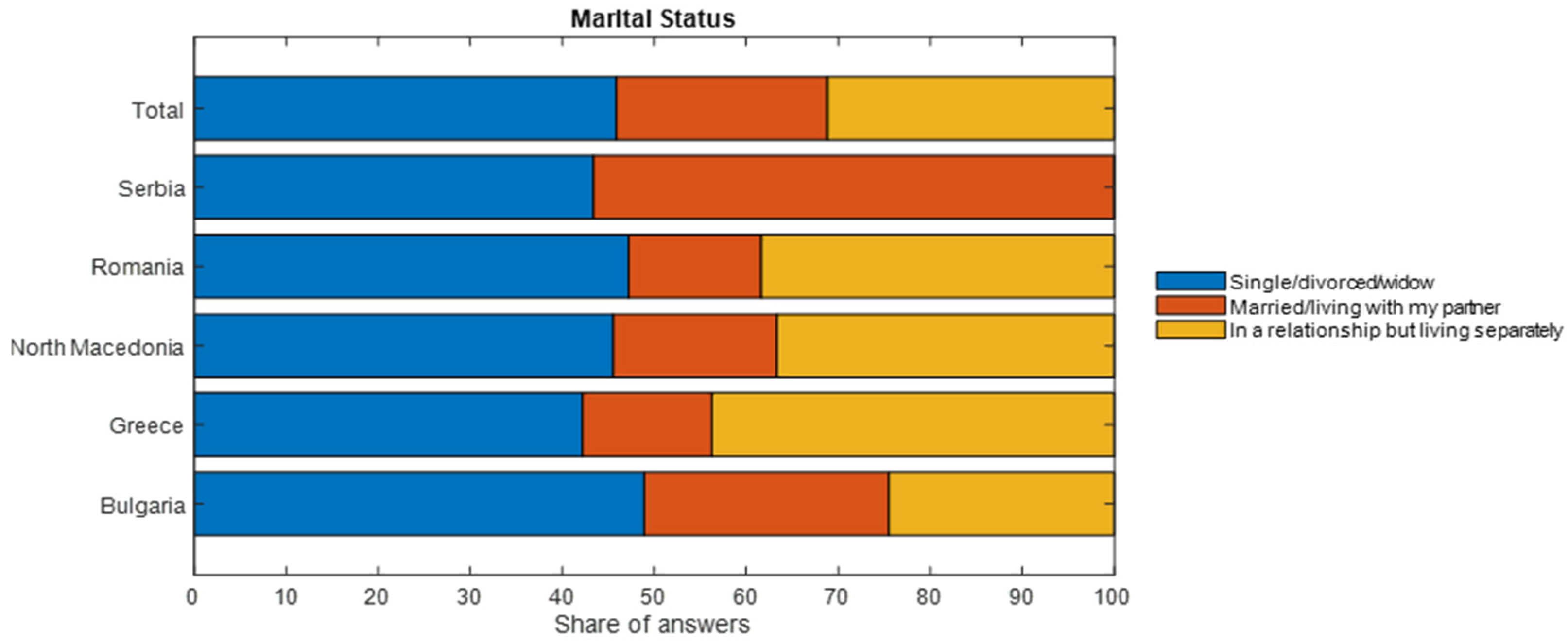
Figure 1 depicts the marital status of the respondents. Regarding marital status, the dominant status is being single, followed by “being in a relationship but living separately”. Married respondents constitute 22.91% of the total answers. Similarly to work status results, the majority of respondents, closer to 20, are single, while the ones, closer to 30, are married. The highest share of married respondents is reported in Serbia. Bulgaria has the highest share of single respondents.
Considering car ownership, 71% of participants reported having at least one car in the household. Based on self-perception, the majority of participants identified as belonging to the middle or middle-high financial class, with 58.8% and 19.3%, respectively. 6.5% reported belonging to the low financial class, 11.9% to the low-middle and 3.5% to the high. However, it should be noted that 205 participants chose not to answer this question.
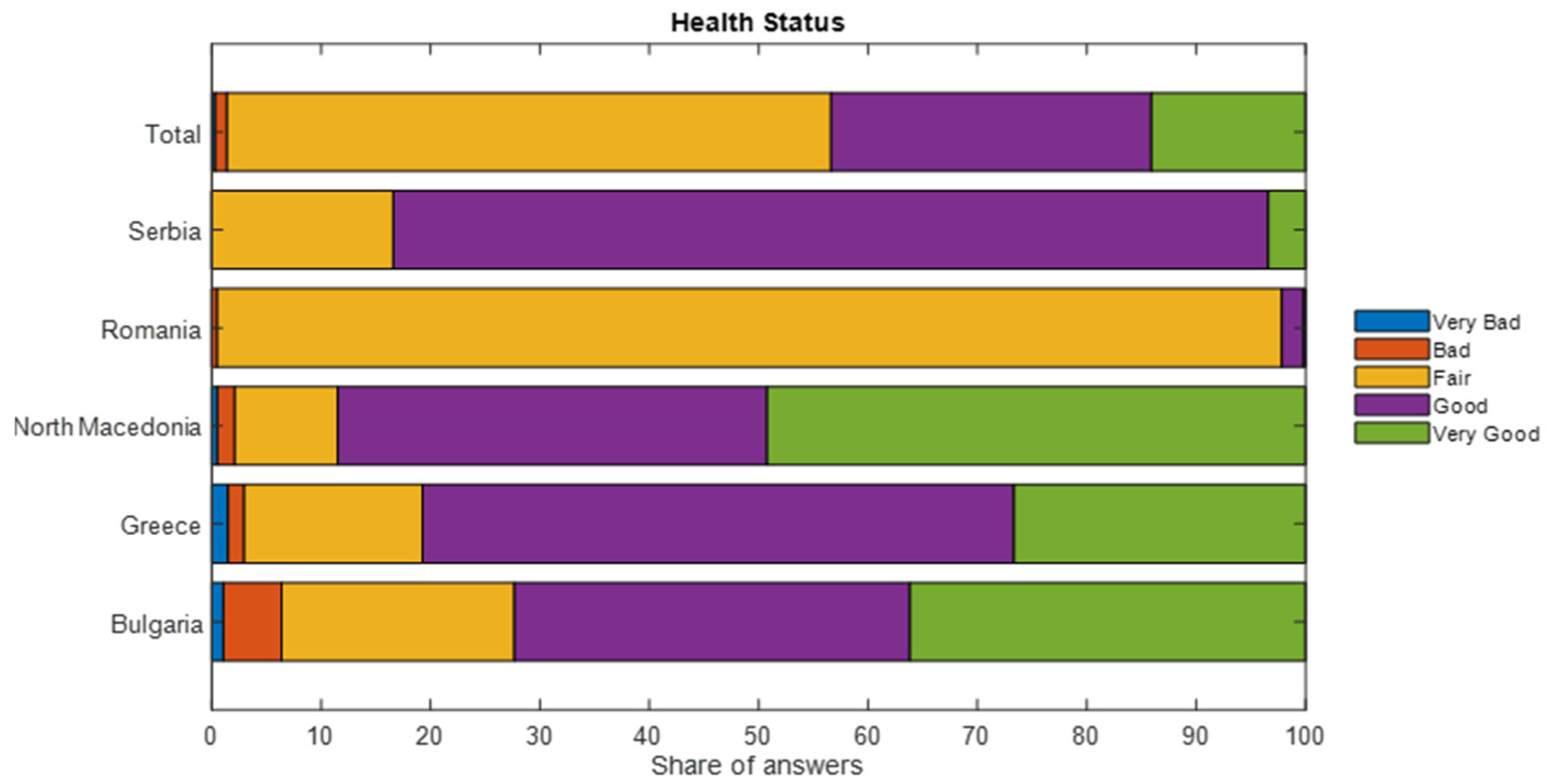
Survey participants were also asked to report their perceived health status. The results per country and per age are illustrated in Figure 2. Half of the respondents perceive their current health status as fair, and almost 35% of the respondents believe that they have a good health status. Less than 2% of the respondents perceive their health status as poor. Serbians perceive their health as good, with 83.41% of the Serbian participants replying “Good” or “Very Good”. The highest share of negative perception on health is reported in Bulgaria (6.38%).

2.3. Neighbourhood and Mobility Attributes

The dependent variable in all models was the perceived mental well-being. The mean of total well-being was calculated to be 52.84. Key neighbourhood and mobility-related variables such as cycling route availability, pleasantness of walking/cycling environments, and access to amenities (e.g., retail shops, entertainment facilities) were measured using four-point Likert scales, ranging from Strongly Disagree to Strongly Agree. Most respondents agreed that their neighbourhoods had walkable sidewalks and some degree of green coverage. However, perceptions of safety during nighttime and when leaving bicycles locked showed more variation, indicating differing levels of perceived neighbourhood security.
51.1% and 28.3% of participants agreed that there are different routes available for walking and cycling in their neighbourhoods. However, only 22.8% of participants considered their neighbourhood safe for parking bicycles, while 49.2% perceived it as dangerous to leave bicycles unattended. In total, 90% of participants reported feeling safe during the day, and 77.3% at night in their neighbourhoods across the Balkans. Additionally, only 8.7% of participants expressed satisfaction with the mixed land-use structure in their residential areas.

2.4. Model Design

Linear regression models were designed to capture the parameters affecting the well-being level of all participating countries and each one individually. The well-being score, calculated by summing all responses for each statement of the WEMWBS, is treated as a continuous variable. It is assumed that the occurrence of each well-being score follows a normal distribution. Moreover, the independent variables of the model affect the occurrence of the specific well-being score.
The Linear Regression model for the well-being score is expressed by the following equation:
y | x 1 , x 2 , , x p = β 0 + β 1 x 1 + β 2 x 2 + + β p x p + ε
Or equivalently,
E y | x 1 , x 2 , , x p = β 0 + β 1 x 1 + β 2 x 2 + + β p x p ,
where
y       the total well-being score from WEMWBS;
x1, x2,…, xp      the predictors of the model (independent variables);
β0        the intercept;
β1, β2,…, βp   the coefficients of each predictor/parameter;
ε       the error term, assumed to follow a normal distribution.
The expected well-being score increases additively with the predictors. Each coefficient represents the expected change in the well-being score for a one-unit increase in the corresponding predictor, holding all other variables constant. For categorical variables, one level (usually the first) is taken as the reference level, effectively taking an estimated coefficient value of zero, and the other levels are entered as dummy variables taking individual coefficient values, which are interpreted with respect to the reference one. The models were designed using R4.4.2 with the corresponding packages installed. The final models are presented in the next section.

3. Results

Linear regression models were designed to capture the factors affecting the perceived mental well-being of the women in the Balkans, and of each participating country separately. The variables tested were classified in four main categories: Neighbourhood and mobility attributes, physical activity, nutrition and socio-economic characteristics. All factors that affect well-being in the models designed are presented in Appendix A. These factors are mainly categorical (ordinal or nominal) and numeric (discrete or continuous). In the following sections, the general model for well-being is presented, followed by the country-specific models.

3.1. General Well-Being Model

Table 2 shows the model results for the women in all participating countries.
The spatial environment affects well-being. Specifically, land use, walking and cycling facilities, perceived security and environmental pleasantness are key contributory factors. Diversity is one of the critical dimensions of the spatial environment assessment [43]. A neighbourhood with diverse land use can satisfy a wide range of needs. Alongside diversity, the presence of attractive shopping, social or recreational activities enhances the liveability of a neighbourhood and contributes to higher well-being. Active mobility is a central pillar of sustainable transport, associated with a healthier and more environmentally friendly lifestyle in cities. Model results highlight this association through factors such as the presence of walkable sidewalks, pedestrian zones and dedicated cycling infrastructure. The impact of these variables is significant, primarily when they are perceived as highly available. Neighbourhood safety, as classified by Karim and Azmi [44], includes well-lit streets, low traffic volume and low crime rates during the day and night. According to the results, high perceived crime during the night is linked with lower well-being levels. Additionally, street cleanliness, building attractiveness and the presence of trees were found to be statistically significant, suggesting that street aesthetics are associated with well-being. Among the spatial environment variables, the perception of a high-crime neighbourhood presented the greatest effect, followed by land-use diversity. With the exception of insecurity due to crime rates, the presence of trees and unattractive and abandoned buildings, the other factors were only associated with well-being at their highest level.
Healthy habits and well-being reinforce each other. The model confirms this through the frequency of walking, engaging in vigorous activity and eating junk food. Walking and vigorous activity are positively associated with well-being, whereas junk food consumption is negatively associated. Walking with a weekly frequency has a slightly higher effect compared to vigorous physical activity. Well-being is also linked with the physical condition of women, as measured by the BMI index, where the reference level is overweight and obese people.
With respect to trip characteristics, using public transport as the main mode of travel, compared to walking, as well as daily use of public transport, is associated with lower well-being levels. The final set of predictors in the well-being model encompasses socio-economic variables. Among these, marital and occupational statuses of women in the Balkans exhibit significant associations with well-being. Specifically, emotional stability within a relationship is positively linked to well-being, whereas engagement in routine household tasks or childcare, which limits both autonomy and opportunities for income-generating or self-directed activities, is negatively associated with well-being.
The model’s intercept (48.939) is relatively high, while its predictive accuracy is low (adjusted R2 = 0.134). This low explanatory power is largely driven by the sample composition, which combines responses from five different surveys with varying socioeconomic profiles. For instance, in Serbia, all respondents are employed, whereas in Romania, the majority are students. Marital status also varies substantially across these sub-populations. To account for sample heterogeneity, five separate models were designed, one for each city. This enables the identification of differences attributable not only to socio-economic characteristics, but also to contextual factors such as local conditions and the cultural orientations of the respective populations.

3.2. Greek Well-Being Model

The results of the Greek well-being model are presented in Table 3.
Findings indicate a substantial positive correlation between well-being and the availability of different cycling routes, with coefficients ranging from 3.543 to 15.219. Urban greenery (coef. 3.214) and attractive shopping, social, and recreational facilities (coef. 3.450) are also strongly associated with higher levels of well-being. The favourable weather in Greece further supports outdoor activities, amplifying the positive effects of such environmental factors. Daily use of public transport is positively associated with well-being (coef. 3.743). In terms of health-related habits, three factors are significantly linked to well-being: weekly walking frequency (coef. 1.493), which shows the strongest effect; time spent on screen-based devices during weekends (coef. –0.012), which is negatively associated; and healthy eating habits (coef. 5.089). Regarding socio-economic characteristics, individuals with medium income (coef. 3.062) report higher well-being compared to those with low income.
The intercept (29.280) is relatively low, while the model’s prediction accuracy is moderate (adjusted R2 0.315). Based on the model results, the factors most strongly associated with well-being are availability of different cycling routes, walking frequency and eating habits. Cycling and walking are not common in Greece, whether for utilitarian or recreational purposes. Nevertheless, their significance in travel satisfaction is substantial [45]. Eating habits also show strong coefficient values. Interestingly enough, Karageorgou et al. [46] analysed data from a large-scale study in Greece and identified a dietary pattern characterised by high snack consumption, which was only observed in women. Health-related habit factors, together with the availability of different cycling routes, exhibit the most consistent associations with well-being, as indicated by their higher t-values.

3.3. Bulgarian Well-Being Model

The variables affecting the well-being of young women in Bulgaria are summarised in Table 4.
Pedestrian and cycling infrastructure are associated with well-being. In particular, the availability of different cycling routes (coef. 6.125) and the presence of walkable sidewalks (coef. 6.745) show a strong positive correlation. Two additional spatial environment factors are neighbourhood cleanliness (coef. −3.141) and perceived crime rates (coef. −11.702), which present the largest effect compared to the other factors, followed by the quality of pedestrian and cycling infrastructure, which present similar effects. Women who cycle for non-commuting trips present considerably higher (coef. 14.321) well-being levels compared to those who travel on foot. Regarding health-related habits, three factors are significantly linked to well-being: weekly walking frequency (coef. 1.841), which shows the strongest effect, time spent on screen-based devices during weekdays (coef. –0.014) and junk food frequency (coef. −1.621). Among socioeconomic factors, only marital status (coef. 3.348) was found to be linked with well-being.
The model’s intercept (44.995) is moderate, while the model shows a reasonably good fit (adjusted R2 0.521). Insecurity at night demonstrates an exceptionally strong association with well-being compared to the other contributory parameters, despite Plovdiv being a safe city. This likely reflects the psychological salience of safety in low-crime environments: in areas where crime is rare, even minor perceived threats have a pronounced effect on well-being. Health-related habit factors show the most reliable associations with well-being, as indicated by their higher t-values.

3.4. Romanian Well-Being Model

The results of the Romanian well-being model are presented in Table 5.
Land-use diversity in a neighbourhood (coef. 1.876) is positively associated with well-being. Regarding pedestrian and cycling infrastructure, quicker cycling routes compared to driving (coef. 1.662) and a more pleasant walking environment (coef. 3.769–6.546) are positively linked to well-being. In contrast, security-related factors, including the risk of bicycle theft and high crime rates at night, are negatively associated. Health-related habits also play an important role: greater walking frequency (coef. 0.795) and healthier eating habits (coef. 5.114) are linked to higher well-being, whereas frequent junk food consumption (coef. −0.390) and obesity (coef. −4.341) are associated with lower well-being. Regarding socio-economic characteristics, being married or living with a partner is positively linked to well-being (coef. 2.713) compared to being single, while engagement in routine household tasks or childcare (coef. −2.207) is negatively associated compared to having a job.
The model’s intercept (42.668) is relatively low, while its predictive accuracy is also low (adjusted R2 0.239). The presence of a pleasant walking environment exhibits the strongest associations with well-being, probably as Bucharest is a city where the contrast between pleasant and unpleasant walking environments is rather pronounced [47]. Eating habits present strong associations with well-being, a result of the reported low adherence of the Romanian population to a healthy diet [48]. Health-related habit factors, except for BMI, along with the presence of a pleasant walking environment, present the most consistent associations with well-being, as indicated by their higher t-values.

3.5. Serbian Well-Being Model

Table 6 presents the results of the Serbian well-being model.
Environmental attractiveness is captured through several parameters. More specifically, the presence of green spaces (coef. 3.934–6.553) is positively related to well-being, while street cleanliness (coef. −8.783) shows a negative relationship. Considering pedestrian and cycling infrastructure, the presence of dedicated lanes (coef. 1.252) and safe parking spaces (coef. 0.419) for bicycles, and the presence of pedestrian zones (coef. 2.611) are also positively linked to well-being. By contrast, higher perceived crime rates during the day (coef. −3.376) show a negative association. Regarding health-related habits, three factors are significantly linked to well-being: weekly walking frequency (coef. 0.368), eating habits (coef. 2.721) and junk food consumption (coef. −3.341). Among socio-economic characteristics, only the number of children (coef. –4.293) is statistically significant, showing a negative impact.
The model intercept (55.373) is high, and predictive accuracy is extremely high (adjusted R2 0.968). Additional tests for model suitability, multicollinearity, and overfitting were performed, suggesting that the model is statistically sound. However, the unusually high accuracy indicates that the coefficients may be highly sensitive and should be interpreted with caution.

3.6. North Macedonian Well-Being Model

The well-being model for North Macedonia is shown in Table 7.
The model incorporates several spatial environment attributes, including land-use diversity (coef. 2665, 3.951) and dedicated infrastructure. Positive associations with well-being are observed for the existence of alternative cycling routes (coef. 4.636), the presence of segregated bicycle lanes (coef. 3.415), and the presence of walkable sidewalks (coef. 4.615). By contrast, security concerns, such as the perceived theft risk of leaving a bicycle locked (coef. –3.378) and perceived crime at night (coef. –3.708), are negatively associated with well-being. Within the health-related habits category, only eating habits (coef. 3.686) are associated with well-being, showing a positive effect. Regarding socio-economic characteristics, the number of children (coef. –3.735) and access to a scooter (coef. –7.369) are both negatively linked with well-being.
The model’s intercept (52.346) is high, while its predictive accuracy is modest (adjusted R2 0.296). All factors present similar coefficients (except for access to a scooter) and t-values, suggesting that their effects are relatively balanced and the model can be considered statistically robust.

4. Discussion

This study explored the factors influencing the perceived mental well-being of young women across five Balkan countries—Greece (Athens), Bulgaria (Plovdiv), Romania (Bucharest), Serbia (Belgrade), and North Macedonia (Shtip). A questionnaire survey was employed to collect data on neighbourhood characteristics, mobility options, physical activity, nutritional habits, and socio-economic parameters. Linear regression models were applied to examine the associations between these predictors and perceived mental well-being, both across all countries and within each country individually. The predictive accuracy of the overall model was notably lower than that of the country-specific models, highlighting the importance of local context and the differences in populations and urban environments across the studied cities. The capitals, Athens and Bucharest, present the lowest well-being scores, while Nis has the highest score.
Neighbourhood attributes were significant determinants of mental well-being across all cities. The availability and attractiveness of local facilities for shopping, socialising, and recreation were positively associated with higher well-being, consistent with theories suggesting spatial diversity and convenience enhance life satisfaction by reducing travel distances and providing more time for leisure [43,49]. Diverse land use was significant in Athens and Bucharest, likely reflecting the challenges of large urban environments where liveable, amenity-rich neighbourhoods are less common, and a significant effect was also observed in Shtip.
Active mobility infrastructure, including sidewalks, cycling routes, dedicated lanes, and secure bicycle parking, was positively associated with mental well-being across the studied cities. This finding highlights the potential benefits of promoting active transport in urban environments, particularly in large cities facing traffic congestion, car dominance, and limited access to local amenities [50,51,52]. The highest impacts were recorded in Greece, suggesting infrastructure improvements in urban mobility can yield considerable benefits in regions facing traffic congestion and car dominance issues [52].
Perceived safety consistently emerged as a negative predictor of mental well-being across all studied countries, with the exception of Athens, presumably because it exhibits higher crime rates than the other cities. In higher-crime environments, residents may habituate to risk, resulting in smaller effects on well-being [53]. Women who reported feeling unsafe in their neighbourhoods, especially with respect to crime at night or the risk of bicycle theft, experienced significantly lower levels of mental well-being, with this effect most pronounced in Plovdiv and Nis [54]. Neighbourhood aesthetics further contributed to well-being: the presence of green spaces, overall cleanliness and visually appealing, well-maintained buildings were positively associated with mental health outcomes, reinforcing the importance of creating attractive and secure urban environments, confirming the findings of previous studies. Access to services has been positively correlated with a higher level of well-being, regardless of age [55]. Ettema et al. [48] demonstrated that neighbourhood attractiveness and social safety are associated with higher levels of well-being. The findings of this study, particularly the strong positive association between cycling infrastructure and women’s well-being across all explored cities, align with those of Eibich et al. [55]. Additionally, Mavoa et al. [56] reported that higher levels of greenness and natural features in residential areas are associated with reduced depressive symptoms among adolescents in New Zealand, while Hobbs et al. [57] highlighted the beneficial effects of well-designed environmental conditions in reducing mental distress.
Physical activity consistently emerged as a positive predictor of mental well-being. The frequency of regular walking correlated positively with enhanced well-being across all countries. This finding reiterates global evidence on the mental health benefits of regular physical exercise, which is known to alleviate symptoms of depression and anxiety and enhance mood states [58]. Particularly robust associations were noted in Athens and Bucharest. This reflects the challenges of large urban environments, where long commutes, traffic congestion, and limited access to local amenities make opportunities for physical activity especially important for mental well-being.
Nutritional habits showed a consistent effect across all the countries studied. Healthier dietary practices were positively associated with higher mental well-being. This association underscores nutrition’s potential role as part of comprehensive public health strategies aimed at enhancing mental well-being, given its influence on mood regulation and general health [59].
Socio-economic characteristics presented nuanced but significant relationships with mental well-being. Higher perceived financial status correlated positively with mental well-being, reaffirming the link between economic security and mental health [60]. Notably, socio-economic stability was highlighted in Greece as particularly important, a country which has recently recovered from the financial crisis. Marital status and family structure presented intriguing contrasts across countries. Being married or in a committed relationship was positively associated with mental well-being in Bulgaria and Romania, emphasising the role of close personal relationships as sources of emotional and social support. However, the presence of children showed negative associations in Serbia and North Macedonia, likely due to childcare responsibilities and limited social support systems in these contexts [61].
Overall, the comparative analysis reveals a multidimensional and context-sensitive picture of factors affecting mental well-being among young women in Balkan cities. Neighbourhood characteristics, mobility options, physical activity, nutrition, and socio-economic stability all play important roles, with some variation across cities. These findings have substantial policy implications: urban planners and policymakers should prioritise creating neighbourhoods with diverse and attractive facilities, robust and safe active transport infrastructure, and integrated crime prevention strategies. Complementary public health interventions promoting physical activity and healthy nutrition, alongside socio-economic initiatives supporting financial stability and family-friendly policies, are essential.
This study also highlights the broader public health and psychosocial relevance of its findings. Mental well-being is closely linked to reduced risks of depression, anxiety, and chronic disease, as well as improved life expectancy and quality of life. By demonstrating associations between social, environmental, and individual factors and young women’s perceived well-being, the study emphasises the importance of integrated, multidisciplinary approaches that combine urban design, safety policies, and community-based interventions. These insights can inform holistic, multi-sectoral strategies to promote resilience, mitigate mental distress, and improve young women’s mental health across the Balkan region.

5. Conclusions

Well-being is essential for a balanced life, as it encompasses physical, mental, and emotional health. Higher levels of well-being are associated with individual benefits, such as emotional stability and social benefits with stronger and resilient relationships within a society. In this context, this study focused on the factors affecting the level of well-being experienced by young women in the Balkans. The analysis revealed that well-being is associated with a range of predictors, including neighbourhood and mobility factors, physical activity levels, nutritional habits and socio-economic characteristics. Spatial features of urban environments and distinct mobility-related factors appear to influence well-being, and all of these factors can be incorporated into urban planning and policy to promote more sustainable, health-supportive living spaces.
Physical activity and healthy nutrition habits affect well-being substantially, even at low intensity. Therefore, encouraging or supporting young women to include any form of physical activity and maintain healthy dietary practices in their daily routines can have a positive effect on their well-being. It is important to note, however, that these relationships may be bidirectional, with no clear directionality—for example, higher well-being could lead women to engage more in physical activity and healthier eating, while these behaviours may also contribute to improved well-being. Further in-depth research is required to disentangle these effects.
Despite these findings, several limitations should be acknowledged. The reliance on self-reported measures may introduce bias, and the absence of objective clinical or health data constrains the robustness of the findings. To address these issues, future investigations employing longitudinal and mixed-methods designs are warranted to strengthen the validity and depth of evidence in this area. Research could also expand to other populations or age groups in the Balkans to explore potential differences and changes in well-being and its determinants.

Author Contributions

The authors confirm contributing to the paper as follows: Conceptualisation, all authors; investigation: B.P., S.J.M., M.D., L.B.E.P.-D. and M.M.; methodology, G.L. and I.S.; analysis and interpretation of the results: G.L., I.S., M.M. and L.B.E.P.-D.; writing—original draft preparation, all authors; writing—review and editing, all authors; All authors have read and agreed to the published version of the manuscript.

Funding

The current study has been designed as a part of the project “Improving the Subjective well-being of Young Women in Balkans through Interventions in their Physical Activity”-Fit-Balkans (Project number 101049997) funded by the ERASMUS+ program of the European Commission. The funders had no role in undertaking this review.

Informed Consent Statement

Informed consent was obtained from all subjects involved in the study.

Data Availability Statement

The datasets generated during and/or analysed during the current study are available from the corresponding author upon reasonable request.

Acknowledgments

We acknowledge support by the Open Access Publication Fund of TU Berlin. The authors are grateful to the participants, and to diverse colleagues/collaborators who have contributed to the management of the survey by guiding participants about the questions, translating the questionnaires from English to local languages, and/or providing guidance/support to data collection/analysis related to accelerometery.

Conflicts of Interest

The authors declare no conflicts of interest.

Appendix A

Table A1. Variables appearing in the final models and their levels.
Neighbourhood and Mobility Attributes
Cycling is quicker than driving in my neighbourhood during the day Strongly Disagree
Somewhat Disagree
Somewhat Agree
Strongly Agree
There are many different routes for cycling from place to place in my neighbourhood so I don’t have to go the same way every time
There are shops for everyday shopping (supermarket, groceries and so on) in my area
There are entertainment establishments (e.g., restaurants, bars, cinema) in my area
There are retail shops (e.g., clothes, shoes, homeware) in my area
There is a diverse land-use mix in my area
My local neighbourhood is a pleasant environment for walking
My local neighbourhood is a pleasant environment for cycling
There is litter in the streets of my neighbourhood None
A few
Some
Plenty
There is green or trees along the streets in my neighbourhood
In my neighbourhood there are badly maintained, unoccupied or ugly buildings
There are walkable sidewalks in my neighbourhoodStrongly Disagree
Somewhat Disagree
Somewhat Agree
Strongly Agree
There are pedestrian zones or pedestrian trails in my neighbourhood
There are special lanes, routes or paths for cycling in my neighbourhood
There are cycle routes in my neighbourhood that are separated from traffic
There are safe areas to park bicycles in my area
It is dangerous to leave a bicycle locked in my neighbourhood
Walking is dangerous because of the traffic in my neighbourhood
It is dangerous in my neighbourhood during the night because of the level of crime
What is your most dominant mode of transport for commuting/for non-commuting tripsOn foot
Bicycle
Scooter
Motorbike
Overground PT
Underground PT
Private car
Taxi
Shared services
How often do you use public transport?Never
A few times per month
A few times per week
Rarely
Everyday
How do you find the shopping, social, recreational facilities of your neighbourhood? Not attractive at all
Little attractive
Medium
Very attractive
Extremely attractive
Not available
International Physical Activity Questionnaire
During the past 7 days, how many days did you do vigorous physical activities like heavy lifting, digging, aerobics, or fast bicycling?Number
During the past 7 days, how many days did you walk for at least 10 min at a time?
During the past 7 days, how many minutes per day did you spend on screens (smartphone, tablet, computer, etc.) on weekdays, on average?
During the past 7 days, how many minutes per day did you spend on screens (smartphone, tablet, computer, etc.) on the weekend, on average?
How many times per week do you eat junk food?
Nutrition Questions
How would you consider your eating habits in general?Not healthy at all
Not really healthy
Somewhat healthy
Very healthy
Extremely healthy
Socio-Economic Characteristics
Which of these descriptions best describes your work status?In paid work (or away temporarily)
Unemployed and actively looking for a job
Permanently sick or disabled
Doing housework, looking after children or other persons
Student
What is your marital status?Single/Divorced/Widowed
Married/Living with my partner
In a relationship but living separately
How many children do you have?Number
Do you own a car/scooterYes/No
Do you have access to car/scooter
How would you describe your financial status?Low
Low-Mid
Mid
Mid-High
High

References

  1. Pereira, C.; Gonçalves, H.; Sequeira, T. Determinants of well-being 2024. arXiv 2024. [Google Scholar] [CrossRef]
  2. Promoting Mental Health: Concepts, Emerging Evidence, Practice. Available online: https://www.who.int/publications/i/item/9241562943 (accessed on 17 July 2025).
  3. “How’s Life? 2024,” OECD. Available online: https://www.oecd.org/en/publications/how-s-life-2024_90ba854a-en.html (accessed on 17 July 2025).
  4. Arnett, J.J. Emerging adulthood: A theory of development from the late teens through the twenties. Am. Psychol. 2000, 55, 469. [Google Scholar] [CrossRef]
  5. Smith, M.D.; Wesselbaum, D. Well-being inequality among adolescents and young adults. J. Adolesc. Health 2024, 74, 703–712. [Google Scholar]
  6. Tudora, D.; Banica, A.; Istrate, M. Evaluation of Gender Disparities from the Balkan Countries. Procedia Econ. Financ. 2015, 20, 654–664. [Google Scholar] [CrossRef]
  7. Daskalaki, M.; Fotaki, M.; Simosi, M. The gendered impact of the financial crisis: Struggles over social reproduction in Greece. Environ. Plan. A 2021, 53, 741–762. [Google Scholar] [CrossRef]
  8. Voices of YOUth: Gender Equality and Social Cohesion in the Western Balkans. UN Women–Albania. Available online: https://albania.unwomen.org/en/digital-library/publications/2023/09/voices-of-youth-gender-equality-and-social-cohesion-in-the-western-balkans (accessed on 17 July 2025).
  9. Veenhoven, R. Well-being in the welfare state: Level not higher, distribution not more equitable. J. Comp. Policy Anal. Res. Pract. 2000, 2, 91–125. [Google Scholar] [CrossRef]
  10. European Foundation for the Improvement of Living and Working Conditions. Impact of COVID-19 on Young People in the EU; EU Publications Office: Luxembourg, 2021; Available online: https://data.europa.eu/doi/10.2806/361465 (accessed on 17 July 2025).
  11. Kahneman, D.; Deaton, A. High income improves evaluation of life but not emotional well-being. Proc. Natl. Acad. Sci. USA 2010, 107, 16489–16493. [Google Scholar] [CrossRef]
  12. Thomson, R.M.; Igelström, E.; Purba, A.K.; Shimonovich, M.; Thomson, H.; McCartney, G.; Reeves, A.; Leyland, A.; Pearce, A.; Katikireddi, S.V. How do income changes impact on mental health and wellbeing for working-age adults? A systematic review and meta-analysis. Lancet Public Health 2022, 7, e515–e528. [Google Scholar] [CrossRef] [PubMed]
  13. Matud, M.P.; Bethencourt, J.M.; del Pino, M.J.; Hernández-Lorenzo, D.E.; Fortes, D.; Ibáñez, I. Time Use, Health, and Well-Being across the Life Cycle: A Gender Analysis. Soc. Sci. 2024, 13, 307. [Google Scholar] [CrossRef]
  14. Orth, U.; Erol, R.Y.; Luciano, E.C. Development of self-esteem from age 4 to 94 years: A meta-analysis of longitudinal studies. Psychol. Bull. 2018, 144, 1045. [Google Scholar] [CrossRef] [PubMed]
  15. Azar, I.A.S.; Vasudeva, P. Self-efficacy and self-esteem: A comparative study of employed and unemployed married women in Iran. Ger. J. Psychiatry 2006, 9, 111–117. [Google Scholar]
  16. Macassa, G.; McGrath, C.; Roy, M.J.; Stål, F.; Hiswåls, A.S.; Rashid, M.; Karlsson, U.; Olsson, R.; Silva, J.P.; Vinberg, S. Perceptions of Health and Wellbeing Among Employees in a Work Integration Social Enterprise in Sweden. Ann. Glob. Health 2023, 89, 31. [Google Scholar] [CrossRef]
  17. Lu, Z.; Yan, S.; Jones, J.; He, Y.; She, Q. From housewives to employees, the mental benefits of employment across women with different gender role attitudes and parenthood status. Int. J. Environ. Res. Public Health 2023, 20, 4364. [Google Scholar] [CrossRef] [PubMed]
  18. Skevington, S.M. Qualities of life, educational level and human development: An international investigation of health. Soc. Psychiat. Epidemiol. 2010, 45, 999–1009. [Google Scholar] [CrossRef]
  19. Education and Quality of Life. In Handbook of Social Indicators and Quality of Life Research; Springer: Dordrecht, The Netherlands, 2012; pp. 265–296. [CrossRef]
  20. Stanojević, D.; Tomanović, S.; Ljubičić, M. Elements of life satisfaction among young adults in Serbia. J. Youth Stud. 2016, 19, 973–989. [Google Scholar] [CrossRef]
  21. Lenzi, C.; Perucca, G. Life satisfaction in Romanian cities on the road from post-communism transition to EU accession. Reg. J. ERSA 2016, 3, 1–22. [Google Scholar]
  22. Singh, K.; Kaur, J.; Singh, D.; Junnarkar, M. Socio-Demographic Variables Affecting Well-Being: A Study on Indian Rural Women. Psychol. Stud. 2014, 59, 197–206. [Google Scholar] [CrossRef]
  23. Ifeoma J, N.; Onyeili, T.S. Factors Affecting the Well-Being of Women in Anambra State, Nigeria: A Qualitative Stu. Nnadiebube J. Soc. Sci. 2024, 4, 15–21. [Google Scholar]
  24. Lee, K.S.; Ono, H. Marriage, Cohabitation, and Happiness: A Cross-National Analysis of 27 Countries. J. Marriage Fam. 2012, 74, 953–972. [Google Scholar] [CrossRef]
  25. Holakoie, A.; Mahmoodi, A.; Maredpoor, A. Development of a Structural Model for Predicting Psychological Well-Being Based on Mindfulness with the Mediating Role of Resilience in Women on the Verge of Divorce in Isfahan. Psychol. Woman J. 2024, 5, 1–11. [Google Scholar] [CrossRef]
  26. Cairney, J.; Boyle, M.; Offord, D.R.; Racine, Y. Stress, social support anddepression in single and married mothers. Soc. Psychiatry Psychiatr. Epidemiol. 2003, 38, 442–449. [Google Scholar] [CrossRef]
  27. Thomas, P.A.; Liu, H.; Umberson, D. Family relationships and well-being. Innov. Aging 2017, 1, igx025. [Google Scholar] [CrossRef]
  28. Edeigba, B.A.; Ashinze, U.K.; Umoh, A.A.; Biu, P.W.; Daraojimba, A.I.; Edeigba, B.A.; Ashinze, U.K.; Umoh, A.A.; Biu, P.W.; Daraojimba, A.I. Urban green spaces and their impact on environmental health: A Global Review. World J. Adv. Res. Rev. 2024, 21, 917–927. [Google Scholar] [CrossRef]
  29. Giles-Corti, B.; Donovan, R.J. The relative influence of individual, social and physical environment determinants of physical activity. Soc. Sci. Med. 2002, 54, 1793–1812. [Google Scholar] [CrossRef]
  30. Xu, Z.; Marini, S.; Mauro, M.; Maietta Latessa, P.; Grigoletto, A.; Toselli, S. Associations between urban green space quality and mental wellbeing: Systematic review. Land 2025, 14, 381. [Google Scholar] [CrossRef]
  31. Navarrete-Hernandez, P.; Vetro, A.; Concha, P. Building safer public spaces: Exploring gender difference in the perception of safety in public space through urban design interventions. Landsc. Urban Plan. 2021, 214, 104180. [Google Scholar] [CrossRef]
  32. Almanza Avendaño, A.M.; Romero-Mendoza, M.; Gómez San Luis, A.H. From harassment to disappearance: Young women’s feelings of insecurity in public spaces. PLoS ONE 2022, 17, e0272933. [Google Scholar] [CrossRef] [PubMed]
  33. Gjorgjev, D.; Dimovska, M.; Morris, G.; Howie, J.; Borota Popovska, M.; Topuzovska Latkovikj, M. How good is our place—Implementation of the place standard tool in North Macedonia. Int. J. Environ. Res. Public Health 2020, 17, 194. [Google Scholar] [CrossRef] [PubMed]
  34. Dzhambov, A.M.; Markevych, I.; Hartig, T.; Tilov, B.; Arabadzhiev, Z.; Stoyanov, D.; Gatseva, P.; Dimitrova, D.D. Multiple pathways link urban green-and bluespace to mental health in young adults. Environ. Res. 2018, 166, 223–233. [Google Scholar] [CrossRef]
  35. Čolić Marković, N.; Danilović Hristić, N. Integrating Gender Perspectives in Participation to Guide Changes in Urban Planning in Serbia. Land 2025, 14, 258. [Google Scholar] [CrossRef]
  36. Pojani, D.; Bakija, D.; Shkreli, E.; Corcoran, J.; Mateo-Babiano, I. Do Northwestern and Southeastern Europe share a common “cycling mindset”? Comparative analysis of beliefs toward cycling in the Netherlands and the Balkans. Eur. J. Transp. Infrastruct. Res. 2017, 17, 25–45. [Google Scholar] [CrossRef]
  37. DJordjević, T.; Tomić, N.; Tešić, D. Walkability and bikeability for sustainable spatial planning in the city of Novi Sad (Serbia). Sustainability 2023, 15, 3785. [Google Scholar] [CrossRef]
  38. Craig, C.L.; Marshall, A.L.; Sjöström, M.; Bauman, A.E.; Booth, M.L.; Ainsworth, B.E.; Pratt, M.; Ekelund, U.; Yngve, A.; Sallis, J.F.; et al. International physical activity questionnaire: 12-country reliability and validity. Med. Sci. Sports Exerc. 2003, 35, 1381–1395. [Google Scholar] [CrossRef]
  39. Tennant, R.; Hiller, L.; Fishwick, R.; Platt, S.; Joseph, S.; Weich, S.; Parkinson, J.; Secker, J.; Stewart-Brown, S. The Warwick-Edinburgh Mental Well-being Scale (WEMWBS): Development and UK validation. Health Qual. Life Outcomes 2007, 5, 63. [Google Scholar] [CrossRef] [PubMed]
  40. Spittaels, H.; Foster, C.; Oppert, J.-M.; Rutter, H.; Oja, P.; Sjöström, M.; De Bourdeaudhuij, I. Assessment of environmental correlates of physical activity: Development of a European questionnaire. Int. J. Behav. Nutr. Phys. Act. 2009, 6, 39. [Google Scholar] [CrossRef]
  41. Iacob, C.I.; Dumitru Tabacaru, C.; Yildiz, M.; Folostina, R. Psychometric properties of the Warwick-Edinburgh Mental Well-being Scale (WEMWBS) in the general Romanian population and professionals working with autistic students. Curr. Psychol. 2025, 44, 5413–5422. [Google Scholar] [CrossRef]
  42. Petrogiannis, K.; Sangeorzan, I.; Andriopoulou, P. Validation of the Greek Warwick-Edinburgh Mental Well-Being Scale (WEMWBS) in a Mature Student Community-Based Sample. Adv. Res. Sci. 2024, 5, 351–368. [Google Scholar] [CrossRef]
  43. Ewing, R.; Cervero, R. Travel and the Built Environment. J. Am. Plan. Assoc. 2010, 76, 265–294. [Google Scholar] [CrossRef]
  44. Karim, H.A.; Azmi, D.I. Convenience and safety of walking experience in Putrajaya neighbourhood area. Procedia-Soc. Behav. Sci. 2013, 101, 318–327. [Google Scholar] [CrossRef][Green Version]
  45. Mouratidis, K.; De Vos, J.; Yiannakou, A.; Politis, I. Sustainable transport modes, travel satisfaction, and emotions: Evidence from car-dependent compact cities. Travel Behav. Soc. 2023, 33, 100613. [Google Scholar] [CrossRef]
  46. Karageorgou, D.; Magriplis, E.; Mitsopoulou, A.V.; Dimakopoulos, I.; Bakogianni, I.; Micha, R.; Michas, G.; Chourdakis, M.; Ntouroupi, T.; Tsaniklidou, S.M. Dietary patterns and lifestyle characteristics in adults: Results from the Hellenic National Nutrition and Health Survey (HNNHS). Public Health 2019, 171, 76–88. [Google Scholar] [CrossRef] [PubMed]
  47. Florescu, T.; Cocheci, R.-M. Bucharest–the role of spatial planning in a challenging urban environment. Disp-Plan. Rev. 2023, 59, 6–15. [Google Scholar] [CrossRef]
  48. Mititelu, M.; Popovici, V.; Neacșu, S.M.; Musuc, A.M.; Busnatu, Ș.S.; Oprea, E.; Boroghină, S.C.; Mihai, A.; Streba, C.T.; Lupuliasa, D.; et al. Assessment of Dietary and Lifestyle Quality among the Romanian Population in the Post-Pandemic Period. Healthcare 2024, 12, 1006. [Google Scholar] [CrossRef]
  49. Giles-Corti, B.; Vernez-Moudon, A.; Reis, R.; Turrell, G.; Dannenberg, A.L.; Badland, H.; Foster, S.; Lowe, M.; Sallis, J.F.; Stevenson, M. City planning and population health: A global challenge. Lancet 2016, 388, 2912–2924. [Google Scholar] [CrossRef]
  50. Pucher, J.; Dill, J.; Handy, S. Infrastructure, programs, and policies to increase bicycling: An international review. Prev. Med. 2010, 50, S106–S125. [Google Scholar] [CrossRef]
  51. Saelens, B.E.; Handy, S.L. Built environment correlates of walking: A review. Med. Sci. Sports Exerc. 2008, 40, S550. [Google Scholar]
  52. Gatersleben, B.; Uzzell, D. Affective appraisals of the daily commute: Comparing perceptions of drivers, cyclists, walkers, and users of public transport. Environ. Behav. 2007, 39, 416–431. [Google Scholar] [CrossRef]
  53. Dustmann, C.; Fasani, F. The effect of local area crime on mental health. Econ. J. 2016, 126, 978–1017. [Google Scholar] [CrossRef]
  54. Lorenc, T.; Clayton, S.; Neary, D.; Whitehead, M.; Petticrew, M.; Thomson, H.; Cummins, S.; Sowden, A.; Renton, A. Crime, fear of crime, environment, and mental health and wellbeing: Mapping review of theories and causal pathways. Health Place 2012, 18, 757–765. [Google Scholar]
  55. Eibich, P.; Krekel, C.; Demuth, I.; Wagner, G.G. Associations between neighborhood characteristics, well-being and health vary over the life course. Gerontology 2016, 62, 362–370. [Google Scholar] [CrossRef] [PubMed]
  56. Mavoa, S.; Lucassen, M.; Denny, S.; Utter, J.; Clark, T.; Smith, M. Natural neighbourhood environments and the emotional health of urban New Zealand adolescents. Landsc. Urban Plan. 2019, 191, 103638. [Google Scholar] [CrossRef]
  57. Hobbs, M.; Kingham, S.; Wiki, J.; Marek, L.; Campbell, M. Unhealthy environments are associated with adverse mental health and psychological distress: Cross-sectional evidence from nationally representative data in New Zealand. Prev. Med. 2021, 145, 106416. [Google Scholar] [CrossRef] [PubMed]
  58. Rebar, A.L.; Stanton, R.; Geard, D.; Short, C.; Duncan, M.J.; Vandelanotte, C. A meta-meta-analysis of the effect of physical activity on depression and anxiety in non-clinical adult populations. Health Psychol. Rev. 2015, 9, 366–378. [Google Scholar] [CrossRef] [PubMed]
  59. Jacka, F.N.; Pasco, J.A.; Mykletun, A.; Williams, L.J.; Hodge, A.M.; O’Reilly, S.L.; Nicholson, G.C.; Kotowicz, M.A.; Berk, M. Association of Western and Traditional Diets with Depression and Anxiety in Women. AJP 2010, 167, 305–311. [Google Scholar] [CrossRef]
  60. Lund, C.; Breen, A.; Flisher, A.J.; Kakuma, R.; Corrigall, J.; Joska, J.A.; Swartz, L.; Patel, V. Poverty and common mental disorders in low and middle income countries: A systematic review. Soc. Sci. Med. 2010, 71, 517–528. [Google Scholar] [CrossRef]
  61. Umberson, D.; Pudrovska, T.; Reczek, C. Parenthood, Childlessness, and Well-Being: A Life Course Perspective. J. Marriage Fam. 2010, 72, 612–629. [Google Scholar] [CrossRef]
Figure 1. Marital status of the respondents.
Women 05 00040 g001
Figure 2. Health status of the respondents.
Women 05 00040 g002
Table 1. Work status of the respondents per country (%).
Paid WorkUnemployedPermanently SickHouseworkStudent
Total38.52.60.11.0957.9
Greece53.06.00.70.739.6
Bulgaria58.15.40.000.0036.5
Romania15.81.010.000.782.5
Serbia 100.000.000.000.000.00
North Macedonia23.36.30.003.267.2
Table 2. General well-being model.
VariablesCoefficientStandard Errort-Value
(Intercept)48.9391.26238.784
Neighbourhood and Mobility Attributes
Shopping/Social/Recreational facilities in the neighbourhood [Extremely attractive]1.7751.0271.729
Diverse land-use mix [Strongly Agree]1.9880.6093.263
Walkable sidewalks [Strongly Agree]1.9560.6582.973
Pedestrian zones [Strongly Agree]1.1610.7021.655
Cycling lanes [Strongly Agree]1.5380.8901.728
It is dangerous during the night because of the level of crime [Somewhat Disagree]−1.6950.605−2.803
It is dangerous during the night because of the level of crime [Somewhat Agree/Strongly Agree]−2.2390.677−3.307
Urban Greenery [Some/Plenty]1.4970.6282.384
Unattractive Buildings [A few/Some/Plenty]−1.1020.574−1.919
Litter [Plenty]−1.4800.772−1.918
Trip characteristics
Public transport use [Everyday]−1.8940.621−3.053
Primary transport mode for non-commuting trips [public transport]−2.0390.699−2.916
Healthy habits
Days of walking0.3840.1502.557
Days of vigorous activity0.2880.1481.944
Times of eating junk food−0.3390.115−2.950
BMI category [Underweight]1.9301.0091.913
BMI category [Normal weight]1.2430.6941.790
Socio-Economic Characteristics
Marital status [Married/Living with my partner]2.7140.6594.121
Work status [Housework, looking after children or other persons]−4.3692.649−1.649
R2: 0.148 Adjusted R2: 0.134
Table 3. Greek well-being model.
Variables Coefficient Standard Errort-Value
(Intercept)29.2803.5828.174
Neighbourhood and Mobility Attributes
Different cycling routes [Somewhat Disagree]3.5431.7951.974
Different cycling routes [Somewhat Agree]9.0272.0914.317
Different cycling routes [Strongly Agree]15.2193.684.135
Urban Greenery [Somewhat Disagree]3.2141.7481.839
Shopping, social, recreational facilities of your neighbourhood [Medium, Very attractive, Extremely attractive]3.4501.6832.050
Trip Characteristics
Public transport use [Everyday]3.7431.8052.074
Health Related Habits
Days of walking1.4930.3843.889
Minutes of weekend screen-time−0.0120.005−2.556
Eating habits [Very Healthy, Extremely Healthy]5.0892.1342.384
Socio-Economic Characteristics
Financial Status [Mid]3.0621.5611.962
R2: 0.370 Adjusted R2: 0.315
Table 4. Bulgarian well-being model.
Variables Coefficient Standard Errort-Value
(Intercept)44.9953.65312.316
Neighbourhood and Mobility Attributes
Different cycling routes [Strongly Agree]6.1252.3252.634
Litter [Some/Plenty]−3.1411.622−1.936
Walkable sidewalks [Somewhat Agree/Strongly Agree]6.7452.5972.597
It is dangerous during the night because of the level of crime [Strongly Agree]−11.7024.066−2.878
Trip Characteristics
Primary transport mode for non-commuting trips [bicycle]14.3216.4702.214
Health Related Habits
Days of walking1.8410.4164.428
Minutes of weekday screen time−0.0140.005−2.993
Times of eating junk food−1.6210.519−3.124
Socio-Economic Characteristics
Marital status [Married/Living with my partner]3.3481.8051.855
R2: 0.591 Adjusted R2: 0.521
Table 5. Romanian well-being model.
Variables Coefficient Standard Errort-Value
(Intercept)42.6682.75115.508
Neighbourhood and Mobility Attributes
Diverse land-use mix [Strongly Agree]1.8760.9372.002
Cycling is quicker than driving during the day1.6620.9341.780
Pleasant environment for walking [Somewhat Disagree]3.7692.0011.884
Pleasant environment for walking [Somewhat Agree]4.5771.952.347
Pleasant environment for walking [Strongly Agree]6.5461.9593.341
It is dangerous to leave a bicycle locked [Somewhat Disagree/Somewhat Agree/Strongly Agree]−2.1280.907−2.345
It is dangerous during the night because of the level of crime [Somewhat Agree/Strongly Agree]−2.1280.907−2.345
Trip Characteristics
Primary transport mode for non-commuting trips [shared services]−15.2786.299−2.426
Health Related Habits
Days of walking0.7950.3012.639
Times of eating junk food−0.3900.152−2.556
Eating habits [Somewhat healthy, Very healthy, Extremely healthy]5.1140.9155.586
BMI category [Obese]−4.3412.466−1.760
Socio-Economic Characteristics
Work status [Housework, looking after children or other persons]−2.2071.273−1.733
Marital status [Married/Living with my partner]2.7131.3222.052
R2: 0.265 Adjusted R2: 0.239
Table 6. Serbian well-being model.
Variables Coefficient Standard Errort-Value
(Intercept)55.3730.79170.019
Neighbourhood and Mobility Attributes
Litter [Plenty]−8.7830.199−44.08
Urban Greenery [A few]6.5330.8168.009
Urban Greenery [Some]3.9340.7595.18
Urban Greenery [Plenty]6.0890.7418.212
Pedestrian Zones [Somewhat Disagree/Somewhat Agree]2.6110.24610.593
Cycling Lanes [Somewhat Disagree/Somewhat Agree]1.2520.2235.602
Safe Bike Park [Somewhat Disagree/Somewhat Agree]0.4190.1942.158
It is dangerous during the day because of the level of crime [Somewhat Agree]−3.3760.200−16.907
Health Related Habits
Days of walking0.3680.0507.386
Eating habits [Very healthy]2.7210.4036.754
Times of eating junk food −3.3410.168−19.886
Socio-Economic Characteristics
Number of children [1]−4.2930.289−14.834
R2: 0.970 Adjusted R2: 0.968
Table 7. North Macedonian well-being model.
Variables Coefficient Standard Errort-Value
(Intercept)52.3461.35538.618
Neighbourhood and Mobility Attributes
Diverse land-use mix [Somewhat Agree]2.6651.5231.750
Diverse land-use mix [Strongly Agree]3.9511.7192.299
Different cycling routes [Somewhat Agree/Strongly Agree]4.6361.3683.388
Walkable Sidewalks [Somewhat Agree]4.6151.6992.716
Separated cycling lanes [Somewhat Agree/Strongly Agree]3.4151.4682.326
It is dangerous to leave a bicycle locked [Somewhat Disagree]−4.3271.499−2.886
It is dangerous to leave a bicycle locked [Strongly Agree]−3.3781.658−2.037
It is dangerous during the night because of the level of crime [Somewhat Disagree]−3.7081.350−2.747
Health-related Habits
Eating habits [Very Healthy/Extremely Healthy]3.6861.4732.502
Socio-Economic Characteristics
Number of Children [1/2]−3.7351.716−2.177
Access to scooter [Yes]−7.3692.868−2.569
R2: 0.344 Adjusted R2: 0.296
Disclaimer/Publisher’s Note: The statements, opinions and data contained in all publications are solely those of the individual author(s) and contributor(s) and not of MDPI and/or the editor(s). MDPI and/or the editor(s) disclaim responsibility for any injury to people or property resulting from any ideas, methods, instructions or products referred to in the content.