Article

Study of Spectroscopic, Thermal, Microscopic Characteristics and Extended-Release Application of Carboxymethyl Ethyl Cellulose


1
Department of Pharmaceutics, SCES’s Indira College of Pharmacy, 89/2A, Niramay, Universe Campus, New Mumbai Pune Highway, Tathawade, Pune 411033, Maharashtra, India
2
Department of Pharmaceutics, Poona College of Pharmacy, Bharati Vidyapeeth (Deemed to be University), Pune 411038, Maharashtra, India
3
ACG Pam Pharma Technologies Pvt. Ltd., Palashi Road, Taluka-Khandala, Shirwal, Pune 412801, Maharashtra, India
4
Image ProVision Technology Pvt. Ltd., D.S. Ikon, Survey No. 22, Laxman Nagar, Baner, Pune 411033, Maharashtra, India
5
Department of Pharmaceutics, Datta Meghe College of Pharmacy, Datta Meghe Institute of Higher Education and Research (Deemed to be University), Sawangi (Meghe), Wardha 442001, Maharashtra, India
*
Authors to whom correspondence should be addressed.
Polysaccharides 2026, 7(2), 64; https://doi.org/10.3390/polysaccharides7020064
Submission received: 12 March 2026 / Revised: 23 April 2026 / Accepted: 30 May 2026 / Published: 3 June 2026

Abstract

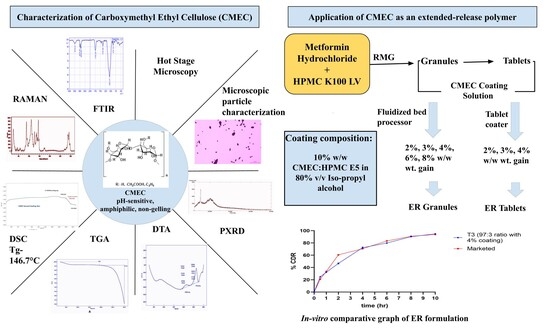
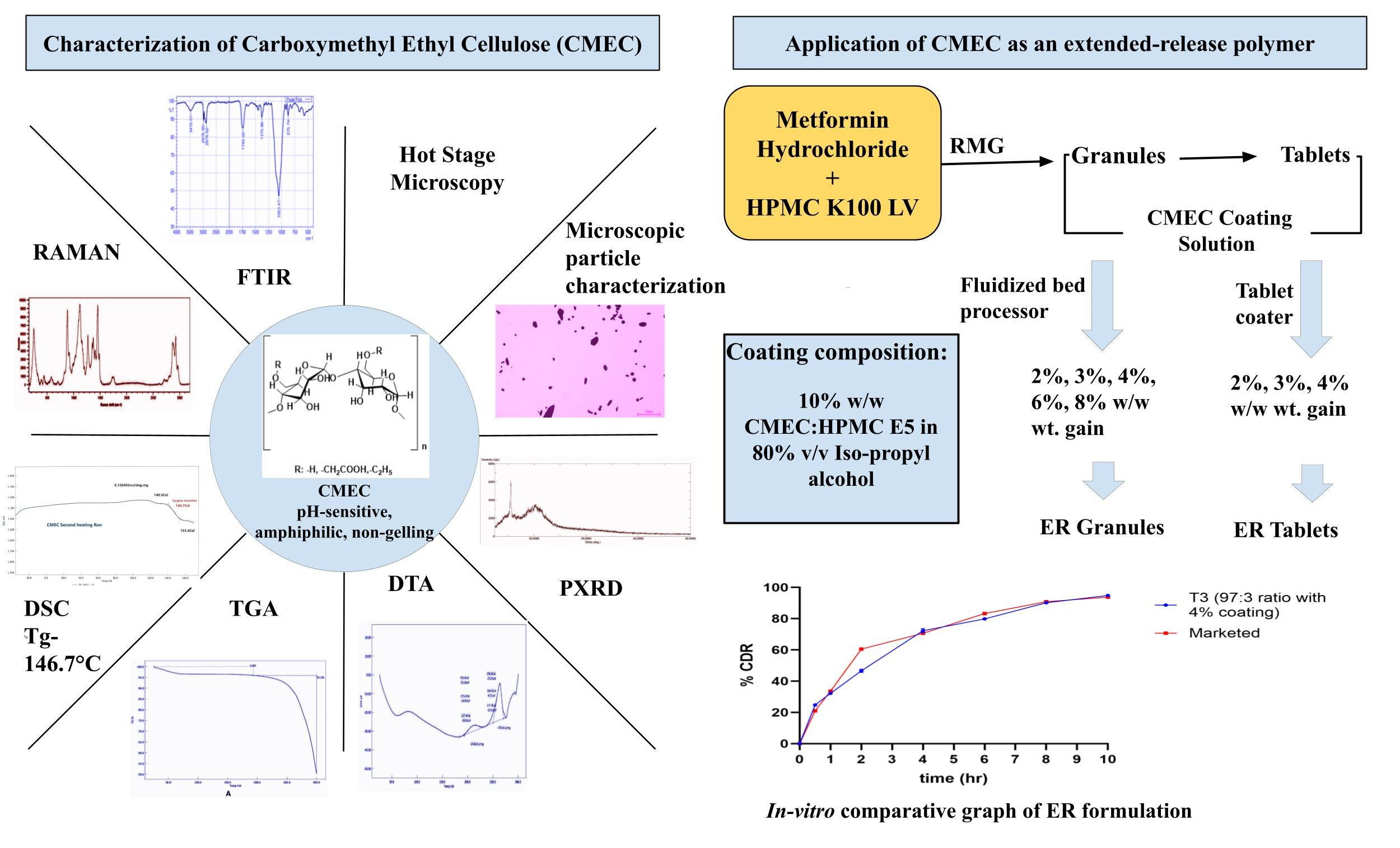
Carboxymethyl ethyl cellulose (CMEC), a pH-sensitive polymer listed in Japanese Pharmaceutical Excipients (JPE), 2013, has seldom been characterized and explored for drug delivery. The current work aimed at characterizing the polymer using spectroscopy, thermal techniques, and microscopy. To study the drug-release-retarding ability of CMEC, metformin hydrochloride (Met) tablets were prepared by wet granulation using hydroxy propyl methyl cellulose (HPMC) K100LV. The tablets were subjected to coating using coating solution comprising combinations of CMEC and HPMC E5 in various % ratios (93:7, 95:5, and 97:3). The coated tablets were subjected to in vitro drug release studies. Raman and FTIR spectra confirmed the presence of ethyl and carboxy groups on the polymer. PXRD and DSC studies confirmed the amorphous nature of CMEC. The microscopy studies revealed almost circular, solid, and smooth morphology of the polymer particles with D10, D50, and D90 of 31, 55, and 134 µ. The release profile of tablets coated with CMEC: HPMC E5 (97:3 ratio) up to 4% weight gain complied with the USP specifications for Met extended-release tablets and exhibited similarity to the marketed Met formulation. The work demonstrated the suitability of CMEC as a barrier film coating polymer and confirmed its release-retarding potential for a water-soluble, high-dose drug like Met, when used in combination with another release retardant like HPMC K100LV.

Graphical Abstract

1. Introduction

Polymers are materials with highly diverse applications in various fields and mainly used in the pharmaceutical industry [1]. There is an increase in demand for the invention of newer polymers that would offer higher stability, mechanical strength, and lower environmental impact [2]. Polymers of natural, semisynthetic and synthetic origin are used extensively in the pharmaceutical field. Polymer as a packaging material is perhaps the most appreciable application of polymers that ensures convenience of storage, shipment, and most importantly stability of the formulations throughout the shelf life. In liquid dosage forms, polymers may be used as suspending, emulsifying, stabilizing, or flocculating agents [3]. The role of polymers as gelling agents and viscosity builders is extremely crucial in the preparation of semisolid dosages. Solid dosage forms such as tablets incorporate polymers as matrix-forming, granulating, and coating agents [4]. Similarly, polymers play a key role in advanced drug delivery systems aiding in achieving spatial and/or temporal control over drug release. For the design of extended and controlled drug delivery systems, the presence of a drug-release-controlling polymer or a polymer combination is essential [5]. CMEC is one such semisynthetic polymer that possesses modified release functionality. It is prepared by partial carboxymethylation of cellulose followed by partial ethylation. CMEC (Freund Corporation, Tokyo, Japan) complies with the specifications for carboxymethyl ethyl cellulose, Japanese Pharmaceutical Excipients (JPE), 2013. CMEC is insoluble in water but soluble in 70–90% aqueous ethanol or isopropanol. The chemical structure of CMEC is built up by an ether linkage, which is difficult to hydrolyze, thus allowing it to be chemically stable. It has been reported to have excellent film-forming properties [6]. The anionic nature confers pH-dependent water solubility to the polymer [7]. CMEC is slower to disintegrate in a lower pH (<5) but faster in a higher pH (>6), hence, the disintegration behavior of tablets coated with CMEC depends on the pH regardless of the buffer solution [8]. This particular property offers enteric and delayed-release potential to the polymer when used in concentrations of up to 10% [6]. Owing to its pH-sensitive behavior, CMEC is also amenable to being used as a carrier for the preparation of amorphous solid dispersions of hydrophobic drugs [9]. The polymer has been shown to prevent the precipitation of hydrophobic drugs in intestinal pH, thereby enhancing absorption and bioavailability of these drugs. CMEC at higher concentrations ranging from 10–30% exhibits extended-release (ER) behavior. Overall water-insoluble and non-swellable nature has been thought to be responsible for the release-rate-retarding ability of the polymer [9].
Despite having applications, CMEC has been rarely explored in the field of drug delivery. There is also a dearth of information on the physicochemical and thermal behavior of the polymer. Detailed characterization therefore would help in better understanding of the polymer and in selecting the process parameters [10,11]. Hence, the current work aimed to characterize CMEC employing spectroscopic, thermal, and microscopic techniques. The further goal was to study the extended-release behavior of the polymer by designing a suitable oral solid dosage form.

2. Materials

CMEC (molecular weight—49,000 g/Mol, carboxymethyl group—8.9 to 14.9%, ethoxy group—3.5 to 43.0%) was generously donated by Arihant Innochem Pvt Ltd., Mumbai, India. Metformin hydrochloride (Met) was procured from Granules India Pvt Ltd., Hyderabad, India, Methocel E5 (molecular weight—~1261 g/Mol, degree of substitution—1.8, Molar substitution—0.23) and Methocel K100 LV (molecular weight—~120,000 g/Mol, degree of substitution—1.4, molar substitution—0.21) were obtained from Colorcon Asia Pvt Ltd., Mumbai, India. Lactose M 80 was purchased from New Arihant Chemicals Pvt Ltd., Mumbai, India. Magnesium stearate and colloidal silicon dioxide were purchased from Sheen International Pvt Ltd., Mumbai, India, and Astrra Chemicals Pvt Ltd., Chennai, India respectively. The rest of the analytical reagent-grade chemicals were purchased from Analab Finechem, Mumbai, India.

3. Methods

3.1. Polymer Characterization

CMEC was subjected to characterization studies using various techniques described below.

3.1.1. Fourier-Transform Infrared Spectroscopy (FTIR Analysis) and Raman Spectroscopy

An FTIR instrument equipped with an attenuated total reflectance (ATR) instrument (Bruker, Alpha II, Opus Software, Billerica, MA, USA) was employed to perform FTIR analysis of the CMEC powder sample. The wavelength range of 400–4000 cm−1 was used for the spectral analysis of the polymer sample [12].

3.1.2. Raman Spectroscopy

The CMEC sample was subjected to Raman spectral analysis using a Raman microscope fitted with a 50× objective (Lyka, Rustington, UK) and a laser source operating at 785 nm. A few particles of the CMEC sample were placed on an aluminum platform. The point measurement of the spectrum was carried out using the Synchroscan technique. With a spectral resolution of 0.8 cm−1/step, the sample’s Raman spectrum was captured between 100 and 3000 cm−1. The spectrum was analyzed using WiRE software (Version 5.6, Renishaw, Wotton-under-Edge, UK). Polynomial baseline subtraction of an order of 4 was applied during the analysis [13].

3.1.3. Differential Scanning Calorimetry (DSC) Analysis

The thermal behavior of CMEC was studied using DSC analysis (Nexta DSC 200 equipped with an electrical cooling unit, Hitachi, Tokyo, Japan). The sample was initially heated to 120 °C at the rate of 10 °C/min. After exposing the sample to 100 °C for 5 min, it was cooled to −20 °C and again heated to 170 °C. Nitrogen gas was purged over the samples at a flow rate of 40 mL/min to maintain the inert environment while the cooling/heating rate was kept at 10 °C/min [13].

3.1.4. Thermal Gravimetric Analysis (TGA) and Differential Thermal Analysis (DTA)

The TGA and DTA were carried out using a 10 mg sample of CMEC powder (Discovery TGA 5500, TA Instruments—Waters LLC; Milford, MA, USA). The sample was heated from 30 to 300 °C at a rate of 10 °C per minute in an open platinum pan. Throughout the examination, nitrogen gas was purged over the sample at a flow rate of 25 mL/min [14].

3.1.5. PXRD Studies

A Rigaku Miniflex 600 X-ray diffractometer (Philips, Amsterdam, The Netherlands) was used to record the PXRD pattern of CMEC. A monochromatic Cu-Kα radiation was generated at 40 kV and 15 mA and the diffraction pattern was recorded over an angular range of 20 to 80°. A recording chart speed of 10 mm/s was chosen [15,16].

3.1.6. Microscopy

Particle characterization of CMEC powder was performed using a microscopic image analysis technique (CH 20i, Olympus, Center Valley, PA, USA equipped with IPV high-resolution, 5MP camera). About 2 mg of polymer sample was dispersed into 2 drops of purified water. The glass slide holding the uniform smear of the dispersion was then focused under the 40× magnification lens of the microscope. A minimum of 20 fields, totally ~1000 particles, were captured in triplicate using the camera. The images were processed using ClAIrity® software, Version 1.0 (Image ProVision Technology, Pune, India) to characterize the particle size and size distribution. Morphological aspects of the polymer particles, including surface area, circular equivalent diameter (CED), circularity, length, width, and aspect ratio, were also analyzed [17].

3.1.7. Hot Stage Microscopy

The dry powder of the CMEC sample was evenly dispersed on a clean microscope slide. The prepared slide was placed in the hot stage plate designed for thermal analysis. The stage temperature was elevated at the rate of 25 °C/min from 32 to 200 °C. A further increase in the temperature was conducted at the rate of 10 °C/min and heating was stopped when the stage temperature reached 350 °C. Images of the sample were captured using ipvPHot software (Image ProVision Technology, Pune, India) from 45 fields under 10× magnification [18].

4. Application of CMEC as an Extended-Release Polymer

4.1. Drug–Excipient Compatibility Study

To explore the extended-release (ER) potential of CMEC, we planned to coat granules and tablets of Met (a model drug) with CMEC. To study drug–excipient compatibility, Met was individually mixed with CMEC, HPMC E5, and HPMC K100LV in a 1:1 ratio. The mixtures were subjected to FTIR and DSC studies as described in Section 3.1.1 and Section 3.1.2 respectively [12,19].

4.2. Preparation of Met Granules

Granules were prepared using a rapid mixer granulator (Quest HSM II, ACG Pam Pharma Technologies, Mumbai, India). Met, lactose, and HPMC K100LV were sieved through a 40# sieve and loaded into a rapid mixer granulator (RMG) (Table 1). After mixing for 10 min, the blend was granulated with purified water. The impeller motor speed was maintained at 350/min and the chopper speed was 2000/min. The wet granules were initially partially dried using a fluid-bed dryer for 10 min at 35–40 °C (GPCG 1.1, ACG, Mumbai, India). After passing through a 16-mesh screen, the semidried granules were further dried in a fluid bed drier until their moisture content fell to 2–3% w/w. After that, a 20-mesh screen was used to filter the dried granules [20,21,22].

4.3. Extended-Release Coating of Granules

Met granules were subjected to coating using the compositions given in Table 2. Met granules (200 g) were loaded into a fluidized bed processor (Mini Quest F, ACG Pam Pharma Technologies, Mumbai, India). Granules were fluidized and coated with a 10% w/w polymeric solution of CMEC/HPMC E5 (97:3, 95:5, 93:7 ratios) in 80% v/v isopropyl alcohol using a top spray arrangement. For each polymer ratio, 5 lots of coated granules having coating levels of 2%, 3%, 4%, 6%, and 8% w/w were obtained [23] (Table 2). The coating conditions were as follows: inlet temperature 45 °C, product temperature 30–35 °C, outlet temperature 30–34 °C, air flow rate 100 CFM, nozzle diameter 0.5 mm, spray pressure 1.5 bar, spray rate 0.85 g/min. After coating, the granules were further fluidized at 40 °C for 10 min to reduce the residual solvents before being collected in a tray [24,25].

4.4. Characterization of ER Granules

The granules of all 15 lots were subjected to micrometric evaluation.

4.4.1. Bulk Density

About 10 g of granules was poured gently into a measuring cylinder and the volume occupied by the granules was noted to determine bulk density [26,27,28]. Bulk density was calculated using Equation (1).
B u l k   d e n s i t y   ( g / m L ) = W e i g h t   o f   g r a n u l e s   ( g ) V o l u m e   ( m L )

4.4.2. Tapped Density

About 10 g of granules was poured into a measuring cylinder. The cylinder was placed in tap density apparatus (TD 1025, Lab-India, Thane, India) and subjected to tapping until a constant volume was obtained [26,27,28]. Equation (2) was used to calculate the tapped density and record the volume occupied by the sample following tapping.
T a p p e d   d e n s i t y   ( g / m L ) = W e i g h t   o f   g r a n u l e s   ( g ) T a p p e d   v o l u m e   ( m L )

4.4.3. Carr’s Index

It was determined by Equation (3).
C a r r s   i n d e x % = T a p p e d   d e n s i t y B u l k   d e n s i t y T a p p e d   d e n s i t y × 100

4.4.4. Hausner’s Ratio

Hausner’s ratio was calculated using Equation (4).
H a u s n e r s   R a t i o = T a p p e d   D e n s i t y B u l k   d e n s i t y

4.4.5. Assay

The granules were powdered with a mortar and pestle. Powder equivalent to 10 mg Met (16.12 mg) was accurately weighed and dissolved in about 20 mL of purified water with the help of sonication. The volume was then made up to 100 mL with distilled water in a volumetric flask to obtain 100 µg/mL stock solution. From the 1st stock solution, an aliquot of 5 mL was diluted up to 50 mL with distilled water to obtain a solution with a theoretical concentration of 10 µg/mL. A UV–visible spectrophotometer was used to measure the absorbance of the solutions at λmax of 232 nm [28]. Equation (5) was used to compute the drug’s percentage content.
D r u g   c o n t e n t = A c t u a l   d r u g   c o n t e n t T h e o r e t i c a l   d r u g   c o n t e n t × 100

4.4.6. In Vitro Drug Release Studies

Drug release studies were conducted as per the USP monograph [29] using a USP Type 2 dissolution test apparatus (model TDT 06L, Electrolab, Mumbai, India). The granules (500 mg of Met) were added to 1000 mL of pH 6.8 phosphate buffer that was kept at 37 ± 0.5 °C. Throughout the experiment, the material was agitated at 100 RPM. At 0.5, 1, 2, 4, 6, 8, and 10 h, 5 mL aliquots were removed and replaced with an equivalent volume of fresh medium. Aliquots, after filtration through Whatman filter paper and appropriate dilutions, were subjected to UV spectroscopic evaluation at 232 nm [30].

5. Preparation, Coating, and Characterization of Met Tablets

5.1. Preparation and Characterization of Uncoated Tablets

Core Met tablets were formulated by using the Met granules prepared as per the method described in Section 4.2. The granules were mixed thoroughly with the specified amounts of magnesium stearate and colloidal silicon dioxide (Table 1). Tablet compression was carried out using a tablet compression machine (PROTAB™ 300, ACG Pam Pharma Technologies, Mumbai, India) with 15 mm × 5 mm capsule-shaped (D-tooling) punches [31,32].

5.2. Characterization of Uncoated Tablets

The hardness of the tablets was tested by a Monsanto hardness tester (Model VMT-1, Roanoke, VA, USA). The thickness of the tablets was measured using a vernier caliper (Mitutoyo, Kawasaki-shi, Japan) [33]. The weight variation test was performed employing a weighing balance (ML304T/A00, Mettler Toledo, Columbus, OH, USA) using the following formula (Equation (6)).
W e i g h t   v a r i a t i o n = A v e r a g e   w t . i n d i v i d u a l   w t . A v e r a g e   w e i g h t × 100
The tablets were subjected to assay and in vitro drug release studies using the same procedure as described in Section 4.4.5 and Section 4.4.6.

5.3. Preparation of Met ER Tablets

The core tablets of Met were coated using the coating compositions mentioned [33] in Table 3. The tablet coating process was performed in a tablet coater (Quest TC, ACG, Mumbai, India) with an inlet temperature of 46 °C, product temperature maintained at 45 °C, outlet temperature of 40 °C, air flow rate of 52 CFM, nozzle diameter of 0.5 mm, spray pressure of 1 bar, pan speed of 4 RPM, and spray pump speed of 2 RPM. Following the coating operation, the coated tablets were subjected to further drying at a temperature of 40 °C for 10 min. This additional drying process ensured the removal of any residual moisture and promoted the formation of a robust and uniform coating layer on the core tablets [34].

5.4. Characterization of Met ER Tablets

Nine batches of ER tablets were evaluated for weight variation, hardness, and thickness. The tablets were subjected to assay and in vitro drug release studies using a similar procedure as mentioned for the coated granules (Section 4.4.5 and Section 4.4.6). To comprehend the mechanism of drug release from formulation T3, the drug release profile was fitted to first order, zero order, Higuchi, and Peppas kinetics models [35,36]. The drug release profile of formulation T3 was compared with that of marketed Met ER tablets (Okamet SR 500, Cipla, Mumbai, India). Equation (7) was used to get the similarity factor [37].
f 2 = 50 × l o g 1 + 1 n t = 1 n ( R t T t ) 2 0.5 × 100

5.5. In Vitro Drug Release Study of ER Tablets Using USP Type 3 Dissolution Apparatus

The studies were performed using a USP Type 3 dissolution apparatus (reciprocating cylinder model). The test procedure involved subjecting the tablets of formulation T3 to a drug release study using a sequence of media starting with 0.1 N hydrochloric acid for 2 h, followed by pH 4.5 acetate buffer for 1 h, then pH 5.8 phosphate buffer for 3 h, and finally, pH 6.8 phosphate buffer for 6 h. All the media were maintained at 37 °C in a total volume of 250 mL. Throughout the study, the reciprocating cylinder containing the tablets was operated at 30 cycles per minute, transitioning successively from one medium to another. Aliquots of 5 mL were taken at hourly intervals and filtered through Whatman filter paper. The filtrates were diluted appropriately and analyzed using a UV–visible spectrophotometer (Shimadzu UV-2450, Kyoto, Japan) [38].

5.6. Scanning Electron Microscopy (SEM) Studies

The transverse section and the surface of the tablets of formula T3 were subjected to SEM studies. Tablets of formulations T3 and T9 were soaked in 0.1 N HCl for 4 h and 10 h, followed by air drying. The surface of these tablets was examined using SEM to characterize their morphological attributes and the pore formation pattern of the coat. The study was performed using Quanta 200 SEM model (FEI, Eindhoven, The Netherlands), featuring a tungsten filament, in conjunction with the xT microscope software. For sample preparation, the solid specimens were securely affixed onto a stage through the application of carbon tape. The ensuing analysis transpired within a magnification spectrum spanning from 30× to 100,000×, leveraging a superior resolution capability of 3.5 nm, and was executed under an operating voltage of 30 kV [38].

6. Results

6.1. Characterization of the Polymer

6.1.1. FTIR and Raman Spectroscopy

CMEC powder was subjected to FTIR and Raman spectroscopic studies to characterize and confirm the functional groups and bonds present in the molecular structure of the polymer (Figure 1A). The distinct peak observed at 3470 cm−1 confirmed the presence of OH groups whereas the peaks at 2976 cm−1 and 2876 cm−1 indicated the stretching vibrations of the C-H, CH2 alicyclic groups of glucose rings present in CMEC [39,40] (Figure 1B). The broad band at 1740 cm−1 was attributed to the carbonyl group of carboxymethyl substitution. The C-OH stretching vibration was confirmed by the peak at 1376 cm−1. In the Raman spectrum (Figure 1C), the wavenumbers 1425 cm−1 and 1482 cm−1 indicated methylene bending vibrations whereas wave numbers 1330 cm−1 and 1265 cm−1 respectively demonstrated wagging and twisting vibrations of methylene groups. The peaks at 1161 and 1105 cm−1 indicated C1-O-C4 stretching vibrations of the cellulose backbone in the polymer. Glycosidic stretching vibration was observed at 1095 cm−1. The peak at 839 cm−1 indicated C-C stretching while the peak at 710 cm−1 confirmed methylene group rocking vibration. The peaks in the range of 100 to 500 cm−1 indicated C-C-C, C-O, and C-C-O ring deformation. The overall broad peaks in the fingerprint region indicated the absence of a crystalline lattice structure of the polymer, thus confirming its amorphous nature [40,41,42].

6.1.2. DSC Studies

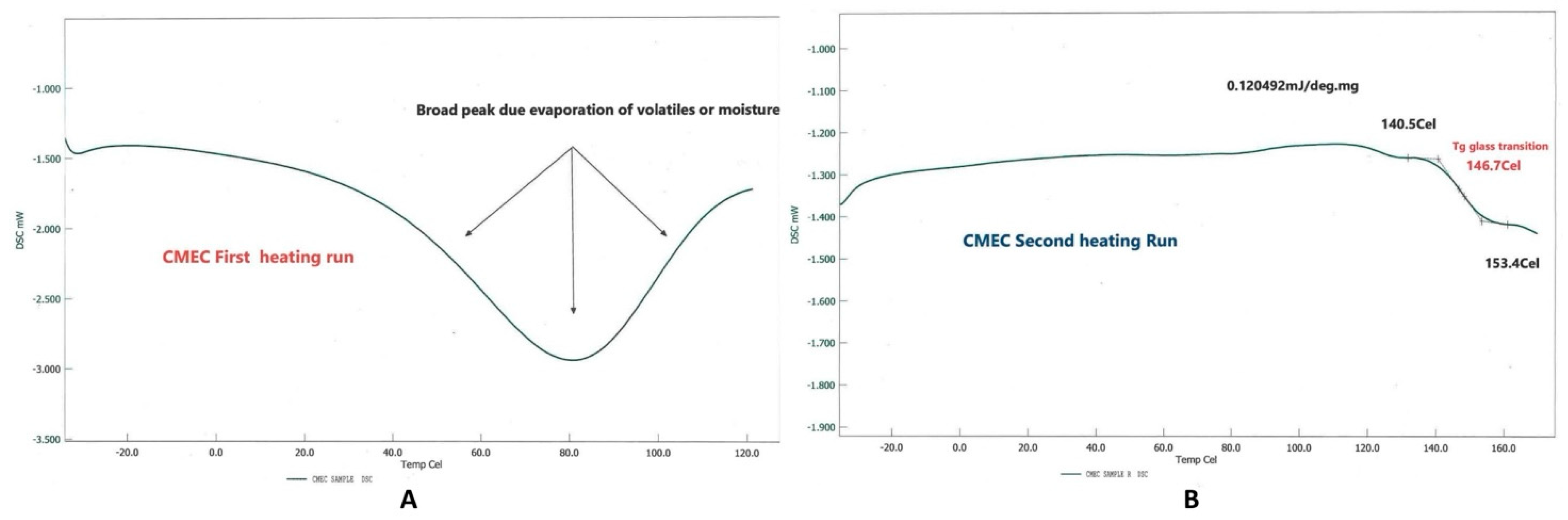
During DSC studies, the CMEC powder sample was cooled to −40 °C and then heated to 120 °C (Figure 2A). This helped in removal of the sorbed moisture and/or volatiles from the sample. A subsequent cooling–heating cycle of the sample in the range of −40 °C to 170 °C exhibited a broad endothermic event between ~140.5 and 153.4 °C, indicating the transition of CMEC from a glassy state to a rubbery state. DSC spectra of CMEC are shown in Figure 2. The glass transition temperature (Tg) was recorded as 146.7 °C (Figure 2B) which was in close agreement with the Tg reported by [43]. This could be attributed to either the glass transition temperature of the polymer or to the loss of bound moisture which was probably not completely evaporated during the exposure of the sample at 100 °C for 5 min. The absence of any sharp endotherm in the thermogram indicated the amorphous nature of the polymer [44].

6.1.3. TGA and DTA Studies

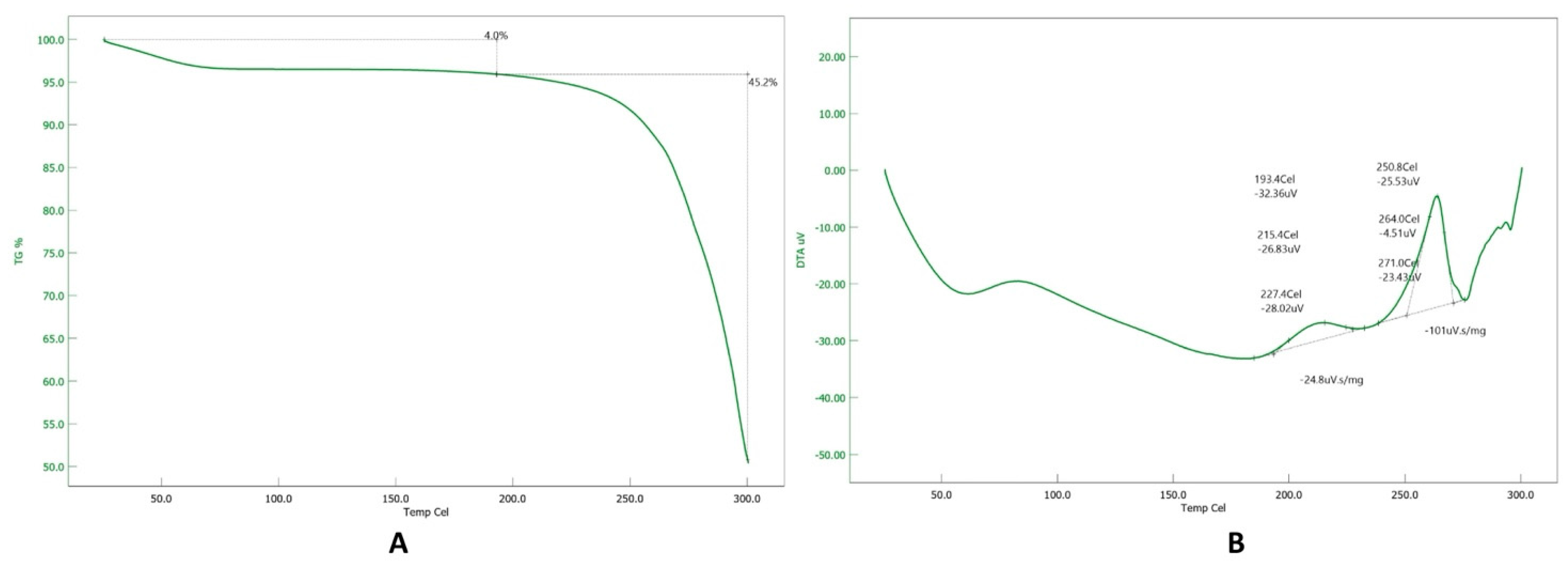
The scan demonstrated 4% weight loss in the temperature range of 30 to 100 °C (Figure 3A). This could be due to the loss of volatile components including sorbed water. A mass loss event with an onset of ~190 °C suggested polymer degradation with a total weight loss of ~ 45% at 300 °C. The DTA scan correlates well with that of TGA. The broad endotherm from 50 to 75 °C could be attributed to the loss of sorbed water and volatile impurities in the polymer (Figure 3B). The exothermic events in the ranges of 200 °C to 230 °C and 250 to 270 °C suggest two discrete polymer degradation steps and correlate with the weight loss seen in TGA [45].

6.1.4. PXRD Studies

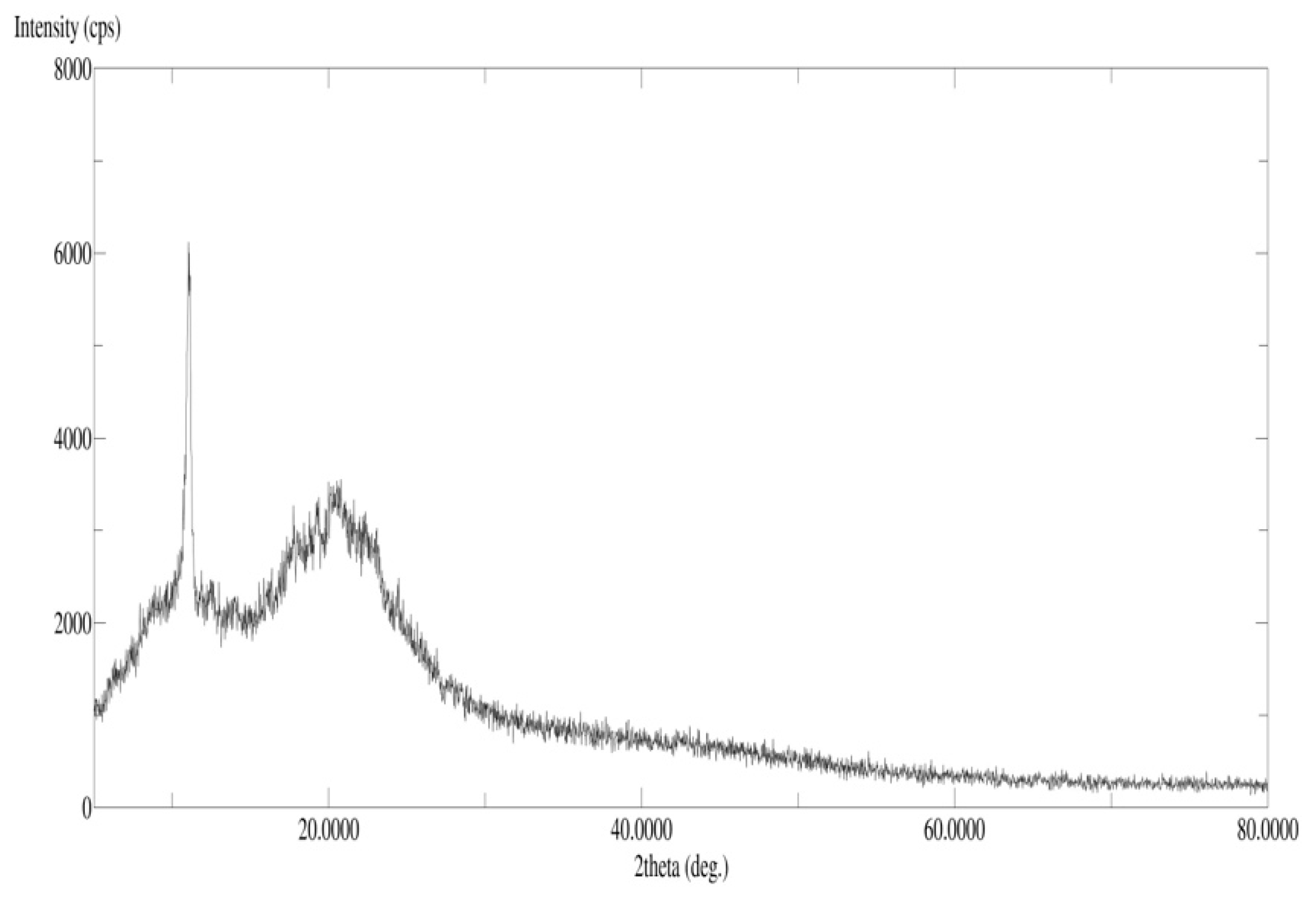
The XRD scan (Figure 4) of the polymer demonstrated the absence of sharp peaks of high intensity except the one at 11° 2θ. A single peak in an otherwise diffuse pattern may suggest some ordered regions in the polymer material in a largely disordered solid phase [46]. The crystallinity index of 32.9 calculated using the Sagel method indicated the predominantly amorphous nature of the polymer [47,48]. The low level of crystallinity based on PXRD data could be corroborated with the DSC scan of the polymer wherein the absence of any sharp endotherm indicated a lack of crystallinity in the polymer.

6.1.5. Microscopy Studies

The particle size and morphological characteristics of CMEC were evaluated using microscopic image analysis. D10, D50, and D90 of the CMEC sample were about 31, 55, and 134 µ (Table 4). The circularity and convexity measured by the ClAIrity software were close to 100%, indicating a nearly circular and uniform shape of the particles. The solidity of the particles was found to be close to 100%, implying the compact and solid nature of the particles with few or no indentations or holes (Supplementary Figure S1). The texture value of the particles was found to be 18.66. A lower value indicates a smoother texture of the polymer particles without any serrations or surface imperfections [49].

6.1.6. Hot-Stage Microscopy Studies

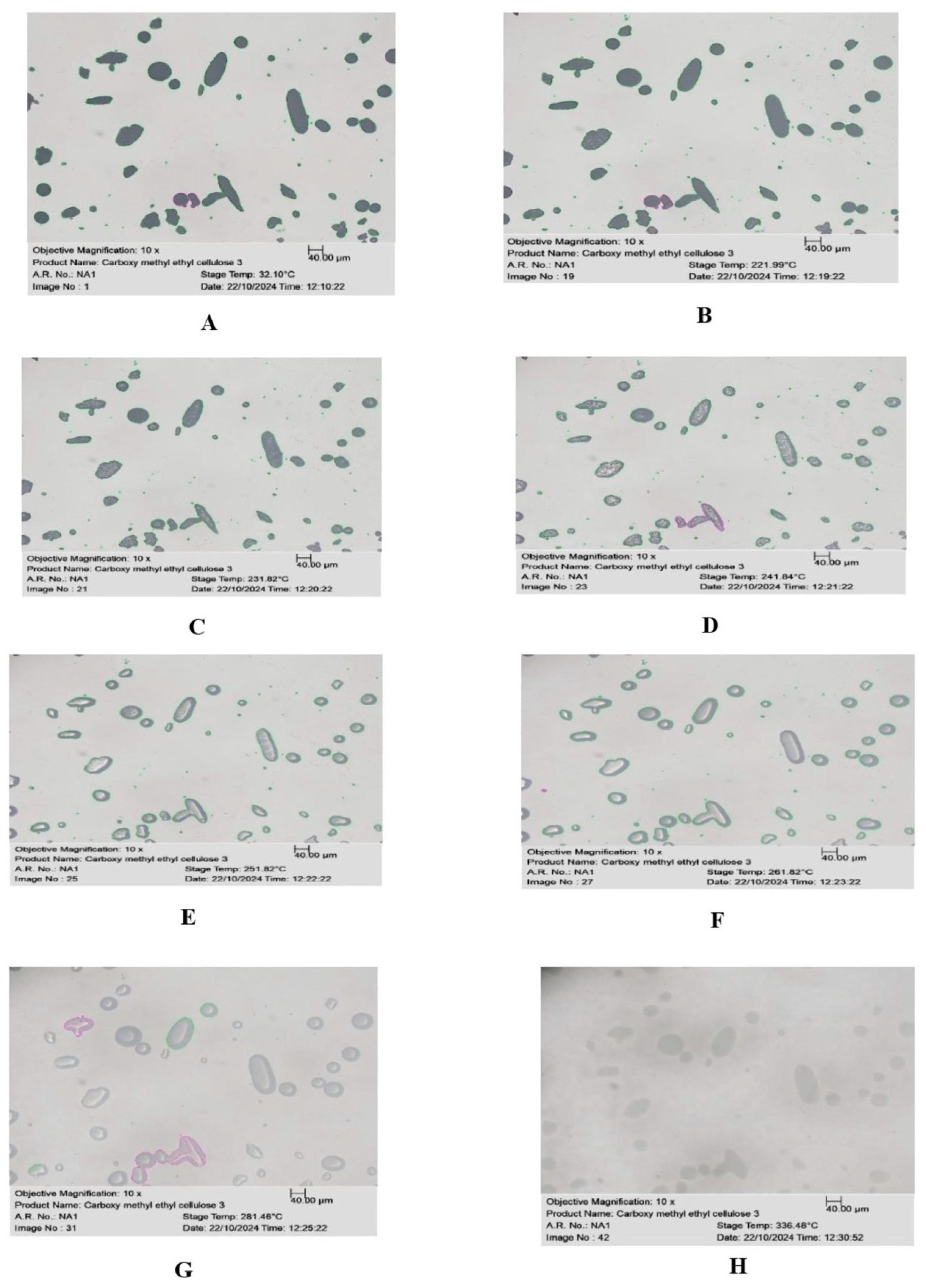
Figure 5 presents the hot-stage microscopy images of CMEC captured at various temperatures. Figure 5A,B taken at 32 and 150 °C do not show any distinct difference in the particle morphology. These images corroborate well with the microscopic image analysis carried out at room temperature. However, image C (Figure 5C) captured at 230 °C shows changes in the appearance of the particles which could be correlated to the commencement of degradation of the CMEC sample which is further progressed at 241, 251, and 261 °C as seen in Figure 5D–F. Above 280 °C, the polymer sample shows complete degradation with foggy images (Figure 5G,H) [50].

7. Application of CMEC as an Extended-Release Polymer

7.1. Drug–Polymer Compatibility Studies

The FTIR spectrum of Met exhibited N-H stretching vibrations within the range of 3550–3250 cm−1 [51]. Additionally, asymmetric N-H deformation bands were observed at 2974 and 2874 cm−1. The C-N stretching vibrations appeared as weak- to medium-intensity bands at frequencies of 1159, 1118, and 1058 cm−1. The NH wagging vibration was noted at 733 cm−1. A distinctive peak corresponding to hydrochloride was evident at 622 cm −1.
In the FTIR spectrum of CMEC, peaks were observed at 1354 cm −1 and 2970 cm −1. The broad band at 1747 cm−1 was attributed to the C-O of the carbonyl group, and the peak at 2950 cm−1 indicated the stretching vibration of the C-H alicyclic group present in solid CMEC. The IR spectrum of a physical mixture containing Met and HPMC K100LV displayed notable peaks corresponding to O-H, C-O-C, and N-H groups at frequencies of 3305 cm−1, 1050 cm−1, and 3495 cm−1, respectively. Additionally, a peak at 625 cm−1 confirmed the presence of the hydrochloride group of Met. The detection of C=O in the cellulose backbone and C-O-C in the ether linkage further substantiates the presence of HPMC E5 in the physical mixture of Met and HPMC E5. The drug peaks without any significant shifts, alongside the characteristic peaks of the polymer, suggested compatibility between the drug and the polymer.
Met exhibited a sharp melting endotherm at around 233.6 (Figure S2), indicating its crystalline nature and purity. CMEC exhibited a broad and shallow endothermic peak at around 39.8 °C, which corresponds to the loss of moisture and volatiles. A physical mixture of several excipients and Met showed a strong melting endotherm at 233.6 °C in the DSC thermograms. This observation strongly suggests compatibility between the drug and the chosen excipients. Based on FTIR and DSC, we suggest that there is an absence of significant physico-chemical interactions and association between the drug and polymer. However, additional studies including solid state NMR and accelerated stability studies will be warranted to better understand the compatibility behavior among drug and excipients.

7.2. Preparation, Coating, and Characterization of ER Granules

7.2.1. Preparation of Granules

High-shear mixers make the granulation process faster and more efficient, ensuring better distribution of the liquid binder [20,21]. HSM creates dense and uniform granules [23,52]. The porosity of granules is reduced by employing a high impeller speed in HSM [52,53]. Hence, Met granules were prepared using HSM. The mixing time and impeller speed were optimized by performing a few trial runs.

7.2.2. Flow Properties of Uncoated Granules

The Met granules were subjected to evaluation of flow properties. Bulk density was found to be 0.47 g/mL while tapped density was 0.60 g/mL. Carr’s index of 21.50% and Hausner’s ratio of 1.27 indicated passable flow characteristics, whereas an angle of repose of 32° indicated good flow properties for the granules [54].

7.2.3. Coating of Granules

CMEC, a non-gelling, pH-sensitive release retardant, was used in combination with HPMC E5, a hydrophilic water-soluble polymer. In this combination, the role of HPMC E5 was of a pore former that would allow the ingress of the medium into the granules to dissolve the drug and allow its release [55]. In the present study, different concentrations of pore former (HPMC E5) were used, i.e., 3%, 5%, and 7%, to understand the influence of pore-forming coating composition on the drug release from the formulation. The coating solutions comprising CMEC concentrations of 5, 7.5, 10, 15, and 20% were prepared. However, the 20% and 15% solutions were more viscous and hence led to difficulty during the coating operation, while the 5 and 7.5% solutions were thin and resulted in agglomeration of the granules due to excessive wetting. The 10% solution showed a good spray pattern during the coating process. The coating process parameters like inlet and outlet temperature and spray rate were further optimized using trial runs. The prepared granules were coated at 2%, 3%, 4%, 6% and 8% weight gain levels. The assay of the ER granules of all the trial formulations was performed in triplicate. All the values complied with the stipulated USP range of 95–105%.

7.2.4. In Vitro Drug Release of Coated Granules

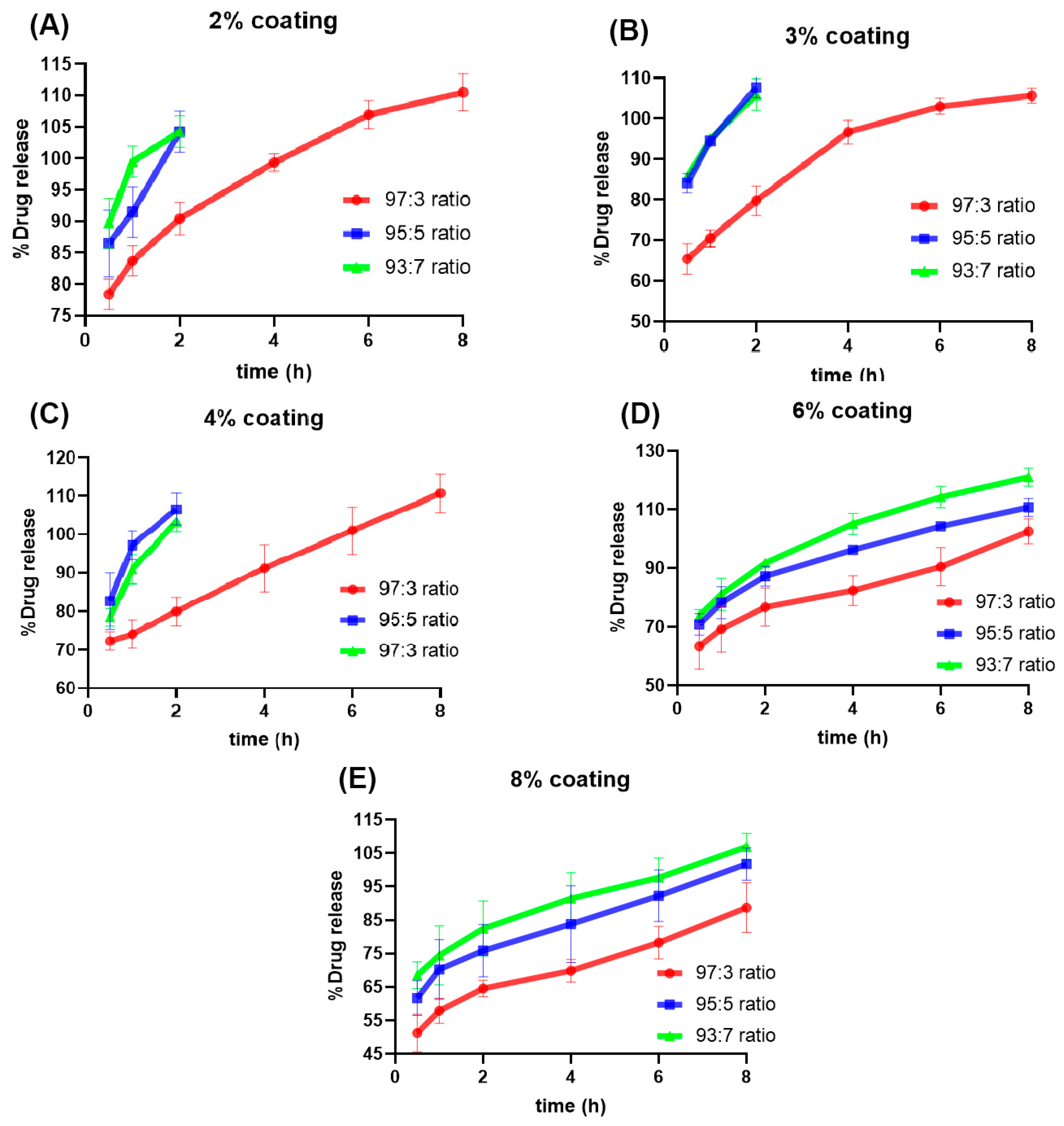
As depicted in Figure 6A–E, an increase in the coating level led to a corresponding decrease in the rate of drug release from the formulation. An increase in the coating level increased the deposition of CMEC film on the granule surface which led to retardation in the drug release. The role of pore former concentration on drug release was studied by varying the proportion of HPMC E5 in the coating solution. HPMC E5 is a low-viscosity, water-soluble polymer that is often used as a pore former in combination with hydrophobic release retardants in extended-release formulations [24]. Notably, formulations containing a higher percentage of the pore former, specifically 7%, exhibited a significantly faster drug release in comparison to formulations having 3% and 5% pore former content. With this composition, even at a 8% coating level (G5), more than 85% drug release was observed at 4 h whereas lower coating levels resulted in complete drug release within 2 h. When the HPMC E5 concentration was reduced to 5% in the case of granules of batches G6 to G10, formulation G10 with an 8% coating level exhibited more than 85% release in 6 h. To achieve an effective coating of CMEC on the surface of the formulation, the pore former concentration was further reduced to 3%, resulting in formulation G15 with an 8% coating level, which demonstrated 88 ± 6% drug release over 8 h. Though formulation G15 retarded drug release significantly compared to the rest of the formulations, the USP specifications for Met ER formulations (1 h—20–40% release, 3 h—45–65% release, and 10 h—NLT 85% release) were not met by any of these 15 formulations. Coating the granules further with CMEC solution to achieve higher coating levels was not feasible due to the generation of fines and difficulty in fluid bed processing using the top spray method. Hence the work on coated granules was discontinued.

8. Preparation, Coating and Characterization of ER Tablets of Met

8.1. Preparation and Characterization of Uncoated Tablets

The core tablets of Met granules compressed using capsule-shaped punches exhibited a white, smooth, and shiny appearance. The weight variation of the tablets was within the ±5% range and hence complied with the pharmacopeial specifications [56]. The average thickness and hardness of tablets were 6.35 ± 0.1 mm and 13.1 ± 0.9 kg/cm2 respectively. The assay of the tablets gave a result of 101.13 ± 1.51%. The tablets exhibited complete drug release in 2 h. The incorporation of 25% HPMC K100LV in the tablets prevented faster release of the water-soluble Met.

8.2. Coating of Tablets

The tablets were divided into three lots. Each lot was coated with coating solutions containing CMEC:HPMC E5 in 97:3, 95:5, and 93:7 ratios. The tablets were coated up to 2, 3, and 4% weight gain to understand the effect of coating level on the drug release. The thickness of the coating indicates coat density. Thicker coats at lower spray rates are less dense due to rapid drying, trapping more air and creating dull coats. Higher spray rates with wetter conditions lead to better spreading droplets and denser, glossier coats [57]. During the coating of tablets, the spray rate was maintained at 2 g/min which helped in obtaining a uniform coating of the tablets.

8.3. Characterization of ER Tablets

The weight variation of the tablets was within the ±5% range and hence complied with the pharmacopeial specifications [58]. The average thickness and hardness of tablets were found to be 6.37 ± 0.1 mm and 14.1 ± 1.1 kg/cm2 respectively. The assay of the ER tablets was performed in triplicate, and the result was 102.03 ± 1.2%.

8.4. In Vitro Drug Release ER Tablets

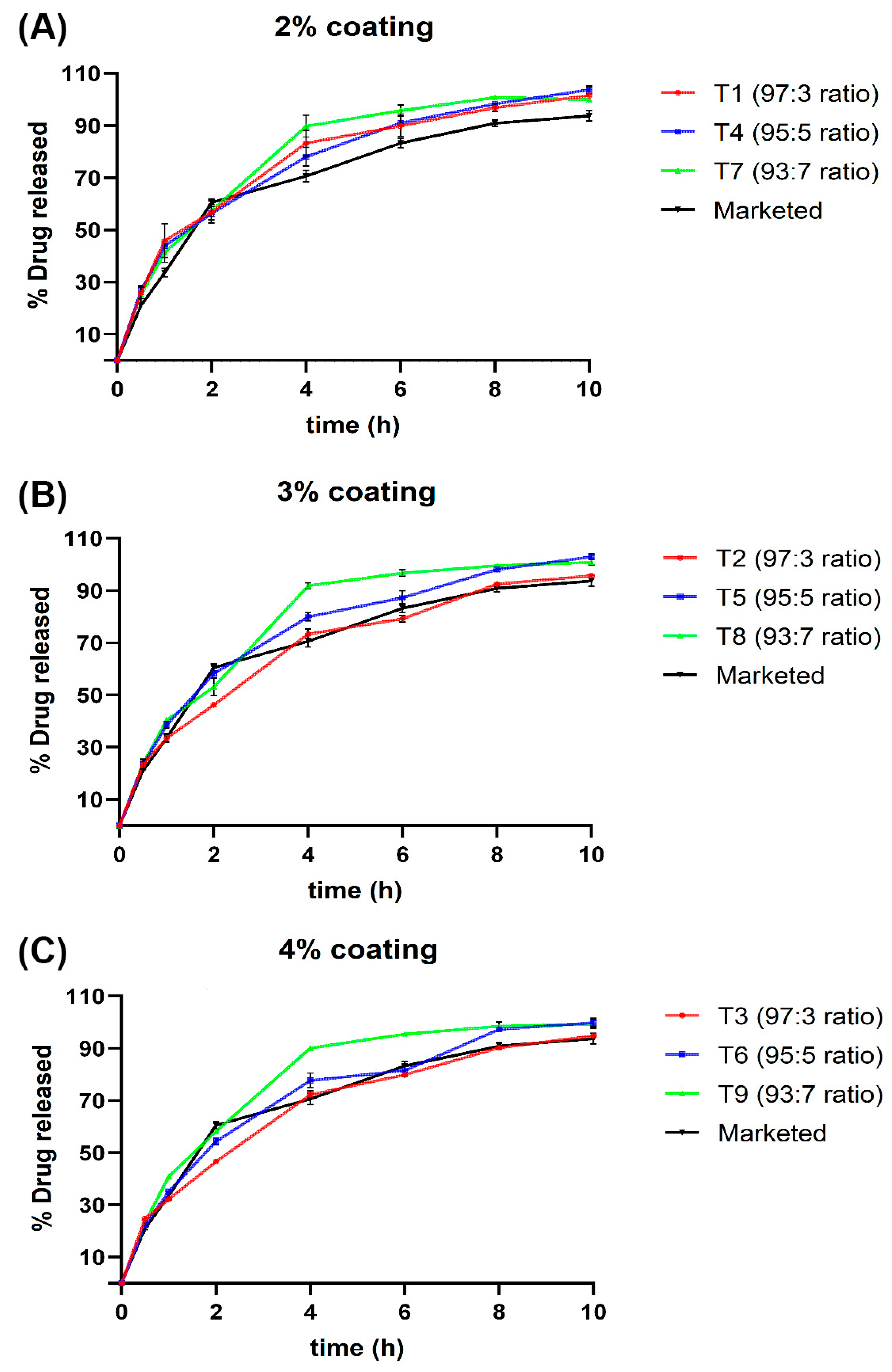
These studies revealed the influence of coating, coating composition and coating level on the drug release kinetics. HPMC K100LV, a granulating agent used in the tablets, could retard the release of Met, a highly soluble drug, for up to 2 h. The tablets, when coated with various combinations of CMEC (release retardant) and HPMC E5 (pore former), exhibited a further retarded drug release. The drug release rate was found to be directly proportional to an increase in pore former concentration. Particularly, coating compositions incorporating pore former levels of 5% and 7% displayed a substantial increase in drug release rates. Drug release rates decreased with an increase in coating levels from 2 to 3 to 4%. At a 2% coating level, formulations T1, T4, and T7 (Figure 7A) exhibited 89.88 ± 2.1%, 90.94 ± 0.9%, 95.78 ± 4.0% release resp. within 6 h, i.e., more than 85.00 ± 3.3%. Whereas, at the 3% level, the release rate was retarded to a maximum of 8 h in the case of formulation T2 (Figure 7B). With 4% coating, formulation T3 coated with a 97:3 ratio of CMEC: HPMC E5 exhibited 94% release in 10 h (Figure 7C). On the other hand, formulations T6 and T9 containing 7 and 5% pore former released 97.20 ± 0.6% and 98.40 ± 1.6% of the drug within 8 h. The release profile of only formulation T3 complied with the USP specifications. Comparison of this profile with that of the marketed Met ER formulation resulted in a similarity factor of 60.4, indicating its similarity to the marketed formulation [38]. Fitting the profile to kinetic models indicated R2 values of 0.9419, 0.867, and 0.9861 for zero order, first order, and Higuchi’s kinetics respectively. The highest correlation coefficient observed for the Higuchi model suggested diffusion as a major mechanism of drug release. The release exponent ‘n’ as per the Korsmeyer–Peppas model was found to be 0.49. The value lying within the range of 0.45 < n < 0.89 implied anomalous release including a combination of diffusion and dissolution-based kinetics [22,59]. Formation of the CMEC coat as a barrier membrane could initially lead to diffusion-based drug release followed by slow dissolution of CMEC film in pH 6.8 buffer leading to dissolution-based release of Met [1,60].

8.5. In Vitro Drug Release Study of ER Tablets Using USP Type 3 Dissolution Apparatus

Formulation T3 exhibited minimal drug release in pH 1.2 (0.1 N HCl) over 2 h (Supplementary Figure S3). However, upon transitioning to pH 4.5 acetate buffer, a notable increase in drug release was observed. In the phosphate buffer at pH 5.8, a significant rise in drug release occurred, demonstrating the capability of CMEC to effectively release the drug in a more basic environment. Further drug release studies in the phosphate buffer at pH 6.8 revealed a cumulative drug release of 87.83% (in a total of 10 h). Though the drug release data did not comply with the USP monograph due to differences in the study design and media, this study confirmed the pH-dependent solubility behavior of CMEC that affected the drug release in the media of different pH [1,9].

8.6. Scanning Electron Microscopy (SEM)

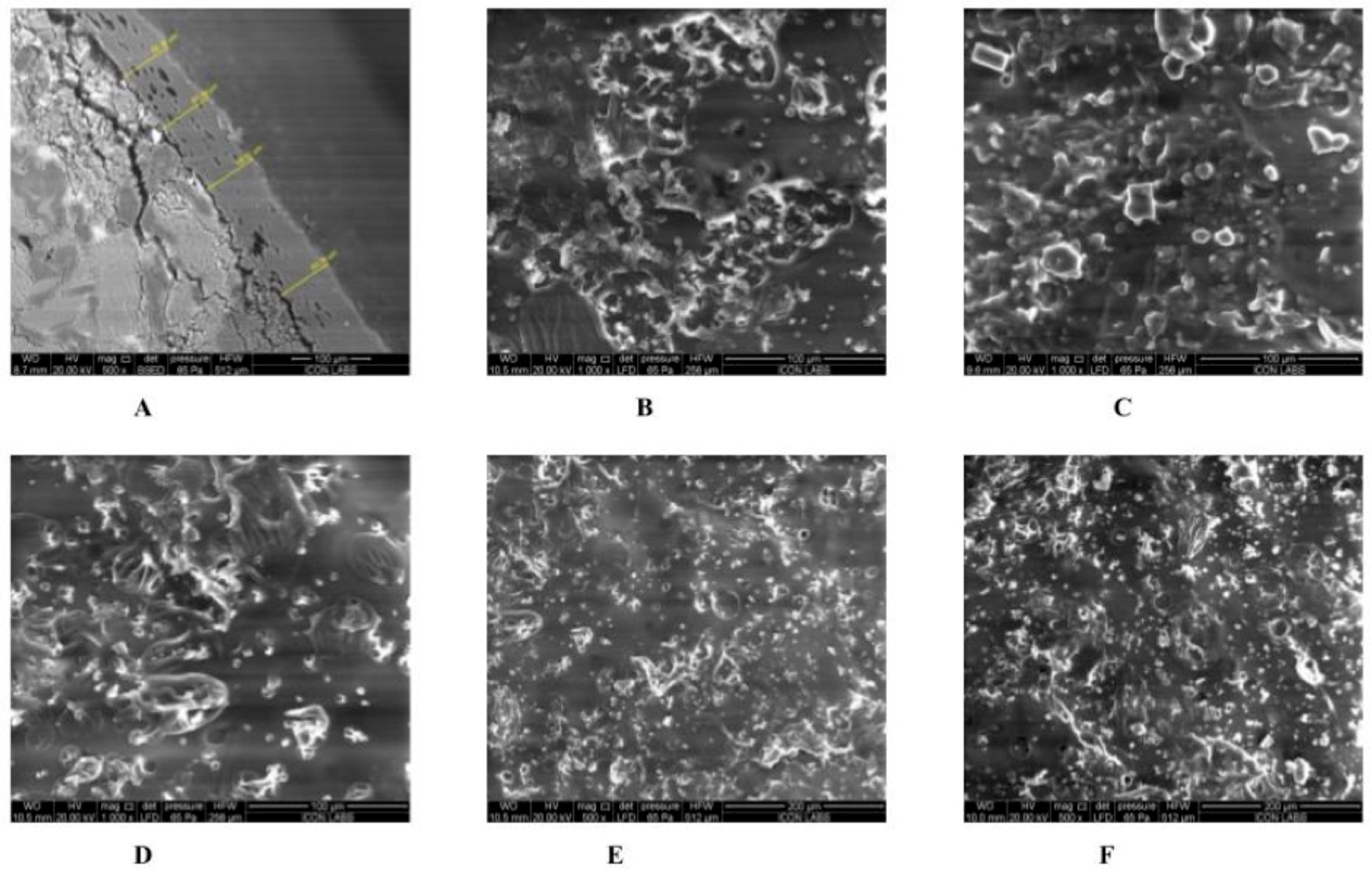
SEM images of tablets of formulations T3 and T9 are shown in Figure 8. Figure 8A reveals an average film thickness of 68 µm for tablets of formulation T3 (coated with CMEC:HPMC E5 97:3 ratio up to a 4% coating level). This figure serves as an indicator of the uniformity of the coating of CMEC on the tablet surface. Figure 8B depicts a comprehensive portrayal of a uniform polymer film on the surface of the tablet of formulation T3. Figure 8C,D exhibit the scans of tablets of formulations T3 and T9 (coated with CMEC:HPMC E5 93:7 ratio up to a 4% coating level) following a soaking period of 4 h in 0.1 N HCl. Though the CMEC layer is intact, the dissolution of HPMC E5 in 0.1 N HCl resulted in the emergence of crystalline, rod-shaped Met particles on the tablet surface as seen in the SEM image. After an extended 10 h soaking period, SEM analysis exhibited the persistence of CMEC film on the surface. In Figure 8E, corresponding to formulation T3, a lower density of pores is observed. Whereas the SEM image of formulation T9, containing 7% pore former, reveals a higher pore count with larger diameters. This data highlights the behavior of the barrier film comprising CMEC and pore former in the presence of 0.1 N HCl wherein the CMEC coat remains intact whereas the HPMC E5 dissolves over time, creating pores in the film (Figure 8F). The extent of pore formation depends on the ratio of CMEC and HPMC E5 [61].

9. Discussion

CMEC is a semisynthetic, amphiphilic, non-gelling, carbohydrate-based polymer with pH-sensitive solubility behavior. Substitution of carboxymethyl on the cellulose backbone confers enteric release properties to the polymer. The unique composition also enables the polymer to be used as a carrier for the preparation of amorphous solid dispersions of hydrophobic drugs. Recently, we have developed and evaluated the amorphous solid dispersion (ASD) of itraconazole, a very poorly soluble, weakly basic drug, with CMEC. The ASD showed an 8-fold and 7.3-fold higher Cmax and AUC with a 2-fold shorter Tmax, thus indicating a significant advantage over pure drug [62]. CMEC thus possesses applications that are similar to some of the well-established, commercially employed semisynthetic cellulose polymers such as HPMC, hydroxypropyl cellulose (HPC), hydroxypropyl methyl cellulose phthalate (HPMCP) and hydroxypropyl methyl cellulose acetate succinate (HPMCAS) [63]. Moreover, a combination of ethyl and carboxymethyl substitution on the cellulose backbone offers a partial hydrophobic nature to CMEC which renders it suitable for extended- and controlled-release application, when incorporated in higher concentrations or combined with suitable release retardant. Despite having these promising applications, CMEC has seldom been used in the drug delivery field unlike these polymers. Hence, the aim of our work was to explore the ER application of CMEC when coated as a barrier membrane on the matrix tablets of Met containing HPMC K100LV as another release retardant.
Though CMEC has been included in the Japanese Excipients List, 2013, there are no scientific reports to our knowledge that reveal the spectroscopic, thermal or microscopic characteristics of the polymer. Hence, we undertook spectroscopic, thermal, and microscopic characterization of CMEC powder. FTIR and Raman spectroscopy confirmed the presence of characteristic groups corresponding to the carboxymethyl, ethyl, and cellulose structure of CMEC. Raman spectroscopy also indicated the amorphous nature of the polymer. The PXRD scan of CMEC exhibited a single sharp peak at 11° 2θ with the rest of the halo pattern. Only one sharp peak representing one dominant lattice spacing indicated a small fraction of the crystalline domain in the polymer, while most of the polymer chains would be disordered [59,60]. The crystallinity index of <30 indicates the amorphous nature of the material. The value of 32.9 calculated using the Segal method indicated the predominantly amorphous nature of the polymer [47,48]. The DSC studies of CMEC involving cooling–heating cycles could confirm the glass transition temperature of the polymer at 146.7 °C. The absence of any sharp endotherm in the thermogram indicates the non-crystalline, amorphous nature of the polymer. This finding agreed with the PXRD scan analysis of CMEC. TGA and DTA of the polymer indicated its slow degradation in the range of 220 to 250 °C, mostly attributed to decarboxylation owing to the carboxymethyl groups in the polymer [64]. Further rapid loss of weight (about 45%) in the range of 250 to 300 °C could be attributed to the pyrolytic decomposition of the cellulose and portions of ethyl-substituted cellulose [65,66]. Hot-stage microscopic studies also demonstrated morphological changes in particles at 230 °C, mostly corresponding to the onset of degradation. The images recorded at 280 and 330 °C exhibited significant changes in the particle morphology, indicating complete degradation of the polymer. The data of HSM thus correlated well with the TGA and DTA data. A degradation temperature above 200° C indicated thermal stability of the polymer like commonly used anionic cellulose polymers such as HPMCP and HPMCAS which exhibit thermal degradation in a similar temperature range [67]. This indicates the suitability of CMEC in pharmaceutical manufacturing wherein the usual processing temperatures for drying and coating are well below 100 °C. CMEC would also be amenable to hot melt extrusion in the temperature range of 150 to 180 °C. Microscopic image analysis specified an almost circular, convex morphology of CMEC particles with smooth margins and an aspect ratio of about 0.6. The particles were confirmed to be solid and non-porous, with the absence of any cracks within [43,49].
To evaluate the ER functionality of CMEC, we selected Met, a hydrophilic, water-soluble, high-dose drug that possesses a variable biological half-life (0.9–2.6 h) [68,69]. There have been reports of the development of Met ER tablets through compression of drug–polymer granules, which were subsequently coated with a pH-dependent polymer in conjunction with a pore former [5]. The kind of polymer and pore former, their concentrations, coating thickness, and the osmotic pressure gradient across the membrane all have an effect on drug release in these investigations [70]. Another significant factor influencing drug release is the permeability of polymeric film coatings [71].
The current work also aimed at attaining an ER profile of Met by employing a multi-step approach involving the preparation of Met granules using HPMC K100LV as an ER polymer and subsequent coating with a solution containing CMEC, an ER polymer, and HPMC E5 as a pore former. A similar approach has been reported in the past by Issa et al. and Mohammed et al [68]. wherein matrix tablets of water-soluble drugs, such as metoprolol succinate and theophylline, were prepared using HPMC K100M. The tablets were coated with solutions containing various ratios of release retardants and pore formers [35,72]. The initial goal of the study was to prepare the ER granules of Met. ER granules would serve as a multi-particulate system that would result in achieving the desired extended drug release, ruling out the possibility of dose dumping [68]. Met granules were prepared in a high-shear granulator using HPMC K100LV, a viscous, swellable ER polymer, as a granulating agent with the intent to retard the release of the highly water-soluble Met. The coating solution comprising CMEC and hydrophilic, water-soluble HPMC E5 as a pore-forming agent was sprayed onto the Met granules. Three different ratios of CMEC: HPMC E5 were employed to select the optimum ratio that would offer the desired release profile. The coating levels studied were 2, 3, and 4%. None of the coating compositions could demonstrate the desired drug release profile at any of these coating levels. A higher surface to volume ratio of the granules could have led to the faster drug release. The coating operation continued further to 6 and 8% weight gain and resulted in retarding the drug release to some extent, albeit not complying with the compendial specifications. Generation of fines during the coating process resulted in enhanced surface area of particles, that could have further posed a challenge in complete and uniform coating. Moreover, the high-dose and water-soluble nature of Met could be responsible for faster drug release from the granules. Hence, ER granule formulation work was discontinued using these coating solution compositions. Changing the solvent composition or switching to a bottom spray method could be tried in future studies to alleviate the challenges encountered during ER coating of Met granules.
Hence, ER granule formulation work was discontinued. Met granules prepared in RMG using HPMC K100LV as a granulating agent were compressed into tablets. Despite incorporating 25% HPMC K100LV as a release retardant in the tablet formulation, the uncoated tablets exhibited complete drug release within 2 h. This could be attributed to the highly water-soluble nature of Met. The tablets were further coated using a 10% w/w coating solution comprising various ratios of CMEC and HPMC E5, obtaining 2, 3, and 4% weight gain. The in vitro drug release profile of formulation T3 coated up to a 4% level with solution containing a CMEC: HPMC E5 ratio of 97:3 complied with the compendial specifications. A similarity factor of 60 also confirmed the similarity of the profile to that of the marketed ER formulation. The other trial formulations failed to comply with the pharmacopeial limits of dissolution despite exhibiting a similarity factor of more than 50. The drug release profiles when subjected to kinetics treatment revealed Higuchi’s diffusion-based release kinetics. However, a release exponent of 0.49 for formulation T3 as per the Peppas model indicated anomalous drug release involving a combination of diffusion and dissolution-based release kinetics [59]. Slow ingress of dissolution medium through the pores formed by dissolution of HPMC E5 would allow drug solubilization in the core. The dissolved drug would then diffuse through the CMEC barrier membrane formed on the tablet surface. The CMEC film would also dissolve slowly in the dissolution medium with alkaline pH of 6.8 which would further promote the drug release. HPMC K100LV as a granulating agent aided in extending the Met release by slowly dissolving in the medium. Thus, the interplay of CMEC with HPMC K100LV and HPMC E5 in the appropriate ratio was essential for achieving the desired drug release profile. Moreover, the percentage of coating exhibited a significant influence on the release rate [73]. Multi-media dissolution of formulations T3, T6, and T9 using USP Type 3 apparatus exhibited pH-dependent release of drug with less than 10% release in acidic media and a gradual increase in the release above pH 3. This confirmed the pH-responsive and release-retardant properties of CMEC.
The study thus indicated the overall suitability of CMEC as a film coating polymer to achieve extended release of drugs. Lower processing temperatures (40 to 45 °C) for film coating and excellent solubility in a combination of water and class 3 organic solvents present the ecological benefits of CMEC. A lower processing temperature also makes CMEC a suitable film coating agent for thermolabile drugs. Ability of CMEC to form a strong yet flexible film in the absence of plasticizer offers economic benefits. Moreover, CMEC coating with relatively lower weight gain offers extended release to even water-soluble drugs like Met from its matrix tablets. This signifies its potential economic advantage in commercial manufacturing operations.

10. Conclusions

CMEC powder was characterized using spectroscopy, thermal, and microscopy techniques. These studies established the identity of the polymer and indicated its amorphous nature. Thermal characterization confirmed the glass transition temperature of 146.7 °C and the decomposition temperature of greater than 200 °C for CMEC. Circular to rod-shaped particles of CMEC with smooth surface characteristics exhibited D10, D50, and D90 of 31, 55, and 134 µ during microscopic image analysis. CMEC was further explored for its functionality as an ER polymer. The solution of CMEC and HPMC E5 in the optimized ratio of 97:3, when coated onto Met–HPMC K100LV matrix tablets to 4% weight gain, could effectively retard the release of Met, a high-dose, hydrophilic drug. The release profile, apart from complying with the USP specifications, also exhibited similarity to the marketed Met ER formulation. The optimized tablets, when subjected to sequential drug release studies in different pH media, confirmed the pH-dependent release characteristics of CMEC. The study thus reinforces the potential application of CMEC in designing oral ER drug delivery systems.

Supplementary Materials

The following supporting information can be downloaded at: https://www.mdpi.com/article/10.3390/polysaccharides7020064/s1, Figure S1: Microscopy study of CMEC (4X magnification); Figure S2: DSC scans of Meb and its binary mixtures (1:1) with excipients; Figure S3: In-vitro drug release study of Met ER tablets (Formula T3) using USP Type 3 dissolution apparatus (data shown is mean ± SD of n = 3).

Author Contributions

A.T.: Experimental work, Writing original draft; A.R.: Writing original draft; P.P.: Methodology, Investigation, Formal Analysis; R.A.: Methodology, Supervision; S.K.: Investigation, Formal Analysis; D.T.: Writing original draft; M.K.: Conceptualization, Methodology, Supervision, Review and Editing. All authors have read and agreed to the published version of the manuscript.

Funding

This research did not receive funding from any funding agency.

Data Availability Statement

No new data were created or analyzed in this study.

Acknowledgments

The authors would like to thank Arihant Innochem Pvt Ltd., Mumbai, India for generously providing a sample of CMEC. The authors would like to thank Arvind Barak of Renishaw India Pvt. Ltd., Pune, India for performing Raman spectroscopic studies of the polymer. The authors would also express their gratitude to Electrolab Pvt Ltd., Mumbai, India for assisting with in vitro release studies of tablets using USP Type 3 dissolution apparatus. The authors are thankful to Premchand Jain of Hitachi High-Tech India Pvt Ltd., Mumbai for the interpretation of the DSC studies of the polymer. The authors are immensely thankful to Ramprakash Govindrajan for the critical review of the manuscript.

Conflicts of Interest

Authors Prashant Pisal and Rahul Aware were employed by ACG Pam Pharma Technologies Pvt. Ltd, Palashi Road, Taluka-Khandala, Shirwal 412801, Pune, Maharashtra, India. The remaining authors declare that the research was conducted in the absence of any commercial or financial relationships that could be construed as a potential conflict of interest. The authors confirm that there is no conflict of interest between the companies mentioned in the Acknowledgements and the research content of this paper. The companies mentioned in the Acknowledgements were not involved in the study design, collection, analysis, interpretation of data, the writing of this article or the decision to submit it for publication.

References

  1. Namazi, H. Polymers in our daily life. BioImpacts BI 2017, 7, 73. [Google Scholar] [CrossRef] [PubMed]
  2. Tu, H.; Zhu, M.; Duan, B.; Zhang, L. Recent progress in high-strength and robust regenerated cellulose materials. Adv. Mater. 2021, 33, 2000682. [Google Scholar] [CrossRef]
  3. Deb, P.K.; Kokaz, S.F.; Abed, S.N.; Paradkar, A.; Tekade, R.K. Pharmaceutical and biomedical applications of polymers. In Basic Fundamentals of Drug Delivery; Elsevier: Amsterdam, The Netherlands, 2019; pp. 203–267. [Google Scholar]
  4. Gandhi, K.J.; Deshmane, S.V.; Biyani, K.R. Polymers in pharmaceutical drug delivery system: A review. Int. J. Pharm. Sci. Rev. Res. 2012, 14, 57–66. [Google Scholar]
  5. Corti, G.; Cirri, M.; Maestrelli, F.; Mennini, N.; Mura, P. Sustained-release matrix tablets of metformin hydrochloride in combination with triacetyl-β-cyclodextrin. Eur. J. Pharm. Biopharm. 2008, 68, 303–309. [Google Scholar] [CrossRef]
  6. Knowde. CMEC. 2026. Available online: https://www.knowde.com/stores/freund/products/cmec (accessed on 29 May 2026).
  7. Turanlı, Y.; Acartürk, F. Preparation and characterization of colon-targeted pH/Time-dependent nanoparticles using anionic and cationic polymethacrylate polymers. Eur. J. Pharm. Sci. 2022, 171, 106122. [Google Scholar] [CrossRef]
  8. Lenz, J.; Fuest, F.; Finke, J.H.; Bunjes, H.; Kwade, A.; Juhnke, M. Tablet Disintegration and dispersion under in vivo-like hydrodynamic conditions. Pharmaceutics 2022, 14, 208. [Google Scholar] [CrossRef] [PubMed]
  9. Meka, V.S.; Nali, S.R.; Songa, A.S.; Battu, J.R.; Kolapalli, V.R.M. Statistical optimization of a novel excipient (CMEC) based gastro retentive floating tablets of propranolol HCl and it’s in vivo buoyancy characterization in healthy human volunteers. DARU J. Pharm. Sci. 2012, 20, 21. [Google Scholar] [CrossRef]
  10. Gomte, S.S.; Agnihotri, T.G.; Khopade, S.; Jain, A. Exploring the potential of pH-sensitive polymers in targeted drug delivery. J. Biomater. Sci. Polym. Ed. 2024, 35, 228–268. [Google Scholar] [CrossRef]
  11. Liechty, W.B.; Kryscio, D.R.; Slaughter, B.V.; Peppas, N.A. Polymers for drug delivery systems. Annu. Rev. Chem. Biomol. Eng. 2010, 1, 149–173. [Google Scholar] [CrossRef]
  12. Mohamed, M.A.; Jaafar, J.; Ismail, A.F.; Othman, M.H.D.; Rahman, M.A. Fourier transform infrared (FTIR) spectroscopy. In Membrane Characterization; Elsevier: Amsterdam, The Netherlands, 2017; pp. 3–29. [Google Scholar]
  13. Xia, J.; Wang, D.; Liang, P.; Zhang, D.; Du, X.; Ni, D.; Yu, Z. Vibrational (FT-IR, Raman) analysis of tea catechins based on both theoretical calculations and experiments. Biophys. Chem. 2020, 256, 106282. [Google Scholar] [CrossRef]
  14. Skotnicki, M.; Czerniecka-Kubicka, A.; Neilsen, G.; Woodfield, B.F.; Pyda, M. Application of advanced thermal analysis for characterization of crystalline and amorphous phases of carvedilol. J. Pharm. Biomed. Anal. 2022, 217, 114822. [Google Scholar] [CrossRef]
  15. Ramya, G.; Aniskumar, M.; Saravanan, V.; Sathya, R. Investigating the Role of TiO2 and MgTiO3 Supports in ZnO-Catalyzed Photocatalytic CO2 Reduction. J. New Mater. Electrochem. Syst. 2024, 27. [Google Scholar] [CrossRef]
  16. Yao, B.; Li, M.; Zhang, J.; Zhang, L.; Song, Y.; Xiao, W.; Cruz, A.; Tong, Y.; Li, Y. TiN paper for ultrafast-charging supercapacitors. Nano-Micro Lett. 2020, 12, 3. [Google Scholar] [CrossRef]
  17. Xie, B.-K.; Liu, S.-B.; Li, L. Large-scale microscope with improved resolution using SRGAN. Opt. Laser Technol. 2024, 179, 111291. [Google Scholar] [CrossRef]
  18. Parikh, D.M. Handbook of pharmaceutical granulation technology. In Drugs and the Pharmaceutical Sciences; CRC Press: Boca Raton, FL, USA, 2005; Volume 81. [Google Scholar]
  19. Li, L.; Yu, H.; Wang, X.; Zheng, S. Thermal analysis of melting and freezing processes of phase change materials (PCMs) based on dynamic DSC test. Energy Build. 2016, 130, 388–396. [Google Scholar] [CrossRef]
  20. Benali, M.; Hemati, M.; Gerbaud, V. Wet granulation in high shear mixer: Effect of physico-chemical properties on the growth kinetics. In Science et Technologie des Poudres et Matériaux Frittés STP 2007; Elsevier: Amsterdam, The Netherlands, 2007. [Google Scholar]
  21. Gao, J.Z.; Jain, A.; Motheram, R.; Gray, D.B.; Hussain, M.A. Fluid bed granulation of a poorly water soluble, low density, micronized drug: Comparison with high shear granulation. Int. J. Pharm. 2002, 237, 1–14. [Google Scholar] [CrossRef]
  22. Paarakh, M.P.; Jose, P.A.; Setty, C.M.; Peterchristoper, G.V. Release kinetics–concepts and applications. Int. J. Pharm. Res. Technol. (IJPRT) 2018, 8, 12–20. [Google Scholar]
  23. Vlad, R.-A.; Pintea, A.; Pintea, C.; Rédai, E.M.; Antonoaea, P.; Bîrsan, M.; Ciurba, A. Hydroxypropyl methylcellulose—A key excipient in pharmaceutical drug delivery systems. Pharmaceutics 2025, 17, 784. [Google Scholar] [CrossRef]
  24. Chang, H.H.R.; Chen, K.; Lugtu-Pe, J.A.; Al-Mousawi, N.; Zhang, X.; Bar-Shalom, D.; Kane, A.; Wu, X.Y. Design and optimization of a nanoparticulate pore former as a multifunctional coating excipient for pH transition-independent controlled release of weakly basic drugs for oral drug delivery. Pharmaceutics 2023, 15, 547. [Google Scholar] [CrossRef] [PubMed]
  25. Song, Y.; Fang, R.; Liu, N.; Wang, T.; Zhou, T.; Zhang, M.; Yang, H. A comparative study on the coating performance of Wurster, bottom and top spray fluidized bed coaters. Chem. Eng. Res. Des. 2025, 220, 1–15. [Google Scholar] [CrossRef]
  26. Avirneni, R.K.; Sarella, P.N.K. Exploration of melt granulation technique for the development of entecavir monohydrate tablets using 32 factorial designs. World J. Biol. Pharm. Health Sci. 2023, 14, 176–189. [Google Scholar] [CrossRef]
  27. Lumay, G.; Boschini, F.; Traina, K.; Bontempi, S.; Remy, J.C.; Cloots, R.; Vandewalle, N. Measuring the flowing properties of powders and grains. Powder Technol. 2012, 224, 19–27. [Google Scholar] [CrossRef]
  28. Pharmacopoeia, I. Addendum 2016. 2016. Available online: https://ipc.gov.in/shop/index.php?route=product/product&product_id=55 (accessed on 17 February 2026).
  29. Martins, M.T.; Lourenço, F.R. Measurement uncertainty for <711> Dissolution tests using Monte Carlo methods–Uncertainties arising from sampling and analytical steps. Anal. Chim. Acta 2024, 1330, 343285. [Google Scholar] [PubMed]
  30. Hate, S.S.; Thompson, S.A.; Singaraju, A.B. Impact of sink conditions on drug release behavior of controlled-release formulations. J. Pharm. Sci. 2025, 114, 520–529. [Google Scholar] [CrossRef]
  31. Kotlowska, H.; Krotka, J.; Szymanska, M.; Kubiak, B.; Sznitowska, M.; Nalluri, B.N. The use of novel tools for the assessment of powders and granules flow properties and for the analysis of minitablets compression process. Drug Dev. Ind. Pharm. 2020, 46, 547–556. [Google Scholar] [CrossRef]
  32. Lin, Z.; Cabello, B.; Kossor, C.; Davé, R. Facilitating direct compaction tableting of fine cohesive APIs using dry coated fine excipients: Effect of the excipient size and amount of coated silica. Int. J. Pharm. 2024, 660, 124359. [Google Scholar] [CrossRef] [PubMed]
  33. Kulkarni, M.; Thorat, A.; Pisal, P.; Aware, R.; Kulkarni, S. Carboxymethyl Ethyl Cellulose: Characterization and Application as an Extended Release Polymer. SSRN 2025. [Google Scholar] [CrossRef]
  34. Ganguly, D.; Ghosh, S.; Chakraborty, P.; Mitra, S.; Chatterjee, S.; Panja, S.; Choudhury, A. A brief review on recent advancement of tablet coating technology. J. Appl. Pharm. Res. 2022, 10, 07–14. [Google Scholar] [CrossRef]
  35. Mohamed, F.A.; Roberts, M.; Seton, L.; Ford, J.L.; Levina, M.; Rajabi-Siahboomi, A.R. Film-coated matrix mini-tablets for the extended release of a water-soluble drug. Drug Dev. Ind. Pharm. 2015, 41, 623–630. [Google Scholar] [CrossRef]
  36. Varma, M.V.; Kaushal, A.M.; Garg, A.; Garg, S. Factors affecting mechanism and kinetics of drug release from matrix-based oral controlled drug delivery systems. Am. J. Drug Deliv. 2004, 2, 43–57. [Google Scholar] [CrossRef]
  37. Xie, F.; Ji, S.; Cheng, Z. In vitro dissolution similarity factor (f2) and in vivo bioequivalence criteria, how and when do they match? Using a BCS class II drug as a simulation example. Eur. J. Pharm. Sci. 2015, 66, 163–172. [Google Scholar] [CrossRef]
  38. Reppas, C.; Vrettos, N.N.; Dressman, J.; Andreas, C.J.; Miyaji, Y.; Brown, J.; Etherson, K.; Hanley, S.; Karkossa, F.; Karlsson, E.; et al. Dissolution testing of modified release products with biorelevant media: An OrBiTo ring study using the USP apparatus III and IV. Eur. J. Pharm. Biopharm. 2020, 156, 40–49. [Google Scholar]
  39. Kondo, T.; Sawatari, C.; Manley, R.S.J.; Gray, D.G. Characterization of hydrogen bonding in cellulose-synthetic polymer blend systems with regioselectively substituted methylcellulose. Macromolecules 1994, 27, 210–215. [Google Scholar] [CrossRef]
  40. Pakzad, Y.; Fathi, M.; Mozafari, M. Characterization methodologies of functional polymers. In Advanced Functional Polymers for Biomedical Applications; Elsevier: Amsterdam, The Netherlands, 2019; pp. 359–381. [Google Scholar]
  41. Akinosho, H.; Hawkins, S.; Wicker, L. Hydroxypropyl methylcellulose substituent analysis and rheological properties. Carbohydr. Polym. 2013, 98, 276–281. [Google Scholar] [CrossRef]
  42. Estrada-Montaño, A.S.; Espinobarro-Velázquez, D.; Sauzameda, M.; Terrazas, E.; Reyes-Martinez, R.; Lardizábal, D.; Manjarrez-Nevárez, L.A.; Zaragoza-Galan, G. Photoluminescence in non-conjugated polyelectrolyte films containing 7-hydroxy-flavylium cation. Polym. Bull. 2020, 77, 5051–5063. [Google Scholar] [CrossRef]
  43. Tanaka, H.; Ueda, H. Carboxymethyl ethylcellulose acts as a solid dispersion carrier with a remarkably higher improvement effect on dissolution-permeation of Itraconazole. ACS Omega 2025, 10, 49231–49242. [Google Scholar] [CrossRef] [PubMed]
  44. Frick, A.; Rochman, A. Characterization of TPU-elastomers by thermal analysis (DSC). Polym. Test. 2004, 23, 413–417. [Google Scholar] [CrossRef]
  45. De la Fuente, J.L.; Ruiz-Bermejo, M.; Menor-Salván, C.; Osuna-Esteban, S. Thermal characterization of HCN polymers by TG–MS, TG, DTA and DSC methods. Polym. Degrad. Stab. 2011, 96, 943–948. [Google Scholar] [CrossRef]
  46. Chougule, M.; Sirvi, A.; Saini, V.; Kashyap, M.; Sangamwar, A.T. Enhanced biopharmaceutical performance of brick dust molecule nilotinib via stabilized amorphous nanosuspension using a facile acid–base neutralization approach. Drug Deliv. Transl. Res. 2023, 13, 2503–2519. [Google Scholar] [CrossRef]
  47. Kaur, P.; Sharma, J.; Bhardwaj, N.K.; Bhardwaj, S.; Kaur, D.; Singh, A.; Kumar, A. Prospects of crude enzymes in replacing pure enzymes for dissolving pulp production. 3 Biotech 2024, 14, 228. [Google Scholar] [CrossRef] [PubMed]
  48. Montoya-Escobar, N.; Ospina-Acero, D.; Velásquez-Cock, J.A.; Gómez-Hoyos, C.; Serpa Guerra, A.; Gañan Rojo, P.F.; Vélez Acosta, L.M.; Escobar, J.P.; Correa-Hincapié, N.; Triana-Chávez, O.; et al. Use of fourier series in X-ray diffraction (XRD) analysis and fourier-transform infrared spectroscopy (FTIR) for estimation of crystallinity in cellulose from different sources. Polymers 2022, 14, 5199. [Google Scholar] [CrossRef]
  49. Arzate-Vázquez, I.; Chanona-Pérez, J.J.; Calderón-Domínguez, G.; Terres-Rojas, E.; Garibay-Febles, V.; Martínez-Rivas, A.; Gutiérrez-López, G.F. Microstructural characterization of chitosan and alginate films by microscopy techniques and texture image analysis. Carbohydr. Polym. 2012, 87, 289–299. [Google Scholar] [CrossRef]
  50. Panna, W.; Wyszomirski, P.; Kohut, P. Application of hot-stage microscopy to evaluating sample morphology changes on heating. J. Therm. Anal. Calorim. 2016, 125, 1053–1059. [Google Scholar] [CrossRef]
  51. Sheela, A.; Sarada, N.; Vijayaraghavan, R. A possible correlation between antioxidant and antidiabetic potentials of oxovanadium (IV) complexes. Med. Chem. Res. 2013, 22, 2929–2937. [Google Scholar] [CrossRef]
  52. Rahmanian, N.; Ghadiri, M.; Jia, X.; Stepanek, F. Characterisation of granule structure and strength made in a high shear granulator. Powder Technol. 2009, 192, 184–194. [Google Scholar] [CrossRef]
  53. Suresh, P.; Surasani, V.K.; Sreedhar, I. Investigations at an industrial scale on granule and tablet attributes in high shear rapid mixer granulator. Part. Sci. Technol. 2018, 36, 457–463. [Google Scholar] [CrossRef]
  54. Shah, R.B.; Tawakkul, M.A.; Khan, M.A. Comparative evaluation of flow for pharmaceutical powders and granules. Aaps Pharmscitech 2008, 9, 250–258. [Google Scholar] [CrossRef]
  55. Hîrjău, M.; Miron, D.S.; Anuța, V.; Lupuliasa, D.; Ghica, M.V.; Jinga, V.; Dinu-Pîrvu, C.E. Evaluation of experimental multi-particulate polymer-coated drug delivery systems with meloxicam. Coatings 2020, 10, 490. [Google Scholar] [CrossRef]
  56. Agarwal, P.; Vaishnav, R.; Goyal, A. Evaluation of quality parameters of three different marketed brands of arogyavardhini vati: A herbo-mineral formulation. Indo Am. J. Pharm. Res. 2018, 8, 1357–1366. [Google Scholar]
  57. Tang, E.S.; Liew, C.V.; Er, D.Z.; Liu, X.; Wigmore, A.J.; Heng, P.W. Study of coat quality of tablets coated by an on-line supercell coater. Aaps Pharmscitech 2007, 8, 63. [Google Scholar] [CrossRef] [PubMed]
  58. Kushwaha, N.; Jain, A.; Jain, P.K.; Khare, B.; Jat, Y.S. An overview on formulation and evaluation aspects of tablets. Asian J. Dent. Health Sci. 2022, 2, 35–39. [Google Scholar] [CrossRef]
  59. Ge, M.; Li, Y.; Zhu, C.; Liang, G.; Alam S.M., J.; Hu, G.; Gui, Y.; Rashid M., J. Preparation of organic-modified magadiite–magnetic nanocomposite particles as an effective nanohybrid drug carrier material for cancer treatment and its properties of sustained release mechanism by Korsmeyer–Peppas kinetic model. J. Mater. Sci. 2021, 56, 14270–14286. [Google Scholar] [CrossRef]
  60. Dasgupta, D.; Patel, A. Engineered MCM-48 and heteropolyacid based hybrid nano-drug delivery systems for controlled release of metformin hydrochloride for diabetes mellitus treatment. RSC Adv. 2025, 15, 33657–33666. [Google Scholar] [CrossRef]
  61. Song, Z.; Yan, H.; Li, J.; She, J.; Liu, S.; Chen, Z.; Shi, L.; Zhan, H.; Han, Q.; Lu, X.; et al. Pore-size control mechanism of support membranes on interfacial polymerization process: Achieving charge enhancement and optimizing NFMs performance. J. Environ. Chem. Eng. 2025, 13, 118568. [Google Scholar] [CrossRef]
  62. Kulkarni, M.; Shirsat, V.; More, P.; Mohite, S.; Jaiswal, A. Carboxymethyl Ethyl Cellulose-based Solid Dispersions: A Promising Approach to Enhance the Dissolution and Oral Bioavailability of Itraconazole. J. Pharm. Innov. 2026, 21, 150. [Google Scholar] [CrossRef]
  63. Siepmann, F.; Siepmann, J.; Walther, M.; MacRae, R.J.; Bodmeier, R. Polymer blends for controlled release coatings. J. Control. Release 2008, 125, 1–15. [Google Scholar] [CrossRef]
  64. El-Sakhawy, M.; Tohamy, H.A.S.; Salama, A.; Kamel, S. Thermal properties of carboxymethyl cellulose acetate butyrate. Cellul. Chem. Technol. 2019, 53, 667–675. [Google Scholar] [CrossRef]
  65. Chakrabarti, A.; Gunjikar, V.; Choudhary, V. Thermal analysis of ethyl cellulose: Influence of atmosphere and addition of diethyl phthalate as plasticizer. Thermochim. Acta 1989, 145, 173–178. [Google Scholar] [CrossRef]
  66. Yeng, L.C.; Wahit, M.U.; Othman, N. Thermal and flexural properties of regenerated cellulose (RC)/poly (3-hydroxybutyrate)(PHB) biocomposites. J. Teknol. Sci. Eng. 2015, 75, 107–112. [Google Scholar] [CrossRef]
  67. Meena, A.; Parikh, T.; Gupta, S.S.; Serajuddin, A.T. Investigation of thermal and viscoelastic properties of polymers relevant to hot melt extrusion-II: Cellulosic polymers. Int. J. Pharm. Excip. 2016, 5, 46–55. [Google Scholar] [CrossRef]
  68. Hu, L.-D.; Liu, Y.; Tang, X.; Zhang, Q. Preparation and in vitro/in vivo evaluation of sustained-release metformin hydrochloride pellets. Eur. J. Pharm. Biopharm. 2006, 64, 185–192. [Google Scholar] [CrossRef] [PubMed]
  69. Vidon, N.; Chaussade, S.; Noel, M.; Franchisseur, C.; Huchet, B.; Bernier, J.J. Metformin in the digestive tract. Diabetes Res. Clin. Pract. 1988, 4, 223–229. [Google Scholar] [CrossRef]
  70. Verma, R.K.; Garg, S. Development and evaluation of osmotically controlled oral drug delivery system of glipizide. Eur. J. Pharm. Biopharm. 2004, 57, 513–525. [Google Scholar] [CrossRef] [PubMed]
  71. Siepmann, F.; Hoffmann, A.; Leclercq, B.; Carlin, B.; Siepmann, J. How to adjust desired drug release patterns from ethylcellulose-coated dosage forms. J. Control. Release 2007, 119, 182–189. [Google Scholar] [CrossRef] [PubMed]
  72. Issa, M.G.; de Souza, N.V.; Jou, B.W.C.; Duque, M.D.; Ferraz, H.G. Development of extended-release mini-tablets containing metoprolol supported by design of experiments and physiologically based biopharmaceutics modeling. Pharmaceutics 2022, 14, 892. [Google Scholar] [CrossRef]
  73. Cui, C.; Sun, J.; Wang, X.; Yu, Z.; Shi, Y. Factors contributing to drug release from enteric-coated omeprazole capsules: An in vitro and in vivo pharmacokinetic study and IVIVC evaluation in beagle dogs. Dose-Response 2020, 18, 1559325820908980. [Google Scholar] [CrossRef] [PubMed]
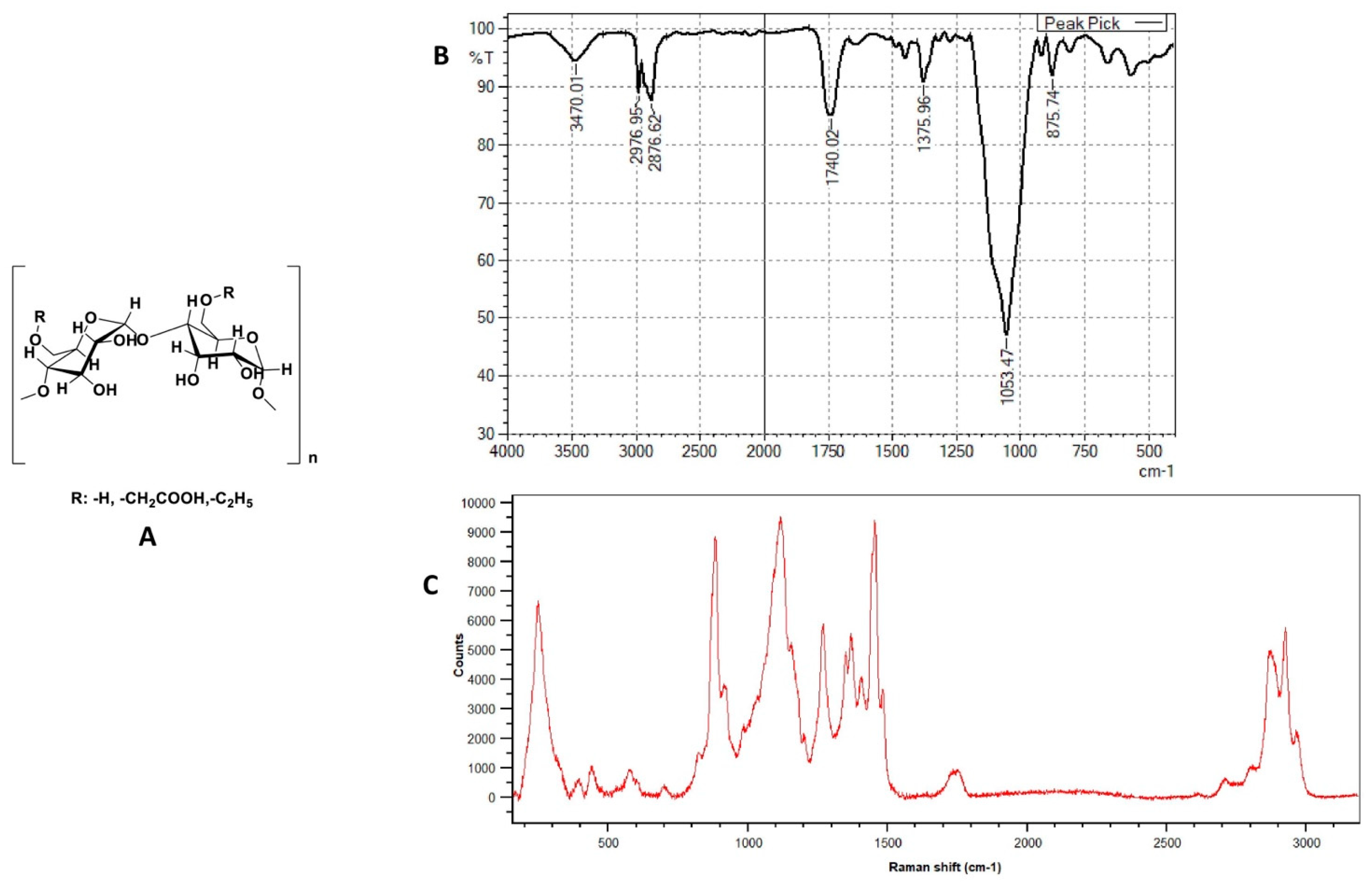
Figure 1. (A) Structure of CMEC, (B) FTIR spectra of CMEC, (C) Raman spectra of CMEC.
Polysaccharides 07 00064 g001
Figure 2. Differential Scanning Calorimetry (DSC) studies of CMEC (A). First cooling–heating cycle (B). Second cooling–heating cycle.
Polysaccharides 07 00064 g002
Figure 3. (A) TGA thermogram of CMEC, (B) DTA thermogram of CMEC.
Polysaccharides 07 00064 g003
Figure 4. PXRD spectra of CMEC.
Polysaccharides 07 00064 g004
Figure 5. Hot-stage Microscopy study of CMEC captured at various temperatures: (A) 32 °C; (B) 150 °C; (C) 230 °C; (D) 241 °C; (E) 251 °C; (F) 261 °C; (G) 281 °C and (H) 336 °C.
Polysaccharides 07 00064 g005
Figure 6. In vitro drug release of coated granules: (A) 2% Coating; (B) 3% Coating; (C) 4% Coating; (D) 6% Coating; (E) 8% Coating (data shown is mean ± SD of n = 3).
Polysaccharides 07 00064 g006
Figure 7. In vitro drug release ER tablets: (A) 2% Coating; (B) 3% Coating; (C) 4% Coating (data shown is mean ± SD of n = 3).
Polysaccharides 07 00064 g007
Figure 8. Scanning Electron Microscopy (SEM) of the tablet of formulation T3. (A): Average film thickness of 68 µm; (B): Comprehensive portrayal of a uniform polymer film on the surface; (C): Following a soaking period of 4 h in 0.1 N HCl; (D) T9 following a soaking period of 4 h in 0.1 N HCl; (E) T9 containing 7% pore former and (F): The barrier film comprising CMEC and pore former in the presence of 0.1 N HCl.
Polysaccharides 07 00064 g008
Table 1. Formula for preparation of Met granules and tablets.
IngredientQuantity Given (mg/Unit Dose)Quantity Taken (g)
Met Granules
Met5001000
Lactose 80 M75150
HPMC K100LV200400
Purified waterq.s.465
Total weight7752015
Met Tablets
Met granules (prepared as per the above formula)7752015
Colloidal silicon dioxide1632
Magnesium stearate1632
Total weight8072079
Table 2. ER coating trials of Met granules.
BatchesCMEC Ratio in Coating SolutionHPMC E5 Ratio in Coating SolutionWeight Gain Granules (%)
G19372
G29373
G39374
G49376
G59378
G69552
G79553
G89554
G99556
G109558
G119732
G129733
G139734
G149736
G159738
Table 3. ER coating trials of Met tablets.
BatchesCMEC Ratio in Coating SolutionHPMC E5 Ratio in Coating SolutionWeight Gain for Tablets (%)
T19732
T29733
T39734
T49552
T59553
T69554
T79372
T89373
T99374
Table 4. Particle size and morphology-related parameters of CMEC.
ParameterAverage Value (Particle)
D10 (µm)31.19
D50 (µm)55.22
D90 (µm)134.37
Length (µm)71.56
Area (sq µm)2952.33
Width (µm)43.77
Circular equivalent diameter (µm)54.13
Aspect ratio0.686
Circularity (%)95.254
Convexity (%)99.4
Solidity (%)98.324
Texture18.66
Disclaimer/Publisher’s Note: The statements, opinions and data contained in all publications are solely those of the individual author(s) and contributor(s) and not of MDPI and/or the editor(s). MDPI and/or the editor(s) disclaim responsibility for any injury to people or property resulting from any ideas, methods, instructions or products referred to in the content.