1. Introduction
Alginate is an anionic polysaccharide composed of β-D-mannuronate (M) and α-L-guluronate (G) units, whose block organization (G-rich, M-rich, and alternating) governs the geometry and density of carboxylate sites available for coordination. In the presence of divalent cations, ionic gelation has classically been described by the “egg-box” model, in which interchain cavities stabilize cations (typically Ca
2+) through coordination by carboxylate oxygens, with a marked dependence on microstructure, particularly in G-rich blocks [
1,
2,
3]. In real aqueous systems, the selective removal of metals by Ca–alginate matrices does not depend solely on electrostatic affinities; rather, it is controlled by competition among the preferred geometry of the cation, the cost of partial dehydration upon entering the pocket, and the multidentate cooperation of carboxylates and water–polymer hydrogen bonds that preorganize the site [
4,
5,
6]. These factors explain why some contaminant ions can thermodynamically displace Ca
2+ even when their stereochemistry or hydration may appear, a priori, unfavorable.
Although there is experimental and mechanistic evidence of selectivity in alginate-based adsorbents, including multimetal systems and pH dependence, quantitative assignment of the cation-exchange component requires comparable thermodynamic metrics and models that do not introduce inconsistencies in charge or hydration. In this context, alginate systems have become promising platforms for capturing heavy metals in water [
7,
8,
9,
10].
Previous studies have shown that alginate–metal interactions depend not only on the identity of the cation but also on the local composition of the polymer and on the physicochemical conditions under which gelation or adsorption takes place. Experimental, spectroscopic, and materials-oriented investigations have reported differences in cross-linking efficiency, coordination behavior, and uptake performance as a function of the M/G ratio, the nature of the divalent ion, and the surrounding aqueous environment [
3,
4,
5]. In parallel, theoretical studies on alginate fragments and related hydrated systems have highlighted the relevance of short-range coordination, solvation, and local conformational effects in determining metal binding [
11,
12]. Additional experimental studies have further emphasized the influence of aqueous conditions and ion-specific effects on alginate-based metal uptake and gelation behavior [
13,
14,
15]. However, a comparative thermodynamic description of Ca
2+ ↔ M
2+ exchange using internally consistent hydrated reference states and explicitly differentiated G-rich and M-rich egg-box pockets remains limited.
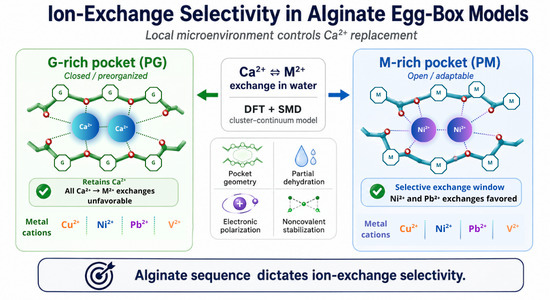
Based on this context, we hypothesized that the two microenvironments would not respond equivalently to ion exchange: the more preorganized PG pocket should preferentially retain the Ca2+-stabilized state, whereas the more adaptable PM pocket should selectively favor incoming cations able either to achieve compact cooperative coordination or to exploit a more flexible polarizable environment. To test this hypothesis, we employed a reproducible cluster–continuum strategy based on an explicit Ca2+ ↔ M2+ exchange scheme in water, using microhydrated species and SMD solvation, to quantify ΔGexch for Cu2+, Ni2+, Pb2+, and V2+ relative to Ca2+. Structural descriptors, molecular electrostatic potential maps, charge redistribution, and NCI/RDG analyses were then used to interpret the thermodynamic trends at the microscopic level. The purpose of this approach is not to reproduce the full complexity of alginate gels in a real solution, but to isolate how the local G-rich or M-rich environment modulates relative exchange preference within a controlled molecular model.
2. Materials and Methods
2.1. Software, Calculation Protocol, and Computational Details (DFT and Solvation)
Because this was an exclusively computational study, no experimental reagents, laboratory materials, equipment, or physical devices were used. The alginate and metal–alginate complex structures were built and edited using GaussView, version 6.0.16 (Semichem Inc., Shawnee Mission, KS, USA), which was used to generate the input files for Gaussian calculations. All quantum-chemical calculations were performed using Gaussian 16, Revision C.01 (Gaussian, Inc., Wallingford, CT, USA). Density functional theory calculations were carried out at the M06-2X/LANL2DZ level of theory, which incorporates an effective core potential for heavy elements and allows an efficient description of divalent cations such as Pb
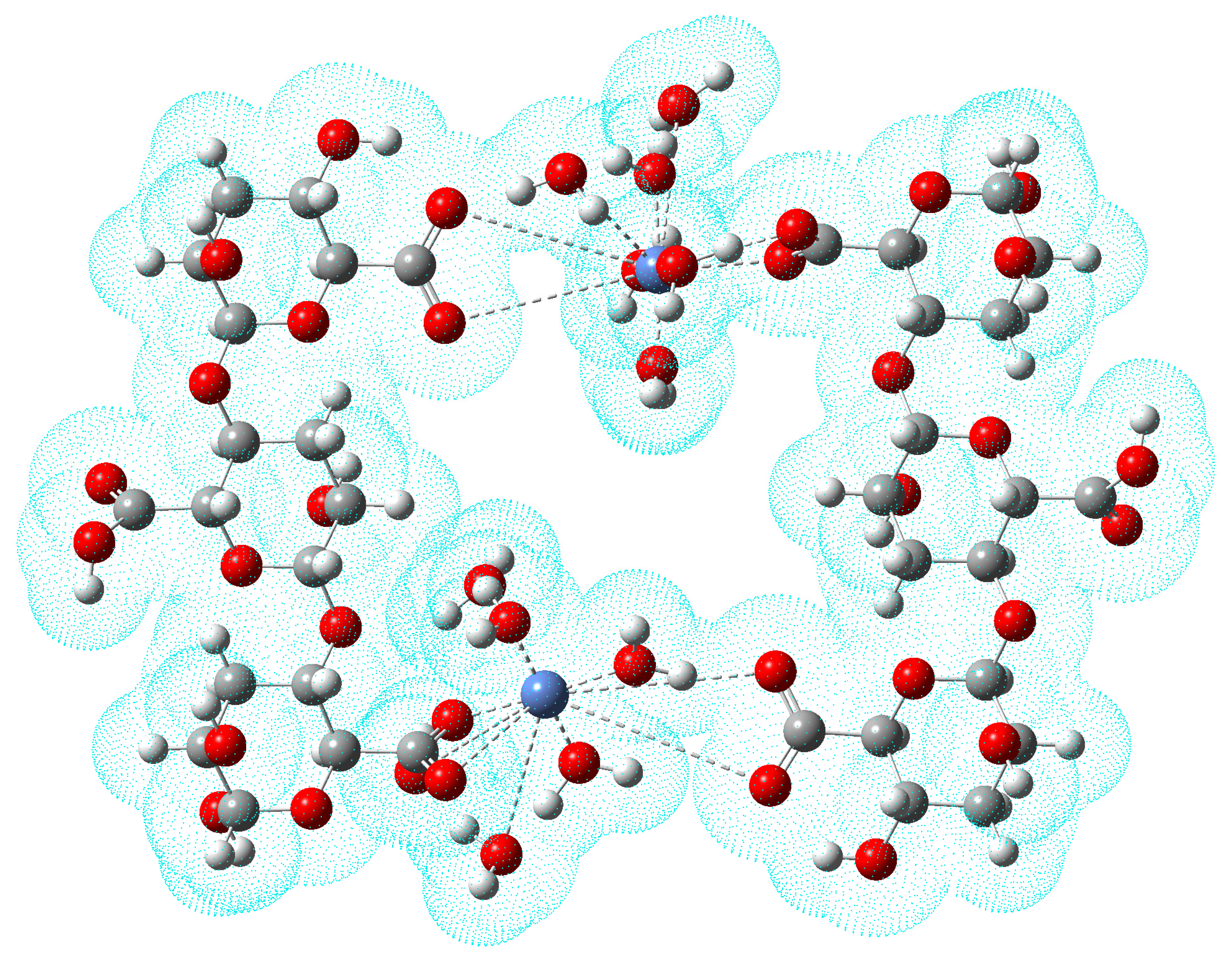
2+. The aqueous environment was included consistently for all species using the SMD continuum solvation model for water, ensuring thermodynamic consistency in the ion-exchange cycle (
Figure 1).
The computational workflow consisted of molecular construction, geometry optimization in solvent, harmonic frequency calculations to confirm true minima through the absence of imaginary frequencies and to obtain thermal corrections, followed by electronic and topological analyses [
16,
17,
18,
19]. Gibbs free energies were reported at 298.15 K. To ensure numerical stability and reproducibility in charged and microhydrated systems, an ultrafine integration grid, strict geometry-optimization convergence criteria, and robust self-consistent-field treatment were employed, with extended convergence schemes used when necessary. No symmetry constraints were imposed during geometry optimizations.
Molecular electrostatic potential maps and Mulliken charge analyses were obtained from Gaussian 16 output files and visualized using GaussView, version 6.0.16 (Semichem Inc., Shawnee Mission, KS, USA). Noncovalent interaction/reduced density gradient analyses were performed using Multiwfn, version 3.8 (Tian Lu, Beijing Kein Research Center for Natural Sciences, Beijing, China). The resulting NCI/RDG surfaces were visualized using Visual Molecular Dynamics (VMD), version 1.9.4 (Theoretical and Computational Biophysics Group, University of Illinois at Urbana–Champaign, Urbana, IL, USA).
The selected protocol was adopted as a computationally consistent framework for comparing a relatively large set of hydrated cations and pocket complexes under a single level of theory. The main objective of this study was not to reproduce absolute aqueous exchange thermodynamics for the full polymeric material, but to identify relative selectivity trends between two local egg-box environments under internally consistent conditions. Therefore, the same functional, basis set/ECP combination, solvation model, hydration scheme, and thermochemical treatment were applied uniformly to all reactants and products in the exchange cycle.
This choice nevertheless imposes limitations that must be considered when interpreting the results. Transition-metal coordination, Pb2+ anisotropy, and hydration-sensitive exchange energetics may depend on the electronic-structure treatment. Therefore, the present results are discussed primarily in terms of relative selectivity trends within the adopted model. Accordingly, the mechanistic analyses derived from molecular electrostatic potential, Mulliken charges, and NCI/RDG descriptors are interpreted as complementary evidence supporting the thermodynamic patterns, rather than as standalone proof of a unique causal hierarchy. A full benchmark against alternative functionals or larger basis sets was beyond the scope of the present work; therefore, the conclusions are intentionally restricted to internally consistent comparisons across the PG and PM series.
2.2. Construction of the Egg-Box-Type Structural Model (G/M Blocks)
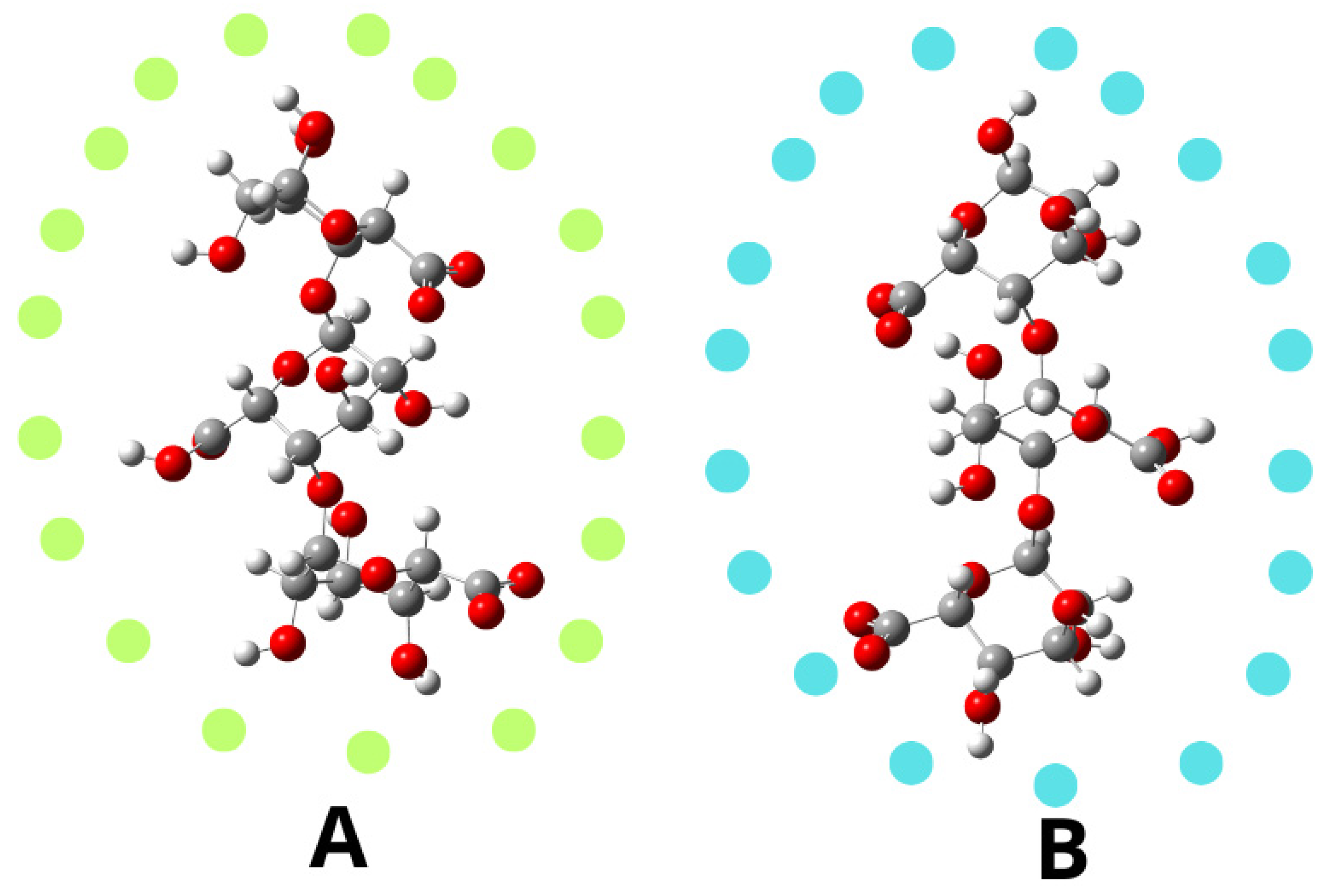
Minimal “pocket”-type models of the egg-box motif were constructed, representing two short opposing alginate segments (chain A and chain B) arranged in an approximately parallel configuration, so that the cation could be cooperatively coordinated by carboxylate oxygens belonging to both chains (interchain coordination) (
Figure 2). To isolate the effect of alginate microstructure on selectivity, two families of sites were considered: guluronate-rich regions (G-rich), modeled as segments with consecutive G–G–G units (triuronate per chain), and mannuronate-rich regions (M-rich), analogously modeled as M–M–M [
17,
18,
19]. The ends of each segment were capped to saturate valences and minimize edge effects arising from polymer truncation, while preserving the immediate chemical environment of the carboxylate site responsible for coordination.
The acid–base state of the model was fixed to represent conditions under which alginate operates as a polyanionic matrix: the carboxyl groups directly involved in coordination were modeled as deprotonated carboxylates (–COO
−). This choice ensures a physically consistent charge balance for complexes with divalent cations and allows direct comparison of free energies without introducing artifacts associated with unrealistic net charges [
20,
21,
22]. Consequently, coordination of M
2+ in the pocket, to a first approximation, leads to globally neutral complexes, which improves numerical stability of the calculations in a solvated medium and favors thermodynamic consistency in the evaluation of ion exchange.
2.3. Explicit Microhydration and the Ca2+ ↔ M2+ Exchange Reaction
The selectivity of the egg-box pocket was evaluated using an explicit thermodynamic scheme for ion exchange in the aqueous phase, formulated to preserve charge consistency and enable direct comparisons among divalent cations. In agreement with the multisite nature of the egg-box motif, the model was defined as binuclear, incorporating two metal centers per system, and each cation was represented in its hexaaquo microhydrated environment. In particular, the simultaneous substitution of two Ca
2+ ions by two contaminant M
2+ ions (M = Cu
2+, Ni
2+, V
2+, or Pb
2+) was modeled through the reaction [
23,
24]:
An integrated interpretation of the results showed that the system’s selectivity cannot be attributed to a single isolated descriptor, but rather to the balance between partial cation dehydration, the coordination affinity of the pocket oxygen atoms, the degree of geometric preorganization of the microenvironment, and the quality of noncovalent stabilization.
2.4. Calculation of the Free Energy of Exchange (Main Metric)
Selectivity was quantified through the free energy of exchange associated with the binuclear Ca
2+ ↔ M
2+ reaction in the egg-box motif, using Gibbs free energies in solution (G) obtained for each microhydrated species (hexaaquo) in aqueous medium. In particular, the following expression was calculated [
23,
24,
25,
26]:
2.5. Mechanistic Analysis: MEP and NCI/RDG
To connect thermodynamic selectivity (ΔGexch) to its electronic origin and to noncovalent contributions from the microenvironment, mechanistic analyses were carried out on the final geometries corresponding to the global minima in solution [
27,
28,
29]. First, the molecular electrostatic potential (MEP) of the empty pocket was evaluated to identify attractive regions dominated by carboxylates and to rationalize the spatial preference of the coordination site. Finally, descriptors based on noncovalent interaction regions (NCI) or on the IRI index were employed to visualize and compare cooperative contributions, including water–carboxylate hydrogen bonds and secondary contacts that stabilize the pocket and modulate the degree of partial dehydration of the cation during exchange. Complementarily, charge changes (Δq) at the metal centers and carboxylate oxygens were quantified using a single-population scheme across the full set of systems to ensure internal comparability among metals, blocks (G-rich vs. M-rich), and reference complexes [
29,
30,
31,
32].
2.6. Comparative Criteria and Scope of Interpretation
The comparative analysis was organized around four complementary levels: structural response of the pocket, assessed from metal–oxygen distances and the degree of first-sphere compaction; thermodynamic preference, assessed primarily from ΔGexch; electronic redistribution, examined through MEP maps and changes in Mulliken populations; and noncovalent stabilization, evaluated qualitatively by NCI/RDG patterns. Among these descriptors, ΔGexch was taken as the primary criterion for discussing selectivity, whereas the remaining quantities were used to rationalize, but not independently prove, the observed trends. In particular, Mulliken populations were used only for internal comparison across the same computational framework, given their known basis-set dependence. Likewise, MEP and NCI/RDG analyses were treated as descriptor-based tools for mechanistic interpretation rather than as direct measures of causal hierarchy.
2.7. Scope and Limitations of the Model
The present model isolates a minimal molecular picture of ion exchange and does not attempt to reproduce all physicochemical variables of real alginate matrices. The pockets were represented by capped binuclear clusters with fixed deprotonated coordinating carboxylates, explicit hexaaquo cations, and continuum solvation. As a result, effects associated with pH-dependent protonation, ionic strength, counterions, metal speciation, long-range polymer heterogeneity, and dynamic restructuring of extended gel networks are not explicitly included. These factors may alter the absolute exchange energetics and modulate the magnitude of the trends. Accordingly, the results should be interpreted as a controlled thermodynamic comparison of local G-rich and M-rich environments, not as a complete quantitative prediction of aqueous selectivity under all experimental conditions.
3. Results and Discussion
3.1. Structural and Vibrational Validation of the Egg-Box Model
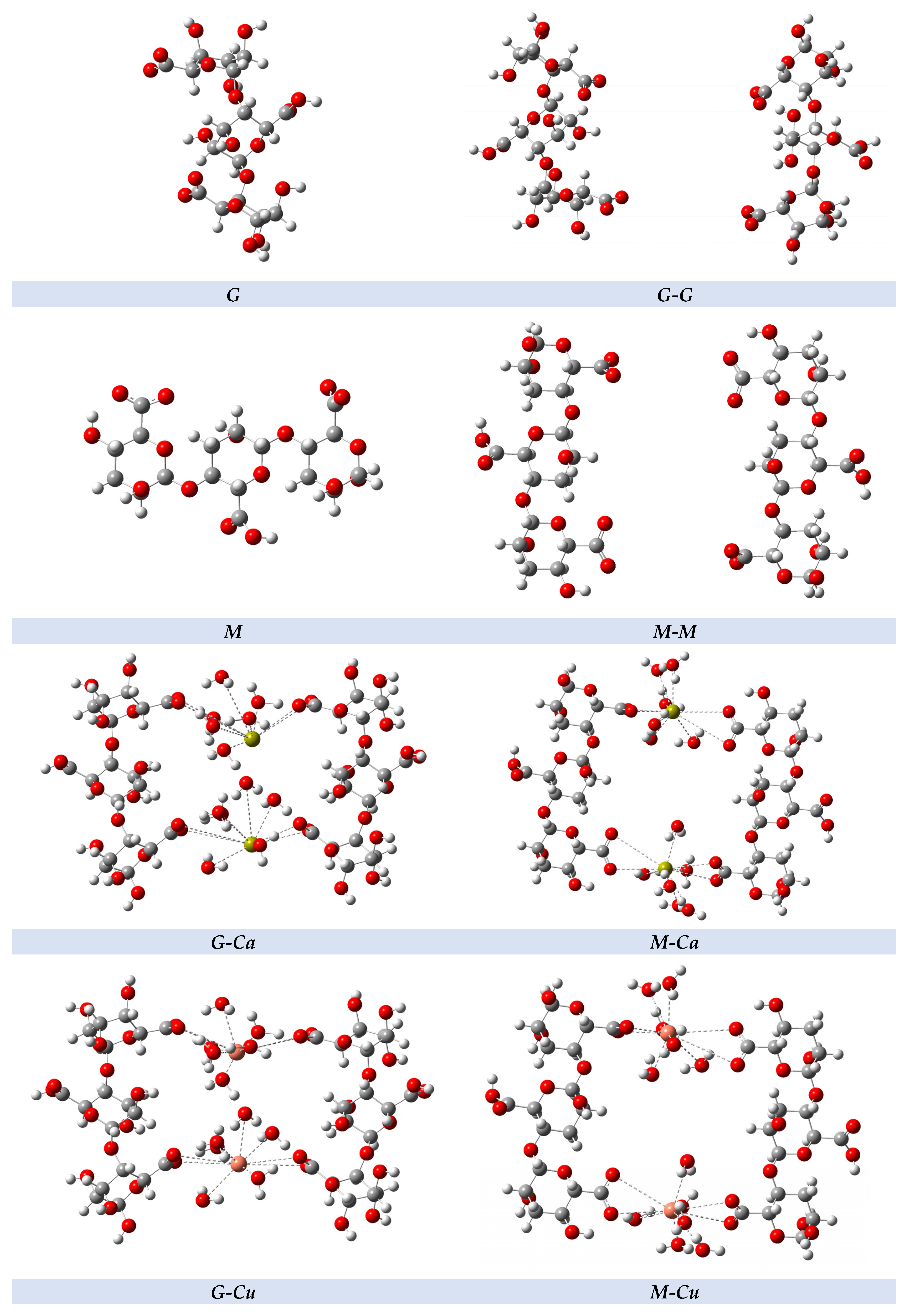
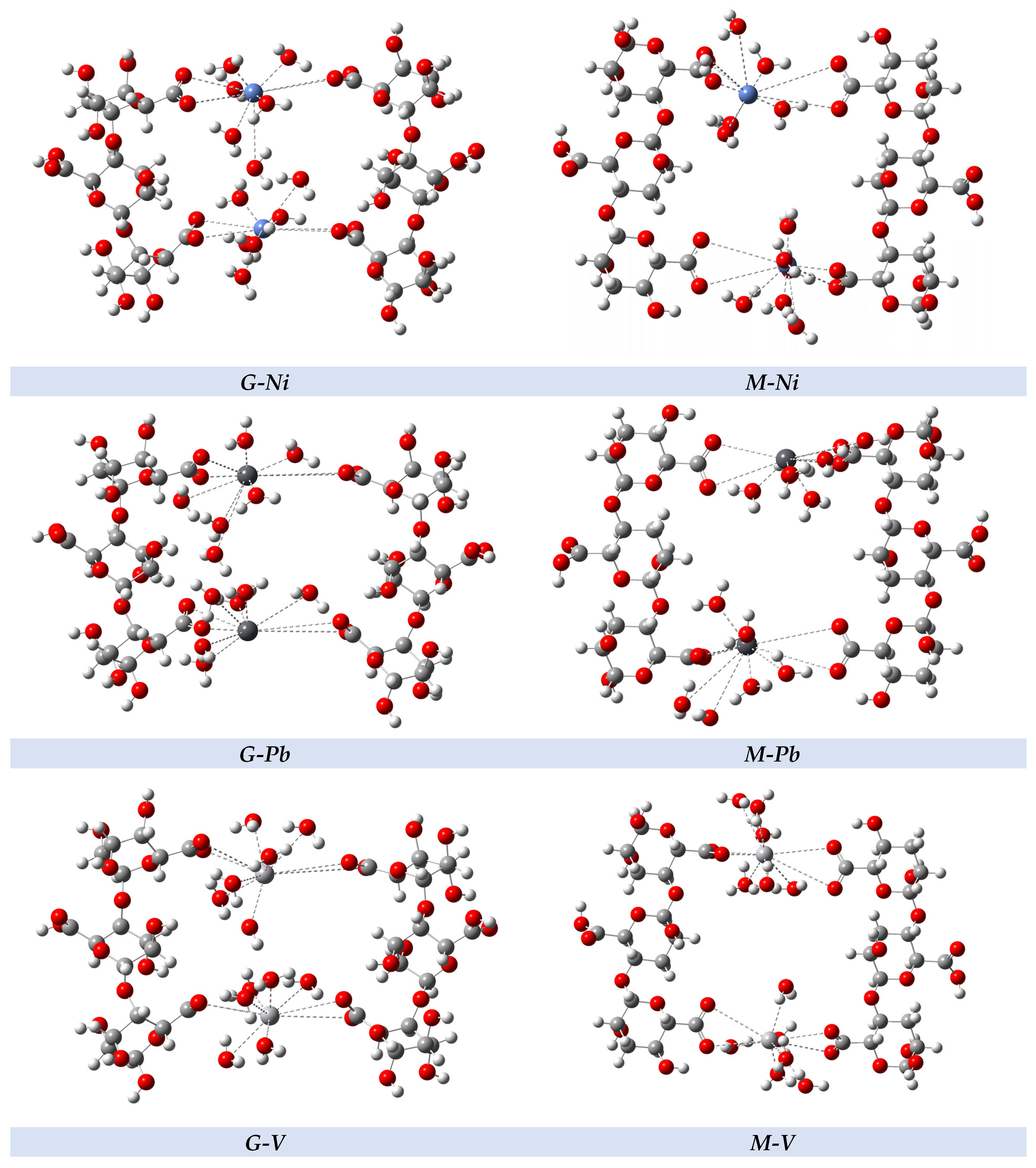
The optimized geometries of the egg-box models associated with the G-rich and M-rich microenvironments preserved the general structural motif expected for the coordination of divalent cations in alginate. In both cases, the optimization led to supramolecular arrangements in which a well-defined binding cavity between polysaccharide segments was retained, without loss of the overall pocket organization or disruption of the coordinating environment. This behavior indicates that the adopted model reproduces a structurally consistent representation of the egg-box motif in aqueous medium and provides an adequate geometric basis for the subsequent comparative analysis of the metallated complexes. The computational treatment was carried out at the M06-2X/LANL2DZ level with SMD implicit solvation in water, under the same methodological framework for the G-rich and M-rich series (
Figure 3).
Inspection of the optimized structures further showed that both the metal-free reference models and the complexes with Ca, Cu, Ni, Pb, and V maintain a topology compatible with the formation of differentiated coordinating pockets, as dictated by the local alginate sequence. In G-rich systems, the spatial arrangement of monomeric units favors more closed, geometrically preorganized cavities. In contrast, in the M-rich models, a more open organization is observed, although still suitable for hosting the metal center and sustaining coordination interactions with oxygen atoms from the biopolymer and water molecules in the immediate environment. From a structural standpoint, preservation of this general motif is essential, since it establishes that the observed differences among metals or between microenvironments do not arise from artifactual distortion of the model, but rather from intrinsic geometric responses of the chemical system under study.
Vibrational validation supported the consistency of these optimized geometries. Frequency analyses performed for representative complexes from both series did not detect any imaginary frequencies, consistent with assigning these structures as local minima on the potential energy surface within the employed modeling scheme. This observation supports the use of these geometries for subsequent thermodynamic and structural analysis. It allows this section to be established as a formal validation of the geometric framework of the study, without yet anticipating the detailed discussion of metal–oxygen distances, pocket compaction, or coordination specifics, which are developed in the following section.
3.2. Metal–Alginate Coordination Features Within the Pocket
Analysis of the optimized geometries showed that metal–alginate coordination in egg-box-type pockets depends jointly on the identity of the cation and on the sequential microenvironment of the polysaccharide. In general terms, replacement of Ca2+ by Cu2+, Ni2+, Pb2+, or V2+ modified the local compaction of the pocket, the distribution of metal–oxygen distances, and the relative contribution of carboxylate oxygens and water molecules in the first coordination sphere. Thus, the egg-box motif did not behave as a rigid cavity, but rather as an adaptable environment whose geometric response was specific for each metal.
The systems containing Ca
2+ retained the most open coordination of the entire series. In G-rich, the short Ca–O distances were distributed approximately between 2.20 and 2.61 Å, followed by secondary contacts in the 2.90–3.23 Å interval, which is consistent with a relatively loose coordination sphere and with significant participation of water in the immediate environment of the metal. In M-rich, the pattern was similar, with primary contacts between 2.39 and 2.56 Å and a second set of interactions around 3.06–3.10 Å. Consequently, Ca
2+ acted as the cation inducing the least contraction of the cavity, preserving a comparatively open pocket that remained structurally closer to the reference egg-box motif (
Table 1).
Replacement by Cu2+ produced a more marked reorganization, although not uniformly between the two pockets. In G-rich, one Cu center exhibited four short contacts in the 1.84–1.95 Å range. In contrast, the other showed two dominant contacts near 1.99 Å, accompanied by longer secondary interactions between 2.73 and 3.01 Å. This behavior indicates a substantial contraction of the coordinating environment and a clearly uneven site-to-site distribution within the same pocket. In M-rich, by contrast, insertion of Cu2+ was less efficient: each center essentially retained only one dominant short contact, at 1.92 Å and 2.28 Å, respectively, whereas the remaining distances shifted toward the 2.72–3.05 Å region. Therefore, although Cu2+ can form short interactions with the pocket, its coordination in M-rich proved to be more extensive and less cooperative than in G-rich.
The behavior of Ni2+ was the most regular within the studied series. In G-rich, both Ni centers exhibited three well-defined short contacts between 1.87 and 1.91 Å, accompanied by an additional somewhat longer interaction in the 2.48–2.84 Å range. In M-rich, compaction was even clearer, with four Ni–O distances per site between 1.87 and 1.94 Å and only a few secondary contacts above 2.5 Å. This pattern suggests that Ni2+ is the cation that best accommodates geometrically within the M-rich pocket, resulting in a more homogeneous and better-defined first coordination sphere than that observed for Ca2+, Cu2+, or Pb2+.
In the case of Pb2+, coordination was characterized by a greater dispersion of distances and by more evident structural anisotropy. In G-rich, one Pb center displayed four primary contacts between 2.23 and 2.57 Å. In contrast, the second showed only three short contacts between 2.24 and 2.27 Å, followed by an abrupt separation toward distances above 3.6 Å. In M-rich, this irregularity was maintained and even accentuated: one center reached five primary contacts between 2.28 and 2.78 Å, whereas the other retained four contacts in the 2.26–2.49 Å interval, accompanied by longer interactions extending up to 3.21–3.64 Å. Taken together, these results are consistent with broader, more flexible, and clearly asymmetric coordination, compatible with a hemidirectional environment or, at least, with a non-isotropic distribution of oxygen donors around Pb2+.
The V2+ series showed the most open and least pocket-integrated behavior. In G-rich, one V center displayed two very similar short contacts, at 2.08 and 2.08 Å, followed by a separation toward distances close to or above 3.0 Å. The second center showed a single clearly short contact at 2.07 Å, accompanied by a longer interaction at 2.63 Å and then by contacts above 2.97 Å. This pattern indicates a poorly developed first coordination sphere, dominated by a limited number of strong interactions and with little overall compaction of the environment. In M-rich, this tendency became even more evident: one V center retained one short contact at 2.01 Å and a second contact at 2.55 Å, whereas the other displayed only one clearly short interaction at 2.01 Å, and the remaining distances appeared above 2.94 Å. Unlike Ni2+ or even Cu2+, vanadium did not show deep insertion or a well-defined multidentate coordination with the pocket, but rather a more diffuse environment sustained predominantly by a very limited number of short contacts.
The nature of the oxygen atoms Involved also showed relevant differences among metals. In Ca2+, coordination remained mixed and open, involving the carboxylate oxygens and the hydrated environment. In Cu2+ and Ni2+, the shortest contacts were concentrated within a more compact first sphere, reflecting stronger interactions with pocket donors. In Pb2+, although the effective coordination was broad, the angular distribution of contacts was much less homogeneous. In V2+, by contrast, the shortest contacts were in several cases dominated by oxygen atoms associated with water molecules. In contrast, interaction with carboxylate oxygens was more limited or appeared at relatively longer distances. This suggests that, structurally, V2+ retains a stronger preference for an aqua-dominated environment and a lower capacity to integrate cooperatively into the alginate cavity.
3.3. Thermodynamic Selectivity of Ion Exchange in G-Rich and M-Rich Pockets
The thermodynamic selectivity of ion exchange was analyzed by taking Ca
2+ as the reference cation in the G-rich and M-rich pockets. To avoid confusion between the mannuronate-rich pocket and the competing metal, the former is denoted as
PM, whereas the guluronate-rich pocket is denoted as
PG. Based on this scheme, Δ
Eexch, Δ
Hexch, and Δ
Gexch were obtained, with Δ
Gexch serving as the main descriptor of selectivity. In this context, negative Δ
Gexch values indicate that displacement of Ca
2+ by the studied metal is thermodynamically favorable, whereas positive values indicate a preference of the pocket to retain calcium. The calculated values for both microenvironments are summarized in
Table 2.
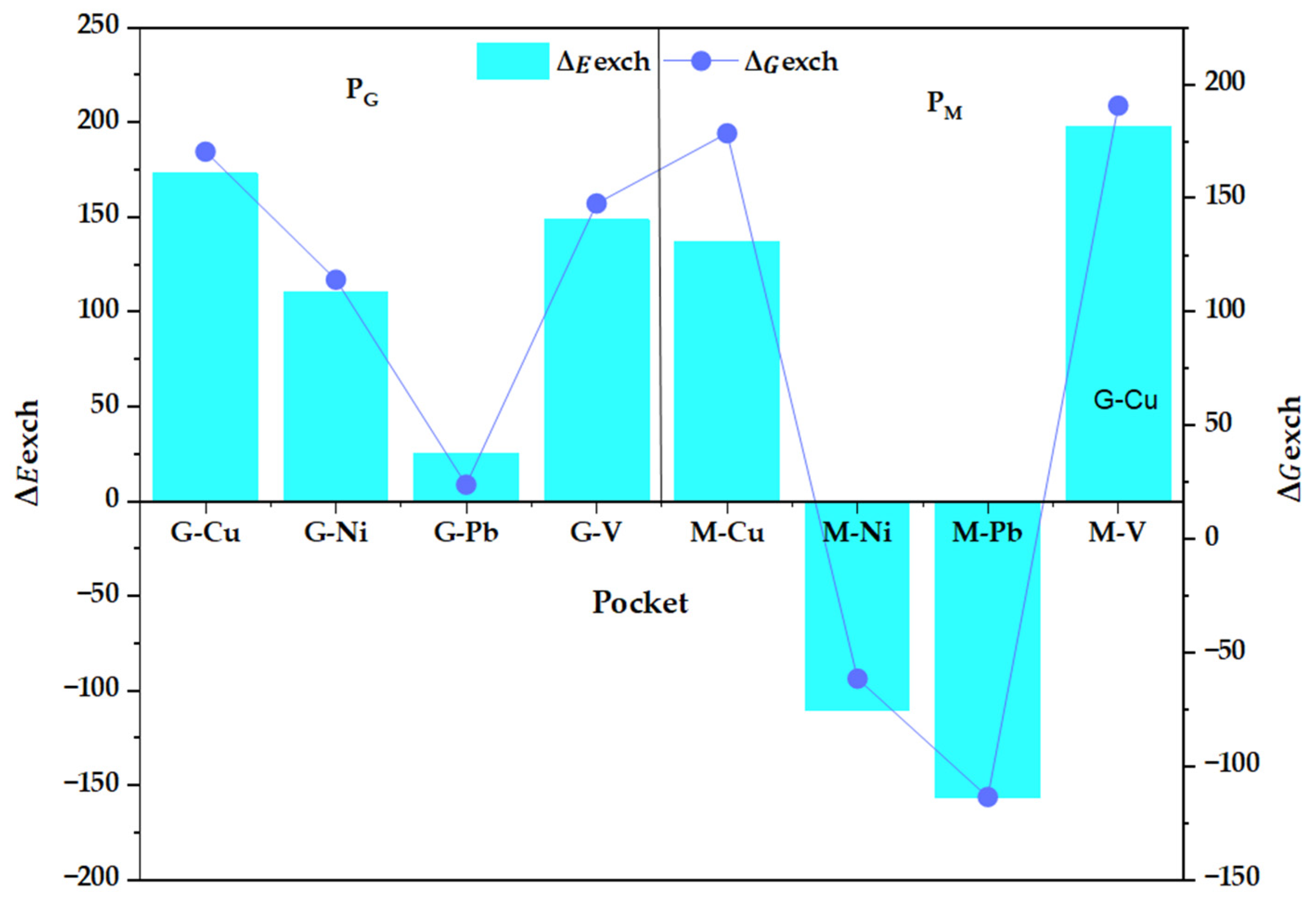
The results reveal a marked dependence of ion exchange on the coordination microenvironment of the egg-box motif. In pocket PG, corresponding to the G-rich environment, all ΔGexch values were positive, indicating that none of the evaluated metal cations favorably displaces Ca2+ in this cavity. However, the magnitude of this thermodynamic penalty was not uniform. Among the studied metals, Pb2+ showed the lowest free-energy cost of exchange, with a value of 24.33 kcal mol−1, followed by Ni2+ (114.55 kcal mol−1), V2+ (148.05 kcal mol−1), and Cu2+ (170.86 kcal mol−1). Consequently, the relative ease of substitution in this environment followed the order Pb2+ > Ni2+ > V2+ > Cu2+. Nevertheless, in all cases, the Ca2+ complex remained the thermodynamically most stable species, indicating that the guluronate-rich pocket is a highly conservative environment for metal exchange.
In contrast, pocket PM, associated with the M-rich environment, exhibited markedly different thermodynamic behavior. In this cavity, Pb2+ and Ni2+ exhibited negative ΔGexch values, −113.00 and −60.93 kcal mol−1, respectively, indicating that exchange by these cations is thermodynamically favored within the present model. By contrast, Cu2+ and V2+ retained high positive ΔGexch values, 178.95 and 191.07 kcal mol−1, respectively, confirming that their incorporation remains thermodynamically unfavorable in this environment. Thus, the selectivity of the M-rich pocket was defined by the order Pb2+ > Ni2+ >> Cu2+ > V2+, with a very marked preference for Pb2+ and Ni2+, whereas Cu2+ and V2+ remained energetically excluded.
Comparison between both microenvironments confirms that the local alginate sequence exerts a decisive effect on exchange selectivity. Upon going from PG to PM, the ΔGexch values decreased by 175.48 kcal mol−1 for Ni2+ and by 137.33 kcal mol−1 for Pb2+, shifting these exchanges from unfavorable to favorable within the present model. This change reveals that the mannuronate-rich environment differentially stabilizes these two cations relative to calcium. In contrast, for Cu2+, an increase of 8.09 kcal mol−1 in the free-energy penalty was observed upon going from PG to PM, indicating that the M-rich pocket does not provide additional stabilization for this ion. Similarly, V2+ showed a 43.02 kcal mol−1 difference between the two pockets, with an increase in ΔGexch in the M-rich environment, indicating that this cavity also does not favor its incorporation and, in fact, makes it less favorable than in the G-rich environment.
From a global perspective, PG behaves as a more restrictive and conservative domain with respect to Ca2+ retention, since no metal can displace it favorably. In contrast, PM generates a defined selectivity window in which Pb2+ and Ni2+ are clearly favored, whereas Cu2+ and V2+ remain thermodynamically disfavored. This behavior confirms that the local microstructure of alginate constitutes a determining factor in ion-exchange selectivity. In addition, the qualitative agreement observed among ΔEexch, ΔHexch, and ΔGexch is internally consistent with this interpretation. Nevertheless, the comparative analysis should be based primarily on ΔGexch, since this parameter captures the total thermodynamic balance of the process more comprehensively and therefore constitutes the most rigorous descriptor for discussing exchange spontaneity and preference.
Figure 4 provides a compact visual summary of the thermodynamic trends reported in
Table 2 and is included to facilitate direct comparison between the two local microenvironments. Whereas
Table 2 contains the full numerical values of ΔEexch, ΔHexch, and ΔGexch,
Figure 4 highlights the relative ordering of the metals, the sign of the exchange free energy, and the marked contrast between P
G and P
M in a form that is immediately accessible at a glance. In this sense, the figure is not intended to replace the table, but to make the microenvironment-dependent change in selectivity easier to identify.
In the PG pocket, both ΔEexch and ΔGexch remain positive for all evaluated cations, showing that the Ca2+-containing state remains thermodynamically preferred within this environment. However, the magnitude of the penalty is not uniform, and the figure makes this discrimination visually evident. In particular, Pb2+ exhibits the lowest positive values, followed by Ni2+, V2+, and Cu2+, which is consistent with the relative ease of substitution inferred from the numerical data. Thus, although none of the evaluated metals is favored over Ca2+ in PG, the figure clearly shows that the G-rich pocket does not respond equally to all cations.
The behavior of the P
M pocket is clearly different. In this case,
Figure 4 allows immediate visualization of the sign inversion for Ni
2+ and Pb
2+, especially in ΔGexch, indicating that exchange by these cations is thermodynamically favored within the present model. Pb
2+ shows the most pronounced stabilization, followed by Ni
2+, whereas Cu
2+ and V
2+ retain strongly positive ΔGexch values and therefore remain disfavored. The main value of the figure lies precisely in making this contrast between P
G and P
M visually explicit: the M-rich environment does not generally enhance affinity for every cation, but instead selectively stabilizes Ni
2+ and Pb
2+ while maintaining Cu
2+ and V
2+ as unfavorable exchanges.
Taken together,
Table 2 and
Figure 4 support the same interpretation at different levels. The table provides the quantitative thermodynamic detail, whereas the figure emphasizes the comparative pattern of selectivity across metals and pockets. Read in this way,
Figure 4 helps clarify that the sign inversion observed for Ni
2+ and Pb
2+ in P
M is best interpreted as a consequence of pocket-specific stabilization, rather than as a simple intrinsic ranking of isolated metal affinity.
3.4. Electronic Origin of Selectivity: MEP, Charge Transfer, and Polarization
The electronic origin of egg-box selectivity was interpreted from the distribution of molecular electrostatic potential and the charge redistribution induced by metal coordination. In the empty pocket, the cavity concentrates its most attractive regions on the carboxylate oxygens oriented toward the interior. In contrast, the zones associated with protonated hydroxyl groups and the hydrocarbon contour are comparatively less favorable for cation binding. In this sense, selectivity does not depend solely on the presence of an anionic cavity but also on the pocket’s ability to cooperatively redistribute electron density after coordination, thereby simultaneously stabilizing the metal and the donor oxygens.
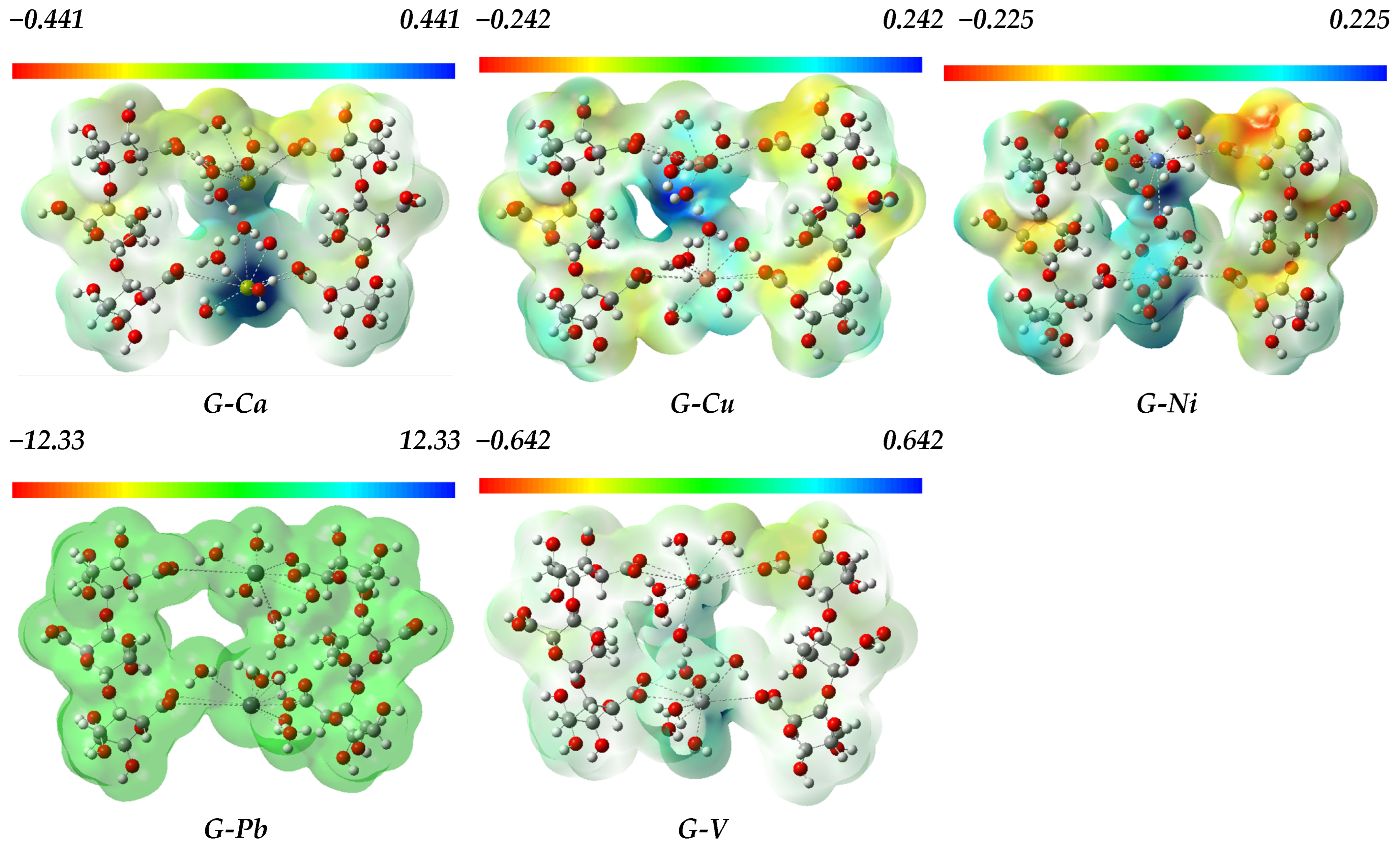
The molecular electrostatic potential maps of the G-rich series show that coordination with Ca
2+ generates a relatively simple pattern, characterized by a strong accumulation of positive potential localized around the metal centers and an outer surface that is mostly near neutrality, as shown in
Figure 5 for G-Ca. This behavior is consistent with the more structural than selective role of Ca
2+ in alginate, since the cation organizes the pocket but induces only moderate polarization of the electronic environment. By contrast, in the same
Figure 5, the G-Cu, G-Ni, G-Pb, and G-V systems exhibit a more heterogeneous electrostatic surface, with more pronounced gradients between donor regions and electron-depleted zones, thus revealing differential pocket polarization dependent on metal identity.
Charge transfer confirms that this polarization does not follow a single trend across the entire series. In the G-rich environment, the Cu centers have Mulliken charges of approximately +0.43 and +1.04, indicating a strongly asymmetric electronic redistribution between the two metal sites. This result is consistent with
Figure 5, which shows intense but spatially unbalanced polarization around the two coordination centers. In turn, G-Ni presents charges of +0.94 and +0.95, much closer together, indicating more homogeneous polarization of both centers, in agreement with the more regular distribution of electrostatic potential also observed in
Figure 5. In the case of G-V, the charges of +1.42 and +1.33 imply more limited attenuation relative to the formal +2 state, suggesting less efficient charge transfer. Consistently,
Figure 5 shows for G-V a more diffuse and less cooperative potential distribution, without such effective electronic integration of the metal within the pocket.
The behavior of Pb
2+ requires a differentiated interpretation. Mulliken charges of Pb in egg-box-type systems are higher than those observed for Ni, indicating a less intense net charge transfer from the pocket to the metal. However,
Figure 5 shows that, in G-Pb stabilization, the stabilization does not disappear but instead adopts a distinct electrostatic pattern: polarization is broader, more extended, and less localized at discrete points within the cavity. This suggests that stabilization of Pb
2+ does not depend so much on maximizing localized electron donation as on the better accommodation of a more polarizable species within a flexible and anisotropic environment.
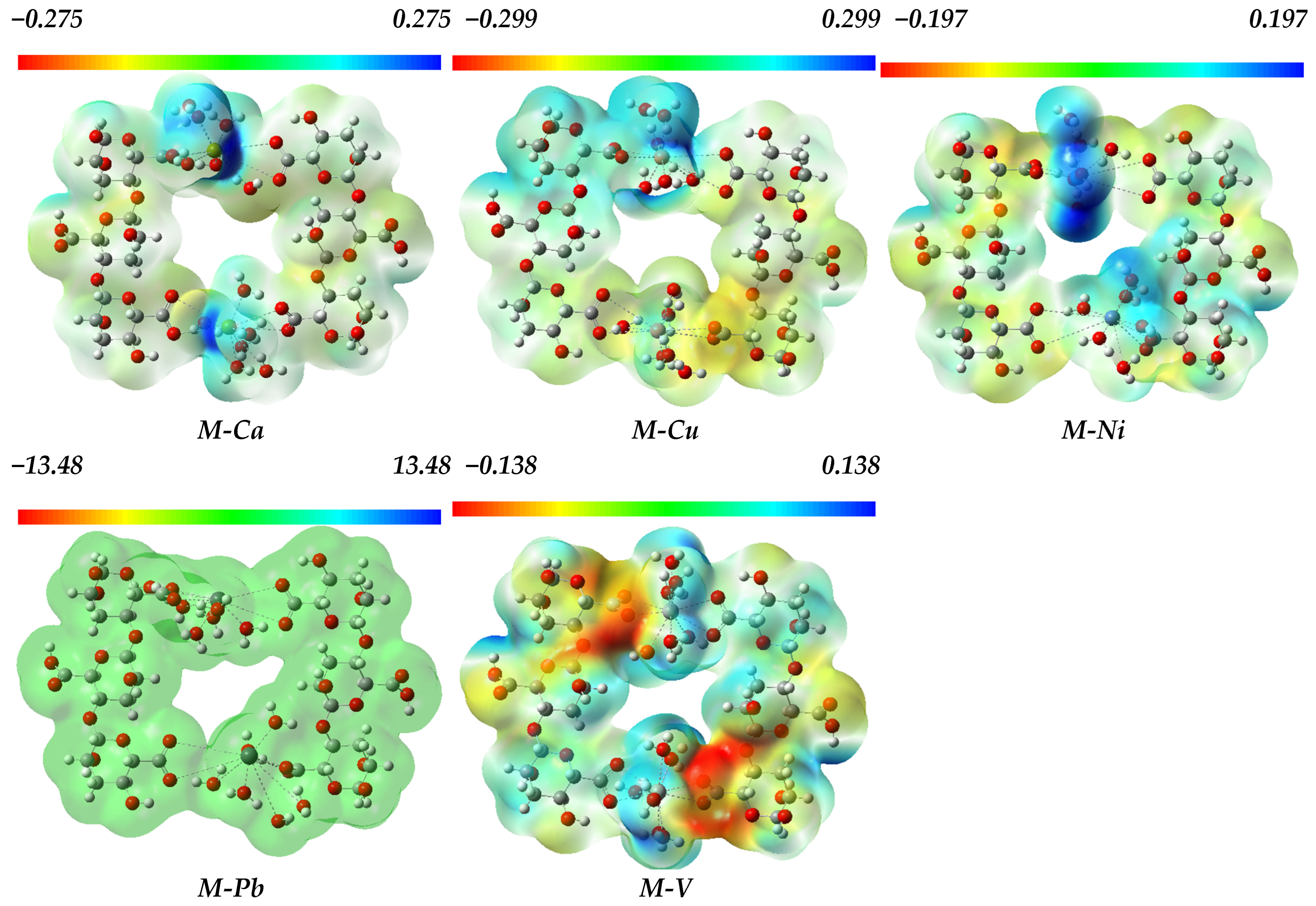
This difference becomes even more evident when analyzing the M-rich series, presented in
Figure 6. In M-Ca, the electrostatic potential retains a relatively ordered pattern localized around the metal centers, maintaining the structural role of calcium within the pocket. However, upon replacing Ca
2+ with Ni
2+,
Figure 6 reveals a more cooperative and more evenly distributed polarization around the two coordination centers. This observation is consistent with the Mulliken charges for M-Ni, approximately +0.81 and +0.81, indicating greater attenuation of cationic character than in G-Ni. In electronic terms, the P
M pocket favors more intense charge donation to Ni
2+ and does so in an almost equivalent way at both sites. This combination of greater charge transfer and lower asymmetry is consistent with the thermodynamic stabilization observed for Ni
2+ in the M-rich environment and provides complementary mechanistic support for that trend.
In M-Cu, by contrast, the charges of the two centers are approximately +0.96 and +0.50, confirming that electronic redistribution remains markedly unequal. This asymmetric character is also reflected in
Figure 6, where the M-Cu map shows more fragmented, less symmetric regions of accumulation and depletion than those observed in the M-Ni map. Consequently, although charge transfer to the metal occurs, it is not distributed cooperatively throughout the cavity, thereby reducing the stabilizing efficiency of the pocket and helping rationalize the unfavorable character of exchange in this system.
The case of M-V is particularly illustrative. The Mulliken charges calculated for V in M-rich are approximately +1.42 and +1.33, practically in the same range as in G-V, indicating that the change in pocket barely modifies the net amount of density transferred to the metal. However, in
Figure 6, the M-V system exhibits a spatially more abrupt polarization, with intense positive and negative regions, but it is poorly cooperative and poorly distributed across the cavity. This combination of limited charge transfer and poorly damped polarization explains why V
2+ is not effectively stabilized in either microenvironment and why its incorporation is particularly unfavorable in pocket P
M.
Analysis of Pb
2+ in M-rich again leads to a different reading. In
Figure 6, the M-Pb system does not exhibit polarization as localized as M-Ni, but rather a more extended and less punctual response, consistent with the high polarizability of the cation and with the anisotropic coordination discussed in the structural section. Thus, stabilization of Pb
2+ does not appear to depend on particularly intense charge transfer, but rather on the pocket’s ability to redistribute the electrostatic field flexibly, without excessively concentrating it in a single domain.
Taken together,
Figure 5 and
Figure 6 suggest that selectivity in the egg-box system is associated with two complementary electronic tendencies rather than with a single dominant descriptor. One is the ability of the pocket to donate and redistribute electron density in a relatively cooperative way, as observed more clearly for Ni
2+ in P
M. The other is the ability of the microenvironment to accommodate a broader and more flexible polarization pattern, which appears to be particularly relevant for Pb
2+. By contrast, Cu
2+ and V
2+ do not combine these features efficiently: Cu
2+ shows marked asymmetry in electronic redistribution between sites, whereas V
2+ remains weakly integrated and poorly stabilized. Because these descriptors are qualitative or semi-quantitative, they are interpreted here as mechanistic support consistent with the thermodynamic results, rather than as direct proof of a unique causal hierarchy.
3.5. Characterization of Noncovalent Interactions in Metal–Oxygen Complexes by NCI/RDG
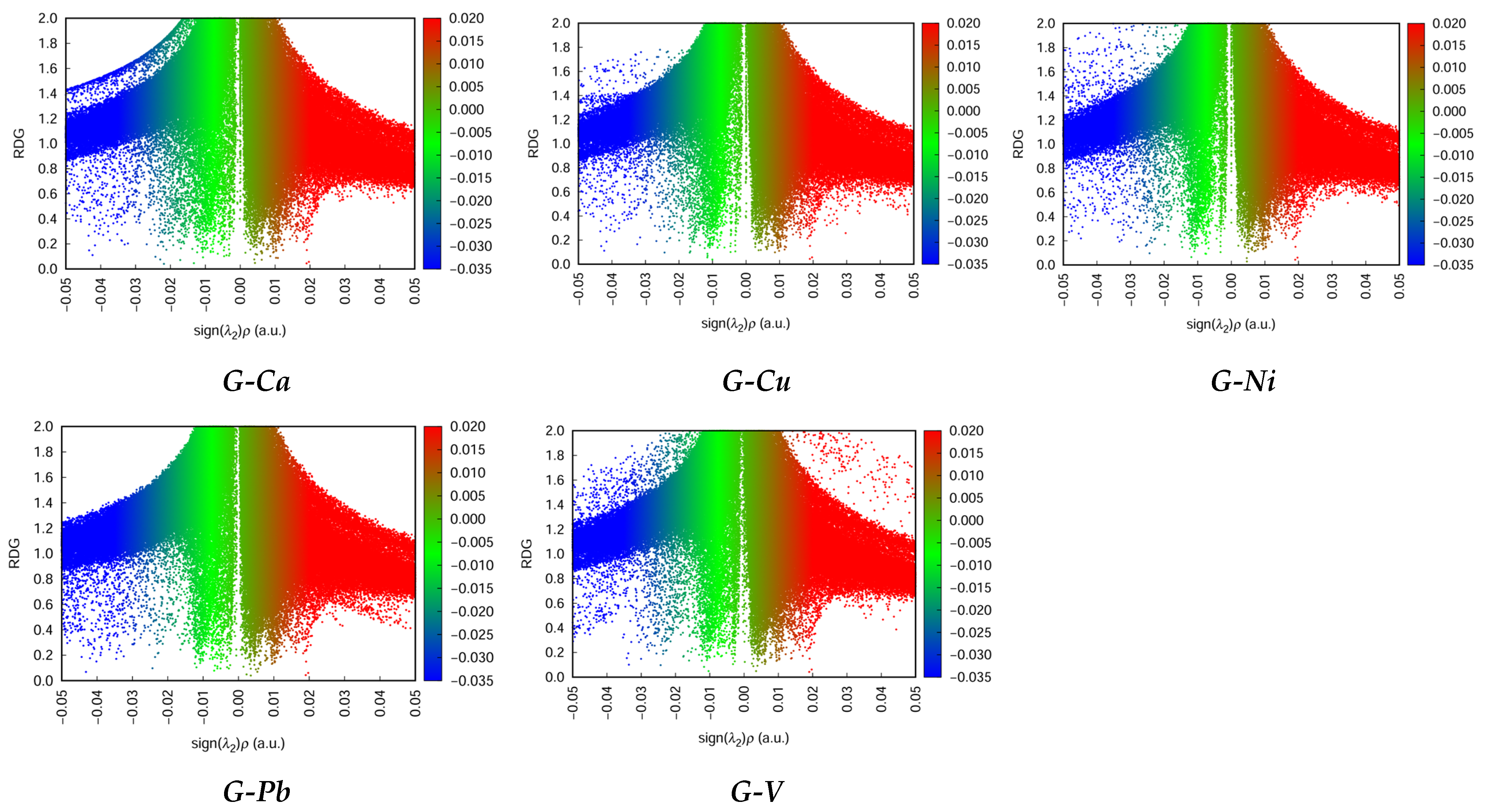
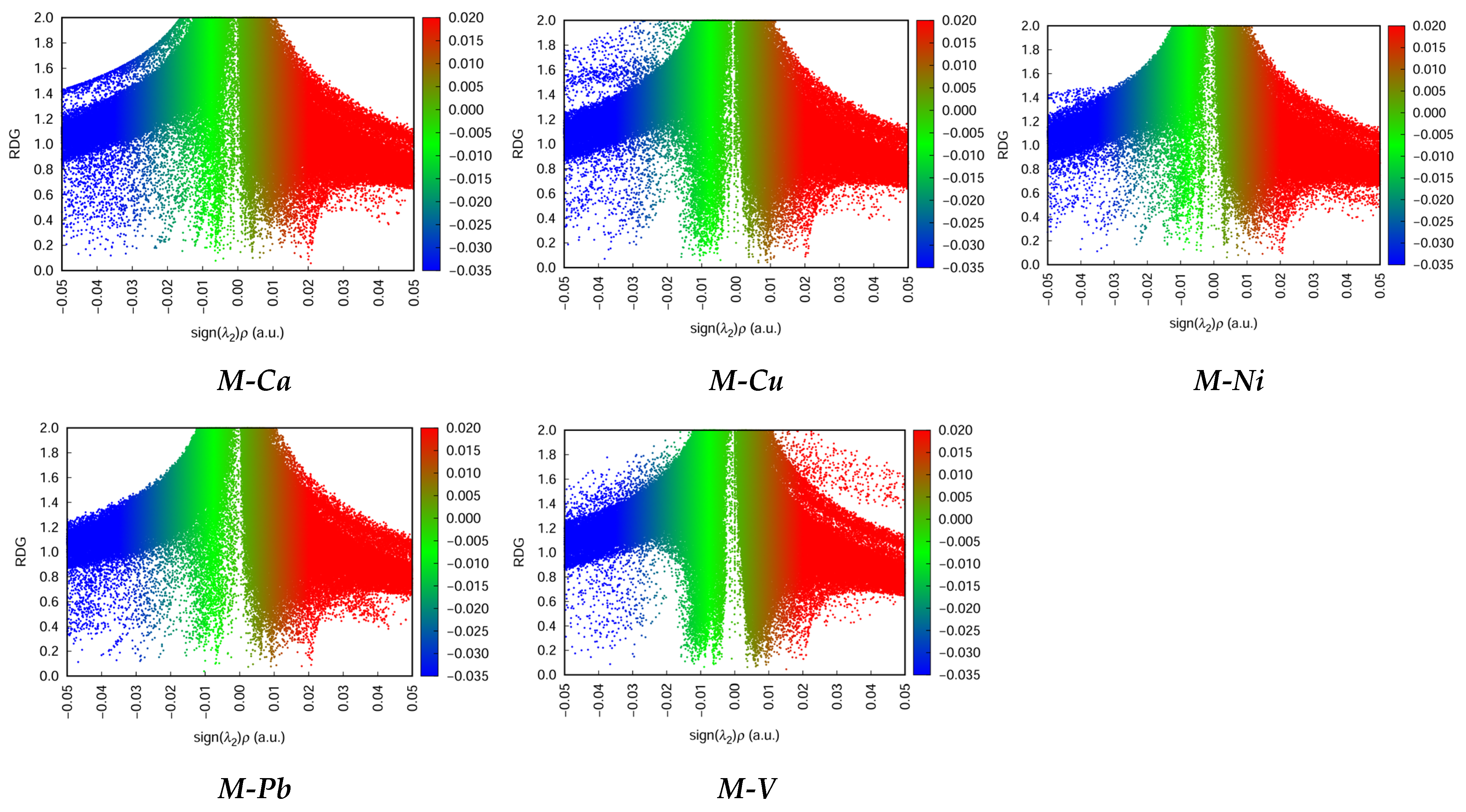
The nature of the interactions contributing to stabilization of the metal–alginate complexes was examined by NCI/RDG analysis, which allows qualitative identification of the relative contribution of attractive, dispersive, and repulsive contacts from the RDG distribution as a function of sign(λ2)ρ. In this formalism, negative sign(λ2)ρ values are associated with attractive interactions, values close to zero reflect weak dispersive or van der Waals contacts, and positive values are related to regions of steric repulsion. Therefore, these diagrams do not replace thermodynamic analysis, but they do provide a complementary reading of the way the pocket locally distributes noncovalent interactions around the metal.
In the P
G series, shown in
Figure 7, all systems exhibit a significant population of points in the region near sign(λ
2)ρ ≈ 0, indicating that stabilization of the egg-box motif includes a significant contribution of weak interactions distributed among the polysaccharide backbone, water molecules, and second-order metal–oxygen contacts. However, the shape and extent of the point cloud in the negative region vary among cations, indicating that the quality of the attractive interactions is not uniform across all complexes. In G-Ca, the distribution is relatively balanced and consistent with an open coordination environment dominated by mild attractions and an important dispersive contribution. In G-Ni, the negative region appears more organized and better defined, in agreement with the more compact and regular coordination previously described for this metal. In G-Cu, although attractive contacts are also observed, the distribution is more heterogeneous, which is consistent with the structural and electronic asymmetry already discussed for this system.
The case of G-Pb requires a somewhat different interpretation. In
Figure 7, its NCI/RDG profile does not necessarily suggest stronger attractive interactions than those of G-Ni, but rather a more diffuse, less localized stabilization, in line with the high polarizability and anisotropic coordination of Pb
2+. This observation does not contradict the fact that Pb
2+ is the least unfavorable cation in terms of Δ
Gexch within P
G; on the contrary, it suggests that its relative advantage in this pocket does not arise from a more compact network of attractive interactions, but from a more flexible electrostatic and noncovalent accommodation of the environment. In G-V, in turn, the distribution remains less concentrated in the attractive region. It shows a more diffuse contribution, consistent with the cation’s lower structural integration in the pocket.
Figure 7 indicates that, although all P
G complexes remain thermodynamically unfavorable relative to the calcium state, the local pattern of noncovalent stabilization does discriminate among metals and follows the structural and electronic differences already observed.
The P
M series, shown in
Figure 8, exhibits more pronounced changes in the organization of noncovalent interactions. In M-Ni, the negative region appears more defined and better consolidated than in the other systems of this pocket, which is consistent with the formation of a more regular first coordination sphere and with the thermodynamically favorable stabilization already demonstrated for this complex. In M-Pb, a significant attractive contribution is also observed, although distributed more broadly and less compactly than in M-Ni. This behavior is consistent with the previous interpretation, according to which Pb
2+ stabilization is not due to a particularly intense localized interaction, but rather to a combination of flexible polarization and anisotropic structural accommodation. Thus, both M-Ni and M-Pb exhibit NCI/RDG signatures compatible with their favorable Δ
Gexch, albeit through non-equivalent stabilization modes.
By contrast, M-Cu and M-V exhibit a less favorable distribution from the noncovalent standpoint. In both systems, the attractive contribution appears less organized and is accompanied by greater dispersion toward regions of less favorable character, suggesting a less cooperative interaction network within the pocket. In M-Cu, this response is consistent with asymmetric coordination and unequal electronic redistribution previously described. In contrast, in M-V, it aligns with the lower geometric integration of the cation and the strong thermodynamic penalty observed in this system. In this way,
Figure 8 supports the idea that pocket P
M does not indiscriminately favor any metal, but rather generates a noncovalent environment particularly propitious for Ni
2+ and Pb
2+, whereas Cu
2+ and V
2+ maintain a less efficient fit.
It is important to note that NCI/RDG diagrams must be interpreted qualitatively and complementarily, not as a direct metric of selectivity. The relative stability of each complex does not depend exclusively on the local intensity of attractive interactions, but on the total balance among geometric reorganization, electronic polarization, charge transfer, and global thermodynamic contributions. Therefore, the presence of an appreciable negative region in the NCI analysis does not necessarily imply that its exchange is spontaneous. This point is particularly relevant in PG, where all metals show some degree of local stabilization, but none thermodynamically surpasses the Ca2+ complex.
Figure 7 and
Figure 8 show that the egg-box motif’s selectivity also has a well-defined noncovalent dimension. In P
G, the differences among metals are expressed mainly as variations in the local organization of attractive interactions, although the calcium state remains the most stable overall. In P
M, by contrast, the noncovalent network reorganizes more efficiently for Ni
2+ and Pb
2+, reinforcing stabilization of the exchanged state already evidenced in the thermodynamic analysis. Thus, the NCI/RDG study is consistent with the structural, electronic, and energetic results discussed in the previous sections and confirms that the system’s selectivity arises from coupling among coordination geometry, environmental polarization, and the cooperative nature of noncovalent interactions.
When the NCI/RDG data are considered together with the structural and thermodynamic results, a consistent pattern emerges. Favorable exchange in PM is not associated merely with the presence of attractive contacts, but with how efficiently those contacts are distributed throughout the hydrated pocket. Ni2+ benefits from a more compact and coherent network of short-range attractive interactions, whereas Pb2+ is stabilized by a broader but still well-organized distribution of noncovalent contacts compatible with its anisotropic coordination. In contrast, Cu2+ and V2+ exhibit either more fragmented or less cooperative interaction patterns, which helps explain why local coordination is not converted into a favorable global ΔGexch. Therefore, the NCI/RDG analysis should be read as complementary evidence that the PM pocket stabilizes some incoming cations more effectively than PG because it supports a more productive coupling between coordination and secondary interactions.
3.6. Integrated Mechanistic Discussion of Selectivity in the Egg-Box Model
Taken together, the structural, thermodynamic, and electronic results show that a single factor does not govern selectivity of the egg-box motif, but by the balance among four coupled contributions: the cost of partial dehydration of the cation upon leaving its hexaaquo environment, its intrinsic affinity for the donor oxygens of the pocket, the degree of geometric preorganization imposed by the alginate microsequence, and the additional stabilization provided by the network of noncovalent interactions in the microenvironment. Consequently, the spontaneity of Ca2+ ↔ M2+ exchange cannot be interpreted solely in terms of metal–carboxylate electrostatic attraction, but rather as the result of a competition between penalties and compensations that depend both on metal identity and on the type of pocket.
Within this framework, pocket PG behaves as both a highly preorganized cavity and a more conservative one toward exchange. Its more closed geometry favors retention of the Ca2+ state, since any incoming metal must incur a reorganization and partial dehydration cost that is not always compensated by the resulting coordination. This explains why, even when some cations develop short M–O contacts or induce appreciable electronic polarization, all exchanges in PG remain thermodynamically unfavorable. In other words, geometric preorganization of the guluronate-rich environment does not automatically translate into higher affinity for any divalent cation; rather, it defines a cavity optimized to retain the reference calcium state.
Pocket PM, by contrast, shows a more adaptable response. Although its organization is less closed than that of PG, this greater conformational flexibility allows more efficient redistribution of coordination, electronic polarization, and the network of weak interactions when the incoming metal is compatible with the environment. Therefore, PM should not be interpreted as an intrinsically stronger pocket, but rather as a microenvironment that compensates more effectively for the cost of partial dehydration for certain specific cations. The central difference between the two pockets thus lies not in a supposed general superiority of one over the other. Still, in the way each transforms the local geometry and electronic field of alginate into effective stabilization of the exchanged state.
The case of Ni2+ clearly illustrates this logic. In PG, nickel develops relatively compact and ordered coordination, but this local gain is not enough to overcome the stability of the calcium complex. In PM, by contrast, the metal attains the most regular coordination sphere of the entire series, with short, homogeneous Ni–O contacts, more balanced charge transfer between the two metal sites, and an NCI/RDG signature compatible with a more cooperative, attractive network. Thus, for Ni2+, the M-rich environment can compensate simultaneously for the partial loss of hydration and the cost of pocket reorganization, so that coordination affinity and noncovalent stabilization converge in the same direction. The final result is that the exchange changes from unfavorable in PG to favorable in PM.
Pb2+ responds through a different mechanism. Its stabilization does not appear to depend on more compact coordination or on especially intense charge transfer, but rather on its high polarizability and its capacity to accommodate in anisotropic and flexible environments. In PG, this compatibility reduces the exchange penalty more than for any other metal, although it does not reverse the sign of ΔGexch. In PM, however, the cavity provides an environment sufficiently malleable to absorb the coordinative anisotropy of Pb2+ and to redistribute the electrostatic field without excessively concentrating it. Therefore, the advantage of Pb2+ does not arise from a locally more intense metal–oxygen interaction, but from better global compatibility among effective size, polarizability, flexible coordination, and diffuse noncovalent stabilization. This combination explains why it is the most favored cation in the mannuronate-rich pocket.
The behavior of Cu2+ confirms that the presence of short contacts alone does not guarantee favorable exchange. Although this metal can induce local contraction and develop intense M–O interactions, both the structure and the electronic analysis show that such stabilization is markedly asymmetric between the two metal sites. Consequently, the coordination gain remains localized and does not translate into cooperative reorganization of the entire cavity. In neither PG nor PM does the pocket succeed in globally compensating for the cost associated with calcium substitution. From this perspective, Cu2+ represents a case in which local affinity for certain pocket oxygens exists. Still, it does not become a net thermodynamic advantage because stabilization is incomplete, uneven, and poorly distributed.
The case of V2+ marks the least favorable extreme of the set. Its coordination remains more open and more dependent on the aqueous environment, with limited integration into the pocket and less evidence of electronic or noncovalent cooperation. This suggests that the cost of partial dehydration is not adequately compensated by coordination with alginate, either in PG or in PM. In fact, the more aqua-dominated character of its first sphere, the relatively limited charge transfer, and the less efficient organization of the NCI/RDG pattern all converge in the same direction: vanadium perturbs the pocket, but fails to incorporate into it favorably. In mechanistic terms, V2+ simultaneously combines the three least advantageous conditions for exchange: poorer geometric fit, lower electronic integration, and lower noncovalent cooperation.
Thus, the role of Ca2+ as the reference state is chemically revealing. Calcium is not simply the initial cation of the model, but the ion that best expresses the structural logic of the classical egg-box: open coordination, high compatibility with the cavity, and sufficient stabilization without requiring extreme reorganization of the pocket. For a contaminant metal to displace it, it is not enough to form short contacts or to strongly polarize the environment; it must recover, through coordination and cooperative stabilization, the cost of partially abandoning its own hydration shell and the cost of perturbing the pocket architecture. Only Ni2+ and Pb2+ achieve this in PM, and they do so through different mechanistic routes: the former through compact, regular, and electronically cooperative coordination; the latter through flexible, polarizable, and noncovalently well-distributed accommodation.
Although the present results identify thermodynamic preferences for Ca2+ ↔ M2+ exchange, they do not directly quantify exchange kinetics or activation barriers. In real alginate matrices, the rate of ion replacement is also expected to depend on partial dehydration barriers, local pocket reorganization, diffusion within the polymer network, and competition with the surrounding aqueous medium. Therefore, a thermodynamically favorable exchange does not necessarily imply rapid uptake under experimental conditions, and future kinetic or time-resolved studies will be necessary to distinguish equilibrium preference from kinetically hindered substitution.
4. Conclusions
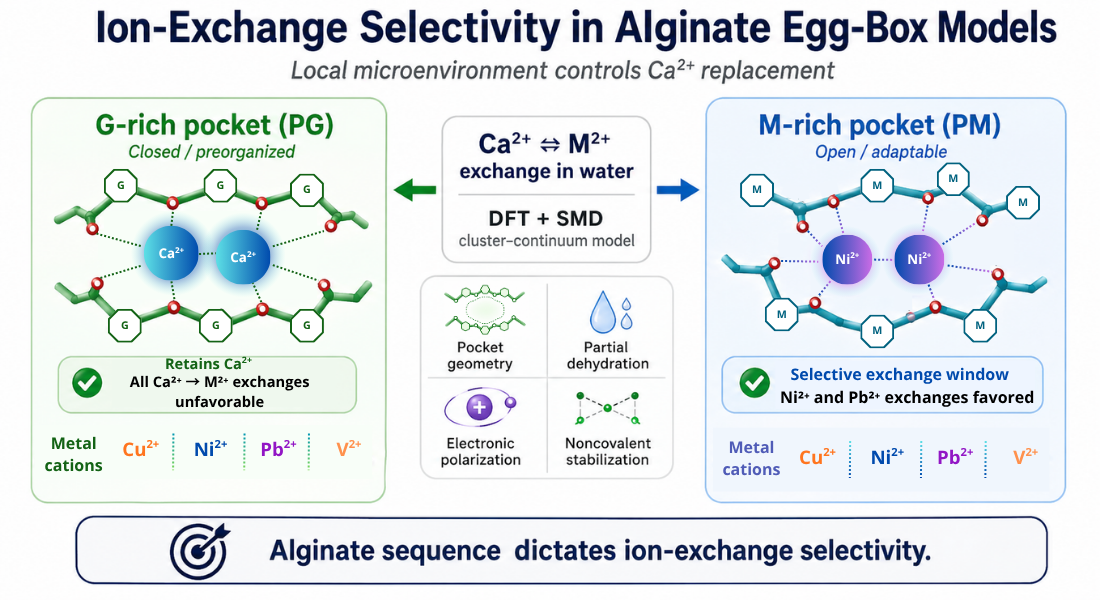
This study shows that ion-exchange selectivity in alginate egg-box-type models depends strongly on the local microenvironment of the polymer. Within the present cluster–continuum model, the G-rich pocket (PG) consistently retained the Ca2+-stabilized state, whereas the M-rich pocket (PM) selectively favored exchange by Ni2+ and Pb2+, as reflected by negative ΔGexch values.
The two favorable metals were stabilized through different mechanistic routes. Ni2+ was associated with the most compact and regular coordination and with a more cooperative electronic and noncovalent response of the PM pocket. Pb2+, in contrast, remained favored through a broader, more anisotropic, and more polarizable mode of accommodation. Cu2+ and V2+ did not achieve sufficient cooperative stabilization to overcome the overall cost of exchange.
These results indicate that selectivity in the egg-box motif is an emergent property of the coupling among pocket geometry, partial dehydration, electronic redistribution, and noncovalent stabilization. At the same time, the conclusions should be interpreted within the limits of the present model, which does not explicitly include pH effects, ionic strength, counterions, metal speciation, or extended polymer heterogeneity.
For experimentalists, the results suggest that increasing the relative contribution of M-rich domains may enhance the thermodynamic tendency for Ca2+ replacement by Pb2+ and Ni2+, whereas G-rich domains should better preserve the Ca2+-stabilized egg-box arrangement. These predictions should be tested experimentally under controlled M/G ratio, pH, ionic strength, and competitive ion conditions. Because the present analysis addresses thermodynamic preference rather than exchange barriers, time-dependent studies will also be necessary to distinguish favorable equilibrium exchange from kinetically hindered uptake.