Article

Absolute Molecular Weight Distribution of Cellulose in DMSO/EmimOAc (1%) with MALS Detection

Department of Chemistry, Umeå University, SE-901 07 Umeå, Sweden
Polysaccharides 2026, 7(2), 47; https://doi.org/10.3390/polysaccharides7020047
Submission received: 13 February 2026 / Revised: 3 March 2026 / Accepted: 14 April 2026 / Published: 16 April 2026
(This article belongs to the Special Issue Recent Progress on Lignocellulosic-Based Materials)

Abstract

This paper presents a method for the measurement of absolute molecular weight of cellulose using a multi-angle light scattering (MALS) detector in 99% dimethyl sulfoxide/1% 1-Ethyl-3-methylimidazolium acetate (DMSO/EmimOAc). The paper also delivers a suitable dn/dc value for cellulose in this solvent. It discusses the pros and cons of using absolute molecular weight measurements versus traditional column calibration in this solvent. The conclusion is that the dn/dc for cellulose in this solvent is 0.049 ± 0.003 mL/g. Absolute molecular weight measurements in this solvent are somewhat beneficial for celluloses with Mw > 250 kg/mol. However, for low-Mw celluloses (e.g., Avicel), it has severe limitations. Herein, it is confirmed that the DMSO/EmimOAc system can be used to replace the traditional DMAc/LiCl system for cellulose molecular weight analysis of some cellulose materials. However, the former is more costly and time-consuming than the latter.

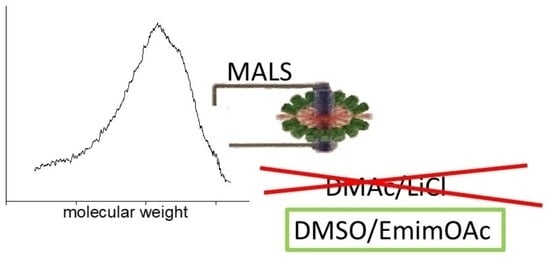
Graphical Abstract

1. Introduction

The molecular weight distribution (MWD) of cellulose is of interest in cellulose chemistry [1]. Although other methods for measuring the MWD exist (e.g., ref. [2]), the preferred method of analysis is size exclusion chromatography (SEC). Historically, cellulose was modified to cellulose tricarbanilates (CTC), which were dissolved in THF [3]. However, the disadvantages of this approach are well established [4]. Today, the solvent system Dimethyl Acetamide/Lithium Chloride (DMAc/LiCl) is widely preferred [4,5,6]. However, the aggregation of cellulose in this solvent has been known for a long time [7,8], and the presence of corrosive Cl in DMAc/LiCl reduces the service span of the chromatographic equipment, as described in the literature [9] and known from personal experience (Figure S1 in the Supplementary Material). Problems with dissolving certain cellulose qualities in the DMAC/LiCl system have been reported [5]. This problem was solved by swelling the samples in dimethyl sulfoxide (DMSO), which was removed by washing [10]. The method, however, results in a significant loss of hemicellulose. Recently, it has been shown that hemicelluloses can be retained by using a small amount of DMSO and then adding the DMAc/LiCl to this [11]. Nonetheless, a central problem with these studies remains: health and environmental problems make it desirable to replace the DMAc-based solvent system. Thus, attempts to replace DMAC/LiCl with ionic liquids have been the focus of many studies, with limited success, and are reviewed elsewhere [9]. The authors of a recent paper successfully combined low ionic-liquid consumption with short retention times in SEC analysis of cellulose dissolved in the ionic liquid 1-ethyl-3-methylimidazolium acetate (EmimOAc), diluted to 1% in dimethyl sulfoxide (DMSO/EmimOAc), using traditional calibration with pullulan standards [12]. Other authors have discussed the problems of using such ionic liquids. The popular belief that the ionic liquids are non-reactive solvents for cellulose was shown to be wrong several years ago [13]. Additionally, problems with using pullulan standards, particularly the overestimation of cellulose molecular weight at relatively high molecular weights, are well documented in traditional column calibration for cellulose molecular weight distribution (MWD) measurements [14]. Using SEC combined with light scattering, such as multi-angle light scattering (MALS), however, enables the direct acquisition of the absolute molecular weight of cellulose molecules. An overview of SEC-MALS can be found elsewhere [4]. A prerequisite for accurate MALS measurements is a thorough understanding of the dn/dc value of the material in the solvent. However, since no such value for cellulose in the DMSO/EmimOAc system exists in the literature, an exact concentration could be used to establish such a value. Hashizume et al. [12] used a method that included the potential loss of material. Herein, the recently discovered DMSO/EmimOAc SEC solvent was combined with MALS detection and a loss-free solvation method for cellulose with the intention of measuring the dn/dc of this combination. The purpose was also to examine the advantages and disadvantages of using MALS detection in this solvent.

2. Materials and Methods

2.1. Materials

A total of six cellulose qualities were used as the cellulose sources in this study: three fully bleached paper grade pulps (Hardwood Kraft Europe (HKE), Softwood Kraft Europe (SKE) and Hardwood Kraft South America (HKSA)), two dissolving quality pulps (Softwood Prehydrolysis Kraft North America (SPKNA) and Softwood Sulphite Dissolving Europe (SSDE)), and one commercial microcrystalline cellulose (Avicel®, Sigma-Aldrich, MA, USA). 1-Ethyl-3-methylimidazolium acetate (EmimOAc, Sigma-Aldrich, MA, USA), dimethyl sulfoxide (DMSO, Fisher, MA, USA), N, N-dimethylacetamide (DMAc, Sigma, MA, USA), and LiCl (Fisher, MA, USA) were used as received.

2.2. Preparation of Cellulose

The cellulose went through different dissolution techniques. depending on the solvent system used for the analysis:

2.2.1. DMAc/LiCl

Approximately 25 mg of each of the cellulose samples was suspended in deionized H2O overnight with stirring. They were then solvent-exchanged with methanol three times and DMAc four times, and the excess solvent was carefully removed with a pipette. Each time, the solvent was allowed to equilibrate for over 30 min. The samples were then dissolved in 5 mL (each) of DMAc with 8% LiCl (w/w) overnight with magnetic stirring. Subsequently, 1 mL of these solutions was mixed with 4 mL of DMAc to achieve cellulose solutions at a concentration of approximately 1 mg/mL. These solutions were filtered through 0.45 µm PTFE filters into experimental vials.

2.2.2. DMSO/EmimOAc

The cellulose samples were dissolved in a manner similar to that described by Hashizume et al. [12]. The cellulose samples were shredded into small pieces and dried at reduced pressure at 105 °C overnight. Approximately 15 mg of cellulose was weighed in vials. Adding a predetermined weight of EmimOAc is challenging due to its very high viscosity; nonetheless, approximately 150 mg of EmimOAc was added on a balance (see Table S1 in the Supplementary Materials for the exact weights). The EmimOAc was slowly adsorbed into the cellulose, and the samples were left for an extended period of time (approximately two weeks) to fully dissolve. After this, no particles could be seen in the samples Subsequently, 4.08 mL of DMSO was added to each of the samples, and the two-phase solutions were left to stir on magnetic stirrers for 24 h. After this time, single-phase solutions had formed in all samples. Then, 9.54 mL of DMSO was added to each sample, and the solutions were stirred for an additional 30 min. Finally, the solutions were filtered through 0.45 µm PFTE filters.

2.3. Properties of 99% DMSO/1% EmimOAc

A solution of 1% EmimOAc in DMSO was prepared by weighing approximately 20 g EmimOAc and diluting it in 1800 mL (1980 g) of DMSO. The mixture was stirred overnight using a magnetic stirrer and then filtered through a 0.45 µm nylon filter. The density of the solution was checked by pipetting it six times onto a scale, and the refractive index was examined with a refractometer (Carls Zeiss, Oberkochen, Germany) three times.

2.4. Size Exclusion Chromatography

The absolute molecular weight, as well as the relative molecular weight (with respect to pullulan standards) of the six celluloses were measured using size exclusion chromatography on an OMNISEC instrument from Malvern Panalytical (Malvern, UK) using two solvent systems. The instrument was equipped with both a refractive index (RI) and a Viscotec SEC-MALS 20 (Malvern, UK) detector. For evaluation, 16 angles, 28, 36, 44, 52, 60, 68, 76, 84, 90, 100, 108, 116, 124, 132, 140 and 148°, were used on the latter. The injection volumes ranged from 50 to 100 µL. Triplicates of the injections were used. Data evaluations were performed using OMNESEC v11.40 (Malvern Panalytical, UK).

2.4.1. DMAc/LiCl

Two 300*8 mm T6000M (mixed pore size, exclusion limit 20,000,000 g/mol, Malvern) columns were connected in series. DMAc with 1% LiCl, filtered through a 0.45 µm PTFE filter, was used as the eluent. The temperature was set to 50 °C, and the flow rate was 0.5 mL/min. The columns were calibrated with six pullulan (Fluka, Buchs, Switzerland) standards, having molecular weights ranging from approximately 10 to approximately 800 kg/mol, dissolved in the eluent. The detectors were calibrated with two polystyrene standards (PSS) dissolved in the eluent.

2.4.2. DMSO/EmimOAc

Two 300*8 mm T6000M (mixed pore size, exclusion limit 20,000,000 g/mol, Malvern) columns were connected in series (similar, but not the same columns as those above). DMSO with 1% EmimOAc, filtered through a 0.45 µm nylon filter, was used as the eluent. The temperature was set to 45 °C and the flow rate was 1 mL/min. The columns and detectors were calibrated with six pullulan (Fluka) standards, having molecular weights ranging from approximately 10 to approximately 800 kg/mol, dissolved in the eluent.

2.4.3. Molecular Weight Averages

The MWD is often reported as several molar molecular weight averages. The averages reported here are the numerical weight average Mn, the mass-weighted molecular weight average Mw, and the Mz-average [15,16]. Mn is the arithmetic average and hence emphasizes the many short cellulose chains, Mw is an average that takes into account the mass (length) of the cellulose chains, and Mz gives even more weighting to the heaviest and longest cellulose molecules. These express a macroscopic average weight of a mol. Thus, the unit reported herein is kg/mol.

3. Results and Discussion

3.1. Refractive Index Increment (dn/dc) of Cellulose in 1%EmimOAc/99%DMSO

Hashizume et al. [12] described how they used a glass rod to improve the contact between the cellulose and the ionic liquid. Herein, a longer contact time was used, avoiding the potential removal of a very small amount of cellulose/ionic liquid. Therefore, all the cellulose added was also in the solution, and no back pressure build-up across the filters was observed. Thus, it was assumed that there was minimal or even non-existent loss of material. The response of an RI detector is proportional to the sensitivity of the detector, the concentration of the solution and the refractive index increment (dn/dc). Since everything but the dn/dc was known, the dn/dc of cellulose in 99% DMSO/1% EmimOAc was calculated to be 0.049 ± 0.003 mL/g. In Table 1, the dn/dc values of all pulps/celluloses, as well as the average, are shown together with the respective standard deviation. The average and standard deviation were then calculated based on all 18 measurements.
The average dn/dc was then applied to all cellulose materials to calculate the absolute Mw-values in 99% DMSO/1% EmimOAc solvent system.

3.2. Molecular Weight Measurements

Molecular weight measurements based on residence time vs. molecular weight relations determined by calibration standards yield a very smooth curve, since it is assumes that all signals arriving at a given time have the same molecular weight. Direct measurements of the molecular weight by laser scattering, however, are based on the light scattering of the molecules. Thus, they are more sensitive to imperfections and particularly sensitive to the possible presence of very small particles [17,18]. A higher concentration could improve the S/N, but tailing in the chromatography prevented its use in this case.

3.2.1. DMAc/LiCl

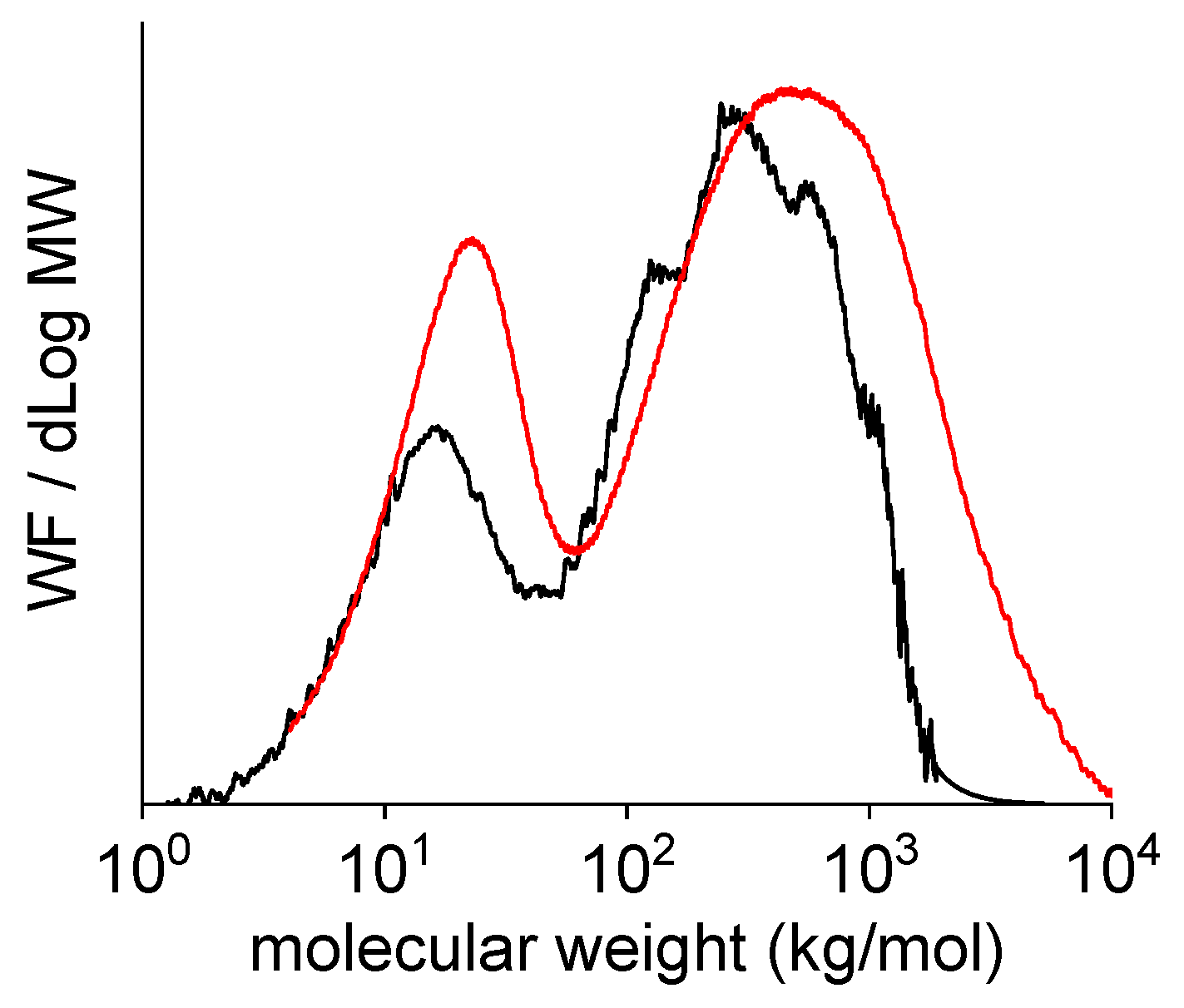
The results from the molecular weight measurements in the well-established DMAc/LiCl system were unsurprising. As expected from the literature, the traditional column calibration method (using pullulan standards) generally overestimated the molecular weight of these materials, with a particular emphasis on higher molecular weights [14]. This is shown in Figure 1 and Table 2, and since the highest molecular weight of the pullulan standards was 805 kg/mol, all higher values are extrapolations. Nonetheless, the values served as valuable references for subsequent analyses in the DMSO/EmimOAc system.

3.2.2. DMSO/EmimOAc

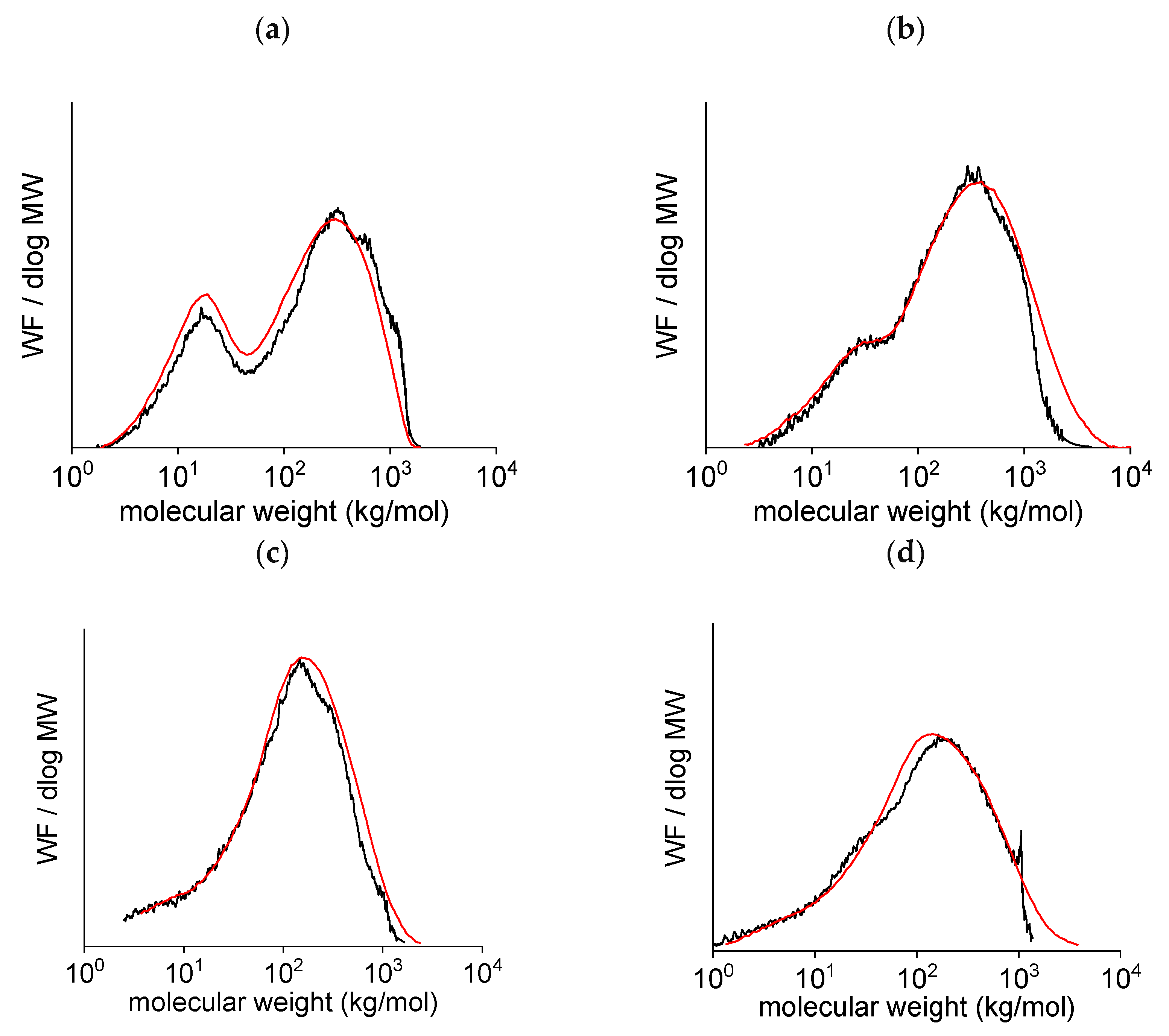
As shown in Figure 2, for many of the studied pulps, the use of MALS detection to acquire absolute molecular weights in the DMSO/EmimOAc system proved to be very effective. Reproducibility was quite good, and despite small differences in the curves (minor shoulders and spikes), the injections for each sample yielded quite similar curves.
As evident in Figure 2b,d and clearly shown in Table 3, calibration with pullulan standards yielded an overestimation of the cellulose molecular weight for the highest molecular weights, i.e., ≳103 kg/mol. In Figure S2 (the Supplementary Materials) it is obvious that this is especially true for HKE, which is also seen in Table 3. This is most clearly seen in the Mz average, which significantly emphasises high-molecular-weight molecules. These findings align with studies conducted in other solvents, e.g., ref. [14], but the differences are smaller than those for the DMAc/LiCl system. These results showed that absolute molecular weight measurement with light scattering is better than traditional calibration with pullulan standards, also in DMSO/EmimOAc for many cellulose materials. The calibration curves for MALS detection are shown in Figure S2 (the Supplementary Materials), and here it is also seen why the MALS data are so noisy. However, unfortunately, it is shown in Table 3 that the calculations based on the MALS detector did not give any data for the low-molecular-weight Avicel® cellulose. As is well-known, the light scattering signal is proportional to both (dn/dc)2, the concentration and the MW of the analyte. As a consequence, the signal simply gets too weak when the molecular weight is low, and the S/N is low. Thus, by increasing the concentration, a better signal could, theoretically, be achieved. Unfortunately, the concentration could not be increased due to tailing in the chromatography. This can be compared to the well-established DMAc/LiCl solvent often used for light scattering, in which cellulose has a dn/dc = 0.131 (i.e., more than twice as high) [19]. Thus, for the same concentration and molecular weight, the S/N is almost four times higher in the MALS detector. It is worth noting, however, that this was an equipment-related issue, and light-scattering detectors with better sensitivity may not experience this problem at all.
For most cellulose materials in this study (i.e., 5 out of 6) and all of the pulps, the method of using MALS detection combined with the solvent system DMSO/EmimOAc worked excellently. In Table 3, the standard deviations between the three injections were significantly smaller for MALS detection than for traditional calibration. Additionally, comparing Table 2 and Table 3 revealed that the DMSO/EmimOAc system yields deviations in the same order of magnitude, or smaller, than the DMAc/LiCl system for MALS detection. Also, some molecular weight averages were higher for the DMSO/EmimOAc system than for the DMAc/LiCl system. However, this was not true for all cases, and Student’s t-test revealed that some averages could not be statistically differentiated. The flow rate with acceptable back pressure was also higher for the DMSO/EmimOAc than for the DMAc/LiCl, despite the higher temperature for the latter and the use of similar columns. Thus, this system seems to have lower viscosity, which is an advantage in SEC-MALS.
Side reactions between cellulose and the EmimOAc can be suspected during the extended time (two weeks) for dissolving the cellulose without physical interference [13]. However, since the side reactions reported by Ebner et al. [13] only affect the reducing end of the cellulose, only one ionic liquid molecule reacts per cellulose molecule. Since even the Mn of the celluloses measured was in the range of 50 kg/mol, an increase in the molecular weight of 10−1 kg/mol is relatively small. For the Mw values, it is certainly insignificant. Another type of side reaction, acetylation, can be a minor problem [20]. However, according to those authors, even a long-stored EMIMOAc would yield a low degree of acetylation, and an increase in measured molecular weight would then be within the experimental error. To sum up, the influence of the side reactions can probably be dismissed in this case. The RI detector gives a signal that is proportional to c*dn/dc. To be certain that c is known, everything must be dissolved. To ensure this, the mentioned extended time of two weeks was used. However, since a decent dn/dc value was determined herein, future users can use this dn/dc value to calculate the exact concentration. The solution can then be prepared in a few overnight steps [12].
Nonetheless, the low dn/dc in the DMSO/EmimOAc system is a disadvantage. The signals from the RI detector, and especially the MALS detector, become weak as a result. For traditional calibration using standards, this is not a problem, since the MWD curves are calculated from residence time using a simple equation, which yields smooth curves. However, for the direct measurement of absolute molecular weight using light scattering (as in a MALS detector) this is a significant limitation, giving spiky curves. Also, the mixture of DMSO, EmimOAc and cellulose that ends up in the solvent waste cannot easily be recovered/recycled. This is a drawback, since the ionic liquid (EmimOAc) is expensive. However, despite the increased cost, the low vapor pressure of DMSO, combined with the almost no vapor pressure of EmimOAc, makes the working environment much better for a user of DMSO/EmimOAc system compared to the DMAc/LiCl system. The stepwise solvation of cellulose in EmimOAc and finally the DMSO/EmimOAc system, could also take more time than the solvent exchange activation that is necessary for the DMAc/LiCl system, which is a minor disadvantage for the former. Thus, the disadvantages of inferior sensitivity and the cost of expensive chemicals with the DMSO/EmimOAc system have to be weighted against the working environment advantages of the same system.

4. Conclusions

A method for analyzing the absolute molecular weight of cellulose using MALS detection in a DMSO-based solvent with only 1% of an ionic liquid (DMSO/EmimOAc) showed some benefits over the commonly used DMAc/LiCl system. The dn/dc of cellulose in DMSO/EmimOAc was determined to be 0.049 ± 0.003. An overestimation of the molecular weight of the longest cellulose chains was observed, also in this solvent system, when using traditional calibration methods (using pullulan standards). This suggests that light scattering (MALS, in this case) methods may sometimes be better. However, the low signal strength when low average molecular weight polymers were investigated led to uncertainty in these determinations, and no MALS data for microcrystalline cellulose were achieved. Thus, combining MALS detection with the DMSO/EmimOAc solvent cannot be recommended for low-molecular-weight celluloses. Practical problems, poor sensitivity and the cost of using the DMSO/EmimOAc system must be weighed against the work environment problems associated with the traditional DMAc/LiCl system.

Supplementary Materials

The following supporting information can be downloaded at: https://www.mdpi.com/article/10.3390/polysaccharides7020047/s1, Figure S1: Corrosion of the outside of columns after a small leak of DMAc/LiCl; Figure S2: The (partly extrapolated) molecular weight as calculated by MALS detection displayed as a function of the retention volume of the chromatography; Table S1: mass (mg) of cellulose and EmimOAc for each of the cellulose qualities.

Funding

This research was funded by Bio4Energy, a strategic research environment supported by the Swedish government.

Data Availability Statement

Some of the data supporting the conclusions of this article are available in the Supplementary Materials. The full chromatograms will be made available by the authors on request.

Acknowledgments

Bio4Energy is greatly acknowledged for its financial support of this work. Diana Reyes Forsberg and Lars Sundvall are acknowledged for supplying several pulps and Mateo Mateo Bello Villarino for grammatical help.

Conflicts of Interest

The author declares no conflicts of interest.

Abbreviations

The following abbreviations are used in this manuscript:
MWDMolecular weight distribution
SECSize exclusion chromatography
DMAcDimethyl acetamide
DMSODimethyl sulfoxide
EmimOAc1-ethyl-3-methylimidazolium acetate
MALSMultiangle light scattering
RIRefractive index
HKEHardwood Kraft Europe
SKESoftwood Kraft Europe
HKSAHardwood Kraft South America
SPKNASoftwood Prehydrolysis Kraft North America
SSDESoftwood Sulphite Dissolving Europe
CTCCellulose TriCarbanilate

References

  1. Li, H.; Legere, S.; He, Z.; Zhang, H.; Li, J.; Yang, B.; Zhang, S.; Zhang, L.; Zheng, L.; Ni, Y. Methods to increase the reactivity of dissolving pulp in the viscose rayon production process: A review. Cellulose 2018, 25, 3733–3753. [Google Scholar] [CrossRef]
  2. Ventouri, I.K.; Loeber, S.; Somsen, G.W.; Schoenmakers, P.J.; Astefanei, A. Field-flow fractionation for molecular-interaction studies of labile and complex systems: A critical review. Anal. Chim. Acta 2022, 1193, 339396. [Google Scholar] [CrossRef] [PubMed]
  3. Evans, R.; Wearne, R.H.; Wallis, A.F.A. Molecular-Weight Distribution of Cellulose as Its Tricarbanilate by High-Performance Size Exclusion Chromatography. J. Appl. Polym. Sci. 1989, 37, 3291–3303. [Google Scholar] [CrossRef]
  4. Oberlerchner, J.T.; Rosenau, T.; Potthast, A. Overview of methods for the direct molar mass determination of cellulose. Molecules 2015, 20, 10313–10341. [Google Scholar] [CrossRef] [PubMed]
  5. Henniges, U.; Vejdovszky, P.; Siller, M.; Jeong, M.-J.; Rosenau, T.; Potthast, A. Finally Dissolved! Activation Procedures to Dissolve Cellulose in DMAc/LiCl Prior to Size Exclusion Chromatography Analysis—A Review. Curr. Chromatogr. 2014, 1, 52–68. [Google Scholar] [CrossRef]
  6. Potthast, A.; Radosta, S.; Saake, B.; Lebioda, S.; Heinze, T.; Henniges, U.; Isogai, A.; Koschella, A.; Kosma, P.; Rosenau, T.; et al. Comparison testing of methods for gel permeation chromatography of cellulose: Coming closer to a standard protocol. Cellulose 2015, 22, 1591–1613. [Google Scholar] [CrossRef]
  7. McCormick, C.L.; Peter, A.; Callais, P.A.; Hutchinson, B.H. Solution Studies of Cellulose in Lithium Chloride and N,N-Dimethylacetamide. Macromolecules 1985, 18, 2394–2401. [Google Scholar] [CrossRef]
  8. Sjöholm, E.; Gustafsson, K.; Eriksson, B.; Brown, W.; Colmsjö, A. Aggregation of cellulose in lithium chloride/N,N-dimethylacetamide. Carbohydr. Polym. 2000, 41, 153–161. [Google Scholar] [CrossRef]
  9. Zhou, Y.; Zhang, X.; Zhang, J.; Cheng, Y.; Wu, J.; Yu, J.; Zhang, J. Molecular weight characterization of cellulose using ionic liquids. Polym. Test. 2021, 93, 106985. [Google Scholar] [CrossRef]
  10. Siller, M.; Ahn, K.; Pircher, N.; Rosenau, T.; Potthast, A. Dissolution of rayon fibers for size exclusion chromatography: A challenge. Cellulose 2014, 21, 3291–3301. [Google Scholar] [CrossRef]
  11. Melikhov, I.; Sulaeva, I.; Kostic, M.; Bacher, M.; Schiehser, S.; Rosenau, T.; Potthast, A. Dissolving limitations: The power of DMSO activation for cellulose SEC analysis. Carbohydr. Polym. 2025, 357, 123443. [Google Scholar] [CrossRef] [PubMed]
  12. Hashizume, T.; Saito, K.; Watanabe, T. Facile characterization of molecular weight distribution of cellulose by gel permeation chromatography using a dimethyl sulfoxide solution containing 1% EmimOAc. Cellulose 2025, 32, 1499–1511. [Google Scholar] [CrossRef]
  13. Ebner, G.; Schiehser, S.; Potthast, A.; Rosenau, T. Side reaction of cellulose with common 1-alkyl-3-methylimidazolium-based ionic liquids. Tetrahedron Lett. 2008, 49, 7322–7324. [Google Scholar] [CrossRef]
  14. Poché, D.S.; Ribes, A.J.; Tipton, D.L. Characterization of Methocel™: Correlation of static light-scattering data to GPC molar mass data based on pullulan standards. J. Appl. Polym. Sci. 1998, 70, 2197–2210. [Google Scholar] [CrossRef]
  15. Stepto, R.F.T. Dispersity in Polymer Science. Pure Appl. Chem. 2009, 81, 351–353. [Google Scholar] [CrossRef]
  16. Musil, J.; Zatloukal, M. Experimental investigation of flow induced molecular weight fractionation phenomenon for two linear HDPE polymer melts having same Mn and Mw but different Mz and Mz+1 average molecular weights. Chem. Eng. Sci. 2012, 81, 146–156. [Google Scholar] [CrossRef]
  17. Kratochvil, P. Classical Light Scattering from Polymer Solutions. Polymer Science Library 5; Jenkins, A.D., Ed.; Elsevier: Amsterdam, The Netherlands, 1988; Volume 5. [Google Scholar]
  18. Striegel, A. Modern Size-Exclusion Liquid Chromatography: Practice of Gel Permeation and Gel Filtration Chromatography; John Wiley & Sons: Hoboken, NJ, USA, 2009. [Google Scholar]
  19. Ono, Y.; Ishida, T.; Soeta, H.; Saito, T.; Isogai, A. Reliable dn/dc Values of Cellulose, Chitin, and Cellulose Triacetate Dissolved in LiCl/N,N-Dimethylacetamide for Molecular Mass Analysis. Biomacromolecules 2016, 17, 192–199. [Google Scholar] [CrossRef] [PubMed]
  20. Yoneda, Y.; Hettegger, H.; Böhmdorfer, S.; Potthast, A.; Rosenau, T. Cellulose acylation in aged 1-ethyl-3-methyl-imidazolium carboxylate ionic liquids upon fiber spinning. Cellulose 2025, 32, 5171–5178. [Google Scholar] [CrossRef]
Figure 1. MWD measured in DMAc/LiCl of HKE with traditional calibration using pullulan standards (red) and MALS detection (black).
Polysaccharides 07 00047 g001
Figure 2. MWD measured in DMSO/EmimOAc system of (a) HKE, (b) SKE, (c) SPKNA, and (d) SSDE with traditional calibration using pullulan standards (red) and MALS detection (black).
Polysaccharides 07 00047 g002
Table 1. Refractive index increment (dn/dc) of cellulose in DMSO/EmimOAc for all the cellulose materials, and the average.
Cellulosedn/dc (mL/g)
HKE0.050 ± 0.002
SKE0.048 ± 0.003
HKSA0.048 ± 0.001
SPKNA0.046 ± 0.001
SSDE0.051 ± 0.001
Avicel®0.049 ± 0.004
AVERAGE0.049 ± 0.003
Table 2. MWD expressed as molecular weight averages of the cellulose materials measured in the DMAc/LiCl system using traditional column calibration (using pullulan standards) and MALS detection, respectively. Standard deviations are based on three injections.
Traditional Calibration, kg/molMALS Detection, kg/mol
CelluloseMnMwMZMnMwMZ
HKE40 ± 9630 ± 102200 ± 3010 ± 6230 ± 23420 ± 40
SKE40 ± 4490 ± 701300 ± 5020 ± 1290 ± 20570 ± 25
HKSA69 ± 10710 ± 1102900 ± 260040 ± 19240 ± 11410 ± 43
SPKNA40 ± 1280 ± 35750 ± 7050 ± 20260 ± 101000 ± 60
SSDE10 *250 *840 *10 *150 *370 *
Avicel®11 ± 270 ± 6300 ± 7010 ± 166 ± 4480 ± 110
* No standard deviation for SSDE was calculated since only one measurement was done due to overpressure in the chromatograph.
Table 3. MWD expressed as molecular weight averages of the cellulose materials measured in the DMSO/EmimOAc system using traditional column calibration (using pullulan standards) and MALS detection, respectively. Standard deviations are based on three injections.
Traditional Calibration, kg/molMALS Detection, kg/mol
CelluloseMnMwMZMnMwMZ
HKE40 ± 5480 ± 703230 ± 240030 ± 7290 ± 8650 ± 8
SKE70 ± 10480 ± 301730 ± 81070 ± 10360 ± 20780 ± 44
HKSA40 ± 10400 ± 201350 ± 46024 ± 12270 ± 10670 ± 34
SPKNA60 ± 9240 ± 10590 ± 4040 ± 6 200 ± 1430 ± 50
SSDE40 ± 10290 ± 20 780 ± 10038 ± 10 230 ± 6550 ± 50
Avicel®10 ± 255 ± 4120 ± 20 ---
Disclaimer/Publisher’s Note: The statements, opinions and data contained in all publications are solely those of the individual author(s) and contributor(s) and not of MDPI and/or the editor(s). MDPI and/or the editor(s) disclaim responsibility for any injury to people or property resulting from any ideas, methods, instructions or products referred to in the content.