Article

Development of Chitosan-Based Films with Enhanced Hydrophobic and Antimicrobial Properties by Incorporating Piper betle L. Leaf Extract in β-Cyclodextrin with Beeswax Coating


by
Hermawan Dwi Ariyanto
1,*,
Vita Paramita
1,
Ireng Sigit Atmanto
1,
Nur Alim Bahmid
2,
Daffa Ikhlasul Amal
3,
Salza Medina Putri
1,
Wikalimma Ningsih
1 and
Fatimah Hapsari
1
1
Department of Industrial Technology, Faculty of Vocational School, Diponegoro University, Tembalang, Semarang 50275, Indonesia
2
Research Center for Food Technology and Processing, National Research and Innovation Agency (BRIN), Yogyakarta 55961, Indonesia
3
Department of Metallurgical & Materials Engineering, University of Indonesia, Depok 16424, Indonesia
*
Author to whom correspondence should be addressed.
Polysaccharides 2026, 7(1), 18; https://doi.org/10.3390/polysaccharides7010018
Submission received: 18 October 2025 / Revised: 6 December 2025 / Accepted: 29 January 2026 / Published: 4 February 2026

Abstract

This study focused on the incorporation of Piper betle L. essential oil (EO) into β-cyclodextrin (β-CD) and the subsequent incorporation of this complex into chitosan-based films with a beeswax coating. The objective of this study was to develop a hydrophobic, antibacterial bio-based film suitable for preservation applications. A total of four formulations were prepared: (1) chitosan film with no EO or β-CD, (2) chitosan film with β-CD only, (3) chitosan film with EO only, and (4) chitosan film with both EO and β-CD. The EO concentration was varied between 0, 0.5 and 1% (v/v) in the formulation, while β-CD was used at a concentration of 5% (w/v). The films were characterized using FTIR to analyze functional groups, SEM for surface morphology, contact angle to assess hydrophobicity, and tensile tests for mechanical properties. The results indicated significant changes in functional group characteristics and surface morphology across the different formulations. Beeswax coating enhanced the water impermeability and increased the hydrophobicity of the films, improving the contact angle from 59.93 ± 1.79° to 97.84 ± 0.77° and the mechanical strength from 0.28 ± 0.07 MPa to 24.49 ± 0.04 MPa. The antibacterial activity, assessed using the Kirby–Bauer method, showed that the EO concentration significantly inhibited the growth of Escherichia coli, with a maximum inhibition zone of 7.43 ± 0.60 mm observed at the highest EO concentration. These findings demonstrate that chitosan-based film modifications, incorporating both EO and β-CD, significantly improve the material properties and antibacterial activity, indicating its potential for food preservation applications.

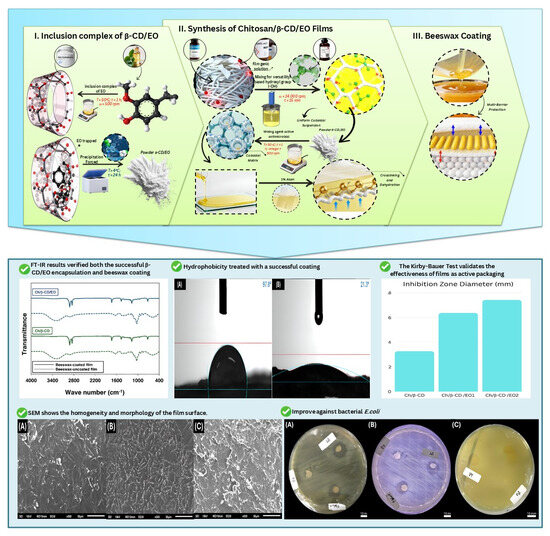
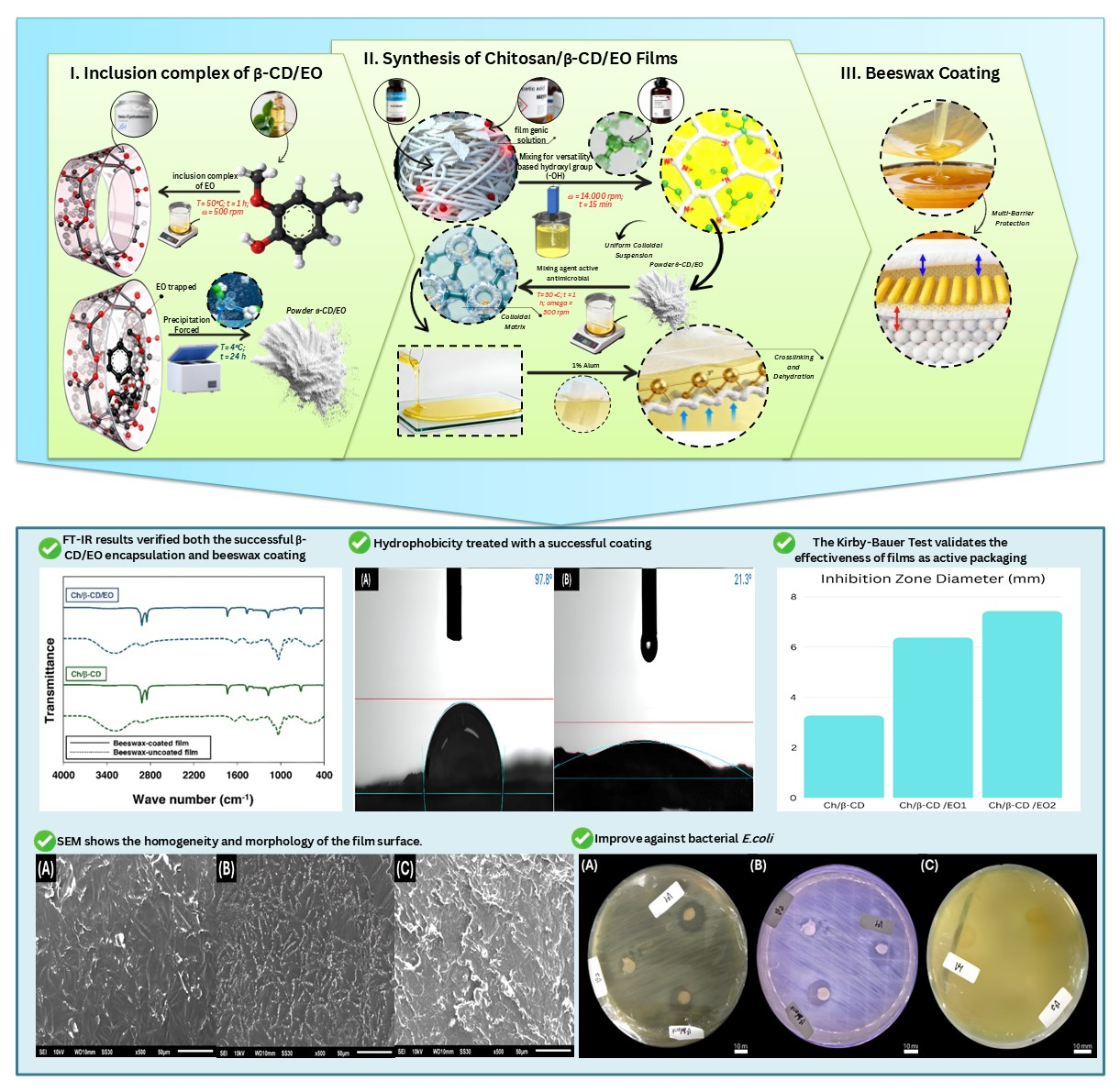
Graphical Abstract

1. Introduction

Non-degradable plastic packaging is extensively used; however, it has resulted in significant environmental issues owing to its inability to degrade [1]. As living conditions improve, there is increasing public concern about the ecological and environmental harm caused by food packaging films. This has led to growing interest in the creation of biocomposite or biodegradable food packaging film [2,3,4]. Therefore, researchers have focused on utilizing natural, biodegradable substances, such as polysaccharides and proteins, for the development of packaging materials instead of plastics [5,6,7]. Biocomposite coating film (ECF) is a revolutionary food packaging technique that is biodegradable and digestible. Many studies have reported that ECF is produced from fruits, vegetables, and essential oils, making it an eco-friendly and cost-effective food packaging option that preserves food quality [8]. ECF also reduces synthetic packaging-related diarrhea, vomit, stomach discomfort, and other gastrointestinal illnesses [9,10,11]. Huang et al. conducted research which revealed that over 25% of all food is lost due to microbial contamination prior to being consumed [12]. Microbicidal agents can eradicate microorganisms and cause food degradation.
The use of essential oils in the food industry is well recognized for their functions as food coatings, antibacterial agents, and detoxifying agent [13]. Green betel leaf essential oil, known as Piper betle L., is an essential oil. Green betel leaves are rich in essential components, including nutrients, minerals, phytochemicals, antioxidants, and bioactive molecules, such as phenolics and flavonoids [14,15,16]. However, the application of these essential oils in the food industry is still limited because of their high volatility and low solubility in water, making them unstable under changes in temperature, pH, and humidity [13]. These challenges make it difficult for essential oils to be directly applied to food packaging. Various studies have employed essential oils as food coatings, one of which is mixed with chitosan to create biocomposite films. As reported by Sarier et al. [17], the development of chitosan-gelatin-based food packaging incorporated with emulsified essential oils resulted in multifunctional films with great potential for use as temperature-sensitive active packaging in the food, pharmaceutical, and cosmetic industries. Chitosan, a widely used polysaccharide, is employed in the production of biocomposite films and coatings due to its antibacterial properties, biocompatibility, biodegradability, and non-toxicity [17]. It is derived from chitin through partial deacetylation and consists of N-acetyl-D-glucosamine and D-glucosamine units [18]. Furthermore, chitosan exhibits antibacterial properties against both Gram-positive and Gram-negative microorganisms. The antibacterial capabilities of chitosan are influenced by several parameters, such as the type of pathogen, pH of the medium, structural features (such as the degree of deacetylation and molecular weight), and the source and concentration of chitosan [19].
Recently, researchers have been interested in using β-cyclodextrin (β-CD) as a novel carrier material in the incorporating of antimicrobial agents to develop a biocomposite film because of its structure. β-CD is a cyclic oligosaccharide made up of seven glucose units, known for its ability to form inclusion complexes with various compounds, improving their stability and solubility [20]. It consists of an oligosaccharide group that forms a ring through glucose bonds, with a hydrophobic cavity and a hydrophilic outer surface. When used as an inclusion complex matrix, β-CD enables the slow and controlled release of essential oils, offering continuous antimicrobial protection throughout the product’s shelf life [21]. Biocomposite films incorporating β-CD present innovative alternatives to traditional packaging materials. This property makes β-CD particularly useful for food-packaging applications. Zolfaghari et al. [22] developed a biocomposite film based on corn zein-containing dill extract and an essential oil/β-CD inclusion complex. They found that encapsulated dill essential oil with β-CD enhanced the preservation properties of fish fillet films during storage which may be used to increase the shelf life of common carp fillets during cold storage [22]. Bizymis et al. [23] successfully improved the properties of biocomposite films by using cellulose nanocrystals. By incorporating cellulose nanocrystals (CNC) and β-cyclodextrin (CD) into the chitosan film, the solution viscosity can be decreased by as much as 50%. However, the surface tension exhibited only a small change when the greatest amount of CNC/CD was added. Furthermore, CH-CNC and CH-CD biocomposite films exhibited a reduction in oxygen and water vapor permeability, along with an increase in transparency and heterogeneity.
To develop an ECF, the hydrophobic properties of surface films are essential for effective food preservation and protection. These hydrophobic properties in biocomposite films function as water barriers which provide food protection against moisture by controlling water vapor transfer. Beeswax is often employed along with other natural polymers, such as chitosan, pectin, or proteins, to enhance the characteristics of films [24,25,26]. This combination enables the optimization of the functional properties of biocomposite films. The co-application of beeswax and chitosan to mango fruit has been shown to effectively retard ripening, minimize weight loss, enhance firmness, and prolong the storage duration of the fruit [27]. Furthermore, beeswax has been used to stabilize essential oils in biocomposite films, augment their antibacterial and antioxidant properties, and prolong the shelf life of food items [28]. Sun et al. conducted an experiment on eggs to examine the effects of adding beeswax and basil essential oil to a chitosan-based biocomposite film. The results suggest that the coating enhanced the stability and water retention properties and exhibited significant antibacterial activity [29]. Parsimehr and Langroudi reported the use of beeswax as a consumable coating [30]. They found that using beeswax as a coating on a biocomposite film resulted in the formation of a film with superhydrophobic properties. This layer not only decreases the moisture level in food but also effectively prevents microbial infection. These findings also demonstrate that applying a mixture of glucomannan, beeswax, and chitosan as a biocomposite coating on snack fruit has a beneficial effect on the microbiological, physical, and mechanical properties of the fruit. Consequently, this leads to an extended shelf life of snack fruit [24,25,26,27,28,29]. These water-retaining properties are directly related to the shelf life of the food.
Therefore, this study focused on the incorporating of betel leaf essential oil using β-CD. The encapsulated oil was then incorporated into a chitosan-based biocomposite film that was modified with a beeswax coating to improve the material characteristics and stability of the antimicrobial agent. The modified chitosan-based biocomposite was further investigated to determine the properties and stability of the essential oil for potential use as a food packaging material.

2. Materials and Methods

2.1. Materials

β-Cyclodextrin (β-CD) with a purity of 99% by weight was obtained from Cyclochem Co., Ltd. (Kobe, Japan). Piper betle L. essential oil with a purity of 100% by weight which phenylpropanoids (44.56–84.14%) and hydrocarbon sesquiterpenes (6.86–39.71%) were the dominant compound was purchased from local market in Semarang (Indonesia). Chitosan (Ch) with a deacetylation level of 97.21% and molecular weight of 50,000 Da, beeswax with ester:acid ratio value of 3.90, ethanol with a concentration of 96% by volume, glacial acetic acid with a purity of 99.99% by weight, glycerol with a concentration of 99.50% by volume, and aluminum sulfate octa decahydrate with a purity of 97% by weight were purchased from Merck (Jakarta, Indonesia).

2.2. Production of Piper betle L. Inclusion Complex with β-CD

The formulation of the Piper betle L. inclusion complex with β-CD is shown in Table 1, following previous research with some modifications [31]. β-CD was diluted in a 70% (v/v) ethanol solution at a ratio of 1:2 with continuous stirring at 60 °C. Subsequently, the β-CD–ethanol solution was cooled to 40 °C. The EO were diluted in a solution of 70% ethanol (v/v) at a ratio of 1-part EO to 1-part ethanol. The mixture of β-CD and EO was continuously stirred at 50 °C for 1 h until a homogenous solution was obtained. The mixtures were further cooled in a chiller at 4 °C for 24 h until precipitates developed. The precipitates were washed with 30% ethanol (v/v) and dried in an oven at 60 °C for 24 h. The β-CD/EO inclusion complex powder was stored in a desiccator until further use.

2.3. Beeswax-Coated Chitosan/β-CD/EO Biocomposite Film Synthesis

A 3% (w/v) chitosan (Ch) solution was prepared by dissolving chitosan powder in a 3% (v/v) acetic acid solution. Then, 3 mL of 95% (w/w) glycerol was added to the solution with constant stirring. To obtain a uniform solution, the agitated solution was homogenized using a D-500 homogenizer (DLAB Scientific Co., Ltd., Beijing, China) at 14,000 rpm for 15 min. The Ch solution was combined with β-CD/EO inclusion powder following the formulation specified in Table 1. The mixture was stirred continuously at room temperature until a homogeneous Ch/β-CD/EO doping solution (DS) was obtained. The obtained DS with volume of 150 mL then was placed on the casting plate and allowed to cure at ambient temperature for 1 h. The solution was then coagulated using a 1% (w/v) alum solution, leading to film formation. Subsequently, the films were dried in an oven at 50 °C for 2 days, resulting in the production of dehydrated biocomposite films. The biocomposite film mentioned in Table 1 was submerged in molten beeswax with temperature of 68 °C and dip-coating process of biocomposite film was conducted for 1 min.

2.4. Characterization of Ch/β-CD/EO Biocomposite Film with Beeswax Coating

2.4.1. Identification of Functional Groups Using FTIR

An investigation using Fourier Transform Infrared (FT-IR) spectroscopy was used to identify the intricate functional groups in the surface of biocomposite films. The film samples were positioned on a specimen holder and infrared light was passed through them. The resulting spectra were collected in the wavelength range 400–4000 cm−1. The testing was conducted with FT-IR Spectroscopy equipment (Spectrum Two, Perkin-Elmer Inc., Waltham, MA, USA) equipped with a Universal Attenuated Total Reflectance (UATR) accessory. The FTIR spectra were acquired using PerkinElmer Spectrum IR 10.6.1 Software (Perkin-Elmer, MA, USA).

2.4.2. Analysis of Surface Morphology Using Scanning Electron Microscopy (SEM)

Scanning electron microscopy (SEM) JSM 6510, (JEOL Co., Ltd., Tokyo, Japan) was used to examine the morphology of the surface of the biocomposite film. Sample preparation followed the study protocols specified by [32]. The samples were photographed under certain operating settings, including a high voltage of 10 kV, spot size of 30 for surface morphology analysis, work distance of 10 mm, and magnification of 500× for each sample.

2.4.3. Hydrophobicity Assessment with a Contact Angle Goniometer

The hydrophobicity of the biocomposite film was assessed using the Optical Contact Angle (OCA 25; Dataphysics, Filderstadt, Germany) at room temperature. The experiment consisted of applying distilled water in quantities ranging from 0.13 to 0.33 μL over the surfaces of both beeswax-coated and untreated film samples. A camera was used to collect images of the water droplets, and the contact angles of the water droplets were measured.

2.4.4. Tensile Strength Measurement

A tensile strength test was used to measure the strength of the biocomposite film by identifying its maximum stretching limit before rupture. The tensile strength (TS) and elongation at break (EB) of the biocomposite films were determined using a Brookfield CT3 texture analyzer (Brookfield, Engineering Laboratories Inc., Oakland, MA, USA) at room temperature. Measurements were performed triplicate to ensure accuracy. The samples were placed in the grips of the texture analyzer, with a 50 mm distance between the grips and the sample. The dimensions and thickness of the samples were as follows: length: 50 mm, width: 15 mm, thickness: 0.2 mm. The specimens were then exposed to a pulling force at a speed of 1 mm/s to evaluate their tensile strength.

2.5. Antimicrobial Activity Assessment

The testing was carried out via the disc diffusion method, namely, the Kirby–Bauer test. The antibacterial activity of the biocomposite films was analyzed using previously reported research methodologies [33]. A solution of Escherichia coli bacteria was prepared by dissolving them in Peptone Water with a concentration of 100 μL. The solution was then evenly distributed over agar plates containing Mueller–Hinton Agar (MHA). Biocomposite film samples measuring 6 mm in diameter were placed on dehydrated agar medium. A test was conducted to ascertain the inhibitory effect of the film on the activity of Escherichia coli. Positive antibacterial activity was determined by the presence of a definite zone of inhibition surrounding the sample, indicating that it had an inhibitory effect on the growth of bacteria.

2.6. Statistical Analysis

The data were analyzed statistically using SPSS Statistics 25 (IBM, New York, NY, USA). All measurements were done at least 3 replicates. The results are shown as the value of averages ± standard deviations. Mean and standard deviation (SD) comparisons at a significance level were conducted using Tukey’s test with p < 0.05.

3. Results

3.1. Physical Characteristics of Biocomposite Films

3.1.1. Effect of Biocomposite Film Composition and Beeswax Immersion Coating on the Structure of Biocomposite Film

Figure 1 illustrates the functional characteristics of the biocomposite film. The findings showed that the functional group characteristics were substantially altered after the beeswax dip-coating treatment in both Ch/β-CD and Ch/β-CD/EO variants. Therefore, inclusion of EO in Ch/β-CD did not lead to any notable variations in the characteristics of the functional groups. Prior to the beeswax dip-coating treatment, the Ch/β-CD and Ch/β-CD/EO variants exhibited primary functional group features consisting mostly of hydroxyl groups (-OH) at wave numbers of 3292 cm−1 and 3284 cm−1, respectively, as shown in Table 2. The IR spectra of the uncoated variances have a significant resemblance to the IR spectrum of chitosan, mostly attributed to the presence of -OH stretching, -NH stretching, N-H bending, C-C stretching, C-O stretching, and C-N stretching [34]. Additionally, it is important to mention that the presence of β-CD did not have any noticeable effect on the overall properties of the functional groups in the chitosan film [35].
Furthermore, the incorporation of EO into biocomposite films did not have a significant impact on the functional group characteristics. However, while conducting a more in-depth investigation in this research, it was shown that the -OH stretch and C-O stretch changed in the reaction. More precisely, the wave number of the response changed from 3292 cm−1 to 3284 cm−1 when EO was added. Previous studies have shown that essential oils contain several functional groups, including terpene molecules such as aldehydes, phenols, carboxylic acids, and esters [36]. This behavior may be ascribed to the change in response observed in this study, which was caused by the interaction between the EO component and the biocomposite film. This interaction leads to a modification in the behavior of the -OH stretch and C-O stretch, which is affected by the wave number and surrounding group environment, including hydrogen bonding [37].
Moreover, the use of beeswax dip-coating on chitosan films is known to induce significant alterations in the characteristics of functional groups. Nevertheless, this study does not offer comprehensive information on these changes. The beeswax dip-coating process led to a significant infrared interaction in the form of fatty acid ester, yet the hydroxyl and amine infrared interaction from chitosan were extinct. The presence of the functional group was confirmed by the presence of typical C=O ester stretching on beeswax at 1733 cm−1 on Ch/β-CD and 1736 cm−1 on Ch/β-CD/EO1. Moreover, the typical C-O ester stretching was also observed at 1172 cm−1 on Ch/β-CD and 1169 cm−1 on Ch/β-CD/EO1. The flexion of the C-H bond was also observed after beeswax dip-coating on Ch/β-CD and Ch/β-CD/EO1, formed as scissoring deformation at wave number 1466 cm−1 and 1464 cm−1, respectively. However, compared to pure beeswax FTIR spectra observed by Svečnjak et al. [38] there was difference at wavenumber of 1714 cm−1 which corresponded to free fatty acid exist on pure beeswax but distinct on the biocomposite films, this explain that the free fatty acid was extinct caused by the bonding between beeswax and the chitosan matrix. Otherwise, the -CH2 stretching still exists formed as stretching intense sharp duplet which corresponds to the hydrocarbon group along the fatty acid ester structure. This finding demonstrates that the beeswax coating on chitosan-based film has affected the chitosan functional group attributes, which interfered with the effective incorporation of beeswax into chitosan-based films.
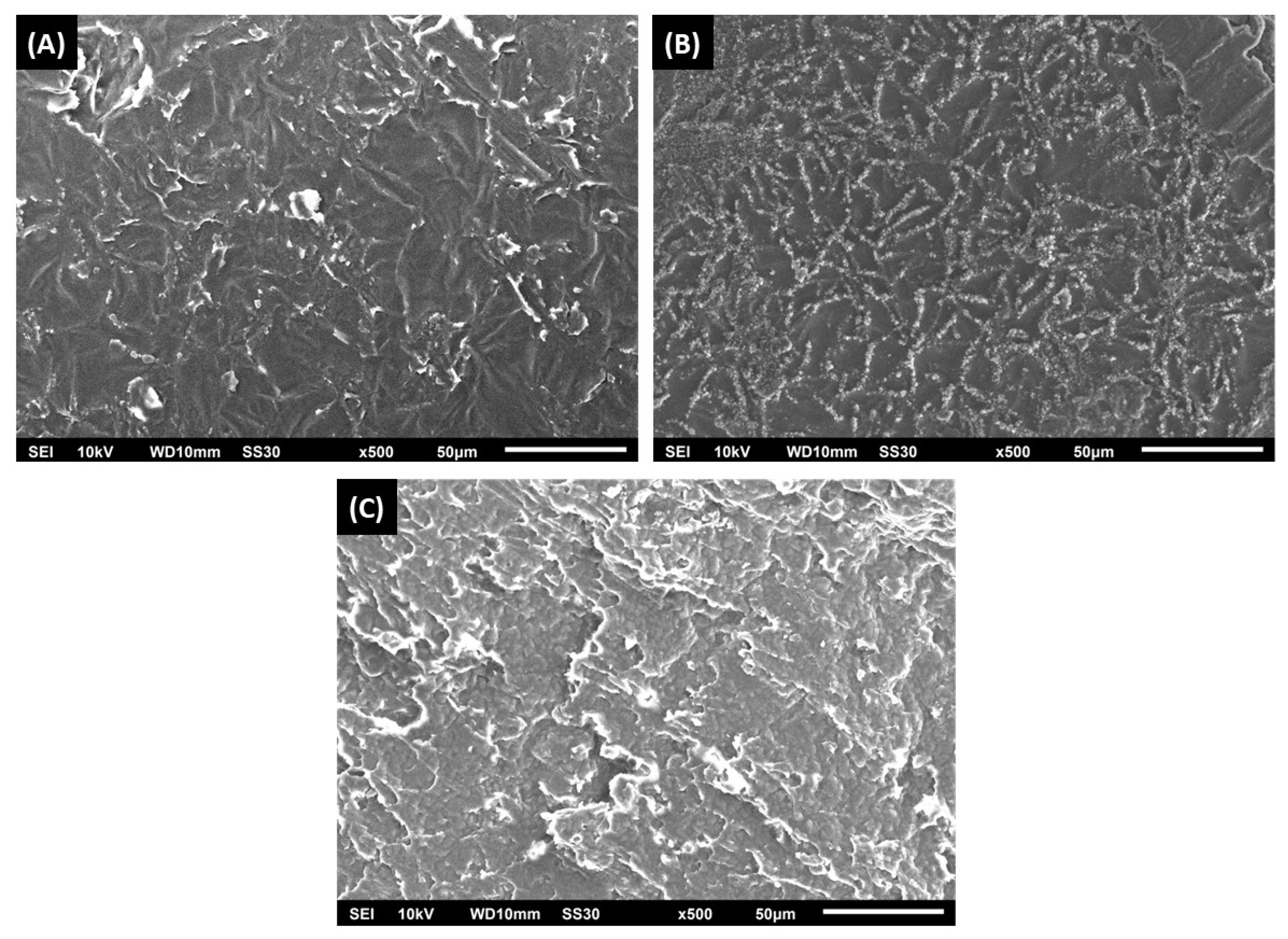
Figure 2 shows the surface morphology of the biocomposite films Ch/β-CD, Ch/β-CD/EO, and beeswax-coated Ch/β-CD/EO. The results demonstrate that the surface morphology of Ch/β-CD displayed several folding without any surface crack being observed, compared to pure chitosan film obtained by Edian et al. [39] which displayed relatively spotted surface with several surface crack were observed. However, details regarding the pure chitosan film were excluded from this study due to confidentiality concerns. The introduction of β-CD into the chitosan film resulted in the transformation of the surface shape from spotted to non-spotted surface with annular folds were observed. It was suggested that β-CD was added to seal the spots on the surface of the film [31]. In addition, Ch/β-CD/EO had a unique surface structure of dendritic folds, where white-dot particles were attached. The origin of these white-dot particles is most likely the β-CD/EO inclusions. Based on previous research, it was shown that the combination of β-CD and EO led to the creation of cubic crystals with particle dimensions ranging from 10 to 25 μm [40]. The occurrence of white-dot particles on the folded surface may be ascribed to the interaction between the crystal inclusions and folding process. Therefore, it can be deduced from this study that the β-CD/EO inclusion crystal fills the empty spaces during folding, resulting in an improvement in the physical properties.
When treated with beeswax, the surface morphology of the Ch/β-CD/EO displayed an irregular wrinkling folding pattern with no visible voids or cracks. The irregular folding pattern and non-porous surface reduce the permeability of the film, limiting the movement of water on the surface. This decrease in permeability can hinder the maintenance of superhydrophobic properties, as effective water repulsion depends on both surface texture and hydrophobic characteristics.

3.1.2. Effect of Biocomposite Film Formulation and Beeswax Immersion Coating on the Water-Repellent Properties of the Biocomposite Film

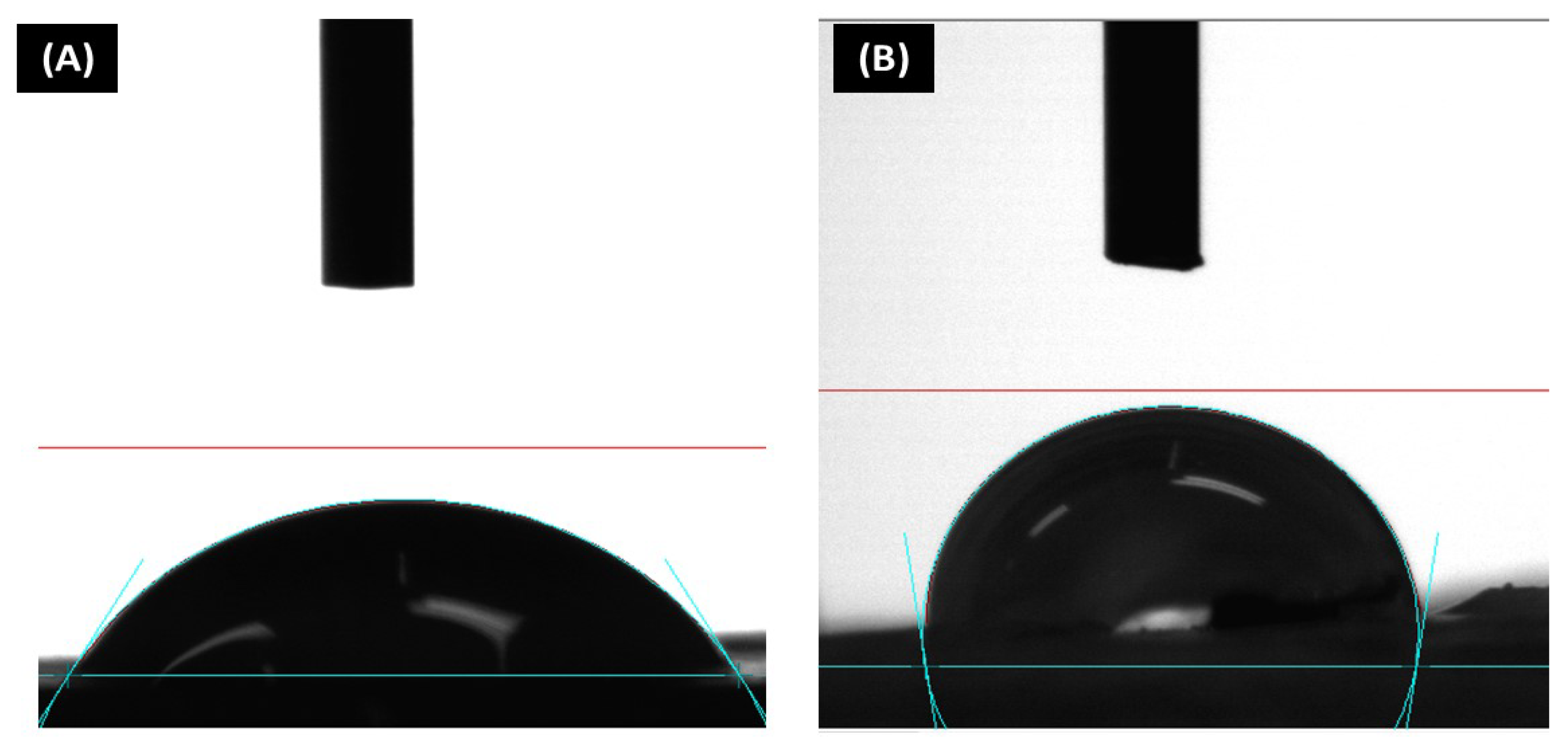
Figure 3 and Table 3 show the hydrophobicity of the biocomposite film. After the beeswax dip-coating treatment, the contact angle of the Ch/β-CD/EO increased significantly from 59.93 ± 1.79 to 97.84 ± 0.77°. The results demonstrated that the beeswax dip-coating procedure significantly decreased the water permeability of the Ch/β-CD/EO biocomposite film. Furthermore, another study postulated that superhydrophobic materials have contact angles above 150° [41]. Contact angles greater than 90° were classified as hydrophobic and contact angles below 90° were classified as hydrophilic. Therefore, it can be deduced that the uncoated Ch/β-CD/EO film is hydrophilic, but the beeswax-coated Ch/β-CD/EO film is hydrophobic.
Another study showed that the contact angle increased after the application of a beeswax coating [42]. This increase was attributed to the non-polar characteristics of beeswax, which consists of lengthy ester hydrocarbon chains. The study also measured the contact angle of a chitosan film covered with beeswax, which varied between 128° and 140°. All recorded measurements were within the range of hydrophobic to superhydrophobic properties. Compared to this study, the contact angle value attained was lower than the value given by that research. The variation in the amount of beeswax used and the coating method may explain this disparity [42].
Table 4 shows a significant enhancement in the tensile strength of the Ch/β-CD/EO film after the beeswax dip coating procedure. More precisely, the tensile strength increased from 0.28 ± 0.07 MPa to 24.49 ± 0.04 MPa. In addition, the elongation of the film rose from 2.40 ± 0.05% to 14.13 ± 0.09%. The primary cause for the substantial enhancement in both tensile strength and elongation is the beeswax dip-coating technique. Compared to Chungsiriporn et al. the application of a beeswax coating treatment led to a significant rise in the tensile strength value, reaching 21.74 kN/m, which is equivalent to 2.17 MPa [43]. However, the tensile strength achieved in our study exceeded this value.
The use of a beeswax dip-coating procedure not only increases the tensile strength but also enhances the mechanical properties of the films. Previous studies have reported varied findings regarding the impact of EO supplementation on these attributes. The addition of EO led to a significant enhancement in both tensile strength, which rose to 28.57 ± 0.17 MPa, and elongation, which climbed to 26.64% [44]. Furthermore, EO led to enhanced characteristics owing to molecular interactions between polymer chains and functional groups. Ethylene oxide, derived from the polyalcohol molecule, facilitates the formation of chemical interactions between the polymer and EO. Consequently, the polymer undergoes a reduction in the accessible volume and mobility of its molecules [45].

3.2. Effect Beeswax-Coated on the Antimicrobial Properties of Composite Film

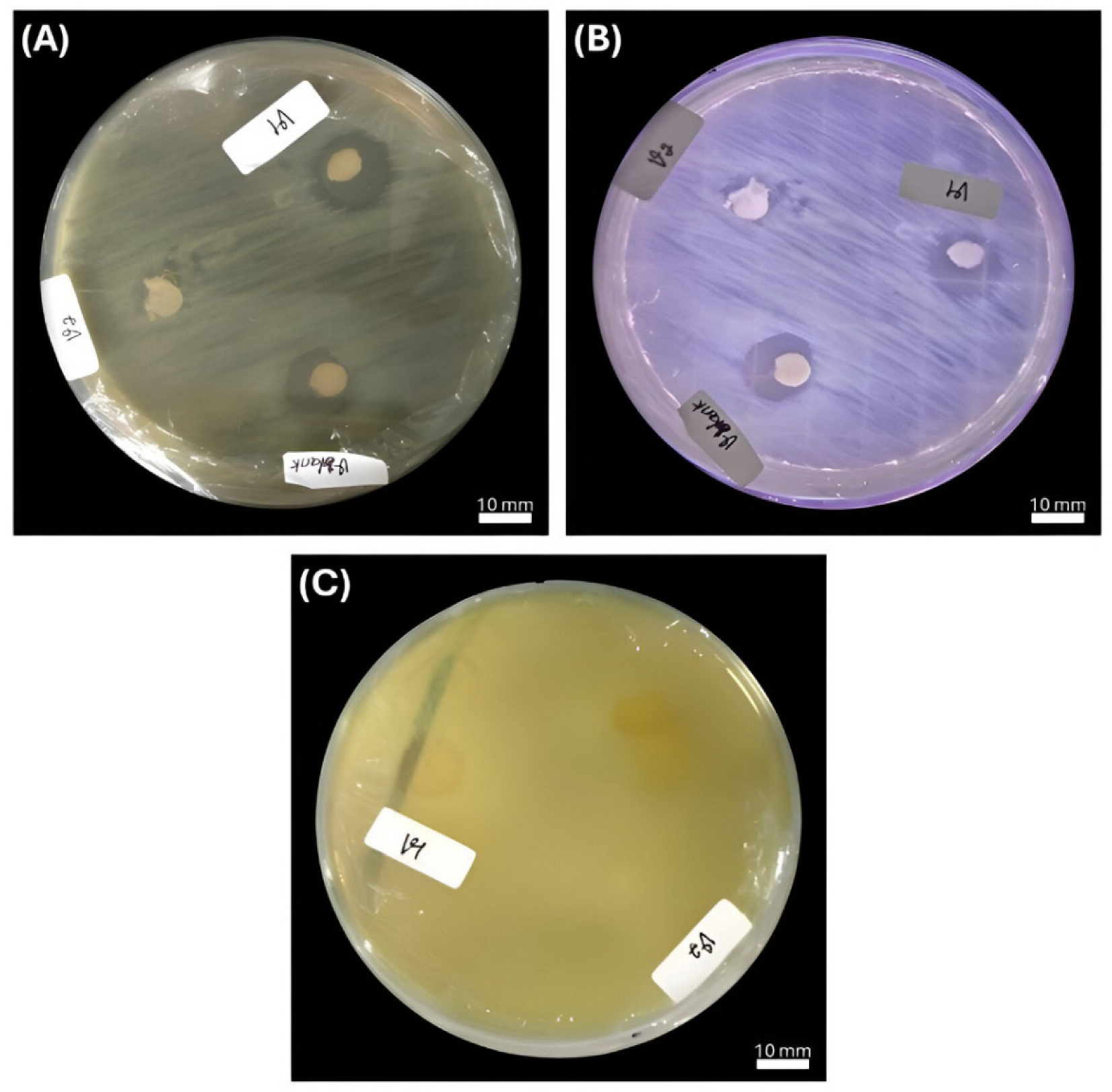
Table 5 shows that the Ch/β-CD film exhibits the smallest inhibition zone against E. coli, measuring 3.28 ± 0.64 mm. However, the addition of EO to the film resulted in an increase in the inhibition zone to 6.38 ± 0.18 mm in the Ch/β-CD/EO1 film, which comprised 0.5% (v/v) Piper betle L. extract. The Ch/β-CD/EO2 film, which includes 1.0% (v/v) EO, achieves a maximum inhibition zone value of 7.43 ± 0.60 mm. This study validates that the ability to kill E. coli is directly linked to the concentration of EO, as shown in Figure 4.
A previous study found that the antimicrobial properties of essential oil (EO) in biocomposite films were attributed to the presence of eugenol. Eugenol can penetrate the lipid composition of cell membranes and enter mitochondria, resulting in the release of cytoplasm and the destruction of E. coli cells [46]. Furthermore, the incorporation of a beeswax coating on the biocomposite film has been shown to impede the antibacterial process by obstructing the flow of water across the film. Hence, it is crucial to consider the thickness of the beeswax coating to maintain the intended antibacterial and hydrophobic characteristics of the film [25]. Felicioli et al. established that beeswax does not exhibit antibacterial characteristics [47]. Beeswax only demonstrates bacteriostatic action, which implies that it hinders the development of bacteria without causing death. Moreover, if permeability is prevented, it impedes the release of the antibacterial drug, potentially resulting in a reduction in its inhibitory effectiveness against E. coli [35]. This finding was also supported by the analytical results of the inhibitory effect on E. coli, which indicated a relatively low level of inhibition in this study.
The films were coagulated using an alum solution, which not only contributes to the structural integrity of the films but also imparts antimicrobial properties due to the strong antiseptic nature of alum. This aspect should be considered in conjunction with the effects of the beeswax coating and essential oil incorporation. Consequently, there was no discernible antibacterial effect, and the proliferation of bacteria remained consistent without any decrease. This asserts that the antibacterial properties in this study were obtained by the incorporation of EO. Hence, it is crucial to thoroughly assess the beeswax coating to ensure that it does not impede the emission of antimicrobial chemicals from EO during the application of biocomposite coatings onto objects.

4. Conclusions

The characteristics of chitosan-based films can be enhanced by incorporating beeswax dip-coating with β-CD and essential oils (EO). While the addition of β-CD and β-CD/EO did not significantly alter the functional group characteristics, the beeswax dip-coating treatment effectively transformed functional groups into ester groups. The surface morphology also changed, with the formation of folds and crystalline structures, depending on the modification steps. Notably, the beeswax coating improved the film’s hydrophobicity and water impermeability, as evidenced by an increase in the contact angle. Additionally, the mechanical properties, including tensile strength and elongation, were significantly enhanced. The EO incorporation, particularly at a 1% (v/v) concentration, demonstrated strong antibacterial activity against E. coli, confirming the potential of these modified films for applications in food preservation.

Author Contributions

Conceptualization, H.D.A. and V.P.; methodology, I.S.A. and N.A.B.; validation, N.A.B., D.I.A. and S.M.P.; formal analysis, W.N.; investigation, D.I.A., S.M.P. and F.H.; data curation, H.D.A. and N.A.B.; writing—original draft preparation, H.D.A. and F.H.; writing—review and editing, H.D.A. and N.A.B.; supervision, H.D.A., V.P. and I.S.A.; project administration, W.N. and F.H.; funding acquisition, V.P. and S.M.P. All authors have read and agreed to the published version of the manuscript.

Funding

This research was funded by Universitas Diponegoro, Indonesia, through the International Publication Research 2025 Program (Grant No: 222-610/UN7.D2/PP/IV/2025).

Data Availability Statement

Data available on request from the authors. The data that support the findings of this study are available from the corresponding authors, (Hermawan Dwi Ariyanto), upon reasonable request.

Acknowledgments

The authors thank Cyclochem Co., Ltd. (Kobe, Japan) for giving the β-cyclodextrin for the research. Daffa Ikhlasul Amal would like to acknowledge the Ministry of Finance, Republic of Indonesia for providing scholarship (Indonesia Endowment Fund for Education: LPDP).

Conflicts of Interest

The authors declare there are no conflicts of interest to disclose concerning this study. Authors receiving β-Cyclodextrin (β-CD) as support from Cyclochem Co., Ltd. (Kobe, Japan). The company did not participate in the study’s design, data collection, analysis, interpretation, the writing of this article, or the decision to submit it for publication.

References

  1. Hong, J.; Chen, Y.; Wang, M.; Ye, L.; Qi, C.; Yuan, H.; Zheng, T.; Li, X. Intensification of municipal solid waste disposal in China. Renew. Sustain. Energy Rev. 2017, 69, 168–176. [Google Scholar] [CrossRef]
  2. Jiang, L.; Jia, F.; Han, Y.; Meng, X.; Xiao, Y.; Bai, S. Development and characterization of zein biocomposite films incorporated with catechin/β-cyclodextrin inclusion complex nanoparticles. Carbohydr. Polym. 2021, 261, 117877. [Google Scholar] [CrossRef] [PubMed]
  3. Li, T.; Xia, N.; Xu, L.; Zhang, H.; Zhang, H.; Chi, Y.; Zhang, Y.; Li, L.; Li, H. Preparation, characterization and application of SPI-based blend film with antioxidant activity. Food Packag. Shelf Life 2021, 27, 100614. [Google Scholar] [CrossRef]
  4. Marques, C.S.; Silva, R.R.A.; Arruda, T.R.; Ferreira, A.L.V.; Oliveira, T.V.d.; Moraes, A.R.F.; Dias, M.V.; Vanetti, M.C.D.; Soares, N.d.F.F. Development and Investigation of Zein and Cellulose Acetate Polymer Blends Incorporated with Garlic Essential Oil and β-Cyclodextrin for Potential Food Packaging Application. Polysaccharides 2022, 3, 277–291. [Google Scholar] [CrossRef]
  5. Jiang, L.; Yang, J.; Wang, Q.; Ren, L.; Zhou, J. Physicochemical properties of catechin/β-cyclodextrin inclusion complex obtained via co-precipitation. CyTA-J. Food 2019, 17, 544–551. [Google Scholar] [CrossRef]
  6. Wang, L.; Lin, L.; Chen, X.; Tong, C.; Pang, J. Synthesis and characteristics of konjac glucomannan films incorporated with functionalized microcrystalline cellulose. Colloids Surf. A Physicochem. Eng. Asp. 2019, 563, 237–245. [Google Scholar] [CrossRef]
  7. Teixeira-Costa, B.E.; Andrade, C.T. Natural Polymers Used in Biocomposite Food Packaging—History, Function and Application Trends as a Sustainable Alternative to Synthetic Plastic. Polysaccharides 2022, 3, 32–58. [Google Scholar] [CrossRef]
  8. Solomakos, N.; Govaris, A.; Koidis, P.; Botsoglou, N. The antimicrobial effect of thyme essential oil, nisin and their combination against Escherichia coli O157:H7 in minced beef during refrigerated storage. Meat Sci. 2008, 80, 159–166. [Google Scholar] [CrossRef]
  9. Heydari, S.; Jooyandeh, H.; Alizadeh, B.B.; Noshad, M. The impact of Qodume Shirazi seed mucilage-based biocomposite coating containing lavender essential oil on the quality enhancement and shelf life improvement of fresh ostrich meat: An experimental and modeling study. Food Sci. Nutr. 2020, 8, 6497–6512. [Google Scholar] [CrossRef]
  10. Paidari, S.; Zamindar, N.; Tahergorabi, R.; Kargar, M.; Ezzati, S.; Shirani, N.; Musavi, S.H. Biocomposite coating and films as promising packaging: A mini review. J. Food Meas. Charact. 2021, 15, 4205–4214. [Google Scholar] [CrossRef]
  11. Silvestre, C.; Duraccio, D.; Cimmino, S. Food packaging based on polymer nanomaterials. Prog. Polym. Sci. 2011, 36, 1766–1782. [Google Scholar] [CrossRef]
  12. Huang, W.; Xu, H.; Xue, Y.; Huang, R.; Deng, H.; Pan, S. Layer-by-layer immobilization of lysozyme–chitosan–organic rectorite composites on electrospun nanofibrous mats for pork preservation. Food Res. Int. 2012, 48, 784–791. [Google Scholar] [CrossRef]
  13. Maurya, A.; Prasad, J.; Das, S.; Dwivedy, A.K. Essential Oils and Their Application in Food Safety. Front. Sustain. Food Syst. 2021, 5, 653420. [Google Scholar] [CrossRef]
  14. Sahu, A.K.; Kar, S.S.; Kumari, P.; Dey, S.K. An overview of Betel vine (Piper betle L.): Nutritional, pharmacological and economical promising natural reservoir. Adv. Hortic. Sci. 2022, 36, 63–80. [Google Scholar] [CrossRef]
  15. Surjowardojo, P.; Setyowati, E.; Ambarwati, I. Antibacterial effects of green betel (Piper betle L.) leaf against streptococcus agalactiae and Escherichia coli. Agrivita 2019, 41, 569–574. [Google Scholar] [CrossRef]
  16. Manzoor, A.; Ahmad, S.; Yousuf, B. Development and characterization of biocomposite films based on flaxseed gum incorporated with Piper betle extract. Int. J. Biol. Macromol. 2023, 245, 125562. [Google Scholar] [CrossRef]
  17. Sarier, N.; Eloglu, A.; Onder, E. The Development of Thermoresponsive Multifunctional Chitosan Films Suitable for Food Packaging. Polysaccharides 2025, 6, 17. [Google Scholar] [CrossRef]
  18. Kumar, S.; Ye, F.; Dobretsov, S.; Dutta, J. Chitosan nanocomposite coatings for food, paints, and water treatment applications. Appl. Sci. 2019, 9, 2409. [Google Scholar] [CrossRef]
  19. Hossain, F.; Follett, P.; Salmieri, S.; Vu, K.D.; Fraschini, C.; Lacroix, M. Antifungal activities of combined treatments of irradiation and essential oils (EOs) encapsulated chitosan nanocomposite films in in vitro and in situ conditions. Int. J. Food Microbiol. 2019, 295, 33–40. [Google Scholar] [CrossRef]
  20. Paiva-Santos, A.C.; Ferreira, L.; Peixoto, D.; Silva, F.; Soares, M.J.; Zeinali, M.; Zafar, H.; Mascarenhas-Melo, F.; Raza, F.; Mazzola, P.G.; et al. Cyclodextrins as an encapsulation molecular strategy for volatile organic compounds—Pharmaceutical applications. Colloids Surf. B Biointerfaces 2022, 218, 112758. [Google Scholar] [CrossRef] [PubMed]
  21. Siva, S.; Li, C.; Cui, H.; Meenatchi, V.; Lin, L. Encapsulation of essential oil components with methyl-β-cyclodextrin using ultrasonication: Solubility, characterization, DPPH and antibacterial assay. Ultrason. Sonochem. 2020, 64, 104997. [Google Scholar] [CrossRef]
  22. Zolfaghari, A.; Gilani, B.B.; Aghajani, N. Edible film based on corn zein containing dill extract and essential oil/β-cyclodextrin inclusion complex: Shelf life enhancement of common carp fillet. Food Sci. Nutr. 2023, 11, 4275–4288. [Google Scholar] [CrossRef]
  23. Bizymis, A.P.; Giannou, V.; Tzia, C. Improved properties of composite biocomposite films based on chitosan by using cellulose nanocrystals and beta-cyclodextrin. Appl. Sci. 2022, 12, 8729. [Google Scholar] [CrossRef]
  24. Liyanapathiranage, A.; Dassanayake, R.S.; Gamage, A.; Karri, R.R.; Manamperi, A.; Evon, P.; Jayakodi, Y.; Madhujith, T.; Merah, O. Recent developments in biocomposite films and coatings for fruits and vegetables. Coatings 2023, 13, 1177. [Google Scholar] [CrossRef]
  25. Zhang, Y.; Bi, J.; Wang, S.; Cao, Q.; Li, Y.; Zhou, J.; Zhu, B. Functional food packaging for reducing residual liquid food: Thermo-resistant biocomposite super-hydrophobic coating from coffee and beeswax. J. Colloid Interface Sci. 2019, 533, 742–749. [Google Scholar] [CrossRef]
  26. Hosseini, S.F.; Mousavi, Z.; McClements, D.J. Beeswax: A review on the recent progress in the development of superhydrophobic films/coatings and their applications in fruits preservation. Food Chem. 2023, 424, 136404. [Google Scholar] [CrossRef]
  27. Eshetu, A.; Ibrahim, A.M.; Forsido, S.F.; Kuyu, C.G. Effect of beeswax and chitosan treatments on quality and shelf life of selected mango (Mangifera indica L.) cultivars. Heliyon 2019, 5, e01116. [Google Scholar] [CrossRef]
  28. Saxena, A.; Sharma, L.; Maity, T. Enrichment of biocomposite coatings and films with plant extracts or essential oils for the preservation of fruits and vegetables. In Biopolymer-Based Formulations; Elsevier: Amsterdam, The Netherlands, 2020; pp. 859–880. [Google Scholar]
  29. Sun, R.; Song, G.; Zhang, H.; Zhang, H.; Chi, Y.; Ma, Y.; Li, H.; Bai, S.; Zhang, X. Effect of basil essential oil and beeswax incorporation on the physical, structural, and antibacterial properties of chitosan emulsion based coating for eggs preservation. LWT 2021, 150, 112020. [Google Scholar] [CrossRef]
  30. Parsimehr, H.; Langroudi, A.E. Superhydrophobic Coatings Applications. In Polymer Coatings; Wiley: Hoboken, NJ, USA, 2020; pp. 95–120. [Google Scholar]
  31. Zarandona, I.; Barba, C.; Guerrero, P.; de la Caba, K.; Maté, J. Development of chitosan films containing β-cyclodextrin inclusion complex for controlled release of bioactives. Food Hydrocoll. 2020, 104, 105720. [Google Scholar] [CrossRef]
  32. Prasetyaningrum, A.; Utomo, D.P.; Raemas, A.F.A.; Kusworo, T.D.; Jos, B.; Djaeni, M. Alginate/κ-Carrageenan-Based Biocomposite Films Incorporated with Clove Essential Oil: Physico-Chemical Characterization and Antioxidant-Antimicrobial Activity. Polymers 2021, 13, 354. [Google Scholar] [CrossRef]
  33. Çakmak, H.; Özselek, Y.; Turan, O.Y.; Fıratlıgil, E.; Karbancioğlu-Güler, F. Whey protein isolate biocomposite films incorporated with essential oils: Antimicrobial activity and barrier properties. Polym. Degrad. Stab. 2020, 179, 109285. [Google Scholar] [CrossRef]
  34. Zając, A.; Sąsiadek, W.; Dymińska, L.; Ropuszyńska-Robak, P.; Hanuza, J.; Ptak, M.; Smółka, S.; Lisiecki, R.; Skrzypczak, K. Chitosan and Its Carboxymethyl-Based Membranes Produced by Crosslinking with Magnesium Phytate. Molecules 2023, 28, 5987. [Google Scholar] [CrossRef] [PubMed]
  35. Adjali, A.; Rosaria, A.; Pontillo, N.; Kavetsou, E.; Katopodi, A.; Tzani, A.; Grigorakis, S.; Loupassaki, S.; Detsi, A. Clove Essential Oil-Hydroxypropyl-β-Cyclodextrin Inclusion Complexes: Preparation, Characterization and Incorporation in Biodegradable Chitosan Films. Micro 2022, 2, 212–224. [Google Scholar] [CrossRef]
  36. Masyita, A.; Mustika, S.R.; Dwi, A.A.; Yasir, B.; Rahma, R.N.; Emran, T.B.; Nainu, F.; Simal-Gandara, J. Terpenes and terpenoids as main bioactive compounds of essential oils, their roles in human health and potential application as natural food preservatives. Food Chem. X 2022, 13, 100217. [Google Scholar] [CrossRef]
  37. Noori, S.M.A.; Hossaeini, M.S.M. Chitosan-based coatings and films incorporated with essential oils: Applications in food models. J. Food Meas. Charact. 2023, 17, 4060–4072. [Google Scholar] [CrossRef]
  38. Svečnjak, L.; Baranović, G.; Vinceković, M.; Prđun, S.; Bubalo, D.; Gajger, T.I. An approach for routine analytical detection of beeswax adulteration using FTIR-ATR spectroscopy. J. Apic. Sci. 2015, 59, 1515. [Google Scholar] [CrossRef]
  39. Edian, M.D.; Jasim, L.S.; AL-Suraify, S.M.; Othman, M.A.M.; Khonakdar, H.A. Exploring the potential of silver phosphate nanoparticles as a slow-releasing agent to develop antibacterial and biocompatible chitosan-based nanocomposite films. Int. J. Biol. Macromol. 2025, 333, 148858. [Google Scholar] [CrossRef]
  40. Shi, C.; Zhou, A.; Fang, D.; Lu, T.; Wang, J.; Song, Y.; Lyu, L.; Wu, W.; Huang, C.; Li, W. Oregano essential oil/β-cyclodextrin inclusion compound polylactic acid/polycaprolactone electrospun nanofibers for active food packaging. Chem. Eng. J. 2022, 445, 136746. [Google Scholar] [CrossRef]
  41. Yang, Q.; Cao, J.; Ding, R.; Zhan, K.; Yang, Z.; Zhao, B.; Wang, Z.; Ji, V. The synthesis and mechanism of superhydrophobic coatings with multifunctional properties on aluminum alloys surface: A review. Prog. Org. Coat. 2023, 184, 107875. [Google Scholar] [CrossRef]
  42. Seth, M.; Jana, S. Development of superhydrophobic coating from biowaste and natural wax. Mater. Today Proc. 2022, 52, 1422–1428. [Google Scholar] [CrossRef]
  43. Chungsiriporn, J.; Khunthongkaew, P.; Wongnoipla, Y.; Sopajarn, A.; Karrila, S.; Iewkittayakorn, J. Fibrous packaging paper made of oil palm fiber with beeswax-chitosan solution to improve water resistance. Ind. Crops Prod. 2022, 177, 114541. [Google Scholar] [CrossRef]
  44. Sarhadi, H.; Shahdadi, F.; Salehi, S.A.; Hatami, M.; Ghorbanpour, M. Investigation of physio-mechanical, antioxidant and antimicrobial properties of starch–zinc oxide nanoparticles active films reinforced with Ferula gummosa Boiss essential oil. Sci. Rep. 2024, 14, 5789. [Google Scholar] [CrossRef]
  45. Kong, I.; Degraeve, P.; Pui, L.P. Polysaccharide-Based Biocomposite Films Incorporated with Essential Oil Nanoemulsions: Physico-Chemical, Mechanical Properties and Its Application in Food Preservation—A Review. Foods 2022, 11, 555. [Google Scholar] [CrossRef] [PubMed]
  46. Li, Z.; Li, Y.; Cheng, W. Determination of cinnamaldehyde, thymol and eugenol in essential oils by LC–MS/MS and antibacterial activity of them against bacteria. Sci. Rep. 2024, 14, 12424. [Google Scholar] [CrossRef] [PubMed]
  47. Felicioli, A.; Cilia, G.; Mancini, S.; Turchi, B.; Galaverna, G.; Cirlini, M.; Cerri, D.; Fratini, F. In vitro antibacterial activity and volatile characterisation of organic Apis mellifera ligustica (Spinola, 1906) beeswax ethanol extracts. Food Biosci. 2019, 29, 102–109. [Google Scholar] [CrossRef]
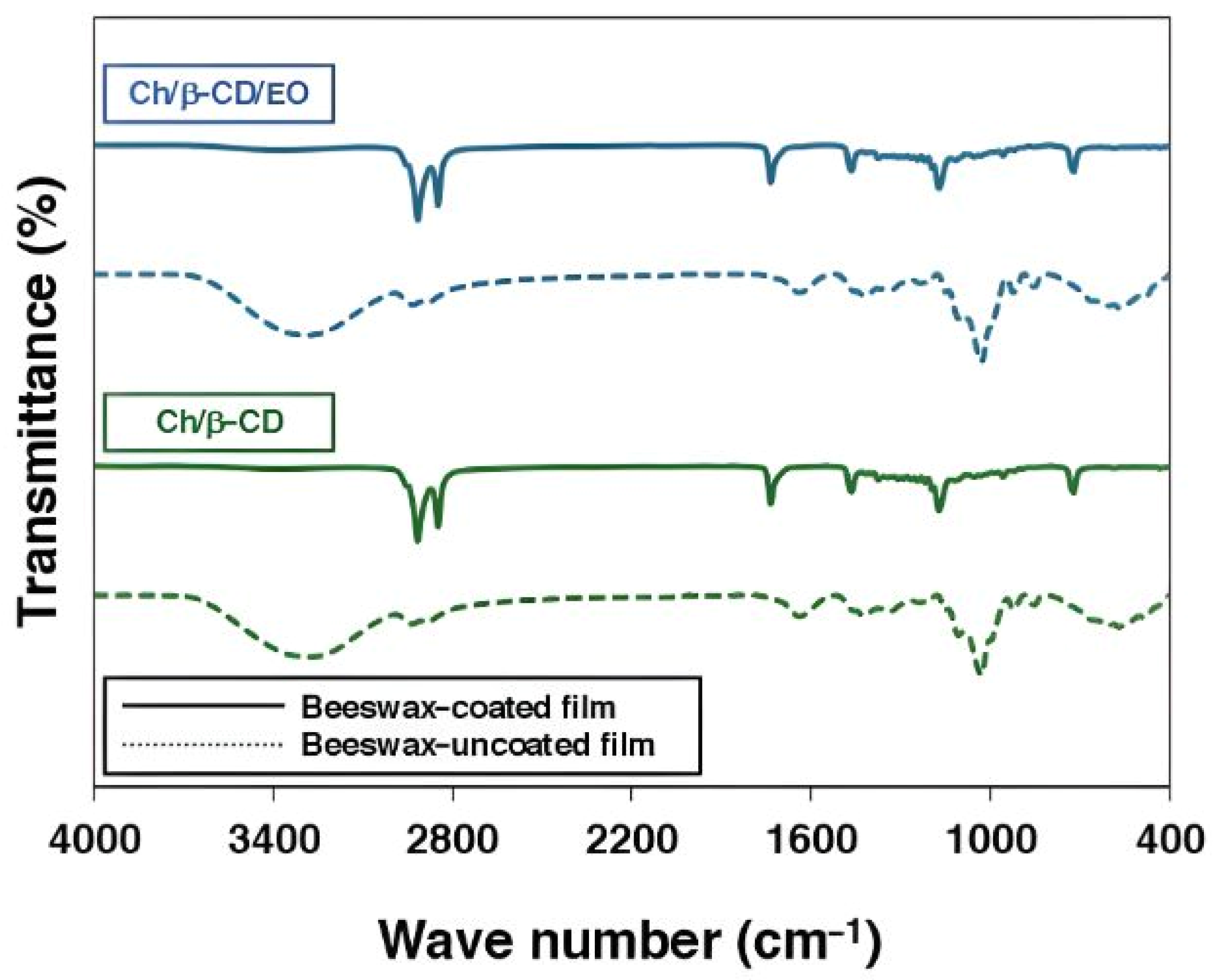
Figure 1. IR Spectrum analysis of the biocomposite film: Ch/β-CD/EO and Ch/β-CD with and without beeswax coating.
Polysaccharides 07 00018 g001
Figure 2. Surface morphology of biocomposite film: (A) Ch/β-CD; (B) Ch/β-CD/EO; (C) Beeswax-coated Ch/β-CD/EO obtained from SEM JSM 6510 (JEOL Co., Japan).
Polysaccharides 07 00018 g002
Figure 3. Contact angle measurement of biocomposite film: (A) Ch/β-CD/EO; (B) Beeswax-coated Ch/β-CD/EO1. Red lines are associated with hydrophilic behavior or advancing contact angles (<90° or the moving edge), whereas blue lines commonly denote hydrophobic behavior or receding contact angles (>90° or the opposite edge).
Polysaccharides 07 00018 g003
Figure 4. Antimicrobial inhibition of biocomposite film against E. coli: (A) initial effect; (B) subsequent effect; and (C) control.
Polysaccharides 07 00018 g004
Table 1. Composition and formulation of the chitosan-based biocomposite film.
Sample CodeComposition
β-CD/EO Inclusion PowderBeeswax-Coated Chitosan-Based Biocomposite Film
β-CD
(% w/v)
Piper betle L. Oil (% v/v)Inclusion Complex Powder (gr)Chitosan (% w/v)Beeswax Dip Coating (gr)
Ch/β-CD50535
Ch/β-CD/EO150.54.8030
Ch/β-CD/EO150.54.8035
Ch/β-CD/EO2514.4035
Table 2. FTIR frequency range and functional group attributes of biocomposite films.
Variance1/λ
(cm−1)
Intensity ShapeAssignment
Ch/β-CD
(Uncoated)
3292Intense broad wide respond-OH stretching
2903Weak respond with 2 band-NH stretching
1637Weak respond single bandN-H bending (1° amine)
1410Weak respondC-C stretching (alkane)
1333Weak respondC-O stretching
1105Intense narrow respondC-N stretching
Ch/β-CD
(Beeswax-coated)
2919Intense sharp duplet band-CH2 stretching (fatty acid ester)
2848Intense sharp duplet band-CH2 stretching (fatty acid ester)
1733Weak narrow respondC=O stretching (fatty acid ester)
1466Weak narrow respond-CH2 scissoring deformation (alkane)
1172Weak narrow respondC-O stretching (ester)
Ch/β-CD/EO1
(Uncoated)
3284Intense broad wide respond-OH stretching
2904Weak respond with 2 band-NH stretching
1637Weak respond single bandN-H bending (1° amine)
1417Weak respondC-C stretching (alkane)
1327Weak respondC-O stretching
1102Intense narrow respondC-N stretching
Ch/β-CD/EO1
(Beeswax-coated)
2916Intense sharp duplet band-CH2 stretching (fatty acid ester)
2848Intense sharp duplet band-CH2 stretching (fatty acid ester)
1736Weak narrow respondC=O stretching (fatty acid ester)
1464Weak narrow respond-CH2 scissoring deformation (alkane)
1169Weak narrow respondC-O stretching (ester)
Table 3. Contact angle values between beeswax-coated and uncoated biocomposite films.
CompositionsContact Angle (°)
Ch/β-CD/EO1 (Uncoated)59.93 ± 1.79 a
Ch/β-CD/EO1 (Beeswax coated)97.84 ± 0.77 b
The values are presented as mean ± standard deviation from three replicates (n = 3). Means with different lowercase superscripts within the same column indicate significant differences between the film samples (p < 0.05).
Table 4. Mechanical properties of the beeswax-coated and uncoated biocomposite film.
VariancesTensile StrengthElongation at Break
(MPa)(%)
Ch/β-CD0.17 ± 0.01 a2.80 ± 0.16 a
Ch/β-CD/EO1 (Uncoated)0.28 ± 0.07 b2.40 ± 0.05 a
Ch/β-CD/EO1 (Beeswax coated)24.49 ± 0.04 c14.13 ± 0.09 b
The values are presented as mean ± standard deviation from three replicates (n = 3). Means with different lowercase superscripts within the same column indicate significant differences between the film samples (p < 0.05).
Table 5. Antibacterial activity of the beeswax-coated biocomposite films.
No.VariancesOccurrenceInhibition Zone Diameter (mm)Mean (mm)
1.Ch/β-CD12.83 ± 0.04 a3.28 ± 0.64 a
23.73 ± 0.04 a
2.Ch/β-CD/EO116.50 ± 0.07 b6.38 ± 0.18 b
26.25 ± 0.25 b
3.Ch/β-CD/EO217.85 ± 0.05 c7.43 ± 0.60 b
27.00 ± 0.00 c
The values are presented as mean ± standard deviation from three replicates (n = 3). Means with different lowercase superscripts within the same column indicate significant differences between the film samples (p < 0.05).
Disclaimer/Publisher’s Note: The statements, opinions and data contained in all publications are solely those of the individual author(s) and contributor(s) and not of MDPI and/or the editor(s). MDPI and/or the editor(s) disclaim responsibility for any injury to people or property resulting from any ideas, methods, instructions or products referred to in the content.