
Review

Changed Characteristics of Bacterial Cellulose Due to Its In Situ Biosynthesis as a Part of Composite Materials

1
Faculty of Chemistry, Lomonosov Moscow State University, Lenin Hills 1/3, Moscow 119991, Russia
2
Amity Institute of Environmental Sciences, Amity University, Uttar Pradesh, Sector 125, Noida, Gautam Buddha Nagar 201313, UP, India
*
Author to whom correspondence should be addressed.
Polysaccharides 2025, 6(4), 114; https://doi.org/10.3390/polysaccharides6040114
Submission received: 21 October 2025 / Revised: 3 December 2025 / Accepted: 12 December 2025 / Published: 14 December 2025

Abstract

In recent years, the sustained and even increasing interest in the development and application of novel composite materials based on the polysaccharide bacterial cellulose (BC) has been driven by the accumulation of experimental data and the emergence of analytical reviews that narratively summarize these findings. This review presents a comparative and critical analysis of various approaches to the fabrication of BC-based composites. Among them, in situ biosynthesis is highlighted as the most promising strategy. In this approach, different additives are introduced directly into the culture medium of BC-producing microorganisms, enabling the formation of materials with different mechanical and physicochemical properties. Such a method also allows imparting to the composites a range of properties that BC itself does not possess, including antibacterial and enzymatic activity, as well as electrical conductivity. During the so-called “cell weaving” stage, performed by BC-producing microorganisms, diverse substances and microorganisms can be incorporated into the cultivation medium. By varying the concentrations of the introduced compounds, their ratios to the synthesized BC, and by employing different BC-producing strains and substrates, it becomes possible to regulate the characteristics of the resulting composites. Special attention is given to the role of various polysaccharides that are either introduced into the medium during BC biosynthesis or co-synthesized alongside BC within the same environment. Depending on the mode of incorporation of these additional polysaccharides, the resulting materials demonstrate variations in Young’s modulus and tensile strength. Nevertheless, they almost invariably exhibit a decreased degree of BC crystallinity within the composite structure and an enhanced water absorption capacity compared to the pure polymer.

Graphical Abstract

1. Introduction

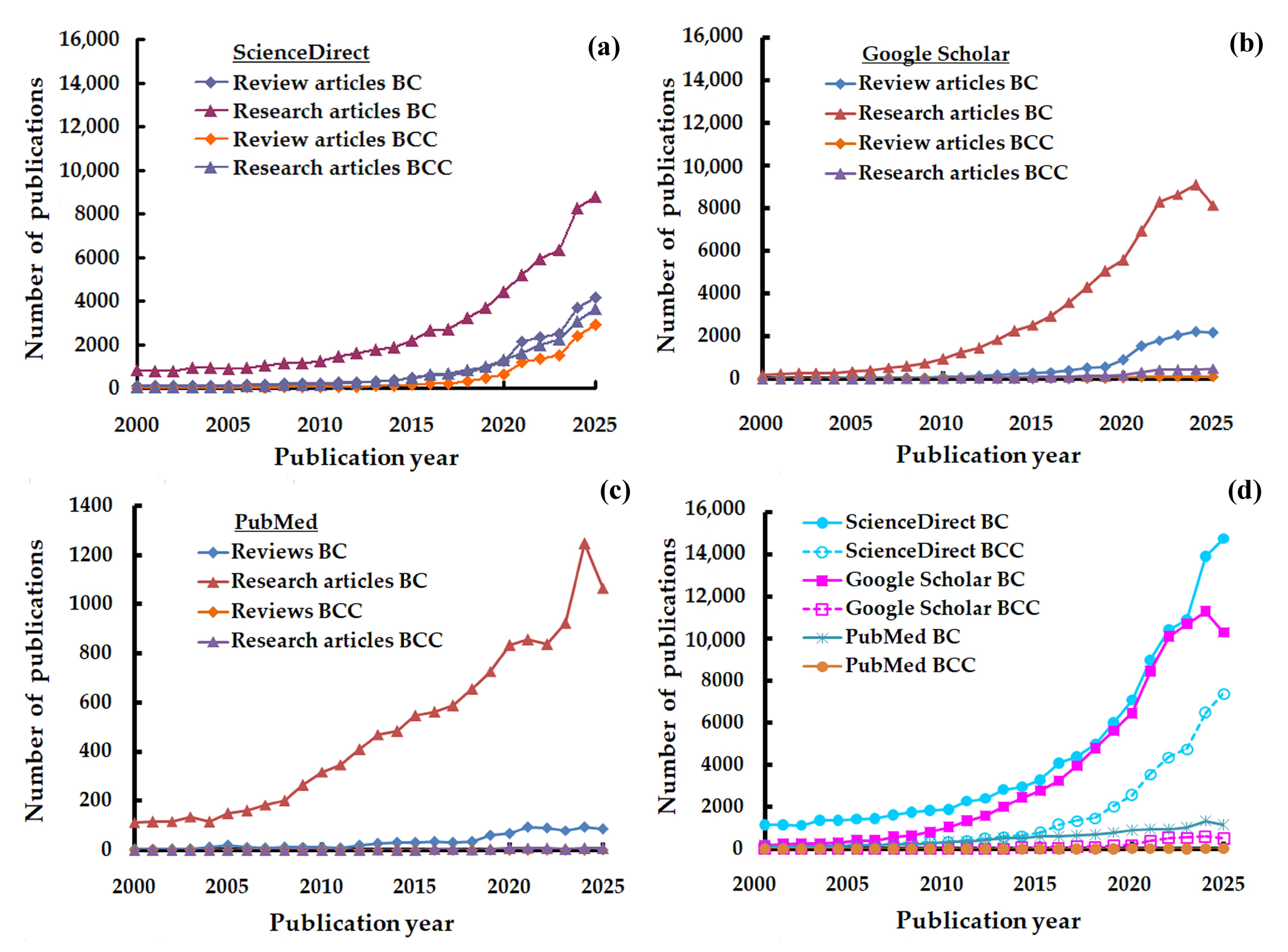
The current international scientific interest in bacterial cellulose (BC) is substantial and is primarily reflected in the increasing number of studies devoted to this polymer. According to the analysis of the chronological growth of publications devoted to the investigations of BC and developments of BC composites (BCCs), it becomes obvious that these studies continue to be relevant (Figure 1). The reasons for such sustained attention have been repeatedly discussed in numerous reviews on BC, and the growth of such summarizing publications also increased. Since 2010, the most significant increase in both research and review articles (Figure 1a,b) linked to BC and BCC can be seen in the Science Direct and Google Scholar databases. Over the past five years, research on the production of composites based on BC has made significant progress due to the development of technologies for studying the properties of nanomaterials, while the number of published results has increased 1.5–2 times. The minimum amount of publication activity in the field under study was found in the PubMed database, when analyzing both the reviews and research articles (Figure 1a–c) and the annual number of all types of publications in the databases (Figure 1d). This is due to the fact that BC currently has broader prospects for its use outside of medicine. Research conducted around the world is aimed at providing the necessary characteristics of BC, including as part of BCC for their potential application on an industrial scale. That is why this review examines examples of obtaining different BCCs and changing the characteristics of such materials.
BC is characterized by a high degree of crystallinity, tensile strength, hydrophilicity, hygroscopicity, high porosity with nanoscale pore dimensions, biocompatibility with various living systems without adverse effects, and potential biodegradability [1]. These properties make BC highly promising for applications in diverse fields, including the textile and food industries, medicine, and the production of various composite materials [2,3,4,5]. The main advantage of BC over plant-derived cellulose lies in the absence of lignin and hemicellulose residues, which eliminates the need for their removal through energy-intensive and multi-stage mechanical, chemical, or costly enzymatic pretreatments. At the same time, purification of BC from proteins and DNA can be achieved using environmentally friendly and biodegradable surfactants [6]. Furthermore, a large number of BC-producing microorganisms are known, and they are widely distributed in nature. Among them, acetic acid bacteria are the most thoroughly studied [7,8,9].
Due to the growing popularity of this polymer and the feasibility of its biotechnological production, extensive research in recent years has focused on revealing the factors influencing BC biosynthesis, with the aim of increasing polymer yield. The key factors identified include: composition of the culture medium, pH, cultivation temperature, and other physicochemical parameters [10,11,12]; utilization of substrates derived from the hydrolysis of natural polymers present in industrial and agricultural wastes with varying chemical compositions [13,14]; and cultivation mode of BC-producing microorganisms (static vs. agitated reactor systems), which affects not only BC yield but also the morphological, mechanical, and physicochemical properties of the resulting polymer. It has been established that, under static cultivation, BC forms a gel-like film or pellicle with a high degree of crystallinity, strong water-holding capacity, and notable elasticity [15]; incorporation of BC synthesis inducers such as ethanol, organic acids, and vitamins into the culture medium [4]; application of highly concentrated cell populations through immobilization techniques [13,16], which enables prolonged microbial activity, thereby increasing both BC yield and overall process efficiency; co-cultivation of BC-producing cells with other microorganisms, which engage in symbiotic interactions that can alter metabolite composition in the medium and mitigate inhibitory effects on BC biosynthesis [17,18].
These findings establish a strong scientific foundation for large-scale BC production and its subsequent practical application [19,20]. However, from the practical standpoint, the most valuable materials are often BC-based composites [21,22,23,24,25,26]. In most cases, such composites are produced after BC biosynthesis, through chemical or biochemical modification, functionalization, impregnation, co-precipitation with other materials, or by employing electrospinning processes [27,28,29,30]. Nevertheless, all these approaches involve additional processing stages and specialized equipment [31]. Moreover, these post-synthetic procedures usually require preliminary purification of BC from residual medium components, producer cells, and their adsorbed metabolites—steps that further complicate composite fabrication. The post-synthetic purification of BC is usually conducted by exposing polymer samples to alkaline solutions. Further, BC films washed from the residues of alkaline hydrolysis products can be dried and chemically modified ex situ. Most often, chemical modification results in the formation of new strong covalent bonds in the presence of substances that cannot be used in the processes of obtaining BC in situ due to their toxicity to polymer-producing cells.
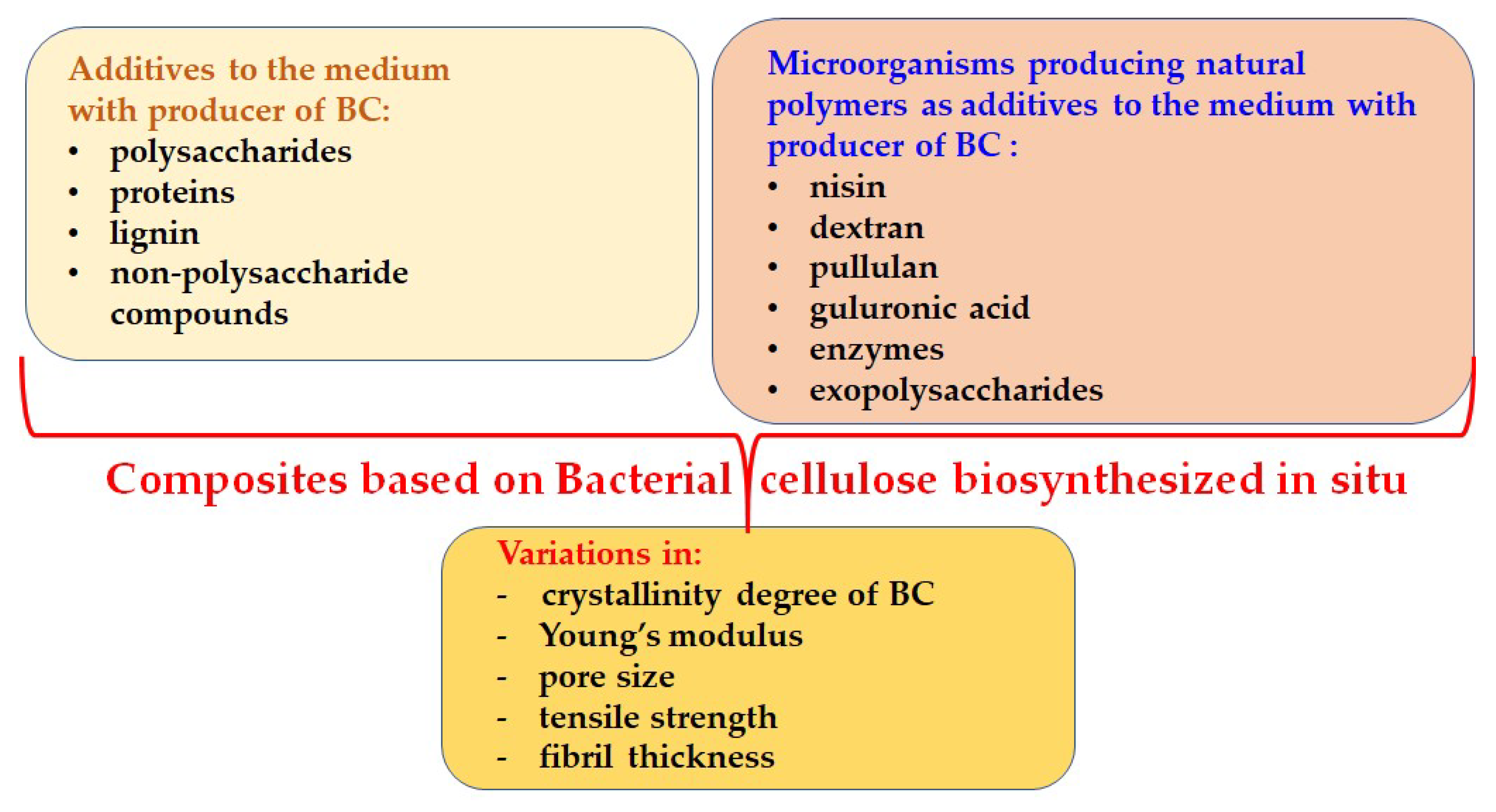
Currently, the greatest scientific and practical interest lies in the one-step production of BC-based composite materials, i.e., directly during the biosynthesis process. The variability of the resulting composites is primarily determined by the nature of the additives—organic, inorganic, biological, or mixed—introduced into the BC biosynthesis medium [3,32,33].
According to the already published works with composites based on BC, this area of research is still gaining popularity, and there are few review papers analyzing and summarizing scientific results in this area, although they are very relevant (Figure 1).
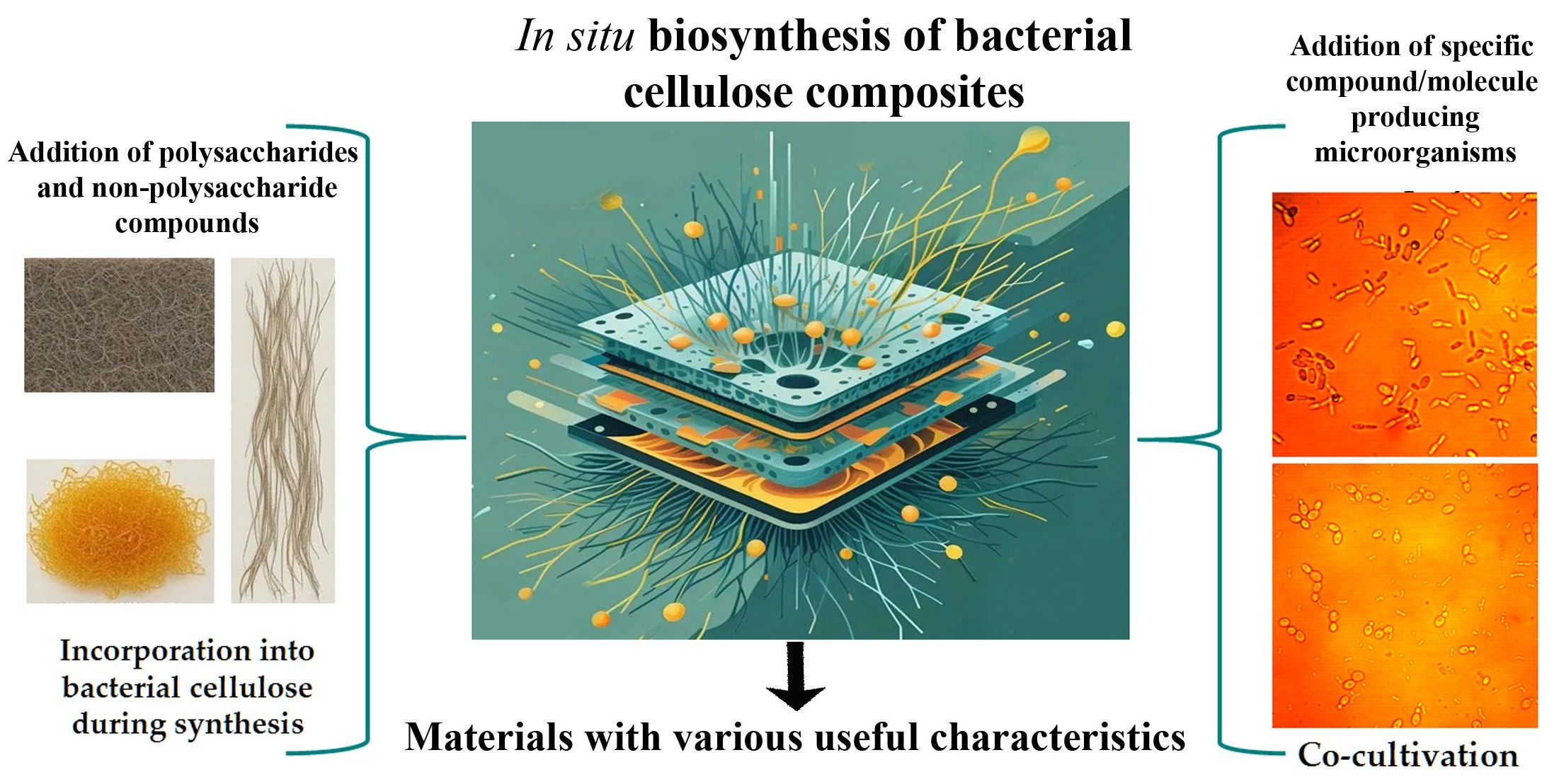
In this regard, the objective of this review was to analyze and summarize current scientific knowledge concerning BC-based composites obtained directly during biosynthesis (in situ), and to identify the major priorities noted in modern experimental studies carried out by various researchers in the field of obtaining composites based on BC “in situ”. The focus of this review was not substrate conversion efficiency or overall composite yield but on how the introduction of various additives affects the structural and functional characteristics of the resulting materials. Based on a preliminary analysis of the literature, three principal types of additives have been distinguished: (i) incorporation of various polysaccharides; (ii) introduction of non-polysaccharide components; and (iii) co-cultivation of BC-producing microorganisms with other microbial species.
This review discusses in detail all three in situ approaches and the properties of the resulting composites.

2. Approaches to Obtaining New BC-Based Composites in the Framework of Polymer Biosynthesis

2.1. The BC—Polysaccharide Composites

Among the various additives introduced into the culture medium during the biosynthesis of BC, polysaccharides (alginate, xanthan, pullulan, κ-carrageenan, cellulose, hemicellulose, etc.) have attracted particular attention (Table 1) [15,32,34,35,36,37,38,39,40,41,42,43,44,45,46,47,48,49,50,51].
Among the polysaccharides tested as BC biosynthesis additives, sodium alginate has been the most frequently investigated [34,35,36]. In particular, BC/alginate composites were obtained in situ by introducing 2% (w/v) alginate into the culture medium of Gluconacetobacter sucrofermentans under static conditions [34]. The resulting composite exhibited a more homogeneous hydrogel structure with a reduced film thickness compared to pure BC (323 μm vs. 561 μm in the wet state). The mechanical strength of the dried BC/alginate composite was three times lower than that of pure BC; however, it showed 10% higher elongation at break, indicating greater flexibility. In contrast, in the hydrated state, the tensile strength of the composite was three times higher than that of BC (0.66 MPa), while elongation at break decreased by a factor of 2.4 [34].
In another study using Acetobacter xylinum, cultivation in a static system with Moso bamboo hydrolysates supplemented with 0.25–1% (w/v) sodium alginate led to a 43% increase in BC yield. The inclusion of alginate occurred through multiple hydrogen bonds between alginate and BC fibrils, forming a three-dimensional porous network. Increasing alginate concentration from 0.25% to 0.75% enlarged BC pore size from 10–60 nm to 50–70 nm. However, at 1% alginate, the porous morphology was replaced by a line-shaped structure. The BC crystallinity index decreased by 5% compared to pure BC, whereas thermal stability and dynamic swelling/de-swelling behavior improved [35].
An alternative approach was reported by immobilizing BC-producing cells in Ba-alginate gel beads prior to cultivation [36]. The BC nanofibers secreted by the bacteria were distributed throughout the alginate hydrogel matrix. To maintain bead integrity, phosphate concentration in the culture medium was reduced by lowering NaHPO4 and yeast extract levels. The alginate beads retained rigidity for up to three days, during which cellulose fibrils covered their surfaces, and bead size increased from 2.5 to 3.6 mm. The resulting composite beads exhibited a 19% decrease in BC crystallinity compared to pure BC, while water vapor sorption capacity markedly increased from 0.07 to 38.9 g/g (dry basis). These BC/alginate composites were subsequently used as supports for lipase immobilization, where enzyme activity was 2.6 times higher than that achieved using pure BC—likely due to enhanced substrate accessibility within the composite matrix [36].
Another polysaccharide widely studied for in situ BC composite formation is xanthan gum (0.6% w/v) [37]. Cultivation of Taonella mepensis in a medium containing xanthan and hydrolysates of Tieguanyin oolong tea residues resulted in a 2.6-fold increase in BC production. The presence of xanthan influenced the medium viscosity. Despite the clear relevance of such effects, the influence of medium viscosity—a factor that could directly affect BC yield—has been specifically studied only in several works [37,42,46,47,49] in contrast to other well-examined parameters such as pH, temperature, and substrate type.
The resulting composite with xanthan gum exhibited enlarged BC microfibril diameters and inter-fibrillar spacing, as well as greater water absorption capacity. The crystallinity of BC/xanthan composites was markedly lower than that of pure BC due to xanthan adsorption onto BC fibril surfaces, which hindered the formation of inter-chain hydrogen bonds typical for native BC. Water absorption capacity increased 2.3-fold, whereas water release rate decreased. The composite also showed improved textural characteristics, including hardness, springiness, cohesiveness, and chewiness [37].
At a lower xanthan concentration (0.1% w/v) under anaerobic conditions, more uniform BC/xanthan composites were obtained, exhibiting significantly enhanced hardness, elasticity, and tensile strength, while BC yield increased 2.6-fold. The average fiber diameter increased by 1.8 times, and crystallinity decreased due to the “disrupting” effect of xanthan on BC chain, which contributed to the formation of a less regular structure in the resulting material [38].
Addition of pullulan (2% w/v) to the culture medium of Komagataeibacter hansenii increased BC production 4.5-fold [39]. BC crystallinity decreased at this concentration but increased when pullulan was added at 0.3–1%. Pullulan promoted the formation of thicker microfibrils (>40 nm), and the Young’s modulus of the composites increased at 0.3–1% pullulan but dropped to 20 MPa at 2% [39].
Chitosan, an amino-polysaccharide, is known for its capacity to interact with biological molecules through its protonated amino groups, which bind negatively charged lipopolysaccharides of Gram-negative bacteria and teichoic acids of Gram-positive bacteria. These interactions underpin its antibacterial properties by hindering nutrient uptake and inducing autolysis. Consequently, BC/chitosan composites have attracted interest for wound dressing and tissue engineering applications. In situ BC/chitosan hydrogels were obtained by introducing 5–10 g/L chitosan into a G. xylinus culture [40]. Due to chitosan’s poor solubility, flocculates formed and coated BC fibrils, filling inter-fibrillar spaces and altering BC morphology. Fibril diameter increased to 107 nm (by 36 nm), while inter-fibrillar filling reduced porosity and crystallinity (from 88% to 69%) at 10 g/L chitosan, accompanied by slightly lower thermal stability. Antibacterial activity against E. coli cells increased with chitosan concentration [40]. Similar results were observed in A. xylinum CTS cultures with 0.5–4 g/L chitosan [41].
Starch from various botanical sources (wheat, corn, waxy maize, high-amylose maize, and potato) also participated in in situ BC composite formation when added to K. xylinus cultures [42]. Starch increased medium viscosity and adhered to BC microfibers, enhancing porosity and elasticity of composite. BC/starch composites exhibited 1.9-fold thicker fibrils, greater flexibility, and higher elasticity compared to pure BC. Potato and high-amylose maize starch yielded more amorphous, less ordered BC networks [42].
Incorporation of pectin and xyloglucan (XG) into G. xylinus cultures also affected BC composite properties [43]. The XG content in BC/XG composites reached 76 mg/g BC — 12 times higher than that of pectin. Combining XG with pectin further increased incorporation levels. Addition of 0.25% (w/v) pectin or XG reduced composite strength, but at an XG-to-pectin ratio of 1:2.5, Young’s modulus increased and fibril thickness decreased. Crystallinity decreased in all cases [43]. Similarly, co-addition of XG with arabinoxylan (AX) or high-molecular-weight mixed-linkage glucan (MLG) (0.5% w/v) during G. xylinus cultivation showed that BC/MLG composites were less rigid, while BC/XG composites exhibited enhanced surface area and water-holding capacity [44].
Of particular interest in obtaining composites with BC are studies in which plant cellulose fibers (from sisal [32], banana peel [45], and cotton [46]) were incorporated directly into BC biosynthesis media. All the resulting composite materials were characterized by improved mechanical (strength) properties compared to pure BC samples (Table 1). The effect was achieved, as the authors of the studies believe, due to the distribution of microfibrillated plant cellulose between BC nanofibers, which actually adhered to the surface of the introduced cellulose samples [32].
It should be noted that, unlike water-soluble polysaccharides, which were mentioned earlier, the presence of plant cellulose fibers in a nutrient medium with BC producers did not affect BC biosynthesis, since the viscosity of the medium did not actually change. These fibers significantly enhanced composite strength due to hydrogen bonding between hydroxyl groups on plant and bacterial cellulose. Obtained composites formed sandwich-like cross-sections with plant fibers wrapped in BC layers. BC film thickness increased 5.5-fold (from 5.6 to 41.4 μm), swelling degree tripled, and both thermal stability and UV barrier properties improved compared to pure BC [46].
Addition of carboxymethyl cellulose (CMC, 1% w/v) during G. xylinus cultivation altered medium viscosity affecting the rate of formation and general properties of the BC produced by the cells in the composite. The BC/CMC composite showed slightly reduced porosity, but the BC yield and crystallinity (from 89.2% to 88.1%) remained unchanged. No noticeable morphological changes in composites were observed compared to pure BC. BC/CMC composites were evaluated as carriers for the cytostatic agent methotrexate, achieving 96% release within 3 h [47].
Another group of polysaccharides, the effect of which on the properties of the resulting BC composites was also examined, are polysaccharides derived from marine algae, such as laminarin, fucoidan, κ-carrageenan, and agar [48,49,50].
The biomass of brown macroalgae contains β-glucan (laminarin) and sulfated polysaccharides, in particular fucoidan, which exhibit biologically active properties. A study was conducted to examine the results of their introduction into a medium with K. hansenii cells producing BC. Extracts (10–25% v/v) from Laminaria japonica biomass slightly increased BC yield. Hydrogen bonding between sulfate groups of L. japonica polysaccharide and BC hydroxyls, and the filling of inter-fibrillar spaces were shown. The obtained BC/Brown algae polysaccharides composites showed an increase in the water sorption capacity (from 1481.7% to 1806.4%), compared to BC, while reducing syneresis by 15%. (from 36.2% to 21.1%). The observed decrease in syneresis was due to the fact that sulfated polysaccharides present in the L. japonica extract enhanced water retention in the resulting material. These composites exhibited decreased fiber diameter and crystallinity but improved Young’s modulus [48].
Addition of κ-carrageenan (0.3% w/v) to G. xylinus cultures halved BC yield due to higher viscosity [49]. The BC/Carrageenan composites had a bilayer structure with BC predominating at the top layer and κ-carrageenan at the bottom layer. An increase in the BC fiber width in the composite was demonstrated compared to the pure polymer. The BC network structure was sparse due to inclusions of κ-carrageenan, which was washed out during the cleaning of the composite from residual cell-producing agents with alkaline solutions (NaOH and KOH). Due to this, the BC/Carrageenan composite was characterized by reduced strength properties. It should be noted that, along with κ-carrageenan, vanillin was also released from the composite, which the authors introduced into it in order to study the release rate of such compounds [49].
In addition to those mentioned above, a number of researchers in their studies on the creation of BC composites with different polysaccharides used a number of options that are quite rare for widespread use. In particular, gellan gum, a microbial polysaccharide obtained from Sphingomonas elodea, and exopolysaccharides (EPS) from Escherichia coli were applied [50,51]. Addition of gellan gum to Taonella mepensis cultures increased BC biosynthesis by up to 59% and improved sugar uptake. The resulting BC/gellan gum composites showed enhanced textural properties (hardness, cohesiveness, springiness, and resilience) and up to 22% reduced crystallinity [50]. When EPS from E. coli were added to G. xylinus cultures, it was found that some mechanical properties typical of BC were changed in a concentration-dependent manner: at 4 mg/L, Young’s modulus doubled and tensile strength increased 1.7-fold; at 40 mg/L, properties were comparable to pure BC; and at 1000 mg/L, Young’s modulus decreased 1.7-fold while elongation at break increased (4.5% to 6.4%). The crystallinity of BC with the addition of 1000 mg/L EPS decreased from 81.2% to 69.9% [51]. Thus, a clear concentration-dependent trend in BC/EPS composite behavior was observed.
In several cases, cultivation under agitated conditions in the presence of polysaccharides [32,36,39] led to irregularly structured composites with diverse morphologies, generally exhibiting lower crystallinity, reduced mechanical strength, and decreased polymerization degree compared to BC produced under static conditions [15]. Such characteristics may, however, be advantageous for applications requiring materials with rapid release of bioactive substances—an aspect of practical importance.
It should be noted that higher concentrations of water-soluble high-molecular-weight compounds inevitably alter the rheological properties of the culture medium and thereby affect the cultivation conditions of BC-producing microorganisms. This aspect may merit further attention in future studies.

2.2. The BC—Non-Polysaccharide Composites

A wide range of non-polysaccharide materials such as graphene oxide, metal nanoparticles, carbon nanotubes, and other substances can be introduced into culture media used for the cultivation of BC-producing cells (Table 2 [52,53,54,55,56,57,58,59,60,61,62,63,64,65,66,67,68,69,70,71]).
There has been growing interest in the production of BC-based composites with proteins (collagen [52], keratin [53]), lignin [54], and polyethylene glycol [55]. BC/collagen composites were obtained by adding 0.4 g/L of collagen into the culture medium during the cultivation of G. xylinus [52]. The interaction between collagen and BC occurred via multiple hydrogen bonds, similar to the mechanism observed with polysaccharides. The amorphous nature of collagen led to a decrease in the crystallinity of BC within the BC/collagen composite. Although the pore size of the resulting material increased, the overall structure became denser and more compact. Hemolytic tests demonstrated high hemocompatibility. Compared to pure BC, the BC/collagen samples were softer, more pliable, and flexible [52].
Keratin extracted from human hair is known to promote neural tissue regeneration [53]. A BC/keratin composite was therefore produced by A. xylinum in the presence of 3% (w/v) keratin added to the culture medium. The resulting material was evaluated as a scaffold for dermal fibroblasts. X-ray diffraction confirmed the incorporation of keratin into the BC structure, which reduced its crystallinity and thermal stability while enhancing its water-holding capacity. However, fibroblast proliferation assays did not show significant improvement, likely due to the insufficient keratin content in the composite [53].
The large quantities of lignin generated as agricultural waste have attracted attention for its potential incorporation into BC composites in situ. Lignin derived from the waste of rice straw was dried and added at 2 g/L in the form of granules to the medium used for Gluconacetobacter kombuchae cultivation [54]. The resulting BC/lignin composite exhibited generally reduced performance characteristics compared to pure BC: although the network density slightly increased, the water-retaining capacity, thermal stability, tensile strength, Young’s modulus, and strain-at-break decreased. Microscopic analysis revealed a layered structure with in-plane oriented BC nanofibrils similar to those observed in wood lignocellulosic materials. Similar results were obtained by other scientists [72]. The intrinsic hydrophobicity of lignin, relative to BC, was identified as the main factor affecting the composite’s performance.
Graphene oxide (GO) [55,56], a two-dimensional monolayer carbon material rich in oxygen-containing hydrophilic functional groups, is another common additive used to prepare BC composites. Such groups promote strong interactions with BC fibrils, enabling applications such as controlled drug release systems. To obtain composites with improved electrical and thermal conductivity, reduced graphene oxide (RGO) is used [57,58]. These materials consist of sp2-hybridized carbon atoms arranged in a hexagonal lattice. BC/graphene composites have attracted considerable interest for developing flexible, self-supporting electrodes with excellent electrochemical and mechanical properties, suitable for supercapacitor applications. An in situ BC/RGO composite was produced by cultivating A. xylinum in a medium containing graphene nanosheets. The nanosheets were uniformly distributed throughout the three-dimensional BC network, resulting in a significant increase in tensile strength (by 62.5%) and tensile modulus (by 172.3%) [55]. The crystallinity index decreased from 91% (pure BC) to 62%. Subsequent modification of the composite with polyaniline produced materials with enhanced electrochemical performance.
Spherical BC/GO composites were synthesized for drug carrier applications by adding GO particles (0.01–0.05 g/L) into the culture medium of Komagataeibacter medellinensis under dynamic conditions. Depending on the agitation speed, the resulting composite spheres ranged from 0.4 cm (150 rpm) to 1 cm (130 rpm) in diameter. Uniform composite spheres were obtained only at low GO concentrations (0.01 g/L) [56]. Increasing the GO concentration produced hydrogels with denser but more heterogeneous structures (2.5–3 times higher packing density than pure BC) and enhanced thermal stability and swelling capacity.
Ibuprofen was loaded into BC/GO composites, and its release behavior in simulated intestinal fluid was studied after freeze-drying. The maximum release reached 63% after 6 h [56].
BC/RGO composites are of interest for flexible electronic devices. However, the presence of carbon nanomaterials can alter the growth kinetics of BC-producing bacteria. The addition of 1–5% (w/v) GO during the cultivation of Komagataeibacter xylinus produced BC hydrogels with strongly integrated GO nanosheets and flakes [55,56]. The crystallinity index decreased from 81% (pure BC) to 65% with 5 wt% RGO [57], while the pore size increased from 10 nm to 12.6 nm at 1–2 wt% RGO. These composites were highly flexible, with elevated Young’s modulus, tensile strength, and toughness, as well as significant electrical conductivity. However, 3 wt% RGO in the culture medium for 15 days inhibited K. xylinus growth and BC production, indicating a toxic effect at higher RGO concentrations. This was due to the fact that GO and its reduced forms are known to exhibit antibacterial properties as a result of the formation of reactive oxygen species, leading to oxidative stress of cells [58].
Silane modification, which involves the incorporation of silicon-based reagents into various materials, is commonly employed to create hydrophobic silane layers on their surfaces. To explore this approach, tetraethyl orthosilicate (TEOS) and tetramethyl orthosilicate (TMOS) were added to the culture medium during BC biosynthesis by K. xylinus [59]. Prior to introduction, these Si-containing precursors were dissolved in methanol, mixed with glucose, and the solvent was subsequently evaporated. During cultivation, TMOS exhibited an inhibitory effect on bacterial growth, whereas TEOS showed little to no impact compared to the control culture. Surface analysis of the resulting BC samples revealed silicon incorporation (up to 6.52% for BC with TEOS), uniformly distributed throughout the material, with some aggregation on the surface. The tensile strength of TMOS-modified BC decreased relative to pure BC, while TEOS-modified BC demonstrated enhanced strength [59]. Conversely, washing the films with NaOH reduced their tensile strength, likely due to interactions between NaOH and silicon compounds.
When glass nanoparticles containing SiO2, CaO, and P2O5 (1.5 g/L) were added to the culture medium, BC synthesis by G. xylinum increased 1.9-fold [60]. This enhancement was attributed to the dispersion of growing BC nanofibrils and the uniform distribution of glass particles among them. Hydrogen bonding occurred between the hydroxyl groups on BC surfaces and the silanol groups of glass particles. The resulting composite exhibited improved thermal stability, a reduced zeta potential, and enhanced biocompatibility. Additionally, the formation of bone-like apatite layers on the composite surface imparted antimicrobial activity (50–100 mg/mL) against clinically significant aerobic bacteria and fungi including Proteus vulgaris, Escherichia coli, Salmonella typhimurium, Pseudomonas aeruginosa, Klebsiella pneumoniae, Bacillus subtilis, Staphylococcus aureus, Candida albicans, and Aspergillus parasiticus [60].
Bone-like apatite materials used for treating bone defects are required to possess sufficient porosity to ensure osteointegration and vascularization. The addition of hydroxyapatite (HAp) enhances bone formation by improving osteoconductivity. BC has been proposed as a potential scaffold for bone tissue engineering; however, its nanoporous structure limits cellular migration and vascularization. To overcome this, in situ BC/hydroxyapatite composites were obtained during G. xylinus cultivation [61]. The introduction of hydroxyapatite led to a substantial increase in pore size while reducing nanofiber diameter, crystallinity, and Young’s modulus. The hydroxyapatite crystals were embedded within the BC matrix, and the Ca/P ratio (1.65) corresponded to the stoichiometric value typical for natural bone. These nanocomposites were successfully used as purified and sterilized scaffolds for human osteoblast-like cells (SaOs-2), demonstrating efficient cell migration between BC fibers.
A similar BC/hydroxyapatite composite was synthesized using Lactiplantibacillus plantarum in media supplemented with 10 g/L of hydroxyapatite nanoparticles under both static and agitated (100 rpm) conditions [62]. The addition of hydroxyapatite increased BC synthesis 1.7-fold due to bacterial immobilization on nanoparticle surfaces. The hydroxyapatite content within the BC nanofiber matrix was higher under agitated conditions than in static culture. The average BC fiber diameter was 145 nm under static conditions (vs. 122 nm for pure BC) and decreased to 56 nm under agitation. In both cases, the BC crystallinity decreased relative to the pure polymer, in agreement with previous findings [61].
A series of studies have explored in situ formation of BC composites containing bioactive components such as propolis [63], antibiotics [64], hyaluronic acid and silk sericin [65], and various disinfecting and regenerative agents [66,67].
The addition of propolis (20–30% w/v) to the culture medium of K. intermedius, K. maltaceti, and K. nataicola led to increased BC yields by 1.3-, 2.1-, and 1.4-fold, respectively [63]. Propolis served as an additional carbon and nitrogen source, thus stimulating BC biosynthesis. However, concentrations above 30% inhibited bacterial growth and polymer accumulation. The resulting BC/propolis composites exhibited enhanced water-holding capacity and moisture retention.
A composite incorporating ciprofloxacin (0.2% w/v) was obtained by adding the antibiotic to the medium during Acetobacter xylinum cultivation [64]. The material demonstrated strong antibacterial activity against E. coli, K. pneumoniae, and P. aeruginosa. However, ciprofloxacin diffusion through BC nanofibrils was limited, as its molecular size exceeded BC pore dimensions. Alkaline purification (0.1 M NaOH, 80 °C, 1 h) removed both bacterial residues and most of the antibiotic. Interactions between BC and ciprofloxacin were primarily due to hydrogen bonding between BC hydroxyl groups and the quinoline and fluorinated groups of ciprofloxacin. The composite exhibited a lower crystallinity index (49%) compared to pure BC (75%) [64].
In another study, BC was functionalized in situ with hyaluronic acid (1 wt%) and silk sericin (3 wt%) during G. xylinus cultivation [65]. The resulting composites possessed thinner BC fibrils with smoother surfaces and slightly reduced crystallinity (from 92% to 88%). They also demonstrated improved thermal stability and water retention. While the tensile strength was lower than that of pure BC, the elongation at break increased by 5%.
Silver nitrate (0.01 g/L) was introduced into the medium during A. xylinum cultivation to produce in situ BC/Ag composites with antibacterial activity against S. aureus and E. coli [66]. Although bacterial growth and BC production rates were reduced in the presence of AgNO3, the resulting BC fibrils were more densely packed, reducing water absorption. The composites showed increased resistance to alkaline treatments commonly applied during antimicrobial material processing [66].
BC has recently gained significant attention as a biomaterial for bone tissue regeneration. To enhance its osteogenic potential, gold nanoparticles (GNPs)—widely used as osteogenic agents for in vitro differentiation and bone repair—were incorporated in situ during G. xylinus cultivation [67]. The resulting BC/GNP composites exhibited a uniform reddish color, indicating homogeneous distribution of nanoparticles without aggregation. While the 3D BC hydrogel network remained largely intact, pore size increased, and the average nanofiber width rose from 110 nm to 358 nm. The addition of GNPs reduced the composite stiffness but substantially increased specific surface area, pore volume, and total pore area compared to pure BC. These materials demonstrated sustained GNP release and excellent osteogenic activity [67].
Heterogeneous advanced oxidation processes, based on reactive oxygen species generation, are considered highly effective for degrading a wide range of pollutants and inactivating microorganisms through oxidative stress. The efficiency of these processes can be enhanced using photocatalytic nanomaterials. An in situ BC/MoS2 nanocomposite was obtained by adding ultrafine MoS2 powder (5 mg/mL) to G. xylinus culture medium [68]. After four days of static cultivation, the forming composite appeared at the air–liquid interface; the film was then inverted and cultured for an additional three days to ensure complete MoS2 incorporation. The resulting composite exhibited a distinctive sandwich-like structure, with MoS2 particles compactly encapsulated between two BC layers. The BC/MoS2 composite showed strong photocatalytic activity, excellent thermal stability, and was effective in degrading various dyes and formaldehyde. Moreover, under infrared irradiation, it displayed antibacterial activity against E. coli and S. aureus.
For the fabrication of materials capable of electromagnetic interference (EMI) shielding, inorganic conductive compounds such as MXenes—transition metal carbides and nitrides with the general formula Mn + 1XnTx (where M is a transition metal, X is carbon or nitrogen, and Tx represents surface terminations such as -OH, -F, or -O)—have been combined with BC [69]. Ultrafine, strong, and highly flexible BC/MXene composites were obtained in situ during K. xylinus cultivation in media containing Ti3C2Tx nanosheets. The resulting composites, 4–11 µm thick and containing up to 77 wt% Ti3C2Tx, were highly flexible and could be folded without cracking. The intertwining of BC nanofibers and Ti3C2Tx nanosheets imparted significant mechanical reinforcement: tensile strength, Young’s modulus, and strain at break were 1.5 times higher than those of pure BC. The electrical conductivity increased with Ti3C2Tx content, and the specific EMI shielding efficiency exceeded that of most reported carbon-based MXene composites [69].
Conductive BC-based composites were also obtained by cultivating Komagataeibacter sp. cells in the presence of iron salts (FeCl2 and FeSO4, individually or combined, 0.05–0.1 w/v) [70]. The addition of FeSO4 enhanced BC production, whereas FeCl2 exhibited toxicity toward the bacteria. It was assumed that the ingestion of excess chlorine ions into cells leads to hyperpolarization of the membrane and inhibition of cell metabolism. The resulting BC composites, containing uniformly distributed Fe2+-particles and iron gluconate, were more brittle than pure BC but demonstrated notable electrical conductivity, making them promising for flexible electronics applications.
An unconventional fluorescent BC composite was obtained in situ by cultivating K. sucrofermentans in a glucose medium modified with 6-carboxyfluorescein (6CF–Glc) [71]. The incorporation of 6CF had minimal influence on BC biosynthesis but decreased composite crystallinity while increasing pore size (up to 27% at the highest 6CF concentration). This led to reduced elastic modulus, tensile strength, and thermal stability compared to pure BC, but the elongation at break increased.
In summary, numerous in situ BC-based composites have been developed by introducing non-polysaccharide additives into the culture media of various BC-producing microorganisms. These materials exhibit a wide range of novel functional properties suitable for biomedical, analytical, and technical applications. For many of these composites, reduced BC crystallinity was observed [52,53,54,61,62], accompanied by decreased thermal stability and tensile strength [55,57,58,59,71]. However, several composites demonstrated enhanced water-holding capacity [53,63,65] and, in certain cases, excellent electrical conductivity [57,58,69,70].

2.3. Production of BC Composites Through Co-Cultivation/Addition of Different Microorganisms Producing Specific Compounds

It has been established that a variety of BC-based composites can be obtained by introducing microbial cells capable of synthesizing different molecules and polymers into media containing BC-producing strains (Table 3 [33,73,74,75,76,77,78,79,80,81,82,83,84,85]).
A particularly promising direction involves BC/nisin composites, as nisin is a natural antimicrobial peptide widely used in the food industry due to its broad-spectrum activity against Gram-positive bacteria. Several studies have reported co-cultivation of Lactococcus strains producing nisin with BC-producing bacteria, resulting in the formation of composites with intrinsic antimicrobial properties. For example, co-cultivation of Komagataeibacter xylinum and Lactococcus lactis subsp. lactis, producing BC and nisin, respectively, led to the production of a BC/nisin composite with pronounced antibacterial activity and significantly improved mechanical properties: the elastic modulus, tensile strength, and elongation at break increased by 161%, 271%, and 195%, respectively [33].
Interestingly, modifying the cultivation conditions of the same strains at the same inoculation ratio resulted in higher nisin yields. The process was carried out in two stages. First, K. xylinum was cultivated in a fructose-containing medium for five days. Then, the BC-producing culture was transferred to MRS medium containing L. lactis and incubated statically at 37 °C for 18 h. The water content, swelling ratio, and reswelling rate of the BC/nisin composites were comparable to those of pure BC, but the average fiber diameter in the composites was 1.2 times smaller (350–360 nm) [73].
Co-cultivation of Enterobacter sp. and Lactococcus lactis also yielded a BC/nisin composite [74]. In this case, BC production decreased 1.2-fold (1 g/L) compared to monoculture due to high lactic acid concentrations produced by L. lactis. The nisin concentration in the composite reached 30 mg/g. Crystallinity decreased slightly from 71% to 63% compared to pure BC. The physical properties remained similar to BC, but the composite displayed strong inhibitory activity against Staphylococcus aureus [74]. In another study, adjusting the cell ratio during co-cultivation increased nisin synthesis by 85% without reducing BC yield. The BC crystallinity index decreased by 28.6% in the resulting composite [75].
Another antibacterial BC composite active against Listeria monocytogenes, the causative agent of listeriosis, was obtained by co-cultivating Kosakonia oryzendophytica (BC producer) with Leuconostoc carnosum (leucocin producer) [76]. Leucocin, a polypeptide antibiotic, forms multiple hydrogen bonds with BC molecules. The composite showed physical characteristics similar to pure BC, with only a slight (4%) reduction in crystallinity.
An alternative to adding polysaccharides directly to the BC culture medium is to co-cultivate different polymer producers. For example, K. sucrofermentans (BC producer) and Leuconostoc mesenteroides (dextran producer) were co-cultured in molasses medium [77]. Dextransucrase secreted by L. mesenteroides hydrolyzed sucrose to fructose, which is an excellent carbon source for BC producers. This metabolic interaction lowered gluconic acid formation, stabilized medium pH, and enhanced BC production. The resulting composite displayed a nanoporous, randomly oriented ribbon-like fibril network (60–90 nm wide). The BC crystallinity index decreased by 30% compared to pure BC [77].
Co-cultivation of K. hansenii and Aureobasidium pullulans resulted in a BC/Pullulan composite [39]. Here, BC yield decreased 1.8-fold due to substrate competition, and mycelial formation by A. pullulans interfered with bacterial growth. Nevertheless, the BC/Pullulan composite exhibited similar general characteristics to pure BC, except for an increased maximum ribbon width and higher Young’s modulus [39].
Several lactic acid bacteria are known producers of hyaluronic acid (HA), a linear heteropolysaccharide, glycosaminoglycan, which is part of the connective, epithelial and nervous tissues of humans. Therefore, there is great interest in BC/HA composites due to the possibility of their use as dressings and in regenerative medicine. BC/HA composites were obtained by co-cultivating Komagataeibacter xylinus or Komagataeibacter sp., and Lactobacillus rhamnosus or L. casei [78,79]. BC production increased by 64–86%, and the HA content reached 2–10 mg per gram of dried BC. BC crystallinity decreased by 2–8%, depending on the strain combination.
The average fiber diameter increased compared to pure BC. Water absorption and retention properties of the composites were strongly dependent on fiber packing. It is known that more densely packed structures have a slower release of water, but at the same time their absorption of aqueous solutions is also slower. The presence of HA reduced water uptake but increased water retention compared to BC alone [78,79].
Another interesting case involved adding various Lactobacillus strains (L. acidophilus, L. delbrueckii, or L. helveticus, 5% v/v) to a whey-based medium containing K. xylinus as BC producers [80]. The resulting BC composites with exopolysaccharides exhibited improved mechanical properties (higher Young’s modulus, tensile strength, and strain at break) and a 1.25-fold increase in BC production. However, the concentration of exopolysaccharides decreased compared to monoculture. Structurally, the composites showed layered BC fiber organization with increased inter-fibrillar spacing due to interactions with bacterial exopolysaccharides [80].
Co-cultivation of K. xylinus and Lactiplantibacillus plantarum in mangosteen pericarp extract medium produced a multifunctional composite [81]. Metabolic analysis revealed 37 metabolites, including exopolysaccharides, succinic and lactic acids, 2-aminobutyrate, valine, xylitol, propionate, isoleucine, and glycerol. This composite exhibited reduced hardness, gumminess, chewiness, and springiness compared to pure BC but increased cohesiveness. Such composites may be used as probiotic-enriched gelling agents or as an additive to food products to change their texture and increase their fiber content [81].
Polyhydroxybutyrates (PHBs) are biodegradable polymers of interest for creating BC-based composite materials. Co-cultivation of Gluconacetobacter xylinus and Ralstonia eutropha resulted in the formation of BC/PHB composites with improved mechanical properties compared to pure BC [82]. Enhanced tensile strength and Young’s modulus were attributed to the formation of a denser BC network with good adhesion of PHB particles. At the same time, BC/PHB composites were characterized by lower tensile strength and elongation. These composites exhibited higher toxic copper ion sorption capacity—2.6 times greater than that of BC alone [82].
A BC/Bacterial flocculant composite was obtained by co-cultivating Taonella mepensis (BC producer) and Diaphorobacter nitroreducens (bacterial flocculant producer) to remove polyethylene terephthalate from wastewater [83]. The flocculants, composed primarily of heteropolysaccharides and glycoproteins, contained 14.8% uronic acid, 33.9% glucosamine, 20% glucose, 15% galactose, and trace mannose and xylose. BC in the composite displayed wider and more densely packed nanofibers, increased pore volume (1.6-fold), greater tensile strength and Young’s modulus, and a doubled specific surface area. The presence of amino groups enhanced microplastic adsorption efficiency, which remained above 90% over five adsorption–regeneration cycles [83].
An innovative approach involved co-cultivating BC producing K. rhaeticus cells with genetically engineered Saccharomyces cerevisiae strains (yCG04, yCG05, yCelMix) producing secreted recombinant proteins. Yeast-secreted proteins altered the properties of BC in the formed composites [84]. These included β-lactamase TEM1, α-galactosidase, laccase, cellobiohydrolase, endoglucanase, β-glucosidase, and lytic polysaccharide monooxygenase. The enzymes remained active within the BC matrix even after drying. The resulting composites were more brittle than BC alone, with tensile strength, Young’s modulus, and viscoelastic properties reduced by approximately 50%. However, the materials displayed a wide range of enzymatic activities, which were incorporated during BC biosynthesis [84]. Taken together, these examples demonstrate that introducing microbial co-cultures into BC-producing systems provides a versatile platform for fabricating functional composites with tailored physical, chemical, mechanical, and biological properties (Table 3). In many cases, the “partner” microorganisms not only contribute their own biopolymers but also stimulate BC production [73,77,78,80], enabling efficient in situ fabrication of multifunctional materials.

3. Comparative Analysis of In Situ Synthesized BC Composites Through Various Modes

When analyzing recent trends in the development of new BC-based composites, it becomes clear that in situ biosynthetic approaches are gaining increasing popularity [30,31,32,38,42]. Examination of the results summarized above (Table 1, Table 2 and Table 3) demonstrates that the introduction of individual molecules of various natural polymers (polysaccharides, proteins, lignin), as well as low-molecular-weight substances, into BC-producing culture media makes it possible to obtain composite materials with a wide range of structural and functional characteristics (Figure 2). The mechanical properties of BC composites (Young’s modulus, elongation at break, tensile strength), as well as crystallinity, water retention, porosity, flexibility, and others can be changed depending on the parameters of the biosynthesis process, including the conditions of cultivation of BC producing cells, the type of microorganism, concentration, and type of additives introduced into the medium. Such observations are summarized in Figure 2 based on data in Table 1, Table 2 and Table 3. One of the most frequently used strategies for improving BC properties is the inclusion of polymers (Figure 2), including various polysaccharides of microbial origin, added to the medium during BC film formation.
All this will determine the potential applications of such composites, including the food, biomedical, textile, electrical and electronic industries. However, further research is still needed to increase the yield of BC-based composites with desired additives and adjusted properties, leading to improved economic performance of the process.
An indisputable advantage of in situ approach, compared with post-synthetic modification of BC, lies in the fact that the numerous hydroxyl groups of BC can participate in multiple intermolecular interactions directly during its biosynthesis. Consequently, the introduction of different compounds into the culture medium at the stage of “cell weaving,” performed by BC-producing microorganisms, enables control over the resulting material’s structure and properties. This can be achieved by varying the concentrations and ratios of added substances to the synthesized BC [56,60,63,66,71], by selecting different BC-producing strains (Table 1, Table 2 and Table 3), or by altering the composition of the culture medium—particularly the main substrates serving as carbon sources [68,76,77,80,81], among other parameters.
As a result, a wide spectrum of factors becomes available for tuning the properties of the obtained composites. It is evident that within the in situ biosynthetic approach to BC-based composite fabrication, there remains an extensive range of potential additives that could be explored. These include not only natural polymers (Figure 3), but also synthetic polymers that do not exert toxic effects on BC-producing bacterial cells [85]. By contrast, when modifying already synthesized BC—which possesses well-characterized mechanical and chemical properties—it is difficult to achieve the same diversity of composite characteristics. This limitation is largely due to BC’s high crystallinity, nanoscale fibril dimensions, and correspondingly small pore sizes, which restrict the penetration of many molecules into the polymer matrix. For example, a study was conducted on the modification of BC ex situ with dye molecules and by introducing it into a culture medium for polymer producers in situ. When comparing the obtained shades and saturation of the paint, the BC sample obtained in situ showed a more intense blue color compared to the sample dyed ex situ. In addition, BC obtained in situ was colored more uniformly than BC prepared ex situ [86].
In another experiment, the moisture retention capacity of BC and inorganic gel of bentonite composites obtained by in situ and ex situ methods was compared. The results showed that the water retention capacity of the composite obtained in situ was higher, since there was not as much dense packing of BC nanofibers as in the case of the BC sample modified ex situ, which was densely coated with the inorganic gel of bentonite. This led to a deterioration in the water absorption of the material [87].
Therefore, post-synthetic BC modification mainly focuses on surface modification and functionalization [27,28,29,30]. A particularly promising direction involves in situ biosynthesis carried out through co-cultivation of BC producers with other microorganisms, rather than by simply introducing specific compounds at defined concentrations.
Such co-cultivation processes are especially interesting because they lead to the formation of new metabolites within the culture medium, including natural polymers (Table 3), whose concentrations—as well as the amount and structure of the synthesized BC—can vary dynamically during cultivation.
In situ BC functionalization has proven effective for obtaining composite materials with different characteristics. However, their use for biomedical purposes remains insignificant in comparison with other areas of in vitro and in vivo research (Figure 1). Obviously, new research on the development and application of BCC in biomedicine should be expected in the near future.
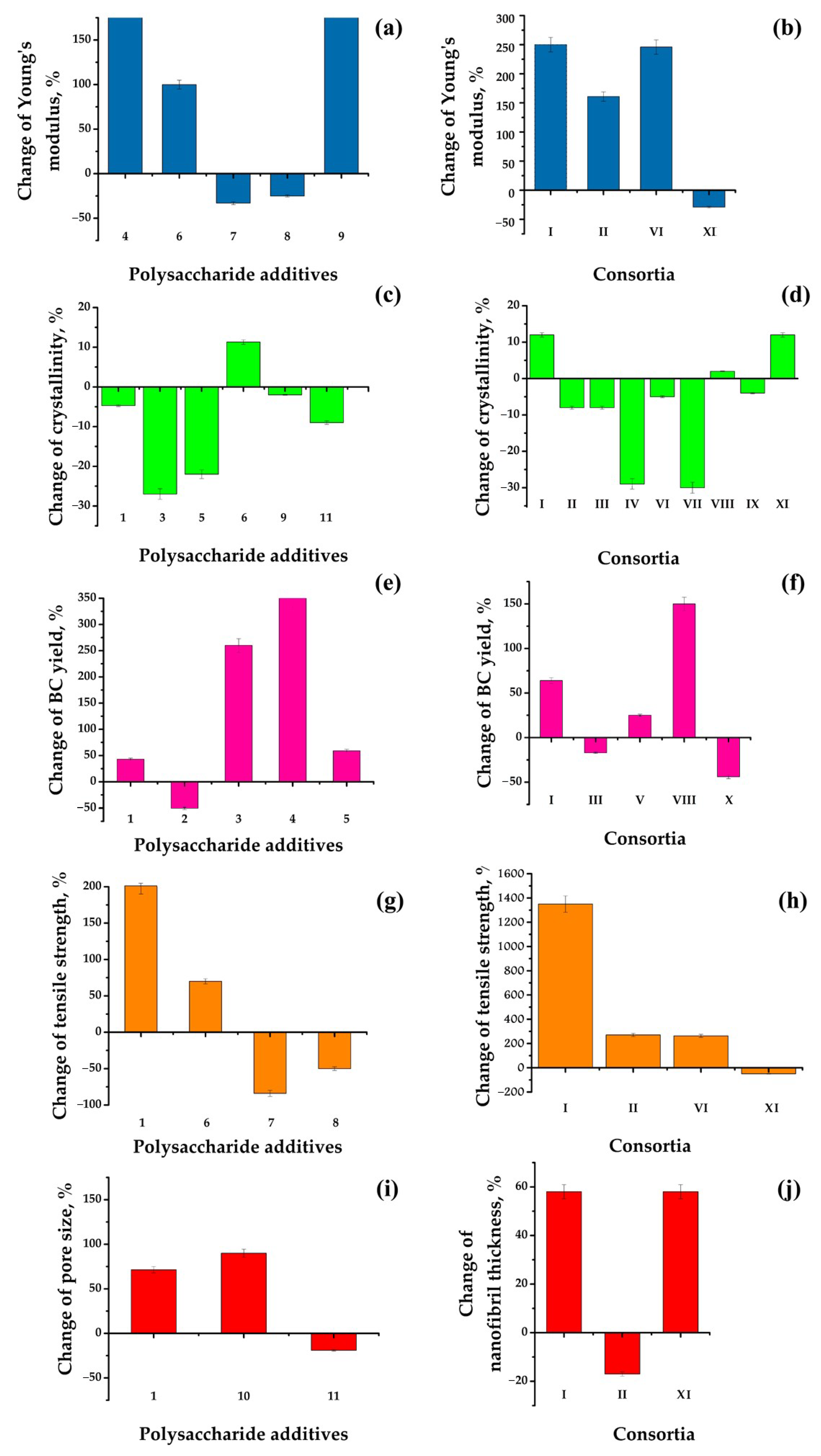
Among the in situ-derived BC composites, many are formed with the participation of polysaccharides, which may be either externally supplied to the BC-producing cultures (Table 1) or synthesized in the same medium by other microorganisms (Table 3). Therefore, it was of particular interest to compare the properties of these composites and evaluate the effects of cultivation conditions on BC yield (Figure 3). The data summarized in Figure 3 are based on the studies reviewed in Table 1 and Table 3 and include only those characteristics explicitly reported by the original authors.
Comparison of the presented data indicates that composites produced via co-cultivation of BC producers with other microorganisms tend to exhibit higher Young’s modulus and tensile strength than those obtained by introducing external polysaccharides into the culture medium (Figure 3). At the same time, composites formed with externally added polysaccharides typically show increased pore size and higher BC accumulation within the matrix compared to those obtained using microbial consortia.
It should be noted that, in nearly all cases, regardless of the method used, a decrease in the crystallinity of BC within the composites is observed—by as much as 30% relative to pure BC. The difference in crystallinity was observed as a function of presence of certain components in the culture medium. The percentage reduction in crystallinity of the composites compared to the pure BC mostly depended on the concentration of the components present [37,40,50,51]. Such dependence of crystallinity alteration was revealed in situ in synthesized composites of BC with proteins and other polysaccharides. The presence of graphene also reduced the crystallinity of the obtained material, and there was a significant change in the observed parameter (for example, from 91% to 62% [55] and from 81% to 65% [57]). However, it is well established that composites with a more amorphous structure possess enhanced water absorption capacity [37,44,48,63,79] and can be molded into more diverse shapes for practical applications.
Furthermore, BC-based composites obtained via in situ synthesis, as well as those produced through post-biosynthetic modification, can acquire entirely new functionalities not inherent to native BC. These include antimicrobial [41,64,66,74,76], enzymatic [85], and electrically conductive properties [55,56,57,58,69,70], among others.

4. Conclusions

The abundance of hydroxyl groups on BC surfaces enables the formation of multiple interactions (primarily hydrogen bonds) between BC and a wide range of compounds either introduced into or synthesized within the culture medium. Consequently, in situ modification through the incorporation of various materials and bioactive substances during BC biosynthesis represents a promising approach to improving BC characteristics and producing new composite materials in a single (biosynthetic) step. These composites can exhibit properties unattainable for pure BC, thereby greatly expanding its potential applications. Moreover, accumulated and systematized knowledge regarding how different materials interact with BC and influence its properties can guide researchers toward the rational design of composites with specific, targeted functionalities. Since such composites are obtained through the simultaneous occurrence of BC biosynthesis and material formation, these in situ processes are attracting increasing scientific attention—both from a theoretical and a practical standpoint. However, it should be noted here that the in situ synthesis approach also has certain limitations. In particular, the incorporation of additives or nanoparticles during the BC formation process can be difficult to control, which may result in non-uniform or nonspecific distribution of the incorporated components. Moreover, some compounds—especially metal-based nanoparticles such as silver—may exhibit cytotoxic effects on the cellulose-producing microorganisms, thereby affecting BC yield and quality. These aspects highlight the need for further optimization of in situ methods and the development of strategies to improve both incorporation efficiency and microbial compatibility.

Author Contributions

Conceptualization, E.E. and A.B.; formal analysis, A.A. and A.B.; investigation, E.E., N.S., A.A., O.M., I.C. and O.S.; data curation, N.S., O.M. and I.C.; writing—original draft preparation, E.E., N.S., A.A., O.M., I.C. and O.S.; writing—review and editing, E.E., N.S., A.A. and A.B.; supervision, E.E.; project administration, E.E. and A.B.; funding acquisition, E.E. and A.B. All authors have read and agreed to the published version of the manuscript.

Funding

This research was financially supported by the Joint international project of Russian Science Foundation (RSF 25-44-01003) and Department of Science and Technology of the Ministry of Science and Technology of the Republic of India (DST/IC/RSF/2025/110, Grant 120407).

Institutional Review Board Statement

Not applicable.

Data Availability Statement

The original contributions presented in this study are included in the article. Further inquiries can be directed to the corresponding author.

Conflicts of Interest

The authors declare no conflicts of interest.

Abbreviations

The following abbreviations are used in this manuscript:
AXArabinoxylan
BCBacterial cellulose
CFUsColony-forming units
CMCCarboxymethyl cellulose
6CF-Glc6-carboxyfluorescein-glucose
EMIElectromagnetic interference
EPSExopolysaccharides
GAGuluronic acid
GNPsGold nanoparticles
GOGraphene oxide
PHBsPolyhydroxybutyrates
RGOReduced form of Graphene oxide
TEOSTetraethyl orthosilicate
TMOSTetramethyl orthosilicate
UVUltra-violet
XGXyloglucan

References

  1. Girard, V.D.; Chaussé, J.; Vermette, P. Bacterial cellulose: A comprehensive review. J. Appl. Polym. Sci. 2024, 141, e55163. [Google Scholar] [CrossRef]
  2. Mishra, S.; Singh, P.K.; Pattnaik, R.; Kumar, S.; Ojha, S.K.; Srichandan, H.; Parhi, P.K.; Jyothi, R.K.; Sarangi, P.K. Biochemistry, synthesis, and applications of bacterial cellulose: A review. Front. Bioeng. Biotechnol. 2022, 10, 780409. [Google Scholar] [CrossRef]
  3. Potočnik, V.; Gorgieva, S.; Trček, J. From Nature to Lab: Sustainable bacterial cellulose production and modification with synthetic biology. Polymers 2023, 15, 3466. [Google Scholar] [CrossRef] [PubMed]
  4. Andriani, D.; Apriyana, A.Y.; Karina, M. The optimization of bacterial cellulose production and its applications: A review. Cellulose 2020, 27, 6747–6766. [Google Scholar] [CrossRef]
  5. Agustina, W.; Boontawan, A.; Gamonpilas, C.; Prakit Sukyai, P.; Yamabhai, M. Recent studies and industrial applications of bacterial nanocellulose in the food industry. Cellulose 2025, 32, 8729–8756. [Google Scholar] [CrossRef]
  6. Nikbakht, A.; van Zyl, E.M.; Larson, S.; Fenlon, S.; Coburn, J.M. Bacterial cellulose purification with non-conventional, biodegradable surfactants. Polysaccharides 2024, 5, 857–871. [Google Scholar] [CrossRef]
  7. Li, G.; Wang, L.; Deng, Y.; Wei, Q. Research progress of the biosynthetic strains and pathways of bacterial cellulose. J. Ind. Microbiol. Biotechnol. 2022, 49, kuab071. [Google Scholar] [CrossRef]
  8. Płoska, J.; Garbowska, M.; Klempová, S.; Stasiak-Różańska, L. Obtaining bacterial cellulose through selected strains of acetic acid bacteria in classical and waste media. Appl. Sci. 2023, 13, 6429. [Google Scholar] [CrossRef]
  9. Netrusov, A.I.; Liyaskina, E.V.; Kurgaeva, I.V.; Liyaskina, A.U.; Yang, G.; Revin, V.V. Exopolysaccharides producing bacteria: A Review. Microorganisms 2023, 11, 1541. [Google Scholar] [CrossRef] [PubMed]
  10. Cruz, M.A.; Flor-Unda, O.; Avila, A.; Garcia, M.D.; Cerda-Mejía, L. Advances in bacterial cellulose production: A scoping review. Coatings 2024, 14, 1401. [Google Scholar] [CrossRef]
  11. Mouro, C.; Gomes, A.P.; Gouveia, I.C. Microbial exopolysaccharides: Structure, diversity, applications, and future frontiers in sustainable functional materials. Polysaccharides 2024, 5, 241–287. [Google Scholar] [CrossRef]
  12. Lanot, A.; Tiwari, S.; Purnell, P.; Omar, A.M.; Ribul, M.; Upton, D.J.; Eastmond, H.; Badruddin, I.J.; Walker, H.F.; Gatenby, A.; et al. Demonstrating a biobased concept for the production of sustainable bacterial cellulose from mixed textile, agricultural and municipal wastes. J. Clean. Prod. 2025, 486, 144418. [Google Scholar] [CrossRef]
  13. Stepanov, N.; Efremenko, E. “Deceived” Concentrated immobilized cells as biocatalyst for intensive bacterial cellulose production from various sources. Catalysts 2018, 8, 33. [Google Scholar] [CrossRef]
  14. Revin, V.V.; Liyaskina, E.V.; Parchaykina, M.V.; Kurgaeva, I.V.; Efremova, K.V.; Novokuptsev, N.V. Production of bacterial exopolysaccharides: Xanthan and bacterial cellulose. Int. J. Mol. Sci. 2023, 24, 14608. [Google Scholar] [CrossRef]
  15. Singhsa, P.; Narain, R.; Manuspiya, H. Physical structure variations of bacterial cellulose produced by different Komagataeibacter xylinus strains and carbon sources in static and agitated conditions. Cellulose 2018, 25, 1571–1581. [Google Scholar] [CrossRef]
  16. Efremenko, E.; Senko, O.; Maslova, O.; Stepanov, N.; Aslanli, A.; Lyagin, I. Biocatalysts in synthesis of microbial polysaccharides: Properties and development trends. Catalysts 2022, 12, 1377. [Google Scholar] [CrossRef]
  17. Li, W.; Huang, X.; Liu, H.; Lian, H.; Xu, B.; Zhang, W.; Sun, X.; Wang, W.; Jia, S.; Zhong, C. Improvement in bacterial cellulose production by co-culturing Bacillus cereus and Komagataeibacter xylinus. Carbohydr. Polym. 2023, 313, 120892. [Google Scholar] [CrossRef]
  18. Jiang, H.; Song, Z.; Hao, Y.; Hu, X.; Lin, X.; Liu, S.; Li, C. Effect of co-culture of Komagataeibacter nataicola and selected Lactobacillus fermentum on the production and characterization of bacterial cellulose. LWT 2023, 173, 114224. [Google Scholar] [CrossRef]
  19. Pandey, A.; Singh, A.; Singh, M.K. Novel low-cost green method for production bacterial cellulose. Polym. Bull. 2024, 81, 6721–6741. [Google Scholar] [CrossRef]
  20. Pandey, A.; Singh, A.; Singh, M.K. Green synthesis and optimization of bacterial cellulose production from food industry by-products by response surface methodolgy. Polym. Bull. 2024, 81, 16965–16998. [Google Scholar] [CrossRef]
  21. Lyagin, I.; Maslova, O.; Stepanov, N.; Presnov, D.; Efremenko, E. Assessment of composite with fibers as a support for antibacterial nanomaterials: A case study of bacterial cellulose, polylactide and usual textile. Fibers 2022, 10, 70. [Google Scholar] [CrossRef]
  22. Soares, A.L.d.B.; Luz, E.P.C.G.; Castro-Silva, I.I.; Monteiro, R.R.d.C.; Andrade, F.K.; Vieira, R.S. Composite based on biomineralized oxidized bacterial cellulose with strontium apatite for bone regeneration. Polysaccharides 2025, 6, 23. [Google Scholar] [CrossRef]
  23. Fu, R.; Ren, Y.; Fang, K.; Sun, Y.; Zhang, Z.; Luo, A. Preparation, characterization and biocompatibility of chitosan/TEMPO-oxidized bacterial cellulose composite film for potential wound dressing applications. Fibers Polym. 2021, 22, 1790–1799. [Google Scholar] [CrossRef]
  24. Aditya, T.; Allain, J.P.; Jaramillo, C.; Restrepo, A.M. Surface modification of bacterial cellulose for biomedical applications. Int. J. Mol. Sci. 2022, 23, 610. [Google Scholar] [CrossRef]
  25. Aslanli, A.; Lyagin, I.; Stepanov, N.; Presnov, D.; Efremenko, E. Bacterial cellulose containing combinations of antimicrobial peptides with various QQ enzymes as a prototype of an “enhanced antibacterial” dressing: In silico and in vitro data. Pharmaceutics 2020, 12, 1155. [Google Scholar] [CrossRef]
  26. Cazón, P.; Vázquez, M. Improving bacterial cellulose films by ex-situ and in-situ modifications: A review. Food Hydrocoll. 2021, 113, 106514. [Google Scholar] [CrossRef]
  27. Aslanli, A.; Stepanov, N.; Razheva, T.; Podorozhko, E.A.; Lyagin, I.; Lozinsky, V.I.; Efremenko, E. Enzymatically functionalized composite materials based on nanocellulose and poly(vinyl alcohol) cryogel and possessing antimicrobial activity. Materials 2019, 12, 3619. [Google Scholar] [CrossRef]
  28. Bhattacharya, A.; Sadaf, A.; Dubey, S.; Singh, R.P.; Khare, S.K. Production and characterization of Komagataeibacter xylinus SGP8 nanocellulose and its calcite based composite for removal of Cd ions. Environ. Sci. Pollut. Res. 2021, 28, 46423–46430. [Google Scholar] [CrossRef]
  29. Naeem, M.A.; Alfred, M.; Lv, P.; Zhou, H.; Wei, Q. Three-dimensional bacterial cellulose-electrospun membrane hybrid structures fabricated through in-situ self-assembly. Cellulose 2018, 25, 6823–6830. [Google Scholar] [CrossRef]
  30. Naeem, M.A.; Lv, P.; Zhou, H.; Naveed, T.; Wei, Q. A Novel In situ self-assembling fabrication method for bacterial cellulose-electrospun nanofiber hybrid structures. Polymers 2018, 10, 712. [Google Scholar] [CrossRef] [PubMed]
  31. Singh, G.; Gauba, P.; Mathur, G. Bacterial cellulose based composites: Recent trends in production methods and applications. Cellul. Chem. Technol. 2024, 58, 799–818. [Google Scholar] [CrossRef]
  32. Qiu, K.; Netravali, A. In situ produced bacterial cellulose nanofiber-based hybrids for nanocomposites. Fibers 2017, 5, 31. [Google Scholar] [CrossRef]
  33. Huang, Y.C.; Khumsupan, D.; Lin, S.P.; Santoso, S.P.; Hsu, H.Y.; Cheng, K.C. Production of bacterial cellulose (BC)/nisin composite with enhanced antibacterial and mechanical properties through co-cultivation of Komagataeibacter xylinum and Lactococcus lactis subsp. lactis. Int. J. Biol. Macromol. 2024, 258, 128977. [Google Scholar] [CrossRef] [PubMed]
  34. Liyaskina, E.V.; Revin, V.V.; Paramonova, E.N.; Revina, N.V.; Kolesnikova, S.G. Bacterial cellulose/alginate nanocomposite for antimicrobial wound dressing. KnE Energy Phys. 2018, 3, 202. [Google Scholar] [CrossRef]
  35. Ji, L.; Zhang, F.; Zhu, L.; Jiang, J. An in-situ fabrication of bamboo bacterial cellulose/sodium alginate nanocomposite hydrogels as carrier materials for controlled protein drug delivery. Int. J. Biol. Macromol. 2021, 170, 459–468. [Google Scholar] [CrossRef] [PubMed]
  36. Kim, J.H.; Park, S.; Kim, H.; Kim, H.J.; Yang, Y.H.; Kim, Y.H.; Jung, S.K.; Kan, E.; Lee, S.H. Alginate/bacterial cellulose nanocomposite beads prepared using Gluconacetobacter xylinus and their application in lipase immobilization. Carbohydr. Polym. 2017, 157, 137–145. [Google Scholar] [CrossRef]
  37. Wu, Y.; Liu, Y.L.; Jia, H.P.; Chen, K.H.; Wu, F.F.; Gao, J.; Hu, Y.; Chen, Y.; Huang, C. Effect of in-situ biochemical modification on the synthesis, structure, and function of xanthan gum based bacterial cellulose generated from Tieguanyin oolong tea residue hydrolysate. Food Chem. 2024, 432, 137133. [Google Scholar] [CrossRef]
  38. Gao, G.; Cao, Y.; Zhang, Y.; Wu, M.; Ma, T.; Li, G. In situ production of bacterial cellulose/xanthan gum nanocomposites with enhanced productivity and properties using Enterobacter sp. FY-07. Carbohydr. Polym. 2020, 248, 116788. [Google Scholar] [CrossRef]
  39. Hu, H.; Catchmark, J.M.; Demirci, A. Effects of pullulan additive and co-culture of Aureobasidium pullulans on bacterial cellulose produced by Komagataeibacter hansenii. Bioprocess Biosyst. Eng. 2022, 45, 573–587. [Google Scholar] [CrossRef]
  40. Jia, Y.; Wang, X.; Huo, M.; Zhai, X.; Li, F.; Zhong, C. Preparation and characterization of a novel bacterial cellulose/chitosan bio-hydrogel. Nanomater. Nanotechnol. 2017, 7, 1847980417707172. [Google Scholar] [CrossRef]
  41. Zhao, H.; Zhang, L.; Zheng, S.; Chai, S.; Wei, J.; Zhong, L.; He, Y.; Xue, J. Bacteriostatic activity and cytotoxicity of bacterial cellulose-chitosan film loaded with in-situ synthesized silver nanoparticles. Carbohydr. Polym. 2022, 281, 119017. [Google Scholar] [CrossRef] [PubMed]
  42. Wang, F.P.; Li, B.; Sun, M.Y.; Wahid, F.; Zhang, H.M.; Wang, S.J.; Xie, Y.Y.; Jia, S.R.; Zhong, C. In situ regulation of bacterial cellulose networks by starch from different sources or amylose/amylopectin content during fermentation. Int. J. Biol. Macromol. 2022, 195, 59–66. [Google Scholar] [CrossRef] [PubMed]
  43. Szymańska-Chargot, M.; Chylińska, M.; Cybulska, J.; Kozioł, A.; Pieczywek, P.M.; Zdunek, A. Simultaneous influence of pectin and xyloglucan on structure and mechanical properties of bacterial cellulose composites. Carbohydr. Polym. 2017, 174, 970–979. [Google Scholar] [CrossRef]
  44. Muñoz-García, J.C.; Corbin, K.R.; Hussain, H.; Gabrielli, V.; Koev, T.; Iuga, D.; Round, A.N.; Mikkelsen, D.; Gunning, P.A.; Warren, F.J.; et al. High molecular weight mixed-linkage glucan as a mechanical and hydration modulator of bacterial cellulose: Characterization by advanced NMR spectroscopy. Biomacromolecules 2019, 20, 4180–4190. [Google Scholar] [CrossRef]
  45. Naeem, M.A.; Siddiqui, Q.; Mushtaq, M.; Farooq, A.; Pang, Z.; Wei, Q. In-situ self-assembly of bacterial cellulose on banana fibers extracted from peels. J. Nat. Fibers 2019, 17, 1317–1328. [Google Scholar] [CrossRef]
  46. Ma, X.; Chen, Y.; Huang, J.; Lv, P.; Hussain, T.; Wei, Q. In situ formed active and intelligent bacterial cellulose/cotton fiber composite containing curcumin. Cellulose 2020, 27, 9371–9382. [Google Scholar] [CrossRef]
  47. de Lima Fontes, M.; Meneguin, A.B.; Tercjak, A.; Gutierrez, J.; Cury, B.S.F.; Dos Santos, A.M.; Ribeiro, S.J.L.; Barud, H.S. Effect of in situ modification of bacterial cellulose with carboxymethylcellulose on its nano/microstructure and methotrexate release properties. Carbohydr. Polym. 2018, 179, 126–134. [Google Scholar] [CrossRef]
  48. Hwang, P.A.; Liu, Y.C.; Hsu, F.Y. Enhancement of the mechanical and hydration properties of biomedical-grade bacterial cellulose using Laminaria japonica extract. Int. J. Biol. Macromol. 2025, 308, 142688. [Google Scholar] [CrossRef]
  49. Numata, Y.; Yoshihara, S.; Kono, H. In situ formation and post-formation treatment of bacterial cellulose/κ-carrageenan composite pellicles. Carbohydr. Polym. Technol. Appl. 2021, 2, 100059. [Google Scholar] [CrossRef]
  50. Wu, Y.; Huang, T.Y.; Li, Z.X.; Huang, Z.Y.; Lu, Y.Q.; Gao, J.; Hu, Y.; Huang, C. In-situ fermentation with gellan gum adding to produce bacterial cellulose from traditional Chinese medicinal herb residues hydrolysate. Carbohydr. Polym. 2021, 270, 118350. [Google Scholar] [CrossRef]
  51. Liu, K.; Catchmark, J.M. Effects of exopolysaccharides from Escherichia coli ATCC 35860 on the mechanical properties of bacterial cellulose nanocomposites. Cellulose 2018, 25, 2273–2287. [Google Scholar] [CrossRef]
  52. Pasaribu, K.M.; Ilyas, S.; Tamrin, T.; Radecka, I.; Swingler, S.; Gupta, A.; Gea, S. Bioactive bacterial cellulose wound dressings for burns with collagen in-situ and chitosan ex-situ impregnation. Int. J. Biol. Macromol. 2023, 230, 123118. [Google Scholar] [CrossRef] [PubMed]
  53. Keskin, Z.; Urkmez, A.S.; Hames, E.E. Novel keratin modified bacterial cellulose nanocomposite production and characterization for skin tissue engineering. Mater. Sci. Eng. C 2017, 75, 1144–1153. [Google Scholar] [CrossRef] [PubMed]
  54. Sharma, P.; Mittal, M.; Sharma, R.; Yadav, A.; Aggarwal, N.K. Development of bacterial cellulose-based nanocomposites incorporated with lignin and MgO as a novel antimicrobial wound-dressing material. Iran Polym. J. 2025, 34, 2033–2044. [Google Scholar] [CrossRef]
  55. Luo, H.; Dong, J.; Zhang, Y.; Li, G.; Guo, R.; Zuo, G.; Ye, M.; Wang, Z.; Yang, Z.; Wan, Y. Constructing 3D bacterial cellulose/graphene/polyaniline nanocomposites by novel layer-by-layer in situ culture toward mechanically robust and highly flexible freestanding electrodes for supercapacitors. Chem. Eng. J. 2018, 334, 1148–1158. [Google Scholar] [CrossRef]
  56. Urbina, L.; Eceiza, A.; Gabilondo, N.; Corcuera, M.Á.; Retegi, A. Tailoring the in situ conformation of bacterial cellulose-graphene oxide spherical nanocarriers. Int. J. Biol. Macromol. 2020, 163, 1249–1260. [Google Scholar] [CrossRef]
  57. Dhar, P.; Pratto, B.; Cruz, A.J.G.; Bankar, S. Valorization of sugarcane straw to produce highly conductive bacterial cellulose/graphene nanocomposite films through in situ fermentation: Kinetic analysis and property evaluation. J. Clean. Prod. 2019, 238, 117859. [Google Scholar] [CrossRef]
  58. Dhar, P.; Etula, J.; Bankar, S.B. In situ bioprocessing of bacterial cellulose with graphene: Percolation network formation, kinetic analysis with physicochemical and structural properties assessment. ACS Appl. Bio Mater. 2019, 2, 4052–4066. [Google Scholar] [CrossRef]
  59. Greenhope, P.C.G.; Loh, J.; Gilmour, K.A.; Zhang, M.; Xie, M.; Dade-Robertson, M.; Jiang, Y. Silicon-infused bacterial cellulose: In situ bioprocessing for tailored strength and surface characteristics. Cellulose 2024, 31, 6663–6679. [Google Scholar] [CrossRef]
  60. Abdelraof, M.; Hasanin, M.S.; Farag, M.M.; Ahmed, H.Y. Green synthesis of bacterial cellulose/bioactive glass nanocomposites: Effect of glass nanoparticles on cellulose yield, biocompatibility and antimicrobial activity. Int. J. Biol. Macromol. 2019, 138, 975–985. [Google Scholar] [CrossRef] [PubMed]
  61. Bayir, E.; Bilgi, E.; Hames, E.E.; Sendemir, A. Production of hydroxyapatite–bacterial cellulose composite scaffolds with enhanced pore diameters for bone tissue engineering applications. Cellulose 2019, 26, 9803–9817. [Google Scholar] [CrossRef]
  62. Saleh, A.K.; Tolba, E.; Salama, A. In situ development of bacterial cellulose/hydroxyapatite nanocomposite membrane based on two different fermentation strategies: Characterization and cytotoxicity evaluation. Biomass Convers. Bioref. 2024, 14, 18857–18867. [Google Scholar] [CrossRef]
  63. Avcioglu, N.H. Propolis: As an additive in bacterial cellulose production. Celal Bayar Univ. J. Sci. 2024, 20, 10–18. [Google Scholar] [CrossRef]
  64. Abdullah, S.S.S.; Aris, F.A.F.; Azmi, S.N.N.S.; John, J.H.S.A.; Anuar, N.N.K.; Asnawi, A.S.F.M. Development and evaluation of ciprofloxacin-bacterial cellulose composites produced through in situ incorporation method. Biotechnol. Rep. 2022, 34, e00726. [Google Scholar] [CrossRef]
  65. Wang, X.; Tang, J.; Huang, J.; Hui, M. Production and characterization of bacterial cellulose membranes with hyaluronic acid and silk sericin. Colloids Surf. B Biointerfaces 2020, 195, 111273. [Google Scholar] [CrossRef]
  66. Fadakar Sarkandi, A.; Montazer, M.; Harifi, T.; Mahmoudi Rad, M. Innovative preparation of bacterial cellulose/silver nanocomposite hydrogels: In situ green synthesis, characterization, and antibacterial properties. J. Appl. Polym. Sci. 2021, 138, 49824. [Google Scholar] [CrossRef]
  67. Huang, C.; Ye, Q.; Dong, J.; Li, L.; Wang, M.; Zhang, Y.; Wang, X.; Wang, P.; Jiang, Q. Biofabrication of natural Au/bacterial cellulose hydrogel for bone tissue regeneration via in-situ fermentation. Smart Mater. Med. 2023, 4, 1–14. [Google Scholar] [CrossRef]
  68. Shen, H.; Liao, S.; Jiang, C.; Zhang, J.; Wei, Q.; Ghiladi, R.A.; Wang, Q. In situ grown bacterial cellulose/MoS2 composites for multi-contaminant wastewater treatment and bacteria inactivation. Carbohydr. Polym. 2022, 277, 118853. [Google Scholar] [CrossRef]
  69. Wan, Y.; Xiong, P.; Liu, J.; Feng, F.; Xun, X.; Gama, F.M.; Zhang, Q.; Yao, F.; Yang, Z.; Luo, H.; et al. Ultrathin, strong, and highly flexible Ti3C2T x MXene/bacterial cellulose composite films for high-performance electromagnetic interference shielding. ACS Nano 2021, 15, 8439–8449. [Google Scholar] [CrossRef]
  70. Barbi, S.; Brugnoli, M.; La China, S.; Montorsi, M.; Gullo, M. Combining microbial cellulose with FeSO4 and FeCl2 by ex situ and in situ methods. Polymers 2025, 17, 1743. [Google Scholar] [CrossRef]
  71. Gao, M.; Li, J.; Bao, Z.; Hu, M.; Nian, R.; Feng, D.; An, D.; Li, X.; Xian, M. A natural in situ fabrication method of functional bacterial cellulose using a microorganism. Nat. Commun. 2019, 10, 437. [Google Scholar] [CrossRef]
  72. Sá, N.M.; Mattos, A.L.; Silva, L.M.; Brito, E.S.; Rosa, M.F.; Azeredo, H.M. From cashew byproducts to biodegradable active materials: Bacterial cellulose-lignin-cellulose nanocrystal nanocomposite films. Int. J. Biol. Macromol. 2020, 161, 1337–1345. [Google Scholar] [CrossRef]
  73. Susilo, M.H.; Lin, H.W.; Hsieh, C.C.; Huang, Y.C.; Chou, Y.C.; Santoso, S.P.; Lin, S.P.; Cheng, K.C. Sequential cocultivation strategy for producing nisin-enriched foaming bacterial cellulose with enhanced antibacterial and functional properties. Cellulose 2025, 32, 7765–7782. [Google Scholar] [CrossRef]
  74. Gao, G.; Fan, H.; Zhang, Y.; Cao, Y.; Li, T.; Qiao, W.; Wu, M.; Ma, T.; Li, G. Production of nisin-containing bacterial cellulose nanomaterials with antimicrobial properties through co-culturing Enterobacter sp. FY-07 and Lactococcus lactis N8. Carbohydr. Polym. 2021, 251, 117131. [Google Scholar] [CrossRef]
  75. Qiao, W.; Qiao, Y.; Gao, G.; Liao, Z.; Wu, Z.; Saris, P.E.J.; Xu, H.; Qiao, M. A novel co-cultivation strategy to generate low-crystallinity bacterial cellulose and increase nisin yields. Int. J. Biol. Macromol. 2022, 202, 388–396. [Google Scholar] [CrossRef] [PubMed]
  76. Qiao, W.; Jia, C.; Yang, J.; Gao, G.; Guo, D.; Xu, X.; Wu, Z.; Saris, P.E.J.; Xu, H.; Qiao, M. Production of bacterial cellulose-based peptidopolysaccharide BC-L with anti-listerial properties using a co-cultivation strategy. Int. J. Biol. Macromol. 2024, 274, 133047. [Google Scholar] [CrossRef]
  77. Nazarova, N.B.; Liyaskina, E.V.; Revin, V.V. Production of bacterial cellulose by co-cultivation of Komagataeibacter sucrofermentans with producers of dextran Leuconostoc mesenteroides and xanthan Xanthomonas campestris. Biochem. Mosc. Suppl. Ser. B 2023, 17, 101–109. [Google Scholar] [CrossRef]
  78. Brugnoli, M.; Mazzini, I.; La China, S.; De Vero, L.; Gullo, M. A microbial co-culturing system for producing cellulose-hyaluronic acid composites. Microorganisms 2023, 11, 1504. [Google Scholar] [CrossRef]
  79. Brugnoli, M.; Carvalho, J.P.F.; Arena, M.P.; Oliveira, H.; Vilela, C.; Freire, C.S.R.; Gullo, M. Co-cultivation of Komagataeibacter sp. and Lacticaseibacillus sp. strains to produce bacterial nanocellulose-hyaluronic acid nanocomposite membranes for skin wound healing applications. Int. J. Biol. Macromol. 2025, 299, 140208. [Google Scholar] [CrossRef] [PubMed]
  80. Płoska, J.; Garbowska, M.; Ścibisz, I.; Stasiak-Różańska, L. Study on obtaining bacterial cellulose by Komagataeibacter xylinus in co-culture with lactic acid bacteria in whey. Appl. Microbiol. Biotechnol. 2025, 109, 191. [Google Scholar] [CrossRef]
  81. Mollica, D.; Thanthithum, C.; Lopez, C.C.; Prakitchaiwattana, C. Bioconversion of mangosteen pericarp extract juice with bacterial cellulose production and probiotic integration: A promising approach for functional food supplement development. Food Biosci. 2024, 61, 104549. [Google Scholar] [CrossRef]
  82. Ding, R.; Hu, S.; Xu, M.; Hu, Q.; Jiang, S.; Xu, K.; Tremblay, P.-L.; Zhang, T. The facile and controllable synthesis of a bacterial cellulose/polyhydroxybutyrate composite by co-culturing Gluconacetobacter xylinus and Ralstonia eutropha. Carbohydr. Polym. 2021, 252, 117137. [Google Scholar] [CrossRef]
  83. Lu, H.; Sun, S.; Sun, J.; Peng, X.; Li, N.; Ullah, M.W.; Zhang, Y.; Chen, L.; Zhou, J. Sustainable production of flocculant-containing bacterial cellulose composite for removal of PET nano-plastics. Chem. Eng. J. 2023, 469, 143848. [Google Scholar] [CrossRef]
  84. Gilbert, C.; Tang, T.C.; Ott, W.; Dorr, B.A.; Shaw, W.M.; Sun, G.L.; Lu, T.M.; Ellis, T. Living materials with programmable functionalities grown from engineered microbial co-cultures. Nat. Mater. 2021, 20, 691–700. [Google Scholar] [CrossRef]
  85. Senko, O.; Stepanov, N.; Aslanli, A.; Efremenko, E. Bioluminescent ATP-metry in assessing the impact of various microplastic particles on fungal, bacterial, and microalgal cells. Microplastics 2025, 4, 72. [Google Scholar] [CrossRef]
  86. Shim, E.; Kim, H.R. Coloration of bacterial cellulose using in situ and ex situ methods. Text. Res. J. 2019, 89, 1297–1310. [Google Scholar] [CrossRef]
  87. Wang, B.; Qi, G.x.; Huang, C.; Yang, X.-Y.; Zhang, H.-R.; Luo, J.; Chen, X.-F.; Xiong, L.; Chen, X.-D. Preparation of Bacterial Cellulose/Inorganic Gel of Bentonite Composite by In Situ Modification. Indian J. Microbiol. 2016, 56, 72–79. [Google Scholar] [CrossRef]
Figure 1. Dynamics of published reviews and research articles (ac) and all types of publications cited in the different databases (d) revealed by using the keywords “Bacterial cellulose” (BC) and “Bacterial cellulose composite” (BCC) in 2000–2025 according to ScienceDirect (a), Google Scholar (b), and PubMed (c) (www.sciencedirect.com, https://scholar.google.com/, www.pubmed.ncbi.nlm.nih.gov, accessed on 20 October 2025).
Polysaccharides 06 00114 g001
Figure 2. Summary information on the options for obtaining composites based on BC in situ considered in this review.
Polysaccharides 06 00114 g002
Figure 3. Changes in BC characteristics in composite materials obtained via in situ biosynthesis in the presence of different polysaccharide additives introduced into the culture medium (a,c,e,g,i) and during co-cultivation of BC-producing microorganisms in artificial consortia with polysaccharide- or metabolite-producing microorganisms (b,d,f,h,j): Young’s modulus (a,b), crystallinity degree (c,d), BC yield (e,f), tensile strength (g,h), pore size (i), and BC nanofibril diameter (j). Polysaccharide additives: 1—Alginate; 2—κ-carrageenan; 3—Xanthan gum; 4—Pullulan; 5—Gellan gum; 6—Exopolysaccharides from E. coli; 7—Pectin; 8—Xyloglucan; 9—Pectin/Xyloglucan; 10—Starch; 11—Chitosan. Consortia: I—Komagataeibacter xylinum + lactic acid bacteria (Lactobacillus cells); II—Komagataeibacter sp. + L. casei; III—K. xylinum + Lactococcus lactis; IV—Enterobacter sp. + L. lactis (1% v/v); V—Enterobacter sp. + L. lactis (ratio 1:2–8:1); VI—K. xylinus+ L. lactis (ratio 1:1–1:8); VII—G. xylinus + Ralstonia eutropha; VIII—K. xylinus/Komagataeibacter sp. + Lactobacillus; IX—K. sucrofermentans + Leuconostoc mesenteroides; X—Kosakonia oryzendophytica + Leuconostoc carnosum; XI—K. hansenii + Aureobasidium pullulans. Values typical for pure BC were accepted as baseline (0%). The data used for comparative presented in Figure 3 are summarized in Table 1 and Table 3 along with their corresponding references.
Polysaccharides 06 00114 g003
Table 1. Biosynthesis of BC—polysaccharide composites through addition of various polysaccharides to the culture media.
BC Producer
[Reference]
Added
Polysaccharides
Conditions of BC Biosynthesis and Formation of CompositesCharacteristics of Obtained Composites
Gluconacetobacter sucrofermentans [34]Alginate 2% (w/v),
treated with
5% CaCl2 for 3 h
Glucose (20 g/L) as substrate, static conditions,
28 °C, 5 days
Increase in the tensile strength;
Decrease in sample elongation in wet state on the contrary to similar characteristics revealed in a dry state
Acetobacter
xylinum [35]
Alginate—
0.25–1% (w/v)
Enzymatic hydrolysate of Moso Bamboo as a substrate (20 g/L glucose), static conditions, pH 6.0,
30 °C, 10 days
Increase in pore diameter;
Decrease in crystallinity index;
Enhancement of the thermal properties and dynamic swelling/de-swelling behavior
Gluconacetobacter xylinus [36]Alginate—
3% (w/w)
Alginate solution was mixed with suspension of cells G. xylinus, then dropped into 0.2 M BaCl2 and placed into the medium with Glucose (20 g/L);
70 rpm, pH 5.5, 26 °C
Increase in water vapor sorption capacity (from 0.07 to 38.9 g/g dry bead);
Decrease (19%) in crystallinity
Taonella mepensis [37]Xanthan gum—
0.6% (w/v)
Hydrolysate of residues of Tieguanyin oolong tea (10 g/L of sugars) as a substrate, pH 6.0, static conditions 30 °C, 10 daysIncrease in average diameter of the microfibrils, of space between them and water absorption capacity (2.3 times);
Decrease in BC crystallinity indexes (2 times) and water release rate
Enterobacter sp. [38]Xanthan gum—
0.1% (w/v)
Glucose (25 g/L) as a substrate, anaerobic fermentation in plastic Petri dishes with different sizes and shapes, static conditions, 30∘C, 1 dayIncrease in the fiber diameter, hardness, chewiness, resilience, tensile strength and elongation at break;
Decrease in BC crystallinity (27%) and spaces between the cellulose fibers
Komagataeibacter hansenii [39]Pullulan—
0.3–2% (w/v)
Glucose (20 g/L) as a substrate, 30 °C, 200 rpm,
7 days
Increase in the crystallinity (with 0.3–1% of pullulan addition), Young’s modulus and tensile strength (with 1% of pullulan), maximal ribbon width, stress at break and elongation capability;
Decrease in the crystallinity with 1.5–2% pullulan.
G. xylinus [40]Chitosan—
5–10 g/L
Dextrose (20 g/L) as a substrate, static conditions, pH 6.0, 30 °C, 10 daysAppearance of antibacterial properties
Decrease in thermal stability and crystallinity
A. xylinum [41]Chitosan—
0.5–4 g/L
Glucose (12.5 g/L) as a substrate, static conditions, pH 4.0–5.0, 30 °C,
7 days
Increase in tensile strength;
Decrease in swelling properties
K. xylinus [42].Wheat starch, corn starch, waxy maize starch, high-amylose maize starch or potato starch—1% w/vGlucose (25 g/L) as a substrate, static conditions, 30 °C, 7 daysIncrease in springiness, cohesiveness, resilience, porosity and average pore diameter
G. xylinus [43]Pectin—
0.25%(w/v) + 12.5 mM CaCl2
Glucose (20 g/L) as a substrate, static conditions, 28 °C, 7 daysDecrease in Young’s modulus (33%), tensile strength (84%), critical strain (75%) and crystallinity
Xyloglucan—
0.25% (w/v)
Decrease in Young’s modulus (25%), tensile strength (50%), critical strain (40%) and crystallinity
Pectin/Xyloglucan—ratio (1:1, 1:2, 1:2.5, 2:1, 2.5:1)Increase in the Young’s modulus at Pectin/Xyloglucan ratio (2.5:1) by 2 times;
Decrease in tensile strength, critical strain and crystallinity in all combinations
G. xylinus [44]Xyloglucan (XG),
Arabinoxylan (AX), mixed-link glucan—
0.5% (w/v)
Glucose (20 g/L) as a substrate, static conditions,
30 °C, 3 days
Increase in binding of water, surface area and water holding capacity for BC−XG
Decrease in stiffness for BC−MLG composite
A. xylinum [32]Micro-fibrillated
cellulose—50 g/L
Mannitol (25 g/L) as a substrate, static conditions, pH 5.0, 30 °C,
10 days
Increase in Young′s modulus (per 13%) and tensile strength (per 6%)
A. xylinum [32]Sisal fiber (containing 65%cellulose, 20% hemicellulose, 5% pectine, 10%lygnin) (average length-12 cm)—13.5 g/LMannitol (25 g/L) as a substrate; pH 5.0, 30 °C,
105 rpm, 3 days
Increase in interfacial shear strength (per 20%)
G. xylinus [45]Banana peel fibers, containing cellulose and hemicellulose (average length—10 cm)—0.6 g/LGlucose (6 g/L) as a substrate, 100 rpm, pH 5.0,
30 °C, 3–7 days
Increase in Young’s modulus and tensile strength
K. xylinum [46]Cotton fiber—
6.7 g/L
Mannite (25 g/L) as substrate, static conditions,
30 °C, 6 days
Increase in the elongation at break swelling degree, thermal stability and the UV barrier properties
Decrease in the tensile strength
G. xylinus [47]Carboxymethyl cellulose with different substitution degrees (0.7, 0.9 and 1.2)—1% w/vGlucose (50 g/L) as substrate, static conditions,
28 °C, 3 days
Increase in liquid uptake capacity
Decrease in crystallinity, porosity, elastic modulus
K. hansenii [48]Extract from Laminaria japonica with laminarin—
10–40% (v/v)
Glucose (20 g/L) as a substrate, static conditions,
30 °C, 14 days
Increase in water content, water absorption and Young’s modulus;
Decrease in the syneresis, hardness, crystallinity
G. xylinus [49]κ-Carrageenan—
0.3% (w/v)
Glucose (20 g/L) as a substrate, static conditions,
30 °C, 4–7 days
Increase in hardness and brittleness
G. xylinus [50]Agar 0.1–0.9% w/v with addition of hydroxyapatite—0.025%Glucose (20 g/L) as substrate, static conditions,
30 °C, 5 days
Increase in pore size
Decrease in stress, strain values at break and Young’s modulus values
T. mepensis [50]Low- or high-acyl gellan gum (0.025–0.4% w/v)Hydrolysate of residues of Chinese medicinal herb as a substrate (sugars—12.5 g/L), pH 7.0, static conditions, 30 °C, 10 daysIncrease in hardness, springiness, cohesiveness, chewiness, and resilience;
Decrease (per 22%) of the crystallinity index
G. hansenii [51]Exopolysaccharides extracted from Escherichia coli—4–1000 mg/LGlucose (20 g/L) as a substrate, static conditions, 30 °C, 5 daysIncrease in Young’s modulus and stress at break at 4 mg of EPS/L,
Decrease in Young’s modulus and crystallinity and increase in strain at break at 100 mg of EPS/L
Table 2. Biosynthesis of BC—non-polysaccharide composites through addition of various non-polysaccharides to the culture media.
BC Producer
[Reference]
AdditivesConditions of BC Biosynthesis and Formation of CompositesCharacteristics of Obtained
Composites
Polymers as additives
G. xylinus [52]Collagen—0.4 g/LGlucose (20 g/L) as a substrate, static conditions,
30 °C, 14 days
Increase in softness and flexibility;
Decrease in the crystallinity degree, moisture content and porosity.
A.xylinum [53]Keratin—3% w/vGlucose (20 g/L) as a substrate, static conditions, pH 5.0–6.0, 30 °C, 5 daysIncrease in water retention capacity;
Decrease in crystallinity and thermal stability
Gluconacetobacter kombuchae [54]Lignin from rice straw—2 g/LGlucose (20 g/L) as a substrate, static conditions,
30–35 °C, 21 days
Increase in dense and compact network structure
Decrease in water retention capacity, thermal stability and tensile strength, Young’s modulus, and strain-at-break
Graphene compounds as additives
A. xylinum [55]Graphene oxide—l g/L, graphene suspension/culture medium—1:5, 1:3 and 1:1 (v/v)Glucose (25 g/L) as a substrate, static conditions,
7 days
Increase in pore size, specific surface area, tensile strength and tensile modulus;
Decrease in crystallinity
K. medellinensis [56]Graphene oxide—
0.01–0.05 (g/L)
Glucose (20 g/L) as a substrate, 130–150 rpm, 28 °C,5 daysIncrease in the thermal stability, swelling capability and drug release
Komagataeibacter xylinus [57]Reduced graphene
oxide—1–5% (w/v)
Sugarcane straw hydrolysate (glucose -20 g/L) as a substrate, static conditions, pH 6.5, 30 °C, 15 daysIncrease in the electrical conductivity, Young’s modulus, tensile strength and toughness,
Decrease in the crystallinity index
K. xylinus [58]Glucose (20 g/L) as a substrate, static conditions,
pH 6.5, 30 °C, 15 days
Increase in the average pore size, tensile strength, Young’s modulus and conductivity values
Decrease in crystallinity
Si- and P-containing additives
K. xylinus [59]Tetraethyl orthosilicate (TEOS) and Tetramethyl orthosilicate (TMOS)—molar ratio 2:1 for glucose/Si-modificationGlucose modified by TEOS and TMOS (20 g/L) as a substrate, static conditions, 30 °C, 7 daysIncrease in tensile strength of TEOS-modified BC composites
Decrease in BC biosynthesis and decrease in average tensile strength of composites formed in presence of TMOS
Gluconacetobacter xylinum [60]Glass nanoparticles, based on SiO2, CaO and P2O5—0.5–7.5 g/L.Glucose (20 g/L) as a substrate, static conditions, 30 °C, 7 daysIncrease in thermal stability;
Decrease in zeta potential;
Enhancement of formation of bone-like apatite layers on composite surface; antimicrobial activity (50–100 mg/mL) against clinically important aerobic bacteria and fungi
G. xylinus [61]Hydroxyapatite
(200-nm particles)—
10 g/L
Glucose (20 g/L) as a substrate, static conditions,
pH 5.5, 30 °C, 5 days
Increase in average nanofiber diameter;
Decrease in the crystallinity
Lactiplantibacillus plantarum [62]Glucose (20 g/L) as a substrate, static conditions or 100 rpm, pH 5.5, 30 °C, 5 daysDecrease in the average nanofiber diameter and crystallinity
Biologically active compounds as additives
K. intermedius, K. maltaceti, and K. Nataicola [63]Propolis—5–40% (w/v)Glucose (20 g/L) as a substrate, static conditions or agitation at 150 rpm, 30 °C, 7 daysIncrease in water-holding capacity and moisture content retention.
A. xylinum [64]Ciprofloxacin—0.2% (w/v)Glucose (20 g/L) as a substrate, static conditions,
38 °C, 10 days
Decrease in crystallinity index from 75 to 49%
G. xylinus [65]Hyaluronic acid
(1% w/v) and
silk sericin (3% w/v)
Glucose (20 g/L) as a substrate, static conditions, 30 °C, 7 daysIncrease in thermal stability, water holding capacity and elongation at break
Decrease in crystallinity and tensile strength
A. xylinum [66]AgNO3—0.01–0.1 g/LSucrose (50 g/L) as a substrate, static conditions, 25 °C, 15 daysDecrease in water absorption, antibacterial properties
G. xylinus [67]Gold nanoparticles—15–35 g/LGlucose (20 g/L) as a substrate, static conditions, 26 °C, 7 daysIncrease in the specific surface area of average pore volume, total pore volume, average pore area, and total pore area;
Decrease in stiffness
Additives for photocatalytic, electromagnetic and other properties
G. xylinus [68]MoS2—5 mg/mLMannitol (25 g/L) as a substrate, static conditions, 30 °C, 7 daysIncrease in nanofiber network compactness, thermal stability, photocatalytic activity;
Decrease in pore size
K. xylinus [69]Ti3C2Tx suspension was mixed with the culture medium in a volume ratio of 1:9, 1:5, 1:2, 1:1, and 4:1Glucose (25 g/L) as a substrate, static conditions, pH 4.5, 30 °C, 1.5 daysIncrease in the tensile strength, Young’s modulus, hydrophilicity and strain at break;
Excellent conductivity and electromagnetic interferences shielding properties
Komagataeibacter sp. [70]FeSO4—0.03%/FeCl2—0.02% w/v, FeSO4—0.04%/FeCl2—0.01%, FeSO4—0.05–0.10% w/v.Glucose (20 g/L) as a substrate, static conditions, 28 °C, 4 daysIncrease in conductive properties
Decrease in elasticity (brittle structure of the BC in the composite)
K. sucrofermentans [71]6-carboxyfluorescein-glucose (6CF-Glc)—
0.38 or 0.95 g/L
Glucose (25 g/L) as a substrate, static conditions, 30 °C, 5 daysIncrease in pore size and elongation at break;
Decrease in crystallinity, elastic modulus, tensile strength and thermal stability
Table 3. Composites and their characteristics based on bacterial cellulose obtained during co-cultivation of different microorganisms.
BC Producer
[Reference]
Added Microorganisms to the Artificial ConsortiumConditions of BC Synthesis and Formation of CompositesComposites and
Their Characteristics
Komagataeibacter xylinum [33]Lactococcus lactis subsp. Lactis
1% v/v
MRS medium (de Man, Rogosa, Sharpe), 37 C, 24 hComposite—BC/Nisin
Increase in thermal stability, Young’s modulus, tensile strength, elongation at break
Decrease in the BC crystallinity from 84% to 14.6%
K. xylinus [73]L. lactis—inoculum ratios 1:1, 1:2, 1:4, 1:8 (v/v)MRS medium, static
conditions, 37 C, 18 h
Composite—BC/Nisin
Increase in BC porosity;
Decrease in the fiber sizes by 1.2 times
Enterobacter sp. [74]L. lactis— 1% v/vGlucose (25 g/L) as substrate, static conditions, 30 °C, 1 dayComposite—BC/Nisin
Decrease in crystallinity
Enterobacter sp. [75]L. lactis—inoculum ratios to 1:2, 1:1, 2:1, 4:1, 8:1Glucose (25 g/L) as substrate, static conditions, 30 °C, 1 dayComposite—BC/Nisin
Increase of thermal stability;
Decrease in crystallinity up to 29%
Kosakonia oryzendophytica [76]Leuconostoc carnosum
1% v/v (107 CFU/mL)
Sucrose (10 g/L) and glucose
(15 g/L) as substrates, 30 °C,
1.5 days
Composite—BC/Leukocin
Decrease in the crystallinity per 4%
K. sucrofermentans [77]Leuconostoc mesenteroidesMolasses (50 g/L), pH 5.0, 28 °C, 250 rpm, 3 days or
static conditions for 5 days
Composite—BC/Dextran
Decrease in crystallinity degree up to 2 times
K. hansenii [39]Aureobasidium pullulans—4 × 10⁶ CFU/mLGlucose (50 g/L) as a substrate, 30 °C, 200 rpm, 7 daysComposite—BC/Pullulan
Increase in the maximum ribbon width, Young’s modulus
K. xylinus or
Komagataeibacter sp. [78]
Lactobacillus rhamnosus or L. casei (106 colony-forming units (CFU)/mL)Glucose (30 g/L) as substrate, 30 °C, static condition, 3 daysComposite—BC/Guluronic acid
Increase in average fiber diameter;
Decrease in crystallinity index (per 2–8%), water uptake capacity
Komagataeibacter sp. [79]Lactobacillus casei
106 CFU/mL
Glucose (30 g/L) as substrate, static conditions, 30 °C, 3 daysComposite—BC/Guluronic acid
Increase in the crystallinity (12%), Young’s modulus (3.5 times), tensile stress at break (14.5 times), water absorption capacity (58%)
K. xylinus [80]Lactobacillus acidophilus,
L. delbrueckii or
L. helveticus —5% v/v
Whey (70 g/L) as substrate,
pH 4.8, static conditions,
30 °C, 14 days
Composite—BC/Exopolysaccharides
Increase in the Young’s modulus, strain at break, stress at break, thermal stability
K. xylinus [81]Lactiplantibacillus plantarum
107 CFU/mL (inoculum ratio 1:1)
Mangosteen pericarp
extract juice (20% v/v) as a substrate, static conditions, 30 °C, 14 days
Composite—BC/Exopolysaccharides
Increase in cohesiveness;
Decrease in the hardness, gumminess, chewiness and springiness
Gluconacetobacter xylinus [82]Ralstonia eutropha
0.5–2% (v/v)
Glucose (50 g/L) as a substrate, 30 °C, 200 rpm, 1 dayComposite—BC/Polyhydroxybutyrates
Increase in the tensile strength and Young’s modulus by 3 times;
Decrease in elongation at break
Taonella mepensis [83]Diaphorobacter nitroreducens
50 mL/L (1.0 × 10⁷ CFU/mL)
Hydrolysate of polyethylene terephthalate ammonia with addition of 10 g/L glucose, static conditions, pH 7.0,
30 °C, 7 days
Composite—BC/Bacterial flocculants
Increase in the pore volume, crystallinity, surface area, tensile strength and Young’s modulus
Komagataeibacter haeticus [84]Genetically modified S. cerevisiae cells—
inoculum ratio 1:100
Glucose (20 g/L) as substrate, 30 °C, 4 daysComposite—BC/Enzymes
Decrease in the tensile strength at break, Young’s modulus, stiffness, viscoelastic properties
Disclaimer/Publisher’s Note: The statements, opinions and data contained in all publications are solely those of the individual author(s) and contributor(s) and not of MDPI and/or the editor(s). MDPI and/or the editor(s) disclaim responsibility for any injury to people or property resulting from any ideas, methods, instructions or products referred to in the content.