Article

From Rejection to Reimbursement: Innovative Strategies for Access to Anti-Obesity Pharmacotherapy in Mexico

by
Alberto Retana-Guzman
1,
Eunice Carpio-Macedo
2,
Juan Carlos Garnica-Cuellar
3,
Horacio Marquez-González
4 and
Jessie Nallely Zurita-Cruz
5,*
1
Montpellier Business School, Occitanie, 34080 Montpellier, France
2
Novo Nordisk, Mexico City 11560, Mexico
3
Centro Médico Nacional 20 de Noviembre, Endocrinology Division, Institute for Social Security and Services for State, Mexico City 03104, Mexico
4
Clinical Research Unit, Hospital Infantil de México Federico Gómez, Mexico City 06720, Mexico
5
Facultad de Medicina, Universidad Nacional Autónoma de Mexico, Hospital Infantil de Mexico Federico Gómez, Mexico City 06720, Mexico
*
Author to whom correspondence should be addressed.
Obesities 2026, 6(4), 54; https://doi.org/10.3390/obesities6040054
Submission received: 12 June 2026 / Revised: 3 July 2026 / Accepted: 7 July 2026 / Published: 17 July 2026

Abstract

Background: Access to anti-obesity pharmacotherapy within publicly funded healthcare systems remains limited because of concerns regarding affordability, budget impact, and appropriate patient selection. This study describes the methodological and strategic process that enabled the incorporation and public reimbursement of anti-obesity pharmacotherapy for obesity management within the Mexican public healthcare system. Methods: A descriptive health policy and market-access analysis was conducted. The reimbursement strategy included five sequential phases: identification of reimbursement barriers, definition of a clinically prioritized target population through expert consensus, generation of local epidemiological evidence, development of pharmacoeconomic and budget impact analyses, and implementation of managed-access and risk-sharing mechanisms. Results: Initial reimbursement attempts were unsuccessful because of concerns regarding the large size of the potentially eligible population and projected budget impact. Sequential application of epidemiological, clinical, and healthcare utilization criteria reduced the potential candidate population from 32,392,801 adults with obesity to 20,412 eligible patients receiving care within public healthcare institutions. Pharmacoeconomic analyses demonstrated favorable cost-effectiveness, while budget impact analyses estimated an average annual investment of MXN $286 million, representing less than 1% of the national pharmaceutical budget over five years. These findings supported the development and regulatory approval of a managed-access strategy that subsequently enabled the incorporation of anti-obesity pharmacotherapy into the National Compendium of Health Supplies in December 2023. Conclusions: Combining local epidemiological evidence, population prioritization, pharmacoeconomic evaluation, and innovative reimbursement mechanisms enabled public access to anti-obesity pharmacotherapy in Mexico. This framework may serve as a model for improving access to obesity therapies in middle-income countries.

1. Introduction

Obesity is one of the most important public health challenges worldwide and represents a major healthcare priority in Mexico, a country with one of the highest obesity prevalences globally. According to the National Health and Nutrition Survey (ENSANUT) 2022, approximately 36% of Mexican adults live with obesity, and prevalence has increased steadily over the last two decades [1]. Obesity is associated with substantial morbidity and mortality through its contribution to type 2 diabetes mellitus, hypertension, dyslipidemia, cardiovascular disease, chronic kidney disease, and several forms of cancer [2,3]. In addition to its clinical consequences, obesity generates a considerable economic burden through increased healthcare utilization, management of chronic complications, disability, and productivity losses [4].
Recognizing the magnitude of this challenge, Mexico has implemented a broad range of public health policies aimed at preventing and controlling obesity. These initiatives include front-of-package warning labels, taxation of sugar-sweetened beverages, regulation of food marketing, promotion of healthy lifestyles, school-based interventions, and nutritional education campaigns [5,6]. Collectively, these policies have positioned Mexico as one of the countries with the most comprehensive obesity prevention frameworks in Latin America [6]. However, despite these efforts, obesity prevalence has continued to rise, highlighting the limitations of prevention-focused approaches when implemented in isolation and emphasizing the need for effective therapeutic strategies for individuals already living with obesity [1,6].
This evolving perspective is reflected in the growing recognition of obesity as a chronic, relapsing, multifactorial disease that requires long-term management using a combination of lifestyle interventions, behavioral support, pharmacotherapy, and, when appropriate, metabolic surgery [7,8]. Consequently, anti-obesity medications have become an increasingly important component of contemporary obesity care.
Among available pharmacological options, anti-obesity pharmacotherapy 3.0 mg, a glucagon-like peptide-1 receptor agonist (GLP-1 RA), has demonstrated clinically meaningful and sustained weight loss, improvements in cardiometabolic risk factors, and reduced progression from prediabetes to type 2 diabetes mellitus in randomized clinical trials [9,10,11]. These findings have led several international organizations to recommend pharmacological treatment as part of a comprehensive obesity management strategy for appropriately selected patients [12,13].
Despite the growing evidence supporting anti-obesity pharmacotherapy, access to innovative therapies within publicly funded healthcare systems remains challenging, particularly in middle-income countries. The incorporation of new technologies frequently requires not only demonstration of clinical effectiveness but also evidence of affordability, budgetary sustainability, and mechanisms to ensure rational use [14,15]. In Mexico, this challenge is particularly relevant because the potential population eligible for obesity treatment is large, creating substantial concerns regarding financial impact and healthcare resource allocation.
Although anti-obesity pharmacotherapy began to appear in institutional formularies within the Mexican public healthcare sector between 2017 and 2018, its initial incorporation was primarily restricted to the management of type 2 diabetes mellitus rather than obesity. Furthermore, despite national clinical practice guidelines recommending pharmacological treatment for selected patients with obesity since 2018, early attempts to obtain public reimbursement for anti-obesity pharmacotherapy were unsuccessful. The principal barriers identified by healthcare decision makers included the large size of the potentially eligible population, uncertainty regarding budget impact, concerns about real-world implementation, and the absence of mechanisms to ensure appropriate prescribing and rational use within the public healthcare system.
In response to these challenges, innovative reimbursement approaches—including population prioritization strategies, local epidemiological evidence generation, pharmacoeconomic evaluations, budget impact analyses, managed-access agreements, and performance-based payment models—have emerged internationally as mechanisms to facilitate access to high-impact therapies while reducing uncertainty for healthcare systems [16,17]. However, evidence describing how these approaches can be successfully implemented to support reimbursement of anti-obesity pharmacotherapy in middle-income countries remains limited.
Based on this context, the objective of this study was to describe the methodological and strategic process used to achieve the incorporation and public reimbursement of an anti-obesity medication within the Mexican public healthcare system through the generation of local epidemiological evidence, the identification of a clinically and economically viable target population, and the development of innovative pharmacoeconomic and financing strategies.

2. Materials and Methods

2.1. Study Design

A descriptive and applied policy analysis was conducted to evaluate the methodological and strategic process that enabled the incorporation and public reimbursement of liraglutide 3.0 mg for obesity management within the Mexican public healthcare system. The analysis focused on the regulatory, epidemiological, clinical, and economic activities developed between the initial submission process and the final approval of anti-obesity pharmacotherapy by the Mexican health authorities.

2.2. Data Sources

Data were obtained from multiple publicly available sources. Epidemiological estimates were derived from the National Health and Nutrition Survey (ENSANUT) 2022 and complementary analyses of obesity, diabetes, and prediabetes in Mexican adults. Demographic projections were obtained from the National Population Council (CONAPO), while healthcare utilization and disease-control indicators were obtained from the Mexican Chronic Disease Information System (SIC). Information regarding healthcare coverage was obtained from the 2020 Population and Housing Census conducted by the National Institute of Statistics and Geography (INEGI). Economic analyses were based on institutional cost databases, Diagnosis-Related Groups (DRGs), published costing studies, and pharmacoeconomic models submitted during the reimbursement process [1,18,19,20,21,22,23,24,25].

2.3. Methodological Framework

The reimbursement strategy was structured into five sequential phases: (1) identification of reimbursement barriers; (2) definition of a clinically prioritized and economically feasible target population; (3) generation of local epidemiological evidence; (4) pharmacoeconomic evaluation and budget impact analysis; and (5) development of managed-access and risk-sharing mechanisms.

2.3.1. Identification of Reimbursement Barriers

Official evaluation reports and responses issued by the Mexican health authorities during previous submission processes were reviewed to identify the principal barriers to reimbursement approval. Particular attention was given to concerns regarding clinical uncertainty, target population size, projected budget impact, comparator selection, consistency with approved prescribing information, transparency of economic assumptions, and mechanisms to ensure rational use of the intervention.

2.3.2. Definition of the Target Population

A multidisciplinary expert panel was convened to define the clinically prioritized target population and key implementation assumptions for the reimbursement strategy. The panel consisted of 20 specialists in endocrinology, cardiology, and internal medicine from public tertiary healthcare institutions in Mexico. Experts were selected based on predefined criteria, including more than 10 years of clinical experience in obesity management, recognized leadership in obesity and cardiometabolic disease management, and active participation in the care of patients with obesity and related cardiometabolic disorders. The consensus process followed structured Delphi principles combined with a modified Nominal Group Technique, consisting of three Delphi rounds, including one face-to-face consensus meeting. Consensus was predefined as agreement by more than 80% of panel members [26].
A targeted literature review was performed to identify patients with obesity at the highest cardiometabolic risk and the greatest likelihood of benefiting from anti-obesity pharmacotherapy. National obesity management guidelines, international health technology assessment recommendations, and pivotal clinical trials evaluating liraglutide 3.0 mg in adults with obesity were reviewed to support the consensus process [9,10,11,13,27,28].
Based on the available evidence and the multidisciplinary expert consensus, several obesity-related comorbidities were evaluated, including hypertension, dyslipidemia, prediabetes/type 2 diabetes, cardiovascular disease, obstructive sleep apnea, and metabolic dysfunction-associated steatotic liver disease. Candidate conditions were assessed according to three predefined criteria: (1) the strength of evidence supporting clinical benefit from weight reduction, (2) their prevalence in the Mexican adult population, and (3) their expected impact on affordability and feasibility of public reimbursement. Hypertension and dyslipidemia were ultimately prioritized because they are among the most prevalent obesity-related cardiometabolic comorbidities in Mexico and have consistently demonstrated improvement following weight reduction in randomized clinical trials and international clinical practice guidelines [9,10,11,12,13].
In addition to defining the target population, the expert panel established the implementation assumptions for the budget impact analysis, including the projected phased uptake of anti-obesity pharmacotherapy within the Mexican public healthcare system. Based on these considerations, the target population was restricted to adults with grade II obesity (BMI 35.0–39.9 kg/m2), hypertension, and dyslipidemia. The final proposed indication was anti-obesity pharmacotherapy as an adjunct to a reduced-calorie diet and increased physical activity for weight management in this prioritized population.
The resulting target population was subsequently quantified through the sequential epidemiological filtering strategy described below.

2.3.3. Generation of Local Epidemiological Evidence

A secondary analysis of national epidemiological sources was conducted to estimate the real-world size of the target population. Sequential filters were applied using demographic, epidemiological, clinical, and healthcare utilization data.
Population estimates incorporated the prevalence of obesity, obesity grade II, hypertension, dyslipidemia, prediabetes, healthcare utilization patterns, disease-control status, and public healthcare coverage [18,19,20,21].
Because the objective was to estimate the magnitude of the eligible population for reimbursement planning rather than to predict individual-level outcomes, point estimates from nationally representative databases were used without probabilistic uncertainty modeling.

2.3.4. Pharmacoeconomic Evaluation

The pharmacoeconomic analyses were developed as supporting components of the reimbursement process rather than as standalone health economic evaluations. Accordingly, this manuscript summarizes the principal methodological characteristics of the models and their contribution to healthcare decision-making, whereas detailed model parameterization and confidential documentation submitted during the reimbursement process are beyond the scope of this policy-focused report.
To address the economic concerns identified during previous evaluations, a comprehensive pharmacoeconomic assessment was conducted from the perspective of the Mexican public healthcare system.
A long-term cost-effectiveness analysis was performed using a cohort-based Markov model with five mutually exclusive health states (normal weight, obesity grade I, obesity grade II, obesity grade III, and death), annual cycles, a 10-year time horizon, and a 5% annual discount rate. All patients entered the model in the obesity grade II health state. Transition probabilities between health states were derived from the SCALE clinical trial program and complementary published evidence, representing the best available evidence at the time of the reimbursement evaluation. Monte Carlo simulations were performed to estimate transitions between BMI categories. The primary effectiveness outcome was years of life free from progression to obesity grades II or III. Obesity-related complications incorporated into the model included coronary heart disease, stroke, type 2 diabetes mellitus, and bariatric surgery. Because long-term real-world data from the Mexican population were not available during the reimbursement process, model assumptions were based on pivotal randomized clinical trials and published pharmacoeconomic evaluations [9,10,28,29,30].
In addition, a short-term cost-effectiveness analysis was conducted using a decision-tree model with a one-year time horizon. The primary effectiveness outcome was the proportion of patients achieving at least 5% weight loss. The model incorporated treatment response, treatment discontinuation, obesity-related complications, and direct medical costs.
Direct medical costs included pharmacological treatment, lifestyle modification programs, specialist consultations, obesity-related complications, and bariatric surgery. Cost estimates were obtained from institutional Mexican sources and published costing studies [22,23,24,25].
Budget Impact Analysis
A five-year budget impact analysis was conducted from the perspective of the Mexican National Health System. The analysis compared a current scenario consisting exclusively of lifestyle intervention with a future scenario incorporating gradual adoption of anti-obesity pharmacotherapy 3.0 mg. Because no historical utilization data were available for anti-obesity pharmacotherapy within the Mexican public healthcare system, the projected treatment uptake was defined through multidisciplinary expert consensus as part of the reimbursement strategy. The panel recommended a gradual implementation scenario with annual uptake increasing from 10% during the first year to 50% by the fifth year. This scenario was designed to reflect the progressive adoption of a newly reimbursed therapy within public healthcare institutions while minimizing uncertainty in budget projections.
The analysis estimated the incremental investment required for implementation and its proportion relative to the annual pharmaceutical budget allocated to public healthcare institutions [15,31].

2.3.5. Managed-Access Strategy

To reduce financial uncertainty and promote rational use, a managed-access framework was developed as part of the reimbursement proposal submitted to the Mexican health authorities. The strategy included restriction of prescribing authority to trained specialists, strict eligibility criteria aligned with the approved indication, monitoring of treatment response, and a performance-based reimbursement proposal linked to predefined weight-loss outcomes. This approach was based on international recommendations regarding managed-entry agreements and performance-based risk-sharing arrangements [16,17]. Following reimbursement approval, this framework served as the basis for subsequent implementation within public healthcare institutions.

2.4. Statistical Analysis

Descriptive statistics were used to characterize the sequential filtering process applied to estimate the eligible population. Absolute frequencies and percentages were calculated for each step of the population selection process.
For pharmacoeconomic evaluations, deterministic cost-effectiveness analyses were conducted using Markov and decision-tree models. Incremental cost-effectiveness ratios (ICERs) were calculated as the ratio between incremental costs and incremental effectiveness. Budget impact analyses were conducted using annual projections over a five-year horizon.

2.5. Ethical Considerations

This study did not involve direct participation of human subjects, patient recruitment, or access to identifiable individual-level information. All analyses were based on publicly available aggregated epidemiological data, administrative databases, published literature, and institutional reports. Therefore, according to Mexican regulations for health research and international ethical guidelines, ethics committee approval and informed consent were not required.

3. Results

3.1. Reimbursement Barriers Identified During Initial Submissions

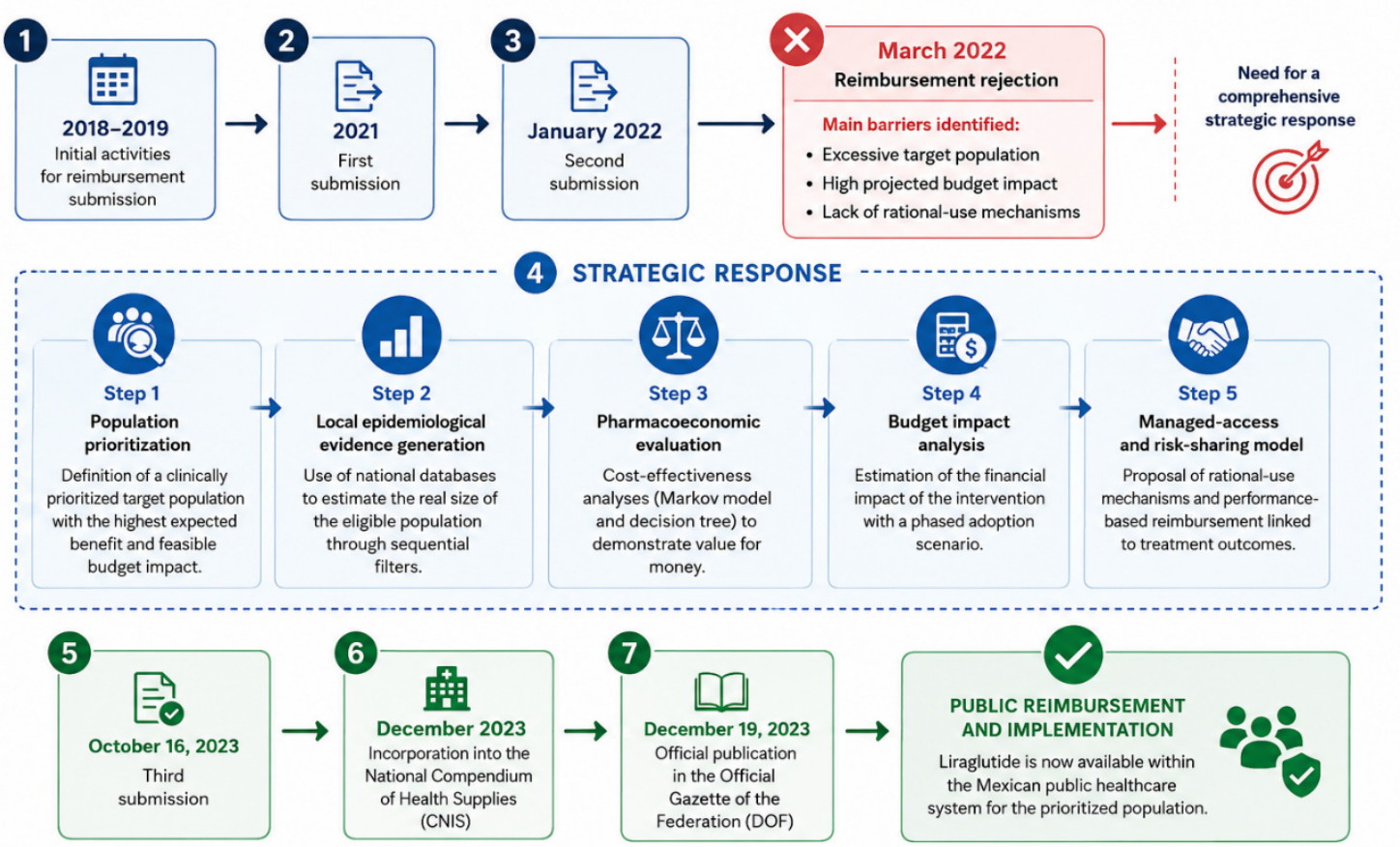
The review of the reimbursement process identified three major barriers preventing the incorporation of anti-obesity pharmacotherapy into the Mexican public healthcare system. First, the potential target population was considered excessively large, resulting in an unsustainable projected budget impact. Second, the economic models initially submitted did not adequately reflect real-world clinical practice and included assumptions that generated uncertainty regarding affordability. Third, health authorities expressed concerns regarding the absence of mechanisms to ensure rational prescribing and appropriate patient selection within public healthcare institutions.
These observations guided the development of a revised reimbursement strategy focused on population prioritization, generation of local epidemiological evidence, contextualized economic analyses, and implementation of managed-access mechanisms (Figure 1).

3.2. Definition of a Clinically Prioritized Target Population

Following the structured expert consensus process, the target population was progressively restricted to individuals expected to derive the greatest clinical benefit while minimizing the potential budget impact.
Based on evidence from clinical trials, obesity management guidelines, and expert recommendations, the panel concluded that adults with grade II obesity and cardiometabolic comorbidities represented the most appropriate population for prioritization.
After evaluating different combinations of comorbidities, hypertension and dyslipidemia were selected as the defining eligibility criteria because of their high prevalence, established association with obesity-related complications, and expected responsiveness to weight reduction interventions.
Consequently, the final proposed indication was defined as adults with obesity grade II (BMI 35.0–39.9 kg/m2), hypertension, and dyslipidemia receiving lifestyle intervention.

3.3. Local Epidemiological Evidence and Target Population Estimation

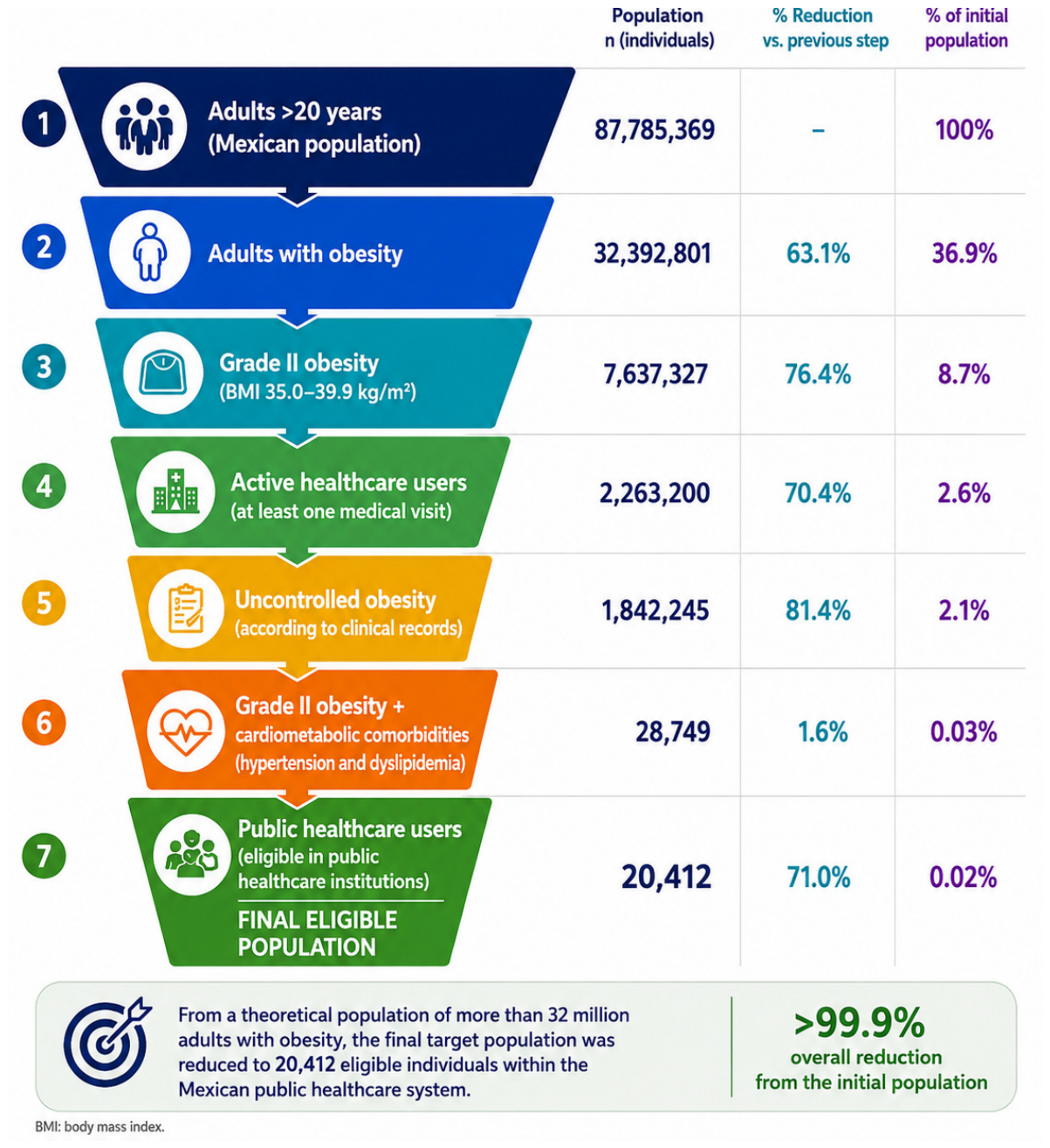
The final target population defined through the multidisciplinary expert consensus consisted of adults with grade II obesity (BMI 35.0–39.9 kg/m2), hypertension, and dyslipidemia receiving care within the Mexican public healthcare system. To estimate the size of this population, a sequential epidemiological filtering process was performed using national demographic, epidemiological, and healthcare utilization databases (Figure 2).
Application of the sequential epidemiological filtering process substantially reduced the size of the potentially eligible population by progressively applying demographic, clinical, and healthcare utilization criteria (Figure 2).
Of the 87,785,369 Mexican adults aged over 20 years, approximately 32,392,801 were estimated to have obesity. Among them, 7,637,327 met criteria for obesity grade II. Restricting the analysis to active healthcare service users reduced the population to 2,263,200 individuals, while application of disease-control criteria further reduced the estimate to 1,842,245 patients.
Patients with grade II obesity, hypertension, and dyslipidemia were subsequently identified through the sequential epidemiological filtering process, resulting in an estimated target population of 28,749 individuals. Application of the final eligibility criteria defined by the multidisciplinary expert panel (grade II obesity, hypertension, and dyslipidemia) identified an estimated 20,412 eligible individuals receiving care within the Mexican public healthcare system.
Overall, the prioritization strategy reduced the theoretical candidate population from more than 32 million adults with obesity to approximately 20,000 eligible individuals within the public healthcare system (Figure 2).

3.4. Cost-Effectiveness Results of the Pharmacoeconomic Models

The long-term Markov model demonstrated that anti-obesity pharmacotherapy combined with lifestyle intervention provided greater effectiveness than lifestyle intervention alone. Patients receiving anti-obesity pharmacotherapy accumulated 0.68 years free from progression to obesity grades II or III compared with 0.10 years in the comparator group, resulting in an incremental effectiveness gain of 0.58 years.
The incremental cost associated with anti-obesity pharmacotherapy treatment was estimated at MXN $26,990 per patient over the 10-year horizon, generating an incremental cost-effectiveness ratio (ICER) of MXN $46,347 per year of life gained without progression. This value remained substantially below the commonly accepted willingness-to-pay threshold of one Mexican gross domestic product per capita.
In the short-term decision-tree analysis, anti-obesity pharmacotherapy increased the proportion of patients achieving clinically meaningful weight loss (≥5% of baseline body weight) by 28.9 percentage points compared with lifestyle intervention alone. The estimated ICER was MXN $162,971 per additional responder.

3.5. Budget Impact Analysis and Managed-Access Strategy

The budget impact analysis demonstrated that restricting anti-obesity pharmacotherapy to the clinically prioritized population substantially reduced the projected financial burden on the Mexican public healthcare system. Based on the consensus-derived phased implementation scenario, treatment uptake was assumed to increase gradually from 10% in 2024 to 50% in 2028. Under this scenario, the incremental investment ranged from MXN $92 million during the first year to MXN $485 million in the fifth year, corresponding to an annual budget impact of 0.05% to 0.25% of the pharmaceutical budget allocated to public healthcare institutions (Table 1). The average annual investment was estimated at approximately MXN $286 million, and the cumulative five-year budget impact represented approximately 0.73% of the national pharmaceutical budget, remaining below 1% throughout the analytical period.
To further reduce financial uncertainty, a managed-access strategy was developed and incorporated into the reimbursement proposal. Following regulatory approval, this framework became the operational basis for subsequent implementation within public healthcare institutions. The strategy restricted prescribing authority to physicians trained in obesity management, established strict eligibility criteria aligned with the approved indication, and incorporated a performance-based reimbursement mechanism linked to predefined weight-loss outcomes. Together, these measures directly addressed the concerns previously raised by healthcare decision makers regarding affordability, rational prescribing, and long-term financial sustainability.

3.6. Regulatory Approval and Incorporation into the CNIS

Between 2018 and 2019, the manufacturer initiated the activities required for incorporation of anti-obesity pharmacotherapy into the Mexican public healthcare system. The first formal submission was presented in 2021. A second submission was filed on 6 January 2022, but was rejected on 1 March 2022, primarily because of concerns regarding budget impact and the absence of mechanisms ensuring rational use.
After incorporation of the epidemiological, clinical, and economic evidence generated during the present process, a third submission was filed on 16 October 2023. The proposal was subsequently approved, and anti-obesity pharmacotherapy was incorporated into the National Compendium of Health Supplies (CNIS) in December 2023. The managed-access framework was incorporated as an integral component of the approved reimbursement strategy and provided the operational basis for subsequent implementation within public healthcare institutions. The decision was officially published in the Official Gazette of the Federation (DOF) on 19 December 2023, thereby authorizing its implementation across the Mexican public healthcare system.

4. Discussion

The present study describes a structured and sequential framework that enabled the incorporation and public reimbursement of anti-obesity pharmacotherapy within the Mexican public healthcare system. Although the reimbursement process described here culminated in the approval of liraglutide, the primary contribution of this work is not the evaluation of a specific medication, but rather the description of a reproducible methodological framework for healthcare decision-making. The most important finding was that reimbursement approval was achieved not solely through demonstration of clinical efficacy, but through the integration of complementary components that directly addressed the concerns raised by healthcare decision makers. These included the identification of a clinically prioritized target population, generation of local epidemiological evidence, development of pharmacoeconomic and budget impact analyses, and development and regulatory approval of managed-access mechanisms designed to promote rational prescribing and financial sustainability. Together, these measures reduced the potentially eligible population from more than 32 million adults with obesity to approximately 20,000 patients receiving care within public healthcare institutions, thereby transforming a potentially unaffordable intervention into a feasible and sustainable reimbursement proposal.
Few published studies have described the practical implementation of reimbursement strategies for anti-obesity pharmacotherapy within publicly funded healthcare systems. One of the most relevant examples comes from Ireland, where a national Managed Access Protocol (MAP) was developed to facilitate reimbursement of anti-obesity pharmacotherapy for weight management. Under this program, reimbursement was restricted to a clinically prioritized subgroup of patients with severe obesity (BMI ≥ 35 kg/m2), prediabetes, and elevated cardiovascular risk. In addition, continuation of therapy required demonstration of clinical response, and predefined discontinuation criteria were applied to patients who failed to achieve meaningful weight loss [32,33]. These measures were specifically designed to reduce uncertainty regarding treatment effectiveness and to ensure efficient use of healthcare resources.
Subsequent evaluation of the Irish MAP demonstrated the potential value of this approach in real-world practice. During the first year of implementation, 7927 reimbursement requests were submitted; however, only 52.2% were approved after application of the eligibility criteria. Importantly, this selective approach substantially reduced public expenditure compared with a hypothetical scenario in which all requests had been approved [32]. The Irish experience illustrates how population prioritization, treatment monitoring, and reimbursement controls can improve affordability while preserving access for patients most likely to benefit from therapy.
Several similarities can be identified between the Irish experience and the strategy developed in Mexico. In both countries, reimbursement approval was supported by restricting treatment to a predefined high-risk population and by incorporating mechanisms intended to promote rational prescribing. However, important differences also exist. The Irish model focused primarily on individual patient authorization and monitoring through a centralized reimbursement system, whereas the Mexican strategy additionally incorporated a comprehensive epidemiological analysis to estimate the size of the eligible population, formal pharmacoeconomic evaluations, budget impact modeling, and a performance-based reimbursement proposal. Consequently, the Mexican approach addressed not only clinical uncertainty but also the broader financial and operational concerns associated with implementing anti-obesity pharmacotherapy in a large and fragmented public healthcare system.
The findings of the present study are also consistent with international health technology assessment experiences demonstrating that the cost-effectiveness and affordability of anti-obesity pharmacotherapy are highly dependent on appropriate patient selection. The Canadian Agency for Drugs and Technologies in Health (CADTH), for example, identified uncertainty regarding target population size, treatment duration, and long-term effectiveness as major determinants of the economic value of anti-obesity pharmacotherapy for obesity management [34]. Similar concerns were identified during the Mexican reimbursement process and ultimately motivated the development of a more restrictive and clinically prioritized reimbursement strategy.
The Mexican reimbursement strategy also differs from reimbursement approaches adopted in several other high-income countries. In Canada, health technology assessment has primarily focused on evaluating the clinical and economic value of anti-obesity pharmacotherapy to inform reimbursement recommendations, whereas implementation decisions remain the responsibility of individual provinces. Similarly, several European healthcare systems have adopted managed-entry agreements or reimbursement restrictions based on predefined eligibility criteria; however, these strategies are generally implemented within healthcare systems with established health technology assessment processes and more homogeneous reimbursement structures. In contrast, the Mexican framework integrated epidemiological prioritization, pharmacoeconomic evaluation, budget impact analysis, and operational reimbursement planning within a fragmented public healthcare system. This combination of methodological components may represent one of the principal innovative features of the proposed framework and may be particularly relevant for middle-income countries facing similar resource constraints [32,33,34].
More broadly, the results support the role of managed-entry agreements and performance-based risk-sharing models as tools to improve access to high-impact therapies when there is uncertainty regarding real-world effectiveness or budget impact [16,17]. These mechanisms have been widely discussed in oncology, rare diseases, and high-cost biologic therapies, but their application to obesity pharmacotherapy remains limited [16,17,35]. Obesity represents a particular challenge for public payers because of its high prevalence and chronic nature; therefore, unrestricted reimbursement may be financially unfeasible even when a therapy is clinically effective. The present analysis provides a real-world example of how access can be expanded without ignoring budgetary constraints.
Implementation of managed-access strategies within large public healthcare systems extends beyond reimbursement approval and requires adequate operational capacity. In Mexico, successful implementation depends on several complementary components, including standardized eligibility criteria, training of healthcare professionals responsible for prescribing anti-obesity pharmacotherapy, monitoring systems to evaluate treatment response and continuation criteria, and reliable data collection to support performance-based reimbursement. These operational requirements are particularly relevant in fragmented healthcare systems where institutional capacities may differ across providers. Consequently, although the reimbursement framework described in this study provides a structured pathway for improving access, its long-term success will depend on the effective integration of these operational components into routine clinical practice [16,17].
Although the reimbursement strategy described in this study was developed within the Mexican public healthcare system, its underlying methodological framework may be transferable to other middle-income and resource-constrained settings. Rather than proposing a country-specific reimbursement model, this study illustrates a sequential decision-making process based on five complementary components: identification of reimbursement barriers, prioritization of a clinically appropriate target population, generation of local epidemiological evidence, pharmacoeconomic and budget impact evaluation, and implementation of managed-access mechanisms. These methodological principles are broadly applicable across health systems, although their operationalization should be adapted to local epidemiological profiles, healthcare financing structures, regulatory pathways, and institutional capacities. Countries with fragmented healthcare systems or constrained healthcare budgets may particularly benefit from this structured approach, provided that local data and context-specific evidence are incorporated into the reimbursement process [36,37].
This study has several limitations. First, the analysis was descriptive and based on a specific reimbursement process; therefore, causal inferences cannot be established. In addition, because the reimbursement strategy was developed within the context of the Mexican public healthcare system, its findings may not be directly generalizable to countries with different healthcare financing structures, epidemiological profiles, or regulatory pathways.
Second, estimation of the eligible population relied on secondary national databases, including ENSANUT, CONAPO, INEGI, and the Chronic Disease Information System (SIC). Although these are the official sources used for epidemiological surveillance and healthcare planning in Mexico, they are subject to sampling variability, underreporting, and differences in data collection methodologies. Consequently, the estimated target population should be interpreted as an approximation for health policy decision-making rather than an exact population count. Future studies incorporating updated epidemiological information and probabilistic sensitivity analyses could better quantify the impact of uncertainty on population estimates and pharmacoeconomic projections.
Third, the pharmacoeconomic models relied on assumptions derived from randomized clinical trials and published economic evaluations because long-term real-world evidence was not available in Mexico during the reimbursement process. Although treatment discontinuation was incorporated into the decision-tree model, assumptions regarding transition probabilities, treatment persistence, maintenance of weight loss, and future obesity-related costs may differ under routine clinical practice. In addition, mild treatment-related adverse events were not explicitly incorporated into the economic models because they were considered unlikely to substantially influence overall cost-effectiveness estimates. Furthermore, some economic inputs were based on institutional costing information and confidential pricing agreements that could not be fully disclosed. Nevertheless, the analyses reflected the official cost information and institutional data available to healthcare decision makers at the time of the reimbursement evaluation.
Fourth, the target population was defined through a structured multidisciplinary expert consensus process supported by the best available evidence. Although predefined prioritization criteria were applied, alternative evidence-based prioritization strategies or different combinations of obesity-related comorbidities could reasonably have been selected. Therefore, the proposed eligibility criteria should be interpreted as one scientifically supported reimbursement strategy rather than the only possible approach.
Finally, this study focused exclusively on the methodological and strategic process leading to reimbursement approval and did not evaluate post-implementation outcomes. Consequently, no real-world data on treatment uptake, adherence, persistence, clinical effectiveness, safety, or healthcare expenditures following reimbursement were available. Future research should evaluate these outcomes to determine whether the projected clinical and economic benefits are achieved under routine clinical practice and to refine future reimbursement strategies.
Despite these limitations, this study contributes to the literature by documenting a pragmatic and replicable framework for incorporating anti-obesity pharmacotherapy into a resource-constrained public healthcare system. The main contribution is not only the evaluation of anti-obesity pharmacotherapy itself, but the description of a structured access strategy that integrated clinical prioritization, local epidemiology, economic evaluation, affordability assessment, and managed-access mechanisms. This approach may be useful for other middle-income countries facing similar challenges related to the reimbursement of high-impact therapies for chronic, highly prevalent diseases.
Future research should focus on the post-reimbursement evaluation of anti-obesity pharmacotherapy within the Mexican public healthcare system through a structured monitoring framework. Key performance indicators should include treatment uptake, adherence, persistence, achievement of clinically meaningful weight loss, improvement of obesity-related comorbidities, safety, healthcare resource utilization, and budget impact. Periodic assessment of these indicators will be essential to validate the assumptions of the pharmacoeconomic models, determine whether the projected clinical and economic benefits are achieved under routine clinical practice, and support continuous refinement of managed-access and performance-based reimbursement strategies. In addition, as newer anti-obesity medications with greater efficacy become available, similar evidence-based frameworks should be developed to define priority populations, evaluate affordability, and ensure equitable access while maintaining the financial sustainability of public healthcare systems.


5. Conclusions

In conclusion, the incorporation of anti-obesity pharmacotherapy into public healthcare systems requires more than evidence of clinical efficacy. In Mexico, the successful reimbursement of anti-obesity pharmacotherapy was achieved through a sequential strategy that combined local epidemiological evidence, expert-defined population prioritization, pharmacoeconomic evaluation, budget impact analysis, and managed-access mechanisms. This experience provides a potential model for expanding access to effective obesity therapies in middle-income countries while addressing the financial and operational concerns of public healthcare systems.

Author Contributions

Conceptualization, A.R.-G.; methodology, A.R.-G. and J.N.Z.-C.; validation, A.R.-G., H.M.-G. and J.N.Z.-C.; formal analysis, J.N.Z.-C.; investigation, J.N.Z.-C.; writing—original draft preparation, H.M.-G., J.C.G.-C. and J.N.Z.-C.; writing—review and editing, A.R.-G., H.M.-G., J.C.G.-C. and J.N.Z.-C.; supervision, A.R.-G. and E.C.-M.; project administration, A.R.-G. All authors have read and agreed to the published version of the manuscript.

Funding

This research received no external funding. The article processing charge (APC) was supported by the National Autonomous University of Mexico (UNAM).

Institutional Review Board Statement

Ethical review and approval were waived for this study because it was based exclusively on the analysis of publicly available epidemiological databases, published literature, administrative healthcare information, and pharmacoeconomic models developed for health technology assessment purposes. No individual-level identifiable data were accessed. According to the Reglamento de la Ley General de Salud en Materia de Investigación para la Salud (Mexico), studies based solely on publicly available, anonymized, or aggregated data are exempt from ethics committee review and approval.

Informed Consent Statement

Patient consent was waived because this study did not involve direct participation of human subjects, collection of individual-level data, or access to identifiable personal information. All analyses were performed using publicly available aggregated data and secondary information sources.

Data Availability Statement

The data supporting the findings of this study were obtained from publicly available sources, including the Mexican National Health and Nutrition Survey (ENSANUT), the National Population Council (CONAPO), the National Institute of Statistics and Geography (INEGI), and the Chronic Disease Information System (Sistema de Información de Enfermedades Crónicas, SIC), together with publicly available governmental and institutional reports. These databases are available at the following official websites: ENSANUT: https://ensanut.insp.mx/ (accessed on 22 November 2021), CONAPO: https://www.gob.mx/conapo (accessed on 22 November 2021), INEGI: https://www.inegi.org.mx/ (accessed on 22 November 2021), SIC: https://www.tablerocronicassic-sinba.com/TableroSIC/SIC (accessed on 22 November 2021).

Acknowledgments

The authors acknowledge the contributions of the multidisciplinary expert panel, including endocrinologists, cardiologists, and internists, who participated in the consensus process used to define the target population and reimbursement strategy evaluated in this study.

Conflicts of Interest

Eunice Carpio-Macedo is an employee of Novo Nordisk Mexico. Her contribution to this study was limited to providing factual information regarding the internal market-access and reimbursement processes described in the manuscript and to reviewing the accuracy of those procedural descriptions. She did not participate in the study conception, methodological design, data collection, statistical analyses, interpretation of the findings, preparation of the Discussion, or the decision to submit the manuscript for publication. The academic investigators independently conceived the study, performed all analyses, interpreted the results, prepared the manuscript, and approved its final version. The remaining authors declare no competing interests.

Abbreviations

The following abbreviations are used in this manuscript:
BMIBody Mass Index
CNISNational Compendium of Health Supplies (Compendio Nacional de Insumos para la Salud)
CONAPONational Population Council
ENSANUTNational Health and Nutrition Survey (Encuesta Nacional de Salud y Nutrición)
GLP-1 RAGlucagon-Like Peptide-1 Receptor Agonist
HTAHealth Technology Assessment
ICERIncremental Cost-Effectiveness Ratio
INEGINational Institute of Statistics and Geography;
MAPManaged Access Protocol
MXNMexican Peso
SICChronic Disease Information System (Sistema de Información en Enfermedades Crónicas)

References

  1. Campos-Nonato, I.; Galván-Valencia, O.; Hernández-Barrera, L.; Oviedo-Solís, C.; Barquera, S. Obesidad en adultos mexicanos: Resultados de la Encuesta Nacional de Salud y Nutrición Continua 2022. Salud Publica Mex. 2023, 65, S238–S247. [Google Scholar] [CrossRef] [PubMed]
  2. GBD 2019 Risk Factors Collaborators. Global burden of 87 risk factors in 204 countries and territories, 1990-2019: A systematic analysis for the Global Burden of Disease Study 2019. Lancet 2020, 396, 1223–1249. [Google Scholar] [CrossRef] [PubMed]
  3. Powell-Wiley, T.M.; Poirier, P.; Burke, L.E.; Després, J.P.; Gordon-Larsen, P.; Lavie, C.J.; Lear, S.A.; Ndumele, C.E.; Neeland, I.J.; Sanders, P.; et al. Obesity and cardiovascular disease: A scientific statement from the American Heart Association. Circulation 2021, 143, e984–e1010. [Google Scholar] [CrossRef] [PubMed]
  4. Tremmel, M.; Gerdtham, U.G.; Nilsson, P.M.; Saha, S. Economic burden of obesity: A systematic literature review. Int. J. Environ. Res. Public Health 2017, 14, 435. [Google Scholar] [CrossRef] [PubMed]
  5. Colchero, M.A.; Rivera-Dommarco, J.; Popkin, B.M.; Ng, S.W. In Mexico, evidence of sustained consumer response two years after implementing a sugar-sweetened beverage tax. Health Aff. 2017, 36, 564–571. [Google Scholar] [CrossRef] [PubMed]
  6. Retana-Guzmán, O.G.; López-Ridaura, R.; Stern, D.; Colchero, M.A.; Barquera, S. Public policies for obesity prevention and control in Mexico: Achievements and challenges. Salud Publica Mex. 2024, 66, S245–S253. [Google Scholar]
  7. Rubino, F.; Puhl, R.M.; Cummings, D.E.; Eckel, R.H.; Ryan, D.H.; Mechanick, J.I.; Nadglowski, J.; Salas, X.R.; Schauer, P.R.; Twenefour, D.; et al. Joint international consensus statement for ending stigma of obesity. Nat. Med. 2020, 26, 485–497. [Google Scholar] [CrossRef] [PubMed]
  8. Wharton, S.; Lau, D.C.W.; Vallis, M.; Sharma, A.M.; Biertho, L.; Campbell-Scherer, D.; Adamo, K.; Alberga, A.; Bell, R.; Boulé, N.; et al. Obesity in adults: A clinical practice guideline. CMAJ 2020, 192, E875–E891. [Google Scholar] [CrossRef] [PubMed]
  9. Pi-Sunyer, X.; Astrup, A.; Fujioka, K.; Greenway, F.; Halpern, A.; Krempf, M.; Lau, D.C.W.; Le Roux, C.W.; Ortiz, R.V.; Jensen, C.B.; et al. A randomized, controlled trial of 3.0 mg of liraglutide in weight management. N. Engl. J. Med. 2015, 373, 11–22. [Google Scholar] [CrossRef] [PubMed]
  10. le Roux, C.W.; Astrup, A.; Fujioka, K.; Greenway, F.; Lau, D.C.W.; Van Gaal, L.; Ortiz, R.V.; Wilding, J.P.H.; Skjøth, T.V.; Manning, L.S.; et al. 3 years of liraglutide versus placebo for type 2 diabetes risk reduction and weight management in individuals with prediabetes: A randomised, double-blind trial. Lancet 2017, 389, 1399–1409. [Google Scholar] [CrossRef] [PubMed]
  11. Khera, R.; Murad, M.H.; Chandar, A.K.; Dulai, P.S.; Wang, Z.; Prokop, L.J.; Loomba, R.; Camilleri, M.; Singh, S. Association of pharmacological treatments for obesity with weight loss and adverse events: A systematic review and meta-analysis. JAMA 2016, 315, 2424–2434. [Google Scholar] [CrossRef] [PubMed]
  12. Garvey, W.T.; Mechanick, J.I.; Brett, E.M.; Garber, A.J.; Hurley, D.L.; Jastreboff, A.M.; Nadolsky, K.; Pessah-Pollack, R.; Plodkowski, R.; Reviewers of the AACE/ACE Obesity Clinical Practice Guidelines. American Association of Clinical Endocrinologists and American College of Endocrinology comprehensive clinical practice guidelines for medical care of patients with obesity. Endocr. Pract. 2016, 22, 1–203. [Google Scholar] [CrossRef] [PubMed]
  13. National Institute for Health and Care Excellence. Liraglutide for Managing Overweight and Obesity. Technology Appraisal Guidance [TA664]; NICE: London, UK, 2020; Available online: https://www.nice.org.uk/guidance/ta664 (accessed on 12 April 2026).
  14. Drummond, M.F.; Sculpher, M.J.; Claxton, K.; Stoddart, G.L.; Torrance, G.W. Methods for the Economic Evaluation of Health Care Programmes, 4th ed.; Oxford University Press: Oxford, UK, 2015. [Google Scholar]
  15. Sullivan, S.D.; Mauskopf, J.A.; Augustovski, F.; Caro, J.J.; Lee, K.M.; Minchin, M.; Orlewska, E.; Penna, P.; Barrios, J.-M.R.; Shau, W.-Y. Budget impact analysis-principles of good practice: Report of the ISPOR 2012 Budget Impact Analysis Good Practice II Task Force. Value Health 2014, 17, 5–14. [Google Scholar] [CrossRef] [PubMed]
  16. Garrison, L.P., Jr.; Towse, A.; Briggs, A.; de Pouvourville, G.; Grueger, J.; Mohr, P.E.; Severens, J.; Siviero, P.; Sleeper, M. Performance-based risk-sharing arrangements-good practices for design, implementation, and evaluation: Report of the ISPOR Good Practices for Performance-Based Risk-Sharing Arrangements Task Force. Value Health 2013, 16, 703–719. [Google Scholar] [CrossRef] [PubMed]
  17. Dabbous, M.; Chachoua, L.; Caban, A.; Toumi, M. Managed entry agreements: Policy analysis from the European perspective. Value Health 2020, 23, 425–433. [Google Scholar] [CrossRef] [PubMed]
  18. Basto-Abreu, A.; López-Olmedo, N.; Rojas-Martínez, R.; Aguilar-Salinas, C.A.; Moreno-Banda, G.L.; Carnalla, M.; Rivera, J.A.; Romero-Martinez, M.; Barquera, S.; Barrientos-Gutiérrez, T. Prevalencia de prediabetes y diabetes en población adulta mexicana: Resultados de la Encuesta Nacional de Salud y Nutrición Continua 2022. Salud Publica Mex. 2023, 65, S163–S168. [Google Scholar] [CrossRef] [PubMed]
  19. Consejo Nacional de Población. Proyecciones de la Población de México y de las Entidades Federativas 2016–2050; CONAPO: Ciudad de México, Mexico, 2023; Available online: https://www.gob.mx/conapo (accessed on 22 November 2021).
  20. Secretaría de Salud. Sistema de Información en Enfermedades Crónicas (SIC); Secretaría de Salud: Ciudad de México, Mexico, 2023. Available online: http://sic.cenaprece.salud.gob.mx (accessed on 5 June 2023).
  21. Instituto Nacional de Estadística y Geografía. Censo de Población y Vivienda 2020; INEGI: Aguascalientes, Mexico, 2021; Available online: https://www.inegi.org.mx/programas/ccpv/2020 (accessed on 22 November 2021).
  22. Instituto Mexicano del Seguro Social. Costos Unitarios por Nivel de Atención Médica para 2023; Instituto Mexicano del Seguro Social: Ciudad de México, Mexico, 2023. [Google Scholar]
  23. Instituto Mexicano del Seguro Social. Grupos Relacionados con el Diagnóstico (GRD): Producto Hospitalario; Instituto Mexicano del Seguro Social: Ciudad de México, Mexico, 2017. [Google Scholar]
  24. Instituto Nacional de Neurología y Neurocirugía Manuel Velasco Suárez. Tabulador de Cuotas de Recuperación; Instituto Nacional de Neurología y Neurocirugía Manuel Velasco Suárez: Ciudad de México, Mexico, 2018. [Google Scholar]
  25. Morales-Durán, P.U.; Hoyos-Loya, E.; Granillo-Miranda, A.P.; Saleme-Aguilar, E.N.; Arredondo-López, A.A. Costo-efectividad de tratamientos ambulatorios para la pérdida de peso en adultos mexicanos. Horiz. Sanit. 2021, 20, 259–265. [Google Scholar] [CrossRef]
  26. Hsu, C.C.; Sandford, B.A. The Delphi technique: Making sense of consensus. Pract. Assess. Res. Eval. 2007, 12, 10. [Google Scholar]
  27. Centro Nacional de Excelencia Tecnológica en Salud. Diagnóstico y Tratamiento del Sobrepeso y Obesidad Exógena en el Adulto. Guía de Práctica Clínica; CENETEC: Ciudad de México, Mexico, 2018. [Google Scholar]
  28. Wadden, T.A.; Hollander, P.; Klein, S.; Niswender, K.; Woo, V.; Hale, P.M.; Aronne, L. Weight maintenance and additional weight loss with liraglutide after low-calorie-diet-induced weight loss: The SCALE Maintenance randomized study. Int. J. Obes. 2013, 37, 1443–1451. [Google Scholar] [CrossRef] [PubMed]
  29. Sonnenberg, F.A.; Beck, J.R. Markov models in medical decision making: A practical guide. Med. Decis. Mak. 1993, 13, 322–338. [Google Scholar] [CrossRef] [PubMed]
  30. Thompson, D.; Edelsberg, J.; Colditz, G.A.; Bird, A.P.; Oster, G. Lifetime health and economic consequences of obesity. Arch. Intern. Med. 1999, 159, 2177–2183. [Google Scholar] [CrossRef] [PubMed]
  31. Secretaría de Hacienda y Crédito Público. Presupuesto de Egresos de la Federación para el Ejercicio Fiscal 2023; SHCP: Ciudad de México, Mexico, 2023; Available online: https://www.ppef.hacienda.gob.mx (accessed on 22 November 2021).
  32. Barrett, R.; Smith, A.; Gorry, C.; Doran, S.; Barry, M.; McCullagh, L. A managed access protocol for liraglutide for weight management: A retrospective, observational study in Ireland. Value Health 2025, 28, 844–851. [Google Scholar] [CrossRef] [PubMed]
  33. Barry, M.; Doran, S.; McCullagh, L.; Gorry, C.; Tilson, L. Utilising health technology assessment to develop managed access protocols to facilitate drug reimbursement in Ireland. Appl. Health Econ. Health Policy 2024, 22, 789–800. [Google Scholar] [CrossRef]
  34. Canadian Agency for Drugs and Technologies in Health. Pharmacoeconomic Review: Liraglutide (Saxenda); CADTH: Ottawa, ON, Canada, 2021. [Google Scholar]
  35. Kim, D.D.; Basu, A.; Neumann, P.J. Balancing innovation and affordability in anti-obesity medications. JAMA Health Forum 2024, 5, e241093. [Google Scholar]
  36. Welte, R.; Feenstra, T.; Jager, H.; Leidl, R. A decision chart for assessing and improving the transferability of economic evaluation results between countries. Pharmacoeconomics 2004, 22, 857–876. [Google Scholar] [CrossRef] [PubMed]
  37. Knies, S.; Ament, A.J.H.A.; Evers, S.M.A.A.; Severens, J.L. The transferability of economic evaluations: Testing the model of Welte. Value Health 2009, 12, 730–738. [Google Scholar] [CrossRef] [PubMed]
Figure 1. Strategic pathway leading to the incorporation of liraglutide into the Mexican public healthcare system.
Obesities 06 00054 g001
Figure 2. Sequential reduction of the eligible population for liraglutide reimbursement in the Mexican public healthcare system.
Obesities 06 00054 g002
Table 1. Five-year budget impact analysis for the gradual incorporation of anti-obesity pharmacotherapy into the Mexican public healthcare system.
Parameter20242025202620272028
Eligible patients in current scenario20,41220,67720,93621,19121,439
anti-obesity pharmacotherapy adoption rate10%20%30%40%50%
Patients receiving anti-obesity pharmacotherapy + lifestyle modification204141356281847610,720
Patients receiving lifestyle modification only18,37116,54214,65512,71410,720
Total cost, current scenario (MXN million)19611987201220362060
Total cost, future scenario (MXN million)20532174229624192545
Incremental investment with anti-obesity pharmacotherapy (MXN million)92187284383485
Budget impact0.05%0.10%0.15%0.20%0.25%
Note: The budget impact analysis assumed a gradual increase in treatment uptake from 10% in Year 1 to 50% in Year 5, based on a consensus-derived implementation scenario developed by the multidisciplinary expert panel to reflect the progressive adoption of anti-obesity pharmacotherapy within the Mexican public healthcare system. Costs are expressed in millions of Mexican pesos (MXN).
Disclaimer/Publisher’s Note: The statements, opinions and data contained in all publications are solely those of the individual author(s) and contributor(s) and not of MDPI and/or the editor(s). MDPI and/or the editor(s) disclaim responsibility for any injury to people or property resulting from any ideas, methods, instructions or products referred to in the content.