1. Introduction
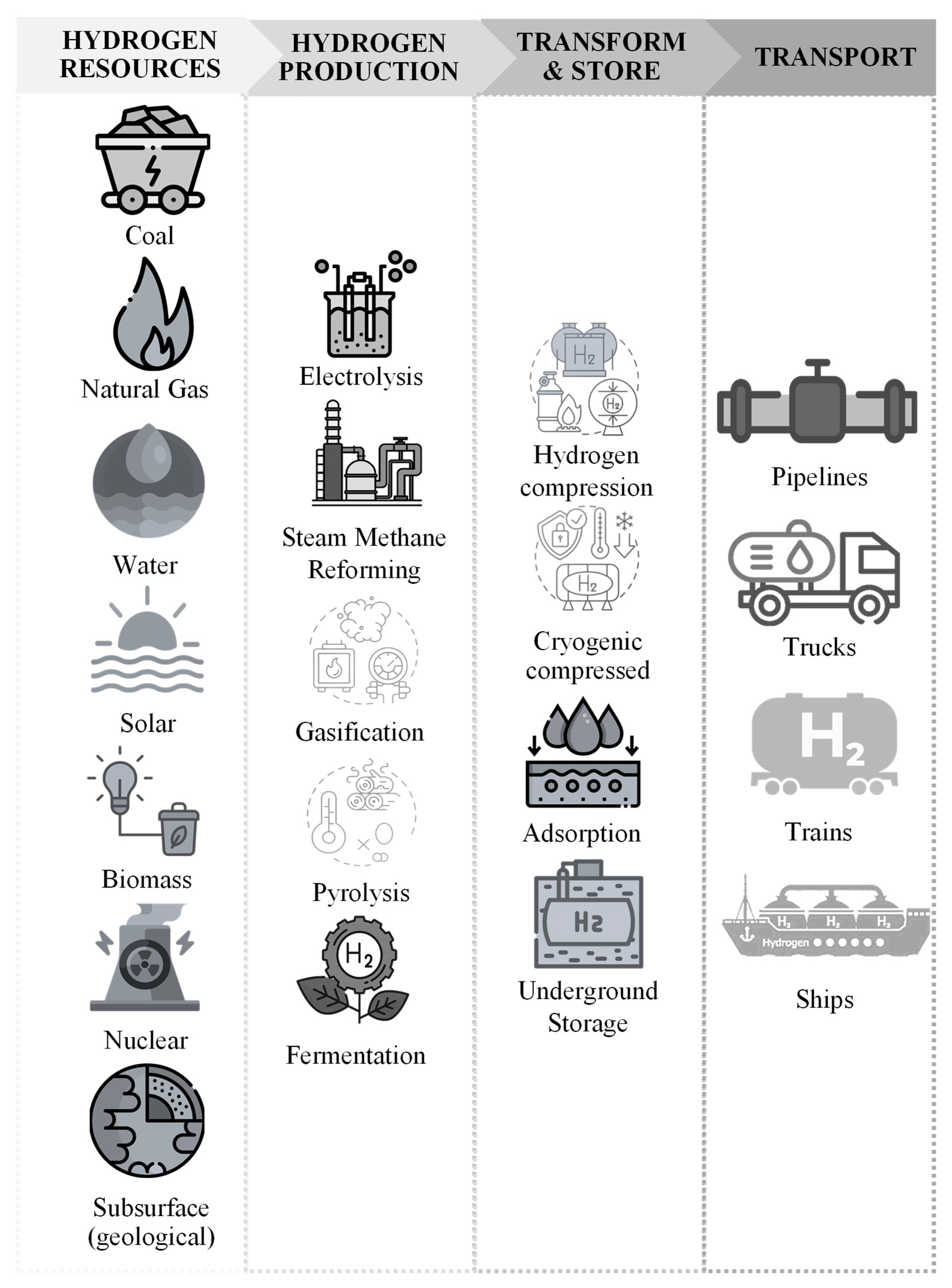
Hydrogen is a versatile energy carrier for decarbonizing hard-to-electrify sectors, produced via multiple resources as presented in
Figure 1. Both gray and blue hydrogen are produced from natural gas via steam methane reforming (SMR) or from coal via the gasification process, but blue hydrogen incorporates carbon capture and sequestration (CCS) to reduce CO
2 emissions. On the other hand, green hydrogen is produced from renewable energy sources (like solar or wind) using the electrolysis process. It can be produced on-site near the usage location, eliminating the supply chain and transmission issues, but it still requires intra-facility piping to interconnect the electrolyzers, compressors, storage, and end-use equipment [
1]. Also, green hydrogen production via offshore wind-powered electrolysis and transporting to onshore locations is more economical than exporting green electricity via high voltage direct current (HVDC) for onshore electrolysis with an estimated cost difference of
$1.77/kg [
2,
3].
Furthermore, the pipelines can transport higher energy volumes; for instance, a single 48-inch hydrogen pipeline can carry 16.9 GW, the equivalent of the energy needed for 5 to 9 overhead transmission lines [
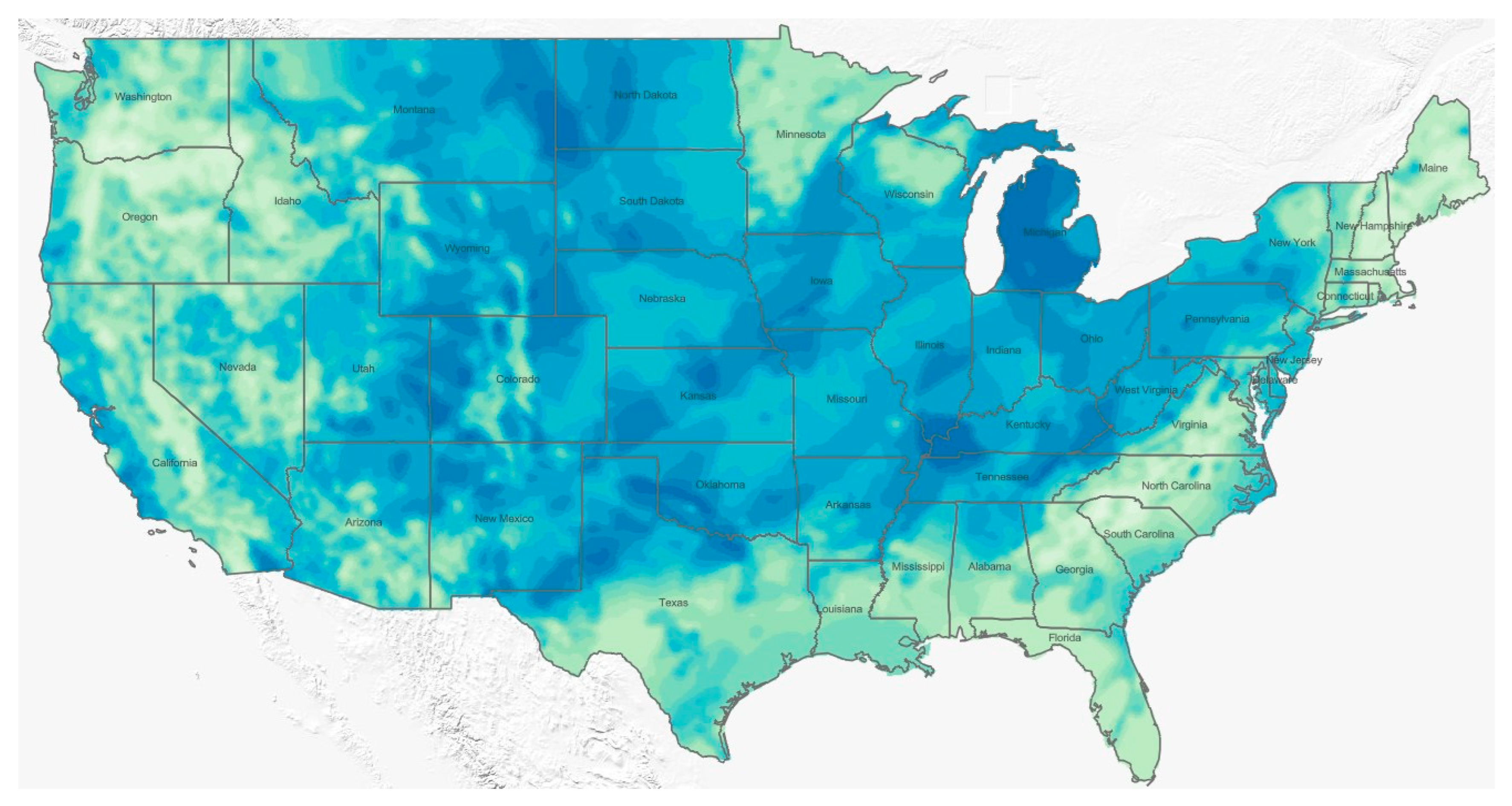
4]. Recently, the subsurface geological hydrogen has been documented with a most probable estimate of 5.6 million Mt; even a small recoverable share (10
5 Mt) can help to reach the net-zero carbon emissions for nearly 200 years [
5,
6], as presented in the prospectivity mapping (
Figure 2) [
6,
7], but commercialization requires gathering and transmission pipelines as well as H
2-specific design/requalification and impurity management (N
2/CH
4/He/CO
2/H
2S) [
8,
9]. However, the substantial costs associated with establishing dedicated hydrogen transportation infrastructure might pose a barrier to the broader adoption of clean hydrogen.
Hydrogen production sites incorporate dedicated piping and compression systems, and existing natural gas transmission and distribution pipelines are being trialed for hydrogen blends. For instance, in Australia, the Hydrogen Park Gladstone initiative in Queensland supplies an entire city gas grid with a 10% hydrogen blend [
10], and the ATCO Hydrogen Blending Project in the city of Cockburn, Western Australia, has successfully injected a 10% hydrogen blend into a portion of its distribution network [
11] and delivered at the customer end without separation. These early trials indicate that modest hydrogen blends are feasible without major modifications. However, as hydrogen blending levels increase (e.g., beyond 20%) or in scenarios where pipelines carry pure hydrogen, future challenges like material compatibility and moisture or water condensation in pipelines causing corrosion and end-user equipment adjustments must be addressed.
The Pipeline and Hazardous Materials Safety Administration (PHMSA) [
12] estimated that the USA has 300,000 miles of onshore gas transmission pipelines; the successful injection of hydrogen gas into those pipelines can offer an economical pathway. However, a critical concern is the structural integrity of pipeline steels. Pipeline steels are generally ferritic–pearlitic in microstructure [
13]. When exposed to hydrogen gas, the hydrogen atom dissociates into the steel’s surface and gives birth to hydrogen-related degradation and cracking, leading to hydrogen embrittlement (HE) [
14]. This phenomenon can significantly alter mechanical properties, leading to reduced ductility, decreased fracture toughness, and accelerated crack growth [
15,
16]. To determine the fitness-for-service and design-for-safety, the response of the pipeline material under cyclic loading is more important than ductility. Higher-strength pipeline steels tend to be more susceptible to HE, showing greater losses in crack growth resistance for a given hydrogen exposure [
17]. Furthermore, the pipelines are weld-intensive and exhibit hard microstructures and residual stresses in the heat-affected zone (HAZ) [
18]. The pipelines operate with design safety limits well below the yield strength; in the weld stress-concentrated HAZ, cracks can nucleate and grow at nominal stresses well below yield, and hydrogen measurably accelerates fatigue crack growth and lowers the safety thresholds in API-grade steels [
18]. Furthermore, pipelines do experience a few regular pressure cycles to balance supply and demand (“line-pack”), which provide the driving force for fatigue and therefore must be characterized for hydrogen service [
19].
Current standards generally do not prescribe a fixed hydrogen blend concentration; instead, they rely on broad requirements that the transported natural gas blend be handled using suitable materials, qualified design methods, and appropriate engineering assessment. Existing ASME B31.12 code covers the design of hydrogen piping and pipelines to handle pure gaseous and liquid hydrogen. On the other hand, the previous ASME B 31.8 for gas transmission and distribution systems did not allow hydrogen blend transportation through existing natural gas pipelines. However, the recent 2026 edition of ASME B31.8 borrows provision from AMSE B31.12 and conservatively permits hydrogen gas and blends. However, the vintage steels and welds require particular attention due to the higher pearlite content and larger grain size compared to modern steel, showing varying fatigue crack growth rate, implying that material verification and hydrogen-calibrated properties are prerequisites for requalification of existing pipelines for hydrogen gas [
20,
21,
22]. Moreover, the buried pipelines with pre-existing corrosion, dents, or gouges have elevated failure likelihood; when combined, these can act as stress concentrators and crack initiators; their combined effect is hazardous and reduces their capacity [
23].
To link FCGR data with in-field pipeline behavior, researchers are currently developing sub-scale hydrogen pressure-cycling methods and conducting full-scale burst trials and offline network tests [
24,
25,
26]. But more hydrogen-environment validation, which includes welded joints and defective pipes under realistic cycles, is still needed to bound conservatism and support code evolution. The integrity management needs supervisory control and data acquisition (SCADA)-based cycle counting and FCGR analyses as per API 1176 [
27] using hydrogen-appropriate parameters, together with targeted inspection/repair of stress concentrators (corrosion, dents, gouges) that might initiate the cracks in H
2 service.
Furthermore, with the rapid advancement and improvement in computational capabilities, machine learning (ML) has also emerged in capturing the complex FCGR dependency on several variables. ML offers a practical pathway to integrate hydrogen pressure, stress intensity range, loading frequency, material grade, weld condition, impurities, chemical composition, and strength of steel to develop predictive models for hydrogen-assisted fatigue crack growth rate and integrity assessment [
28,
29]. The adoption of ML algorithms can help to reduce the expensive and complex fatigue experiments.
Although fracture mechanics and ML models are essential for integrity assessment, they do not directly address the atomic-scale hydrogen embrittlement (HE) [
30,
31]. Hydrogen-assisted degradation starts with atomic hydrogen absorption, diffusion, and trapping in the crystal lattice, affecting the microstructural features [
32]. The change in microstructure alters local cohesion, dislocation mobility, crack-tip plasticity, and phase/interface stability, resulting in reduced ductility and fracture resistance and eventually accelerating FCGR [
33]. Molecular dynamics (MD) simulations serve as a mechanistic link between nanoscale hydrogen–defect interactions and macroscale fatigue crack growth rate (FCGR) and integrity models.
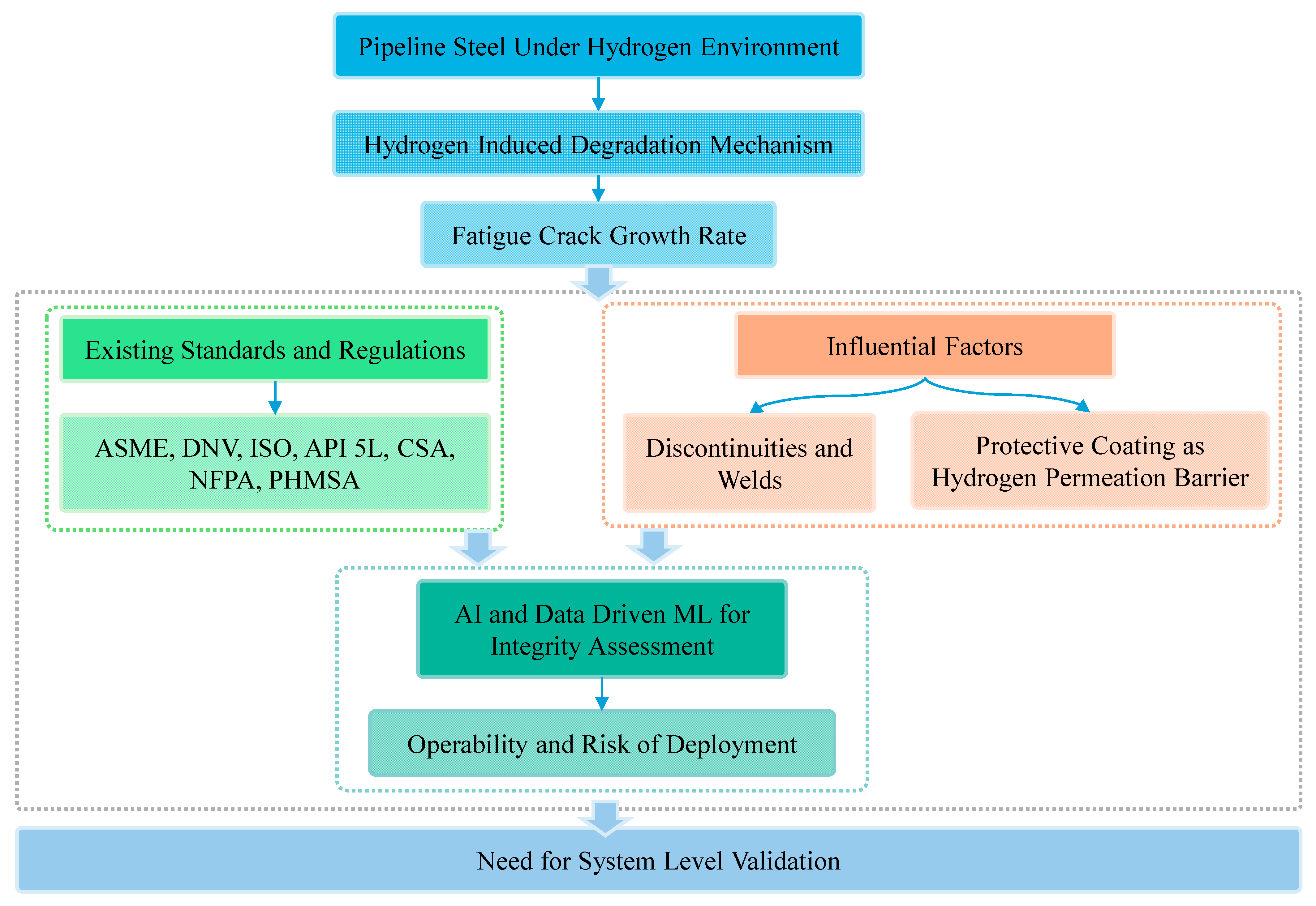
Considering the opportunities and challenges, the current review combines scientometric and systematic reviews of the literature on the fatigue behavior of pipeline steel under a gaseous hydrogen environment. By quantitatively mapping research trends and qualitatively analyzing key studies, we aim to summarize current knowledge and identify gaps. The focus is on the fatigue crack growth rate (FCGR,
) behavior of pipeline steels in gaseous hydrogen and how it is influenced by hydrogen pressure, load frequency, stress ratio, temperature, material grade/microstructure, welds vs. base metal, and the presence of impurities or inhibitors. Also, the adoption of machine learning is discussed thoroughly. The complete overview is presented in
Figure 3. The findings of this review are intended to guide future research and engineering practices for safely integrating hydrogen into existing pipelines.
2. Review Methodology and Scientometric Mapping
Hydrogen degrades fracture resistance and accelerates the fatigue crack growth rate (FCGR) of pipeline steels, even when tensile properties vary slightly; therefore, assessment of FCGR under gaseous H
2 is necessary for fitness-for-service and requalification decisions, instead of relying on monotonic strength alone. As the design standards (ASME B31.12 option B) converge on fracture-mechanics-based qualification [
1,
9], the current review focuses on (
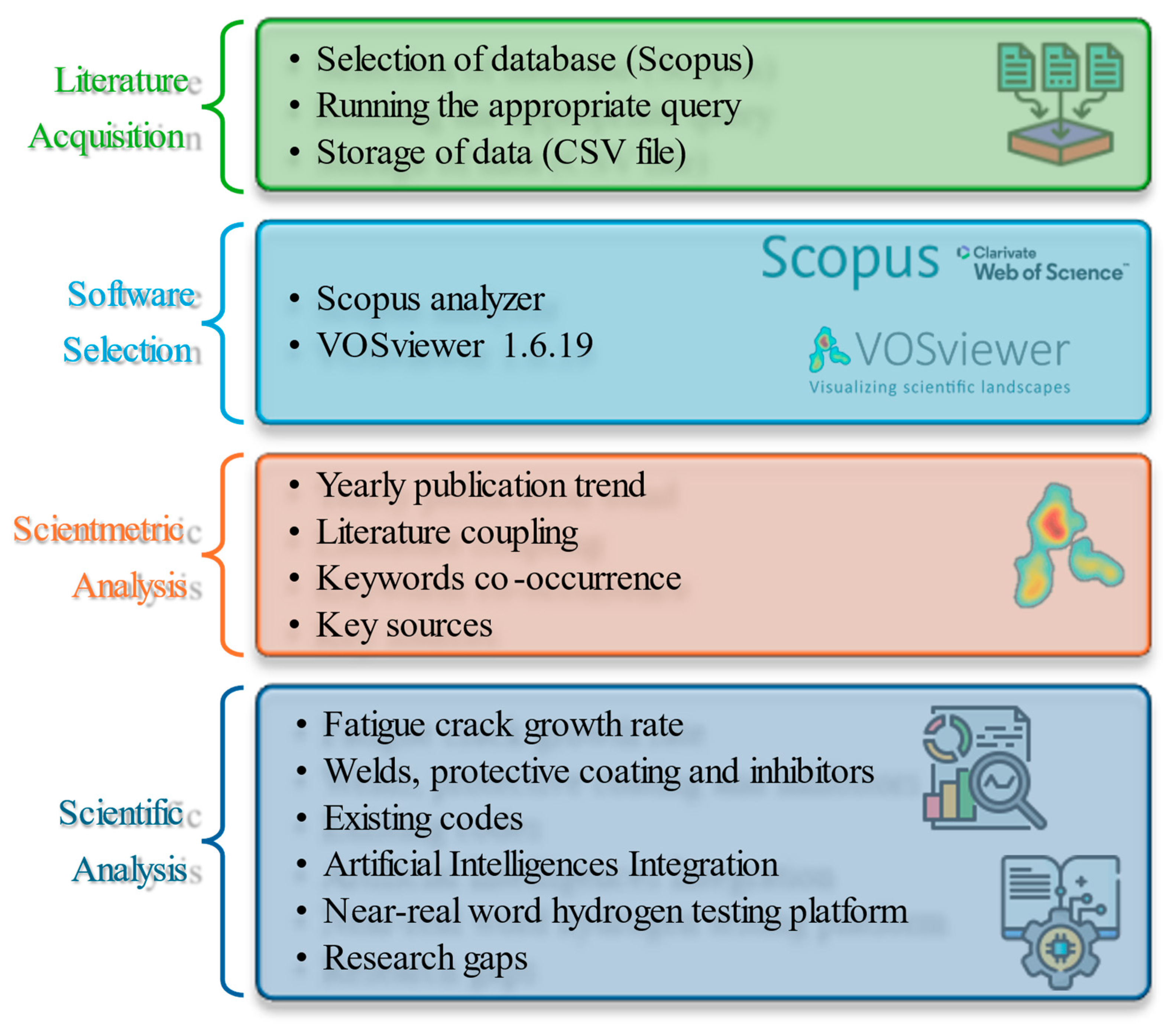
vs. ΔK) considering the material, environmental, and mechanical variables. The partial scientometric workflow was combined with a systematic literature review to identify, organize, and synthesize evidence on fracture toughness and the fatigue crack growth behavior of hydrogen-exposed pipeline steels (see
Figure 4).
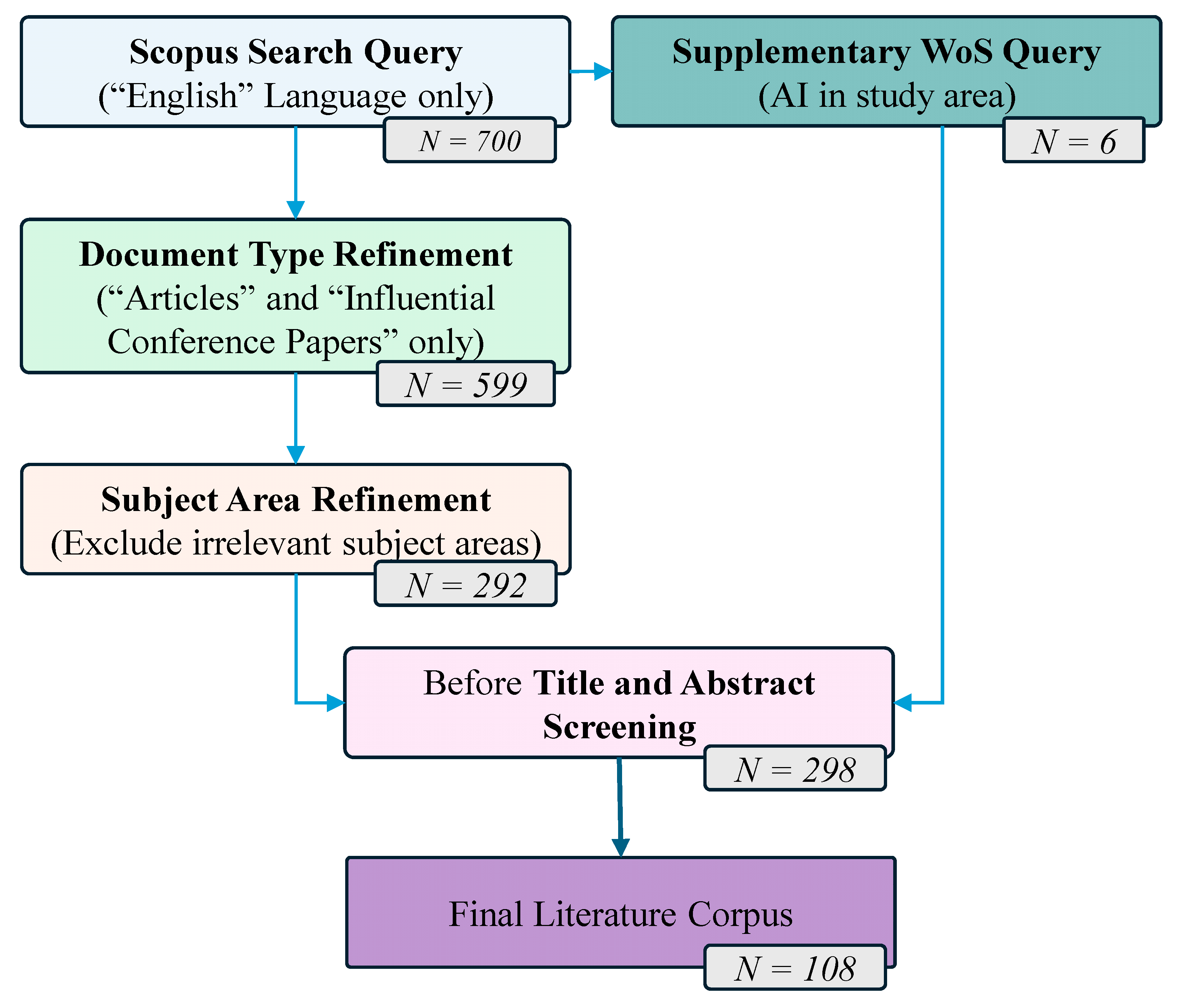
Scopus and Web of Science (WoS) were used to compile bibliometric databases [
34,
35], as presented in
Figure 5. The ultimate query used in Scopus that provides the maximum number of relevant documents was
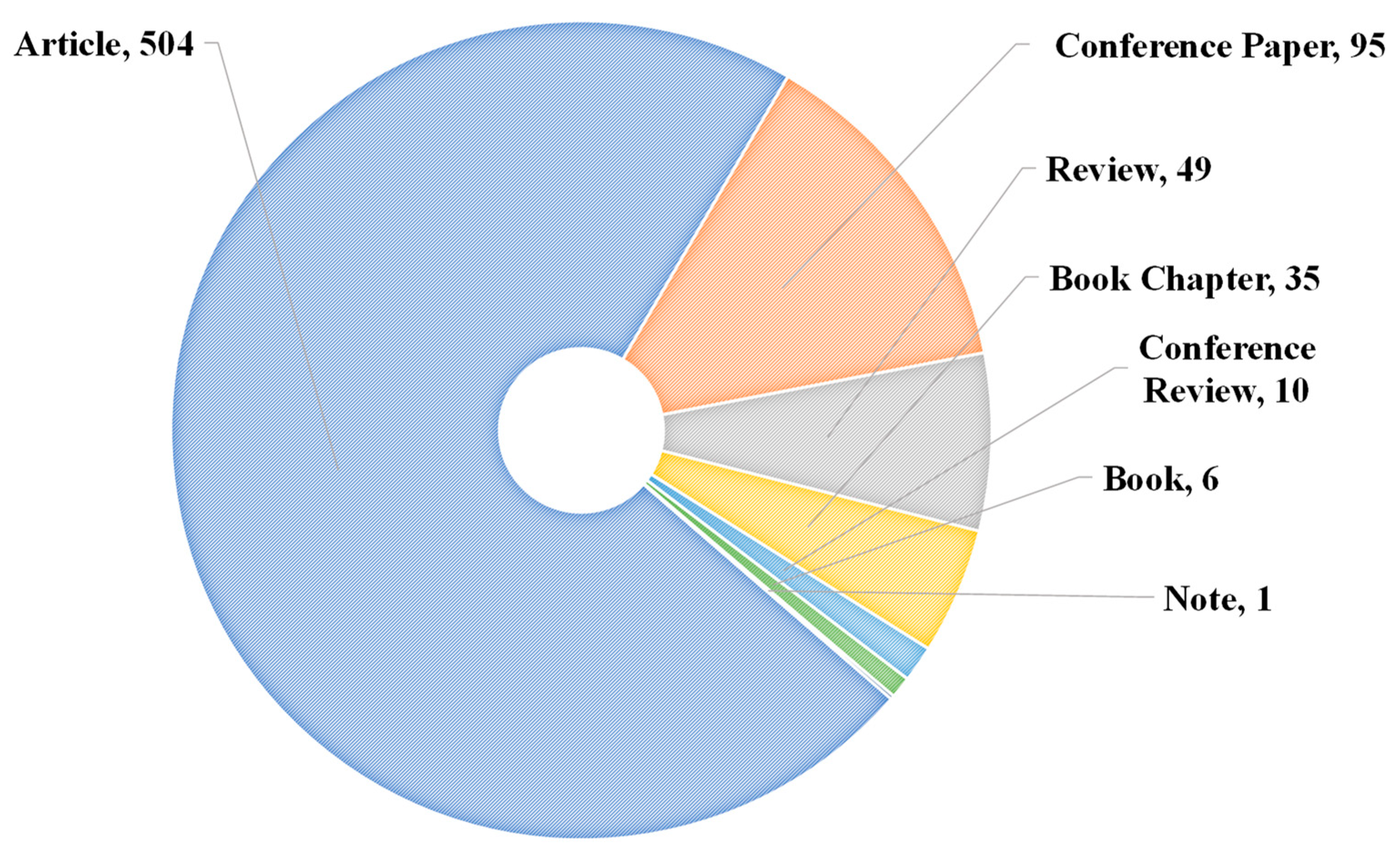
“((ALL(fracture PRE/0 toughness) OR (fracture PRE/0 resistance) OR (fatigue PRE/0 crack PRE/0 growth) OR (crack PRE/0 propagation) AND (hydrogen PRE/0 embrittlement) AND (pipeline PRE/0 steel) AND ALL(hydrogen PRE/0 gas) OR ALL(gaseous PRE/0 hydrogen)) AND (LIMIT-TO (LANGUAGE, “English”))”. The proximity operator “PRE/x” specifies that the first word shall be followed by the second with a gap of “x” intervening words. The language restriction was applied within the initial query, i.e., “English”. The initial query yielded 700 documents, which included articles (504), Conference Papers (95), Reviews (49), Book Chapters (35), Conference Reviews (10), Books (6) and Notes (1), as presented in
Figure 6. The present review was then restricted to only “articles” and the most influential “Conference Papers”. Subsequently, exclusions using the “Subject Area” were also applied to remove the documents related to “Business, Management and Accounting”, “Decision Science”, “Economics, Econometrics and Finance”, and “Social Sciences”, and other irrelevant areas were excluded, resulting in 292 articles. In addition, Web of Science (WoS) was used to identify the articles related to the adoption of data-driven machine learning for the integrity management of pipeline steel under a hydrogen environment with a similar aforementioned query coupled with
“(“machine learning” OR “artificial intelligence” OR “deep learning” OR “data-driven” OR “neural network*”)”, while excluding the review articles. This search resulted in separate set of 6 articles. Moreover, the final refinement was performed based on a thorough reading of the title and abstract of each article to strictly identify the studies related to fracture and fatigue crack growth behavior of pipeline steel under a hydrogen environment, consistent with the scope of the present review, which eventually resulted in 108 articles.
The freely available VOSviewer (Ver. 1.6.19) was adopted to identify the prominent sources (such as journals and others) and keywords with co-occurrence/co-citation mapping and density visualization [
35,
36]. Again, during the systematic review, we then manually appraised a subset of highly cited and methodologically strong sources, extracting fatigue-related data. The outcome factors can be broadly categorized into fracture toughness and the influence of various controlling variables on the fatigue performance of hydrogen pipeline steels, such as pipeline strength, load ratio, loading frequency, and microstructure, among others.
2.1. Scientometric Analysis of Hydrogen-Related Pipeline Steel Research
A scientometric review of fracture toughness and fatigue performance of gaseous hydrogen pipeline steel was conducted. The subsequent sections present the findings elucidating the various attributes of the database related to the fatigue life of hydrogen pipeline steels.
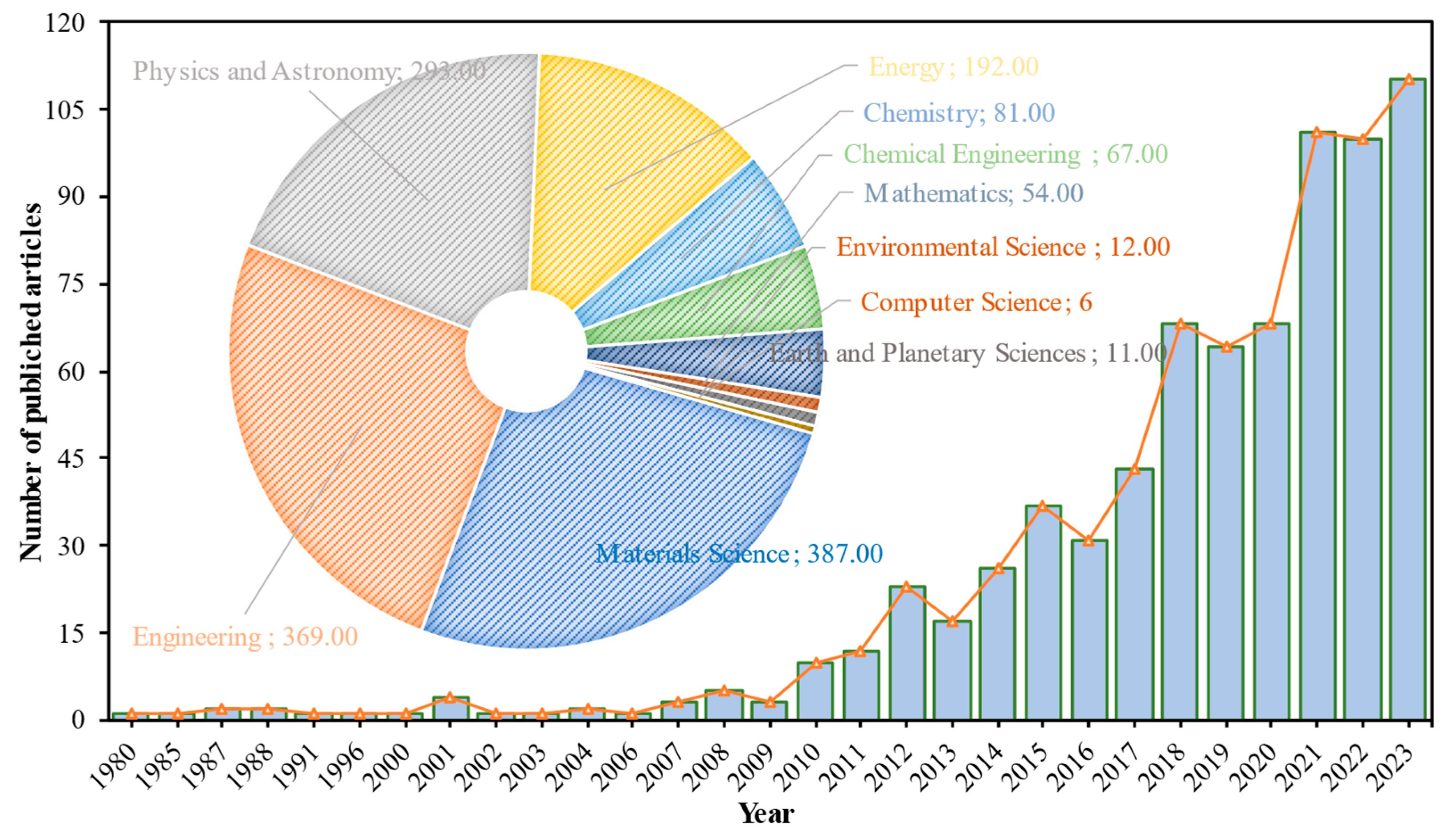
Considering the annual publication trend depicted in
Figure 7, it is evident that the first scholarly work pertaining to the subject of concern was issued back in the 1980s. Suresh and Ritchie [
37] conducted a comprehensive investigation on the impact of hydrogen gas and air on the near-threshold fatigue crack growth of chromium–manganese-based pressure vessel steel. Notably, the authors critically examined the prevailing theory of HE, challenging its validity. Nevertheless, the rate of the publication process continued to be significantly sluggish until the end of 2010, with a mean publication rate of less than two documents annually. The occurrence of rapid publication growth is evident in the years 2012, 2015, and 2018, where the number of documents published exceeded 10, 10, and 40, respectively. Moreover, it was observed that the rate of publication accelerated significantly after 2010 and has continued to rise exponentially up until the present time. Between the years 2021 and 2022, the publication output has reached a notable milestone of 100 documents annually. This achievement serves as an encouraging indication of the diligent efforts being made by the research community in addressing the crucial matter of ensuring the structural integrity of hydrogen gas pipelines. The subject domains were also examined (see
Figure 7). It was determined that materials sciences, engineering, physics and astronomy, energy, chemistry, chemical engineering, and mathematics accounted for approximately 98% of the total published research. Notably, materials sciences and engineering emerged as the most prominent domains, bringing more than 51% to the overall literature.
2.2. Source Distribution and Keyword Co-Occurrence
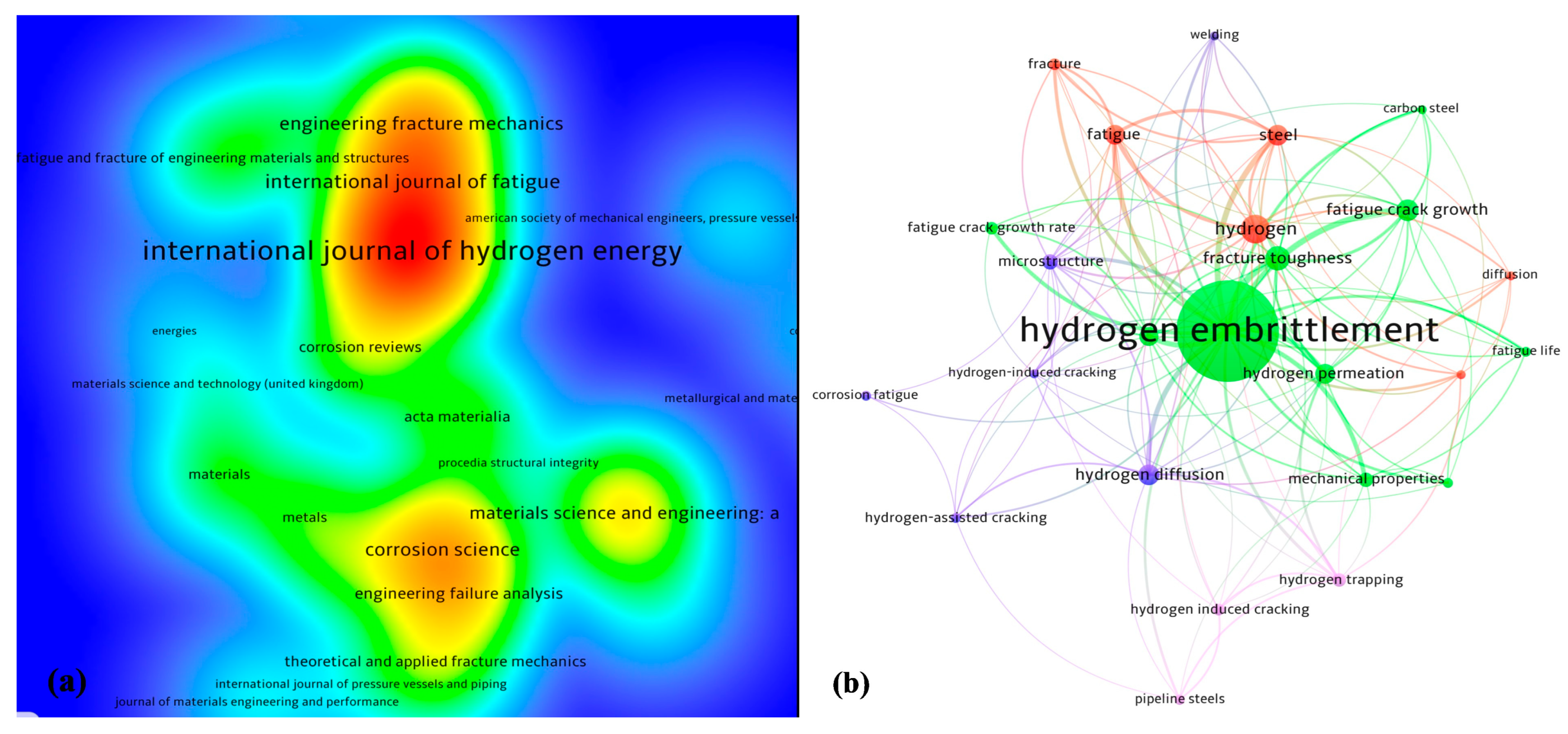
The scientometric analysis identified the most prominent sources (journals and conferences) and the most frequent keywords, using bibliographic coupling analysis of sources in VOSviewer with a minimum of 5 documents per source (see
Figure 8a). The “International Journal of Hydrogen Energy” emerged as the leading journal, with 157 relevant documents, receiving the most 4894 citations, with the highest total link strength of 3613. Furthermore, analysis of author-provided keywords revealed the terms most associated with hydrogen pipeline steel studies. As expected, “hydrogen embrittlement” was the top recurring keyword, followed by “fracture toughness,” “steel”, “fatigue crack growth,” and “hydrogen,”, which confirms the main technical focus areas. A VOSviewer keyword co-occurrence map (
Figure 8b) showed distinct clusters of these terms, illustrating subtopics: for instance, one cluster linked “hydrogen embrittlement” with “fracture” and “mechanical properties” and another linked “fatigue” with “welding” and “microstructure”. Such bibliometric insights provide confidence that the review in
Section 4 is aligned with the key topics researchers have been pursuing.
4. Existing Standards and Codes
The ASME B31.12 code was developed for the service of hydrogen piping and pipelines, using an extensive number of tensile tests, which generally showed increasing HE sensitivity with increasing pipeline steel strength. Based on monotonic tensile data, earlier provisions imposed conservative thickness and design penalties on steels with SMYS exceeding APLI 5L X52 (360 MPa). However, the studies conducted at Sandia National Laboratories (SNL) and the National Institute of Standards and Technology (NIST) have revealed that the relation between material strength and HA-FCGR is not clear, and the findings indicate that the specifications for higher-strength steel can be excessively conservative [
43,
44]. In the context of hydrogen gas transportation, the assessment of material behavior under cyclic loads is important in determining the safe design and serviceability of pipeline steel. Accordingly, a requirement has been articulated to revise the ASME B31.12 code in accordance with fatigue data rather than blanket strength-based derating.
Therefore, models were formulated that define a correlation between the behavior of HA-FCGR in pipeline steels and factors such as hydrogen pressure, cyclic loading ratio, loading frequency, etc. [
45,
46]. The study resulted in a modification of the code, which eliminated the design limitations on pipeline steels from API 5L X52 to API 5L X70, having SMYS 360 MPa to 480 MPa, respectively. The current ASME B31.12 code [
1] (hydrogen piping and pipelines) considers four location classes and requires designing the hydrogen pipeline via option A (prescriptive design method) or option B (performance-based design using the actual pressure-cycle history) if the hoop stresses are over 40% SMYS. Option B requires material qualification in hydrogen (pipeline + weld) using fracture and fatigue tests as per ASME BPVC VIII, Division 3, Article KD-10, with a restriction that the pipeline must meet American Petroleum Institute (API) 5L—Product Specification Level (PSL) 2; maximum ultimate tensile strength (UTS) and yield strength (YS) must not exceed 760 MPa and 550 MPa, respectively, with a hydrogen service pressure of at most 20 MPa.
According to API 5L [
47], the difference between PSL1 and PSL2 is based on the (i) manufacturing and heat treatment (delivery) conditions (R: as-rolled; N: normalizing rolled or normalizing Formed; Q: quenched and tempered; M: thermomechanical rolled or thermomechanical formed); (ii) mechanical testing—for example, PSL1 does not require impact testing; (iii) nondestructive tests—for example, PSL2 must be tested using radiographic, ultrasonic or other NDT methods; and (iv) chemical composition—for example, PSL2 has strict limits on the presence of trace elements (phosphorus, sulfur and silicon) and carbon content to improve weldability and prevent hydrogen embrittlement.
Consequently, as per ASME B31.12 [
1] option B, PSL2 should be regarded as the baseline material for new hydrogen pipelines. In contrast, PSL1 material may exist in existing natural gas pipelines, particularly X42–X52 grades. Therefore, the actual chemical composition, product specification level, seam type, wall thickness, grade, toughness, and weld condition must be verified using mill certificates or material verification testing.
Table 2 summarizes representative API 5L PSL2 grades with their important elemental composition limits most relevant to hydrogen pipeline assessment.
For the requalification of existing pipelines for hydrogen gas, ASME B31.12 [
1] provides a conservative integrity pathway; i.e., the maximum allowable operating pressure (MOAP) must not exceed 15 MPa (75% of SMYS). In the absence of a mill certificate, PHMSA 49 CFR 192.607 requires the operators to obtain a pipeline sample at every mile to perform the physical and chemical analysis [
48]. Furthermore, if the pipeline cannot be qualified under either option (option A or option B), the MAOP should be set such that the hoop stress does not exceed 40% SMYS along the entire line [
1].
ASME B31.8 [
49] is the baseline code for pipeline systems intended to be used for the transportation of gaseous substances. The recent 2026 ASME B31.8 edition borrows the provisions from ASME B31.12 and includes a separate section for the transportation of pure hydrogen and hydrogen blends within existing natural gas infrastructure, specifically focusing on the material compatibility, hydrogen embrittlement, and pressure-derating requirements.
However, pipeline design standards assume that gas transmission lines experience limited cyclic loading, considering a relatively steady operating pressure. ASME B31.3 [
50] (process piping) allows 7000 pressure cycles over the expected service life of the piping system. Det Norske Veritas (DNV) provides a framework for fatigue assessment and pipeline requalification. DNV-SE-0657 [
9] defines the process and information requirements for requalification (data gathering, materials/weld compatibility, integrity threats, and acceptance) and explicitly points the detailed engineering checks (fracture and fatigue) to the appropriate technical standards. DNV-RP-C203 [
51] relies on S–N curves for pipeline welds, but fatigue is generally not a design driver for offshore gas pipelines. However, conventional S–N-based fatigue assessment does not directly resolve hydrogen-assisted crack growth under cyclic pressure, particularly where welds, heat-affected zones (HAZs), and existing flaws control integrity. It is therefore crucial to re-examine pipeline fatigue performance under hydrogen exposure for any cyclic pressure or transient events that were previously deemed inconsequential. DNV, therefore, recognized that existing standards [
52] need additional hydrogen-specific provisions to meet target safety levels offshore, underscoring the need for coordinated FCGR guidance and crack-arrest criteria in H
2 service. Considering the other standard, NFPA 2 [
53] can be applied to gas mixtures with more than 95% hydrogen by volume without specific pressure limits. The Canadian Standards Association CSA Z662 [
54] is dependent on engineering assessment to permit hydrogen transportation in the natural gas pipeline system. To qualify the material for hydrogen service, CSA CHMC 1-2014 [
55] outlines three routes, i.e., (i) the utilization of austenitic stainless steel or aluminum alloy, (ii) a safety factor multiplier to de-rate the MAOP, or (iii) the use of material-specific fatigue testing in a hydrogen environment for design.
Current codes depend heavily on design factors, thickness premiums, minimum threshold or toughness requirements, and generic flaw-assessment routes. Divergence becomes even more significant when welds and defects are considered. Most operational codes still work with homogeneous-property assumptions, generic flaw assessment, or conventional S–N fatigue.
5. Hydrogen-Assisted Fatigue Crack Growth Behavior
The literature on the fatigue performance of hydrogen pipeline steels was deeply examined. Typically, FCGR for metals is expressed as the incremental crack growth
with respect to the number of load cycles
, denoted as
, plotted against the applied stress intensity factor range
on a log–log scale. For pipeline steels (air or inert gas), these plots exhibit three-region behavior. Stage I (low-ΔK region—below the threshold ΔK
th) represents the regime where fatigue crack growth is minimal but can be crucial in case of existing defects. Stage II (Paris-law region—10
−6 to 10
−4 mm/cycle) represents the regime where
, where “C” and “m” are used to denote the material constants. “C” is the intercept and “m” is the slope of the regression line of the log–log plot of
vs.
. In stage II, ferritic pipeline steels in air typically show transgranular fracture propagation [
37]. Lastly, stage III represents the occurrence of rapid crack propagation once the
reaches critical stress intensity
considering the plane strain provision.
As illustrated in
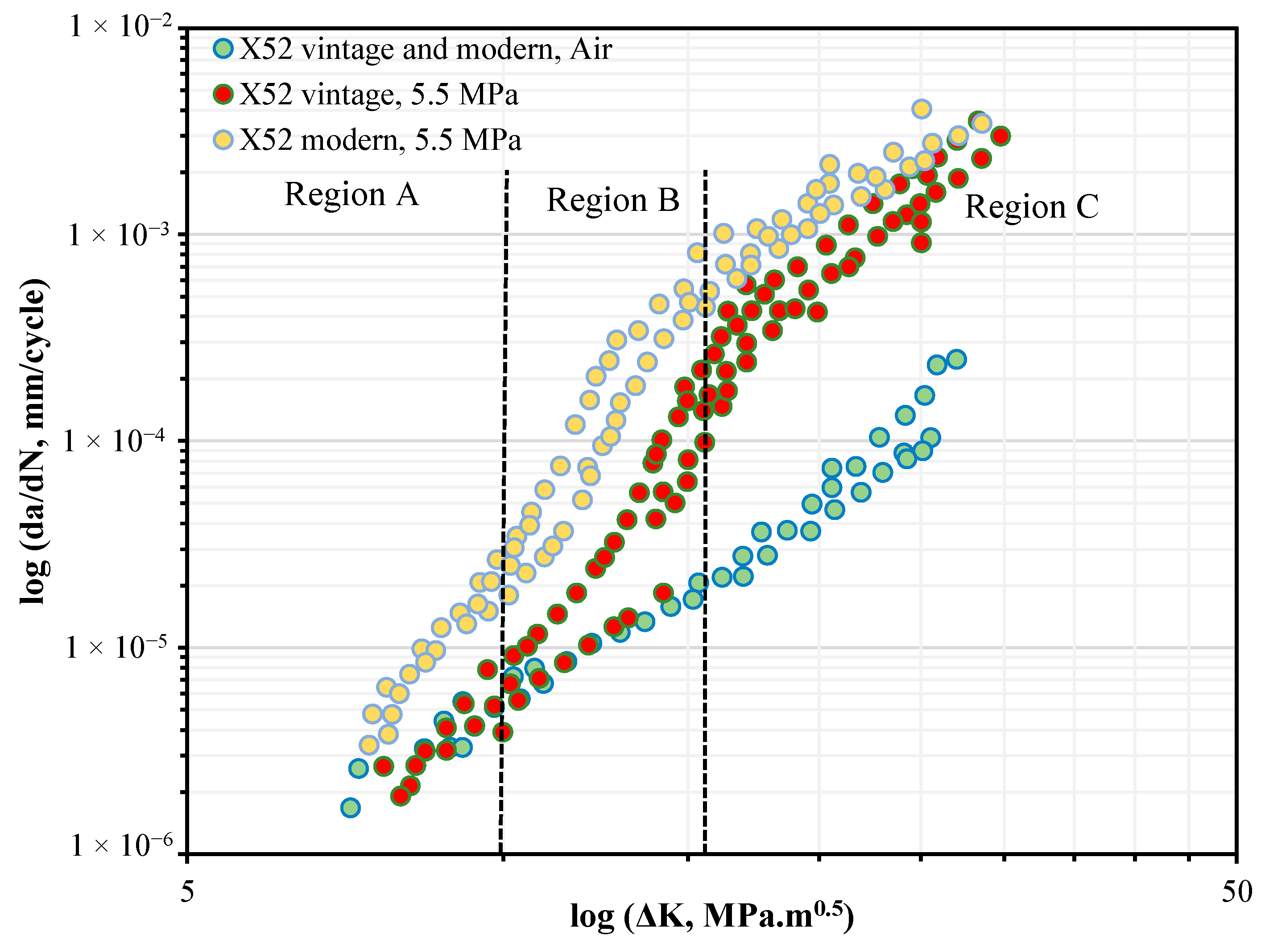
Figure 9, comparing the fatigue crack growth rate (FCGR) plots for materials exposed to a gaseous hydrogen environment with those tested in air or inert environments (vintage and modern steels) reveals three distinct regions. Notably, the boundaries of these zones are significantly affected by loading frequency and hydrogen gas pressure [
43]. In most cases, the data generated in region I in air converges with that generated in the hydrogen environment. An abrupt spike in
has been reported in region B, due to the increase in diffusible hydrogen near the crack tip, as the stress triggered a greater driving force, leading to the alteration of both Paris constants (C and m) [
44]. In region III, it can be observed that the slope (m) is nearly the same in both hydrogen and inert environments. The aforementioned state is commonly known by the term “steady state” region, and the Paris constants derived from this region are frequently employed as a highly conservative FCGR feature [
44].
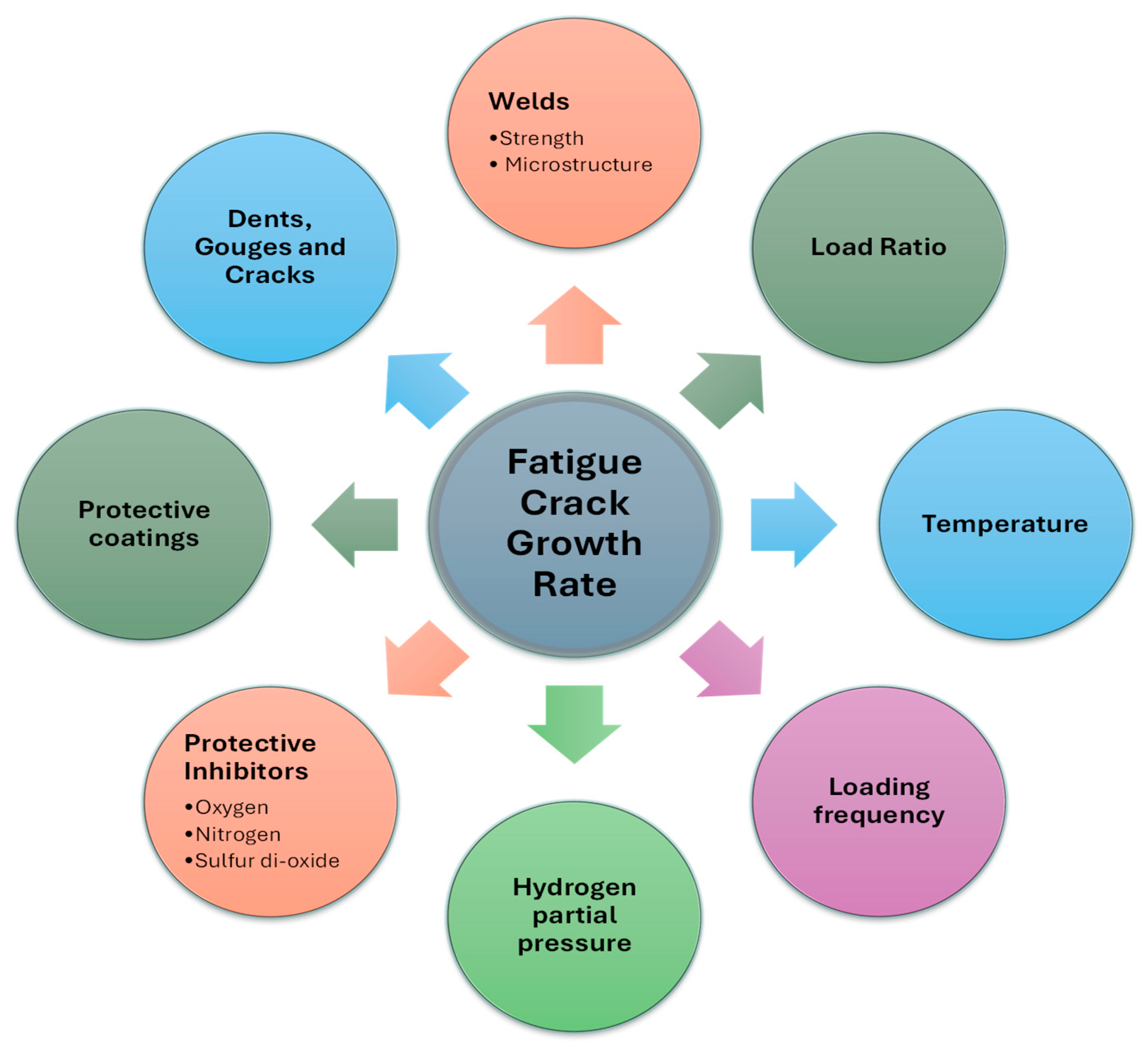
Factors affecting the FCGR of pipeline steels are presented in
Figure 10. The injection of hydrogen gas into existing pipelines can significantly accelerate ΔK and impact their fatigue life [
56]. To accurately assess the fatigue-related lifespan of pipelines used for transporting gaseous hydrogen, it is essential to investigate how hydrogen-induced fatigue acceleration is influenced by the load cyclic frequency
, the load waveform, stress ratio
, hydrogen partial pressure, welds (microstructure/strength), temperature, and the presence of injected impurities like oxygen, nitrogen, and sulfur dioxide. Furthermore, understanding the underlying mechanisms responsible for this acceleration is critical. The present study synthesized the effects of hydrogen pressure, loading frequency, and load ratio, along with temperature variation, oxygen inhibition effect, and weldment condition.
5.1. Effect of Partial Pressure and Loading Frequency on Fatigue Crack Growth
One of the prominent factors influencing the FCGR of pipeline steel is the partial pressure of gaseous hydrogen. In ferritic pipeline steels, for a given ΔK and loading conditions, higher pH
2 generally yields higher
, with accelerated
in the mid-ΔK (Paris region) once the crack-tip hydrogen concentration threshold is exceeded. Furthermore, generally, the
increases as the cyclic load frequency decreases. The effects of hydrogen partial pressure and loading frequency are provided in
Table 3.
Slifka et al. [
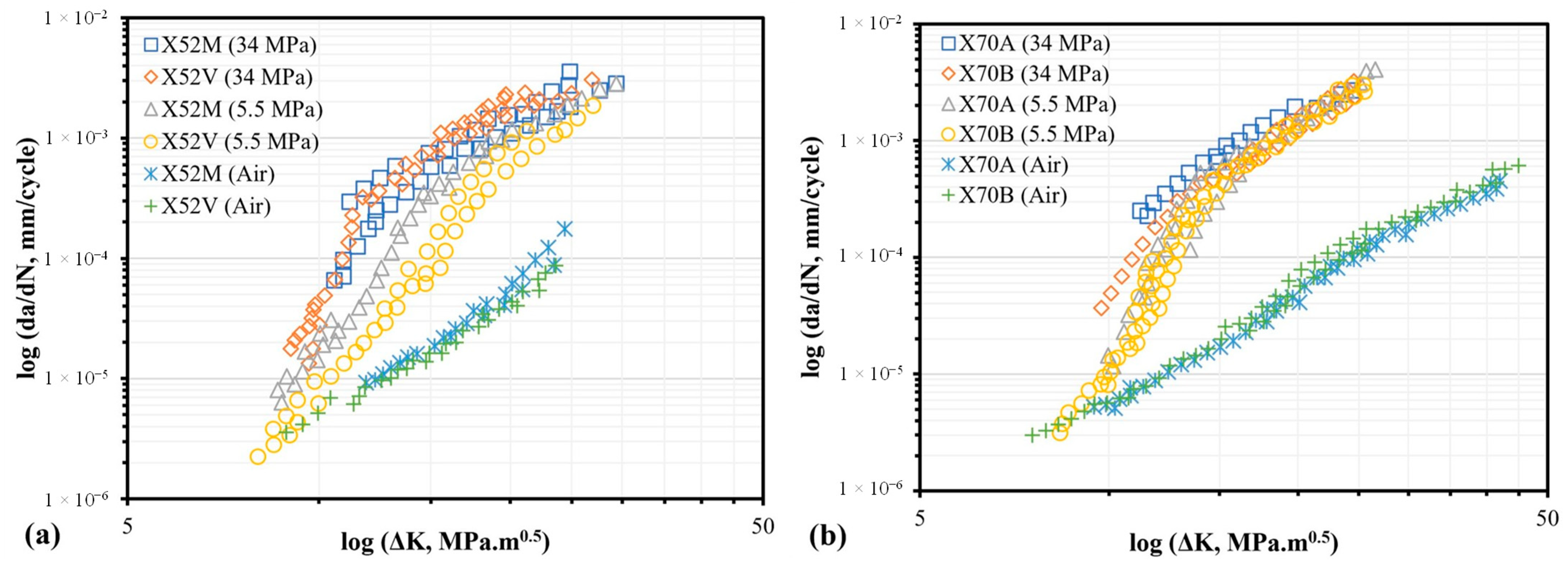
44] tested the FCGR on four API 5L steels at varying hydrogen partial pressures and cyclic loading frequencies. The vintage X52 steel exhibited a grain size ten times larger than the other three materials. The disparity in grain size has the potential to impact hydrogen diffusivity. Both X70A and X70B exhibited comparable chemical compositions, although their microstructures displayed slight variations as a result of disparities in thermomechanical processing techniques. As shown in
Figure 11, the X52V is more susceptible to an increase in hydrogen pressure as compared to X52M, X70A, and X70B. Yet, at lower hydrogen pressure (i.e., 5.5 MPa), the
of X52V is lower than X52M, indicating a higher resistance to fatigue at reduced hydrogen pressure. The X70A, compared to X70B, is more susceptible to an increase in hydrogen pressure. However, at ΔK greater than 13 MPa.m
0.5, the
is comparable irrespective of the variation in hydrogen pressure. Surprisingly, the
values of considered materials do not vary significantly from one another. Additionally, the overlap in the data between X52M and X70B, both in an air and hydrogen environment, reflects that SMYS does not significantly affect the
of modern pipeline steels [
46].
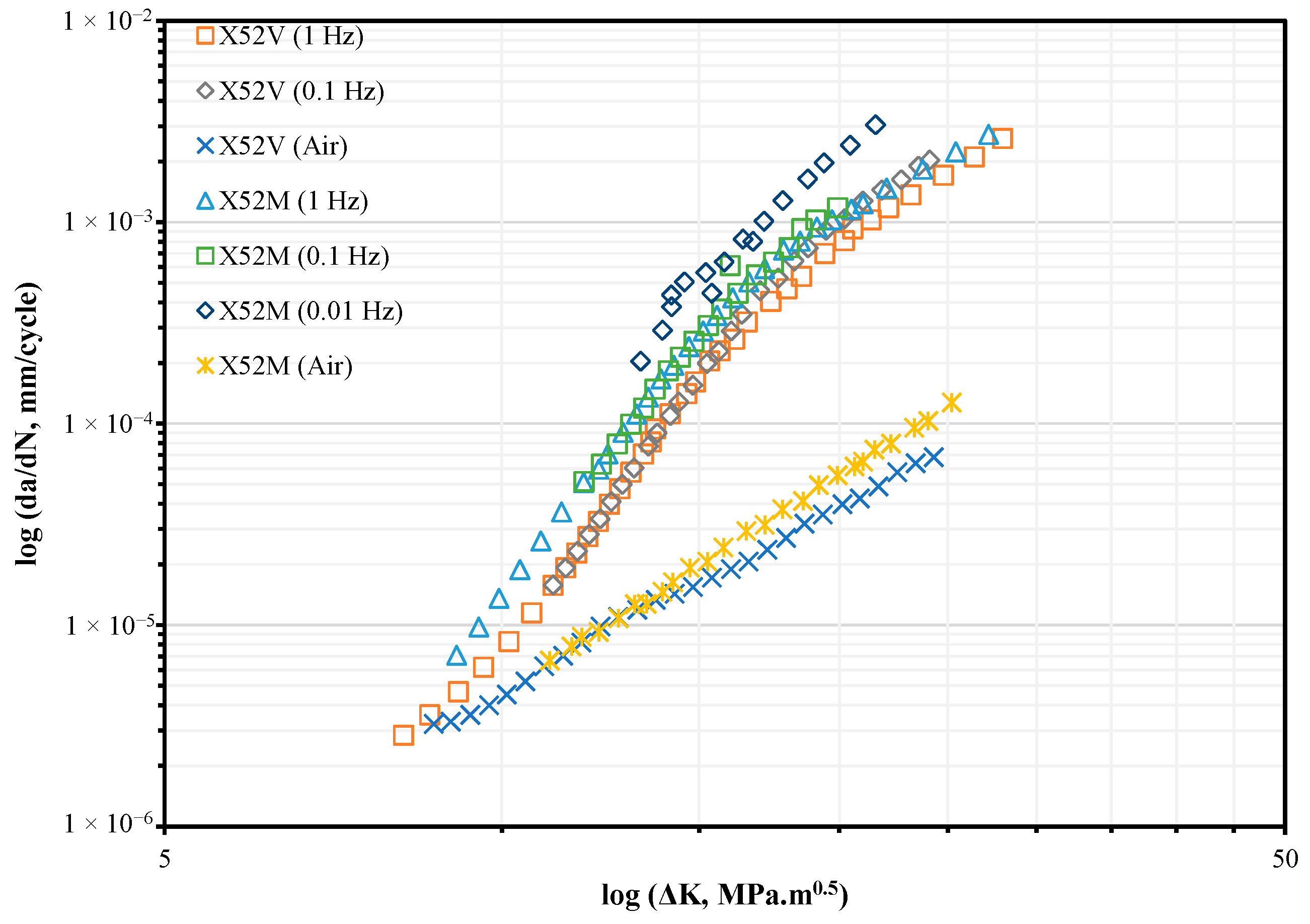
Slifka et al. [
44] reported that at 34 MPa, hydrogen-assisted
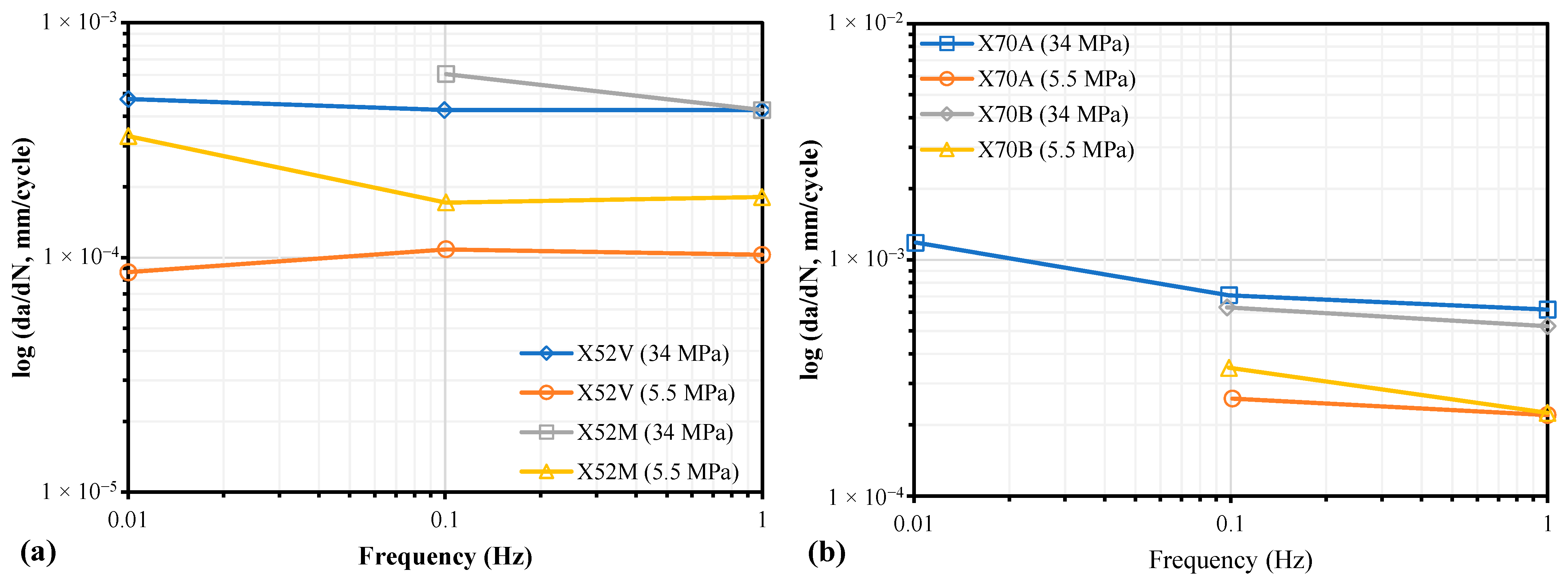
modestly depends on the frequency. As shown in
Figure 12, at 5.5 MPa hydrogen pressure, the
for X52V and X52M varies in a similar pattern for frequencies equal to 0.1 and 1 Hz. A higher
was observed for X52M at 0.01 Hz. At the same frequency, the authors did not complete the test for X52V because a similar
variation was obtained for frequencies equal to 0.1 and 1 Hz. As presented in
Figure 12, at ΔK = 14 MPa.m
0.5, the
of X52V is less altered when the frequency is at its lowest. Conversely, for X52M and X70A, the
greatly increased at the lowest frequency. It is worth mentioning that, comparatively, the effect of increasing pressure (5.5 to 34 MPa) is more significant than decreasing the frequency.
In general, hydrogen-enhanced
is associated with the diffusion and increased concentration of hydrogen at the crack tip [
58]. Consequently, it is acceptable to assume that a decrease in frequency and an increase in pressure will result in a comparable impact. Thus, at a lower frequency, the hydrogen atoms will take longer to diffuse near the crack tip. Furthermore, the hydrogen pressure affects hydrogen absorption, which in turn increases the hydrogen flux and thus the driving force is higher for hydrogen-enhanced
. In contrast, as depicted in
Figure 13a, the authors declare that for X52V the observed frequency dependency on
is not obvious. It is important to note that for X52V, the
at a frequency of 0.01 Hz is based on an assumption. More specifically, it is assumed that for frequencies ranging from 0.1 to 0.01 Hz, the
varies in a similar fashion as compared to X52M. The X70A at 34 MPa pressure exhibits a marginal reduction in
at the lowest frequency.
Generally, both the loading frequency and the ΔK levels significantly influence the growth and comparative proportions of all three surface fracture patterns. As the level of ΔK rises, the fracture mechanism shifts towards quasi-cleavage (QC) from transgranular (TG), whereas the percentage of intergranular (IG) cracks remains consistently low, comprising around 2–3% of the total fracture surface area, regardless of the testing configurations [
59].
5.2. Effect of Load Ratio on Fatigue Crack Growth
The load ratio (R) is regarded as a significant factor, but it is not the primary governing variable for the impact of hydrogen on
. Equation (1) shows the relationship between ΔK and K
max:
The R value seems to have an impact during the transitions observed between the different regimes of fatigue crack growth. In general, at constant ΔK, in the hydrogen gas environment presents an increasing trend as the value of R increases. Nevertheless, there exists contradictory data regarding the impact of R on . It is pertinent to understand that altering the R entails changes in mean, maximum, and/or minimum load and the extent of closure mechanisms, which can potentially account for the inconsistencies observed.
Somerday et al. [
57] investigated the behavior of X52 pipeline steel under a constant hydrogen pressure of 21 MPa and R values equal to 0.1 and 0.5. As presented in
Table 3, at each R value,
follows a similar trend with the exemption that the initiation of acceleration shifted towards lower ΔK at R equal to 0.5 (highest). Furthermore, across the entire ΔK range, the rate of crack growth at higher R (0.5) was greater than that at lower R (0.1).
5.3. Effect of Temperature on Hydrogen-Assisted Fatigue Behavior
Temperature affects the hydrogen-assisted FCGR due to the variation in trap-site occupancy at the crack tip. Matsuoka et al. [
60] investigated the influence of temperature (298, 363, 393, and 423 K) and hydrogen partial pressure variation (0.1, 0.7, 10, and 90 MPa) on FCGR, considering JIS-SM490B (low-carbon steel). Another study performed similar sorts of experiments on low-alloy steel, i.e., JIS-SCM435 Cr–Mo low-alloy steel [
61]. The effect of temperature variation on HA-FCGR is attributed to hydrogen trap-site occupancy near the crack tip. As summarized in
Table 4, in low-to-moderate hydrogen pressures (0.1 to 0.7 MPa), increasing temperature from 298 K to 423 K mitigates HA-FCGR; at ΔK = 25 MPa√m, the
acceleration ratio
drops from 27 to 2.5, consistent with the reduced occupancy of dislocation-core traps (47 kJ/mol). In contrast, at high hydrogen pressure (90 MPa), the acceleration becomes temperature-insensitive because the trap sites are saturated across the same temperature range.
The scanning electron microscopy (SEM) images indicated a deviated striation morphology of
at 298 K (0.7 and 90 MPa) compared with that observed at 298 K (air) and 423 K (0.7 MPa) [
60]. At 298 K, considering the hydrogen pressure of 0.7 and 90 MPa, the fatigue crack is straight and localized in comparison with that in air. Furthermore, there is little difference between the striation’s formation at different hydrogen pressures since during the loading process, the crack retains a sharp tip, and the blunting effect disappears. The worst-case HA-FCGR at near-ambient temperatures can persist even as temperature rises when partial pressure is high; therefore, temperature effects should be evaluated together with the expected hydrogen partial pressure and cycle frequency in service.
5.4. Effect of Gaseous Impurities and Inhibitors on Fatigue Crack Growth
In high-pressure H
2, fatigue crack growth in ferritic API 5L steels accelerates with the accumulation of hydrogen atoms at the crack tip; however, the detrimental effects can be partially suppressed by additional impurities like oxygen, water vapors, carbon-based molecules, sulphur compounds, and unsaturated hydrocarbons [
57]. Among these impurities, oxygen is deemed to be more important, while water vapor, CO
2, and H
2S are deemed as operationally important contaminants but might require corrosion control.
For API 5L X52 and X100, adding 10–1000 vppm O
2 to 21 MPa H
2 holds crack growth close to air in the low–mid ΔK region, with an abrupt transition to accelerated growth above a concentration-dependent critical ΔK [
57]. As presented in
Table 5, Somerday et al. [
57] and Ronevich et al. [
62] explored the inhibition effect of O
2 on API 5L X52 and API 5L X100 at different levels of hydrogen partial pressure and loading conditions. The O
2 concentration equals 1000 vppm and R = 0.5, offering analogous effects to those observed in the air (inert environment) even in the higher ΔK region, showing a complete inhibition effect. However, in the cases of 100 and 1000 vppm and R = 0.1, the crack starts propagating in low- and mid-ΔK regions. The
trends obtained under conditions of 10 vppm O
2 and pure H
2 exhibited similar characteristics.
Furthermore, Ronevich et al. [
62] studied the effect of O
2 on higher-strength steel, i.e., API 5L X100, under lower H
2 pressure and frequency. A strong inhibition effect was observed for 100 vppm O
2 at lower pressure (1.4 and 2.1) MPa H
2 (curves approach air across the tested ΔK range). At 21 MPa H
2, the increasing O
2 concentration delays the onset of hydrogen-assisted
and remains near those in the air throughout the low- to mid-ΔK range. However, the accelerated
reappears at higher ΔK or with faster cycling. The higher pressure and frequency narrow the O
2-inhibition window.
Although laboratory studies show that inhibitors can suppress hydrogen-accelerated fatigue crack growth in pipeline steels, translating this approach to transmission pipelines seems more challenging. Oxygen inhibition can be beneficial for crack growth resistance under controlled laboratory conditions, but it is not compatible with international standards used for hydrogen transmission and may adversely contribute to internal corrosion, sulfide stress cracking, and gas-quality non-compliance.
First, in the fuel cells, the fuel-quality specifications are extremely tight: ISO 14687/SAE J2719 cap contaminants at levels such as O
2 ≤ 5 vppm, CO ≤ 0.2 vppm, total sulfur ≤ 0.004 vppm, and H
2O ≤ 5 vppm [
63,
64]. Along with the poisoning effect, the small amounts of CO and H
2S adsorb onto the catalysts in fuel cells and block the active sites where hydrogen reacts, thus dramatically reducing the fuel cell performance and lifespan [
65].
The addition of oxidizers elevates the safety risk; hydrogen has a wide flammability range in air and low ignition energy, so O
2 injection increases the severity of ignition in compressors, valves, and blowdown systems [
66,
67].
Also, the O
2, H
2O, CO
2, and H
2S contents lead to internal corrosion in carbon-steel pipelines [
68]. In the presence of water and oxygen, H
2S can cause sour corrosion, even in high-strength steels, and lead to sulfide stress cracking (SSC). Furthermore, gas-network rules also restrict O
2; the EN 16726 framework treats O
2 as a controlled impurity in transmission gas [
69]. The recent European Network of Transmission System Operators for Gas (ENTSOG) monitoring guidance reiterates the need to limit O
2 to avoid corrosion and interoperability issues [
70]. Moreover, the purposeful inhibition conflicts with the PHMSA integrity practices, which emphasize the dehydration and contaminant control precisely to mitigate corrosion failures [
68].
The lab results are not validated at pipeline scale, as inhibition depends on ΔK, frequency, and pressure and can vanish above a transition ΔK; therefore, standards [
71] manage hydrogen risk through materials selection, stress limits, and fracture/fatigue qualification, not impurity dosing. Consequently, the extrapolation of high-purity hydrogen FCGR experiments to operating pipelines should therefore be performed conservatively. High-purity H
2 data provide an appropriate upper-bound reference for HA-FCGR without the inhibition effect. In the case of impurity injection with a purpose to reduce FCGR the operation should be limited to experimentally validated conditions (pressure, frequency, load ratio, ΔK, material grade, and impurity concentration). For engineering assessment, impurity effects should be incorporated through gas-quality monitoring, conservative crack growth envelopes, threshold/transition-ΔK checks, and validation under realistic pressure cycling before being used to modify inspection intervals.
5.5. Low-ΔK Region (Near the Threshold) and the Crack Initiation Stage
HA-FCGR is most discussed in the Paris region and the low-ΔK region is equally important for long-life design, requalification of existing pipelines, and inspection-interval planning.
The threshold stress intensity factor range (ΔKth) represents the nominal long crack driving force below which crack extension is slow and undetectable. Under hydrogen environments, ΔKth should be treated as an apparent, condition-dependent parameter, as hydrogen can reduce the effective resistance to crack advancement by increasing crack-tip hydrogen concentration and localized plasticity, which eventually reduces crack-tip blunting and facilitates decohesion or quasi-cleavage under certain stress and diffusion conditions. As discussed earlier, even when air and hydrogen data appear to converge at very low ΔK, the transition from non-accelerated to hydrogen-accelerated crack growth may shift towards the lower ΔK region [
44].
The influence of hydrogen on ΔKth is controlled by the same coupled variables, but their effects are more sensitive to crack closure. Higher hydrogen pressure increases hydrogen at the crack tip, while lower frequency provides more time for hydrogen diffusion and trapping during each cycle. A higher load ratio increases Kmax and reduces crack-closure shielding, which can shift the onset of hydrogen-assisted acceleration toward lower ΔK, as observed for X52 steel tested at different R values [
57]. Furthermore, the welds and heat-affected zones (HAZs) can adversely affect near-threshold behavior because of residual stress and heterogeneous microstructures.
Consequently, in existing pipelines the occurrence of corrosion pits, dents, gouges, and coating defects is obvious [
72]. Under hydrogen exposure, these existing defects may grow at ΔK values below the long crack ΔKth because they experience less crack closure. Consequently, a long crack threshold obtained from CT specimens may be non-conservative if directly used to screen small flaws in hydrogen-exposed pipelines.
6. Effect of Pipeline Discontinuities and Role of Protective Coatings
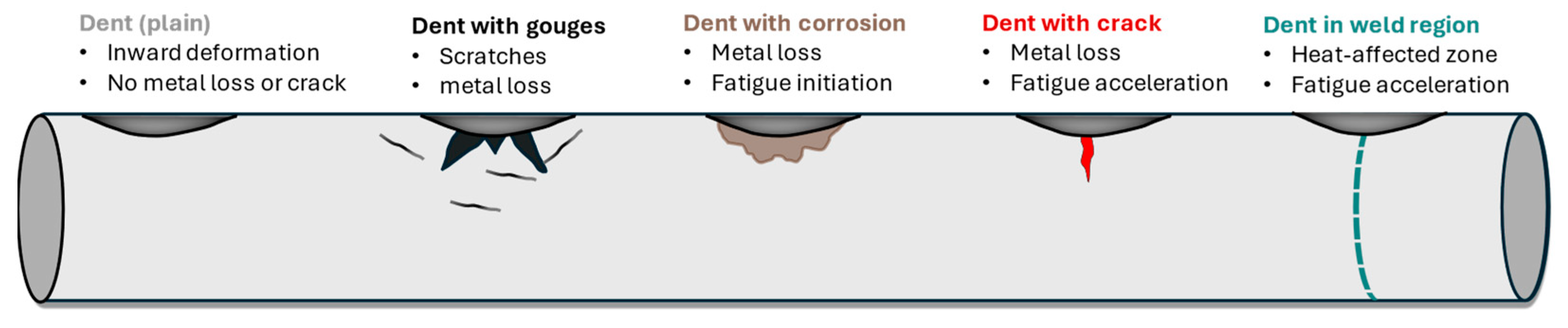
Requalification of natural gas pipelines for hydrogen, either as blends with natural gas or pure H
2, requires assessment of hydrogen interactions with existing pipeline defects, i.e., dents, gouges, cracks, and corrosion, along with weld/HAZs, illustrated in
Figure 14. Among these, dents are a prominent form of mechanical damage, often resulting from excavation operations and pipeline installation [
72]. Across U.S. gas transmission pipelines (2010–2022), the major cause of significant incidents has been material/equipment failure (43%), followed by excavation/third-party damage (19%) and corrosion (16%), underscoring that defect severity and local conditions might pose a significant risk [
73].
The pipeline industry places significant emphasis on developing accurate and efficient methods for dent evaluation. Standards for defect assessment include ASME B31.8 [
49], API 1160 [
74], 49 CFR 192 [
48], and API 1104 [
75] for weld acceptance/repair. Even a plain dent, without interaction with corrosion or welds, reduces the fatigue life of pipeline steel [
23]. To assess the structural integrity of pipeline steel, particularly in the context of transporting gaseous hydrogen, it is critical to examine the relationship between
and ΔK, while considering material discontinuities such as the heat-affected zone (HAZ), welding defects, dents, gouges, cracking, and corrosion. Additionally, remedial measures such as coatings and the use of inhibitors must be incorporated into the evaluation process.
6.1. Effect of Welds and Heat-Affected Zones on Fatigue Crack Growth
In transmission pipelines, two types of welds are used: (i) longitudinal seam factory welds from electric welds (EWs)/submerged arc welds (SAWs) and (ii) field circumferential girth welds (GWs). The field weld is the most frequent origin of an imperfection that has the potential to develop into a fracture. Welded locations can govern integrity in hydrogen service due to weld metal/HAZ microstructures, local residual stress, and potential strength mismatch. The construction industry employs the mechanized gas metal arc weld technique (GMAW) or shielded metal arc weld (FCAW) paired with nondestructive examination (NDE) for GWs; nevertheless, hydrogen can elevate FCGR in weld regions relative to the same base steel when crack-tip hydrogen accumulates. Hence, it is essential to conduct a comprehensive characterization of the fatigue characteristics of both the welds and the base metal. The distinctions between base metal, weld metal, and heat-affected zones (HAZs) when subjected to hydrogen testing add additional complications.
To set preheat/heat input limits and manage hydrogen-assisted cracking risk, the practitioners compute the International Institute for Welding (IIW) carbon equivalent (CE) (see Equation (2)) [
76], as an approximation for HAZ hardness, and the carbon equivalent for welding (PCM) (see Equation (3)) [
77], which is more sensitive for low-carbon micro-alloyed steels and can be used for short cooling times and root welding. API 5L (PSL2) particularly requires CE control, and common welding guidance bases preheat on these indices. For hydrogen service pipelines, these metrics offer a quantitative foundation for avoiding martensitic HAZs.
The effect of weldments on the fatigue response is summarized in
Table 6. Ronevich et al. [
78] investigated the
of X100 steel GWs at BM, HAZ, and WFZ locations. The WFZ exhibited convergence with the BM upon considering residual stress implications, emphasizing the significance of residual stress inclusion for the evaluation of fatigue performance. Before the consideration of residual stress, the WFZ showed higher
compared to BM. The determination of whether welds or HAZs have higher
compared to the BM could be influenced by many variables, such as the welding process used, the microstructure, and the degree of undermatching or overmatching between the strength of the BM and weld.
Furthermore, Ronevich and Somarday [
79] investigated the
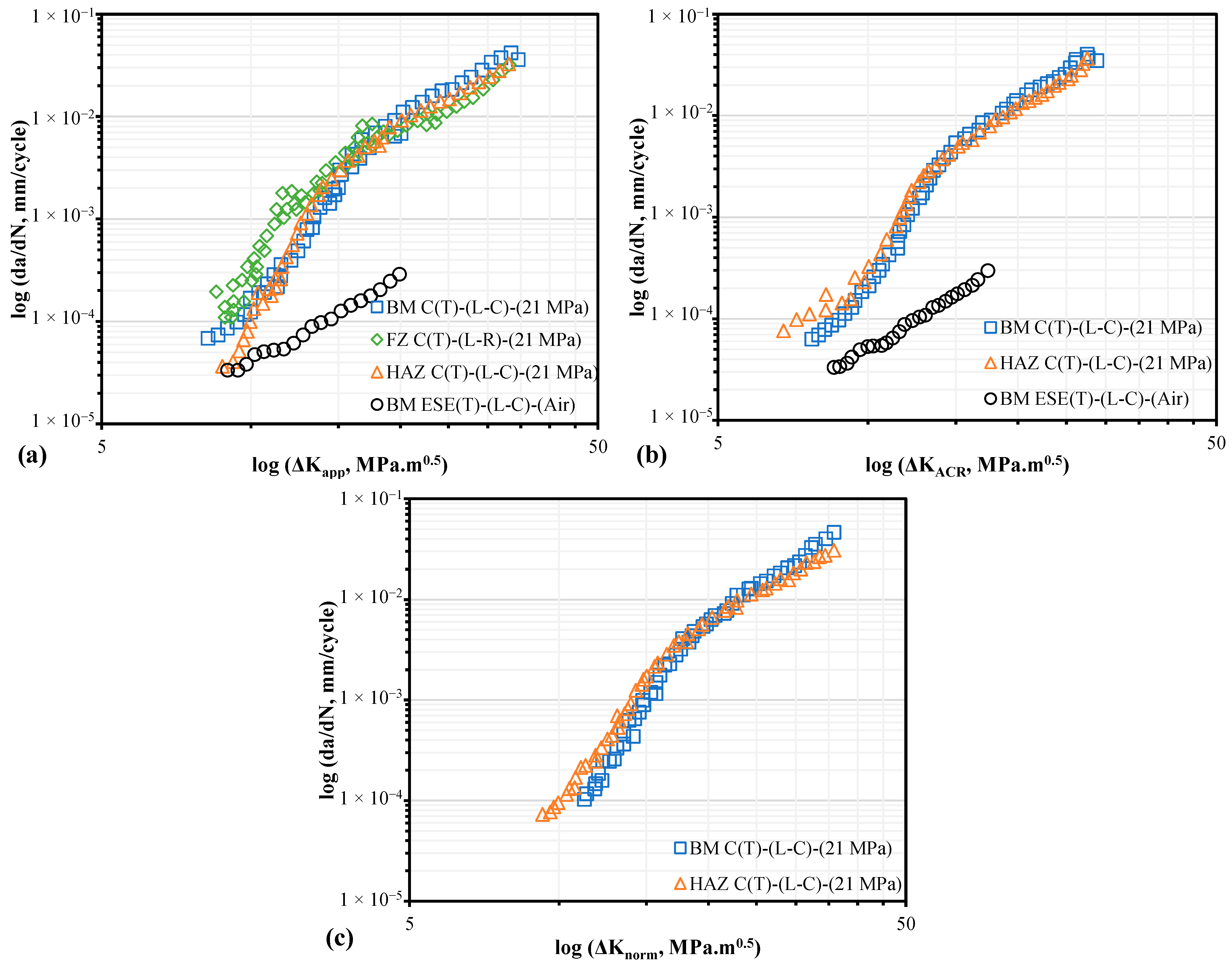
of X65 steel girth weld (GW) at WFZ and HAZ and compared with BM; a similar trend was observed for all three conditions, while at ΔK < 12 MPa.m
0.5, the deviation in
was observed with the highest value noted for WFZ. The relative
depends on the crack closure and residual stress added to the crack-tip driving force obtained in HAZ samples. As shown in
Figure 15b, after applying the adjusted compliance ratio method, at lower ΔK
ACR, a higher
was observed for the HAZ as compared to the BM samples. ΔK
norm was calculated to account for the crack closure and residual stresses, which permitted the evaluation of real
in BM and HAZ samples. As indicated in
Figure 15c, at lower ΔK
norm, the hydrogen-assisted
was slightly higher in HAZ as compared to BM samples.
As summarized in
Table 6, Ronevich et al. [
80] investigated the hydrogen-accelerated
of X52 friction stir girth weld (FSW) under 21 MPa pressure, a load ratio of 0.5, and frequency equal to 1.0 Hz. The authors selected three different regions, i.e., BM, the center of FSW, and 15 mm off-center of FSW. The applied load was longitudinal with the extension of the crack through the circumference for all extracted samples. At ΔK < 15 MPa.m
0.5, the hydrogen-accelerated
of the FSW was slightly higher than both the BM and 15 mm off-center specimens. FCGRs of the FSW were marginally greater than those in the base metal and off-center regions. The fracture surface examination shows the presence of intergranular fractures in the BM and 15 mm off-center samples.
Drexler et al. [
18] performed a comprehensive analysis of
on two different types of welds, i.e., girth weld (GW), seam weld (SW), and their HAZs, considering four steel pipelines (X70A, X70B, X52V, and X52M). For the GW, the modern pipeline steel gas metal arc weld (GMAW) technique was used, while for vintage pipeline steel, the shielded metal arc weld (SMAW) technique was used. It is important to mention that the SMAW technique introduced higher temperatures as compared to GMAW. As summarized in
Table 6, the HAZ of SW (SH) for X52V provided a slightly higher
than X52V (BM) due to the presence of untampered martensite (higher carbon content), which is the primary cause of HE [
81]. The higher resistance in the GW was due to the multiple passes generating the softer and harder regions in the fusion zone (FZ). The
of X52V (SW) followed a similar trend to X52V (BM), while the X70A (SW) was noted to be higher than X70A (BM), particularly at ∆K < 15 MPa·m
0.5. The occurrence of martensite in the HAZ potentially elevated the
compared to the unaltered microstructure of BM, i.e., polygonal ferrite–pearlite [
82]. Consequently, this resulted in a notable rise in the
within the HAZ, surpassing what was seen in BMs with banded microstructures.
Welded Pipe Fracture Control and Crack-Arrest Requirements
For pipelines with longitudinal seam welds or field girth welds, in addition to local da/dN behavior in the weld metal or HAZ, it also requires full-scale fracture control. Most of the gas pipelines are longitudinally welded and full-scale fracture control recognizes that running ductile fracture propagates axially along the pipeline. Therefore, welded pipe integrity requires crack-arrest checks using the Battelle Two-Curve method [
83], where toughness alone is insufficient. This implies that crack arrestors remain essential for high-pressure gas service [
84]. In practice, the running-fracture control is specified via Charpy V-notch (CVN—to meet ductile fracture) and the drop weight tearing test (DWTT—brittle fracture) as per API 5L/ISO 3183; when warranted, arrestors are used to supplement the required arrest energy [
47,
85]. Construction specifications commonly stagger/rotate longitudinal seams between adjacent joints (and place seams in the upper half of the pipe) to avoid continuous alignment, reducing the chance of a running fracture [
86]. For old pipeline (incomplete records) segments, PHMSA 49 CFR 192.607 [
48] requires material verification using nondestructive/destructive testing of cut-out samples as per API 5L. These fracture-control measures continue to apply when repurposing existing pipelines for hydrogen. The recent guidance explicitly points back to API 5L/Battelle for arrest-energy targets in gas pipelines [
87].
6.2. Protective Coatings as Hydrogen Permeation Barrier
In gas transmission pipelines, protective coatings are used to control corrosion and mitigate hydrogen permeation. External pipeline coatings are applied in controlled coating plants through fusion-bonded epoxy (FBE) or multilayer polyethylene/polypropylene systems, while field-joint coating systems applied after girth welding following the ISO standards [
88,
89,
90]. These systems require controlled surface preparation, abrasive blast cleaning, thickness verification, holiday detection, and adhesion testing. On the other hand, internal coatings used in natural gas transmission include thin epoxy-based flow efficiency coatings, which do not provide a strong barrier for hydrogen permeation [
91].
Table 7 summarizes the major coating technologies, along with their application location, fabrication method and primary function. In contrast, at the laboratory scale, advanced ceramic, graphene-based, and polymer-composite coatings are studied to mitigate hydrogen permeation.
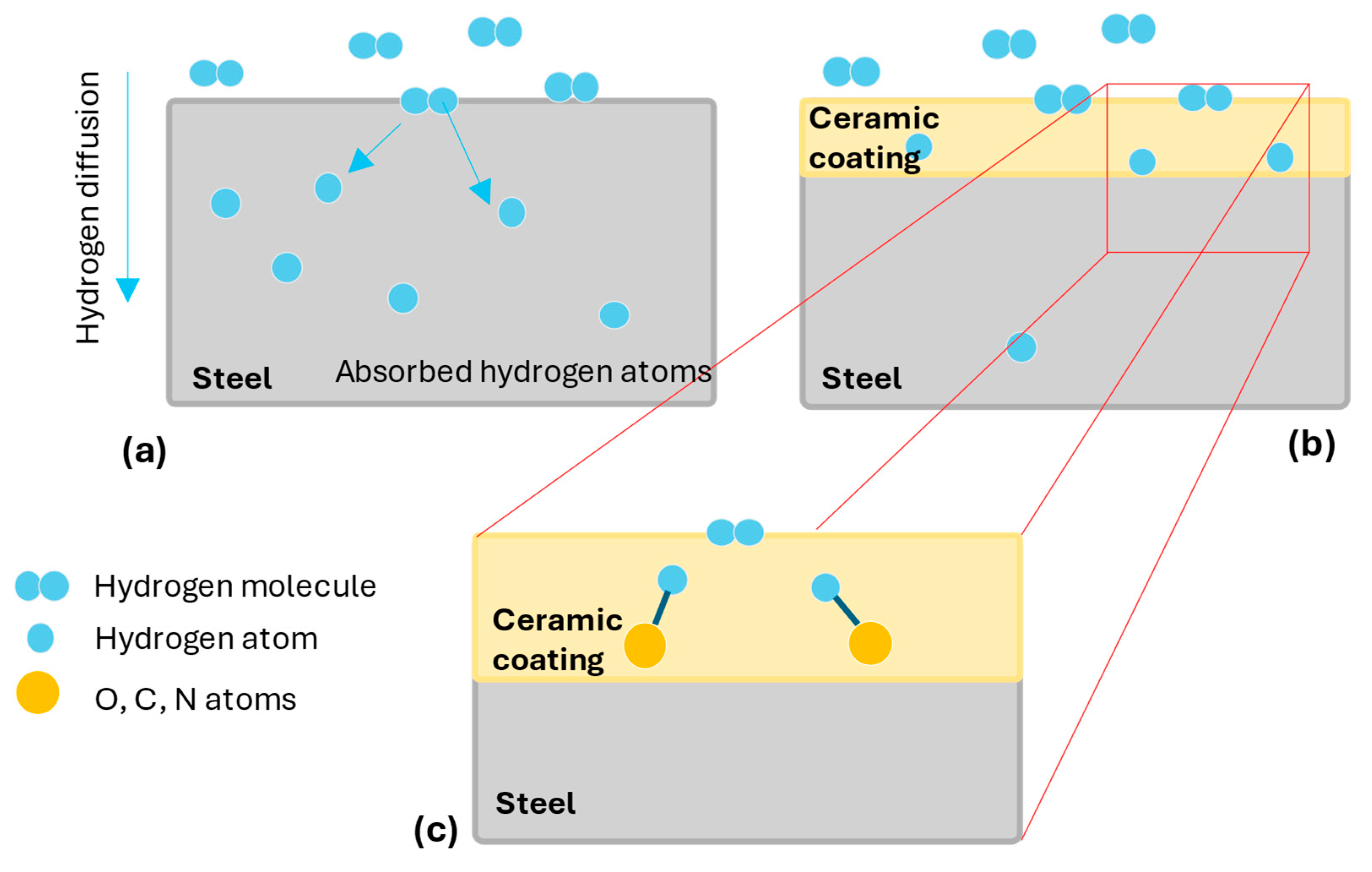
The role of advanced coating can be interpreted in terms of its ability to delay hydrogen adsorption, dissociation, diffusion, and permeation into steel. The hydrogen atom penetrates the microstructure of steel and reduces the fatigue strength and tensile strength, which can result in brittle/catastrophic failures in practical applications [
92,
93]. The reduced thickness of the pipe wall was preferred, accompanied by high strength, which eventually poses an increased risk of HE [
94]. The consequences often include significant financial losses for the pipeline company and result in adverse environmental effects [
93,
95]. Hence, it is essential that the steel used in pipelines can endure and tolerate harsh weather situations [
96]. Usually, the occurrence of a fracture often precedes sulfide corrosion in high-strength pipeline steel. Hydrogen-induced cracking (HIC) and stress corrosion cracking (SCC) are often documented types of hydrogen-related deterioration in steels [
97]. To mitigate the damage of hydrogen pipeline steel, one of several other proposed strategies involves coating the interior and/or exterior surface of the pipeline steel [
98]. Therefore, the authors used coating materials as a preventive measure to delay hydrogen permeation, which eventually decreases the risk of cracking and failure [
99,
100,
101]. As presented in the literature, among the three different types of coating, ceramic coatings were the most preferable, providing several advantages over metallic and polymeric coatings (see
Figure 16).
Ceramic coatings protect the pipeline steel from degradation, providing high strength, electrical insulation, low thermal expansion, and high thermal resistance [
101,
102]. The carbide-, oxide-, and nitride-based ceramic coatings have demonstrated their suitability as corrosion-resistant coatings at high temperature, alongside restricted permeability, which can effectively assist in hydrogen environments. For instance, aluminum oxide-based high-quality coatings provide a strong barrier for hydrogen isotopes [
103,
104]. FeAl/Al
2O
3 reduced deuterium permeation flux by five orders of magnitude at 600 °C and retained stability after 100 h exposure and 50 thermal cycles [
103], while Al
2O
3/FeAl coatings prepared on SS-316L showed a deuterium permeation reduction factor greater than 1000 at 500 °C [
104]. Recently, Laadel et al. [
105] used electrophoretic deposition to prepare α-Al
2O
3 coatings on metallic substrates (AISI 430 grade sheets) to produce compact alumina layers with few pores or cracks and good adhesion for a hydrogen permeation barrier. Additional oxides that can be considered to reduce hydrogen permeation resistance are SiO
2, Zr
2O
2, and (AlCrZr)O [
102,
106,
107]. Different studies have reported that nitride-based ceramic coatings are also effective as a hydrogen permeation barrier. For example, a layer-structured Cr/Cr
xN coating fabricated through electroplating-based nitridation with a 321 austenitic stainless steel substrate achieved a deuterium permeation reduction factor of nearly 3600 at 500 °C [
108]. Furthermore, the 1.4 mm thickness of zirconium nitride (ZrN) deposited on a Eurofer 97 substrate decreased the permeability by 4600 times and thus provided the most promising results; however, compared to the other materials, the properties of ZrN, such as thermal expansion, residual strain, and coating adhesion, are not reliable [
109]. Among several carbides that provided promising thermal and mechanical properties, only silicon carbide (SiC) and titanium carbide (TiC) were recognized as excellent hydrogen permeation barriers [
110]. Moreover, titanium-based composite coatings (TiO
2/TiC
x) achieved hydrogen permeation barriers through the TiC
x layer for additional hydrogen trapping sites and inhibited hydrogen diffusion, while the TiO
2 layer protected the TiC
x phase from oxidation and improved coating stability [
111].
Besides their good hydrogen resistance, ceramic coatings, however, due to their brittle nature and difference in thermal expansion between the substrate and coating material, can lead to spalling and cracking, which will eventually cause failure, especially under severe conditions. The use of a unique 2D-graphene sheet gained research interest due to its high thermal stability, good mechanical behavior, chemically inert nature, and low permeability to standard gases [
112,
113,
114]. Monolayer graphene exhibits an exceptional honeycomb structure described as impermeable to hydrogen atoms under ambient conditions and can take billions of years to penetrate its dense electronic cloud [
115]. However, along with the intrinsic impermeability of graphene, practical hydrogen barrier performance also depends on coating continuity, interfacial adhesion, sheet stacking, defect control, and compatibility with the polymer or metallic substrate. Modified graphene oxide (mGO) sandwiched between epoxy resin (EP), i.e., EP/mGO/EP, where covalent modification improved GO dispersion and adhesion and the tightly stacked mGO layer reduced hydrogen transport with a permeation current density and hydrogen content of 1.38 μA and 1.34 ppm, respectively [
112]. Furthermore, the average adhesion and impedance modulus were nearly equal to 9 MPa and 10
9 Ω cm
2, respectively, which indicates the simultaneous hydrogen barrier and corrosion resistance [
112].
Furthermore, the ion implantation and annealing methods for in situ deposition of multi-layered graphene (MLG) coatings can help mitigate HE [
116]. The authors investigated five different samples, i.e., X70 steel, X70 after annealing, X70 coated with Ni, X70 coated with Ni after annealing, and X70 coated with MLG. The stacked MLG promoted coating adherence and improved protection against hydrogen. Planar and cross-sectional images of graphene that has been placed onto a Nickel substrate show that the MLG coating effectively covered the entire substrate and thus decreased the permeability by 48 times with a 123-fold reduction in diffusion coefficient, indicating excellent resistance against HE. Furthermore, the electrochemical test indicated that MLG coating can effectively resist corrosion [
116]. Recently, Aman et al. [
117] assessed polyvinylidene fluoride (PVDF)-based graphene nanocomposite coatings for 306 stainless steel substrates with 1 wt. % graphene content, achieving a 31.6% reduction in hydrogen permeation as compared to pure PVDF. Furthermore, sandwich coating, i.e., graphene–SiC–graphene (GN/SiC/G), on a 316L stainless steel substrate indicates that multilayer composites are needed to increase the hydrogen diffusion pathway, along with improvements in adhesion and corrosion resistance [
118]. Looking into the discussed results, it can be deduced that the usage of graphene can be one of the feasible solutions to protect pipeline steels from HE, although their practical deployment still requires service-relevant qualification under pressure cycling, wet gas exposure, coating defects, adhesion loss, long-term hydrogen permeation conditions, and their compatibility with pigging and cleaning tools.
Practical Limitations for Coating Application
Besides the reduction in diffusion and permeability achieved by using coatings, in high-pressure gas transmission, internal coatings should not be treated as a primary integrity control, as recent advanced coatings are still in the laboratory validation stage. When installed in natural gas pipelines, they are typically thin-flow efficiency epoxies used to reduce frictional losses, and their performance is highly dependent on surface preparation, coating uniformity, adhesion, and defect control. The application of 16 internal polymeric coatings (with 12 commercially available) for transmission pipeline steels showed that several commercial coatings were still too permeable to prevent hydrogen permeation; 2 mm crosslinked PVA coating reduced the equilibrium hydrogen concentration at the steel surface by only 44% after seven years, indicating that further material development is needed before internal coatings can be relied on as hydrogen permeation barriers [
98]. Regulatory requirements also flag coating application and inspection challenges (i.e., cleanliness, shielding, thickness verification) during construction; therefore, any proposed coating solution for hydrogen service would need extensive testing in partnership with industry (coating manufacturers) before adoption. Care must also be taken to ensure that any internal coating does not introduce catalytic surfaces that could promote undesired reactions (e.g., certain metal oxides can facilitate hydrogen–oxygen recombination if oxygen is present, posing explosion risks).
7. Artificial Intelligence and Data-Driven Modeling of Hydrogen-Assisted Fatigue Crack Growth
Hydrogen-exposed pipeline steel integrity assessment has moved from empirical
prediction to integrity assessment as summarized in
Table 8. Amaro et al. [
119] established fracture-mechanics-based equations for
and a set methodology to calculate the cycles to final crack size, considering the tensile and fatigue crack growth tests for X52 and X100 pipeline steel conducted under a gaseous hydrogen environment. The authors define the governing variables as hydrogen pressure, material, deformation response, crack size, stress intensity factor range, and pipe flaw geometry and provide a mechanics benchmark for the adoption of intelligent models. The recent machine learning (ML) literature extends this foundation and captures the nonlinear interactions among pressure, loading condition, material state, and crack driving force. However, the engineering value of these models depends on their validity domain, uncertainty treatment, interpretability, and compatibility with the inspection-decision framework.
Aduwenye et al. [
29] showed that data-driven regression-based artificial neural networks (ANNs) and random forests (RFs) can predict hydrogen-assisted
considering API 5L X52, X70, and X100 steels. RF produced a strong fit performance, while ANN was more useful for interpolation across pressure levels not included in training. This distinction is important to practically deploy the model for hydrogen pipeline operation, as field conditions can vary from the discrete laboratory conditions (pressures, frequencies, or stress intensity ranges).
Considering the need for hydrogen blend-specific pipeline assessment, Ahmed et al. [
120] tested API 5L X60 steel under hydrogen natural gas blends from 0 to 100 percent hydrogen at controlled pressure and temperature. Additionally, the authors developed a sequential CatBoost framework to predict the reduction in area (RA) and fracture toughness (K
IC) before predicting
. This nested structure is more consistent with the actual degradation mechanism in hydrogen-exposed steel, where ductility loss and toughness reduction influence crack propagation. The study showed that pure hydrogen can increase crack growth by up to two orders of magnitude relative to natural gas, while fatigue life decreased by about 33% to 50% hydrogen and by more than 55% in pure hydrogen. Ahmad et al. [
121] further utilized 16 carbon steel test datasets under pure hydrogen exposure. Along with the CatBoost framework, six other algorithms, K-nearest neighbors (KNN), random forest (RF), decision tree (DT), Xtreme Gradient Boosting (XGBoost), AdaBoost, and gradient boosting (GB), were also exercised to learn 26 features, which also include the impurities associated with inhibition effects (O
2, N
2, CO
2) and microstructure composition. The predicted RA was used as an additional 27th feature for
prediction. The adopted methodology partially compensates for the sparse hydrogen fatigue datasets in a single framework; however, RA used as an input variable is model-generated, and its uncertainty propagates into the
prediction. Therefore, sequential ML architecture must report uncertainty at each prediction stage, particularly when intermediate variables are model-generated rather than directly measured.
Furthermore, Zhang et al. [
122] addressed the weakness of black box prediction through integration of Balanced Iterative Reducing and Clustering Using Hierarchies (BIRCH) clustering with interpretable physically guided symbolic regression to derive an explicit two-stage equation for hydrogen-assisted
in X60 and X42 pipeline steels. The adopted methodology segments the
curve into two stages, then constrains symbolic regression with physically meaningful ΔK, ΔK
th, R, K
IH, and K
IC. The equation was trained on X60 test data at 5.5 MPa hydrogen pressure with a load ratio equal to 0.5 and validated across X60 and X42 with different hydrogen pressures and load ratios. As shown in
Table 8, the authors achieved strong validation performance across different pressure and load ratio conditions, as compared to other existing empirical crack growth models. Their study supports stage-aware hydrogen fatigue modeling, rather than forcing threshold and Paris region behavior into one homogeneous function. Although the physical equations improve transparency, they cannot eliminate the need for external validation across other steels, welds, blend conditions, and pressure-cycle histories.
Moreover, the prediction of
needs to be aligned and embedded in field-relevant inspection planning to ensure automated decision-making under the operational constraints. Campari et al. [
92] consider the low-alloy steel (API 5L X42, X60, X80, and AISI 4130) and quantify the severity of hydrogen-enhanced fatigue through the fatigue acceleration factor FAF
H2, which is the ratio between fatigue crack growth rate in hydrogen and inert (air) environments,
. The study concluded that RF classification reached 97.64% accuracy, higher than both deep neural network (DNN) and linear models, while also training an RF regression model for the FAF
H2. The authors deduced that loading parameters (ΔK, f, R) and pH
2 are the most influential features, while yield and ultimate tensile strength are less critical than often assumed for hydrogen-compatible material screening. Furthermore, considering the need of pipeline operators, Campari et al. [
123] further embedded similar logic into a hydrogen risk inspection strategy, where fatigue severity (five classes) is connected to damage factor, probability of failure (PoF), and inspection planning. The authors validated the trained gradient boosting machine (GBM) on blends of 10% and 100% hydrogen by volume and achieved strong performance for negligible-, low-, and medium-severity classes, but weaker performance for high- and extreme-severity classes because of data imbalance and increasing physical complexity at higher stress intensity.
Although studies have moved beyond direct FCGR regression toward fatigue severity classification and risk-oriented inspection logic, most ML models remain restricted to laboratory-calibrated surrogate predictors rather than field-ready integrity-management tools. The next advancement lies in embedding ML within physics-informed, uncertainty-aware pipelines that translate crack growth predictions into remaining life and risk metrics, along with validation of the complete pipeline under unseen operating conditions.
Operability, Uncertainty, and Inspection Deployment of ML Models
The studies summarized in
Table 8 show that ML models for hydrogen-assisted fatigue can be grouped into three operational categories: (i) direct FCGR regressors, (ii) sequential degradation models, and (iii) severity/risk classifiers. Direct regressors (ANN and tree-based models) are computationally efficient and suitable for rapid estimation of da/dN within the validated training domain (lab-based data). Their transferability into complex field conditions (e.g., welds, HAZ, realistic pressure cycling, crack-size uncertainty) is still limited [
29]. Sequential degradation models (CatBoost frameworks) provide mechanistically consistent representation of hydrogen-assisted degradation [
121]. Nevertheless, these models require explicit uncertainty propagation because intermediate predicted variables (predicted RA and K
IC) are reused as inputs in the downstream fatigue model. Severity/risk classifiers translate hydrogen-assisted fatigue acceleration into discrete damage or risk classes that are compatible with inspection planning [
123]; however, their reliability is affected by data imbalance when extreme-severity cases are underrepresented. The operability and deployment constraints of the discussed studies are presented in
Table 9.
From an engineering perspective, prediction intervals should be reported together with point estimates in addition to model performance metrics. A model that performs well on dominant low- or medium-severity classes may still underpredict rare but high-consequence fatigue acceleration. Future ML-based FCGR models should include uncertainty quantification through ensemble dispersion, bootstrap resampling, Bayesian regression, quantile regression, or conformal prediction. These methods would help to predict da/dN as bounded intervals, eventually enabling conservative inspection decisions when the model is extrapolating beyond its validated domain.
Interpretability of developed predictive models is also necessary before deployment. Feature-importance analysis helps to verify that model response is governed by physically meaningful variables. Tree-based models (RF, XGBoost, CatBoost, and GBM) support global and local feature-attribution analysis, while symbolic regression provides explicit closed-form equations that are more transparent for engineering review. However, interpretability should not be treated as a substitute for validation. A model may be explainable but still unreliable outside its training domain. The current studies explicitly need the integration of (LIME: Local Interpretable Model-agnostic Explanations) and (SHAP: Shapley Additive ExPlanations)-based interpretability modules for post hoc analysis before deployment into a risk-based inspection (RBI) framework [
124,
125].
Furthermore, for risk-based inspection (RBI), the ML model output is a single component. A comprehensive workflow begins with operational inputs such as hydrogen concentration, pressure-cycle history, temperature, steel grade, weld condition, and initial flaw size obtained from inspection records. These inputs can then be converted into crack-driving parameters (ΔK, load ratio and frequency and others) and passed to an ML model to estimate fatigue-based degradation behavior, which can be then used to estimate remaining life and update the PoF. The PoF combined with consequence categories can help to prioritize inspection intervals, repair decisions, and inform management actions. In the discussed framework, ML can eventually reduce the time required for fatigue assessment.
8. Toward System-Level Validation: Near-Real-World Hydrogen Pipeline Testbeds
This section proposes a conceptual and operational framework for near-real-world hydrogen pipeline testing, addressing the critical gap between laboratory-scale fatigue testing and field-scale integrity assessment. The transition from laboratory-scale fatigue tests to field-ready hydrogen pipeline integrity assessment requires controlled system-level testing [
126]. Existing hydrogen fatigue models are derived from CT specimens and simplified loading [
127]; however, operational pipelines experience coupled effects of pressure cycling, gas composition, thermal transients, fittings, welds, and hardware interfaces [
128]. Pipelines are evaluated based on defect-tolerant design, which requires reliable links among crack size,
, pressure history, and remaining life [
129]. Therefore, this paper discusses the near-real-world hydrogen pipeline testing platform that can safely mimic essential operational conditions and produce high-quality data for integrity assessment.
In this review, a near-real-world testbed is defined as a controlled hydrogen pipeline segment that preserves field operation and maintains laboratory-level repeatability and safety control. Along with the exposure steel coupons to hydrogen; it should reproduce the coupled effects of gas composition, pressure cycling, weld/HAZ heterogeneity, fittings, leak paths, and transient operation. The purpose is to create a traceable bridge between CT specimen data, pipe segments, fracture mechanics, and risk-based inspection decisions.
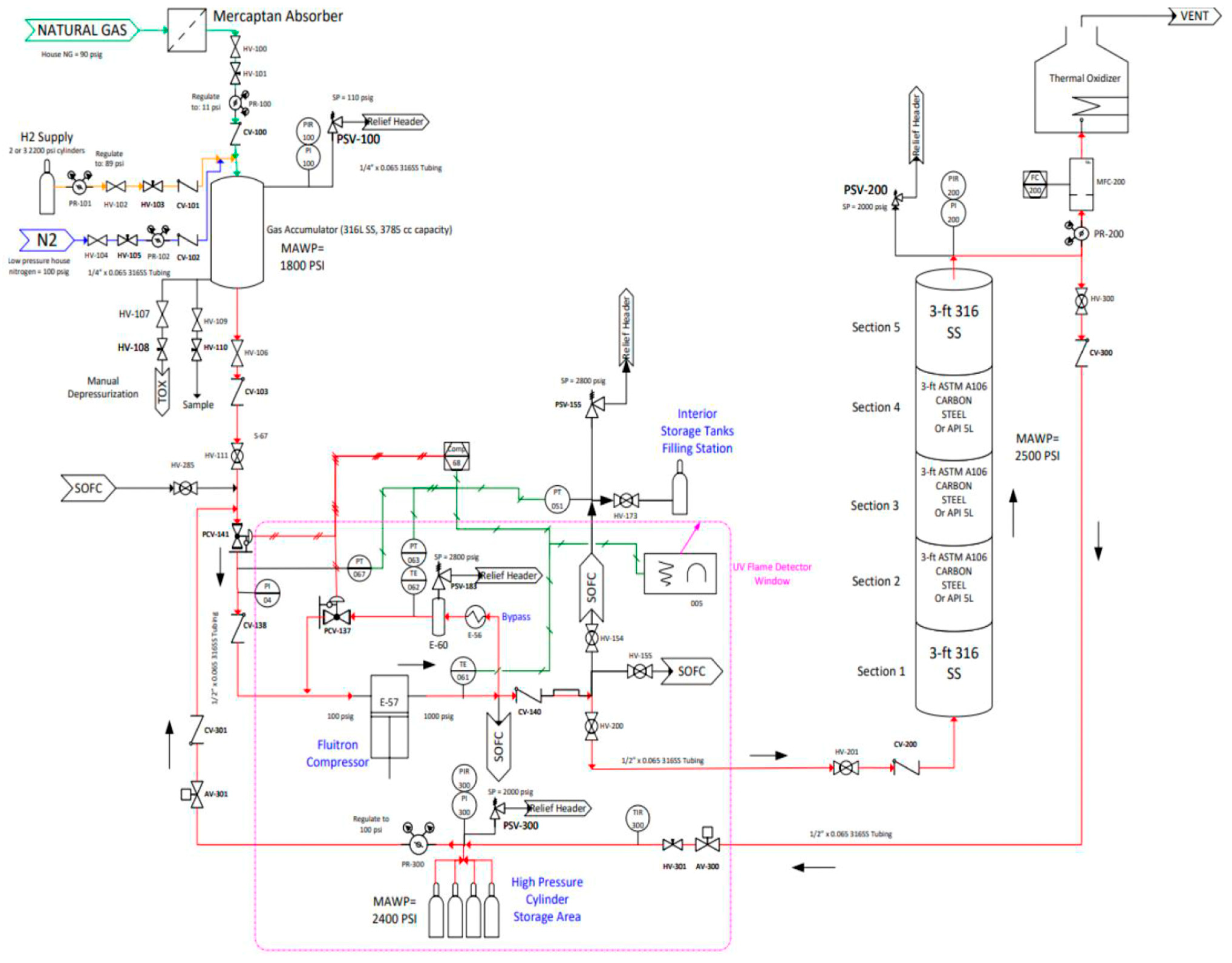
The near-real-world testbed shown in
Figure 17 through process and instrumentation diagrams (P&IDs) integrates gas supply and conditioning, pressure accumulation, compression, storage, five (3 ft long) segmented pipeline exposure sections, relief headers, nitrogen purging, and controlled discharge through a thermal oxidizer [
130]. The various groups of parameters for the proposed concept and their primary purpose are summarized in
Table 10. This configuration supports (i) repeatable pressure cycling representative of field operation; (ii) controlled exposure of base metal, weld regions, fittings, and internal coupons; and (iii) synchronized data acquisition (pressure, temperature, flow, strain, and anomalies) through embedded sensors, which can be used for the development of predictive tools. The presented design logic is aligned with ASME B31.12 [
1], which covers materials, welding, testing, inspection, operation, and maintenance requirements for hydrogen piping and pipelines.
The hierarchical validation approach should be adopted. First, CT specimens should be tested under the same hydrogen pressure, blend ratio, temperature, load ratio, and frequency used in the pipe segment. Second, equivalent crack-driving parameters should be computed for pipe-wall flaws using fracture-mechanics solutions. Third, the measured pipe-scale crack extension, leak response, acoustic-emission, strain redistribution, and pressure-decay behavior should be compared with CT specimen FCGR curves. The consistency between CT specimen da/dN and pipe-scale crack growth response can support model transferability. Through this approach, the testbed can be used to calibrate and validate Paris-law models, probabilistic fracture mechanics, ML surrogates, and risk-based inspection frameworks.
To ensure safety, hydrogen systems require engineered controls for leak detection, ventilation, flame detection, pressure relief, purging, and safe vent routing [
131,
132]. The mass flow controller (MFC) is installed on the discharge line to the thermal oxidizer (TOx) [
133]. During depressurization, the controller enables stepwise blowdown instead of uncontrolled venting, which reduces rapid pressure decay, excessive flow velocity, and unstable thermal loading at the oxidizer [
134].
The presented testing platform combined pressure cycling and internal coupon exposure to evaluate both system-level response and material degradation under field-relevant operational conditions. Coupon specimens were installed within the flow path to capture the response of representative pipeline materials, including base metal, weld metal, and HAZ, where applicable. The protocol should begin with predefined pressure cycles that reproduce field-relevant pressure fluctuations, surges, and depressurization events, followed by controlled introduction of hydrogen natural gas blends to simulate embrittlement, permeation, leakage, and other hydrogen-induced stress scenarios [
135]. During each test sequence, high-precision sensors, nondestructive evaluation tools, and wireless monitoring systems can continuously record pressure, temperature, flow response, strain, leak indication, and crack-related anomaly signals [
131,
136]. These synchronized data should then be analyzed to assess mechanical stability, sensor sensitivity, material behavior, and early degradation patterns, and the measured response should be compared with theoretical predictions and model outputs for
, remaining life, and integrity risk. This staged approach is consistent with the need to validate the hydrogen-assisted
behavior for defect-tolerant pipeline design, where crack growth, hydrogen pressure, loading history, and material condition jointly govern integrity. The procedure should also be reviewed with pipeline industry experts and hydrogen safety specialists to confirm operational relevance, refine test parameters, and ensure that purging, pressure relief, and venting practices remain consistent with established hydrogen system controls.
9. Research Gaps and Future Directions
Laboratory results for hydrogen-assisted FCGR must be validated against service-realistic data (pressure cycling, transients, gas quality). Recent guidance for hydrogen requalification explicitly calls for asset-specific evidence and material verification rather than generic assumptions. PHMSA is now funding studies on hydrogen blending in the existing pipeline network, also focusing on the impact of hydrogen on the composite/multilayered pipeline. PHMSA is also working to prioritize structured data-sharing with pipeline operators like pressure/flow histories, gas compositions, vintage records, mill certificates, weld procedures, and hydrogen test datasets to promote the use of the pipeline safety management systems.
Despite advancements in understanding the effects of hydrogen on materials, the precise mechanisms leading to HE, particularly in complex pipeline materials and welded joints, remain underexplored. Current studies offer insights into how hydrogen interacts with various materials, but the atomic-level processes and their influence on microstructural integrity are still not fully understood [
137,
138]. Future research should focus on using advanced characterization techniques, such as atom probe tomography and in situ testing, to examine hydrogen’s behavior at the grain boundary level and in various microstructures [
137]. Additionally, environmental factors like temperature and pressure must be incorporated into studies to assess their role in hydrogen-induced material degradation [
138].
Furthermore, atomistic-level MD simulation can help to identify the mechanisms and governing parameters behind HE [
30,
31]. It is pertinent to mention that MD simulations need thorough interpretation due to nano-scale domain features. Future work needs to couple MD-based parameters with experimentally validated hydrogen diffusion data, weld/HAZ characterization, and FCGR to support pipeline remaining-life assessment [
28]. Also, computational fluid dynamics-based numerical simulation can help to simulate and optimize the hydrogen blending percentage before injection into existing natural gas pipelines, which is necessary to avoid the hazardous consequences in the hydrogen supply chain before time [
139,
140].
Welds and the HAZ are known to be particularly susceptible to HE, yet their exact role in pipeline failure, especially under cyclic loading conditions, is not fully understood [
18]. Many studies have shown that welded joints are more vulnerable to hydrogen-induced damage than base materials [
18], but the contribution of these joints to pipeline failure under operational stresses is still unclear. The requalification should consider the welding technique, fillers, heat input control, interpass temperatures, preheat, and post-weld heat treatment to suppress cold cracking and hard microstructures in the HAZ. Also, the vintage pipelines exhibit variable toughness, hard spots, and incomplete mill certificates; requalification requires material sampling and verification before MAOP reconfirmation, and hydrogen service may warrant additional fracture/fatigue testing of seams and HAZs. Current API 1104 welding standards [
75] and fitness-for-service practices recognize preheat/temper-based deposition sequences as effective measures to reduce hydrogen cracking risk, yet these are rarely linked to hydrogen gas service in codes. Research is needed to translate welding controls into quantitative reductions in HA-FCGR and thresholds in hydrogen environments and to enhance the long-term durability of pipelines under service conditions.
Gaseous hydrogen accelerates
, with sensitivity to pressure, frequency, R-ratio, weld microstructure, and impurities. Codes for hydrogen pipelines and requalification provide prescriptive and performance-based methods, but still rely on conservative generalizations [
1,
9]. The FCGR data is incomplete, considering welds, realistic pressure-cycle spectra, and transients. Current models of fatigue do not fully account for the combined effects of hydrogen exposure and mechanical stresses, which can lead to premature failures. To address this, future work should focus on developing comprehensive fatigue models that incorporate hydrogen-induced degradation [
141]. Expanded FCGR datasets for API 5L PSL2 grades (base and welds) across hydrogen pressures (5–30 MPa) and weld conditions, together with validated crack growth models, are needed to refine option B assessments.
Hydrogen permeation through pipeline walls remains a significant concern for the integrity of hydrogen transport systems. Although coatings and inhibitors have been identified as promising solutions to reduce hydrogen permeation, their performance under real-world conditions, such as exposure to mechanical stress, high temperatures, and long-term hydrogen exposure, remains largely untested [
112,
113,
114]. Future research should explore and develop more effective materials, including advanced coatings and barrier layers, that can prevent hydrogen permeation while maintaining structural integrity [
98,
116].
Pipeline discontinuity like dents are a prominent form of mechanical damage which occurr during pipeline installation [
72]. Even the plain dent, without interaction with corrosion or welds, reduces the fatigue life of pipeline steel [
23,
142]. Corrosion, particularly when combined with hydrogen exposure, plays a significant role in the degradation of pipeline materials. However, research into the synergistic effects of corrosion and hydrogen on material properties is still limited. Additionally, the role of material defects such as porosity and microstructural irregularities in enhancing hydrogen-induced damage has not been fully explored [
143,
144]. The discontinuities from existing corrosion pits, weld toes, dents, and gouges can even accelerate crack initiation, which would eventually shift the onset of ΔKth before the paris-law region. More studies are needed to investigate how localized corrosion interacts with hydrogen embrittlement and accelerates crack initiation and propagation.
While significant progress has been made in nondestructive testing (NDT) and damage detection technologies, reliable, real-time monitoring tools to assess hydrogen-induced damage in pipelines are still lacking. Current techniques are limited in detecting early-stage hydrogen embrittlement and monitoring the health of pipelines under dynamic loading conditions [
145,
146]. Early-stage hydrogen-induced cracks are difficult to detect because they are often small, localized, and coupled with corrosion and material heterogeneity, which can complicate the interpretation of acoustic, ultrasonic, and electromagnetic signals [
147]. Future research should focus on developing sensors that can measure hydrogen diffusion, crack growth, and stress corrosion cracking in real time [
148].
One of the major challenges in studying the effects of hydrogen on pipeline materials is the lack of standardized testing protocols. ASME B31.12 is only for dedicated hydrogen pipelines and does not address the injection of gaseous hydrogen in the existing pipelines and even requires engineering judgment and additional application-specific testing to fully qualify new pipeline components for hydrogen service [
1]. Without universally accepted testing standards, comparing results from different studies is challenging, making it difficult to draw reliable conclusions about material behavior in hydrogen environments.
Most studies on hydrogen-induced damage focus on short-term exposure, electrochemical pre-charging, or controlled gaseous hydrogen tests, leaving a critical gap in knowledge regarding the long-term durability of pipeline materials under continuous hydrogen exposure. Operated natural gas pipeline steels might have greater HE susceptibility than comparable vintage steels [
149]. Understanding how materials degrade over time is essential for predicting the lifespan of hydrogen pipelines and ensuring the sustainability of hydrogen infrastructure [
150].
The ML literature has established a strong methodological basis for intelligent hydrogen-assisted fatigue assessment; however, it is insufficient for field-ready pipeline integrity management. Generalization of ML models under unseen pressure and loading conditions remains a central challenge [
29]. Similarly, a recent probabilistic approach, the hydrogen-assisted
model, showed the need to account for uncertainty in material grade and realistic pressure fluctuations [
151]. Furthermore, the developed models are dependent on laboratory-based CT specimen data, idealized loading conditions, and literature-compiled datasets with limited representation of welds (base metal and HAZ), realistic pressure histories, crack sizing uncertainty, and consequence modeling under operational uncertainty. Future research must therefore move beyond isolated model development toward integrated validation frameworks that can combine (i) base metal, weld metal, and HAZ testing under hydrogen blend conditions; (ii) standardized external validation under unseen operating conditions; (iii) transparent uncertainty propagation into remaining life assessment of pipelines; (iv) data-driven Bayesian models for variable interdependence; and (v) ML-based consequence categorization for risk-informed inspection. The next phase should validate the developed framework on a near-real-world hydrogen pipeline steel testbed with controlled hydrogen blending, realistic pressure cycling, continuous crack monitoring, and synchronized data acquisition.
Existing risk assessment models for hydrogen pipelines often fail to account for the complex interactions between hydrogen, material properties, environmental conditions, and mechanical stresses [
125]. There is a need for deployable monitoring that links hydrogen exposure to integrity metrics: pressure-cycle counting and weld-zone crack growth indicators integrated into “digital twins” for hydrogen service. PHMSA is working to develop AI-powered risk assessment, mitigation, and decision support tools incorporating the fatigue/fracture of welds in high-pressure hydrogen.