
3D-CFD Analysis of Direct Hydrogen Feed-In into Natural Gas Pipelines

 , ,
, ,  ,
,
Abstract
1. Introduction
2. Methodology
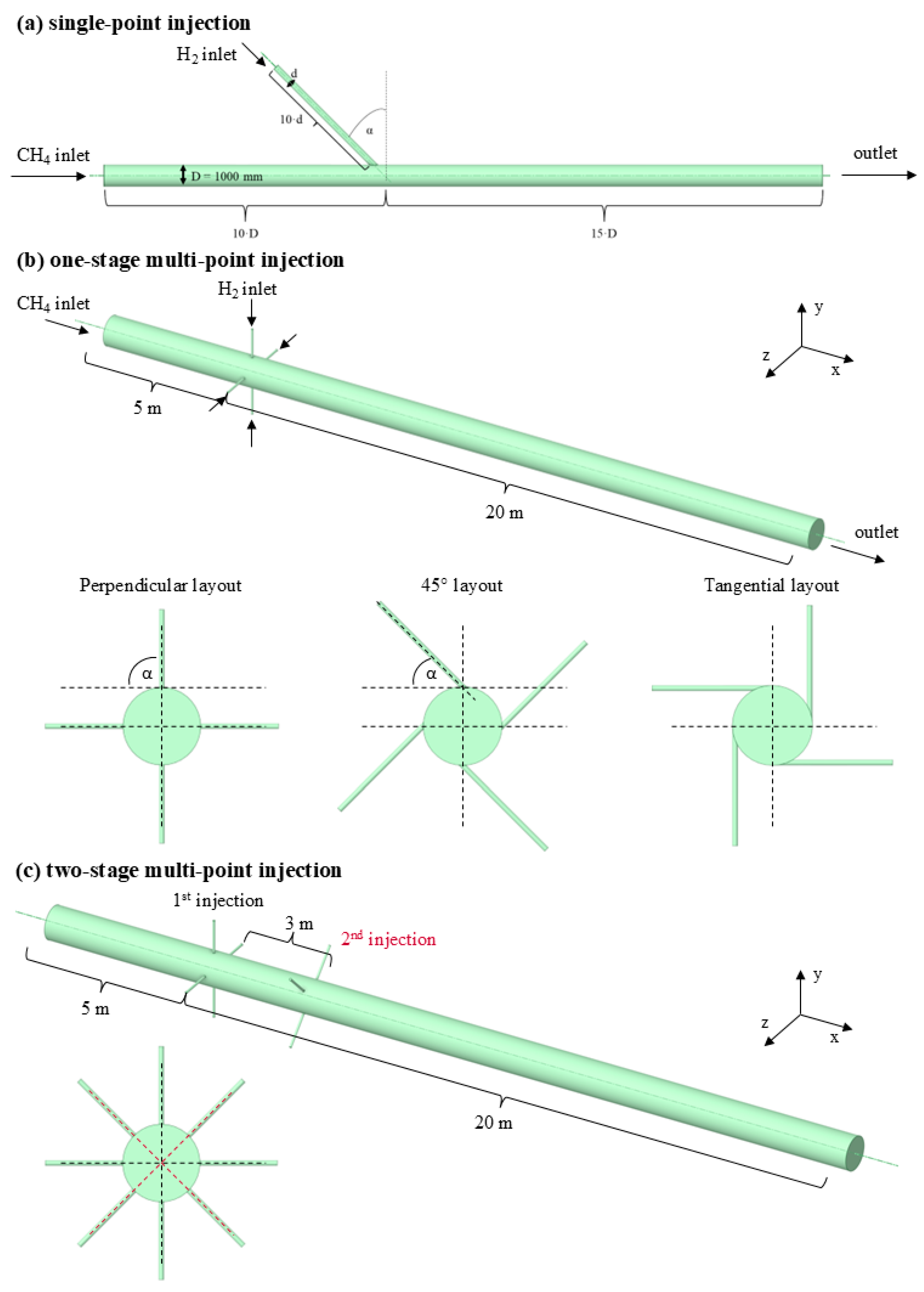
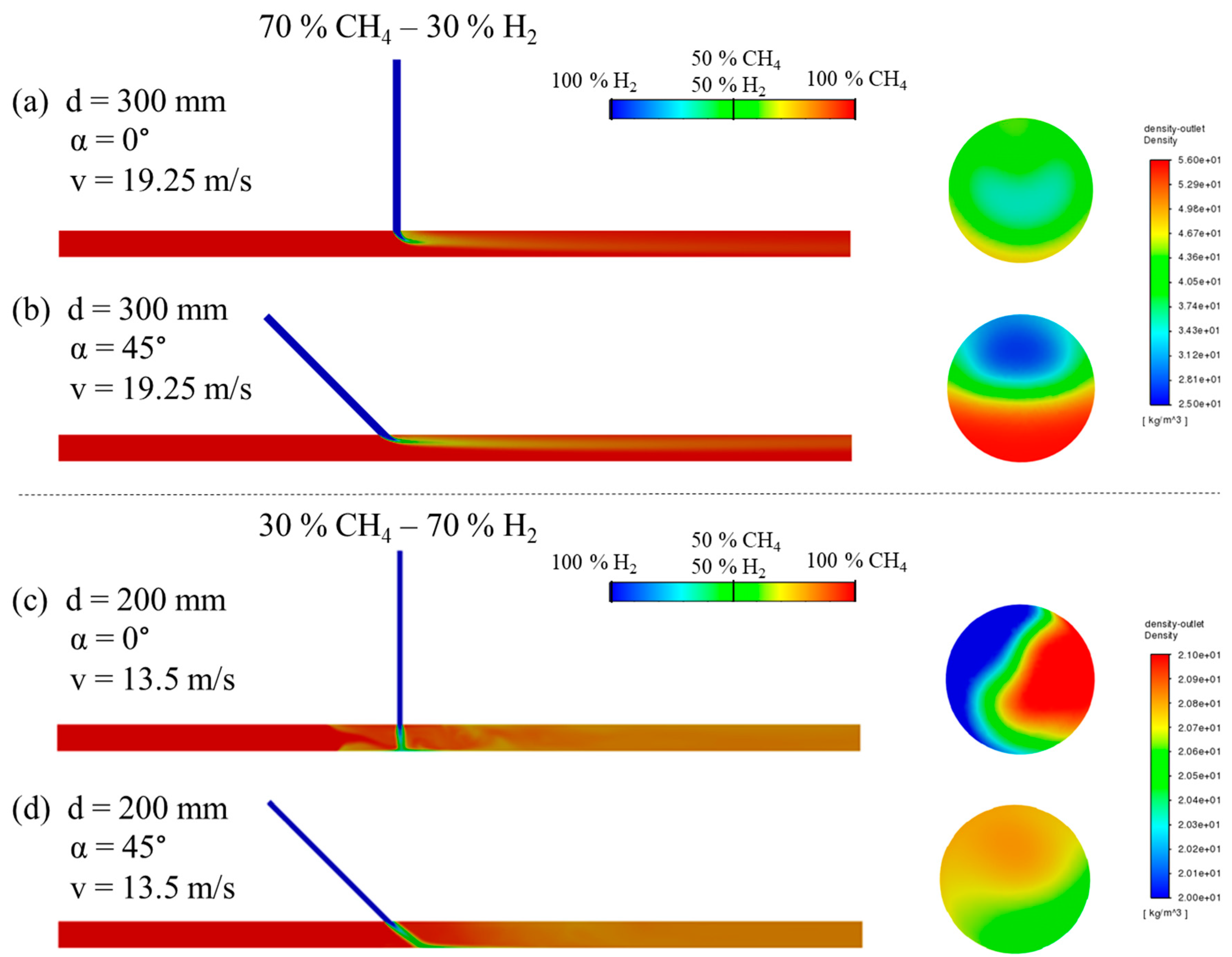
- In the first scenario focusing on grid level 1, a simple geometrical model consisting of a topside T-junction with two pipes, namely the main pipeline and the hydrogen injection pipeline, was prepared. The aim of this model was to investigate the effects of geometrical parameters (injection angle and diameter) and operational parameters (natural gas velocity and target hydrogen volume fractions of mixture) on mixing quality. Furthermore, a simple topside injection would potentially represent the best case for blending from a construction standpoint; thus, this configuration was chosen as the starting point of the investigations. A design of experiments (DoE) approach, which will be described in the subsequent sections, was used for the parameter study in the first scenario.
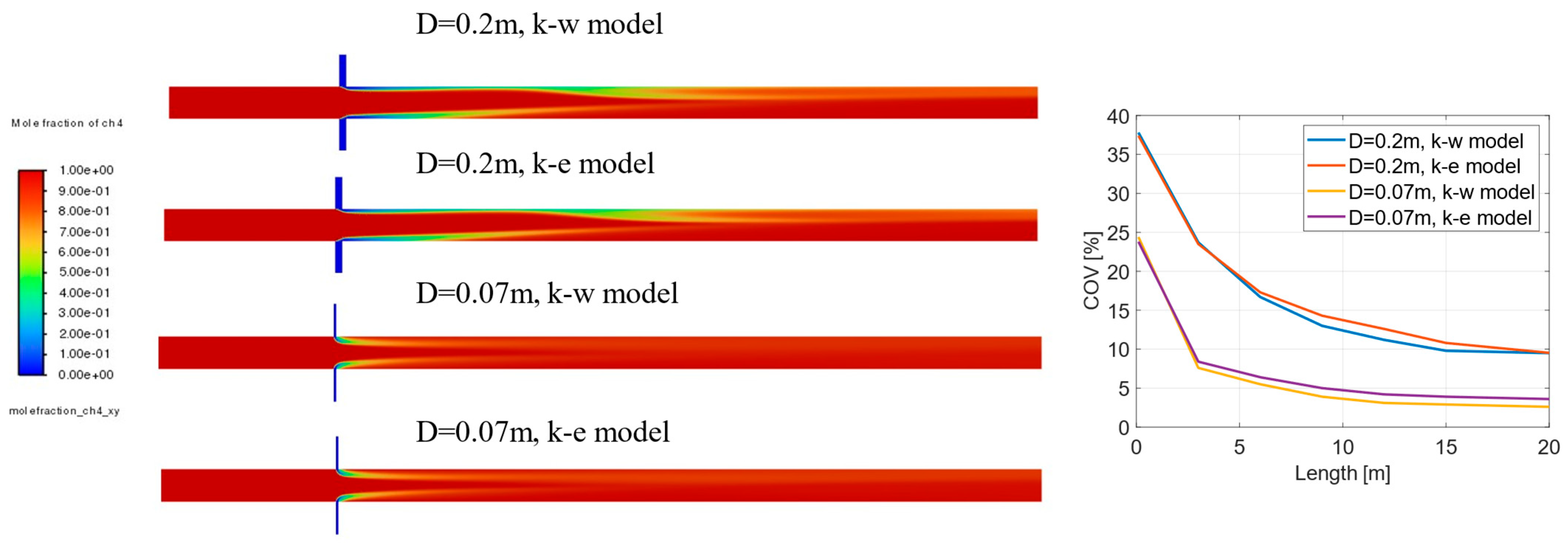
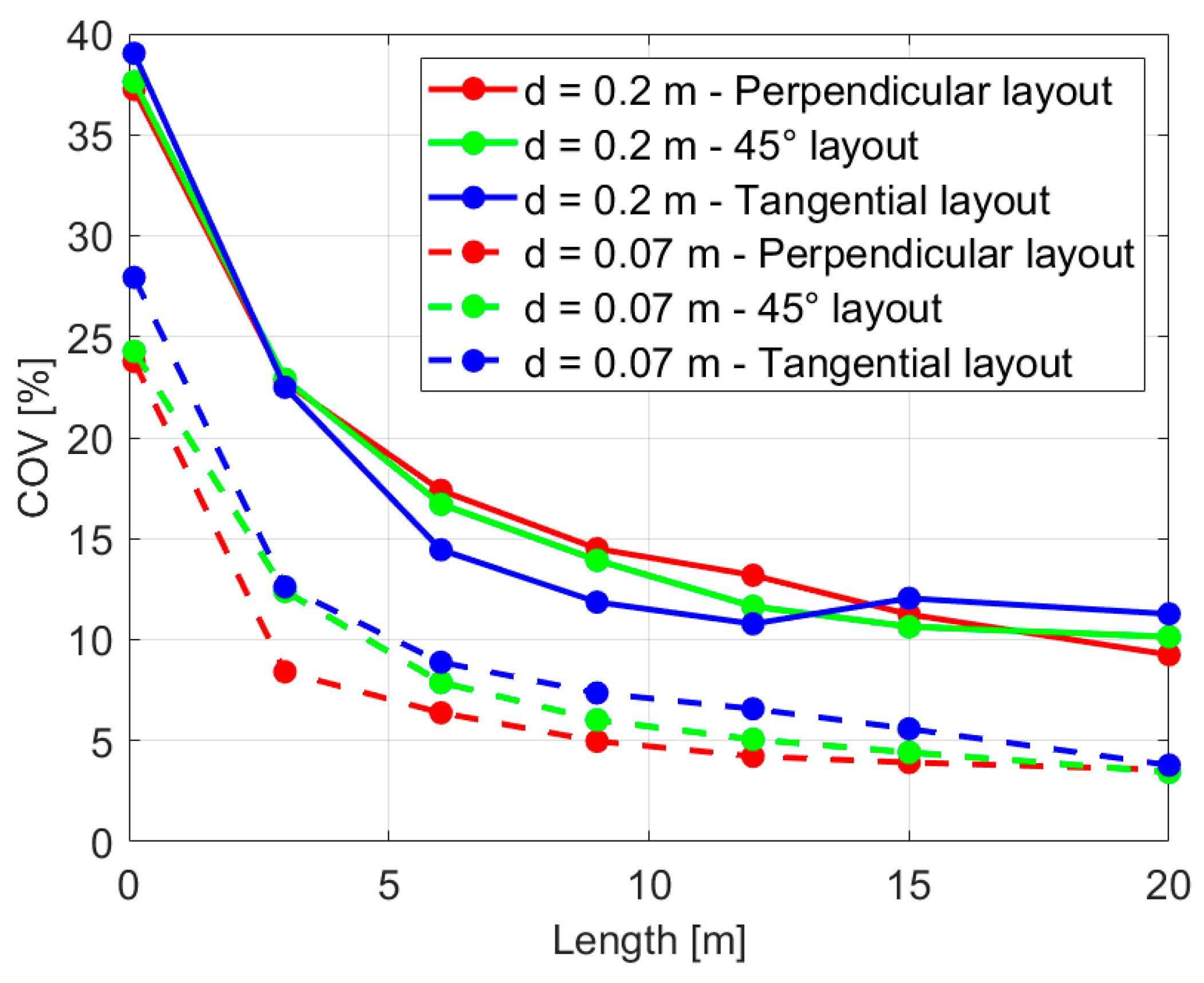
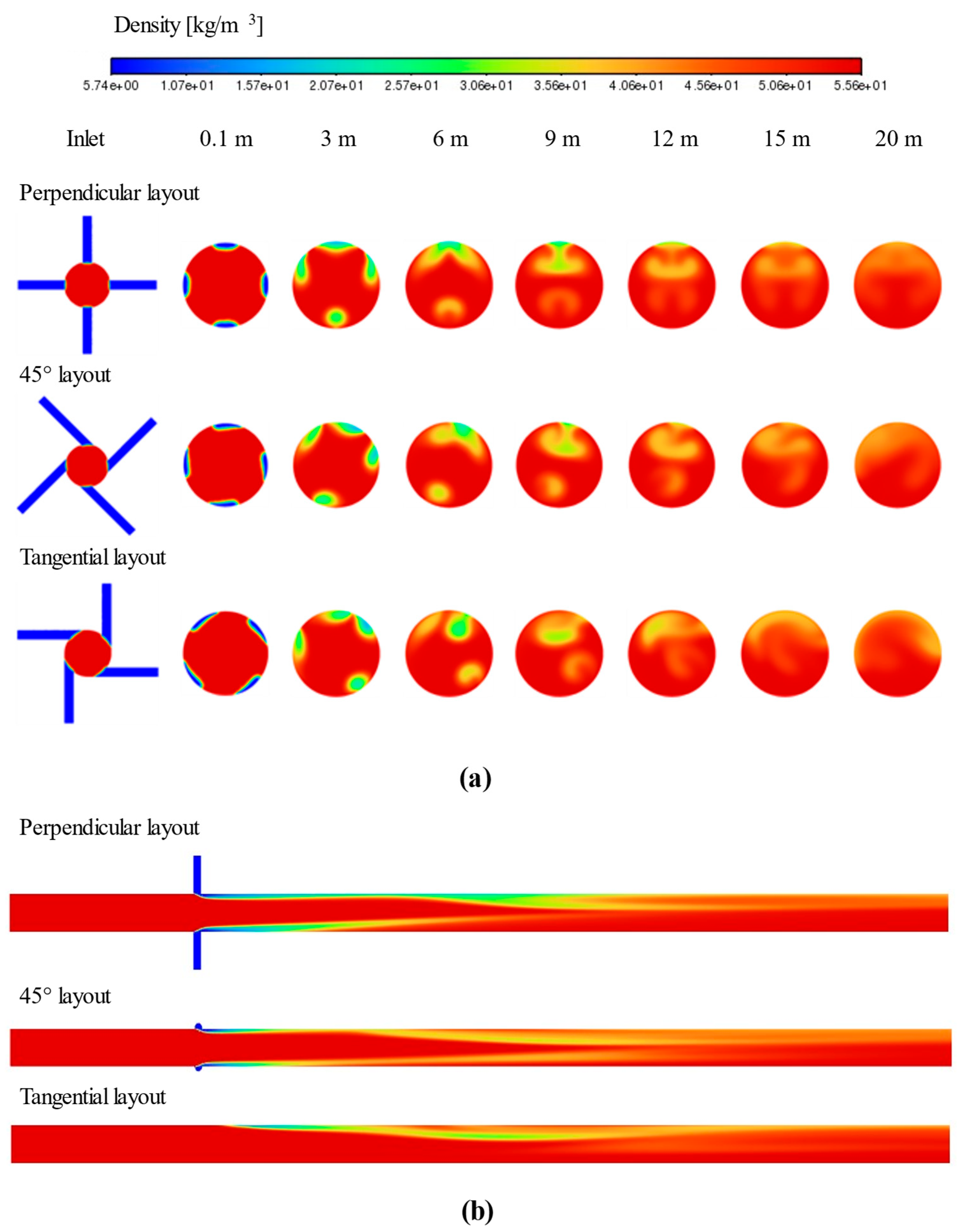
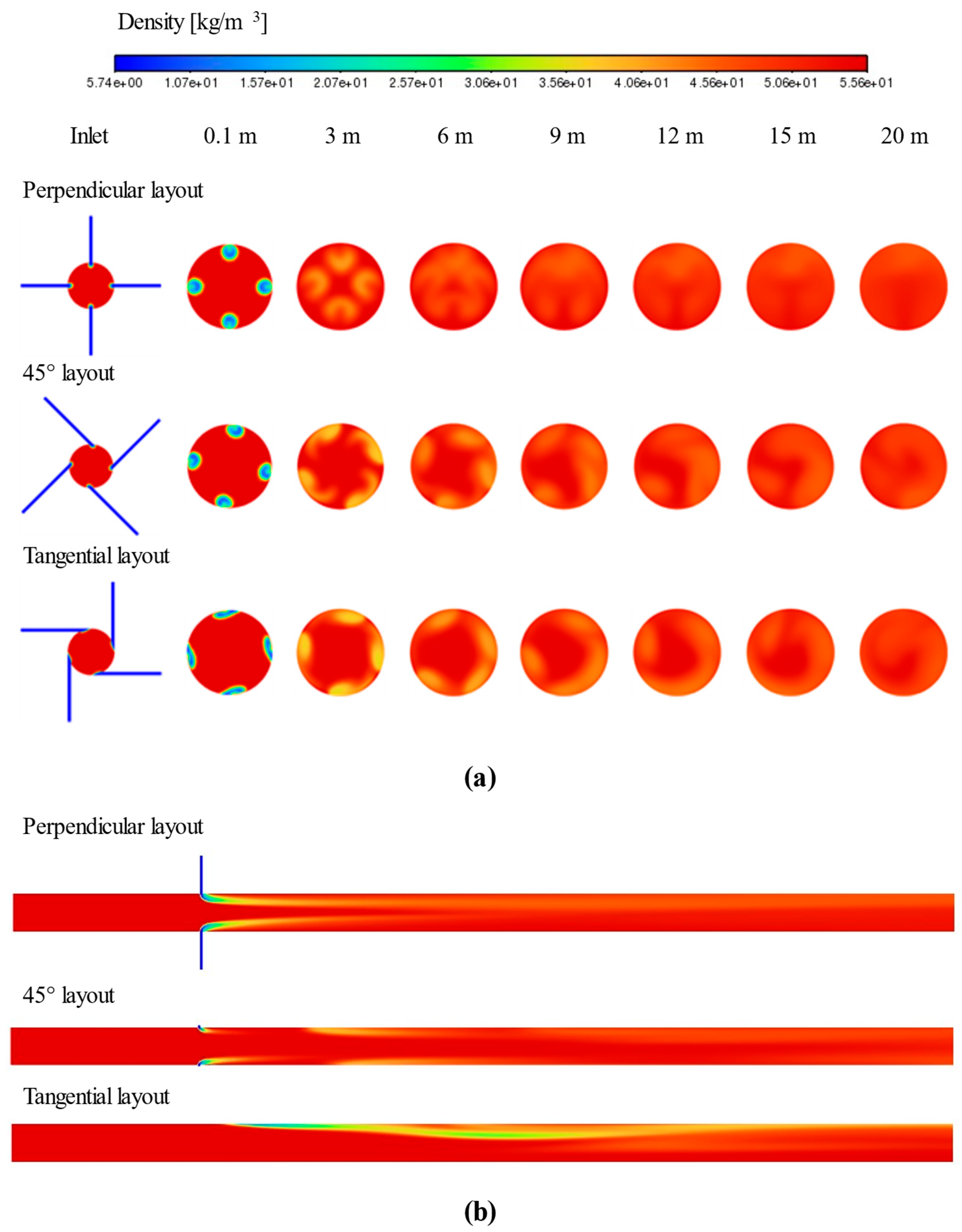
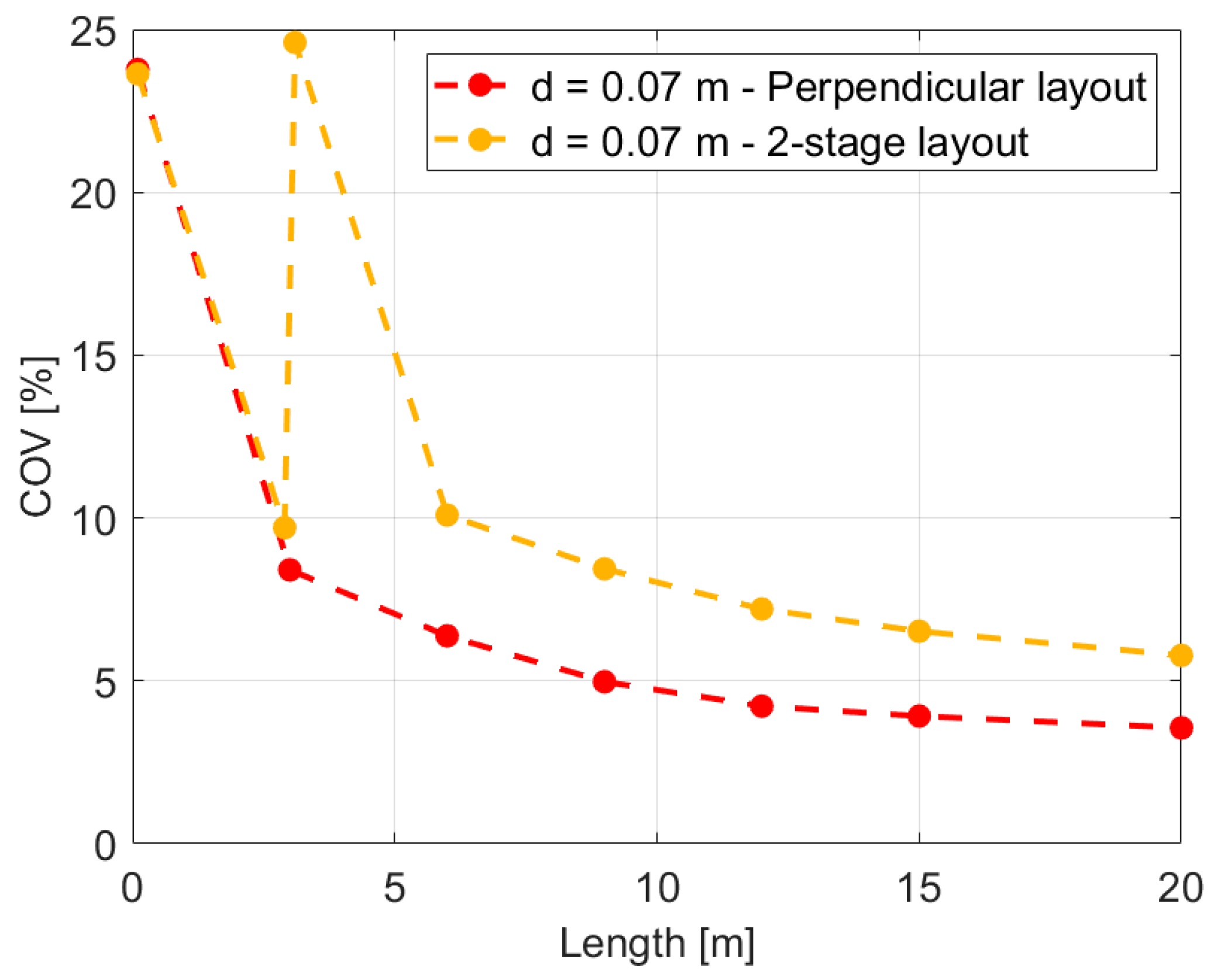
- Based on the results of the first scenario, it was decided to investigate multi-point injection in more detail in the second scenario. Since current pipeline regulations in Austria and Germany limit the hydrogen content to 10 vol%, we focused on this limiting scenario only in the second scenario. Different geometrical layouts and hydrogen pipe diameters were compared to assess their impact on the mixing process. The aim was to identify suitable geometries leading to good mixing behavior of the gases.
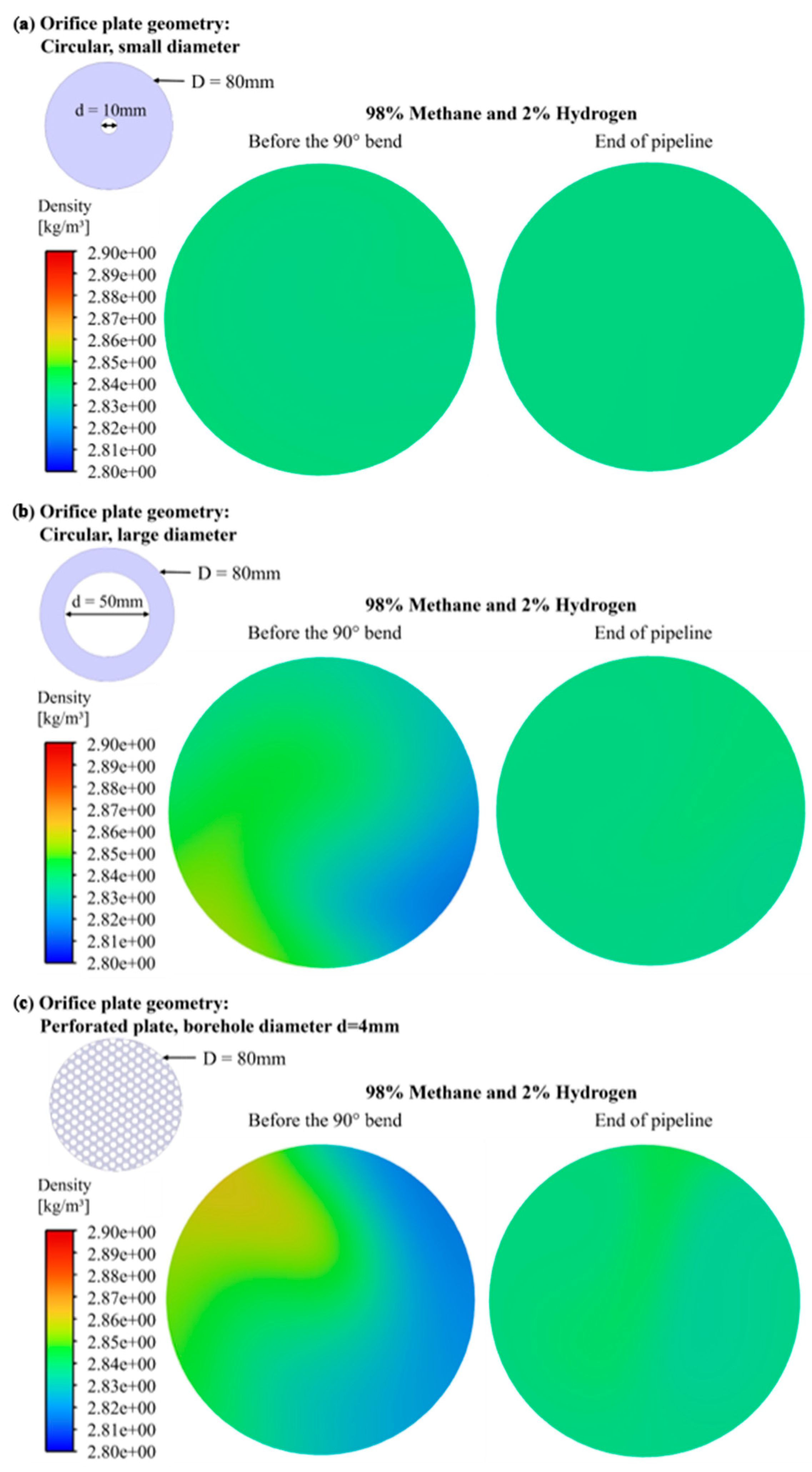
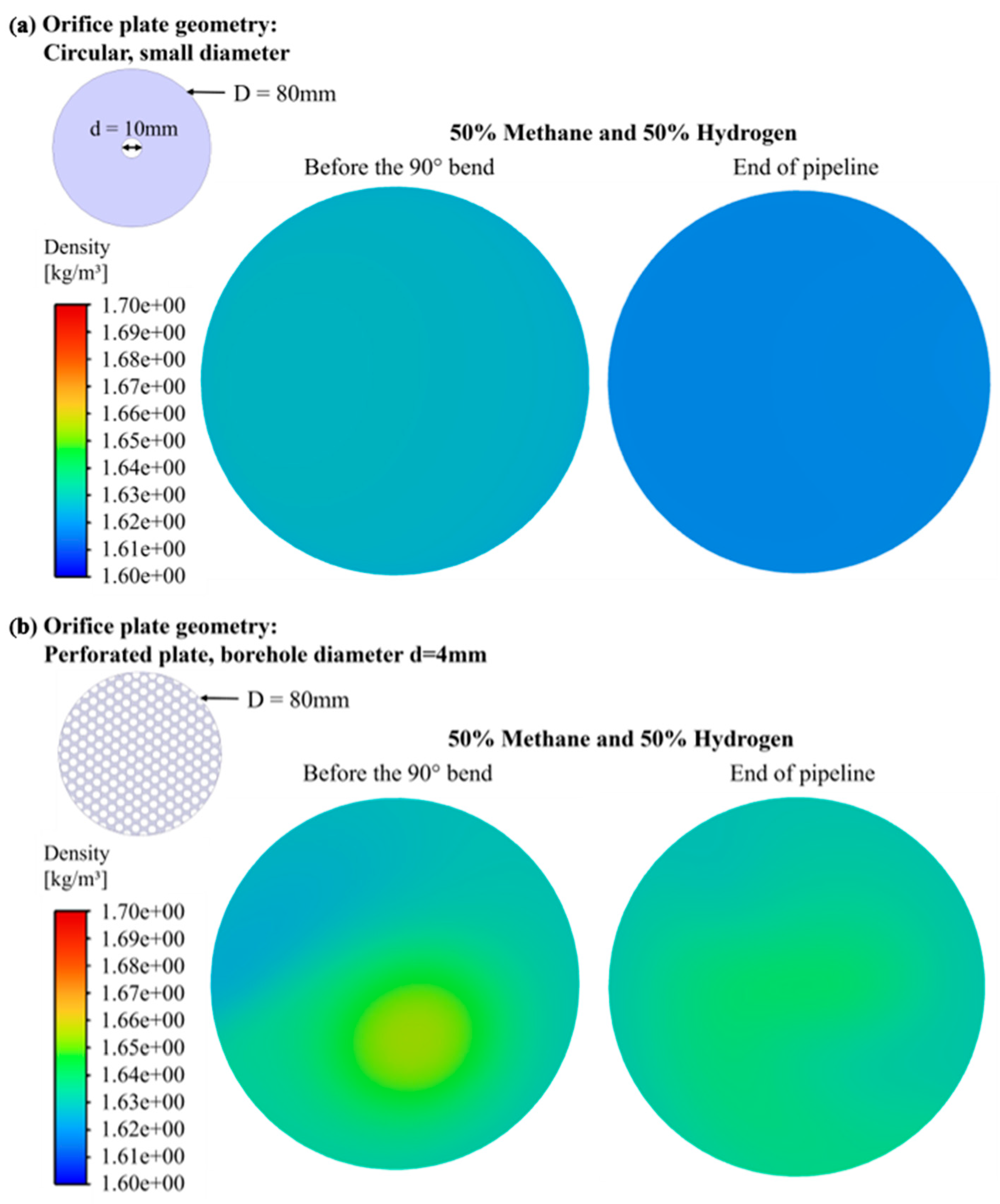
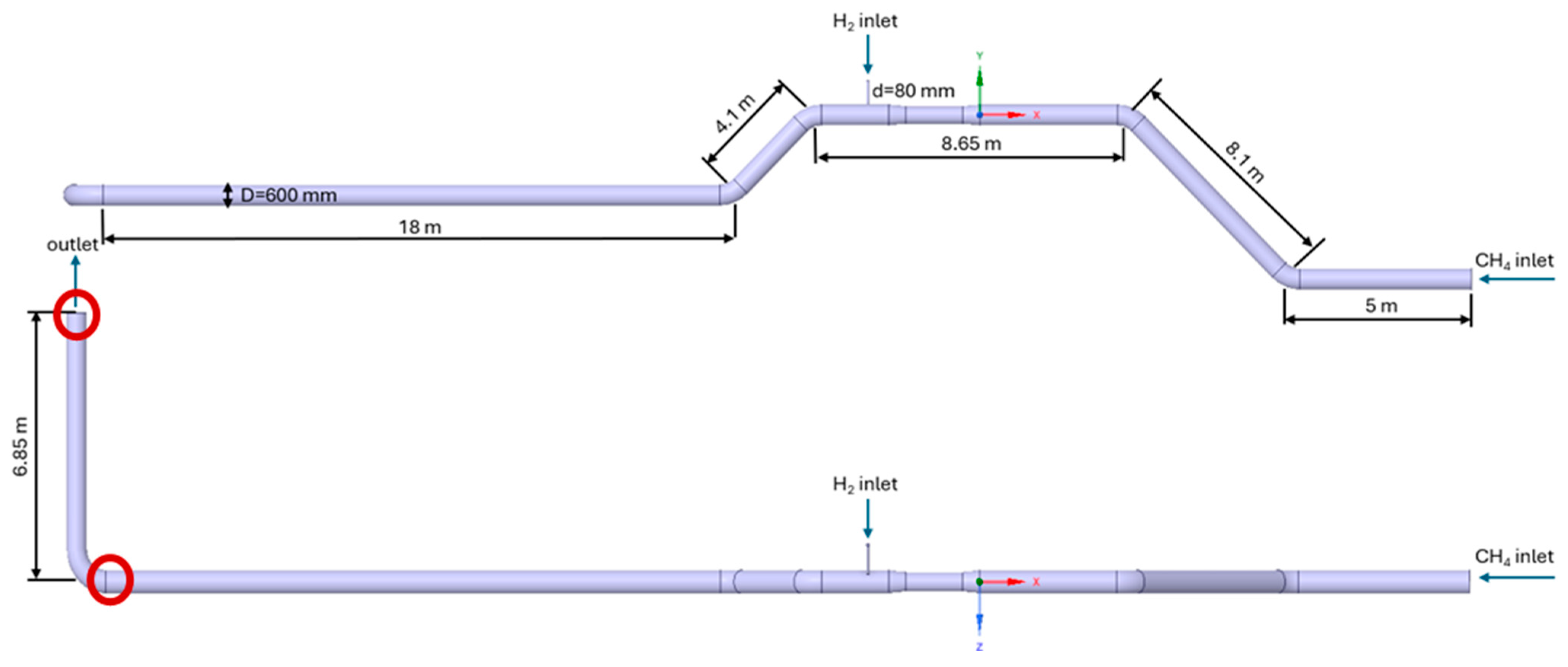
- In the third scenario, different orifice geometries and their effect on blending were examined for a real-life application within the national distribution network (grid level 3) in Austria. Furthermore, the effects of bends in the pipeline on the mixing quality due to secondary mixing effects was examined. The simulations were done at grid level 3 for a DN600 pipeline with single-point injection and an operating pressure of 4.2 bar.
2.1. Mathematical Model
- Continuity:
- Momentum:
- Energy:
- Turbulence:
- ○
- Turbulent kinetic energy:
- ○
- Turbulent dissipation rate:
- Species transport:
2.2. Physical Model
2.3. Mixing Uniformity
2.4. Mesh and Grid Independence
2.5. Boundary Conditions and Solver Settings
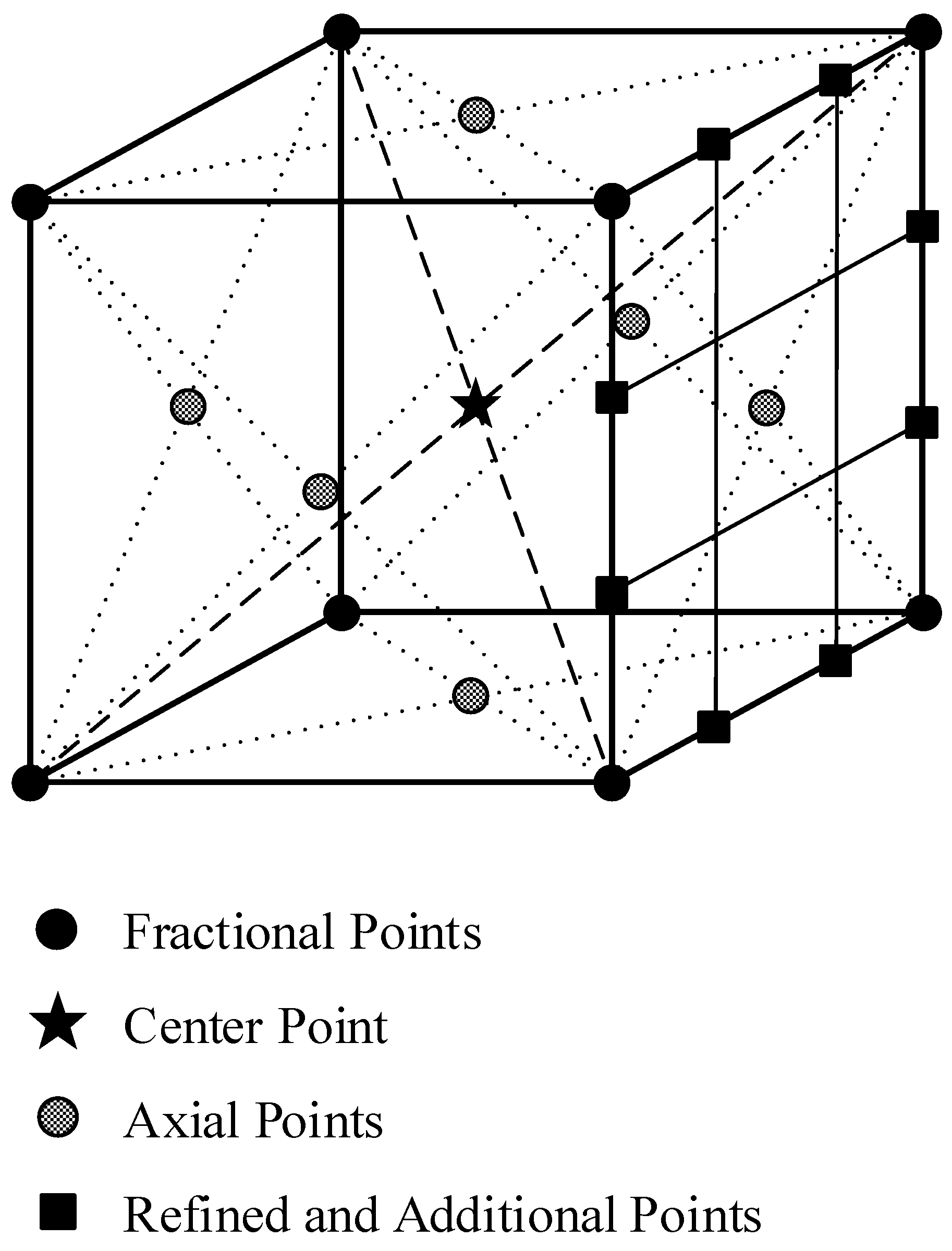
2.6. Design of Experiments for Scenario 1
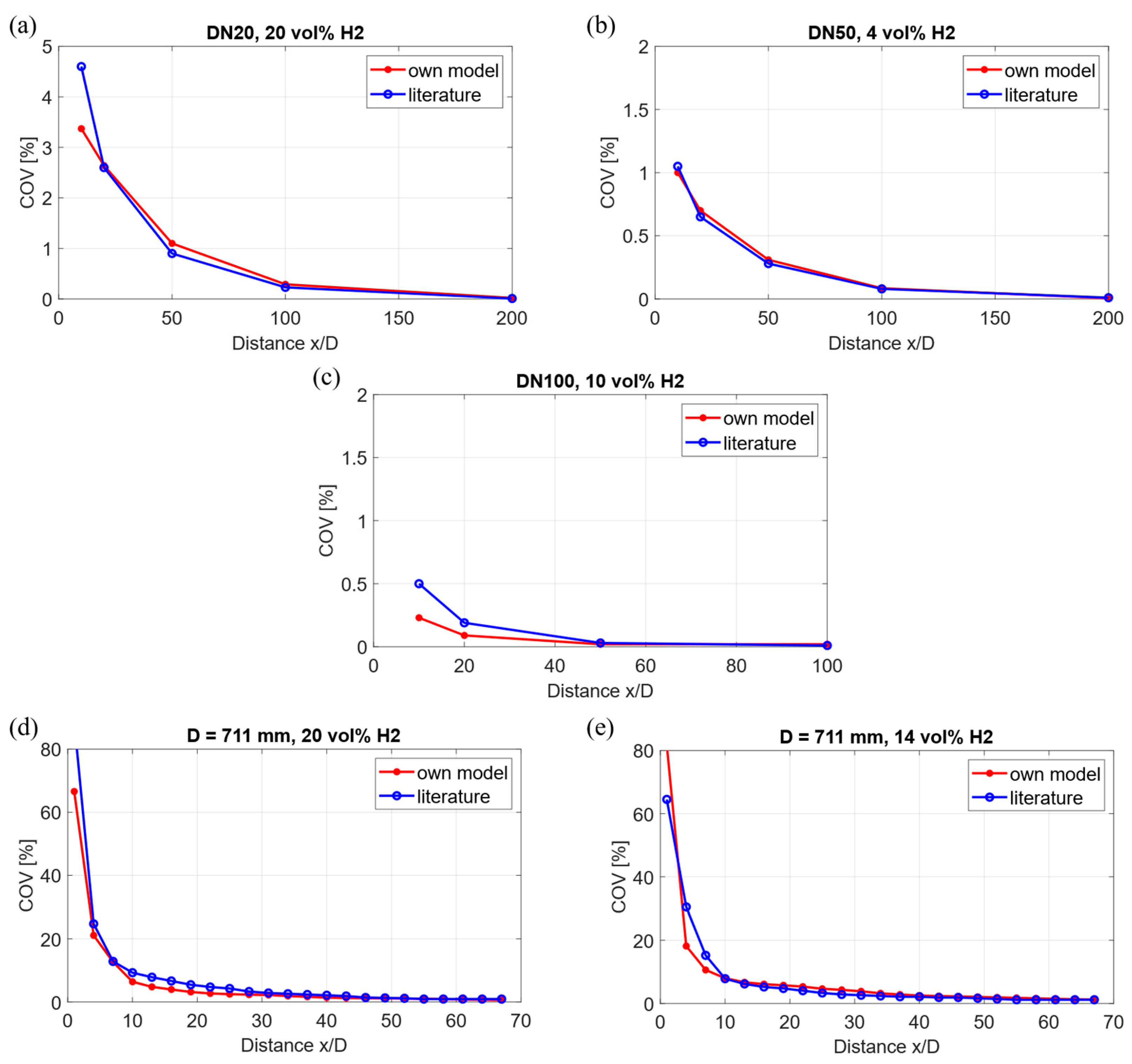
2.7. Model Validation
3. Results and Discussion
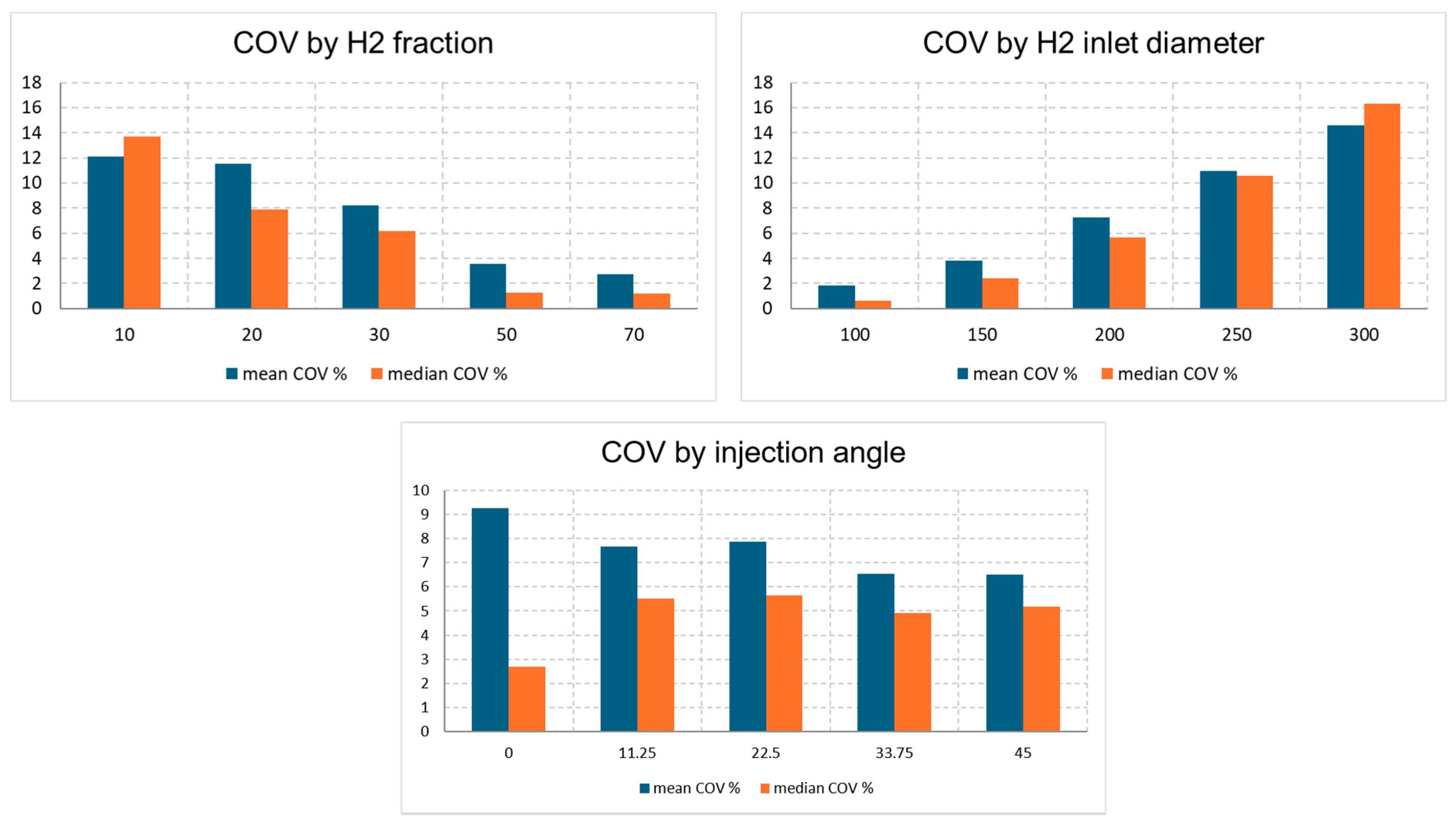
3.1. Scenario 1: Investigation of Single-Point Injection
3.2. Scenario 2: Investigation of Multi-Point Injection
3.3. Scenario 3: Real-Life Application of Hydrogen Blending Station with Single-Point Injection at Grid Level 3
4. Conclusions
Author Contributions
Funding
Data Availability Statement
Acknowledgments
Conflicts of Interest
Abbreviations
| 3D | Three-dimensional |
| CFD | Computational fluid dynamics |
| COV | Coefficient of variation |
| DoE | Design of experiments |
| NG | Natural gas |
References
- Trattner, A.; Klell, M.; Radner, F. Sustainable hydrogen society—Vision, findings and development of a hydrogen economy using the example of Austria. Int. J. Hydrogen Energy 2022, 47, 2059–2079. [Google Scholar]
- European Hydrogen Backbone. Five Hydrogen Supply Corridors for Europe in 2030. 2022. Available online: https://ehb.eu/files/downloads/EHB-Supply-corridor-presentation-Full-version.pdf (accessed on 24 October 2022).
- Tezel, G.; Robert, H. HyWay 27: Hydrogen Transmission Using the Existing Natural Gas Grid? Final Report for the Ministry of Economic Affairs and Climate Policy. 2021. Available online: https://www.entsog.eu/sites/default/files/2021-11/1.2.%20HyWay27%20Final%20report%20%28UK%29.pdf (accessed on 15 December 2021).
- International Renewable Energy Agency (IRENA). Geopolitics of the Energy Transformation: The Hydrogen Factor; IRENA: Abu Dhabi, United Arab Emirates, 2022; Available online: https://www.irena.org/-/media/Files/IRENA/Agency/Publication/2022/Jan/IRENA_Geopolitics_Hydrogen_2022.pdf (accessed on 9 June 2023).
- Ortiz Cebolla, R.; Dolci, F.; Weidner, E. Assessment of Hydrogen Delivery Options: Feasibility of Transport of Green Hydrogen Within Europe; Publications Office of the European Union: Luxembourg, 2022. [Google Scholar]
- European Commission. Hydrogen Generation in Europe: Overview of Costs and Key Benefits; Publications Office of the European Union: Luxembourg, 2020; Available online: https://op.europa.eu/en/publication-detail/-/publication/7e4afa7d-d077-11ea-adf7-01aa75ed71a1 (accessed on 10 February 2022).
- van Rossum, R.; Jens, J.; La Guardia, G.; Wang, A.; Kühnen, L.; Overgaag, M. European Hydrogen Backbone: A European Hydrogen Infrastructure Vision Covering 28 Countries. 2022. Available online: https://ehb.eu/files/downloads/ehb-report-220428-17h00-interactive-1.pdf (accessed on 5 April 2022).
- Wang, A.; van der Leun, K.; Peters, D.; Buseman, M. European Hydrogen Backbone: How Dedicated Hydrogen Infrastructure Can Be Created. 2021. Available online: https://ehb.eu/files/downloads/2020_European-Hydrogen-Backbone_Report.pdf (accessed on 9 November 2021).
- Jansma, S.; Rekers, D. D1C.3 The Influence of the Existing Natural Gas Distribution Networks on the Purity of Hydrogen; Zenodo: Geneva, Switzerland, 2022. [Google Scholar]
- Steiner, M.; Marewski, U.; Silcher, H. DVGW-Projekt SyWeSt H2: Stichprobenhafte Überprüfung von Stahlwerkstoffen für Gasleitungen und Anlagen zur Bewertung auf Wasserstofftauglichkeit; DVGW: Bonn, Germany, 2023. [Google Scholar]
- Fink, S. Untersuchung zur Wasserstoffversprödung von Gasrohrleitungen. Diploma Thesis, Technische Universität Graz, Graz, Austria, 2021. [Google Scholar]
- Drexler, A.; Helic, B.; Silvayeh, Z.; Mraczek, K.; Sommitsch, C.; Domitner, J. The role of hydrogen diffusion, trapping and desorption in dual phase steels. J. Mater. Sci. 2022, 57, 4789–4805. [Google Scholar] [CrossRef]
- Drexler, A.; Konert, F.; Sobol, O.; Rhode, M.; Domitner, J.; Sommitsch, C.; Böllinghaus, T. Enhanced gaseous hydrogen solubility in ferritic and martensitic steels at low temperatures. Int. J. Hydrogen Energy 2022, 47, 39639–39653. [Google Scholar] [CrossRef]
- Drexler, A.; Vandewalle, L.; Depover, T.; Verbeken, K.; Domitner, J. Critical verification of the Kissinger theory to evaluate thermal desorption spectra. Int. J. Hydrogen Energy 2021, 46, 39590–39606. [Google Scholar] [CrossRef]
- Mohtadi-Bonab, M.A. Effect of different parameters on hydrogen affected fatigue failure in pipeline steels. Eng. Fail. Anal. 2022, 137, 106262. [Google Scholar] [CrossRef]
- Laureys, A.; Depraetere, R.; Cauwels, M.; Depover, T.; Hertelé, S.; Verbeken, K. Use of existing steel pipeline infrastructure for gaseous hydrogen storage and transport: A review of factors affecting hydrogen induced degradation. J. Nat. Gas Sci. Eng. 2022, 101, 104534. [Google Scholar] [CrossRef]
- Jia, G.; Lei, M.; Li, M.; Xu, W.; Li, R.; Lu, Y.; Cai, M. Hydrogen embrittlement in hydrogen-blended natural gas transportation systems: A review. Int. J. Hydrogen Energy 2023, 48, 32137–32157. [Google Scholar] [CrossRef]
- Ronevich, J.; Shrestha, R.; San Marchi, C. Misconceptions of hydrogen degradation of pipeline steels in existing natural gas infrastructure. In Proceedings of the Fourth International Conference on Metals & Hydrogen, Ghent, Belgium, 11–13 October 2022. [Google Scholar]
- Klopčič, N.; Stöhr, T.; Grimmer, I.; Sartory, M.; Trattner, A. Refurbishment of natural gas pipelines towards 100% hydrogen—A thermodynamic-based analysis. Energies 2022, 15, 9370. [Google Scholar]
- Sodwatana, M.; Kazi, S.R.; Sundar, K.; Zlotnik, A. Optimization of hydrogen blending in natural gas networks for carbon emissions reduction. In Proceedings of the 2023 American Control Conference (ACC), San Diego, CA, USA, 31 May–2 June 2023; IEEE: Piscataway, NJ, USA, 2023; pp. 1229–1236. [Google Scholar]
- Tsiklios, C.; Hermesmann, M.; Müller, T.E. Hydrogen transport in large-scale transmission pipeline networks: Thermodynamic and environmental assessment of repurposed and new pipeline configurations. Appl. Energy 2022, 327, 120097. [Google Scholar] [CrossRef]
- Tan, K.; Mahajan, D.; Venkatesh, T.A. Computational fluid dynamic modeling of methane-hydrogen mixture transportation in pipelines: Understanding the effects of pipe roughness, pipe diameter and pipe bends. Int. J. Hydrogen Energy 2024, 49D, 1028–1042. [Google Scholar]
- Peet, Y.; Sagaut, P.; Charron, Y. Pressure loss reduction in hydrogen pipelines by surface restructuring. Int. J. Hydrogen Energy 2009, 34, 8964–8973. [Google Scholar] [CrossRef]
- Zhang, C.; Li, Z.; Li, C.; Wu, X.; Sun, L.; Chen, C. Insight into the effects of hydrogen on inside-valve flow and Joule-Thomson characteristics of hydrogen-blended natural gas: A numerical study. Int. J. Hydrogen Energy 2024, 49D, 1056–1074. [Google Scholar] [CrossRef]
- Wang, C.; Zhou, D.; Xiao, W.; Shui, C.; Ma, T.; Chen, P.; Hao, J.; Yan, J. Research on the dynamic characteristics of natural gas pipeline network with hydrogen injection considering line-pack influence. Int. J. Hydrogen Energy 2023, 48, 25469–25486. [Google Scholar] [CrossRef]
- André, J.; Auray, S.; Brac, J.; De Wolf, D.; Maisonnier, G.; Ould-Sidi, M.M.; Simonnet, A. Design and dimensioning of hydrogen transmission pipeline networks. Eur. J. Oper. Res. 2013, 229, 239–251. [Google Scholar] [CrossRef]
- Lee, H.; Lee, S. Economic analysis on hydrogen pipeline infrastructure establishment scenarios: Case study of South Korea. Energies 2022, 15, 6824. [Google Scholar] [CrossRef]
- Galyas, A.B.; Kis, L.; Tihanyi, L.; Szunyog, I.; Vadaszi, M.; Koncz, A. Effect of hydrogen blending on the energy capacity of natural gas transmission networks. Int. J. Hydrogen Energy 2023, 48, 14795–14807. [Google Scholar] [CrossRef]
- Lipiäinen, S.; Lipiäinen, K.; Ahola, A.; Vakkilainen, E. Use of existing gas infrastructure in European hydrogen economy. Int. J. Hydrogen Energy 2023, 48, 31317–31329. [Google Scholar] [CrossRef]
- Prinzhofer, A.; Cacas-Stentz, M.C. Natural hydrogen and blend gas: A dynamic model of accumulation. Int. J. Hydrogen Energy 2023, 48, 21610–21623. [Google Scholar] [CrossRef]
- Bellocchi, S.; De Falco, M.; Facchino, M.; Manno, M. Hydrogen blending in Italian natural gas grid: Scenario analysis and LCA. J. Clean. Prod. 2023, 416, 137809. [Google Scholar] [CrossRef]
- Kazi, S.R.; Sundar, K.; Zlotnik, A. Dynamic Optimization and Optimal Control of Hydrogen Blending Operations in Natural Gas Networks. In 2024 American Control Conference (ACC); IEEE: Piscataway, NJ, USA, 2024. [Google Scholar]
- Zhang, C.; Shao, Y.; Shen, W.; Li, H.; Nan, Z.; Dong, M.; Bian, J.; Cao, X. Key technologies of pure hydrogen and hydrogen-mixed natural gas pipeline transportation. ACS Omega 2023, 8, 19212–19222. [Google Scholar] [CrossRef] [PubMed]
- Ekhtiari, A.; Flynn, D.; Syron, E. Investigation of the multi-point injection of green hydrogen from curtailed renewable power into a gas network. Energies 2020, 13, 6047. [Google Scholar] [CrossRef]
- Li, J.; Song, F.; Zhang, X. A review on hazards and risks to pipeline operation under transporting hydrogen energy and hydrogen-mixed natural gas. Sci. Tech. Energ. Transit. 2024, 79, 9. [Google Scholar] [CrossRef]
- Ouyang, B.; Sun, D.; Yu, Y.; Hu, Z.; Wu, M. Simulation and analysis of leakage characteristics in hydrogen-blended natural gas pipelines. Int. J. Hydrogen Energy 2025, 99, 888–897. [Google Scholar] [CrossRef]
- Cristello, J.; Dang, Z.; Hugo, R.; Park, S.S. Artificial intelligence based leak detection in blended hydrogen and natural gas pipelines. Int. J. Hydrogen Energy 2024, 91, 744–764. [Google Scholar] [CrossRef]
- Sánchez-Laínez, J.; Cerezo, A.; Storch de Gracia, M.D.; Aragón, J.; Fernandez, E.; Madina, V.; Gil, V. Enabling the injection of hydrogen in high-pressure gas grids: Investigation of the impact on materials and equipment. Int. J. Hydrogen Energy 2024, 52, 1007–1018. [Google Scholar]
- Qin, G.; Li, R.; Wang, B.; Wang, Y.; Cheng, Y.F. Enhancing hydrogen pipeline safety: Perspectives on resilience against hydrogen-induced degradation. J. Pipeline Sci. Eng. 2025, 6, 100314. [Google Scholar]
- Sánchez, M.; Marinova, N.; Silveira, E.; Larrosa, N. Standards and codes for hydrogen in pipeline infrastructure: Testing, qualification, and integrity assessment. J. Pipeline Sci. Eng. 2025, 5, 100296. [Google Scholar] [CrossRef]
- Stöhr, T.; Reiter, V.; Scheikl, S.; Klopčič, N.; Brandstätter, S.; Trattner, A. Hydrogen quality in used natural gas pipelines: An experimental investigation of contaminants according to ISO 14687:2019 standard. Int. J. Hydrogen Energy 2024, 67, 1136–1147. [Google Scholar] [CrossRef]
- Roland Berger. Development of Business Cases for Fuel Cells and Hydrogen Applications for Regions and Cities: Hydrogen Injection into the Natural Gas Grid; Fuel Cells and Hydrogen Joint Undertaking: Brussels, Belgium, 2017. [Google Scholar]
- Eames, I.; Austin, M.; Wojcik, A. Injection of gaseous hydrogen into a natural gas pipeline. Int. J. Hydrogen Energy 2022, 47, 25745–25754. [Google Scholar] [CrossRef]
- Hadi Sichani, P.; Zonta, F.; Soldati, A. Analyse des Mischens und Entmischens von Wasserstoff in Erdgasleitungen; TU Wien: Vienna, Austria, 2021. [Google Scholar]
- Kong, M.; Feng, S.; Xia, Q.; Chen, C.; Pan, Z.; Gao, Z. Investigation of mixing behavior of hydrogen blended to natural gas in gas network. Sustainability 2021, 13, 4255. [Google Scholar] [CrossRef]
- Liu, C.; Pei, Y.; Cui, Z.; Li, X.; Yang, H.; Xing, X.; Duan, P.; Li, L.; Li, Y. Study on the stratification of the blended gas in the pipeline with hydrogen into natural gas. Int. J. Hydrogen Energy 2023, 48, 5186–5196. [Google Scholar]
- ÖVGW. H E310—Wasserstoffeinspeiseanlagen; ÖVGW: Vienna, Austria, 2023. [Google Scholar]
- Salman, P.; Sartory, M.; Klell, M. wind2hydrogen—Umwandlung von erneuerbarem Strom in Wasserstoff zur Speicherung und zum Transport im Erdgasnetz. In Proceedings of the 14th Symposium Energieinnovation, Graz, Austria, 10–12 February 2016. [Google Scholar]
- Hunt, P. Entry-Exit Transmission Pricing with Notional Hubs: Can It Deliver a Pan-European Wholesale Market in Gas? Oxford Institute for Energy Studies: Oxford, UK, 2008. [Google Scholar]
- Liu, Y.; Rao, A.; Ma, F.; Li, X.; Wang, J.; Xiao, Q. Investigation on mixing characteristics of hydrogen and natural gas fuel based on SMX static mixer. Chem. Eng. Res. Des. 2023, 197, 738–749. [Google Scholar] [CrossRef]
- Yan, S.; Jia, G.; Xu, W.; Li, R.; Lu, Y.; Cai, M. Computational fluid dynamic analysis of hydrogen-injected natural gas for mixing and transportation behaviors in pipeline structures. Energy Sci. Eng. 2023, 11, 2912–2928. [Google Scholar] [CrossRef]
- Su, Y.; Li, J.; Guo, W.; Zhao, Y.; Li, J.; Zhao, J.; Wang, Y. Prediction of mixing uniformity of hydrogen injection in natural gas pipeline based on a deep learning model. Energies 2022, 15, 8694. [Google Scholar] [CrossRef]
- Fernandes, L.A.; Marcon, L.R.C.; Rouboa, A. Simulation of flow conditions for natural gas and hydrogen blends in the distribution natural gas network. Int. J. Hydrogen Energy 2024, 59, 199–213. [Google Scholar] [CrossRef]
- Ouyang, X.; He, Q.; Chai, C.; Wang, Y.; Di, T.; Zhou, J.; Sun, X. A numerical study on hydrogen blending in natural gas pipeline by a T-pipe. J. Pipeline Sci. Eng. 2024, 4, 100186. [Google Scholar] [CrossRef]
- Du, J.; Lv, X.F.; Zhao, H.J.; Qiao, S.W.; Chen, Z.H. Numerical study of the mixing process during hydrogen blending in natural gas pipelines. J. Appl. Fluid Mech. 2024, 17, 1618–1630. [Google Scholar] [CrossRef]
- Grácio, G.; Rosa, N.; Martinho, N.; Gaspar, A.; Da Silva, M.G. CFD optimisation of hydrogen blending in high-pressure natural gas pipelines with T-junction configurations. Fuel 2026, 422, 139178. [Google Scholar] [CrossRef]
- ANSYS. Ansys Fluent Theory Guide 2023 R2; ANSYS, Inc.: Canonsburg, PA, USA, 2023. [Google Scholar]
- Horlacher, H.B.; Helbig, U. Rohrleitungen 2; Springer: Berlin/Heidelberg, Germany, 2018. [Google Scholar]
- Suomalainen, M.S.; Arasto, A.; Teir, S.; Siitonen, S. Improving a pre-combustion CCS concept in gas turbine combined cycle for CHP production. Energy Procedia 2013, 37, 2327–2340. [Google Scholar] [CrossRef][Green Version]
- Bell, I.H.; Wronski, J.; Quoilin, S.; Lemort, V. Pure and Pseudo-Pure Fluid Thermophysical Property Evaluation and the Open-Source Thermophysical Property Library CoolProp. Available online: www.coolprop.org (accessed on 26 June 2022).
- Bell, I.H.; Wronski, J.; Quoilin, S.; Lemort, V. Pure and pseudo-pure fluid thermophysical property evaluation and the open-source thermophysical property library CoolProp. Ind. Eng. Chem. Res. 2014, 53, 2498–2508. [Google Scholar] [CrossRef] [PubMed]
- Kravos, A.; Ritzberger, D.; Hametner, C.; Jakubek, S.; Katrašnik, T. Methodology for efficient parametrisation of electrochemical PEMFC model for virtual observers: Model-based optimal design of experiments supported by parameter sensitivity analysis. Int. J. Hydrogen Energy 2021, 46, 13832–13844. [Google Scholar] [CrossRef]
- Rahim, Y.; Janßen, H.; Lehnert, W. Characterizing membrane electrode assemblies for high temperature polymer electrolyte membrane fuel cells using design of experiments. Int. J. Hydrogen Energy 2017, 42, 1189–1202. [Google Scholar] [CrossRef]
- Charbonné, C.; Dhuitte, M.L.; Bouziane, K.; Chamoret, D.; Candusso, D.; Meyer, Y. Design of experiments on the effects of linear and hyperelastic constitutive models and geometric parameters on polymer electrolyte fuel cell mechanical and electrical behaviour. Int. J. Hydrogen Energy 2021, 46, 13775–13790. [Google Scholar] [CrossRef]
- Vairis, A.; Petousis, M. Designing experiments to study welding processes: Using the Taguchi method. J. Eng. Sci. Technol. 2009, 4, 99–103. [Google Scholar] [CrossRef]
- Gregor, M.; Grznar, P.; Mozol, S.; Mozolova, L. Design of simulation experiments using central composite design. Acta Simulatio 2023, 9, 21–25. [Google Scholar] [CrossRef]
- Klopčič, N. Advancing Hydrogen Storage Technologies and Infrastructures. Ph.D. Thesis, Technische Universität Graz, Graz, Austria, 2024. [Google Scholar]





| Item | ANSYS Fluent Settings |
|---|---|
| Turbulence Model | Realizable k-ε; buoyancy effects—only turbulence production |
| Near-Wall Treatment | Standard wall functions |
| Pressure–Velocity Coupling | Coupled |
| Spatial Discretization Gradient | Least squares cell-based |
| Spatial Discretization Pressure | Second order |
| Spatial Discretization Density | Second order upwind |
| Spatial Discretization Momentum | Second order upwind |
| Spatial Discretization Turbulent Kinetic Energy | Second order upwind |
| Spatial Discretization Turbulent Dissipation Rate | Second order upwind |
| Spatial Discretization CH4 | Second order upwind |
| Spatial Discretization Energy | Second order upwind |
| Variation Parameter | Lower Limit | Upper Limit |
|---|---|---|
| H2 injection angle | 0° | 45° |
| H2 injection diameter | 100 mm | 300 mm |
| Flow velocity of CH4 | 2 m/s | 25 m/s |
| Hydrogen volume concentration | 10% | 70% |
| Dimensionless Parameter | Range | Median | Spearman Correlation with COV |
|---|---|---|---|
| ReCH4 | 9.2 × 10⁶–1.15 × 10⁸ | 6.23 × 10⁷ | −0.06 |
| ReH2 | 4.8 × 10⁵–3.81 × 10⁸ | 1.87 × 10⁷ | −0.64 |
| ReH2/ReCH4 | 0.052–3.31 | 0.33 | −0.74 |
| Velocity ratio | 1.24–236.3 | 11.2 | −0.81 |
| Momentum flux ratio | 0.16–5796 | 13.0 | −0.81 |
| Froude number hydrogen inlet | 1.4–5964 | 103.6 | −0.77 |
| Bulk densimetric Froude number | 0.75–28.10 | 6.86 | −0.32 |
| Diameter ratio dH2/DCH4 | 0.10–0.30 | 0.20 | +0.57 |
| Scenario | Grid Level | Operating Conditions | Main Configuration | Key COV Result | Design Recommendation |
|---|---|---|---|---|---|
| Scenario 1 | Grid level 1 | 70 bar, 10 °C, 1 m main pipe diameter, base case natural gas velocity of 8 m/s | Simple topside injection with varied angles, diameters, natural gas velocities, and hydrogen concentrations | In total, 50.7% of cases achieved COV ≤ 5%. For J ≥ 20, 90.0% reached the target, with a median COV of 1.19%. | The momentum flux ratio can be used as a compact screening parameter. Simple injection is robust only at sufficiently high jet momentum, yet high momentum flux does not guarantee sufficient mixing in all cases. |
| Scenario 2 | 70 bar, 10 °C, 1 m main pipe diameter, 10 vol% hydrogen | Single-stage multi-point injection with perpendicular, 45° and tangential layouts | dH2 = 0.07 m achieved approximately 3.5–3.7% COV at 20 m and J = 4.54; dH2 = 0.20 m remained at approximately 9–11% COV. | Multi-point injection can reduce the required momentum level compared with simple injection, though sufficient local jet momentum remains necessary. | |
| Scenario 2—two-stage variant | Two-stage multi-point injection with reduced inlet velocity | The target COV was not reached within 20 m. | Additional injection points do not improve mixing if inlet velocity and jet momentum are reduced too strongly. | ||
| Scenario 3 | Grid level 3 | 4.2 bar, 10 °C, 50% H2, 600 mm main pipeline diameter | Orifice-based injection into a pipeline section with bends | All investigated orifice geometries achieved COV < 5%. | Existing bends and secondary flow structures can support homogenization and may reduce the need for additional mixing devices. |
Disclaimer/Publisher’s Note: The statements, opinions and data contained in all publications are solely those of the individual author(s) and contributor(s) and not of MDPI and/or the editor(s). MDPI and/or the editor(s) disclaim responsibility for any injury to people or property resulting from any ideas, methods, instructions or products referred to in the content. |
© 2026 by the authors. Licensee MDPI, Basel, Switzerland. This article is an open access article distributed under the terms and conditions of the Creative Commons Attribution (CC BY) license.
Share and Cite
Klopčič, N.; Rainwald, K.; Krennböck, M.; Schiffer, D.; Regenfelder, R.; Stöhr, T.; Winkler, F.; Trattner, A. 3D-CFD Analysis of Direct Hydrogen Feed-In into Natural Gas Pipelines. Hydrogen 2026, 7, 89. https://doi.org/10.3390/hydrogen7030089
Klopčič N, Rainwald K, Krennböck M, Schiffer D, Regenfelder R, Stöhr T, Winkler F, Trattner A. 3D-CFD Analysis of Direct Hydrogen Feed-In into Natural Gas Pipelines. Hydrogen. 2026; 7(3):89. https://doi.org/10.3390/hydrogen7030089
Chicago/Turabian StyleKlopčič, Nejc, Karin Rainwald, Martin Krennböck, Dominik Schiffer, René Regenfelder, Thomas Stöhr, Franz Winkler, and Alexander Trattner. 2026. "3D-CFD Analysis of Direct Hydrogen Feed-In into Natural Gas Pipelines" Hydrogen 7, no. 3: 89. https://doi.org/10.3390/hydrogen7030089
APA StyleKlopčič, N., Rainwald, K., Krennböck, M., Schiffer, D., Regenfelder, R., Stöhr, T., Winkler, F., & Trattner, A. (2026). 3D-CFD Analysis of Direct Hydrogen Feed-In into Natural Gas Pipelines. Hydrogen, 7(3), 89. https://doi.org/10.3390/hydrogen7030089