Review

Hydrogen’s Role in Decarbonising the Global Energy Sector: An Insightful Perspective

Department of Applied Science, Faculty of Natural Sciences, Walter Sisulu University, Old King William Town Road, Potsdam Site, East London 5200, South Africa
*
Authors to whom correspondence should be addressed.
Hydrogen 2026, 7(2), 72; https://doi.org/10.3390/hydrogen7020072
Submission received: 10 March 2026 / Revised: 24 April 2026 / Accepted: 28 April 2026 / Published: 28 May 2026

Abstract

The intensifying climate problem requires substantial decarbonisation in the energy, industry, and transportation sectors, with hydrogen recognised as a crucial energy carrier. The increase in global energy consumption, driven by population growth and industrialisation, challenges the constraints of fossil fuel resources and their detrimental impact on CO2 levels. Hydrogen, noted for its high energy density and versatility in generating power from both fossil and renewable sources, acts as a crucial supplement to direct electrification. Currently, worldwide hydrogen production exceeds 100 million tonnes per year, predominantly in the form of “grey hydrogen,” which significantly contributes to CO2 emissions without the use of carbon capture systems. This analysis comprehensively assesses hydrogen’s contribution to decarbonisation, encompassing the entire value chain: production methods, storage options (compressed gas, liquid hydrogen, and complex hydrides), transportation techniques (pipelines, cars, rail, and ammonia carriers), and various uses. Key performance parameters indicate trade-offs concerning energy density, storage, production expenses, and transportation alternatives. Notwithstanding advancements in hydrogen technologies, obstacles persist, encompassing energy penalties, infrastructural requirements, and safety issues. This evaluation highlights the need for coordinated policies and investment to enhance hydrogen’s adaptability, ensuring alignment with direct electrification policies to achieve net-zero emissions by 2050.

1. Introduction

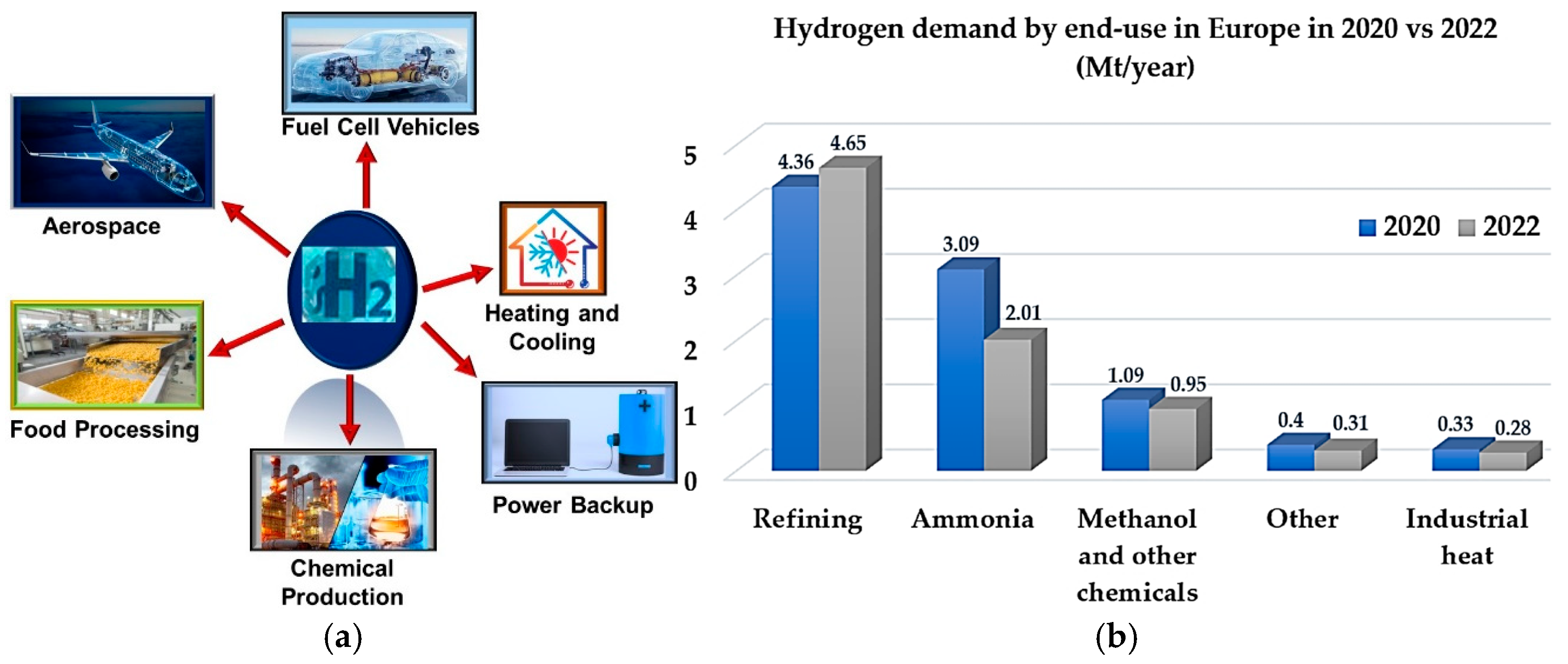
The ongoing expansion in the global population and economy, along with rapid urbanisation, has driven a significant rise in energy demand. The traditional approach to energy supply is based on hydrocarbon resources, which are finite and constrained by their geographical availability and extraction feasibility [1]. The utilisation of fossil fuels as our primary energy source since the Industrial Revolution has led to a significant rise in CO2 and other greenhouse gases in the atmosphere, which is the main driver of global warming [2]. Therefore, transitioning to a clean, sustainable, and renewable energy supply is crucial for ensuring future energy sustainability and enhancing global security [3]. Hydrogen, a colourless, odourless and highly flammable gas, has garnered significant interest due to its unique properties, including non-toxicity, light weight, and high energy content. It can be generated from a range of resources utilising diverse feedstocks, pathways, and technologies, encompassing both fossil fuels and renewable energy sources [4]. The traditional approach involves the cracking or reforming of fossil fuels as a cost-efficient pathway for hydrogen production in industrial applications, with a global estimate of above 100 million tonnes in 2025 (exceeding 600 billion Nm3/yr) [5]. It is important to recognise that the significance of hydrogen as an energy source and its environmental benefits are not the foremost considerations. The diverse role of hydrogen as a feedstock material, specifically as an industrial raw commodity, is what is referred to as industrial hydrogen. This industrial hydrogen finds applications across multiple sectors, including fertilisers, petrochemical refining, metalworks, food processing, cooling power generators in power plants, and semiconductor manufacturing [6]. The adaptability of hydrogen is not merely a characteristic; it represents a thrilling opportunity to harness its potential to revolutionise multiple sectors. Companies, especially within the food processing sector, have the potential to greatly diminish their carbon emissions and achieve sustainability goals through the adoption of hydrogen technology. This will promote a more sustainable future for everyone and motivate others to follow suit. Figure 1a illustrates the use of hydrogen as an energy source.
As the urgency of decreasing greenhouse gas emissions intensifies, renewable energy resources are emerging as a viable clean source of hydrogen. Connection is facilitated by renewable hydrogen, an energy source devoid of carbon emissions. The advancement of renewable hydrogen facilitates the transformation of energy supply, transportation, industry, and the exportation of renewable energy. Transitioning to alternative, clean, sustainable, and renewable energy sources is crucial for ensuring future energy sustainability and enhancing global security. The shift towards a clean and sustainable energy system will rely heavily on renewable energy (RE) resources [7].
Despite its potential, the adoption of hydrogen faces considerable challenges, particularly in terms of demand, distribution and storage. In 2022, Europe required a total of 8.2 million metric tonnes of hydrogen, with the production of ammonia (2.0 million tonnes) and refining (4.7 million tonnes) accounting for approximately 81% of this demand. The leftover portion was employed to generate methanol and various chemicals, which subsequently found applications in the automotive sector, in addition to serving as fuel for industrial heating and seeing use in the production of semiconductors (Figure 1b). The transportation sector presently accounts for approximately 0.04% of the hydrogen demand. Nonetheless, the drive to reduce carbon emissions in air, road, and sea transport is fostering the advancement of hydrogen-based transit solutions across Europe. However, the main obstacles to this progress are insufficient infrastructure, the high cost of vehicles, and the ongoing expense associated with producing pure hydrogen [8].
Figure 1. (a) Hydrogen functions as a generator of energy [9]. (b) Europe’s hydrogen consumption change by end-use between 2020 and 2022 (Mt/year). Reused with permission from [10].
Hydrogen 07 00072 g001
Current storage technologies, including compressed gas, liquid hydrogen, and solid-state storage, encounter several challenges such as material deterioration, inadequate volumetric density, substantial energy demands for compression or liquefaction, and safety concerns. The limitations outlined hinder the large-scale deployment and economic competitiveness when compared to conventional fuels [9]. This review paper aims to provide an in-depth perspective on the role of hydrogen in the decarbonization of the global energy sector, through a thorough examination of the relevant issues. This exploration addresses technological and financial challenges by examining advanced storage technologies, innovative materials, and comprehensive system-level strategies. The evaluation underscores the necessity for global collaboration and policy structures to accelerate the integration of hydrogen into energy systems. This initiative aims to position hydrogen as a vital component in achieving a sustainable, low-carbon future by addressing technological challenges and promoting international collaboration.
Furthermore, we examine the cohesive integration of hydrogen production, storage, transportation, and end-use applications within a comprehensive decarbonisation framework, which sets this review apart from conventional reviews that treat these subjects in isolation. This work emphasises geological (white) hydrogen alongside industrial variants and contrasts cryo-compressed storage with traditional methods, thereby addressing a notable gap in the existing literature. The integration of techno-economic limitations and their connection to policy and infrastructure places progress within the socioeconomic framework of decarbonisation. Although it provides a comprehensive systems perspective that encompasses different types of hydrogen and avoids the limited focus on green hydrogen common in other reviews, it falls short in the depth of more specialised analyses, such as those employing lifecycle assessments. Furthermore, the lack of AI and machine learning in materials design is recognised as a significant oversight in the discipline’s adoption of advanced methodologies.

Properties and Composition of Hydrogen

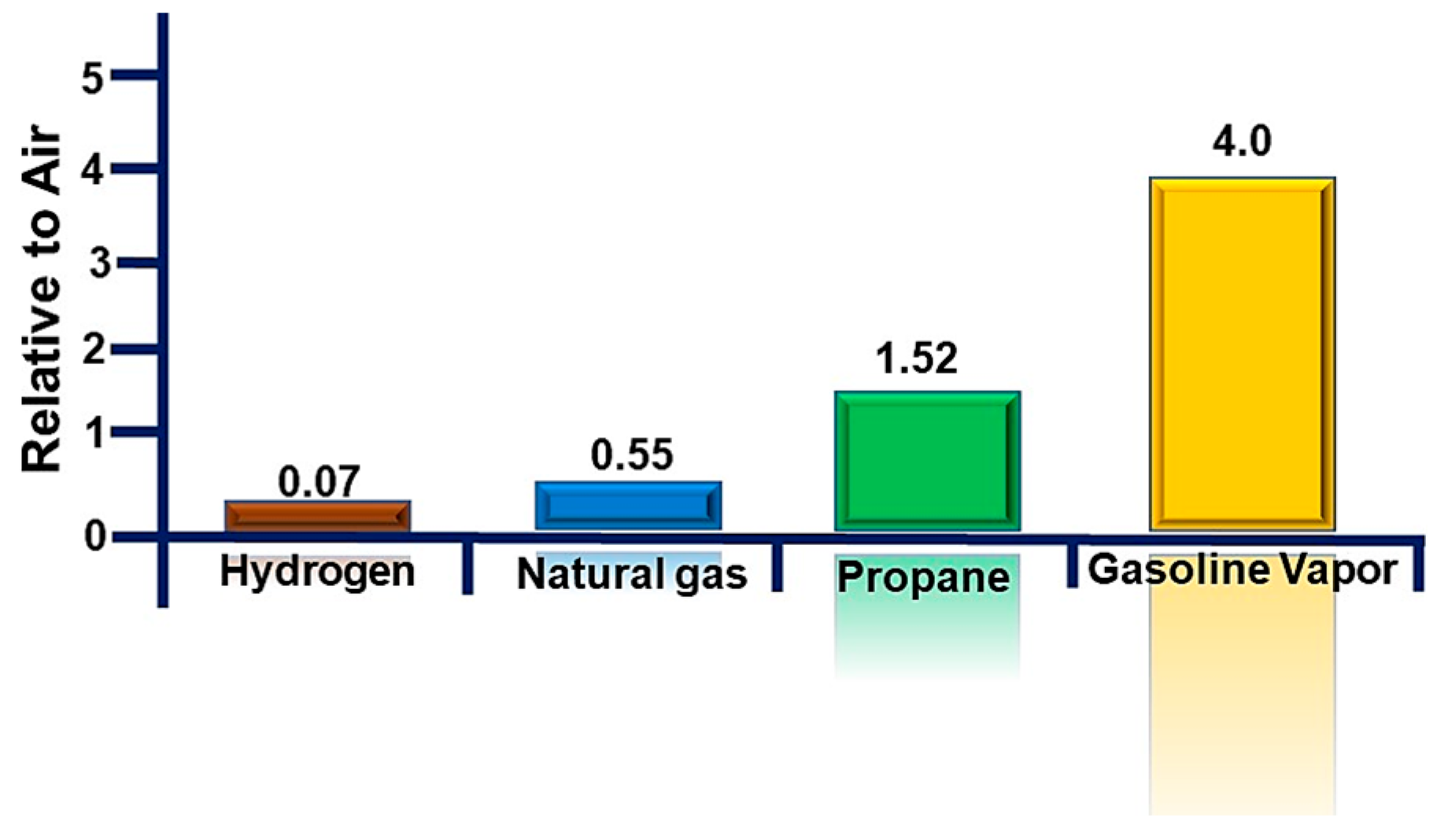
Hydrogen has the capacity to transfer or store significant quantities of energy; it functions primarily as an energy transporter instead of being a direct energy source. Fuel cells generate power and heat or electricity through the utilisation of hydrogen. Currently, the primary sectors utilising hydrogen are fertiliser production and petroleum refining, while utilities and transportation represent more recent applications. Hydrogen is not only tasteless and odourless, but it is also non-toxic and non-poisonous. It has the potential to embrittle certain metals; however, it does not exhibit corrosive properties. Hydrogen is regarded as the lightest and smallest element; it serves as a major energy carrier, produced naturally from feedstocks such as water, biomass, and/or hydrocarbons [3]. Figure 2 shows the comparative weight of hydrogen relative to other gases. This suggests that it will rise and disperse rapidly when released in an open space. In an outdoor environment, this presents a significant safety benefit.
Hydrogen presents a distinct challenge in storage, as it has a high energy content relative to its weight, yet its volumetric energy density is comparatively low. Hydrogen gas undergoes compression and is stored under high pressures to ensure adequate supplies are maintained. Hydrogen tanks are equipped with pressure relief mechanisms to ensure that the pressures within the tanks do not exceed safe limits [11]. Hydrogen exhibits a notable energy content of 141.8 MJ/kg at 298 K, alongside a lower heating value of 120 MJ/kg at the same temperature. This positions hydrogen as possessing a significantly higher energy content compared to many conventional fuels, including petrol, which has an energy content of 44 MJ/kg at 298 K. Nonetheless, in contrast to hydrocarbon fuels such as gasoline, liquid hydrogen exhibits a significantly lower energy density by volume, measuring at 8 MJ/L compared to gasoline’s 32 MJ/L. Hydrogen gas exhibits a remarkable energy density when measured by weight; however, its energy density by volume is comparatively low, necessitating a larger storage tank than that used for hydrocarbons [12].
Table 1 presents a comprehensive comparison of the properties of hydrogen alongside various conventional fuels, such as methanol, propane, methane, petrol, and diesel. For the purpose of comparison, the following key features are outlined: combustible range (%), flame temperature (°C), minimum ignition energy (MJ), auto-ignition temperature (°C), stoichiometric air/fuel ratio (kg), lower heating values (MJ/kg), and hydrogen heating values (MJ/kg). Hydrogen exhibits the highest combustion rate among all other fuels, gases, and liquids. Fuel cells, unbound by the thermal efficiency constraints of the Carnot cycle, demonstrate a notable indication of high performance in terms of efficiency [4].
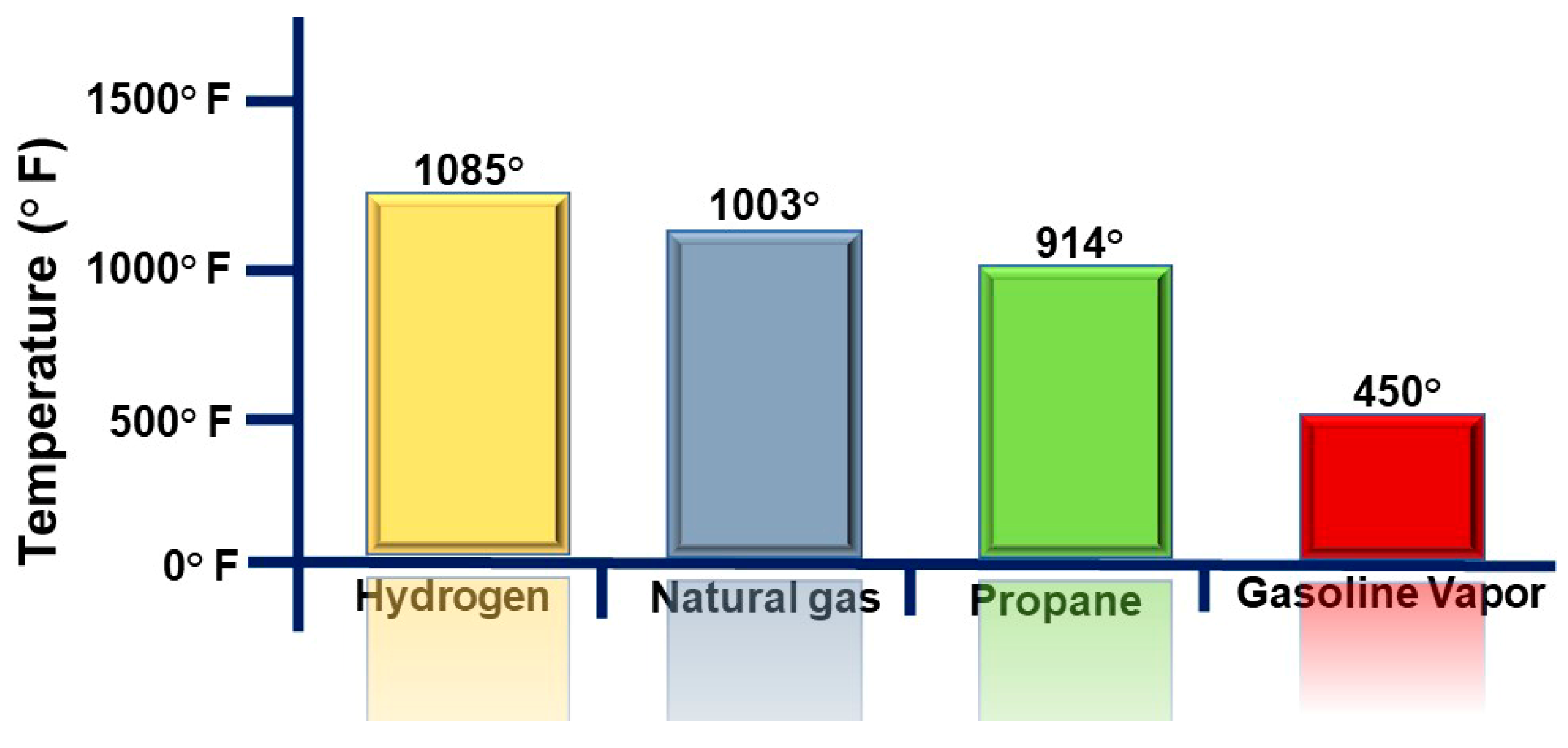
The low ignition temperature and flammable properties of hydrogen significantly contribute to its associated risks. It has the ability to infiltrate various materials, leading to mechanical degradation and potential failure, even resulting in leaks, due to its small molecular size and destructive capabilities (hydrogen embrittlement). The auto-ignition temperatures of natural gas and hydrogen are similar, Figure 3 [13].

2. Hydrogen Production Methods and Feedstocks

2.1. Thermochemical Conversion of Biomass: Pyrolysis and the Water–Gas Shift Reaction

The method of converting biomass into gas in the absence of oxygen is referred to as pyrolysis. Biomass typically exhibits a slower gasification rate compared to coal, and the gas mixture produced by the gasifier contains a higher concentration of hydrocarbon compounds, especially in oxygen-deprived conditions. This often necessitates an extra step to reform these hydrocarbons with a catalyst, resulting in a pure syngas mixture comprising carbon dioxide, hydrogen, and carbon monoxide. The conversion of carbon monoxide to carbon dioxide occurs through a shift reaction stage, utilising steam, similar to the gasification process employed in hydrogen production. Subsequently, the hydrogen undergoes separation and refinement [14]. This reaction is represented in a simplified form in Equation (1).
C O + H 2 O   C O 2 + H 2 H
A significant domestic resource is biomass; the availability in the US exceeds the requirements for human consumption and animal feed. A recent analysis estimates that as much as 1 billion dry tonnes of biomass may be available for energy use each year, contingent upon anticipated improvements in plant breeding and agricultural practices, thereby supporting the biomass supply for the bioenergy and bioproducts sector. For further information, refer to [15]. Biomass plays a crucial role in the natural growth process by “recycling” carbon dioxide. During this process, plants absorb carbon dioxide from their surroundings while producing biomass. This process effectively balances the carbon dioxide released during biomass gasification, resulting in minimal net greenhouse gas emissions [16].

2.2. Electrochemical Methods

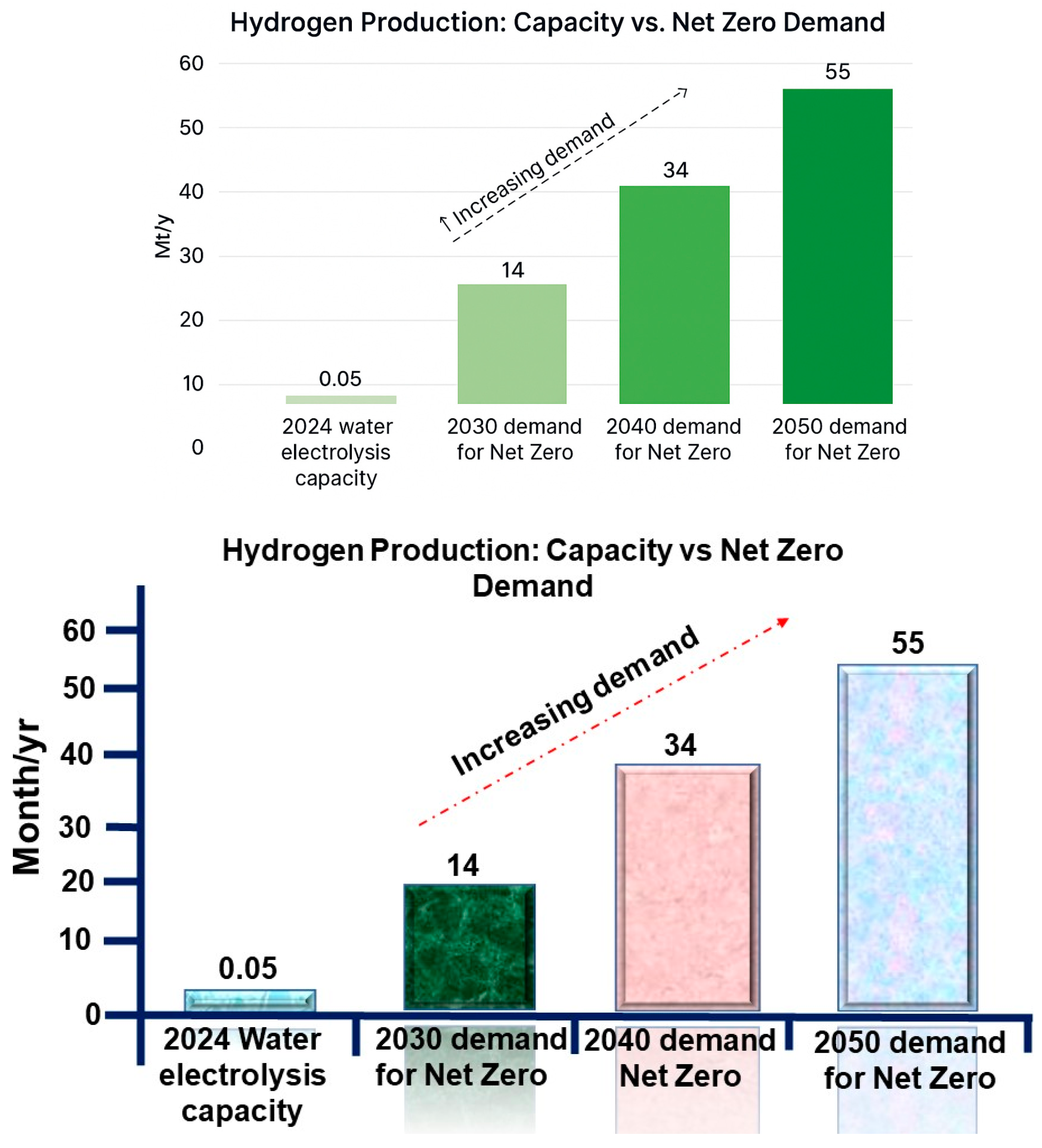
Water electrolysis presents considerable benefits when viewed through the lens of a comprehensive energy system. The potential for cost reduction is significant, including the opportunity for gas to integrate with the electrical industry, which could enhance the utilisation of renewable energy within the energy system and drive further technological progress [17]. Furthermore, water electrolysis has the potential to produce pure hydrogen, which is projected to contribute to achieving Net Zero in Europe by 2050. This holds significant relevance for regions where renewable energy is readily available, as well as for those where it is either expensive or scarce. Included in this are processes such as carbon capture and reforming, methane splitting, transforming biowaste into hydrogen, and converting non-biological waste into hydrogen. Each pathway for generating clean hydrogen presents distinct benefits and obstacles regarding scale, cost, greenhouse gas intensity, feedstock infrastructure requirements, and regulatory factors. The expenses associated with producing clean hydrogen vary between 1.7 and 10.2 EUR per kilogram. In regions where electricity is affordable, water electrolysis presents a potentially lucrative option; however, expenses often remain elevated, and financial incentives differ based on the specific project. Figure 4 illustrates the hydrogen that Europe needs to utilise in order to achieve net zero. Multiple clean hydrogen generation methods will be necessary to achieve sufficient hydrogen production by 2050; however, since the cost of renewable energy primarily influences expenses, a reduction in water and capital expenditure costs is expected. Among the methods analysed, electrolysis demonstrates the greatest potential for cost efficiency [18].

2.3. Production of Hydrogen (Grey and White/Geological Hydrogen)

Grey hydrogen is produced through the process of steam reforming coal or natural gas, without the incorporation of carbon capture, utilisation, or storage methods. As noted by Dash et al. [20], around 40% of grey hydrogen is generated via alternative chemical reactions. Grey hydrogen finds its primary application in the petrochemical sector and in the production of ammonia [21]. The main drawback of grey hydrogen is its substantial carbon dioxide emissions during the synthesis process, which are estimated to be around 830 million tonnes of CO2 each year [22]. Nonetheless, the established method of natural gas steam reforming (SMR) without carbon capture utilisation and storage (CCUS) produces hydrogen at a reasonable cost. The price could potentially decrease further, as carbon capture and reformation stand out as some of the most economically viable solutions. Additionally, the costs associated with natural gas, which serve as a primary cost driver, remain elevated compared to levels seen prior to World War II.
White hydrogen, also known as geological hydrogen, refers to the naturally occurring molecular hydrogen located in the Earth’s crust, setting it apart from the industrially produced “coloured” hydrogen. It is generally colourless, highly diffusive, and frequently found as free gas in seeps, within geological formations, or dissolved in groundwater, with purities of approximately 98–99% H2. This form of hydrogen offers advantages such as the absence of a primary energy requirement for synthesis, lifecycle carbon footprints near zero to negative, and the potential for reduced fixed energy costs compared to grey, blue, or green hydrogen, provided that commercially viable reserves are validated. White hydrogen originates from several geological processes, including the serpentinization of ultramafic rocks, water-rock interactions in iron-rich formations, and radiation-induced reactions occurring in Precambrian shields. Extraction techniques include surface identification and exploratory drilling in regions such as Bourakébougou (Mali) and Nebraska, where wells have produced over 95% H2. Improved production techniques could involve introducing CO2-saturated water during CO2 sequestration processes. At present, white hydrogen primarily serves small-scale power generation, yet its potential for extensive applications in fuel, power, ammonia, and chemical production is considerable, particularly if economically feasible reservoirs are developed. When utilised effectively, white hydrogen has the potential to be incorporated into global hydrogen supply networks as an economical feedstock in pursuit of net-zero energy objectives [23,24,25].
The advantages and disadvantages of the various hydrogen production processes are outlined in Table 2. The challenges presented can be addressed through the selection of appropriate feedstock, modifications to the process, and the implementation of an effective bioreactor design [26]. The primary challenge in hydrogen generation lies in reducing its cost, particularly when utilising renewable resources. The focus is on enhancing the lifespan and effectiveness of hydrogen production technologies while minimising operational, maintenance, and capital equipment costs to decrease the overall expense of hydrogen [27].

2.4. Photocatalytic Method

A notable approach for hydrogen production is photocatalysis, which enables H2 evolution via solar-driven photocatalytic water splitting (PWS). This approach is crucial for facilitating clean energy solutions and addressing global environmental issues. Consequently, numerous photocatalysts have been created in recent years [8].
Photocatalytic hydrogen production employs semiconductor materials to capture sunlight and directly facilitate water splitting (or reform biomass-derived organics) in a unified process. In a typical system, powders like oxides, nitrides, or sulfides are suspended in water. Photons with energy exceeding the bandgap excite electron–hole pairs, which then migrate to surface active sites. Here, electrons reduce protons to H2, while holes oxidise water or sacrificial organics [28]. At every stage, conversion losses occur: a mere fraction of the solar spectrum is absorbed due to bandgap limitations, a significant number of photogenerated carriers recombine prior to reaching reactive sites, and interfacial overpotentials, along with mass-transport constraints, diminish the proportion of absorbed photons that contribute to the formation of chemical bonds. Consequently, the observed quantum efficiencies and solar-to-hydrogen efficiencies are notably low in practical applications. Detailed evaluations indicate that most water-splitting photocatalyst systems achieve STH efficiencies of 1–2% or less under unconcentrated sunlight. Only a limited number of meticulously designed materials or concentrated-light configurations achieve approximately 5–9% STH in laboratory settings, while outdoor panel reactors of 100 m2 yield around 0.7–1% STH [29].
On the contrary, PV-electrolyser (PV-EC) routes separate the processes of light absorption and catalysis: high-efficiency photovoltaic modules transform sunlight into electricity, which subsequently powers a well-established alkaline, PEM, or solid-oxide electrolyser. Commercial electrolysers typically achieve electrical efficiencies of 65–75% (≈50–55 kWh/kg H2), whereas multi-junction PV cells exceed 30% in solar-to-electric efficiency. When appropriately aligned, integrated PV-electrolysis systems have shown STH efficiencies of approximately 10–15% under realistic conditions. Furthermore, record laboratory systems utilising concentrated multi-junction PV alongside advanced electrolysers have sustained STH of 25–30% for extended periods, significantly surpassing the performance of current practical particulate photocatalysts. Optical and resistive losses in the PV, along with ohmic and overpotential losses in the electrolyser, and balance-of-plant consumption primarily drive PV-EC losses [30]. These factors are well-characterised and can be incrementally reduced. Photocatalytic systems face significant challenges due to inherent photophysical limitations, including rapid electron-hole recombination, restricted spectral utilisation, instability issues such as corrosion and photocorrosion, and difficulties in gas separation and reactor design. These factors collectively hinder their efficiency and longevity, even though they offer potential benefits in terms of simplicity, low-pressure operation, and scalability across extensive land or water: From a materials and systems perspective, PV-electrolysis is currently the more efficient and deployment-ready solar hydrogen route, while photocatalysis remains a promising but pre-commercial area of study whose competitiveness depends on significant improvements in STH efficiency, stability, and scalable reactor design.
It must be noted that during hydrogen production, significant conversion losses occur when primary energy sources are converted into hydrogen (H2). Well-known electrolyser systems, such as alkaline and PEM electrolysers, achieve electrical efficiencies of 63–79% and require 50–55 kWh to produce 1 kg of hydrogen. Advanced solid-oxide electrolysers enhance this to 37–45 kWh/kg, with optimal conditions surpassing 75% efficiency. When paired with existing photovoltaics with efficiencies ranging from 20 to 25%, PV-electrolysis systems can achieve solar-to-hydrogen efficiencies of 10 to 15%. Under laboratory conditions, these efficiencies can even reach 20–30% [31]. Losses arise from optical challenges in photovoltaics and multiple inefficiencies in electrolysers, highlighting distinct opportunities for improvement. Conversely, photocatalytic systems consolidate all functions within a single medium; however, they exhibit reduced efficiencies (1–2%) due to suboptimal light utilisation and rapid electron recombination. Recent advancements, including InGaN-based photocatalysts, have reached 9.2% solar-to-hydrogen efficiency under concentrated light. However, they still fall considerably short of the efficiencies seen in PV-electrolysis systems, which also encounter fewer stability issues over extended periods [32]. The existing electrolysers demonstrate enhanced conversion efficiencies; however, they depend on costly electricity generation. Conversely, photocatalytic methods offer straightforward, low-capital-expenditure reactors that could be cost-effective in sunny locations, depending on progress in solar-to-hydrogen efficiency and longevity. This difference is further summarised in Table 3.
The methods for producing hydrogen differ greatly in terms of efficiency, emissions, and cost, and can be classified into several categories: “grey” (unabated steam methane reforming and coal gasification), “blue” (with carbon capture), and “green” (renewable electrolysis), as well as alternatives such as biomass and methane pyrolysis [39,40]. Conventional steam methane reforming (SMR) achieves thermal efficiencies of 70% to 85%, utilising about 3.3 to 3.6 kg of CH4 per kg of H2 produced. The levelized cost of hydrogen (LCOH) from steam methane reforming (SMR) is projected to range from 1.5 to 2.5 €/kg H2; however, it could increase to approximately 3.3 €/kg H2 due to rising gas prices. Nonetheless, it exhibits a high carbon intensity, generating 9–11 kg CO2-eq per kilogram of hydrogen, which poses obstacles to decarbonisation efforts.
“Blue” hydrogen, generated through carbon capture, significantly lowers emissions to 2–7 kg CO2-eq/kg H2; however, it introduces complexity and raises costs to 2–4 €/kg. The efficacy of blue hydrogen depends on the effective management of methane leakage throughout its supply chain. Coal gasification remains prevalent, especially in China, yet it is associated with significant life-cycle emissions that surpass 18–20 kg CO2-eq/kg H2 in the absence of carbon capture. The incorporation of carbon capture into this process has the potential to reduce emissions, though it is less efficient than gas-based methods [41].
Water electrolysis, which splits water into hydrogen and oxygen by applying electricity, can achieve efficiencies of 63% to 70%, depending on the specific technology employed. The levelized cost of hydrogen production ranges from 4 to 6 €/kg, assuming an electricity price of 50–60 €/MWh. Nonetheless, the environmental consequences are significantly influenced by the carbon intensity of the electricity utilised, with emissions potentially reaching as low as 0.1 g CO2-eq/MJ H2 when sourced from renewable energy.
Biomass-based methods have the potential to yield low or even negative net emissions when integrated with carbon capture technologies, with associated costs generally ranging from 2 to 5 €/kg; however, they face significant scalability challenges. Methane pyrolysis can generate hydrogen and solid carbon with remarkable efficiency and low emissions. This process holds significant potential, possibly leading to hydrogen prices falling below 2 $/kg as technology continues to advance. In summary, although fossil-based methods continue to dominate, the emergence of low-emission and renewable pathways is becoming increasingly important for sustainable hydrogen production [42].
The main routes for producing hydrogen are shown in Table 4, which indicates that grey SMR is economical but produces substantial emissions. Blue hydrogen, which depends on petrol and CCS economics, is a transitional option with moderate emissions. Although it is more expensive now, electrolysis has the lowest emissions among renewable energy sources and is predicted to become more affordable. Methane pyrolysis and biomass can produce low or negative emissions at competitive prices, but they have readiness and scalability issues. As a result, there is no single best way to transition from grey to blue and green technologies; instead, a variety of strategies is needed to balance cost, efficiency, and climate impact.

3. Hydrogen Storage Technologies

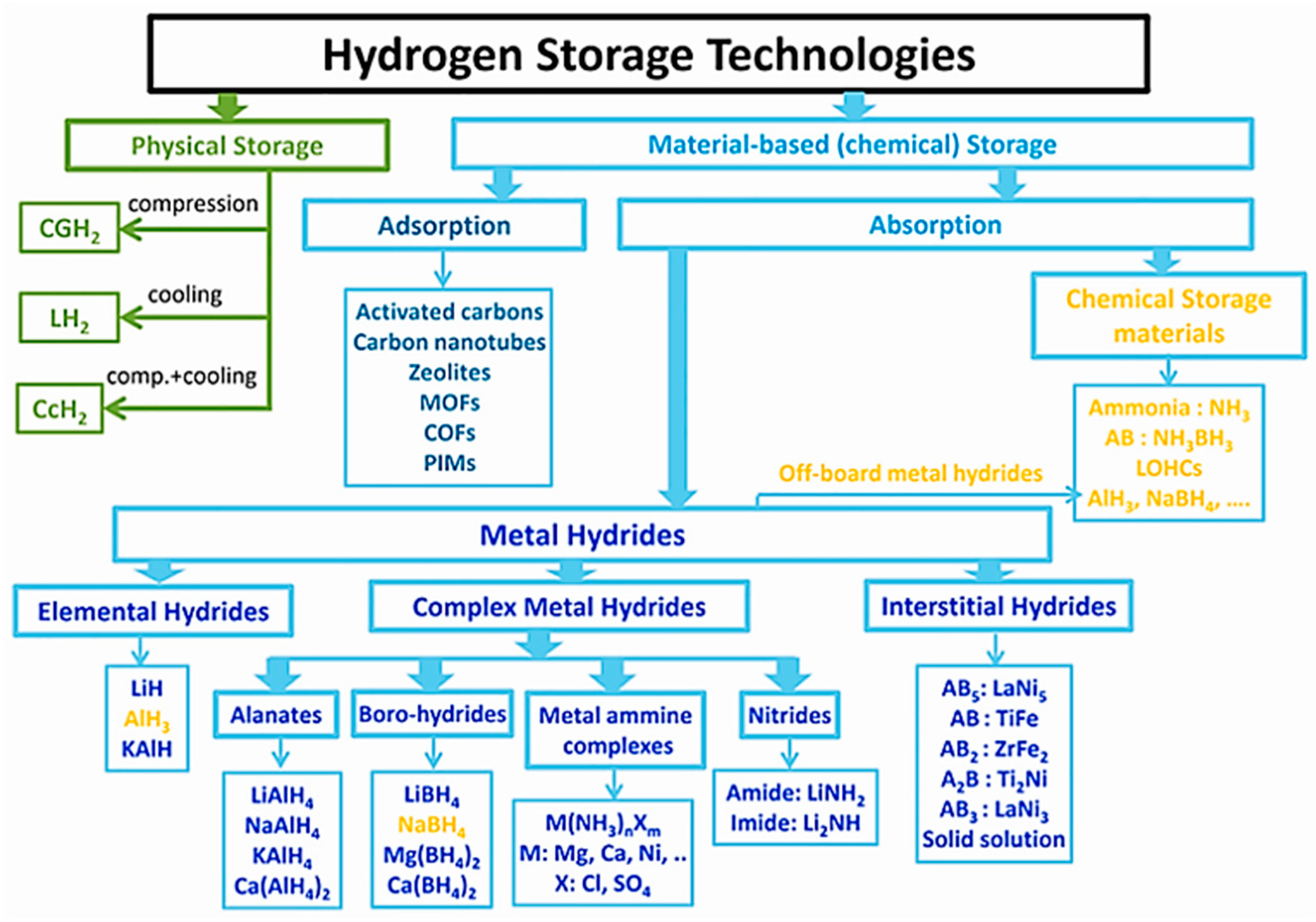
Hydrogen is widely acknowledged as a pivotal component of future energy systems due to its capacity to decarbonise several sectors, including transportation, stationary power production, and industrial processes. Its gravimetric energy density surpasses that of gasoline or natural gas; yet, its volumetric density at ambient temperature and pressure is merely 0.01 MJ L−1, in contrast to 32 MJ L−1 for gasoline [49]. Consequently, effective hydrogen storage remains a critical obstacle to achieving a hydrogen-based economy. Various storage techniques have been established, classified into physical methods (compressed gas, liquefaction, and cryo-compression) and chemical methods (metal hydrides, complex hydrides, and liquid organic hydrogen carriers), encompassing compressed gas storage, liquid hydrogen storage, metal hydrides, chemical hydrogen carriers, and cryo-compressed storage. The various hydrogen production technologies are illustrated in Figure 5 [40,50]. Each method offers distinct advantages and imposes specific constraints on gravimetric and volumetric capacity, cost, safety, and infrastructure compatibility.

3.1. Compressed Gas Storage

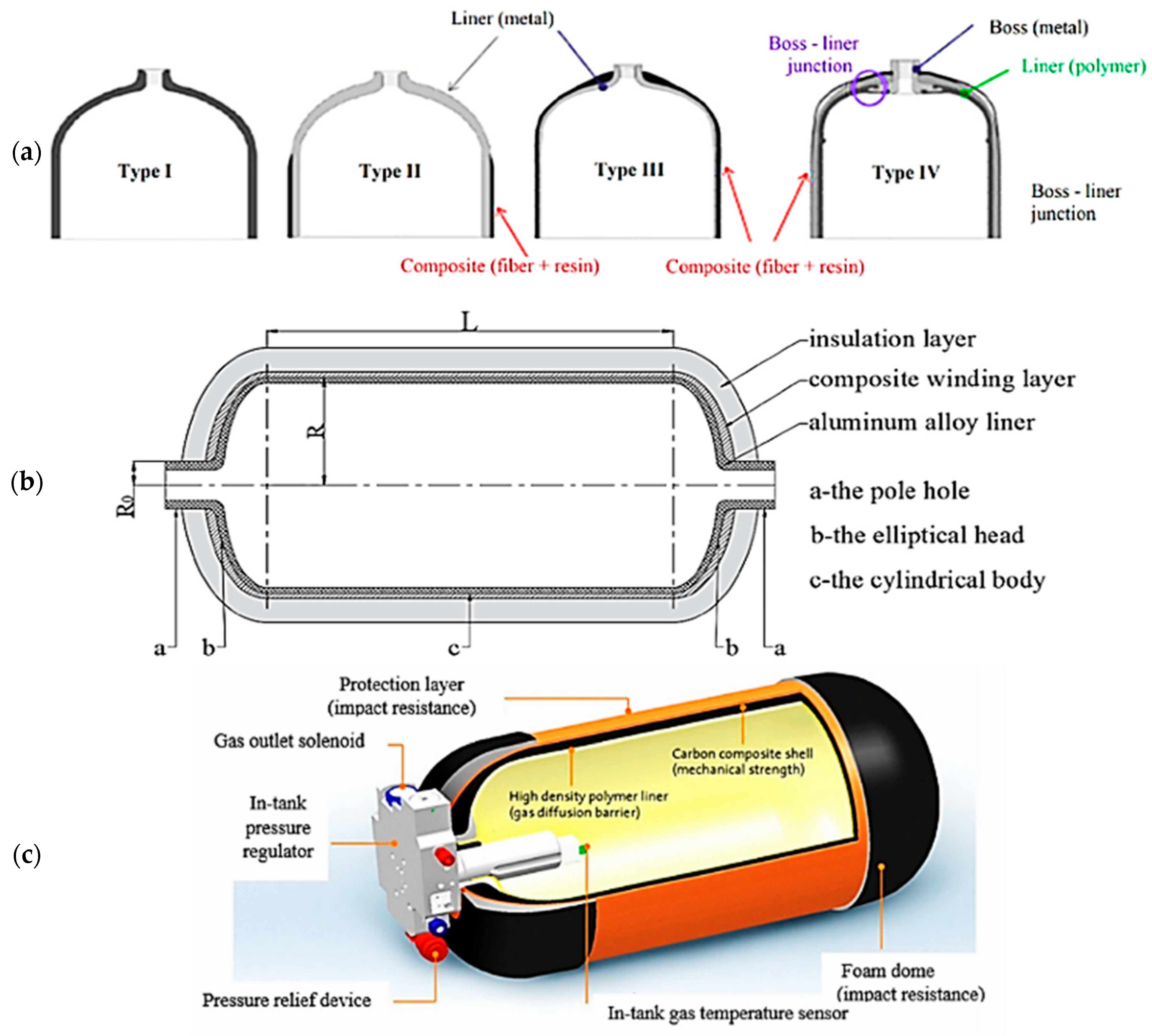
Compressed hydrogen storage is the most straightforward and prevalent technique, utilised in both stationary systems, such as hydrogen-powered generating plants, and mobile applications. Hydrogen is generally stored at pressures ranging from 350 to 700 bar in high-pressure cylinders [52]. Contemporary storage employs Type I–IV tanks, as shown in Figure 6a–c, ranging from entirely metallic cylinders to totally composite, polymer-lined carbon fibre containers. Type IV tanks, designed to store hydrogen at 700 bar pressure, are extensively utilised in fuel cell electric vehicles (FCEVs), including the Toyota Mirai and Hyundai Nexo. This approach is preferred due to its operational simplicity, characterised by rapid hydrogen loading and release. Compressed hydrogen storage demonstrates a volumetric energy density of 4.5 MJL−1, a volumetric capacity of 10–15 gL−1, and a gravimetric capacity of 1–2%, with an estimated cost between $500 and $1000 per kilogram of stored hydrogen [52,53]. This approach utilises specialist cylinders engineered to endure high pressures and resist hydrogen embrittlement, while also being lightweight, economical, and impervious to hydrogen diffusion [53]. The principle of compressed hydrogen storage is to increase gas pressure through compression, thereby improving its volumetric energy density. The benefits are swift refuelling (under 3 min) and a developed infrastructure for compressed gases. Nonetheless, this elevated pressure presents safety hazards and consumes around 13–18% of hydrogen’s lower heating value, hence affecting the overall cost-effectiveness of the method. Moreover, safety issues associated with high-pressure ruptures require sophisticated valve systems and materials that are resistant to hydrogen embrittlement. Alternative methods, such as subterranean cavern storage or hydrogen-filled glass microspheres, are being explored for large-scale or safer storage solutions [54].

3.2. Liquid Hydrogen Storage

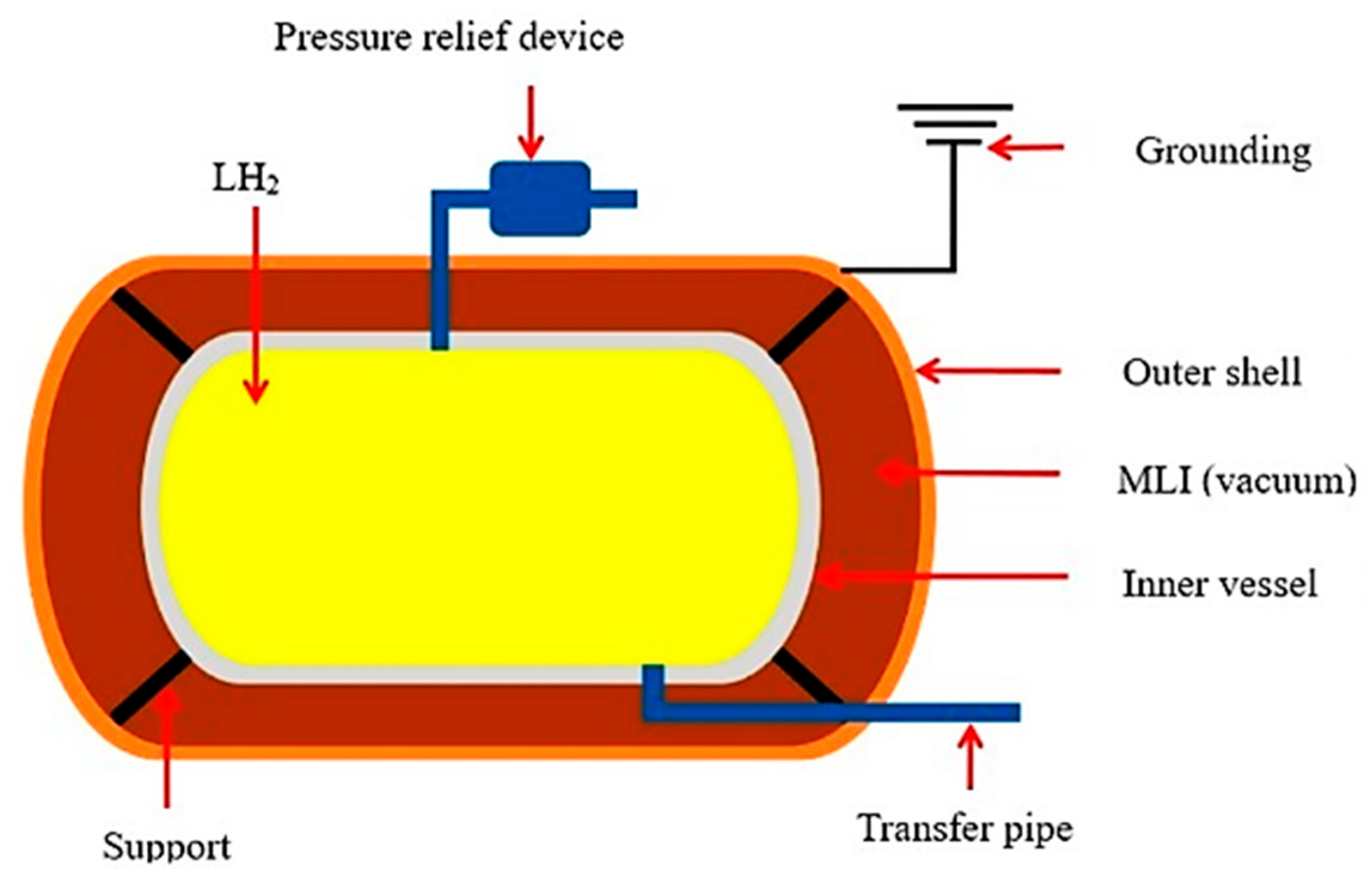
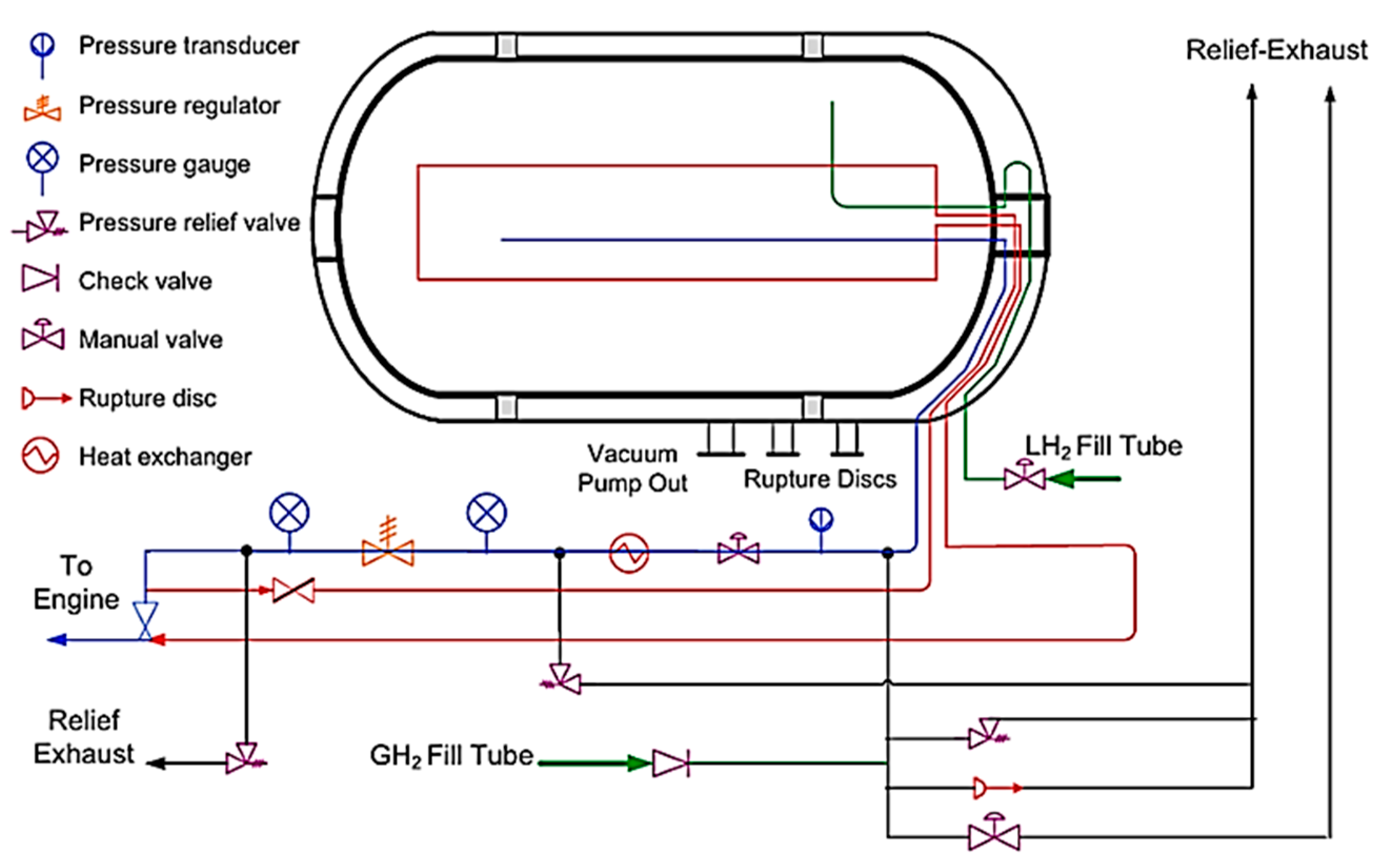
Liquefied hydrogen storage methods require cooling hydrogen to extremely low temperatures (down to −253 °C) for liquefaction, which demands a substantial amount of energy. This procedure is established and necessitates specialised containers with insulating devices to avert boil-off and sustain efficiency. The liquefied hydrogen is subsequently stored in an insulated tank, typically employed in high-vacuum, adiabatic, low-pressure tanks to reduce vaporisation [55]. Effective attainment of this objective necessitates stringent thermal insulation. The storage tank comprises three elements: the interior vessel, the insulation layer, and the exterior shell. The inner vessel must preserve its mechanical capabilities at low temperatures, while the outer shell safeguards the inner vessel and facilitates the connection of the tank to the external structure. To reduce radiative heat transfer, multilayer insulation is placed between the inner vessel and the outer shell, while the intervening space is kept under vacuum to diminish convective and conductive heat transfer from any residual gas within the insulation layers. Liquefied hydrogen storage is a promising solution for long-term storage and large-scale transportation, with a gravimetric density of 70.8 kg/m3 and the possibility for a substantial volumetric density of 8.5 MJL−1 [56,57]. It is extensively utilised in the aerospace industry in the United States, particularly during NASA’s Space Shuttle missions, where liquid hydrogen serves as the primary fuel source. The initial showcased transportation projects comprise the BMW Hydrogen 7 and the Sinot Aqua hydrogen boat. In contrast to compressed hydrogen storage, liquid hydrogen storage operates at pressures below 1 MPa, thereby mitigating the substantial expenses associated with gas compression. The storage of liquefied hydrogen presents obstacles, including the requirement for extremely low temperatures. While LH2 diminishes tank capacity needs and provides swift discharge rates, the liquefaction process utilises approximately 30–40% of the hydrogen’s net heating value, and boil-off losses of 1.5–3% daily pose significant challenges. Boil-off losses are influenced by factors such as the quality of thermal insulation, hydrogen volume, storage duration, ambient conditions, and tank shape [57]. Furthermore, it exhibits low energy efficiency, elevated overall costs, and substantial energy consumption during the liquefaction process, known as the liquefaction energy penalty. Although liquid hydrogen storage systems are a mature technology, they necessitate continual material-level innovations to address issues such as reducing tank weight, enhancing corrosion resistance, minimising boil-off losses, and strengthening tank integrity. Materials commonly used in the fabrication of liquid hydrogen storage tanks include nickel alloys, aluminium alloys, and stainless steel. Research endeavours concentrate on the development of sophisticated lightweight insulating materials, including aerogels and cryogenic substances, as well as composites and titanium alloys. A typical example is illustrated in Figure 7 [58]. Future research should focus on developing materials for tank construction to address the economic and technological challenges associated with liquid hydrogen storage, thereby promoting the advancement of more efficient, lightweight, and sustainable energy storage technologies.

3.3. Understanding Hydrogen Cylinders

High-pressure containers, known as hydrogen cylinders, are specifically designed to store and transport hydrogen, whether in liquid or gaseous form, safely. The integrity of the stored hydrogen is ensured by the design of these hydrogen cylinders, which can bear high pressures. The pressure inside hydrogen cylinders can vary from 350 to 700 bar (5076 to 10,152 psi), depending on the type and intended use. Gaseous Hydrogen Storage using Compression is the most popular type of hydrogen storage in hydrogen fuel cells or hydrogen-powered cars. Vehicle hydrogen tank-related regulations and guidelines from various groups state that the technology of these tanks is evolving quickly and can withstand pressures of up to 70 MPa [60]. There are roughly five different types of compressed gaseous hydrogen storage tanks, which are displayed in Table 5 [61]. Thanks to the quick advancement of materials science. Type 3 and Type 4 tanks are now in operation, while Type 5 tanks are being developed [62]. Conceptual models of Type 5 hydrogen storage tanks already exist, although the products are not yet commercially available. In fuel cell vehicle (FCV) applications, types 3 and 4 are frequently used. Stacks are formed by layers of carbon fibre composites wrapped in different orientations around a metal and polymer liner on their inner surface. These stacks give the tank the necessary rigidity and strength. A Type 4 filament-wound tank was constructed [63], with the fibres supporting the main load and the matrix preserving their position and orientation. A high-density polyethene (HDPE) liner was used to hold hydrogen.

3.4. Metal Hydrides

A variety of metal-based materials can absorb hydrogen when subjected to moderate pressure and low temperatures. Metal hydrides composed of lightweight elements such as lithium (Li), boron (B), nitrogen (N), magnesium (Mg), and aluminium (Al) show considerable promise as hydrogen storage materials. Furthermore, this method seems to be the most secure for hydrogen storage due to its relatively low operating temperatures and the endothermic nature of hydrogen release. Metal hydrides consist of H2 atoms distributed among metal atoms within the metal lattice structure. The defect position exhibits elevated surface energy, facilitating the adsorption of H2 atoms and the formation of solid solutions [64,65]. There are two methods available for the hydrogenation of metals: direct dissociative chemisorption and electrochemical water splitting. The reactions are presented in Equations (2) and (3).
M + ( 2 x ) H 2 M H x
M + ( 2 x ) H 2 O + 2 x e   M H x + ( 2 x )   O H
In this context, M represents metal. Equation (1) illustrates the process of direct dissociative chemisorption. Equation (2) illustrates the process of electrochemical water splitting. An essential component for the electrochemical splitting process aimed at degrading water is a catalyst, like palladium (Pd) [66]. While metal hydrides offer significant safety and cost advantages, they are hindered by their restricted hydrogen storage capacity, with many potential candidates allowing for only 2 to 3 wt.% of H2 storage. Additionally, the inherent irreversibility of the hydrolysis reaction further complicates their utility. Elevated dehydrogenation temperatures and slow reaction kinetics present additional challenges associated with metal hydrides [67]. Ideally, the metal hydride demonstrates H2 intercalation that is either interstitial or substitutional, facilitating a minimum of 25% volumetric expansion and leading to reversible H2 sorption behaviour. Consequently, in comparison to gravimetric densities, the volumetric hydrogen storage capacity of metal hydrides is markedly superior. Furthermore, these metal hydrides present a limitation, as they are formed by the combination of two, three, or more heavy elements from the periodic table, including those from the lanthanide group and transition metals, resulting in reduced gravimetric H2 storage capacities [68]. Recently, there has been significant interest in transition metal hydrides with cubic structures, attributed to their exceptional volumetric and gravimetric capacity. Vanadium hydrides exhibit a significant capacity for H2 storage relative to other metal hydrides. For example, Zhang et al. found that vacancy clusters occur in the moderate temperature range, while VHm (including VH1, VH2, VH3, and VH4) is formed in a low-temperature environment [69]. Challenges remain, including low desorption and sorption kinetics, high costs, limited hydrogen storage capacity, sluggish kinetics, and elevated dehydrogenation temperatures, which impede practical applications. To overcome these limitations, techniques such as severe plastic deformation and nano-structuring have been employed to enhance the hydrogen sorption properties and cycling performance of metal hydride storage methods, relevant to both stationery and transportation applications, including marine transportation [70,71]. Advancements in thermal management techniques, such as reactor design optimisation and the incorporation of heat exchangers, nano oxide additives, and materials with high thermal conductivity, are intended to enhance overall efficiency in metal hydride systems. These innovative approaches facilitate the development of customised strategies and progress in hydrogen storage using metal hydrides. Hydride formation initiates with the dissociation of a hydrogen molecule into atomic hydrogen at the surface, which then diffuses into the bulk material and becomes chemisorbed within the metal or alloy structure, as depicted in Figure 4 [72,73]. The chemisorption process may result in a lattice expansion of about 20–30% of the initial volume. Hydride formation occurs through the direct reaction of hydrogen with metal or through the electrochemical dissociation of water molecules. Strategies for enhancement that have been implemented to optimise the properties of metal hydride hydrogen storage include particle size reduction through ball milling, catalytic doping with elements such as Pd, Ti, and Nb2O5, as well as nanostructuring aimed at improving kinetics and decreasing desorption temperatures. While these advancements enhance performance, issues related to cycling stability and thermal management remain a concern. Hydrides demonstrate a strong suitability for stationary storage applications, where weight considerations are not as paramount; a few examples are illustrated in Table 6 [74,75].

3.5. Cryo-Compressed Storage

Cryo-compressed storage integrates cryogenic cooling (ranging from −253 °C to −163 °C) with hydrogen compression at pressures between 250 and 350 bar. This hybrid approach attains greater densities (~9.6 MJ L−1) than either compressed or liquid hydrogen alone. The system reduces boil-off losses and allows for dormancy periods surpassing 7 days with minimal hydrogen loss. This hybrid storage method integrates principles from compressed storage and liquefied hydrogen storage techniques, demonstrating potential by storing hydrogen at very low temperatures and moderate to high pressures within specialised containers to enhance gravimetric and volumetric density. Cryo-compressed hydrogen storage achieves higher densities, approximately 80 gL−1, exceeding the density of liquefied hydrogen by about 10 gL−1, and effectively reduces boil-off losses [76]. Currently, cryo-compressed storage techniques are the most advanced commercial technology in the transportation sector, particularly for fuel cell electric vehicles, when compared to other storage options. These storage tanks are designed to withstand extremely low temperatures and elevated pressures. Cryo-compressed storage presents advantages over alternative storage methods, including medium to high volumetric and gravimetric density, reduced storage costs, and suitability for long-range vehicle applications [77]. Cryo-compression effectively addresses the major shortcomings of hydrogen storage in liquefied form, specifically boil-off loss, as well as the limitations of compressed hydrogen technologies. This method integrates the benefits of both alternatives while alleviating their disadvantages.
Research indicates that cryo-compressed hydrogen storage offers high density and cost feasibility. The design features of cryo-compressed vessels, including double-shell insulation and pressure regulation systems, enhance their safety and efficiency [78]. Currently, cryo-compressed hydrogen is contained within composite, over-wrapped pressure vessels, which primarily consist of an inner liner and a fibre winding layer. Cryo-compressed hydrogen storage demonstrates potential for high gravimetric and volumetric densities but is limited by its well-to-wheel efficiency and manufacturing costs. Moreover, a significant issue associated with hydrogen storage via cryogenic compression is the considerable increase in temperature during the filling process, which diminishes hydrogen density and jeopardises the safety of storage tanks. The filling standards for compressed gas are not entirely applicable to cryogenic-compressed hydrogen due to its cryogenic temperature range, which restricts temperature increases during rapid filling [79]. Research should concentrate on optimising cryogenic hydrogen filling processes to control the temperature increase during rapid filling, thereby ensuring safety. This involves the development of advanced cooling systems, novel materials, and dynamic filling protocols to improve efficiency and ensure regulatory compliance. Moreover, further research is needed to investigate the fatigue and strength characteristics of cryo-compressed hydrogen storage tanks, aiming to enhance their safety, storage efficiency, and life cycle assessment. Figure 8 illustrates the design schematic for cryo-compressed hydrogen storage [80,81]. Nonetheless, the challenges associated with CCH2 encompass the requirement for expensive double-walled composite tanks and significant energy input for cooling and pressurisation. The infrastructure for cryo-compression has not yet been established. This technology is regarded as promising for mobile storage applications that necessitate high density and minimised boil-off [81].
In conclusion, hydrogen storage stands as a significant challenge in the pursuit of a sustainable hydrogen economy. While compressed gas and liquid hydrogen storage technologies have reached a level of maturity, they still face constraints related to safety, efficiency, and cost. Metal and complex hydrides present significant storage densities; however, they encounter challenges related to kinetics and thermodynamics. While Cryo-compressed systems exhibit potential as a high-density, low-loss option, there is a necessity for infrastructure development.
Hydrogen storage options need to be matched deliberately to the application domain because their strengths and weaknesses are almost orthogonal. For mobility, gravimetric and volumetric energy density, fast refuelling, and safety under crash conditions are the key factors. Compressed gaseous hydrogen at 350–700 bar in Type III/IV composite cylinders has therefore become the de facto standard for fuel-cell vehicles: it offers relatively mature, automotive-qualified hardware, refuelling in a few minutes, and acceptable on-board mass and volume, albeit at the cost of high pressures, thick-walled composite tanks, and significant compression energy. Cryogenic liquid hydrogen further improves volumetric density and is being piloted in heavy-duty trucks, shipping, and aerospace, where long-range, compact tanks justify liquefaction energy and boil-off management. However, both compressed and liquid storage pose safety and cost challenges for mobility: high-pressure vessels must meet stringent burst and fatigue requirements, adding weight and capital cost, while liquid systems must manage boil-off and require complex insulation and venting strategies, with associated energy penalties and operational constraints in daily vehicle use [83].
Stationary systems relax weight and volume constraints and instead prioritise capital cost per kilogram of hydrogen stored, long-duration storage capability, and integration with fuel cells or turbines. Here, metal hydrides and other materials-based storage technologies become more attractive. Reversible intermetallic or complex hydrides can store hydrogen at near-ambient pressures with high volumetric densities and inherent safety (no high-pressure gas phase), and recent techno-economic analyses show that, for multi-hour to multi-day storage at megawatt (MW) scale, metal hydride tanks can be competitive with compressed gas, especially when waste heat from fuel cells is available for desorption [84]. Their main limitations are slow kinetics in some materials, thermal management complexity during charge/discharge, degradation over many cycles, and the need to manage system-level density (many promising materials that meet gravimetric targets still underperform volumetrically when packaged with heat exchangers and containment). For very large, seasonal stationary storage, underground salt caverns storing compressed hydrogen are technically and economically promising, providing massive capacities at relatively low cost per unit of hydrogen, but they require suitable geology and involve non-trivial issues of cavern integrity, cushion gas, and long-term materials compatibility [85].
Large-scale transport and trade of hydrogen (inter-regional pipelines, shipping) accentuate different trade-offs again. Pipelines transporting compressed hydrogen are efficient over land for high and steady throughput but demand extensive retrofitting or new builds, with challenges around hydrogen embrittlement, leakage, and regulatory acceptance. For overseas transport, liquefied hydrogen, liquid organic hydrogen carriers (LOHCs), and hydrogen-rich “circular” molecules such as ammonia and methanol compete. Liquefied hydrogen offers high volumetric density and avoids carrying additional molecular mass, but liquefaction is energy intensive and boil-off losses plus expensive cryogenic tanks drive up levelized transport costs. LOHCs and ammonia operate at near-ambient conditions using conventional liquid-fuel infrastructure and can deliver very high volumetric hydrogen densities at low storage pressure, making them attractive for large-scale, long-duration storage and shipping. Their limitations are largely on the conversion side: LOHCs and ammonia require energy-intensive dehydrogenation or cracking, high-temperature reactors with costly catalysts, and add conversion losses that reduce round-trip efficiency; they also introduce toxicity and environmental risks (especially ammonia) and system complexity that may be ill-suited to distributed, small-scale use. Thus, while all storage technologies can in principle serve multiple roles, a critical mapping emerges: compressed and cryogenic hydrogen for vehicles and some industrial end-uses where rapid fuelling and energy density are paramount; materials-based and underground compressed storage for stationary and seasonal balancing; and chemical carriers and liquefied hydrogen as vectors for global trade, where infrastructure compatibility and volumetric density outweigh conversion penalties [49,59,86]. This understanding is summarised in Table 7.
Consequently, this mapping indicates that there is no one-size-fits-all storage technology that is optimal across the board. Compressed gas and LH2 are prevalent in scenarios where rapid fuelling and high-power density are essential, such as in mobility and certain industrial applications. In contrast, metal hydrides and extensive compressed systems are more appropriate for stationary and seasonal uses, where mass limitations are less of a concern. Meanwhile, LOHCs and chemical carriers, like ammonia, excel in large-scale, long-distance transport and buffering, particularly when their compatibility with existing liquid.
Generally, compressed gaseous hydrogen at 350–700 bar is considered the most advanced storage method, offering gravimetric energies of approximately 120 MJ/kg and a modest volumetric density of 5–6 MJ/L, with compression energy costs ranging from 2–6 kWh/kg H2. Liquid hydrogen (LH2) offers a higher volumetric density of around 8.5 MJ/L; however, it faces considerable energy losses attributed to liquefaction, which requires 10–15 kWh/kg H2, and boil-off rates of 0.05–0.25% daily. Cryo-compressed hydrogen reduces boil-off but still requires 6–10 kWh/kg of H2. Materials-based storage, such as metal hydrides, can achieve high volumetric densities but require 200–400 °C for hydrogenation/desorption, resulting in significant energy losses. Liquid organic hydrogen carriers (LOHCs) offer benefits for large-scale storage; however, they can utilise 25–35% of hydrogen’s energy content during hydrogen release and recompression, primarily due to the thermal and electrical energy requirements. The losses experienced based on different storage techniques are summarised in Table 8.

4. Hydrogen Transportation and Distribution

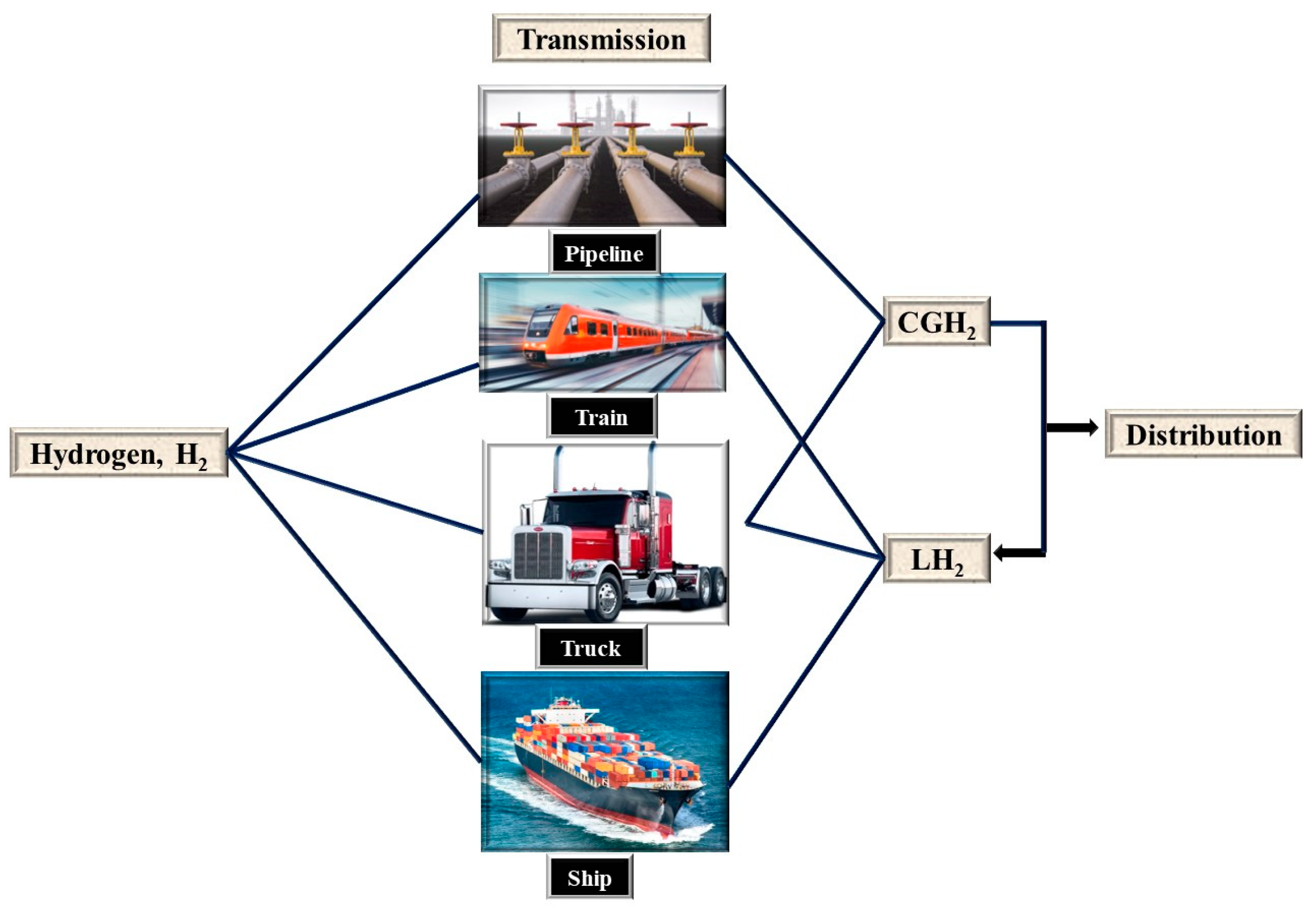
Hydrogen transportation and distribution are crucial aspects in establishing a robust hydrogen infrastructure. This is underscored by its potential as a clean energy source, offering a pathway to a low-carbon, sustainable future. Its high energy density and promise of zero emissions, particularly in hydrogen transportation, make it a desirable choice for several applications [10]. Figure 9 depicts the trend of hydrogen transportation and distribution since the turn of the 20th century. With its large stocks, diverse sources, high energy per mass, and potential to lower carbon emissions, hydrogen is a renewable resource. Due to these remarkable qualities, it is an emerging energy source [97]. Realising the full potential of hydrogen as a clean energy source necessitates a robust hydrogen infrastructure. This infrastructure involves intricate technical details related to the distribution and transportation of hydrogen, with a particular focus on state-of-the-art methods and tools, including ammonia, liquid hydrogen, liquid organic hydrogen carriers (LOHC), cryogenic containers, hydrogen pipelines, hydrogen tankers, and hydrogen filling stations [98]. These advancements include the development of more efficient hydrogen production methods, the improvement of hydrogen storage and transportation technologies, and the establishment of a robust hydrogen refueling infrastructure [59].
Transport systems can be adjusted based on the hydrogen storage model. Transporting hydrogen can be done in three primary ways: via pipeline, by large boats, or by road using trucks and trailers. Rail transit is also a part of road mobility. Since it shares many economic benefits and hydrogen transportation principles with truck-trailer transport, it will not be explored separately. Furthermore, specific innovative and reasonably priced methods are being investigated. Hunt et al. have researched hydrogen transport by balloon [99] and further investigated the feasibility of transporting hydrogen via a marine pipeline [100].

4.1. Hydrogen Pipelines

Nowadays, cryogenic liquid tanker trucks or gaseous tube trailers are used to transport hydrogen from the site of production to the place of usage via pipeline. Pipelines are installed in areas where demand is high (hundreds of tons per day) and is predicted to stay that way for many years. Tube trailers, liquid tankers, and liquefaction plants are used in areas where demand is new or on a lesser scale. On a larger scale, demonstrations of hydrogen supply by chemical carriers, such as barges, are also underway in export markets. Additional infrastructure elements frequently installed at the point of hydrogen use are meters, dispensers, compression, storage, and contamination detection and purification systems [101,102,103]. Several US companies currently distribute bulk hydrogen, and delivery technology for hydrogen infrastructure is available on the commercial market. The development of new technologies, such as chemical carriers for high-density hydrogen transportation and high-throughput fuelling systems for heavy-duty fuel cell transportation, will be necessary to meet the growing demand for hydrogen in the region [104]. Establishing a dependable and effective hydrogen distribution network is crucial for the development of hydrogen pipelines. The purpose of these specialised pipes is to transmit high-purity hydrogen gas over various distances, enabling the smooth transfer of hydrogen from production hubs to end customers. Pipeline integrity is threatened by hydrogen-induced embrittlement, necessitating the application of specialised materials and coatings. Advanced leak detection systems and monitoring technologies are implemented to ensure maximum pipeline performance and the safety and security of hydrogen delivery [59]. For long-distance H2 transportation, pipeline transportation is a viable option. The capacity to retrofit existing natural gas pipes for transporting LOHC and even pure hydrogen gas is a significant benefit of pipeline transportation [105]. In general, after travelling through pipelines, the pressure of hydrogen gas drops, necessitating periodic re-compression. Table 6 displays the pipeline’s detailed data. It is estimated that 5% of the annual gross revenue of the CGH2 transported by the pipeline is allocated to maintenance, covering the ongoing upkeep of compression devices and pipelines. Table 9 shows the data from pipeline modelling [59].

4.2. Ammonia as a Transporter of Hydrogen

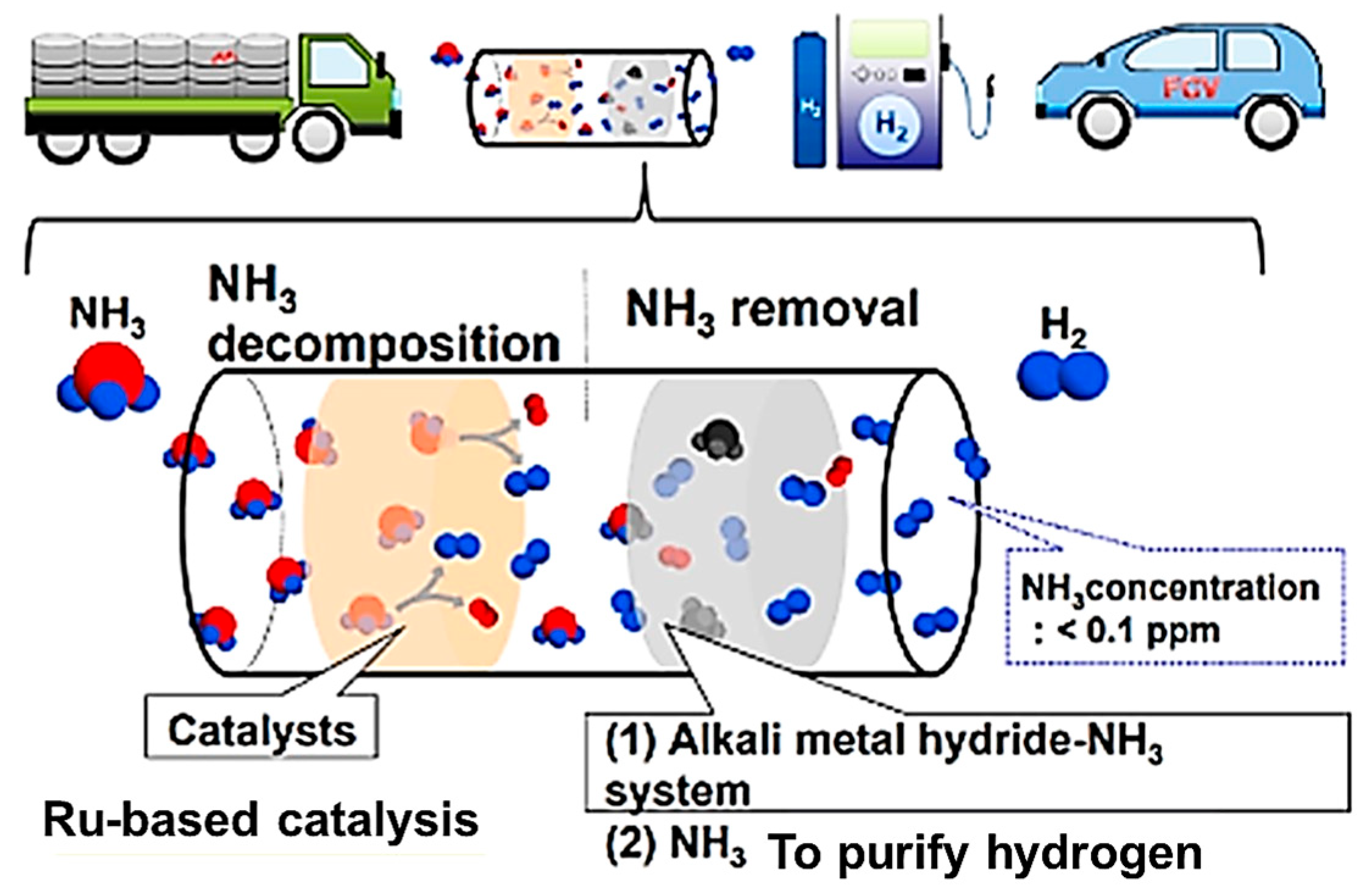
Ammonia (NH3), with a high hydrogen content by weight, has garnered interest as a potential carrier of hydrogen. Ammonia is a viable contender for long-distance hydrogen transportation because of its 17.6% bulk hydrogen content. Its production by the Haber-Bosch process, which combines hydrogen and nitrogen, guarantees a transportable and easily accessible hydrogen source. Ammonia is easily stored and transported in liquid form when refrigerated or subjected to moderate pressure. Because of this characteristic, ammonia is a feasible solution for long-distance hydrogen distribution, which supports energy security and the growth of the hydrogen market [104]. Excellent gravimetric and volumetric H2 densities have been recorded using ammonia as a hydrogen energy carrier. The characteristics of ammonia storage tanks and the energy efficiency of ammonia synthesised from steam methane reforming without and with CCS were examined. According to ISO 13600, an energy carrier is any substance that has the capacity to generate mechanical work or heat. A hydrogen carrier, on the other hand, is a specific type of liquid hydrogen (liquid H2) or liquid hydride. In 2022, 163 million tons of nitrogen were produced worldwide from hydrocarbon sources such as air, water, and natural gas. Figure 10 provides a schematic representation of the ammonia decomposition process [105].
Fertiliser utilises about 80% of the ammonia. Thus, fossil-fuel-based ammonia production plants (producing 2000–3000 tons of ammonia per day and 356–534 tons of hydrogen per day) [104]. Ammonia is also widely used in Japan, even though official records are scarce. The ammonia’s color in Table 10 corresponds to the production of hydrogen. As previously demonstrated, ammonia is categorised using the same colour as hydrogen (see Table 11).

4.3. Liquid Hydrogen Carrier

The outstanding energy density of liquid hydrogen (LH2) makes it an attractive option for long-distance hydrogen transportation. Liquid hydrogen has a substantially higher energy content in its cryogenic state at very low temperatures (−253 °C) and low pressures than conventional hydrogen storage techniques. However, specialised cryogenic containers, or cryo tanks, are needed to transport liquid hydrogen efficiently. Modern insulating materials are used in these containers to reduce boil-off losses and maintain ultra-low temperatures, ensuring safe and effective hydrogen distribution [106]. Like gaseous hydrogen, liquid hydrogen has no flavour, colour, or odour. Liquid hydrogen can be distinguished from gaseous hydrogen primarily by its liquid phase and extremely low temperature. Density in the liquid phase is notably higher (around 848 times that of gaseous hydrogen). Table 12 lists liquid hydrogen’s characteristics [107].
A novel method of storing and transferring materials, LOHC technology forms stable LOHCs by chemically bonding hydrogen to liquid organic molecules. Through a process known as hydrogenation, LOHCs efficiently absorb hydrogen at low pressures and temperatures, providing a secure medium for the transport and storage of hydrogen. A flexible and dynamic hydrogen delivery network is made possible by the release of hydrogen through dehydrogenation, which can be utilised in various ways. LOHC-based hydrogen transportation, which offers a higher volumetric hydrogen density, addresses the issues associated with low hydrogen density. Large-scale hydrogen storage with LOHCs is a desirable alternative that facilitates the integration of hydrogen into the existing infrastructure. They can include up to 6.5 by weight percent hydrogen [68].

4.4. Methanol as a Hydrogen Carrier

To decarbonize the transportation sector, we need a pathway to green hydrogen that is not reliant on large amounts of electric energy, is scalable to support transportation, is cost-competitive with diesel fuel, and offers the near-term potential of being carbon neutral [77]. Hydrogen of the future is today’s methanol. It is a highly effective hydrogen carrier, containing more hydrogen than a single primary alcohol molecule. Since methanol is a liquid at room temperature, it is easily handled, stored, and transported by utilising the infrastructure already in place to support the worldwide methanol trade. To avoid the complexity and high cost of logistics associated with using hydrogen as a fuel, methanol reformers can produce on-demand hydrogen at the point of consumption. For methanol to be a low-carbon, possibly even carbon-neutral, transporter of hydrogen, it can also be generated in an environmentally friendly and sustainable manner [78]. Renewable methanol will replace the grey methanol produced from natural gas in that pipeline shortly. Renewable feedstocks include municipal solid waste (MSW), biomass, digester biogas, CO2 collected from industrial streams, and direct air absorption of CO2. When combined with water, methanol forms a dense hydrogen carrier that can be easily transformed into syngas, a combination of hydrogen and carbon oxides. It is also easy to separate hydrogen that has been purified from syngas. One of the top ten chemical commodities produced worldwide, methanol can bridge the gap between high-carbon fuels like diesel and the ultimate objective of using only renewable energy sources. There is a market for renewable methanol, and numerous new facilities are being built. Outstanding evaluations exist for renewable methanol, which includes estimates of costs and current commercial operations. It will take time for renewable methanol to be used on a large scale, but as demand for renewable methanol rises, producers throughout the world are investing to boost output.

4.5. Comparison of Various Techniques for Transporting Hydrogen

The cost of supply chain integration must be considered when determining the most economical method of transporting hydrogen. In addition, the amount, distance, and investment must be considered, as noted by Riera et al. It is evident from Table 13 that LH2’s total transportation costs are less than those of CGH2. With an emphasis on pressure, depreciation duration, capacity, transportation cost, CAPEX, and OPEX, Table 13 compares and contrasts relevant data for the hydrogen transportation techniques discussed from publications (mainly for Germany and Europe) [92]. If LH2 is only carried a short distance, this benefit can be offset by the high cost of the liquefaction process. According to a case study for Germany, even though CGH2’s transportation costs are higher, its final product cost is the most competitive at a 130 km transportation distance. For medium distances, LH2 transfer by vehicle is, therefore, economical. However, the boil-off loss will become non-negligible and negatively affect the cost if the transit distance is excellent. Table 6 also suggests that the pipeline seems to be the least expensive method of moving CGH2 (compressed gaseous hydrogen storage) [108]. This is accurate, provided that a significant quantity of hydrogen can be transported across a considerable distance. As a result, it is a beneficial transport technique for directly supplying hydrogen to huge industrial user groups [109]. Transportation of hydrogen for civil users, such as hydrogen refuelling stations, may be another profitable application for a pipeline despite the lack of experience and data in this area. This path may require more investigation and analysis in the future. Ship transport will be the most cost-effective choice if the hydrogen exporter and importer are connected by water rather than by pipeline [110]. The benefits and drawbacks of the various hydrogen shipping technologies-such as LH2, CGH2, NH3, and LOHC-vary. The final price of hydrogen may be significantly impacted by additional costs related to the preparation of hydrogen for transportation and release (compression, liquefaction, hydrogenation, dehydrogenation, etc.), in addition to the ship’s CAPEX (capital expenditure) and OPEX (operating expenditure) costs and the cost of inland transportation. The advantages of LH2 shipping include the high energy content and the ability to run the liquefaction on the exporter side, where energy is less expensive [111].
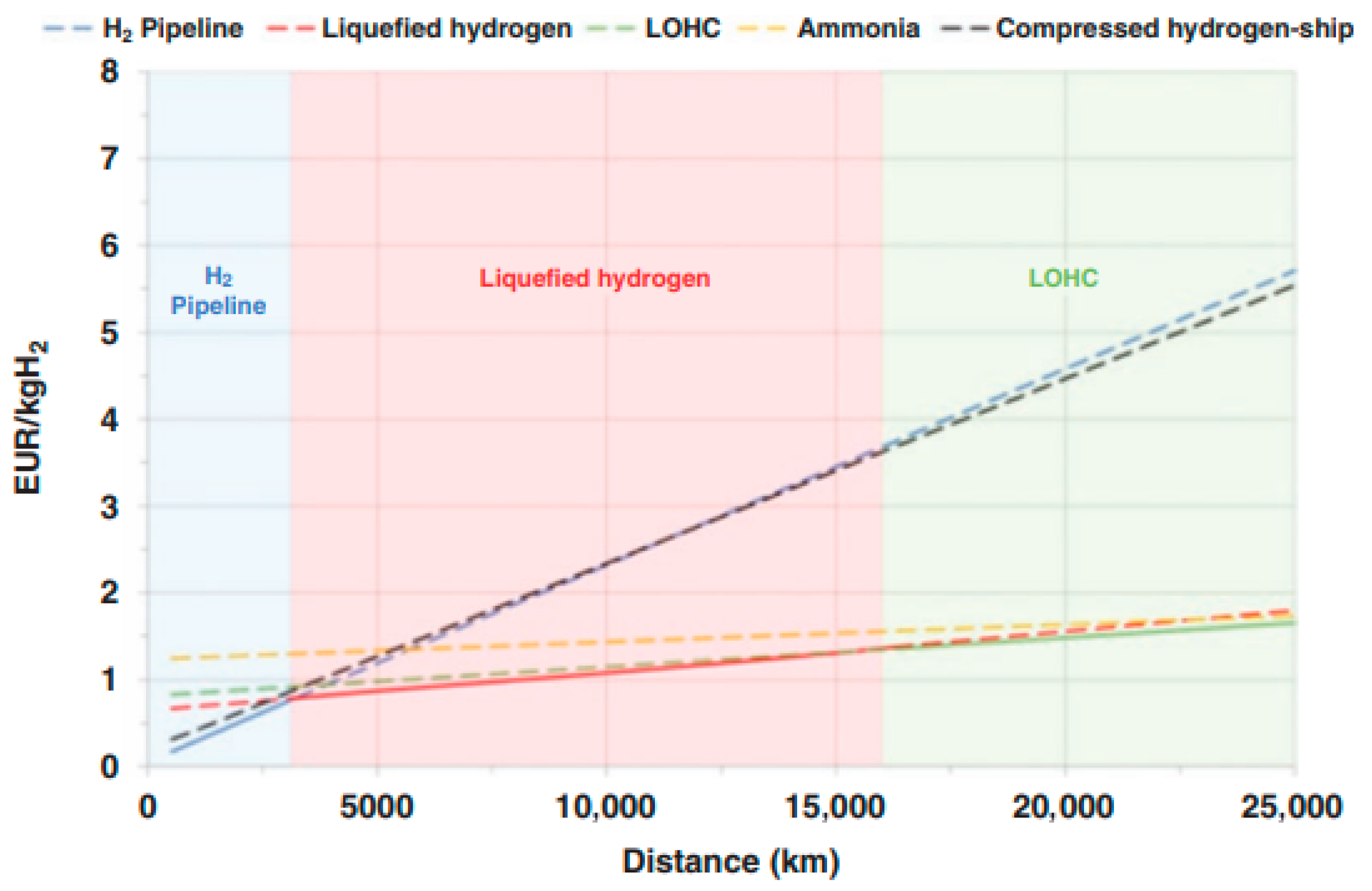
The infrastructure for hydrogen will develop further through ongoing research, technical breakthroughs, and wise investments, resulting in a robust and linked ecosystem for hydrogen. With the help of hydrogen’s plentiful and clean energy potential, we can clear the way for a more environmentally friendly and sustainable future by tackling technological obstacles and adopting creative solutions [111]. However, the boil-off effect limits the maximum sailing distance and sailing time of an LH2 ship. The preferred shipping distance of the Joint Research Centre (JRC), the research and knowledge department of the European Commission, falls between 2500 and 16,000 km. This addresses the Saudi Arabia to Rotterdam LH2 shipping route. The most successful initiative for transcontinental LH2 transport is HySTRA. Australia and Japan work together to produce grey hydrogen from brown coal. To turn it into blue hydrogen, a CCS device will be implemented later. With significant advancements, the project offers a sizable test field for portside handling, loading/unloading, and LH2 shipment. The first LH2 ship constructed by Kawasaki, the SUISO FRONTIER, was launched in December 2019 and completed by mid-2020. Beginning in 2021, the first hydrogen with a purity of 99.999% was produced. Following COVID-19-related delays, the SUISO FRONTIER’s journey commenced in early 2022. Over 9000 km and 16 days, it transports 1250 m3 and 75 t of LH2 at 10 K [111]. Although the SUISO FRONTIER still has a diesel engine, the upcoming ships are expected to run on hydrogen. Despite the JRC’s estimates that, from an economic perspective, LOHC would be the most suitable option for transporting hydrogen over very long distances (see Figure 11), no LOHC shipping infrastructure has been implemented as of yet. The LOHC cycle is being tested at several locations, although none operates on a size similar to shipping. Additional advancements in technology are still required to lower the energy requirements for dehydrogenation and maintain the stability of the catalysts [111].
Reducing costs, boosting energy efficiency, preserving hydrogen purity, and avoiding hydrogen leakage are the key obstacles to hydrogen transportation. To examine the trade-offs between the possibilities for producing hydrogen and delivering it as a system, further research is required. Another major problem is developing a nationwide infrastructure for transporting hydrogen. Its development will probably involve combining several different technologies, and it will take time. The resources and needs for delivery infrastructure will differ depending on the geography and kind of market, such as rural, interstate, or urban. As delivery methods advance and the demand for hydrogen rises, so will the available infrastructure [112]. Comparing different methods of transporting hydrogen, the ultimate costs of transporting hydrogen via various routes (including the cost of hydrogen generation, conversion, transportation, and hydrogen loss during conversions and transportation) were examined and contrasted (see Table 13). They came to the conclusion that the costliest option out of all the transportation options that could be examined was the supply of hydrogen in the form of ammonia, both by ship and by trailer on the road (shipping: ≤180 000 km; on the road: ≤5000 km). LH2 trucks or CGH2 pipes were the most cost-effective inland routes for transporting hydrogen over vast distances, exceeding 1000 km. The survey also found that LH2 shipping was the most affordable method of sending goods across the ocean, with LOHC shipping coming in second. Table 14 may serve as a future reference for identifying the most cost-effective way to transport hydrogen, based on this comparison of several methods.
Pipelines designed for the transport of compressed hydrogen are ideal for extensive land-based flows, as compressors effectively reduce pressure losses, similar to those used for natural gas. Incorporating hydrogen into current gas networks (up to 10–20% volume) offers a gradual decarbonisation strategy, albeit with limited CO2 reductions and higher energy costs. In the context of intercontinental transport, the available options encompass liquefied hydrogen (LH2), ammonia, methanol, and liquid organic hydrogen carriers (LOHCs). Liquid hydrogen enables the direct delivery of unadulterated hydrogen, even accounting for losses incurred during liquefaction. Ammonia, despite its density and efficiency, experiences considerable energy losses during its synthesis and cracking processes. LOHCs reduce standing losses and leverage existing logistics; however, they incur significant energy penalties during dehydrogenation. In terms of mobility, compressed gas systems are preferred for both light- and heavy-duty applications, while chemical carriers are more effective as intermediate solutions closer to end use. The overall pros and cons of hydrogen transportation routes are illustrated in Table 15.

4.6. A Mix of Hydrogen and Natural Gas in the Distribution Network

Hydrogen blending into existing natural gas networks is increasingly viewed as a pragmatic, near-term bridge between today’s methane-dominated systems and a future dedicated hydrogen infrastructure. In low to medium-pressure distribution grids, numerous technical assessments and pilot projects indicate that blends of around 5–20 vol.% hydrogen can usually be transported without major modifications to polyethene (PE) distribution mains and many end-use appliances, enabling incremental decarbonisation of heat and power while leveraging sunk infrastructure costs [116]. At these modest blend levels, most combustion equipment can tolerate the higher flame speed and lower volumetric energy content with only limited adjustments, and studies classify the additional safety risk as minor, provided gas quality monitoring and leakage detection are upgraded. From a system perspective, blending allows early electrolyser projects and industrial by-product hydrogen to find a market before dedicated hydrogen pipelines and end-use clusters exist, smoothing demand growth and supporting investment in low-carbon hydrogen production.
However, hydrogen blending is not a free-lunch decarbonisation strategy and faces several intrinsic limitations. First, the emissions benefit is capped by the blending limit: replacing 10–20% of the natural gas volume with zero-carbon hydrogen reduces combustion-phase CO2 emissions by roughly 7–18%, because hydrogen has a lower energy density per unit volume than methane. Life-cycle analyses of blended pipelines confirm that upstream and end-use CO2 emissions fall with increasing hydrogen fraction, but this gain is partly offset by higher compression energy-hydrogen’s lower density means more work is needed to deliver the same energy and by any upstream emissions from hydrogen production itself if it is not fully renewable [117]. Second, materials and integrity constraints limit maximum blending levels, especially in high-pressure transmission lines and older distribution assets. Hydrogen can exacerbate fatigue and fracture in vintage steels and welds (embrittlement), and elastomeric seals and some plastics show altered mechanical properties and higher permeation in hydrogen-rich environments, requiring detailed asset-specific assessments before raising blend ratios. Third, end-use compatibility is often governed by the most sensitive equipment on the network; while many boilers and turbines can tolerate moderate blends, gas engines, industrial burners, and metering/calibration systems may require redesign or replacement beyond about 10–20% hydrogen by volume, especially where standards still impose very tight limits on hydrogen content (as low as 0.5–4% in some EU member states) [117,118].
These constraints mean that hydrogen blending should be understood as a transitional and context-dependent option rather than a universal long-term solution. Its strongest role is likely in regions with modern PE-dominated distribution grids, relatively homogeneous appliance fleets, and ready access to low-carbon hydrogen, where 5–20% blending can quickly cut emissions from building heat and small industry while dedicated pure-hydrogen backbones and end-use conversions are planned. In contrast, for high-pressure transmission systems, ageing steel infrastructure, or networks with diverse and sensitive industrial loads, the technical effort to verify integrity and retrofit or replace incompatible assets can erode the apparent cost advantage. Ultimately, once hydrogen demand becomes substantial, converting selected pipelines fully to 100% hydrogen or building new hydrogen-only corridors will deliver far greater decarbonisation impact per unit of hydrogen than continued low-level blending, and several European TSOs have already started this process. Framing blending explicitly as a time-limited integration tool, with clear regional thresholds and exit strategies, therefore provides a more analytically robust view than treating it as an end-state for hydrogen transport [118].

5. Hydrogen in Industrial Applications

Hydrogen is recognised as a versatile energy carrier and reducing agent in various industrial applications. The role of this technology in transforming and decarbonising traditional manufacturing processes is particularly significant in the refining and petrochemical industries, as well as in ammonia and methanol production, and the steel and metal processing sectors. Hydrogen energy is utilised in various industries, notably the oil and chemical sectors, as well as in steel processing. In the oil and chemical industry, the majority of hydrogen is utilised for hydrogenation, hydrocracking, and desulfurization [119]. The processes are designed to improve fuel quality and decrease sulphur emissions, as mentioned in the work of Abe et al. [120]. The demand for hydrogen in these applications has increased significantly due to stricter environmental regulations and the industry’s shift toward cleaner fuels. The hydrogen necessary for these processes is conventionally obtained through steam methane reforming (SMR), which, while efficient, is associated with high carbon emissions [121]. Recent developments focus on integrating renewable hydrogen generated through electrolysis, utilising excess renewable energy to promote sustainability [53]. Hydrogen is utilised in the synthesis of ammonia, primarily for fertilisers, and in the production of methyl alcohol within the chemical industry. Hydrogen constitutes approximately 60% of the volume in ammonia synthesis, with this proportion increasing to 80% in China. The volume of hydrogen utilised in oil refining ranks second to its use in ammonia synthesis. The Haber-Bosch process synthesises ammonia and necessitates hydrogen as a crucial reactant. Historically, hydrogen used in ammonia production has been sourced from fossil fuels, resulting in significant CO2 emissions. With the emergence of renewable hydrogen production, there is an increasing shift towards “green ammonia” production, which employs hydrogen generated from water electrolysis powered by renewable energy sources. This approach reduces carbon emissions and aligns with international sustainability initiatives focused on achieving carbon neutrality [53,122].
The steel industry is among the largest contributors to global greenhouse gas emissions, primarily due to its reliance on coal and coke in blast furnace processes. The incorporation of hydrogen in steelmaking processes presents a significant opportunity for decarbonisation. The use of hydrogen in the steel industry fulfils two functions: it acts as an intermediate product in the steel production process. This hydrogen production method is economically viable; however, the generated hydrogen is primarily utilised to support combustion within the furnace, with minimal quantities available for external use. Additionally, it functions as a protective gas in the cold rolling process. As carbon emission limits become increasingly stringent, an increasing number of steel manufacturers are adopting hydrogen power as a replacement for carbon in metallurgical processing. The principle involves substituting hydrogen for carbon as a reductant in direct reduction iron (DRI) processes, which notably reduces CO2 emissions. A typical example is the Salcos project inaugurated by the Salzgitter Group in Germany [123]. The project mitigates carbon emissions by incorporating hydrogen and natural gas into the iron smelting reduction process. This technology faces challenges, including the procurement of competitive green hydrogen and the need for operational efficiency, which must be resolved to effectively scale its implementation [124,125]. This project aims to utilise solar energy, wind energy, and other clean energy sources to replace hydrogen, thereby contributing to a further reduction in carbon emissions. Hydrogen is essential in the production of methanol. Hydrogen reacts with carbon monoxide and carbon dioxide to produce methanol, which serves as a precursor for numerous chemicals and fuels. The conventional production of methanol, similar to ammonia, predominantly depends on hydrogen derived from steam methane reforming (SMR). Advancements in catalytic processes and the utilisation of hydrogen derived from renewable sources are crucial for establishing a sustainable methanol production cycle. Recent advancements in CO2 utilisation, alongside hydrogen production, may facilitate a closed-loop system that enhances sustainability and reduces the carbon footprint associated with methanol production [126].

6. Hydrogen in Transportation

6.1. Hydrogen Fuel Cell Vehicles (HFCVs)

The transportation industry substantially contributes to global greenhouse gas emissions, with road vehicles accounting for around 74.5% of the total emissions. The urgent need for decarbonization in this sector has increased interest in hydrogen fuel cell vehicles (HFCVs), which offer a feasible solution for achieving zero-emission mobility. Hydrogen fuel cell cars (HFCVs) utilise hydrogen as a fuel source, turning it into electricity via a polymer electrolyte membrane (PEM) fuel cell, producing only water and heat as by-products. The direct conversion process eliminates combustion-related emissions, positioning hydrogen fuel cell vehicles (HFCVs) as a notable clean alternative to internal combustion engine (ICE) vehicles [119,125]. Recent improvements in fuel cell technology have significantly improved the efficiency, longevity, and economic viability of hydrogen fuel cell vehicles (HFCVs). Leading car manufacturers, such as Toyota, Hyundai, and Honda, have launched models like the Mirai and NEXO, demonstrating driving ranges exceeding 500 km and refuelling durations comparable to those of conventional vehicles. These vehicles offer substantial advantages for long-range and heavy-duty applications, where battery electric vehicles (BEVs) face limitations due to battery weight and charging times [119]. The environmental benefits of hydrogen fuel cell vehicles (HFCVs) are substantial, with life cycle studies indicating a decrease in greenhouse gas emissions by 50–90% compared to internal combustion engine (ICE) vehicles, depending on the hydrogen manufacturing technique utilised. The generation of hydrogen using renewable energy sources, such as electrolysis, significantly reduces the carbon footprint of hydrogen fuel cell vehicles (HFCVs), thereby supporting global climate goals. Nonetheless, the predominant method for hydrogen production, steam methane reforming (SMR), is energy-intensive and produces CO2 emissions, underscoring the imperative for a transition to green hydrogen [123]. Hydrogen Fuel Cell Vehicles face numerous obstacles that hinder their widespread adoption, despite their promise. The infrastructure for hydrogen refueling is insufficient, as the quantity of stations markedly trails that of traditional fueling options. The high costs associated with fuel cell stacks, hydrogen storage tanks, and the production of green hydrogen substantially hinder market growth. The storage of hydrogen under high pressure presents safety issues that necessitate robust engineering solutions and regulatory supervision. Investigation of novel methodologies, such as onboard hydrogen production via ethanol steam reforming and the incorporation of hybrid systems, seeks to mitigate these constraints. Ethanol, derived from renewable biomass, functions as an economic and ecological precursor for hydrogen production, potentially enabling a closed carbon cycle. Fuel Cell Hybrid Electric Vehicles (FCHEVs) employ larger batteries to enhance energy recovery and performance, therefore augmenting the viability of hydrogen-powered transportation. Supportive policies are crucial for the advancement of hydrogen fuel cell vehicles (HFCVs). Governments and industry players are dedicating money to infrastructure development, research and development, and regulatory frameworks to accelerate adoption. Financial incentives, subsidies, and clearly articulated standards are essential for fostering innovation and securing market acceptability. Due to technological improvements and the expansion of green hydrogen generation, hydrogen fuel cell cars (HFCVs) are expected to play a crucial role in the future of sustainable transportation [119].

6.2. Maritime and Aviation Applications

The maritime industry accounts for approximately 3% of global greenhouse gas emissions, necessitating substantial initiatives for decarbonization through the use of hydrogen-based technologies. Hydrogen fuel cells are progressively utilised in ferries, service vessels, and coastal ships, especially on short, predictable routes where centralised recharging infrastructure is viable. Demonstration projects, such as the Sea Change ferry in San Francisco and Norled’s MF Hydra in Norway, illustrate the feasibility of hydrogen-powered vessels, providing low-emission alternatives to diesel propulsion [127]. Advancements in hydrogen storage technology, encompassing compressed and liquid hydrogen, offer versatility for nautical applications. Liquefied hydrogen, maintained at −253 °C, provides superior energy density and is appropriate for larger vessels necessitating increased range. Hybrid systems integrating hydrogen fuel cells with batteries or traditional fuels enable progressive transitions while ensuring operational dependability and sustainability [128]. Hydrogen-powered vessels mitigate noise pollution, as fuel cell systems function silently with few moving components. The utilisation of green hydrogen significantly decreases lifecycle emissions, contingent upon the integration of renewable energy into logistics systems. Ports like Rotterdam and Antwerp-Bruges are in the forefront of establishing extensive hydrogen import, distribution, and refuelling infrastructures, establishing global benchmarks for maritime decarbonisation. Policy advancements, notably the International Maritime Organisation’s (IMO) objective of achieving net-zero emissions by 2050, are promoting research, investment, and public–private partnerships. Significant subsidies and support measures, exemplified by the European Union’s green hydrogen program, aim to bridge the cost disparity with fossil fuels and promote initial industrial development. Due to technological breakthroughs and reduced manufacturing costs, hydrogen is anticipated to progressively compete in maritime applications [129,130]. In aviation, hydrogen’s elevated energy density and low weight position it as a prime contender for sustainable aircraft fuels. Both fuel cell-driven electric propulsion and direct hydrogen combustion are experiencing rigorous advancement, particularly in small aircraft, air taxis, and short-haul commercial aviation. Companies such as Airbus and ZeroAvia have conducted successful test flights and formulated plans for hydrogen-powered aircraft to commence commercial operations by 2035. Three Aviation infrastructure has distinct issues, such as hydrogen storage, transportation, and management at airports, necessitating significant investment and stringent safety measures. Innovations like mobile liquid hydrogen refuelling vehicles and airport hydrogen ecosystems are propelling the field forward. Aviation aims to achieve its net-zero objectives by utilising sustainable aviation fuels (SAF) sourced from green hydrogen, contingent upon ongoing international collaboration and financial backing to facilitate scientific and regulatory progress [52,130].

6.3. Hydrogen Trains and Heavy-Duty Vehicles

Hydrogen fuel cell technology is developing into a significant clean propulsion alternative for trains, particularly in areas where the installation of electrified lines is impractical or prohibitively expensive. Germany has led the implementation of several hydrogen units for passenger service, providing zero-emission operation, reduced noise, and practical refueling intervals. The trains employ modular fuel cell systems derived from heavy-duty trucks, providing the necessary performance for extended routes while emitting only water vapour as a byproduct. Projects in California, Japan, and Switzerland are progressing in alignment with ambitious objectives for low-carbon rail networks, supported by substantial government investment [59]. California’s hydrogen commuter trains commenced operations in 2024, marking the inaugural deployment of this technology in North America, offering a viable alternative to diesel in regions lacking electrification. The international implementation of hydrogen trains is intricately connected to the advancement of hydrogen production and refueling infrastructure, which can support both locomotives and heavy-duty trucks within a unified logistics framework.
The capabilities of hydrogen fuel cell vehicles (HFCVs) across different transportation modes, such as buses, aircraft, and ships, are noteworthy. With buses constituting 63% of urban public transport, they play a crucial role in facilitating mobility. Although diesel buses continue to dominate, cleaner alternatives such as battery-electric buses (BEBs) and fuel-cell buses (FCBs) are emerging. Fuel cell buses, while currently costly and primarily utilised in pilot projects, have the potential to reduce emissions by up to 93% when powered by green hydrogen. BEBs appear more suitable for urban applications in the near future, while FCBs may be preferred over time due to their extended driving range. The current cost of FCBs is approximately 40% higher than that of diesel buses, which poses a challenge to their adoption. Nevertheless, technological advancements are expected to reduce costs, with BEBs projected to surpass diesel prices by 2027 and all bus technologies achieving cost parity by 2050 [119].
Heavy-duty vehicles, such as long-haul trucks, buses, and commercial fleets, are particularly well-suited for hydrogen fuel cells due to their significant energy demands, substantial payload capacities, long driving ranges, and the need for quick refueling, Figure 12. These vehicles offer operational benefits compared to battery electric alternatives, particularly in terms of refueling speed and payload capacity [119,127]. The market for hydrogen heavy-duty vehicles remains in its early stages, characterised by limited deployments that are bolstered by federal and state investments, particularly in designated “hydrogen hubs”.
Experts recommend that the application of hydrogen be concentrated in sectors lacking viable zero-emission alternatives, including remote freight rail and long-haul trucking. The expansion of renewable hydrogen production and the optimisation of refueling infrastructure could enhance applicability and expedite the transition to cleaner alternatives in various commercial transport sectors [127]. The effective scale-up of hydrogen trains and heavy-duty vehicles depends on improvements in fuel cell durability, reductions in costs, market incentives, and the coordinated development of infrastructure. Initial high-value applications will enhance investment and public trust, propelling the hydrogen transport economy forward [59].

6.4. Infrastructure Development for Hydrogen Refuelling

The infrastructure for hydrogen refuelling is crucial for the advancement of hydrogen-powered vehicles; however, it is currently unevenly distributed and underdeveloped on a global scale. Regions such as Germany, Japan, and California have achieved notable advancements through public–private partnerships, incentive programs, and targeted investments. Germany plans to establish more than 400 hydrogen stations by 2025, with comparable goals in Japan and the European Union [119,127]. Establishing hydrogen refuelling stations incurs higher costs than traditional or electric charging stations, primarily due to the technical complexities of hydrogen compression, storage, and delivery. Achieving economies of scale and integrated supply chains, encompassing hydrogen production (ideally through renewable energy), safe distribution, and high-pressure dispensing, is essential for cost reduction and the development of self-sustaining station networks. California’s Hydrogen Highway and the European Hydrogen Backbone serve as examples of collaborative initiatives aimed at overcoming infrastructure challenges [119]. Future infrastructure will incorporate hydrogen refuelling alongside other modalities, such as electric vehicle fast charging and liquefied natural gas (LNG), resulting in multi-fuel transport hubs that emphasise flexibility and digital fleet management. Heavy-duty hydrogen corridors, especially for freight and public transport, are emerging as primary focus areas, utilising higher throughput to enhance economic viability. Initial infrastructure deployment may necessitate station operators to tolerate low utilisation rates until vehicle numbers rise, thereby requiring public underwriting or regulation. Upon reaching critical density, stations enhance their profitability and resilience, facilitating broader adoption and expansion into passenger markets and rural areas [127]. Safety considerations are critical in hydrogen storage and dispensing due to the flammability of hydrogen. Modern hydrogen refuelling stations are as safe as petrol or natural gas stations due to rigorous industry standards, risk assessments and established design protocols. Vehicles and tanks undergo extensive testing, including crash scenarios, to verify their roadworthiness and enhance consumer confidence [127]. The development of hydrogen refuelling infrastructure relies on collaborative efforts among governments, manufacturers, energy providers, and consumers (Table 16 and Table 17). The expansion of renewable hydrogen production necessitates the integration of clean energy infrastructure with green mobility, positioning hydrogen refuelling infrastructure as a critical component in global decarbonisation initiatives [119,127].

7. Hydrogen in Residential and Commercial Applications

The global transition to sustainable energy systems has rendered hydrogen an essential element in attaining carbon neutrality targets by 2050 [134]. Hydrogen technologies are projected to attract $680 billion in investments by 2030, with more than 1572 projects announced worldwide. The residential and commercial sectors, which significantly impact global energy consumption and carbon emissions, present considerable opportunities for integrating hydrogen. The combustion of hydrogen produces water vapour solely as a by-product, rendering it appealing for construction applications where decarbonisation poses difficulties. The hydrogen economy in the residential and commercial sectors is anticipated to expand significantly by 2030. The UK hydrogen sector is projected to generate 30,000 direct jobs and produce more than £7.0 billion in annual gross value added (GVA) by 2030. Nonetheless, hydrogen heating is expected to be the least significant sub-sector for employment generation by 2030. The residential hydrogen fuel cell market exhibits significant growth potential, with a compound annual growth rate of 7.1% projected from 2025 to 2031 [135]. Japan epitomises this trend, having installed over 300,000 residential fuel cell systems in residences that provide hot water and power.
The integration of hydrogen in residential and commercial structures necessitates comprehensive infrastructure development encompassing production, storage, and distribution networks. The worldwide investment deficit for hydrogen infrastructure is significant, with an estimated $190 billion required to achieve net-zero targets by 2030. Three principal methods for hydrogen supply to buildings comprise dedicated hydrogen pipelines, integration with natural gas in existing infrastructure, and decentralised production systems. Integrating hydrogen with natural gas provides a transitional option that considerably diminishes the need for infrastructure expenditure. Global projects have successfully implemented hydrogen blending ratios ranging from 5% to 20%, contingent upon the availability of green hydrogen and adherence to safety regulations. The shift to 100% hydrogen systems introduces complex challenges, particularly in the need for substantial updates to building codes and standards to meet hydrogen-specific safety requirements. Hydrogen-ready appliances serve as a transitional technology, capable of operating on natural gas initially and being converted to hydrogen through straightforward component replacement and recommissioning processes [136]. Hydrogen applications in buildings provide significant environmental advantages over traditional fossil fuel systems. Research indicates that transitioning to hydrogen-based heating systems can reduce carbon emissions by approximately 50% compared to conventional heating methods. Energy efficiency characteristics differ markedly across various hydrogen applications, with fuel cell systems attaining electrical efficiencies of 35–45% and overall system efficiencies surpassing 80% when heat recovery is utilised. Safety considerations are essential in the implementation of hydrogen in buildings. Modern hydrogen systems integrate various safety features, such as leak detection systems, automatic shut-off valves, and specialised materials designed for hydrogen service. Regulatory frameworks are adapting to accommodate hydrogen applications in buildings. In the UK, standards such as PAS4444 offer technical specifications for appliances designed to transition from natural gas to hydrogen operation [135,137].

7.1. Hydrogen Heating Systems Technology

Hydrogen heating systems represent an innovative approach to space and water heating, functioning through the direct combustion of hydrogen in specialised boilers that are designed to react with pure oxygen or atmospheric air [138]. These systems address the key differences in combustion between hydrogen and natural gas, including hydrogen’s higher flame speed and wider flammability limits. Contemporary hydrogen boilers demonstrate significant environmental efficiency, emitting solely water vapour as a by-product of combustion. Commercial hydrogen heating applications are progressing swiftly, as manufacturers create specialised boilers for extensive installations. BDR Thermea Group has developed the inaugural pure hydrogen boilers for commercial use, designed for both standalone operation and hybrid setups with heat pumps. These systems enable commercial users to leverage hydrogen’s potential, providing flexibility for managing peak loads and enhancing grid stability services. Commercial hydrogen boilers are capable of achieving capacities that meet the requirements for district heating applications, hospitals, office buildings, and industrial facilities [139].
Hydrogen cooking applications are emerging as viable alternatives to traditional gas cooking systems. Several manufacturers have developed prototype hydrogen cooking appliances, including hobs, ovens, and comprehensive cooking ranges designed for operation solely on hydrogen. The HyCookers consortium has developed a series of certified hydrogen gas cooking appliances, illustrating the technical viability of hydrogen for use in domestic kitchens. The shift to hydrogen cooking necessitates a thorough evaluation of appliance compatibility and the conversion processes involved. Research indicates that current natural gas appliances are unable to directly use pure hydrogen without substantial modifications, owing to inherent differences in combustion properties. Hydrogen-ready appliances serve as a transitional technology that mitigates the challenges of conversion. These appliances are engineered for initial operation on natural gas and can be converted to hydrogen operation via component replacement and recommissioning [140]. The emergence of dual-fuel appliances that can function on both natural gas and hydrogen provides adaptability throughout the transition phase. These systems utilise adaptive combustion controls that automatically modify operating parameters according to fuel composition, thereby ensuring optimal performance across various fuel types. Hydrogen heating and cooking systems exhibit enhanced efficiency compared to traditional options. Hydrogen boilers can attain thermal efficiencies greater than 90% through the integration of condensing heat recovery technology. The complete combustion of hydrogen removes partial combustion products, leading to cleaner heat transfer surfaces and decreased maintenance needs. The energy content of hydrogen plays a crucial role in system design and operation, as its heating value is three times greater than that of petrol, offering significant advantages in energy density. Hydrogen’s lower volumetric energy density relative to natural gas necessitates careful consideration of fuel delivery and storage systems to ensure sufficient heat output [141]. Hydrogen heating and cooking systems provide notable environmental benefits by emitting no carbon dioxide, carbon monoxide, or particulate matter. The emission characteristics of hydrogen heating render it particularly advantageous in urban areas with stringent air quality standards.
It must be noted that hydrogen has a lower density than methane, meaning that if your existing boiler were to operate solely on hydrogen, there would be a significant risk of gas leaks. Consequently, hydrogen boilers require specific adaptations to mitigate these risks, leading to variations in their components, such as the flame detector and burner. It is important to distinguish hydrogen boilers from hydrogen-fuel-cell boilers and hydrogen-ready boilers, as they represent different systems. This approach is currently in the preliminary stages of investigation and development; it is anticipated to be one of several strategies for facilitating comprehensive decarbonisation. Options are being evaluated to determine how currently certified heating engineers might assist in transforming products designed with this objective in mind.

7.2. Hydrogen-Powered Appliances

Residential fuel cell systems represent the most sophisticated application of hydrogen technology in home environments, utilising hydrogen extracted from natural gas or a direct hydrogen supply to produce electricity and thermal energy for residential purposes. Since 2009, these systems have been commercially available in Japan and are currently installed in over 300,000 homes. The operational principle of these systems entails the extraction of hydrogen via steam reforming of natural gas or direct hydrogen input, followed by electrochemical conversion with oxygen to generate electricity and heat. This process achieves high efficiencies, with contemporary systems attaining 35–45% electrical efficiency and overall system efficiencies exceeding 80% when thermal energy is recovered. The integration of residential fuel cell systems with hot water storage facilitates a comprehensive energy supply for domestic applications, delivering 0.3–1.0 kW of continuous electrical power [142]. During times of increased electrical demand, power is sourced from the electrical grid, while surplus thermal energy is retained in integrated hot water tanks for space heating and domestic hot water use. Hydrogen-powered water heating signifies a notable progression in domestic appliance technology, exemplified by Rinnai Corporation’s development of the first residential water heaters utilising 100% hydrogen combustion technology. This innovative technology exhibits performance comparable to traditional gas water heaters, while also eliminating carbon dioxide emissions. The technical achievement of hydrogen water heaters includes advanced combustion control systems that regulate the rapid combustion properties of hydrogen [143].
Space heating technologies encompass a range of solutions, including direct heating appliances, integrated building systems, and conventional boiler applications. Hydrogen-ready local space heaters include flue-less, conventional flue and balanced-flue designs, intended for initial operation on natural gas, with the capability for conversion to pure hydrogen. The incorporation of hydrogen space heating within building thermal management systems enhances efficiency by facilitating the recovery of waste heat. Hybrid heating systems that integrate hydrogen with heat pump technology are an emerging field, utilising hydrogen for peak thermal loads and heat pumps for base load heating, thereby optimising energy efficiency under varying demand conditions. Commercial and industrial applications adapt residential technologies to fulfil the greater capacity demands characteristic of business and institutional settings [144]. Commercial hydrogen boilers vary in scale, ranging from small applications with capacities between 50 and 500 kW to large institutional systems that exceed 1 MW. Industrial hydrogen appliances encompass specialised applications such as process heating, steam generation, and manufacturing support systems. Hydrogen-powered appliances utilise various safety systems designed to address the distinct characteristics of hydrogen. Leak detection systems continuously search for the presence of hydrogen through specialised sensors that account for hydrogen’s small molecular size and rapid dispersion characteristics. Hydrogen appliances have distinct ventilation requirements compared to traditional gas systems, attributed to the buoyancy and rapid dispersion properties of hydrogen. Hydrogen appliance maintenance protocols highlight the necessity of specialised training and certification for service technicians [139].
Table 18 compares prominent hydrogen applications with their primary low-carbon alternatives, emphasising advantages and disadvantages, conversion losses, and long-term viability. This comparison highlights a growing consensus: hydrogen is most viable in sectors where direct electrification poses technical challenges (such as steel, ammonia, certain heavy transport, and long-duration storage). Conversely, for numerous widespread applications (including cars, buildings, and short-term storage), more direct electrical pathways yield significantly higher system efficiency and lower long-term costs.

7.3. Backup Power Systems

Hydrogen-based backup power systems represent a significant advancement in the energy sector, offering clean and dependable hybrid power solutions. These systems amalgamate hydrogen fuel cells with conventional uninterruptible power supply (UPS) infrastructure, augmented by brief-duration battery backup. The essential architecture of these systems comprises hydrogen storage tanks, fuel cell stacks for electrochemical energy conversion, power inverter systems for voltage regulation and frequency control, energy management systems for load monitoring and system optimisation, short-term battery systems for immediate power delivery, cooling systems for thermal regulation, and integrated control and safety systems [145]. Contemporary hydrogen backup power systems exhibit exceptional performance attributes compared to traditional options. The H2Genset mobile generator features a peak output of 28 kW and a nominal continuous power of 10 kW, operating for 14 to 24 h, depending on the internal tank design. These systems operate at 50% efficiency, generating only water vapour as a by-product, so rendering them highly environmentally sustainable. Residential hydrogen backup power systems offer complete energy autonomy for households desiring dependable electricity during grid failures. Oncore Energy offers scalable residential systems with capacities ranging from 4 kW for smaller homes (1500–2000 sq. ft.) to over 20 kW for larger residences, including extendable options. Solar-powered hydrogen generators facilitate a complete off-grid life by converting surplus solar energy into hydrogen for prolonged utilisation [146,147]. This method mitigates the primary drawback of battery storage systems, which deteriorate over time, by offering hydrogen storage that preserves energy potential for weeks or months without degradation. Commercial and industrial backup power systems are designed to accommodate the significant power demands of corporate and institutional establishments. Data centres serve as a principal application domain for hydrogen-based UPS systems, which offer benefits such as elevated energy density, environmental sustainability, rapid reaction times, and scalable flexibility. Hydrogen engines can deliver substantial energy for an extended power supply during outages, surpassing traditional battery systems [148]. The industrial uses of hydrogen backup power include manufacturing plants, hospitals, and other forms of essential infrastructure that necessitate a prolonged backup power supply. PowerUP Energy Technologies offers hydrogen fuel cell generators that deliver dependable primary power, backup power, and battery extension solutions, guaranteeing continuous power availability. Grid-independent and microgrid applications offer total grid autonomy through hydrogen backup power systems that deliver primary power, rather than merely serving as emergency backup. The Oncore Energy MicroGrid is a self-sustaining energy system utilising hydrogen fuel cells, enabling homes and businesses to achieve complete energy self-sufficiency [149]. Hydrogen backup power systems exhibit exceptional performance across various operational metrics, including zero air pollution during operation, near-silent functionality, and little emissions. Efficiency attributes vary according to system configuration and operational conditions; nevertheless, they provide negligible mechanical wear, enhanced system availability, and reliable maintenance schedules [150].

7.3.1. Economic and Operational Considerations

The economic feasibility of hydrogen backup power systems depends on several key factors, including initial capital expenditures, operational costs, fuel prices, and the costs averted due to power outages. Although hydrogen systems often incur greater initial expenses than diesel generators, their operational benefits-such as zero emissions, silent operation, and less maintenance needs offer significant total cost of ownership advantages [150]. Considerations regarding fuel supply in hydrogen backup power systems encompass on-site hydrogen generation, delivery of hydrogen in various forms, and potential future integration with hydrogen pipeline networks. The H2Genset system exhibits practical versatility in fuel delivery through integrated hydrogen tank systems and connections for external tank supplies, including typical 12-cylinder gas cylinder bundles. This adaptability guarantees a dependable fuel supply across various deployment circumstances. The operational advantages of hydrogen backup power systems include remote monitoring via cloud-based platforms, which provide real-time performance data, fuel level oversight, position tracking, usage analysis, early defect identification, and automated cost assessments. These monitoring capabilities facilitate preventative maintenance, enhance system performance, and diminish operational expenses [151].

7.3.2. Combined Heat and Power Systems

Hydrogen-based combined heat and power (CHP) systems are a sophisticated energy conversion technology that produces electricity and thermal energy from hydrogen fuel sources. These systems attain significant efficiency enhancements compared to standalone generation systems, with overall efficiencies around 90% when both electrical and thermal outputs are harnessed. The primary benefit of hydrogen CHP is its capacity to absorb and utilise waste heat that would otherwise be dissipated in traditional power generation methods. The technological basis of hydrogen CHP systems includes three main conversion technologies: internal combustion engines, gas turbines, and fuel cells. Fuel cells exhibit exceptional efficiency potential, with electrical efficiencies of 80–90% (when utilised in CHP mode, i.e., encompassing both electrical and thermal outputs), and generate high-quality waste heat suitable for building heating applications.
However, in real systems, fuel cells generally attain a net electrical efficiency of approximately 40–60% (i.e., from fuel to AC power), which is influenced by the type and operating conditions. In stationary applications, the majority of commercial proton-exchange membrane (PEM) and solid oxide fuel cell (SOFC) systems currently operate with net AC efficiencies of 30–50%. Although certain SOFC and advanced PEM systems can achieve or slightly exceed 55–60% electrical efficiency, particularly in optimised setups, when these systems are utilised in combined heat and power (CHP) mode [152].
Contemporary hydrogen CHP systems feature advanced control mechanisms that enhance performance across diverse electrical and thermal demands, enabling a more precise alignment with building energy profiles compared to traditional generation systems [153,154].
Residential micro-CHP systems employing hydrogen fuel cells provide homeowners with integrated energy solutions that fulfil both electrical and thermal requirements. These systems generally operate within the 1–10 kW electrical range, with thermal outputs of 5–15 kW, providing adequate capacity for single-family residences and small business establishments. The heat-to-power ratio of roughly 6:1 corresponds with standard household energy consumption trends, wherein thermal demands substantially surpass electrical demands [155]. Research indicates that micro-CHP systems can reduce primary energy use by as much as 30% compared to conventional electrical grid supply and gas boiler heating. Reductions in carbon dioxide emissions of 25–40% are attainable, contingent upon the carbon intensity of the electrical grid and the operational patterns of the system. Commercial hydrogen CHP systems enhance micro-CHP technology to meet the increased energy requirements of office buildings, hospitals, hotels, and other institutional facilities. These systems often operate within the 50 kW to several megawatt range, delivering significant electrical and thermal energy for large buildings. The economic advantages of commercial hydrogen combined heat and power systems include reduced energy expenses due to increased overall efficiency, improved energy security through on-site production, and potential income from surplus electricity output [156].
Hydrogen trigeneration systems exemplify the pinnacle of hydrogen combined heat and power technology, which concurrently generates electricity, heating, and cooling from a single fuel source. These systems attain total energy efficiencies of up to 71% at a capacity of 1.5 kW, showcasing exceptional performance for small-scale applications. Advanced combined heat and power setups include thermal energy storage and intricate control systems to optimise energy utilisation efficiency. High-temperature fuel cell systems operating at 120–180 °C offer efficient thermal management for residential and industrial applications, achieving total efficiency rates exceeding 80%. Industrial and district energy applications provide significant power and thermal energy to industrial sites and district energy networks. Extensive hydrogen combined heat and power systems cater to industrial establishments and district energy networks that necessitate significant electrical and thermal energy resources. The amalgamation of hydrogen combined heat and power with renewable energy systems has significant prospects for energy storage and grid stability services [157,158].

7.3.3. Efficiency and Environmental Performance

The efficiency attributes of hydrogen CHP systems markedly surpass those of traditional separate generating systems across various performance criteria. Modern fuel cell combined heat and power systems consistently attain electrical and thermal efficiencies of 85–90%, in contrast to the 45–55% efficiency of traditional power plants and gas boilers. This efficiency benefit directly results in diminished fuel usage and a reduced environmental footprint [159]. The environmental efficacy of hydrogen combined heat and power systems is heavily influenced by the methods of hydrogen production. Utilising green hydrogen generated from renewable electricity enables these devices to attain nearly zero lifecycle carbon emissions. Hydrogen CHP systems, even when utilising reformed natural gas, generate 20–30% lower carbon emissions than separate generation systems owing to their enhanced efficiency attributes [159,160]. The air quality advantages of hydrogen CHP systems include the elimination of particulate matter and sulphur compounds, as well as significant reductions in nitrogen oxide emissions compared to traditional combustion systems. Fuel cell systems emit solely water vapour during operation, rendering them optimal for urban applications where air quality is paramount. The environmental advantages of hydrogen CHP establish it as a crucial technology for meeting stringent emissions regulations in urban areas [159].

8. Challenges and Limitations

Hydrogen has the potential to be a clean energy carrier; however, several technical, financial, and infrastructure obstacles hinder its widespread use, thereby preventing the world from meeting its decarbonization goals. The cost of producing hydrogen through water electrolysis remains high, with current estimates ranging from €1.7 to €10.2/kg. High electricity demand and capital-intensive electrolyser systems are the leading causes of these expenses. In most markets, hydrogen remains less competitive than fossil fuels, despite expected cost reductions through technological advancements and economies of scale [161]. Compared to battery electric systems (70–90%), hydrogen systems have an overall end-to-end efficiency of 20–30%. Hydrogen’s competitiveness for specific applications is limited by the significant energy losses incurred during several conversion processes, including power-to-hydrogen, compression or liquefaction, transport, and reconversion [162]. Due to its low volumetric energy density, hydrogen must either undergo cryogenic liquefaction (−253 °C) or high-pressure compression (up to 700 bar), both of which are expensive and energy-intensive processes. Although they present possible solutions, advanced technologies such as liquid organic hydrogen carriers (LOHC) and cryo-compressed storage are hindered by boil-off losses, with substantial capital expenditures, and complex handling requirements [163]. For example, heat leaks in cryogenic liquid hydrogen (LH2) storage result in boil-off losses, which progressively diminish storage efficiency. Research indicates mass losses of 0.1% to 3% per day, while life-cycle analyses suggest that 7% to 25% of liquefied hydrogen may go unused if boil-off is not captured. Furthermore, transfer operations may also potentially incur additional losses of 3% to 16% if not optimised [164,165,166]. Even sophisticated systems such as the Suiso Frontier LH2 carrier encounter persistent boil-off rates, requiring refrigeration or recovery solutions that utilise energy and resources. Conversely, liquid organic hydrogen carrier (LOHC) systems address cryogenic losses by chemically binding hydrogen; however, they also face efficiency challenges stemming from the energy-intensive hydrogenation and dehydrogenation processes, which can account for 60–70% of the environmental impact. Moreover, LOHC systems entail significant capital expenditures for infrastructure and require meticulous management of flammable or toxic substances, which complicates their large-scale implementation.
One of the biggest obstacles remains the lack of large-scale storage facilities, refueling stations, and specialised pipelines. Hydrogen embrittlement makes it challenging to retrofit natural gas pipes for hydrogen transport, necessitating the use of specific materials and coatings to prevent this issue. Coordinated regulatory frameworks and significant investment are necessary to establish a global hydrogen infrastructure [167]. Hydrogen poses serious safety issues due to its broad flammability range (4–75%), low ignition energy, and capacity to seep through materials. To mitigate risks during storage and transportation, sophisticated leak detection systems, adequate ventilation, and stringent regulations are essential [168]. Hydrogen initiatives are delayed despite their ambitious goals due to unclear regulations and a lack of incentives. The cost of carbon capture and storage (CCS) remains unknown, and to prevent stranded investments, policy frameworks must strike a balance between sustainability and economic viability [110]. Scaling up production necessitates innovation in catalysts and membranes, as electrolyser manufacture relies on limited resources, such as platinum group metals. Further impeding growth are gaps in technical skills and a lack of workers [18]. This raises questions about how resources are distributed and prioritised in energy transition plans [17]. Thus, if all the aforementioned challenges are mitigated, it will enable a significant decarbonisation of the economy.

9. Future Trends and Innovations

The contribution of hydrogen to global decarbonization is expected to increase significantly as barriers related to technology, finance, and policy are eliminated. Several new trends and tactical recommendations can accelerate its adoption, such as examples of electrolyser design innovations that are anticipated to reduce capital costs and enhance efficiency, including solid oxide and proton exchange membrane (PEM) technologies [169]. Utilising automation and expanding manufacturing capabilities will further reduce costs. By utilising low-cost renewable energy sources and increasing operational flexibility, green hydrogen will become more competitive [170]. Regional hydrogen hubs that combine production, storage, and end-use applications will be the focus of future deployment. These hubs will lessen transportation challenges and provide economies of scale. Investment in large-scale storage facilities, refuelling stations, and specialised pipelines is crucial and should be backed by international cooperation and public–private partnerships. To overcome volumetric energy density constraints, research into metal hydrides, ammonia-based transport, and liquid organic hydrogen carriers (LOHCs) is intensifying. It is anticipated that cryo-compressed storage and modular tank systems, which reduce boil-off losses and enhance safety, will become economically feasible. To mitigate investment risk, governments should implement carbon pricing, contracts for difference (CfDs), and transparent regulatory frameworks. Green hydrogen certification programs and long-term policy signals will drive demand in industries such as heavy transportation, steel, and chemicals [11]. To balance sporadic renewable generation, hydrogen will increasingly be utilised as a flexible energy storage medium. Seasonal storage and grid stability will be made possible by combining hydrogen production with offshore wind, solar farms, and nuclear power. Hybrid systems that combine biomass gasification and electrolysis may also prove to be economical options [4]. Future electrolyser designs will prioritise non-critical materials and recycling techniques for membranes and catalysts to overcome material limitations. Creating closed-loop supply chains will improve sustainability and lessen reliance on limited resources [171]. Networks for hydrogen generation, storage, and delivery will be optimised using artificial intelligence and digital twins. Real-time monitoring and predictive maintenance will lower operating expenses while increasing safety. International collaborations will expedite technology transfer and standardise standards, such as those set by the EU Hydrogen Strategy, Japan’s Green Growth Plan, and Africa’s Green Hydrogen Initiatives. Global access to hydrogen technologies will be guaranteed by cooperative R&D initiatives.

10. Conclusions

In this review, we have demonstrated that Hydrogen has transitioned from a specialised industrial feedstock to an essential element of net-zero initiatives. It has a high gravimetric energy density of 141.8 MJ kg−1 and a notably lower heating value of 120 MJ kg−1, rendering it beneficial for industries such as long-haul haulage and aircraft, where batteries encounter constraints. Nonetheless, obstacles such as hydrogen’s low volumetric energy density in ambient conditions (0.01 MJL−1) require energy-intensive techniques for storage and transportation, resulting in significant energy penalties. Furthermore, our analysis indicates that hydrogen is particularly applicable in sectors such as challenging-to-electrify industries and high-reliability backup power, which depend on concurrent advances in technology, infrastructure, and policy. Hydrogen’s potential for climate neutrality is hindered by the prevalence of grey hydrogen production processes, which release substantial CO2 emissions. Although blue hydrogen can diminish carbon intensity, its scalability is constrained by uncertainties over the price of carbon capture and storage. Green hydrogen produced through electrolysis demonstrates significant potential for decarbonization; yet, it remains expensive and less efficient compared to batteries. The significance of green hydrogen may become pertinent in some settings, such as extended-duration storage. Our analysis examines multiple storage and transportation techniques, contending that a diverse strategy is essential. Compressed gas storage is economically feasible, but it is constrained by the risks of high pressure. Liquid hydrogen, although efficient, encounters difficulties such as tank boil-off losses. Options such as metal hydrides and ammonia exhibit promise; however, they face certain constraints. Infrastructure planning must be customised to the specific location and sector. The broader implications of decarbonization underscore the need to integrate technological performance with socioeconomic policy frameworks. Securing substantial investments in hydrogen technology necessitates resolving legislative ambiguities and establishing cohesive hydrogen hubs. In conclusion, we have highlighted successful hydrogen initiatives while advising against relying solely on hydrogen in sectors where direct electrification is more efficient. Hydrogen is identified as a crucial but specific facilitator of profound decarbonisation, requiring meticulous implementation within a cohesive transition framework.

Author Contributions

Conceptualization, writing—original draft preparation, data curation, resources, N.F. and H.O.S.; writing—review and editing, project administration, funding acquisition, N.F., N.D. and R.T. All authors have read and agreed to the published version of the manuscript.

Funding

This research and APC were funded by the Research and Innovation office of the Walter Sisulu University, Mthatha, South Africa.

Data Availability Statement

No new data were created or analyzed in this study. Data sharing is not applicable to this article.

Acknowledgments

N.F., H.O.S., N.D. and R.T. express their gratitude to the Research Directorate of Walter Sisulu University for providing research facilities. HS is grateful for the generous financial support for the postdoctoral research fellowship.

Conflicts of Interest

The Authors declare no conflicts of interest.

Abbreviations

S/NAbbreviationsDefinitions
1LHVLower Heating Value
2HHVHigher Heating Value
3CCUSCarbon Capture, Utilisation, and Storage
4SMRSteam Methane Reforming
5CAPEXCapital Expenditure
6LCOHLevelised Cost of Hydrogen
7LNGLiquefied Natural Gas
8PWSPhotocatalytic Water Splitting
9STHSolar-To-Hydrogen
10InGaNIndium Gallium Nitride
11FCEVsFuel Cell Electric Vehicles
12PVPhotovoltaic
13PV-ECPV-Electrolyser
14FCVFuel Cell Vehicle
15MWMegawatt
16ISOInternational Standard Organisation
17MSWMunicipal Solid Waste
18OPEXOperating Expenditure
19PEPolyethene
20HFCVsHydrogen Fuel Cell Vehicles
21ICEInternal Combustion Engine
22PEMPolymer Electrolyte Membrane
23FCHEVsFuel Cell Hybrid Electric Vehicles
24IMOInternational Maritime Organisation
25BEVBattery Electric Vehicle
26CHPCombined Heat and Power
27SOFCSolid Oxide Fuel Cell

References

  1. Blondeel, M.; Michael, M.J.; Bridge, G.; Kuzemko, C. The geopolitics of energy system transformation: A review. Geo. Comp. 2021, 15, e12580. [Google Scholar] [CrossRef]
  2. Holechek, J.L.; Geli, H.M.E.; Sawalhah, M.N.; Valdez, R. A global assessment: Can renewable energy replace fossil fuels by 2050? Sustainability 2022, 14, 4792. [Google Scholar] [CrossRef]
  3. Abdin, Z.; Zafaranloo, A.; Rafiee, A.; Mérida, W.; Lipiński, W.; Khalilpour, K.R. Hydrogen as an energy vector. Renew. Sust. Energy Rev. 2020, 120, 109620. [Google Scholar] [CrossRef]
  4. Ishaq, H.; Dincer, I.; Crawford, C. A review on hydrogen production and utilisation: Challenges and opportunities. Int. J. Hydrogen Energy 2022, 47, 26238–26264. [Google Scholar] [CrossRef]
  5. Megía, P.J.; Arturo, J.V.; José, A.; Calles, J.A.; Carreroet, A. Hydrogen production technologies: From fossil fuels toward renewable sources. A Mini review. Energy Fuels 2021, 35, 16403–16415. [Google Scholar] [CrossRef]
  6. Dawood, F.; Anda, M.; Shafiullah, G.M. Hydrogen production for energy: An overview. Int. J. Hydrogen Energy 2020, 45, 3847–3869. [Google Scholar] [CrossRef]
  7. Ahmed, S.F.; Mofijur, M.; Samiha, N.; Nazifa, R.; Afla, M.; Su, S.L.; Alberto, B. Sustainable hydrogen production: Technological advancements and economic analysis. Int. J. Hydrogen Energy 2022, 47, 37227–37255. [Google Scholar] [CrossRef]
  8. Wawrzyńczak, A.; Feliczak-Guzik, A. Hydrogen production using modern photocatalysts. Coatings 2024, 14, 366. [Google Scholar] [CrossRef]
  9. Hassan, Q.; Algburi, S.; Sameen, A.Z.; Jaszczur, M.; Salman, H.M. Hydrogen as an energy carrier: Properties, storage methods, challenges, and future implications. Environ. Syst. Decis. 2024, 44, 327–350. [Google Scholar] [CrossRef]
  10. Fernandez, D.M.; Hossein, E.; Athar, H.; Sugan, R.T. A holistic review on wellbore integrity challenges associated with underground hydrogen storage. Int. J. Hydrogen Energy 2024, 57, 240–262. [Google Scholar] [CrossRef]
  11. Yang, F.; Wang, T.; Deng, X.; Dang, J.; Huang, Z.; Hu, S.; Li, Y.; Ouyang, M. Review on hydrogen safety issues: Incident statistics, hydrogen diffusion, and detonation process. Int. J. Hydrogen Energy 2021, 46, 31467–31488. [Google Scholar] [CrossRef]
  12. Osman, A.I.; Neha, M.; Ahmed, M.E.; Mahmoud, H.; Amer, A.; Ala’a, H.A.; David, W.R. Hydrogen production, storage, utilisation and environmental impacts: A review. Environ. Chem. Lett. 2022, 20, 153–188. [Google Scholar] [CrossRef]
  13. Zhang, K.; Luo, T.; Li, Y.; Zhang, T.; Li, X.; Zhang, Z.; Shang, S.; Zhou, Y.; Zhang, C.; Chen, X.; et al. Effect of ignition, initial pressure and temperature on the lower flammability limit of hydrogen/air mixture. Int. J. Hydrogen Energy 2022, 47, 15107–15119. [Google Scholar] [CrossRef]
  14. Sarmah, M.K.; Singh, T.P.; Kalita, P.; Dewan, A. Sustainable hydrogen generation and storage—A review. RSC Adv. 2023, 13, 25253–25275. [Google Scholar] [CrossRef]
  15. Biomass as Feedstock for a Bioenergy and Bioproducts Industry: The Technical Feasibility of a Billion-Ton Annual Supply. Fueling the Future: On the Road to the Hydrogen Economy: Joint Hearing Before the Subcommittee on Energy and the Subcommittee on Research, Committee on Science, House of Representatives, One Hundred Ninth Congress, First Session, 20 July 2005; US Government Printing Office: Washington, DC, USA, 2006.
  16. Antar, M.; Lyu, D.; Nazari, M.; Shah, A.; Zhou, X.; Smith, D.L. Biomass for a sustainable bioeconomy: An overview of world biomass production and utilization. Renew. Sustain. Energy Rev. 2021, 139, 110691. [Google Scholar] [CrossRef]
  17. Terlouw, T.; Christian, B.; Russell, M.; Marco, M. Large-scale hydrogen production via water electrolysis: A techno-economic and environmental assessment. Energy Environ. Sci. 2022, 15, 3583–3602. [Google Scholar] [CrossRef]
  18. Janssen, J.L.; Weeda, M.; Detz, R.J.; van der Zwaan, B. Country-specific cost projections for renewable hydrogen production through off-grid electricity systems. Appl. Energy 2022, 309, 118398. [Google Scholar] [CrossRef]
  19. Pobitra, H.; Meisam, B.; Farhad, S.; Nawshad, H.; Russell, S.; Svetlana, S.; Timothy, A.B.; Ali, Z. Advancements in hydrogen production, storage, distribution and refuelling for a sustainable transport sector: Hydrogen fuel cell vehicles. Int. J. Hydrogen Energy 2024, 52, 973–1004. [Google Scholar] [CrossRef]
  20. Dash, S.K.; Chakraborty, S.; Elangovan, D. A brief review of hydrogen production methods and their challenges. Energies 2023, 16, 1141. [Google Scholar] [CrossRef]
  21. Aydin, M.I.; Dincer, I. A life cycle impact analysis of various hydrogen production methods for public transportation sector. Int. J. Hydrogen Energy 2022, 47, 39666–39677. [Google Scholar] [CrossRef]
  22. Woody, A.; Carlson, H. State of Play: Hydrogen in 2020; White & Case LLP: New York, NY, USA, 2020. [Google Scholar]
  23. Aimikhe, V.J.; Eyankware, O.E. Recent advances in white hydrogen exploration and production: A mini review. J. Energy Res. Rev. 2023, 13, 64–79. [Google Scholar] [CrossRef]
  24. Shin, H.; Jang, D.; Lee, S.; Cho, H.-S.; Kim, K.-H.; Kang, S. Techno-economic evaluation of green hydrogen production with low-temperature water electrolysis technologies directly coupled with renewable power sources. Energy Convers. Manag. 2023, 286, 117083. [Google Scholar] [CrossRef]
  25. Gorre, J.; Fabian, R.; Hannu, K.; Johannes, S.; Tero, T. Cost benefits of optimizing hydrogen storage and methanation capacities for Power-to-Gas plants in dynamic operation. Appl. Energy 2020, 257, 113967. [Google Scholar] [CrossRef]
  26. Dulta, K.D.; Adedapo, O.A.; Segun, E.A.; Titilope, I.B.; Joshua, O.I. Biohydrogen production and its bioeconomic impact: A review. Waste Dispos. Sustain. Energy 2022, 4, 219–230. [Google Scholar] [CrossRef]
  27. Bhandari, S.; Darbin, K.P.; Rishab, M.; Sonika, D.; Karan, K.; Sitaram, P.; Shreesti, S.; Santosh, G.; Kusum, B.; Uddhav, K.; et al. Microbial enzymes used in bioremediation. J. Chem. 2021, 2021, 8849512. [Google Scholar] [CrossRef]
  28. Wang, M.; Zhou, H.; Wang, F. Photocatalytic biomass conversion for hydrogen and renewable carbon-based chemicals. Joule 2024, 8, 604–621. [Google Scholar] [CrossRef]
  29. Zhou, P.; Navid, I.A.; Ma, Y.; Xiao, Y.; Wang, P.; Ye, Z.; Zhou, B.; Sun, K.; Mi, Z. Solar-to-hydrogen efficiency of more than 9% in photocatalytic water splitting. Nature 2023, 613, 66–70. [Google Scholar] [CrossRef]
  30. Chavan, G.T.; Dubal, D.P.; Cho, E.C.; Patil, D.R.; Gwag, J.S.; Mishra, R.K.; Mishra, Y.K.; An, J.; Yi, J. A roadmap of sustainable hydrogen production and storage: Innovations and challenges. Small 2025, 21, 241144. [Google Scholar] [CrossRef] [PubMed]
  31. Maukonen, J. Techno-Economic Analysis of Dynamic Operation of Water Electrolysis. Master’s Thesis, Aalto University School of Chemical Engineering, Espoo, Finland, 2023. Available online: https://urn.fi/URN:NBN:fi:aalto-202312187466 (accessed on 10 February 2026).
  32. Lin, J.; Wang, W.; Li, G. Modulating surface/interface structure of emerging InGaN nanowires for efficient photoelectrochemical water splitting. Adv. Funct. Mater. 2020, 30, 2005677. [Google Scholar] [CrossRef]
  33. Shanian, S.; Savadogo, O. Techno-economic analysis of electrolytic hydrogen production by alkaline and PEM electrolysers using MCDM methods. Discov. Energy 2024, 4, 23. [Google Scholar] [CrossRef]
  34. Bove, G. Synthetic Natural Gas Generation by Co-Electrolysis in SOEC and Methanation: Experimental and Techno-Economic Analysis. Master’s Thesis, Politecnico di Torino, Torino, Italy, 2022. Available online: https://webthesis.biblio.polito.it/id/eprint/22111 (accessed on 20 March 2026).
  35. Song, H.; Luo, S.; Huang, H.; Deng, B.; Ye, J. Solar-driven hydrogen production: Recent advances, challenges, and future perspectives. ACS Energy Lett. 2022, 7, 1043–1065. [Google Scholar] [CrossRef]
  36. Martens, J.A. The bright future of solar-driven hydrogen production. Front. Sci. 2024, 2, 1532051. [Google Scholar] [CrossRef]
  37. Nishiyama, H.; Yamada, T.; Nakabayashi, M.; Maehara, Y.; Yamaguchi, M.; Kuromiya, Y.; Nagatsuma, Y.; Tokudome, H.; Akiyama, S.; Watanabe, T.; et al. Photocatalytic solar hydrogen production from water on a 100-m2 scale. Nature 2021, 598, 304–307. [Google Scholar] [CrossRef]
  38. HHassan, A.; Yousuf, S.; Deng, Z.; Quanfang, C.; Abbas, S.; Mastoi, M.S.; Hassan, M. Solar-driven green hydrogen production: Comparative pathways, technical challenges, and future perspectives. Int. J. Hydrogen Energy 2025, 195, 152516. [Google Scholar] [CrossRef]
  39. Sarmah, R.; Sarma, A.K. Phosphate solubilizing microorganisms: A review. Commun. Soil Sci. Plant Anal. 2023, 54, 1306–1315. [Google Scholar] [CrossRef]
  40. Ammar, M.; Oyewale, B.O.; Elseragy, A.; Albayati, I.M.; Aliyu, A.M. A Global Review of Blue and Green Hydrogen Fuel Production Technologies, Trends and Future Outlook to 2050. Fuels 2025, 6, 88. [Google Scholar] [CrossRef]
  41. Johnson, T.L.; Keith, D.W. Electricity from fossil fuels without CO2 emissions: Assessing the costs of carbon dioxide capture and sequestration in US electricity markets. J. Air Waste Manag. Assoc. 2001, 51, 1452–1459. [Google Scholar] [CrossRef] [PubMed]
  42. El-Gendy, N.S.; Nassar, H.N.; Ali, B.A. Advancing Sustainable Energy: Circular Utilization of Lignocellulosic Biomass for Bioethanol and Renewable Biofuels in the Green Economy. In Agroindustrial Waste Management: Towards a Sustainable Future; Wiley: Hoboken, NJ, USA, 2026; pp. 169–234. [Google Scholar] [CrossRef]
  43. Do, T.N.; Kwon, H.; Park, M.; Kim, C.; Kim, Y.T.; Kim, J. Carbon-neutral hydrogen production from natural gas via electrified steam reforming: Techno-economic-environmental perspective. Energy Convers. Manag. 2023, 279, 116758. [Google Scholar] [CrossRef]
  44. Frieden, F.; Leker, J. Future costs of hydrogen: A quantitative review. Sustain. Energy Fuels 2024, 8, 1806–1822. [Google Scholar] [CrossRef]
  45. Katebah, M.; Al-Rawashdeh, M.; Linke, P. Analysis of hydrogen production costs in Steam-Methane Reforming considering integration with electrolysis and CO2 capture. Clean. Eng. Technol. 2022, 10, 100552. [Google Scholar] [CrossRef]
  46. Christopher, K.; Dimitrios, R. A review on exergy comparison of hydrogen production methods from renewable energy sources. Energy Environ. Sci. 2012, 5, 6640–6651. [Google Scholar] [CrossRef]
  47. Feng, Y.; Chen, J.; Luo, J. Life cycle cost analysis of power generation from underground coal gasification with carbon capture and storage (CCS) to measure the economic feasibility. Resour. Policy 2024, 92, 104996. [Google Scholar] [CrossRef]
  48. Kim, H.S. Techno-economic, exergetic, and life cycle assessment of clean hydrogen production methods using renewable energy: A comparative study of e-methane pyrolysis, e-steam methane reforming, and alkaline water electrolysis. Int. J. Hydrogen Energy 2025, 100, 635–645. [Google Scholar] [CrossRef]
  49. Rolo, I.; Costa, V.A.F.; Brito, F.P. Hydrogen-based energy systems: Current technology development status, opportunities and challenges. Energies 2023, 17, 180. [Google Scholar] [CrossRef]
  50. Sattar, M.A.; Rasul, M.G.; Jahirul, M.I.; Hasan, M.M. An up-to-date review on the progress and challenges of hydrogen storage, and its safety and economic analysis. Sustain. Energy Fuels 2024, 8, 3545–3573. [Google Scholar] [CrossRef]
  51. Hassan, I.A.; Ramadan, H.S.; Saleh, M.A.; Hissel, D. Hydrogen storage technologies for stationary and mobile applications: Review, analysis and perspectives. Renew. Sustain. Energy Rev. 2021, 149, 111311. [Google Scholar] [CrossRef]
  52. Jayabal, R. Hydrogen energy storage in maritime operations: A pathway to decarbonization and sustainability. Int. J. Hydrogen Energy 2025, 109, 1133–1144. [Google Scholar] [CrossRef]
  53. Elberry, A.M.; Thakur, J.; Santasalo-Aarnio, A.; Larmi, M. Large-scale compressed hydrogen storage as part of renewable electricity storage systems. Int. J. Hydrogen Energy 2021, 46, 15671–15690. [Google Scholar] [CrossRef]
  54. Franco, A.; Giovannini, C. Hydrogen gas compression for efficient storage: Balancing energy and increasing density. Hydrogen 2024, 5, 293–311. [Google Scholar] [CrossRef]
  55. Zheng, J.; Liu, X.; Xu, P.; Liu, P.; Zhao, Y.; Yang, J. Development of high-pressure gaseous hydrogen storage technologies. Int. J. Hydrogen Energy 2012, 37, 1048–1057. [Google Scholar] [CrossRef]
  56. Barthelemy, H.; Weber, M.; Barbier, F. Hydrogen storage: Recent improvements and industrial perspectives. Int. J. Hydrogen Energy 2017, 42, 7254–7262. [Google Scholar] [CrossRef]
  57. Principi, G.; Agresti, F.; Maddalena, A.; Lo Russo, S.; Principi, G. The problem of solid-state hydrogen storage. Energy 2009, 34, 2087–2091. [Google Scholar] [CrossRef]
  58. Zhao, Y.; Gong, M.; Zhou, Y.; Dong, X.; Shen, J. Thermodynamics analysis of hydrogen storage based on compressed gaseous hydrogen, liquid hydrogen and cryo-compressed hydrogen. Int. J. Hydrogen Energy 2019, 44, 16833–16840. [Google Scholar] [CrossRef]
  59. Xie, Z.; Jin, Q.; Su, G.; Lu, W. A review of hydrogen storage and transportation: Progresses and challenges. Energies 2024, 17, 4070. [Google Scholar] [CrossRef]
  60. Wang, D.; Liao, B.; Zheng, J.; Huang, G.; Hua, Z.; Gu, C.; Xu, P. Development of regulations, codes and standards on composite tanks for on-board gaseous hydrogen storage. Int. J. Hydrogen Energy 2019, 44, 22643–22653. [Google Scholar] [CrossRef]
  61. Li, J.; Lixin, Z.; Ruiyi, L.; Xiao, Y.; Ting, Z. High-pressure gaseous hydrogen storage vessels: Current status and prospects. Energy Storage Sci. Technol. 2021, 10, 1835. [Google Scholar] [CrossRef]
  62. Magliano, A.; Perez, C.C.; Pappalardo, C.M.; Guida, D.; Berardi, V.P. comprehensive literature review on hydrogen tanks: Storage, safety, and structural integrity. Appl. Sci. 2024, 14, 9348. [Google Scholar] [CrossRef]
  63. Sapre, S.; Vyas, M.; Pareek, K. Impact of refueling parameters on storage density of compressed hydrogen storage Tank. Int. J. Hydrogen Energy 2021, 46, 16685–16692. [Google Scholar] [CrossRef]
  64. Blackman, J.M.; Patrick, J.W.; Arenillas, A.; Shi, W.; Snapeet, C.E. Activation of carbon nanofibres for hydrogen storage. Carbon 2006, 44, 1376–1385. [Google Scholar] [CrossRef]
  65. Jain, R.; Jain, A.; Agarwal, S.; Lalla, N.P.; Ganesan, V.; Phase, D.M.; Jain, I.P. Hydrogenation behaviour of Ce-based AB5 intermetallic compounds. J. Alloy. Compd. 2007, 440, 84–88. [Google Scholar] [CrossRef]
  66. Li, X.; Hao, X.; Abudula, A.; Guan, G. Nanostructured catalysts for electrochemical water splitting: Current state and prospects. J. Mater. Chem. A 2016, 4, 11973–12000. [Google Scholar] [CrossRef]
  67. Chen, A.; Ostrom, C. Palladium-based nanomaterials: Synthesis and electrochemical applications. Chem. Rev. 2015, 115, 11999–12044. [Google Scholar] [CrossRef] [PubMed]
  68. Aldridge, S.; Downs, A.J. Hydrides of the main-group metals: New variations on an old theme. Chem. Rev. 2001, 101, 3305–3366. [Google Scholar] [CrossRef]
  69. Yvon, K.; Renaudin, G. Hydrides: Solid state transition metal complexes. In Encyclopedia of Inorganic Chemistry; John Wiley & Sons: Chichester, UK, 2006. [Google Scholar] [CrossRef]
  70. Callini, E.; Atakli, Z.Ö.K.; Hauback, B.C.; Orimo, S.-I.; Jensen, C.; Dornheim, M.; Grant, D.; Cho, Y.W.; Chen, P.; Hjörvarsson, B.; et al. Complex and liquid hydrides for energy storage. Appl. Phys. A 2016, 122, 353. [Google Scholar] [CrossRef]
  71. Paskevicius, M.; Lars, H.J.; Pascal, S.; Radovan, C.; Dorthe, B.R.; Yaroslav, F.; Martin, D.; Flemming, B.; Torben, R.J. Metal borohydrides and derivatives—Synthesis, structure and properties. Chem. Soc. Rev. 2017, 46, 1565–1634. [Google Scholar] [CrossRef] [PubMed]
  72. Niaz, S.; Manzoor, T.; Pandith, A.H. Hydrogen storage: Materials, methods and perspectives. Renew. Sustain. Energy Rev. 2015, 50, 457–469. [Google Scholar] [CrossRef]
  73. Drawer, C.; Lange, J.; Kaltschmitt, M. Metal hydrides for hydrogen storage–Identification and evaluation of stationary and transportation applications. J. Energy Storage 2024, 77, 109988. [Google Scholar] [CrossRef]
  74. Usman, M.R. Hydrogen storage methods: Review and current status. Renew. Sustain. Energy Rev. 2022, 167, 112743. [Google Scholar] [CrossRef]
  75. Møller, K.T.; Jensen, T.R.; Akiba, E.; Li, H.-W. Hydrogen: A sustainable energy carrier. Prog. Nat. Sci. Mater. Int. 2017, 27, 34–40. [Google Scholar] [CrossRef]
  76. Petitpas, G.; Bénard, P.; Klebanoff, L.E.; Xiao, J.; Aceves, S. A comparative analysis of the cryo-compression and cryo-adsorption hydrogen storage methods. Int. J. Hydrogen Energy 2014, 39, 10564–10584. [Google Scholar] [CrossRef]
  77. Ahluwalia, R.; Peng, J.-K.; Hua, T.Q. Cryo-compressed hydrogen storage. In Compendium of Hydrogen Energy; Elsevier: Amsterdam, The Netherlands, 2016; pp. 119–145. [Google Scholar] [CrossRef]
  78. Agnolucci, P.; McDowall, W. Designing future hydrogen infrastructure: Insights from analysis at different spatial scales. Int. J. Hydrogen Energy 2013, 38, 5181–5191. [Google Scholar] [CrossRef]
  79. Xiao, R.; Tian, G.; Hou, Y.; Chen, S.; Cheng, C.; Chen, L. Effects of cooling-recovery venting on the performance of cryo-compressed hydrogen storage for automotive applications. Appl. Energy 2020, 269, 115143. [Google Scholar] [CrossRef]
  80. Li, S.; Han, F.; Liu, Y.; Xu, Z.; Yan, Y.; Ni, Z. Evaluation criterion for filling process of cryo-compressed hydrogen storage vessel. Int. J. Hydrogen Energy 2024, 59, 1459–1470. [Google Scholar] [CrossRef]
  81. Ahluwalia, R.; Hua, T.; Peng, J.-K.; Lasher, S.; McKenney, K.; Sinha, J.; Gardiner, M. Technical assessment of cryo-compressed hydrogen storage tank systems for automotive applications. Int. J. Hydrogen Energy 2010, 35, 4171–4184. [Google Scholar] [CrossRef]
  82. Mekonnin, A.S.; Krzysztof, W.; Muhammad, H.; Shaowei, Z.; Habib, U. Hydrogen storage technology, and its challenges: A review. Catalysts 2025, 15, 260. [Google Scholar] [CrossRef]
  83. Khan, S.; Kumar, A. Manufacturing Challenges in Advanced Cylindrical Composite Pressure Vessels for Hydrogen Storage: A Comprehensive Review. Energy Storage 2025, 7, e70263. [Google Scholar] [CrossRef]
  84. Lyu, R.; Li, A.; Wang, J.; Luo, H.; Shen, Y.; Guo, H.; Du, E.; Kang, C.; Jenkins, J. Overcapacity-enabled seasonal flexibility benefits energy-intensive industry and decarbonizing energy systems. Nature, 2025; preprint.
  85. Begum, S. Techno-Economic Analysis of Hydrogen Production & Storage Technologies for Grid Scale Applications. Master’s Thesis, University of Vaasa, Vaasa, Finland, 2024. Available online: https://urn.fi/URN:NBN:fi-fe2024052739504 (accessed on 25 March 2026).
  86. Alssalehin, E.; Holborn, P.; Pilidis, P. Assessment of hydrogen storage and pipelines for hydrogen farm. Energies 2025, 18, 1167. [Google Scholar] [CrossRef]
  87. Burke, A.; Gardiner, M. Hydrogen Storage Options: Technologies and Comparisons for Light-Duty Vehicle Applications; University of California: Davis, CA, USA, 2005; Available online: https://escholarship.org/uc/item/7425173j (accessed on 25 March 2026).
  88. Villanueva Martinez, E.W.; Medina Collana, J.T.; Azorza Guillen, K.R.; Mitma Ramírez, D.; Gabriel Hurtadob, D.; Guevara Salcedo, R.B.; Trujillo Luna, C.A.; Roca Pelayo, C.L.; Herrera Espinoza, N.E. Hydrogen Storage: Review of Technologies and Future Prospects. Chem. Eng. Trans. 2025, 122, 553–558. [Google Scholar] [CrossRef]
  89. Mulky, L.; Srivastava, S.; Lakshmi, T.; Sandadi, E.R.; Gour, S.; Thomas, N.A.; Priya, S.S.; Sudhakar, K. An overview of hydrogen storage technologies-Key challenges and opportunities. Mater. Chem. Phys. 2024, 325, 129710. [Google Scholar] [CrossRef]
  90. Wang, X.; Peng, P.; Witman, M.D.; Stavila, V.; Allendorf, M.D.; Breunig, H.M. Technoeconomic insights into metal hydrides for stationary hydrogen storage. Adv. Sci. 2025, 12, 2415736. [Google Scholar] [CrossRef]
  91. Blackburn, J.L.; Curtis, C.; Davis, M.; Dillon, A.C.; Engtrakul, C.; Gennett, T.; Heben, M.J.; Jones, K.M.; Kim, Y.-H.; Parilla, P.A.; et al. DOE Carbon-Based Hydrogen Storage Center of Excellence: Center Highlights and NREL Activities (Presentation); National Renewable Energy Laboratory (NREL): Golden, CO, USA, 2006. [Google Scholar]
  92. Abdin, Z.; Tang, C.; Liu, Y.; Catchpole, K. Large-scale stationary hydrogen storage via liquid organic hydrogen carriers. iScience 2021, 24, 102966. [Google Scholar] [CrossRef]
  93. Kundu, D.; Barathi, A.; Pooja, K.; Surya, M.; Jacob, S.; Koley, A.; Samanta, P.; Kumar, V.; Chintagunta, A.D.; Kumar, N.S.S.; et al. Green hydrogen pathways for a net-zero future: Technologies, circular economy integration, life-cycle performance and safety dimensions. RSC Adv. 2026, 16, 13471–13514. [Google Scholar] [CrossRef]
  94. Piccardo, S. Innovative Technologies and Low-Impact Alternative Fuels for Maritime Sector Decarbonisation: Applicability, Integration, Techno-Economic Assessment, and Operational Simulations. Ph.D. Thesis, Università degli Studi di Genova, Genova, Italy, 2025. Available online: https://tesidottorato.depositolegale.it/handle/20.500.14242/210835 (accessed on 26 March 2026).
  95. Hu, B.; Yu, L.; Mi, X.; Xu, F.; Li, S.; Li, W.; Wei, C.; Zhang, T. Comparative analysis of thermodynamic and mechanical responses between underground hydrogen storage and compressed air energy storage in lined rock caverns. Int. J. Min. Sci. Technol. 2024, 34, 531–543. [Google Scholar] [CrossRef]
  96. Pinzón, M.; García-Carpintero, R.; de la Osa, A.; Romero, A.; Abad-Correa, D.; Sánchez, P. Ammonia as a hydrogen carrier: An energy approach. Energy Convers. Manag. 2024, 321, 118998. [Google Scholar] [CrossRef]
  97. Midilli, A.; Dincer, I. Hydrogen as a renewable and sustainable solution in reducing global fossil fuel consumption. Int. J. Hydrogen Energy 2008, 33, 4209–4222. [Google Scholar] [CrossRef]
  98. Li, H.; Cao, X.; Liu, Y.; Shao, Y.; Nan, Z.; Teng, L.; Peng, W.; Bian, J. Safety of hydrogen storage and transportation: An overview on mechanisms, techniques, and challenges. Energy Rep. 2022, 8, 6258–6269. [Google Scholar] [CrossRef]
  99. Hunt, J.D.; Zakeri, B.; Nascimento, A.; de Freitas, M.A.V.; Amorim, F.D.C.; Guo, F.; Witkamp, G.-J.; van Ruijven, B.; Wada, Y. Hydrogen balloon transportation: A cheap and efficient mode to transport hydrogen. Int. J. Hydrogen Energy 2024, 53, 875–884. [Google Scholar] [CrossRef]
  100. Genovese, M.; Pagnotta, L.; Piraino, F.; Fragiacomo, P. Fluid-dynamics analyses and economic investigation of offshore hydrogen transport via steel and composite pipelines. Cell Rep. Phys. Sci. 2024, 5, 101907. [Google Scholar] [CrossRef]
  101. Genovese, M.; Blekhman, D.; Fragiacomo, P. An exploration of safety measures in hydrogen refueling stations: Delving into hydrogen equipment and technical performance. Hydrogen 2024, 5, 102–122. [Google Scholar] [CrossRef]
  102. Bade, S.O.; Olusegun, S.T.; Ajan, M.; Patrick, F.; Babalola, A.O. Economic, social, and regulatory challenges of green hydrogen production and utilization in the US: A review. Int. J. Hydrogen Energy 2024, 49, 314–335. [Google Scholar] [CrossRef]
  103. Cerniauskas, S.; Antonio, J.C.J.; Thomas, G.; Martin, R.; Detlef, S. Options of natural gas pipeline reassignment for hydrogen: Cost assessment for a Germany case study. Int. J. Hydrogen Energy 2020, 45, 12095–12107. [Google Scholar] [CrossRef]
  104. Kojima, Y.; Yamaguchi, M. Ammonia as a hydrogen energy carrier. Int. J. Hydrogen Energy 2022, 47, 22832–22839. [Google Scholar] [CrossRef]
  105. Rasul, M.; Hazrat, M.A.; Sattar, M.A.; Jahirul, M.I.; Shearer, M.J. The future of hydrogen: Challenges on production, storage and applications. Energy Convers. Manag. 2022, 272, 116326. [Google Scholar] [CrossRef]
  106. Ratnakar, R.R.; Nikunj, G.; Kun, Z.; Casimir, D.; James, F.; Birol, D.; Vemuri, B. Hydrogen supply chain and challenges in large-scale LH2 storage and transportation. Int. J. Hydrogen Energy 2021, 46, 24149–24168. [Google Scholar] [CrossRef]
  107. Aziz, M.; Darmawan, A.; Juangsa, F.B. Hydrogen production from biomasses and wastes: A technological review. Int. J. Hydrogen Energy 2021, 46, 33756–33781. [Google Scholar] [CrossRef]
  108. Miao, B.; Giordano, L.; Chan, S.H. Long-distance renewable hydrogen transmission via cables and pipelines. Int. J. Hydrogen Energy 2021, 46, 18699–18718. [Google Scholar] [CrossRef]
  109. Faye, O.; Szpunar, J.; Eduok, U. A critical review on the current technologies for the generation, storage, and transportation of hydrogen. Int. J. Hydrogen Energy 2022, 47, 13771–13802. [Google Scholar] [CrossRef]
  110. van der Spek, M.; Banet, C.; Bauer, C.; Gabrielli, P.; Goldthorpe, W.; Mazzotti, M.; Munkejord, S.T.; Røkke, N.A.; Shah, N.; Sunny, N.; et al. Perspective on the hydrogen economy as a pathway to reach net-zero CO2 emissions in Europe. Energy Environ. Sci. 2022, 15, 1034–1077. [Google Scholar] [CrossRef]
  111. Yang, M.; Ralf, H.; Stefano, B.; Bernd, S.; Baodong, W. A review of hydrogen storage and transport technologies. Clean Energy 2023, 7, 190–216. [Google Scholar] [CrossRef]
  112. Zou, C.; Li, J.; Zhang, X.; Jin, X.; Xiong, B.; Yu, H.; Liu, X.; Wang, S.; Li, Y.; Zhang, L.; et al. Industrial status, technological progress, challenges, and prospects of hydrogen energy. Nat. Gas Ind. B 2022, 9, 427–447. [Google Scholar] [CrossRef]
  113. Zemite, L.; Jansons, L.; Zeltins, N.; Lappuke, S.; Bode, I. Blending hydrogen with natural gas/biomethane and transportation in existing gas networks. Latv. J. Phys. Tech. Sci. 2023, 60, 43–55. [Google Scholar] [CrossRef]
  114. Souissi, N. Fueling the Future: AtechnoEconomic Evaluation of e-Ammonia Production for Marine Applications; OIES Paper: ET No. 40; The Oxford Institute for Energy Studies: Oxford, UK, 2024. [Google Scholar]
  115. Usman, M.; Yamada, T. Methanol reforming for hydrogen production: Advances in catalysts, nanomaterials, reactor design, and fuel cell integration. ACS Eng. Au 2025, 5, 314–346. [Google Scholar] [CrossRef]
  116. Fofana, I.; N’CHo, J.S.; Rao, U.M.; Rozga, P.; Wang, F.; Beroual, A. Over 40 Years of Ester Dielectric Liquids for High-Voltage Transformers: A Retrospective on Evolution, Performance, and Future Prospects (An Extended report of the Hans Tropper Memorial Lecture 2025). IEEE Electr. Insul. Mag. 2026, 42, 5–19. [Google Scholar] [CrossRef]
  117. Oluleye, G.; McLaughlin, S.; Steen, E.; Wu, S.; Hanna, R.; Heptonstall, P. Blending interventions to achieve green hydrogen cost competitiveness for industrial decarbonisation. Int. J. Hydrogen Energy 2025, 144, 1343–1357. [Google Scholar] [CrossRef]
  118. Laimon, M.; Yusaf, T. Towards energy freedom: Exploring sustainable solutions for energy independence and self-sufficiency using integrated renewable energy-driven hydrogen system. Renew. Energy 2024, 222, 119948. [Google Scholar] [CrossRef]
  119. Günaydın, Ö.F.; Topçu, S.; Aksoy, A. Hydrogen fuel cell vehicles: Overview and current status of hydrogen mobility. Int. J. Hydrogen Energy 2025, 142, 918–936. [Google Scholar] [CrossRef]
  120. Abe, J.O.; Popoola, A.P.I.; Ajenifuja, E.; Popoola, O.M. Hydrogen energy, economy and storage: Review and recommendation. Int. J. Hydrogen Energy 2019, 44, 15072–15086. [Google Scholar] [CrossRef]
  121. Emonts, B.H.C.; Lehnert, M.D.; Villar-Martín, M.; Norris, R.P.; Ekers, R.D.; van Moorsel, G.A.; Dannerbauer, H.; Pentericci, L.; Miley, G.K.; Allison, J.R.; et al. Molecular gas in the halo fuels the growth of a massive cluster galaxy at high redshift. Science 2016, 354, 1128–1130. [Google Scholar] [CrossRef]
  122. Caglayan, D.G.; Dilara, G.C.; Nikolaus, W.; Heidi, U.H.; Jochen, L.; Martin, R.; Peter, A.K.; Detlef, S. Technical potential of salt caverns for hydrogen storage in Europe. Int. J. Hydrogen Energy 2020, 45, 6793–6805. [Google Scholar] [CrossRef]
  123. Navinkumar, T.; Bharatiraja, C. Sustainable hydrogen energy fuel cell electric vehicles: A critical review of system components and innovative development recommendations. Renew. Sustain. Energy Rev. 2025, 215, 115601. [Google Scholar] [CrossRef]
  124. Srinivasan, S.; Dervis, E.D.; Ajeet, K.; Meenu, S.; Ganga, R.C.; Nicoleta, H.; Elias, S. Reversible hydrogen storage using nanocomposites. Appl. Sci. 2020, 10, 4618. [Google Scholar] [CrossRef]
  125. Michalski, J.; Ulrich, B.; Fritz, C.; Sabine, D.; Gregor-Sönke, S.; Thomas, P.; Karl-Kiên, C.; Dominik, H. Hydrogen generation by electrolysis and storage in salt caverns: Potentials, economics and systems aspects with regard to the German energy transition. Int. J. Hydrogen Energy 2017, 42, 13427–13443. [Google Scholar] [CrossRef]
  126. Züttel, A.; Arndt, R.; Andreas, B.; Oliver, F. Hydrogen: The future energy carrier. Philos. Trans. R. Soc. A Math. Phys. Eng. Sci. 2010, 368, 3329–3342. [Google Scholar] [CrossRef] [PubMed]
  127. Alreshidi, M.A.; Yadav, K.K.; Shoba, G.; Gacem, A.; Padmanabhan, S.; Ganesan, S.; Guganathan, L.; Bhutto, J.K.; Saravanan, P.; Fallatah, A.M.; et al. Hydrogen in transport: A review of opportunities, challenges, and sustainability concerns. RSC Adv. 2025, 15, 23874–23909. [Google Scholar] [CrossRef] [PubMed]
  128. Li, J.-C.; Xu, H.; Zhou, K.; Li, J.-Q. A review on the research progress and application of compressed hydrogen in the marine hydrogen fuel cell power system. Heliyon 2024, 10, e25304. [Google Scholar] [CrossRef]
  129. Ustolin, F.; Campari, A.; Taccani, R. An extensive review of liquid hydrogen in transportation with focus on the maritime sector. J. Mar. Sci. Eng. 2022, 10, 1222. [Google Scholar] [CrossRef]
  130. del Bosque, A.; Fernández-Arias, P.; Vergara, D. Advancements in Hydrogen Storage Vessels: A Bibliometric Analysis. Sci 2025, 7, 21. [Google Scholar] [CrossRef]
  131. Borsboom-Hanson, T.; Shashank, R.P.; Omar, E.H.; Walter, M. Point-to-point transportation: The economics of hydrogen export. Int. J. Hydrogen Energy 2022, 47, 31541–31550. [Google Scholar] [CrossRef]
  132. Wang, Z.; Sun, K.; Hui, K.; Chun, X. An in-depth review of key technologies and pathways to carbon neutrality: Classification and assessment of decarbonization technologies. Carbon Neutrality 2025, 4, 15. [Google Scholar] [CrossRef]
  133. Oliveira, A.M.; Beswick, R.R.; Yan, Y. A green hydrogen economy for a renewable energy society. Curr. Opin. Chem. Eng. 2021, 33, 100701. [Google Scholar] [CrossRef]
  134. Kumar, A.; Daw, P.; Milstein, D. Homogeneous catalysis for sustainable energy: Hydrogen and methanol economies, fuels from biomass, and related topics. Chem. Rev. 2021, 122, 385–441. [Google Scholar] [CrossRef] [PubMed]
  135. Strelkovskii, N.; Komendantova, N. Integration of UN sustainable development goals in national hydrogen strategies: A text analysis approach. Int. J. Hydrogen Energy 2025, 102, 1282–1294. [Google Scholar] [CrossRef]
  136. Khaleel, M.; Ziyodulla, Y.; Muhammet, T.G.; Yasser, N.; Hala, E.; Abdussalm, A.; Abdulgader, A.A. Towards hydrogen sector investments for achieving sustainable electricity generation. J. Sol. Energy Sustain. Dev. 2024, 13, 71–96. [Google Scholar] [CrossRef]
  137. Li, X.; Theodoros, D.; Zoe, S.; Stefano, M.; Boris, M.; Markus, F.; François, M. Decarbonization in complex energy systems: A study on the feasibility of carbon neutrality for Switzerland in 2050. Front. Energy Res. 2020, 8, 549615. [Google Scholar] [CrossRef]
  138. Hilali, I. Accelerating the transition to a hydrogen economy: Achieving carbon neutrality. In Accelerating the Transition to a Hydrogen Economy; Elsevier: Amsterdam, The Netherlands, 2025; pp. 105–127. [Google Scholar] [CrossRef]
  139. Kaleem, A.; Zaman, A.; Rajakaruna, S. Hydrogen at home: The current and future landscape of green hydrogen in residential settings. Sustain. Energy Technol. Assess. 2024, 72, 104058. [Google Scholar] [CrossRef]
  140. Shahzad, S.; Jasińska, E. Renewable revolution: A review of strategic flexibility in future power systems. Sustainability 2024, 16, 5454. [Google Scholar] [CrossRef]
  141. Alzahrani, A.; Ahmad, A.; Senthil, K.R.; Gunapriya, D.; Indragandhi, V.; Subramaniyaswamy, V. A review on hydrogen-based hybrid microgrid system: Topologies for hydrogen energy storage, integration, and energy management with solar and wind energy. Energies 2022, 15, 7979. [Google Scholar] [CrossRef]
  142. Dodds, P.E.; Staffell, I.; Hawkes, A.D.; Li, F.; Grünewald, P.; McDowall, W.; Ekins, P. Hydrogen and fuel cell technologies for heating: A review. Int. J. Hydrogen Energy 2015, 40, 2065–2083. [Google Scholar] [CrossRef]
  143. Sorensen, B.; Spazzafumo, G. Hydrogen and Fuel Cells: Emerging Technologies and Applications; Academic Press: Cambridge, MA, USA, 2018. [Google Scholar] [CrossRef]
  144. Sorgulu, F.; Dincer, I. A renewable source-based hydrogen energy system for residential applications. Int. J. Hydrogen Energy 2018, 43, 5842–5851. [Google Scholar] [CrossRef]
  145. Johnson, N.; Liebreich, M.; Kammen, D.M.; Ekins, P.; McKenna, R.; Staffell, I. Realistic roles for hydrogen in the future energy transition. Nat. Rev. Clean Technol. 2025, 1, 351–371. [Google Scholar] [CrossRef]
  146. Egeland-Eriksen, T.; Hajizadeh, A.; Sartori, S. Hydrogen-based systems for integration of renewable energy in power systems: Achievements and perspectives. Int. J. Hydrogen Energy 2021, 46, 31963–31983. [Google Scholar] [CrossRef]
  147. Tziritas, D.; Stavrakakis, G.M.; Bakirtzis, D.; Kaplanis, G.; Patlitzianas, K.; Damasiotis, M.; Zervas, P.L. Techno-economic analysis of a hydrogen-based power supply backup system for tertiary sector buildings: A case study in Greece. Sustainability 2023, 15, 7646. [Google Scholar] [CrossRef]
  148. Backurs, A.; Jansons, L.; Zemite, L.; Laizans, A. The Practical Implementation of Hydrogen-Based Sustainable Power Generation Backup. Latv. J. Phys. Tech. Sci. 2024, 61, 69–79. [Google Scholar] [CrossRef]
  149. Al Rikabi, A.; Abdelsalam, S.; Dabo, O.Y. Hydrogen fuel cells for backup power applications: Advantages, challenges, and case studies. Int. J. Res. Adv. Eng. Technol. 2023, 9, 25–30. [Google Scholar]
  150. Dai, S.; Shen, P.; Deng, W.; Yu, Q. Hydrogen energy in electrical power systems: A review and future outlook. Electronics 2024, 13, 3370. [Google Scholar] [CrossRef]
  151. Srdanović, J.; Puljić, I.; Čović, A. Planning the distribution network of the city of Omiš conditioned by the need to build electric vehicle charging stations and analysis of a mobile electro-hydrogen generator as an alternative solution. In IET Conference Proceedings CP922; IET: Stevenage, UK, 2025. [Google Scholar] [CrossRef]
  152. Roy, D.; Samanta, S.; Roy, S.; Smallbone, A.J.; Roskilly, A.P. Techno-economic analysis of solid oxide fuel cell-based energy systems for decarbonising residential power and heat in the United Kingdom. Green Chem. 2024, 26, 3979–3994. [Google Scholar] [CrossRef]
  153. Khan, A.; Bressel, M.; Davigny, A.; Abbes, D.; Bouamama, B.O. Comprehensive Review of Hybrid Energy Systems: Challenges, Applications, and Optimisation Strategies. Energies 2025, 18, 2612. [Google Scholar] [CrossRef]
  154. Eze, V.H.U. Innovations in thermal energy systems, bridging traditional and emerging technologies for sustainable energy solutions. Front. Therm. Eng. 2025, 5, 1654815. [Google Scholar] [CrossRef]
  155. Sullivan, B. A Comparison of Different Heating and Cooling Energy Delivery Systems and the Integrated Community Energy and Harvesting System in Heating-Dominant Communities. Master’s Thesis, McMaster University, Hamilton, ON, Canada, 2020. Available online: https://macsphere.mcmaster.ca/items/28405e86-cab8-4330-bd91-f2825be14043 (accessed on 18 March 2026).
  156. Khan, M.A. Techno-Economic Assessment and Fuel Flexibility Analysis of Micro-Combined Heat and Power (Micro-CHP) Systems for Sustainable Domestic Energy Applications. Ph.D. Thesis, Staffordshire University, Stoke-on-Trent, UK, 2025. Available online: https://eprints.staffs.ac.uk/id/eprint/9157 (accessed on 18 March 2026).
  157. Zhang, L.; Li, H.; Gudmundsson, O. Comparison of district heating systems used in China and Denmark. Int. J. Sustain. Green. Energy 2015, 4, 102–116. [Google Scholar]
  158. Wang, Z.; Miao, J.; Zhang, L.; Wang, A.; Gu, Y. Seasonal off-design performance analysis of waste heat and pressure cascade utilisation in a CHP unit. Appl. Therm. Eng. 2025, 278, 127362. [Google Scholar] [CrossRef]
  159. Yu, S.; Fan, Y.; Shi, Z.; Li, J.; Zhao, X.; Zhang, T.; Chang, Z. Hydrogen-based combined heat and power systems: A review of technologies and challenges. Int. J. Hydrogen Energy 2023, 48, 34906–34929. [Google Scholar] [CrossRef]
  160. Cinti, G.; Bidini, G.; Hemmes, K. Comparison of the solid oxide fuel cell system for micro-CHP using natural gas with a system using a mixture of natural gas and hydrogen. Appl. Energy 2019, 238, 69–77. [Google Scholar] [CrossRef]
  161. Konovalov, D.; Adams, T.A., II. Hydrogen power development: A comparative review of national strategies and the role of energy in scaling green hydrogen. Renew. Sustain. Energy Rev. 2026, 226, 116378. [Google Scholar] [CrossRef]
  162. Pereira, J.; Reinaldo, S.; Jeferson, O.; Ana, M. Hydrogen production, transporting and storage processes—A brief review. Clean Technol. 2024, 6, 1260–1313. [Google Scholar] [CrossRef]
  163. Aziz, M. Liquid hydrogen: A review on liquefaction, storage, transportation, and safety. Energies 2021, 14, 5917. [Google Scholar] [CrossRef]
  164. Ortega Ruiz, A. Energy Storage for Renewable Sources: Life Cycle Assessment (LCA) of Hydrogen Storage. Master’s Thesis, University of California, Los Angeles, CA, USA, 2025. Available online: https://upcommons.upc.edu/entities/publication/9d6e9c8f-4ab2-426f-b272-2ba04461f805 (accessed on 27 March 2026).
  165. Obeid, M. Optimization of a LNG Storage Tank for the Minimization of the Boil-Off Rate with a LCA for This Technology. Master’s Thesis, Politecnico di Torino, Torino, Italy, 2021. [Google Scholar]
  166. Candelaresi, D. Life Cycle Assessment of Hydrogen for Mobility Options and Energy Systems Based on Carbon-Neutral Fuels. Ph.D. Thesis, Università degli Studi di Cassino e del Lazio Meridionale, Cassino, Italy, 2023. Available online: https://tesidottorato.depositolegale.it/handle/20.500.14242/168319 (accessed on 28 March 2026).
  167. Ma, N.; Zhao, W.; Wang, W.; Li, X.; Zhou, H. Large-scale green hydrogen storage: Opportunities and challenges. Int. J. Hydrogen Energy 2024, 50, 379–396. [Google Scholar] [CrossRef]
  168. Ahad, M.T.; Monjur, M.; Hossain, B.; Ahmed, N.S.; Alfredo, B.C.; Zahed, S. An overview of challenges for the future of hydrogen. Materials 2023, 16, 6680. [Google Scholar] [CrossRef]
  169. Wang, Y.; Pang, Y.; Xu, H.; Martinez, A.; Chen, K.S. PEM Fuel cell and electrolysis cell technologies and hydrogen infrastructure development—A review. Energy Environ. Sci. 2022, 15, 2288–2328. [Google Scholar] [CrossRef]
  170. Taibi, E.; Raul, M.; Marcelo, C.; Herib, B. Green Hydrogen Cost Reduction. 2020. Available online: https://www.h2knowledgecentre.com/content/researchpaper1613 (accessed on 3 April 2026).
  171. Mori, M.; Stropnik, R.; Sekavčnik, M.; Lotrič, A. Criticality and life-cycle assessment of materials used in fuel-cell and hydrogen technologies. Sustainability 2021, 13, 3565. [Google Scholar] [CrossRef]
Figure 2. Relative Vapour Density of various gases, including hydrogen [10].
Hydrogen 07 00072 g002
Figure 3. Temperatures for auto ignition [14].
Hydrogen 07 00072 g003
Figure 4. In 2024, the capacity for water electrolysis in Europe was assessed in relation to the hydrogen demand necessary for the continent to achieve net-zero emissions by 2050. Reused with permission from [19].
Hydrogen 07 00072 g004
Figure 5. Various technologies of hydrogen storage, reused with permission from [51].
Hydrogen 07 00072 g005
Figure 6. Schematic representation of (a) compressed hydrogen storage in Type I–IV tanks, (b) structure of type III hydrogen storage tank and (c) A typical type IV pressure storage vessel for compressed hydrogen storage. Reused with permission from [51].
Hydrogen 07 00072 g006
Figure 7. Liquid hydrogen storage system showing cryogenic tank and boil-off control mechanism. Reused with permission from [59].
Hydrogen 07 00072 g007
Figure 8. Concept of cryo-compressed hydrogen storage system. Reused with permission from [82].
Hydrogen 07 00072 g008
Figure 9. Graphical representation showing the leading systems for transporting hydrogen. Reused with permission from [99].
Hydrogen 07 00072 g009
Figure 10. Graphical representation of the breakdown of NH3. Reused with permission from [105].
Hydrogen 07 00072 g010
Figure 11. Costs of hydrogen delivery for a straightforward (point-to-point) transportation route, assuming a low electricity cost scenario in 2025 and 1 Mt of H2. Reused with permission from [111].
Hydrogen 07 00072 g011
Figure 12. Heat map showing the relative market shares for each vehicle category of medium- and heavy-duty vehicles (MHVDs). Reused with permission from [131].
Hydrogen 07 00072 g012
Table 1. Properties of hydrogen about other standard fuels [4].
FuelsHHV (MJ/kg)LHV
(MJ/kg)
Stoichiometric
Air/Fuel Ratio
(kg)
Minimum Ignition Energy
(MJ)
Auto Ignition
Temperature
(°C)
Combustible Range (%)Flame
Temperature (°C)
Hydrogen141.6119.934.30.0175854–752207
Propane50.345.615.60.304502.1–9.51925
Methanol22.718.06.50.144606.7–361870
Methane55.550.017.20.30540–6305–151914
Diesel44.842.514.5-180–3200.6–5.52327
Gasoline47.344.514.60.29260–4601.3–7.12307
Table 2. Synopsis of Benefits and Drawbacks of Technologies for Producing Hydrogen [26].
TechniqueAdvantageDisadvantage
Steam reforming of hydrocarbonsHigh yield; Feedstock for fuel cells and other hydrocarbon productsHigh heating requirement; CO2 emission
Thermal processingHigh conversion factorMajor gas conditioning requirement
ElectrolysisH2 utilised in fuel cells, and O2 produced can be used in space applicationsHigh electric power requirement
Fermentation processesRequires ambient conditions; cost-effective; low chemical oxygen demandSlow production rate; cost associated with bioreactor design; carefully controlled
environment due to the sensitivity of microbes
Photoelectrochemical processesEco-friendly; InexpensiveNo electricity is produced when there is no sunshine, such as at night and on cloudy days
Bio-photolysisHigh hydrogen selectivity, no need to separate hydrogen from oxygenLight-dependent; low hydrogen yield at a slow rate
Table 3. Indicative conversion efficiencies and losses for electrolyser vs. photocatalytic hydrogen production.
Route/ConfigurationPrimary InputSystem Efficiency
Metric
Representative Values
(Current State)
Major Conversion Losses/ChallengesRef.
Stand-alone alkaline/PEM electrolysisElectricityElectrical η (H2 LHV/electrical input)≈63–79%; 50–55 kWh/kg H2 for commercial unitsOverpotentials at electrodes, ohmic losses, and balance-of-plant power use[33]
Advanced/SOEC electrolysisHigh-T heat + electricityElectrical η (plus effective use of heat)≈70–80%; 37–45 kWh/kg in best casesHigh-T materials durability, thermal cycling losses, integration with heat sources[34]
PV-electrolyser (PV-EC)Sunlight → electricity → H2Solar-to-hydrogen (STH) via PV × electrolyser ηPractical ≈10–15% STH today; lab demonstrations up to ≈20–30% STHOptical losses in PV, DC-DC and wiring losses, electrolyser overpotentials[35]
Photoelectrochemical (PEC) cellsSunlight directly in the cellSTH efficiency of the integrated deviceLab cells often 5–15% STH; stability still limited [1,9]Coupled light absorption and electrochemistry; corrosion; junction engineering[36]
Particulate photocatalytic water splittingSunlight, suspended catalystSTH efficiency of the slurry or panel reactorMajority ≤1–2% STH; best reported ≈9.2% in concentrated systems, ≈0.7–1% at 100 m2 scaleNarrow spectral use, fast recombination, gas separation and back-reaction losses[37]
Photothermal/solar-thermochemical variantsSunlight (heat + sometimes PV)Solar-to-fuel or STH (depending on scheme)Highly system-specific; often <10% demonstrated at scaleHigh-T reactor losses, radiative/convective heat loss, complex cycles and materials[38]
Table 4. Comparative overview of major hydrogen production pathways (current typical values).
Pathway/FeedstockTypical Process
Efficiency (LHV)
Main Energy Input
(per kg H2)
Approx. LCOH Today (Global/EU Order of
Magnitude)
Life Cycle CO2 eq
Emissions (kg CO2 eq/kg H2)
Key AdvantagesKey Limitations/RisksRef
SMR (natural gas, no CCS, “grey”)~70–85%~3.3–3.6 kg CH4; ~50–55 kWh fuel + powersciencedirect SMR (natural gas, no CCS, “grey”)~70–85%~3.3–3.6 kg CH4; ~50–55 kWh fuel power[43,44]
SMR/ATR + CCS (“blue”)~60–80% (capture penalty)Similar CH4 plus CCS energy use~2–4 €/kg (region and gas/CO2 cost dependent)~2–7 (depends on capture rate, leaks)Lower emissions than grey; uses existing gas assetsResidual CO2; strong sensitivity to methane leakage and CCS infrastructure[45]
Coal gasification (no CCS)~60–75%Coal gasification (no CCS)~60–75%Coal gasification (no CCS)~60–75%Coal gasification (no CCS)[46]
Coal gasification + CCS~55–70%Coal + significant CCS energy>2–3 €/kg (site specific)Lower than unabated, but still relatively highCoal gasification + CCS~55–70%[47]
Alkaline/PEM electrolysis (grid)~63–70%~50–55 kWh electricity~4–6 €/kg at 50–60 €/MWh power observatory.~8.5–41 depending on grid mixFlexible siting, modular, enables sector couplingEmissions can exceed SMR on fossil grids; the power price is sensitive[44]
Renewable electrolysis (“green”)Similar efficiency; ~50–55 kWhWind/solar/hydro electricity~4–8 €/kg today; projected ~2–3 €/kg by 2050~0.1–1 (near zero when fully renewable)Very low emissions; scalable with renewablesHigh current CAPEX; needs cheap, reliable renewables[44]
Biomass/biogas to H2 (with CCS)~55–75% (varies) Biomass/biogas to H2 (with CCS)~55–75% (varies)[48]
Electrified methane pyrolysis~60–80% (exergy efficient)Electrified methane pyrolysis~60–80% (exergy efficient)Electrified methane pyrolysis~60–80% (exergy efficient)Electrified methane pyrolysis[48]
Table 5. Various kinds of tanks for storing hydrogen [61].
TypeType 1Type 2Type 3Type 4Type 5
MaterialCompletely
metallic tank
Metallic tank
reinforced by
composite hoop
wrap
Metallic liner fully
wrapped with
composite material
Plastic liner wrapped
with carbon-fibre- or
glass-fiber-reinforced
epoxy resin
Linerless structure,
carbon fiber
composite material
Working
pressure/MPa
17.5–2026.3–3030–70>70<100
Media
compatibility
With hydrogen
brittleness and
corrosivity
With hydrogen
brittleness and
corrosivity
With hydrogen
brittleness and
corrosivity
With hydrogen
brittleness and
corrosivity
/
Quality
density/%
≈1≈1.5≈2.4–4.12.5–5.7/
Volume
density/(gL−1)
14.28–17.2314.28–17.2335–4038–40/
Useful life/years151515–2015–20/
CostLowMediumHighestHigh/
Used in vehiclesNoNoYesYes/
Table 6. Hydrogen storage properties of selected metal hydrides.
Metal HydrideH2 Capacity (wt%)Desorption Temp (°C)Enthalpy (kJ mol−1 H2)
MgH27.6>30075
Mg2NiH43.6>28065
FeTiH21.9~3028
LaNi5H61.4~10031
Table 7. Application-oriented comparison of hydrogen storage technologies.
Storage TechnologyTypical State/ConditionsApprox. Usable H2 Density (grav./vol.) *Typical Round-Trip/System Efficiency **Most Suitable Application DomainsAdvantagesDemerits and ChallengesRef.
Compressed gas cylinders (Type III/IV)350–700 bar, ambient T~4–6 wt.%; ~15–25 g/L at 700 barHigh on-board; compression cost ~7–12 kWh/kg H2Light-duty and heavy-duty FCEVs, forklifts, and small stationary backupMature automotive tech; fast refuelling; simple balance of plantHigh-pressure hardware cost; weight/volume penalty; embrittlement, safety[87]
Large above-ground compressed tanks30–200 bar, ambientLower volumetric than 700 bar; cheap €/kg capacityHigh, dominated by compressionSmall/medium stationary storage at refueling stations, industry, microgridsLow CAPEX per kg vs. cylinders; simple operationFootprint; safety distances; not ideal for very large or seasonal storage[88]
Underground compressed storage (caverns)~100–200 bar in salt caverns or porous rockSystem-level: very high total capacityHigh, mainly compression + geologic lossesSeasonal and strategic storage; large-scale grid balancing, H2 hubsLowest cost per kg for multi-TWh storage; decades of experience with gasRequires suitable geology, long permitting, leakage, and integrity management[89]
Liquid hydrogen (LH2)−253 °C, near 1 bar~70 g/L; ~100% H2 by mass in tank fillLiquefaction 10–13 kWh/kg; boil-off reduces netAviation demos, heavy trucks, space launch, export/import terminalsHigh volumetric density; fast bunkering; suitable for long-range mobilityHigh liquefaction energy; boil-off losses; expensive cryogenic tanks, safety[88]
Metal hydrides (intermetallic/complex)1–100 bar; 20–350 °C depending on systemUp to 1.5–2× volumetric density of 700 bar; 1–7 wt.%Moderate; thermal management can be efficientStationary storage at kW-MW scale; niche on-board (submarines, niche vehicles)Low pressure; high volumetric density; inherent safetyWeight; heat management, cost of hydride material, cycling degradation[90]
Porous materials (MOFs, adsorbents)Often 30–200 bar; cryogenic or near-ambientPromising gravimetric; volumetric still evolvingDepends on operating P, T; research stageFuture on-board storage; niche stationary bufferingTuneable materials; potential high density at lower pressureMostly TRL 3–5; cost, synthesis scalability, stability[91]
LOHC (e.g., toluene/MCH, dibenzyl toluene)Liquid at ambient; mild pressure~5–7 wt.% H2 in carrier; 50–60 g/LHydrogenation/dehydrogenation energy cuts the round-tripLarge-scale stationary storage; international shipping; industrial usersUses existing liquid-fuel infrastructure; no high pressure or cryogenicsHigh-temperature reactors; noble-metal catalysts; energy penalty; toxicity[92]
Ammonia as an H2 carrierLiquid at ~10 bar, RT; or refrigerated at 1 bar~17.6 wt.% H2; ~108 g/L as NH3Synthesis-cracking losses; often <60% overallBulk international energy trade; co-firing in turbines; shipping fuelVery high volumetric H content; mature logisticsToxic, corrosive; NOx emissions; energy-intensive cracking for pure H2[89]
Methanol/synthetic fuels as carriersLiquid at ambientLower H fraction; high energy density per LDepends on the synthesis and reforming chainShipping, chemicals, possibly onboard reforming for FCsMature handling; multi-product value chainCO2 cycle must be closed; reformer adds complexity and emissions[92]
* Gravimetric and volumetric densities refer to system-level storage (tank plus hydrogen), approximate ranges from DOE/NREL and recent reviews. ** “Efficiency” here reflects major energy penalties (compression, liquefaction, chemical conversion) rather than a single thermodynamic figure of merit.
Table 8. Various storage technologies and the losses associated with them.
Storage OptionTypical ConditionsSystem-Level H2 Density (Order)Main Energy Use/Loss per kg H2Application Fit (Primary)Key Pros/Cons (Loss-Focused)Ref.
Compressed gas (350–700 bar)Ambient T, 350–700 bar~5–6 MJ/L at 700 barCompression ≈2–6 kWh/kg H2Mobility, refueling stations, small stationaryLow storage loss; significant compression work; modest volumetric density[93]
Large above-ground tanks30–200 bar, ambientLower than 700 barSimilar compression, lower per cycleRefueling buffers, industrial usersLow CAPEX; footprint and safety distances[94]
Underground caverns~100–200 barVery high total capacityCompression; negligible standing lossSeasonal/strategic storage, H2 hubsVery low €/kg capacity; geology-dependent[95]
Cryo-compressed H2−150 to −253 °C, 200–300 bar Cryo-compressed H2−150 to −253 °C, 200–300 bar [47]
Metal hydrides1–100 bar, 200–400 °C Metal hydrides1–100 bar, 200–400 °C [93]
LOHCsLiquid at near ambient P, TEnergy ~1.9 kWh/kg (carrier + H2)LOHCsLiquid at near ambient P, TEnergy ~1.9 kWh/kg (carrier + H2)[92]
Ammonia (as H2 carrier)−33 °C/1 bar or 7.5 bar/20 °C Ammonia (as H2 carrier)−33 °C/1 bar or 7.5 bar/20 °C[96]
Table 9. Pipeline modelling data [59].
ParameterValue
Pipeline5%/annual
Hydrogen mass flow35 tons/day
Pipeline length100 km
Recompression0.02 kWh/kg
Table 10. Colour of ammonia [75].
Ammonia ColoursDescription of Different Ammonia Colours
Gray AmmoniaGrey ammonia is produced from natural gas (typically methane) through steam reforming, nitrogen is separated from air, and the Haber-Bosch process.
Blue AmmoniaBlue ammonia is the same as grey ammonia, but with CO2 emissions captured and stored.
Green AmmoniaGreen ammonia is produced by reacting hydrogen generated through the electrolysis of water and nitrogen extracted from air using the Haber-Bosch process, all powered by renewable energy sources.
Table 11. Efficiency of energy use, Emissions of CO2, and volumetric H2 densities of hydrogen gas and energy carriers [104].
Hydrogen Energy Carrier Energy Efficiency (LHV)/%Energy Efficiency (HHV)/%CO2 Emission/%Volumetric H2
Density/kgH2/100 L Carrier
AmmoniaGray ammonia67.982.010010.7(1 MPa, 298 K) 12.1(0.1 MPa, 240 K)
Blue ammonia66.280.050
Green ammonia56.167.80
Liquid hydrogenGray liquid H256.166.21007.08(0.1 MPa, 20 K)
Blue liquid H254.163.950
Green liquid H255.765.80
MCH
MCH: Methylcyclohexane.
Gray liquid MCH49.762.21004.73(293 K)
Blue liquid MCH47.960.050
Green liquid MCH49.261.70
Hydrogen gasGray hydrogen68.981.41000.0809(1 MPa, 298 K)
Blue hydrogen66.578.650
Green hydrogen68.480.80
Table 12. Liquid hydrogen physical properties [76].
PropertiesValueRef.
Density70.85 (kg m−3)[21]
Volumetric energy density2.36 (kWh L−1)[80]
Gravimetric energy density33.3 (kWh kg−1)[80]
Heat of evaporation446 (kJ/kg)[81]
The heat of ortho-to para-hydrogen706 (kJ kg−1) at (−253 °C)[82]
Table 13. Assessment of various hydrogen transport techniques [111].
FeaturesCGH2 TrailerLH2 TrailerCGH2 PipelineLH2-ShipNH3-ShipLOHC
Pressure (MPa)20–500.1–0.4 (−253 °C)2–3~0.1~0.1~0.1
Depreciation period (years121240
30–55
n/an/an/a
Capacity (kg H2)500 (20–25 MPa) 1000 (50 MPa)4000–4300n/a75,000 (SUISO FRONTIER); ~11,336,000 (estimated for 160,000 m3 LH2 ship)19,200,000 (estimated for 160,000 m3 NH3 ship) a~8,265,600 (estimated for 160,000 m3 LOHC ship carrying H18-DBT
Transportation cost (€/kg H2)2.690.740.64/500 km 0.11–0.21/1000 km0.7–1.5 (with liquefaction 2–2.5)0.8–0.9 (with dehydrogenation 1.8–2.9)1.6–2.7
CAPEX (€)660,000/trailer (50 MPa) (2019)860,000/trailer (2019)Invest(e/m) = 0.0022D2 + 0.86D + 247.5 (pipeline diameter D in mm)179,944,000/ship b134,924 800/ship b99,600,000/ship b
OPEX (€/year)2%2%4–4.7%9,900,000 + 4% CAPEX b9,047,000 + 4% CAPEX b15,604,000 + 4% CAPEX b
a The common cargo volumes of liquid ammonia ships are 30,000, 52,000, and 80,000 m3, corresponding to ~3,600,000, ~6,200,000, and ~9,600,000 kg of hydrogen, respectively. b Estimated for a ship with a cargo volume of 160,000 m3.
Table 14. Optimal distance for various hydrogen delivery techniques [111].
TransportAppropriate Distance
Land transportation
CG trucks LH2 trucks
Pipeline Overseas
transportation LH2 ship
Short-distance transport → up to 100 km
Medium-distance transport → over 500 km
Long-distance transport → up to 1000 km
Long-distance transport → over 1000 km
Table 15. Overview of main hydrogen transport vectors, applications, and losses.
Transport VectorTypical Conditions/ChainMain Energy Uses and Losses (Order)Best Fit ApplicationsKey Pros/Cons (Incl. Losses)Ref.
Dedicated H2 pipeline30–100 bar, linepackCompressor power (few % of energy per 100 sq km)Dedicated H2 pipeline30–100 bar, line pack[87]
H2 blending in gas gridsUp to ~10–20 vol% H2Extra compression; limited CO2 reductionNear-term decarbonisation of heat/powerUses existing grid; capped emissions benefit; appliance and material limits[113]
Trucked compressed H2200–500 bar tube trailersCompression; logistics energyEarly markets, small/medium usersFlexible; relatively high €/kg delivered, moderate energy penalties[113]
Liquid H2 shipping−253 °C storage and transportLiquefaction 10–15 kWh/kg + boil off (0.05–0.25%/d)Export/import over long distances, some mobilityHigh density, high energy loss, and CAPEX; complex cryogenics[93]
LOHC shippingAmbient liquid; hydrogenation/dehydrogenationDehydrogenation ~10–11 kWh/kg H2 + recompressionLong-distance transport + stationary storageUses oil logistics; high thermal penalty; complex reactors; purity and compression needed[93]
Ammonia as a carrierLiquefied NH3 by ship/pipelineHaber-Bosch energy + cracking ~9 kWh/kg H2Global trade; co use as fertiliser/marine fuelVery high volumetric density; energy intense conversion; toxicity and NOx control required[114]
Methanol/synfuelsLiquid fuels; reforming to H2Synthesis + reformer lossesShipping fuels, chemical feedstock + H2 co-productionMethanol/synfuels[115]
Table 16. Comparative Overview of hydrogen fuel cell vehicles (HFCVs) and Battery Electric Vehicles (BEVs).
Vehicle ModelVehicle TypeEnergy Storage Capacity (kWh or kg H2)Range (km)Refueling/Recharging TimeEfficiency (%)Weight (kg)Infrastructure AvailabilityRef
Toyota MiraiHFCV5 kg H2650~5 min60–651850Growing (urban clusters)[99]
Hyundai NexoHFCV6.33 kg H2666~5 min58–621840Growing[100]
Honda Clarity Fuel CellHFCV5.46 kg H2589~4 min55–601865Limited[102]
Nikola Badger (Prototype)HFCV8 kg H2965~5 min632400Limited[102]
BMW iX5 Hydrogen (Prototype)HFCV6 kg H2600~4 min592500Developing[103]
Tesla Model 3BEV75 kWh56030–45 min (fast charge)85–901740Established[106]
Tesla Model SBEV100 kWh65230–45 min (fast charge)88–922240Established[104]
Nissan LeafBEV40 kWh36440 min (Fast charge)80–851580Established[105]
Chevrolet Bolt EVBEV66 kWh41630 min (fast charge)82–861625Established[103]
Porsche TaycanBEV93 kWh45020–30 min (fast charge)85–902300Established[106]
Rivian R1TBEV135 kWh48030–45 min (fast charge)82–862590Growing[107]
Hyundai Kona ElectricBEV64 kWh41547 min (fast charge)82–851685Established[105]
Toyota bZ4XBEV71.4 kWh45030 min (fast charge)83–871900Established[92]
Mercedes-Benz GLC F-CELL HybridHFCV + BEV4.4 kg H2 + 13.8 kWh battery4373 min (H2)/30 min (charge)65 combined2160Limited but innovative[60,104]
Audi h-tron QuattroHFCV5.8 kg H2600~5 min622300Prototype stage[103]
Honda e: NP1 (BEV)BEV35.5 kWh20030 min (fast charge)80–851480Established[61]
Ford Mustang Mach-EBEV88 kWh48338 min (fast charge)852100Established[99]
Lucid AirBEV113 kWh83230–40 min (fast charge)902160Growing[99]
Hyundai Ioniq Fuel CellHFCV5.64 kg H2594~5 min591720Growing[92]
BMW i Hydrogen NEXT (Prototype)HFCV6 kg H2500~4–5 min602100Prototype phase[92,103]
Table 17. Current Status of Hydrogen Refuelling Stations Worldwide.
Country/RegionNo. of Operational StationsNew Stations Added in 2024Infrastructure NotesRef.
China384~30Largest global network, scaling rapidly, and many commercial vehicle hubs[62]
South Korea19825Strong government support, significant public/private investment[63]
Japan1618Mature national program, dense station network in urban areas[132]
Germany1135–10Leading network in Europe, expanding refueling coverage with government incentives[133]
France656–7Growing steadily, focus on metro regions and highway corridors[132]
Netherlands253–4Early adopter, strong EU support, integration with Green Hydrogen projects[108]
Switzerland192–3Focused on public transport and urban mobility[109]
United States899 (mostly California)Regional hubs are mainly in California, with infrastructure challenges in other states[110]
Canada344Concentrated in Ontario and BC, supporting transit fleets[111]
United Kingdom223Expanding with a focus on major transport routes and cities[112]
Austria152Expanding network with cross-border connectivity emphasis[119]
New Zealand11New entrant, first station opened in 2024[120]
Bulgaria11The first station opened in Sofia[121]
Slovakia11The first station opened in Bratislava[111]
Belgium121–2Coordinated EU efforts to expand stations[110]
Italy101Pilot projects underway, focused on highway corridors[122]
Sweden80Focus on heavy transport[123]
Norway71Focus on public transport and freight[124]
Spain51Emerging projects along major corridors[125]
Table 18. Analysis of various hydrogen applications in comparison to alternative options [145].
End-Use Sector and ServiceHydrogen-Based Option (Route)Main
Alternative(s)
Approx. End-to-End Efficiency *Key Advantages of
Hydrogen Route
Key Disadvantages/Conversion Losses
Light-duty road transport (cars, vans)Fuel-cell electric vehicle (FCEV) using green H2Battery electric vehicle (BEV)FCEV: ~25–35%; BEV: ~70–90% electricity → wheelFast refueling, long range, lower battery critical-metal demandLarge electrolysis/compression/fuel-cell losses; costly H2 and refueling; less efficient than BEV for the same electricity input
Heavy-duty trucks and busesH2 FCEV or H2 ICEBEV trucks; advanced biofuelsH2 FCEV: ~25–40%; BEV HD: ~60–80% energy.Higher range at given weight, especially vs large batteries; fast refueling; good for high duty cycle logisticsRequires dense H2 infrastructure; still less efficient and often costlier than direct electrification where grid access is good
Heavy-duty trucks & busesH2 FCEV or H2 ICEBEV trucks; advanced biofuelsH2 FCEV: ~25–40%; BEV HD: ~60–80% Higher range at given weight, especially vs large batteries; fast refuelling; good for high duty cycle logisticsRequires dense H2 infrastructure; still less efficient and often costlier than direct electrification where grid access is good
Rail (non-electrified lines)H2 FCEV trainBattery electric multiple units; partial electrificationH2: ~25–35%; battery: ~60–80% energy.Avoids costly overhead electrification on low traffic lines; lower noise/emissions vs dieselLower efficiency than battery or wires; H2 logistics to depots
Shipping (deep sea)H2 derived fuels (ammonia, methanol, e diesel, and some LH2)Advanced biofuels; efficiency measuresGreen NH3/methanol well to wake often 30–45%High energy density in liquid carriers; existing liquid fuel logistics; scalable global supplySignificant synthesis + cracking/engine losses; NOx and toxicity for NH3; high fuel cost
Aviation (medium/long haul)LH2 direct combustion/fuel cells; H2 derived e keroseneSustainable aviation fuels (bio SAF)LH2 + turbines: low overall WTT efficiency; e kerosene similar or slightly lowerAviation (medium/long haul)LH2 direct combustion/fuel cells; H2 derived e kerosene
Residential/commercial space heating & hot waterH2 boilers or H2 ready networksHeat pumps; district heating; direct electrificationGreen H2 boiler chain: often 45–60%; heat pumps: 250–400% (COP 2.5–4)Potential reuse of gas grids and burners; familiar user experience4–6 × more renewable electricity needed vs heat pump; leakage/embrittlement issues; higher operating costs
High temperature industrial heat (kilns, furnaces)Direct H2 combustion or H2 oxy burnersElectric furnaces, resistive and induction heatingGreen H2 heat: ~50–70%; electrified heat: ~90–95%cCan retrofit some existing burners; useful where electric heating is technically challenging or power-limitedLower system efficiency than electrification; NOx control needed; high H2 cost
Steelmaking (iron ore reduction)H2 based direct reduction (H2 DRI + EAF)BF BOF with CCS; NG DRI with CCS; scrap EAFH2 DRI: 3–5 MWhₑ/kg H2 + process; overall energy ↑ vs BFNear zero process CO2 if H2 is green; mature DRI technology; large, concentrated H2 demandHigh H2 cost; ore quality constraints; significant CAPEX for new DRI plants
Ammonia and fertilisersGreen H2 via electrolysis → NH3 (Haber-Bosch)Conventional NG-based NH3 with CCSSimilar process; green route adds electrolysis lossesAmmonia and fertilisersGreen H2 via electrolysis → NH3 (Haber-Bosch)
Long-duration grid energy storage (days-seasons)Power to H2 (electrolysis) → storage → fuel cell/turbine (P2G2P)Li ion/flow batteries; pumped hydro; CAESH2 RTE typically ~30–45%; batteries ~85–95% energy.Very large, low-cost energy capacity (e.g., caverns); long-duration and seasonal storage feasibleLow round-trip efficiency; high CapEx for electrolysers + turbines; complexity
Short duration grid balancing (minutes-hours)H2 turbines/fuel cellsBatteries; demand responseH2: 30–45%; batteries: 85–95% energy.Fast start peaking with low direct emissions; can use excess H2 from industryVery inefficient vs batteries; fuel cost; low utilisation risks, stranded assets
Off-grid/backup power (telecom, data centres)H2 fuel cells with stored H2Diesel gensets; batteriesH2: ~30–50% fuel → AC; diesel: ~35–45%Zero local CO2, low noise; long duration autonomy by scaling tanks; good for critical loadsH2 logistics; fuel cost; lower RTE than batteries for short events
* “Efficiency” here reflects major energy penalties (compression, liquefaction, chemical conversion) rather than a single thermodynamic figure of merit.
Disclaimer/Publisher’s Note: The statements, opinions and data contained in all publications are solely those of the individual author(s) and contributor(s) and not of MDPI and/or the editor(s). MDPI and/or the editor(s) disclaim responsibility for any injury to people or property resulting from any ideas, methods, instructions or products referred to in the content.