Review

The Role of Electrofuels in the Decarbonization of Hard-to-Abate Sectors: A Review of Feasibility and Environmental Impact


by
Adamu Kimayim Gaduwang
1,*,
Bassam Tawabini
1,* and
Nasiru S. Muhammed
2
1
Department of Geosciences, King Fahd University of Petroleum and Minerals, Dhahran 31261, Saudi Arabia
2
Department of Petroleum Engineering, King Fahd University of Petroleum and Minerals, Dhahran 31261, Saudi Arabia
*
Authors to whom correspondence should be addressed.
Hydrogen 2026, 7(2), 49; https://doi.org/10.3390/hydrogen7020049
Submission received: 4 February 2026 / Revised: 9 April 2026 / Accepted: 10 April 2026 / Published: 13 April 2026

Abstract

The decarbonization of hard-to-abate sectors remains a significant challenge in achieving net-zero emissions targets. These industries depend on energy-dense fuels, making direct electrification and the direct use of hydrogen technically and economically challenging. Electrofuels present a promising pathway to reducing emissions while leveraging surplus renewable energy. This review evaluates the feasibility of electrofuels for deep decarbonization, focusing on production processes, energy demands, and economic viability. Environmental performance is discussed in terms of lifecycle greenhouse gas (GHG) emissions, carbon circularity considerations, and energy conversion efficiencies, while techno-economic feasibility is evaluated using metrics such as levelized cost of hydrogen (LCOH), CO2 capture costs, and projected fuel production costs. The review indicates that while electrofuels can achieve substantial lifecycle emission reductions up to 40–90%, depending on pathway and electricity source, their deployment remains constrained by high energy demand, conversion losses, and capital costs. Projected reductions in LCOH to below $2.1/kg by 2030 and declining renewable electricity costs could significantly improve competitiveness, particularly in regions with abundant solar and wind resources. However, substantial trade-offs exist between efficiency, infrastructure compatibility, scalability, and carbon neutrality across different electrofuel routes. The review identifies key technological bottlenecks, cost drivers, and research priorities necessary to position electrofuels as a strategic solution for deep decarbonization in sectors where direct electrification is not feasible.

1. Introduction

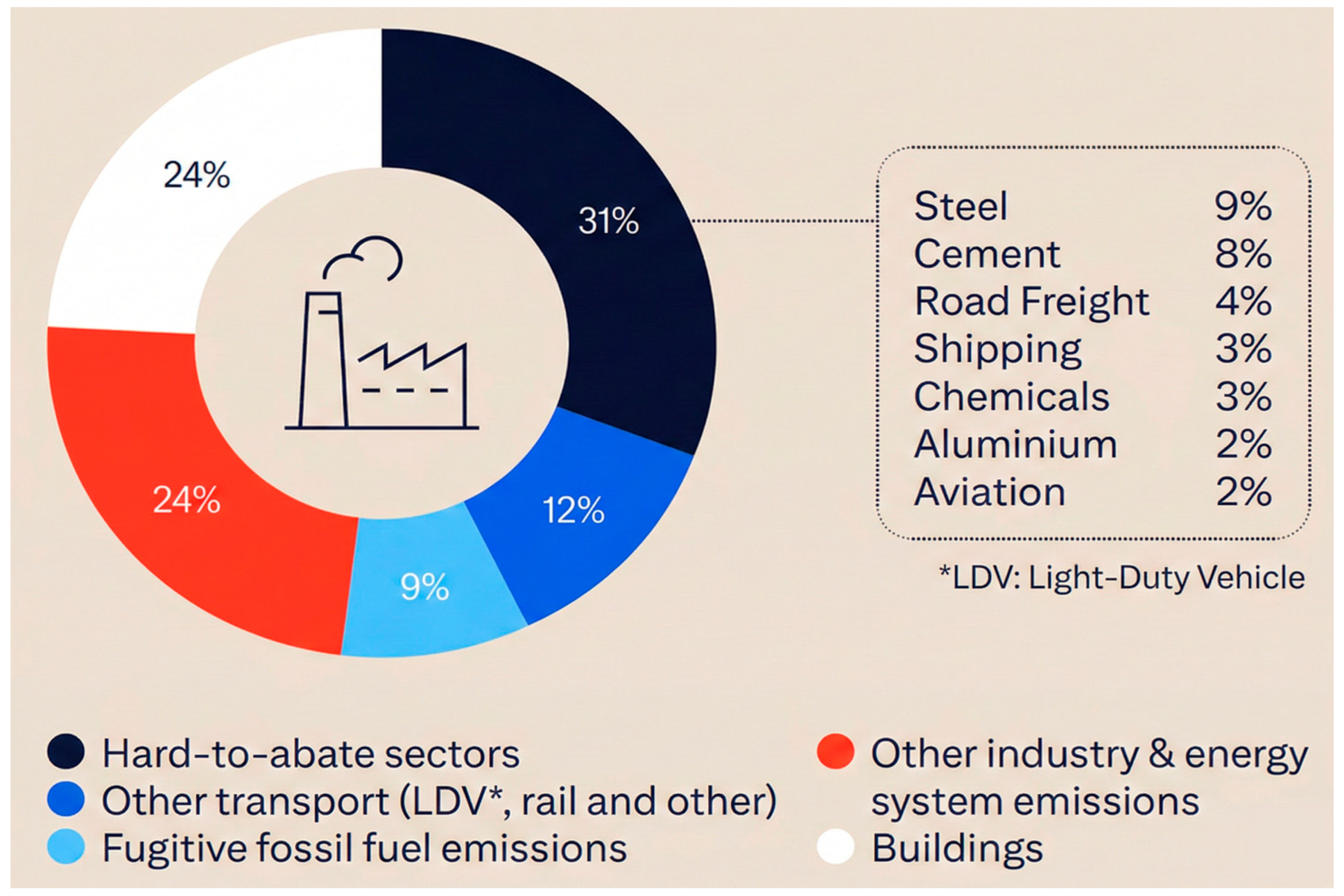
The global shift toward a low-carbon economy is a critical response to the climate crisis, driven by international commitments such as the Paris Agreement and national pledges to achieve net-zero emissions by mid-century [1]. While many sectors have begun reducing carbon emissions through electrification and renewable energy, hard-to-abate industries such as aviation, maritime transport, steel, cement production, and heavy manufacturing remain significant hurdles in achieving net-zero targets [2,3,4]. These sectors contribute over 30% of global CO2 emissions (Figure 1), primarily due to their reliance on fossil fuels for energy-intensive processes and long-distance transport [5,6,7]. As power generation transitions to renewables, decarbonizing these sectors is more challenging because of their high-energy-density requirements and dependence on liquid fuels.
Hydrogen is being recognized as an emerging, promising alternative to fossil fuels, as a clean energy source that can support the achievement of net-zero emissions goals [9,10,11,12,13]. However, hydrogen’s reliance as a fuel presents some technological challenges, particularly regarding storage and distribution. Recent advances in electrofuels production using hydrogen aim to address limitations of hydrogen applications in other sectors where direct applications are not readily feasible [5,6,14]. By combining renewable energy with captured CO2 and hydrogen, electrofuels can provide a low-carbon alternative to conventional fossil fuels, potentially reducing CO2 emissions from high-temperature, energy-intensive industrial processes and supporting deep decarbonization [15,16].
This transition requires a fundamental transformation of how energy is produced, stored, and consumed across all sectors of the economy. Hydrogen can act as an energy carrier, but it faces the challenge of having a low volumetric energy density, which is significantly lower than gasoline [17]. To facilitate transport and improve energy density, hydrogen is typically stored under high pressure or at low temperature [18,19,20]. In contrast, electrofuels present an alternative energy storage solution, where renewable electricity is converted to chemical energy stored in the bonds of liquid or gaseous fuels [21,22]. This involves an electrolysis process of dissociating water, then the hydrogen produced is combined with captured CO2 (either by direct air capture or industrial carbon capture) to produce electrofuels such as methanol, ammonia, etc. [14,23,24]. Electrofuels offer several advantages over other energy carriers, such as batteries, including higher energy density. In addition, they can often utilize existing transportation and distribution infrastructure, which in many cases makes their delivery more cost-effective and operationally simpler [21,25,26]. These benefits have recently attracted the attention of policymakers to exploring electrofuels as a viable option for deep decarbonization.
One of the key advantages of electrofuels is their potential compatibility with existing infrastructure, which can expedite achieving the decarbonization goals. Unlike other energy carriers, such as hydrogen, which require entirely new storage, transportation, and distribution networks, electrofuels can be used in the current fuel supply chain with minimal modifications [14]. This makes them an attractive near-term solution for decarbonizing sectors where building new infrastructure is either economically or technically unfeasible. For instance, electrofuels can be directly utilized in current combustion systems, jet turbines, and industrial furnaces, enabling a smoother transition away from fossil fuels without massive infrastructural changes [27]. Consequently, this has increased interest in synthesizing electrofuels. One such fuel, liquefied synthetic methane, produced through the Sabatier process (Equation (1)), is seen as a viable option for the shipping industry. Methanol (CH3OH) is a promising electrofuel for deep-sea shipping because it remains in liquid form under standard conditions, and hydrogen can be reacted with nitrogen to form ammonia through the Haber-Bosch process, showing a potential carbon-neutral fuel with several applications [4,7].
4H2 + CO2 → CH4 + 2H2O ΔH = −165 kJ/mol
While electrofuels present a promising pathway for decarbonizing hard-to-abate sectors, several critical challenges must be overcome to enable their large-scale adoption. One of the primary concerns is energy efficiency, as electrofuel production requires substantial amounts of renewable electricity, which raises concerns about overall system efficiency and energy demand. The conversion processes of electrolysis for hydrogen production, CO2 capture, and subsequent fuel synthesis are inherently energy-intensive, leading to lower well-to-wheel efficiency compared to direct electrification or hydrogen use [22,23,25]. This inefficiency shows the need for continued research into improving process efficiency, reducing energy losses, and integrating electrofuels into broader renewable energy systems. Another major hurdle is the economic viability of electrofuels. Currently, in many contexts, electrofuel production costs exceed those of conventional fossil fuels, making widespread adoption economically challenging [22,23,25]. The high capital expenditures required for large-scale electrolysis plants, direct air capture (DAC) facilities, and fuel synthesis infrastructure further exacerbate the cost gap. Without strong policy support, carbon pricing mechanisms, and technological advancements to drive down costs, electrofuels may struggle to compete with conventional fuels. Cost parity with traditional fuels remains a long-term goal, requiring advancements in process efficiency, economies of scale, and financial incentives to accelerate adoption.
Given these challenges, this review aims to provide a comprehensive assessment of electrofuels’ role in the decarbonization of hard-to-abate sectors. It will critically analyze their feasibility, scalability, and environmental impact, offering insights into the latest technological advancements and policy frameworks shaping their development. Additionally, this review will examine future outlooks for electrofuels, identifying key areas of innovation and research necessary to unlock their full potential. By addressing existing knowledge gaps, this review seeks to contribute to a strategic roadmap for electrofuel deployment, ultimately supporting the transition to a low-carbon energy future and reducing global dependence on fossil fuels.
This review is structured as follows: Section 2 provides an in-depth analysis of the challenges faced by hard-to-abate industries, including aviation, maritime shipping, heavy manufacturing, and freight transportation. Section 3 explores the production pathways for electrofuels, focusing on electrolysis technologies and CO2 capture methods. Section 4 delves into the synthesis mechanisms and chemical dynamics of electrofuels, examining their formation and energy conversion processes. Section 5 evaluates the techno-economic feasibility of electrofuels in future energy systems, assessing their cost competitiveness and scalability. Section 6 outlines key recommendations for future research, addressing the technological, economic, and policy gaps that need to be bridged. Finally, Section 7 presents a summary of the key findings and conclusions of this review.

2. Hard-to-Abate Industries: Overview and Challenges

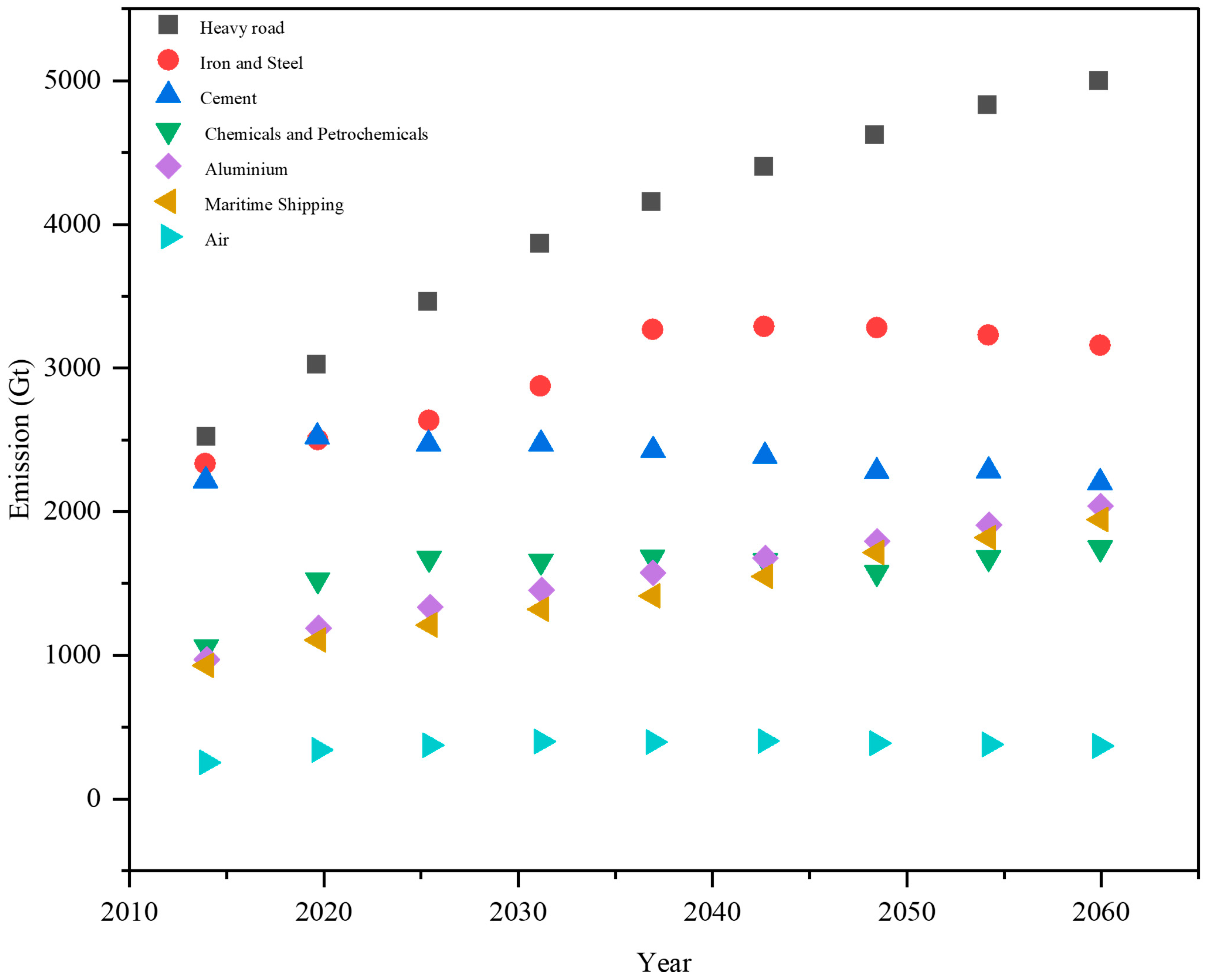
The transition to renewable energy and investments in energy efficiency are widely recognized as effective and immediate measures for reducing carbon footprints across various industries. However, these strategies pose significant challenges for hard-to-abate sectors. Hard-to-abate sectors are industries that are particularly difficult to reduce emissions due to their reliance on high-energy-density fuels and processes that are very challenging to electrify [8,23]. These sectors are critical to the global economy and are responsible for a reasonable share of GHG emissions. Projections as shown in Figure 2 indicate that, without targeted mitigation efforts, these sectors could emit approximately 15.7 Gt in total carbon dioxide by 2050, a value exceeding the permissible global carbon budget necessary to limit global temperature rise to below 2 °C [28]. Below is an overview of the main hard-to-abate industries and the unique challenges each faces in the path toward decarbonization.

2.1. Aviation

Aviation is heavily dependent on conventional jet fuel derived from crude oil, and unlike road transport, it faces significant barriers to full electrification [29]. According to research by Schäfer et al. [30], an all-electrical aircraft with a range of around 1000 km would require an increase of 220% battery improvement, emphasizing the technological hurdles in achieving electric flight. Meanwhile, hydrogen-powered aircraft, as detailed by Adler and Martins [31], offer a technically feasible alternative, though several challenges remain. The biggest of these include the complexities of onboard hydrogen storage, handling, and the lengthy regulatory certification process required for such a transition. The aviation sector accounts approximately 2.5% of global CO2 emissions which relies on high-energy-density fuels for long-distance flights [32]. Currently, the most practical method for decreasing emissions in the aviation industry is found to be an electrofuel, specifically certified sustainable aviation fuels (SAF) compatible with existing airplanes [15,33]. Although alternative propulsion technologies, such as some battery electric and hydrogen-powered planes, are being developed, their commercial viability is not anticipated until much later in this century. In light of these constraints, carbon offsetting, compensating aviation emissions by facilitating equivalent CO2 reductions, remains an important complementary strategy toward achieving carbon neutrality in the near term [32,34].
Most studies on decarbonizing the aviation sector have focused on substituting the conventional jet fuel with low-emission options [35]. In their thorough review, Kandaramath Hari et al. [36] explored the potential benefits and obstacles tied to the production of biofuels for aviation. Their findings highlighted significant barriers, like the costs associated with fuel production and the large amount of land required for crop cultivation, both of which could limit the extensive implementation of biofuels in the aviation sector. While hydrogen-powered aviation appears promising for the future, solving the technical issues related to fuel storage, obtaining regulatory permits, scaling the technology from small local airplanes to bigger commercial jets, and developing extensive hydrogen refueling airport infrastructures are significant challenges [37]. These factors make hydrogen a long-term solution for decarbonization, unlikely to be fully realized until later in the century. The potential for electrofuels to meet aviation energy demands is also gaining attention [15,29]. Drünert et al. [38] estimate that producing jet fuel to meet aviation needs for Germany alone may require an additional 440 to 745 TWh of renewable power, which is equivalent to about 80% to 135% of Germany’s total electricity consumption in 2021.

2.2. Maritime Shipping

Maritime shipping plays a crucial role in facilitating global trade, with vessels often covering vast distances between refueling ports [39]. The decarbonization of the international shipping sector presents significant challenges as a result of the low energy capacity of the existing battery technologies and the high demands of energy associated with a very long-distance maritime journey [4,40,41,42]. As a result, the sector continues to be a significant source of global GHG emissions, responsible for about 3% of total global CO2 emissions [43]. This reliance on heavy fuel oil, a high-emission, low-cost fossil fuel, further exacerbates the environmental impact. While battery-powered vessels provide a promising approach for cutting emissions in short-distance sea shipping and passenger ferries that operate on shorter routes, the limitations in battery energy storage make them unsuitable for deep-sea shipping, which represents the largest share of shipping emissions. Therefore, electrofuels emerge as a potential pathway for decarbonizing long-distance maritime transport by enabling the indirect use of renewable electricity to replace conventional fossil fuels [40]. This transition could significantly reduce the shipping sector’s carbon footprint, while addressing the energy density challenges faced by battery technologies.
Container shipping represents the most significant contributor of emissions within the maritime industry; as such, converting container ships to operate on low-emission electrofuels could substantially reduce overall shipping emissions [40,43,44]. However, the technical feasibility of these electrofuels must be assessed, alongside their economic and environmental impacts, particularly in relation to the costs associated with the infrastructure needed for managing, storing, and distributing fuels in port facilities [26,27]. Various stakeholders along the container shipping value stream emphasize various economic indicators. Ship operators are primarily concerned with the capital and operational costs tied to vessels powered by renewable fuels, while cargo owners focus on the potential increase in transportation costs resulting from the shift to lower emission options. Meanwhile, administrative bodies are expected to prioritize greenhouse gas reductions [45]. Hansson et al. [39] analyzed alternative fuels through a multi-criteria lens and discovered that, for ship owners, economic factors, especially fuel costs, are paramount. Conversely, governmental representatives tend to prioritize environmental factors, such as reductions in GHG emissions, highlighting the need for an equitable approach that considers the diverse interests of all stakeholders involved in the transition to low-carbon shipping solutions. Such an inclusive strategy will be essential for achieving widespread adoption of sustainable practices in the container shipping and the entire maritime industry [45].

2.3. Manufacturing

Manufacturing industries contribute roughly 20% of global anthropogenic emissions and utilize around 25% of the global energy [46]. Achieving climate targets demands an accelerated shift toward climate-neutral strategies in this sector, especially in energy-demanding manufacturing like the steel industry, cement, chemicals, and petrochemicals. Steel production is one of the most carbon-intensive processes, generating significant CO2 emissions as a byproduct and accounting for approximately 7–9% (Figure 1) of global CO2 emissions [47]. Cement production releases CO2 during the calcination of limestone and through fossil fuel combustion needed to reach high process temperatures. Similarly, the chemical industry is a major greenhouse gas emitter, relying on fossil fuels as both an energy source and a feedstock for products like plastics and fertilizers, which involve complex, hard-to-decarbonize reactions. Together, these sectors make up more than 70% of industrial emissions within the European Union (EU), and shifting away from fossil fuels to sustainable alternatives is a critical emissions reduction strategy for energy-intensive industries (EIIs) [5,46,48].
Decarbonizing energy-intensive manufacturing industries is particularly challenging due to their unique reliance on high-emission processes, where each EII requires transformative innovations to reach near-term meaningful decarbonization [7,49]. For example, in steel production, the primary hurdle is reducing the carbon footprint of traditional blast furnaces; while hydrogen-based steelmaking and carbon capture technologies show promising alternatives, they are not yet economically viable and carbon-neutral steelmaking is still in the initial research stages. Additionally, the long life of steel plants means that retrofitting or replacing these assets with cleaner technologies will require decades and substantial investment [47,50]. Cement production faces dual emission challenges arising from both chemical reactions during limestone calcination and the combustion of fossil fuels used in the process. Reducing these emissions requires the development of novel production pathways or the implementation of carbon capture technologies, both of which are currently costly, energy-intensive, and difficult to scale across the global industry. Similarly, decarbonizing the chemicals and petrochemicals sector requires a transition toward low-carbon energy sources and alternative feedstocks [2,5,49,51]. However, the high cost of alternatives and deeply embedded global supply chains pose significant barriers to a rapid shift.

2.4. Heavy-Duty Transport

Heavy-duty transport, which includes long-haul trucks, trains, and other large vehicles, requires substantial energy to cover extensive distances, posing significant challenges to electrification strategies [52,53]. Batteries suitable for these vehicles are generally too large, heavy, and costly for effective use in long-range operations. Reducing greenhouse gas emissions in heavy-duty transport thus hinges on either decreasing overall energy consumption, lowering the carbon intensity of energy sources, or both. While the potential for integrating electricity and hydrogen is promising, questions remain concerning the suitability of batteries and fuel cells for long-distance applications, especially regarding cost, efficiency, and scalability. Shifting to these new energy carriers will require extensive infrastructure development to facilitate their broad implementation and ensure seamless integration into existing transport systems [5,14,23,54]. Large-scale biofuel usage, despite its renewable basis, faces sustainability challenges, and its future contribution may fall short of meeting global transport demands as anticipated, especially in a sector with such high energy requirements.
The transition to carbon neutrality for heavy-duty transportation increasingly depends on policy support, with renewable electricity-based fuels and chemicals holding promise across a variety of applications beyond transportation [55,56]. Recent research highlights electrofuels as a promising low-carbon energy carrier, offering potential scalability and the ability to reduce emissions in the transport sector, while supporting broader energy transition goals [57,58]. To accelerate adoption, greater stakeholder involvement and public awareness initiatives are gaining importance, helping to smooth the path for renewable fuel integration [59,60]. Significant uncertainties remain, with questions around production and vehicle costs, scalability, and lifecycle environmental impacts yet to be fully addressed [21,61]. It has been suggested that electrofuels could positively impact emission reduction targets, emphasizing their role in advancing sustainable heavy-duty transportation solutions [62,63]. Even though the scale and timing of benefits are complex and will require comprehensive analysis and policy guidance to overcome technical and economic barriers, the primary challenge for heavy-duty transport is the energy density required for long-distance travel and adopting cleaner technologies will take time [64].
Decarbonizing hard-to-abate industries is challenging. Each sector, like aviation, shipping, manufacturing, and heavy-duty transport, faces its own set of difficulties. Solutions like hydrogen, electrofuels, and carbon capture are being explored, but there are still technical, cost, and policy hurdles. Table 1 below summarizes the challenges associated with different sectors and strategies for decarbonizing these industries.

3. Electrofuels Production Pathways

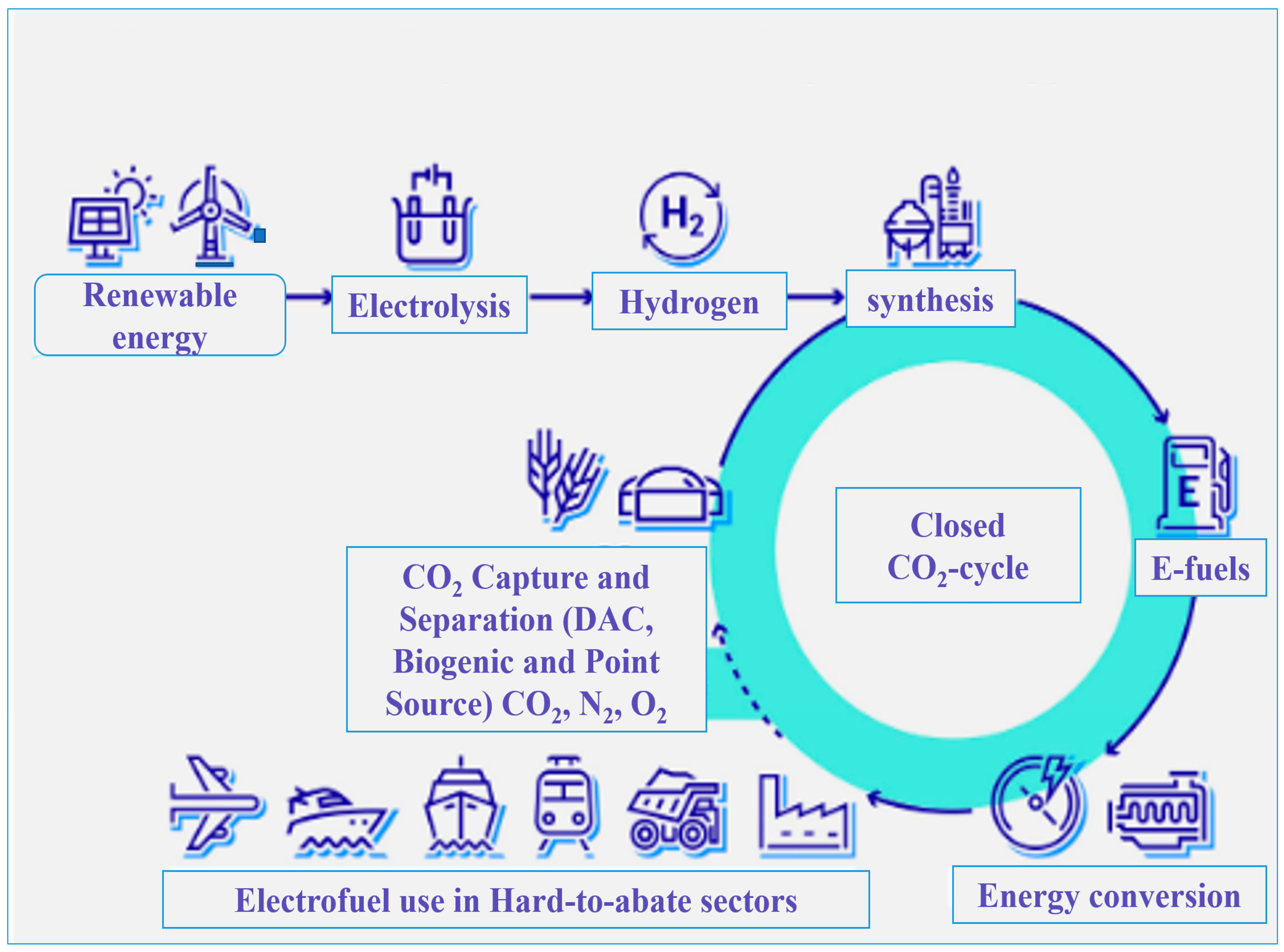
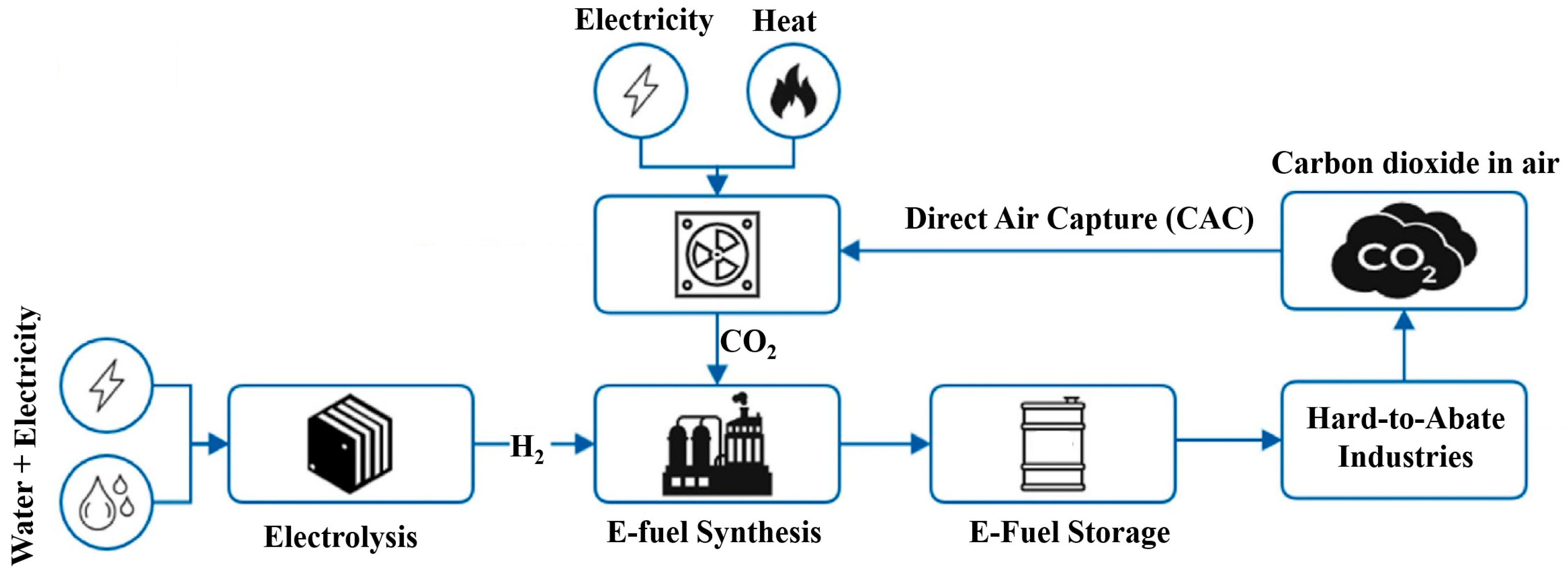
Electrofuels, often termed e-fuels, are synthetic fuels produced through various processes that utilize renewable power as a primary energy source [21,23,51,60,66]. These pathways are designed to create fuels that serve as sustainable, low-carbon alternatives to conventional fossil fuels [34,54], making them ideal for decarbonizing sectors that are hard-to-abate, such as maritime, aviation and heavy industry (Figure 3). The synthetic fuel paradigm is fundamentally rooted in sustainability, emphasizing that the electricity utilized for its production must originate from sustainable energy sources [67]. This innovative approach has not only the potential to reduce the overall environmental impact of energy use but also plays a role in closing the carbon loop by ensuring that the lifecycle emissions are balanced (Figure 3). Moreover, the scalability of this technology could serve a crucial role in meeting global climate objectives by enabling a transition away from fossil fuel dependence [26,36,51]. The production of electrofuels involves a series of key steps: generating renewable electricity, electrolyzing water to produce hydrogen, capturing carbon dioxide, and finally synthesizing the fuel. This section provides an in-depth look into the key e-fuel production pathways and technologies currently being researched and developed.

3.1. Renewable Energy as a Foundation for Electrofuel Production

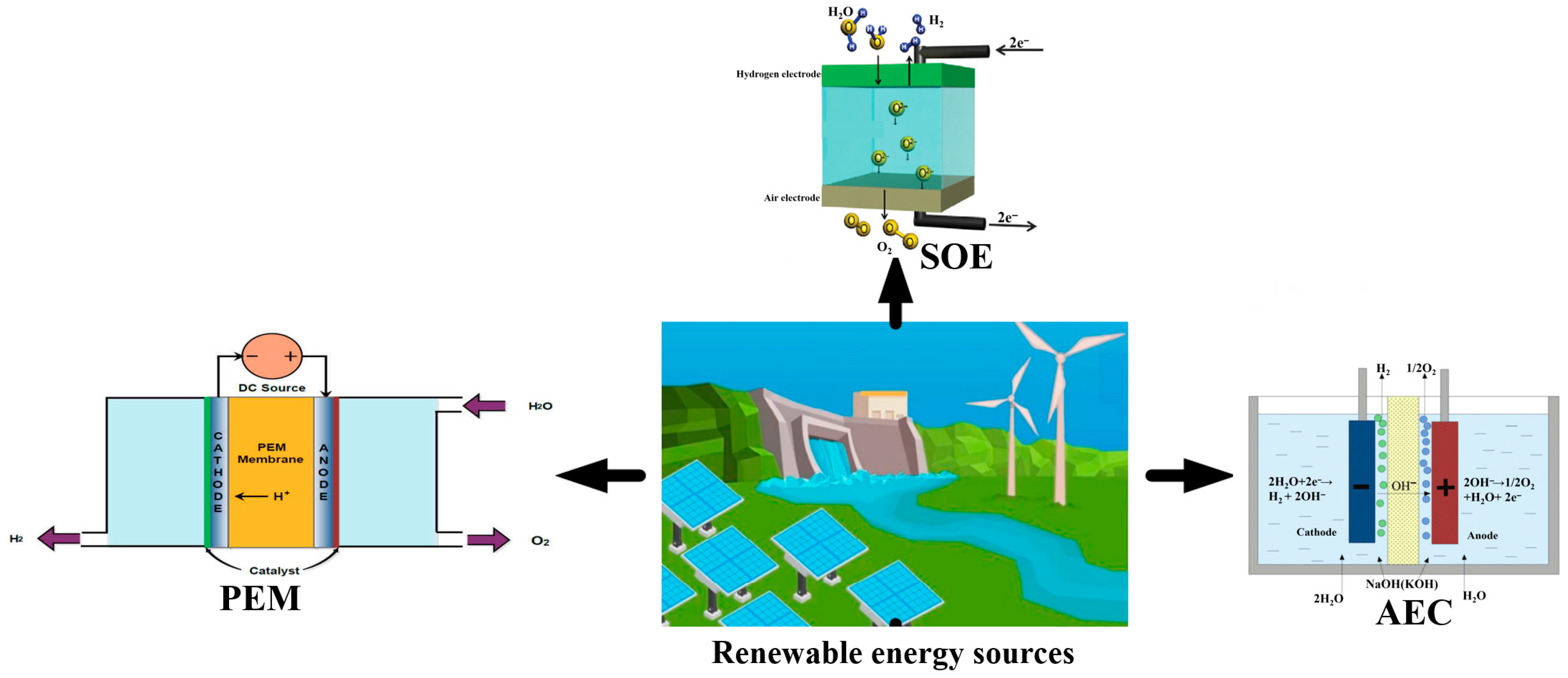
Renewable energy is a cornerstone of sustainable e-fuel production, serving as the primary input for clean hydrogen generation through water electrolysis. This process contributes to partially closing the carbon loop by recycling captured CO2 for fuel synthesis, although the overall environmental benefits depend on factors such as the carbon intensity of the electricity used and the efficiency of the conversion processes [23,68]. Among the available renewable energy sources, solar photovoltaic (PV), wind, and hydropower are the major contributors due to their scalability, technological maturity, and costs. As shown in Figure 4, electricity generated from renewable energy sources can be used to power various electrolyzer technologies for hydrogen production. In addition, geothermal energy and biomass also offer localized opportunities for renewable hydrogen generation. Global installed capacities exceeded 1.6 TW for solar and 1047 GW for wind energy by the end of 2023 [69,70]. These resources are increasingly being harnessed that can power electrolyzers in regions rich in renewable potential, to enable large-scale hydrogen generation with minimal emissions. Solar energy, particularly in sun-rich regions such as the Middle East, North Africa, and Southern Europe [71], offers it exceptional potential in different regions of the world. Wind energy has similarly emerged as a key enabler of clean hydrogen production. Countries such as Germany, the United Kingdom, and Denmark have achieved significant wind energy, powering electrolysis units directly from wind turbines [72]. Hydropower also contributes significantly by providing stable, dispatchable electricity for electrolysis, thereby mitigating the intermittency associated with solar and wind [73].
Despite these advances, several challenges remain. The variable output of solar and wind power can disrupt the continuity of electrolyzer operation, affecting hydrogen yield, purity, and the efficiency of electrofuel synthesis. Hybrid renewable systems integrated with energy storage and smart grid infrastructure can be developed to ensure a consistent and reliable electricity supply [73]. The feasibility and cost competitiveness of renewable-powered electrofuels vary regionally, shaped by local resource availability, grid infrastructure, and supportive policy environments. The deployment of renewable energy infrastructure will not only decarbonize the power sector but also enable the clean synthesis of electrofuels. This convergence of technologies supports broader climate goals and aligns with multiple Sustainable Development Goals (SDGs). As illustrated in Figure 3 and Figure 4, renewable electricity enables a production chain in which hydrogen is generated and subsequently converted into energy-dense electrofuels. When CO2 used in the synthesis is captured from sustainable sources and low-carbon electricity is employed, the system can approach a closed-loop CO2 cycle, contributing to achieving a net-zero future.

3.2. Hydrogen Production Through Electrolysis Technologies

Hydrogen is a fundamental building block for electrofuels, and its production is typically achieved through the electrolysis of water. Hydrogen can be produced through both sustainable and conventional energy pathways, with sustainable methods encompassing electrolysis, thermolysis, and thermochemical cycles [18,74,75,76]. Among these, electrolysis is the most technologically advanced and widely implemented. This process relies on electricity, preferably from renewable sources, as the main energy input. During electrolysis, an electric current is applied to water, which is dissociated into hydrogen and oxygen. This reaction occurs between two electrodes, submerged in an electrolyte solution to facilitate ion conductivity, ensuring an efficient separation of gases by the electrolyzer [75]. The electrolyzer is the central component in an electrofuel system, responsible for generating green hydrogen. The three main types of electrolyzers widely used in green hydrogen production today are alkaline electrolysis cells (AECs), proton exchange membranes (PEMs) and solid oxide electrolysis cells (SOECs). Each of these technologies offers distinct advantages in efficiency, operational conditions, and suitability for various energy sources, providing essential versatility for sustainable hydrogen generation.

3.2.1. Alkaline Electrolyzers

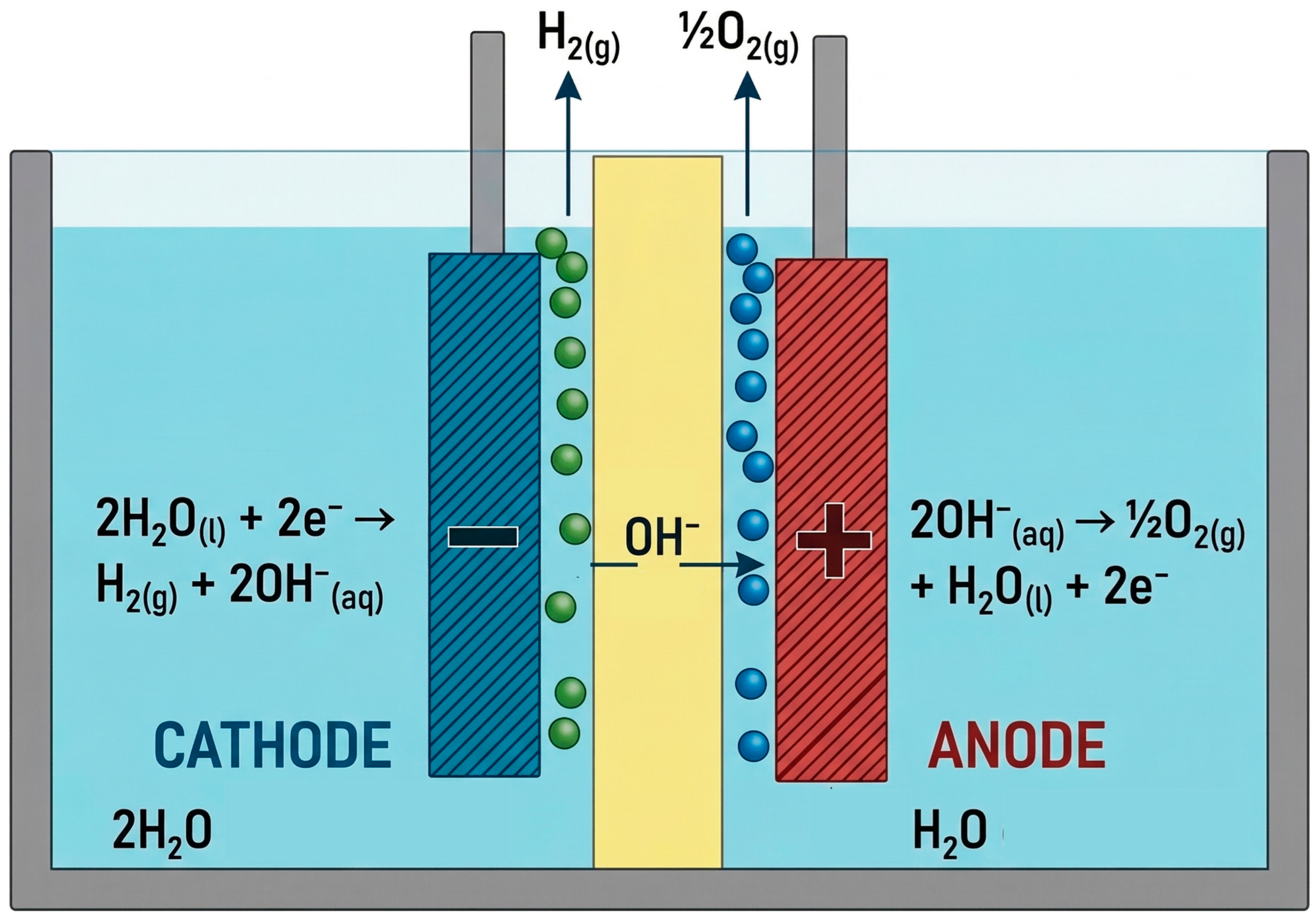
AECs, a widely established technology in hydrogen production, have been integral to industries like chemical production, metallurgy, and fertilizer manufacturing for over a century [77,78]. These systems operate with a relatively simple cell design consisting of two electrodes separated by a diaphragm and immersed in an aqueous alkaline electrolyte, typically potassium hydroxide (KOH) or sodium hydroxide (NaOH), as illustrated in Figure 5. The charge carriers in this technology are hydroxide ions, which facilitate the splitting of water molecules into hydrogen and oxygen [79]. Operating temperatures typically range between 60 °C and 80 °C, which supports stable reaction kinetics while maintaining manageable system complexity [21,80]. One of the key advantages of AEC technology lies in its robustness and cost-effectiveness. The use of non-precious metal catalysts and well-established materials enables relatively low capital costs compared to emerging electrolyzer technologies [81,82]. In addition, AEC systems can operate under both atmospheric and pressurized conditions, allowing flexibility in hydrogen delivery and reducing downstream compression requirements under higher-pressure operation. These features make AECs particularly attractive for large-scale hydrogen production in industrial settings where a stable and continuous power supply is available.
However, despite their technological maturity, AECs face several limitations that constrain their broader integration with renewable energy systems. A major challenge is their limited operational flexibility, as they typically require relatively high minimum load conditions and are less tolerant to rapid fluctuations in power input. This makes them less suitable for direct coupling with intermittent renewable energy sources such as solar and wind without additional buffering systems, such as energy storage or grid stabilization mechanisms [83]. Furthermore, frequent load variations can accelerate degradation of key components, including electrodes and diaphragms, thereby reducing system lifetime and performance stability [83,84]. Additional technical challenges include gas crossover through the diaphragm, which can affect hydrogen purity and raise safety concerns under certain operating conditions. Long-term durability of diaphragms and electrode materials also remains an area of ongoing investigation, particularly under dynamic operating regimes. Recent research efforts have focused on addressing these limitations through the development of advanced diaphragm materials with improved ionic conductivity and gas separation properties, as well as the optimization of electrode structures and catalyst compositions to enhance efficiency and operational stability [85,86]. Improvements in system design, including hybrid configurations and integration with energy storage, are also being explored to enhance the flexibility of AECs in renewable energy applications [87]. Their future deployment in low-carbon energy systems will depend on continued advancements aimed at improving flexibility, durability, and compatibility with variable renewable energy sources.

3.2.2. Proton Exchange Membrane (PEM) Electrolyzers

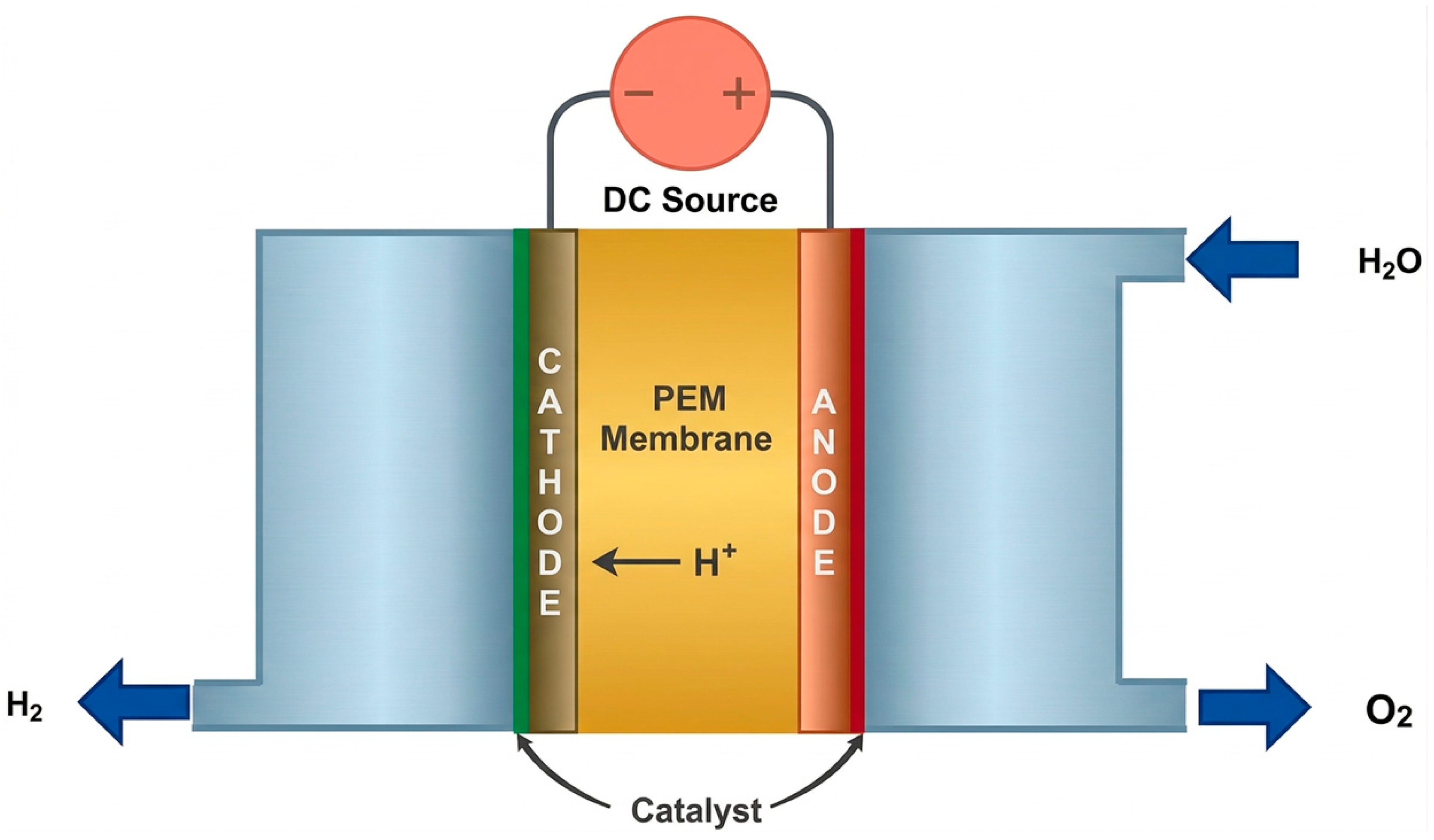
PEM electrolyzers are an advanced and adaptable technology that has gained traction in hydrogen production, especially for settings requiring flexible and fast response operation [88]. Unlike traditional AECs, PEM systems are a newer technology, primarily suited for installations at lower capacities but now widely available in megawatt-scale configurations. These electrolyzers are well suited in pairing with renewable energy sources, as they can adapt quickly to fluctuating electricity generation and operate at a low minimum load. In PEM systems design (Figure 6), a proton-conducting membrane, often made from Nafion, serves as the electrolyte rather than a liquid alkaline solution, and the charge carrier is hydrogen ions (H+). This setup provides a streamlined, less corrosive alternative to AECs, while the membrane’s composition allows for high power density and the elimination of corrosive chemicals [89]. PEM electrolyzers typically operate at moderate temperatures (50–80 °C) and can sustain high pressures, often exceeding 30–80 bar, which reduces or eliminates the need for downstream hydrogen compression [90,91]. One of their most significant advantages is their operational flexibility, characterized by rapid start-up times and the ability to operate across a wide dynamic range from low partial loads to full capacity within seconds [92]. This makes PEM systems particularly suitable for coupling with intermittent renewable energy sources such as wind and solar, where power input can fluctuate rapidly.
Despite these advantages, PEM electrolyzers face several technical and economic challenges that currently limit their large-scale deployment. A primary constraint is the reliance on scarce and expensive noble metal catalysts, such as platinum and iridium, which significantly increase capital costs and raise concerns regarding long-term material availability [80,93]. Membrane degradation remains a critical issue, particularly under dynamic operating conditions involving frequent load cycling, which can lead to reduced efficiency and shortened system lifetime [80]. Durability challenges are also associated with catalyst layer degradation, membrane thinning, and mechanical stress induced by pressure differentials and hydration cycles. These factors contribute to performance losses over time and increase maintenance requirements. Furthermore, while PEM electrolyzers offer high operational flexibility, they may exhibit slightly higher specific energy consumption compared to alkaline systems under certain conditions, reflecting a trade-off between responsiveness and overall energy efficiency [94]. Research efforts have focused on addressing these limitations through the development of low-cost and earth-abundant catalyst materials, including non-precious metal alternatives and reduced noble metal loading strategies. Advances in membrane materials, such as reinforced and composite membranes, are also being explored to improve chemical stability and mechanical durability. System-level optimizations, including improved water management, thermal control, and stack design, are contributing to enhanced performance and longer operational lifetimes [95]. Widespread adoption of PEM will depend on continued progress in reducing material costs, improving durability, and enhancing energy efficiency to achieve long-term economic viability.

3.2.3. Solid Oxide Electrolyzer Cells (SOECs)

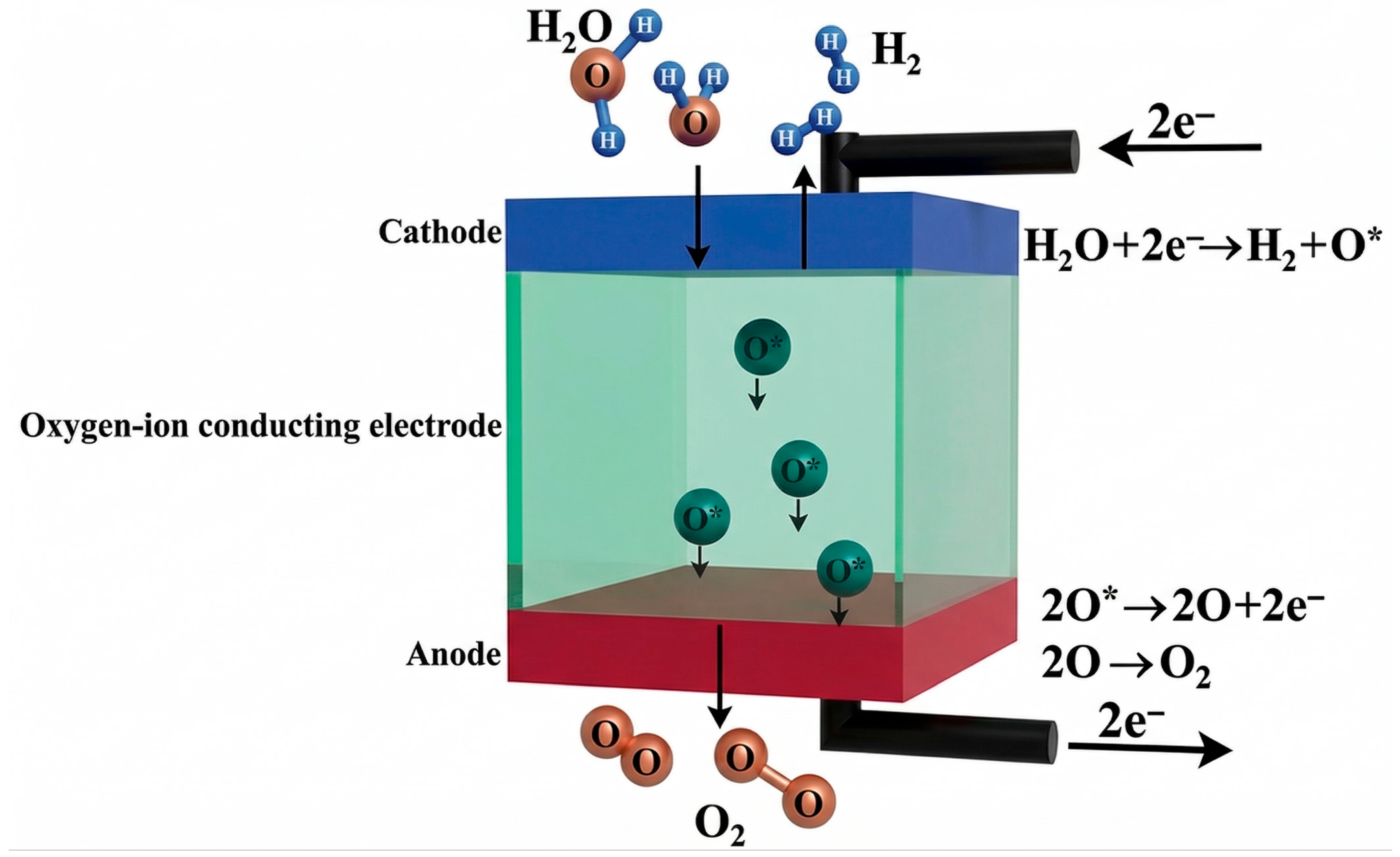
SOECs represent a more recent advancement in electrolysis technology, with considerable future potential for green hydrogen production [96]. Although the current installed capacity is limited, SOEC technology is expected to become one of the key technologies for electrolysis as they mature. Operating within a temperature range of 800 °C to 1000 °C, SOECs can integrate effectively with industrial processes that generate excess heat, providing significant efficiency [21,97,98]. Through the utilization of this external heat, SOECs can decrease the electrical power required for hydrogen production, achieving higher conversion efficiencies than other electrolyzer types. This makes them particularly suitable for applications where high-temperature heat sources are accessible [99]. The working principle of SOECs is based on oxygen ion (O2−) conduction through a dense ceramic electrolyte, commonly yttria-stabilized zirconia (YSZ), with porous electrodes facilitating electrochemical reactions (Figure 7). At the cathode, steam is reduced to produce hydrogen and oxygen ions, which migrate through the electrolyte to the anode, where oxygen gas is evolved. The use of Ni-YSZ cermet as the cathode material and perovskite-based oxides such as strontium-doped lanthanum manganite (LSM) at the anode has been widely adopted due to their favorable electrochemical properties [21,96,97]. In addition to hydrogen production, SOECs offer the unique capability of co-electrolysis of CO2 and H2O to produce syngas, which serves as a key intermediate for synthetic fuel production [100,101].
However, SOEC technology faces several critical challenges that currently limit its large-scale commercialization. The high operating temperatures, while beneficial for efficiency, result in longer start-up and shut-down times, reducing operational flexibility and making SOECs less compatible with variable renewable energy sources such as solar and wind [96]. Also, SOECs have limited durability compared to other electrolyzer types, largely due to thermal stress, redox cycling, and material degradation under prolonged high-temperature operation. Also, their high costs, both for operation and materials, pose challenges for scalability [29,81,102]. As the technology advances, however, these issues may be mitigated, opening pathways for SOECs to be essential in the energy transition, especially in applications where heat integration is feasible and efficiency demands are paramount. Recent research efforts have focused on addressing these limitations through a range of material and design innovations [103,104]. These include the development of alternative electrode materials with improved redox stability, such as perovskite-based and ceramic electrodes, as well as the use of infiltration techniques to enhance catalytic activity and structural resilience. Advances in cell architecture, including graded electrode structures and improved sealing and interconnect materials, have also contributed to enhanced durability. Furthermore, efforts to lower operating temperatures while maintaining high performance are being actively explored to reduce thermal stress and extend system lifetime.

3.3. Carbon Capture for CO2 Supply in E-Fuel Synthesis

To achieve carbon neutrality in e-fuels production, CO2 must be sustainably sourced through methods like direct air capture (DAC) from the atmosphere, point sources or from biogenic processes [15]. The capture of CO2 is essential yet poses high cost and logistical challenges, especially given the substantial volumes required for large-scale production. As the second key component of e-fuels production, CO2 capture is very substantial, and the hydrogen obtained through electrolysis is then combined with captured CO2 to create renewable, low-carbon fuels. This approach is particularly promising for decarbonizing sectors that are otherwise very challenging to abate, helping to progress toward carbon neutrality by decreasing dependence on fossil fuels. Although offsetting emissions remains an option, the capture of CO2 from the atmosphere is increasingly viewed as a necessary strategy to mitigate the global increase in temperature and is utilized as a resource needed for e-fuels [105].

3.3.1. Direct Air Capture (DAC)

The DAC process provides an efficient method to obtain CO2 from ambient air, which contains about 0.04% CO2 by volume, making it usable as a feedstock in synthetic fuel production [38,106]. In this approach, CO2 is captured directly from the atmosphere, utilized in fuel synthesis, and subsequently released back into the atmosphere during fuel combustion, thereby forming a potential carbon recycling pathway (Figure 8). This process can create a nearly closed carbon cycle if other greenhouse gas emissions along the production chain are minimized [107]. However, high altitude-related CO2 emissions, even in a closed cycle, can still impact the climate due to high altitude and secondary effects from other emissions, such as nitrogen oxides [108]. There are two primary DAC technologies approaches that exist: solid and liquid capture methods. Solid DAC utilizes solid adsorbents to capture CO2 through adsorption and desorption cycles at moderate temperatures (80 °C to 120 °C), making it less capital-intensive and allowing full electrification using heat pumps. Liquid DAC, on the other hand, operates in a continuous chemical cycle where an aqueous solution captures CO2 in the first loop, and high-temperature regeneration (300 °C to 900 °C) in the second loop releases it [23,109]. Though liquid DAC is more mature and efficient at higher capacities, it demands high-grade heat usually from natural gas combustion, which restricts its potential for electrification [110]. Although still developing, a solid DAC could become a more sustainable option because of its flexibility in energy use and lower temperature requirements.

3.3.2. Biogenic CO2 Capture

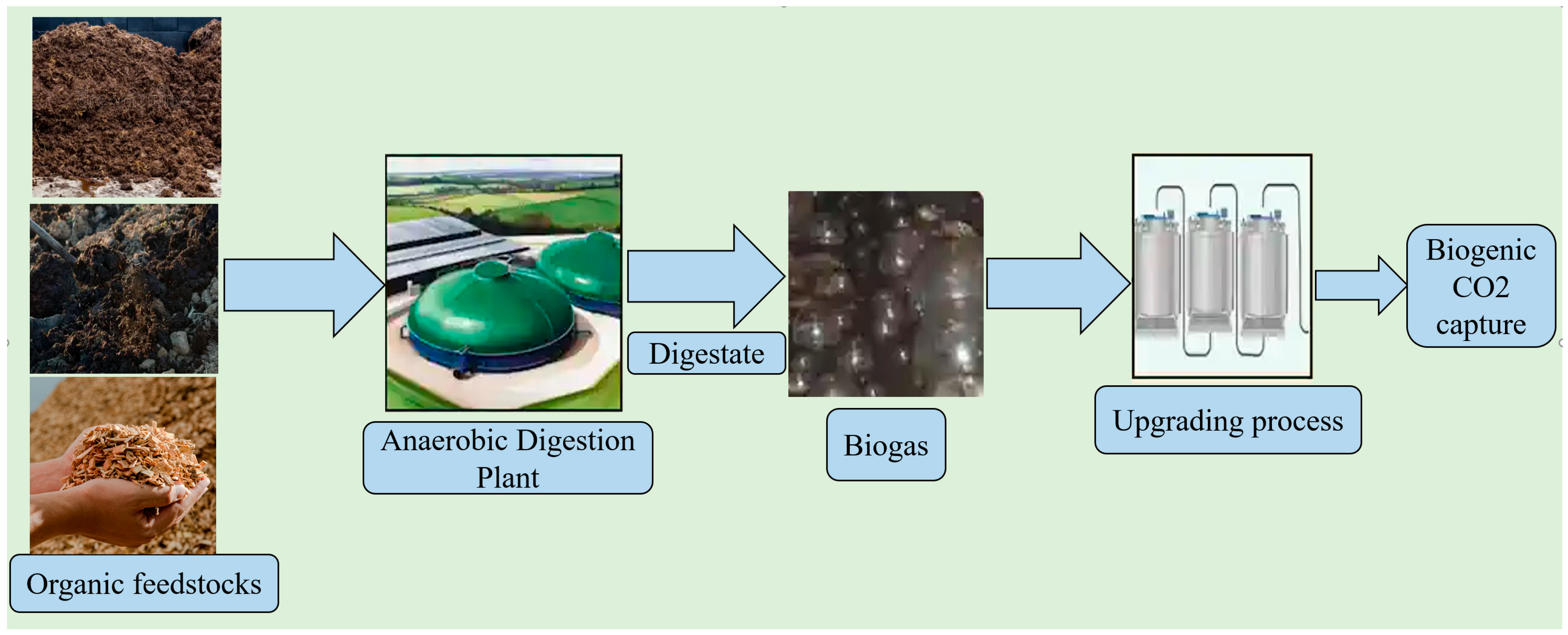
Biogenic CO2, which is derived from natural organic processes such as fermentation, biomass combustion, and biogas production, offers a more economical alternative to DAC for the generation of sustainable fuels [111,112]. This CO2 is primarily sourced from biogenic activities (Figure 9), including biogas purification, alcoholic fermentation, and biomass combustion for district heating or the generation of power, and is increasingly utilized in electrofuel projects across Europe [38]. The widespread adoption of biogenic CO2 in many e-fuel projects can be attributed to its lower cost and the relatively straightforward logistics of sourcing it compared to other capture methods. Since biogenic CO2 is part of a natural carbon cycle, it is originally absorbed by plants through photosynthesis and stored within organic materials; its use can maintain a closed carbon cycle [7]. Consequently, CO2 released during the combustion or processing of biomass does not contribute to an increase in atmospheric greenhouse gas levels, assuming the organic matter is sustainably cultivated and processed in an environmentally responsible manner. This approach, therefore, offers a significant advantage in mitigating climate change when combined with responsible land management practices.
To maximize the potential of biogenic CO2, emissions captured from sources such as wastewater treatment facilities, dairies, and landfills can be compressed and transported to specialized processing plants, where they are converted into valuable renewable products [23,113]. This process aligns with the growing trend of carbon markets, emphasizing the reduction in anthropogenic emissions and the recycling of CO2 into useful products. By facilitating the conversion of captured CO2 into e-fuels, this method fosters a circular economy that integrates renewable energy resources and reduces dependence on fossil fuels. Despite its advantages, biogenic CO2 utilization can be logistically complex, especially when large volumes are needed for large-scale electrofuel production. Challenges such as transporting CO2 from rural or remote sources to processing sites remain, and achieving scale requires infrastructure investments and optimized transportation solutions [30,114]. The continued advancement of these technologies will be essential for meeting the increasing demand for sustainable energy solutions.

3.3.3. Point-Source Carbon Capture

Point-source carbon capture involves capturing CO2 directly from industrial processes that emit high concentrations of this gas. This method is particularly applicable to industries such as cement, steel, and paper production, as well as natural gas processing and power generation [5]. It is crucial that CO2 emissions captured arise from unavoidable aspects of the production process, rather than from fossil-based energy sources. In particular, CO2 emissions resulting from the inherent chemical reactions in material production, such as in cement or lime production, are difficult to avoid [115]. Compared to DAC, point-source capture is generally more cost-effective. However, it is limited in its ability to contribute to true carbon neutrality, as it primarily addresses emissions directly tied to the industrial processes, rather than accounting for the broader carbon footprint. In these industries, CO2 is emitted both from fossil fuels combusted to generate the energy needed for industrial processes and from the process-related emissions intrinsic to specific production steps [51,116]. For example, during cement manufacturing, CO2 is released when limestone is calcined to produce lime, as shown in (Equation (2)).
CaCO3 → CaO + CO2 ΔH = 176 kJ/mol
The potential for long-term use of industrial CO2 sources must be considered. For instance, cement production from limestone is a significant contributor to unavoidable CO2 emissions, but due to the essential nature of the raw materials involved, substituting these processes with alternative, more sustainable methods remains challenging [5,6,51]. It is important to recognize that using CO2 from point-source capture does not result in a fully closed carbon cycle, unlike CO2 captured from direct air capture (DAC) or biogenic sources, where emissions are part of a renewable, cyclical process. Instead, using industrial CO2 in e-fuels production processes constitutes a form of cascading CO2 use, where it is eventually released back into the atmosphere after being utilized in synthetic fuel production. Although point-source carbon capture can help reduce emissions, it should be considered a part of a broader strategy for decarbonization [113].

3.3.4. Emerging CO2 Capture Technologies

Beyond established CO2 capture pathways, a new generation of emerging technologies is being developed to overcome the limitations of conventional systems, particularly in terms of energy demand, cost, and scalability. These approaches are increasingly framed within broader carbon management strategies, which aim not only to reduce emissions but also to transform captured CO2 into valuable resources [117,118]. Their development is especially important given the large volumes of CO2 required for sustained e-fuel synthesis and the need for economically viable and low-carbon supply chains. Significant progress has been made in the development of advanced materials and alternative capture mechanisms. Solid sorbent-based technologies, utilizing porous materials such as zeolites, metal–organic frameworks (MOFs), and functionalized carbons, offer lower regeneration energy requirements compared to conventional liquid solvents and enable improved cyclic stability [119,120]. Electrochemically driven processes, including electric swing adsorption and redox-active capture systems, are also gaining attention due to their ability to directly couple CO2 capture with renewable electricity, thereby reducing reliance on thermal regeneration. Similarly, pressure-driven techniques, such as pressure-induced carbon capture, provide solvent-free alternatives that can simplify system design and reduce operational complexity [121,122].
Membrane-based separation technologies represent another rapidly advancing area, with improvements in material selectivity and permeability enabling more efficient CO2 separation from mixed gas streams. Hybrid systems that integrate membranes with adsorption or absorption processes are being explored to further enhance performance while minimizing energy consumption [123]. In addition, novel solvent systems, including ionic liquids and nanofluids, are under investigation due to their favorable physicochemical properties, such as low volatility and high CO2 affinity, which can improve capture efficiency and reduce environmental impacts [119,121,124]. Biological and bio-inspired approaches are also emerging as complementary strategies. These include the use of microalgae, engineered microorganisms, and genetically enhanced plants to capture CO2 through natural or enhanced photosynthetic pathways [125,126]. While still at an early stage of development, such approaches may contribute to decentralized and nature-based carbon capture solutions, particularly when integrated with biomass-derived CO2 streams.
Despite their potential, many of these emerging CO2 capture technologies remain at varying stages of technological readiness and face challenges related to scalability, long-term stability, and economic feasibility. In particular, the deployment of these systems at an industrial scale requires significant infrastructure investment and careful consideration of supply chain logistics. Moreover, while many technologies are effective for concentrated emission sources, capturing diffuse emissions from sectors such as transportation and distributed systems remains a significant challenge [126]. Nevertheless, continued innovation in this area is expected to play a critical role in diversifying CO2 supply options and reducing the overall cost and environmental footprint of electrofuel production systems. Integrating these advanced capture methods with renewable energy sources and downstream fuel synthesis pathways will be essential for achieving sustainable and large-scale deployment of electrofuels.

4. Electrofuel Synthesis and Chemical Dynamics

E-fuel technologies are emerging as a critical approach to achieving greenhouse gas neutrality in energy production solutions, particularly in sectors that are challenging to decarbonize. These fuels are produced through a process that begins with green hydrogen generated by renewable-powered electrolysis, which is subsequently integrated with CO2 captured either from the atmosphere or industrial sources to synthesize synthetic fuels through methods such as the Fischer-Tropsch process, Sabatier reaction, and various other energy carriers, such as CH3OH, dimethyl ether (DME), etc., can be produced from H2 and CO2. These synthesized fuels, often referred to as e-fuels, provide a sustainable alternative to fossil-based fuels [67]. The closed carbon cycle of e-fuels, where the CO2 used in production is released upon combustion, makes them a promising option for mitigating greenhouse gas emissions in hard-to-abate industries [5]. The versatility of e-fuels allows for their production and makes them suitable options for a wide range of applications, including aviation, shipping, transportation and the heavy manufacturing industry. Through the use of renewable hydrogen and captured carbon, e-fuels present carbon-neutral energy vectors that are in line with global climate goals and can play a major role in contributing to the transition towards sustainable energy and in meeting global decarbonization targets [113,116]. The main synthesis and e-fuel chemical dynamics are discussed.

4.1. Fischer-Tropsch Production Process

The Fischer-Tropsch (FT) synthesis process, developed in 1927 by Franz Fischer and Hans Tropsch, is an essential pathway for producing synthetic hydrocarbon fuels and chemicals (e-fuels) from syngas, a combination of carbon monoxide and hydrogen through catalytic reactions [127,128]. Utilizing either iron or cobalt-based catalysts, this process enables the conversion of CO and H2 into long-chain hydrocarbons through an exothermic reaction, as represented in the general reaction (Equation (3)) [129].
nCO + 2nH2 → (CH2)n + nH2O ΔH = −165 kJ/mol
The product (CH2)n represents a hydrocarbon chain that can vary in length based on the reaction conditions and properties of the catalyst. The FT process can be adjusted to generate a variety of hydrocarbons by adjusting parameters like temperature, pressure, and catalyst selection [2,129]. FT synthesis generally operates across two temperature ranges: The low temperature Fischer-Tropsch (LTFT) and high temperature Fischer-Tropsch (HTFT). LTFT operates between 180 °C and 250 °C and can be performed with both cobalt and iron catalysts, yielding longer chain hydrocarbons suitable for liquid fuels and waxes. In contrast, HTFT is conducted at 300 °C to 350 °C, typically with iron catalysts, favoring the production of gaseous hydrocarbons like 1-olefins and oxygenates [2]. In the FT process, the chain growth of hydrocarbons is affected by the H2 to CO ratio, temperature, and reactor pressure. A typical FT synthesis reaction that produces a liquid hydrocarbon chain from CO and H2, such as a diesel-range fuel, can be expressed as in (Equation (4)). Recent innovations also involve direct CO2 hydrogenation as a means of carbon utilization, although this approach remains an active area of research rather than a fully mature technology [115,130]. In this reaction (Equation (5)), CO2 is directly converted into hydrocarbons in a single step.
3H2 + CO → CH4 + H2O ΔH= −165 kJ/mol at 400 K
CO2 + 3H2 → CH4 + H2O ΔH= −125 kJ/mol at 400 K
CO2 + H2 → CO + H2O ΔH= +41 kJ/mol at 298 K
Before FT synthesis, a reverse water–gas shift (RWGS) reaction can adjust the H2/CO ratio to the desired stoichiometry, especially when using CO2 as a feedstock. The RWGS reaction is represented in (Equation (6)). This endothermic reaction is more favorable at elevated temperatures, often exceeding 830 °C, to attain nearly complete conversion of CO2 to CO. Overall, the FT process offers a versatile pathway for converting syngas to various liquid and gaseous fuels [2,23,129]. By manipulating reaction conditions and catalysts, FT synthesis can produce a broad spectrum of hydrocarbon-based products, including gasoline, diesel, jet fuel, and specialty chemicals as electrofuels. The overall efficiency of the FT pathway is constrained by multiple energy conversion steps, particularly when CO2 is used as the primary carbon source. Also, maintaining optimal reaction conditions and achieving precise control over product distribution requires careful system design and operational stability. As a result, while FT synthesis is a versatile and proven route for e-fuel production, its large-scale deployment in low-carbon energy systems depends on continued improvements in catalyst development, process integration, and renewable hydrogen availability.

4.2. Methanation Process (Sabatier Reaction)

The methanation process enables the synthesis of methane (or e-methane) by reacting hydrogen produced from water electrolysis with CO2, through the Sabatier reaction. This exothermic reaction (Equation (7)) is significant as e-fuel, due to methane’s suitability for efficient storage and transport compared to hydrogen gas [21,131]. Methane’s stable chemical structure and high energy density make it an effective fuel for both transportation and stationary energy applications [17,19]. From a carbon management perspective, methanation contributes to the utilization of captured CO2 by converting it into a usable fuel, thereby supporting circular carbon pathways under defined system boundaries. Its exothermic nature additionally allows heat from the reaction to be repurposed for district heating or high-temperature electrolysis, enhancing the overall energy performance of the process.
CO2 + 4H2 → CH4 + 2H2O ΔH = −165 kJ/mol
Methanation can be carried out via catalytic or biological routes, each offering distinct advantages and limitations. Catalytic methanation is the more mature and widely implemented approach, typically operating at temperatures between 200 °C and 400 °C and moderate pressures, using nickel-based catalysts due to their high activity and cost-effectiveness [132]. Industrial systems often employ multi-stage fixed-bed reactors with intercooling to manage the substantial heat release and to prevent catalyst deactivation caused by sintering or carbon deposition. Recent advances in this area have focused on improving catalyst stability, enhancing resistance to poisoning, and optimizing reactor configurations to enable more efficient thermal management and dynamic operation under variable renewable energy inputs [133]. Biological methanation, in contrast, utilizes methanogenic microorganisms to convert CO2 and H2 into methane under milder conditions, generally in the range of 20 °C to 70 °C and near-atmospheric pressure [134,135]. This approach offers potential advantages in terms of lower energy input and simpler reactor design. However, its large-scale implementation remains constrained by kinetic limitations, particularly those associated with gas–liquid mass transfer and the relatively slow metabolic rates of microorganisms. Maintaining stable operating conditions, including pH and substrate availability, is also critical for sustained performance, as fluctuations in hydrogen or CO2 supply can significantly impact microbial activity. Hybrid approaches, combining catalytic and biological systems, as well as power-to-gas concepts, are being explored to improve flexibility and overall system performance.

4.3. Methanol Synthesis

Methanol synthesis, much like catalytic methanation, is an exothermic reaction process that involves the hydrogenation of CO2 or CO using H2. This process typically occurs under high temperatures (200 °C to 300 °C) and pressures (50 to 100 bar) in the presence of a copper/zinc oxide catalyst [2]. In the one-step synthesis method (Equation (8)), CO2 is directly converted to methanol. In addition to this primary reaction, methanol can also be synthesized from CO in a process where CO reacts with H2 (Equation (9)), producing methanol through an alternative reaction pathway [136,137].
CO2 + 3H2 → CH3OH + H2O ΔH = −49.6 kJ/mol
CO + 2H2 → CH3OH
CO2 + H2 → CO + H2O
Another important reaction that often occurs in the methanol synthesis process is the reverse water–gas shift (RWGS) reaction, which converts CO2 to CO (Equation (10)). This reaction is often used in a two-step methanol synthesis pathway where CO2 is first reduced to CO before hydrogenation. In the two-step pathway, the CO produced is then hydrogenated to form methanol [138,139]. Due to these competing reactions, direct methanol synthesis from CO2 has typical conversion rates of around 20 to 40% in a fixed-bed reactor without recycling. To improve overall efficiency, unreacted CO2, CO, and H2 are recycled back into the reactor, enhancing methanol yield and selectivity. The resulting methanol–water mixture then undergoes distillation to achieve the desired methanol purity [51]. The versatility of methanol makes it valuable both as a synthetic fuel and as a feedstock in chemical manufacturing. It can be transformed into a range of products, such as DME and jet fuel [137]. This provides a cleaner substitute for fossil-based fuels and is increasingly explored for its potential in decarbonizing the chemical industry and supporting a sustainable energy economy.

4.4. Ammonia Synthesis (Haber-Bosch Process)

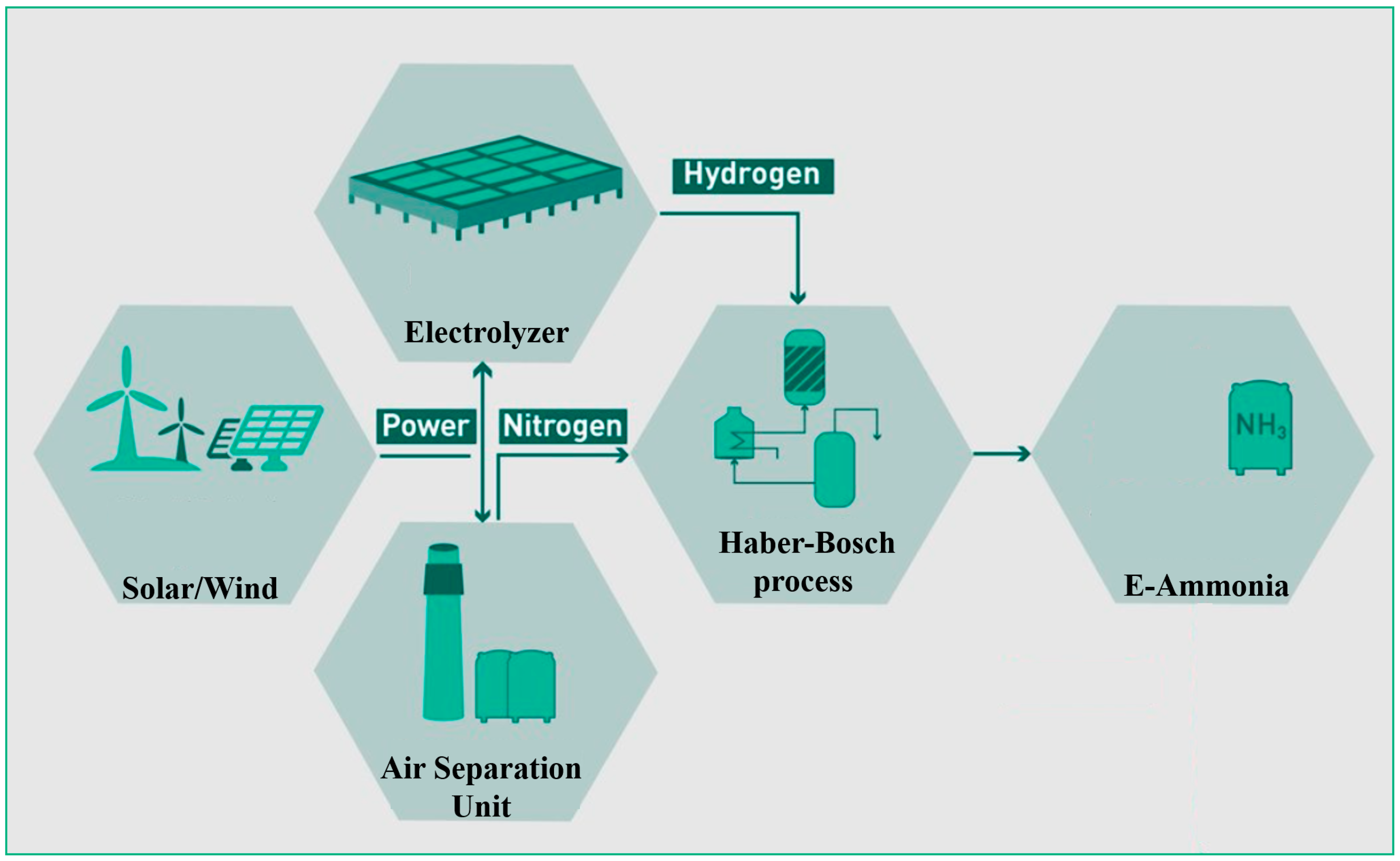
Ammonia is a promising e-fuel with diverse applications, including its potential as a zero-carbon energy carrier and a viable alternative to traditional fuels [2]. It can be synthesized from nitrogen obtained directly from captured air, and hydrogen produced through renewable-powered water electrolysis, creating a pathway toward “green” ammonia (Figure 10). This contrasts with traditional ammonia production methods, particularly the Haber-Bosch process, which relies on fossil fuel-derived hydrogen. The foundational reaction in the Haber-Bosch process is shown in (Equation (11)). This exothermic reaction, driven by high temperature (400 °C to 500 °C) and pressure (100 to 450 bar), utilizes an iron-based catalyst [140]. Yet, this traditional approach produces “gray ammonia,” which is heavily reliant on natural gas. To reduce its carbon footprint, “blue ammonia” integrates carbon capture and storage (CCS) technologies to sequester CO2 emissions generated during hydrogen production. Alternatively, “green ammonia” synthesizes NH3 entirely through renewable hydrogen and nitrogen separated from air (Figure 10), aligning with carbon-neutral goals and supporting long-term sustainability [2].
N2 + 3H2 → 2NH3 ΔH= +91.8 kJ/kmol
3H2 → 6H+ + 6e
N2 + 6H+ + 6e→ 2NH3
Solid state ammonia synthesis (SSAS) is an emerging low-temperature alternative that bypasses the high energy demands of the Haber-Bosch process [141]. SSAS synthesizes ammonia electrochemically via a solid-state electrolyte, avoiding the need for extreme pressure. In this method, hydrogen gas at the anode undergoes dissociation into protons and electrons (Equation (12)). These protons then move through the electrolyte to the cathode, where they combine with nitrogen to form ammonia (Equation (13)). The overall reaction aligns with the Haber-Bosch reaction process, providing a more adaptable and potentially energy-efficient route. Despite the SSAS promise, significant challenges remain, such as optimizing proton conductivity within the electrolyte and enhancing reaction kinetics at lower temperatures. Each ammonia production route presents unique environmental and operational trade-offs. While blue ammonia reduces emissions relative to gray ammonia, green ammonia offers a fully renewable path. However, large-scale adoption of green ammonia depends on further advancements in hydrogen and nitrogen production efficiency, economic feasibility, and supply chain adaptations. Ammonia as a zero-carbon energy carrier could support the decarbonization of multiple sectors, especially in applications where direct electrification is very difficult.
Several electrofuel production pathways have been developed and discussed in this review, each characterized by distinct reaction mechanisms, catalytic systems, and operating conditions tailored to optimize efficiency and yield. These processes vary in their scalability, energy requirements, and integration potential with renewable energy sources. Table 2 provides a comparative summary of key electrofuel synthesis methods, detailing their fundamental reactions, catalysts, operating conditions, and the associated benefits and challenges that influence their feasibility for large-scale implementation.
A comparative perspective is useful for understanding the advantages and limitations of different electrofuel pathways. Electrofuels such as e-methanol, e-ammonia, and e-methane exhibit distinct characteristics in terms of lifecycle carbon emissions, energy density, and production costs. For example, e-methanol offers relatively easier storage and handling and can utilize existing liquid fuel infrastructure, making it attractive for maritime and chemical applications [40,142]. E-ammonia provides a high hydrogen content and does not contain carbon, which eliminates direct CO2 emissions during combustion, although challenges remain related to toxicity, combustion efficiency, and nitrogen oxide emissions. In contrast, e-methane has the advantage of compatibility with existing natural gas infrastructure but may involve additional energy losses during synthesis and liquefaction [143]. From a lifecycle perspective, the carbon reduction potential of these fuels depends strongly on the carbon intensity of the electricity used and the source of captured CO2. Production costs also vary widely depending on technology maturity, renewable electricity prices, and system integration. Therefore, the suitability of each electrofuel pathway is highly context-dependent and must be evaluated based on specific sectoral requirements, infrastructure availability, and environmental performance.
Despite the growing interest in electrofuels, their suitability varies significantly depending on the specific requirements of each end-use sector, highlighting the need for a more nuanced, application-driven evaluation. Different electrofuel pathways present distinct trade-offs in terms of energy efficiency, infrastructure compatibility, storage requirements, and environmental performance [37,144]. For instance, e-kerosene is particularly suited for aviation due to its compatibility with existing aircraft and fueling infrastructure, despite its relatively high production cost and conversion losses. In contrast, e-ammonia offers advantages for maritime transport because of its carbon-free composition and high energy density by volume, although challenges related to toxicity, combustion efficiency, and nitrogen oxide emissions remain. Similarly, e-methanol provides easier handling and integration into existing fuel systems, making it attractive for shipping and chemical applications, but it has a lower energy density compared to conventional fuels [145]. These differences illustrate that no single electrofuel pathway is universally optimal; rather, their deployment must be tailored to sector-specific operational, economic, and environmental constraints. Therefore, the effective integration of electrofuels into decarbonization strategies requires a systems-level approach that considers trade-offs between efficiency, cost, infrastructure readiness, and lifecycle emissions [146]. Table 3 further highlights each electrofuel pathway to sector-specific suitability based on infrastructure compatibility, energy density requirement, combustion characteristic, handling constraint, and production maturity criteria.

5. Techno-Economic Viability of Electrofuels in Future Energy Systems

The transition to a completely renewable energy system by 2050 is a critical yet highly complex goal in the global effort to mitigate carbon emissions and limit the adverse impacts of climate change. Achieving this vision is essential for reducing these adverse effects and moving away from fossil fuels. Electrofuels produced through the combination of sustainable electricity and carbon dioxide capture have emerged as a key technology for reducing carbon emissions in challenging sectors, including heavy transport, aviation, and certain industrial processes. Techno-economic assessment is required to better understand their long-term viability, cost competitiveness, and integration potential within future energy systems [68,147]. Despite their potential to drastically lower greenhouse gas emissions, the production of e-fuels remains more energy-intensive compared to conventional fossil fuels, primarily due to the need for substantial inputs of electricity in the synthesis process. For example, a study by Connolly et al. [148] shows that the production of methanol derived from biomass requires 0.83 units of biomass and 0.53 units of electrical power for every unit of fuel produced; as such, more than one unit of energy is utilized to produce one unit of e-fuels, which highlights the energy-intensive nature of e-fuels. This energy demand, while providing a clear environmental benefit, comes at a higher cost in comparison to traditional fuels. When electrofuels are used as replacements for conventional fuels in sectors including heavy-duty transport and industrial operations, there is a reduction of up to 40% in CO2 emissions [23]. These higher costs are primarily driven by the energy inputs and technological infrastructure required for e-fuel production [149].
The economic viability of e-fuels is heavily influenced by the cost of electricity, particularly renewable sources like solar and wind energy [150,151]. The cost of electricity directly impacts the price competitiveness of e-fuels, as the price of green hydrogen, considered a fundamental building block in e-fuel production, relies heavily on the cost of renewable power [152]. A key factor influencing the cost of green hydrogen production is the levelized cost of hydrogen (LCOH), which includes both capital expenditures (CAPEX) and operational expenditures (OPEX) related to hydrogen production technologies [153,154]. As electrolysis technologies continue to evolve and improve, current projections indicate that by 2030, the LCOH for green hydrogen could fall below $2.1/kg on average. Table 4 presents the achievable LCOHs for various electrolysis technologies, based on current and projected electricity prices for 2030 [153]. Such a reduction in costs would make green hydrogen compete effectively with hydrogen derived from fossil fuels, thereby improving the economic feasibility of electrofuels as a viable replacement for traditional fuels. For instance, Millinger et al. [155] provided a case study for Germany, demonstrating the impact of utilizing excess renewable electricity to synthesize electrofuels to replace fossil fuels. Their findings showed that electrofuels could reduce transportation sector emissions by 46% and achieve annual abatement of 74 Mt CO2 equivalent greenhouse gases.
The integration of CO2 capture technologies is another key factor in the economic assessment of electrofuels [25,136,137,138,139]. These technologies remain in their initial phases of advancement, with costs ranging from $105 to $525 per ton of CO2 captured, varying with the technology and the extent of deployment. Solid DAC systems, in particular, have shown promise due to their energy efficiencies and the potential for electrification, which could support large-scale operations. An estimate for DAC technologies by different researchers ranges from $168 to over $1364 per ton of CO2, with costs heavily influenced by plant capacity utilization and electricity prices as well. Whereas, carbon capture from biogenic sources and point sources shows a more cost-effective alternative, with costs below $53 per ton of CO2 [153]. This highlights the importance of optimizing carbon capture strategies to minimize production expenses. These systems require medium-grade heat, which industrial heat pumps can provide, making them a feasible alternative for integration into an extensive e-fuel production facility. Thus, achieving higher operational efficiencies in CO2 capture facilities will be critical to reducing the overall costs of e-fuel production and enhancing their economic viability in the long term for achieving deep decarbonization.
In addition to cost considerations, policy frameworks and carbon offsetting mechanisms play an important role in supporting the market adoption of electrofuels [157]. Because electrofuels are currently more expensive than conventional fossil fuels, policy instruments such as carbon pricing, emissions trading systems, renewable fuel mandates, and targeted subsidies are essential to help reduce the competitiveness gap [22,158]. These policy tools help internalize the environmental costs of fossil fuels and provide economic incentives for the development and deployment of low-carbon fuel alternatives. For instance, SAF blending mandates and emerging maritime fuel regulations in several regions are beginning to create early market demand for synthetic fuels and encourage investments in large-scale production facilities. Carbon offsetting mechanisms, particularly in the aviation sector, can also provide a temporary pathway for reducing emissions while the production and supply of low-carbon fuels continue to scale. Such mechanisms allow industries with limited short-term decarbonization options to compensate for emissions while transitioning toward cleaner fuel systems. However, the effectiveness of these approaches depends on robust accounting rules, clear additionality criteria, and transparent lifecycle assessment frameworks to prevent double-counting and ensure real and verifiable emissions reductions [157]. Therefore, the large-scale viability of electrofuels is not determined solely by technological maturity but by the alignment between innovation, regulatory stability, and carbon governance structures.
E-fuel shows a promising potential for deep decarbonization; however, several practical challenges limit its large-scale implementation. One major barrier is the need for substantial infrastructure transformation, including the development of new production facilities, storage systems, and transport networks, as well as the retrofitting of existing infrastructure to accommodate different fuel properties [159]. For example, while some electrofuels, such as e-methane, can utilize existing natural gas networks, others, like ammonia, require specialized handling, storage, and safety systems due to toxicity and material compatibility concerns. The lack of harmonized certification standards and regulatory frameworks presents a significant challenge for market adoption. Clear sustainability criteria, lifecycle accounting methods, and fuel certification schemes are required to ensure environmental integrity and enable international trade [145]. Furthermore, the development of global supply chains for electrofuels remains complex, as production is often geographically tied to regions with abundant renewable energy resources, while demand is concentrated in industrial and transport hubs. This creates logistical challenges related to fuel transport, storage, and cross-border regulation. Addressing these barriers will require coordinated efforts in infrastructure investment, policy alignment, standardization, and international collaboration to support the large-scale deployment of electrofuels.
The development of electrofuels is expected to follow regionally differentiated pathways, largely driven by the availability and cost of renewable energy resources. Regions with abundant solar and wind potential, such as the Middle East, North Africa, Australia, and parts of South America, are well-positioned to become major production hubs due to their ability to generate low-cost renewable electricity, which is a key determinant of electrofuel production costs. In contrast, regions with limited renewable resources but high energy demand, such as parts of Europe and East Asia, may rely more heavily on electrofuel imports to meet decarbonization targets [160]. This geographic imbalance highlights the importance of aligning electrofuel production pathways with regional resource endowments and infrastructure capabilities. For example, hydrogen-derived fuels such as e-ammonia and e-methanol may be more suitable for export-oriented production due to their relative ease of storage and transport compared to hydrogen. Furthermore, the cost competitiveness of electrofuels is highly sensitive to regional electricity prices, carbon pricing mechanisms, and policy incentives, leading to significant variations in economic feasibility across different regions. Therefore, the successful deployment of electrofuels will depend on region-specific strategies that integrate resource availability, technology selection, infrastructure development, and international trade considerations.

6. Future Outlook and Research Directions

Despite the significant potential of e-fuels as low-carbon energy carriers for decarbonizing hard-to-abate sectors, their large-scale deployment remains constrained by a combination of technical, economic, and systemic challenges. Future research should move beyond incremental technological improvements and adopt a more integrated, systems-level perspective that explicitly considers trade-offs between efficiency, cost, infrastructure requirements, and environmental performance. Advancements in electrolyzer technologies remain a critical priority, particularly in improving efficiency, durability, and cost-effectiveness through the development of advanced catalysts, electrode materials, and system designs. At the same time, progress in carbon capture technologies, especially DAC, is essential to ensure a reliable and sustainable CO2 supply. However, these technological improvements must be evaluated within a broader lifecycle framework, as their environmental benefits are highly dependent on electricity carbon intensity, process efficiencies, and system integration.
Future research should also focus on the sector-specific deployment of electrofuels, recognizing that no single fuel pathway is universally optimal. For instance, aviation is likely to rely on synthetic hydrocarbons such as e-kerosene due to strict fuel compatibility requirements, while maritime transport may favor alternatives such as e-ammonia or e-methanol depending on trade-offs between energy density, safety, and infrastructure readiness. Similarly, industrial applications may prioritize electrofuels based on feedstock requirements and process integration. These differences highlight the need for targeted research that aligns electrofuel pathways with specific sectoral demands. In addition to technological considerations, addressing practical implementation barriers is essential for scaling electrofuels. Key challenges include the need for significant infrastructure transformation, the development of standardized certification frameworks, and the establishment of reliable global supply chains. These challenges are further compounded by the geographic mismatch between renewable energy availability and fuel demand, necessitating coordinated international efforts in infrastructure development, regulation, and trade.
The future development of electrofuels is also expected to follow regionally differentiated pathways. Regions with abundant renewable energy resources, such as solar- and wind-rich areas, are well positioned to become cost-competitive production hubs, while energy-importing regions may rely on international supply chains. Understanding these regional dynamics is critical for optimizing production strategies, improving cost competitiveness, and enabling large-scale deployment. Policy support is critical to overcoming most of the barriers to electrofuel adoption. Governments must implement supportive measures such as subsidies, carbon credits, and direct investments to expedite the advancement and implementation of e-fuels. Mechanisms such as carbon pricing, fuel standards, and targeted subsidies can help bridge the cost gap with conventional fuels and stimulate market adoption. Raising public awareness and conducting educational initiatives will also play a crucial role in building societal acceptance and understanding of the potential benefits of e-fuels. Lifecycle assessments (LCA) will be increasingly important in evaluating the overall environmental impact of e-fuels, ensuring that they deliver on their promise of sustainability. To foster innovation and ensure the successful integration of e-fuels, these efforts must be coupled with a stable policy environment and long-term investment in research and infrastructure development.

7. Conclusions

This study provides a comprehensive assessment of the feasibility and environmental implications of electrofuels in the decarbonization of hard-to-abate sectors, including aviation, maritime transport, and heavy industry. The analysis highlights that, while electrofuels offer a promising pathway toward deep decarbonization, their large-scale deployment remains constrained by several interrelated technical, economic, and infrastructural challenges. In particular, electrofuel production is highly energy-intensive, primarily due to the substantial electricity requirements for water electrolysis and CO2 capture processes, which contribute to high production costs and overall energy conversion inefficiencies.
Advancements in electrolysis technologies, especially those aimed at improving efficiency and reducing the levelized cost of hydrogen, are identified as critical to enhancing the economic viability of electrofuels. Lower hydrogen production costs are expected to play a central role in narrowing the competitiveness gap between electrofuels and conventional fossil-based alternatives. At the same time, the availability and cost of renewable energy resources remain highly region-specific, suggesting that international collaboration and strategic trade frameworks will be essential for optimizing global electrofuel supply chains. Regions with abundant renewable energy potential, such as the Middle East and North Africa, are particularly well-positioned to become key hubs for cost-effective electrofuel production.
The transition toward large-scale electrofuel deployment will also require substantial investments in infrastructure, including electrolysis facilities, CO2 capture systems, and fuel distribution networks. In this context, supportive policy frameworks such as carbon pricing mechanisms, targeted subsidies, and regulatory incentives will be essential to accelerate market adoption and reduce financial risks. Beyond their role as an alternative fuel, electrofuels have the potential to contribute to the broader transformation of global energy systems by enhancing long-term sustainability and energy security. Continued innovation, coupled with coordinated policy support and infrastructure development, will be crucial in enabling electrofuels to serve as a cornerstone technology for deep decarbonization across hard-to-abate sectors.

Author Contributions

Conceptualization, B.T. and A.K.G.; methodology, A.K.G. and N.S.M.; software, A.K.G.; validation, B.T., A.K.G. and N.S.M.; formal analysis, A.K.G., N.S.M. and B.T.; data curation, A.K.G. and N.S.M.; writing—original draft preparation, A.K.G.; writing—review and editing, B.T. and N.S.M.; visualization, A.K.G. and N.S.M.; supervision, B.T.; project administration, B.T. All authors have read and agreed to the published version of the manuscript.

Funding

The APC was funded by College of Petroleum Engineering and Geoscience (CPG).

Institutional Review Board Statement

Not applicable.

Informed Consent Statement

Not applicable.

Data Availability Statement

No new data were created or analyzed in this study.

Acknowledgments

The authors appreciate the College of Petroleum Engineering and Geoscience (CPG) at King Fahd University of Petroleum and Minerals (KFUPM) for providing unrestricted access to vast academic resources which made this work possible.

Conflicts of Interest

The authors declare no conflicts of interest.

Abbreviations

The following abbreviations are used in this manuscript:
AECsAlkaline Electrolysis Cells
CAPEXCapital expenditures
CH4Methane
COCarbon Monoxide
CO2Carbon Dioxide
DACDirect air capture
DMEDimethyl ether
EUEuropean Union
EIIsEnergy-intensive industries
FTFischer-Tropsch
GHGGreenhouse Gas
H2Hydrogen
HTFTHigh Temperature Fischer-Tropsch
LCOHLevelized Cost of Hydrogen
LCALife Cycle Assessments
LTFTLow Temperature Fischer-Tropsch
NH3Ammonia
OPEXOperational Expenditures
PEMsProton Exchange Membranes
RWGSReverse Water Gas Shift
SAFSustainable Aviation Fuels
SDGsSustainable Development Goals
SOECsSolid Oxide Electrolysis Cells
SSASSolid State Ammonia Synthesis
YSZYttria-Stabilized Zirconia

References

  1. IRENA. Global Trade in Green Hydrogen Derivatives. 2024. Available online: https://www.irena.org/-/media/Files/IRENA/Agency/Publication/2024/Oct/IRENA_Green_hydrogen_derivatives_trade_2024.pdf (accessed on 20 February 2025).
  2. Alsunousi, M.; Kayabasi, E. The Role of Hydrogen in Synthetic Fuel Production Strategies. Int. J. Hydrogen Energy 2024, 54, 1169–1178. [Google Scholar] [CrossRef] [Scilit]
  3. Edelenbosch, O.Y.; Hof, A.F.; van den Berg, M.; de Boer, H.S.; Chen, H.-H.; Daioglou, V.; Dekker, M.M.; Doelman, J.C.; den Elzen, M.G.J.; Harmsen, M.; et al. Reducing Sectoral Hard-to-Abate Emissions to Limit Reliance on Carbon Dioxide Removal. Nat. Clim. Change 2024, 14, 715–722. [Google Scholar] [CrossRef] [Scilit]
  4. Gray, N.; McDonagh, S.; O’Shea, R.; Smyth, B.; Murphy, J.D. Decarbonising Ships, Planes and Trucks: An Analysis of Suitable Low-Carbon Fuels for the Maritime, Aviation and Haulage Sectors. Adv. Appl. Energy 2021, 1, 100008. [Google Scholar] [CrossRef] [Scilit]
  5. Carmona-Martínez, A.A.; Rueda, A.; Jarauta-Córdoba, C.A. Deep Decarbonization of the Energy Intensive Manufacturing Industry through the Bioconversion of Its Carbon Emissions to Fuels. Fuel 2024, 371, 131922. [Google Scholar] [CrossRef] [Scilit]
  6. Nhuchhen, D.R.; Sit, S.P.; Layzell, D.B. Decarbonization of Cement Production in a Hydrogen Economy. Appl. Energy 2022, 317, 119180. [Google Scholar] [CrossRef] [Scilit]
  7. Urban, F.; Nurdiawati, A.; Harahap, F.; Morozovska, K. Decarbonizing Maritime Shipping and Aviation: Disruption, Regime Resistance and Breaking through Carbon Lock-in and Path Dependency in Hard-to-Abate Transport Sectors. Environ. Innov. Soc. Transit. 2024, 52, 100854. [Google Scholar] [CrossRef] [Scilit]
  8. Hard to Abate Sectors and Emissions II. Available online: https://www.citigroup.com/global/insights/hard-to-abate-sectors-and-emissions-ii (accessed on 9 June 2025).
  9. Acar, C.; Dincer, I. Review and Evaluation of Hydrogen Production Options for Better Environment. J. Clean. Prod. 2019, 218, 835–849. [Google Scholar] [CrossRef] [Scilit]
  10. Al-Yaseri, A.; Amao, A.; Fatah, A. Experimental Investigation of Shale/Hydrogen Geochemical Interactions. Fuel 2023, 346, 128272. [Google Scholar] [CrossRef] [Scilit]
  11. Al-Yaseri, A.; Yekeen, N.; Al-Mukainah, H.; Hassanpouryouzband, A. Geochemical Interactions in Geological Hydrogen Storage: The Role of Sandstone Clay Content. Fuel 2024, 361, 130728. [Google Scholar] [CrossRef] [Scilit]
  12. Li, X.; Krooss, B.M.; Weniger, P.; Littke, R. Molecular Hydrogen (H2) and Light Hydrocarbon Gases Generation from Marine and Lacustrine Source Rocks during Closed-System Laboratory Pyrolysis Experiments. J. Anal. Appl. Pyrolysis 2017, 126, 275–287. [Google Scholar] [CrossRef] [Scilit]
  13. Tarkowski, R.; Uliasz-Misiak, B. Towards Underground Hydrogen Storage: A Review of Barriers. Renew. Sustain. Energy Rev. 2022, 162, 112451. [Google Scholar] [CrossRef] [Scilit]
  14. Erdemir, D.; Dincer, I. A Quicker Route to Hydrogen Economy with Ammonia. Int. J. Hydrogen Energy 2024, 82, 1230–1237. [Google Scholar] [CrossRef] [Scilit]
  15. Gray, N.; O’Shea, R.; Smyth, B.; Lens, P.N.L.; Murphy, J.D. The Role of Direct Air Carbon Capture in Decarbonising Aviation. Renew. Sustain. Energy Rev. 2024, 199, 114552. [Google Scholar] [CrossRef] [Scilit]
  16. Harahap, F.; Nurdiawati, A.; Conti, D.; Leduc, S.; Urban, F. Renewable Marine Fuel Production for Decarbonised Maritime Shipping: Pathways, Policy Measures and Transition Dynamics. J. Clean. Prod. 2023, 415, 137906. [Google Scholar] [CrossRef] [Scilit]
  17. Muhammed, N.S.; Haq, B.; Al Shehri, D.; Al-Ahmed, A.; Rahman, M.M.; Zaman, E. A Review on Underground Hydrogen Storage: Insight into Geological Sites, Influencing Factors and Future Outlook. Energy Rep. 2022, 8, 461–499. [Google Scholar] [CrossRef] [Scilit]
  18. Calabrese, M.; Portarapillo, M.; Di Nardo, A.; Venezia, V.; Turco, M.; Luciani, G.; Di Benedetto, A. Hydrogen Safety Challenges: A Comprehensive Review on Production, Storage, Transport, Utilization, and CFD-Based Consequence and Risk Assessment. Energies 2024, 17, 1350. [Google Scholar] [CrossRef] [Scilit]
  19. Chilev, C.; Lamari, F.D. Hydrogen Storage at Low Temperature and High Pressure for Application in Automobile Manufacturing. Int. J. Hydrogen Energy 2016, 41, 1744–1758. [Google Scholar] [CrossRef] [Scilit]
  20. Yang, F.; Tianze, W.; Deng, X.; Dang, J.; Huang, Z.; Hu, S.; Li, Y.; Ouyang, M. Review on Hydrogen Safety Issues: Incident Statistics, Hydrogen Diffusion, and Detonation Process. Int. J. Hydrogen Energy 2021, 43, 31467–31488. [Google Scholar] [CrossRef] [Scilit]
  21. Brynolf, S.; Taljegard, M.; Grahn, M.; Hansson, J. Electrofuels for the Transport Sector: A Review of Production Costs. Renew. Sustain. Energy Rev. 2018, 81, 1887–1905. [Google Scholar] [CrossRef] [Scilit]
  22. D’Adamo, I.; Gastaldi, M.; Giannini, M.; Nizami, A.-S. Environmental Implications and Levelized Cost Analysis of E-Fuel Production under Photovoltaic Energy, Direct Air Capture, and Hydrogen. Environ. Res. 2024, 246, 118163. [Google Scholar] [CrossRef] [Scilit]
  23. Ababneh, H.; Hameed, B.H. Electrofuels as Emerging New Green Alternative Fuel: A Review of Recent Literature. Energy Convers. Manag. 2022, 254, 115213. [Google Scholar] [CrossRef] [Scilit]
  24. Zang, G.; Sun, P.; Elgowainy, A.; Bafana, A.; Wang, M. Life Cycle Analysis of Electrofuels: Fischer–Tropsch Fuel Production from Hydrogen and Corn Ethanol Byproduct CO2. Environ. Sci. Technol. 2021, 55, 3888–3897. [Google Scholar] [CrossRef] [Scilit]
  25. Kim, S.; Dodds, P.E.; Butnar, I. Technoeconomic Characterisation of Low-Carbon Liquid Hydrocarbons Production. Energy 2024, 294, 130810. [Google Scholar] [CrossRef] [Scilit]
  26. Smejkal, Q.; Rodemerck, U.; Wagner, E.; Baerns, M. Economic Assessment of the Hydrogenation of CO2 to Liquid Fuels and Petrochemical Feedstock. Chem. Ing. Tech. 2014, 86, 679–686. [Google Scholar] [CrossRef] [Scilit]
  27. Watson, M.J.; Machado, P.G.; Da Silva, A.V.; Saltar, Y.; Ribeiro, C.O.; Nascimento, C.A.O.; Dowling, A.W. Sustainable Aviation Fuel Technologies, Costs, Emissions, Policies, and Markets: A Critical Review. J. Clean. Prod. 2024, 449, 141472. [Google Scholar] [CrossRef] [Scilit]
  28. The World Economic Forum. Available online: https://www.weforum.org/ (accessed on 11 February 2025).
  29. Baroutaji, A.; Wilberforce, T.; Ramadan, M.; Olabi, A.G. Comprehensive Investigation on Hydrogen and Fuel Cell Technology in the Aviation and Aerospace Sectors. Renew. Sustain. Energy Rev. 2019, 106, 31–40. [Google Scholar] [CrossRef] [Scilit]
  30. Schäfer, A.W.; Barrett, S.R.H.; Doyme, K.; Dray, L.M.; Gnadt, A.R.; Self, R.; O’Sullivan, A.; Synodinos, A.P.; Torija, A.J. Technological, Economic and Environmental Prospects of All-Electric Aircraft. Nat. Energy 2019, 4, 160–166. [Google Scholar] [CrossRef] [Scilit]
  31. Adler, E.; Martins, J. Hydrogen-Powered Aircraft: Fundamental Concepts, Key Technologies, and Environmental Impacts. Prog. Aerosp. Sci. 2023, 141, 100922. [Google Scholar] [CrossRef] [Scilit]
  32. Dolšak, N.; Prakash, A. Different Approaches to Reducing Aviation Emissions: Reviewing the Structure-Agency Debate in Climate Policy. Clim. Action 2022, 1, 2. [Google Scholar] [CrossRef] [Scilit]
  33. Gopalasingam, D.; Rakhshani, B.; Rodriguez, C. Hydrogen Propulsion Technologies for Aviation: A Review of Fuel Cell and Direct Combustion Systems Towards Decarbonising Medium-Haul Aircraft. Hydrogen 2025, 6, 92. [Google Scholar] [CrossRef] [Scilit]
  34. Anika, O.C.; Nnabuife, S.G.; Bello, A.; Okoroafor, E.R.; Kuang, B.; Villa, R. Prospects of Low and Zero-Carbon Renewable Fuels in 1.5-Degree Net Zero Emission Actualisation by 2050: A Critical Review. Carbon Capture Sci. Technol. 2022, 5, 100072. [Google Scholar] [CrossRef] [Scilit]
  35. Karpuk, S.; Freund, Y.; Hanke-Rauschenbach, R. Potential of Hydrogen Fuel Cell Aircraft for Commercial Applications with Advanced Airframe and Propulsion Technologies. Aerospace 2025, 12, 35. [Google Scholar] [CrossRef] [Scilit]
  36. KandaramathHari, T.; Yaakob, Z.; Binitha, N.N. Aviation Biofuel from Renewable Resources: Routes, Opportunities and Challenges. Renew. Sustain. Energy Rev. 2015, 42, 1234–1244. [Google Scholar] [CrossRef] [Scilit]
  37. Sparano, M.; Sorrentino, M.; Troiano, G.; Cerino, G.; Piscopo, G.; Basaglia, M.; Pianese, C. The Future Technological Potential of Hydrogen Fuel Cell Systems for Aviation and Preliminary Co-Design of a Hybrid Regional Aircraft Powertrain through a Mathematical Tool. Energy Convers. Manag. 2023, 281, 116822. [Google Scholar] [CrossRef] [Scilit]
  38. Drünert, S.; Neuling, U.; Zitscher, T.; Kaltschmitt, M. Power-to-Liquid Fuels for Aviation—Processes, Resources and Supply Potential under German Conditions. Appl. Energy 2020, 277, 115578. [Google Scholar] [CrossRef] [Scilit]
  39. Hansson, J.; Månsson, S.; Brynolf, S.; Grahn, M. Alternative Marine Fuels: Prospects Based on Multi-Criteria Decision Analysis Involving Swedish Stakeholders. Biomass Bioenergy 2019, 126, 159–173. [Google Scholar] [CrossRef] [Scilit]
  40. Gray, N.; O’Shea, R.; Smyth, B.; Lens, P.N.L.; Murphy, J.D. An Assessment of Decarbonisation Pathways for Intercontinental Deep-Sea Shipping Using Power-to-X Fuels. Appl. Energy 2024, 376, 124163. [Google Scholar] [CrossRef] [Scilit]
  41. Deng, C.; Li, X.; Chen, R.; Ye, K.; Lipton, J.; Maclean, S.A.; Wang, H.; Taylor, A.D.; Weng, G.M. Recent Advances in Rocking Chair Batteries and Beyond. Energy Storage Mater. 2023, 60, 102820. [Google Scholar] [CrossRef] [Scilit]
  42. Aghmadi, A.; Mohammed, O.A. Energy Storage Systems: Technologies and High-Power Applications. Batteries 2024, 10, 141. [Google Scholar] [CrossRef] [Scilit]
  43. IMO. Fourth IMO Greenhouse Gas Study. 2020. Available online: https://greenvoyage2050.imo.org/wp-content/uploads/2021/07/Fourth-IMO-GHG-Study-2020-Full-report-and-annexes_compressed.pdf (accessed on 20 February 2025).
  44. Kersey, J.; Popovich, N.D.; Phadke, A.A. Rapid Battery Cost Declines Accelerate the Prospects of All-Electric Interregional Container Shipping. Nat. Energy 2022, 7, 664–674. [Google Scholar] [CrossRef] [Scilit]
  45. Poulsen, R.T.; Viktorelius, M.; Varvne, H.; Rasmussen, H.B.; von Knorring, H. Energy Efficiency in Ship Operations—Exploring Voyage Decisions and Decision-Makers. Transp. Res. Part D Transp. Environ. 2022, 102, 103120. [Google Scholar] [CrossRef] [Scilit]
  46. Rahnama Mobarakeh, M.; Kienberger, T. Climate Neutrality Strategies for Energy-Intensive Industries: An Austrian Case Study. Clean. Eng. Technol. 2022, 10, 100545. [Google Scholar] [CrossRef] [Scilit]
  47. Kim, J.; Sovacool, B.K.; Bazilian, M.; Griffiths, S.; Lee, J.; Yang, M.; Lee, J. Decarbonizing the Iron and Steel Industry: A Systematic Review of Sociotechnical Systems, Technological Innovations, and Policy Options. Energy Res. Soc. Sci. 2022, 89, 102565. [Google Scholar] [CrossRef] [Scilit]
  48. Fennell, P.; Driver, J.; Bataille, C.; Davis, S.J. Cement and Steel—Nine Steps to Net Zero. Nature 2022, 603, 574–577. [Google Scholar] [CrossRef] [Scilit]
  49. Gerres, T.; Chaves Ávila, J.P.; Llamas, P.L.; San Román, T.G. A Review of Cross-Sector Decarbonisation Potentials in the European Energy Intensive Industry. J. Clean. Prod. 2019, 210, 585–601. [Google Scholar] [CrossRef] [Scilit]
  50. Sgobbi, A.; Nijs, W.; De Miglio, R.; Chiodi, A.; Gargiulo, M.; Thiel, C. How Far Away Is Hydrogen? Its Role in the Medium and Long-Term Decarbonisation of the European Energy System. Int. J. Hydrogen Energy 2016, 41, 19–35. [Google Scholar] [CrossRef] [Scilit]
  51. León, D.; Amez, I.; Castells, B.; Ortega, M.F.; Bolonio, D. Techno-Economic Analysis of the Production of Synthetic Fuels Using CO2 Generated by the Cement Industry and Green Hydrogen. Int. J. Hydrogen Energy 2024, 80, 406–417. [Google Scholar] [CrossRef] [Scilit]
  52. Nemmour, A.; Inayat, A.; Janajreh, I.; Ghenai, C. Green Hydrogen-Based E-Fuels (E-Methane, E-Methanol, E-Ammonia) to Support Clean Energy Transition: A Literature Review. Int. J. Hydrogen Energy 2023, 48, 29011–29033. [Google Scholar] [CrossRef] [Scilit]
  53. Sen, A.; Miller, J. Emissions Reduction Benefits of a Faster, Global Transition to Zero-Emission Vehicles; International Council on Clean Transportation: Washington, DC, USA, 2023. [Google Scholar]
  54. Rahman, M.N.; Wahid, M.A. Renewable-Based Zero-Carbon Fuels for the Use of Power Generation: A Case Study in Malaysia Supported by Updated Developments Worldwide. Energy Rep. 2021, 7, 1986–2020. [Google Scholar] [CrossRef] [Scilit]
  55. Galimova, T.; Ram, M.; Bogdanov, D.; Fasihi, M.; Gulagi, A.; Khalili, S.; Breyer, C. Global Trading of Renewable Electricity-Based Fuels and Chemicals to Enhance the Energy Transition across All Sectors towards Sustainability. Renew. Sustain. Energy Rev. 2023, 183, 113420. [Google Scholar] [CrossRef] [Scilit]
  56. Skov, I.R.; Schneider, N. Incentive Structures for Power-to-X and e-Fuel Pathways for Transport in EU and Member States. Energy Policy 2022, 168, 113121. [Google Scholar] [CrossRef] [Scilit]
  57. Peacock, J.; Cooper, R.; Waller, N.; Richardson, G. Decarbonising Aviation at Scale through Synthesis of Sustainable E-Fuel: A Techno-Economic Assessment. Int. J. Hydrogen Energy 2024, 50, 869–890. [Google Scholar] [CrossRef] [Scilit]
  58. Colelli, L.; Dell’Aversano, S.; Bassano, C.; Vanga, G.; Gallucci, K.; Vilardi, G. Liquid E-Fuels for a Sustainable Future: A Comprehensive Review of Production, Regulation, and Technological Innovation. Energy Convers. Manag. 2026, 347, 120529. [Google Scholar] [CrossRef] [Scilit]
  59. Linzenich, A.; Bongartz, D.; Arning, K.; Ziefle, M. What’s in My Fuel Tank? Insights into Beliefs and Preferences for e-Fuels and Biofuels. Energy Sustain. Soc. 2023, 13, 35. [Google Scholar] [CrossRef] [Scilit]
  60. Yang, Z.; Ahmad, S.; Bernardi, A.; Shang, W.; Xuan, J.; Xu, B. Evaluating Alternative Low Carbon Fuel Technologies Using a Stakeholder Participation-Based q-Rung Orthopair Linguistic Multi-Criteria Framework. Appl. Energy 2023, 332, 120492. [Google Scholar] [CrossRef] [Scilit]
  61. Grahn, M.; Malmgren, E.; Korberg, A.D.; Taljegard, M.; Anderson, J.E.; Brynolf, S.; Hansson, J.; Skov, I.R.; Wallington, T.J. Review of Electrofuel Feasibility—Cost and Environmental Impact. Prog. Energy 2022, 4, 032010. [Google Scholar] [CrossRef] [Scilit]
  62. Samavati, M.; Martin, A.; Santarelli, M.; Nemanova, V. Synthetic Diesel Production as a Form of Renewable Energy Storage. Energies 2018, 11, 1223. [Google Scholar] [CrossRef] [Scilit]
  63. Yoo, E.; Lee, U.; Zang, G.; Sun, P.; Elgowainy, A.; Wang, M. Incremental Approach for the Life-Cycle Greenhouse Gas Analysis of Carbon Capture and Utilization. J. CO2 Util. 2022, 65, 102212. [Google Scholar] [CrossRef] [Scilit]
  64. Shelare, S.D.; Belkhode, P.N.; Nikam, K.C.; Jathar, L.D.; Shahapurkar, K.; Soudagar, M.E.M.; Veza, I.; Khan, T.M.Y.; Kalam, M.A.; Nizami, A.-S.; et al. Biofuels for a Sustainable Future: Examining the Role of Nano-Additives, Economics, Policy, Internet of Things, Artificial Intelligence and Machine Learning Technology in Biodiesel Production. Energy 2023, 282, 128874. [Google Scholar] [CrossRef] [Scilit]
  65. Hydrogen Explained—U.S. Energy Information Administration (EIA). Available online: https://www.eia.gov/energyexplained/hydrogen/ (accessed on 20 February 2024).
  66. Slama, R.B. Hydrogen Production by Water Electrolysis Effects of the Electrodes Materials Nature on the Solar Water Electrolysis Performances. Nat. Resour. 2013, 4, 1–7. [Google Scholar] [CrossRef]
  67. Karbassi, V.; Trotter, P.A.; Walther, G. Diversifying the African Energy System: Economic versus Equitable Allocation of Renewable Electricity and e-Fuel Production. Appl. Energy 2023, 350, 121751. [Google Scholar] [CrossRef] [Scilit]
  68. Sherwin, E.D. Electrofuel Synthesis from Variable Renewable Electricity: An Optimization-Based Techno-Economic Analysis. Environ. Sci. Technol. 2021, 55, 7583–7594. [Google Scholar] [CrossRef] [Scilit]
  69. IRENA. Renewable Capacity Statistics 2025. Available online: https://www.irena.org/Publications/2025/Mar/Renewable-capacity-statistics-2025 (accessed on 20 February 2025).
  70. WWEA Annual Report 2023: Record Year for Windpower. Available online: https://wwindea.org/AnnualReport2023 (accessed on 7 July 2025).
  71. Kiriakidis, P.; Christoudias, T.; Kushta, J.; Lelieveld, J. Projected Wind and Solar Energy Potential in the Eastern Mediterranean and Middle East in 2050. Sci. Total Environ. 2024, 927, 172120. [Google Scholar] [CrossRef] [Scilit]
  72. Amadhe, F.; Ali, D. Assessing the Viability of Hydrogen-Based Wind Energy Conversion and Transmission Systems Versus the Existing Electrical-Based System—A Comprehensive Review. Processes 2025, 13, 3612. [Google Scholar] [CrossRef] [Scilit]
  73. Paraschiv, L.S.; Paraschiv, S. Contribution of Renewable Energy (Hydro, Wind, Solar and Biomass) to Decarbonization and Transformation of the Electricity Generation Sector for Sustainable Development. Energy Rep. 2023, 9, 535–544. [Google Scholar] [CrossRef] [Scilit]
  74. El-Shafie, M. Hydrogen Production by Water Electrolysis Technologies: A Review. Results Eng. 2023, 20, 101426. [Google Scholar] [CrossRef] [Scilit]
  75. ShivaKumar, S.; Lim, H. An Overview of Water Electrolysis Technologies for Green Hydrogen Production. Energy Rep. 2022, 8, 13793–13813. [Google Scholar] [CrossRef] [Scilit]
  76. Younas, M.; Shafique, S.; Hafeez, A.; Javed, F.; Rehman, F. An Overview of Hydrogen Production: Current Status, Potential, and Challenges. Fuel 2022, 316, 123317. [Google Scholar] [CrossRef] [Scilit]
  77. Garcia-Navarro, J.; Schulze, M.; Friedrich, K.A. Understanding the Role of Water Flow and the Porous Transport Layer on the Performance of Proton Exchange Membrane Water Electrolyzers. ACS Sustain. Chem. Eng. 2018, 7, 1600–1610. [Google Scholar] [CrossRef] [Scilit]
  78. Parra-Restrepo, J.; Bligny, R.; Dillet, J.; Didierjean, S.; Stemmelen, D.; Moyne, C.; Degiovanni, A.; Maranzana, G. Influence of the Porous Transport Layer Properties on the Mass and Charge Transfer in a Segmented PEM Electrolyzer. Int. J. Hydrogen Energy 2020, 45, 8094–8106. [Google Scholar] [CrossRef] [Scilit]
  79. de Groot, M.T.; Kraakman, J.; Garcia Barros, R.L. Optimal Operating Parameters for Advanced Alkaline Water Electrolysis. Int. J. Hydrogen Energy 2022, 47, 34773–34783. [Google Scholar] [CrossRef] [Scilit]
  80. Bonanno, M.; Müller, K.; Bensmann, B.; Hanke-Rauschenbach, R.; Aili, D.; Franken, T.; Chromik, A.; Peach, R.; Freiberg, A.T.S.; Thiele, S. Review and Prospects of PEM Water Electrolysis at Elevated Temperature Operation. Adv. Mater. Technol. 2024, 9, 2300281. [Google Scholar] [CrossRef] [Scilit]
  81. Sadeq, A.M.; Homod, R.Z.; Hussein, A.K.; Togun, H.; Mahmoodi, A.; Isleem, H.F.; Patil, A.R.; Moghaddam, A.H. Hydrogen Energy Systems: Technologies, Trends, and Future Prospects. Sci. Total Environ. 2024, 939, 173622. [Google Scholar] [CrossRef] [Scilit]
  82. Sánchez-Molina, M.; Amores, E.; Rojas, N.; Kunowsky, M. Additive Manufacturing of Bipolar Plates for Hydrogen Production in Proton Exchange Membrane Water Electrolysis Cells. Int. J. Hydrogen Energy 2021, 46, 38983–38991. [Google Scholar] [CrossRef] [Scilit]
  83. Trinke, P.; Haug, P.; Brauns, J.; Bensmann, B.; Hanke-Rauschenbach, R.; Turek, T. Hydrogen Crossover in PEM and Alkaline Water Electrolysis: Mechanisms, Direct Comparison and Mitigation Strategies. J. Electrochem. Soc. 2018, 165, F502. [Google Scholar] [CrossRef] [Scilit]
  84. Brauns, J.; Schönebeck, J.; Kraglund, M.R.; Aili, D.; Hnát, J.; Žitka, J.; Mues, W.; Jensen, J.O.; Bouzek, K.; Turek, T. Evaluation of Diaphragms and Membranes as Separators for Alkaline Water Electrolysis. J. Electrochem. Soc. 2021, 168, 014510. [Google Scholar] [CrossRef] [Scilit]
  85. Nikolić, V.M.; Dimić-Mišić, K.M.; Maslovara, S.L.; Popović, D.P.; Gigov, M.N.; Krstić, S.S.; Kaninski, M.P.M. Advances in Alkaline Water Electrolysis—The Role of In Situ Ionic Activation in Green Hydrogen Production. Catalysts 2026, 16, 98. [Google Scholar] [CrossRef] [Scilit]
  86. Tumiwa, J.R.; Mizik, T. Advancing Nickel-Based Catalysts for Enhanced Hydrogen Production: Innovations in Electrolysis and Catalyst Design. Int. J. Hydrogen Energy 2025, 109, 961–978. [Google Scholar] [CrossRef] [Scilit]
  87. Shehzad, B.; Latif, S.; Wahab, A.; Shafique, M.U.; Ch, A.R. Progress and Challenges in Alkaline Water Electrolysis for Sustainable Hydrogen Production. Discov. Chem. 2026, 3, 118. [Google Scholar] [CrossRef] [Scilit]
  88. Upadhyay, M.; Lee, S.; Jung, S.; Choi, Y.; Moon, S.; Lim, H. Systematic Assessment of the Anode Flow Field Hydrodynamics in a New Circular PEM Water Electrolyser. Int. J. Hydrogen Energy 2020, 45, 20765–20775. [Google Scholar] [CrossRef] [Scilit]
  89. Shiva Kumar, S.; Himabindu, V. Hydrogen Production by PEM Water Electrolysis—A Review. Mater. Sci. Energy Technol. 2019, 2, 442–454. [Google Scholar] [CrossRef] [Scilit]
  90. Corti, H.R. Polymer Electrolytes for Low and High Temperature PEM Electrolyzers. Curr. Opin. Electrochem. 2022, 36, 101109. [Google Scholar] [CrossRef] [Scilit]
  91. Garbe, S.; Futter, J.; Schmidt, T.J.; Gubler, L. Insight into Elevated Temperature and Thin Membrane Application for High Efficiency in Polymer Electrolyte Water Electrolysis. Electrochim. Acta 2021, 377, 138046. [Google Scholar] [CrossRef] [Scilit]
  92. Hassan, N.S.; Jalil, A.A.; Rajendran, S.; Khusnun, N.F.; Bahari, M.B.; Johari, A.; Kamaruddin, M.J.; Ismail, M. Recent Review and Evaluation of Green Hydrogen Production via Water Electrolysis for a Sustainable and Clean Energy Society. Int. J. Hydrogen Energy 2023, 52, 420–441. [Google Scholar] [CrossRef] [Scilit]
  93. Krishnan, S.; Koning, V.; Theodorus de Groot, M.; de Groot, A.; Mendoza, P.G.; Junginger, M.; Kramer, G.J. Present and Future Cost of Alkaline and PEM Electrolyser Stacks. Int. J. Hydrogen Energy 2023, 48, 32313–32330. [Google Scholar] [CrossRef] [Scilit]
  94. Xiao, F.; Wang, Y.; Wang, L.; Sun, Y.; Oliveira, A.M.; Wang, T.; Shi, W.; Oliveira, N.J.; Zhao, Q.; Liu, G.; et al. High-Performance Non-Precious Metal Cathode for Pure-Water Hydroxide Exchange Membrane Electrolyzers. J. Electrochem. Soc. 2026, 173, 044505. [Google Scholar] [CrossRef] [Scilit]
  95. Khoiruddin, K.; Nandar, C.S.A.; Kawi, S.; Lim, T.M.; Wenten, I.G. Advanced Proton Exchange Membranes for High-Efficiency Fuel Cells: Material Innovations and Durability Optimization. Energy Mater. 2025, 5, 500141. [Google Scholar] [CrossRef]
  96. Götz, M.; Lefebvre, J.; Mörs, F.; McDaniel Koch, A.; Graf, F.; Bajohr, S.; Reimert, R.; Kolb, T. Renewable Power-to-Gas: A Technological and Economic Review. Renew. Energy 2016, 85, 1371–1390. [Google Scholar] [CrossRef] [Scilit]
  97. Hanif, M.B.; Rauf, S.; Khan, M.Z.; Babar, Z.U.D.; Gohar, O.; Saleem, M.; Zheng, K.; Hussain, I.; Lin, B.; Medvedev, D.; et al. Innovative Advances and Challenges in Solid Oxide Electrolysis Cells: Exploring Surface Segregation Dynamics in Perovskite Electrodes. Mater. Sci. Eng. R Rep. 2024, 161, 100864. [Google Scholar] [CrossRef] [Scilit]
  98. Laguna-Bercero, M.A. Recent Advances in High Temperature Electrolysis Using Solid Oxide Fuel Cells: A Review. J. Power Sources 2012, 203, 4–16. [Google Scholar] [CrossRef] [Scilit]
  99. Pikalova, E.Y.; Kalinina, E.G.; Pikalova, N.S.; Filonova, E.A. High-Entropy Materials in SOFC Technology: Theoretical Foundations for Their Creation, Features of Synthesis, and Recent Achievements. Materials 2022, 15, 8783. [Google Scholar] [CrossRef] [Scilit]
  100. Hanif, M.B.; Rauf, S.; Sultan, A.; Tayyab, Z.; Zheng, K.; Makarov, H.; Madej, D.; Łasocha, W.; Roch, T.; Mosiałek, M.; et al. Boosting the Electrochemical Performance of Oxygen Electrodes via the Formation of LSCF-BaCe0.9–xMoxY0.1O3–δ Triple Conducting Composite for Solid Oxide Fuel Cells: Part II. Energy 2024, 289, 129985. [Google Scholar] [CrossRef] [Scilit]
  101. Nechache, A.; Cassir, M.; Ringuedé, A. Solid Oxide Electrolysis Cell Analysis by Means of Electrochemical Impedance Spectroscopy: A Review. J. Power Sources 2014, 258, 164–181. [Google Scholar] [CrossRef] [Scilit]
  102. Tarutin, A.P.; Filonova, E.A.; Ricote, S.; Medvedev, D.A.; Shao, Z. Chemical Design of Oxygen Electrodes for Solid Oxide Electrochemical Cells: A Guide. Sustain. Energy Technol. Assess. 2023, 57, 103185. [Google Scholar] [CrossRef] [Scilit]
  103. Chew, T.L.; Lingam, V.S. Recent Advances in Perovskite Cathode Materials for Solid Oxide Fuel Cells (SOFC). Chem. Eng. J. Adv. 2026, 101166. [Google Scholar] [CrossRef] [Scilit]
  104. Tayari, F.; Teixeira, S.S.; Graca, M.P.F.; Nassar, K.I. A Comprehensive Review of Recent Advances in Perovskite Materials: Electrical, Dielectric, and Magnetic Properties. Inorganics 2025, 13, 67. [Google Scholar] [CrossRef] [Scilit]
  105. Chen, L.; Msigwa, G.; Yang, M.; Osman, A.I.; Fawzy, S.; Rooney, D.W.; Yap, P.-S. Strategies to Achieve a Carbon Neutral Society: A Review. Environ. Chem. Lett. 2022, 20, 2277–2310. [Google Scholar] [CrossRef] [Scilit]
  106. Goeppert, A.; Czaun, M.; Prakash, G.K.S.; Olah, G.A. Air as the Renewable Carbon Source of the Future: An Overview of CO2 Capture from the Atmosphere. Energy Environ. Sci. 2012, 5, 7833–7853. [Google Scholar] [CrossRef] [Scilit]
  107. Executive Summary—Direct Air Capture 2022—Analysis. Available online: https://www.iea.org/reports/direct-air-capture-2022/executive-summary (accessed on 12 November 2024).
  108. Jungbluth, N.; Meili, C. Recommendations for Calculation of the Global Warming Potential of Aviation Including the Radiative Forcing Index. Int. J. Life Cycle Assess. 2019, 24, 404–411. [Google Scholar] [CrossRef] [Scilit]
  109. Chiquier, S.; Patrizio, P.; Bui, M.; Sunny, N.; Dowell, N.M. A Comparative Analysis of the Efficiency, Timing, and Permanence of CO2 Removal Pathways. Energy Environ. Sci. 2022, 15, 4389–4403. [Google Scholar] [CrossRef] [Scilit]
  110. Fasihi, M.; Efimova, O.; Breyer, C. Techno-Economic Assessment of CO2 Direct Air Capture Plants. J. Clean. Prod. 2019, 224, 957–980. [Google Scholar] [CrossRef] [Scilit]
  111. Breyer, C.; Fasihi, M.; Aghahosseini, A. Carbon Dioxide Direct Air Capture for Effective Climate Change Mitigation Based on Renewable Electricity: A New Type of Energy System Sector Coupling. Mitig. Adapt. Strat. Glob. Change 2020, 25, 43–65. [Google Scholar] [CrossRef] [Scilit]
  112. Ozkan, M.; Nayak, S.P.; Ruiz, A.D.; Jiang, W. Current Status and Pillars of Direct Air Capture Technologies. iScience 2022, 25, 103990. [Google Scholar] [CrossRef] [Scilit]
  113. Bui, M.; Adjiman, C.S.; Bardow, A.; Anthony, E.J.; Boston, A.; Brown, S.; Fennell, P.S.; Fuss, S.; Galindo, A.; Hackett, L.A.; et al. Carbon Capture and Storage (CCS): The Way Forward. Energy Environ. Sci. 2018, 11, 1062–1176. [Google Scholar] [CrossRef] [Scilit]
  114. Swennenhuis, F.; de Gooyert, V.; de Coninck, H. Towards a CO2-Neutral Steel Industry: Justice Aspects of CO2 Capture and Storage, Biomass- and Green Hydrogen-Based Emission Reductions. Energy Res. Soc. Sci. 2022, 88, 102598. [Google Scholar] [CrossRef] [Scilit]
  115. Keith, D.W.; Holmes, G.; Angelo, D.S.; Heidel, K. A Process for Capturing CO2 from the Atmosphere. Joule 2018, 2, 1573–1594. [Google Scholar] [CrossRef] [Scilit]
  116. Limpens, G.; Rixhon, X.; Contino, F.; Jeanmart, H. EnergyScope Pathway: An Open-Source Model to Optimise the Energy Transition Pathways of a Regional Whole-Energy System. Appl. Energy 2024, 358, 122501. [Google Scholar] [CrossRef] [Scilit]
  117. Vaz, S.; Rodrigues de Souza, A.P.; Lobo Baeta, B.E. Technologies for Carbon Dioxide Capture: A Review Applied to Energy Sectors. Clean. Eng. Technol. 2022, 8, 100456. [Google Scholar] [CrossRef] [Scilit]
  118. Fu, L.; Ren, Z.; Si, W.; Ma, Q.; Huang, W.; Liao, K.; Huang, Z.; Wang, Y.; Li, J.; Xu, P. Research Progress on CO2 Capture and Utilization Technology. J. CO2 Util. 2022, 66, 102260. [Google Scholar] [CrossRef] [Scilit]
  119. Carrascal-Hernández, D.C.; Grande-Tovar, C.D.; Mendez-Lopez, M.; Insuasty, D.; García-Freites, S.; Sanjuan, M.; Márquez, E. CO2 Capture: A Comprehensive Review and Bibliometric Analysis of Scalable Materials and Sustainable Solutions. Molecules 2025, 30, 563. [Google Scholar] [CrossRef] [Scilit]
  120. Woodhead Publishing. CO2 Adsorption by Conventional and Nanosized Zeolites. In Advances in Carbon Capture; Woodhead Publishing: Cambridge, UK, 2020; pp. 193–228. [Google Scholar]
  121. Li, X.; Deng, C.; Chen, R.; Li, X.; Xie, F.; Wu, Z.; Xie, Y.; Wang, S.; Weng, G.-M. Exploiting Thiolate/Disulfide Redox Couples toward Large-Scale Electrochemical Carbon Dioxide Capture and Release. Energy Environ. Sci. 2025, 18, 2584–2598. [Google Scholar] [CrossRef] [Scilit]
  122. Abdinejad, M.; Reffet, M.; Tan, K.-J.; Hatton, T.A. Sustainable Electrochemical CO2 Capture from Air Using Heterogenized Quinones in Aqueous Media. ACS Sustain. Chem. Eng. 2025, 13, 11425–11436. [Google Scholar] [CrossRef] [Scilit]
  123. Dongare, S.; Zeeshan, M.; Aydogdu, A.S.; Dikki, R.; Kurtoğlu-Öztulum, S.F.; Coskun, O.K.; Muñoz, M.; Banerjee, A.; Gautam, M.; Ross, R.D.; et al. Reactive Capture and Electrochemical Conversion of CO2 with Ionic Liquids and Deep Eutectic Solvents. Chem. Soc. Rev. 2024, 53, 8563–8631. [Google Scholar] [CrossRef] [Scilit]
  124. Azeez, R.A.; Shakor, Z.M.; Al-Zuhairi, F.K.; Al-Shafei, E.N. Recent Techniques of Hybrid ILs for CO2 Capture, Challenges, Environmental and Economic Impact: Review Study. Hybrid Adv. 2026, 13, 100651. [Google Scholar] [CrossRef] [Scilit]
  125. Bui, M.; Fajardy, M.; Mac Dowell, N. Bio-Energy with Carbon Capture and Storage (BECCS): Opportunities for Performance Improvement. Fuel 2018, 213, 164–175. [Google Scholar] [CrossRef] [Scilit]
  126. Cheng, H.; Liu, Y.; Deng, Z.; Yang, C.; Xie, X.; Baloch, H.; Xu, W.; Zhang, H.; Gao, J.; Qin, Z.; et al. The Potential Microalgae-Based Strategy for Attaining Carbon Neutrality and Mitigating Climate Change: A Critical Review. Front. Mar. Sci. 2025, 12, 1644390. [Google Scholar] [CrossRef] [Scilit]
  127. Taherzadeh, M.; Tahouni, N.; Panjeshahi, M.H. Design of an Integrated System for Electrofuels Production through Fischer-Tropsch Process. Int. J. Hydrogen Energy 2024, 75, 515–528. [Google Scholar] [CrossRef] [Scilit]
  128. Willauer, H.D.; Hardy, D.R. 26—Synthetic Fuel Development. In Future Energy, 3rd ed.; Letcher, T.M., Ed.; Elsevier: Amsterdam, The Netherlands, 2020; pp. 561–580. ISBN 978-0-08-102886-5. [Google Scholar]
  129. Mahmoudi, H.; Mahmoudi, M.; Doustdar, O.; Jahangiri, H.; Tsolakis, A.; Gu, S.; LechWyszynski, M. A Review of Fischer Tropsch Synthesis Process, Mechanism, Surface Chemistry and Catalyst Formulation. Biofuels Eng. 2017, 2, 11–31. [Google Scholar] [CrossRef]
  130. Graves, C.; Ebbesen, S.D.; Mogensen, M.; Lackner, K.S. Sustainable Hydrocarbon Fuels by Recycling CO2 and H2O with Renewable or Nuclear Energy. Renew. Sustain. Energy Rev. 2011, 15, 1–23. [Google Scholar] [CrossRef] [Scilit]
  131. Ozturk, M.; Dincer, I. A Comprehensive Review on Power-to-Gas with Hydrogen Options for Cleaner Applications. Int. J. Hydrogen Energy 2021, 46, 31511–31522. [Google Scholar] [CrossRef] [Scilit]
  132. Kim, J. Ni Catalysts for Thermochemical CO2 Methanation: A Review. Coatings 2024, 14, 1322. [Google Scholar] [CrossRef] [Scilit]
  133. Zhu, M.; Wang, Q.; Wang, S. Recent Advances and Future Perspectives in Catalyst Development for Efficient and Sustainable Biomass Gasification: A Comprehensive Review. Sustainability 2025, 17, 7370. [Google Scholar] [CrossRef] [Scilit]
  134. Bensmann, A.; Hanke-Rauschenbach, R.; Heyer, R.; Kohrs, F.; Benndorf, D.; Reichl, U.; Sundmacher, K. Biological Methanation of Hydrogen within Biogas Plants: A Model-Based Feasibility Study. Appl. Energy 2014, 134, 413–425. [Google Scholar] [CrossRef] [Scilit]
  135. Ming, L.; Dae-Yeong, K.; Shutaro, N.; Tomohiro, N. CO2 Methanation through Gliding Arc Discharge over Ni/Al2O3. Int. J. Plasma Environ. Sci. Technol. 2024, 18, e02005. [Google Scholar] [CrossRef]
  136. Nyári, J. Techno-Economic Feasibility Study of a Methanol Plant Using Carbon Dioxide and Hydrogen. Master’s Thesis, Delft University of Technology, Delft, The Netherlands, 2018. [Google Scholar]
  137. Schmidt, P.; Batteiger, V.; Roth, A.; Weindorf, W.; Raksha, T. Power-to-Liquids as Renewable Fuel Option for Aviation: A Review. Chem. Ing. Tech. 2018, 90, 127–140. [Google Scholar] [CrossRef] [Scilit]
  138. Singh, H.; Li, C.; Cheng, P.; Wang, X.; Liu, Q. A Critical Review of Technologies, Costs, and Projects for Production of Carbon-Neutral Liquid e-Fuels from Hydrogen and Captured CO2. Energy Adv. 2022, 1, 580–605. [Google Scholar] [CrossRef] [Scilit]
  139. Zang, G.; Sun, P.; Elgowainy, A.; Wang, M. Technoeconomic and Life Cycle Analysis of Synthetic Methanol Production from Hydrogen and Industrial Byproduct CO2. Environ. Sci. Technol. 2021, 55, 5248–5257. [Google Scholar] [CrossRef] [Scilit]
  140. Garagounis, I.; Vourros, A.; Stoukides, D.; Dasopoulos, D.; Stoukides, M. Electrochemical Synthesis of Ammonia: Recent Efforts and Future Outlook. Membranes 2019, 9, 112. [Google Scholar] [CrossRef] [Scilit]
  141. Goldmann, A.; Sauter, W.; Oettinger, M.; Kluge, T.; Schröder, U.; Seume, J.R.; Friedrichs, J.; Dinkelacker, F. A Study on Electrofuels in Aviation. Energies 2018, 11, 392. [Google Scholar] [CrossRef] [Scilit]
  142. Nunes, L.J.R. Renewable Methanol as an Agent for the Decarbonization of Maritime Logistic Systems: A Review. Future Transp. 2025, 5, 54. [Google Scholar] [CrossRef] [Scilit]
  143. Pintér, G. The Development of Global Power-to-Methane Potentials between 2000 and 2020: A Comparative Overview of International Projects. Appl. Energy 2024, 353, 122094. [Google Scholar] [CrossRef] [Scilit]
  144. Dolatabadi, S.H.; Ishaq, H.; Crawford, C. Scenario-Based Multi-Criteria Evaluation of Alternative Fuels for International Marine Transportation. Energy Convers. Manag. 2026, 121147. [Google Scholar] [CrossRef] [Scilit]
  145. Ismail, A.M.; Metwalli, M.M.A.; Alamoush, A.S. Towards Safe Maritime Decarbonization: Safety Barriers of Methanol Fuel. Sustainability 2025, 17, 4896. [Google Scholar] [CrossRef] [Scilit]
  146. Dolatabadi, S.H.; Masodzadeh, P.G.; Ishaq, H.; Crawford, C. Green Shipping Corridors: An Overview of Pacific Northwest Region and Key Ports. Ocean Coast. Manag. 2025, 269, 107745. [Google Scholar] [CrossRef] [Scilit]
  147. Trinko, D.; Horesh, N.; Porter, E.; Dunckley, J.; Miller, E.; Bradley, T. Transportation and Electricity Systems Integration via Electric Vehicle Charging-as-a-Service: A Review of Techno-Economic and Societal Benefits. Renew. Sustain. Energy Rev. 2023, 175, 113180. [Google Scholar] [CrossRef] [Scilit]
  148. Connolly, D.; Lund, H.; Mathiesen, B.V. Smart Energy Europe: The Technical and Economic Impact of One Potential 100% Renewable Energy Scenario for the European Union. Renew. Sustain. Energy Rev. 2016, 60, 1634–1653. [Google Scholar] [CrossRef] [Scilit]
  149. Global Hydrogen Review 2022—Analysis. Available online: https://www.iea.org/reports/global-hydrogen-review-2022 (accessed on 17 December 2024).
  150. Gado, M.G.; Al-Ghussain, L.; Alrbai, M.; Al-Dahidi, S. Sustainable E-Fuels Production, Liquefaction and Transport Technoeconomic Feasibility Using Renewable Energy Resources. Energy Convers. Manag. 2025, 345, 120373. [Google Scholar] [CrossRef] [Scilit]
  151. International Energy Agency. Clean Hydrogen Monitor 2022; International Energy Agency: Paris, France, 2022.
  152. Borlaug, B.; Salisbury, S.; Gerdes, M.; Muratori, M. Levelized Cost of Charging Electric Vehicles in the United States. Joule 2020, 4, 1470–1485. [Google Scholar] [CrossRef] [Scilit]
  153. Matošec, M. Electrolysis Technologies and LCOH: Current State and Prospects for 2030. Hydrog. Tech World 2023, 9, 30–36. [Google Scholar]
  154. Tassew, F.A.; Brinks, H.; Tvete, H.A. Techno-Economic Analysis of Electrofuel as a Shipping Fuel. J. Offshore Mech. Arct. Eng. 2024, 147, 031403. [Google Scholar] [CrossRef] [Scilit]
  155. Millinger, M.; Tafarte, P.; Jordan, M.; Hahn, A.; Meisel, K.; Thrän, D. Electrofuels from Excess Renewable Electricity at High Variable Renewable Shares: Cost, Greenhouse Gas Abatement, Carbon Use and Competition. Sustain. Energy Fuels 2021, 5, 828–843. [Google Scholar] [CrossRef] [Scilit]
  156. Chatenet, M.; Pollet, B.G.; Dekel, D.R.; Dionigi, F.; Deseure, J.; Millet, P.; Braatz, R.D.; Bazant, M.Z.; Eikerling, M.; Staffell, I.; et al. Water Electrolysis: From Textbook Knowledge to the Latest Scientific Strategies and Industrial Developments. Chem. Soc. Rev. 2022, 51, 4583–4762. [Google Scholar] [CrossRef] [Scilit] [PubMed]
  157. ur Rehman, A.; Sanjari, M.J.; Elavarasan, R.M.; Jamal, T. Sustainability-Aligned Pathways for Energy Transition: A Review of Low-Carbon Energy Network Solutions. Renew. Sustain. Energy Rev. 2026, 226, 116428. [Google Scholar] [CrossRef] [Scilit]
  158. IRENA—International Renewable Energy Agency. Available online: https://www.irena.org/ (accessed on 5 March 2026).
  159. Vakili, S.; Insel, M.; Singh, S.; Ölçer, A. Decarbonizing Domestic and Short-Sea Shipping: A Systematic Review and Transdisciplinary Pathway for Emerging Maritime Regions. Sustainability 2025, 17, 7294. [Google Scholar] [CrossRef] [Scilit]
  160. Kolodziejski, M.; Sosnowski, M. Review of Wind-Assisted Propulsion Systems in Maritime Transport. Energies 2025, 18, 897. [Google Scholar] [CrossRef] [Scilit]
Figure 1. Greenhouse gas emissions by sector, illustrating energy-related emissions and showing that hard-to-abate sectors contribute approximately one-third of the total global emissions, after Citi GPS [8].
Hydrogen 07 00049 g001
Figure 2. Projected emissions growth in hard-to-abate sectors if their operations continue without deployment of electrofuels; data from ref. [28].
Hydrogen 07 00049 g002
Figure 3. Overview of electrofuel production processes (key stages of green hydrogen generation, carbon capture and synthesis) and their applications in hard-to-decarbonize sectors to achieve carbon neutrality with close CO2 cycle.
Hydrogen 07 00049 g003
Figure 4. Schematic representation of renewable energy-powered electrolysis, illustrating the three electrolyzer technologies used for sustainable hydrogen production as a precursor to electrofuel synthesis.
Hydrogen 07 00049 g004
Figure 5. Schematic representation of an alkaline electrolyzer illustrating its main components, including electrodes, diaphragm, and electrolyte system.
Hydrogen 07 00049 g005
Figure 6. Schematic diagram of a PEM electrolyzer highlighting the solid polymer membrane, catalyst layers, and the transport of protons enabling efficient hydrogen production.
Hydrogen 07 00049 g006
Figure 7. Schematic illustration of a SOEC showing its high-temperature operation, ceramic electrolyte, and steam electrolysis process for hydrogen generation.
Hydrogen 07 00049 g007
Figure 8. Overview of circular integration of direct air capture (DAC) to support decarbonization in hard-to-abate industries.
Hydrogen 07 00049 g008
Figure 9. Process diagram illustrating biogenic CO2 capture and its utilization in electrofuel synthesis within a carbon recycling framework.
Hydrogen 07 00049 g009
Figure 10. Schematic flow chart of a typical e-ammonia synthesis process, illustrating key stages from hydrogen and nitrogen feedstocks to ammonia production and highlighting major reaction and separation steps.
Hydrogen 07 00049 g010
Table 1. Summary of challenges, mitigation approaches, and constraints across hard-to-abate sectors.
SectorsChallengesDecarbonization StrategiesTechnological BarriersEconomic and Policy ConsiderationsEstimated Emissions Contribution
AviationHigh reliance on Jet fuel, difficulty in electrification, limited battery capacity for electric flightHydrogen-powered aircraft, E-fuels (SAF), and carbon offsetting.Hydrogen Storage and handling, lack of regulatory certifications and high cost and scaling issues.Significant CAPEX and OPEX for infrastructure and CCS.2.5% of global CO2 emissions [32]
Maritime ShippingLow energy density of batteries, long-distance travel, and high reliance on low-cost and high-emission fuel. E-Fuels, battery-powered for short distances, and ammoniaEnergy density limitation in batteries, Infrastructure for fuel storage and management.Cost of Transitioning to low-emission fuel.
Focus on GHG reductions vs. operational cost
3% of global CO2 emissions [43]
ManufacturingCarbon-intensive processes.
High energy consumption in steel, cement and petrochemicals
Long retrofitting periods
E-fuels, hydrogen-based fuel and CCSHigh cost for alternative solutions and a lack of viable low-carbon alternatives.Need for extensive capital investment.
Challenges in scaling and global supply chain adaptation.
Approximately 20% of global emissions [65]
Heavy-duty transportLarge energy needs for long-haul trucks, trains, and vehicles.
Electrification challenges and limited battery storage capacities.
E-fuels, hydrogen fuel cells, battery electric solutions and renewable electricity-based fuels.Infrastructure limitations for new energy carriers.
High-energy-density requirement.
Policy support for e-fuel and renewable fuel adoption.
Economic viability of scaling solutions
4% of global CO2 emissions
Table 2. Overview of key electrofuel synthesis pathways, highlighting the primary reactions, catalytic systems, operating conditions, and the associated advantages and challenges influencing their feasibility and scalability.
E-Fuel Synthesis ProcessKey ReactionOperating Conditions and CatalystMain ProductsAdvantagesChallenges
Fischer-TropschnCO + 2nH2 → (CH2)n + nH2OLTFT: 180–250; HTFT: 300–350 °C.
Iron, Cobalt
Liquid HCs (diesel, jet fuel, waxes, gasolines)Scalable, produces different long-chain HCsEnergy-intensive, catalyst deactivation, complex product separation
Methanation Process (Sabatier reaction)CO2 + 4H2 → CH4 + 2H2O200–700 °C, 1–100 bar.
Nickel (Catalytic), Microbes (Biological)
E-methane, synthetic natural gasHigh energy density, stable chemical structure, compatible with natural gas, established technology and scalable for grid storageHighly exothermic, requires effective heat management, catalyst deactivation
Methanol SynthesisCO2 + 3H2 → CH3OH + H2O200–300 °C, 50–100 bar
Copper/Zinc Oxide
Methanol fuel, versatile chemical feedstocksHigh efficiency, scalable, feedstock for DME and jet fuelsLimited direct CO2 conversion requires CO2 recycling for efficiency
Ammonia Synthesis (Haber-Bosch process; SSAS)N2 + 3H2 → 2NH3Haber-Bosch: 400–500 °C, 100–450 bar
SSAS: Low-temp, atmospheric pressure
Iron/Nickel
Ammonia (e-fuel, fertilizer, hydrogen carrier)Scalable hydrogen carrier, zero-carbon, potential for energy storage, SSAS reduces energy intensityHigh energy input, Haber-Bosch requires extreme conditions, SSAS faces slow kinetics and material challenges
Table 3. Sector-specific adaptation mechanisms and key trade-offs influencing the technical suitability, efficiency, and deployment potential of different electrofuel pathways.
SectorPrimary Electrofuel CandidateKey Suitability DriverAdaptation Mechanism RequiredLimiting Trade-Off
AviationFT synthetic keroseneHigh energy density; drop-in compatibility with jet engines and fueling infrastructureDirect replacement for Jet A-1 after blending certificationLow production efficiency (about 45%) vs. infrastructure lock-in, efficiency is accepted due to the lack of alternatives
Maritime (shipping)E-ammonia OR E-methanolAmmonia: Zero-carbon combustion; Methanol: Easier handling, existing bunkering precedentsAmmonia: Engine modifications (combustion chamber, NOx after-treatment), crew training for toxicity; Methanol: Minor injector and seal material changesAmmonia offers lower lifecycle emissions but requires major engine re-design; methanol offers an easier transition but retains carbon emissions
Heavy road transport E-methane (compressed or LNG)Compatibility with existing natural gas engine platforms and refueling corridorsCompressed gas storage systems (250–700 bar) or cryogenic tanks; engine calibration adjustmentsEnergy density (~50 MJ/kg for LNG) vs. storage complexity—acceptable for long-haul routes with centralized refueling
Manufacturing (cement, steel, chemicals)E-methane or E-methanolAbility to retrofit existing natural gas boilers and furnaces with minimal capital expenditureBurner modifications (fuel-air ratio, flame stability controls); in the methanol case, corrosion-resistant fuel linesFuel cost sensitivity vs. retrofit simplicity—sectors with long asset lives prioritize minimal disruption over operating expense
Power generation E-methane (via Sabatier)Direct injection into existing natural gas pipeline network and combined-cycle gas turbinesNo customer-side changes; the power plant may require increased maintenance due to different flame characteristicsRound-trip efficiency vs. storage scale acceptable for long-duration storage, not for daily cycling
Chemical feedstock E-ammonia (fertilizer) or E-methanol (plastics intermediates)Direct substitution of fossil-derived feedstocks in existing Haber-Bosch or methanol-to-olefins plantsFor green ammonia: Only hydrogen source changes (electrolysis replaces SMR); for e-methanol: CO2 source switchingCost competitiveness vs. green premium sector will adopt only with policy support or carbon pricing
Table 4. Projected characteristics of various electrolysis technologies for 2030, along with corresponding LCOH values derived from specified CAPEX and OPEX estimates [156].
2030
ParameterUnitsAlkalinePEMSOECs
Essential raw materialsChemical elements NiPt, IrCo, Ni
Stack sizeMW|kg/h20|43210|2160.5|13.3
Maximum system sizeGW>1>11
Average system efficiencykWh/kg505038
Average degradationH100,00080,00080,000
Average system CAPEX$/kW|$1000 per kg/h200|9400|18400|15
LCOH with electricity price $30/MWh$/kg2.22.41.9
LCOH with electricity price $15/MWh$/kg1.21.41.1
Disclaimer/Publisher’s Note: The statements, opinions and data contained in all publications are solely those of the individual author(s) and contributor(s) and not of MDPI and/or the editor(s). MDPI and/or the editor(s) disclaim responsibility for any injury to people or property resulting from any ideas, methods, instructions or products referred to in the content.