Article

Modeling and Optimal Scheduling of a Hydrogen Production-Enriched Compressing-Integrated Urban Energy System

1
School of Electric Engineering, South China University of Technology, Guangzhou 510640, China
2
Guangdong Provincial Key Laboratory of Green Energy Technology, Guangzhou 510640, China
*
Author to whom correspondence should be addressed.
Hydrogen 2026, 7(1), 32; https://doi.org/10.3390/hydrogen7010032
Submission received: 20 January 2026 / Revised: 14 February 2026 / Accepted: 20 February 2026 / Published: 24 February 2026

Abstract

Hydrogen, an emerging low-carbon energy carrier, is pivotal for high-penetration renewable energy and integrated energy systems, yet the coupling of hydrogen with electricity and gas for hydrogen production and enriched compression-integrated systems remains a key issue for energy transition. This study establishes the architecture and analyzes the energy flow of an urban hydrogen production and enriched compressing-integrated energy system, as well as models its hydrogen production-enriched compressing, power, and hydrogen-enriched compressed natural gas subsystems based on water electrolysis, hydrogen storage, hydrogen fuel cells (HFCs), and hydrogen-enriched compressed natural gas (HCNG) technology, and develops a low-carbon optimal scheduling model with demand response to minimize intraday economic dispatch costs. Scenario comparisons verify the model’s effectiveness, showing that the system boosts wind-solar utilization by 6.81% and cuts carbon emissions by 1.89%.

1. Introduction

Against the backdrop of the global low-carbon energy transition, hydrogen energy has emerged as a critical carrier for integrating high proportions of renewable energy into energy systems [1]. Since 2024, a host of countries, including China [2], Germany [3], Japan [4,5], Australia [6], and India [7,8], have successively issued hydrogen energy development plans, explicitly setting forth targets for large-scale green hydrogen production and export, which provides crucial support for building a clean, efficient and flexible new-type global energy system.
Hydrogen production from electricity has evolved into a research hotspot in the field of integrated energy as an effective approach to facilitate local accommodation of new energy sources and realize the low-carbon transition of energy systems [9]. In terms of methods for promoting new energy accommodation with hydrogen energy as the carrier, global water electrolysis hydrogen production projects have witnessed an accelerated trend of large-scale development in 2024, with various countries actively advancing the deployment of large-scale green hydrogen projects, such as the Hydrogen City green hydrogen project in the United States and the H2Carrier offshore floating green hydrogen project in Norway. At present, hydrogen production from electricity has become the core link connecting renewable energy and the hydrogen energy industry. Through the technical route encompassing renewable power generation, electrolytic hydrogen production, hydrogen storage, and hydrogen fuel cells, the coupling of hydrogen and electricity not only addresses the problem of wind and solar curtailment [10] but also offers clean energy solutions for fields such as industrial decarbonization [11] and transportation [12,13]. Existing studies on hydrogen energy utilization have focused on individual processes such as standalone hydrogen production, hydrogen methanation, and direct hydrogen storage. With the advancement of hydrogen production from electricity technology, hydrogen energy utilization will present a trend of diversification and integration, and the potential of comprehensive hydrogen energy utilization based on the combination of hydrogen production and hydrogen-enriched compressing needs to be urgently explored.
While pure hydrogen shows promise as a clean fuel, its practical implementation faces several challenges, including storage difficulties, infrastructure requirements, and combustion characteristics that differ significantly from conventional fuels. Currently, the construction cost of pure hydrogen pipeline networks remains high, and hydrogen transportation technology is not yet mature. To address these limitations while still leveraging hydrogen’s environmental benefits, hydrogen blending with natural gas has emerged as a transitional strategy. This approach, known as hydrogen-enriched compressed natural gas (HCNG) technology, offers a pragmatic pathway that combines the emissions reduction potential of hydrogen with the existing natural gas infrastructure and familiar combustion properties.
The application of HCNG technology, which involves injecting hydrogen into natural gas pipelines for transportation at an appropriate ratio, will effectively promote the development of large-scale hydrogen production from electricity [14]. Literature [15,16] has verified through technical feasibility analysis that no major renovation is required when the enriched compressing ratio of HCNG in existing pipeline networks reaches 5–20%, which can effectively boost the accommodation of new energy sources such as photovoltaic and wind power. The literature [17,18] holds that the participation of HCNG in scheduling can significantly reduce carbon emissions in the industrial and power sectors while enhancing the overall flexibility of energy systems. Recent studies [19,20,21] have advanced research on multi-energy coupling scenarios by introducing mechanisms such as stepped carbon trading and dynamic energy flow models, thereby enhancing the renewable energy accommodation capacity and carbon emission reduction efficiency of HCNG in multi-system coordination. These studies all provide valuable explorations for the application of HCNG technology in integrated energy systems. However, these existing studies still have certain limitations. The literature [19,20,21] primarily focuses on HCNG applications within single-domain optimization or partial system coupling, lacking comprehensive integration of the entire hydrogen production–storage–utilization chain with renewable energy accommodation and demand-side flexibility. Moreover, systematic mathematical modeling of HCNG operational characteristics in multi-energy networks, particularly the refined characterization of hydrogen-enriched compressing ratio constraints and dynamic calorific value variations, remains insufficiently addressed. The present work advances beyond these limitations through three key innovations. Taking full account of the characteristics of hydrogen energy and HCNG technology, depicting the coupling constraints between HCNG and multi-energy networks, and conducting optimal scheduling of integrated energy systems in combination with the flexible capability of demand response resources [22,23,24] constitute one of the important research trends in this field.
Despite these valuable contributions, several critical research gaps remain in existing studies. First, most research focuses on isolated hydrogen utilization pathways, either emphasizing standalone hydrogen production or single-pathway applications such as hydrogen methanation, while lacking systematic integration of the complete hydrogen value chain from production through storage to diversified end-use applications. Second, although HCNG technology has been validated for technical feasibility, the existing literature provides insufficient mathematical characterization of the coupling dynamics between hydrogen-enriched compressing operations and multi-energy network constraints, particularly regarding the operational interdependencies among power systems, natural gas networks, and hydrogen infrastructure. Third, current optimization frameworks predominantly address single objectives such as economic dispatch or renewable integration in isolation, without comprehensively incorporating demand-side flexibility resources into the low-carbon scheduling paradigm of hydrogen-enriched integrated energy systems. These limitations constrain the practical deployment of hydrogen energy in urban integrated energy systems and hinder the achievement of coordinated optimization across generation, transmission, and consumption domains.
Centering on the two core objectives of improving the accommodation level of wind and solar energy and ensuring the low-carbon and economic operation of the system, this paper proposes a low-carbon optimal scheduling method for urban integrated energy systems coupled with electricity, hydrogen, and HCNG. First, on the basis of urban distribution networks, user units, and hydrogen-enriched compressed natural gas networks (HCNGNs), the architecture of a hydrogen production and enriched compressing-integrated energy system is constructed. Second, the electricity–hydrogen–HCNG coupling unit is subdivided into four functional modules, namely hydrogen production, hydrogen storage, hydrogen utilization, and HCNG, and refined modeling is carried out. On this basis, a low-carbon optimal scheduling model for the hydrogen production and enriched compressing-integrated energy system that takes into account the demand response of user units is established. Finally, through setting up different operation scenarios and conducting comparative simulation analysis, the effectiveness and feasibility of the proposed model in practical application are fully verified.
Compared with the existing research, the innovations of this paper are mainly reflected in the following three aspects.
First, regarding the systematic integration of innovation in hydrogen multi-utilization pathways, existing research primarily focuses on single segments such as hydrogen production, hydrogen methanation, or direct hydrogen storage. In contrast, this paper establishes, for the first time, an electricity–hydrogen–HCNG coupling unit architecture that covers the entire chain of hydrogen production–storage–utilization-enriched compressing. Through water electrolysis units, hydrogen storage devices, HFCs, and HCNG technology, multi-dimensional and multi-pathway flexible conversion of hydrogen energy among power systems, natural gas systems, and end users is achieved, breaking through the limitations of single-pathway hydrogen utilization in traditional research.
Second, with respect to the refined modeling of HCNG and multi-energy network coupling constraints, although the existing literature has confirmed the feasibility and carbon reduction potential of HCNG technology, the systematic mathematical characterization of the energy flow mechanisms, hydrogen-enriched compressing ratio constraints, dynamic changes in calorific value, and coupling operational characteristics with power systems and hydrogen energy systems in multi-energy networks remains lacking. This paper achieves refined modeling of HCNG operational characteristics in integrated energy systems by establishing a hydrogen-enriched compressing ratio constraint model, an HCNG calorific value calculation model, and a triple balance relationship of hydrogen volumetric flow rate, providing theoretical support for the in-depth application of HCNG technology in multi-energy collaborative optimization.
Third, with a collaborative optimization strategy of demand response and low-carbon scheduling, different from the existing research that emphasizes single optimization objectives, this paper deeply integrates the demand response mechanism into the low-carbon optimal scheduling framework of the electricity–hydrogen–HCNG coupling system. By synergistically considering wind and solar energy accommodation, carbon emission reduction, and user-side flexibility resources, a multi-objective optimization model is established with the objective of minimizing intraday economic dispatch cost, achieving full-chain collaboration of clean energy production on the supply side, multi-energy coupling transmission on the network side, and flexible regulation on the demand side, thereby providing a new solution pathway for the low-carbon and economic operation of integrated energy systems.

2. Architecture of Urban Integrated Energy System Coupled with Electricity–Hydrogen–HCNG

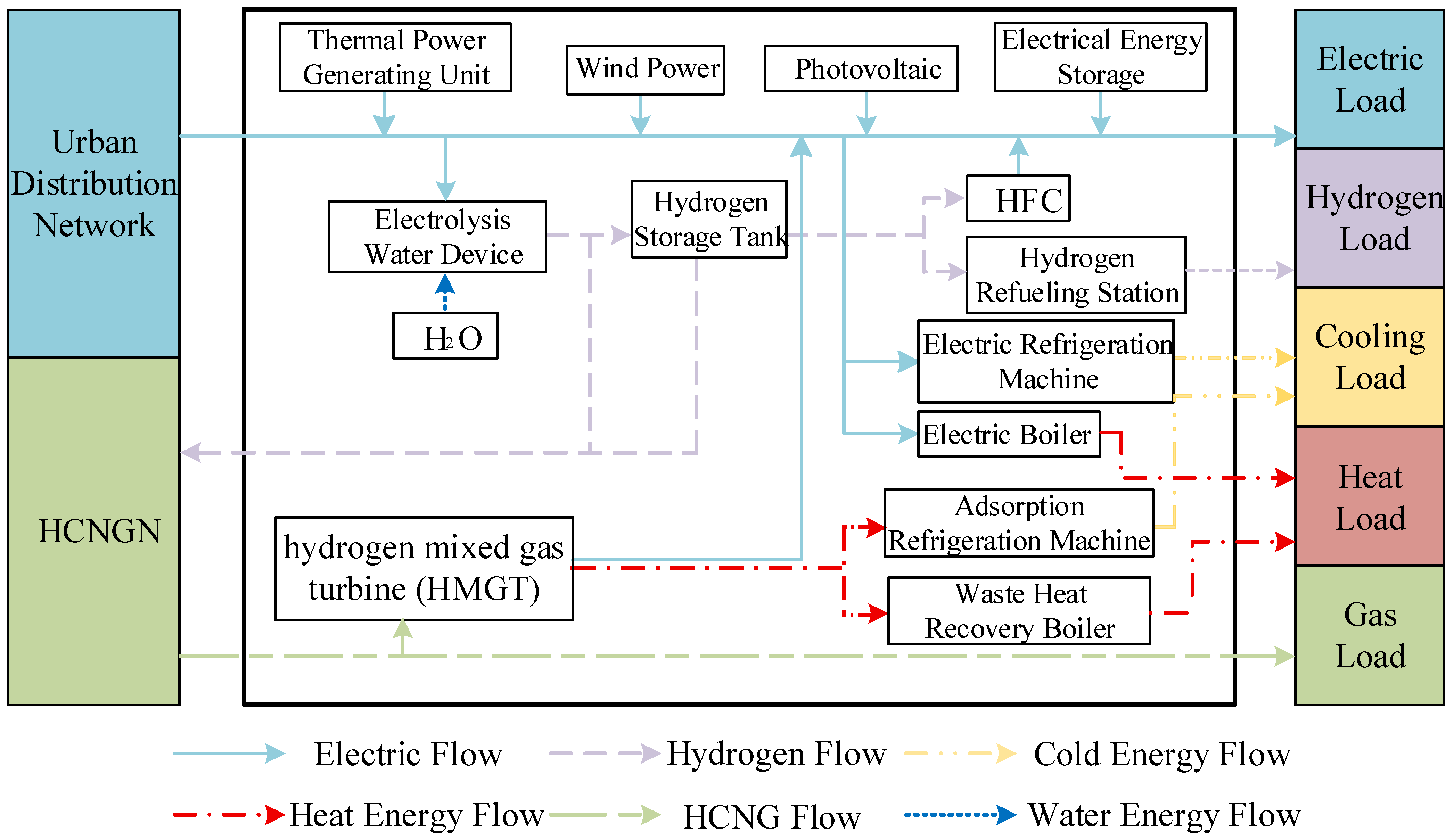
The basic structure of the hydrogen production and enriched compressing-integrated energy system is illustrated in Figure 1. On the supply side, energy is provided by thermal power units, wind power, photovoltaic power, HCNG, and other sources; the demand side comprises five types of loads, namely electricity, hydrogen, cooling, heating, and gas loads.
In the urban integrated energy system, the electricity–hydrogen–HCNG coupling unit is composed of hydrogen mixed gas turbines (HMGTs), water electrolysis units, hydrogen fuel cells (HFCs), and hydrogen storage tanks, as well as hydrogen refueling stations. When wind and solar curtailment occur frequently, or there is a surplus of power in the power grid, the water electrolysis units produce hydrogen, realizing the conversion between electric energy flow and hydrogen energy flow. A portion of the produced hydrogen is stored in hydrogen storage tanks and supplied to user units, while another portion is injected into the natural gas network at a certain ratio to form HCNG, achieving the conversion between hydrogen energy flow and HCNG flow. Meanwhile, HCNG is supplied to the HMGTs inside the user units for power generation, realizing the conversion between HCNG flow and electric energy flow. When there is a power shortage in the user units of the urban distribution network or during peak electricity consumption periods, the hydrogen fuel cells generate electricity by utilizing hydrogen, realizing the conversion between hydrogen energy flow and electric energy flow. In addition, the cooling-heating-power coupling unit is made up of HMGTs, adsorption refrigerators, waste heat recovery boilers, electric boilers, and electric refrigerators, realizing the conversion between electric energy flow and thermal energy flow, between electric energy flow and cooling energy flow, and between thermal energy flow and cooling energy flow.

3. Model Constraints of the Hydrogen Production-Enriched Compressing-Integrated Urban Energy System

Based on the structure and characteristics of the electricity–hydrogen–HCNG coupling unit, this paper divides the unit into four sub-units, namely the hydrogen production unit, hydrogen storage unit, hydrogen consumption unit, and HCNG unit, as illustrated in Figure 2.

3.1. Hydrogen System

3.1.1. Hydrogen Production Unit

The main equipment of the hydrogen production unit is the water electrolysis unit, which is used to convert the surplus wind and photovoltaic output of the power system into hydrogen. Its operation model is presented as follows.
q P 2 G , n , t H 2 = η P 2 G P P 2 G , n , t / HHV H 2 / Δ t
0 P P 2 G , n , t P P 2 G , n , max
where q P 2 G , n , t H 2 denotes the volumetric flow rate of hydrogen produced by the n-th water electrolysis unit at time t; η P 2 G represents the efficiency of the water electrolysis unit; P P 2 G , n , t represents the input electric power of the n-th water electrolysis unit at time t; HHV H 2 is the higher heating value of hydrogen; P P 2 G , n , max indicates the upper limit of the input electric power of the n-th water electrolysis unit at time t.

3.1.2. Hydrogen Storage Unit

The hydrogen storage unit is a cluster composed of multiple hydrogen storage tanks. Its hydrogen is sourced from the hydrogen production unit, and its main purpose is to supply hydrogen to the hydrogen consumption unit and the HCNG unit.
The hydrogen storage model employs a linear accumulation approach for state-of-charge dynamics, which has been widely validated in integrated energy system optimization studies and effectively captures hydrogen storage behavior while maintaining computational tractability for large-scale optimization problems [25]. Similarly, recent research demonstrates that linear hydrogen storage dynamics provide sufficient accuracy for capacity planning and operational scheduling [26].
Regarding the assumption of identical hydrogen storage tank specifications, the modeling approach depends on the scale variation among hydrogen users. When user demands exhibit significant disparities, heterogeneous tank specifications are necessary [25]. Conversely, when user scales are relatively uniform, employing standardized tank specifications simplifies system design and reduces operational complexity without compromising solution quality. In the present study, the hydrogen demand profiles across different user nodes show moderate variation rather than extreme disparities, falling within the category of relatively uniform user scales. Therefore, the assumption of identical hydrogen storage tank specifications is justified and aligns with practical engineering considerations for distributed hydrogen energy systems serving similar-scale industrial or commercial users.
Regarding heat losses in hydrogen storage tanks, this model adopts the following treatment. First, according to research on hydrogen storage systems, thermal loss rates in modern well-insulated storage tanks typically remain below 0.5 percent under normal operating conditions [25,26]. Second, the negligible thermal loss assumption is widely adopted in existing electric–hydrogen-integrated energy system studies, where minor thermal effects are omitted to maintain model tractability [25,26]. Third, considering the day-ahead scheduling nature of this optimization framework, the impact of thermal losses on system optimization and scheduling results is minimal and does not affect the validity of the proposed scheduling framework.
The operation model is presented as follows.
U ST , n , t in + U ST , n , t out 1
0 q ST , n , t in U ST , n , t in q ST , n , t in , max
0 q ST , n , t out U ST , n , t out q ST , n , t out , max
q ST , n , t ont , 1 + q ST , n , t ont , 2 = q ST , n , t ont
V ST , n . t = V ST , n . t 1 + q ST , n , t 1 in η in q ST , n , t 1 out / η out
V ST , n . 1 = V ST , n . 24 + q ST , n , 24 in η in q ST , n , 24 out / η out
N Tank , n V Tank , min V ST , n , t N Tank , n V Tank , max
where U ST , n , t in and U ST , n , t out are both 0–1 variables, representing the decision variables for the hydrogen injection and extraction processes of the n-th hydrogen storage unit at time t; q ST , n , t in denotes the volumetric flow rate of hydrogen injected into the n-th hydrogen storage unit at time t; q ST , n , t out denotes the total volumetric flow rate of hydrogen extracted from the n-th hydrogen storage unit at time t; q ST , n , t out , 1 is the volumetric flow rate of hydrogen extracted from the n-th hydrogen storage unit and injected into the natural gas pipeline at time t; q ST , n , t out , 2 represents the volumetric flow rate of hydrogen extracted from the n-th hydrogen storage unit and supplied to the hydrogen consumption unit at time t; q ST , n , t in , max indicates the maximum allowable volumetric flow rate of hydrogen that can be injected into the n-th hydrogen storage unit at time t; V ST , n . t denotes the hydrogen volume of the n-th hydrogen storage unit at time t; V Tank , max and V Tank , min are the minimum and maximum volumes of a single hydrogen storage tank, respectively; and N Tank , n represents the number of hydrogen storage tanks in the n-th hydrogen storage unit.

3.1.3. Hydrogen Consumption Unit

The hydrogen consumption unit is composed of hydrogen refueling stations and hydrogen fuel cells. The hydrogen load of hydrogen refueling stations is mainly supplied to hydrogen-fueled electric vehicles and other hydrogen-consuming equipment. Hydrogen fuel cells generate electrical energy and thermal energy through electrochemical reactions.
The waste heat recovery from hydrogen fuel cells is not separately modeled in this work. This simplification is based on three considerations. First, the waste heat generated by hydrogen fuel cells is relatively minor compared to the main energy flows in the system. Second, similar approaches that neglect hydrogen fuel cell waste heat recovery have been widely adopted in recent studies [27,28]. Third, given the small amount of waste heat from hydrogen fuel cells, its omission has a negligible impact on system optimization results, and incorporating waste heat recovery would require additional heat exchange system costs.
The operation model is presented as follows:
P HFC , l , t = η HFC q HFC , l , t H 2 HHV H 2 Δ t
P HPC , l , min P HPC , l , t P HPC , l , max
Δ P HFC , l , max P HFC , l , t P HFC , l , t 1 Δ P HFC , l , max
where P HFC , l , t denotes the output power of the hydrogen fuel cell in the l-th user unit at time t; η HFC represents the efficiency of the hydrogen fuel cell; q HFC , l , t H 2 indicates the hydrogen volume flow rate required by the hydrogen fuel cell in the l-th user unit at time t; P HFC , l , max and P HFC , l , min refer to the upper and lower limits of the output power of the hydrogen fuel cell stack in the l-th user unit, respectively; and Δ P HFC , l , max indicates the maximum ramping power of the hydrogen fuel cell stack in the l-th user unit.

3.1.4. Hydrogen Methanation Unit

To promote the downstream utilization of hydrogen energy, the system in this paper synthesizes methane through the catalytic reaction of hydrogen and carbon dioxide via the methanation process [29]. The chemical reaction equation is
C O 2 + 4 H 2 C H 4 + 2 H 2 O
It can be seen from the reaction equation that the theoretical molar ratio of hydrogen, carbon dioxide, methane, and water is 4:1:1:2. However, in practical applications, the molar ratio of hydrogen to carbon dioxide is usually set to be greater than or equal to 4 to mitigate the carbon deposition caused by side reactions.
Considering that the reaction efficiency is related to multiple factors, the conversion efficiency of the methanation reaction is set as a fixed value. The relationship between the input hydrogen volume flow rate and the output methane volume flow rate is expressed as
q ME , l , t CH 4 = η ME μ M E q ME , l , t H 2 ρ H 2 M CH 4 M H 2 ρ CH 4
where q ME , l , t CH 4 and q ME , l , t H 2 denote the volume flow rates of methane and hydrogen output by the l-th hydrogen methanation unit at time t, respectively; η ME represents the conversion efficiency of the methanation reaction unit; μ M E is the molar conversion coefficient of hydrogen to natural gas; ρ CH 4 and ρ H 2 are the densities of methane and hydrogen, respectively; and M CH 4 and M H 2 stand for the molar masses of methane and hydrogen, respectively.

3.1.5. HCNG Unit

The HCNG unit considers that the hydrogen produced via power-to-hydrogen technology is injected into the existing natural gas pipelines to form HCNG. The HCNG is regarded as a binary mixture consisting of two components, namely natural gas with methane as the primary component and hydrogen. The hydrogen-enriched compressing ratio is defined as the proportion of hydrogen in HCNG. In accordance with the relevant indicators specified in Natural Gas (GB17820-2012) [30], HCNG meets the calorific value standard of Class 1 natural gas when the hydrogen-enriched compressing ratio is less than 10%.
In this study, the energy loss and temperature variation during the hydrogen-natural gas blending process are neglected based on the following considerations. First, according to relevant experimental studies [31,32], the energy loss during hydrogen and natural gas mixing is minimal, which is negligible compared to the overall system energy flow. Second, similar simplifications have been widely adopted in recent research on HCNG-based integrated energy systems [31,32], where the blending process is treated as an ideal mixing scenario without significant thermodynamic penalties. This assumption has been validated through experimental verification and does not compromise the accuracy of scheduling optimization models. Third, for the scope of this study, focusing on system-level economic dispatch and carbon emission reduction, the impact of blending-related energy losses on the overall optimization results is marginal. Therefore, the adopted simplifications are justified and acceptable for the intended application of integrated energy microgrid scheduling optimization.
The hydrogen-enriched compressing ratio shall satisfy the following constraints:
0 x H 2 , i , t 10 %
where x H 2 , i , t denotes the hydrogen-enriched compressing ratio at gas network node i at time t.
In this study, the hydrogen-enriched compressing ratio is constrained to 0–10% in the base case scenario according to the Chinese national standard GB17820-2012 for natural gas quality specifications. This standard represents the current regulatory framework and technical safety requirements for HCNG applications in urban gas networks. The 10% upper limit is adopted as a conservative baseline to ensure compliance with existing infrastructure and safety standards in practical implementation.
Owing to the inherent properties of hydrogen, such as its low calorific value, the calorific value of HCNG differs from that of conventional natural gas, and the calculation method is presented as follows:
G C V i , t = x H 2 , i , t HHV H 2 + 1 x H 2 , i , t HHV Gas
where G C V i , t denotes the calorific value of HCNG at gas network node i at time t; HHV Gas represents the higher heating value (HHV) of natural gas.

3.1.6. Volume Flow Rate Balance Relationship of Hydrogen

Combined with Figure 2, the hydrogen volume flow rate in the hydrogen production and enriched compressing-integrated energy system shall satisfy three balance relationships: (1) the volume flow rate of hydrogen produced by the hydrogen production unit is equal to the sum of the hydrogen volume flow rate entering the hydrogen storage unit for storage and that entering the HCNG network, as shown in Equation (17); (2) the hydrogen volume flow rate consumed by the hydrogen consumption unit should be balanced with the hydrogen volume flow rate q ST , n , t out , 2 extracted from the hydrogen storage unit, as shown in Equation (18); and (3) the hydrogen volume flow rate injected into the HCNG network is equal to the sum of the hydrogen volume flow rate injected into the natural gas pipeline by the hydrogen production unit and part of the hydrogen volume flow rate extracted from the hydrogen storage unit, as shown in Equation (19).
q P 2 G , n , t H 2 = q ST , n , t in + q MH , n , t H 2
l = 1 L q HFC , l , t H 2 + q Load , l , t H 2 + q ME , l , t H 2 = n = 1 N q ST , n , t out , 2
q MH , n , t H 2 + q ST , n , t out , 1 = Q MH , n , t H 2
where q ST , n , t in denotes the hydrogen volume flow rate injected into the hydrogen storage unit by the n-th water electrolysis device at time t; q MH , n , t H 2 represents the hydrogen volume flow rate injected into the natural gas pipeline by the n-th water electrolysis device at time t; q Load , l , t H 2 represents the hydrogen volume flow rate required by the hydrogen refueling station in the l-th user unit at time t; and Q MH , n , t H 2 indicates the total hydrogen volume flow rate injected into the HCNGN by the n-th coupling unit at time t.

3.2. Power System

Considering the electricity consumption of water electrolysis devices, the output power of thermal power units, the actual output power of wind farms and photovoltaic power stations, the electricity purchased by user units, as well as the electricity load of the urban distribution network, the urban distribution network shall satisfy the electric power balance, which is specified as follows:
g = 1 G P g , t + w = 1 W P w , t + v = 1 V P v , t = l = 1 L P buy , l , t grid + n = 1 N P P 2 G , v , t + L ud , t
where P g , t denotes the output power of the g-th thermal power unit at time t; P w , t represents the actual output power of the w-th wind farm at time t; P v , t indicates the actual output power of the v-th photovoltaic power station at time t; P buy , l , t grid indicates the power purchased from the urban distribution network by the l-th user unit at time t; and L ud , t refers to the electricity load of the urban distribution network at time t.
The operation constraints of thermal power units, wind farms, and photovoltaic power stations in the urban distribution network are as follows.

3.2.1. Thermal Power Units

P g , min P g , t P g , max P g , t 1 P g , t R d , g Δ t P g , t P g , t 1 R u , g Δ t
where P g , max and P g , min denote the upper and lower output limits of the g-th thermal power unit, respectively; R d , g and R u , g represent the downward and upward ramp rates of the g-th thermal power unit, respectively.

3.2.2. Wind Farms and Photovoltaic Power Stations

0 P w , t P w , t *
0 P v , t P v , t *

3.2.3. Photovoltaic Units Inside User Units

0 P P V , t P P V , t *

3.2.4. Electrical Energy Storage

Taking batteries as an example, a suitable flexible regulation mode and capacity configuration of energy storage are established to promote the local consumption of renewable energy and improve the utilization efficiency of electric energy. The constraints mainly considered include charge–discharge state constraints, charge–discharge cycle constraints, charge–discharge power constraints, and energy storage capacity constraints.
U ESS , t d i s + U ESS , t c h 1 t = 1 T | U ESS , t d i s + U ESS , t c h | N ESS 0 P CH , t U ESS , t c h P CH , max 0 P DIS , t U ESS , t d i s P DIS , max E ESS , t = E ESS , t 1 + P CH , t 1 η CH P DIS , t 1 / η DIS Δ t E ESS , 1 = E ESS , 24 + P CH , 24 η CH P DIS , 24 / η DIS Δ t 0.2 E ESS , max E ESS , t 0.9 E ESS , max
where U ESS , t d i s and U ESS , t c h are both 0–1 variables, representing the charging and discharging states of the electrical energy storage at time t; N ESS denotes the maximum number of charge–discharge cycles of the electrical energy storage; P CH , max and P DIS , max refer to the upper limits of charging and discharging power of the electrical energy storage, respectively; E ESS , t denotes the capacity of the electrical energy storage at time t; and E ESS , max is the maximum capacity of the electrical energy storage.

3.2.5. Waste Heat Recovery Boiler

The thermal energy on the input side of the waste heat recovery boiler comes from the waste heat generated by the HMGT, and the corresponding operation constraints are specified as follows:
H RH , t = η RH H RH , t in β RH 0 H RH , t in H RH , in , max
where η RH denotes the heating efficiency of the waste heat recovery boiler; β RH represents the heating coefficient of the waste heat recovery boiler; and H RH , in , max is the upper limit of heat collection power on the input side of the waste heat recovery boiler.

3.2.6. Electric Boiler

The electric boiler takes electrical energy as the input energy form and converts electrical energy into thermal energy through its operating mode, and the corresponding operation constraints are specified as follows:
H EH , t = η EH P EH , t 0 P EH , t P EH , max
where η EH denotes the heating efficiency of the electric boiler; P EH , max represents the upper limit of power consumption of the electric boiler.

3.2.7. Absorption Chiller

The thermal energy on the input side of the absorption chiller is all derived from the waste heat generated by the HMGT, and the corresponding operation constraints are specified as follows:
C AC , t = η AC H AC , t in β AC 0 H AC , t in H AC , in , max
where η AC denotes the refrigeration efficiency of the absorption chiller; β AC represents the refrigeration coefficient of the absorption chiller; and H AC , in , max is the upper limit of heat collection power on the input side of the absorption chiller.

3.2.8. Electric Chiller

The electric chiller takes electrical energy as the input energy form and converts electrical energy into cooling energy through its operating mode, and the corresponding operation constraints are specified as follows:
C EC , t = η EC P EC , t 0 P EC , t P EC , max
where η EC denotes the refrigeration efficiency of the electric chiller; P EC , max represents the upper limit of power consumption of the electric chiller.

3.3. HCNGN System

3.3.1. System Constraints of the HCNGN

It is assumed that the gas supply flow rate at the gas source points of the HCNGN and the hydrogen injection flow rate at the hydrogen-enriched compressing points have reached stable values. The system constraints of HCNGN mainly take into account the constraints related to gas sources, node gas pressures, compressors, and natural gas pipeline flow rates, which are specified as follows:
q s , min q s , t q s , max
q i j , t = σ i j ε i j , t p i , t 2 p j , t 2
ε i j , t = sgn q i j , t
q i j , max q i j , t q i j , max
p i , min p i , t p i , max
K min p i , t p j , t K max
where q s , t denotes the gas supply flow rate at the gas source; q s , max and q s , min represent the upper and lower limits of the gas supply flow rate at the gas source, respectively; σ i j indicates the pipeline transmission parameter between gas network nodes i and j; p i , t refers to the pressure value at gas network node i at time t; ε i j , t is the pipeline direction parameter of the gas network at time t, which takes the values of −1, 0, and 1; p i , max and p i , min are the upper and lower limits of the pressure value at gas network node i, respectively; and K max and K min are the upper and lower limits of the compression ratio.

3.3.2. Node Balance Constraints of the HCNGN

The node balance constraints of the HCNGN take into account the node energy balance and HCNG component balance, which are specified as follows:
k u i q k i , t ξ k , t GCV j d i q i j , t ξ i , t GCV + q S , i , t ξ HHVGas + q MH , i , t ξ HHVH 2 = q MT , i , t ξ i , t GCV + q D , i , t ξ i , t GCV
x c , i , t q MH , i , t + q S , i , t + k u i q k i , t = q MH , i , t x c , i , t MH + q S , i , t x c , i , t S + k u i q k i , t x c , k , t
where u i represents the set of upstream nodes connected to node i; d i represents the set of downstream nodes connected to node i; q S , i , t denotes the gas supply flow rate at gas network node i at time t; q MH , i , t denotes the volumetric flow rate of hydrogen injected into gas network node i at time t; q MT , i , t denotes the volumetric flow rate of HCNG consumed by the HMGT connected to gas network node i at time t; q D , i , t denotes the volumetric flow rate of the HCNG load at gas network node i at time t; x c , i , t MH denotes the proportion of gas component c in the hydrogen-enriched compressed at gas network node i at time t; and x c , i , t S denotes the proportion of gas component c in the natural gas supplied by the gas source at gas network node i at time t.
After the calorific value changes at each node in the gas network, the gas load at the corresponding node also changes. The volumetric flow rate of the gas load q D , i , t in Equation (36) is no longer a constant; it is determined by the original volumetric flow rate demand of the natural gas load and the calorific value of the enriched compressed gas. The specific calculation is as follows:
q D , i , t = q L , i , t CH 4 ξ HHVGas / ξ i , t GCV
where q L , i , t CH 4 represents the original natural gas load demand volumetric flow rate at gas network node i.

3.4. User Units

3.4.1. Demand Response of User Units

The demand response of user units mainly considers the demand response of electric loads, namely the electric load curtailment and the temporal transfer of electric loads within the dispatching cycle. In this paper, the cooling and heating loads have been converted into electric power form, so the demand response of cooling and heating loads is not taken into account.
The electric loads of user units are divided into three parts: fixed electric loads, curtailable electric loads, and transferable electric loads, among which the fixed loads do not participate in demand response. The compensation prices for load curtailment and load transfer are determined based on user willingness-to-participate surveys and the economic losses associated with consumption adjustments [33,34]. The load curtailment compensation reflects the economic impact users experience when reducing their electricity consumption during peak periods. The load transfer compensation is set lower than curtailment compensation since users only shift their energy usage timing rather than reducing total consumption. These compensation mechanisms ensure economic incentives for user participation while maintaining system cost-effectiveness. The details are specified as follows:
L us , l , t = L us , l , t fix , 0 + L us , l , t cut , 0 + L us , l , t tran , 0
where L us , l , t fix , 0 , L us , l , t cut , 0 and L us , l , t tran , 0 denote the fixed electric load, curtailable electric load, and substitutable electric load of the l-th user unit at time t, respectively.
User units can withstand a certain degree of load interruption and power reduction. According to the actual energy supply and consumption conditions, the power of curtailable loads can be partially or fully reduced to achieve the goal of satisfying the overall energy consumption of user units. The modeling of curtailable loads is presented as follows:
L us , l , t cut = L us , l , t cut , 0 Δ L us , l , t cut
0 Δ L us , l , t cut Δ L us , l , max cut
where L us , l , t cut and Δ L us , l , t cut denote the value of the curtailable load of the l-th user unit at time t after demand response and participating in demand response, respectively; Δ L us , l , max cut represents the upper limit of the curtailable load that can be reduced for the l-th user unit at time t.
A transferable load refers to the shift in energy consumption time periods within the system, while the total volume of transferable loads must remain unchanged throughout the dispatching cycle. The modeling of transferable loads is presented as follows:
L us , l , t tran = L us , l , t tran , 0 + Δ L us , l , t tran
Δ L us , l , t tran = B us , l , t tran , in L us , l , t tran , in B us , l , t tran , out L us , l , t tran , out
B us , l , t tran , in + B us , l , t tran , out = 1
t = 1 T Δ L us , l , t tran = 0
L us , l , min tran Δ L us , l , t tran L us , l , max tran
where L us , l , t tran and Δ L us , l , t tran denote the value of the transferable load of the l-th user unit at time t after demand response and participating in demand response, respectively; B us , l , t tran , in and B us , l , t tran , out are both 0–1 variables, representing the load-shifting-in and load-shifting-out states of the transferable load of the l-th user unit at time t; L us , l , t tran , in and L us , l , t tran , out indicate the load-shifting-in and load-shifting-out power of the transferable load of the l-th user unit at time t, respectively; L us , l , max tran and L us , l , min tran refer to the lower and upper limits of the demand response capacity of the transferable load of the l-th user unit at time t, respectively.

3.4.2. Internal Operating Equipment of User Units

Three types of user units are considered, namely commercial parks, industrial parks, and residential communities. Commercial parks and residential communities are equipped with devices such as HMGT, photovoltaic units, electrical energy storage systems, and hydrogen fuel cells. In contrast, industrial parks incorporate not only the above-mentioned equipment but also combined cooling and heating devices, including electric boilers, electric chillers, waste heat recovery boilers, and absorption chillers. This paper takes industrial parks as an example to introduce the operation constraints of internal equipment within user units.
The constraints on the balance of cooling, heating, and electric power that must be satisfied by the operation of internal equipment in the park are presented in Equations (47)–(49).
C EC , t + C AC , t = C us , t
H RH , t + H EH , t = H us , t
P HT , t + P buy , t grid + P PV , t + P DIS , t + P HFC , t = L us , t + P CH , t + P EH , t + P EC , t
where C EC , t denotes the cooling power output by the electric chillers in the industrial park at time t; C AC , t represents the cooling power output by the absorption chillers in the industrial park at time t; C us , t represents the cooling load of the industrial park at time t; H RH , t indicates the heat release power output by the waste heat recovery boilers in the industrial park at time t; H EH , t refers to the heat release power output by the electric boilers in the industrial park at time t; H us , t is the heating load of the industrial park at time t; P HT , t is the electric power output by the HMGT at time t; P buy , t grid is the power purchased by the industrial park at time t; P PV , t is the actual output power of the photovoltaic units in the industrial park at time t; P CH , t and P DIS , t are the charging and discharging power of the electrical energy storage systems in the industrial park at time t, respectively; P EC , t is the electric power consumed by the electric chillers in the industrial park at time t; and L us , t is the electric load of the industrial park at time t.
As a critical coupling device between the urban distribution network and the HCNGN, the HMGT has its relevant models presented as follows:
P HT , t = η H T V HT , t G C V t
P HT , min P HT , t P HT , max
Q cab , t = G C V t V HT , t ε NG × 10 3
where η H T denotes the power generation efficiency of the HMGT; V HT , t represents the HCNG volume required for power generation of the HMGT at time t; G C V t is the HCNG calorific value at the connection node of the HMGT to the HCNGN at time t; P HT , max and P HT , min are the upper and lower limits of the output power of the HMGT, respectively; Q cab , t refers to the carbon dioxide emissions of the HMGT at time t; ε NG indicates the carbon dioxide emission factor of natural gas.
The carbon accounting boundary in this study focuses exclusively on direct emissions from HCNG combustion. Indirect emissions associated with electricity purchased from the grid were not included in the calculation, as the primary energy input for the system is HCNG. The carbon emission factor for HCNG was determined based on its composition and the standard emission factors for natural gas and hydrogen combustion. This approach allows for a focused assessment of the direct carbon footprint attributable to the HCNG combustion process.
As a critical coupling device for cooling and heating, the waste heat output by the HMGT must satisfy the following balance condition with the heat collection power of absorption chillers and waste heat recovery boilers:
H HT , t = η RE P HT , t
H RH , t in + H AC , t in = H HT , t
where η RE denotes the waste heat output efficiency of the HMGT; H HT , t represents the waste heat output per unit time of the HMGT in the industrial park at time t; H RH , t in is the heat collection capacity at the input side of the waste heat recovery boiler at time t; and H AC , t in refers to the heat collection capacity at the input side of the absorption chiller at time t.

4. Optimal Scheduling Model for the Hydrogen Production-Enriched Compressing-Integrated Urban Energy System

4.1. Objective Function

In this paper, the objective is to minimize the intraday economic dispatch cost of the hydrogen production-enriched compressing-integrated energy system, and the objective function is presented as follows:
min F = C o p + C p + C d r + C t
where C op denotes the operation and maintenance cost of the urban integrated energy system; C p represents the penalty cost; C dr denotes the demand response cost of user units; C t indicates the carbon emission cost of the system.
The specific models of each cost are as follows.

4.1.1. Operation and Maintenance Cost

C op = C e + C g + C h + C us
where C e , C g , C h , and C us denote the operation costs of the power system, HCNGN, electricity–hydrogen–HCNG coupling unit, and internal equipment of the user unit, respectively.
The operation cost of the power system mainly considers the power generation cost of thermal power units, the operation costs of wind farms and photovoltaic power stations, and the electricity purchase cost of user units from the upper-level power grid, which are specified as follows:
C e = C PG + C PW + C PV + C buy C PG = t = 1 T g = 1 G a g P g , t 2 + b g P g , t + c g C PW = ζ PW t = 1 T w = 1 W P w , t C PV = ζ PV t = 1 T v = 1 V P v , t C buy = t = 1 T l = 1 L λ buy , t grid P buy , l , t grid
where a g , b g , and c g denote the cost coefficients of thermal power units, respectively; ζ PW and ζ PV represent the operation and maintenance costs per unit output of wind power and photovoltaic power, respectively; λ buy , t grid is the time-of-use electricity price.
The operation cost of the HCNGN mainly takes into account the gas supply cost of gas sources, which is specified as follows:
C g = λ sg t = 1 T s = 1 S q s , t Δ t
where λ sg denotes the gas supply cost of the gas source.
The operation cost of the electricity–hydrogen–HCNG coupling unit mainly takes into account the operation costs of water electrolysis units, hydrogen fuel cells and hydrogen storage units, as well as the installation cost of hydrogen storage tanks, which is specified as follows:
C h = C P 2 G + C HFC + C ST + C Tank C P 2 G = ζ P 2 G t = 1 T n = 1 N P P 2 G , n , t C HFC = ζ HFC u = 1 U P HFC , u , t C ST = ζ ST t = 1 T n = 1 N q ST , n , t in + q ST , n , t out , 1 + q ST , n , t out , 2 C Tank = κ Tank n = 1 N N Tank , n
where ζ P 2 G represents the operation and maintenance cost per unit power consumption of the water electrolysis; ζ HFC denotes the operation and maintenance cost per unit power generation of the hydrogen fuel cell; ζ ST denotes the operation and maintenance cost per unit hydrogen volume flow of injection and extraction in the hydrogen storage unit; and κ Tank refers to the installation cost of a single hydrogen storage tank.
The operation cost of the internal equipment of the user unit mainly takes into account the operation costs of equipment such as photovoltaic units, electrical energy storage, electric chillers, absorption chillers, electric boilers, and waste heat recovery boilers, as well as the gas purchase cost of the HMGT from the natural gas system, which is specified as follows:
C us = C PV us + C ESS + C HT + C EH + C EC + C RH + C AC C PV us = ζ PV us l = 1 L P PV , l , t C ESS = ζ ESS l = 1 L P CH , l , t + P DIS , l , t C HT = t = 1 T l = 1 L λ hg , t V hg , l , t C EH = ζ EH P EH , t C EC = ζ EC P EC , t C RH = ζ RH H RH , t in C AC = ζ AC H AC , t in
where ζ PV us denotes the operation and maintenance cost per unit output of the photovoltaic units inside the user unit; cees represents the operation and maintenance cost per unit charging and discharging power of the electrical energy storage; ζ ESS indicates the time-of-use gas price for HMGT to purchase gas from HCNGN; ζ EH , ζ EC , ζ RH and ζ AC refer to the unit operation and maintenance costs of the electric boiler, electric chiller, waste heat recovery boiler and absorption chiller, respectively.

4.1.2. Penalty Cost

The penalty cost of the system mainly takes into account the wind curtailment and solar curtailment costs of wind farms, photovoltaic power stations and the photovoltaic units inside the user unit, which are specified as follows:
C p = C PWp + C PVp + C PVp us C PWp = δ PW t = 1 T w = 1 W P w , t * P w , t C PVp = δ PV t = 1 T v = 1 V P v , t * P v , t C PVp us = δ PV l = 1 L P PV , l , t * P PV , l , t
where δ PW denotes the unit wind curtailment cost of the system; δ PV represents the unit solar curtailment cost of the system; P w , t * is the predicted output of the i-th wind farm at time t; P v , t * refers to the predicted output of the j-th photovoltaic power station at time t; and P PV , l , t * represents the predicted output of the photovoltaic unit inside the k-th user unit at time t.

4.1.3. Demand Response Cost of User Units

The demand response cost of user units mainly takes into account the load curtailment cost and load transfer cost of electrical loads, which are specified as follows:
C dr = C cut + C tran C cut = τ c t = 1 T l = 1 L Δ L us , l , t cut C tran = τ t t = 1 T l = 1 L L us , l , t t r a n , out
where τ c denotes the compensation price per unit power of electrical load curtailment; τ t represents the compensation price per unit power of electrical load transfer-out.

4.1.4. Carbon Emission Cost

The carbon emission cost of the system mainly takes into account the carbon emission costs of thermal power units and HMGT, as well as the carbon emission cost of HCNG loads, which are specified as follows:
C t = C PGt + C HTt + C GLt C PGt = ξ CO 2 t = 1 T g = 1 G P g , t Δ t C HTt = ξ CO 2 t = 1 T l = 1 L Q cab , l , t C DLt = ξ CO 2 t = 1 T i = 1 N G G C V i , t V D L , i , t ε NG × 10 3
where ξ CO 2 denotes the carbon price.

4.2. Model Summary and Solution

The low-carbon economic optimal dispatch model for the electricity–hydrogen–HCNG urban integrated energy system is composed of the objective functions shown in Equations (55)–(63) and the constraint conditions shown in Equations (1)–(54).
The MINLP optimization model is implemented in GAMS 42 and solved using the DICOPT solver with the following convergence criteria and computational settings. The maximum iteration limit is set to 50,000 to ensure sufficient search space exploration. The maximum computational time is restricted to 300 s to maintain practical applicability for day-ahead scheduling applications. The numerical precision for decision variables is set to five decimal places. Under these settings, the solver successfully converges to optimal solutions for all test cases within the specified time limit, demonstrating the computational efficiency of the proposed model.

5. Case Study

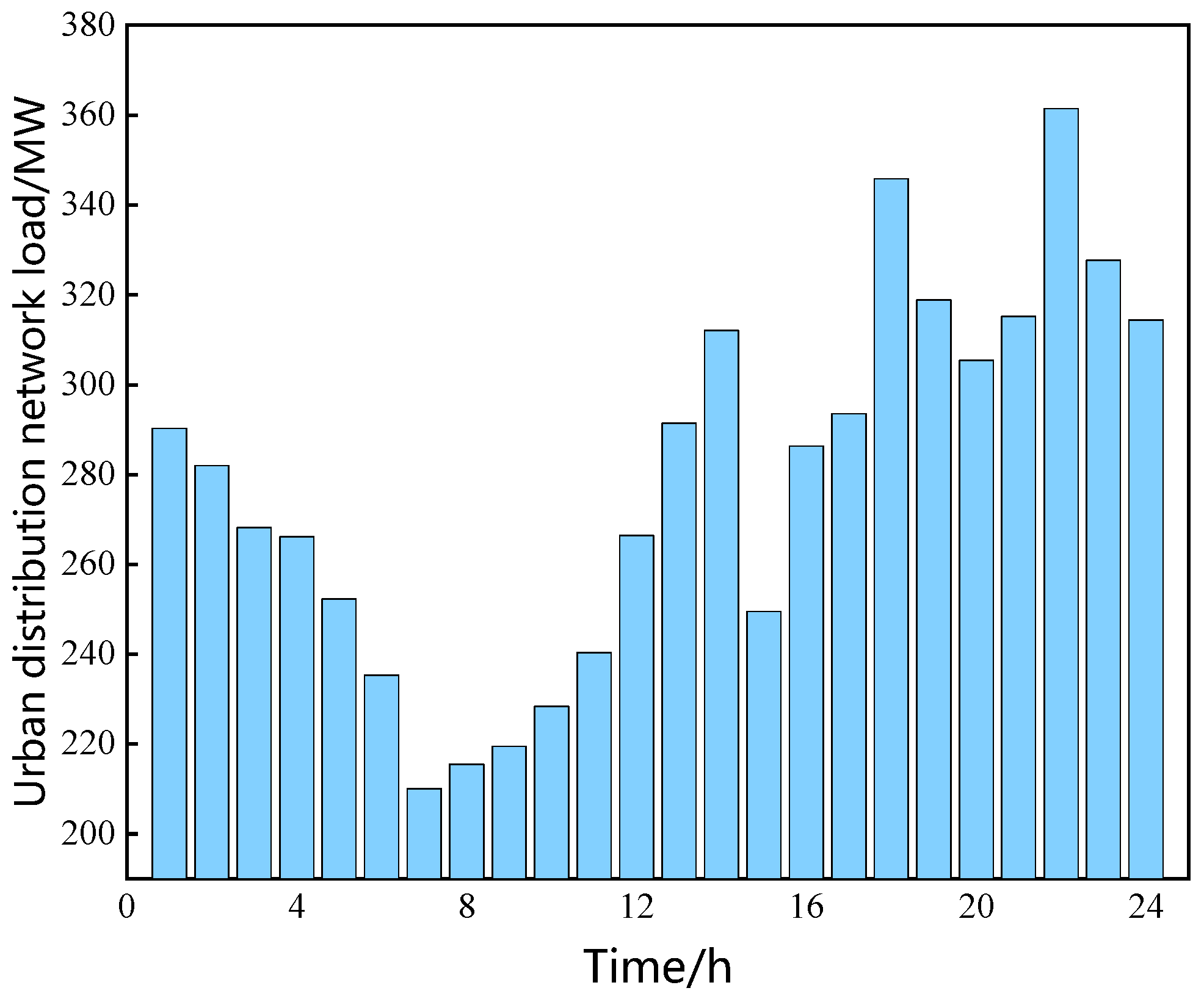
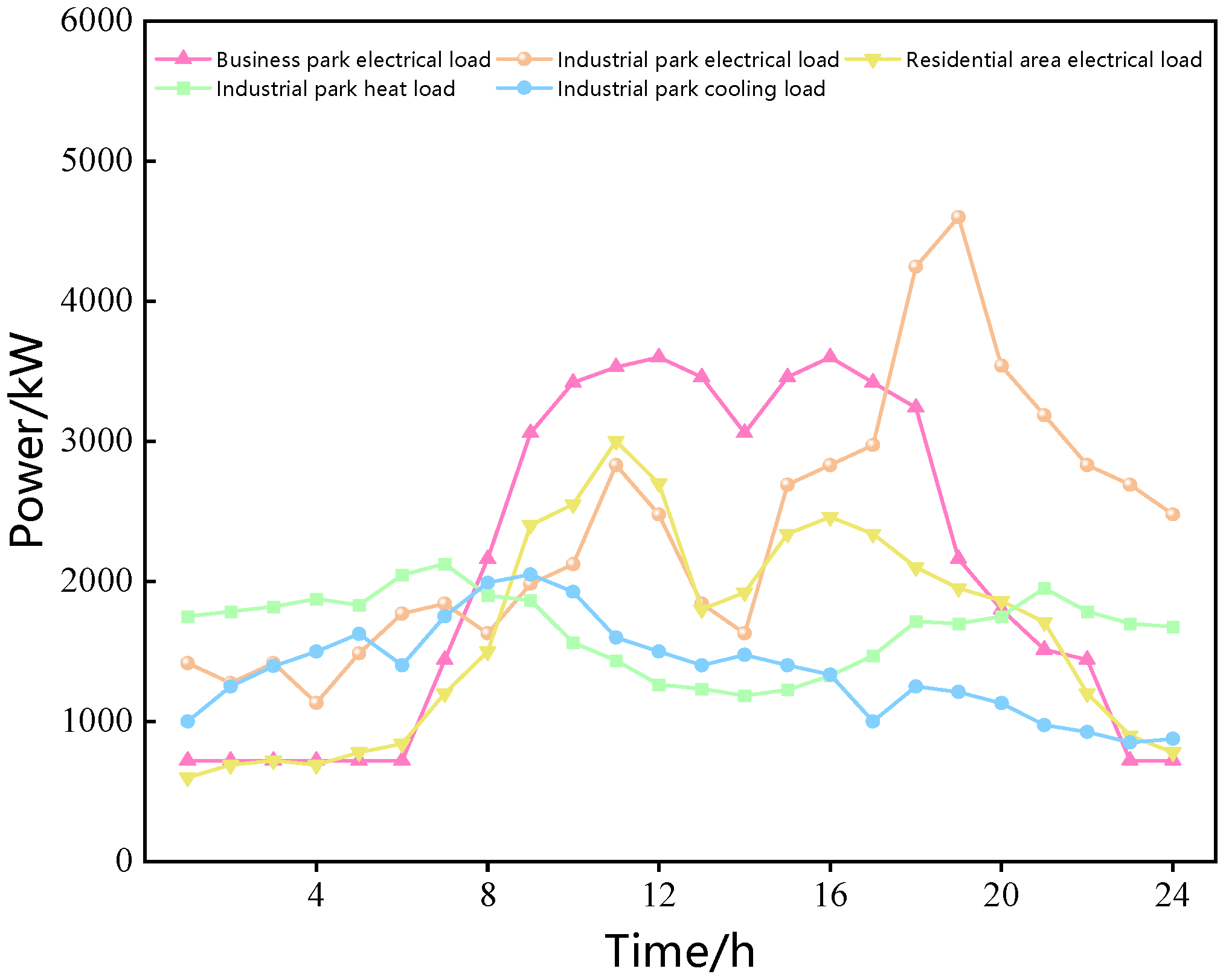
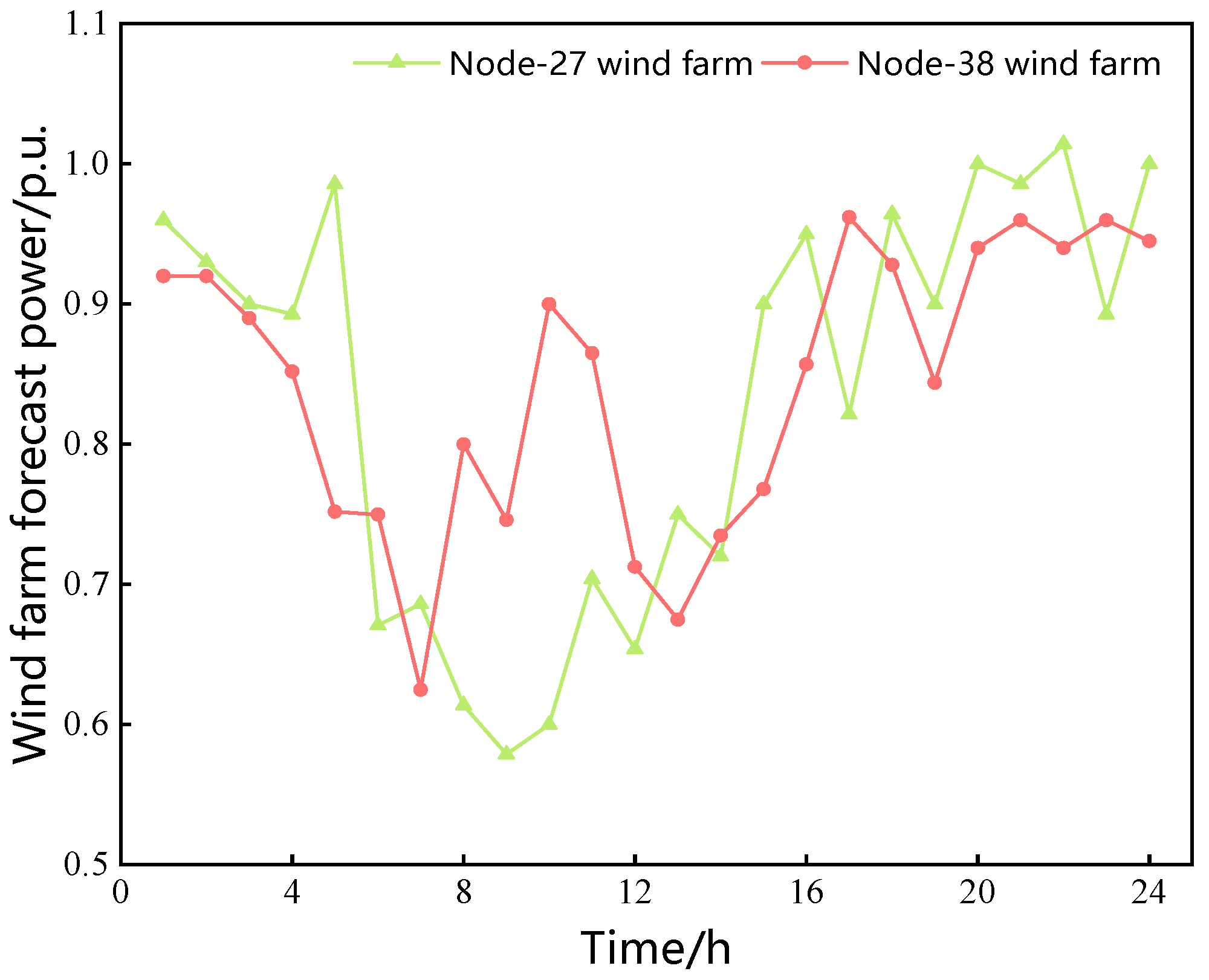
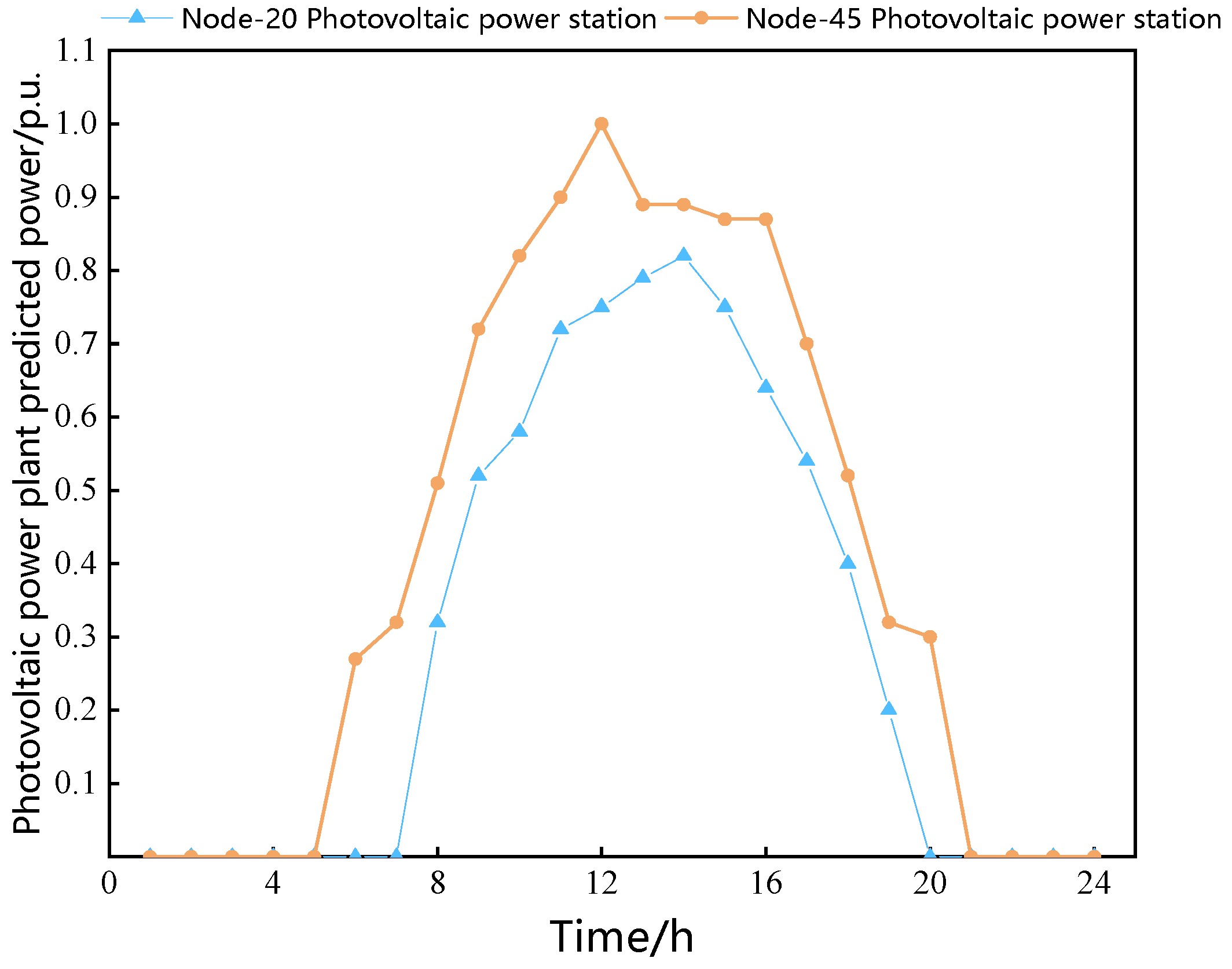
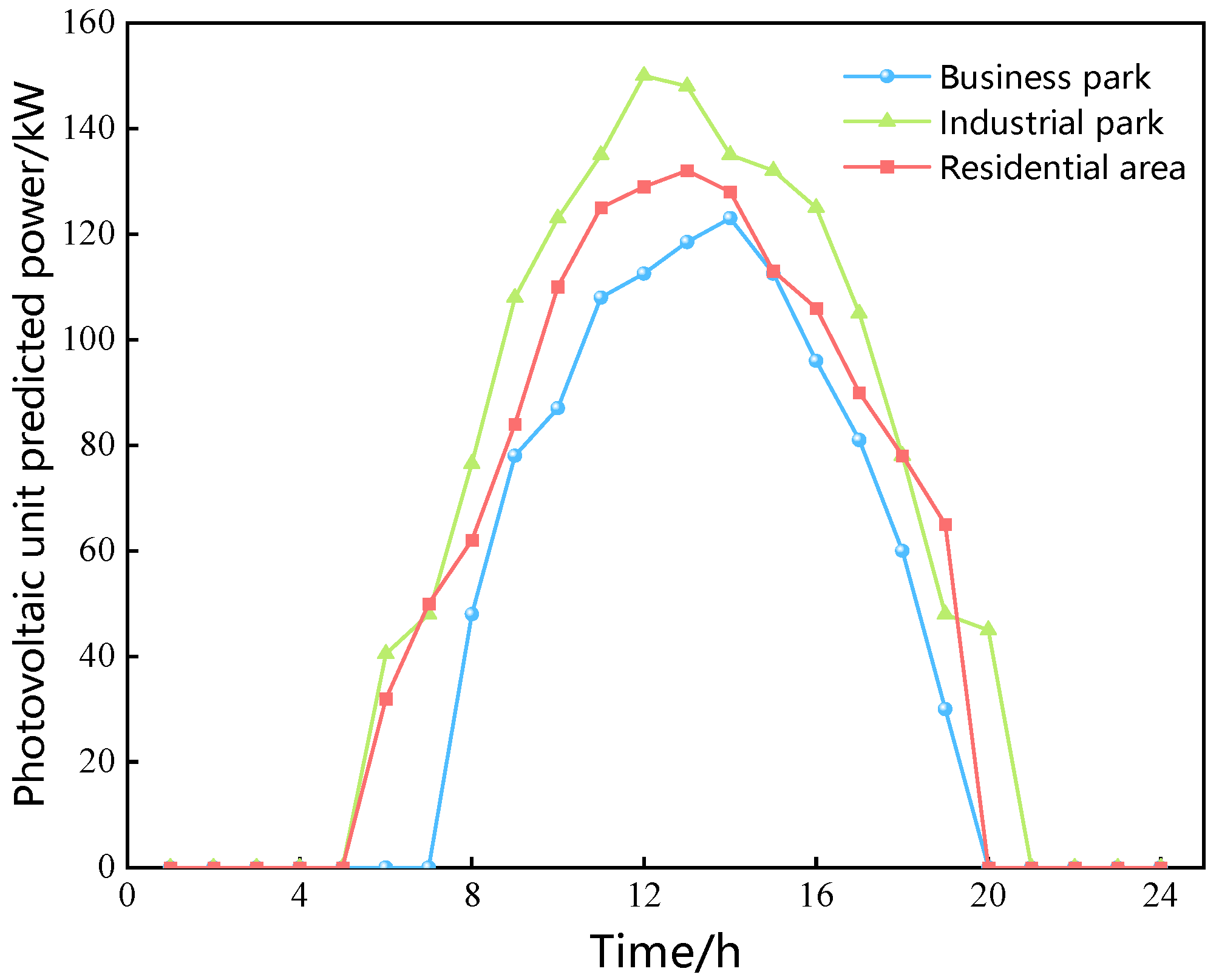
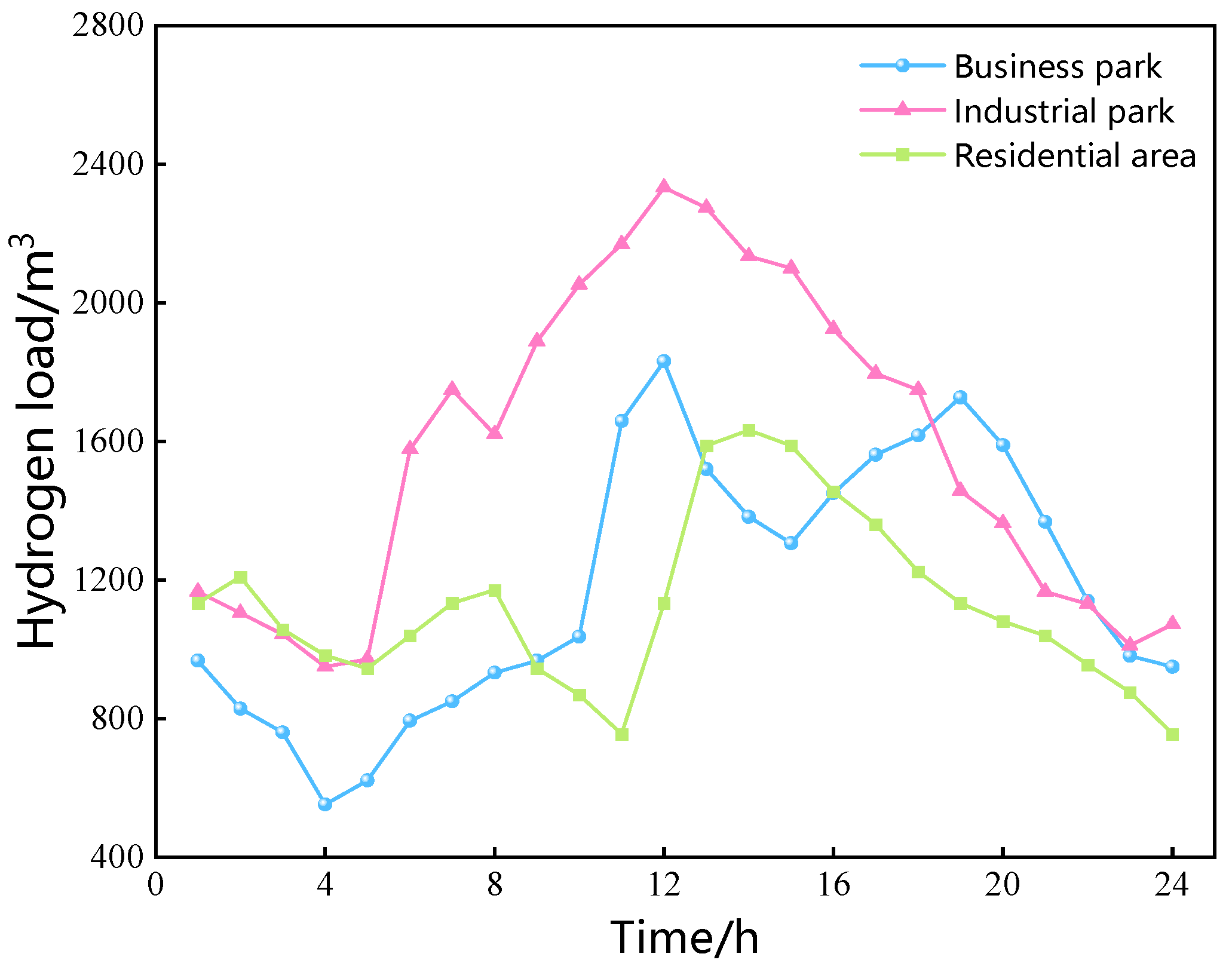
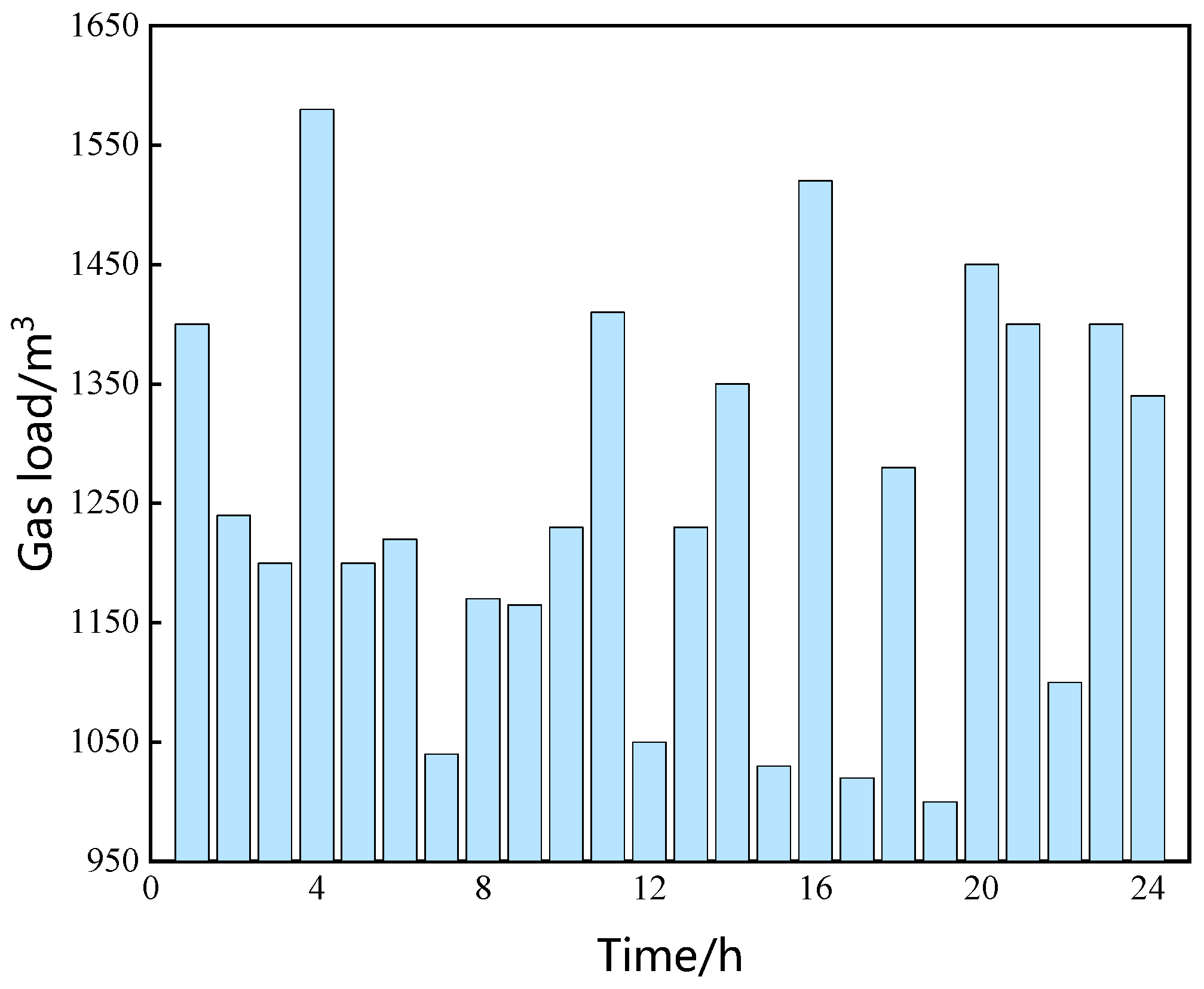
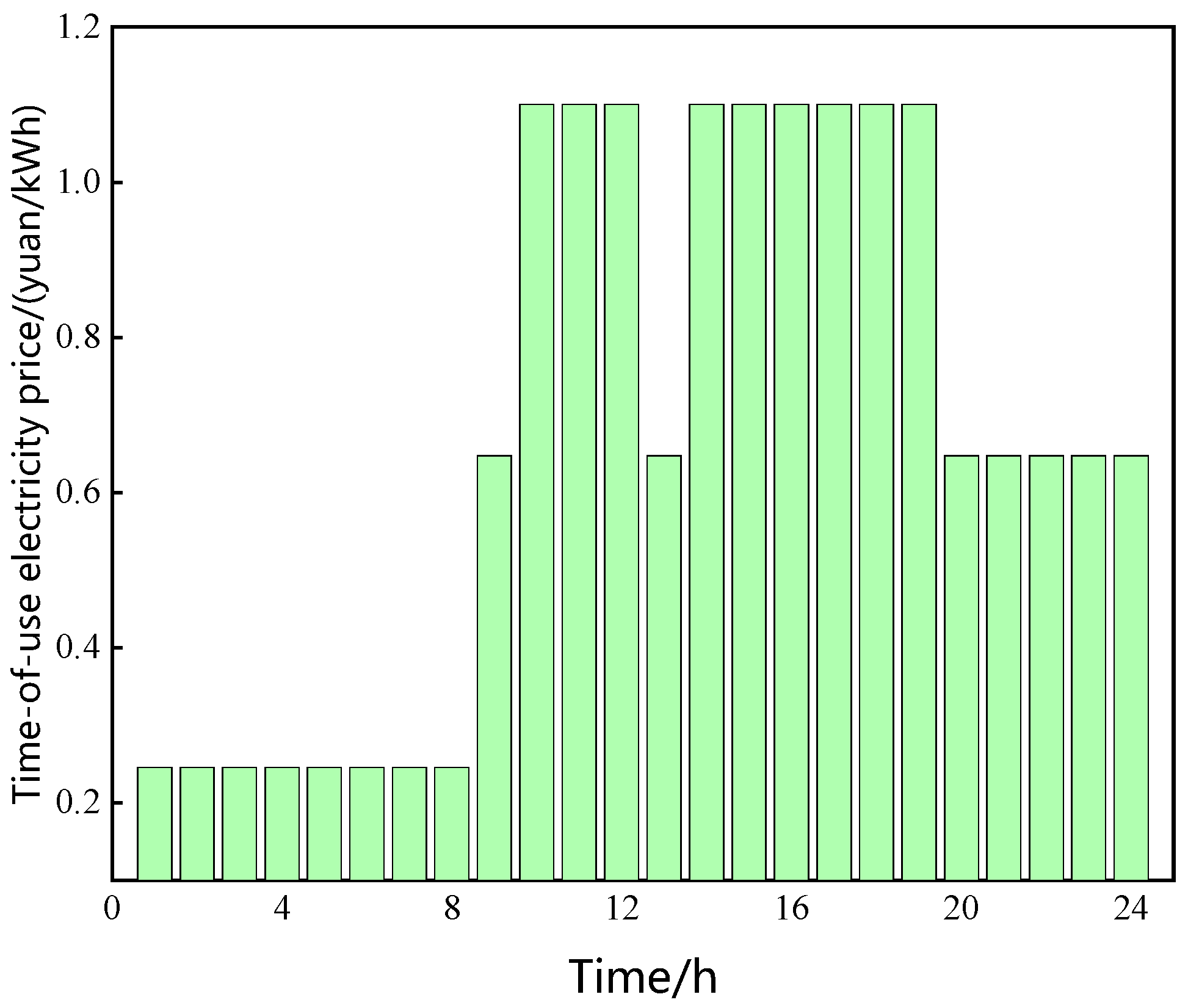
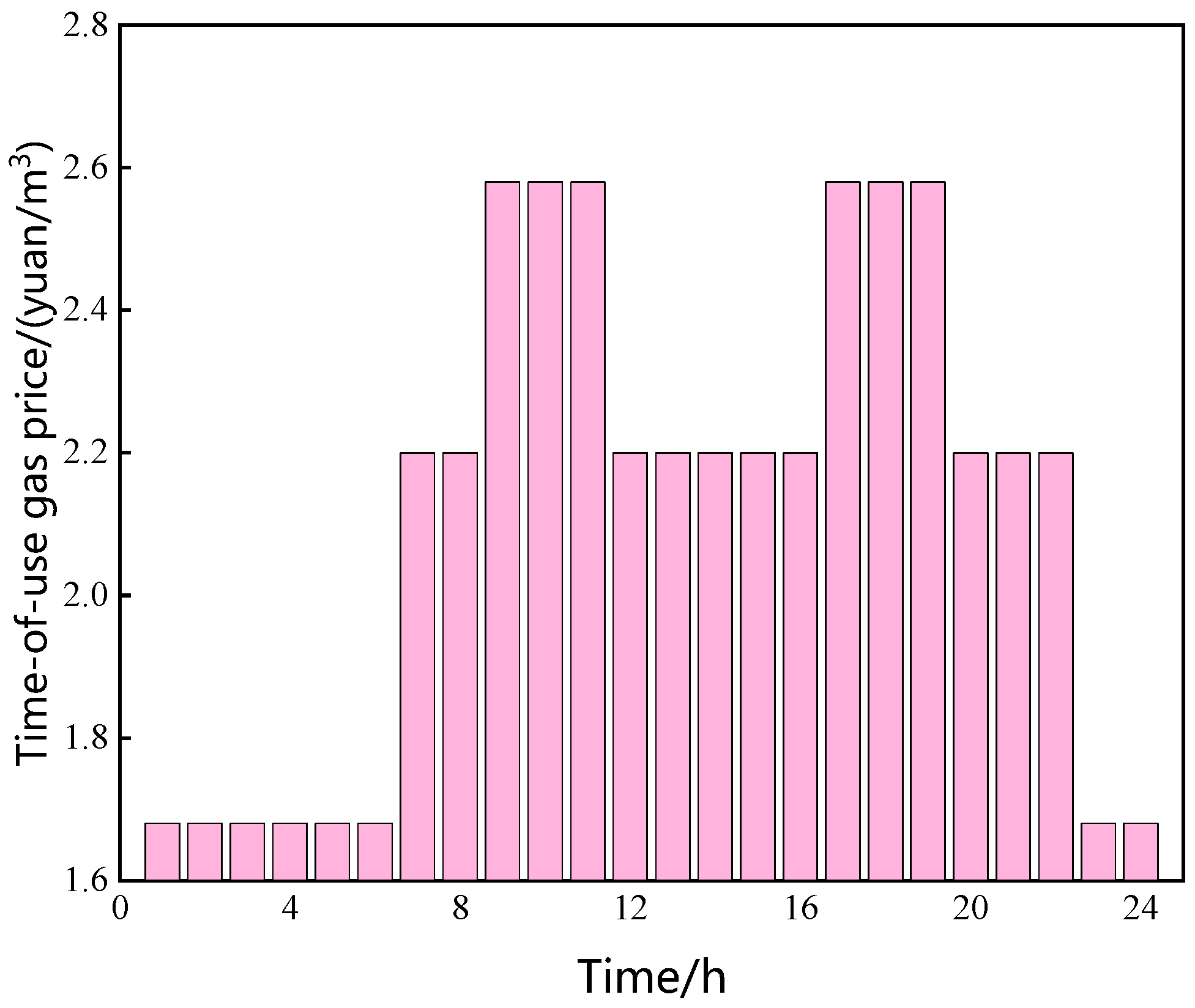
The proposed model is verified by simulation based on an actual urban distribution network with 102 nodes and an HCNGN with 8 nodes. The distribution network data are obtained from an inland city in Southwest China, while the natural gas network data are based on the standard eight-node test case. These parameters are realistic and widely used in similar studies. The dispatching cycle is set as one day with a time step of 1 h, and the system structure diagram is shown in Figure 3. In the urban distribution network, node 15 is connected to a thermal power unit with a capacity of 50 MW, nodes 27 and 38 are respectively connected to large-scale wind farms with a capacity of 200 MW each, and nodes 20 and 45 are respectively connected to photovoltaic power stations with a capacity of 80 MW each. Water electrolysis devices and hydrogen storage units are connected to nodes 20, 27, 38, and 45, respectively. Three types of user units, namely commercial parks, industrial parks and residential communities, are connected to nodes 24, 32 and 41, respectively. In the HCNGN, nodes 1 and 7 are gas source points, nodes 3 and 4 are hydrogen-enriched compressing points, and node 5 is the gas load connection point. The system operation parameters, typical daily load curves, wind and photovoltaic output prediction curves, time-of-use electricity prices, time-of-use gas prices and other relevant data are provided in Appendix A.

5.1. Comparative Analysis of System Optimal Dispatch Results Under Different Scenarios

To verify the overall effectiveness of the proposed model in optimizing the operation of urban integrated energy systems, three scenarios are established for comparative analysis.
Case 1: Basic scenario, where power-to-hydrogen is not considered, the system does not include electricity–hydrogen–HCNG coupling units, and the gas turbines in user units are traditional gas turbines;
Case 2: Based on one of the important current utilization pathways of hydrogen, where power-to-hydrogen and hydrogen methanation are taken into account, the system does not contain electricity–hydrogen–HCNG coupling units, and the gas turbines in user units are traditional gas turbines;
Case 3: The scenario considering electricity–hydrogen–HCNG coupling units, which refers to the model proposed in this paper.

5.1.1. Analysis of System Operation Cost

The operation costs of the system under different scenarios are shown in Table 1. Compared with Case 1, the wind and photovoltaic curtailment costs of Case 2 and Case 3 are reduced by 9.32% and 29.55%, respectively. The comparative analysis indicates that Case 2 achieves the lowest total cost and the highest economic efficiency. This is because the methane synthesized from hydrogen produced in Case 2 via the methanation reactor is injected into the natural gas network, which reduces the gas supply cost of the natural gas network by 76.94%. Consequently, the gas consumption costs of gas turbines in user units and gas loads in the natural gas system decrease substantially, the output of gas turbines increases, the electricity purchase cost of user units declines, and the total cost of the system is reduced significantly. Case 3 incorporates electricity–hydrogen–HCNG coupling units, and the increased operation and maintenance costs of relevant units lead to a rise in the total system cost. However, in comparison with Case 1 and Case 2, the carbon emission cost of the system in Case 3 is reduced.
Although Case 3 demonstrates the highest total cost among the three scenarios, this primarily reflects the infrastructure investment required for establishing the electricity–hydrogen–HCNG coupling system, including hydrogen production facilities, storage devices, and enriched compressing equipment. A comprehensive evaluation of future cost trends suggests several factors that may influence the economic viability of the proposed model.
First, the capital costs of hydrogen energy equipment are projected to decline substantially in the coming years. Industry forecasts indicate that water electrolysis devices and hydrogen storage systems may experience cost reductions of 40–60% by 2030 due to technological maturation and manufacturing scale-up [35,36]. Such cost trajectories would narrow the economic gap observed between Case 3 and the baseline scenarios.
Second, carbon pricing mechanisms are expected to evolve globally [37]. As carbon markets develop and environmental regulations strengthen, the 1.89% carbon emission reduction achieved by Case 3 relative to Case 2 represents an increasingly valuable attribute. Higher carbon prices would enhance the economic competitiveness of low-carbon energy systems through avoided emission costs.
Third, the multi-pathway hydrogen utilization framework provides operational flexibility that extends beyond immediate cost metrics. The system’s capacity to accommodate renewable energy fluctuations and maintain supply reliability offers resilience benefits that contribute to long-term value, particularly as renewable penetration increases.
These considerations indicate that while Case 3 requires greater upfront investment, its economic performance relative to conventional approaches may improve as hydrogen technologies mature and environmental policy frameworks strengthen. The present cost differential should therefore be evaluated within the context of anticipated market and technological developments.

5.1.2. Analysis of Wind and Photovoltaic Absorption in the System

The wind and photovoltaic absorption of the system under different scenarios is shown in Figure 4. When power-to-hydrogen is not taken into account, the wind and photovoltaic curtailment volume reaches as high as 29.91%. Compared with Case 1, the wind and photovoltaic utilization rate of the system is improved after power-to-hydrogen is considered. Specifically, part of the wind and photovoltaic output in Case 2 is used for hydrogen production and subsequent methane synthesis. Restricted by the operation constraints of the natural gas network and the operation efficiency of the methanation reactor, the wind and photovoltaic utilization rate of the system is increased by 2.79%. Case 3 incorporates electricity–hydrogen–HCNG coupling units, in which the hydrogen-consuming units and HCNG units further promote the system to absorb wind and photovoltaic output for hydrogen production, so as to meet the hydrogen demand of hydrogen fuel cells and hydrogen refueling stations in user units. As a result, the wind and photovoltaic utilization rate is increased by 6.81% compared with Case 1.
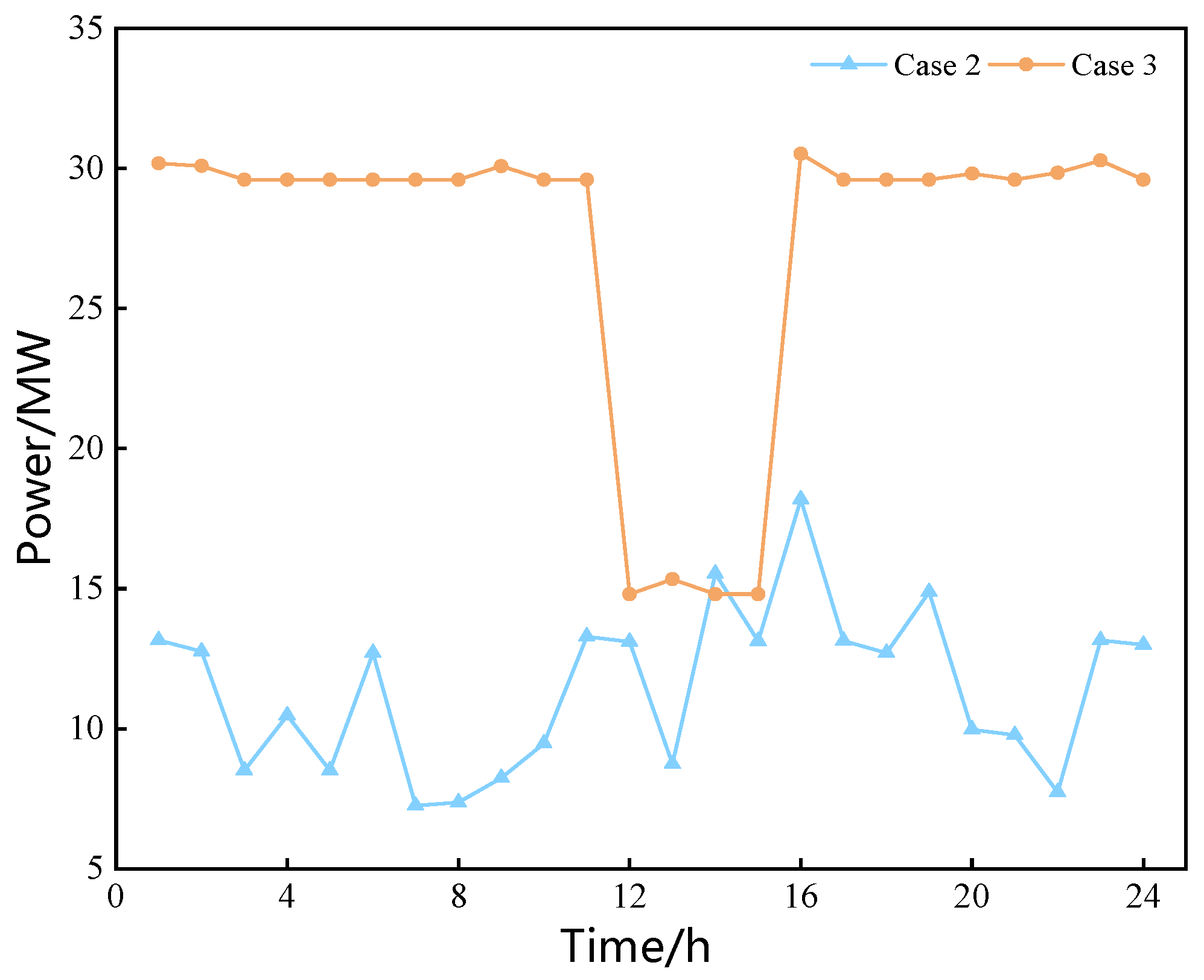
As can be seen from Figure 5, the water electrolysis devices are mainly operated during periods with high wind power output, such as 0–4 and 16–24 h. After the electricity–hydrogen–HCNG coupling units are taken into consideration, the system’s capacity to absorb wind and photovoltaic power is significantly improved. Compared with Case 2, the total electricity consumption of the water electrolysis devices in Case 3 increases by 380.59 MW.

5.1.3. Analysis of System Carbon Emission

The carbon emission performance of the system under different scenarios is presented in Table 2. Case 3 achieves the lowest total carbon emissions, which are reduced by 0.47% and 1.89% compared with Case 1 and Case 2, respectively, indicating that the model proposed in this paper yields superior environmental benefits. By contrast, Case 2 has the highest total carbon emissions of the power grid. This is because although Case 2 incorporates power-to-hydrogen and hydrogen methanation technologies, which cut down the gas supply cost of the natural gas network and lower the power generation cost of gas turbines, the consequent increase in gas turbine output leads to a rise in the total gas consumption of the system, thus resulting in higher carbon emissions. Case 3 takes both power-to-hydrogen and hydrogen utilization into account; since gas turbines burn HCNG, their total carbon emissions decrease when generating the same amount of power. Moreover, driven by hydrogen-consuming units, part of the system’s electrical load is supplied by hydrogen fuel cells, which further reduces carbon emissions. As can be seen from the carbon emission per unit power generation of the system under various scenarios, the model proposed in this paper features the lowest carbon emission per unit power generation and achieves the optimal carbon emission reduction benefit.
To further evaluate the economic efficiency of carbon emission reduction, the marginal carbon abatement cost is calculated by comparing the additional investment required in Case 3 relative to Case 1 against the corresponding carbon emission reduction achieved. Based on the results presented in Table 1 and Table 2, Case 3 incurs an additional cost of 570,500 yuan while reducing carbon emissions by 1.46 tCO2 compared to Case 1, yielding a marginal abatement cost of approximately 390,753 yuan per ton of CO2.
Current carbon prices in major trading markets range from 60 to 120 yuan per ton of CO2, substantially lower than the calculated marginal abatement cost. However, as discussed in Section 5.1.1, this cost differential is expected to narrow as hydrogen equipment costs decline and carbon pricing mechanisms strengthen. When evaluating the comprehensive value proposition of the electricity–hydrogen–HCNG coupling framework, considerations extend beyond direct carbon abatement economics to encompass improved renewable integration, enhanced grid flexibility, and strengthened energy security. These multidimensional benefits warrant assessment within a broader techno-economic evaluation framework that accounts for both short-term operational costs and long-term strategic value.

5.1.4. Analysis of Optimal Dispatch Performance of the Natural Gas Network

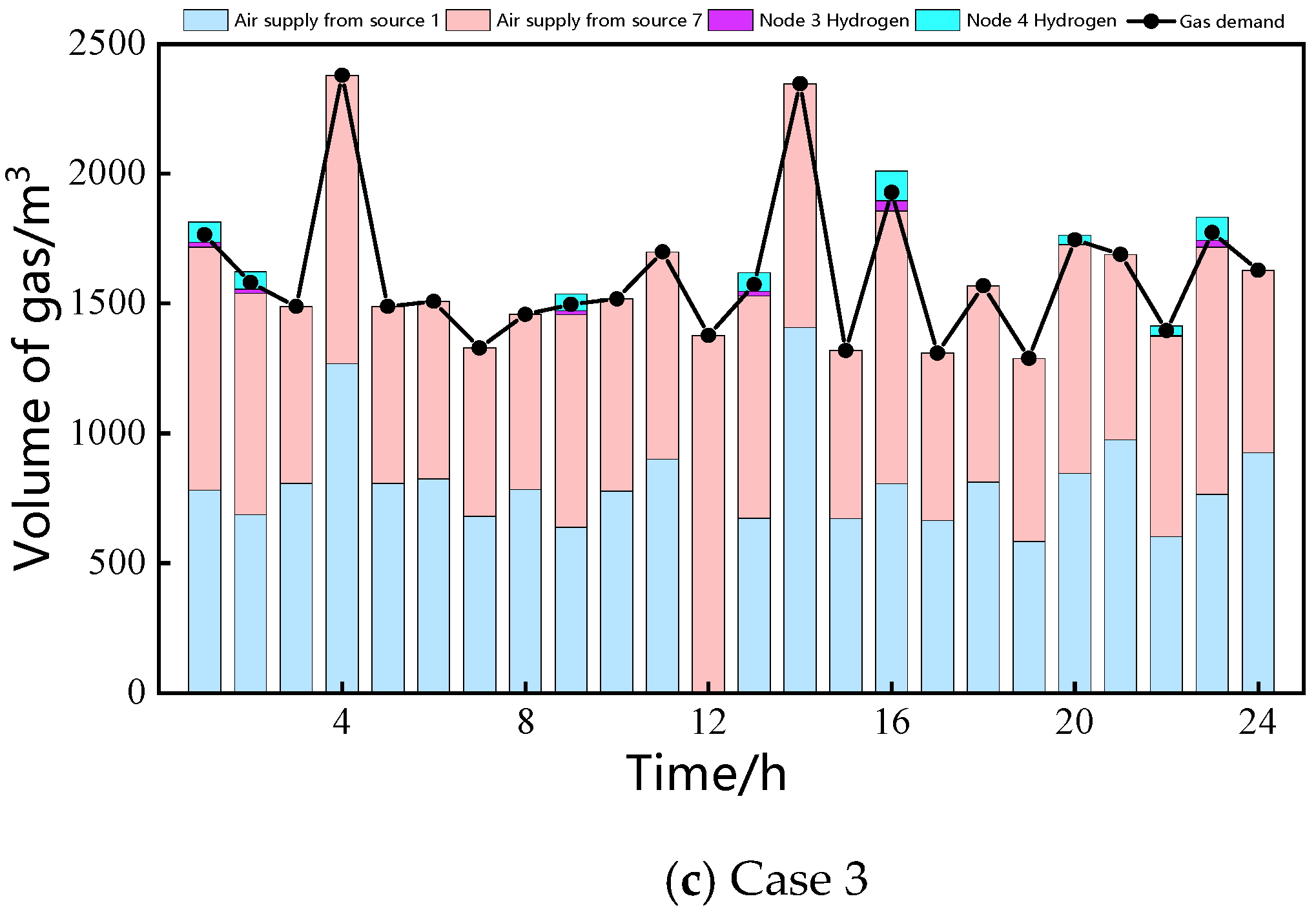
The optimal dispatch performance of the natural gas network under different scenarios is illustrated in Figure 6. By comparing Figure 6a–c, it can be observed that Case 1 does not take power-to-hydrogen into consideration, so the entire gas demand of the system is fully met by gas supply from the gas sources, with the total gas supply volume of gas source 1 and gas source 7 reaching 39,147.56 m3. Case 2 incorporates power-to-hydrogen and hydrogen methanation technologies, where the methane synthesized by the system is injected into the natural gas pipeline through nodes 3 and 4 of the natural gas network, satisfying 78.26% of the system’s gas demand and thus leading to a substantial reduction in the gas supply volume from the natural gas network’s gas sources. Case 3 accounts for power-to-hydrogen, where a portion of the hydrogen produced by the hydrogen generation units is supplied to hydrogen-consuming units, and another portion is injected into the natural gas pipeline via nodes 3 and 4 of the natural gas network to form HCNG. The total volume of hydrogen injected into the system accounts for 1.83% of the total gas supply volume of the natural gas network, and the total gas supply volume of the natural gas network’s gas sources is 38,307.75 m3, representing a 2.15% decrease compared with Case 1. Part of the system’s gas demand is satisfied by hydrogen, which reduces the gas supply cost of the natural gas network.
In summary, the model proposed in this paper plays a more positive role in promoting the accommodation of wind and photovoltaic power in the power system, improving the utilization rate of wind and photovoltaic energy, and advancing the low-carbon transformation of the system.

5.2. Analysis of Hydrogen Production and Utilization

To analyze the impact of hydrogen-consuming units on hydrogen generation and utilization under the proposed model, two sets of scenarios are designed for comparison as follows:
Case 4: The hydrogen-consuming units are not taken into account in the electricity–hydrogen–HCNG coupled units.
Case 5: The hydrogen-consuming units are incorporated in the electricity–hydrogen–HCNG coupled units, which correspond to the model proposed in this paper.
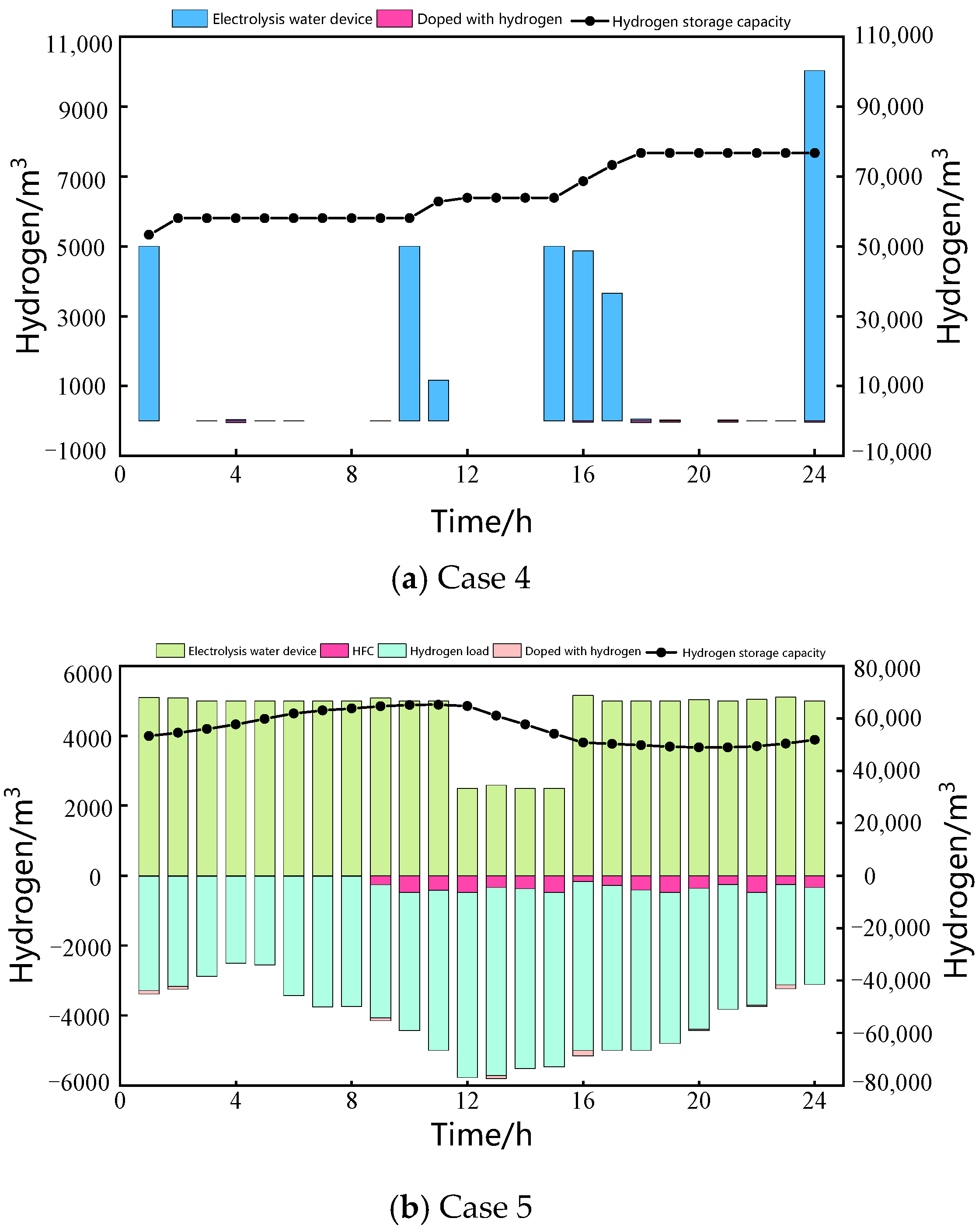
As can be seen from Figure 7b, during the optimal scheduling period, 84.27% of the hydrogen in the system is supplied to the hydrogen load of hydrogen refueling stations, 5.4% is used for power generation by HFCs, 0.63% is injected into natural gas pipelines, and the remaining hydrogen is stored in hydrogen storage tanks. It is evident that hydrogen consumption for hydrogen load in hydrogen-consuming units serves as the primary approach to promoting wind and solar energy absorption. Constrained by their maximum output, hydrogen fuel cells consume a relatively small total amount of hydrogen. In comparison with Figure 7a, when hydrogen-consuming units are not considered in the system, the total hydrogen production of water electrolysis units decreases to 31.52% of that in the scenario where hydrogen-consuming units are taken into account. During the optimal scheduling period, only 0.67% of the hydrogen in the system is injected into natural gas pipelines to form HCNG, while the rest is injected into hydrogen storage tanks for storage. This indicates that the total hydrogen production of water electrolysis units in the system is closely related to the hydrogen demand of hydrogen-consuming units; hydrogen-consuming units can not only enhance the system’s capacity to absorb wind and solar energy, but also increase the total volume of hydrogen injected into natural gas pipelines.
Further observation of the total hydrogen production and total hydrogen consumption of the system at each time step reveals that hydrogen storage units can store hydrogen when there is a surplus in the system and extract hydrogen when there is a shortage, thereby playing a role in flexible hydrogen scheduling and effectively balancing hydrogen production and consumption within the system.

5.3. Analysis of Optimal Scheduling Results of User Units

5.3.1. Analysis of Multi-Energy Flow Optimization Results of User Units

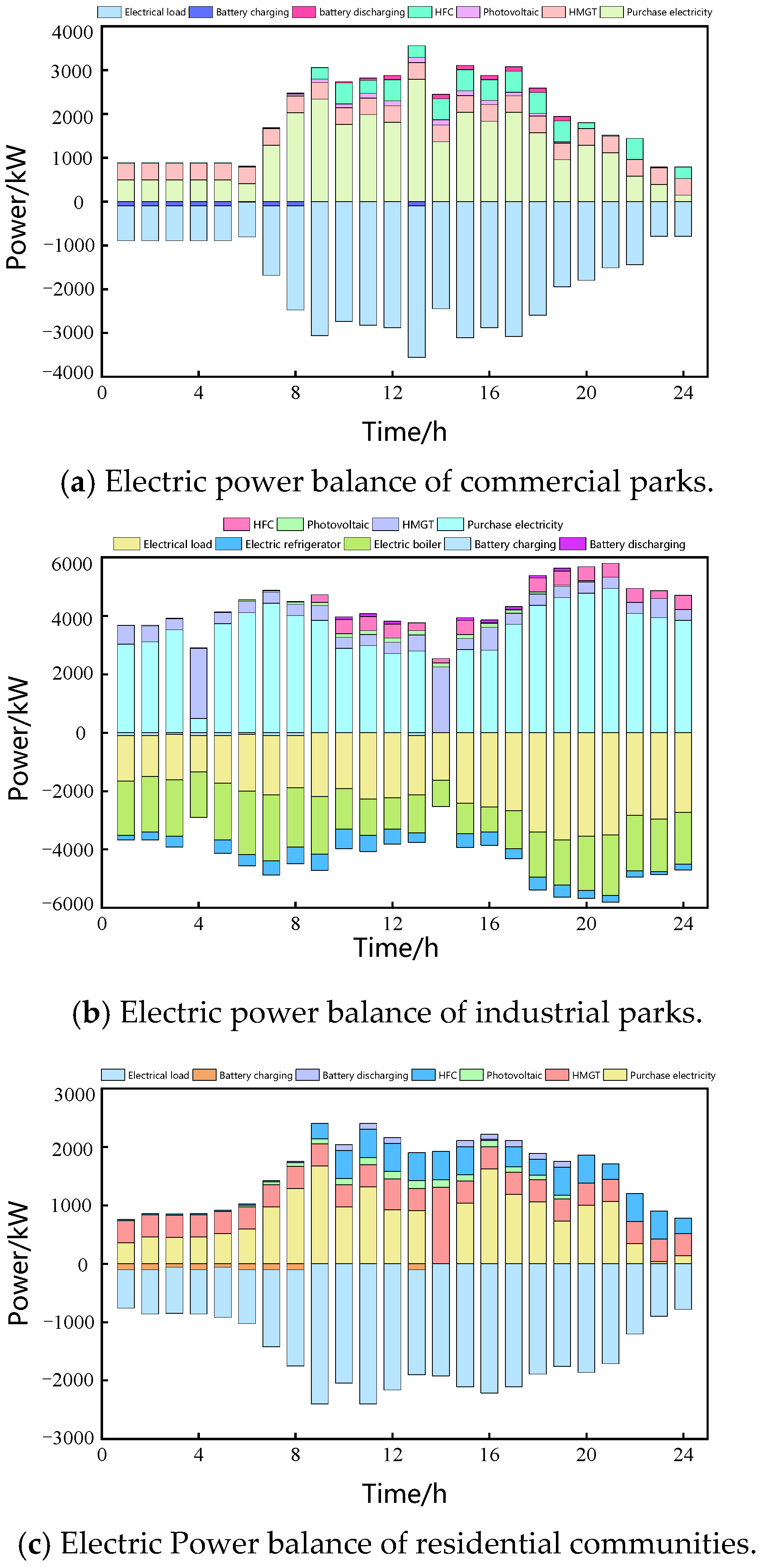
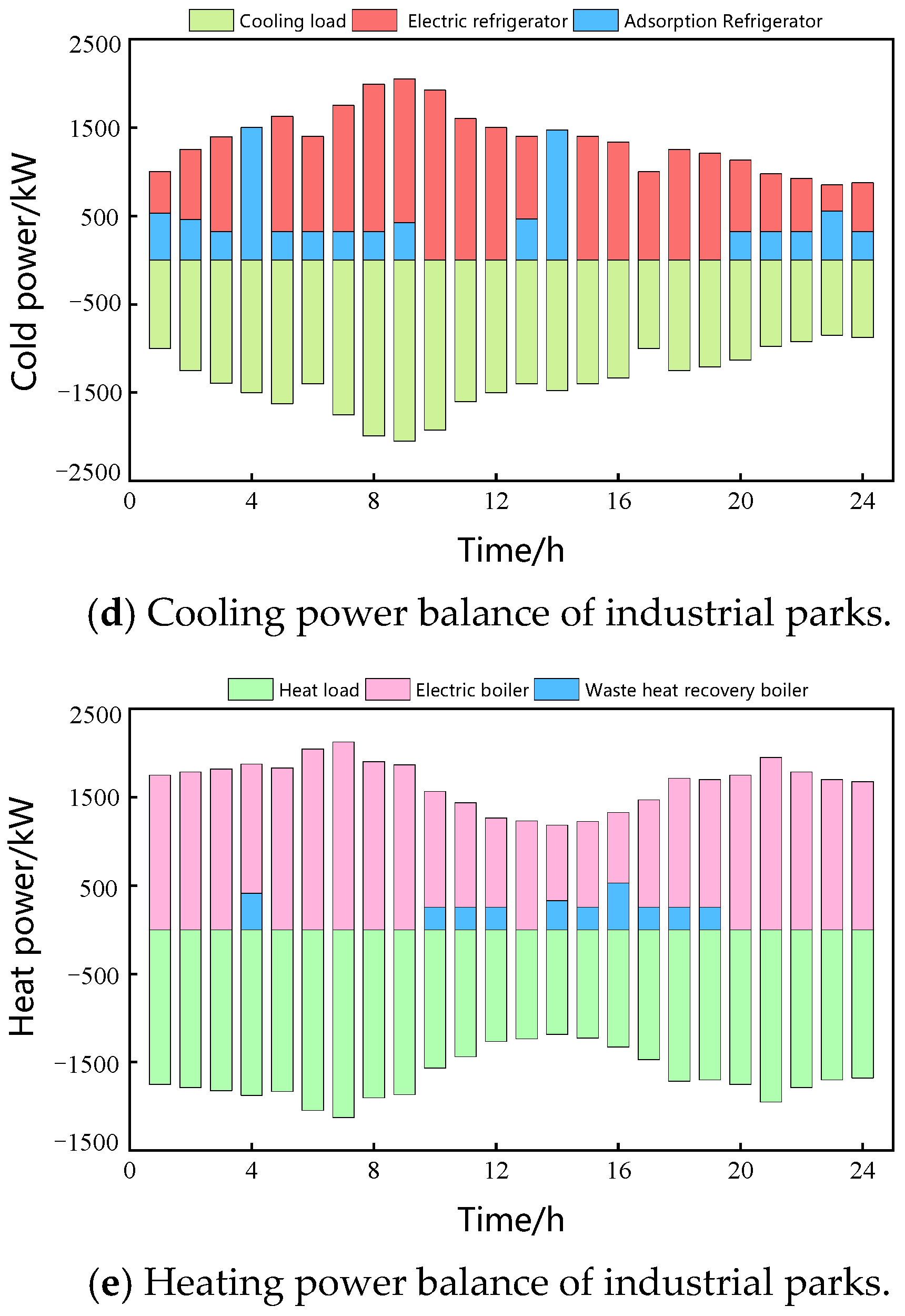
The user units in this paper take into account the balance of multiple energy forms such as cooling, heating and electricity within the parks. Specifically, commercial parks and residential communities mainly conduct internal optimization with electric energy flow as the core, while industrial parks prioritize the balance of cooling, heating and electric energy flows for internal optimization. The multi-energy flow optimization results of the user units under the model proposed in this paper are shown in Figure 8.
It can be seen from the electric power balance results in Figure 8a–c that purchasing electricity from the upper-level distribution network is the primary source of electric energy for user units, and the photovoltaic units inside the user units achieve full absorption of generated power. Affected by natural gas prices and gas supply costs, the power generation cost of HMGT remains high. In commercial parks and residential communities with relatively low electricity load levels, HMGT operates at the minimum output for most of the time. Industrial parks feature a relatively high electricity load level, and the HMGT in industrial parks serves as a crucial coupling device for cooling–heating–electric power balance. To meet the cooling and heating power balance of the system, the output of the unit is higher than that of the other two types of user units. Driven by time-of-use electricity prices, the energy storage systems inside each user unit charge during the load valley periods and discharge during the load peak periods. Given the lower electricity prices during load valleys and higher prices during load peaks, energy storage not only realizes peak-valley arbitrage but also plays a role in peak load shifting. HFCs mainly operate during periods of high load levels in user units to further balance the electric power consumption of the system.
As can be seen from the cooling and heating power balance results of the industrial park in Figure 8d,e, the cooling and heating loads of the park are mainly met by electric chillers and electric boilers. Due to the existence of operation and maintenance costs for relevant equipment inside the industrial park, and the fact that the operation and maintenance cost of waste heat recovery boilers is higher than that of adsorption chillers, the heat collection power of adsorption chillers is greater than that of waste heat recovery boilers. When adsorption chillers and waste heat recovery boilers fail to satisfy the cooling and heating power balance of the industrial park, electric chillers and electric boilers are required to supply energy to maintain the balance of cooling and heating power within the park.

5.3.2. Analysis of Demand Response Performance of User Units

To analyze the demand response performance of user units under the model proposed in this paper, the following scenarios are set for comparison:
Case 6: The demand response mechanism is not considered for user units;
Case 7: The demand response mechanism is incorporated for user units, which corresponds to the model proposed in this paper.
The optimal scheduling results of electric energy before and after the implementation of demand response for user units are shown in Table 3. After the adoption of electric load demand response, the total loads of commercial parks, industrial parks and residential communities have been reduced by 8.10%, 2.19% and 5.30%, respectively, and the electricity purchase volumes of users in commercial parks and residential communities have decreased accordingly. Affected by the cooling–heating–electric power balance, the electricity purchase volume of user units in industrial parks has changed slightly before and after the implementation of demand response. With the demand response mechanism taken into account, the electricity purchase cost of user units has declined.
Further comparative analysis reveals that the total cost of the system in Case 7 is 1400 yuan lower than that in Case 6, with the carbon emission cost reduced by 100 yuan, and the total carbon emissions of the system decreased by 0.19 tons. This demonstrates that the demand response of user units plays a positive role in facilitating the low-carbon and economic operation of the system.
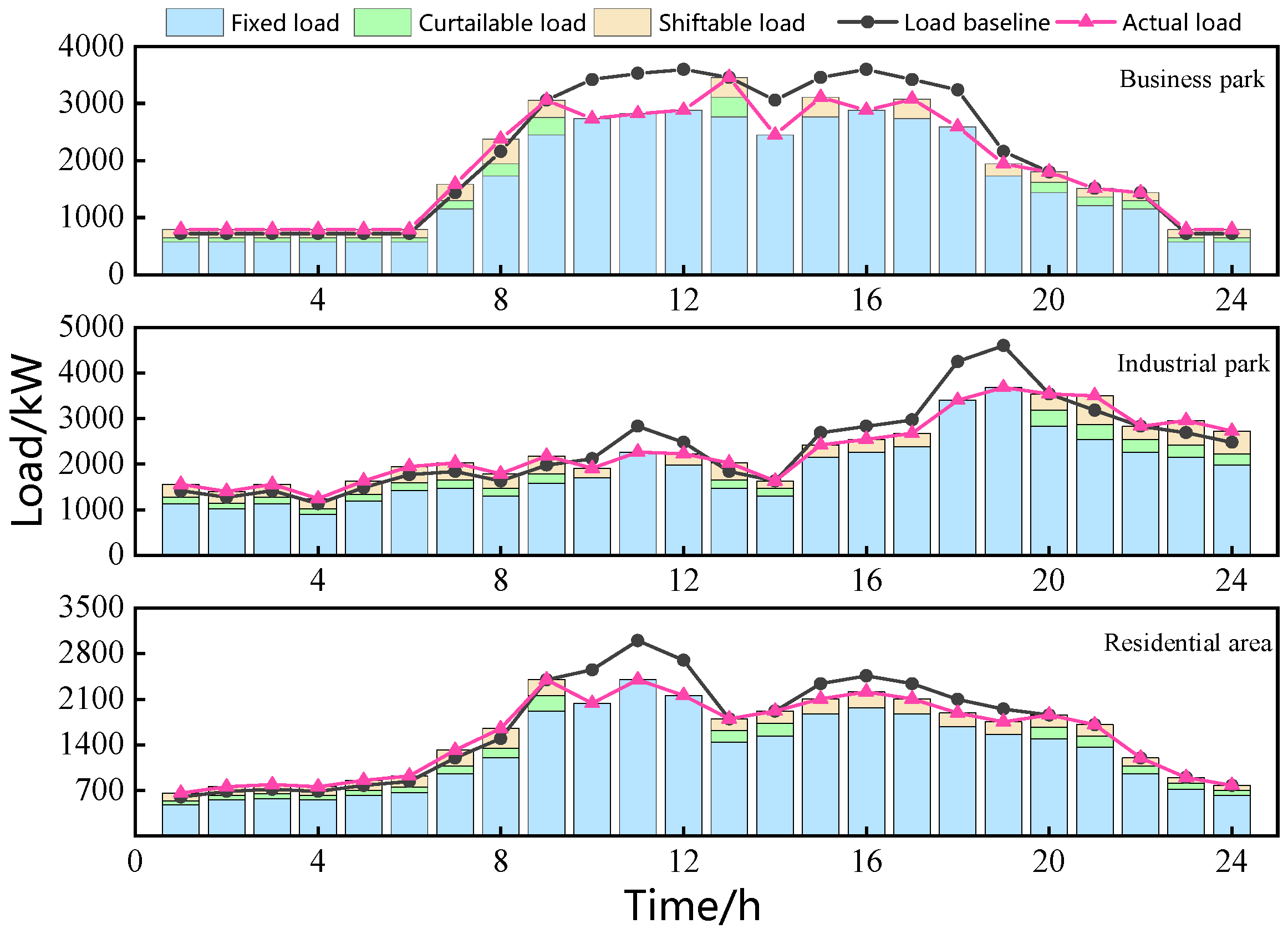
Figure 9 depicts the variation in the electrical load of user units before and after their participation in demand response in Case 7. Guided by price signals, user units engage in demand response, which achieves load curtailment and load shifting during peak periods. The curtailable load is reduced to a certain extent during peak electricity consumption hours, with the curtailment volume remaining within a reasonable range. Meanwhile, part of the transferable load is shifted from peak load periods to load valley periods with high wind and solar power output, such as the time intervals of 1–9 and 20–24. It is evident that the demand response of user units yields favorable scheduling effects under the combined action of time-of-use electricity prices and demand response compensation costs. It plays a distinct role in peak load shaving and valley filling for the overall user load curve, thereby maximizing the accommodation of renewable energy.

5.3.3. Analysis of Carbon Emission Performance of User Units

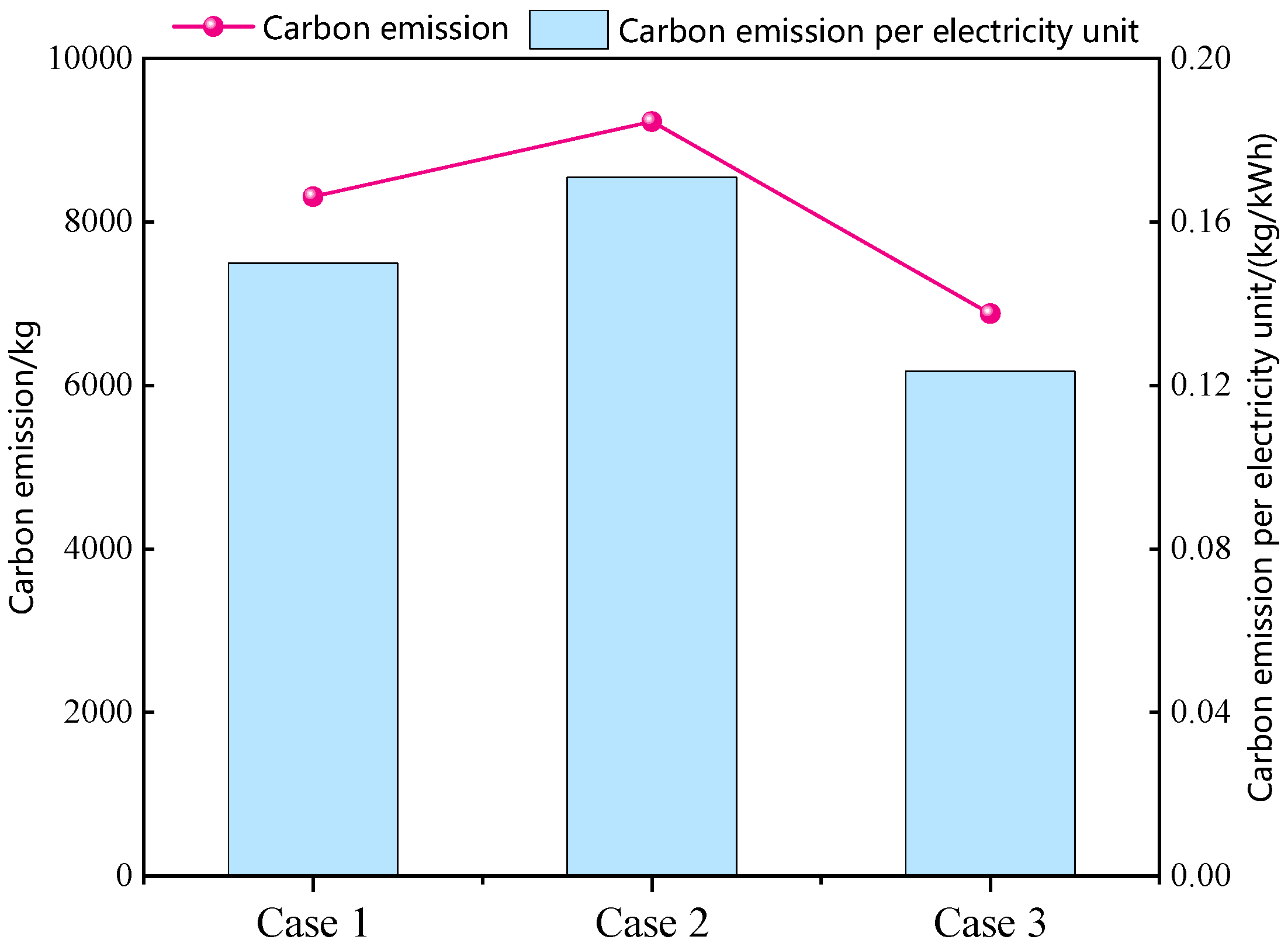
Based on the scenarios established in Section 4.1, this section takes the industrial park as an example to analyze the carbon emission performance of user units, with the results presented in Figure 10. The total carbon emissions and carbon emission intensity per kilowatt-hour of the industrial park in Case 2 reach the highest levels. This is because the reduction in the power generation cost of gas turbines in the industrial park leads to an increase in unit output, resulting in a 0.919-ton rise in carbon emissions from gas consumption in the park compared with Case 1. In Case 3, the gas turbines in the park are replaced by HMGTs, and HFCs are incorporated into the park. Since hydrogen fuel cells generate power through hydrogen consumption without producing any carbon emissions, the total carbon emissions of the park decrease by 17.23% in contrast to Case 1. It can be concluded that power supply relying on traditional gas turbines tends to generate substantial carbon emissions, while enriched compressing hydrogen into natural gas pipelines and supplying the mixture to HMGTs for combustion-based power generation can effectively reduce the carbon emissions of user units, thus facilitating the low-carbon transition of users.

5.4. Sensitivity Analysis of Upper Limit of Hydrogen-Enriched Compressing Ratio

Internationally, several countries have proposed raising the upper limit of the hydrogen-enriched compressing ratio to 20%. For example, Avacon, a subsidiary of the German energy giant E.ON, plans to increase the upper limit of the hydrogen-enriched compressing ratio in its operated natural gas pipeline networks to 20% in the future [38]. In France, some natural gas operators will attempt a 20% hydrogen-enriched compressing ratio starting from 2030 [39]. At present, the UK’s HyDeploy demonstration project has successfully blended 20% hydrogen into in-service natural gas pipelines [40]. On this basis, this paper further investigates the impact of variations in the upper limit of the hydrogen-enriched compressing ratio in natural gas pipelines on scheduling results, and designs four sets of scenarios for comparative analysis:
Case 8: The upper limit of the hydrogen-enriched compressing ratio is set at 5%;
Case 9: The upper limit of the hydrogen-enriched compressing ratio is set at 10%, which corresponds to the model proposed in this paper;
Case 10: The upper limit of the hydrogen-enriched compressing ratio is set at 15%;
Case 11: The upper limit of the hydrogen-enriched compressing ratio is set at 20%

5.4.1. Analysis of Impacts on Scheduling Results

The optimal scheduling results of the system under different scenarios are presented in Table 4. With the increase in the upper limit of the hydrogen-enriched compressing ratio, the total volume of hydrogen injected into natural gas pipelines by the system rises, the gas supply volume from gas sources decreases, and the total cost of the system’s optimal scheduling declines. According to calculations, compared with Case 8, the proportion of hydrogen injected into the natural gas network in Case 11 of the total hydrogen production increases by 1.26%, indicating that the natural gas network accommodates a larger quantity of hydrogen. In terms of wind and solar energy accommodation of the system, the utilization rate of wind and solar energy continuously improves as the upper limit of hydrogen-enriched compressing ratio increases, which demonstrates that raising the upper limit of hydrogen-enriched compressing ratio in the natural gas network is conducive to promoting the accommodation of renewable energy in the system.
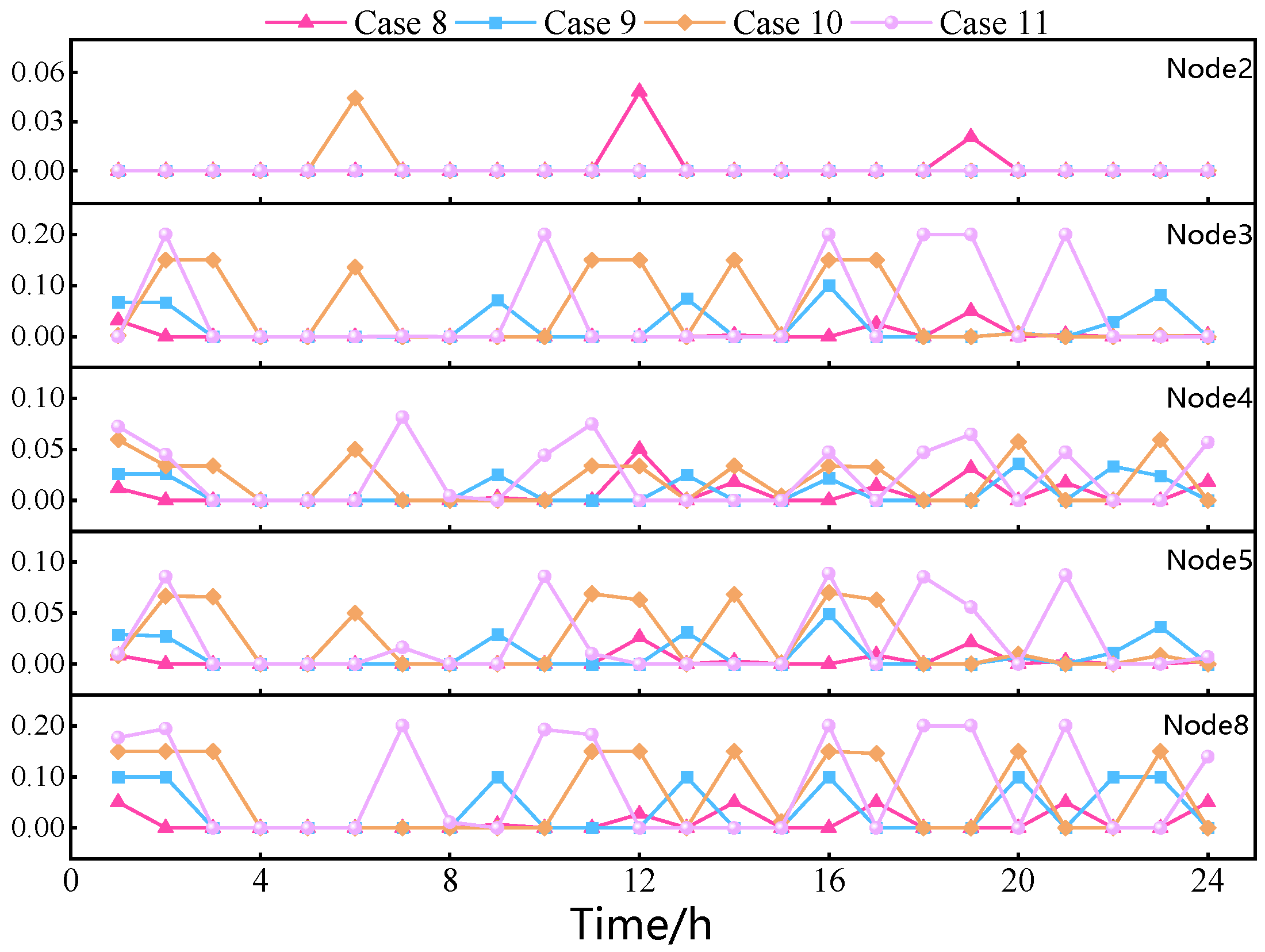
During the scheduling period, nodes 1 and 7 in the HCNGN are gas source points that inject conventional natural gas, with the hydrogen-enriched compressing ratio being 0 under all scenarios; node 6 has no gas demand, so its hydrogen-enriched compressing ratio is also 0. The hydrogen-enriched compressing ratios of the remaining nodes in the HCNGN under different scenarios are shown in Figure 11. It can be seen that different upper limits of the hydrogen-enriched compressing ratio exert a significant impact on the hydrogen-enriched compressing status of HCNGN nodes. Moreover, after considering the component tracking of HCNG, the relationship between the upper limit of the hydrogen-enriched compressing ratio and the actual hydrogen-enriched compressing ratio in HCNG presents a nonlinear rather than proportional pattern.
Regarding the non-linear relationship between the actual hydrogen-enriched compressing ratio and the hydrogen-enriched compressing ratio upper limit, under the condition of a fixed volume of mixed gas requirement in this case, the actual hydrogen-enriched compressing ratio is primarily influenced by the natural gas pipeline flow. Since the pipeline flow exhibits a quadratic relationship with nodal pressure according to the Weymouth equation, and the nodal pressure is constrained by upper and lower limits, this results in the actual hydrogen-enriched compressing ratio reaching its maximum value when the natural gas pipeline flow reaches its minimum value. Therefore, when the hydrogen-enriched compressing ratio upper limit exceeds this maximum value, the actual hydrogen-enriched compressing ratio no longer increases linearly with the hydrogen-enriched compressing ratio upper limit but is instead limited by the pipeline network pressure constraints, thereby exhibiting a non-linear pattern between the actual hydrogen-enriched compressing ratio and the hydrogen-enriched compressing ratio upper limit.

5.4.2. Analysis of Impacts on HCNG Carbon Emission Reduction Performance

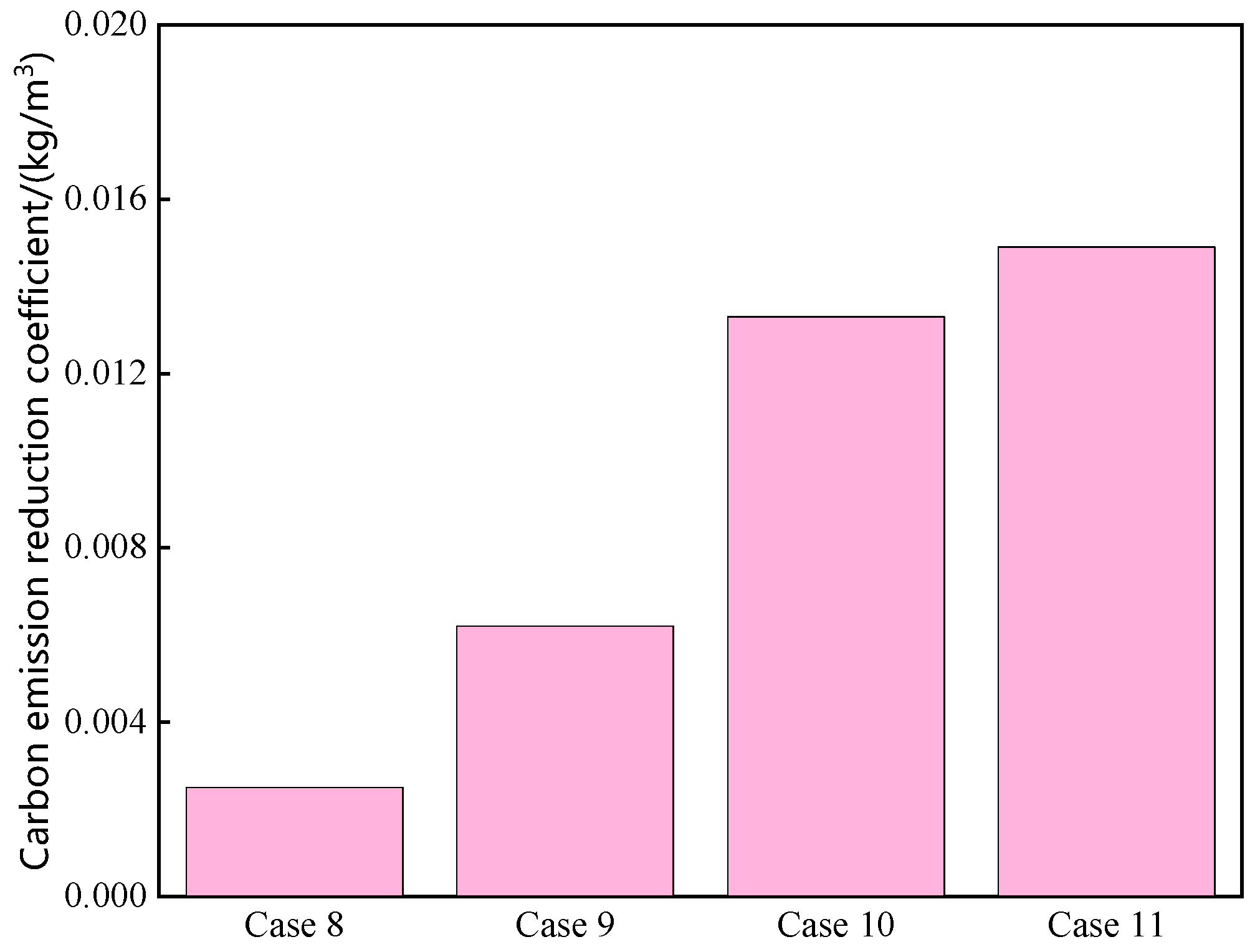
To quantitatively evaluate the carbon emission reduction performance of HCNG technology, it is necessary to establish an appropriate metric that directly reflects the environmental benefits of hydrogen-enriched compressing. The carbon emission reduction coefficient per unit volume of HCNG is proposed as the evaluation metric for the following reasons [41,42]. First, this coefficient represents the decrease in carbon emissions per unit volume of gas mixture compared to pure natural gas, which directly quantifies the carbon mitigation effect of hydrogen introduction. Second, the volumetric basis aligns with practical gas network operations where gas flow is typically measured and controlled by volume rather than mass or energy content. Third, this metric enables straightforward comparison across different hydrogen-enriched compressing scenarios and facilitates the assessment of marginal carbon reduction benefits when adjusting the hydrogen-enriched compressing ratio. By adopting this coefficient, the carbon emission reduction performance of HCNG can be evaluated in a manner consistent with the low-carbon optimization objective of the entire urban integrated energy system.
In this section, the carbon emission reduction coefficient per unit volume of HCNG is defined as e HCNG (unit: kg/m3), and its calculation formula is shown in Equation (64).
e HCNG = x H 2 HHV H 2 ε NG × 10 3
where x H 2 denotes the proportion of hydrogen in HCNG.
As shown in Figure 12, with the increase in the upper limit of the hydrogen-enriched compressing ratio, the total volume of hydrogen injected into natural gas pipelines rises, and the carbon emission reduction coefficient of HCNG increases accordingly. It can be seen that compared with conventional natural gas, HCNG technology enables the clean and low-carbon transformation of natural gas. Meanwhile, raising the upper limit of the hydrogen-enriched compressing ratio is conducive to reducing carbon emissions of the hydrogen production and enriched compressing-integrated energy system, increasing the carbon emission reduction coefficient of HCNG, and promoting the low-carbon transition of the system.

5.5. Sensitivity Analysis of Carbon Price

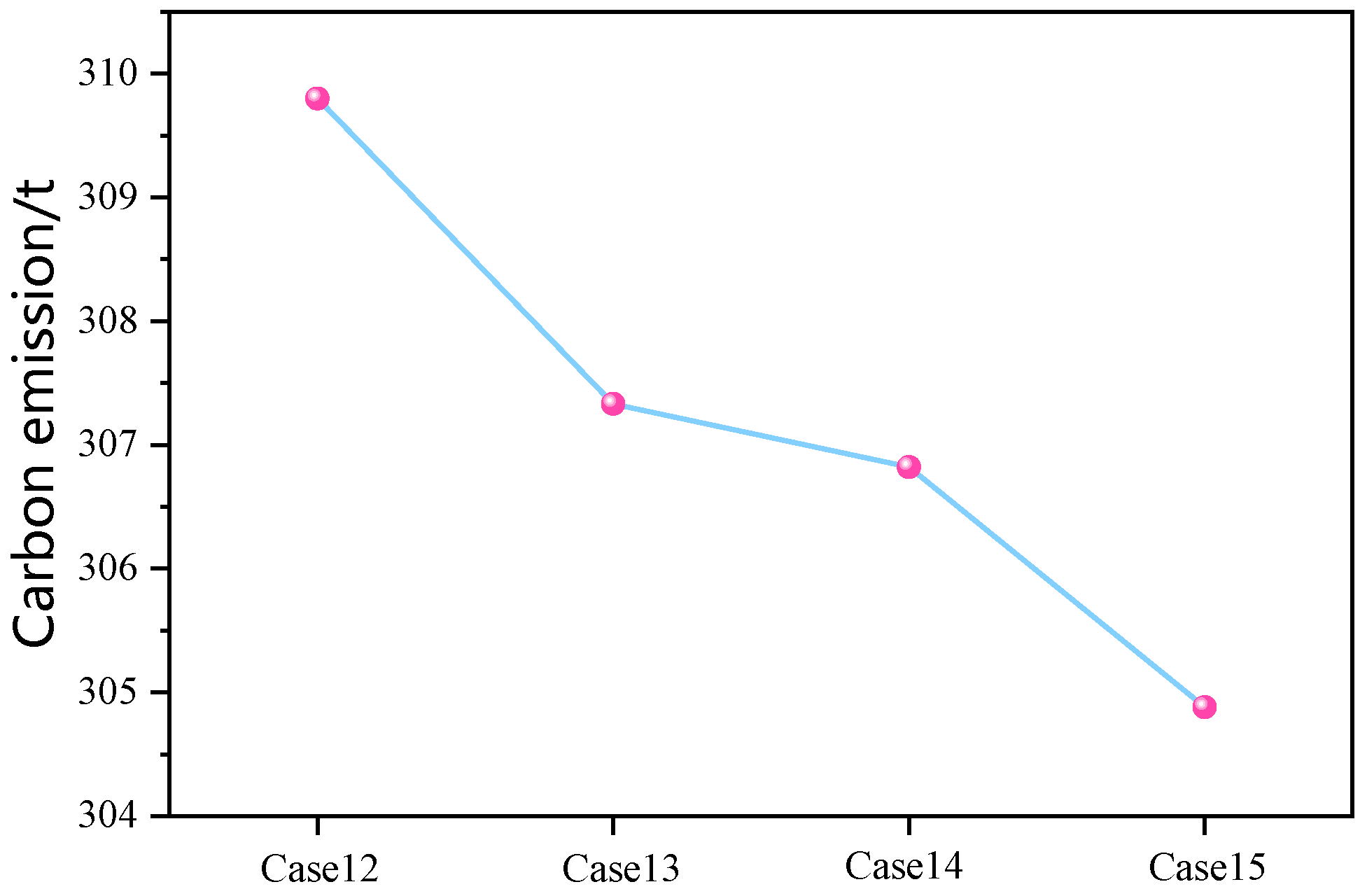
According to existing studies [43], the carbon price in 2025 is approximately ranged from 60 to 120 CNY per ton. Based on this, four scenarios are set in this paper to investigate the impact of carbon price changes on dispatching results:
Case 12: Carbon price is 60 CNY per ton;
Case 13: Carbon price is 80 CNY per ton, which is the model proposed in this paper;
Case 14: Carbon price is 100 CNY per ton;
Case 15: Carbon price is 120 CNY per ton.

5.5.1. Analysis of Impacts on Scheduling Results

The results of the system’s low-carbon optimal scheduling under different scenarios are presented in Table 5. The wind and solar energy utilization rate rises continuously with the increase in carbon price, which indicates that a higher carbon price is conducive to promoting the utilization of renewable energy in the system. With the increase in carbon price, the total volume of hydrogen injected into the natural gas pipeline by the system increases, the gas supply from the gas source decreases, and the total cost of the system’s optimal scheduling goes up.

5.5.2. Analysis of Impacts on Carbon Emission Performance

As shown in Figure 13, the carbon emissions of the system exhibit a declining trend with the increase in carbon price. It can be concluded that a higher carbon price is conducive to reducing carbon emissions of the hydrogen production and enriched compressing-integrated urban energy system and advancing its low-carbon transition.

5.6. Sensitivity Analysis of Hydrogen Storage Capacities

To investigate the impact of variations in hydrogen storage capacity on scheduling results, four scenarios are designed and discussed in this paper as follows.
A hydrogen storage capacity of 10,000 m3 is selected as the base capacity in this paper, with all subsequent units expressed in per-unit values.
Case 16: Hydrogen storage capacity is 0.5 per unit;
Case 17: Hydrogen storage capacity is 1 per unit, which is the model proposed in this paper;
Case 18: Hydrogen storage capacity is 1.5 per unit;
Case 19: Hydrogen storage capacity is 2 per unit.

5.6.1. Analysis of Impacts on Scheduling Results

The results of the system’s low-carbon optimal scheduling under different scenarios are presented in Table 6. The wind and solar energy utilization rate rises continuously with the increase in hydrogen storage capacity, which indicates that a larger hydrogen storage capacity is conducive to promoting the wind and solar energy utilization of the system. The calculation results show that compared with Case 19, the proportion of hydrogen injected into the natural gas grid compared to the total hydrogen production in Case 16 is increased by 1.07%, meaning that more hydrogen is absorbed by the natural gas grid. With the increase in hydrogen storage capacity, the total volume of hydrogen injected into the natural gas pipeline by the system increases, the gas supply from the gas source decreases, and the total cost of the system’s optimal scheduling goes up.

5.6.2. Analysis of Impacts on Carbon Emission Performance

As shown in Figure 14, the carbon emissions of the system exhibit a declining trend with the increase in hydrogen storage capacity. It can be concluded that a larger hydrogen storage capacity is conducive to reducing carbon emissions of the hydrogen production-enriched compressing-integrated urban energy system and advancing its low-carbon transition.


6. Discussion

6.1. Practical Implementation Challenges

Several practical challenges must be addressed when implementing the proposed framework. First, accurate demand forecasting requires reliable data collection systems and historical records. Second, real-time coordination between hydrogen production, natural gas supply, and power systems necessitates advanced monitoring and control infrastructure. Third, existing pipeline networks may require upgrades to safely accommodate hydrogen-enriched compressing. Finally, regional variations in safety standards and regulatory requirements must be carefully evaluated before deployment.

6.2. Computational Performance

The computational efficiency was evaluated across the three cases presented in Section 4. All models were solved using GAMS 42 with the DICOPT solver on a standard desktop computer. Case 1 required 38 s to reach an optimal solution, Case 2 required 45 s due to additional hydrogen-enriched compressing constraints, and Case 3 required 52 s with the integrated optimization variables. The short solution times demonstrate the model’s suitability for practical day-ahead scheduling applications.

7. Conclusions

7.1. Main Findings

To address the problem of wind and solar curtailment caused by the large-scale grid connection of renewable energy, this paper takes the urban integrated energy system as the research object; applies HCNG technology and hydrogen utilization links to system optimal scheduling; couples electric energy, hydrogen energy, and HCNG energy; and considers the demand response of user units. A low-carbon optimal scheduling model for the hydrogen production and enriched compressing-integrated energy system is proposed with the goal of minimizing the system operation cost. Through theoretical and simulation analyses, specific conclusions are drawn as follows:
(1)
The electricity–hydrogen–HCNG coupling unit participates in the optimal operation of the urban integrated energy system by virtue of technical routes such as hydrogen production via water electrolysis, power generation using HFCs, hydrogen consumption at hydrogen refueling stations, and HCNG application. It replaces thermal power units and gas sources in the system to bear part of the electricity and gas demand, thereby improving the economy, flexibility, and low-carbon performance of system operation.
(2)
Comparative analysis between the proposed hydrogen production and enriched compressing-integrated energy system and the traditional electricity–gas-coupled integrated energy system shows that although hydrogen utilization brings additional hydrogen storage costs and operation costs, the energy utilization technical route and optimization model proposed in this paper still have significant advantages in improving the system’s wind and solar energy accommodation capacity and reducing carbon emissions. The cost premium is expected to diminish as hydrogen equipment costs decline and carbon pricing mechanisms strengthen, while the system’s operational flexibility provides strategic value for long-term energy transition.
(3)
Comparative analysis of scenarios with different upper limits of hydrogen-enriched compressing ratio proves that HCNG technology helps improve the carbon emission reduction capacity of urban integrated energy systems, reduce the carbon footprint of the entire energy system, and promote the low-carbon transition of power systems and natural gas systems.

7.2. Limitations of the Study

This study has several limitations that should be acknowledged. First, the HCNG enriched compressing model simplifies the mixing process by neglecting energy losses and temperature variations during hydrogen–natural gas enriched compressing. While these simplifications are acceptable for system-level scheduling optimization with low hydrogen-enriched compressing ratios, they may introduce minor deviations in estimating actual HCNG calorific values and volumetric requirements. Second, the current model does not consider waste heat recovery from hydrogen fuel cells. Although HFCs primarily serve as flexible power generation units rather than main heat sources in this system, incorporating waste heat utilization could potentially reduce heating costs and improve overall energy efficiency. Third, the optimization model assumes perfect forecasting of renewable energy generation, hydrogen demand, and natural gas demand. In practical applications, prediction uncertainties may affect system performance and operational decisions, particularly regarding energy storage scheduling and demand response activation.

7.3. Recommendations for Practitioners

Based on the research findings, several quantitative recommendations are provided for practitioners. First, electrolyzer capacity should be sized at approximately 1.2 to 1.5 times the peak hydrogen demand to ensure adequate operational flexibility while avoiding excessive investment costs. Second, a hydrogen storage capacity equivalent to at least 8 h of average hydrogen demand is recommended to buffer supply–demand imbalances and support stable system operation. Third, implementing demand response programs in integrated energy systems can reduce total operational costs by 5% to 12%, as demonstrated in the case studies.

7.4. Future Research Directions

Future research should address these limitations and extend the current work in several directions. First, more detailed thermodynamic modeling of the HCNG-enriched compressing process could be developed to quantify the actual impact of mixing energy losses and temperature variations on system performance, especially for higher hydrogen-enriched compressing ratios. Second, the techno-economic feasibility of integrating waste heat recovery from hydrogen fuel cells should be investigated, including the required heat exchanger design, thermal storage capacity, and impact on total system costs and carbon emissions. Third, robust optimization or stochastic programming approaches should be incorporated to handle uncertainties in renewable energy forecasting, load prediction, and energy price fluctuations.

Author Contributions

Conceptualization, writing—review and editing, funding acquisition, M.X.; methodology, software, writing—original draft preparation, X.J.; formal analysis, software, validation, writing—original draft preparation, Y.L. All authors have read and agreed to the published version of the manuscript.

Funding

This work is supported by the Guangdong Basic and Applied Basic Research Foundation (2022A1515240074) and the Guangdong Province Key Field R&D Plan Project (2021B0101230004).

Data Availability Statement

The original contributions presented in this study are included in the article. Further inquiries can be directed to the corresponding author.

Conflicts of Interest

The authors declare no conflicts of interest.

Appendix A

Figure A1. Electric load curve of urban distribution network.
Hydrogen 07 00032 g0a1
Figure A2. Electric, heating, and cooling load curve of urban user units.
Hydrogen 07 00032 g0a2
Figure A3. Predicted output curve of wind farm.
Hydrogen 07 00032 g0a3
Figure A4. Predicted output curve of photovoltaic power station.
Hydrogen 07 00032 g0a4
Figure A5. Predicted output curve of photovoltaic unit in user units.
Hydrogen 07 00032 g0a5
Figure A6. Hydrogen load curve of urban user units.
Hydrogen 07 00032 g0a6
Figure A7. HCNG load curve.
Hydrogen 07 00032 g0a7
Figure A8. Time-sharing electricity price.
Hydrogen 07 00032 g0a8
Figure A9. Time-sharing gas price.
Hydrogen 07 00032 g0a9
Table A1. Operating parameters and values.
ParameterValueParameterValue
η P 2 G 0.6 η HFC 0.85
η in 0.95 η RE 0.7
η out 0.95 η EC 2.9
η RH 0.96 η CH 0.98
η EH 0.94 η DIS 0.98
η AC 1.2 P HFC , l , max 480 kW
V Tank , min 133.2 m3 P HFC , l , min 20 kW
V Tank , max 2130.7 m3 P CH , max 100 kW
P g , min 10 MW P DIS , max 100 kW
P g , max 50 MW R d , g 20 MW/h
a g 4.85 yuan/MW2 R u , g 20 MW/h
b g 328 yuan/MW τ c 0.3 yuan/kWh
c g 980 yuan τ t 0.2 yuan/kWh
ζ PW 0.1 yuan/kWh ξ CO 2 100 yuan/tCO2
ζ PV 0.1 yuan/kWh ε NG 53.03 kg/GJ
ζ P 2 G 0.450.1 yuan/kWh δ PW 0.75 yuan/kWh
ζ HFC 0.150.1 yuan/kWh δ PV 0.75 yuan/kWh
ζ ST 0.1550.1 yuan/m3 HHV H 2 12.789 MJ/Nm3
ζ ESS 0.150.1 yuan/kWh HHV Gas 36.44 MJ/Nm3
Table A2. Gas well operating parameters and values.
NodeMaximum Gas Supply Limit/m3Gas Supply Cost/(Yuan/m3)
130001.97
730001.97

References

  1. Ullah, S.; Sohail, S.; Majeed, M.T.; Sohail, M.T. Future of hydrogen energy: The role of environmental policy and political globalization. Int. J. Hydrogen Energy 2025, 122, 12–21. [Google Scholar] [CrossRef]
  2. Song, Y.; Feng, Y.; Li, Y.; Kong, R.; Xiao, S. Evolutionary patterns and future trends of China’s hydrogen energy industry policy. Energy Rep. 2026, 15, 108966. [Google Scholar] [CrossRef]
  3. Eissler, T.; Groos, U.; Holst, M.; Deringer, P.; Edenhofer, L.; Mendler, F.; Voglstätter, C.; Szolak, R. Optimizing the supply chain for green hydrogen and derivatives: A case study from Australia to Germany including inland transport considerations. Int. J. Hydrogen Energy 2025, 144, 1200–1206. [Google Scholar] [CrossRef]
  4. Karmaker, S.C.; Chapman, A.J.; Sen, K.K.; Saha, B.B. Electrification or hydrogen? A strategic pathway for Japan’s energy transition. Int. J. Hydrogen Energy 2026, 201, 152989. [Google Scholar] [CrossRef]
  5. Tzioutzios, D.; Liu, Y.; Sato, H.; Yamamoto, T.; Navajas, J.; Badia, E.; Paltrinieri, N. From accidents to safer hydrogen systems: Exploring failures and safety barriers at hydrogen refuelling stations in Japan. Int. J. Hydrogen Energy 2025, 171, 151309. [Google Scholar] [CrossRef]
  6. Tomomewo, O.S.; Bade, S.O.; Benarbia, A. A cross-regional analysis of policies, regulations, and incentives from the United States, the European union, China, and Australia for shaping hydrogen economy. Appl. Energy 2026, 406, 127240. [Google Scholar] [CrossRef]
  7. Barman, P.; Kalita, A.; Sarmah, P.; Bhattarai, S.; Bordoloi, S.; Khalid, F. Governance strategies, policy measures, and regulatory framework for hydrogen energy in India: A comprehensive review. Int. J. Hydrogen Energy 2025, 140, 505–518. [Google Scholar] [CrossRef]
  8. Thekkethil, R.; Ananthakumar, M.R.; Kumar, D.; Srinivasan, V.; Kalshetty, M. Green hydrogen hubs in India: A first order analytical hierarchy process for site selection across states. Int. J. Hydrogen Energy 2024, 63, 767–774. [Google Scholar] [CrossRef]
  9. Konovalov, D.; Adams, T.A. Hydrogen power development: A comparative review of national strategies and the role of energy in scaling green hydrogen. Renew. Sustain. Energy Rev. 2026, 226, 116378. [Google Scholar] [CrossRef]
  10. Pompodakis, E.E.; Orfanoudakis, G.I.; Katsigiannis, Y.A.; Karapidakis, E.S. Hydrogen production from wave power farms to refuel hydrogen-powered ships in the Mediterranean sea. Hydrogen 2024, 5, 494–518. [Google Scholar] [CrossRef]
  11. Rosa, N.; Fereidani, N.A.; Cardoso, B.J.; Martinho, N.; Gaspar, A.; da Silva, M.G. Advances in hydrogen blending and injection in natural gas networks: A review. Int. J. Hydrogen Energy 2025, 105, 367–381. [Google Scholar] [CrossRef]
  12. Ingersoll, J.G. The case of renewable methane by and with green hydrogen as the storage and transport medium for intermittent wind and solar PV energy. Hydrogen 2024, 5, 209–229. [Google Scholar] [CrossRef]
  13. Wang, W.; Qi, Y.; Zhang, X.; Xie, P.; Guo, Y.; Sun, H. Carbon emission optimization of the integrated energy system in industrial parks with hydrogen production from complementary wind and solar systems. Hydrogen 2025, 6, 8. [Google Scholar] [CrossRef]
  14. Das, P.; Mohtasim, M.S.; Rowe, A.; Shuvo, K.A.; Mishuk, N.J. A review of natural gas transportation pipeline optimization and progress towards hydrogen injection: Challenges and advances. Int. J. Hydrogen Energy 2025, 124, 102–122. [Google Scholar] [CrossRef]
  15. Bdioui, H.; Touati, H.; Chiekh, M.B.; López-Agüera, A. Green hydrogen blending into the tunisian natural gas distributing system. Hydrogen 2024, 5, 1004–1019. [Google Scholar] [CrossRef]
  16. Muhsen, H.; Tarawneh, R. Hydrogen blending as a transitional solution for decarbonizing the jordanian electricity generation sector. Hydrogen 2025, 6, 101. [Google Scholar] [CrossRef]
  17. Franco, A.; Rocca, M. Hydrogen injection into natural gas grids as a flexibility option for renewable energy integration and storage. Hydrogen 2025, 6, 112. [Google Scholar] [CrossRef]
  18. Mirshokraee, S.A.; Bedogni, S.; Bindi, M.; Santoro, C. Substituting natural gas with hydrogen for thermal application in a hard-to-abate industry: A real case study. Hydrogen 2025, 6, 37. [Google Scholar] [CrossRef]
  19. Gao, C.; Lu, H.; Chen, M.; Chang, X.; Zheng, C. A low-carbon optimization of integrated energy system dispatch under multi-system coupling of electricity-heat-gas-hydrogen based on stepwise carbon trading. Int. J. Hydrogen Energy 2025, 97, 362–376. [Google Scholar] [CrossRef]
  20. Yang, T.; Geng, Y.; Wang, H. Dynamic energy flow optimization of electricity and hydrogen-enriched natural gas integrated energy systems. Int. J. Hydrogen Energy 2025, 109, 1274–1285. [Google Scholar] [CrossRef]
  21. Qiu, R.; Wang, J.; Wang, Z.; Xi, G. Optimal dispatch of electricity-hydrogen blended natural gas integrated energy systems incorporating refined gas transmission network modeling. Int. J. Hydrogen Energy 2026, 199, 152836. [Google Scholar] [CrossRef]
  22. Liu, M.; Zhang, X.; Zhao, Y.; Rong, Y.; Chen, S.; Gao, X. Optimal scheduling of an integrated electricity-hydrogen-heat energy system considering electrolyzer flexibility and demand response. Int. J. Hydrogen Energy 2026, 202, 152845. [Google Scholar] [CrossRef]
  23. Gao, X.; Wang, X.; Zheng, L.; Zhang, S.; Zhang, X. Techno-economic optimization of a coupled electricity-heat-hydrogen energy system considering seasonal hydrogen storage and demand response. Int. J. Hydrogen Energy 2025, 180, 151642. [Google Scholar] [CrossRef]
  24. Xu, X.; Wang, B.; Shi, M.; Li, G.; Zhang, Y.; Wang, Q.; Liu, D. Research on hydrogen storage system configuration and optimization in regional integrated energy systems considering electric-gas-heat-hydrogen integrated demand response. Int. J. Hydrogen Energy 2025, 135, 86–103. [Google Scholar] [CrossRef]
  25. Tan, H.; Chen, S.; Lin, Z.; Wang, Q.; Mohamed, M.A. Distributionally robust scheduling of electric-hydrogen integrated energy systems based on pipeline-road coordinated hydrogen transportation. Appl. Energy 2026, 404, 127055. [Google Scholar] [CrossRef]
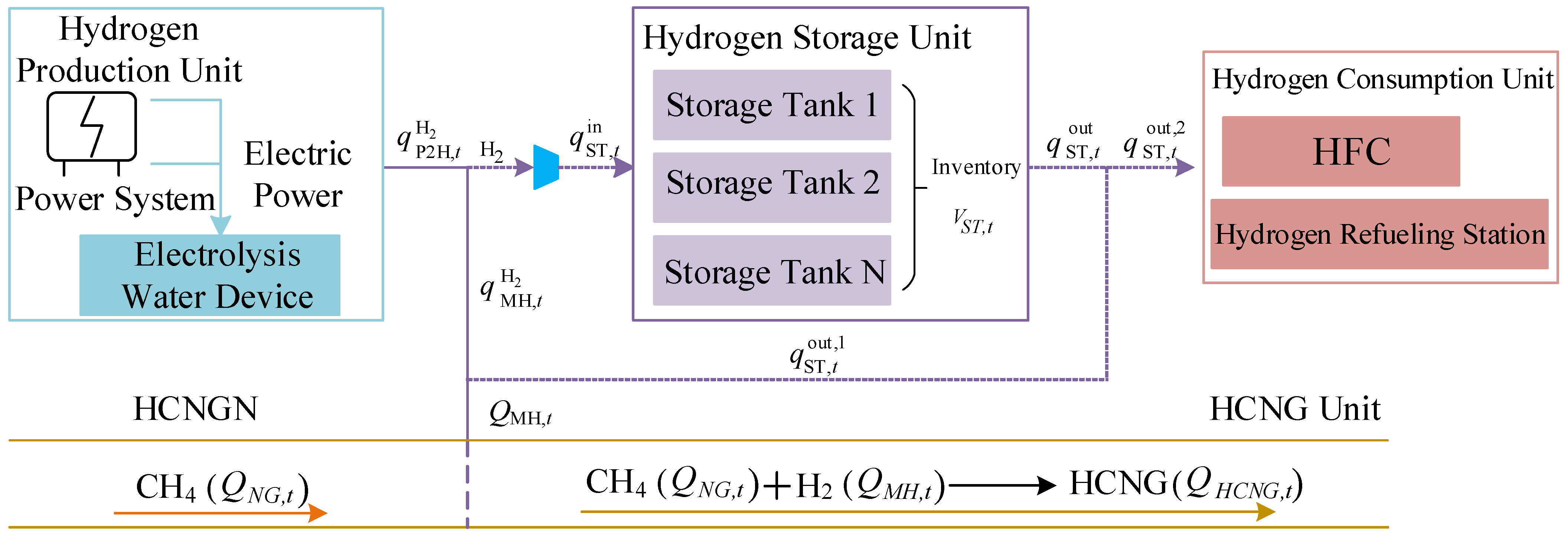
  26. Yang, S.; Yan, R.; Zhang, J.; Wang, J.; Bai, Z.; He, Y.; Hu, K.; Ao, X. Nested long-short-term temporal compression optimization for high-renewable integrated energy systems with hydrogen storage and heat recovery. Energy 2025, 333, 137423. [Google Scholar] [CrossRef]
  27. Emam, A.A.; Keshta, H.E.; Abdel-Latif, K.M.; Shaker, H. A hierarchical optimization framework for the real-time operation of hybrid hydrogen-battery microgrids considering solid oxide fuel cell start-up and waste heat recovery. Electr. Power Syst. Res. 2026, 255, 112738. [Google Scholar] [CrossRef]
  28. Zhou, J.; Fan, F.; Ye, X.; Wang, Z.; Xu, J.; Zhang, H.; Jiang, J.; Xue, R.; Sun, C.; Song, K.; et al. Power-to-hydrogen-ammonia coordination and planning for integrated energy systems with ammonia co-firing and waste heat recovery. Appl. Energy 2026, 406, 127258. [Google Scholar] [CrossRef]
  29. Bolt, A.; Dincer, I.; Agelin-Chaab, M. Investigation of a renewable energy based integrated system with carbon capturing for hydrogen, methane and other useful outputs. J. Clean. Prod. 2023, 422, 138572. [Google Scholar] [CrossRef]
  30. GB 17820-2018; Natural Gas. China Natural Gas Standardization Technology Committee, Standards Press of China: Beijing, China, 2019.
  31. Wang, C.; Sun, X. Integrated energy microgrid bi-level game scheduling optimization taking into account electricity-heat-hydrogen enriched compressed natural gas coupling and shared energy storage. Int. J. Electr. Power Energy Syst. 2025, 169, 110735. [Google Scholar] [CrossRef]
  32. Shahid, M.I.; Farhan, M.; Rao, A.; Salam, H.A.; Chen, T.; Li, X.; Ma, F. Performance, emissions and thermodynamic analysis of hydrogen-enriched compressed natural gas engine. Therm. Sci. Eng. Prog. 2025, 63, 103643. [Google Scholar] [CrossRef]
  33. Nikzad, M. Risk-averse stochastic multi-objective optimization for time-of-use demand response pricing in smart microgrids. Energy 2025, 322, 135733. [Google Scholar] [CrossRef]
  34. Cao, Y.; Lei, J.; Liu, Z. Multi-layered optimal scheduling method for multi-park energy systems based on price-based demand response uncertainty. Electr. Power Syst. Res. 2026, 250, 112149. [Google Scholar] [CrossRef]
  35. Zhou, Z.; Cai, G.; Huang, Y.; Bai, R.; Nie, S.; Chen, X. Spatial and temporal evolution of cost-competitive offshore hydrogen in China: A techno-economic analysis. Renew. Sustain. Energy Rev. 2024, 203, 114780. [Google Scholar] [CrossRef]
  36. Brancaleoni, P.P.; Damiani Ferretti, A.N.; Corti, E.; Bellucci, F.; Moro, D. Cost efficiency in clean urban mobility: TCO breakdown of hydrogen and electric buses in the European union with projections for 2030 and 2050. Int. J. Hydrogen Energy 2026, 211, 153615. [Google Scholar] [CrossRef]
  37. Wu, J.; Shen, Y.; Yang, R.; Fan, H.; Duan, Y. Electric-carbon market coupling and price transmission mechanism in China: An empirical analysis and development barriers study. J. Clean. Prod. 2026, 544, 147692. [Google Scholar] [CrossRef]
  38. FuelCellsWorks. Hydrogen Levels in German Gas Distribution System to Be Raised to 20 Percent for the First Time. 3 August 2019. Available online: https://fuelcellsworks.com/news/hydrogen-levels-in-german-gas-distribution-system-to-be-raised-to-20-percent-for-the-first-time (accessed on 24 May 2020).
  39. Sam, M. French Gas Networks Could Mix in Green Hydrogen in Future, Say Operators. Available online: https://www.euractiv.com/news/french-gas-networks-could-mix-in-green-hydrogen-in-future-say-operators/ (accessed on 24 May 2020).
  40. ITM Power. HyDeploy: UK Gas Grid Injection of Hydrogen in Full Operation. 2 January 2020. Available online: https://www.itm-power.com/news/hydeploy-uk-gas-grid-injection-ofhydrogen-in-full-operation (accessed on 24 May 2020).
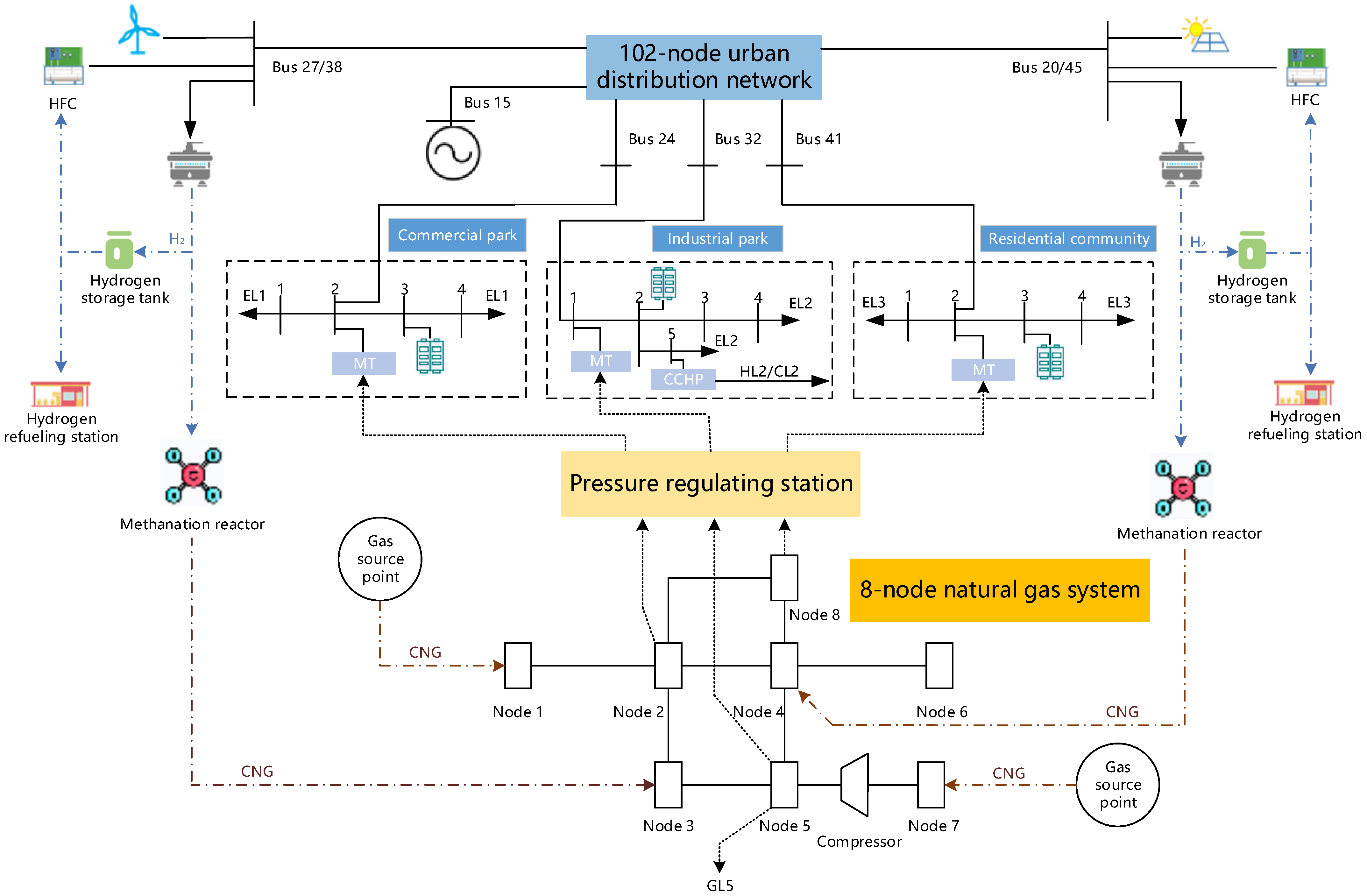
  41. Chen, J.; Wu, P.; Chen, W.; Guerrero, J.M.; Niu, Z.; Li, Z. Two-layer coordinated operation of multi-energy system considering carbon-oriented collaborative pricing mechanism via two-stage stochastic programming approach. Appl. Energy 2026, 406, 127298. [Google Scholar] [CrossRef]
  42. Li, J.; Ding, T.; Tan, R.; Liang, L. Trading characteristics of emissions trading scheme and carbon emission reduction efficiency: Evidence from China. Energy Econ. 2026, 153, 109072. [Google Scholar] [CrossRef]
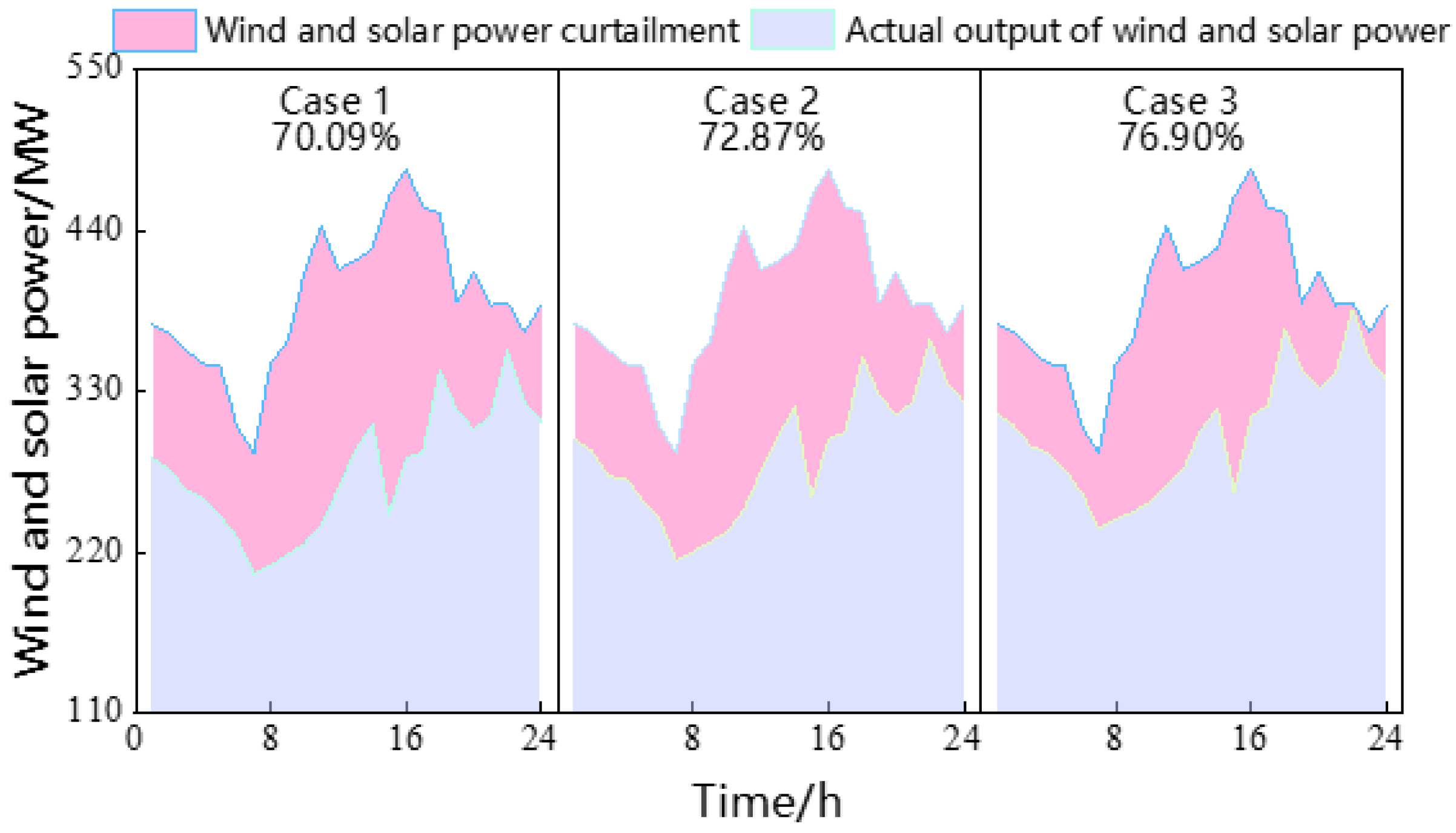
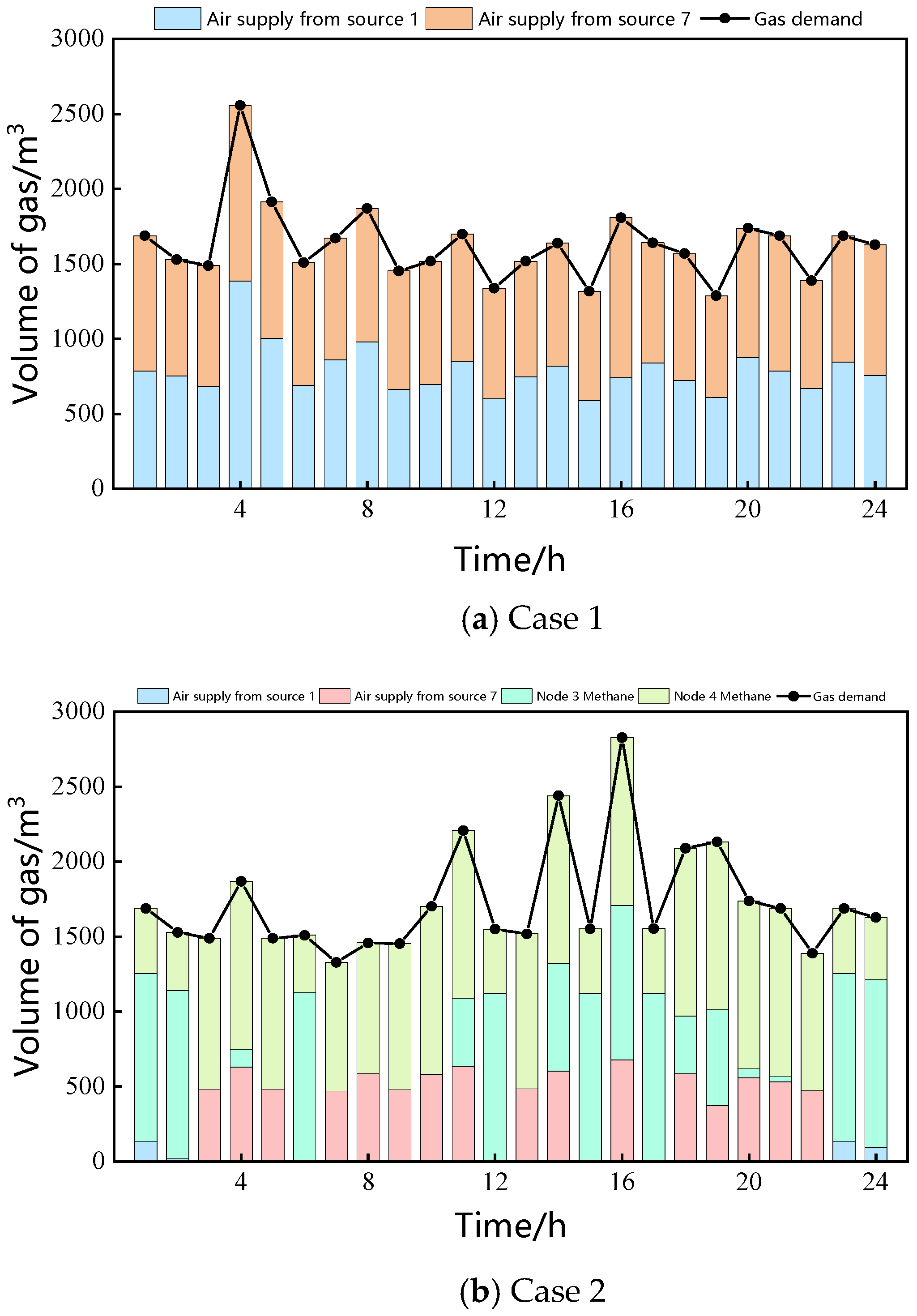
  43. Zhang, C.; Fan, Y.; Fang, C. Interplay of carbon pricing and emission policies: A game-theoretic study of China’s electricity market. Energy 2026, 345, 140103. [Google Scholar] [CrossRef]
Figure 1. Schematic diagram of Power–Hydrogen–HCNG-coupled urban integrated energy system.
Hydrogen 07 00032 g001
Figure 2. Schematic diagram of power–hydrogen–HCNG coupled unit.
Hydrogen 07 00032 g002
Figure 3. Structure diagram of urban integrated energy system coupled with 102-bus distribution network system and 8-node HCNGN.
Hydrogen 07 00032 g003
Figure 4. Consumption of wind power and photovoltaics in different cases.
Hydrogen 07 00032 g004
Figure 5. Input power curve of P2H in different cases.
Hydrogen 07 00032 g005
Figure 6. Dispatching of hydrogen-enriched compressed natural gas system in different cases.
Hydrogen 07 00032 g006aHydrogen 07 00032 g006b
Figure 7. Hydrogen generation and utilization in different cases.
Hydrogen 07 00032 g007
Figure 8. Multi-energy flow optimization of user units.
Hydrogen 07 00032 g008aHydrogen 07 00032 g008b
Figure 9. Dispatching of demand response results of user units in Case 7.
Hydrogen 07 00032 g009
Figure 10. Carbon emission of industrial unit in different cases.
Hydrogen 07 00032 g010
Figure 11. Hydrogen mix ratio of HCNGN nodes in different cases.
Hydrogen 07 00032 g011
Figure 12. Carbon emission indicators of HCNG in different cases.
Hydrogen 07 00032 g012
Figure 13. Carbon emission in different cases.
Hydrogen 07 00032 g013
Figure 14. Carbon emission in different cases.
Hydrogen 07 00032 g014
Table 1. Operating costs in different cases.
Cost/10,000 YuanCase 1PercentagesCase 2PercentagesCase 3Percentages
Thermal power operation11.393.64%11.393.77%11.393.29%
Abandon the wind and light211.3267.49%191.6363.47%163.2147.20%
Wind turbine photovoltaic operation and maintenance66.0321.09%68.6622.74%72.4520.95%
Hydrogen energy unit operation and maintenance0.000.00%13.304.40%76.4422.11%
Air supply7.712.46%1.780.59%7.552.18%
Demand response0.320.10%0.330.11%0.300.09%
Users purchase electricity10.973.50%8.732.89%9.282.68%
Users purchase gas1.910.61%2.560.85%1.810.52%
Energy storage operation and maintenance0.070.02%0.070.02%0.070.02%
Hot and cold equipment operation and maintenance0.260.08%0.380.13%0.230.07%
Carbon emissions3.090.99%3.131.04%3.070.89%
Total cost313.06100.00%301.95100.00%345.79100.00%
Table 2. System carbon emissions in different cases.
SceneCase 1Case 2Case 3
Gas grid carbon emissions/tCO256.6456.6456.28
Grid carbon emissions/tCO2252.17256.64251.06
System carbon emissions/tCO2308.80313.28307.34
System carbon emissions per unit of electricity/(kg/kWh)0.0370.0360.033
Table 3. Electric energy dispatching of user units in different cases.
ParkScenarioLoad/MWhPurchased Electricity/MWh
Business parkCase 650.1134.81
Case 746.0530.18
Industrial parkCase 656.981.45
Case 755.6581.56
Residential areaCase 639.0320.78
Case 736.9619.1
Table 4. Optimization scheduling results in different cases.
CaseCase 8Case 9Case 10Case 11
Total cost/10,000 yuan346.90345.79345.90345.06
Wind power photovoltaic utilization rate/%76.7176.9076.9277.01
Total amount of hydrogen injected/m3148.05699.861418.841555.87
Air supply volume/m340,658.3938,307.7538,402.4136,712.56
System carbon emissions/t311.65307.33307.53304.43
Table 5. Optimization scheduling results in different cases.
CaseCase 12Case 13Case 14Case 15
Total cost/10,000 yuan344.20345.79346.31346.94
Wind power photovoltaic utilization rate/%76.5176.9077.2577.58
Total amount of hydrogen injected/m3650.92699.86745.20788.50
Air supply volume/m338,520.4038,307.7538,110.3037,925.60
System carbon emissions/t309.80307.33306.82304.88
Table 6. Optimization scheduling results in different cases.
CaseCase 16Case 17Case 18Case 19
Total cost/10,000 yuan344.82345.79346.51347.02
Wind power photovoltaic utilization rate/%75.8276.9077.4577.82
Total amount of hydrogen injected/m3267.82699.861324.321537.46
Air supply volume/m339,685.2038,307.7537,956.3037,196.51
System carbon emissions/t310.25307.33305.20304.85
Disclaimer/Publisher’s Note: The statements, opinions and data contained in all publications are solely those of the individual author(s) and contributor(s) and not of MDPI and/or the editor(s). MDPI and/or the editor(s) disclaim responsibility for any injury to people or property resulting from any ideas, methods, instructions or products referred to in the content.