
Effect of Na+ vs. K+ Cations and Carbonate Presence on Urea Oxidation Reaction Coupled with Green Hydrogen Production in Alkaline Media: A Voltammetric and Electrochemical Impedance Spectroscopy Study


Abstract
1. Introduction
2. Materials and Methods
3. Results and Discussion

4. Conclusions
Author Contributions
Funding
Data Availability Statement
Conflicts of Interest
Abbreviations
| HER | Hydrogen evolution reaction |
| OER | Oxygen evolution reaction |
| UOR | Urea oxidation reaction |
| DES | Deep eutectic solvent |
| EIS | Electrochemical impedance spectroscopy |
| CVA | Cyclic voltammogram |
| CPE | Constant phase element |
| CAS | Chemical Abstracts Service (registry number) |
References
- Dawood, F.; Anda, M.; Shafiullah, G.M. Hydrogen production for energy: An overview. Int. J. Hydrogen Energy 2020, 45, 3847–3869. [Google Scholar] [CrossRef]
- Squadrito, G.; Maggio, G.; Nicita, A. The green hydrogen revolution. Renew. Energy 2023, 216, 119041. [Google Scholar] [CrossRef]
- Jeje, S.O.; Marazani, T.; Obiko, J.O.; Shongwe, M.B. Advancing the hydrogen production economy: A comprehensive review of technologies, sustainability, and future prospects. Int. J. Hydrogen Energy 2024, 78, 642–661. [Google Scholar] [CrossRef]
- Ansari, S.A.; Alam, M.W.; Dhanda, N.; Abbasi, M.S.; Ahmed, M.E.; Bader Alrashidi, A.; Al-Farhan, A.M.; Abebe, B. Sustainable hydrogen production, a review of methods, types, applications, challenges, and future perspectives. Glob. Chall. 2025, 9, 2500086. [Google Scholar] [CrossRef]
- Okada, Y.; Sasaki, E.; Watanabe, E.; Hyodo, S.; Nishijima, H. Development of dehydrogenation catalyst for hydrogen generation in organic chemical hydride method. Int. J. Hydrogen Energy 2006, 31, 1348–1356. [Google Scholar] [CrossRef]
- Diglio, M.; Contento, I.; Impemba, S.; Berretti, E.; Della Sala, P.; Oliva, G.; Naddeo, V.; Caporali, S.; Primo, A.; Talotta, C.; et al. Hydrogen production from formic acid decomposition promoted by gold nanoparticles supported on a porous polymer matrix. Energy Fuels 2025, 39, 14320–14329. [Google Scholar] [CrossRef]
- Adhikari, S.P.; Hood, Z.D.; Lachgar, A. Semiconductor heterojunctions for enhanced visible light photocatalytic H2 production. MRS Adv. 2018, 3, 3263–3270. [Google Scholar] [CrossRef]
- Bahadoran, A.; Liu, Q.; Ramakrishna, S.; Sadeghi, B.; De Castro, M.M.; Cavaliere, P.D. Hydrogen production as a clean energy carrier through heterojunction semiconductors for environmental remediation. Energies 2022, 15, 3222. [Google Scholar] [CrossRef]
- Impemba, S.; Provinciali, G.; Filippi, J.; Salvatici, C.; Berretti, E.; Caporali, S.; Banchelli, M.; Caporali, M. Engineering the heterojunction between TiO2 and In2O3 for improving the solar-driven hydrogen production. Int. J. Hydrogen Energy 2024, 63, 896–904. [Google Scholar] [CrossRef]
- Boddula, R.; Lee, Y.-Y.; Masimukku, S.; Chang-Chien, G.-P.; Pothu, R.; Srivastava, R.K.; Sarangi, P.K.; Selvaraj, M.; Basumatary, S.; Al-Qahtani, N. Sustainable hydrogen production: Solar-powered biomass conversion explored through (Photo)electrochemical advancements. Process Saf. Environ. Prot. 2024, 186, 1149–1168. [Google Scholar] [CrossRef]
- Pan, H.; Li, J.; Wang, Y.; Xia, Q.; Qiu, L.; Zhou, B. Solar-driven biomass reforming for hydrogen generation: Principles, advances, and challenges. Adv. Sci. 2024, 11, 2402651. [Google Scholar] [CrossRef]
- Impemba, S.; Provinciali, G.; Filippi, J.; Caporali, S.; Muzzi, B.; Casini, A.; Caporali, M. Tightly interfaced Cu2O with In2O3 to promote hydrogen evolution in presence of biomass-derived alcohols. ChemNanoMat 2024, 10, e202400459. [Google Scholar] [CrossRef]
- Vidas, L.; Castro, R. Recent developments on hydrogen production technologies: State-of-the-art review with focus on green-electrolysis. Appl. Sci. 2021, 11, 11363. [Google Scholar] [CrossRef]
- Ajanovic, A.; Sayer, M.; Haas, R. The economics and the environmental benignity of different colors of hydrogen. Int. J. Hydrogen Energy 2022, 47, 24136. [Google Scholar] [CrossRef]
- Shih, A.J.; Monteiro, M.C.O.; Dattila, F.; Pavesi, D.; Philips, M.; da Silva, A.H.M.; Vos, R.E.; Ojha, K.; Park, S.; van der Heijden, O.; et al. Water electrolysis. Nat. Rev. Methods Primers 2022, 2, 84. [Google Scholar] [CrossRef]
- Raveendran, A.; Chandran, M.; Dhanusuraman, R. A comprehensive review on the electrochemical parameters and recent material development of electrochemical water splitting electrocatalysts. RSC Adv. 2023, 13, 3843–3876. [Google Scholar] [CrossRef] [PubMed]
- Zhou, W.; Chen, S.; Meng, X.; Li, J.; Gao, J. Energy-saving cathodic H2 production enabled by non-oxygen evolution anodic reactions: A critical review on fundamental principles and applications. Int. J. Hydrogen Energy 2023, 48, 15748–15770. [Google Scholar] [CrossRef]
- Boggs, B.K.; King, R.L.; Botte, G.G. Urea electrolysis: Direct hydrogen production from urine. Chem. Commun. 2009, 32, 4859–4861. [Google Scholar] [CrossRef]
- Sun, X.; Ding, R. Recent progress with electrocatalysts for urea electrolysis in alkaline media for energy-saving hydrogen production. Catal. Sci. Technol. 2020, 10, 1567–1581. [Google Scholar] [CrossRef]
- Yang, K.; Hao, L.; Hou, Y.; Zhang, J.; Yang, J.H. Summary and application of Ni-based catalysts for electrocatalytic urea oxidation. Int. J. Hydrogen Energy 2024, 51, 966–981. [Google Scholar] [CrossRef]
- Paygozar, S.; Aghdam, A.S.R.; Hassanizadeh, E.; Andaveh, R.; Darband, G.B. Recent progress in non-noble metal-based electrocatalysts for urea-assisted electrochemical hydrogen production. Int. J. Hydrogen Energy 2023, 48, 7219–7259. [Google Scholar] [CrossRef]
- Anuratha, K.S.; Rinawati, M.; Wu, T.H.; Yeh, M.H.; Lin, J.Y. Recent development of nickel-based electrocatalysts for urea electrolysis in alkaline solution. Nanomaterials 2022, 12, 2970. [Google Scholar] [CrossRef] [PubMed]
- Akkari, S.; Sánchez-Sánchez, C.M.; Hopsort, G.; Serrano, K.G.; Loubière, K.; Tzedakis, T.; Benyahia, R.; Rebiai, L.; Bastide, S.; Cachet-Vivier, C.; et al. Progress on electrochemical and photoelectrochemical urea and ammonia conversion from urine for sustainable wastewater treatment. Appl. Catal. B Environ. Energy 2025, 362, 124718. [Google Scholar] [CrossRef]
- Gao, X.; Zhang, S.; Wang, P.; Jaroniec, M.; Zheng, Y.; Qiao, S.-Z. Urea catalytic oxidation for energy and environmental applications. Chem. Soc. Rev. 2024, 53, 1552–1591. [Google Scholar] [CrossRef] [PubMed]
- Weerakoon, D.; Bansal, B.; Padhye, L.P.; Rachmani, A.; Wright, L.J.; Roberts, G.S.; Baroutian, S. A critical review on current urea removal technologies from water: An approach for pollution prevention and resource recovery. Sep. Purif. Technol. 2023, 314, 123652. [Google Scholar] [CrossRef]
- Swify, S.; Mažeika, R.; Baltrusaitis, J.; Drapanauskaitė, D.; Barčauskaitė, K. Review: Modified urea fertilizers and their effects on improving nitrogen use efficiency (NUE). Sustainability 2024, 16, 188. [Google Scholar] [CrossRef]
- Knospe, P.; Shams Uldeen, M.; Reichmann, R.; Seithümmer, J.; Abdulkarim, A.; Rubbert, L.V.; Knospe, F.; Dornbusch, M. Next-generation urea resins: Formaldehyde-free coating materials based on higher aldehydes and amides. J. Coat. Technol. Res. 2025, 22, 999–1017. [Google Scholar] [CrossRef]
- Ghosh, A.K.; Brindisi, M. Urea derivatives in modern drug discovery and medicinal chemistry. J. Med. Chem. 2020, 63, 2751–2788. [Google Scholar] [CrossRef]
- Protsenko, V.S. Thermodynamic aspects of urea oxidation reaction in the context of hydrogen production by electrolysis. Int. J. Hydrogen Energy 2023, 48, 24207–24211. [Google Scholar] [CrossRef]
- Protsenko, V.S.; Bobrova, L.S.; Butyrina, T.E.; Sukhatskyi, O.D. Thermodynamics of electrochemical urea oxidation reaction coupled with cathodic hydrogen evolution reaction in an alkaline solution: Effect of carbonate formation. Int. J. Hydrogen Energy 2024, 59, 354–358. [Google Scholar] [CrossRef]
- Protsenko, V. Towards sustainable urea electro-oxidation: A thermodynamic and green chemistry evaluation of alternative pathways. R. Soc. Open Sci. 2025, 12, 250156. [Google Scholar] [CrossRef]
- Wang, H.; Zheng, X.; Fang, L.; Lu, S. Urea electrooxidation in alkaline environment: Fundamentals and applications. ChemElectroChem 2023, 10, e202300138. [Google Scholar] [CrossRef]
- Protsenko, V.S.; Shaiderov, D.A.; Sukhatskyi, O.D.; Butyrina, T.E.; Korniy, S.A. Nickel-containing electrocatalysts for green hydrogen production: Electrodeposition from deep eutectic solvent-based solutions and electrocatalytic activity for hydrogen evolution, oxygen evolution and urea oxidation reactions. J. Appl. Electrochem. 2025, 55, 2129–2148. [Google Scholar] [CrossRef]
- Kityk, A.; Pavlik, V.; Hnatko, M. Exploring deep eutectic solvents for the electrochemical and chemical synthesis of photo- and electrocatalysts for hydrogen evolution. Int. J. Hydrogen Energy 2023, 48, 39823–39853. [Google Scholar] [CrossRef]
- Al-Farsi, R.; Hayyan, M. Deep eutectic solvents: Green multi-task agents for sustainable super green hydrogen technologies. J. Energy Chem. 2024, 92, 357–382. [Google Scholar] [CrossRef]
- Hansen, B.B.; Spittle, S.; Chen, B.; Poe, D.; Zhang, Y.; Klein, J.M.; Horton, A.; Adhikari, L.; Zelovich, T.; Doherty, B.W.; et al. Deep eutectic solvents: A review of fundamentals and applications. Chem. Rev. 2021, 121, 1232–1285. [Google Scholar] [CrossRef]
- Abbott, A.P. Deep eutectic solvents and their application in electrochemistry. Curr. Opin. Green Sustain. Chem. 2022, 36, 100649. [Google Scholar] [CrossRef]
- Zhang, C.; Fu, Y.; Gao, W.; Bai, T.; Cao, T.; Jin, J.; Xin, B. Deep eutectic solvent-mediated electrocatalysts for water splitting. Molecules 2022, 27, 8098. [Google Scholar] [CrossRef]
- Zhang, C.; Bai, T.; Sun, Y.; Xin, B.; Zhang, S. Ionic liquid/deep eutectic solvent-mediated Ni-based catalysts and their application in water splitting electrocatalysis. Catalysts 2022, 12, 928. [Google Scholar] [CrossRef]
- Daramola, D.A.; Singh, D.; Botte, G.G. Dissociation rates of urea in the presence of NiOOH catalyst: A DFT analysis. J. Phys. Chem. A 2010, 114, 11513–11521. [Google Scholar] [CrossRef] [PubMed]
- Vedharathinam, V.; Botte, G.G. Direct evidence of the mechanism for the electro-oxidation of urea on Ni(OH)2 catalyst in alkaline medium. Electrochim. Acta 2013, 108, 660–665. [Google Scholar] [CrossRef]
- Wang, D.; Botte, G.G. In situ X-ray diffraction study of urea electrolysis on nickel catalysts. ECS Electrochem. Lett. 2014, 3, H29–H32. [Google Scholar] [CrossRef]
- Singh, R.K.; Rajavelu, K.; Montag, M.; Schechter, A. Advances in catalytic electrooxidation of urea: A review. Energy Technol. 2021, 9, 2100017. [Google Scholar] [CrossRef]
- Guo, F.; Ye, K.; Du, M.; Huang, X.; Cheng, K.; Wang, G.; Cao, D. Electrochemical impedance analysis of urea electro-oxidation mechanism on nickel catalyst in alkaline medium. Electrochim. Acta 2016, 210, 474–482. [Google Scholar] [CrossRef]
- Gebremariam, G.K.; Jovanović, A.Z.; Pašti, I.A. The effect of electrolytes on the kinetics of the hydrogen evolution reaction. Hydrogen 2023, 4, 776–806. [Google Scholar] [CrossRef]
- Monteiro, M.C.O.; Goyal, A.; Moerland, P.; Koper, M.T.M. Understanding cation trends for hydrogen evolution on platinum and gold electrodes in alkaline media. ACS Catal. 2021, 11, 14328–14335. [Google Scholar] [CrossRef]
- Li, P.; Jiang, Y.-L.; Men, Y.; Jiao, Y.-Z.; Chen, S. Kinetic cation effect in alkaline hydrogen electrocatalysis and double layer proton transfer. Nat. Commun. 2025, 16, 1844. [Google Scholar] [CrossRef]
- Marcandalli, G.; Boterman, K.; Koper, M.T.M. Understanding hydrogen evolution reaction in bicarbonate buffer. J. Catal. 2022, 405, 346–354. [Google Scholar] [CrossRef]
- Carr, J.K.; Buchanan, L.E.; Schmidt, J.R.; Zanni, M.T.; Skinner, J.L. Structure and dynamics of urea/water mixtures investigated by vibrational spectroscopy and molecular dynamics simulation. J. Phys. Chem. B 2013, 117, 13291–13300. [Google Scholar] [CrossRef]
- Moll, C.J.; Versluis, J.; Bakker, H.J. Direct observation of the orientation of urea molecules at charged interfaces. J. Phys. Chem. Lett. 2021, 12, 10823–10828. [Google Scholar] [CrossRef]
- del Rosario, J.A.D.; Li, G.; Labata, M.F.M.; Ocon, J.D.; Chuang, P.-Y.A. Unravelling the roles of alkali-metal cations for the enhanced oxygen evolution reaction in alkaline media. Appl. Catal. B Environ. 2021, 288, 119981. [Google Scholar] [CrossRef]
- Mangel Raventos, A.; Kortlever, R. Effect of different alkali metal cations on the oxygen evolution activity and battery capacity of nickel electrodes in concentrated hydroxide electrolytes. Electrochim. Acta 2022, 415, 140255. [Google Scholar] [CrossRef]
- Gallenberger, J.; Gohlke, C.; Neumann, M.; Mechler, A.K.; Hofmann, J.P. Water dissociation on NiOOH in alkaline water electrolysis improves with increasing alkali metal cation size. ChemSusChem 2025, 18, e202402596. [Google Scholar] [CrossRef]
- Cha, S.; Cao, X.; Du, W.; Jin, H.; Liu, Y.; Wang, R.; Yang, Y.; Sun, B.; Yang, X.; Gong, M. The ion effect on electrocatalytic oxidation reactions. J. Mater. Chem. A 2024, 12, 32548–32565. [Google Scholar] [CrossRef]
- Ghosh, S.; Dasgupta, B.; Kalra, S.; Ashton, M.L.P.; Yang, R.; Kueppers, C.J.; Gok, S.; Alonso, E.G.; Schmidt, J.; Laun, K.; et al. Evolution of carbonate-intercalated γ-NiOOH from a molecularly derived nickel sulfide (pre)catalyst for efficient water and selective organic oxidation. Small 2023, 19, 2206679. [Google Scholar] [CrossRef] [PubMed]
- Hall, D.S.; Lockwood, D.J.; Bock, C.; MacDougall, B.R. Nickel hydroxides and related materials: A review of their structures, synthesis and properties. Proc. R. Soc. A 2015, 471, 20140792. [Google Scholar] [CrossRef] [PubMed]
- Chen, Z.; Wei, W.; Shon, H.K.; Ni, B.-J. Designing bifunctional catalysts for urea electrolysis: Progress and perspectives. Green Chem. 2024, 26, 631–654. [Google Scholar] [CrossRef]
- Lazanas, A.C.; Prodromidis, M.I. Electrochemical Impedance Spectroscopy—A Tutorial. ACS Meas. Sci. Au 2023, 3, 162–193. [Google Scholar] [CrossRef] [PubMed]
- Barsoukov, E.; Macdonald, J.R. Impedance Spectroscopy: Theory, Experiment, and Applications, 2nd ed.; John Wiley & Sons: Hoboken, NJ, USA, 2005. [Google Scholar]
- Armstrong, R.D.; Henderson, M. Impedance plane display of a reaction with an adsorbed intermediate. J. Electroanal. Chem. Interf. Electrochem. 1972, 39, 81–90. [Google Scholar] [CrossRef]
- Lyons, M.E.G.; Brandon, M.P. The oxygen evolution reaction on passive oxide covered transition metal electrodes in aqueous alkaline solution. Part 1—Nickel. Int. J. Electrochem. Sci. 2008, 3, 1386–1424. [Google Scholar] [CrossRef]
- Protsenko, V.S.; Butyrina, T.E.; Danilov, F.I. Kinetics and mechanism of electrochemical oxygen evolution in an alkaline solution on nickel coatings. J. Chem. Technol. 2022, 30, 26–33. [Google Scholar] [CrossRef]
- Mohamed, I.M.A.; Kanagaraj, P.; Yasin, A.S.; Iqbal, W.; Liu, C. Electrochemical impedance investigation of urea oxidation in alkaline media based on electrospun nanofibers towards the technology of direct-urea fuel cells. J. Alloys Compd. 2020, 816, 152513. [Google Scholar] [CrossRef]
- Yang, M.; Liu, Z.; Liu, F.; Lv, Y.; Zhang, J. Boosting electrocatalytic urea oxidation performance of NiSx-VS4-C mediated via glycerol coking. J. Alloys Compd. 2024, 1008, 176743. [Google Scholar] [CrossRef]
- Upadhyay, P.; Deka, A.; Chakma, S. Unlocking efficient electrochemical urea oxidation and understanding mechanism insights of Co-doped NiS. ACS Eng. Au 2025, 5, 450–467. [Google Scholar] [CrossRef]
- Mulder, W.H.; Sluyters, J.H. An explanation of depressed semi-circular arcs in impedance plots for irreversible electrode reactions. Electrochim. Acta 1988, 33, 303–310. [Google Scholar] [CrossRef]
- Rammelt, U.; Reinhard, G. On the applicability of a constant phase element (CPE) to the estimation of roughness of solid metal electrodes. Electrochim. Acta 1990, 35, 1045–1049. [Google Scholar] [CrossRef]



| Electrolyte Composition | j/mA cm−2 |
|---|---|
| 1 M NaOH + 0.33 M CO(NH2)2 | 0.014 |
| 1 M KOH + 0.33 M CO(NH2)2 | 0.010 |
| 1 M NaOH + 0.33 M CO(NH2)2 + 0.1 M Na2CO3 | 0.012 |
| 1 M KOH + 0.33 M CO(NH2)2 + 0.1 M K2CO3 | 0.006 |
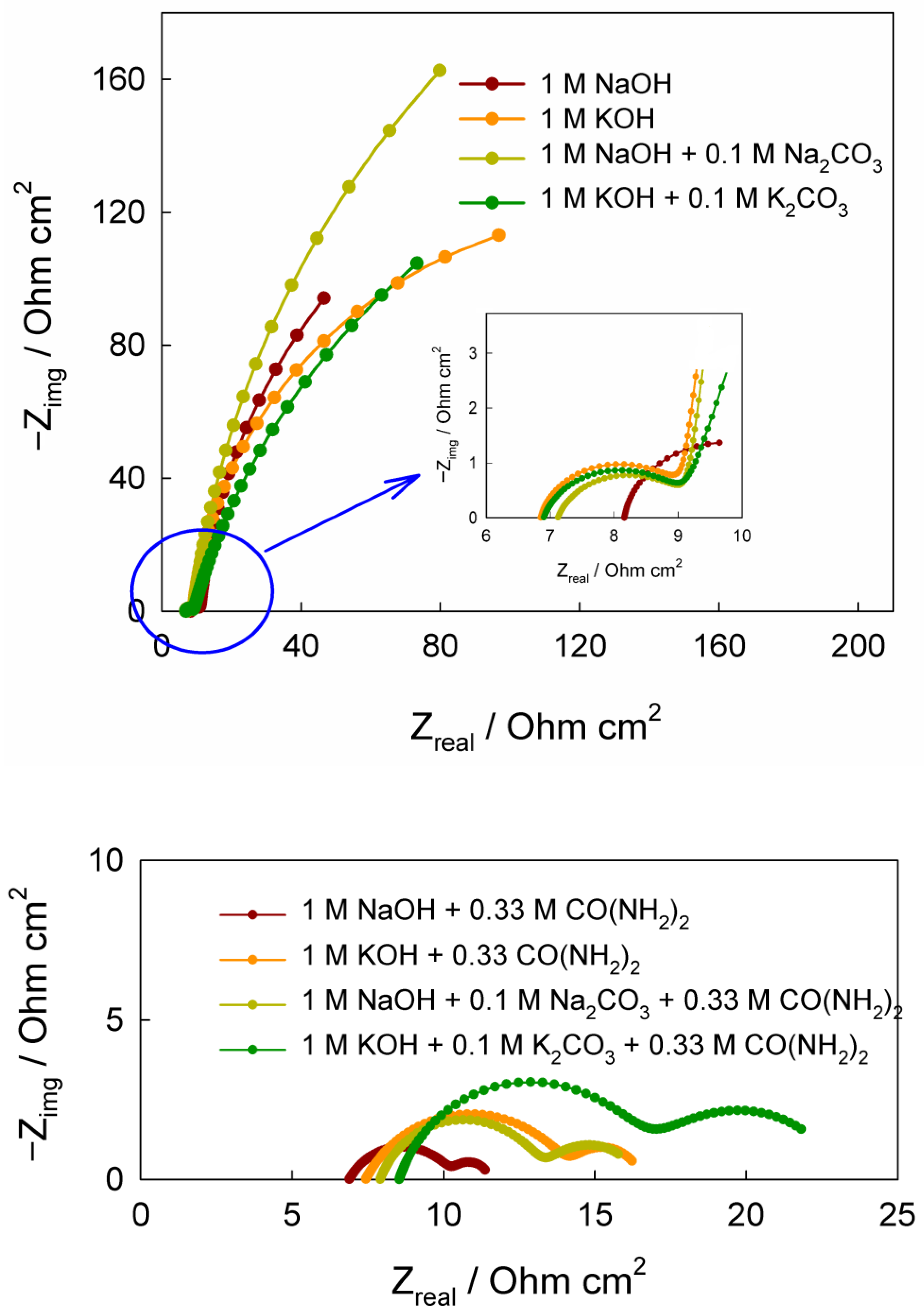
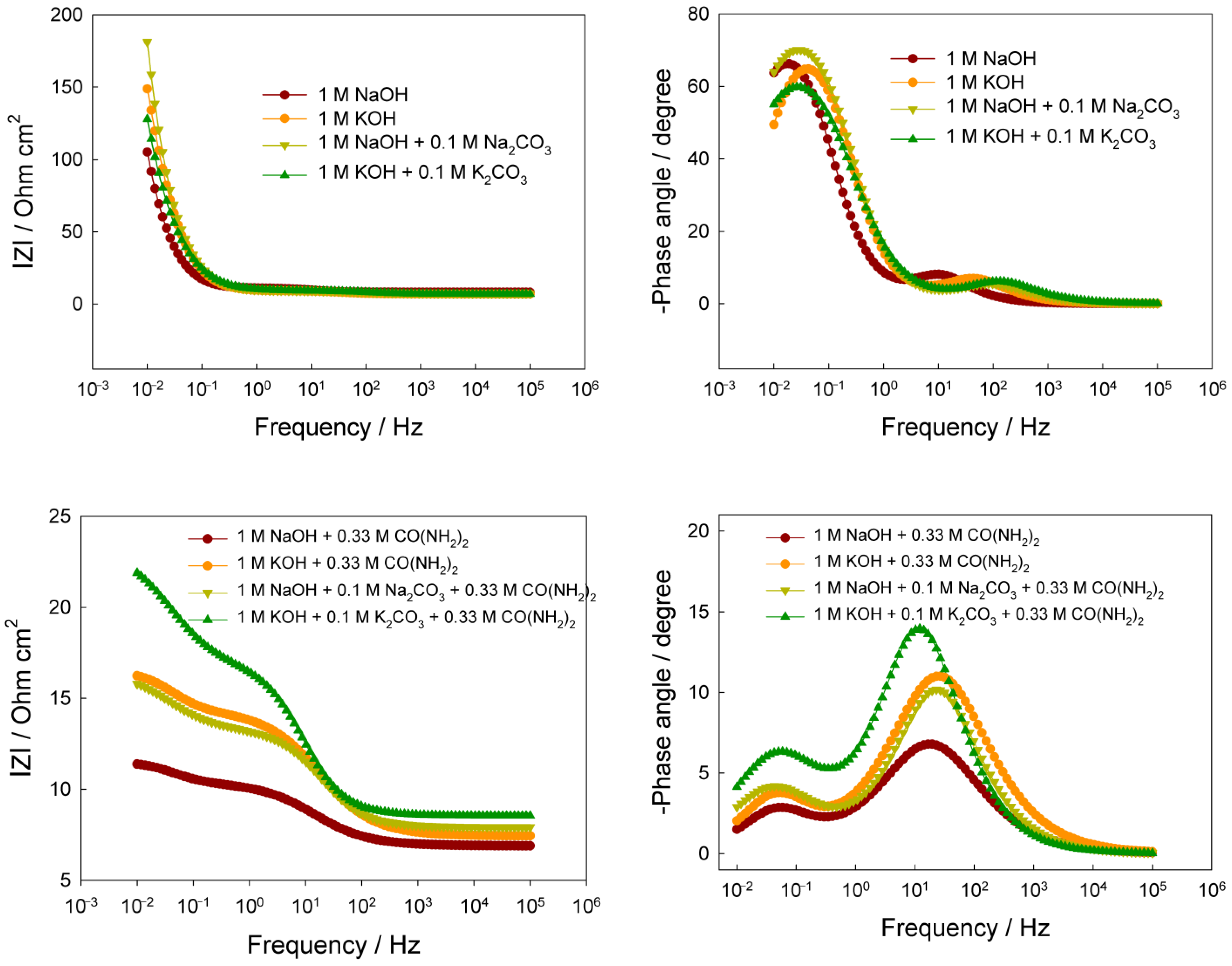
| Electrolyte Composition | High-Frequency Region | Low-Frequency Region | ||
|---|---|---|---|---|
| fpeak/Hz | τ/s | fpeak/Hz | τ/s | |
| 1 M NaOH | 7.41 | 2.15 × 10⁻² | – | – |
| 1 M KOH | 3.72 | 4.28 × 10⁻² | – | – |
| 1 M NaOH + 0.1 M Na2CO3 | 70.8 | 2.25 × 10⁻³ | – | – |
| 1 M KOH + 0.1 M K2CO3 | 97.7 | 1.63 × 10⁻³ | – | – |
| 1 M NaOH + 0.33 M CO(NH2)2 | 14.1 | 1.13 × 10⁻² | 0.0501 | 3.18 |
| 1 M KOH + 0.33 M CO(NH2)2 | 16.6 | 9.59 × 10⁻³ | 0.0501 | 3.18 |
| 1 M NaOH + 0.33 M CO(NH2)2 + 0.1 M Na2CO3 | 16.6 | 9.59 × 10⁻³ | 0.0363 | 4.38 |
| 1 M KOH + 0.33 M CO(NH2)2 + 0.1 M K2CO3 | 7.41 | 2.15 × 10⁻² | 0.0427 | 3.73 |
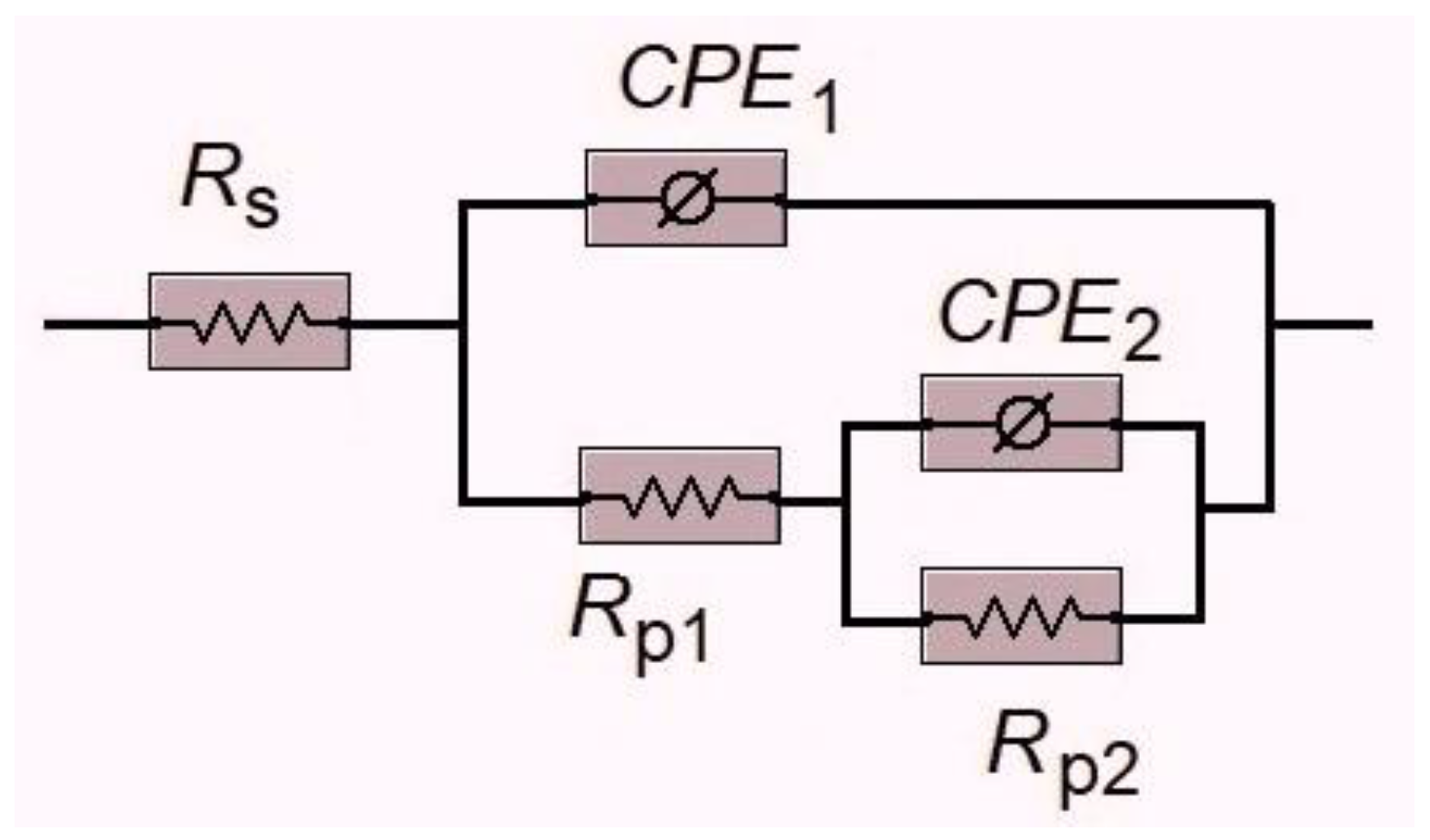
| Electrolyte Composition | RS/Ohm | RP1/Ohm cm2 | CPE1 | RP2/Ohm cm2 | CPE2 | ||
|---|---|---|---|---|---|---|---|
| Y1/Ohm−1 sn1 cm−2 | n1 | Y2/Ohm−1 sn2 cm−2 | n2 | ||||
| 1 M NaOH | 8.16 | 3.11 | 8.36 × 10⁻³ | 0.91 | 363.46 | 0.120 | 0.95 |
| 1 M KOH | 6.85 | 2.41 | 3.80 × 10⁻³ | 0.86 | 262.87 | 0.072 | 0.95 |
| 1 M NaOH + 0.1 M Na2CO3 | 7.12 | 2.16 | 3.49 × 10⁻³ | 0.79 | 598.84 | 0.065 | 0.94 |
| 1 M KOH + 0.1 M K2CO3 | 6.90 | 2.31 | 2.15 × 10⁻³ | 0.81 | 405.18 | 0.071 | 0.84 |
| 1 M NaOH + 0.33 M CO(NH2)2 | 6.89 | 3.49 | 14.82 × 10⁻³ | 0.67 | 1.16 | 2.57 | 0.86 |
| 1 M KOH + 0.33 M CO(NH2)2 | 7.43 | 6.91 | 6.40 × 10⁻³ | 0.68 | 2.20 | 1.43 | 0.86 |
| 1 M NaOH + 0.33 M CO(NH2)2 + 0.1 M Na2CO3 | 7.91 | 5.47 | 5.32 × 10⁻³ | 0.76 | 3.08 | 1.00 | 0.74 |
| 1 M KOH + 0.33 M CO(NH2)2 + 0.1 M K2CO3 | 8.54 | 8.44 | 5.43 × 10⁻³ | 0.79 | 6.23 | 0.46 | 0.72 |
Disclaimer/Publisher’s Note: The statements, opinions and data contained in all publications are solely those of the individual author(s) and contributor(s) and not of MDPI and/or the editor(s). MDPI and/or the editor(s) disclaim responsibility for any injury to people or property resulting from any ideas, methods, instructions or products referred to in the content. |
© 2025 by the authors. Licensee MDPI, Basel, Switzerland. This article is an open access article distributed under the terms and conditions of the Creative Commons Attribution (CC BY) license (https://creativecommons.org/licenses/by/4.0/).
Share and Cite
Protsenko, V.S.; Shaiderov, D.A.; Sukhatskyi, O.D. Effect of Na+ vs. K+ Cations and Carbonate Presence on Urea Oxidation Reaction Coupled with Green Hydrogen Production in Alkaline Media: A Voltammetric and Electrochemical Impedance Spectroscopy Study. Hydrogen 2025, 6, 119. https://doi.org/10.3390/hydrogen6040119
Protsenko VS, Shaiderov DA, Sukhatskyi OD. Effect of Na+ vs. K+ Cations and Carbonate Presence on Urea Oxidation Reaction Coupled with Green Hydrogen Production in Alkaline Media: A Voltammetric and Electrochemical Impedance Spectroscopy Study. Hydrogen. 2025; 6(4):119. https://doi.org/10.3390/hydrogen6040119
Chicago/Turabian StyleProtsenko, Vyacheslav S., Denys A. Shaiderov, and Oleksandr D. Sukhatskyi. 2025. "Effect of Na+ vs. K+ Cations and Carbonate Presence on Urea Oxidation Reaction Coupled with Green Hydrogen Production in Alkaline Media: A Voltammetric and Electrochemical Impedance Spectroscopy Study" Hydrogen 6, no. 4: 119. https://doi.org/10.3390/hydrogen6040119
APA StyleProtsenko, V. S., Shaiderov, D. A., & Sukhatskyi, O. D. (2025). Effect of Na+ vs. K+ Cations and Carbonate Presence on Urea Oxidation Reaction Coupled with Green Hydrogen Production in Alkaline Media: A Voltammetric and Electrochemical Impedance Spectroscopy Study. Hydrogen, 6(4), 119. https://doi.org/10.3390/hydrogen6040119