
Abstract
Freshwater ostracods have considerable potential as indicators of environmental conditions, yet their ecology remains poorly documented in many large river floodplains of Southeast Europe. This study examines samples collected from ten aquatic habitats located along the Danube floodplain in Serbia’s Banat and Podunavlje regions. Monthly sampling was conducted over a twelve-month period (July 2023–June 2024), with concurrent measurements of water temperature, pH, dissolved oxygen, electrical conductivity, and turbidity. Ostracods were recorded at seven sites, yielding 19 taxa belonging to 13 genera and four families within all three non-marine superfamilies of Podocopida. Eight recorded taxa represent new additions to the Serbian fauna. Species richness was highest in semi-isolated floodplain habitats. Canonical correspondence analysis (CCA) showed that seasonal environmental variation, especially water temperature, turbidity, and conductivity, strongly structured assemblages. Hierarchical cluster analysis (UPGMA) grouped samples primarily by species composition, with seasonality exerting a strong secondary influence. Seasonal patterns revealed pronounced interspecific differences in temporal persistence and ecological tolerance of recorded species. Findings highlight the Danube floodplain’s role as a dispersal corridor, while also revealing that the river itself acts as a partial barrier, restricting faunal exchange to widespread, tolerant species. The results emphasize the importance of habitat heterogeneity and year-round sampling and support the integration of ostracods into long-term floodplain monitoring programs.
1. Introduction
Ostracods are small crustaceans that often go unnoticed, yet they inhabit a wide range of aquatic and semiaquatic environments, including marine, brackish, and freshwater habitats [1,2]. They form an essential component of many inland aquatic ecosystems. Their ability to occupy diverse surface waters, from shallow temporary pools to large river floodplains [3,4], makes them potentially useful for ecological interpretation, although their diversity remains poorly documented in many regions [5]. Ostracods respond rapidly to seasonal changes in temperature, hydrology, and water chemistry [6,7,8], and because of this sensitivity, their communities can reveal subtle environmental shifts that may escape routine monitoring.
Along the Danube River, natural, modified and artificial waterbodies occur side by side. Although the Danube is among Europe’s most extensively studied rivers in terms of ecology and zoology, the 413 km stretch of its middle basin running through Serbia [9] has received far less attention regarding its ostracod fauna. Most existing research on freshwater ostracods in this region has focused on isolated localities or specific habitat types, leaving extensive sections of the Danube’s riverbanks and adjacent aquatic habitats in the Banat and Podunavlje regions largely unexplored, apart from a few studies that only partially address them [10,11,12]. Recent studies from Central Europe suggest that these floodplain systems may support a richer and more dynamic ostracod fauna than previously assumed, particularly when seasonal variation is taken into account [4,13,14]. Water-level fluctuations, periodic flooding, and the mosaic of permanent and temporary waterbodies create conditions that favor both widespread eurytopic species and more specialized taxa [15,16].
Understanding seasonal changes in ostracod assemblages is especially important for interpreting their ecology [13,17,18,19]. Seasonal patterns influence not only species occurrence but also reproductive timing, dispersal, and the persistence of resting eggs [20,21]. Despite the ecological significance of these processes, comprehensive seasonal surveys remain scarce, particularly in Serbia and the wider Balkan region. In the absence of such data, it is difficult to assess how local environmental gradients shape community structure or to compare regional patterns with those reported elsewhere.
The study was based on the hypotheses that ostracod assemblages vary significantly among seasons in response to changes in hydrological conditions and water chemistry, and that environmental variables, such as water temperature and electrical conductivity, play a key role in shaping ostracod community structure in the investigated habitats.
The aim of the present study is to address part of the existing knowledge gap by examining the seasonal diversity and ecological characteristics of freshwater ostracods in a variety of waterbodies along the Danube floodplain in the Banat and Podunavlje regions of Serbia. In addition to documenting species composition and seasonal dynamics, this study aims to contribute new data to the knowledge of Serbian ostracod fauna, a group that remains insufficiently studied at the national scale, with only 56 ostracod species reported from Serbia prior to the present study [22]. By combining species records with measurements of key environmental variables, this work also aims to provide new insights into the ecology of ostracods in the middle Danube floodplain. Furthermore, by implementing the easily interpretable Ostracod Watch Model proposed by Külköylüoğlu [23,24] to illustrate seasonal patterns in species occurrence, the study supports this practical method for visualizing ostracod seasonality and facilitating comparisons among habitats and sampling periods. Lastly, this study aims to contribute to a broader understanding of ostracod ecology and distribution in inland waters.
2. Materials and Methods
2.1. Research Area and Sampling Sites
The study was conducted in the southern part of the Banat region and the northern part of the Podunavlje region in Serbia, along the middle course of the Danube River and its adjacent lowland aquatic habitats. This section of the Danube floodplain is characterized by a mosaic of natural and artificial waterbodies, including large rivers, smaller lowland rivers, canals, ponds, oxbow lakes, and backwaters. The area is subject to pronounced seasonal hydrological variation, influenced by fluctuations in Danube water levels, periodic flooding, and local climatic conditions, creating a range of aquatic environments that differ in permanence, connectivity, and physicochemical properties.
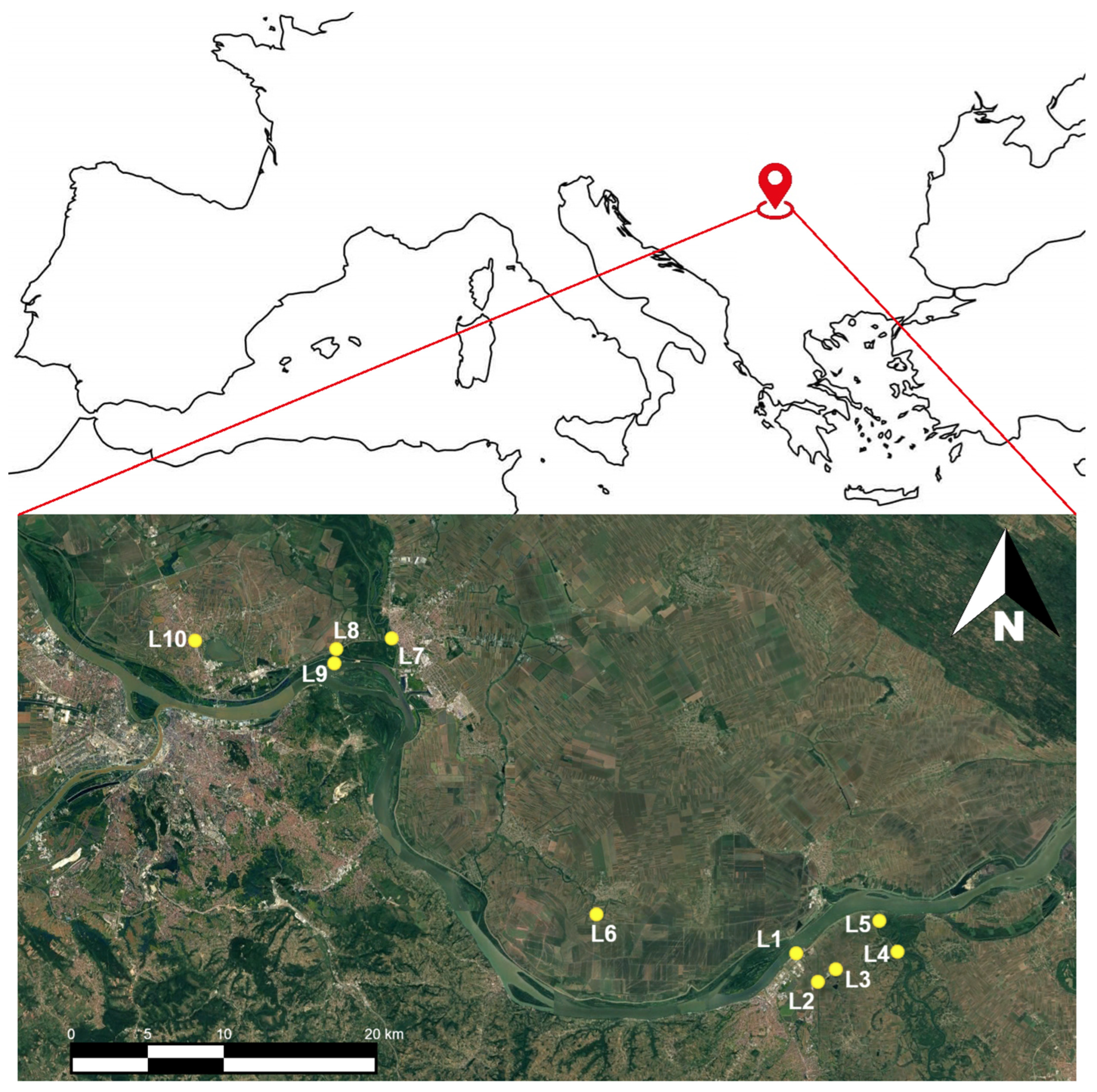
A total of ten sampling sites were selected and designated with locality codes L1–L10. The sites comprised a range of aquatic habitat types commonly found along the Danube floodplain. Five sites were located on the right bank of the Danube near the city of Smederevo (Podunavlje region): the Danube River in Smederevo (L1), Železara Canal (L2), Šalinac Lake (L3), the Velika Morava River in Šalinac (L4), and a remnant of the Velika Morava River meander—an oxbow lake near Kulič (L5). The remaining five sites were situated on the left bank of the Danube in the southern Banat region, extending from Banatski Brestovac through Pančevo to the Belgrade city area: the Ponjavica River (L6), the Tamiš River in Pančevo (L7), the Sibnica backwater (L8), the Danube River in Čapljin (L9), and the Sebeš Canal in Borča (L10).
The selection of sites was designed to include ecologically comparable habitat types on opposite banks of the Danube. These included Danube riverbank sites on each side (L1 and L9), major lowland tributaries of the Danube (Velika Morava, L4 and Tamiš, L7), highly eutrophicated canals (Železara Canal, L2 and Sebeš Canal, L10), and wetland habitats (oxbow lake, L5 and Sibnica backwater, L8). In addition, two waterbodies that are not of the same formal type but share many ecological characteristics were included: a relatively small and shallow Šalinac lake (L3) and the Ponjavica River (L6). The Ponjavica River is slow-flowing and highly eutrophic, exhibiting ecological conditions more typical of standing waters. This paired site design aimed to assess whether the Danube River functions as a natural barrier or ecological boundary, potentially influencing differences in ostracod assemblages inhabiting similar habitat types on opposing riverbanks. The selected sites also span a gradient of anthropogenic pressure, with the Sebeš Canal (L10) representing the most heavily impacted system in the dataset. Sites L2, L5, L8, and L10 occasionally display pronounced eutrophic features, such as phytoplankton blooms, hypoxia, and surface accumulations of duckweed (Lemna sp.) and other floating aquatic macrophytes.
Sampling was carried out monthly over a 12-month period from July 2023 to June 2024. Samples were generally collected on the same day each month; however, during July 2023, sampling was conducted in two sessions, one week apart. Sampling was not possible on three occasions: once at L8 in October 2023 due to complete habitat desiccation, and twice at L9 in December 2023 and January 2024 because access to the site was prevented by flood conditions. In total, 117 samples were collected during the study period.
Information on site coordinates, altitude, waterbody type, and substrate characteristics is provided in Table 1, and the geographic distribution of sampling sites is shown in Figure 1.
Table 1.
Information on sampling sites.
Figure 1.
Satellite image (Google Earth) of the study area with sampling sites indicated by yellow dots and labeled with their respective site codes (L1–L10).
2.2. Sampling, Preparation and Identification
Before collecting each sample, the general features of the habitat were noted, and the basic water parameters, temperature (T), dissolved oxygen (DO), pH, electrical conductivity (EC), and turbidity, were measured on site with a portable water-quality probe (WQC-22A Water Quality Checker, DKK-TOA Corporation, Tokyo, Japan). Sampling itself was carried out using a plankton hand-net (mesh size: 250 μm), which was swept through the water column in the littoral zone, across the surface of the sediment, and through any macrophytes present. Seven strokes were made per sample to maintain consistency. The collected material was transferred into plastic containers (250 mL) and preserved in 70% ethanol. All samples were processed at the University of Belgrade, Faculty of Biology, where they were examined under a stereomicroscope (×10–100) (Zeiss SteREO Discovery.V8, Carl Zeiss AG, Oberkochen, Germany), and the ostracods were separated from the remaining sediment. Selected representative specimens were dissected, with soft parts mounted in glycerol on microslides and carapaces placed on dry micropaleontological slides. These preparations were studied using a Leica DMLB microscope equipped with a Leica DFC295 camera (Leica Camera AG, Wetzlar, Germany), and species identifications were made following the keys of Meisch [25] and Karanović [26].
2.3. Data Analyses
For the statistical analyses of the material, only live ostracods, both adults and juveniles, were taken into account. Before running the analyses, the raw counts were converted from absolute to relative values using the Hellinger transformation [27], which reduces the influence of highly abundant species and makes the data more suitable for ordination. To explore how the recorded species relate to the measured environmental conditions, a Canonical Correspondence Analysis (CCA) of the samples containing ostracods was carried out based on five variables: T, DO, pH, EC, and turbidity. All computations were performed in PAST 4.13 [28]. By combining species abundances with the environmental measurements, the CCA helped reveal the main gradients shaping the distribution of the assemblages, and the scaling of the diagram was adjusted to highlight relationships among species. The PAST software does not provide F statistics for CCA permutation tests; therefore, significance is reported based on permutation p-values.
In addition to the ordination, a two-way hierarchical cluster analysis based on Jaccard similarity coefficients was performed in the same software, using the UPGMA algorithm to group samples according to similarities in their species composition. Only the species data were included in this step, without the environmental variables, and the raw abundance data were converted to binary presence–absence values (1–0), with the aim of illustrating similarities in species composition among samples and co-occurrence patterns among taxa more clearly.
Seasonal patterns in the occurrence of selected ostracod species were illustrated graphically using the Ostracod Watch Model (OWM) [23,24]. Species were selected based on their general abundance and presence in samples collected in at least six of the twelve months of the study, allowing their temporal distribution to be evaluated in a broader seasonal context.
3. Results
3.1. Environmental Data
Environmental conditions varied notably among sampling sites and throughout the study period (Table 2).
Table 2.
Average, maximum and minimum values of each measured environmental parameter for each site.
Water temperature (T) ranged from 2.8 °C to 31.3 °C throughout the year across the study area. The lowest temperatures were recorded in January 2024 at the Tamiš River (L7) and Sibnica backwater (L8), while the highest was measured in June 2024 at the oxbow lake (L5). Average temperature at the sites generally ranged between approximately 16 °C and 18 °C.
Measured pH values indicated mostly neutral to slightly alkaline conditions in the studied waterbodies. Across all sites, pH ranged from a minimum of 6.2 at the Sebeš Canal (L10) to a maximum of 9.0, recorded at the Tamiš River (L7). Average pH values varied relatively little among sites, ranging from 7.38 to 8.26.
Dissolved oxygen (DO) concentrations showed pronounced spatial and temporal variability across sites. Most localities maintained moderate to high oxygen levels throughout the year, including the riverine sites (L1, L4, L9), where DO remained consistently elevated. The lowest values were recorded during isolated late-summer events at L10 in August (0.38 mg/L) and at L5 in July (0.5 mg/L) and August (0.42 mg/L). However, these minima were not sustained in subsequent months. The lowest average DO concentrations were characteristic of sites with slow flow or high organic load (L5, L8, L10), whereas higher averages occurred in well-oxygenated habitats such as Šalinac Lake (L3), where the annual maximum of 18.8 mg/L was measured in May 2024, and at sites like the Železara Canal (L2), where elevated DO was linked to periods of intensive primary production rather than increased water movement.
Electrical conductivity (EC) values spanned a wide range, reflecting differences in water chemistry among sites. The lowest recorded EC was 24 µS/cm at the Tamiš River (L7), whereas the highest value, 159 µS/cm, was measured at the Sebeš Canal (L10). Mean EC values ranged from approximately 40 µS/cm to 120 µS/cm, with notably higher averages at sites influenced by eutrophication or reduced water exchange.
Turbidity varied considerably across sites and sampling periods. The lowest value (1 mg/L) was recorded at the Ponjavica River (L6), while the highest reached 695 mg/L at the Danube site near Čapljin (L9). At L2 and L9, elevated turbidity was generally observed during warmer months, whereas at L5, a pronounced increase occurred in December. Although phytoplankton biomass was not measured, and thus the presence or intensity of algal blooms cannot be directly assessed, the observed peaks likely reflect differing contributions of suspended sediments and biological material. Average turbidity values ranged from approximately 26 to 154 mg/L, with higher levels typically associated with riverine or otherwise highly disturbed habitats.
The complete raw collected environmental dataset is provided in the Supplementary Materials (Table S1).
3.2. Diversity
Out of the 117 collected samples, ostracods were recorded in 48 of them, originating from seven of the ten sampling sites. No ostracods were found in samples taken from the Danube River (L1 and L9) or the Morava River (L4).
A total of 19 taxa were identified (Table 3), belonging to 13 genera and four families distributed across all three non-marine superfamilies of the order Podocopida. The superfamily Cypridoidea was the most diverse, with 16 taxa, equally divided between the families Cyprididae and Candonidae. The family Limnocytheridae (superfamily Cytheroidea) was represented by two species, while Darwinulidae (superfamily Darwinuloidea) was represented by a single species.
Table 3.
Taxonomy of recorded species, their distribution across sampling sites, with species presence shown as occurrence (proportion of samples in which the species was recorded at each site), and a summary column showing regional occurrence across all ten sites.
The most widely distributed species was Physocypria kraepelini G.W. Müller, 1903, which was recorded at six sampling sites. Other frequently recorded species included Cypridopsis vidua (O.F. Müller, 1776), recorded at 4 sites, as well as Bradleycypris vittata (Sars, 1903), Bradleystrandesia reticulata (Zaddach, 1844) Wouters 1989 and Eucypris virens (Jurine, 1820) Daday 1900, each occurring at three sites. Tanycypris centa Chang et al. 2012 and Fabaeformiscandona balatonica (Daday, 1894) Griffiths & Mount 1993 were found at two sites each, while 11 species were recorded at only a single site, including Candona candida (O.F. Müller, 1776) Baird 1845, Candona cf. weltneri Hartwig, 1899, Cypridopsis elongata (Kaufmann, 1900) G.W. Müller 1912, Darwinula stevensoni (Brady & Robertson, 1870) Brady & Robertson 1885, Fabaeformiscandona breuili (Paris, 1920) Meisch 2000, Fabaeformiscandona brevicornis (Klie, 1925) Meisch 1996, Limnocythere inopinata (Baird, 1843) Brady 1867, Paralimnocythere compressa (Brady & Norman, 1889) Diebel & Pietrzeniuk 1969, Pseudocandona stagnalis (Sars, 1890) Meisch & Broodbakker 1993, Pseudocandona sucki (Hartwig, 1901) Danielopol 1980 and Tonnacypris lutaria (Koch, 1838) Diebel & Pietrzeniuk 1975. At two sites (L3 and L8), several specimens belonging to the genus Candona Baird, 1845, were recorded. Based on both carapace and soft-part morphology, these specimens appeared to represent a single species but could not be identified to species level using the available literature, and were thus referred to in the study as Candona sp.
Species richness per site ranged from two taxa at the Sebeš Canal (L10) to eleven taxa at the oxbow lake (L5), while the remaining five sites each supported four or five taxa.
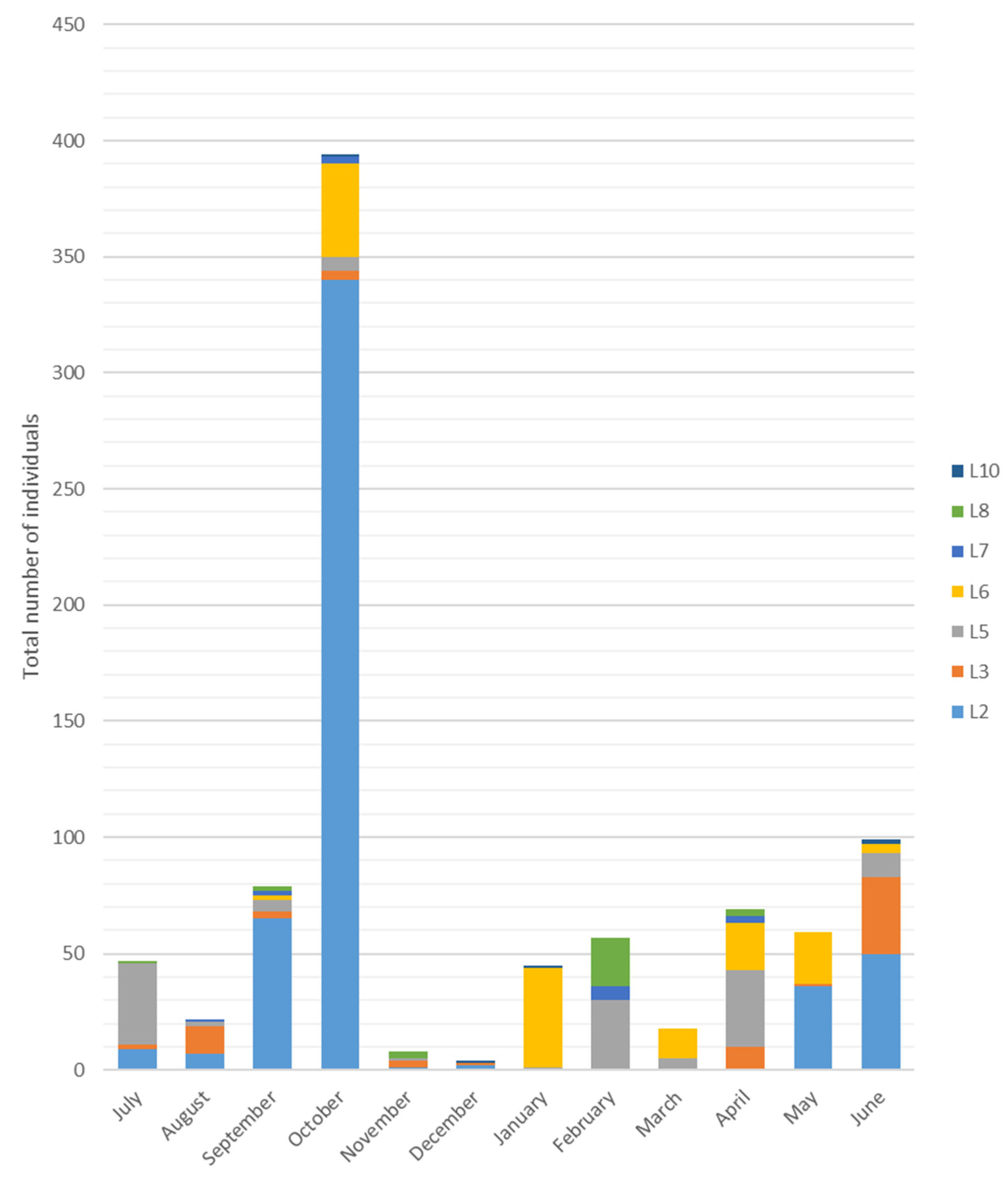
The two samples with the highest ostracod abundances were both collected from the Železara Canal (L2), in September and October, with 65 and 340 individuals per sample, respectively. In both cases, only Bradleycypris vittata and Tanycypris centa were recorded. The September sample comprised 10 individuals of B. vittata and 55 of T. centa, whereas in October, their numbers increased substantially to 200 and 140 individuals, respectively. This pronounced peak in the October sample from L2 is the main reason why the October data, illustrated in Figure 2, stands out clearly from that of the other months.
Figure 2.
Monthly totals of all recorded individuals across the study area, with colors indicating the proportional contribution of each site/sample to the overall count.
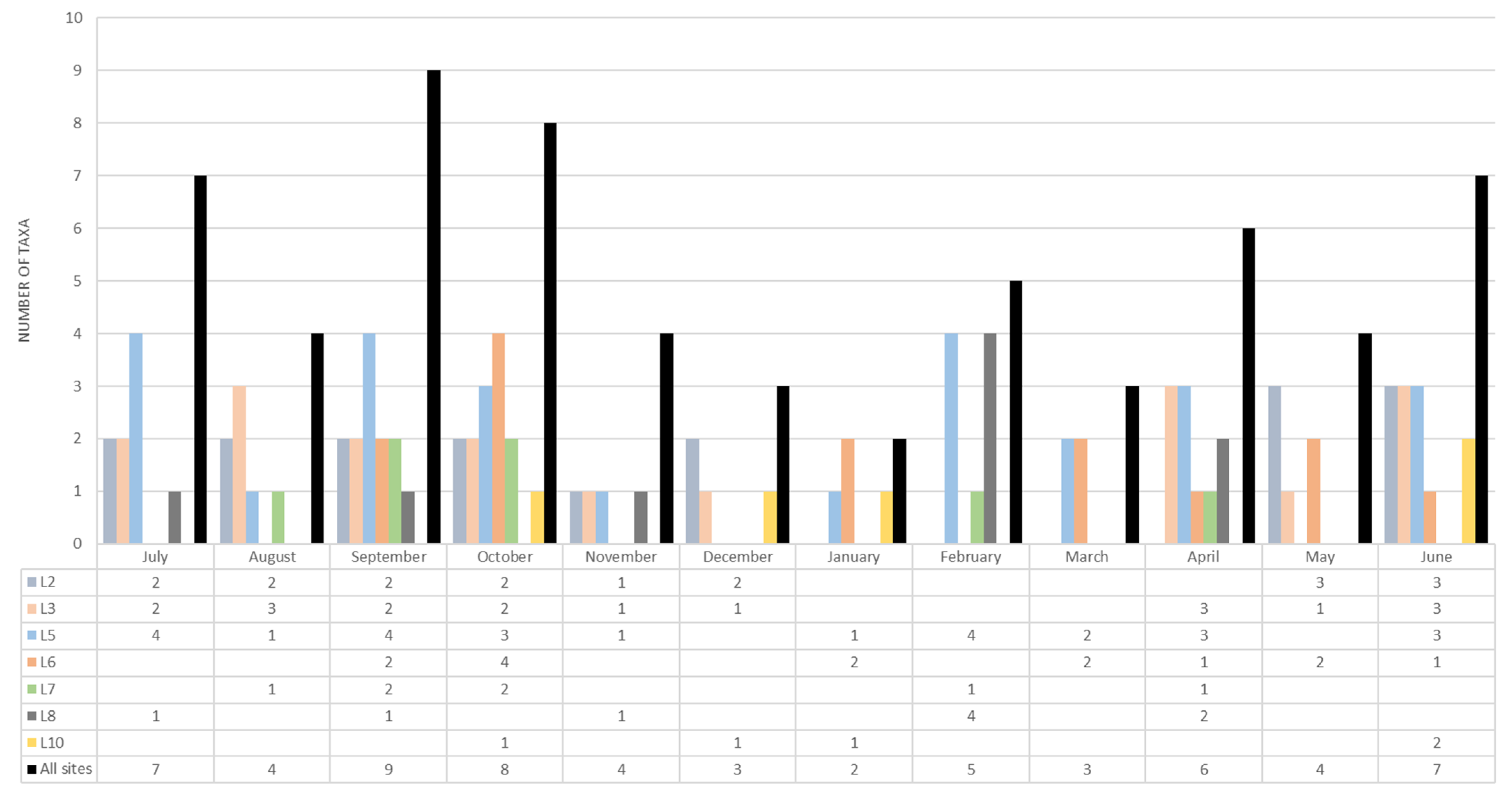
Monthly abundances of individual taxa are presented in Table 4, while Table 5 summarizes, for each site, the monthly species richness and total ostracod abundance. The complete raw species dataset is provided in the Supplementary Materials (Table S1). A graphical representation of the number of recorded taxa by month and site is shown in Figure 3.
Table 4.
Number of recorded specimens of each species by month, across all sampling sites.
Table 5.
The number of recorded taxa (NT) and the total abundance of all taxa (A) by month for each site.
Figure 3.
Number of recorded taxa by month and site.
Notes on Selected Species
All eight species listed below, belonging primarily to the Candonidae family, are recorded for the first time in Serbia in the present study, adding to the national ostracod fauna.
- (a)
- Cypridopsis elongata
This species is known from freshwater habitats across Europe, typically inhabiting ditches, ponds, and lakes with abundant aquatic vegetation. The species is considered to have a wide circum-Mediterranean distribution and is sporadically passively dispersed toward other regions of the Palearctic [25,29]. In the present study, it was recorded only once, at the oxbow lake (L5), and in low abundance. It was found in July, which is consistent with literature reports describing the species as stenochronic, occurring primarily during the summer months [25].
- (b)
- Candona cf. weltneri
Specimens of this taxon were recorded only once, in February, at the Sibnica backwater (L8), and in low abundance. The collected material could be assigned to either C. weltneri or Candona sanociensis Sywula, 1971, two morphologically similar species that are primarily distinguished by characters of the male copulatory organ. As no males were present in the sample, species-level identification based on this key diagnostic feature was not possible. Consequently, the specimens are provisionally referred to as Candona cf. weltneri, as the morphological characteristics of the collected females correspond somewhat more closely to descriptions of C. weltneri than to C. sanociensis in the available literature. In addition, the timing of occurrence and the general distribution patterns reported for C. weltneri are consistent with the present record. However, it should be noted that the morphology, ecology and distribution of C. sanociensis are less documented. According to Meisch [25], C. weltneri inhabits both permanent and temporary small water bodies, particularly swamps and ditches, as well as lakes, occurring mainly in the littoral zone but also in the profundal. It is considered to have a Holarctic distribution [29]. Adults are reported to appear in autumn and gradually disappear during spring, with males maturing and vanishing earlier than females. Regardless of the exact species identity, this record represents a new addition to the ostracod fauna of Serbia. Further sampling at the same locality may clarify the taxonomic status of this population if male specimens are obtained.
- (c)
- Fabaeformiscandona balatonica
This species has been reported from a variety of freshwater habitats across Europe, particularly lakes and ponds, and has a general distribution considered Palearctic [29], possibly Holarctic [25]. It typically prefers shallow temporary pools and swampy, very shallow lake margins that may dry out during summer, but has also been recorded from canals, deeper littoral zones of lakes, and streams [25]. In the present study, the species was recorded in low abundance in February and April at two sites: the oxbow lake (L5) and the Sibnica backwater (L8), both standing eutrophic water bodies in which water levels recede or the habitat may dry out during summer.
- (d)
- Fabaeformiscandona breuili
This taxon is generally associated with freshwater habitats characterized by relatively stable environmental conditions. Available records indicate its occurrence in water flowing from drainage pipes, springs, caves, and interstitial groundwater. The species is considered stygobitic, occasionally occurring in epigean habitats that are connected to underground waters [25]. They are considered to have a Palearctic distribution [29]. Mature females have been reported in late winter and spring. Its ecology and life history remain relatively poorly known [25]. In the present study, it was recorded only once, at the oxbow lake (L5), where a small number of individuals were found during late spring.
- (e)
- Fabaeformiscandona brevicornis
This species has a Palearctic distribution [29], inhabiting stagnant and slow-flowing waters connected to springs and having also been reported from hyporheic habitats of streams [25]. Ecologically, it has been characterized as cold-stenothermal, mesorheophilic, and euryplastic with respect to substrate [25]. Nüchterlein [30] reported collecting the species throughout the year. Known records indicate it is predominantly distributed across Central Europe. Although it is typically associated with cold lentic freshwater habitats, in the present study, it was recorded at the Tamiš River (L7), where it occurred in low abundance in September and October, with only a single specimen collected in each month.
- (f)
- Pseudocandona stagnalis
This species is known from both lentic and lotic freshwater habitats across Europe and has a Holarctic distribution [25,29]. It inhabits bogs, small permanent and temporary woodland or open-field waters, and spring-fed habitats. It is notable for tolerating acidic conditions and is characterized as mesothermophilic, rheotolerant, and oligotitanophilic. The life history of this species remains poorly understood, though records suggest year-round occurrence in permanent habitats [25]. In this study, it was recorded at the oxbow lake (L5) in four samples, from July to November, except in August, and always in low abundance.
- (g)
- Pseudocandona sucki
This is a Palearctic species, distributed across Europe (excluding the south) and central Asia, typically inhabiting standing or slowly flowing freshwater [25,29]. It prefers shallow, swampy, temporary, and well-vegetated small water bodies, including those with peat litter, but also occurs in permanent habitats. Slight salinity increases are tolerated, as shown by records from brackish coastal waters. In samples from Hungary examined by Meisch [25], adults were mainly observed in spring (March–June), classifying the species among early-year forms, which was also the case in a shallow lake in Turkey in a study by Külköylüoğlu et al. [17]. In contrast, in the present study, it was recorded in July, September, and October at the oxbow lake (L5), though always in low numbers.
- (h)
- Paralimnocythere compressa
In Europe, P. compressa has been rarely reported, only from the British Isles [25]. However, additional records from Erzincan in Turkey [31] and Lake Qinghai in China [32] suggest a potentially wider Palearctic distribution despite its rarity. Meisch [25] notes that the species’ life history remains unknown and that it has been recorded exclusively in lakes. In contrast, the Turkish record comes from a stream [33]. As for the present study, it was recorded only once, at the Ponjavica River (L6) in March, occurring in low numbers within a eutrophic habitat characterized by slow-flowing water and a well-developed littoral zone.
3.3. Multivariate and Cluster Analyses of Environmental Gradients and Assemblage Structure
3.3.1. Canonical Correspondence Analysis (CCA)
The Canonical correspondence analysis (CCA) revealed a significant overall relationship between datasets, driven primarily by canonical axes 2–4 rather than the first axis, representing gradients of physical mixing (temperature–turbidity), conductivity, and pH–oxygen conditions, respectively.
Permutation tests (9999 permutations) indicated that axes 2 and 3 were highly significant (axis 2: p = 0.0058; axis 3: p = 0.0006), whereas axis 1 was not (p > 0.1). The overall model was significant, as indicated by the trace test (trace p = 0.0028), supporting the use of environmental variables to explain species distribution patterns.
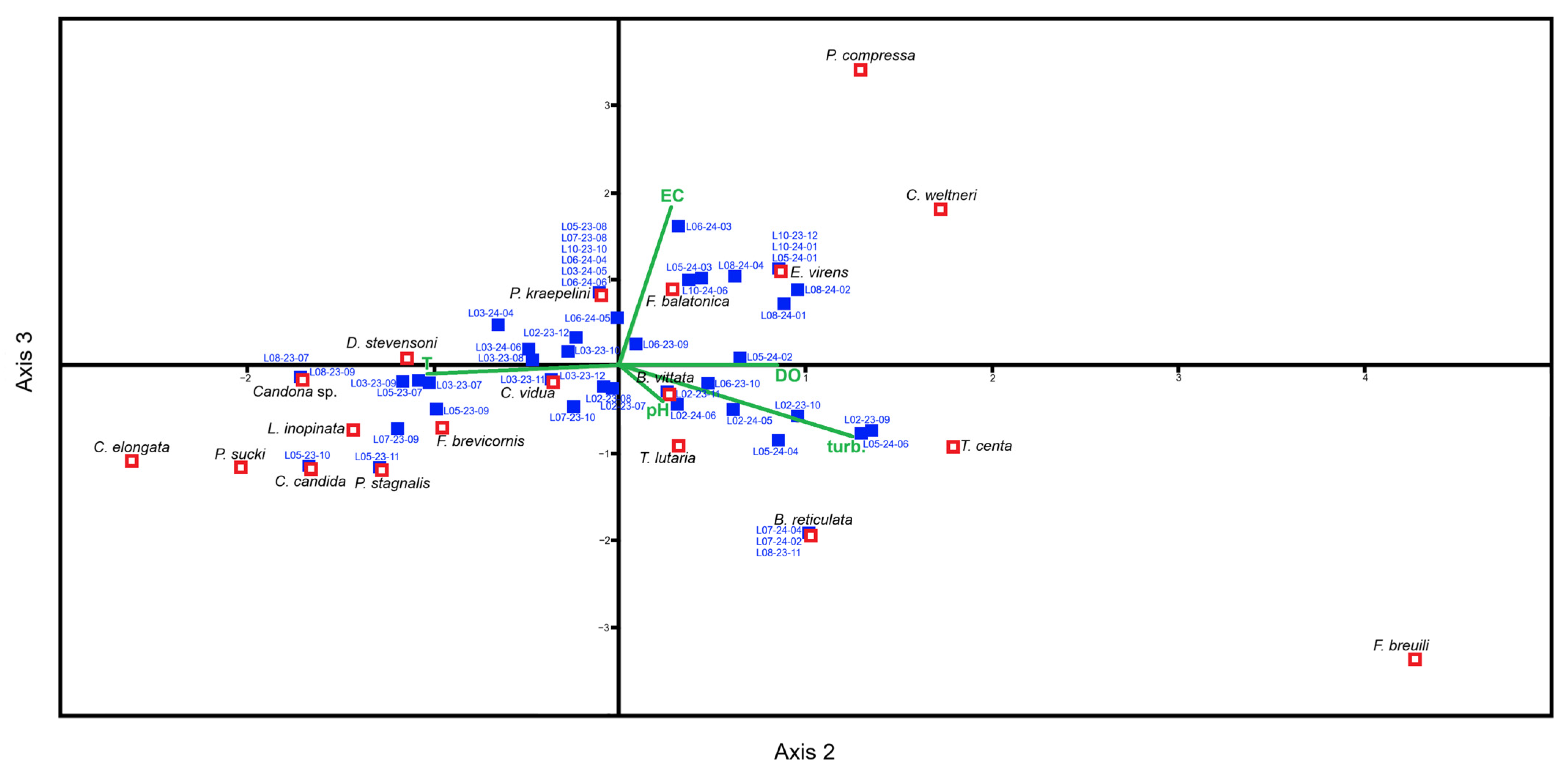
The first four canonical axes accounted for 100% of the constrained inertia, with axis 1 explaining 35.42%, axis 2 29.82%, axis 3 23.06%, and axis 4 11.70% of the constrained variance. Axis 5 contributed negligibly and was therefore excluded from interpretation. Although the first canonical axis explained the largest proportion of constrained inertia, it was not statistically significant (p > 0.1). Therefore, an ordination plot of samples and species constrained by environmental variables (Figure 4) was constructed using axes 2 and 3, which were both significant (p < 0.05) and together accounted for 52.9% of the constrained variance. In terms of total inertia, axes 2 and 3 explained 7.36% (4.15% and 3.21%, respectively). Axis 2 was driven by turbidity (loading = 0.415), water temperature (loading = −0.345) and somewhat by dissolved oxygen (loading = 0.278), representing the physical mixing gradient, while axis 3 was primarily driven by electrical conductivity (loading = 0.607), indicating a strong mineralization gradient.
Figure 4.
Canonical Correspondence Analysis (CCA) ordination plot defined by the second and third canonical axes showing relationships between collected samples (blue squares), ostracod species (red squares) and environmental variables (green vectors), with species/samples positions reflecting their weighted averages along the displayed environmental gradients.
Species scores indicated clear ecological separation among taxa, while sample scores showed partial seasonal structuring rather than strict site clustering. Several samples from late summer and early autumn plotted toward higher turbidity and DO values, while winter and early spring samples tended to occupy the opposite part of the ordination space. This pattern suggests that seasonal environmental variation played a stronger role than site identity alone in shaping assemblage composition.
Correlation coefficients of the measured environmental variables with the first four canonical axes are presented in Table 6, while the statistical summaries of these axes based on the permutation test are given in Table 7. The complete CCA scores for species, samples, and environmental variables for each axis are provided in the Supplementary Materials (Table S2).
Table 6.
Correlation coefficients of environmental variables with the first four CCA axes, with the highest score of each variable bolded.
Table 7.
Statistical summary of the first four canonical axes from CCA based on 9999 permutations (trace: 1.036; trace p: 0.0028) in PAST, with significant p-values (p < 0.05) highlighted in bold.
3.3.2. Cluster Analysis (UPGMA)
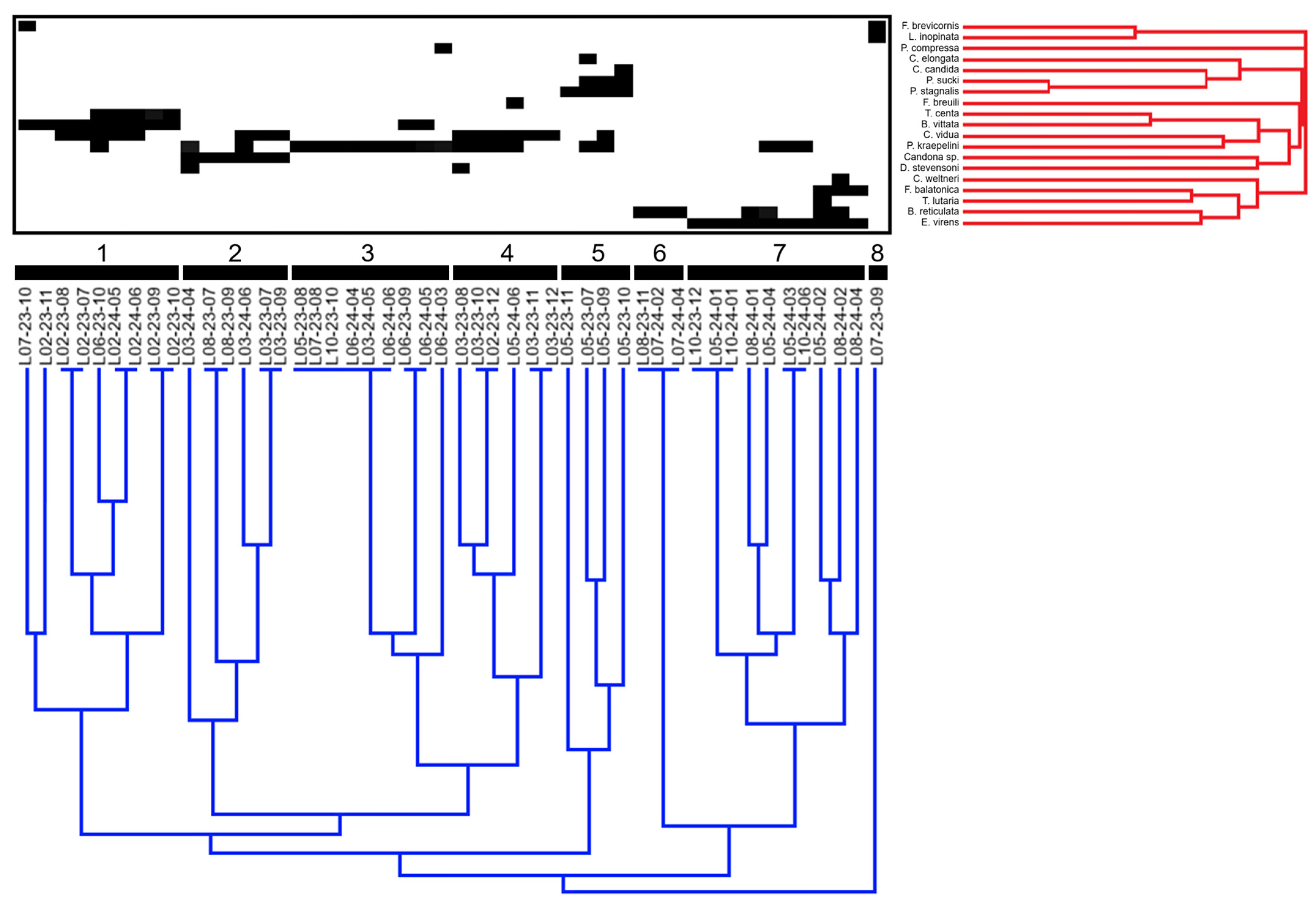
The cluster analysis resolved eight distinct groups, defined by combinations of species composition, season of sampling, and habitat type:
- Samples from two rivers and one canal, collected during all seasons except winter, characterized by the presence of B. vittata.
- Samples from a lake and a backwater, collected almost exclusively during summer, characterized by the presence of an unidentified species of the genus Candona.
- Samples from multiple sites and seasons, characterized by the presence of P. kraepelini and the absence of C. vidua.
- Samples from three sites (L2, L3, and L5), collected in all seasons except spring, characterized by the presence of Cypridopsis vidua.
- All four samples containing P. stagnalis, collected from the oxbow lake during summer and autumn.
- All three samples in which B. reticulata was the only recorded species, collected at sites L7 and L8 during late autumn, winter, and spring.
- All samples in which E. virens was present, originating from three sites (L5, L8, and L10) and collected during winter and spring.
- A single sample collected from the Tamiš River in September, which was the only sample containing L. inopinata.
The sample clustering (Figure 5) showed that samples tended to group primarily according to similarity in species composition, with secondary structuring related to season. Still, samples collected during periods with comparable hydrological and physicochemical conditions frequently clustered together, even when originating from different sites, while samples from the same site but different seasons were often placed in separate clusters, reinforcing the importance of temporal dynamics.
Figure 5.
Two-way UPGMA cluster dendrogram based on Jaccard similarity coefficients, showing hierarchical clustering of ostracod species and samples, with numbers 1–8 indicating the eight main groups.
3.4. Ostracod Watch Model
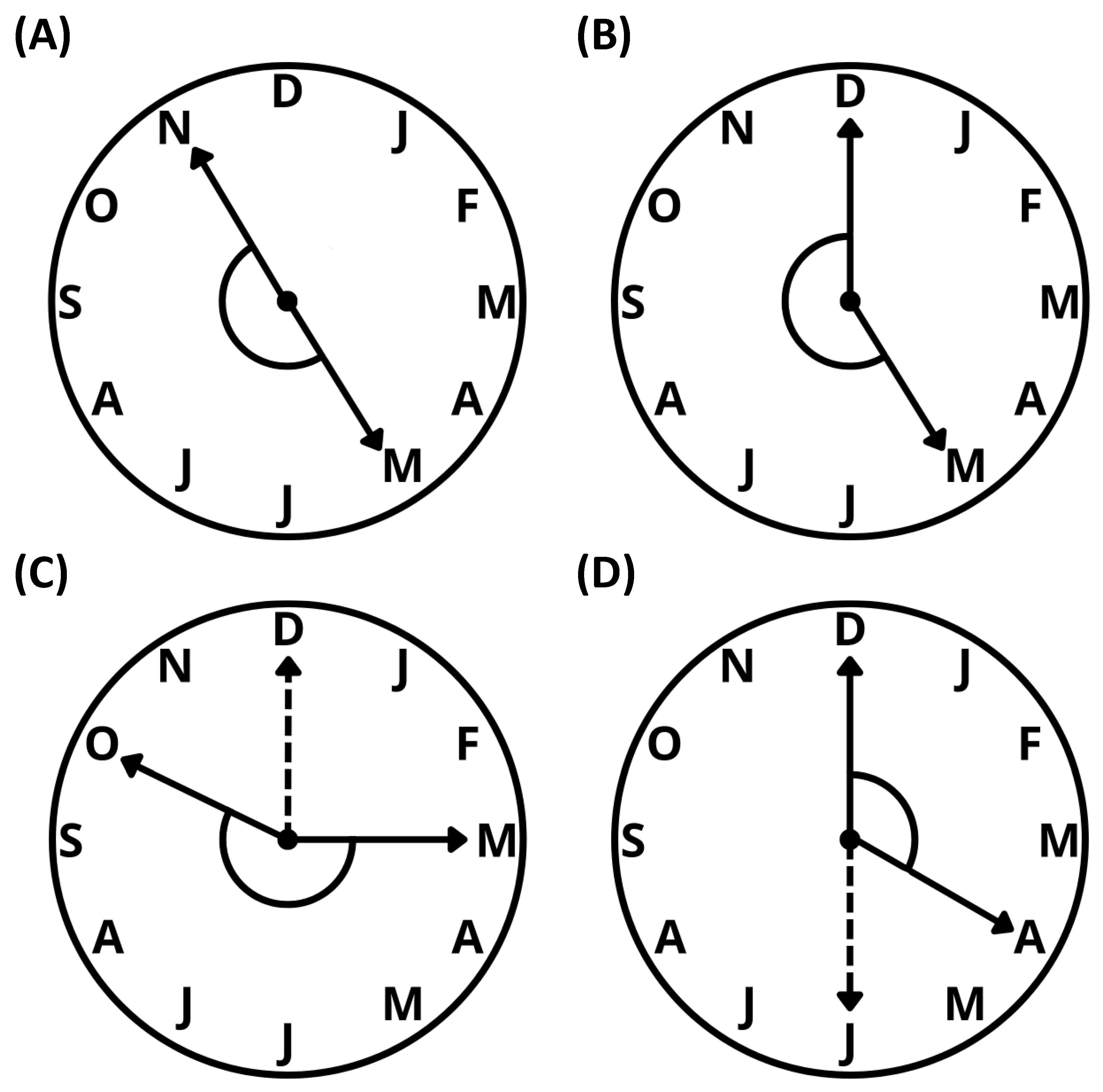
Seasonal occurrence patterns of four selected ostracod species are illustrated using the Ostracod Watch Model (Figure 6). The OWM highlights differences in the continuity and timing of species occurrence throughout the year, reflecting varying degrees of seasonal persistence.
Figure 6.
Ostracod Watch Model (OWM), illustrating their seasonal occurrence patterns of four selected species: (A) Bradleycypris vittata, (B) Cypridopsis vidua, (C) Physocypria kraepelini, and (D) Eucypris virens. Capital letters (J, F, M, …, D) denote the twelve months of the year (January–December). Species occurrence is indicated by arcs drawn between arrows, while dashed arrows show months in which a species was recorded outside a continuous range of occurrence.
Bradleycypris vittata (Figure 6A) showed a relatively restricted seasonal distribution, with occurrences concentrated within a limited and continuous portion of the annual cycle (May–November). Cypridopsis vidua (Figure 6B) displayed a broader temporal range, being recorded across much of the year (May–December), indicating a somewhat more extended period of activity and presence in the studied habitats. The OWM diagram for P. kraepelini (Figure 6C) indicates a mostly continuous pattern of occurrence, with records spanning multiple seasons (March–October), with an additional record outside this continuous range (in December), suggesting year-round presence of the species. Of the four selected species, E. virens (Figure 6D) exhibited the shortest seasonal distribution (December–April); however, an additional record outside this continuous range (in June) suggests that its ecological time window may be wider and last until summer.
4. Discussion
4.1. Environmental Gradients and Spatio-Temporal Distribution
The present study demonstrates that freshwater ostracod assemblages along the Danube riverbanks in the Banat and Podunavlje regions are structured primarily by environmental gradients that vary seasonally, rather than by site identity alone. Despite the geographic proximity of the investigated waterbodies, marked differences in physicochemical conditions resulted in pronounced variation in species composition and abundance. This pattern is consistent with the well-documented sensitivity of ostracods to changes in temperature, oxygen availability, mineralization, and hydrological stability [6], which collectively act as strong habitat filters in floodplain systems.
The absence of ostracods from the Danube main channel (L1 and L9) and the Velika Morava River (L4) is noteworthy and likely reflects a combination of high hydrodynamic disturbance, unstable substrates, and elevated turbidity. Such conditions are generally unfavorable for the establishment of benthic and periphytic ostracod populations, which tend to retreat into sediments or vegetation during periods of elevated flow velocity [34]. Similar, though less pronounced, patterns have been reported from the Danube in Hungary [14], where ostracod assemblages exhibited higher densities and species richness in the plesiopotamal side arms of the Gemenc Floodplain compared to the main river channel. In contrast, results from other systems indicate that this pattern is not universal. For example, a study conducted on the Krąpiel River in Poland [4] found that, although ostracod population densities remained markedly higher in lentic and weakly lotic habitats, ostracods were also present in the main channel, where species richness was unexpectedly higher than in adjacent lentic habitats, floodplain water bodies, or helocrenes.
Although ostracods were absent from most strongly lotic environments in this study, they were consistently present in lentic and weakly lotic habitats characterized by fine substrates, reduced flow, and elevated productivity. The oxbow lake near Kulič (L5) supported the highest species richness, emphasizing the ecological importance of semi-isolated floodplain waterbodies as refugia for ostracod diversity. Such habitats combine relative hydrological stability with periodic connectivity to riverine systems, facilitating colonization while maintaining conditions suitable for species with limited dispersal abilities [15,35].
The recorded coexistence of generalist taxa with more specialized ones underscores the ecological heterogeneity of the investigated waterbodies and highlights the importance of maintaining a mosaic of habitat types within riverine landscapes.
Seasonality emerged as a key driver of ostracod occurrence across the study area. In contrast, Rossetti et al. [36], based on a study of freshwater wetlands in Northern Italy with one sampling event per season, did not detect a clear seasonal signal in community structure. Differences between the two studies likely reflect variation in temporal resolution, with monthly sampling providing a finer-scale view of seasonal dynamics.
Both abundance and species richness varied substantially throughout the year, with clear peaks during late summer, autumn, and early spring, depending on habitat type. The CCA results corroborate this observation, showing that samples tended to group according to seasonal environmental conditions rather than spatial proximity.
Water temperature and turbidity were among the most influential variables shaping assemblage structure. Late summer and early autumn samples were associated with higher temperatures and increased turbidity, likely reflecting enhanced primary production, sediment resuspension, and reduced water levels. In contrast, winter and early spring samples clustered toward lower temperature and turbidity values, conditions under which several cold-adapted and stenothermal taxa were recorded. These findings are consistent with the known life-history strategies of many freshwater ostracods, which often exhibit seasonally restricted periods of activity and reproduction [25].
In addition to temperature and turbidity, dissolved oxygen and electrical conductivity also showed marked monthly variation, particularly at eutrophic sites during warmer periods. Reduced oxygen concentrations, coupled with increased habitat complexity from macrophyte development and occasional blooms, likely promoted taxa tolerant of hypoxic or organically enriched conditions while limiting species preferring well-oxygenated environments. Seasonal shifts in conductivity, reflecting hydrological dynamics and concentration effects during lower water levels, may have further contributed to species turnover. Together, these interacting physicochemical gradients suggest that seasonal restructuring of assemblages results from a combination of life-history dynamics and environmentally mediated niche differentiation, rather than reproductive timing alone. Such results, with the dominant spatio-temporal gradient being driven strongly by temperature and only somewhat by DO, are expected given that all samples were collected within a lowland floodplain and none from water bodies with relatively stable thermal and oxygen regimes (e.g., higher-altitude systems), where DO would likely exert a stronger influence on species distribution. In floodplain habitats, temperature exhibits pronounced seasonal variability, while DO largely fluctuates as a secondary response to these thermal changes [37]. Consequently, species inhabiting such environments are expected to tolerate broad ranges of DO and to be structured primarily along the temperature gradient, which acts as the main seasonal driver of their distribution [38].
The Ostracod Watch Model further illustrated clear interspecific differences in seasonal occurrence patterns of the four selected species. Eurytopic species such as P. kraepelini and C. vidua displayed extended or nearly continuous temporal presence, indicating broad ecological tolerances and the ability to exploit a wide range of conditions. In contrast, taxa such as B. vittata and E. virens exhibited somewhat fragmented or seasonally restricted distributions, reflecting narrower ecological niches and stronger coupling to specific environmental regimes. These patterns reflect differences in temporal ecological windows and are consistent with previously reported seasonal dynamics of the selected taxa [25,39]. The application of the OWM in this study demonstrates its value as a complementary tool for visualizing seasonal patterns and comparing species phenology across habitats. When combined with multivariate analyses, such approaches can provide a more nuanced understanding of temporal dynamics than presence-absence data alone.
The presence of the stygobitic species F. breuili in surface waters further emphasizes the role of hydrological connectivity between epigean and hypogean systems in shaping ostracod assemblages, while the detection of taxa with predominant distribution in western, northern or central parts of Europe, such as P. compressa, suggests that the middle Danube floodplain potentially acts as an important biogeographical corridor, facilitating the dispersal and persistence of ostracod species across regions. Passive dispersal mechanisms, combined with periodic flooding and habitat connectivity, likely contribute to the observed assemblage composition.
The paired site design adopted in this study allowed an explicit evaluation of whether the Danube River functions as a dispersal barrier for ostracods inhabiting ecologically comparable habitats on opposing riverbanks. The results indicate only partial faunal overlap between the two sides of the river. Of the 19 recorded taxa, eight occurred on both banks of the Danube (B. vittata, B. reticulata, C. vidua, E. virens, P. kraepelini, T. centa, Candona sp., and F. balatonica), while only five of these were shared consistently between paired sites representing similar habitat types (B. reticulata, C. vidua, E. virens, P. kraepelini, and F. balatonica). This pattern suggests that, although the Danube floodplain potentially acts as a corridor for species dispersal, the Danube itself, while not constituting an absolute barrier to ostracod dispersal, likely represents a meaningful physical and ecological boundary that restricts the exchange of species between floodplain habitats. Notably, the taxa occurring on both sides are predominantly widespread, ecologically tolerant, or generalist species, whereas taxa with more specific habitat requirements tended to be confined to one riverbank. These findings support the interpretation that large lowland rivers such as the Danube can selectively filter dispersal, favoring species with broader ecological amplitudes and higher dispersal potential while limiting the establishment of more specialized taxa across the river corridor.
4.2. Recorded Diversity and Comparison to Previous Studies
A particularly important outcome of this study is the documentation of eight new ostracod species for the Serbian fauna. Most of these taxa belong to the family Candonidae, a group that is often underrepresented in faunistic surveys due to taxonomic difficulties and their frequent association with interstitial or seasonally inaccessible habitats [40].
The investigated area is situated within two parts of Serbia, in both of which studies on ostracod diversity have previously been conducted. Banat was the main focus of a regional ostracod diversity study in which samples from localities across the region were collected during spring, summer, and autumn of 2002 and 2003 [11]. It overlaps with the present study at only a single site, the Sebeš Canal (L10), where only P. kraepelini was recorded previously. The same species was also found at this locality during the present study, but with the additional presence of E. virens. Podunavlje, as part of Central Serbia, was included in a more recent study that surveyed ostracod assemblages at numerous sites during the summer of 2021 [12]. It overlaps with two localities examined also in the present study: the Železara Canal (L2) and the Šalinac Lake (L3). At L2, the same two species recorded previously (B. vittata and C. vidua) were again found, along with two additional taxa (T. centa and P. kraepelini). At L3, the species recorded earlier (C. vidua and D. stevensoni) were also present, accompanied by two additional taxa (P. kraepelini and an unidentified species of the genus Candona). The increased diversity recorded at these three sites compared to earlier studies highlights the advantages of surveys that encompass not only multiple seasons but also consecutive months throughout the year.
In the Banat-focused study [11], two additional species, Cypria ophthalmica (Jurine, 1820) and Cyclocypris laevis (O.F. Müller, 1776) Sars 1890, were recorded at a slow-flowing waterbody located between Pančevo and Dolovo, in relatively close proximity (~15 km) to two sites examined in the present study (L6 and L7). Given the distance, habitat similarity, lack of any major physical barriers, and the generally broad distribution of these species [29], it is reasonable to assume that they may also occur at one or more of the investigated localities, or in nearby waterbodies, particularly along the left bank of the Danube, despite not being recorded during the present survey. In the mentioned Banat study [11], the species T. centa was recorded in Serbia for the first time, but was misidentified as Tanycypris pellucida (Klie, 1932) Victor & Fernando 1981.
With a total of 19 recorded taxa, eight of which represent new records for the Serbian fauna, this study further demonstrates that ostracod diversity at both regional and national scales remains insufficiently explored.
4.3. Interpretation of the Gathered Ecological Data on Recorded Species
The CCA results indicate that ostracod assemblages are primarily structured along seasonal environmental gradients, especially water temperature, turbidity, and EC, with DO playing a secondary role. While some species show clear associations with specific ranges of these variables, many occupy central positions in the ordination space, indicating broader ecological tolerance. The UPGMA cluster analysis grouped samples primarily based on species composition, but with a strong secondary influence of seasonal occurrence, supporting the findings of the CCA. Together, these analyses provide the basis for the following species-specific ecological interpretations.
Several of the recorded species (B. vittata, C. vidua, P. kraepelini, T. lutaria, F. balatonica and F. brevicornis) were positioned close to the center of the CCA ordination, indicating relatively broad ecological tolerances with respect to the measured environmental parameters. Such a placement suggests a generalist ecological strategy, which is consistent with the well-documented ecology of the cosmopolitan C. vidua, as well as the widely distributed B. vittata and P. kraepelini [25,29,41]. Results of the cluster analysis further supported the euryvalent nature of C. vidua and P. kraepelini, while also indicating that B. vittata shows a preference for moderate to higher water temperatures and is absent during winter months.
Tonnacypris lutaria was recorded only once, in a February sample from the oxbow lake at L5. Its position near the center of the CCA plot likely reflects the combination of low values of both temperature and turbidity, together with moderately low EC values (~50 µS/cm). According to the literature, T. lutaria is a characteristic inhabitant of grassy seasonal pools and ditches in open landscapes that dry up in late spring or early summer, where it often co-occurs with E. virens, with larvae typically appearing in March and maturing within five to six weeks, after which adults soon disappear, ranking the species among early-year forms [25]. This description fully agrees with the situation observed in the present study, as the sample was collected in late February from an oxbow lake characterized by large seasonal water-level fluctuations, flooding adjacent open fields during winter and receding in late spring or early summer. The simultaneous presence of Eucypris virens in the same sample further supports this interpretation.
Fabaeformiscandona balatonica was recorded at the same oxbow lake (L5) in February, and additionally at the Sibnica backwater (L8) in February and April. Based on the measured environmental parameters, the species exhibited a broad tolerance to water temperature (8.2–27.6 °C), turbidity (8–84 mg/L) and EC (50–92 µS/cm). This ecological flexibility is consistent with its generalist position in the ordination. In the literature, F. balatonica is reported to prefer shallow temporary pools and swampy, very shallow zones of lakes that dry out in summer, with sexual maturity reached in spring (March–April) [25], which corresponds well with the observed timing and habitat characteristics in this study.
Fabaeformiscandona brevicornis was recorded at the Tamiš River (L7) in September and October, with only one individual found in each month. Based on local environmental conditions, the species appeared to occur at moderate temperatures (21.4 °C in September and 16.2 °C in October), moderately alkaline pH (~8), low to moderate DO (~4–7 mg/L), moderately low EC (~55–60 µS/cm), and moderate turbidity (~20–30 mg/L). However, F. brevicornis is described in the literature as a hyporheic, cold-stenothermal species inhabiting slow-flowing waters [25], which contrasts with its occurrence in a river channel during late summer and autumn. It is therefore likely that the recorded individuals originated from hyporheic habitats connected to the river, which would also explain their very low abundance.
Bradleystrandesia reticulata, recorded at sites L5, L7, and L8, exhibited a relatively broad tolerance with respect to habitat type (an oxbow lake, a lowland river and a backwater habitat). Its position on the CCA plot (positive along Axis 2 and negative along Axis 3) corresponds well with its seasonal occurrence, as it was recorded in November, January, February, and April, when water temperatures were low to moderate (with a minimum of 2.8 °C at L8 in January). Although the species was present at L8 during colder months, it was absent there in April when water temperature rose sharply (27.6 °C), while remaining present at L5 and L7, where temperatures were still moderate. The species also showed a wide tolerance to EC, occurring in February both at L7 (24 µS/cm) and L8 (92 µS/cm). UPGMA results further indicated that seasonality, particularly change in water temperature, represents the primary factor structuring the spatial and temporal distribution of this species. These findings support the interpretation of B. reticulata as euryvalent with respect to most environmental parameters, aside from a clear preference for winter and early spring conditions. This is largely consistent with literature descriptions of the species as mesothermophilic and a stenochronic early-year form [25], although its presence already in November contrasts with reports suggesting that adults disappear soon after egg laying, which takes place from late May to June, and that larval hatching begins exclusively in spring [25].
Eucypris virens exhibited a similarly broad ecological tolerance, as indicated by both CCA and cluster analyses. Across its records, the species tolerated wide ranges of pH (6.2–8.2), DO (0.5–11.6 mg/L), EC (43–159 µS/cm), and turbidity (6–206 mg/L). Despite being recorded in waters with a wide range of temperatures (2.8–27.6 °C), it showed a clear preference for lower to moderate values of this parameter, corresponding to winter and spring. It was recorded at sites L5, L8, and L10, in standing or weakly flowing waters, with the highest abundance observed at L8 in January (42 individuals in the collected sample). This pattern aligns well with literature descriptions of E. virens as a stenochronic early-year species preferring grassy pools and ditches that dry up in late spring or summer [25].
Tanycypris centa was positioned in the positive part of Axis 2 and the negative part of Axis 3 on the CCA plot, but did not show a strong association with the EC gradient, occurring across a wide EC range (40–139 µS/cm). The species was recorded from September to November and in May, suggesting limited tolerance to both summer extremes and lower temperatures in winter. Water temperatures at the time of sampling ranged from 17.9 °C to 25.6 °C. Its placement along Axis 2 likely reflects the extremely high turbidity values measured in September and October samples (355 mg/L and 509 mg/L, respectively), rather than temperature alone. Based on habitat characteristics and environmental conditions, T. centa appears to prefer slow-flowing waters such as canals and small lowland rivers with high eutrophication levels, occurring during periods of moderate water temperatures (~20 °C). Notably, the species reached very high abundance at L2 in October, with 140 individuals found in the sample, coinciding with a sharp increase in B. vittata abundance (200 individuals) in the same sample. At the time of sampling, the site was characterized by moderate water temperature (17.9 °C), moderately alkaline pH (8.0), and moderately low DO and EC values (5.9 mg/L and 55 µS/cm, respectively), similar to the measured conditions at the site in some other months, but with an exceptionally high turbidity (509 mg/L). The observed abundance pattern suggests potentially similar environmental optima for these species, and the values of measured parameters could suggest that turbidity, either directly or through associated environmental processes, may play an important role in shaping the distribution and life-history patterns of the two species. This interpretation is further supported by the cluster analysis, which separated a distinct group composed exclusively of these two species, as well as by their co-occurrence at an additional site (L6) located on the opposite bank of the Danube. It should be noted that B. vittata was recorded in all five samples in which T. centa occurred, collected at sites L2 and L6, whereas B. vittata was also present in six additional samples in the absence of T. centa, including one from site L7. This pattern suggests that B. vittata exhibits a broader ecological tolerance than T. centa. However, the two species may nonetheless share similar ecological optima, because although B. vittata could be considered more of a generalist than T. centa, recent records of T. centa from highly artificial habitats, such as the Botanical Garden in Munich [42], point to a potentially notable degree of ecological plasticity in this species as well.
Cypridopsis elongata, Candona candida, Pseudocandona stagnalis and Pseudocandona sucki were all recorded exclusively at the oxbow lake (L5), in one or more samples collected between July and November, depending on the species, and always in low abundance (1–4 individuals). Environmental parameters during this period were relatively stable, with neutral to moderately alkaline pH, moderately high temperatures (>20 °C), except in November (8 °C), low DO (0.5–4.1 mg/L), moderately low EC (43–53 µS/cm), and low-to-moderate turbidity (4–57 mg/L). This stability likely facilitated the grouping of these species in both CCA and cluster analyses. Their distribution along the temperature–turbidity gradient suggests a preference for warm, weakly turbid, oxygen-poor standing waters during summer and autumn. The literature data [25] for C. elongata, C. candida and P. stagnalis generally agree with the observed timing and habitat conditions, while P. sucki, described as an early-year form, occurring mainly in spring and until late June, appeared later in the season in this study (July–October), suggesting a potentially broader adult occurrence period than previously assumed, or the existence of a summer/autumnal form.
Limnocythere inopinata was positioned in the negative part of both CCA axes, reflecting its occurrence in a single sample collected in September at site L7, represented by only one individual. At the time of sampling, water temperature and turbidity were moderate (21.4 °C and 32 mg/L, respectively), pH was moderately alkaline (8), EC was moderately low (57 µS/cm), while DO was low (4.1 mg/L). These environmental conditions explain its placement along the temperature–turbidity gradient (Axis 2), while its proximity to the center of the conductivity gradient (Axis 3) indicates a weak association with it. The limited number of records prevents a robust ecological characterization, but the observed conditions suggest that L. inopinata can occur in moderately warm, oxygen-poor and moderately turbid waters during late summer or early autumn, which is consistent with literature data describing L. inopinata as a polythermophilic species [19] of broad ecological tolerance, with both adults and juveniles reported to occur throughout the year, and having been documented from a wide range of lentic and lotic freshwater habitats, including rivers [25]. Its sporadic occurrence and low abundance in the studied area are therefore more likely related to local habitat structure and sampling stochasticity rather than narrow ecological requirements.
Candona cf. weltneri was recorded at L8 in February, with four individuals. This occurrence is consistent with the literature reports describing autumn appearance and progressive disappearance of C. welneri during spring [25]. Elevated EC values (92 µS/cm) positioned the species high along the conductivity gradient, while low temperature (8.2 °C) and relatively high DO (10.2 mg/L) placed it in the positive part of Axis 2 despite low turbidity (8 mg/L). From the habitat features and recorded environmental data, it could be speculated that this species prefers standing waters periodically supplied by nearby river systems, and subject to seasonal desiccation. This inference is consistent with the available literature data on C. weltneri, stating that the species has been reported from lakes, ponds, and both permanent and temporary small water bodies, particularly swamps and ditches [25].
Fabaeformiscandona breuili was the most isolated taxon on the CCA ordination, positioned high along the positive portion of Axis 2 and low along the negative portion of Axis 3. This distinct placement is largely a consequence of its very limited occurrence, as the species was recorded only once, in early June at the oxbow lake (L5), represented by three individuals. The site is characterized by shallow, stagnant, and highly turbid water with pronounced seasonal fluctuations and near-anoxic conditions during warmer periods. The position of this species on the CCA ordination primarily reflects the environmental conditions measured at the time of sampling rather than a well-defined ecological preference derived from multiple observations. During sampling, water temperature was exceptionally high (31.3 °C), while turbidity reached 623 mg/L, the second-highest value recorded during the entire study. The position of F. breuili along Axis 2 does not correspond strongly to temperature, but instead appears to be driven mainly by the extremely high turbidity, which loads in opposition to temperature along the combined gradient. Its low placement along Axis 3 is readily explained by the moderately low EC (47 µS/cm), the primary factor structuring this axis. Given the single record and low abundance, firm conclusions regarding the ecology of F. breuili cannot be drawn from the present data alone. Nevertheless, based on the environmental context of its occurrence, it can be tentatively suggested that the species is capable of tolerating, and possibly favoring, shallow lentic habitats characterized by strong seasonal variability, high summer temperatures, moderately low conductivity, and periodic oxygen depletion. The oxbow lake where it was recorded is likely hydraulically connected to interstitial or groundwater systems, which may provide refugial conditions during unfavorable surface-water phases. This interpretation is broadly consistent with the sparse information available in the literature, stating that the species is considered stygobitic, occasionally persisting in epigean habitats connected to underground waters [25]. Its occurrence in early June in the present study falls close to the known temporal window of adult presence (February–May). The rarity of records and low abundance observed here support the hypothesis that surface-water records represent transient or opportunistic emergence from subterranean refugia rather than stable populations.
Paralimnocythere compressa was also recorded only once, in March at site L6, and its distinct position on the CCA plot reflects the high EC measured at that time (125 µS/cm), together with relatively low temperature and low turbidity. Ecological interpretation is limited by the low number of individuals, but the species appears to tolerate, or possibly prefer, conditions characterized by elevated conductivity and cooler water. Although relatively scarce, previous records of P. compressa are almost exclusively found in lakes [25,32], making its occurrence in the Ponjavica River particularly notable. However, the sampled section of this river does exhibit characteristics more similar to a small eutrophic lake or pond.
Darwinula stevensoni, described in the literature as a cosmopolitan and thermoeuryplastic species, was recorded only twice (April and August) at Šalinac Lake (L3). Its position on the CCA plot reflects high water temperatures and low turbidity at the time of sampling. Although the species is known to occur year-round in a wide range of lentic and weakly lotic habitats [25], its low frequency in this study likely reflects local habitat conditions rather than narrow ecological tolerance. The low frequency and abundance of D. stevensoni in the present study may also be influenced by sampling depth. McGregor [43] reported the species to occur at depths with a range of 0–12 m, with maximum densities observed at approximately 6 m. In contrast, sampling in the present study was restricted to shallow littoral zones, with a maximum depth of approximately 0.3–0.4 m. This methodological limitation likely reduced the probability of encountering D. stevensoni, particularly if local populations are concentrated in deeper parts of the waterbody. Thus, its rare occurrence in the samples is more plausibly attributed to habitat use and sampling constraints rather than true scarcity or unsuitable environmental conditions at the site.
The unidentified Candona species showed broad tolerance to most measured environmental factors but a clear preference for warmer seasons. It was recorded at L3 and L8 during April, June, July and September, under moderate or high temperatures (19–30.7 °C), neutral to strongly alkaline pH (7–8.5), widely variable DO (1–15.1 mg/L), moderately low to moderate EC (45–71 µS/cm) and variable turbidity (4–117 mg/L). Its CCA position reflects a weak association with EC and a stronger association with higher temperatures, overall suggesting a preference for summer conditions in standing waters.
5. Conclusions
The present study provides a seasonally resolved assessment of freshwater ostracod assemblages from a range of waterbodies along the Danube floodplain in the Banat and Podunavlje regions of Serbia. The results indicate that ostracod distribution in the studied area is shaped primarily by seasonal environmental gradients, rather than by spatial proximity or waterbody type alone. Among the measured environmental factors, water temperature, turbidity, and electrical conductivity emerged as the main determinants of the spatio-temporal distribution of recorded species across the investigated habitats, with dissolved oxygen and pH having a secondary influence.
Lentic and weakly flowing floodplain waterbodies supported the highest ostracod diversity, underscoring their role as important reservoirs of regional biodiversity. In contrast, large river channels characterized by strong hydrodynamic disturbance were largely devoid of ostracods. Seasonal turnover was pronounced, with several taxa showing distinct temporal windows of occurrence, reflecting differences in life-history strategies and ecological tolerances.
In total, 19 ostracod taxa belonging to four families and thirteen genera were recorded. Eight of these species represent new records for the Serbian fauna, highlighting the still fragmentary state of knowledge regarding ostracods in the region and emphasizing the need for continued faunistic and ecological investigations. The occurrence of stygobitic and otherwise rare taxa further points to complex ecological connections between surface and subsurface waters within the Danube floodplain, and suggests its important role as a corridor, facilitating the dispersal of ostracod species across European regions. However, the findings of this study also show that the Danube River acts as a partial dispersal barrier for freshwater ostracods, with faunal exchange between opposing banks largely restricted to widespread and ecologically tolerant species, while taxa with narrower habitat requirements remain more spatially constrained.
The strong influence of seasonal environmental variation on ostracod assemblages could have important implications for the potential use of freshwater ostracods in biomonitoring and ecological assessment, highlighting the need for more extensive and detailed ecological studies of this group. Single-season surveys are unlikely to capture the full diversity of ostracod communities, particularly in dynamic floodplain systems. Long-term and seasonally resolved sampling designs are therefore essential for accurately assessing species composition and ecological status.
Overall, these findings provide baseline data for future comparative studies and contribute new ecological information on the recorded species, thereby increasing their potential applicability as bioindicators in condition assessments of freshwater habitats. By integrating faunistic data with environmental analyses and a seasonal perspective, this study advances the understanding of ostracod ecology in one of Europe’s major river systems and reinforces the importance of floodplain habitats in maintaining freshwater biodiversity.
Supplementary Materials
The following supporting information can be downloaded at: https://www.mdpi.com/article/10.3390/ecologies7010028/s1, Table S1: Environmental parameters and number of specimens recorded for each collected sample; Table S2: Canonical Correspondence Analysis (CCA) scores for species, samples, and environmental variables across each axis generated in PAST, with the highest score for each species, sample, or environmental factor highlighted in bold.
Author Contributions
Conceptualization, J.P. and T.K.-Ž.; methodology, J.P. and T.K.-Ž.; software, J.P.; validation, T.K.-Ž.; formal analysis, J.P.; investigation, J.P.; resources, J.P. and T.K.-Ž.; data curation, J.P.; writing—original draft preparation, J.P. and T.K.-Ž.; writing—review and editing, J.P. and T.K.-Ž.; visualization, J.P.; supervision, T.K.-Ž.; project administration, J.P. and T.K.-Ž.; funding acquisition, T.K.-Ž. All authors have read and agreed to the published version of the manuscript.
Funding
This research was funded by the Ministry of Education, Science and Technological development (Grant Numbers: 451-03-34/2026-03/200178 and 451-03-33/2026-03/200178).
Institutional Review Board Statement
Not applicable.
Informed Consent Statement
Not applicable.
Data Availability Statement
Data is contained within the article or Supplementary Material.
Acknowledgments
The authors sincerely thank all their colleagues, friends and family members who have helped with this study. Special thanks go to Nevena Batinić Pokrajac for her unreserved assistance throughout all fieldwork activities.
Conflicts of Interest
The authors declare no conflicts of interest.
References
- Mesquita-Joanes, F.; Smith, A.J.; Viehberg, F.A. The ecology of Ostracoda across levels of biological organisation from individual to ecosystem: A review of recent developments and future potential. Dev. Quat. Sci. 2012, 17, 15–35. [Google Scholar]
- Smith, A.J.; Horne, D.J.; Martens, K.; Schön, I. Class Ostracoda. In Thorp and Covich’s Freshwater Invertebrates, 4th ed.; Thorp, J.H., Rogers, D.C., Eds.; Ecology and General Biology; Academic Press: San Diego, CA, USA, 2015; Volume 1, pp. 757–777. [Google Scholar]
- de Campos, R.; Conceição, E.D.O.D.; Martens, K.; Higuti, J. Extreme drought periods can change spatial effects on periphytic ostracod metacommunities in river-floodplain ecosystems. Hydrobiologia 2019, 828, 369–381. [Google Scholar] [CrossRef]
- Szlauer-Łukaszewska, A.; Pešić, V. Habitat factors differentiating the occurrence of Ostracoda (Crustacea) in the floodplain of a small lowland River Krąpiel (NW Poland). Knowl. Manag. Aquat. Ecosyst. 2020, 421, 23. [Google Scholar] [CrossRef]
- Martens, K.; Schön, I.; Meisch, C.; Horne, D.J. Global diversity of ostracods (Ostracoda, Crustacea) in freshwater. Hydrobiologia 2008, 595, 185–193. [Google Scholar] [CrossRef]
- McCormack, J.; Viehberg, F.; Akdemir, D.; Immenhauser, A.; Kwiecien, O. Ostracods as ecological and isotopic indicators of lake water salinity changes: The Lake Van example. Biogeosciences 2019, 16, 2095–2114. [Google Scholar] [CrossRef]
- Tan, C.W.J.; Gouramanis, C.; Pham, T.D.; Hoang, D.Q.; Switzer, A.D. Ostracods as pollution indicators in Lap An Lagoon, central Vietnam. Environ. Pollut. 2021, 278, 116762. [Google Scholar] [CrossRef]
- Schmitz, O.; Alivernini, M.; Yasuhara, M.; Frenzel, P. Ostracoda (Crustacea) as indicators of anthropogenic impacts–A review. Earth-Sci. Rev. 2025, 263, 105049. [Google Scholar] [CrossRef]
- Tubić, B.P.; Simić, V.M.; Zorić, K.S.; Gačić, Z.M.; Atanacković, A.D.; Csányi, B.J.; Paunović, M.M. Stream section types of the Danube River in Serbia according to the distribution of macroinvertebrates. Biologia 2013, 68, 294–302. [Google Scholar] [CrossRef]
- Karan-Žnidaršič, T.; Nikolić, V.; Simić, G.S.; Petrov, B. The Occurrence of Epibionts and Endobionts of Ostracoda (Crustacea) in some parts of the Danube basin in Serbia. In Proceedings of the 36th International Conference of IAD, Vienna, Austria, 4–8 September 2006; pp. 246–249. [Google Scholar]
- Karan-Žnidaršič, T.; Petrov, B. Non-marine ostracoda (Crustacea) of Banat district in Serbia. Hydrobiologia 2007, 585, 57–66. [Google Scholar] [CrossRef]
- Pokrajac, J.; Stojanović, K.; Stamenković, S.; Karan-Žnidaršič, T. Diversity and ecology of freshwater Ostracoda (Crustacea) in Central Serbia. Aquat. Ecol. 2024, 58, 617–640. [Google Scholar] [CrossRef]
- Szlauer-Łukaszewska, A. The dynamics of seasonal ostracod density in groyne fields of the Oder River (Poland). J. Limnol. 2014, 73, 298–311. [Google Scholar] [CrossRef]
- Kiss, A.; Ágoston-Szabó, E.; Dinka, M.; Schöll, K.; Berczik, Á. Microcrustacean (Cladocera, Copepoda, Ostracoda) diversity in three side arms in the Gemenc Floodplain (Danube River, Hungary) in different hydrological situations. Acta Zool. Bulg. 2014, 7, 135–141. [Google Scholar]
- Pereira, L.C.; Lansac-Tôha, F.A.; Martens, K.; Higuti, J. Biodiversity of ostracod communities (Crustacea, Ostracoda) in a tropical floodplain. Inland Waters 2017, 7, 323–332. [Google Scholar] [CrossRef]
- Ruiz-Jiménez, J.A.; Cohuo-Duran, S.; Criales-Hernandez, M.I. Effect of the flood pulse on the ostracod assemblage (Ostracoda: Podocopida) in microenvironments in the Ciénaga Río Viejo, Colombia. Rev. Biol. Trop. 2023, 71, e52779. [Google Scholar]
- Külköylüoğlu, O.; Sarı, N.; Dügel, M.; Dere, Ş.; Dalkıran, N.; Aygen, C.; Dincer, S.C. Effects of limnoecological changes on the Ostracoda (Crustacea) community in a shallow lake (Lake Cubuk, Turkey). Limnologica 2014, 46, 99–108. [Google Scholar] [CrossRef]
- Lorenschat, J.; Pérez, L.; Correa-Metrio, A.; Brenner, M.; Von Bramann, U.; Schwalb, A. Diversity and spatial distribution of extant freshwater ostracodes (Crustacea) in ancient Lake Ohrid (Macedonia/Albania). Diversity 2014, 6, 524–550. [Google Scholar] [CrossRef]
- Hoehle, M.; Wrozyna, C. Spatio-temporal distribution of ostracod species in saline inland lakes (Mansfeld lake area; Central Germany). PeerJ 2022, 10, e13668. [Google Scholar] [CrossRef]
- Castillo-Escrivà, A.; Rueda, J.; Zamora, L.; Hernández, R.; del Moral, M.; Mesquita-Joanes, F. The role of watercourse versus overland dispersal and niche effects on ostracod distribution in Mediterranean streams (eastern Iberian Peninsula). Acta Oecologica 2016, 73, 1–9. [Google Scholar] [CrossRef]
- Rossi, V.; Albini, D.; Benassi, G.; Menozzi, P. To rest in hydration: Hatching phenology of resting eggs of Heterocypris incongruens (Crustacea: Ostracoda). Fundam. Appl. Limnol. Arch. Hydrobiol. 2012, 181, 49–58. [Google Scholar] [CrossRef]
- Pokrajac, J.; Karan-Žnidaršič, T. Initial Checklist of Extant Non-Marine Ostracods in Serbia. In Proceedings of the 10th European Ostracodologists’ Meeting, Catania, Italy, 16–20 September 2024. [Google Scholar]
- Kulkoyluoglu, O. Freshwater Ostracoda (Crustacea) and their quarterly occurrence in Samlar lake (Istanbul, Turkey). Limnologica 1998, 28, 229–235. [Google Scholar]
- Külköylüoğlu, O.; Yağcı, A.; Erbatur, İ.; Yağcı, M.A.; Bulut, C.; Çınar, Ş. Effects of water quality changes on the Ostracoda (Crustacea) species diversity and seasonal occurrence patterns in Lake Eğirdir (Isparta, Turkey). Biologia 2023, 78, 755–769. [Google Scholar] [CrossRef]
- Meisch, C. Crustacea: Ostracoda. In Süßwasserfauna von Mitteleuropa; Spektrum Akademischer Verlag GmbH: Heidelberg/Berlin, Germany, 2000; Volume 8. [Google Scholar]
- Karanovic, I. Recent Freshwater Ostracods of the World: Crustacea, Ostracoda, Podocopida; Springer Science & Business Media: Berlin/Heidelberg, Germany, 2012. [Google Scholar]
- Legendre, P.; Gallagher, E.D. Ecologically meaningful transformations for ordination of species data. Oecologia 2001, 129, 271–280. [Google Scholar] [CrossRef]
- Hammer, Ø. PAST—Paleontological Statistics, version 4.13. Reference Manual. Natural History Museum, University of Oslo: Oslo, Norwey, 2023.
- Meisch, C.; Smith, R.J.; Martens, K. An updated subjective global checklist of the extant non-marine Ostracoda (Crustacea). Eur. J. Taxon. 2024, 974, 1–144. [Google Scholar] [CrossRef]
- Nüchterlein, H. Freshwater Ostracods from Franconia: A contribution to the knowledge of systematic and ecology of ostracoda. Int. Rev. Ges. Hydrobiol. 1969, 54, 223–287. [Google Scholar] [CrossRef]
- Akdemir, D. Determination of Biogeographical Distribution, Ecological Characteristics and Tolerance Levels of Ostracods (Crustacea) in Erzincan and Diyarbakır Cities (Turkey). Ph.D. Thesis, Marmara University, Istanbul, Turkey, 2009. [Google Scholar]
- Li, X.; Liu, W.; Zhang, L.; Sun, Z. Distribution of Recent ostracod species in the Lake Qinghai area in northwestern China and its ecological significance. Ecol. Indic. 2010, 10, 880–890. [Google Scholar] [CrossRef]
- Özuluğ, O.; Kubanç, S.N.; Kubanç, C.; Demirci, G.İ. Checklist of Quaternary and Recent Ostracoda (Crustacea) species from Turkey with information on habitat preferences. Turk. J. Biosci. Collect. 2018, 2, 51–100. [Google Scholar]
- Ruiz, F.; Abad, M.; Bodergat, A.M.; Carbonel, P.; Rodríguez-Lázaro, J.; González-Regalado, M.L.; Toscano, A.; Garcia, E.A.; Prenda, J. Freshwater ostracods as environmental tracers. Int. J. Environ. Sci. Technol. 2013, 10, 1115–1128. [Google Scholar] [CrossRef]
- da Conceição, E.D.O.; Higuti, J.; Martens, K. Variability in ostracod communities (Crustacea, Ostracoda) in connected and isolated tropical floodplain lakes. Ann. Limnol. Int. J. Limnol. 2017, 53, 325–332. [Google Scholar] [CrossRef]
- Rossetti, G.; Bartoli, M.; Martens, K. Limnological characteristics and recent ostracods (Crustacea, Ostracoda) of freshwater wetlands in the Parco Oglio Sud (Northern Italy). Ann. Limnol. Int. J. Limnol. 2004, 40, 329–341. [Google Scholar] [CrossRef]
- Rajwa-Kuligiewicz, A.; Bialik, R.J.; Rowiński, P.M. Dissolved oxygen and water temperature dynamics in lowland rivers over various timescales. J. Hydrol. Hydromech. 2015, 63, 353–363. [Google Scholar] [CrossRef]
- Çapraz, Ç.; Külköylüoğlu, O.; Akdemir, D.; Yavuzatmaca, M. Determining effective environmental factors and ecology of non-marine Ostracoda (Crustacea) in Giresun, Turkey. Int. J. Limnol. 2022, 58, 3. [Google Scholar] [CrossRef]
- Ma, S.; Yu, N. Freshwater ostracods (Crustacea) from Tiantong National Forest Park and Dongqian Lake, eastern China, with descriptions of two new species. J. Nat. Hist. 2018, 52, 1825–1868. [Google Scholar] [CrossRef]
- Rossetti, G.; Mazzini, I.; Bruno, M.C. On the occurrence of the genus Schellencandona (Ostracoda, Candonidae) in Italy, with the description of a new species. Zootaxa 2025, 5723, 189–208. [Google Scholar] [CrossRef]
- Meisch, C.; Scharf, B.; Czajkowska, M.; Forel, M.B.; Hoehle, M.; Lefebvre, B.; Mazzini, I.; Perrier, V.; Thibault, M.; Vittori, C.; et al. Non-marine Ostracoda (Crustacea) collected from the Camargue, southern France, with four species new to France. Bull. Soc. Nat. Luxemb. 2025, 127, 107–138. [Google Scholar] [CrossRef]
- Nagler, C.; Geist, J.; Matzke-Karasz, R. Revision of the genus Tanycypris (Ostracoda, Cypricercinae) with the description of Tanycypris alfonsi n. sp., and an identification key to the genus. Zootaxa 2014, 3821, 401–424. [Google Scholar] [CrossRef]
- McGregor, D.L. The reproductive potential, life history and parasitism of the freshwater ostracod Darwinula stevensoni. In The Taxonomy Morphology and Ecology of Recent Ostracoda; Oliver and Boyd: Edinburgh, UK, 1969; pp. 194–221. [Google Scholar]
Disclaimer/Publisher’s Note: The statements, opinions and data contained in all publications are solely those of the individual author(s) and contributor(s) and not of MDPI and/or the editor(s). MDPI and/or the editor(s) disclaim responsibility for any injury to people or property resulting from any ideas, methods, instructions or products referred to in the content. |
© 2026 by the authors. Licensee MDPI, Basel, Switzerland. This article is an open access article distributed under the terms and conditions of the Creative Commons Attribution (CC BY) license.