
Article

Agreement in Body Fat Percentage Estimates Between Three Common Bioelectrical Impedance Analysis Devices and a Myography-Based Analyzer in Healthy Young Adults


by
Jorge A. Aburto-Corona
1,
Bryan Montero-Herrera
2,
Juan J. Calleja-Núñez
1,
Eva I. Torres
3,
Michelle Y. Moroyoqui
3 and
Roberto Espinoza-Gutiérrez
1,*
1
Research Group UABC-CA-341 Physical Performance, Health and Disciplinary Education, Human Motor Bioscience Laboratory, Faculty of Sports, Autonomous University of Baja California, Tijuana 22427, Mexico
2
Department of Kinesiology, University of North Carolina, Greensboro, NC 27412, USA
3
Faculty of Sports, Autonomous University of Baja California, Tijuana 22427, Mexico
*
Author to whom correspondence should be addressed.
Biophysica 2026, 6(5), 90; https://doi.org/10.3390/biophysica6050090
Submission received: 14 August 2026 / Revised: 8 September 2026 / Accepted: 16 September 2026 / Published: 19 September 2026

Abstract

Background: Body composition assessment is highly relevant in various fields, including health and performance. This study aimed to evaluate the agreement in body fat percentage (BF%) estimates between three bioelectrical impedance analysis (BIA) devices (InBody 770, Omron HBF-514C, and Tanita BC-533) and a myography-based analyzer (Skulpt Chisel® Skulpt Inc., San Francisco, CA, USA). Methods: BF% was assessed in 115 participants (33 women, 82 men) using four different devices in random order. Results: In contrast to the InBody, the results showed that the Omron overestimated (p = 0.001) BF% (by 2.5% in men and 4.0% in women), whereas the Tanita underestimated it (by 2.4% in men and 3.8% in women). In women, the Skulpt® also underestimated BF% (3.6%; p = 0.001), whereas in men, the estimate was like that of the InBody 770 (0.8%; p = 0.184). Conclusions: Although some devices demonstrated relatively small mean differences compared with the InBody 770, Bland–Altman analyses indicated considerable individual-level variability between devices. Thus, similarity in group-level BF% estimates should not be interpreted as individual-level agreement, and the devices should not be used interchangeably for longitudinal monitoring of BF% changes.

1. Introduction

Body composition (BC) assessment is highly relevant across multiple fields, including health and performance. Therefore, ensuring that evaluation methods are valid and reliable is fundamental [1]. In humans, BC can be analyzed at the anatomical, molecular, cellular, tissue, and whole-body levels [2,3], with tissue-level evaluation accounting for a substantial proportion of research in exercise and health sciences [4,5]. In sports, monitoring BC is essential, particularly in disciplines in which technical and tactical performance is strongly influenced by body weight and composition (e.g., muscle mass, body fat, and visceral fat) [6,7,8]. Similarly, in health contexts, a high body fat percentage (BF%) and low muscle mass have been associated with a range of diseases and increased mortality risk [9,10,11]. Consequently, accurate devices for measuring BC outside laboratory settings are crucial for research, clinical practice, and everyday applications.
BC can be measured using direct, indirect, or doubly indirect methods. The direct method involves cadaver dissection, in which body components are separated and weighed to estimate total BC, a technique that has also been used to validate muscle mass prediction equations [12]. In contrast, indirect methods assess BC in vivo, enabling population-level evaluation and broader generalization. Some of the most accurate and widely accepted indirect methods include computed axial tomography (CAT), dual-energy X-ray absorptiometry (DXA), nuclear magnetic resonance (NMR), hydrodensitometry, and plethysmography [13,14]. Conversely, doubly indirect methods, such as bioelectrical impedance analysis (BIA) and anthropometry, are validated against indirect methods. These approaches are valuable because of their low cost, accessibility, portability, and ease of interpretation, making them particularly suitable for epidemiological studies [3,15,16]. Therefore, the choice of BC measurement method depends on the context, requiring a balance between accuracy, practicality, and accessibility.
The BIA method measures the body’s resistance (impedance) to the flow of a low-intensity current. Based on this measurement, predictive equations are used to estimate total body water, fat-free mass, and, by difference, fat mass [17]. This method is based on the principle that the volume of a conductor (i.e., body water) is proportional to its length and inversely proportional to its resistance [18]. The advantages of BIA include portability and rapid assessment, making it efficient for evaluating large groups. However, its reliability depends on factors such as electrode configuration, hydration status, and the prediction equations used [16,19]. In the field of BC assessment using BIA, scientific evidence indicates that various brands and device models are available, offering different options for researchers and healthcare professionals seeking to monitor BC [20,21,22]. Nevertheless, it is crucial to assess agreement across devices, as substantial measurement differences within the same individuals highlight two key considerations: first, longitudinal BC monitoring should be conducted with the same device to ensure consistency; second, multi-center studies should employ identical devices to ensure comparability. Additionally, comparing devices may help identify those that align most closely with reference standards, although the current evidence remains inconclusive.
In recent years, various InBody models (BIA-based devices for BC assessment) have demonstrated strong correlations and agreement with dual-energy X-ray absorptiometry (DXA), one of the most accurate methods for such evaluations [20,22]. The InBody 770 (IB770), one of the brand’s most advanced stationary devices, features a tetrapolar system with eight measurement contact points. It performs segmental analyses of the trunk, arms, and legs using six different frequencies ranging from 5 kHz to 1000 kHz. Evidence suggests that this device provides high precision and reliability in both healthy and trained populations, including men and women under caloric restriction [23,24]. Due to its accuracy, segmental analysis capability, and multi-frequency technology, the IB770 is considered a dependable and practical tool for BC assessment in both clinical and sports settings.
On the other hand, several affordable and portable BIA devices facilitate data collection and are more accessible to the general population due to their ease of use. Commercial brands such as Tanita and Omron are frequently cited in scientific studies [25,26,27,28]. Notably, certain models from both brands have shown no significant differences in their measurements despite not adhering to some standard BIA assessment principles, such as testing under dehydration conditions or immediately after exercise. In addition to standard BIA scales, another type of device has recently become available at an affordable and accessible price for individuals and professionals interested in evaluating BF%. These devices can measure BF% in up to 24 body regions and assess relative muscle strength and quality [29].
One such device is the body scanner Skulpt Chisel® (SChisel). This device operates by passing a very weak, high-frequency alternating current through the body surface in the analyzed region between the two outer electrodes. According to the manufacturer, as the current travels through the skin, subcutaneous fat, and muscle tissue, some energy is lost due to the resistance of each tissue type. This energy loss is detected by two inner electrodes. Additionally, muscle fibers briefly store and release electrical charge, causing a slight delay in the voltage measured at the inner electrodes. Consequently, the device measures both the resistive and capacitive properties of the tissue. This method is referred to as Composition Myography [30,31].
Some researchers have compared BF% estimates obtained from this device with those derived from hydrostatic weighing and skinfold measurements, reporting that the SChisel tends to overestimate BF% [32]. However, other studies support its use as an accurate and reliable method for estimating BF%, reporting no significant differences compared with DXA measurements in healthy young individuals with BF% ranges of 10–22% for men and 20–32% for women [33]. Further validation research is needed to determine its accuracy across different populations; nevertheless, current evidence suggests that it may represent a practical alternative to traditional methods in specific contexts.
These devices are also sensitive to several pre-assessment conditions, such as recent water or food intake or having a full bladder [34]. Interestingly, some models from these brands have demonstrated high validity when compared with air displacement plethysmography, confirming their reliability for BC assessment [25]. Specifically, in the early 2000s, several studies reported good agreement between Tanita devices and DXA [35,36]. However, more recent models of both DXA and Tanita devices lack updated validation studies to determine whether this level of agreement still exists [37]. Nonetheless, Tanita devices remain widely used in multi-center studies involving large participant samples [38], highlighting the need to re-evaluate the agreement between newer models and established reference instruments.
Based on the above considerations, there is a need to compare estimates obtained from different BIA devices commonly used by researchers and healthcare professionals and determine whether significant differences exist between them. Therefore, the purpose of this study is to evaluate the agreement in total BF% among three BIA devices—the InBody 770 (IB770), Tanita BC-533 (TBC), and Omron HBF-514C (OHBF)—and a BIA-based myography analyzer, the Skulpt Chisel® (SChisel). We hypothesized that significant differences in BF% estimates would be observed between the IB770 (a high-precision device) and the more affordable BIA devices (TBC, OHBF, and SChisel).

2. Materials and Methods

2.1. Power Analysis

An a priori statistical power analysis was conducted using G*Power 3.1.9.4 software (Heinrich Heine University Düsseldorf, Düsseldorf, Germany) to determine the required sample size for an F test (ANOVA: repeated measures, within–between interaction), considering four within-subject study conditions and two between-subject groups based on sex (male and female) [39]. Assuming a moderate-to-large effect size (Cohen’s f = 0.30), an alpha level of 0.05, a statistical power of 0.95, a correlation of 0.50 among repeated measures, and a nonsphericity correction of 0.75, the analysis indicated that the study required a minimum total sample of 32 participants.

2.2. Participants

A total of 115 physically active and apparently healthy undergraduate students (33 women and 82 men; age = 22.5 ± 2.9 years; height = 169.8 ± 9.6 cm) enrolled in physical activity and sport sciences programs were evaluated. Exclusion criteria included metabolic disorders, musculoskeletal conditions, metal prostheses, or pacemakers. Female participants were also required not to be pregnant. This study was conducted in accordance with the ethical principles outlined in the Declaration of Helsinki and was reviewed and approved by the Research Ethics Committee of the Autonomous University of Baja California, under ID P-02-2023-1.

2.3. Procedures

Prior to testing, all participants provided written informed consent. Participants were instructed to consume at least three liters of water the day before testing, avoid moderate or high-intensity physical activity, and refrain from consuming diuretic beverages, food, drugs, or medications prior to the assessment. Participants were also asked to arrive clean and wearing comfortable clothing for the measurements (men: compression shorts; women: compression shorts and a sports top).
Upon arrival at the [concealed to ensure masked review], [concealed to ensure masked review], participants were instructed to urinate and defecate. A urine sample (~5 mL) was collected in a sterile container and analyzed using a refractometer (Atago URC/Nα; Tokyo, Japan) to assess hydration status via urine specific gravity (USG). Only participants with adequate hydration status (≤1.020 USG) proceeded with the protocol; otherwise, their session was rescheduled [40,41].
Next, participants remained standing for five minutes prior to height measurement. Height was measured using a stadiometer (InBody BSM170; Seoul, South Korea), weight was measured using IB770, and total BF% was assessed using four different devices in random order: IB770 (tetrapolar BIA, eight contact points; 1, 5, 50, 250, 500, and 1000 kHz), TBC (bipolar; 50 kHz), OHBF (tetrapolar BIA, eight contact points; 50 kHz), and SChisel (myography-based analyzer; 50 kHz).
During the IB770 measurement, participants stood barefoot on the device platform and maintained an upright position. They were instructed to place their feet on the designated electrodes and to firmly grasp the hand electrodes, keeping their arms slightly abducted from the trunk to avoid contact with the body. Participants were asked to remain still and refrain from speaking throughout the assessment to prevent measurement interference. The analyzer automatically performed the impedance measurements across multiple frequencies, with a total duration of approximately 30–60 s per participant. All measurements were conducted following the manufacturer’s guidelines to ensure consistency and reliability of the data [42].
For the TBC assessment, body composition was assessed using a bioelectrical impedance analyzer. During the measurement, participants stood barefoot on the device platform, ensuring proper contact between the soles of the feet and the footpad electrodes. Participants maintained an upright posture with their arms relaxed at their sides and were instructed to remain still and avoid speaking throughout the measurement to minimize potential interference. The device automatically estimated body composition parameters based on impedance values, with a measurement duration of approximately 10–20 s. All assessments were performed according to the manufacturer’s instructions to ensure consistency and reliability of the measurements [43].
The OHBF device estimates body composition parameters, including body fat percentage, skeletal muscle mass, visceral fat level, and resting metabolism. Prior to data collection, the device was calibrated and used according to the manufacturer’s instructions. The device was placed on a flat, stable surface to ensure accurate measurements. Measurements were performed in a standing position with the participant placing both bare feet on the foot electrodes and grasping the hand electrodes with both hands. The arms were extended forward at approximately shoulder height, forming a 90-degree angle between the arms and torso, as recommended by the manufacturer. Participants were instructed to maintain a stable posture and avoid movement during the measurement. The device employs a hand-to-foot bioelectrical impedance analysis method, allowing an electrical current to pass through both the upper and lower body segments. This configuration improves whole-body composition estimation compared with foot-to-foot devices. For both the TBC and OHBF, all assessments were performed using the “Normal” mode. Participants were considered physically active based on the physical activity requirements of the Physical Activity and Sport Sciences program (≥150 min of moderate-intensity physical activity per week); however, none met additional characteristics that warranted classification as an athlete. Accordingly, “Normal” rather than “Athlete” mode was selected for all participants. All other manufacturer instructions were followed to ensure consistent and reliable measurements. The same trained evaluator conducted all measurements under standardized environmental conditions to minimize variability.
The SChisel device estimates body fat percentage and muscle quality, measuring localized impedance across multiple anatomical sites. Prior to data collection, the device was fully charged and paired via Bluetooth with the corresponding mobile application (Skulpt app, Firmware version 2.4.1.47). Participants were also asked to wear light clothing and ensure that the measurement areas were clean, dry, and free of lotions or creams. All assessments were conducted in a standing position. A standardized measurement protocol was applied using the full-scan mode, which includes multiple measurements across up to 24 anatomical sites (12 per side of the body [biceps, triceps, forearm, chest, abdomen, upper back, lower back, quadriceps, hamstrings, gastrocnemius, and gluteal region]). The device was placed firmly over each muscle group as indicated by the application, maintaining stable contact until a valid signal was obtained. The application guided the operator through each measurement site in a sequential manner [44]. To minimize variability, all measurements were conducted by the same trained evaluator under standardized environmental conditions.
To randomize the testing order, 24 slips were prepared, each containing a different sequence of device assessments, and participants were asked to select one. They were instructed to consume their last meal before 22:00 h the evening prior to the assessment. All measurements were conducted on the same day between 08:00 and 09:00 h. For BIA measurements, participants wore minimal clothing (as described above), removed all metal objects (e.g., rings, chains, bracelets, and earrings), and avoided bras with metal wires or clasps. All participants also confirmed that they had no prostheses or implanted devices.

2.4. Statistical Analysis

All statistical analyses were performed using SPSS version 23. Descriptive statistics (mean ± SD) were calculated for age, height, weight, muscle percentage, and USG. Normality of the data was assessed using the Kolmogorov–Smirnov test. For BF% across devices, the mean and standard deviation (SD) were calculated. A two-factor mixed ANOVA (sex × condition) was conducted to analyze differences in BF% between devices and between sexes. When significant effects were detected, Bonferroni-adjusted post hoc analyses were performed for all pairwise comparisons across sex and device conditions. Effect sizes were reported using partial eta squared (ηp2) for the main effects of sex, condition, and their interaction. In addition, the mean difference, standard deviation of the differences, and 95% confidence intervals were calculated for comparisons between devices to determine their comparability [45]. Following the primary analyses, the magnitude of the observed mean differences in BF% was additionally contextualized using a range of approximately 3–5 percentage points, based on previously reported measurement and prediction errors for BIA-derived BF% estimates [24,46]. This range was used as a post hoc descriptive reference for interpreting the magnitude of mean between-device differences and was not treated as a prespecified statistical, clinical, or equivalence criterion. Agreement between devices was evaluated separately using Bland–Altman analyses and associated limits of agreement. The alpha level was set at 0.05 for all inferential analyses.

3. Results

Table 1 presents the participants’ characteristics. The Kolmogorov–Smirnov normality test indicated that the variables were normally distributed (p > 0.05).
A two-factor mixed ANOVA revealed significant main effects for device (p < 0.001; ηp2 = 0.302) and sex (p < 0.001; ηp2 = 0.310), as well as a significant device x sex interaction (p < 0.001; ηp2 = 0.089). These results indicate that the BF% values differed between devices and between men and women and that the magnitude of these differences varied by sex. Pairwise comparisons between devices revealed significant differences in BF% across most comparisons (p < 0.001), except for the comparisons between IB770 vs. SChisel (p = 0.089) and between SChisel vs. TBC (p = 0.061). These findings indicate that the body fat values reported by most devices differed significantly; however, the estimates obtained with IB770 and SChisel, as well as those obtained with SChisel and TBC, were statistically similar. Regarding sex comparisons, significant differences were observed between men and women (p < 0.001), indicating that BF% differed between males and females.
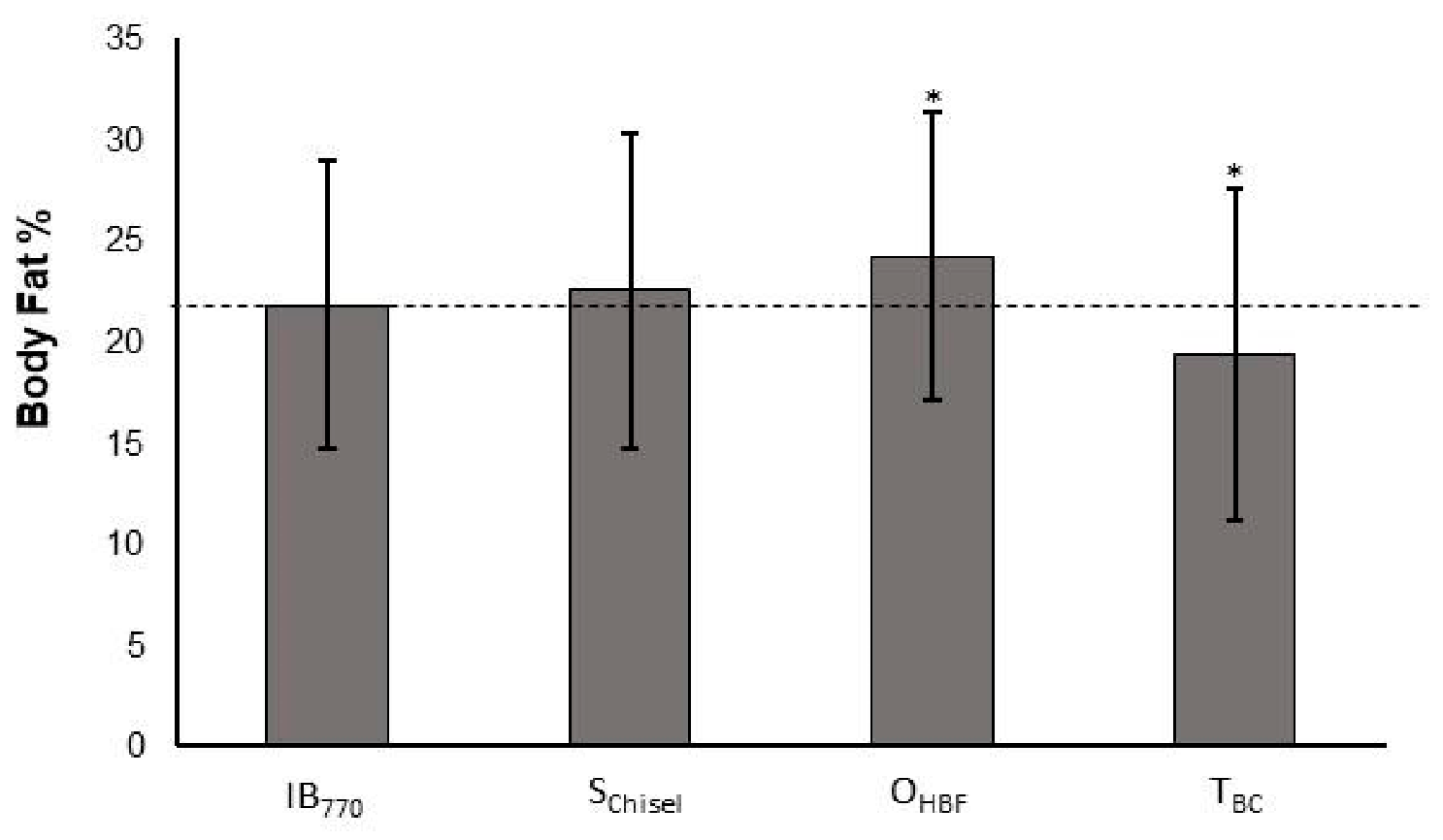
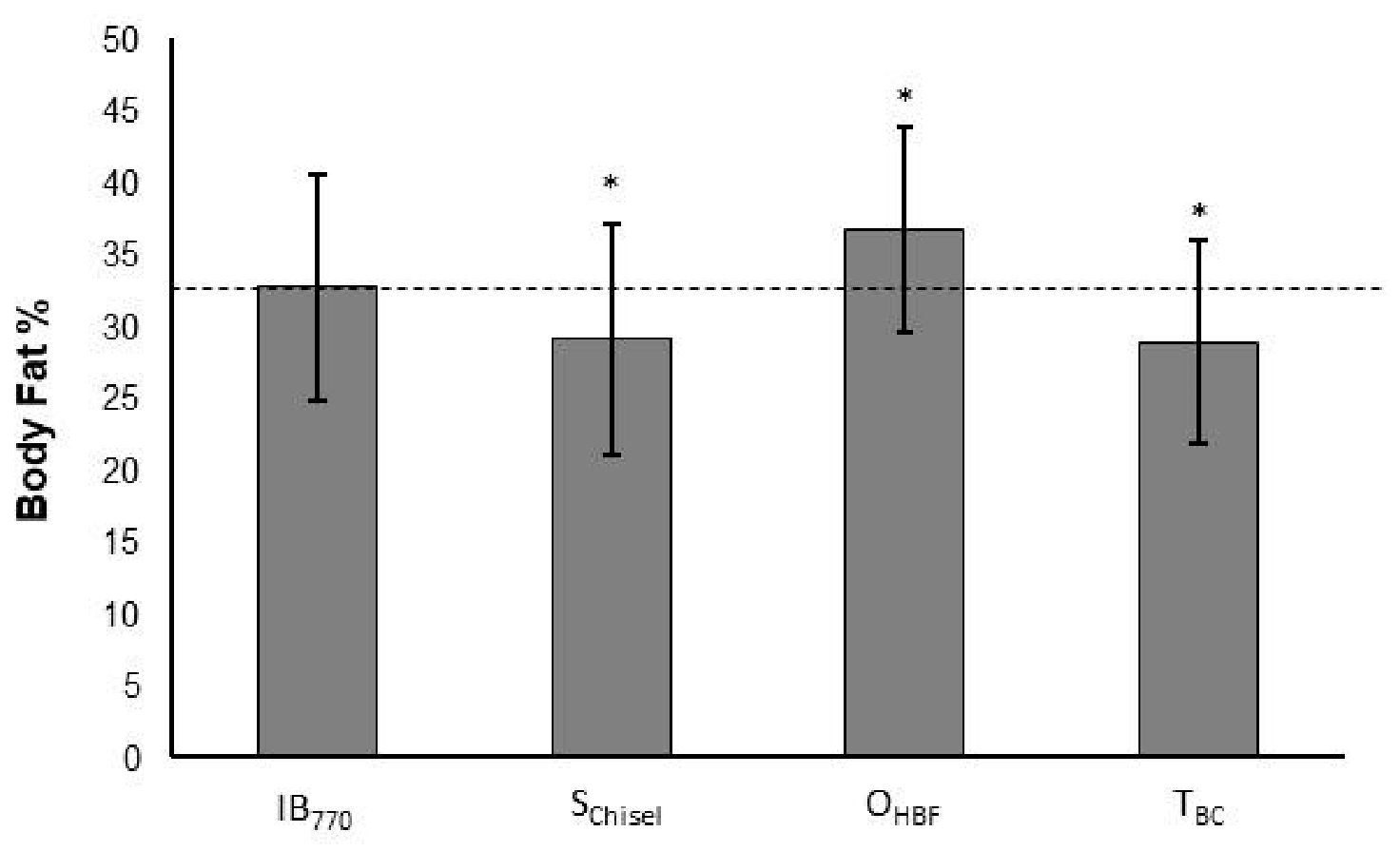
Pairwise analyses in men revealed significant differences in BF% between the IB770 vs. OHBF, IB770 vs. TBC, and OHBF vs. TBC devices (p < 0.001), whereas IB770 vs. SChisel and OHBF vs. SChisel did not differ (p = 0.184 and p = 0.174, respectively) (see Figure 1). In women, no significant differences were found between the TBC vs. SChisel devices (p = 1.000), whereas all other comparisons were significant (IB770 vs. OHBF, IB770 vs. TBC, IB770 vs. SChisel, OHBF vs. TBC, and OHBF vs. SChisel; p < 0.001; Figure 2).
Differences were observed between the devices used to estimate BF%. The comparison between SChisel and IB770 showed a small mean difference (Δ = 0.47), with a 95% confidence interval that included zero (−0.61 to 1.55). In contrast, when comparing SChisel with the OHBF device, a mean difference of 3.31 was observed (95% CI: 2.02 to 4.61). Likewise, the comparison between SChisel and TBC showed a mean difference of 2.40, with a confidence interval ranging from −3.63 to −1.18 (Table 2).
When comparing IB770 with OHBF, a mean difference of 2.84 was found (95% CI: 2.11 to 3.57), whereas the comparison between IB770 and TBC showed a mean difference of −2.87 (95% CI: −3.78 to −1.96). Finally, the comparison between OHBF and TBC showed the largest discrepancy between devices (Δ = −5.71; 95% CI: −6.42 to −5.01). In terms of variability, the standard deviation of the differences ranged from 3.91 to 7.00 (Table 2).
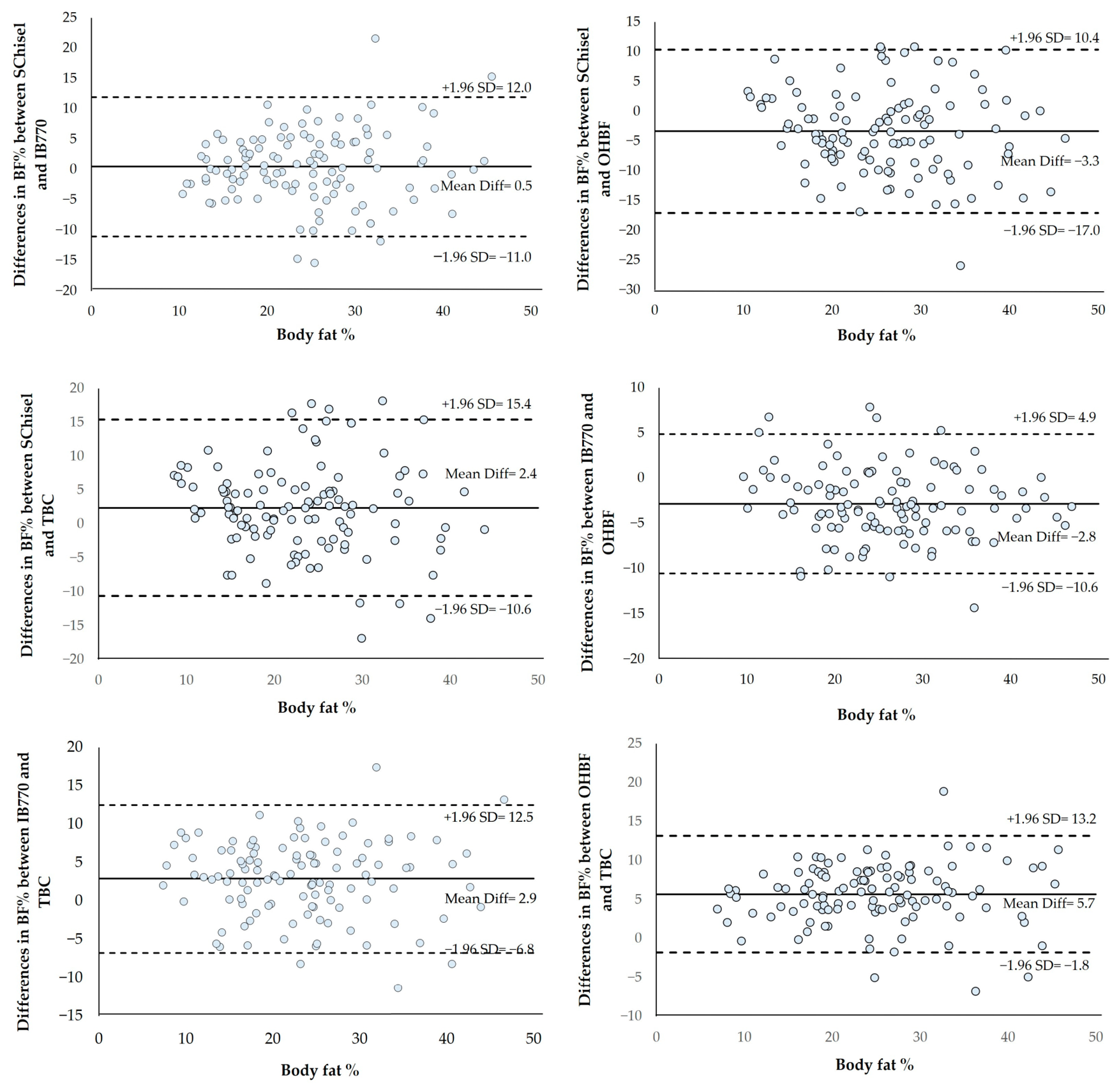
Bland–Altman analyses revealed varying levels of agreement between the devices used to estimate body fat percentage (BF%). The comparison between SChisel and IB770 showed a negligible mean difference (0.47%), although the limits of agreement were wide (−11.0 to 12.0%). When compared with OHBF, SChisel underestimated BF% (mean difference: 3.31%), with broad limits of agreement (−17.0 to 10.4%). In contrast, SChisel slightly overestimated BF% relative to TBC (mean difference: 2.40%), again with wide limits (−10.6 to 15.4%).
For the comparison between IB770 and OHBF, a negative bias was observed (mean difference: −2.84%), indicating higher BF% values in OHBF, with limits of agreement ranging from −10.6 to 4.9%. IB770 showed a positive bias compared to TBC (mean difference: 2.87%), with limits of agreement between −6.8 and 12.5%.
The largest systematic bias was found between TBC and OHBF (mean difference: 5.7%), with limits of agreement ranging from −1.8 to 13.2%. Across all comparisons, the limits of agreement were relatively wide, indicating substantial variability at the individual level despite small-to-moderate mean differences. Visual inspection of the Bland–Altman plots also suggested that the magnitude of disagreement may increase at higher BF% values in some device comparisons, with several of the largest between-device differences occurring at the upper end of the BF% range (Figure 3).

4. Discussion

The purpose of this study was to evaluate the agreement in total BF% among three BIA devices (IB770, OHBF, and TBC) and one myography analyzer using BIA (SChisel). The portable myographic analyzer (SChisel) demonstrated the closest agreement with the multifrequency tetrapolar BIA device (IB770), whereas the consumer-grade devices (OHBF and TBC) showed larger discrepancies relative to IB770. These results indicate that although differences exist among devices, some portable technologies may provide BF% estimates comparable to more advanced laboratory-grade BIA systems when standardized testing conditions are implemented [47].
BIA remains one of the most widely used field methods for estimating body composition due to its practicality, portability, and relatively low cost [16,47,48]. However, BIA device agreement varies with several methodological and physiological factors, including hydration status, electrode configuration, electrical frequency, and the prediction equations embedded in device algorithms [16,18,19,48]. As a result, different BIA devices may produce systematically different BF% estimates even when measuring the same individuals, which has been documented in previous research comparing commercial BIA systems [22,25,49]. The present results support these findings, as significant differences were observed between most of the devices evaluated.
One important methodological factor that may explain differences between studies is the control of hydration status before testing. In the present investigation, hydration was standardized using urine specific gravity (USG), ensuring that participants were euhydrated prior to measurement. This control is physiologically relevant because BIA estimates body composition based on the electrical conductivity of body tissues, which is strongly influenced by total body water [48,50]. Adequate hydration improves electrical conductivity and facilitates the passage of electrical current through lean tissue, whereas dehydration increases resistance and may lead to systematic bias in BF% estimates [51,52,53]. Previous studies have demonstrated that fluid intake, food consumption, and deviations from euhydration can significantly influence BIA-derived estimates of body composition [34,53]. Therefore, the hydration standardization implemented in the present study likely reduced measurement error and may partially explain the relatively close agreement observed between some devices.
Previous research examining the agreement of the IB770 relative to reference methods (e.g., DXA) has produced mixed findings. For example, Mally et al. [54] reported that BIA overestimated BF% in men and underestimated it in women compared with DXA. Similarly, Anderson et al. [55] found that BF% estimates obtained with multifrequency BIA devices were more accurate in women than in men compared with DXA. In contrast, McLester et al. [33] reported that the IB770 underestimated BF% in both men and women compared with DXA. Additionally, Dolezal et al. [56] observed that BIA underestimated BF% in lean individuals and overestimated BF% in heavier participants relative to DXA. Together, these findings suggest that BIA-derived body composition estimates may vary depending on sex, body composition characteristics, and the specific algorithms used by each device. These inconsistencies in the literature highlight the importance of evaluating agreement between commonly used field devices, as performed in the present study. However, because the IB770 provides an estimate of body composition rather than a criterion measure, agreement with the IB770 should be interpreted as agreement between devices rather than evidence of absolute measurement accuracy.
Interestingly, the portable myographic analyzer (SChisel) showed the closest agreement with the IB770 among the devices evaluated. Previous research comparing this device with hydrostatic weighing, skinfold methods, and DXA has reported mixed findings. For instance, Wells [32] observed that the device tended to overestimate BF% compared with seven-site skinfold and hydrostatic weighing assessments, whereas McLester et al. [33] reported that SChisel estimates did not differ significantly from DXA in healthy young adults. Although a criterion method was not included in the present study, the close agreement observed between SChisel and IB770 suggests that this technology may provide reasonably consistent BF% estimates when standardized testing conditions are implemented. One potential explanation lies in the measurement approach of the device. Unlike traditional whole-body BIA systems, SChisel evaluates tissue properties across multiple anatomical regions (12 anatomical zones per side), which may reduce some of the variability associated with whole-body current flow. Because impedance-based assessments are influenced by factors such as tissue hydration and electrical conductivity, regional measurements may provide more localized estimates and reduce variability related to whole-body assumptions [57]. Consequently, the regional assessment strategy of the SChisel may contribute to the relatively consistent BF% estimates observed in the present study when compared with the whole-body approach of the IB770.
The discrepancies observed between the IB770 and the consumer-grade devices (OHBF and TBC) for BF% are consistent with previous literature examining commercial BIA systems [25,26,27,58]. These differences likely reflect variations in electrode configuration and electrical frequency. The IB770 uses an eight-electrode configuration and multiple frequencies (1, 5, 50, 250, 500, and 1000 kHz), whereas both the OHBF and TBC operate at a single frequency of 50 kHz, with the TBC relying on a foot-to-foot electrode configuration [25,26,27,58]. Electrical current frequency strongly influences bioimpedance measurements because biological cell membranes act as capacitive barriers that affect current flow across different body-fluid compartments [59]. At lower frequencies, electrical current primarily travels through extracellular fluid because cell membranes restrict current flow into cells. At higher frequencies, current can penetrate cell membranes more extensively, providing information from both extracellular and intracellular fluid compartments [16,48]. Consequently, single-frequency BIA, typically performed at 50 kHz, relies more heavily on prediction equations and modeling assumptions to estimate total body water and subsequent body composition outcomes. In contrast, multifrequency BIA obtains impedance measurements across several frequencies, allowing more comprehensive characterization of body-water compartments and potentially improving body composition estimation [16,48]. These technological differences may partially explain the between-device discrepancies observed in the present study because differences in the estimation of body water and fat-free mass ultimately influence the calculation of BF%. However, differences in electrical frequency alone are unlikely to fully explain the observed variability. Electrode configuration, measurement pathway, and proprietary prediction algorithms likely also contribute to the discrepancies observed between the IB770, OHBF, and other devices.
Although mean differences among several devices were relatively small, Bland–Altman analyses revealed wide limits of agreement in some comparisons. This distinction is important because a small mean bias at the group level does not necessarily indicate acceptable agreement at the individual level. For example, although the mean difference between SChisel and IB770 was only 0.5%, the 95% limits of agreement ranged from −11.0% to 12.0%, indicating that BF% estimates for an individual could differ considerably between the two devices despite minimal average bias. Likewise, the other device comparisons showed relatively wide limits of agreement. Thus, the small mean differences observed for some devices suggest group-level comparability but do not support their interchangeability for individual assessment. From a practical perspective, differences of this magnitude may obscure or exceed changes in BF% expected during longitudinal monitoring, particularly when relatively small changes in body composition are of interest. Therefore, whenever possible, repeated assessments of an individual should use the same device, particularly in clinical, research, or longitudinal monitoring settings [16,22,25,49].
As noted, several larger individual differences occurred toward the upper end of the BF% range. This suggests that agreement between BIA devices may vary by adiposity level. Previous studies have reported reduced individual-level agreement between BIA and reference methods in populations with overweight or obesity, including relatively wide limits of agreement for BF% estimates [35,60]. Methodological characteristics associated with greater adiposity may contribute to these discrepancies. BIA relies on assumptions regarding body geometry, tissue conductivity, and the hydration and distribution of fat-free mass; these assumptions may be increasingly challenged as adiposity increases [35,60,61]. Differences in body geometry and body-water distribution, particularly the relative distribution of extracellular and total body water, have been identified as potential sources of error in impedance-based estimates among individuals with obesity [60,62]. In addition, device-specific prediction equations may perform differently across levels of adiposity, particularly when equations developed in normal-weight populations are applied to individuals with greater body fat [60,63]. Therefore, the apparent increase in between-device variability at higher BF% observed in the present study may reflect limitations inherent to impedance-based estimation as body composition becomes more heterogeneous. Nevertheless, these observations should be interpreted cautiously because our sample consisted primarily of young, physically active adults and included relatively few participants with high BF% values.
The present study also has several methodological strengths. First, hydration status was objectively standardized using USG, reducing one of the most common sources of measurement error in BIA research [40,41,51,52,53,59]. Second, randomizing the device testing order minimizes potential order effects. Third, the sample size was determined using an a priori power analysis, ensuring sufficient statistical power to detect meaningful differences between devices [39]. Finally, this study compared multiple technologies—including a multifrequency research-grade BIA device, consumer-grade scales, and a novel myography-based analyzer—providing a broader comparison of commonly used field-based body composition tools.
Despite these strengths, some limitations should be acknowledged. First, the study did not include a reference method (e.g., DXA), which limits the ability to determine the absolute accuracy of each device [64,65]. Second, the study population consisted primarily of young, physically active university students, which may limit the generalizability of the findings to other populations such as older adults, sedentary individuals, or individuals with obesity. Third, commercial BIA devices rely on proprietary prediction equations that are not publicly available, which makes it difficult to fully understand how body composition estimates are derived. Additionally, only a single measurement was obtained from each device for each participant. Consequently, within-device test–retest reliability and device-specific measurement error could not be evaluated. Moreover, the study did not record or control for menstrual cycle phase in female participants. Hormonal fluctuations across the menstrual cycle may influence fluid distribution and retention, potentially affecting impedance-based measurements [66]. Finally, previous evidence suggests that the validity of impedance-based estimates may vary across demographic and ethnic groups, which should be considered when interpreting the present findings [55,67]. Future research should include more diverse populations, incorporate reference methods, document menstrual cycle phase, and, when appropriate, standardize assessment timing across the menstrual cycle. Moreover, studies should incorporate repeated measurements from each device to assess within-device reliability and quantify device-specific measurement error, which would also permit more robust errors-in-variables analyses.

5. Conclusions

In conclusion, although the devices use different technologies to estimate BF%, relatively small mean differences were observed between some devices at the group level. However, Bland–Altman analyses revealed relatively wide limits of agreement, indicating substantial variability in BF% estimates at the individual level. Therefore, small average differences between devices should not be interpreted as evidence of individual-level agreement or interchangeability. Although some devices may produce similar mean BF% estimates under standardized testing conditions, the magnitude of the individual differences suggests that they should not be used interchangeably when monitoring changes in BF% over time. Whenever possible, repeated assessments should therefore be conducted using the same device, particularly in clinical, research, and longitudinal monitoring settings.

Author Contributions

Conceptualization, J.A.A.-C. and R.E.-G.; methodology, B.M.-H., E.I.T. and M.Y.M.; software, J.A.A.-C. and J.J.C.-N.; validation, B.M.-H., R.E.-G.; formal analysis, J.A.A.-C., B.M.-H. and R.E.-G.; research, J.A.A.-C., B.M.-H., R.E.-G.; resources, J.J.C.-N. and R.E.-G.; data curation, M.Y.M., E.I.T. and J.A.A.-C.; writing—original draft preparation, J.A.A.-C., R.E.-G., B.M.-H., E.I.T. and M.Y.M.; writing—review and editing, J.A.A.-C., R.E.-G., B.M.-H., E.I.T. and M.Y.M.; visualization, J.J.C.-N., E.I.T. and M.Y.M.; supervision, J.J.C.-N., R.E.-G. and J.A.A.-C.; project administration, J.A.A.-C., M.Y.M. and E.I.T.; funding acquisition, J.J.C.-N. and R.E.-G. All authors have read and agreed to the published version of the manuscript.

Funding

This research received no external funding.

Institutional Review Board Statement

The study was conducted in accordance with the Declaration of Helsinki. Ethics approval for this study was obtained from the Ethics Committee of the Autonomous University of Baja California, México (P-02-2023-1, approved on 28 February 2023).

Informed Consent Statement

Informed consent was obtained from all subjects involved in the study.

Data Availability Statement

Data are contained within the article.

Conflicts of Interest

The authors declare no conflicts of interest. This article is a revised and expanded version of an abstract entitled Concordance of an electrical impedance myography device (Skulpt Chisel®) and bioelectrical impedance analyzers in the assessment of body fat in healthy adults, which was presented at Zoom Forward 22nd and 29th European Congress on Obesity, Maastricht, The Netherlands, 4–7 May 2022.

Abbreviations

BMIBody mass index
BF%Body fat percentage
USGUrine specific gravity
IB770InBody 770
SChiselSkulpt Chisel®
OHBFOmron HBF-514C
TBCTanita BC-533
ΔDifference
CVCoefficient of variation

References

  1. Andreoli, A.; Garaci, F.; Cafarelli, F.P.; Guglielmi, G. Body composition in clinical practice. Eur. J. Radiol. 2016, 85, 1461–1468. [Google Scholar] [CrossRef] [Scilit] [PubMed]
  2. Wang, Z.M.; Pierson, R.N., Jr.; Heymsfield, S.B. The five-level model: A new approach to organizing body-composition research. Am. J. Clin. Nutr. 1992, 56, 19–28. [Google Scholar] [CrossRef] [Scilit] [PubMed]
  3. Sant’Anna, M.d.S.L.; Priore, S.E.; Franceschini, S.D.C.C. Métodos de avaliação da composição corporal em crianças. Rev. Paul. Pediatr. 2009, 27, 315–321. [Google Scholar] [CrossRef] [Scilit]
  4. Gonzalez, S.L.; Alvarez, V.; Nelson, E.L. Do Gross and Fine Motor Skills Differentially Contribute to Language Outcomes? A Systematic Review. Front. Psychol. 2019, 10, 2670. [Google Scholar] [CrossRef] [Scilit] [PubMed]
  5. Mundi, M.S.; Patel, J.J.; Martindale, R. Body Composition Technology: Implications for the ICU. Nutr. Clin. Pract. 2019, 34, 48–58. [Google Scholar] [CrossRef] [Scilit] [PubMed]
  6. Barbieri, D.; Zaccagni, L.; Babić, V.; Rakovac, M.; Mišigoj-Duraković, M.; Gualdi-Russo, E. Body composition and size in sprint athletes. J. Sports Med. Phys. Fit. 2017, 57, 1142–1146. [Google Scholar] [CrossRef] [Scilit] [PubMed]
  7. Bernal-Orozco, M.F.; Posada-Falomir, M.; Quiñónez-Gastélum, C.M.; Plascencia-Aguilera, L.P.; Arana-Nuño, J.R.; Badillo-Camacho, N.; Márquez-Sandoval, F.; Holway, F.E.; Vizmanos-Lamotte, B. Anthropometric and Body Composition Profile of Young Professional Soccer Players. J. Strength Cond. Res. 2020, 34, 1911–1923. [Google Scholar] [CrossRef] [Scilit] [PubMed] [PubMed Central]
  8. Pilis, K.; Stec, K.; Pilis, A.; Mroczek, A.; Michalski, C.; Pilis, W. Body composition and nutrition of female athletes. Rocz. Państw. Zakł. Hig. 2019, 70, 243–251. [Google Scholar] [CrossRef] [Scilit] [PubMed]
  9. Abdelaal, M.; le Roux, C.W.; Docherty, N.G. Morbidity and mortality associated with obesity. Ann. Transl. Med. 2017, 5, 161. [Google Scholar] [CrossRef] [Scilit] [PubMed] [PubMed Central]
  10. Marenco, R.G.; Escobedo, M.M.; Balam, M.G.; Zapata, J.E.; Barreiro, A.C.; Poot, P.V.; Martín, K.C. Concordancia entre la composición corporal medida con un inbody 120 y un skulpt chisel en atletas de combate adolescentes. Rev. Digit. Act. Fis. Deporte 2021, 7, 1–12. [Google Scholar] [CrossRef] [Scilit]
  11. Goossens, G.H. The Metabolic Phenotype in Obesity: Fat Mass, Body Fat Distribution, and Adipose Tissue Function. Obes. Facts 2017, 10, 207–215. [Google Scholar] [CrossRef] [Scilit] [PubMed] [PubMed Central]
  12. Moreira, O.C.; Alonso-Aubin, D.A.; de Oliveira, C.E.P.; Candia-Luján, R.; de Paz, J.A. Métodos de evaluación de la composición corporal: Una revisión actualizada de descripción, aplicación, ventajas y desventajas. Arch. Med. Deporte 2015, 32, 387–394. [Google Scholar]
  13. Kuriyan, R. Body composition techniques. Indian J. Med. Res. 2018, 148, 648–658. [Google Scholar] [CrossRef] [Scilit] [PubMed] [PubMed Central]
  14. Lemos, T.; Gallagher, D. Current body composition measurement techniques. Curr. Opin. Endocrinol. Diabetes Obes. 2017, 24, 310–314. [Google Scholar] [CrossRef] [Scilit] [PubMed] [PubMed Central]
  15. Ellis, K.J. Human body composition: In vivo methods. Physiol. Rev. 2000, 80, 649–680. [Google Scholar] [CrossRef] [Scilit] [PubMed]
  16. Ward, L.C. Bioelectrical impedance analysis for body composition assessment: Reflections on accuracy, clinical utility, and standardisation. Eur. J. Clin. Nutr. 2019, 73, 194–199. [Google Scholar] [CrossRef] [Scilit] [PubMed]
  17. Lee, S.Y.; Gallagher, D. Assessment methods in human body composition. Curr. Opin. Clin. Nutr. Metab. Care 2008, 11, 566–572. [Google Scholar] [CrossRef] [Scilit] [PubMed] [PubMed Central]
  18. Lukaski, H.C.; Johnson, P.E.; Bolonchuk, W.W.; Lykken, G.I. Assessment of fat-free mass using bioelectrical impedance measurements of the human body. Am. J. Clin. Nutr. 1985, 41, 810–817. [Google Scholar] [CrossRef] [Scilit] [PubMed]
  19. Ayvaz, G.; Çimen, A.R. Methods for Body Composition Analysis in Adults. Open Obes. J. 2011, 3, 62–69. [Google Scholar] [CrossRef] [Scilit] [PubMed]
  20. McLester, C.N.; Nickerson, B.S.; Kliszczewicz, B.M.; McLester, J.R. Reliability and Agreement of Various InBody Body Composition Analyzers as Compared to Dual-Energy X-Ray Absorptiometry in Healthy Men and Women. J. Clin. Densitom. 2020, 23, 443–450. [Google Scholar] [CrossRef] [Scilit] [PubMed]
  21. Ling, C.H.; de Craen, A.J.; Slagboom, P.E.; Gunn, D.A.; Stokkel, M.P.; Westendorp, R.G.; Maier, A.B. Accuracy of direct segmental multi-frequency bioimpedance analysis in the assessment of total body and segmental body composition in middle-aged adult population. Clin. Nutr. 2011, 30, 610–615. [Google Scholar] [CrossRef] [Scilit] [PubMed]
  22. Burns, R.D.; Fu, Y.; Constantino, N. Measurement agreement in percent body fat estimates among laboratory and field assessments in college students: Use of equivalence testing. PLoS ONE 2019, 14, e0214029. [Google Scholar] [CrossRef] [Scilit] [PubMed] [PubMed Central]
  23. Antonio, J.; Kenyon, M.; Ellerbroek, A.; Carson, C.; Burgess, V.; Tyler-Palmer, D.; Mike, J.; Roberts, J.; Angeli, G.; Peacock, C. Comparison of Dual-Energy X-ray Absorptiometry (DXA) Versus a Multi-Frequency Bioelectrical Impedance (InBody 770) Device for Body Composition Assessment after a 4-Week Hypoenergetic Diet. J. Funct. Morphol. Kinesiol. 2019, 4, 23. [Google Scholar] [CrossRef] [Scilit] [PubMed]
  24. Brewer, G.J.; Blue, M.N.; Hirsch, K.R.; Saylor, H.E.; Gould, L.M.; Nelson, A.G.; Smith-Ryan, A.E. Validation of InBody 770 bioelectrical impedance analysis compared to a four-compartment model criterion in young adults. Clin. Physiol. Funct. Imaging 2021, 41, 317–325. [Google Scholar] [CrossRef] [Scilit] [PubMed]
  25. Vasold, K.L.; Parks, A.C.; Phelan, D.M.L.; Pontifex, M.B.; Pivarnik, J.M. Reliability and Validity of Commercially Available Low-Cost Bioelectrical Impedance Analysis. Int. J. Sport Nutr. Exerc. Metab. 2019, 29, 406–410. [Google Scholar] [CrossRef] [Scilit] [PubMed]
  26. Samouda, H.; Langlet, J. Body fat assessment in youth with overweight or obesity by an automated bioelectrical impedance analysis device, in comparison with the dual-energy x-ray absorptiometry: A cross sectional study. BMC Endocr. Disord. 2022, 22, 195. [Google Scholar] [CrossRef] [Scilit] [PubMed] [PubMed Central]
  27. Kutáč, P.; Kopecký, M. Comparison of body fat using various bioelectrical impedance analyzers in university students. Acta Gymnica 2015, 45, 177–186. [Google Scholar] [CrossRef] [Scilit]
  28. Ballesteros-Pomar, M.D.; Calleja-Fernández, A.; Diez-Rodríguez, R.; Vidal-Casariego, A.; Blanco-Suárez, M.D.; Cano-Rodríguez, I. Comparison of different body composition measurements in severely obese patients in the clinical setting. Nutr. Hosp. 2012, 27, 1626–1630. [Google Scholar] [CrossRef] [Scilit] [PubMed]
  29. Skulpt. Home. Available online: https://www.skulpt.me/ (accessed on 5 September 2026).
  30. Albano, D.; Gitto, S.; Vitale, J.; Bernareggi, S.; Lamorte, S.; Aliprandi, A.; Sconfienza, L.M.; Messina, C. Knee Muscles Composition Using Electrical Impedance Myography and Magnetic Resonance Imaging. Diagnostics 2022, 12, 2217. [Google Scholar] [CrossRef] [Scilit] [PubMed] [PubMed Central]
  31. Albano, D.; Gitto, S.; Vitale, J.; Bernareggi, S.; Aliprandi, A.; Sconfienza, L.M.; Messina, C. Comparison between magnetic resonance imaging and electrical impedance myography for evaluating lumbar skeletal muscle composition. BMC Musculoskelet. Disord. 2022, 23, 970. [Google Scholar] [CrossRef] [Scilit] [PubMed] [PubMed Central]
  32. Wells, A.D.; Bellovary, B.N.; Houck, J.M.; Ducharme, J.B.; Masoud, A.A.; Gibson, A.L.; Mermier, C.M. New Multisite Bioelectrical Impedance Device Compared to Hydrostatic Weighing and Skinfold Body Fat Methods. Int. J. Exerc. Sci. 2020, 13, 1718–1728. [Google Scholar] [CrossRef] [Scilit] [PubMed] [PubMed Central]
  33. McLester, C.N.; Dewitt, A.D.; Rooks, R.; McLester, J.R. An investigation of the accuracy and reliability of body composition assessed with a handheld electrical impedance myography device. Eur. J. Sport Sci. 2018, 18, 763–771. [Google Scholar] [CrossRef] [Scilit] [PubMed]
  34. Randhawa, A.K.; Jamnik, V.; Fung, M.D.T.; Fogel, A.S.; Kuk, J.L. No differences in the body fat after violating core bioelectrical impedance measurement assumptions. BMC Public Health 2021, 21, 495. [Google Scholar] [CrossRef] [Scilit] [PubMed] [PubMed Central]
  35. Pateyjohns, I.R.; Brinkworth, G.D.; Buckley, J.D.; Noakes, M.; Clifton, P.M. Comparison of three bioelectrical impedance methods with DXA in overweight and obese men. Obesity 2006, 14, 2064–2070. [Google Scholar] [CrossRef] [Scilit] [PubMed]
  36. Thomson, R.; Brinkworth, G.D.; Buckley, J.D.; Noakes, M.; Clifton, P.M. Good agreement between bioelectrical impedance and dual-energy X-ray absorptiometry for estimating changes in body composition during weight loss in overweight young women. Clin. Nutr. 2007, 26, 771–777. [Google Scholar] [CrossRef] [Scilit] [PubMed]
  37. Nakagata, T.; Yamada, Y.; Tabata, H.; Someya, Y.; Kaga, H.; Kawamori, R.; Watada, H.; Tamura, Y. Agreement and systematic difference between bioelectrical impedance analysis and dual-energy X-ray absorptiometry for appendicular lean mass in 1617 community-dwelling older adults: The Bunkyo Health Study. Clin. Nutr. ESPEN 2026, 72, 102961. [Google Scholar] [CrossRef] [Scilit] [PubMed]
  38. Crespo-Ruiz, B.; García, P.E.; Fernández-Vega, C.; Crespo-Ruiz, C.; Rivas-Galan, S. A Descriptive Analysis of Body Composition Among Forest Firefighters in Spain. J. Occup. Environ. Med. 2020, 62, e174–e179. [Google Scholar] [CrossRef] [Scilit] [PubMed]
  39. Faul, F.; Erdfelder, E.; Lang, A.-G.; Buchner, A. G*Power 3: A flexible statistical power analysis program for the social, behavioral, and biomedical sciences. Behav. Res. Methods 2007, 39, 175–191. [Google Scholar] [CrossRef] [Scilit] [PubMed]
  40. Armstrong, L.E.; Pumerantz, A.C.; Fiala, K.A.; Roti, M.W.; Kavouras, S.A.; Casa, D.J.; Maresh, C.M. Human hydration indices: Acute and longitudinal reference values. Int. J. Sport Nutr. Exerc. Metab. 2010, 20, 145–153. [Google Scholar] [CrossRef] [Scilit] [PubMed]
  41. Oppliger, R.A.; Magnes, S.A.; Popowski, L.A.; Gisolfi, C.V. Accuracy of urine specific gravity and osmolality as indicators of hydration status. Int. J. Sport Nutr. Exerc. Metab. 2005, 15, 236–251. [Google Scholar] [CrossRef] [Scilit] [PubMed]
  42. Aburto-Corona, J.A.; Calleja-Núñez, J.J.; Moncada-Jiménez, J.; de Paz, J.A. The Effect of Passive Dehydration on Phase Angle and Body Composition: A Bioelectrical Impedance Analysis. Nutrients 2024, 16, 2202. [Google Scholar] [CrossRef] [Scilit] [PubMed] [PubMed Central]
  43. Rivera-Paredez, B.; Muciño-Sandoval, K.; Velázquez-Cruz, R.; Rivas-Ruíz, R.; Meneses-León, J.; Orozco, R.; González-Muñoz, C.E.; Tamayo-Orozco, J.A.; Denova-Gutiérrez, E.; Salmerón, J.; et al. Association between lean mass, fat mass, and waist circumference with bone mineral density in Mexican children and adolescents: A cross-sectional study. Eur. J. Pediatr. 2025, 184, 671. [Google Scholar] [CrossRef] [Scilit] [PubMed] [PubMed Central]
  44. West, D.; Choi, J. Measurement and Comparision of Multi-Electrode Placement for Bioelectrical Impedance Analysis. In Proceedings of the 2019 Design of Medical Devices Conference, Minneapolis, MN, USA, 15–18 April 2019; ASME: New York, NY, USA, 2019. [Google Scholar] [CrossRef] [Scilit]
  45. Hopkins, W.G. Measures of Reliability in Sports Medicine and Science. Sports Med. 2000, 30, 1–15. [Google Scholar] [CrossRef] [Scilit] [PubMed]
  46. Looney, D.P.; Schafer, E.A.; Chapman, C.L.; Pryor, R.R.; Potter, A.W.; Roberts, B.M.; Friedl, K.E. Reliability, biological variability, and accuracy of multi-frequency bioelectrical impedance analysis for measuring body composition components. Front. Nutr. 2024, 11, 1491931. [Google Scholar] [CrossRef] [Scilit] [PubMed]
  47. Marra, M.; Sammarco, R.; De Lorenzo, A.; Iellamo, F.; Siervo, M.; Pietrobelli, A.; Donini, L.M.; Santarpia, L.; Cataldi, M.; Pasanisi, F.; et al. Assessment of Body Composition in Health and Disease Using Bioelectrical Impedance Analysis (BIA) and Dual Energy X-Ray Absorptiometry (DXA): A Critical Overview. Contrast Media Mol. Imaging 2019, 2019, 3548284. [Google Scholar] [CrossRef] [Scilit] [PubMed] [PubMed Central]
  48. Kyle, U.G.; Bosaeus, I.; De Lorenzo, A.D.; Deurenberg, P.; Elia, M.; Gomez, J.M.; Heitmann, B.L.; Kent-Smith, L.; Melchior, J.-C.; Pirlich, M.; et al. Bioelectrical impedance analysis—Part I: Review of principles and methods. Clin. Nutr. 2004, 23, 1226–1243. [Google Scholar] [CrossRef] [Scilit] [PubMed]
  49. Silva, A.M.; Matias, C.N.; Nunes, C.L.; Santos, D.A.; Marini, E.; Lukaski, H.C.; Sardinha, L.B. Lack of agreement of in vivo raw bioimpedance measurements obtained from two single and multi-frequency bioelectrical impedance devices. Eur. J. Clin. Nutr. 2019, 73, 1077–1083. [Google Scholar] [CrossRef] [Scilit] [PubMed]
  50. Roumelioti, M.-E.; Glew, R.H.; Khitan, Z.J.; Rondon-Berrios, H.; Argyropoulos, C.P.; Malhotra, D.; Raj, D.S.; Agaba, E.I.; Rohrscheib, M.; Murata, G.H.; et al. Fluid balance concepts in medicine: Principles and practice. World J. Nephrol. 2018, 7, 1–28. [Google Scholar] [CrossRef] [Scilit] [PubMed] [PubMed Central]
  51. Tinsley, G.M.; Stratton, M.T.; Harty, P.S.; Williams, A.D.; White, S.J.; Rodriguez, C.; Dellinger, J.R.; Johnson, B.A.; Smith, R.W.; Trexler, E.T. Influence of Acute Water Ingestion and Prolonged Standing on Raw Bioimpedance and Subsequent Body Fluid and Composition Estimates. J. Electr. Bioimpedance 2022, 13, 10–20. [Google Scholar] [CrossRef] [Scilit] [PubMed] [PubMed Central]
  52. Buchholz, A.C.; Bartok, C.; Schoeller, D.A. The validity of bioelectrical impedance models in clinical populations. Nutr. Clin. Pract. 2004, 19, 433–446. [Google Scholar] [CrossRef] [Scilit] [PubMed]
  53. Androutsos, O.; Gerasimidis, K.; Karanikolou, A.; Reilly, J.J.; Edwards, C.A. Impact of eating and drinking on body composition measurements by bioelectrical impedance. J. Hum. Nutr. Diet. 2015, 28, 165–171. [Google Scholar] [CrossRef] [Scilit] [PubMed]
  54. Mally, K.; Trentmann, J.; Heller, M.; Dittmar, M. Reliability and accuracy of segmental bioelectrical impedance analysis for assessing muscle and fat mass in older Europeans: A comparison with dual-energy X-ray absorptiometry. Eur. J. Appl. Physiol. 2011, 111, 1879–1887. [Google Scholar] [CrossRef] [Scilit] [PubMed]
  55. Anderson, L.J.; Erceg, D.N.; Schroeder, E.T. Utility of multifrequency bioelectrical impedance compared with dual-energy x-ray absorptiometry for assessment of total and regional body composition varies between men and women. Nutr. Res. 2012, 32, 479–485. [Google Scholar] [CrossRef] [Scilit] [PubMed]
  56. Dolezal, B.A.; Lau, M.J.; Abrazado, M.; Storer, T.W.; Cooper, C.B. Validity of Two Commercial Grade Bioelectrical Impedance Analyzers for Measurement of Body Fat Percentage. J. Exerc. Physiol. 2013, 16, 74–83. [Google Scholar]
  57. Rutkove, S.B. Electrical impedance myography: Background, current state, and future directions. Muscle Nerve 2009, 40, 936–946. [Google Scholar] [CrossRef] [Scilit] [PubMed] [PubMed Central]
  58. Monson, A.L.; Chismark, A.M.; Cooper, B.R.; Krenik-Matejcek, T.M. Effects of Yoga on Musculoskeletal Pain. J. Dent. Hyg. JDH 2017, 91, 15–22. [Google Scholar] [PubMed]
  59. Brantlov, S.; Ward, L.C.; Isidor, S.; Hvas, C.L.; Rud, C.L.; Jødal, L. Cell Membrane Capacitance (Cm) Measured by Bioimpedance Spectroscopy (BIS): A Narrative Review of Its Clinical Relevance and Biomarker Potential. Sensors 2025, 25, 4362. [Google Scholar] [CrossRef] [Scilit] [PubMed]
  60. Deurenberg, P. Limitations of the bioelectrical impedance method for the assessment of body fat in severe obesity. Am. J. Clin. Nutr. 1996, 64, 449S–452S. [Google Scholar] [CrossRef] [Scilit] [PubMed]
  61. Kyle, U.G.; Bosaeus, I.; De Lorenzo, A.D.; Deurenberg, P.; Elia, M.; Gómez, J.M.; Heitmann, B.L.; Kent-Smith, L.; Melchior, J.-C.; Pirlich, M.; et al. Bioelectrical impedance analysis—Part II: Utilization in clinical practice. Clin. Nutr. 2004, 23, 1430–1453. [Google Scholar] [CrossRef] [Scilit] [PubMed]
  62. Coppini, L.Z.; Waitzberg, D.L.; Campos, A.C.L. Limitations and validation of bioelectrical impedance analysis in morbidly obese patients. Curr. Opin. Clin. Nutr. Metab. Care 2005, 8, 329–332. [Google Scholar] [CrossRef] [Scilit] [PubMed]
  63. Horie, L.M.; Barbosa-Silva, M.C.G.; Torrinhas, R.S.; de Mello, M.T.; Cecconello, I.; Waitzberg, D.L. New body fat prediction equations for severely obese patients. Clin. Nutr. 2008, 27, 350–356. [Google Scholar] [CrossRef] [Scilit] [PubMed]
  64. Nana, A.; Slater, G.J.; Stewart, A.D.; Burke, L.M. Methodology review: Using dual-energy X-ray absorptiometry (DXA) for the assessment of body composition in athletes and active people. Int. J. Sport Nutr. Exerc. Metab. 2015, 25, 198–215. [Google Scholar] [CrossRef] [Scilit] [PubMed]
  65. Bilsborough, J.C.; Greenway, K.; Opar, D.; Livingstone, S.; Cordy, J.; Coutts, A.J. The accuracy and precision of DXA for assessing body composition in team sport athletes. Sports Sci. 2014, 32, 1821–1828. [Google Scholar] [CrossRef] [Scilit] [PubMed]
  66. White, C.P.; Hitchcock, C.L.; Vigna, Y.M.; Prior, J.C. Fluid Retention over the Menstrual Cycle: 1-Year Data from the Prospective Ovulation Cohort. Obstet. Gynecol. Int. 2011, 2011, 138451. [Google Scholar] [CrossRef] [Scilit] [PubMed] [PubMed Central]
  67. Deurenberg, P.; Andreoli, A.; Borg, P.; Kukkonen-Harjula, K.; de Lorenzo, A.; Lichtenbelt, W.v.M.; Testolin, G.; Vigano, R.; Vollaard, N. The validity of predicted body fat percentage from body mass index and from impedance in samples of five European populations. Eur. J. Clin. Nutr. 2001, 55, 973–979. [Google Scholar] [CrossRef] [Scilit] [PubMed]
Figure 1. Comparison of body fat percentage among different body composition devices in men. Note: * Significant differences compared with InBody 770; IB770 = InBody 770; SChisel = Skulpt Chisel; OHBF = Omron HBF-514C; TBC = Tanita BC-533.
Biophysica 06 00090 g001
Figure 2. Comparison of body fat percentage among different body composition devices in women. Note: * Significant differences compared with InBody 770; IB770 = InBody 770; SChisel = Skulpt Chisel; OHBF = Omron HBF-514C; TBC = Tanita BC-533.
Biophysica 06 00090 g002
Figure 3. Bland–Altman plots of the differences between the various devices compared to InBody 770. Note: IB770 = InBody 770; SChisel = Skulpt Chisel; OHBF = Omron HBF-514C; TBC = Tanita BC-533.
Biophysica 06 00090 g003
Table 1. Descriptive statistics of the participants.
Men (n = 82)Women (n = 33)
Age (years)23.3 ± 4.720.9 ± 1.8
Height (cm)172.9 ± 6.3158.9 ± 5.1
Weight (kg)77.0 ± 15.560.8 ± 11.8
BMI25.6 ± 4.424.1 ± 4.6
Muscular mass (kg)32.6 ± 7.321.4 ± 5.6
BF% IB77021.7 ± 7.132.7 ± 7.9
BF% SChisel22.5 ± 7.829.1 ± 8.0
BF% OHBF24.2 ± 7.136.7 ± 7.2
BF% TBC19.3 ± 8.228.9 ± 7.0
USG1.011 ± 0.0061.011 ± 0.005
Note: BF% = body fat percentage; IB770 = InBody 770; SChisel = Skulpt Chisel; OHBF = Omron HBF-514C; TBC = Tanita BC-533; BMI = body mass index; USG = urine specific gravity.
Table 2. Comparison statistics between devices for body fat percentage.
Comparison∆SDdiff95%CI
SChisel-IB7700.475.86−0.61–1.55
SChisel-OHBF−3.317.002.02–4.61
SChisel-TBC2.406.62−3.63–−1.18
IB770-OHBF−2.843.932.11–3.57
IB770-TBC2.874.93−3.78–−1.96
OHBF-TBC5.713.91−6.42–−5.01
Note: IB770 = InBody 770; SChisel = Skulpt Chisel; OHBF = Omron HBF-514C; TBC = Tanita BC-533; ∆ = differences between devices; SDdiff = standard deviation of the differences; CI95% = 95% confidence interval.
Disclaimer/Publisher’s Note: The statements, opinions and data contained in all publications are solely those of the individual author(s) and contributor(s) and not of MDPI and/or the editor(s). MDPI and/or the editor(s) disclaim responsibility for any injury to people or property resulting from any ideas, methods, instructions or products referred to in the content.