Article

Copper-Enhanced Gold Nanoparticle Sensor for Colorimetric Histamine Detection

Graduate School of Science and Engineering, Yamagata University, Jonan 4-3-16, Yonezawa 992-8510, Japan
Biophysica 2025, 5(4), 59; https://doi.org/10.3390/biophysica5040059 (registering DOI)

Submission received: 29 October 2025 / Revised: 19 November 2025 / Accepted: 27 November 2025 / Published: 1 December 2025
(This article belongs to the Collection Feature Papers in Biophysics)

Abstract

A rapid, colorimetric sensor for histamine detection is presented using citrate-stabilized gold nanoparticles enhanced with Cu2+ coordination. The sensing mechanism involves dual recognition: protonated histamine first adsorbs electrostatically onto AuNP surfaces at pH 5.5, followed by Cu2+-mediated coordination between imidazole rings that induces interparticle coupling, resulting in a characteristic shift of the localized surface plasmon resonance from 520 to 620 nm. The optical response, measured as the absorbance ratio A620/A520, exhibits excellent linearity over the range of 1.25–10 μM with a detection limit of 0.95 μM and total assay time under 30 min. The dual-recognition mechanism provides high selectivity for histamine over structural analogs, including L-histidine, imidazole, and L-lysine. The metal ion-mediated colorimetric approach described here achieves sub-micromolar sensitivity in simple buffer solutions, which is comparable to the histamine level used in in vitro cell assays and food-related studies. Thus, the present system is best viewed as a mechanistic model that can inform the design of future biosensing and analytical methods, rather than as a fully optimized sensor for direct clinical measurements in complex biofluids.

1. Introduction

Histamine is a biogenic amine that functions as a signaling molecule in various physiological and pathological processes [1,2]. In mammalian systems, histamine is released from mast cells and basophils upon activation, reaching concentrations ranging from sub-micromolar to several micromolar in the extracellular environment [3,4]. The released histamine mediates diverse biological responses through H1 and H2 receptor signaling, including allergic reactions, inflammation, neurotransmission, and gastric acid secretion [5,6,7,8,9,10]. Given its central role in multiple physiological pathways, quantitative detection of histamine has important implications for biological research and analytical chemistry [11,12].
Classical analytical techniques, such as reversed-phase HPLC [13], LC-MS/MS [14], fluorimetry [15], electrochemical sensing [16], and ELISA-based immunoassays [17], provide nanomolar sensitivity and molecular specificity. However, these techniques typically require expensive equipment, specialized reagents, and skilled operators, making them unsuitable for routine laboratory use and real-time monitoring applications. Furthermore, sample preparation processes often involve dilution/concentration, pH adjustment, or organic solvent extraction that can introduce artifacts and prevent kinetic measurements.
Gold nanoparticles (AuNPs) are attractive materials for rapid quantitative assays because their localized surface plasmon resonance (LSPR) exhibits pronounced spectral changes upon interparticle coupling. This property produces distinctive colorimetric responses that enable both visual observation and quantification by simple UV-vis spectroscopy [18,19]. These spectral changes can be detected within minutes, enabling time-course studies through sequential measurements [20,21]. Several AuNP-based colorimetric sensors for histamine have been reported [22,23,24,25,26,27,28,29,30,31,32,33,34,35]. However, most of these systems employ surface-functionalized AuNPs and were designed as application-oriented sensors for specific matrices such as fish or meat extracts or basophil suspensions. In many cases, histamine is detected through generic interactions of protonated amino groups and/or imidazole rings with negatively charged or reactive surface ligands on AuNPs. As a result, structurally related biogenic amines can also interact with the same surface, and the observed selectivity often reflects relative response amplitudes under a particular pH, concentration, and time window rather than strict chemical specificity for histamine.
To address these limitations, we focus on a metal ion-assisted recognition scheme using unmodified citrate-stabilized AuNPs as a minimal model for histamine. Previous studies have used metal ions to mediate aggregation of functionalized AuNPs and thereby amplify colorimetric responses for other analytes [36,37,38]; in these reports, metal ions are mainly described as a signal enhancer rather than an explicit recognition element. In the present work, we adopt a complementary viewpoint and treat Cu2+–histamine coordination as a secondary recognition event that operates in parallel with the electrostatic adsorption of protonated histamine onto the negatively charged citrate layer. In this design, histamine is recognized not only through electrostatic attraction of its protonated amino group to the citrate-coated AuNP surface but also through coordination of its imidazole rings to a transition Cu2+ that bridges between histamine and the nanoparticle surface. This metal-mediated dual recognition imposes additional geometric and coordination constraints that many other biogenic amines cannot satisfy as efficiently and can therefore sharpen the response bias toward histamine within the class of analytes. By operating under well-defined buffer conditions and systematically varying pH and buffer ionic strength in the micromolar concentration range, the present work aims to provide a mechanistic framework for Cu2+-mediated AuNP-based colorimetric sensing of histamine rather than a highly engineered sensor for a specific real sample.

2. Materials and Methods

2.1. Chemicals

Histamine dihydrochloride, L-histidine hydrochloride, L-tryptophan, imidazole, L-lysine, and disodium hydrogen phosphate were purchased from Nacalai Tesque (Kyoto, Japan). Citrate-stabilized gold nanoparticles (AuNPs, average diameter 10 nm, concentration 6.0 × 10¹² particles/mL) were obtained from Sigma-Aldrich (St. Louis, MO, USA). Copper(II) chloride, iron(II) chloride tetrahydrate, zinc chloride, nickel chloride hexahydrate, cobalt chloride hexahydrate, and citric acid were purchased from Wako Pure Chemical Industries (Osaka, Japan). MES and HEPES buffers were purchased from Dojin Chemical Industries (Kumamoto, Japan). Ultrapure water (18.2 MΩ·cm) produced by a Milli-Q system (Merck Millipore, Billerica, MA, USA) was used throughout.

2.2. Colorimetric Detection of Histamine

Aliquots (960 μL) of the citrate-stabilized AuNPs solution were transferred into a 1.5 mL centrifuge tube. Histamine solution (10 μL) was added to achieve the desired final concentration, and the mixture was vortexed for 5 min at room temperature. Copper(II) chloride (30 μL) was then added to give a final Cu2+ concentration of 30 μM, followed by gentle mixing and incubation for 20 min. The total reaction volume was 1.0 mL. UV-vis absorption spectra (400–700 nm) were recorded with a SmartSpec Plus spectrophotometer (Bio-Rad, Hercules, CA, USA). The sensor response was quantified as the absorbance ratio A620/A520 unless otherwise noted. All measurements were performed in triplicate.

2.3. pH and Cation Effect

The assay was performed in 1 mM MES buffer (pH 5.5) and 1 mM HEPES buffer (pH 7.0) to evaluate pH effects on sensor performance. For cation selectivity studies, Fe2+, Zn2+, Ni2+, and Co2+ (30 μM each) were individually substituted for Cu2+ under otherwise identical conditions. Histamine concentration was maintained at 10 μM for all comparative studies.

2.4. Selectivity Test

Selectivity was examined by replacing histamine with equimolar concentrations (10 μM) of L-histidine, imidazole, L-tryptophan, or L-lysine. Each compound was tested using the same incubation protocol described in Section 2.2, with Cu2+ concentration maintained at 30 μM. Absorbance changes were recorded to evaluate potential interference from structurally related compounds and basic amino acids.

2.5. Statistical Analysis

Statistical significance was assessed using Welch’s t-test for comparison between two groups and one-way ANOVA followed by Tukey’s post hoc test for multiple comparisons. All data with error bars are presented as mean ± standard deviation (SD) from three independent measurements (n = 3). Statistical significance was set at p < 0.05. For multiple comparisons, significance levels are indicated as follows: * p < 0.05, ** p < 0.01, *** p < 0.005, **** p < 0.001. Statistical analyses were performed using GraphPad Prism 9 software (GraphPad Software Inc., San Diego, CA, USA). The coefficient of determination (R2) was calculated to assess the linearity of the calibration curve. The limit of detection (LOD) was estimated as three times the standard deviation of the blank divided by the slope of the calibration curve, as follows:
LOD = 3σblank/S
where σblank is the standard deviation of the blank measurement, and S is the slope of the calibration curve.

3. Results

3.1. Evaluation of Basic Mechanism

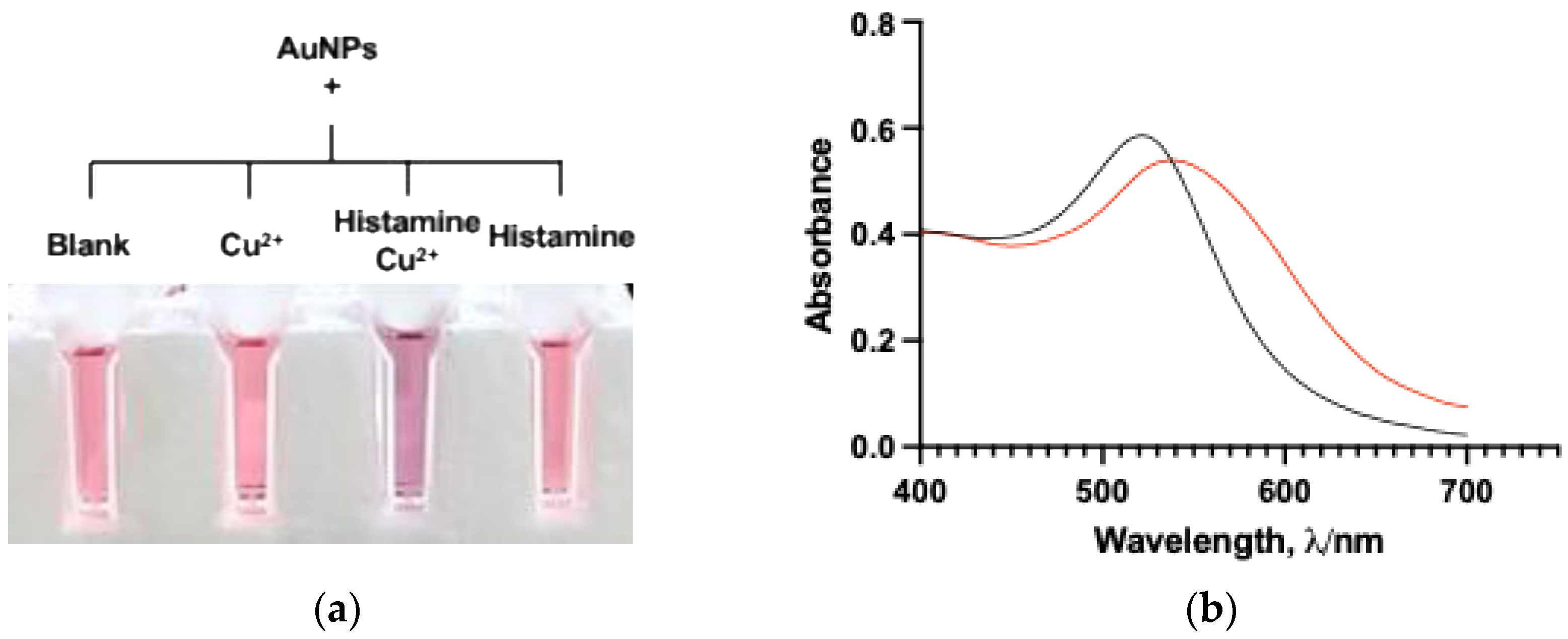
Colorimetric detection of histamine using citrate-stabilized AuNPs and Cu2+ was successfully demonstrated. The solution showed a clear color change when histamine and Cu2+ were present (Figure 1a). Neither Cu2+ alone nor histamine alone induced significant spectral changes in the AuNPs, indicating that both components are required for the sensing mechanism. UV-vis spectra confirmed these observations (Figure 1b). Without histamine, the AuNPs solution exhibited a sharp absorption peak at 520 nm (black line), characteristic of well-dispersed nanoparticles. Upon addition of histamine and Cu2+, the sharp absorption peak at 520 nm decreased in intensity, and the spectrum broadened toward longer wavelengths (red line), consistent with coordination-induced changes in the nanoparticle optical properties.

3.2. Assay Sensitivity

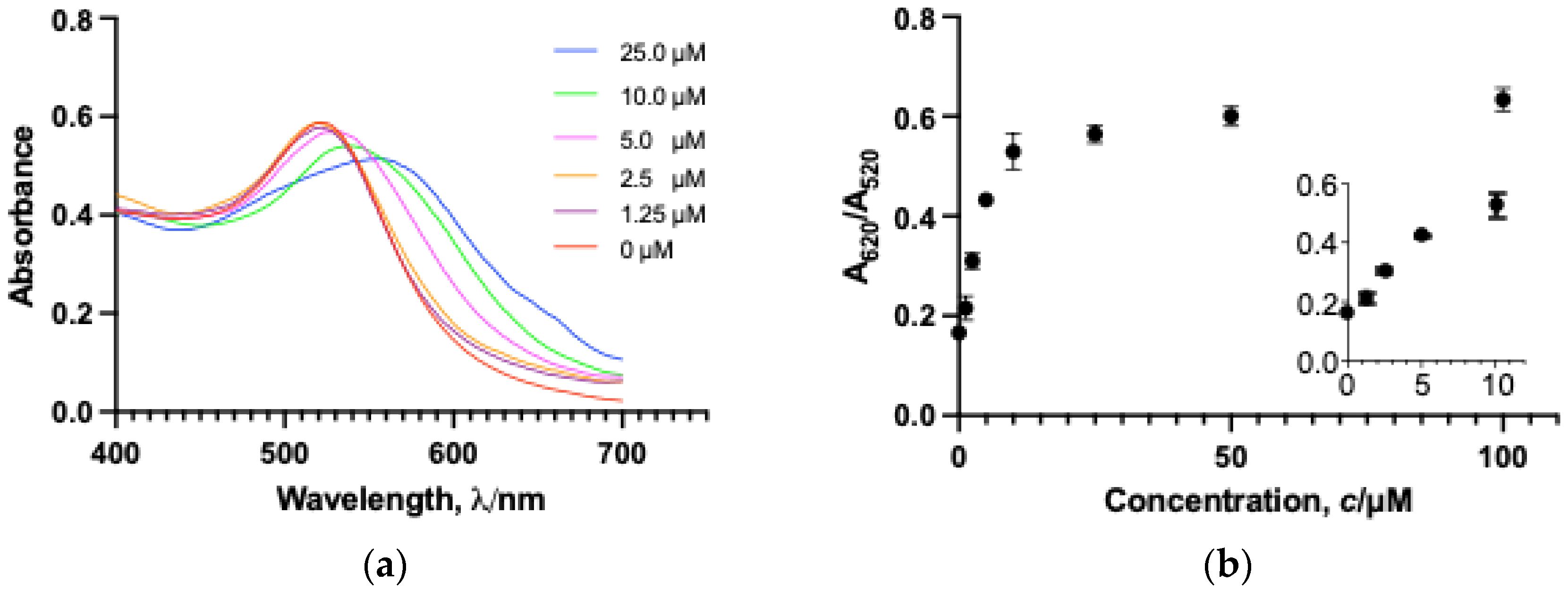
Figure 2a shows the UV-vis spectra obtained with different histamine concentrations. As histamine concentration increased from 0 to 100 μM, the absorption peak at 520 nm progressively decreased in intensity, while the spectrum broadened toward the red region, demonstrating the concentration-dependent optical response of the sensor system. The ratio of absorbance at 620 nm to 520 nm (A620/A520) was calculated for each histamine concentration (Figure 2b). The ratio increased in a concentration-dependent manner, and the response was linear in the range of 1.25–10 μM (R2 = 0.953). The limit of detection (LOD) calculated using Equation (1) was 0.95 μM.

3.3. Assay Kinetics and Colloidal Stability

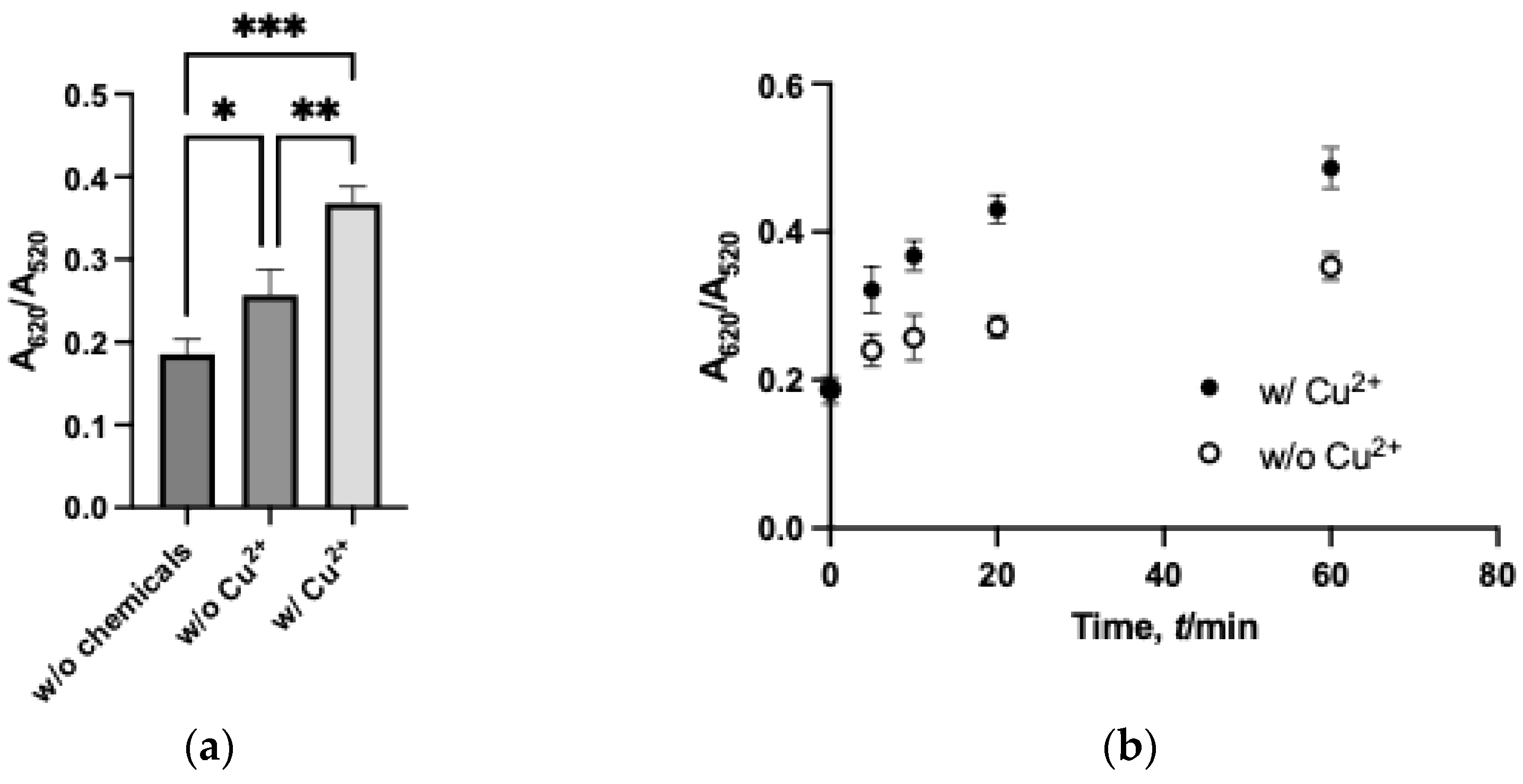
At 10 μM histamine, the endpoint response after 5 min was significantly higher with Cu2+ than without it (Figure 3a), indicating that histamine alone produces only a modest change in the plasmonic signal. Thus, Cu2+ markedly accelerates and amplifies the aggregation of citrate-stabilized AuNPs in response to histamine under our experimental conditions. Figure 3b shows how the A620/A520 response changes over time after the addition of histamine (10 μM) with or without Cu2+ (30 μM). With Cu2+ present, the A620/A520 response increased rapidly and reached a plateau within 20 min, whereas without Cu2+, the A620/A520 remained minimal even after 60 min.

3.4. Effect of Buffer Conditions

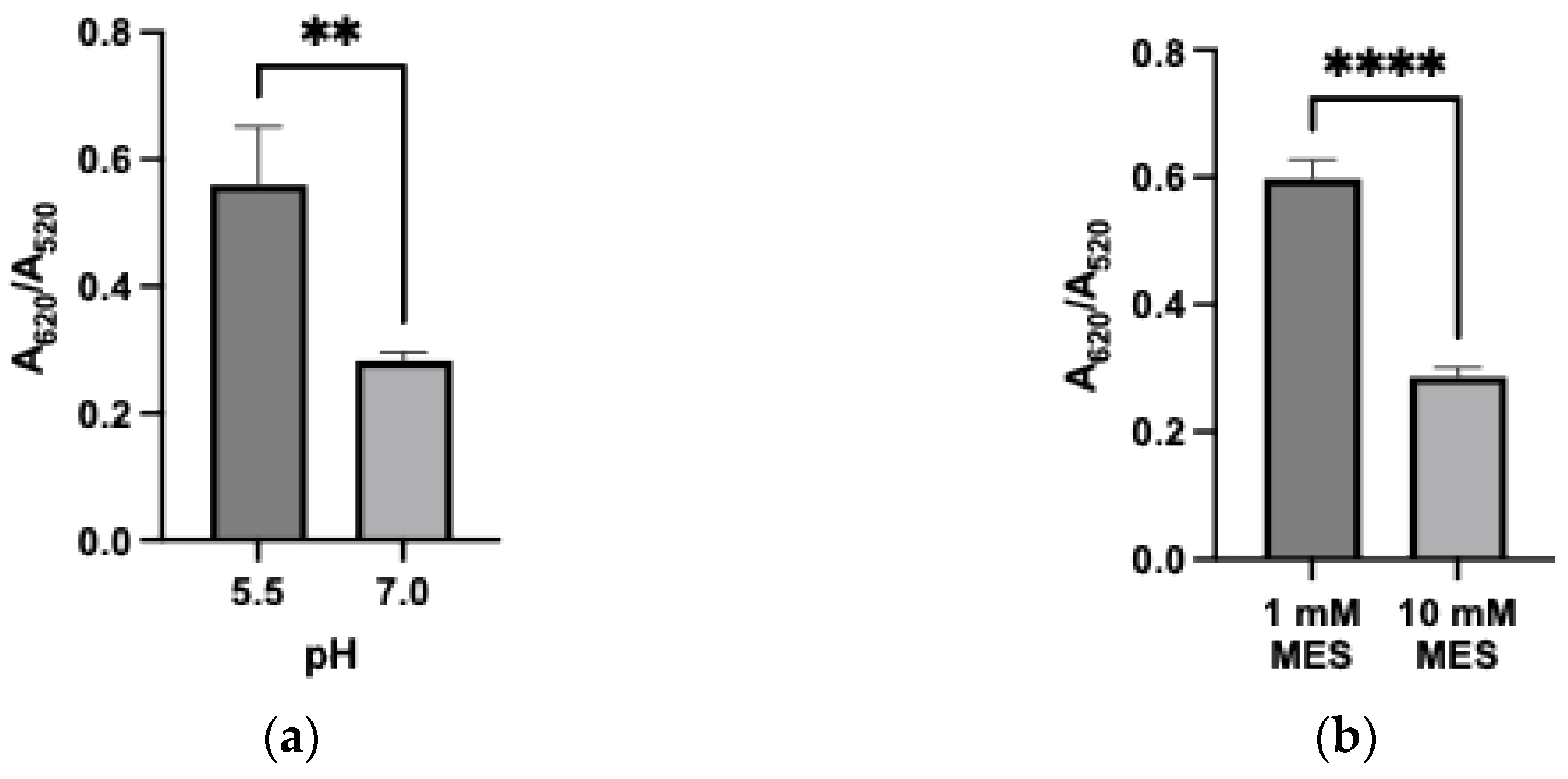
Figure 4 shows the A620/A520 response at different buffer conditions. At pH 5.5 using 1 mM MES buffer, the A620/A520 response increased markedly, whereas with 1 mM HEPES buffer at pH 7.0, the A620/A520 response was much lower (Figure 4a). This behavior is consistent with histamine speciation and the dual-recognition mechanism: around pH 5–6, histamine is predominantly doubly protonated, which enhances its electrostatic adsorption onto the negatively charged citrate-coated AuNPs, while the imidazole group can still coordinate to Cu2+. Both steps therefore operate more efficiently at pH 5.5 than at pH 7.0. These results indicate that the assay performs optimally under mildly acidic conditions, likely due to enhanced electrostatic interactions between protonated histamine and the negatively charged AuNP surface. To evaluate the effect of buffer concentration on sensor performance, we tested 1 mM and 10 mM MES (Figure 4b). Increasing the MES concentration decreased the sensor response. This is readily explained by ionic-strength effects: higher buffer concentration shortens the Debye length and screens electrostatic interactions between the protonated histamine and the citrate layer on the AuNPs, which in turn weakens the formation of Cu2+-bridged aggregates. These results highlight that the Cu2+-mediated dual-recognition scheme requires low ionic strength to maintain a strong response, indicating that higher buffer concentration decreases the response, possibly due to increased ionic strength affecting electrostatic interactions between histamine and the AuNP surface.

3.5. Effect of Metal Cation

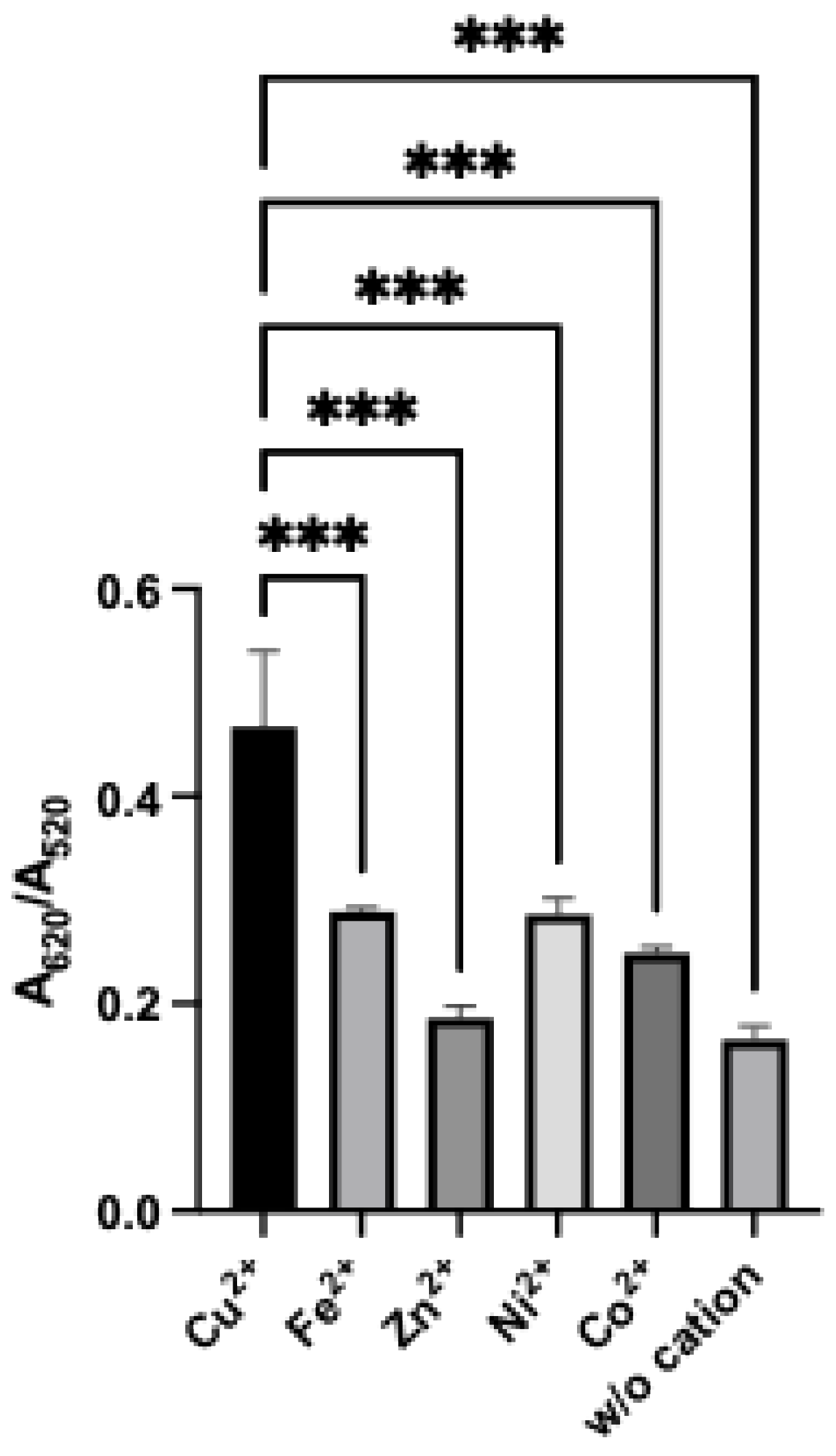
Figure 5 shows the A620/A520 response obtained at pH 5.5 when Cu2+ was replaced by other divalent metal ions (30 μM each). Cu2+ produced the largest response, confirming its key role as the bridging ion facilitating interparticle coupling in the assay. The absorbance spectra with Zn2+ showed no significant response compared to the control without metal ions, consistent with its weak affinity for imidazole nitrogen atoms. Fe2+, Ni2+ and Co2+ produced intermediate responses, reflecting their moderate binding affinity for histamine.

3.6. Assay Selectivity

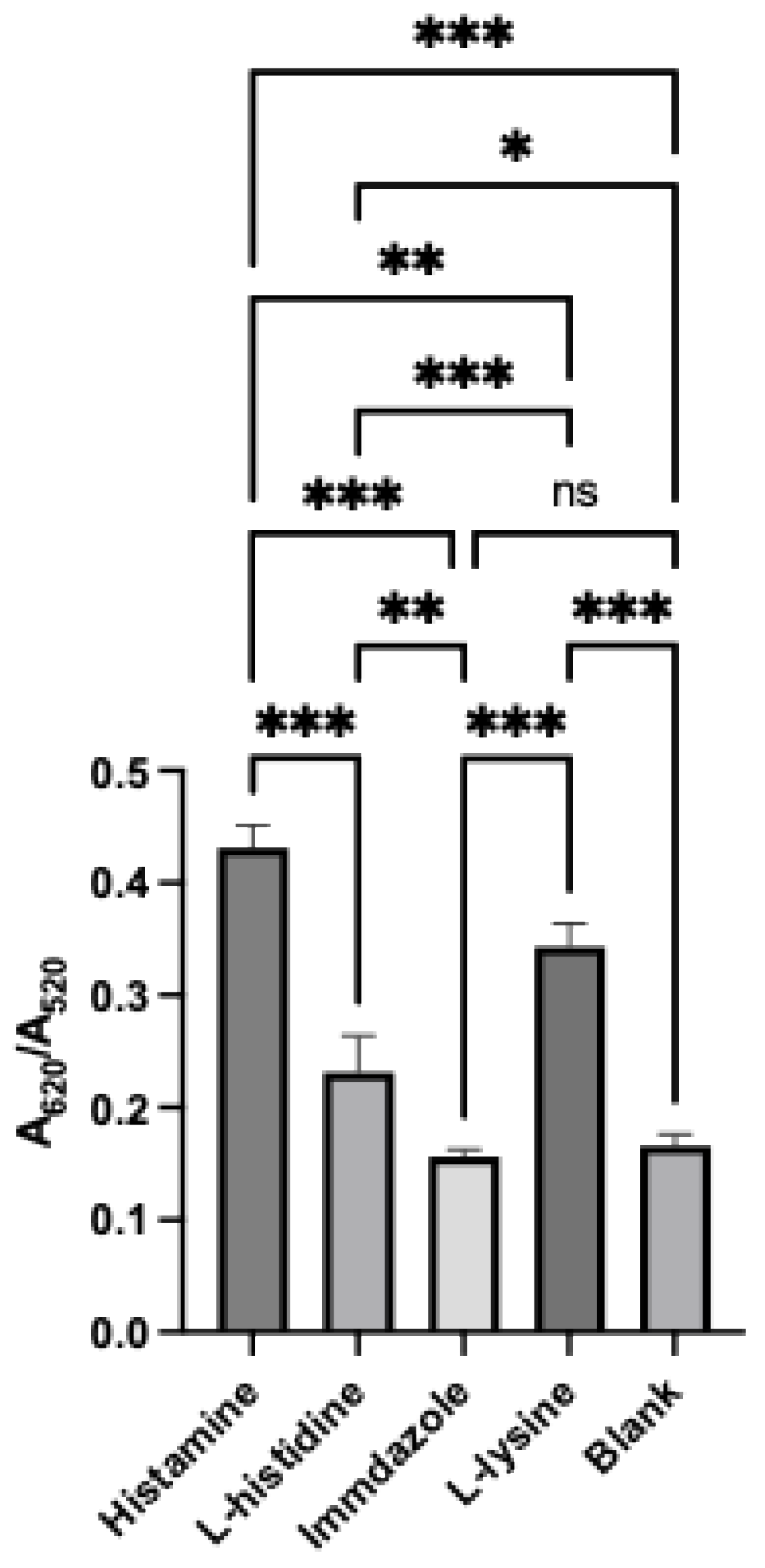
Selectivity was evaluated by comparing the sensor response to histamine with that of structural analogs, including L-histidine, L-tryptophan, imidazole, and L-lysine (Figure 6). L-histidine produced a significantly lower response than histamine, whereas L-tryptophan and imidazole showed no statistically significant response compared to the blank control. L-lysine, which contains two amino groups but lacks an imidazole ring, gave a response similar to L-histidine. These results demonstrate high selectivity for histamine over the tested structural analogs.

4. Discussion

The colorimetric response of citrate-stabilized AuNPs follows a dual-recognition mechanism. First, histamine molecules are electrostatically adsorbed onto the AuNP surface. At pH 5.5, histamine carries a positive charge due to protonation of its amino group, facilitating strong electrostatic interactions with the negatively charged citrate layer of the AuNPs. Second, Cu2+ ions coordinate with the imidazole rings of histamine molecules, creating interparticle coupling between neighboring AuNPs. This coordination-driven assembly results in enhanced plasmonic coupling, as evidenced by the characteristic spectral shift from 520 nm to longer wavelengths with peak broadening (Figure 1b). According to Haiss et al., which correlates absorption wavelength with effective particle size and interparticle distance [39], these spectral changes indicate increased effective particle size due to the close proximity of coupled nanoparticles, confirming the proposed dual-recognition mechanism.
Several lines of evidence support this mechanism over alternative explanations. First, simple surface adsorption of histamine or Cu2+ alone would not produce the pronounced spectral changes observed, as confirmed by our control experiments showing minimal response with individual components. Second, the rapid kinetics (plateau within 20 min) and stable response argue against particle growth mechanisms, which typically require extended reaction times and reducing conditions not present in our system. Third, the absence of gold ions in the reaction mixture precludes nanoparticle growth through metal deposition. While direct morphological characterization through transmission electron microscopy (TEM) or dynamic light scattering (DLS) would provide more definitive evidence for the proposed interparticle assembly, the combination of spectroscopic evidence, kinetic behavior, and chemical reasoning provides robust support for the dual-recognition mechanism involving histamine-mediated interparticle coupling enhanced by Cu2+ coordination.
Cu2+ demonstrates superior performance compared to other metal cations due to its enhanced binding affinity for histamine. The Irving–Williams series predicts that complex stability follows the order Mn(II) < Fe(II) < Co(II) < Ni(II) < Cu(II) > Zn(II) [40], making Cu2+ the optimal choice for this dual-recognition mechanism. For effective interparticle coupling, the metal ion must coordinate with the imidazole rings of histamine molecules on neighboring particles simultaneously. Cu2+ is particularly effective in this coordination role, with reported stability constants for Cu2+–histamine complexes (log K1 = 9.56, log K2 = 6.50) being significantly higher than those of other divalent metal ions such as Ni2+ (log K1 = 6.82, log K2 = 5.05) and Zn2+ (log K1 = 5.21, log K2 = 4.92) [41]. In contrast, other metal ions show lower binding affinities: Co2+ and Ni2+ form moderately stable complexes, Fe2+ shows intermediate binding, while Zn2+ suffers from kinetic limitations and partial hydrolysis at pH 5.5, rendering it ineffective for rapid sensor applications. Therefore, Cu2+ produces an immediate color change, whereas Ni2+ and Co2+ generate weaker signals, and Zn2+ remains inactive. This selectivity pattern is fully consistent with the Irving–Williams series, confirming that metal–histamine complex stability is the key factor determining the coordination efficiency in our sensor system.
The assay reaches a plateau within 20 min and remains stable for at least 3 h, demonstrating excellent temporal stability. The sensor response is linear over the range of 1.25–10 μM with a detection limit of 0.95 μM (Table 1). While advanced analytical methods such as HPLC or ELISA can achieve nanomolar detection limits, our assay provides sufficient sensitivity to monitor histamine in the micromolar range in simple buffered model systems. Mast cell and basophil degranulation can release histamine at concentrations ranging from 0.1 to 10 μM [3,4], so the present detection limit of 0.95 μM is compatible with in vitro studies that use micromolar histamine levels. However, additional optimization and matrix-tolerant designs would be required for direct measurements in complex biofluids.
Compared to other colorimetric approaches for histamine detection (Table 1), our sensor exhibits competitive sensitivity while using unmodified AuNPs without complex surface functionalization and a Cu2+-mediated dual-recognition mechanism that can be systematically tuned by pH and ionic strength. The metal ion-enhanced dual-recognition mechanism provides a simple model that could potentially be extended to other biogenic amines or adapted to different pH ranges through strategic metal ion selection. The assay performance is optimized under mildly acidic conditions (pH 5.5). At pH values above 7.0, sensitivity decreases due to reduced availability of Cu2+ ions for coordination. Strong metal chelating agents such as EDTA can interfere with the assay by sequestering Cu2+ ions. Additionally, very high ionic strength conditions may disrupt the electrostatic interactions between protonated histamine and the citrate-stabilized AuNP surface, potentially affecting sensor performance.
Beyond analytical performance, this Cu2+-enhanced colorimetric assay offers potential advantages for cellular biosensing applications. The consistent spectroscopic response and its correlation with histamine concentration demonstrate the reliability of the sensing mechanism for practical applications. While future studies incorporating morphological characterization could provide deeper mechanistic insights, the current approach provides a functional platform for histamine detection. The pH-dependent performance observed with Cu2+ suggests that the operational pH range could potentially be extended through strategic metal ion selection. Alternative metal ions with different coordination properties and hydrolysis behavior might enable sensor operation under varied pH conditions while maintaining the dual-recognition mechanism. Such metal ion optimization could represent a promising avenue for developing versatile histamine sensors suitable for diverse analytical applications.
This proof-of-concept study focuses on assay chemistry under low ionic strength conditions (1 mM MES, pH 5.5). Direct structural visualization of nanoparticle clustering (e.g., TEM, DLS, or ζ-potential measurements) and validation in complex biological samples were not conducted in this work. Such post-analyses of the nanoparticle aggregates would likely provide additional structural insight into the dual-recognition mechanism and would be an interesting subject for future studies.

5. Conclusions

A Cu2+-enhanced colorimetric sensor for histamine detection was developed using citrate-stabilized gold nanoparticles. The sensor operates through a dual-recognition mechanism involving electrostatic adsorption of protonated histamine onto the AuNP surface, followed by Cu2+-mediated coordination between imidazole rings, resulting in characteristic plasmonic coupling and a colorimetric response. This sensor demonstrates a detection limit of 0.95 μM with linear response over 1.25–10 μM, high selectivity over structural analogs, and a total analysis time of less than 30 min. The metal-enhanced recognition strategy was characterized under controlled buffer conditions (pH 5.5), providing stable and reproducible measurements. Although this micromolar LOD is higher than that reported for some more elaborate AuNP-based platforms, it is sufficient to monitor histamine in simple buffered model systems and in vitro studies that use micromolar histamine levels. This proof-of-concept study establishes a mechanistic framework for AuNP-based histamine sensing, with the dual-recognition mechanism offering potential for adaptation to varied analytical applications through strategic metal ion selection and pH optimization.

Funding

This research received no external funding.

Data Availability Statement

The data that support the findings of this study are available from the corresponding author upon reasonable request.

Conflicts of Interest

The authors declare no conflict of interest.

References

  1. Qian, H.; Shu, C.; Xiao, L.; Wang, G. Histamine and histamine receptors: Roles in major depressive disorder. Front. Psychiatry 2022, 13, 825591. [Google Scholar] [CrossRef]
  2. Szukiewicz, D. Histaminergic System Activity in the Central Nervous System: The Role in Neurodevelopmental and Neurodegenerative Disorders. Int. J. Mol. Sci. 2024, 25, 9859. [Google Scholar] [CrossRef]
  3. Guo, X.; Lei, Y.; Xu, Y.; Du, X.; Lin, L.; Luo, Y.; Xi, Y.; Guo, Y.; Niu, X.; Wang, Z.; et al. PRL2 negatively regulates FcεRI mediated activation of mast cells. Cell Death Dis. 2025, 16, 322. [Google Scholar] [CrossRef]
  4. Zhou, Z.-W.; Zhu, X.-Y.; Li, S.-Y.; Lin, S.-E.; Zhu, Y.-H.; Ji, K.; Chen, J.-J. Formononetin Inhibits Mast Cell Degranulation to Ameliorate Compound 48/80-Induced Pseudoallergic Reactions. Molecules 2023, 28, 5271. [Google Scholar] [CrossRef] [PubMed]
  5. Mohammadi-Pilehdarboni, H.; Rasouli, M. Histamine H1- and H2-receptors participate to provide metabolic energy differently. Fundam. Clin. Pharmacol. 2022, 36, 1031–1037. [Google Scholar] [PubMed]
  6. Ince, M.; Ruether, P. Histamine and antihistamines. Anaesth. Intensive Care Med. 2021, 22, 749–755. [Google Scholar]
  7. Kou, E.; Zhang, X.; Dong, B.; Wang, B.; Zhu, Y. Combination of H1 and H2 histamine receptor antagonists: Current knowledge and perspectives of a classic treatment strategy. Life 2024, 14, 164. [Google Scholar] [CrossRef]
  8. Carthy, E.; Elender, T. Histamine, Neuroinflammation and neurodevelopment: A review. Front. Neurosci. 2021, 15, 680214. [Google Scholar] [CrossRef]
  9. Barocelli, E.; Ballabeni, V. Histamine in the control of gastric acid secretion: A topic review. Pharmacol. Rev. 2003, 47, 299–304. [Google Scholar]
  10. Tuomisto, L.; Lozeva, V.; Valjakka, A.; Lecklin, A. Modifying effects of histamine on circadian rhythms and neuronal excitability. Behav. Brain Res. 2001, 124, 129–135. [Google Scholar] [CrossRef]
  11. Mehta, P.; Miszta, P.; Filipek, S. Molecular modeling of histamine receptors—Recent advances in drug discovery. Molecules 2021, 26, 1778. [Google Scholar] [CrossRef]
  12. Yang, F.; Limjunyawong, N.; Peng, Q.; Schroeder, J.T.; Saini, S.; MacGlashan, D., Jr.; Dong, X.; Gao, L. Biological screening of a unique drug library targeting MRGPRX2. Front. Immunol. 2022, 13, 997389. [Google Scholar] [CrossRef] [PubMed]
  13. Chen, S.S.; Gong, J.; Liu, F.T.; Mohammed, U. Naturally occurring polyphenolic antioxidants modulate IgE-mediated mast cell activation. Immunology 2000, 100, 471–480. [Google Scholar] [CrossRef] [PubMed]
  14. Hu, X.; Bian, X.; Gu, W.Y.; Sun, B.; Gao, X.; Wu, J.L.; Li, N. Stand out from matrix: Ultrasensitive LC-MS/MS method for determination of histamine in complex biological samples using derivatization and solid phase extraction. Talanta 2021, 225, 122056. [Google Scholar] [CrossRef] [PubMed]
  15. Zhang, X.; Wang, J.; Hasan, E.; Sun, X.; Asif, M.; Aziz, A.; Lu, W.; Dong, C.; Shuang, S. Bridging biological and food monitoring: A colorimetric and fluorescent dual-mode sensor based on N-doped carbon dots for detection of pH and histamine. J. Hazard. Mater. 2024, 470, 134271. [Google Scholar] [CrossRef]
  16. Komori, K.; Komatsu, Y.; Nakane, M.; Sakai, Y. Bioelectrochemical detection of histamine release from basophilic leukemia cell line based on histamine dehydrogenase-modified cup-stacked carbon nanofibers. Bioelectrochemistry 2021, 138, 107719. [Google Scholar] [CrossRef]
  17. Chen, Z.; Xie, J.; Mei, J. A Review on Analytical Techniques for Quantitative Detection of Biogenic Amines in Aquatic Products. Chemosensors 2024, 12, 274. [Google Scholar] [CrossRef]
  18. Kumalasaari, M.R.; Alfanaar, R.; Andreani, A.S. Gold nanoparticles (AuNPs): A versatile material for biosensor application. Talanta Open 2024, 9, 100327. [Google Scholar] [CrossRef]
  19. Aldewach, H.; Chalati, T.; Woodroofe, M.N.; Bricklebank, N.; Sharrack, B.; Gardiner, P. Gold nanoparticle-based colorimetric biosensors. Nanoscale 2018, 10, 18–33. [Google Scholar] [CrossRef]
  20. Xu, R.; Cheng, Y.; Qi, X.; Li, X.; Zhang, Z.; Chen, L.; Sun, T.; Gao, Z.; Zhu, M. Target-induced gold nanoparticles colorimetric sensing coupled with aptamer for rapid and high-sensitivity detecting kanamycin. Anal. Chim. Acta 2022, 1230, 340377. [Google Scholar] [CrossRef]
  21. Wen, J.; Zhu, Y.; Liu, J.; He, D. Smartphone-based surface plasmon resonance sensing platform for rapid detection of bacteria. RSC Adv. 2022, 12, 13045. [Google Scholar] [CrossRef]
  22. Hua, Z.; Yu, T.; Liu, D.; Xianyu, Y. Recent advances in gold nanoparticles-based biosensors for food safety detection. Biosens. Bioelectron. 2021, 179, 113076. [Google Scholar] [CrossRef] [PubMed]
  23. Omping, J.; Unabia, R.; Reazo, L.; Lapening, M.; Lumod, R.; Ruda, A.; Rivera, R.B.; Sayson, N.L.; Latayada, F.; Capangpangan, R.; et al. Facile synthesis of PEGylated gold nanoparticles for enhanced colorimetric detection of histamine. ACS Omega 2024, 9, 14269–14278. [Google Scholar] [CrossRef] [PubMed]
  24. Rivera, R.B.P.; Unabia, R.B.; Reazo, R.L.D.; Lapening, M.A.; Lumod, R.M.; Ruda, A.G.; Omping, J.L.; Magdadaro, M.R.D.; Sayson, N.L.B.; Latayada, F.S.; et al. Influence of the gold nanoparticle size on the colorimetric detection of histamine. ACS Omega 2024, 9, 33652–33661. [Google Scholar] [CrossRef] [PubMed]
  25. Huang, C.; Wang, S.; Zhao, W.; Zong, C.; Liang, A.; Zhang, Q.; Liu, X. Visual and photometric determination of histamine using unmodified gold nanoparticles. Microchim. Acta 2017, 184, 2249–2254. [Google Scholar] [CrossRef]
  26. Bi, J.; Tian, C.; Zhang, G.L.; Hao, H.; Hou, H.M. Detection of Histamine Based on Gold Nanoparticles with Dual Sensor System of Colorimetric and Fluorescence. Foods 2020, 9, 316. [Google Scholar] [CrossRef]
  27. El-Nour, K.M.A.; Salam, E.T.A.; Soliman, H.M.; Orabi, A. Gold Nanoparticles as a Direct and Rapid Sensor for Sensitive Analytical Detection of Biogenic Amines. Nanoscale Res. Lett. 2017, 12, 231. [Google Scholar] [CrossRef]
  28. Unabia, R.B.; Reazo, R.L.D.; Rivera, R.R.B.P.; Lapening, M.A.; Omping, J.L.; Lumod, R.M.; Ruda, A.G.; Sayson, N.L.B.; Dumancas, G.; Malaluan, R.M.; et al. Dopamine-functionalized gold nanoparticles for colorimetric detection of histamine. ACS Omega 2024, 9, 17238–17246. [Google Scholar] [CrossRef]
  29. Shaikh, T.; Tan, E.M.M.; Cingil, H.E. L-cysteine gold nanoparticles for colorimetric and electrochemical detection of spermine and histamine. Microchem. J. 2024, 207, 112196. [Google Scholar] [CrossRef]
  30. Lapenna, A.; Dell’Aglio, M.; Palazzo, G.; Mallardi, A. “Naked” gold nanoparticles as colorimetric reporters for biogenic amine detection. Colloids Surf. A 2020, 600, 124903. [Google Scholar] [CrossRef]
  31. Lerga, T.M.; Skouridou, V.; Bermudo, M.C.; Bashammakh, A.S.; El-Shahawi, M.S.; Alyoubi, A.O.; O’Sullivan, C.K. Gold nanoparticle aptamer assay for the determination of histamine in foodstuffs. Microchim. Acta 2020, 187, 452. [Google Scholar] [CrossRef]
  32. Li, H.; Gan, J.; Yang, Q.; Fu, L.; Wang, Y. Colorimetric detection of food freshness based on amine-responsive dopamine polymerization on gold nanoparticles. Talanta 2021, 234, 122706. [Google Scholar] [CrossRef]
  33. Ling, X.; Liu, Y.; Zhu, D.; Umapathi, R.; Oh, S.Y.; Cho, Y.; Huh, Y.S. Colorimetric visualization of histamine secreted by basophils based on DSP-functionalized gold nanoparticles. Anal. Methods 2022, 14, 269–2702. [Google Scholar] [CrossRef]
  34. Choi, N.; Park, B.; Lee, M.J.; Umapathi, R.; Oh, S.Y.; Cho, Y.; Huh, Y.S. Fabrication of Carbon Disulfide Added Colloidal Gold Colorimetric Sensor for the Rapid and On-Site Detection of Biogenic Amines. Sensors 2021, 21, 1738. [Google Scholar] [CrossRef]
  35. Rivera, R.B.P.; Lumod, R.M.; Unabia, R.B.; Reazo, R.L.D.; Ruda, A.G.; Lapening, M.A.; Omping, J.L.; Ceniza, A.P.; Sayson, N.L.B.; Latayada, F.S.; et al. Paper-based colorimetric sensor for histamine detection using dopamine-functionalized, size-varied gold nanoparticles. Sci. Rep. 2025, 15, 36148. [Google Scholar]
  36. Zhang, M.; Liu, Y.Q.; Ye, B.C. Rapid and sensitive colorimetric visualization of phthalates using UTP-modified gold nanoparticles cross-linked by copper(ii). Chem. Commun. 2011, 47, 11849–11851. [Google Scholar]
  37. Wu, Y.; Liu, R.; Huang, Z. Dual-channel colorimetric sensor based on metal ion mediated color transformation of AuNPs to identify the authenticity and origin of Atractylodis macrocephalae Rhizoma. Sens. Actuators B 2024, 400, 134920. [Google Scholar]
  38. Rasouli, Z.; Ghavami, R. Enhanced Sensitivity to Detection Nanomolar Level of Cu2+ Compared to Spectrophotometry Method by Functionalized Gold Nanoparticles: Design of Sensor Assisted by Exploiting First-order Data with Chemometrics. Spectrochim. Acta Part A Mol. Biomol. Spectrosc. 2018, 191, 336–344. [Google Scholar] [CrossRef]
  39. Haiss, W.; Thanh, N.T.K.; Aveyard, J.; Fering, D.G. Determination of size and concentration of gold nanoparticles from UV-vis spectra. Anal. Chem. 2007, 79, 4215–4221. [Google Scholar]
  40. Irving, H.; Williams, R.J.P. The stability of transition-metal complexes. J. Chem. Soc. 1953, 3192–3210. [Google Scholar] [CrossRef]
  41. Sjöberg, S. Critical evaluation of stability constants of metal-imidazole and metal-histamine systems. Pure Appl. Chem. 1997, 69, 1549–1570. [Google Scholar] [CrossRef]
Figure 1. Colorimetric detection of histamine using Cu2+. (a) Color changes of AuNP solutions; + denotes the addition of AuNP in that step. (b) UV-vis absorption spectra of AuNPs in the absence (black) and presence (red) of histamine (10 μM) and Cu2+. Absorption spectra were measured 20 min after the addition of Cu2+.
Biophysica 05 00059 g001
Figure 2. Histamine concentration dependency of the sensor response. (a) UV-vis absorption spectra of AuNPs at 0–25 μM histamine concentrations. (b) Sensor response represented by the ratio of absorbance values at 620 and 520 nm; the inset shows an expanded view of the low-concentration range (0–10 μM). The data represent the mean ± SD (n = 3).
Biophysica 05 00059 g002
Figure 3. Effect of histamine and Cu2+ on the plasmonic response of citrate-stabilized AuNPs. (a) Endpoint sensor response (A620/A520) at 10 μM histamine after 20 min incubation for AuNPs alone (0 μM histamine), histamine without Cu2+, and histamine with Cu2+. Bars indicate mean ± SD (n = 3). (b) Change in sensor response with incubation time after Cu2+ addition. The data represent the mean ± SD (n = 3). * represents p < 0.05, ** represents p < 0.01, and *** represents p < 0.005, respectively.
Biophysica 05 00059 g003
Figure 4. Effect of buffer conditions on the sensor response. (a) Effect of buffer pH using 1 mM MES and HEPES (pH 7.0). (b) Effect of buffer concentration at pH 5.5. Histamine (10 μM) was added in both experiments. The data represent the mean ± SD (n = 3). ** represents p < 0.01, and **** represents p < 0.001, respectively.
Biophysica 05 00059 g004
Figure 5. Sensor responses to AuNPs, histamine (10 μM), and various metal cations at pH 5.5. The data represent the mean ± SD (n = 3). *** represents p < 0.005.
Biophysica 05 00059 g005
Figure 6. Selectivity of the sensor response. The concentrations of all species were 10 μM. The data represent the mean ± SD (n = 3). * represents p < 0.05, ** represents p < 0.01, *** represents p < 0.005, and ns represents no significant difference, respectively.
Biophysica 05 00059 g006
Table 1. Performance comparison of AuNP-based colorimetric histamine sensors.
Mechanistic CategorySurface
Modification
Linear
Range
Detection
Limit
Ref.
Dual recognition (electrostatic interaction and metal ion coordination)Citrate1.25–10 μM0.95 μMThis work
Electrostatic interaction and/or hydrogen bondsPEG180–895 μM *
(20–100 ppm)
9.357 μM[23]
Citrate9–90 μM *
(1–10 ppm)
0.72 μM[24]
Citrate0.1–2.1 μM0.038 μM[25]
Citrate0.001–10.0 μM0.87 nM[26]
Citrate45–105 μM0.6μM[27]
Dopamine9–90 μM *
(1–10 ppm)
0.426 μM[28]
L-cysteine1–10 μM3.7 μM[29]
Naked0.2–0.4μM0.2μM[30]
Aptamer-basedH2 aptamer19–70 nM8 nM[31]
Dopamine polymerizationPEG9–900 μM *
(1–100 μg/mL)
25 μM *
(2.8 μg/mL)
[32]
Chemical reactiondithiobis(succinimidylpropionate) (DSP)0.8–2.5 μM0.014 μM[33]
Dithiocarbamate (DTC–BA)ND50 μM (total biogenic amines)[34]
* Concentrations were converted from original units using histamine MW = 111.15 g/mol. For ppm values, density = 1.0 g/mL was assumed. Original units are shown in parentheses.
Disclaimer/Publisher’s Note: The statements, opinions and data contained in all publications are solely those of the individual author(s) and contributor(s) and not of MDPI and/or the editor(s). MDPI and/or the editor(s) disclaim responsibility for any injury to people or property resulting from any ideas, methods, instructions or products referred to in the content.