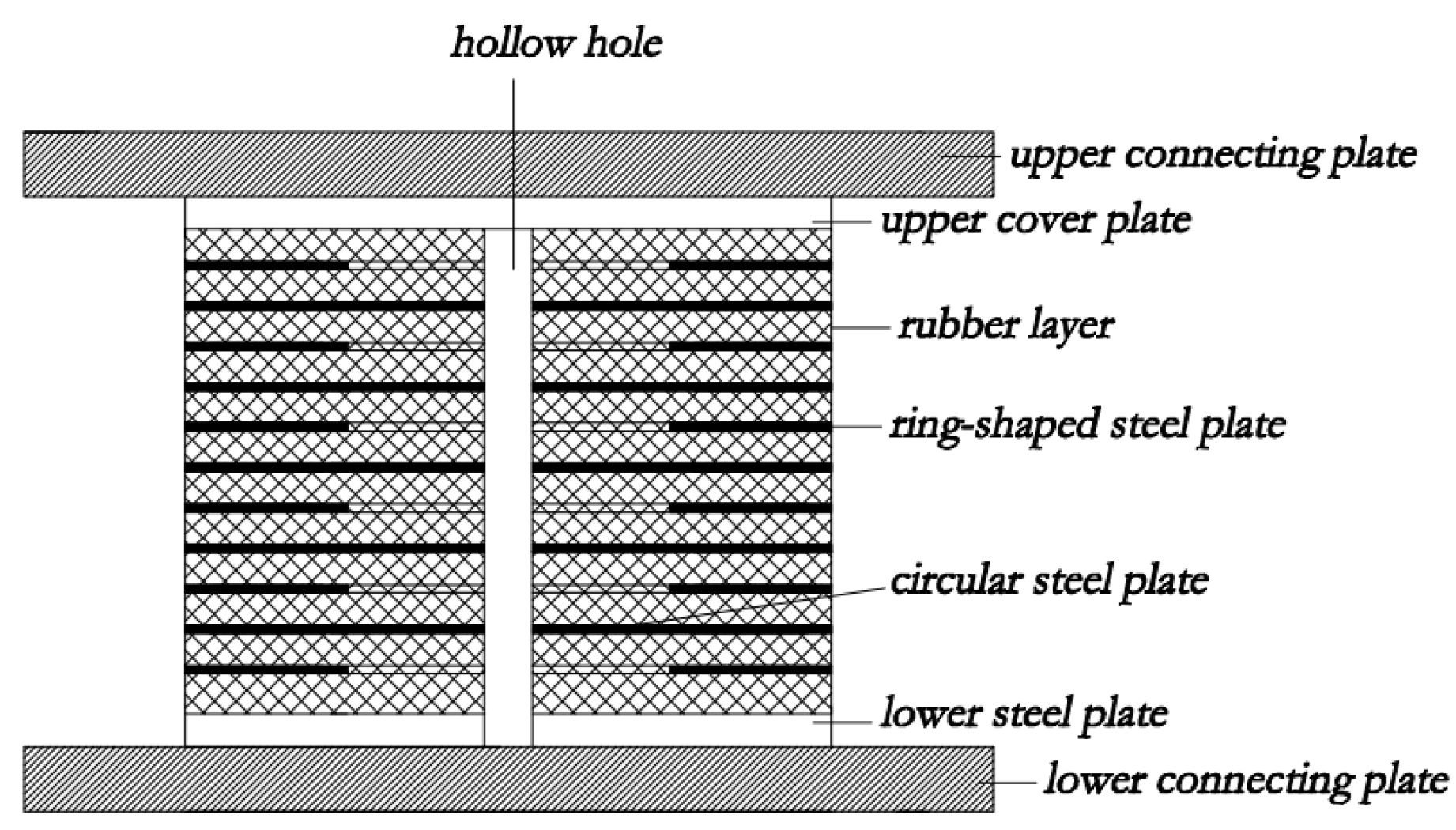

Design and Performance Study of Stiffness-Reduced Rubber Isolation Bearings

Abstract
1. Introduction
2. Stiffness Calculation Model of Stiffness-Reduced Isolation Bearing
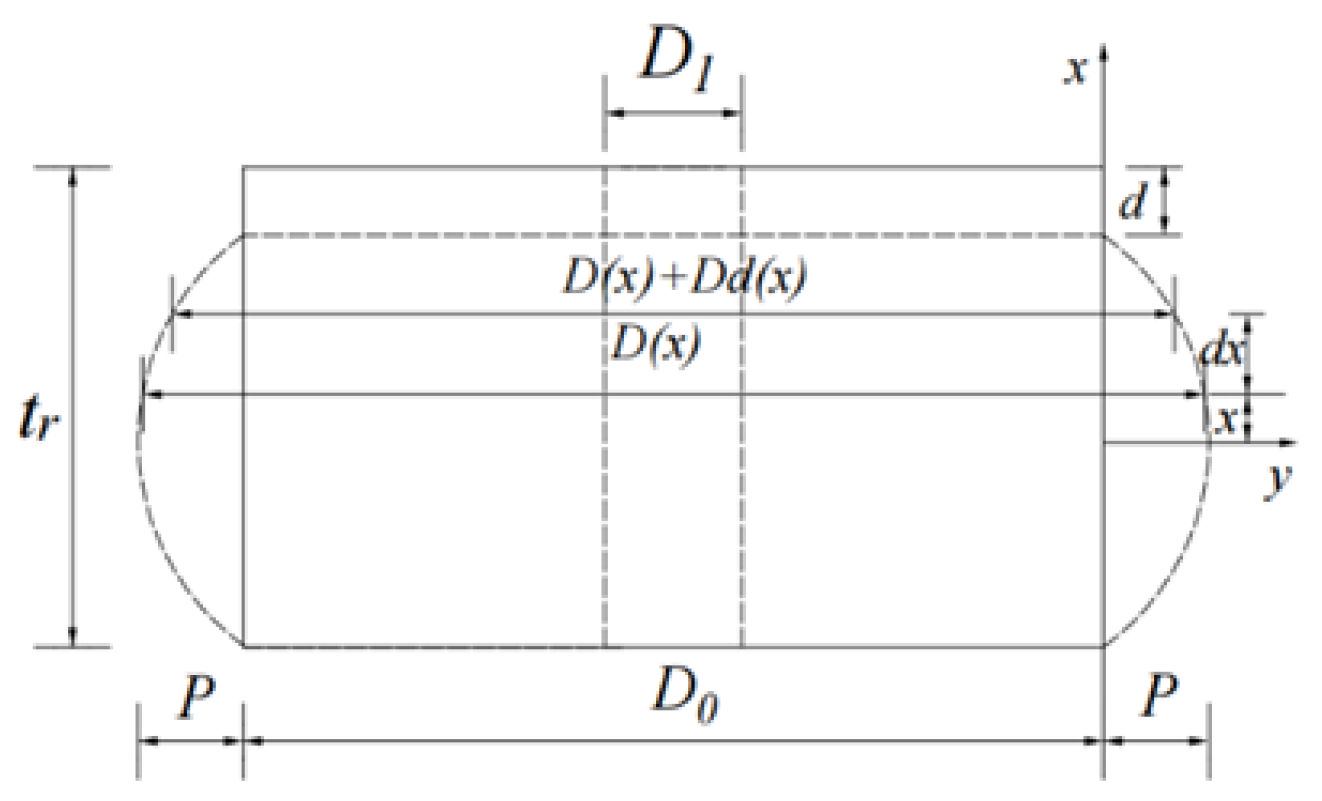
2.1. Vertical Stiffness Calculation of Inner Thick-Layer Rubber Bearing
2.2. Vertical Stiffness Calculation of the Outer Laminated Rubber Bearing
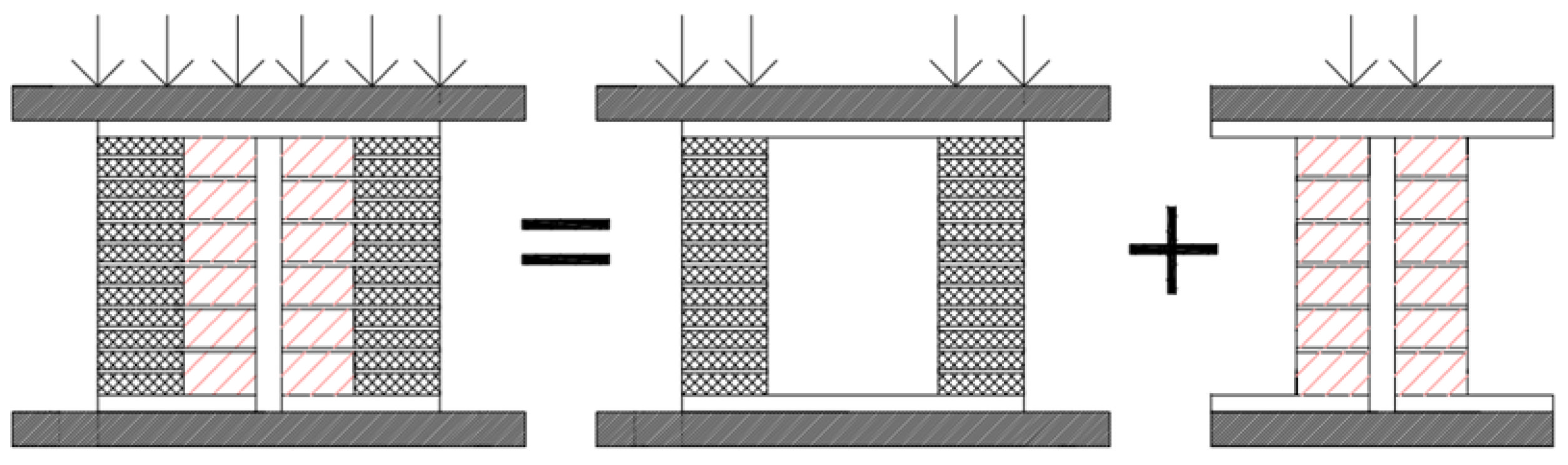
2.3. Vertical Stiffness Calculation Model of the Stiffness-Reduced Isolation Bearing
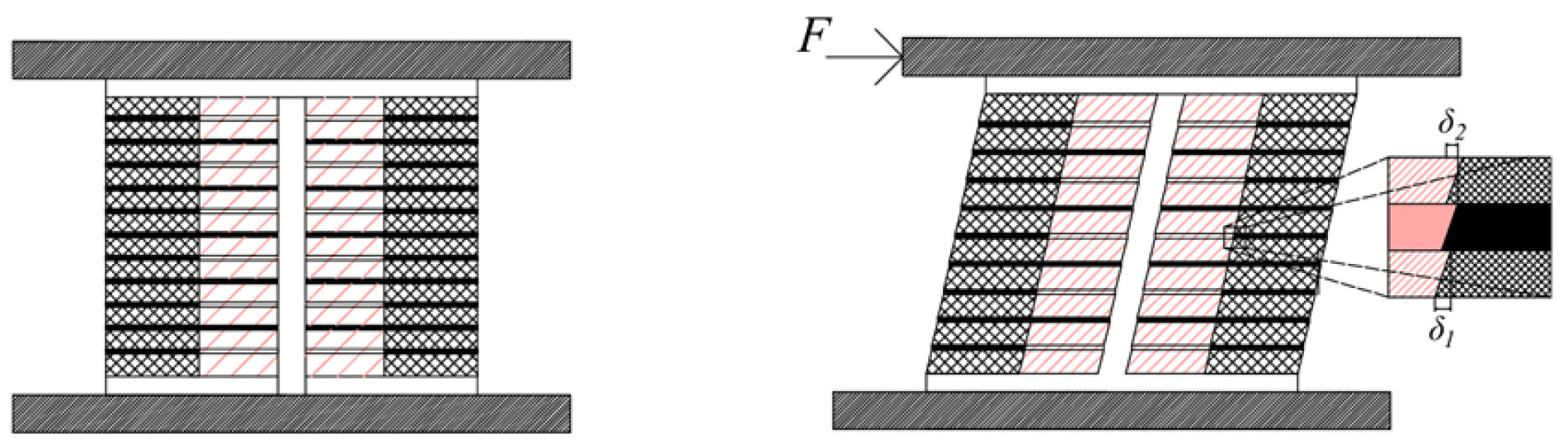
2.4. Horizontal Stiffness Calculation Model of the Stiffness-Reduced
3. Experimental Study and Analysis
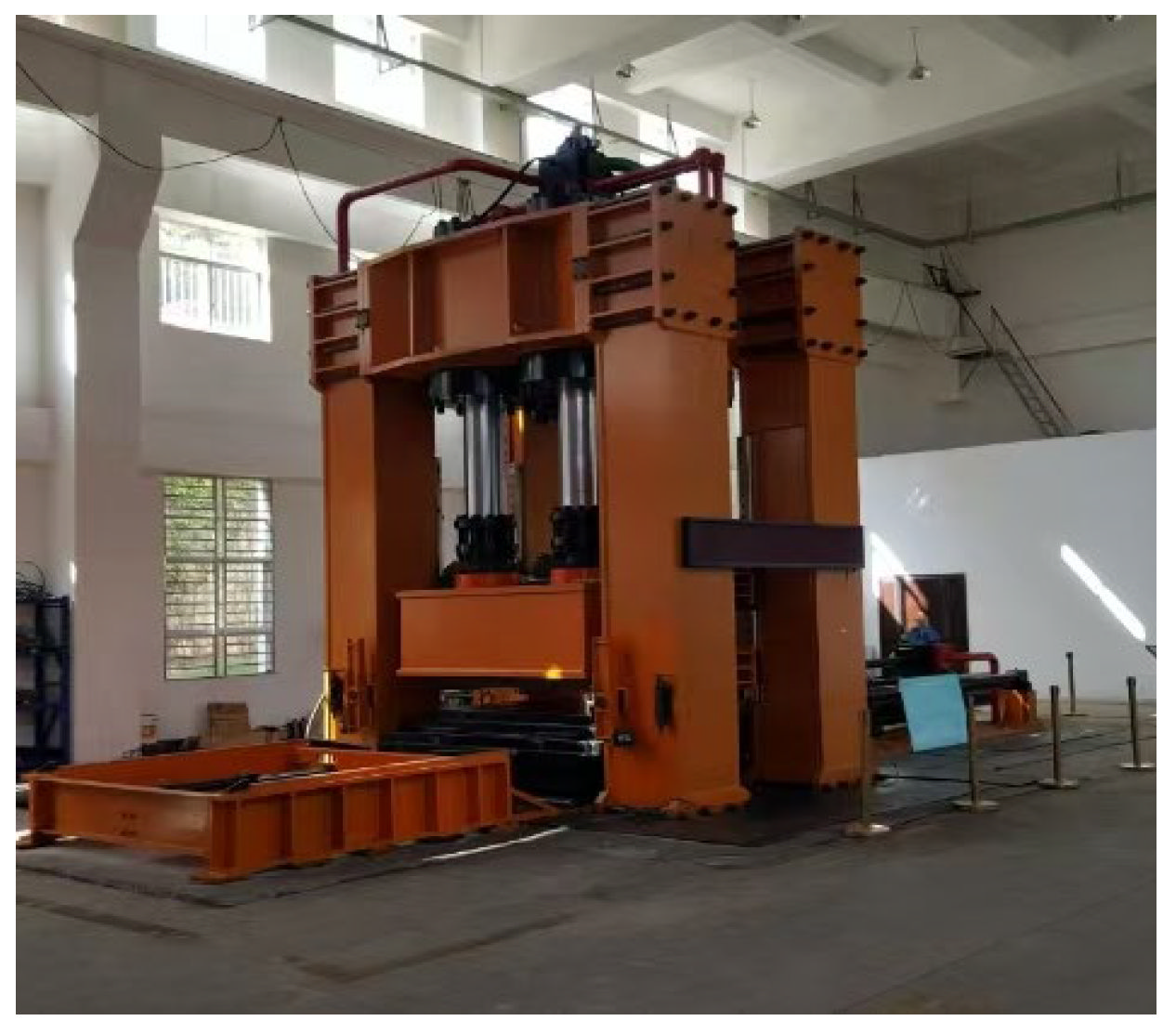
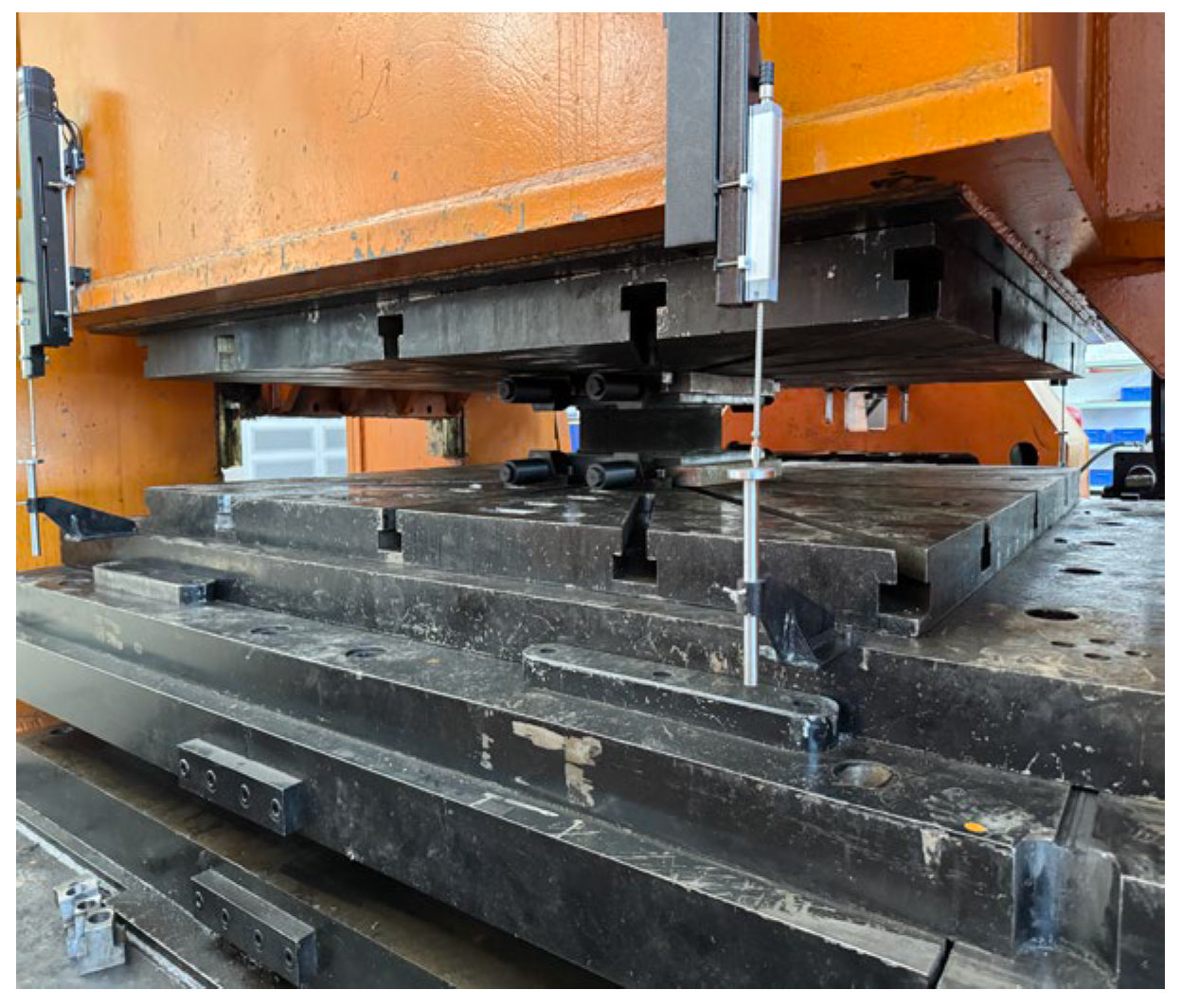
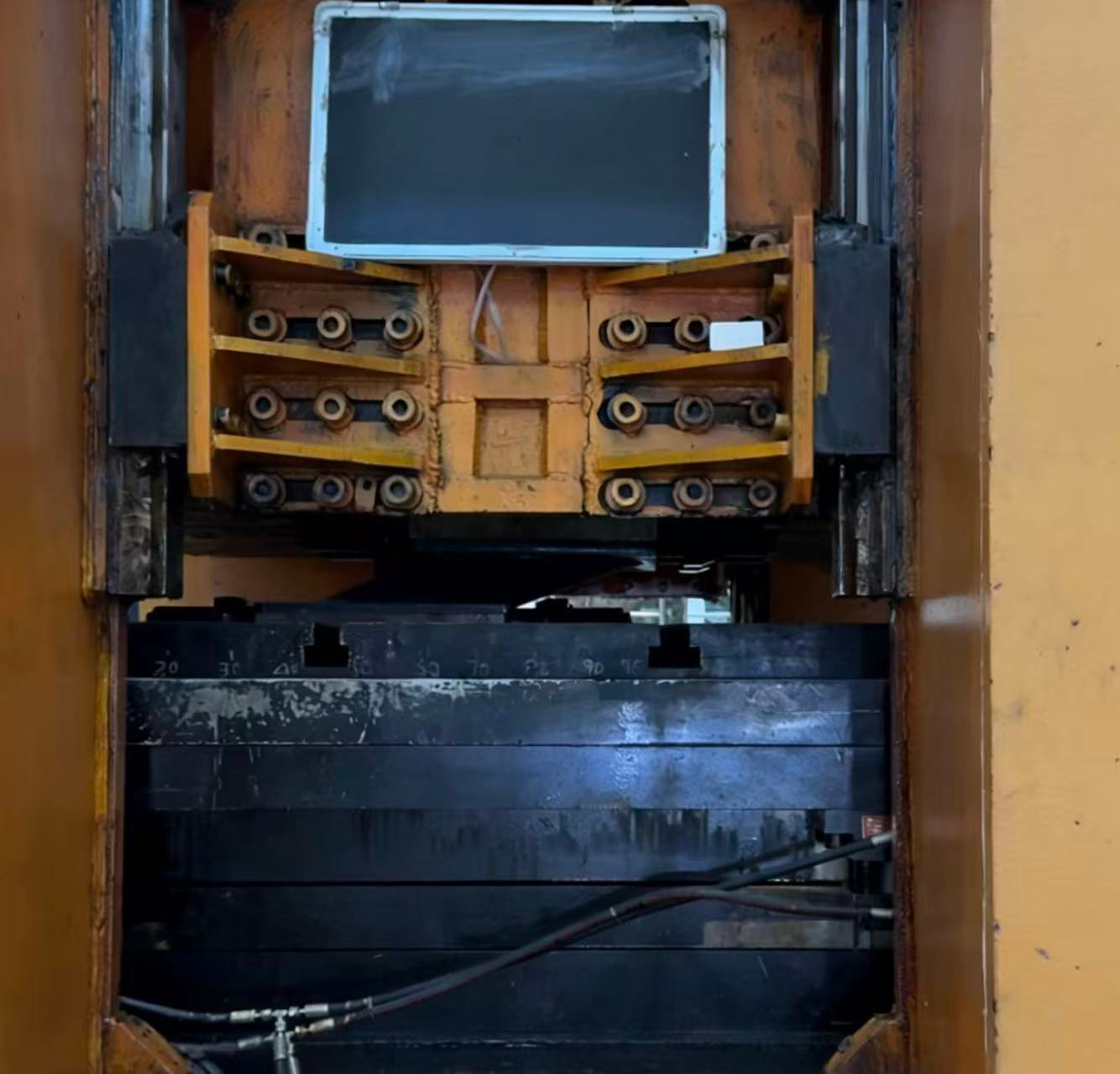
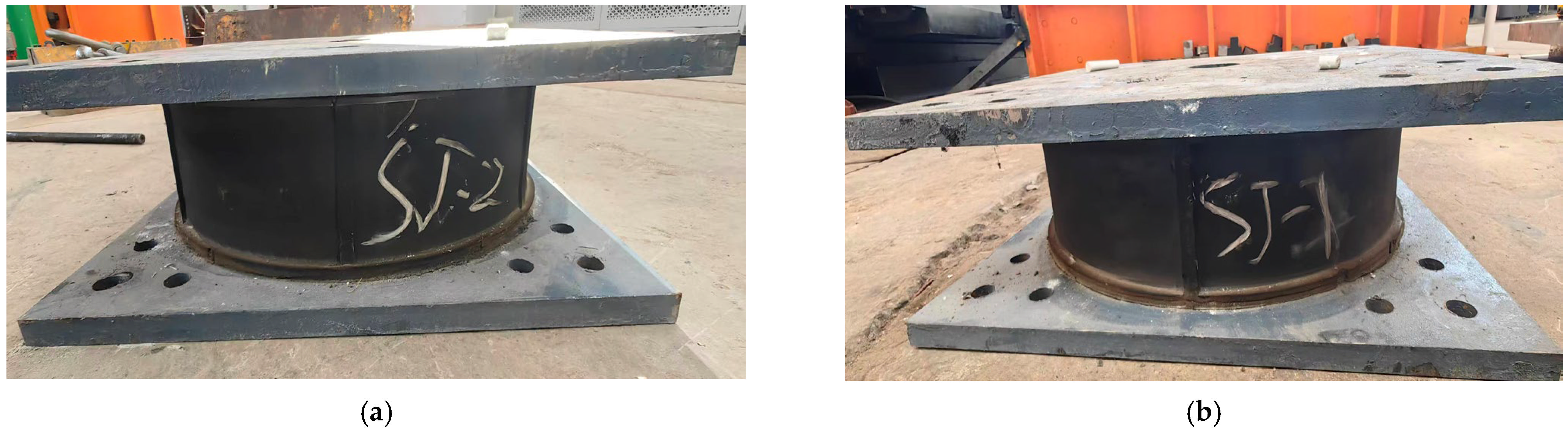
3.1. Experiment Overview
3.2. Test Procedures and Experimental Parameters
3.2.1. Test Preparation Procedures
3.2.2. Formal Test Procedures
- (1)
- Horizontal Shear Test (Working Conditions 1–4)
- (2)
- Vertical Compression Test (Working Conditions 5–7)
3.3. Horizontal Performance Test
- (1)
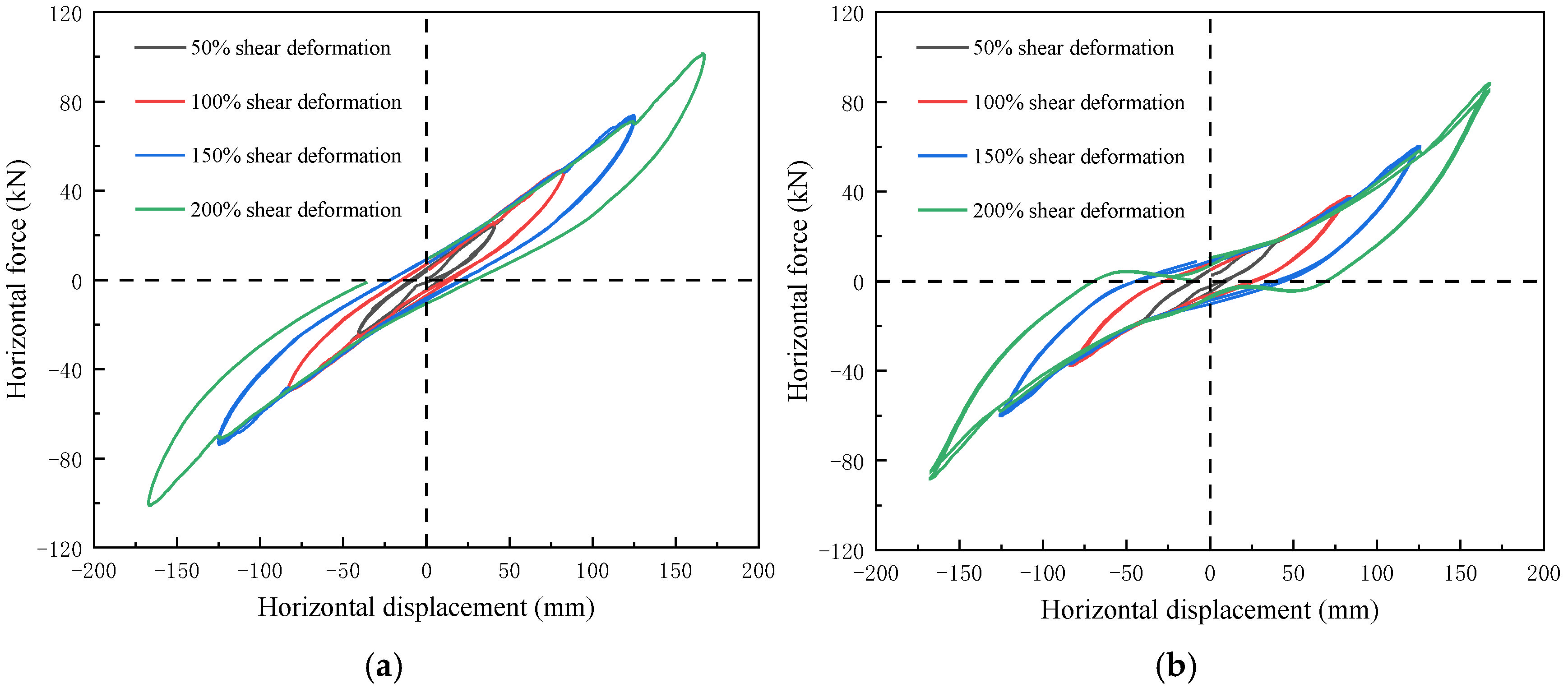
- Under the same compressive stress, in the small displacement stage (horizontal displacement: 0 mm~±100 mm), the horizontal force values of the stiffness-reduced rubber isolation bearing under different shear strains are relatively close, and the hysteretic loops are more “compact”. This indicates that the force response difference under different shear deformations is small in the small displacement stage, and the relatively small area of the hysteretic loops implies weak energy dissipation capacity. In contrast, the horizontal force difference in the traditional laminated rubber bearing is more obvious in the small displacement stage, and the larger area of the hysteretic loops indicates stronger energy dissipation capacity.
- (2)
- Under the same compressive stress, in the large displacement stage (horizontal displacement: ±100 mm~±200 mm), the horizontal force of the stiffness-reduced rubber isolation bearing increases relatively gently, while that of the traditional laminated rubber bearing increases more steeply. This shows that the ductility of the stiffness-reduced rubber isolation bearing is relatively weaker than that of the traditional laminated rubber bearing.
- (3)
- Under different shear deformations, the curves of the stiffness-reduced rubber isolation bearing have a higher fitting degree in the entire displacement range, indicating that the structure has lower sensitivity to the amplitude of shear deformation and more uniform mechanical performance. For the traditional laminated rubber bearing, the curves under different shear deformations are more scattered, especially the force growth difference is significant in the large deformation stage, reflecting higher sensitivity to shear deformation amplitude and more prominent differentiation of mechanical performance under large deformation.
- (4)
- Meanwhile, the stiffness-reduced bearing showed greater energy dissipation capacity and a higher equivalent viscous damping ratio, with a dissipated energy per cycle = 7.23%. By contrast, the traditional bearing yielded corresponding values of 4.58%. In terms of cyclic degradation, the traditional laminated rubber bearing showed no obvious stiffness degradation, and its secant stiffness remained nearly stable over the identified cycles. By contrast, the stiffness-reduced rubber isolation bearing exhibited a stiffness reduction of about 5.25% between the extracted stable cycles, indicating a certain degree of softening under repeated loading. Nevertheless, the bearing still maintained a relatively high compressive resistance and stable cyclic response within the tested loading range.
3.4. Vertical Performance Test
- (1)
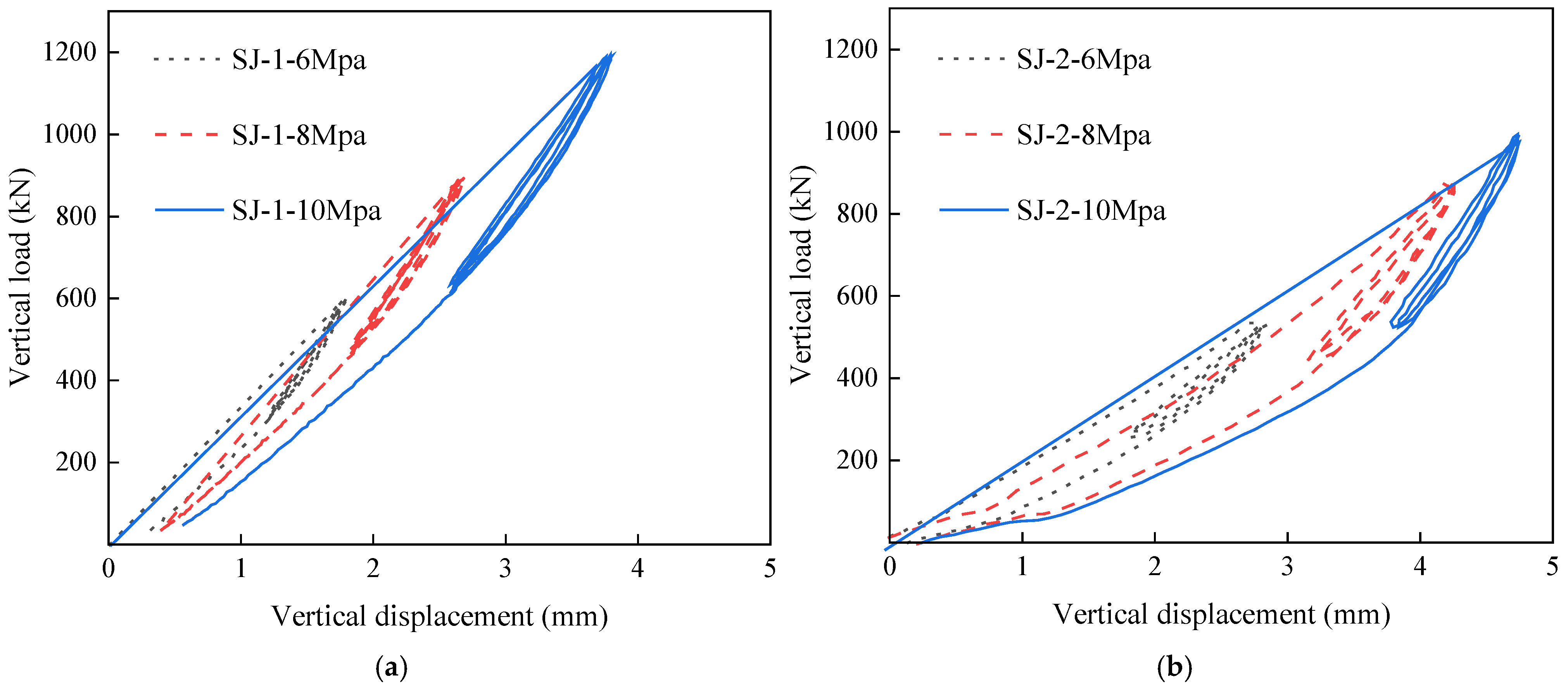
- Compared with the traditional laminated rubber bearing, the vertical stiffness of the stiffness-reduced rubber isolation bearing is smaller, with an average reduction of 35.8%. Based on the calculation of the vertical equivalent viscous damping ratios of the two types of bearings, the average vertical equivalent viscous damping ratio of the traditional laminated rubber bearing is 4.58%, while that of the stiffness-reduced rubber isolation bearing is 8.19%. Furthermore, after multiple loading cycles, neither type of bearing exhibited significant stiffness degradation.
- (2)
- Due to the characteristics of the inner thick-layer rubber, the hysteretic curves of the stiffness-reduced rubber isolation bearing are fuller under the same compressive stress, showing stronger energy dissipation capacity and better ductility. It can maintain a stable stress state even under large deformation.
- (3)
- Compared with the traditional laminated rubber bearing, the latter “ring-on-ring” shape of the stiffness-reduced rubber isolation bearing indicates that the structure undergoes a certain degree of stiffness degradation in the large deformation stage, but it can still maintain high load-bearing capacity, with better deformation stability and deformation resistance.
4. Numerical Simulation of Mechanical Properties of the Stiffness-Reduced Rubber Isolation Bearing
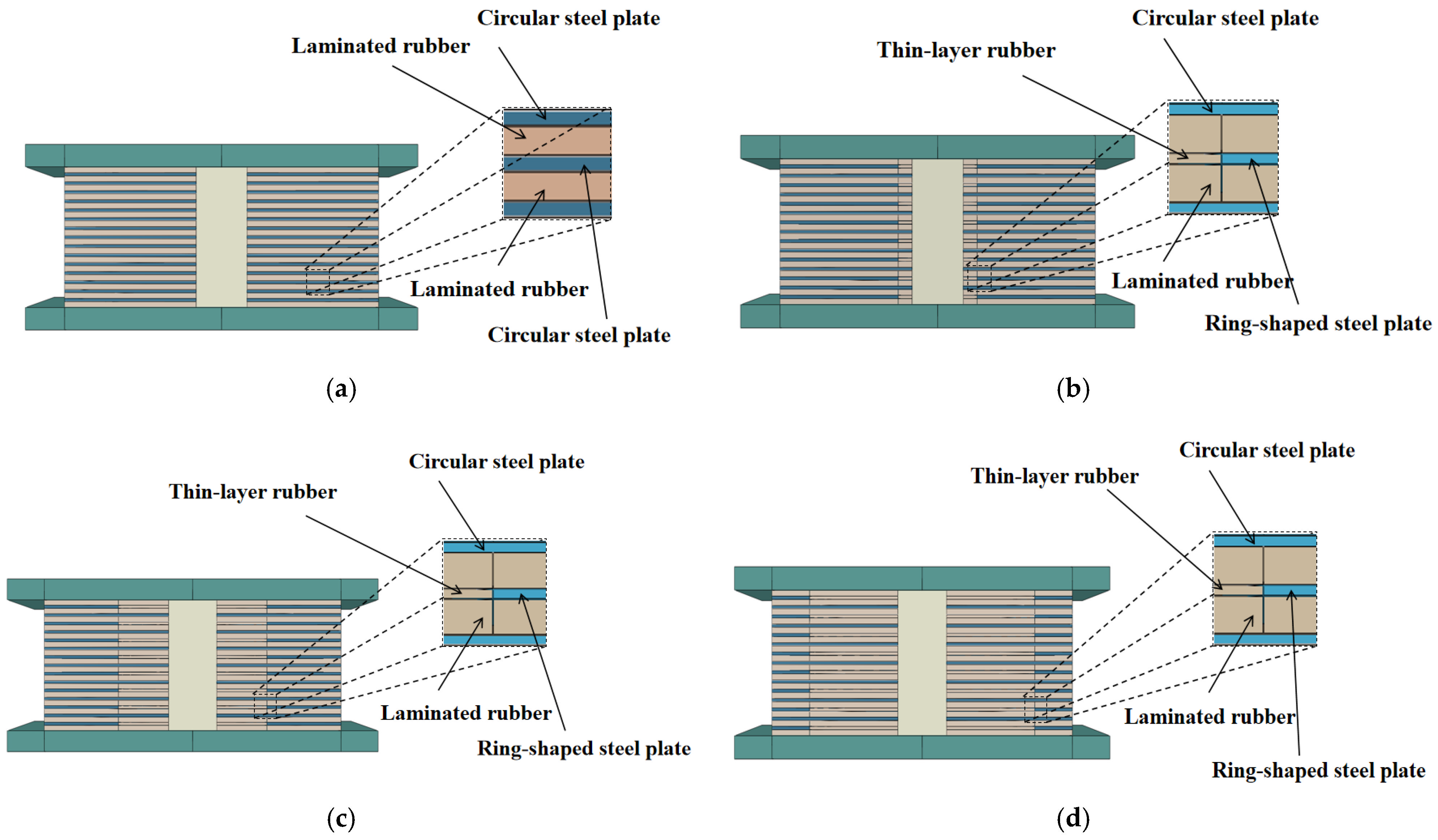
4.1. Establishment of Finite Element Model
4.2. Analysis of Calculation Results

- (1)
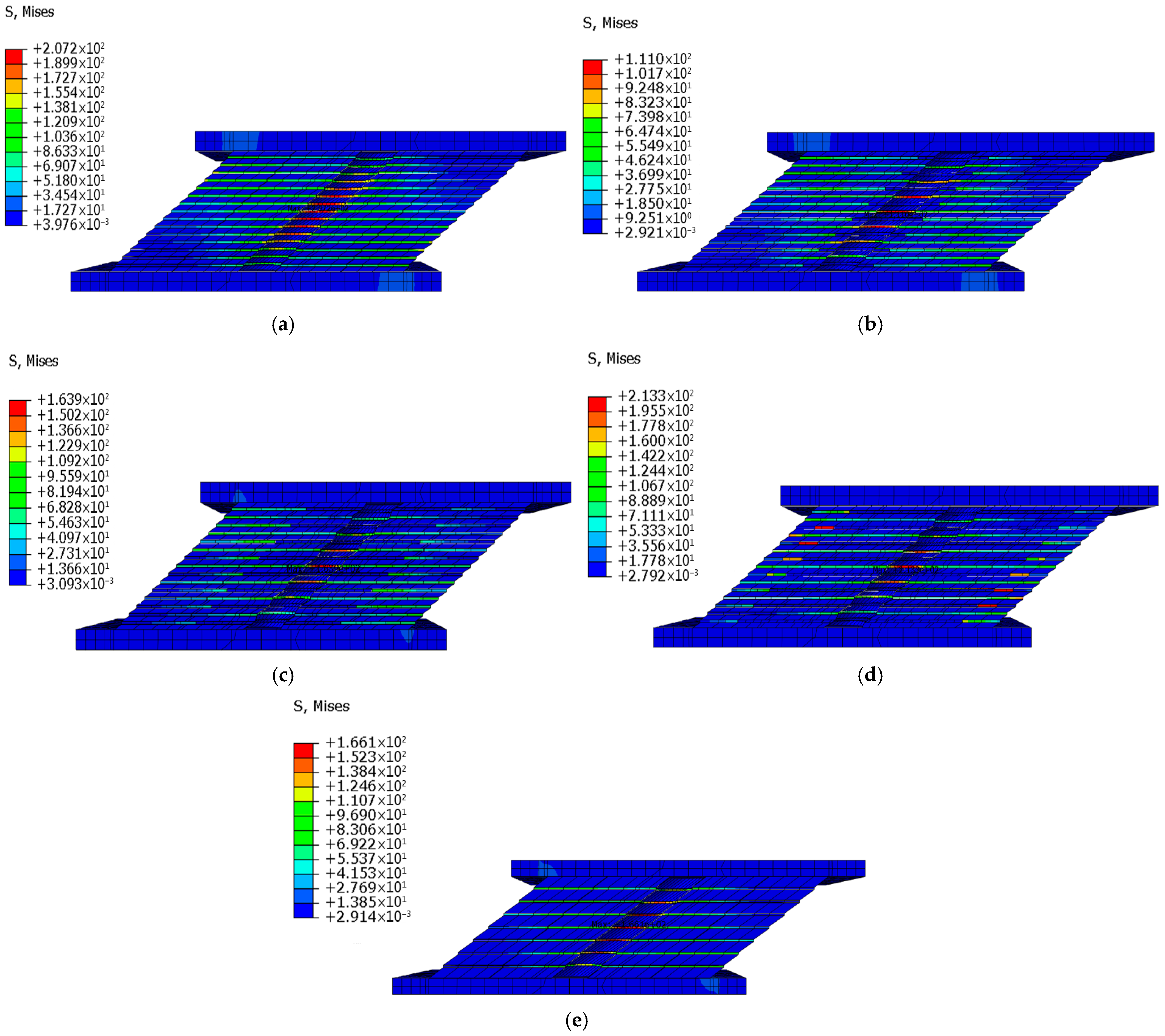
- Among all bearings under 8 MPa axial pressure and 200% shear strain, the maximum stress occurs in the 75% stiffness-reduced rubber isolation bearing, reaching 213 MPa, while the minimum maximum stress is observed in the 25% stiffness-reduced rubber isolation bearing, which is 109 MPa. Additionally, the thick-layer rubber at the hollow hole of the stiffness-reduced rubber isolation bearing tends to squeeze inward. The inferred reason is that during horizontal shear deformation, the internal thick-layer rubber begins to deform peripherally under compression; however, the outer laminated rubber and steel plate layers restrict its outward deformation, leading to inward squeezing toward the hollow hole. The maximum vertical displacement appears in the thick-layer rubber bearing, with a value of 5.309 mm, and the minimum vertical displacement occurs in the laminated rubber bearing, which is 2.741 mm. These simulation results are consistent with the experimental findings.
- (2)
- Under the same vertical load, the equivalent horizontal stiffness of the stiffness-reduced rubber isolation bearing is smaller than that of the laminated rubber bearing. Specifically, for every 25% increase in the inner diameter/outer diameter ratio of the stiffness-reduced rubber isolation bearing, the equivalent horizontal stiffness decreases by an average of 4.18%.
- (3)
- Under the same vertical load, the vertical stiffness of the stiffness-reduced rubber isolation bearing is smaller than that of the laminated rubber bearing. Specifically, for every 25% increase in the inner diameter/outer diameter ratio of the stiffness-reduced rubber isolation bearing, the vertical stiffness decreases by an average of 17.87%.
- (4)
- The maximum error between the theoretical value of the equivalent horizontal stiffness and the finite element simulation value is no more than 5.6%, and the maximum error with the experimental value is no more than 3.3%. The maximum error between the theoretical value of the vertical stiffness and the finite element simulation value is no more than 7.9%, and the maximum error with the experimental value is no more than 2.3%. These verify the reliability of the above theoretical model.
5. Analysis of Vibration Isolation Performance
5.1. Effects of External Excitation and Damping Ratio on Vertical Vibration Isolation
5.2. Simulation of an Engineering Case
6. Conclusions
- (1)
- Based on the deformation compatibility principle and the incompressibility of thick rubber, the traditional code-based formulas, which are not directly applicable to bearings with low shape factors, were modified. Analytical expressions were established for the vertical stiffness of the inner thick-rubber region, the outer laminated-rubber region, and the overall bearing. In addition, by considering the different shear deformation characteristics of the inner and outer rubber regions, a series–parallel analytical model for horizontal stiffness was derived. Comparison with FEM and test results showed that the maximum error of the analytical horizontal stiffness was within 5.6% relative to FEM and 3.3% relative to experiments, while the maximum error of the analytical vertical stiffness was within 7.9% relative to FEM and 2.3% relative to experiments. These results indicate that the proposed analytical model can reasonably predict the stiffness characteristics of the bearing and may serve as a useful basis for preliminary engineering design.
- (2)
- In terms of horizontal behavior, the experimental and numerical results showed that the proposed stiffness-reduced bearing maintained stable horizontal load-carrying capability over the tested displacement range. The agreement between FEM and experiment was satisfactory, indicating that the numerical model can reproduce the overall horizontal mechanical response of the bearing. Compared with the traditional laminated rubber bearing, the stiffness-reduced bearing exhibited lower sensitivity to shear deformation amplitude in the small-to-moderate displacement range, whereas under larger horizontal deformation its force increase became more gradual. This suggests that the proposed configuration can preserve horizontal isolation capability, while its large-deformation response characteristics remain different from those of the traditional laminated rubber bearing.
- (3)
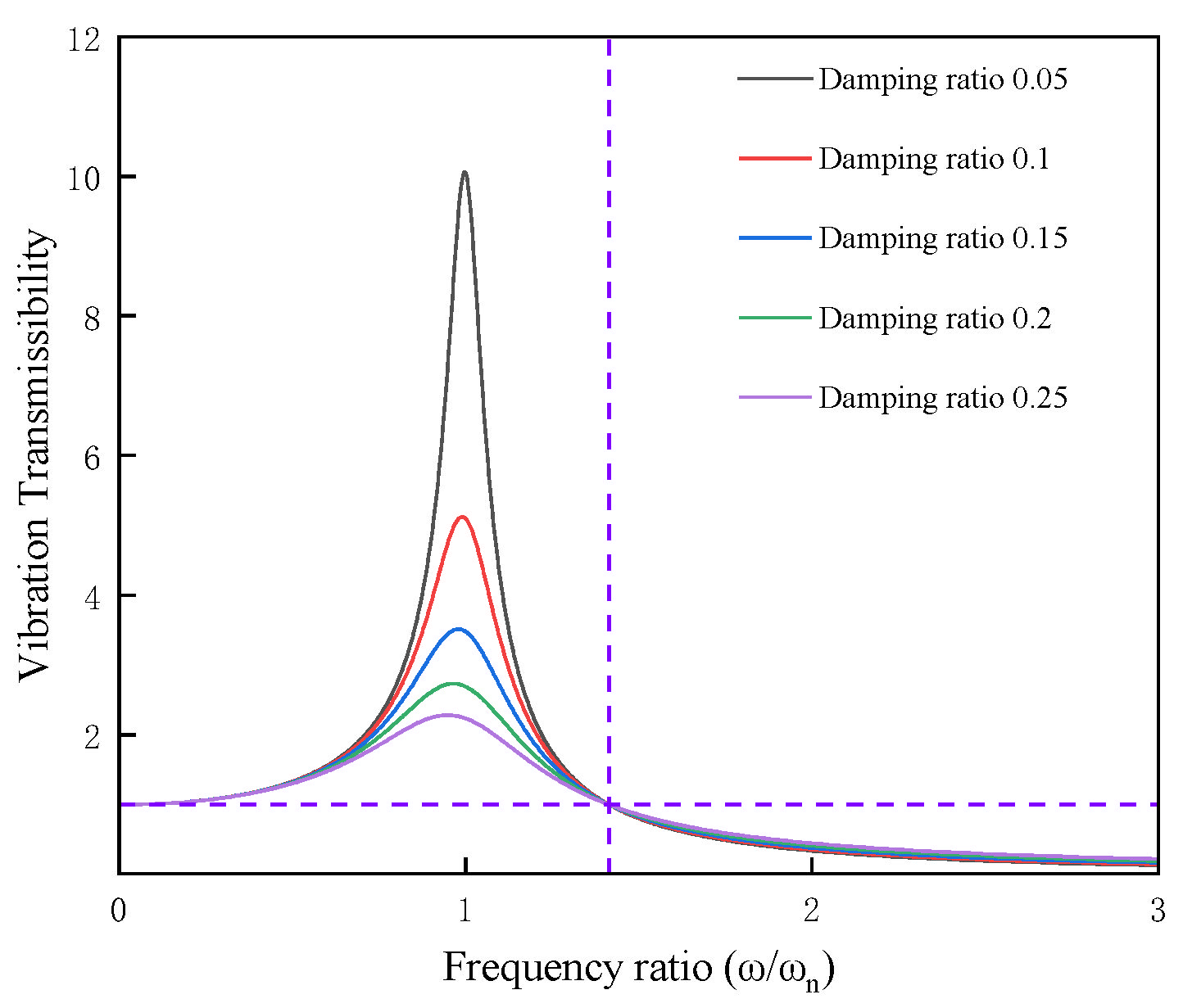
- In terms of vertical behavior, the average vertical stiffness of the stiffness-reduced bearing was reduced by 35.8% compared with that of the traditional laminated rubber bearing. Quantitative hysteretic analysis further showed that the proposed bearing exhibited a softer vertical response together with distinct energy dissipation characteristics under cyclic compression. Although some stiffness degradation was observed under large deformation, the specimen maintained overall integrity and load-carrying capacity within the tested range. These results confirm the effectiveness of the proposed configuration in reducing vertical stiffness while retaining adequate compressive resistance. However, the actual vibration-isolation performance should be evaluated jointly with the frequency ratio and damping characteristics, rather than inferred from stiffness reduction alone.
- (4)
- When the outer diameter of the bearing was kept constant, increasing the diameter of the inner thick-rubber region led to a monotonic decrease in both horizontal and vertical stiffness. Specifically, for every 25% increase in the inner-diameter-to-outer-diameter ratio, the equivalent horizontal stiffness decreased by an average of 4.18%, while the vertical stiffness decreased by an average of 17.87%. This trend demonstrates that the proposed bearing provides a practical means of stiffness tailoring, whereby the horizontal and vertical stiffness can be adjusted through geometric design to meet different performance requirements.
- (5)
- The FEM results showed that the thick-rubber region near the hollow core tended to deform inward during loading. This behavior is attributed to the fact that, under compression–shear deformation, the inner thick rubber tends to expand laterally, while the surrounding laminated rubber and steel shims constrain its outward deformation, resulting in inward squeezing toward the hollow region. This observation identifies the transition region near the hollow core as a critical zone for local deformation concentration. Therefore, in practical design, additional attention should be given to local deformation control and detailing in this region to reduce the risk of local damage at the rubber–steel interface.
- (6)
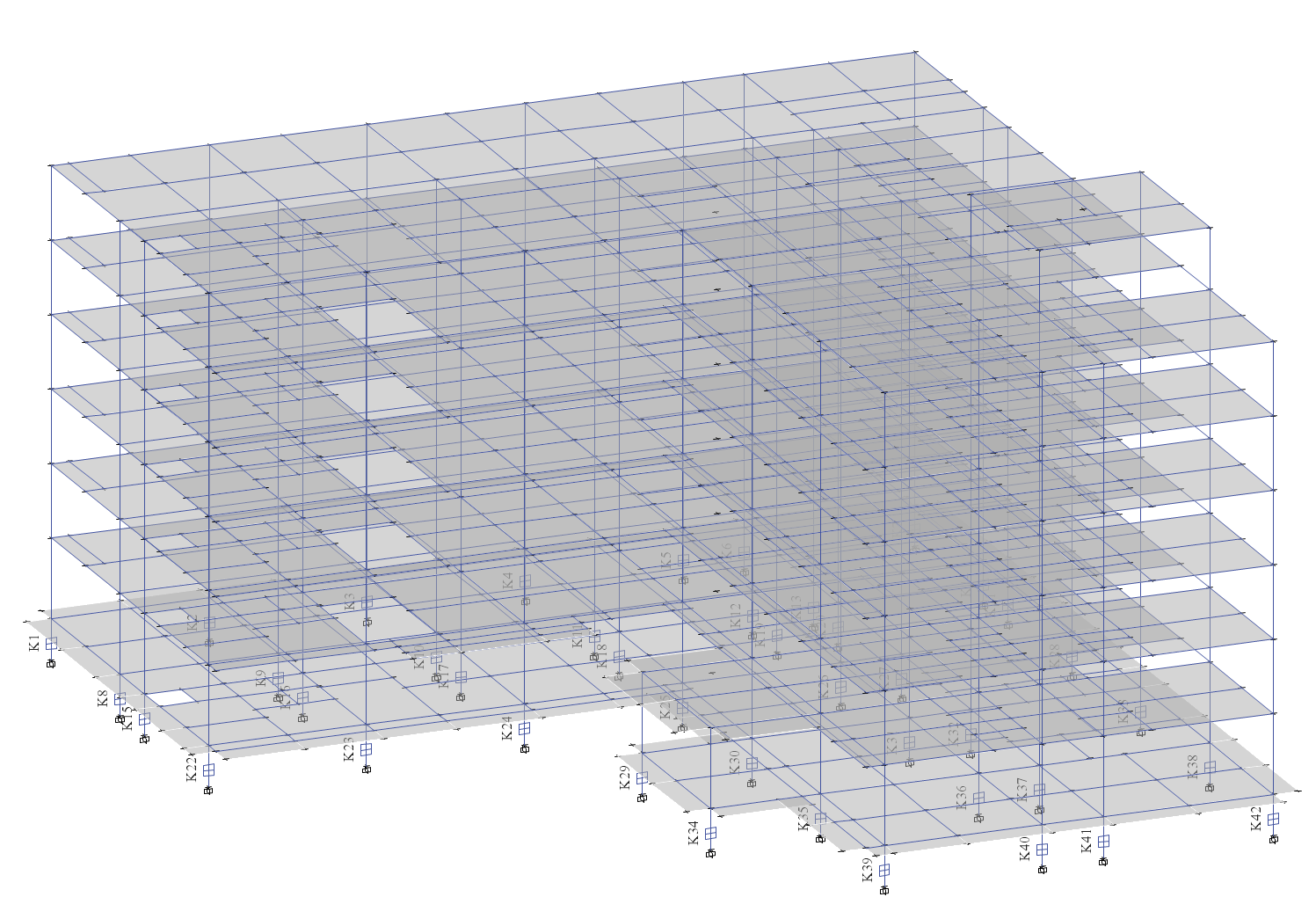
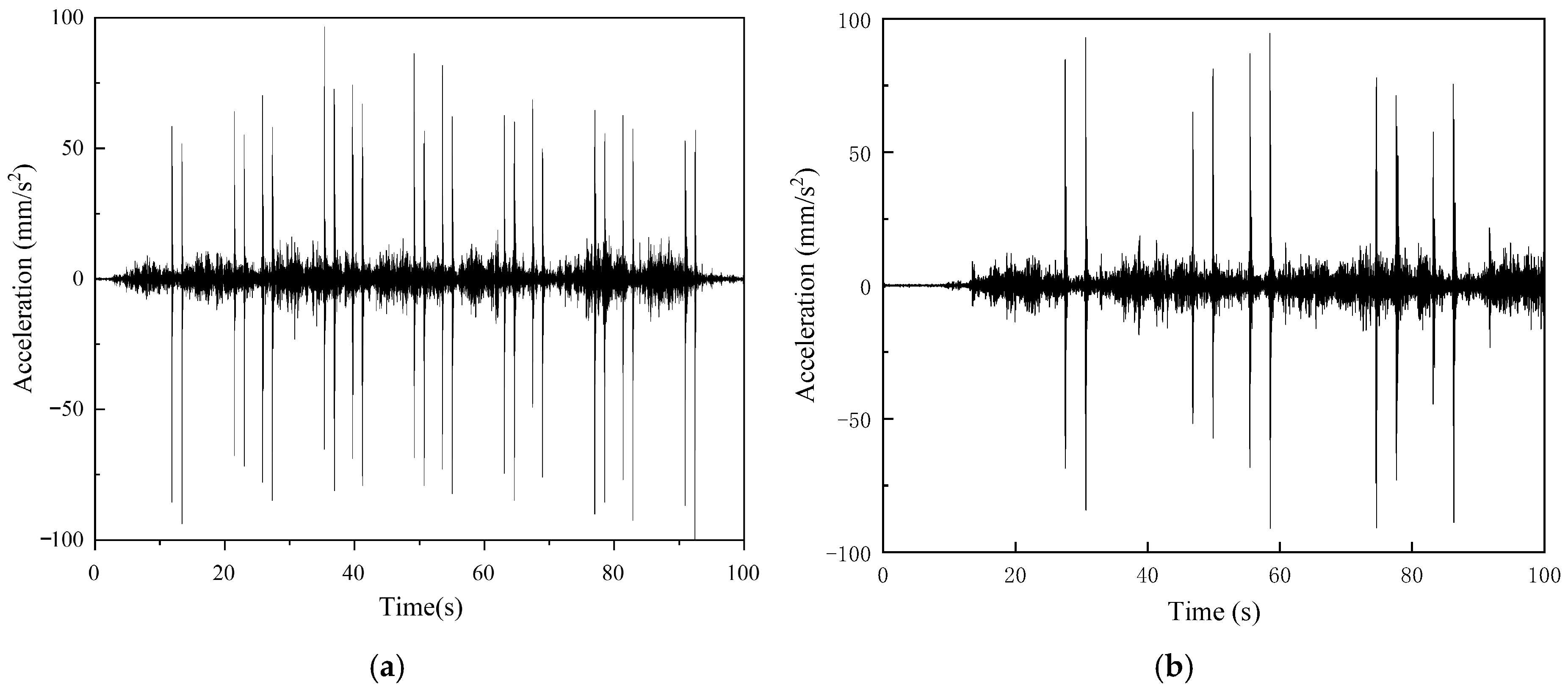
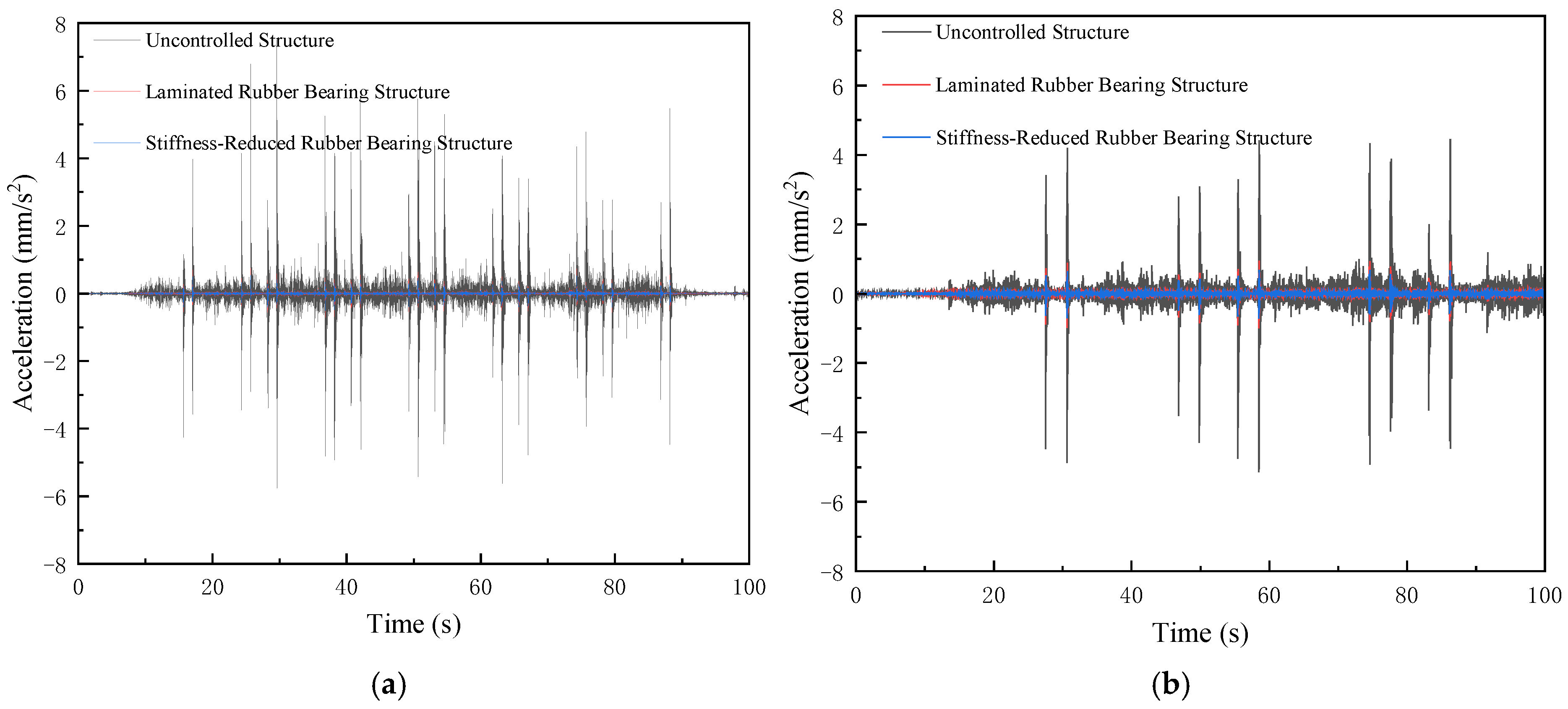
- Using ETABS 21 software, the metro vibration time-history curves were imported to analyze the top-story acceleration and displacement of three structural configurations: the uncontrolled structure, the structure isolated with traditional laminated rubber bearings, and the structure isolated with stiffness-reduced rubber bearings. The results indicate that, compared with the structure isolated with traditional laminated rubber bearings, the structure isolated with stiffness-reduced rubber bearings achieves an effective reduction of approximately 38.2% in the mean peak top-story vertical acceleration, thereby improving the structural comfort.
- (7)
- Overall, the stiffness-reduced rubber isolation bearing proposed in this paper forms a feasible configuration that achieves reduced vertical stiffness while maintaining overall stability by combining an inner thick-layer rubber region and an outer laminated rubber region in parallel. Compared with traditional thick-layer rubber bearings, this design mitigates the risk of instability that may arise from insufficient vertical load-bearing capacity. In contrast to more complex dual-control isolation systems, the proposed bearing features a relatively simple structure and lower manufacturing complexity. Based on a preliminary interpretation using transmissibility theory and a comparative analysis of dynamic responses in a representative engineering case study, the proposed bearing demonstrates the potential to simultaneously achieve vertical vibration control.
Author Contributions
Funding
Data Availability Statement
Acknowledgments
Conflicts of Interest
References
- Kelly, J.M. Earthquake-Resistant Design with Rubber. In Earthquake-Resistant Design with Rubber; Springer: Berlin/Heidelberg, Germany, 1993. [Google Scholar]
- Alhan, C.; Gavin, H.P. Reliability of Base Isolation for the Protection of Critical Equipment from Earthquake Hazards. Eng. Struct. 2005, 27, 1435–1449. [Google Scholar] [CrossRef]
- Chen, J.B.; Liu, W.Q.; Peng, Y.B.; Li, J. Stochastic Seismic Response and Reliability Analysis of Base-Isolated Structures. J. Earthq. Eng. 2007, 11, 797–810. [Google Scholar] [CrossRef]
- Castaldo, P.; Palazzo, B.; Della Vecchia, P. Life-Cycle Cost and Seismic Reliability Analysis of 3D Systems Equipped with FPS for Different Isolation Degrees. Eng. Struct. 2016, 125, 349–363. [Google Scholar] [CrossRef]
- Fukasawa, T.; Okamura, S.; Somaki, T. Research and development of three-dimensional isolation system for sodium-cooled fast reactor: Part 1—Proposal of analytical models based on loading tests. In Proceedings of the ASME 2018 Pressure Vessels and Piping Conference; ASME: Prague, Czech Republic, 2018. [Google Scholar]
- Shimada, T.; Suhara, J.; Inoue, K. Three dimensional seismic isolation system for next-generation nuclear power plant with rolling seal type air spring and hydraulic rocking suppression system. In Proceedings of the ASME 2005 Pressure Vessels and Piping Conference; ASME: Denver, CO, USA, 2005. [Google Scholar]
- Cao, Y.R.; Pan, P.; Sun, J.B.; Wang, H. Mechanical properties and isolation effect of disc spring-single friction pendulum 3D vibration isolation device. J. Build. Struct. 2022, 43, 44–53. [Google Scholar] [CrossRef]
- Kanazawa, K.; Hirata, K.; Matsuda, A. Shaking Table Test of Three-Dimensional Base Isolation System Using Laminated Thick Rubber Bearings. In Proceedings of the 15th International Conference on. Structural Mechanics in Reactor Technology, SMiRT-15, Seoul, Republic of Korea, 15–20 August 1999. [Google Scholar]
- Yabana, S.; Matsuda, A. Mechanical Properties of Laminated Rubber Bearings for Three-Dimensional Seismic Isolation. In Proceedings of the 12th World Conference on Earthquake Engineering, Auckland, New Zealand, 30 January–4 February 2000; Paper No. 2452. [Google Scholar]
- Zhu, Y.H.; Ai, F.L.; Ren, X.X.; Lu, W. Mechanical Properties of Thick Lead-Rubber Bearings. Tongji Daxue Xuebao/J. Tongji Univ. (Nat. Sci.) 2018, 46, 1189–1194+1233. [Google Scholar] [CrossRef]
- Pan, P.; Shen, S.D.; Shen, Z.Y.; Gong, R. Experimental Investigation on the Effectiveness of Laminated Rubber Bearings to Isolate Metro Generated Vibration. Measurement 2018, 122, 554–562. [Google Scholar] [CrossRef]
- Zhao, Z.; Meng, W.; Yan, B.; Liang, H.; Geng, Y.; Sun, Z. Study on the dynamic characteristics of low-frequency high-stiffness viscoelastic damping structures. Materials 2025, 18, 1446. [Google Scholar] [CrossRef] [PubMed]
- Cheng, Z.; Zhang, X.; Zhuang, Y.; Zhao, Y.; Cui, J. A parallel polyurea method for enhancing damping characteristics of metal lattice structures in vibration isolation and shock resistance. Appl. Sci. 2025, 15, 7116. [Google Scholar] [CrossRef]
- Zhu, G.; Lei, S.; Daley, S.; Bai, X.; Xing, J. A nonlinear fractional-order model of soft magnetorheological elastomers for applications in vibration isolation. J. Low Freq. Noise Vib. Act. Control 2025, 45, 538–552. [Google Scholar] [CrossRef]
- Kraśkiewicz, C.; Zbiciak, A.; Al Sabouni-Zawadzka, A.; Marczak, M. Analysis of the influence of fatigue strength of prototype under ballast mats (UBMs) on the effectiveness of protection against vibration caused by railway traffic. Materials 2021, 14, 2125. [Google Scholar] [CrossRef] [PubMed]
- EN 17282:2020-10; Railway Applications—Infrastructure—Under Ballast Mats. CEN: Brussels, Belgium, 2020.
- Jayasuriya, C.; Indraratna, B.; Ngo, T.N. Experimental study to examine the role of under sleeper pads for improved performance of ballast under cyclic loading. Transp. Geotech. 2019, 19, 61–73. [Google Scholar] [CrossRef]
- Li, Y.M.; Ma, Y.H.; Zhao, G.F.; Liu, R. Effect of alternation of aging and seawater erosion on properties of rubber material used in lead rubber bearing. J. Renew. Mater. 2022, 10, 1642–1658. [Google Scholar] [CrossRef]
- Kraśkiewicz, C.; Zbiciak, A.; Al Sabouni-Zawadzka, A. Laboratory tests of resistance to severe environmental conditions of prototypical under sleeper pads applied in the ballasted track structures. Arch. Civ. Eng. 2021, 67, 319–331. [Google Scholar] [CrossRef]
- EN 16730:2016-06; Railway Applications—Track—Concrete Sleepers and Bearers with Under Sleeper Pads. CEN: Brussels, Belgium, 2016.
- JG/T 118-2018; Rubber Isolation Bearings for Buildings. MOHURD: Beijing, China, 2018.
- Chen, S.C.; Yan, W.M.; Zhang, Z.Q.; Chen, Y. Modeling and Analyzing of Rubber Layers for Laminated Rubber Bearings: Theory Model. Chin. J. Comput. Mech. 2013, 30, 520–525. [Google Scholar] [CrossRef]
- Li, J.C.; Shang, Q.X.; Luo, Q.Y.; Wang, T. Tests for Mechanical Performance of Thick Rubber Bearings. J. Vib. Shock 2019, 38, 157–165. [Google Scholar] [CrossRef]
- Ma, Q.Y.; Li, B.B.; Ye, J.C. Experimental Study on Mechanical Properties of Steel Plate Weakened Laminated Rubber Bearings. J. Zhejiang Univ. (Eng. Sci.) 2024, 58, 1436–1445+1478. [Google Scholar] [CrossRef]
- GB/T 51408-2021; Standard for Seismic Isolation Design of Building. MOHURD & SAMR: Beijing, China, 2021.
- GB/T 20688.1-2007; Rubber Bearings—Part 1: Seismic-Protection Isolators Test Methods. AQSIQ & SAC: Beijing, China, 2007.
- Wu, C.X.; Zhou, Y.; Deng, X.S.; Chen, Z.K.; Wang, H. Analytical studies on the vibration response of the vertical isolation building. China Civ. Eng. J. 2013, 46, 13–18. [Google Scholar]


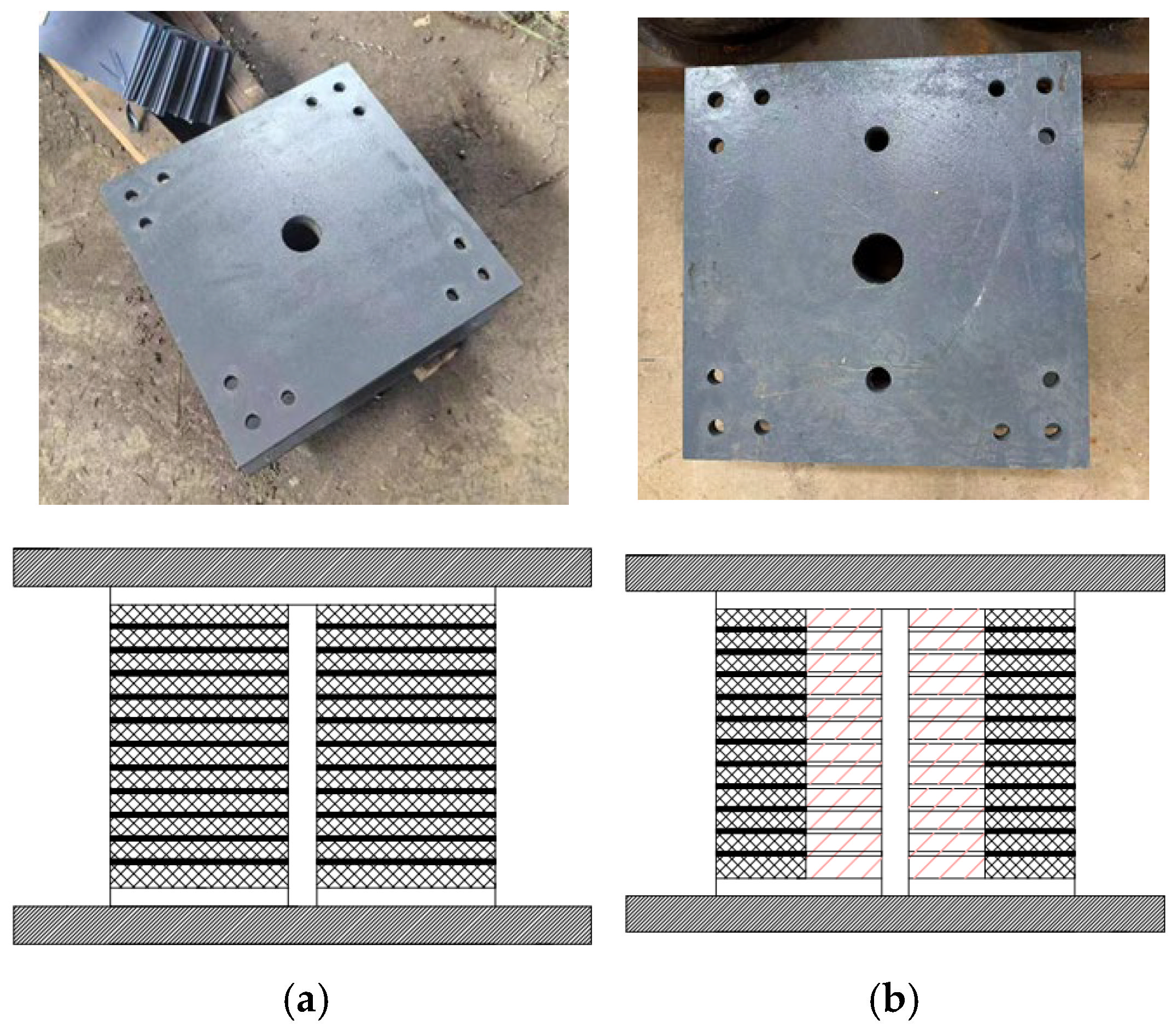



| Parameters | SJ-1 | SJ-2 |
|---|---|---|
| Rubber layer diameter (mm) | 400 | 400 |
| Inner thick-layer rubber diameter (mm) | 0 | 200 |
| Outer rubber layer parameters (tr × n) | 5.25 × 16 | 5.25 × 16 |
| Inner rubber layer parameters (tr × n) | 0 × 0 | 13.25 × 8 |
| Steel plate thickness (mm) | 2.75 | 2.75 |
| Hollow hole diameter (mm) | 65 | 65 |
| Working Condition | Vertical Load (MPa) | Loading Frequency (Hz) | Loading Rate | Number of Cyclic Loading | Shear Strain | Experimental Purpose |
|---|---|---|---|---|---|---|
| 1 | 8 | 0.05 | 5 mm/s (displacement) | 3 | 50% | Horizontal performance |
| 2 | 100% | |||||
| 3 | 150% | |||||
| 4 | 200% | |||||
| 5 | 6 | 0.05 | 2 kN/s (load) | 4 | 0% | Vertical performance |
| 6 | 8 | |||||
| 7 | 10 |
| Mesh Scheme | Rubber Mesh Size (mm) | Steel Mesh Size (mm) | Calculated Horizontal Stiffness (kN·mm−1) | Difference |
|---|---|---|---|---|
| M1 | 8 | 12 | 0.569 | 3.3% |
| M2 | 5 | 10 | 0.551 | / |
| M3 | 3 | 8 | 0.545 | 1.1% |
| Inner Diameter/Outer Diameter | Maximum Stress (MPa) | Maximum Vertical Displacement (mm) |
|---|---|---|
| 0% (SJ-1) | 207 | 2.741 |
| 25% | 109 | 3.372 |
| 50% (SJ-2) | 164 | 3.925 |
| 75% | 213 | 4.589 |
| 100% | 166 | 5.309 |
| Inner Diameter /Outer Diameter | Analytical Value (kN·mm−1) | FEM Simulation Value (kN·mm−1) | Relative Change Rate of Simulation Values | Experimental Value (kN·mm−1) |
|---|---|---|---|---|
| 0% (SJ-1) | 0.532 | 0.551 | / | 0.544 |
| 25% | 0.521 | 0.529 | 4.16% | / |
| 50% (SJ-2) | 0.484 | 0.511 | 3.52% | 0.500 |
| 75% | 0.453 | 0.482 | 6.02% | / |
| 100% | 0.432 | 0.429 | 3.03% | / |
| Inner Diameter /Outer Diameter | Analytical Value (kN·mm−1) | FEM Simulation Value (kN·mm−1) | Relative Change Rate of Simulation Values | Experimental Value (kN·mm−1) |
|---|---|---|---|---|
| 0% (SJ-1) | 313.57 | 326.03 | / | 316.58 |
| 25% | 256.15 | 265.87 | 22.63% | / |
| 50% (SJ-2) | 211.86 | 228.55 | 16.33% | 203.22 |
| 75% | 198.26 | 195.48 | 16.92% | / |
| 100% | 178.21 | 169.05 | 15.63% | / |
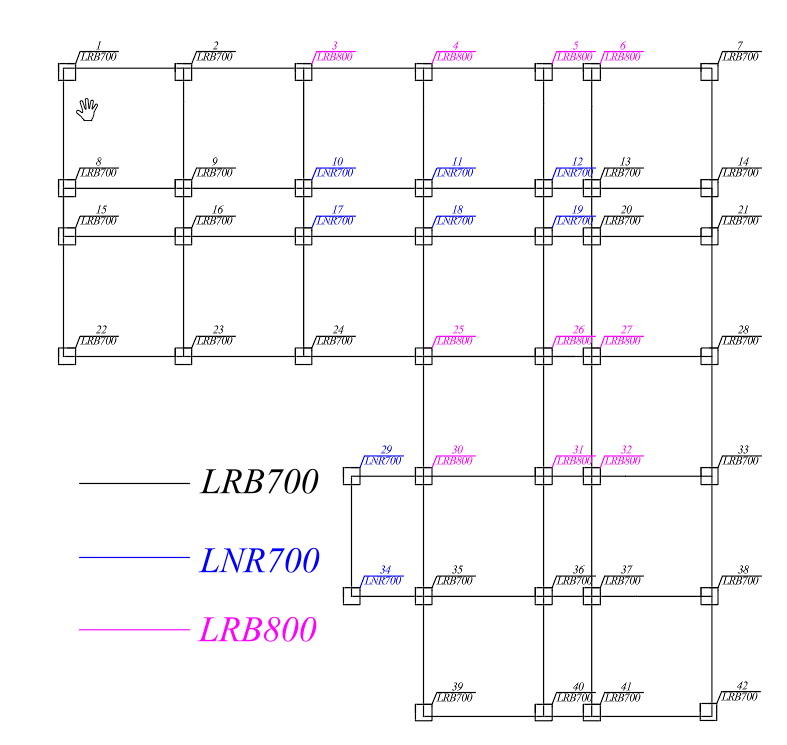
| Item | LRB700-I | LRB800-I | LNR700-I |
|---|---|---|---|
| Quantity used | 24 | 10 | 8 |
| Vertical Stiffness (kN/mm) | 2600 | 2900 | 2300 |
| horizontal stiffness (kN/mm) | 1.87 | 2.05 | 1.17 |
| damping ratio (%) | 24 | 23 | / |
| Pre-yield stiffness (kN/mm) | 15.2 | 17.4 | / |
| Post-yield stiffness (kN/mm) | 1.17 | 1.33 | / |
| Yield force (kN) | 90 | 106 | / |
| Item | LRB700-II | LRB800-II | LNR700-II |
|---|---|---|---|
| Quantity used | 24 | 10 | 8 |
| Vertical Stiffness (kN/mm) | 2600 | 2900 | 2300 |
| horizontal stiffness (kN/mm) | 1.87 | 2.05 | 1.17 |
| damping ratio (%) | 24 | 23 | / |
| Pre-yield stiffness (kN/mm) | 15.2 | 17.4 | / |
| Post-yield stiffness (kN/mm) | 1.17 | 1.33 | / |
| Yield force (kN) | 90 | 106 | / |
| Uncontrolled Structure | Laminated Rubber Bearing Structure | Stiffness-Reduced Rubber Isolation Bearing Structure | ||||
|---|---|---|---|---|---|---|
| (a) | (b) | (a) | (b) | (a) | (b) | |
| Positive peak | 7.50 | 4.46 | 0.75 | 0.95 | 0.54 | 0.68 |
| Negative peak | −5.76 | −5.14 | −0.71 | −0.99 | −0.51 | 0.72 |
| Mean peak (abs.) | 6.63 | 4.80 | 0.73 | 0.97 | 0.53 | 0.70 |
Disclaimer/Publisher’s Note: The statements, opinions and data contained in all publications are solely those of the individual author(s) and contributor(s) and not of MDPI and/or the editor(s). MDPI and/or the editor(s) disclaim responsibility for any injury to people or property resulting from any ideas, methods, instructions or products referred to in the content. |
© 2026 by the authors. Licensee MDPI, Basel, Switzerland. This article is an open access article distributed under the terms and conditions of the Creative Commons Attribution (CC BY) license.
Share and Cite
Wang, X.; Lu, C.; Wang, L.; Chen, Y.; Yang, J.; Deng, S. Design and Performance Study of Stiffness-Reduced Rubber Isolation Bearings. Eng 2026, 7, 152. https://doi.org/10.3390/eng7040152
Wang X, Lu C, Wang L, Chen Y, Yang J, Deng S. Design and Performance Study of Stiffness-Reduced Rubber Isolation Bearings. Eng. 2026; 7(4):152. https://doi.org/10.3390/eng7040152
Chicago/Turabian StyleWang, Xianjie, Chengpeng Lu, Linjian Wang, Yiming Chen, Jiayun Yang, and Shifang Deng. 2026. "Design and Performance Study of Stiffness-Reduced Rubber Isolation Bearings" Eng 7, no. 4: 152. https://doi.org/10.3390/eng7040152
APA StyleWang, X., Lu, C., Wang, L., Chen, Y., Yang, J., & Deng, S. (2026). Design and Performance Study of Stiffness-Reduced Rubber Isolation Bearings. Eng, 7(4), 152. https://doi.org/10.3390/eng7040152