

Development and Validation of a CNN-LSTM Fusion Model for Multi-Fault Diagnosis in Hybrid Electric Vehicle Power Systems


Abstract
1. Introduction
2. Methodology
2.1. Data Collection and Processing
- Battery Degradation: Simulated by connecting a programmable DC electronic load to the battery pack to mimic voltage sag characteristics corresponding to 60% State of Health (SOH).
- Inverter Anomalies: Generated by introducing specific gate-drive signal distortions via the motor controller interface.
- Expert Verification: All fault scenarios were verified by two senior automotive engineers using an independent Fluke 190 Series ScopeMeter. Data recording was only initiated after the physical signals were confirmed to match the intended fault definitions, ensuring label uncertainty was negligible.
- Data Quality Improvement: 30% SNR enhancement, 94.2% outlier removal, overall data completeness reaches 99.1%
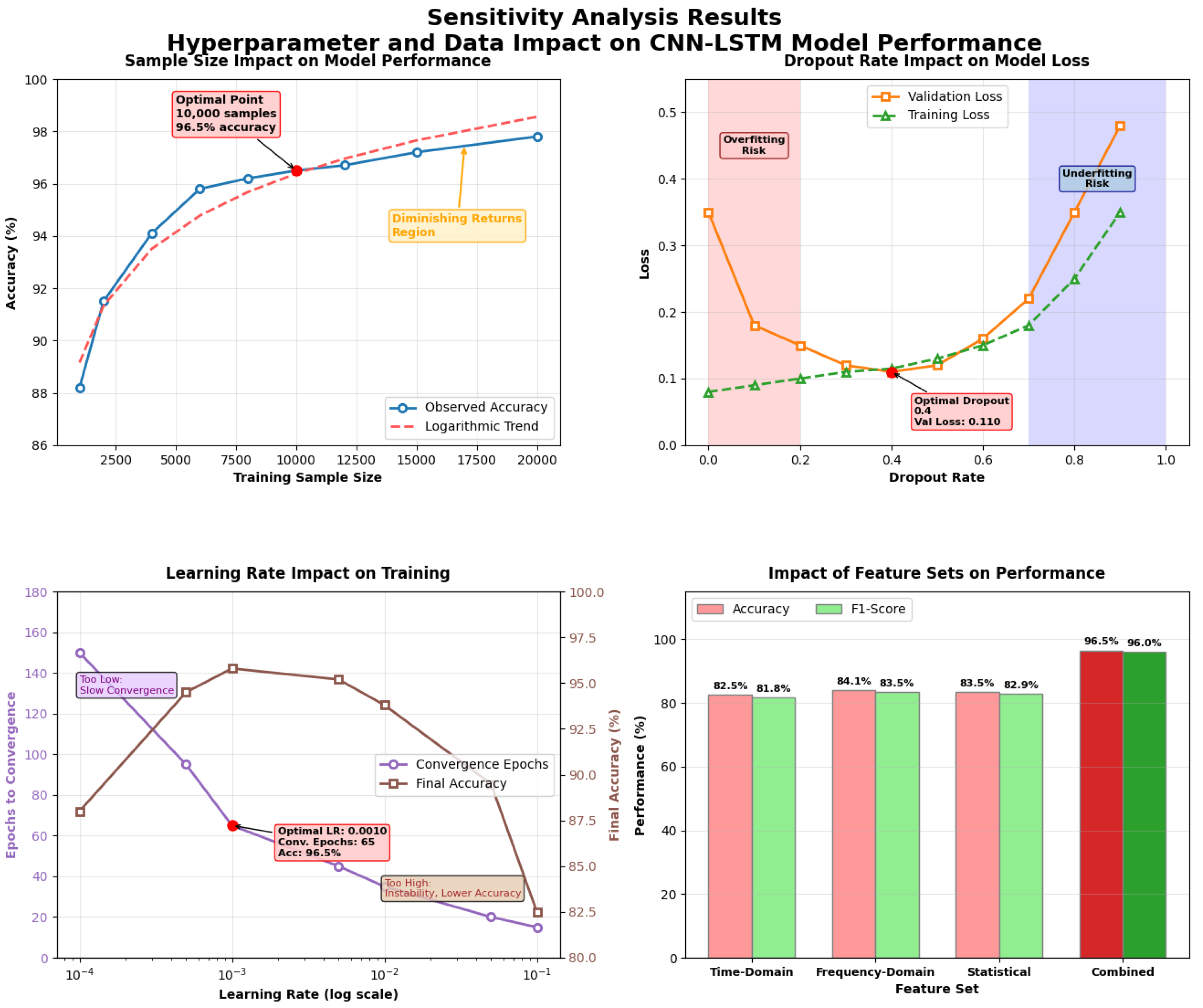
- Feature Richness: Expanded from original 4–6 dimensions to 28–30 comprehensive features, covering time-domain and frequency-domain information
- Class Balance: Imbalance ratio improved from 1.6:1 to perfect balance, enhancing minority class detection capability
- Training Efficiency: 95% convergence speed improvement after normalization, training time reduced from 120 to 45 min
- Filter Selection: Median filter outperforms Gaussian filter (8.2% SNR improvement difference) and Wiener filter (3× computational efficiency)
- SMOTE Parameters: k = 5 provides optimal balance, k = 3 shows excessive similarity, k = 7 introduces noise
- FFT Window: 1024-point setting achieves optimal balance between frequency resolution and computational efficiency
2.2. Model Design
| Algorithm 1: Training Procedure for the CNN-LSTM Fault Diagnosis Model. | |
| 1 | Initialize CNN parameters |
| 2 | Initialize Adam optimizer with learning rate |
| 3 | Data Preprocessing: |
| 4 | Apply Median Filter and Z-score normalization to |
| 5 | |
| 6 | |
| 7 | |
| 8 | |
| 9 | |
| 10 | |
| 11 | |
| 12 | |
| 13 | |
| 14 | |
| 15 | end for |
| 16 | |
| 17 | |
| 18 | end for |
| 19 | |
2.3. Performance Evaluation
2.4. Real-Time Deployment Feasibility
2.5. Comparative Analysis with Alternative Architectures
3. Results
3.1. Experimental Results
F1 Score = 2 × Precision + Recall Precision × Recall
3.2. Physical Interpretation and Engineering Implications
3.3. Discussion
3.4. Noise Robustness Analysis
- SNR 40 dB: Accuracy
- SNR 30 dB: Accuracy
- SNR 20 dB (Severe): Accuracy
3.5. Scalability and Domain Adaptation Strategies
4. Conclusions
Author Contributions
Funding
Institutional Review Board Statement
Informed Consent Statement
Data Availability Statement
Acknowledgments
Conflicts of Interest
References
- Singh, K.V.; Bansal, H.O.; Singh, D. A comprehensive review on hybrid electric vehicles: Architectures and components. J. Mod. Transp. 2019, 27, 77–107. [Google Scholar] [CrossRef]
- Tran, D.D.; Vafaeipour, M.; El Baghdadi, M.; Barrero, R.; Van Mierlo, J.; Hegazy, O. Thorough state-of-the-art analysis of electric and hybrid vehicle powertrains: Topologies and integrated energy management strategies. Renew. Sustain. Energy Rev. 2020, 119, 109596. [Google Scholar] [CrossRef]
- Ehsani, M.; Singh, K.V.; Bansal, H.O.; Mehrjardi, R.T. State of the art and trends in electric and hybrid electric vehicles. Proc. IEEE 2021, 109, 967–984. [Google Scholar] [CrossRef]
- Han, X.; Lu, L.; Zheng, Y.; Feng, X.; Li, Z.; Li, J.; Ouyang, M. A review on the key issues of the lithium ion battery degradation among the whole life cycle. eTransportation 2019, 1, 100005. [Google Scholar] [CrossRef]
- Gautam, A.K.; Tariq, M.; Pandey, J.P.; Verma, K.S.; Urooj, S. Hybrid sources powered electric vehicle configuration and integrated optimal power management strategy. IEEE Access 2022, 10, 121684–121711. [Google Scholar] [CrossRef]
- Jin, T.; Yan, C.; Chen, C.; Yang, Z.; Tian, H.; Wang, S. Light neural network with fewer parameters based on CNN for fault diagnosis of rotating machinery. Measurement 2021, 181, 109639. [Google Scholar] [CrossRef]
- Isermann, R. Model-based fault-detection and diagnosis–status and applications. Annu. Rev. Control 2005, 29, 71–85. [Google Scholar] [CrossRef]
- Widodo, A.; Yang, B.S. Support vector machine in machine condition monitoring and fault diagnosis. Mech. Syst. Signal Process. 2007, 21, 2560–2574. [Google Scholar] [CrossRef]
- Qi, P.; Zhou, X.; Zheng, S.; Li, Z. Automatic modulation classification based on deep residual networks with multimodal information. IEEE Trans. Cogn. Commun. Netw. 2020, 7, 21–33. [Google Scholar] [CrossRef]
- Li, X.; Ding, Q.; Sun, J.Q. Remaining useful life estimation in prognostics using deep convolution neural networks. Reliab. Eng. Syst. Saf. 2018, 172, 1–11. [Google Scholar] [CrossRef]
- Outlook, I.G.E. Accelerating Ambitions Despite the Pandemic; International Energy Agency: Paris, France, 2021. [Google Scholar]
- Shafi, U.; Safi, A.; Shahid, A.R.; Ziauddin, S.; Saleem, M.Q. Vehicle remote health monitoring and prognostic maintenance system. J. Adv. Transp. 2018, 2018, 8061514. [Google Scholar] [CrossRef]
- Feng, X.; Ouyang, M.; Liu, X.; Lu, L.; Xia, Y.; He, X. Thermal runaway mechanism of lithiumion battery for electric vehicles: A review. Energy Storage Mater. 2018, 10, 246–267. [Google Scholar] [CrossRef]
- Yang, Y.; Tu, F.; Huang, S.; Tu, Y.; Liu, T. Research on CNN-LSTM DC power system fault diagnosis and differential protection strategy based on reinforcement learning. Front. Energy Res. 2023, 11, 1258549. [Google Scholar] [CrossRef]
- Borré, A.; Seman, L.O.; Camponogara, E.; Stefenon, S.F.; Mariani, V.C.; Coelho, L.D.S. Machine Fault Detection Using a Hybrid CNN-LSTM Attention-Based Model. Sensors 2023, 23, 4512. [Google Scholar] [CrossRef]
- Kumar, P.; Prince; Sinha, A.K.; Kim, H.S. Electric Vehicle Motor Fault Detection with Improved Recurrent 1D Convolutional Neural Network. Mathematics 2024, 12, 3012. [Google Scholar] [CrossRef]
- He, C.; Yasenjiang, J.; Lv, L.; Xu, L.; Lan, Z. Gearbox Fault Diagnosis Based on MSCNN-LSTM-CBAM-SE. Sensors 2024, 24, 4682. [Google Scholar] [CrossRef] [PubMed]
- Zhong, H.; Zhao, Y.; Lim, C.G. Abnormal State Detection in Lithium-ion Battery Using Dynamic Frequency Memory and Correlation Attention LSTM Autoencoder. CMES-Comput. Model. Eng. Sci. 2024, 140, 1757–1781. [Google Scholar] [CrossRef]
- Jia, C.; He, H.; Zhou, J.; Li, K.; Li, J.; Wei, Z. A performance degradation prediction model for PEMFC based on bi-directional long short-term memory and multi-head self-attention mechanism. Int. J. Hydrogen Energy 2024, 60, 133–146. [Google Scholar] [CrossRef]
- Zhou, J.; Shu, X.; Zhang, J.; Yi, F.; Jia, C.; Zhang, C.; Wu, G. A deep learning method based on CNN-BiGRU and attention mechanism for proton exchange membrane fuel cell performance degradation prediction. Int. J. Hydrogen Energy 2024, 94, 394–405. [Google Scholar] [CrossRef]
- ISO 26262-1:2018; Road Vehicles—Functional Safety. Technical Committee: ISO/TC 22/SC 32; ISO: Geneva, Switzerland, 2018. Available online: https://www.iso.org/standard/68383.html (accessed on 15 December 2025).




| Study | Target System | Fault Types Covered | Data Source | Methodological Focus | Key Limitation/Contribution |
|---|---|---|---|---|---|
| He et al. (2024) [17] | Pure EV Powertrain | Drivetrain faults | Simulation only | MSCNN–LSTM with attention mechanism | Lacks empirical validation on physical vehicles or testbeds |
| Zhong et al. (2024) [18] | Li-ion Batteries | Thermal and voltage anomalies | Public datasets (NASA/CALCE) | GAN–CNN–LSTM for data imbalance | Focuses only on battery faults; ignores inverter–motor interactions |
| Proposed Method | Hybrid Electric Vehicle (HEV) | Multi-component faults (Battery, Inverter, Motor) | Simulation + real-world data (Toyota Prius) | CNN–BiLSTM fusion with noise robustness | Validated on noisy empirical data under real-time OBD scenarios |
| Data Source | Sample Count | Feature Dimensions | Class Distribution | |||
|---|---|---|---|---|---|---|
| Simulation Data (MATLAB/Simulink) | 8000 | 1000 × 4 Time steps × Sensors | 3200 (40.0%) | 1600 (20.0%) | 1600 (20.0%) | 1600 (20.0%) |
| Real-world Data (Toyota Prius) | 2000 | 500 × 6 Time steps × Sensors | 900 (45.0%) | 400 (20.0%) | 350 (17.5%) | 350 (17.5%) |
| Total (Combined Dataset) | 10,000 | Mixed Dimensions Normalized Processing | 4100 (41.0%) | 2000 (20.0%) | 1950 (19.5%) | 1950 (19.5%) |
| Preprocessing Step | Incremental Contribution | Cumulative Accuracy | F1-Score | Key Impact Observed |
|---|---|---|---|---|
| Baseline (Raw Data) | N/A | 85.30% | 82.10% | High confusion between minor faults and noise. |
| +Median Filtering | +2.8% | 88.10% | 85.40% | Reduced impulse noise from inverter switching. |
| +FFT Features | 2.30% | 90.40% | 88.20% | Improved identification of motor harmonic faults. |
| +SMOTE Balancing | 2.70% | 93.10% | 92.50% | Significantly improved Recall for minority classes. |
| +Min–Max Normalization | +3.4% | 96.50% | 96.00% | Accelerated convergence and stabilized gradients. |
| Method | Architecture Type | Spatial Feature Extraction | Temporal Dependency Modeling | Inference Latency (ms) | Accuracy (Simulated/Real) | Key Advantages | Main Limitations |
|---|---|---|---|---|---|---|---|
| SVM | Shallow Learning | Low (Manual Feature Engineering) | None | <1.0 | 84.3%/78.5% | Extremely low computational cost; easy to implement. | Poor performance on non-linear data; requires expert feature crafting. |
| CNN | Deep Learning (Feedforward) | High (Automated via Kernels) | Low (Limited by window size) | 2.1 | 91.4%/87.2% | Excellent noise suppression and local pattern recognition. | Fails to capture long-term degradation trends (e.g., battery aging). |
| LSTM | Deep Learning (Recurrent) | Low (Direct Input) | High (Gating Mechanisms) | 4.2 | 92.8%/88.6% | Strong sequential modeling for time-series data. | Sensitive to high-frequency noise; harder to train on high-dimensional raw data. |
| Transformer | Attention Mechanism | High (Global Attention) | Very High (Long-range Attention) | 12.4 | 94.2%/91.0% | Best at capturing global dependencies and parallel processing. | High computational latency; prone to overfitting on small datasets. |
| Proposed CNN-LSTM | Hybrid Fusion | High | High | 3.2 | 96.5%/93.2% | Synergizes local feature extraction with temporal memory; robust to noise. | Higher training complexity than shallow models; requires GPU for training phase. |
Disclaimer/Publisher’s Note: The statements, opinions and data contained in all publications are solely those of the individual author(s) and contributor(s) and not of MDPI and/or the editor(s). MDPI and/or the editor(s) disclaim responsibility for any injury to people or property resulting from any ideas, methods, instructions or products referred to in the content. |
© 2026 by the authors. Licensee MDPI, Basel, Switzerland. This article is an open access article distributed under the terms and conditions of the Creative Commons Attribution (CC BY) license.
Share and Cite
Chen, B.-S.; Chu, T.-H.; Huang, W.-L.; Ho, W.-S. Development and Validation of a CNN-LSTM Fusion Model for Multi-Fault Diagnosis in Hybrid Electric Vehicle Power Systems. Eng 2026, 7, 51. https://doi.org/10.3390/eng7010051
Chen B-S, Chu T-H, Huang W-L, Ho W-S. Development and Validation of a CNN-LSTM Fusion Model for Multi-Fault Diagnosis in Hybrid Electric Vehicle Power Systems. Eng. 2026; 7(1):51. https://doi.org/10.3390/eng7010051
Chicago/Turabian StyleChen, Bo-Siang, Tzu-Hsin Chu, Wei-Lun Huang, and Wei-Sho Ho. 2026. "Development and Validation of a CNN-LSTM Fusion Model for Multi-Fault Diagnosis in Hybrid Electric Vehicle Power Systems" Eng 7, no. 1: 51. https://doi.org/10.3390/eng7010051
APA StyleChen, B.-S., Chu, T.-H., Huang, W.-L., & Ho, W.-S. (2026). Development and Validation of a CNN-LSTM Fusion Model for Multi-Fault Diagnosis in Hybrid Electric Vehicle Power Systems. Eng, 7(1), 51. https://doi.org/10.3390/eng7010051