

Emerging Reliability Challenges of Spillway Discharging Systems in Aging Hydroelectric Dams



Abstract
1. Introduction
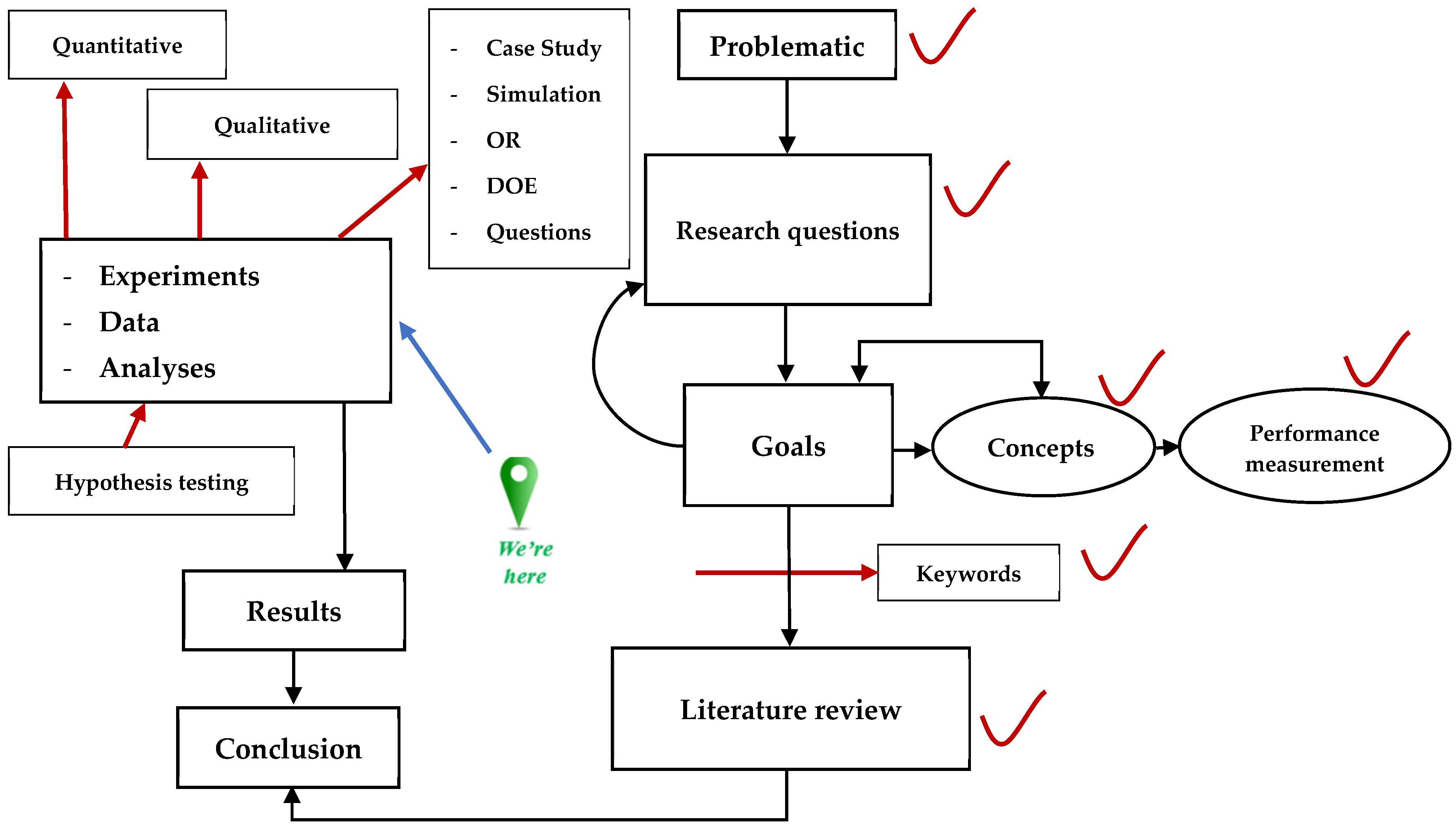
2. Research Methodology
2.1. Systematic Literature Review (SLR)
2.2. Study of Factors Affecting the Spillway
2.3. Functionality of Strategic Infrastructure Systems
3. Literature Review
3.1. Spillway Discharge Gates
3.2. Types of Spillway Gates Used
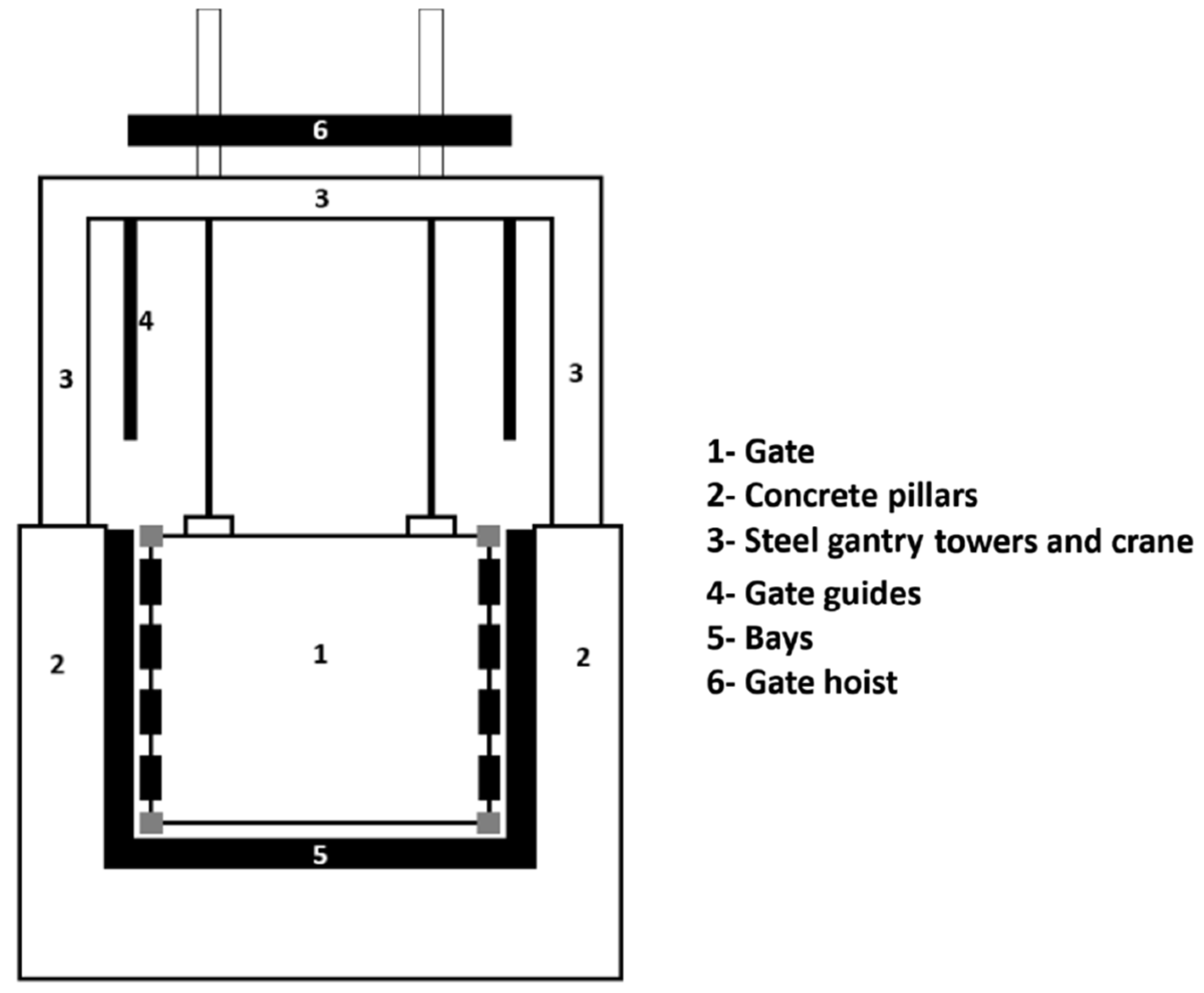
3.3. Functional Structure of a Spillway Gate System
3.4. Signs of Degradation in the Spillway Gate System
3.5. Comparative Failure Modes Studies on Spillway Gates
3.6. Factors Affecting a Spillway System
3.6.1. Aging Assets
3.6.2. Hydrological Events Increased by Climate Change
3.6.3. The Rise in Electricity Demand
3.7. Operational and Management-Related Factors Affecting Spillways
3.7.1. Maintenance Practices
3.7.2. Power Plant Tripping
3.8. Resilience of Structures in Dams
3.9. Spillway Discharge Gate System Management
3.10. Potential Solutions
4. Research Framework
- What types of spillway discharging gates are used?
- What are the degradation indicators?
- What are the factors affecting the life cycle of spillway gates?
- What are the current maintenance plans for spillway gates? Are these plans still effective given the recent changes?
- What technologies can be used to improve the reliability, availability, and durability of spillway gates?
- What is the future research that will be done?
5. Case Study
5.1. Discharge Gates Used at Hydro-Québec
“Handling beams under flow, often without mechanical assistance, exposes personnel to hazardous conditions, including hydraulic thrust and rapid flow. Mechanized, remotely controlled closure systems are preferable for ensuring both personnel safety and reliable flow control.”[53]
5.2. Functional Structure at Hydro-Québec
5.3. Signs of Degradation at Hydro-Québec
5.4. FMEA by Hydro-Québec
- DC—Hidden failure whose condition is not obvious to determine due to the difficulty or impossibility of inspection (e.g., concrete core, anchorage systems, etc.).
- S—May have consequences for the safety of workers and/or the public.
- E—Potential for environmental impact.
- L—May result in non-compliance with legal or regulatory requirements.
- A—Expected service of the facility, with an impact on the availability of the different systems.
- É—Economic in nature, with no consequences other than the costs incurred to repair the failure.
5.5. Spillway’s System Management at Hydro-Québec
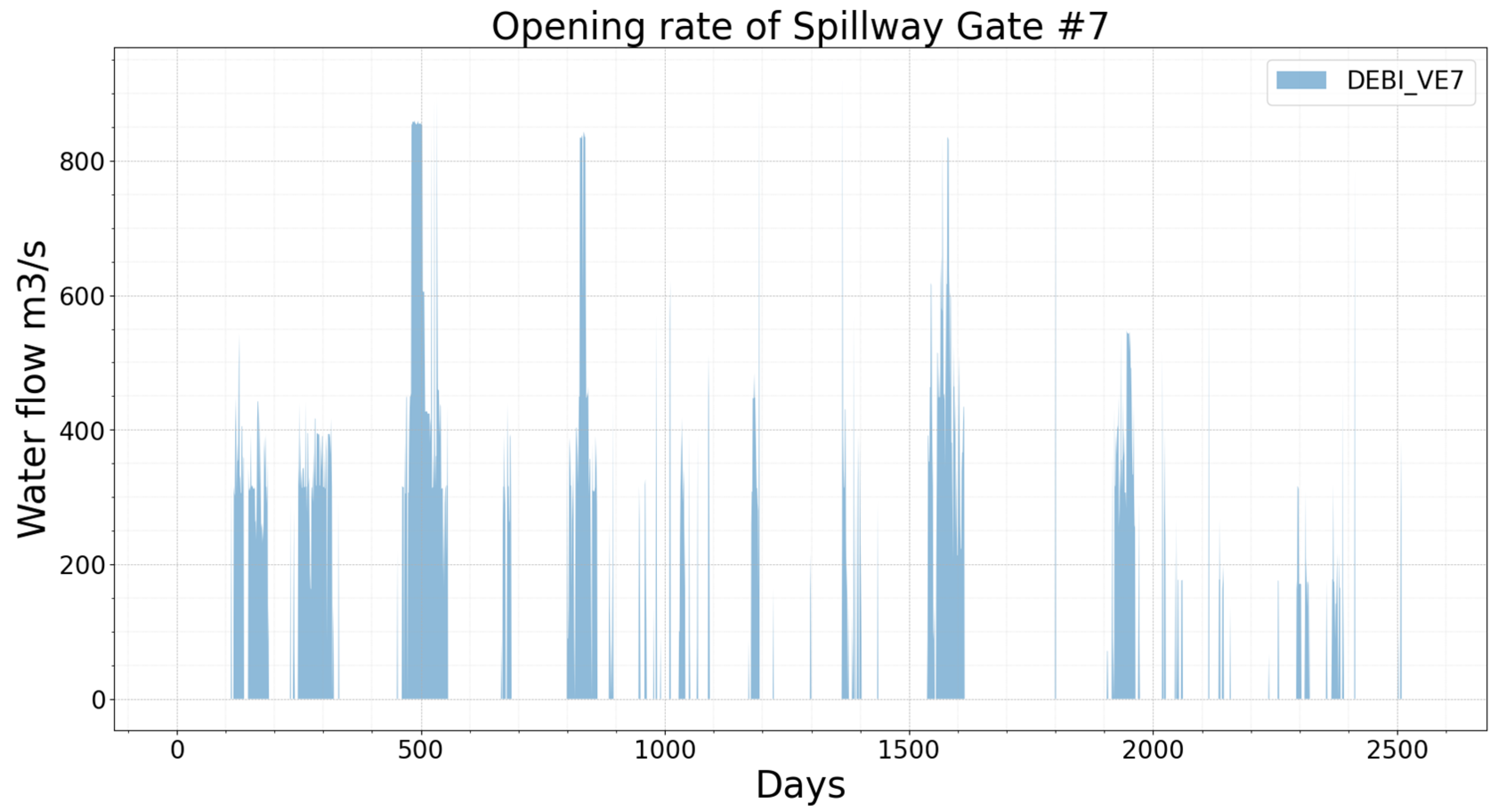
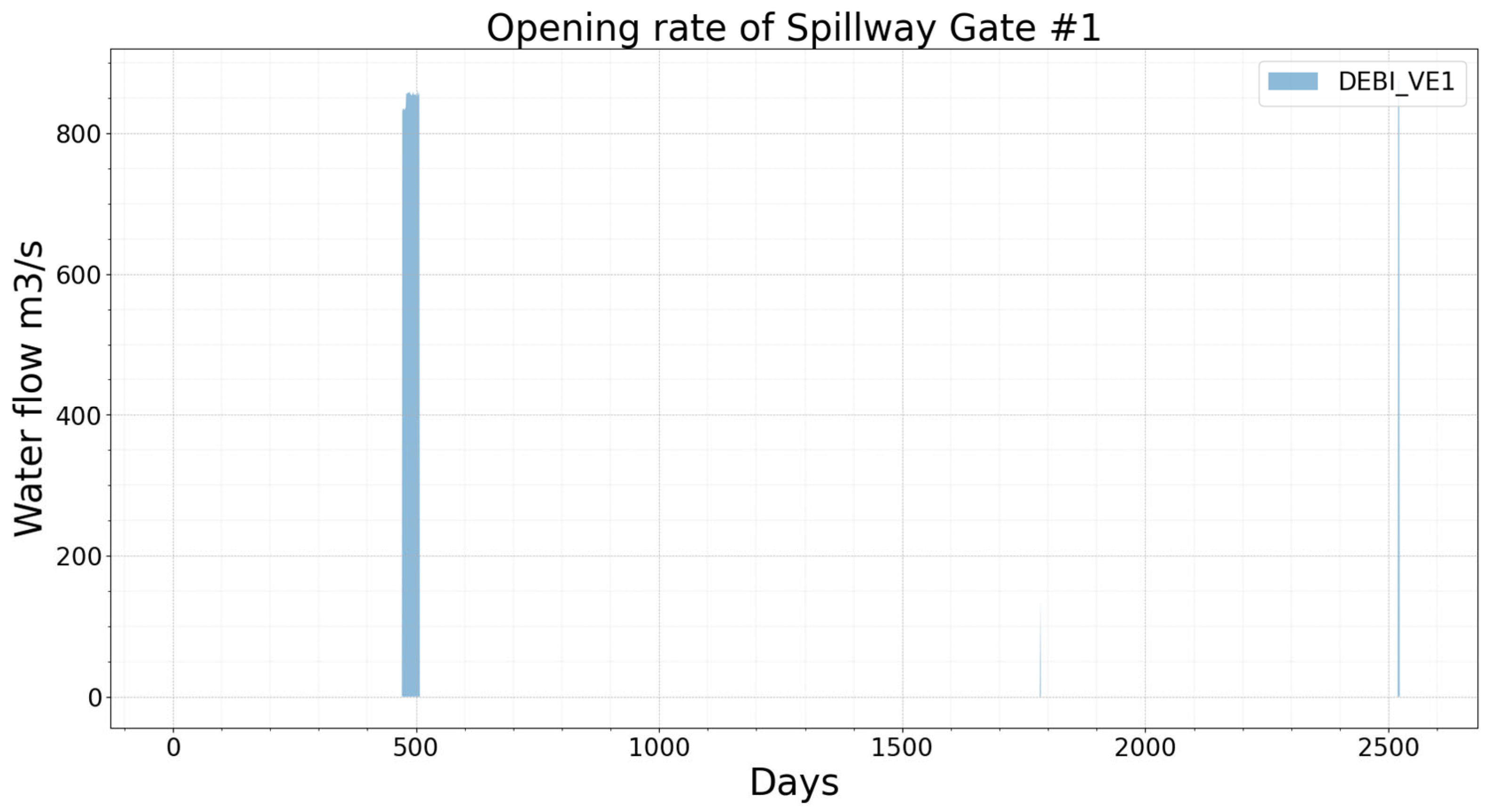
5.6. Operating Rate of a Spillway
5.7. Proposed Solutions by Hydro-Québec
- On-site data collection during inspections;
- Help with analysis and performance criteria;
- Output and decision support;
- Detection of generator anomalies.
6. Discussion
7. Conclusions
Future Research
- Build reliable databases based on industry 4.0 technologies that make it possible to use artificial intelligence algorithms for the modeling and monitoring of systems. This makes it possible to adapt maintenance policies to the condition of the system for better life cycle management.
- Evaluate and compare the different types of system modeling: FMEA, simulations, digital twins, Markovian (Bayesian) modeling, etc., to choose the best way to model spillway systems, for better life cycle management and system resilience.
- Validate our results through case studies at Hydro-Québec.
Author Contributions
Funding
Data Availability Statement
Conflicts of Interest
Abbreviations
| HQ | Hydro-Québec |
| RAM | Reliability, Availability, Maintainability |
| AI | Artificial Intelligence |
| PMEV | Poutrelles de Maintenance à Eau Vive |
| FMEA | Failure Mode Effects and Analysis |
| FMECA | Failure Mode, Effects, and Criticality Analysis |
| EV | Electric Vehicle |
| USBR | U.S. Bureau of Reclamation |
| ICOLD | International Commission On Large Dams |
| SFOR | Sûreté Fonctionnelle des Ouvrages Régulateurs |
| RPN | Risk Priority Number |
References
- IEA. Key World Energy Statistics 2019; OECD Publishing: Paris, France, 2019. [Google Scholar] [CrossRef] [Scilit]
- Perera, D.; Smakhtin, V.; Williams, S.; North, T.; Curry, A. Ageing Water Storage Infrastructure: An Emerging Global Risk; UNU-INWEH Report Series; United Nations University Institute for Water, Environment and Health (UNU-INWEH): Hamilton, ON, Canada, 2021; Available online: https://www.preventionweb.net/quick/18068 (accessed on 1 December 2025).
- Cottin, L. Les évacuateurs de crues des barrages hydroélectriques concédés français; vue synthétique du parc. In CFBR-SHF: «Dimensionnement et Fonctionnement des Évacuateurs de Crues»; Bureau d’Etude Technique et de Contrôle des Grands Barrages: Lyon, France, 2009; p. 8. [Google Scholar]
- Hydro-Québec. Refurbishment of Carillon Generating Station. Planning for the Energy of Tomorrow—Projects. Available online: https://www.hydroquebec.com/projets/carillon/ (accessed on 1 December 2025).
- Loucks, D.P.; van Beek, E. Water Resources Planning and Management: An Overview. In Water Resource Systems Planning and Management; Springer: Cham, Switzerland, 2017. [Google Scholar] [CrossRef] [Scilit]
- United States Society on Dams. The Aging of Embankment Dams; USSD Committee on Materials for Embankment Dams: Denver, CO, USA, 2010.
- Soriano Martín, E.; Mediero Orduña, L.; Petroselli, A.; Grimaldi, S.; De Luca, D.L. Effects of climate change on hydrological safety of dams with gated spillways. In Proceedings of the IAHS2022 Scientific Assembly; Copernicus Meetings: Göttingen, Germany, 2022. [Google Scholar] [CrossRef] [Scilit]
- García-Moreno, S.; López-Ruiz, V.-R. A Review of the Energy Sector as a Key Factor in Industry 4.0: The Case of Spain. Energies 2023, 16, 4446. [Google Scholar] [CrossRef] [Scilit]
- Wong, W.; Anwar, M.F.; Soh, K.L. Transportation 4.0 in supply chain management: State-of-the-art and future directions towards 5.0 in the transportation sector. Oper. Manag. Res. 2024, 17, 683–710. [Google Scholar] [CrossRef] [Scilit]
- Alfredsen, K.; Amundsen, P.A.; Hahn, L.; Harrison, P.M.; Helland, I.P.; Martins, E.G.; Twardek, W.M.; Power, M. A synoptic history of the development, production and environmental oversight of hydropower in Brazil, Canada & Norway. Hydrobiologia 2022, 849, 269–280. [Google Scholar] [CrossRef] [Scilit]
- Soomro, S.; Soomro, A.; Batool, S.; Guo, J.; Li, Y.; Bai, Y.; Hu, C.; Tayyab, M.; Zeng, Z.; Li, A.; et al. How does the climate change effect on hydropower potential, freshwater fisheries, and hydrological response of snow on water availability? Appl. Water Sci. 2024, 14, 65. [Google Scholar] [CrossRef] [Scilit]
- Kitchenham, B.; Brereton, O.P.; Budgen, D.; Turner, M.; Bailey, J.; Linkman, S. Systematic literature reviews in software engineering—A systematic literature review. Inf. Softw. Technol. 2009, 51, 7–15. [Google Scholar] [CrossRef] [Scilit]
- Ho, M.; O’Shea, D.; Wasko, C.; Nathan, R.; Sharma, A. The impact of climate change on dam overtopping floods in Australia. Hydrol. Earth Syst. Sci. 2025, 29, 5851–5870. [Google Scholar] [CrossRef] [Scilit]
- Li, B.; Chen, M.; Li, Q.; Cheng, T.; Ma, Z.; Zhang, S.; Qian, X. Integration of battery electric vehicles in a regional hydro–thermal–wind power system. Energy Rep. 2020, 6, 1199–1205. [Google Scholar] [CrossRef] [Scilit]
- Hao, F. Impact of electric vehicle charging demand on clean energy regional power grid control. Energy Inform. 2025, 8, 83. [Google Scholar] [CrossRef] [Scilit]
- ICOLD. Dam Safety Management: Operational Phase of the Dam Life Cycle; Bulletin No. 118; International Commission on Large Dams: Paris, France, 2013. [Google Scholar]
- ICOLD. Dam Failures—Statistical Analysis; Bulletin No. 99; International Commission on Large Dams: Paris, France, 1995. [Google Scholar]
- ISO 55000; Asset Management—Overview, Principles and Terminology. International Organization for Standardization: Geneva, Switzerland, 2014.
- Wang, H.; Li, D.; Sheng, T.; Sheng, J.; Jing, P.; Zhang, D. A Modeling of Human Reliability Analysis on Dam Failure Caused by Extreme Weather. Appl. Sci. 2023, 13, 12968. [Google Scholar] [CrossRef] [Scilit]
- Ntemiroglou, C.; Sakki, G.-K.; Efstratiadis, A. Flood control across hydropower dams: The value of safety. In Role of Dams and Reservoirs in a Successful Energy Transition, 1st ed.; CRC Press: Boca Raton, FL, USA, 2023. [Google Scholar] [CrossRef]
- Stamatis, D.H. Failure Mode and Effect Analysis: FMEA from Theory to Execution; ASQ Quality Press: Milwaukee, WI, USA, 2003. [Google Scholar]
- Bartsch, M. FMECA of the Ajaure Dam. In BDS Conference on Reservoirs; Thomas Telford: London, UK, 2004; pp. 179–190. [Google Scholar] [CrossRef] [Scilit]
- Durkee, D.; Kabala, C. “It is a New Dam, How Can it Fail?”—FMEA for Design of New Tempe Town Lake Dam; Association of State Dam Safety Officials: San Diego, CA, USA, 2014. [Google Scholar]
- Bates, B.C.; Kundzewicz, Z.W.; Wu, S.; Palutikof, J. Climate Change and Water; Technical Paper VI; IPCC: Geneva, Switzerland, 2008; Available online: https://www.ipcc.ch/site/assets/uploads/2018/03/climate-change-water-en.pdf (accessed on 1 December 2025).
- Novak, P. Hydraulic Structures, 4th ed.; Taylor & Francis: London, UK, 2007. [Google Scholar] [CrossRef] [Scilit]
- Lewin, J. Hydraulic Gates and Valves: In Free Surface Flow and Submerged Outlets, 2nd ed.; Thomas Telford: London, UK, 2001; Available online: https://books.google.ca/books?id=ftoydBCm-4wC (accessed on 1 December 2025).
- Adamo, N.; Al-Ansari, N.; Sissakian, V.; Laue, J.; Knutsson, S. Dam Safety: Technical Problems of Ageing Concrete Dams. J. Earth Sci. Geotech. Eng. 2020, 10, 241–279. Available online: https://urn.kb.se/resolve?urn=urn:nbn:se:ltu:diva-79850 (accessed on 1 December 2025).
- ICOLD. Automated Dam Monitoring Systems—Guidelines and Case Histories; Bulletin No. 118; International Commission on Large Dams: Paris, France, 2000. [Google Scholar]
- ICOLD. Internal Erosion of Existing Dams, Levees and Dikes, and Their Foundations; Bulletin No. 164; International Commission on Large Dams: Paris, France, 2017. [Google Scholar]
- IDAS. Kraftföretagens Riktlinjer för Dammsäkerhet (Guidelines for Dam Safety). 2025. Available online: https://www.ridas.se/ (accessed on 1 December 2025).
- Arizona Administrative Code. Title 12, Chapter 5, Article 12 (Dam Safety Procedures). 2007. Available online: https://www.azwater.gov/dam-safety (accessed on 1 December 2025).
- Foster, M.; Spannagle, M. Reliability of spillway gates at Glenmaggie and Little Nerang Dams. In Proceedings of the ANCOLD Conference on Dams, Hobart, Tasmania, Australia; Australian National Committee on Large Dams: Hobart, Australia, 2000. [Google Scholar]
- ANCOLD. Guidelines on Dam Safety Management. Lake Glenmaggie. 2003. Available online: https://www.srw.com.au/ (accessed on 1 December 2025).
- Queensland Water Supply (Safety and Reliability) Act 2008. Available online: https://www.seqwater.com.au/dams/little-nerang (accessed on 1 December 2025).
- Bryan, C.; Langlais, N. Rapport AMDEC—Travaux Prioritaire Coteau 1 et 3. 700363-0000-40ER-0001_00; Hydro-Québec-AtkinsRéalis: Montréal, QC, Canada, 2024; 66p. [Google Scholar]
- Boivin, G. Beyond operational testing—A methodology for spillway gates. In Proceedings of the 92nd ICOLD Annual Meeting—Symposium “Dams for People, Water and Environment and Development”, New Delhi, India, 29 September–3 October 2024; Hydro-Quebec Research Center: Varennes, QC, Canada, 2024. [Google Scholar]
- Adamo, N.; Al-Ansari, N.; Sissakian, V.; Laue, J.; Knutsson, S. Dam Safety: Sediments and Debris Problems. J. Earth Sci. Geotech. Eng. 2020, 11, 27–63. [Google Scholar] [CrossRef] [Scilit]
- Lovgren, S. Les Barrages, Un Outil Controversé Dans la Lutte Contre le Changement Climatique. National Geographic. 2022. Available online: https://www.nationalgeographic.fr/environnement/2022/10/les-barrages-un-outil-controverse-dans-la-lutte-contre-le-changement-climatique (accessed on 1 December 2025).
- Martinez Monseco, F.J. Analysis of maintenance optimization in a hydroelectric power plant. J. Appl. Res. Technol. Eng. 2020, 1, 23–29. [Google Scholar] [CrossRef] [Scilit]
- Neupane, B.; Vereide, K.; Panthi, K.K. Operation of Norwegian Hydropower Plants and Its Effect on Block Fall Events in Unlined Pressure Tunnels and Shafts. Water 2021, 13, 1567. [Google Scholar] [CrossRef] [Scilit]
- Schleiss, A.J.; Erpicum, S.; Matos, J. Advances in Spillway Hydraulics: From Theory to Practice. Water 2023, 15, 2161. [Google Scholar] [CrossRef] [Scilit]
- Forcellini, D.; Kalfas, K.N. A framework to quantify the impact of deterioration on the seismic resilience of structures. Struct. Infrastruct. Eng. 2025, 1–9. [Google Scholar] [CrossRef] [Scilit]
- Du, A.; Wang, X.; Xie, Y.; Dong, Y. Regional seismic risk and resilience assessment: Methodological development, applicability, and future research needs—An earthquake engineering perspective. Reliab. Eng. Syst. Saf. 2023, 233, 109104. [Google Scholar] [CrossRef] [Scilit]
- Kameshwar, S.; Forcellini, D.; Barbosa, A.R. Assessment of building recovery functions for local and global resilience assessment to tsunamis. Resilient Cities Struct. 2025, 4, 132–145. [Google Scholar] [CrossRef] [Scilit]
- Hariri-Ardebili, M.A. Risk, Reliability, Resilience (R3) and beyond in dam engineering: A state-of-the-art review. Int. J. Disaster Risk Reduct. 2018, 31, 806–831. [Google Scholar] [CrossRef] [Scilit]
- Paxson, G.; Indri, R.; Landis, M. Addressing Operational Risks and Uncertainties for Gated Spillways. In Proceedings of the USSD 2015 Annual Conference, Louisville, KY, USA, 13–17 April 2015; United States Society on Dams (USSD): Denver, CO, USA, 2015; Available online: https://www.ljcainc.com/uploads/1/1/2/0/112055939/addressing_operational_uncertainties_for_gated_spillways.pdf (accessed on 1 December 2025).
- Graham, W.J.; Hilldale, R.C. Spillway Gate Failure or Misoperation: Representative Case Histories; U.S. Bureau of Reclamation: Denver, CO, USA, 2001. Available online: https://www.usbr.gov/damsafety/TechDev/DSOTechDev/DSO-01-01.pdf (accessed on 1 December 2025).
- CSA Group. Adaptation aux Changements Climatiques pour les Barrages; Groupe CSA: Toronto, ON, Canada, 2022; Available online: https://www.csagroup.org/wp-content/uploads/Groupe-CSA-Recherche-Adaptation-aux-changements-climatiques-pour-les-barrages.pdf (accessed on 1 December 2025).
- Flecker, A.S.; Shi, Q.; Almeida, R.M.; Angarita, H.; Gomes-Selman, J.M.; García-Villacorta, R.; Sethi, S.A.; Thomas, S.A.; Poff, N.L.; Forsberg, B.R.; et al. Reducing adverse impacts of Amazon hydropower expansion. Science 2022, 375, 753–760. [Google Scholar] [CrossRef] [Scilit]
- Tancrédi, S. Comment l’IA Contribue au Bon Fonctionnement des Barrages: Rapport. Nouvelles Quotidiennes, Nouvelles Environnementales. Sigma Earth. 2023. Available online: https://sigmaearth.com/fr/how-ai-is-aiding-in-smooth-running-of-dams-report/ (accessed on 1 December 2025).
- Hariri-Ardebili, M.A.; Mahdavi, G.; Nuss, L.K.; Lall, U. The role of artificial intelligence and digital technologies in dam engineering: Narrative review and outlook. Eng. Appl. Artif. Intell. 2023, 126, 106813. [Google Scholar] [CrossRef] [Scilit]
- Bentley Systems. Jumeaux Numériques d’Infrastructure: Logiciels de Bentley Systems. Available online: https://fr.bentley.com/software/infrastructure-digital-twins/ (accessed on 1 December 2025).
- Nicolet, R. Rapport de la Commission d’Enquête sur la Sécurité des Barrages Rapide-Blanc et Rapide-des-Coeurs; Hydro-Québec: Québec, QC, Canada, 1980. [Google Scholar]
- Boussaha, F.; Belkalem, C.; Brouillette, J. Analyse de la maintenance et évaluation de la dégradation des actifs—Barrage en béton; P-GAB-N-122-2022; Hydro-Québec: Montréal, QC, Canada, 2022; 52p. [Google Scholar]
- Carrasco, J.M.; Ortega, E.M.; Cordeiro, G.M. A generalized modified Weibull distribution for lifetime modeling. Comput. Stat. Data Anal. 2008, 53, 450–462. [Google Scholar] [CrossRef] [Scilit]
- Liu, X.; Ma, M. Cumulative fatigue damage theories for metals: Review and prospects. Int. J. Struct. Integr. 2023, 14, 629–662. [Google Scholar] [CrossRef] [Scilit]
- Stoffels, R.J.; Thompson, R.M. Avoiding the ‘One-Size-Fits-All’ Trap in Policy-Based Monitoring. River Res. Appl. 2026, 42, 732–746. [Google Scholar] [CrossRef] [Scilit]






| Gate/Valve Type | Primary Function | Environment Best Suited for | Notes |
|---|---|---|---|
| Radial (Tainter/Segment) gate | Spillway flow regulation | Large spillways needing wide clear openings and moderate hoist forces | Workhorse crest gate in modern dams |
| Vertical-lift Sluice/slide gate | Closure/diversion | Intakes, outlets, canals; moderate heads | Simple, robust, economical |
| Roller/Wagon gate | Wide bay opening with low rolling friction | Navigation dams and very wide spillways | Specialized; legacy but still used |
| Drum (hinged crest) gate | Automatic crest level regulation | Overflow weirs needing near automatic level control | Buoyant/hinged system; higher O&M |
| Flap gate (incl. tide/non return) | One-way discharge (non-return) | Coastal/tidal drainage, storm protection | Opens under head differential |
| Tilting/Bascule gate | Level and navigation control | Low-head rivers/canals; frequent operations | Compact hoists; good debris passage |
| Siphon spillway/Siphon gate | Autonomous discharge (no hoists) | Sites needing unattended crest control and compact works | Priming/de-priming governs flow |
| Hollow-jet (Howell–Bunger) valve | Energy-dissipating outlet | High-head bottom outlets needing aerated jets | Stable hollow jet; cavitation-resistant |
| Fixed cone (dissipation) valve | Energy-dissipating outlet | High-head controlled releases | Highly aerated, stable jet |
| Butterfly valve | Isolation/regulation in pressure lines | Penstocks and plant piping | Compact (for pressurized conduits) |
| Canal knife/Slide valve | Canal regulation and isolation | Irrigation/sluice structures | Low cost; small to medium openings |
| Stoplogs/Bulkheads | Temporary closure for maintenance | Any intake/bay needing dewatering | Accessory (not for regulation) |
| Fuse gates/Fuse plugs | Passive extra flood capacity | Dams needing rare-event capacity boost | Sacrificial/tilting units at extremes |
| Component | Main Function | Environment Best Suited for | Common Materials | Link with Other Components |
|---|---|---|---|---|
| Gate body | Structural shell resisting hydrostatic load | All gates; high head | Structural steel, cast iron, reinforced concrete | Carries closure element, transmits load to piers/foundations |
| Closure element (disc/segment/slide/cone) | Interrupts/allows flow | Spillways, outlets, canals | Structural/Stainless steels (alloys) | Moves within gate body along guides, pressed against seals (actuated by hoists) |
| Actuation system (hoists, cylinders, motors) | Provide motion | Depending on head and operation frequency | Steel machinery; hydraulic/electric drives | Connects to closure element; supported by piers/bridges and linked with control systems |
| Sealing joints | Prevent leakage | All gates under head | Rubber (neoprene/EPDM) PTFE facings | Mounted on closure and frame; pressed by guides/actuation |
| Discharge conduit/tunnel | Carries water downstream | Outlet works, tunnels | Reinforced concrete Steel lining | Receives flow from closure; interacts with valves/dissipators |
| Guides/embedded parts | Align closure, transfer loads | High-head, precision gates | Stainless steel, bronze, cast steel | Anchor closure to piers ensures sealing and controlled movement |
| Instrumentation and control | Position/pressure monitoring | Modernized dams | Sensors, encoder, control panels | Integrated with actuation; feeds operator feedback |
| Winches/operating machinery | Lifting/rotation | Radial, tilting, flap gates | Steel winches, gearboxes, ropes | Drive actuation mounted on gantries, linked to closure |
| Gantry bridges (overhead cranes) | Support hoists, handling | Multi-bay/tall bays | Structural steel | Carry winches/hoists; move stoplogs; link to piers |
| Concrete piers/pillars | Structural support | Multi-bay spillways | Reinforced concrete | House guides and seals; support bridges and hoists |
| Maintenance/winch beams | Handling and access | All dams | Steel or reinforced concrete | Enable handling stoplogs/closure; connect to gantry |
| Sign of Degradation | Most Affected Environments | Main Causes |
|---|---|---|
| Corrosion of metallic parts | Humid/tropical climates, saline reservoirs, industrially polluted water | Humidity, chlorides, aging or lack of protective coatings |
| Cracking and structural fatigue | Gates with high operational frequency; aging steel structures | Cyclic stress from repeated operations; stress concentrations; fatigue of metals |
| Cavitation damage | High-head outlets and spillways with high velocities | Formation and collapse of vapor cavities causing surface erosion |
| Wear of hydromechanical mechanisms | Worldwide (especially under poor maintenance) | Friction, abrasion, lack of lubrication, aging of moving |
| Loss of joint watertightness | Cold climates with freeze–thaw cycles; aging assets | Seal aging, hydraulic pressure cycles, freeze–thaw deterioration |
| Global deformation/instability | Seismic regions; dams under overload or aging | Earthquakes, extreme floods, design/foundation defects |
| Dam and Country | Gate Type | Method Applied | Key Failure Modes | How Criticality Was Assessed | Explanation for Reader | Maintenance Strategy | Ref. |
|---|---|---|---|---|---|---|---|
| Ajaure Dam (Sweden) | Controlled spillway gates | FMECA with worksheets, subsystem “Spillway Gate Control” | Hoist and control failure, gate not opening on demand, loss of discharge capacity | Criticality index per failure mode (severity x occurrence) ranked in tables | A textbook-style FMECA: clear identification of failure modes, causes, effects, and numerical criticality. Demonstrates how to apply FMECA to gate control systems in practice. | The Ajaure spillway requires mandatory annual functional gate testing and weekly visual monitoring, with comprehensive technical reviews occurring every five to seven years. | [22,30] |
| Temple Town Lake Dam (USA, Arizona) | 8 hydraulically operated steel crest gates (spillway) | Design phase FMEA at 60% design review | Seal leakage, hydraulic cylinder failure, gate jamming, structural deformation, control system failure | Consequence categories (safety, operational, financial); no RON | A proactive FMEA carried out during design. Shows how gate failure modes can be anticipated before commissioning, with consequences categorized rather than scored numerically. | The Temple Town Lake annual formal engineering inspections and quarterly operational reviews, supplemented by mandatory functional gate testing and immediate assessments before and after major storm events. | [23,31] |
| Glenmaggie and Little Nerang Dams (Australia) | Glenmaggie (14 radial gates) Little Nerang (2 drum gates) | Reliability/fault-tree analysis (FMECA-equivalent) | Bearing failure, hoist malfunction, gate seizure, seal leakage, operator error | Quantified probabilities of single versus multiple gate failure | Although labeled “fault tree”, this analysis is functionally an FMECA: it breaks gates into components, identifies failure paths, and quantifies failure likelihoods. Adds a probabilistic dimension missing in traditional FMEA tables. | The Glenmaggie spillway requires weekly visual checks and annual functional gate testing to ensure all fourteen floodgates remain operational for frequent spilling. Little Nerang Dam undergoes weekly visual inspections, annual engineering assessments, and comprehensive reviews every five years to monitor its ungated spillway and structural stability. | [32,33,34] |
| Subsystem/Component | Failure Mode | Potential Cause(s) | Effect(s) on System | S | O | D | RPN |
|---|---|---|---|---|---|---|---|
| Dam body | An earthquake damages the abutments, prevents access to the structure and makes the two end spillways unusable. | Inadequate stability under seismic loading. | Damage to the dam body limits discharge capacity. | 5 | 1 | 5 | 25 |
| An earthquake damages all the piers and renders the spillway inoperative. | Inadequate lateral stability of piers due to lack of reinforcement between piers and slabs. | Damage to the dam body limits discharge capacity. | 5 | 1 | 5 | 25 | |
| Uplift of a slab renders a spillway inoperable. | Inadequate structural integrity of slabs under uplift loads. | Damage to the dam body limits discharge capacity. | 3 | 2 | 4 | 24 | |
| Gates and piers | The gate no longer has the capacity to resist loads and deforms. Unable to release the spillway gate. | Gate degradation. | It is impossible to release the gate of a spillway. | 3 | 3 | 3 | 27 |
| The gate no longer has the capacity to resist loads and fails. | Gate degradation. | It is impossible to release the gate of a spillway. | 5 | 2 | 3 | 30 | |
| Gate and/or groove heating malfunctions and prevents its lifting. | Frozen gates in grooves and do not move. | It is impossible to release the gate of a spillway. | 4 | 4 | 3 | 48 | |
| Gantry crane | The gantry crane does not operate due to mechanical or electrical problems. | Motors do not function: translation/lifting. | The gantry crane is unusable. | 4 | 3 | 4 | 48 |
| The gantry crane does not operate due to mechanical or electrical problems. | Electromagnetic brakes do not function. | The gantry crane is unusable. | 3 | 3 | 4 | 36 | |
| The gantry crane does not operate due to mechanical or electrical problems. | Gears do not function. | The gantry crane is unusable. | 4 | 2 | 2 | 16 | |
| The gantry crane does not operate due to mechanical or electrical problems. | Reducers do not function. | The gantry crane is unusable. | 4 | 2 | 4 | 32 | |
| Crane runway | Solicitation of the upstream beam exceeds its capacity during a valve lift and it deforms (overload protection failure). | Absence of reinforcement causes failure of upstream or downstream beam. | One or more spans of the crane runway are unusable, isolating the crane on a section of the structure. | 3 | 3 | 3 | 27 |
| Complete failure of one or more supports of a span and loss of the gantry crane during empty crane passage. | Replace deformed anchors of crane runway beams. | One or more spans of the crane runway are unusable, isolating the crane on a section of the structure. | 5 | 3 | 5 | 75 | |
| Lack of mobility in the supports leads to compression of a beam and the removal of the runway span to perform stress-relief work. | Absence of oblong holes and movable supports. | One or more spans of the crane runway are unusable, isolating the crane on a section of the structure. | 2 | 2 | 3 | 12 | |
| Lack of mobility in the supports leads to compression of a beam and the beam breaks during crane travel. | Absence of oblong holes and movable supports. | One or more spans of the crane runway are unusable, isolating the crane on a section of the structure. | 5 | 2 | 3 | 30 | |
| Partial failure of one or more supports of a span during empty crane passage leads to span removal. | Lack of capacity of supports of crane runway. | One or more spans of the crane runway are unusable, isolating the crane on a section of the structure. | 2 | 4 | 4 | 32 | |
| Complete failure of one or more supports of a span and loss of the gantry crane during empty crane passage. | Lack of capacity of supports of crane runway. | One or more spans of the crane runway are unusable, isolating the crane on a section of the structure. | 5 | 2 | 4 | 40 | |
| Complete failure of one or more supports of a span and loss of the gantry crane during empty crane passage. | Lack of capacity of supports of crane runway. | One or more spans of the crane runway are unusable, isolating the crane on a section of the structure. | 3 | 3 | 3 | 27 | |
| Complete failure of one or more supports of a span and loss of the gantry crane during empty crane passage. | Loss of verticality and horizontality of the rail. | One or more spans of the crane runway are unusable, isolating the crane on a section of the structure. | 1 | 3 | 4 | 12 | |
| Lack of mobility in the supports leads to compression of a beam and the removal of the runway span to perform stress-relief work. | Absence of reinforcement causes failure of upstream or downstream beam. | One or more spans of the crane runway are unusable, isolating the crane on a section of the structure. | 5 | 1 | 2 | 10 |
| Independent Variables | Dependent Variables | Moderating Variables |
|---|---|---|
| Asset aging | Signs of degradations | Types of gates used |
| Hydrological events affected by climate change | RAM | Environment |
| Rising electricity demand | Risk |
| Gates | Number | % |
|---|---|---|
| Wagon | 314 | 57 |
| PMEV | 157 | 27 |
| Slide | 36 | 6 |
| Stoney | 24 | 4 |
| Segment | 19 | 3 |
| Bottom outlets | 6 | 1 |
| Inflatable | 5 | 1 |
| Butterfly | 4 | 1 |
| Subsystems | Components | Additional Information | Functional Role |
|---|---|---|---|
| Gate | Frame | Composed of the screen plate (steel deck) and the gate structure (horizontal beams and vertical side members) | Provides the main structure to resist water pressure and transfer loads to supports. |
| Sealing components | Includes sealing joints, bronze rods, cylindrical rods, clamps, and sealing plate | Ensures watertight closure of the gate to prevent leakage. | |
| Rolling system | Consists of lateral wheels and a guide system connected to a lubrification station | Allows smooth gate misalignment and transfers structural loads. | |
| Lateral wheels and fixed shoes | Lateral shoes limit the gate’s movement to avoid jamming; lateral wheels are protected by fixed shoes that carry the load | Prevents gate misalignment and transfers structural loads. | |
| Heating system | - | Prevents ice formation, ensures operability in cold climates. | |
| Gate knife | - | Cut water flows when the gate is lowered. | |
| Lifting points | Gate attachment points | Provide anchor points for hoisting and safe lifting. | |
| Concrete piers | Survey terminal | - | Allows monitoring and deformation control. |
| Steels towers & gantry | Gantry bridge structure | Steel structure, bolted/assembled | Supports hoisting equipment for gate lifting. |
| Bearings & expansion joints | - | Compensate for structural movements and thermal effects. | |
| Anchors | - | Transfer loads to foundation. | |
| Overhead guides | Lateral guides | - | Guide gates along their tracks. |
| Spillway passage | Embedded parts | Includes lateral grooves, gate tracks, and sealing surfaces | Provide tracks and sealing interfaces for gate operation. |
| Crest | - | Defines spillway discharge elevation | |
| Concrete | - | Provides structural strength and water passage. | |
| Sealing components | - | Ensure tightness of gate passage. | |
| Hoists | Mechanical elements | Cables, drums, screws, nuts, shafts, gears, etc. | Provide tracks and sealing interfaces for gate operation. |
| Gearbox & motor set | Motor, speed reducer, drum, bearings, braking system (electromagnetic brake, fans, ventilation system), limit switches, gate lifting equipment | Defines spillway discharge elevation. | |
| Control & protections | Protection systems (limit switches, slack cable switches, overload devices) | Ensure safe and reliable operation of hoists. | |
| Power supply | Power supply from plants, auxiliary generator | Provide energy for hoist motors and control. | |
| Maintenance beams | Maintenance beams | - | Allow gate support during maintenance. |
| Grooves | - | Provide insertion points for stoplogs or beams. | |
| Auxiliary lifting system | - | Assists in handling during maintenance operations. | |
| Spillway chute & floor | Spillway chute and stilling basin | - | Guides floodwater downstream, dissipates energy to reduce erosion. |
| Control & monitoring | Control panels, sensors, SCADA integration, position detectors, emergency backup systems | Monitor gate position, loads, motor conditions, water levels; integrated into automated control system | Automates gate operation, provides real-time monitoring, improves safety and operational decision-making. |
| Causes | % |
|---|---|
| Mechanical and alignment problems | 40.47 |
| Abnormal operating conditions | 37.09 |
| Leakage problems | 7.75 |
| Final material deterioration | 5.38 |
| Deformations and functional interfaces | 4.33 |
| Structural and design-related causes | 4.33 |
| Environmental degradation | 0.65 |
| Component | Function | Failure Mode | Cause(s) | Effect(s) | Consequences | |||||
|---|---|---|---|---|---|---|---|---|---|---|
| DC | S | E | L | A | É | |||||
| Discharge Gate | Retain Water | Deterioration/wear |
|
| X | X | ||||
| Leakage/loss of tightness/infiltration | Wear/degradation |
| X | |||||||
| Gate heating | Heat air volume (sufficient to prevent ice cover adhesion to the screen plate and ice formation in the rolling area) | Partial or total loss of heating efficiency |
|
| X | |||||
| Presence of water in watertight compartment of heating elements | Deterioration of silicone sealant of connection boxes or sealing joints of bolted covers | Accelerated corrosion of heating elements | X | |||||||
| Defective side seals | Corrosion of fasteners, rubber deterioration | Reduced efficiency of wheel heating, potential wheel, freezing, risk of gate blockage in cold weather | X | |||||||
| Beams operated in flowing water | Retain water | Deterioration/wear | Wear/degradation | Beams can no longer be operated or used | X | |||||
| Remotely triggered beams | Retain water | Deterioration/wear | Wear/degradation | Beams can no longer be operated or used | X | |||||
Disclaimer/Publisher’s Note: The statements, opinions and data contained in all publications are solely those of the individual author(s) and contributor(s) and not of MDPI and/or the editor(s). MDPI and/or the editor(s) disclaim responsibility for any injury to people or property resulting from any ideas, methods, instructions or products referred to in the content. |
© 2026 by the authors. Licensee MDPI, Basel, Switzerland. This article is an open access article distributed under the terms and conditions of the Creative Commons Attribution (CC BY) license.
Share and Cite
Ghoche, P.; Lavoie, B.; Nezhad, M.K.; Abdul-Nour, G. Emerging Reliability Challenges of Spillway Discharging Systems in Aging Hydroelectric Dams. CivilEng 2026, 7, 31. https://doi.org/10.3390/civileng7020031
Ghoche P, Lavoie B, Nezhad MK, Abdul-Nour G. Emerging Reliability Challenges of Spillway Discharging Systems in Aging Hydroelectric Dams. CivilEng. 2026; 7(2):31. https://doi.org/10.3390/civileng7020031
Chicago/Turabian StyleGhoche, Peter, Bernard Lavoie, Maryam Kamali Nezhad, and Georges Abdul-Nour. 2026. "Emerging Reliability Challenges of Spillway Discharging Systems in Aging Hydroelectric Dams" CivilEng 7, no. 2: 31. https://doi.org/10.3390/civileng7020031
APA StyleGhoche, P., Lavoie, B., Nezhad, M. K., & Abdul-Nour, G. (2026). Emerging Reliability Challenges of Spillway Discharging Systems in Aging Hydroelectric Dams. CivilEng, 7(2), 31. https://doi.org/10.3390/civileng7020031