
Article

Preoperative Intra-Articular Corticosteroid Injection Is Not Associated with Inferior Reoperation or Patient-Reported Outcomes Following Meniscal Allograft Transplantation


Department of Orthopedic Surgery, New York University Langone Health, New York, NY 10016, USA
*
Author to whom correspondence should be addressed.
Surgeries 2026, 7(2), 75; https://doi.org/10.3390/surgeries7020075 (registering DOI)

Submission received: 14 April 2026 / Revised: 26 May 2026 / Accepted: 17 June 2026 / Published: 20 June 2026

Abstract

Background/Objectives: This investigation was performed because corticosteroid injections are commonly used for symptomatic relief in patients with meniscal deficiency, yet their effect on graft survivorship and postoperative outcomes following meniscal allograft transplantation (MAT) remains poorly understood, with limited literature specifically addressing this topic. The aim of this study is to evaluate whether preoperative intra-articular corticosteroid injections (ICS) are associated with reoperation after MAT. Secondary aims included comparing reoperation-free survival, patient-reported outcome measures (PROMs), and patient acceptable symptom state (PASS) achievement. Methods: A retrospective review of 130 adults undergoing meniscal allograft transplantation (MAT) between 2011 and 2023 was performed. Patients with documented corticosteroid injection (CSI) status and ≥2 years of follow-up were included. Exclusion criteria included prior meniscal allograft transplantation, receipt of non-corticosteroid injections (e.g., hyaluronic acid or platelet-rich plasma), concomitant osteotomy procedures, multi-ligament knee reconstruction or inadequate follow-up. Propensity score matching (2:1 no steroid: steroid) based on age, sex, body mass index, fixation technique, operative compartment, and concomitant procedures yielded 54 matched patients (35 no steroid, 19 steroid). The primary outcome was ipsilateral knee reoperation, categorized as major reoperation (revision MAT, anterior cruciate ligament reconstruction, osteochondral allograft transplantation, conversion to total knee arthroplasty, meniscectomy and meniscus repair). Minor reoperations included irrigation and debridement, lysis of adhesions or manipulation under anesthesia, hardware removal, chondroplasty, and synovectomy. Reoperation-free survival was assessed using Kaplan–Meier analysis. PROMs and PASS were compared using adjusted regression models. Statistical significance was set at p < 0.05. Results: Baseline characteristics and follow-up were comparable between groups (7.6 ± 3.5 vs. 6.6 ± 3.2 years; p = 0.30). Overall reoperation occurred in 37.1% of patients in the no-steroid group and 31.6% in the steroid group (p = 0.771). Major reoperation rates were similar (17.1% vs. 15.8%; p = 1.000. There was no significant difference in minor reoperations between groups (20.0% vs. 10.5%; p = 0.468). Kaplan–Meier analysis demonstrated no difference in reoperation-free survival (p = 0.903), with comparable survival at the 1-, 2-, and 5-year time points. No individual subtypes differed significantly between groups. PROMs and PASS achievement were also similar, with no statistically significant differences observed. Conclusions: Preoperative corticosteroid injection was not associated with increased reoperation risk, inferior reoperation-free survival, or worse patient-reported outcomes following meniscal allograft transplantation. However, given the study’s limited power, lack of detailed injection characteristics, and the use of a heterogeneous complication outcome, these findings should be interpreted cautiously, as further investigation is warranted.

1. Introduction

Meniscal allograft transplantation (MAT) is a joint-preserving procedure used to treat symptomatic meniscal deficiency in patients who remain symptomatic despite nonoperative management. By restoring meniscal tissue, MAT may improve load distribution across the tibiofemoral compartment, reduce peak contact pressures, and potentially delay progressive articular cartilage degeneration and osteoarthritis [1,2,3]. These biomechanical effects are believed to underlie the symptomatic relief and functional improvement commonly observed following MAT [1,2,3].
Despite increasing clinical utilization, long-term MAT survivorship remains variable across the literature. Reported mid- to long-term failure rates range from approximately 10% to 30%, influenced by patient selection, surgical technique, and how failure is defined [1,4,5,6]. Larger cohort studies suggest that nearly one-quarter of patients may experience graft failure within the first postoperative decade, most commonly due to graft tearing, extrusion, or subsequent [4,7,8]. Although MAT generally provides meaningful improvements in pain and function, survivorship declines over time, averaging approximately 70–75% at 10 years and about 60% at 15 years [4,9]. This attrition reflects both the biologic limits of transplanted tissue and the cumulative burden of underlying joint disease.
Given this variability, efforts have focused on identifying patient- and procedure-related factors that may influence long-term outcomes. While not uniform among the orthopedic literature, several studies have demonstrated that increased age, prior ipsilateral knee surgery, concomitant cartilage restoration procedures, untreated high-grade chondral lesions, and generalized osteoarthritis (International Cartilage Repair Society, ICRS grade 3–4 or bone-on-bone lesions) are associated with increased risk of graft failure and inferior clinical outcomes [10,11,12,13]. The use of preoperative intra-articular corticosteroid injections has not been directly investigated or reported as an independent factor that predicts outcomes following MAT, although some articles refer to this in the literature. However, the effect of preoperative intra-articular corticosteroid injection (CSI) on outcomes following MAT remains poorly understood and has not been directly investigated.
Intra-articular CSI is commonly utilized in orthopedic practice to provide temporary symptomatic relief in patients with knee pain awaiting surgery. However, concerns persist regarding the potential deleterious effects of corticosteroids on cartilage integrity, meniscal tissue, biologic healing, and graft incorporation. Although prior studies in arthroplasty and other orthopedic procedures have suggested possible associations between corticosteroid exposure and postoperative complications, the relevance of these findings to MAT remains uncertain given the unique biologic environment of meniscal transplantation.
Therefore, the primary aim of this study was to evaluate the association between preoperative CSI and reoperation, reoperation-free survivorship, patient-reported outcome measures (PROMs), and patient acceptable symptom state (PASS) achievement following MAT. We hypothesized that patients receiving preoperative CSI would demonstrate comparable mid- to long-term outcomes relative to patients without corticosteroid exposure.

2. Materials and Methods

2.1. Study Design and Data Collection

Institutional review board approval was obtained prior to study initiation (Protocol i19-01430). This single-center retrospective cohort study included consecutive adult patients who underwent primary meniscal allograft transplantation between 2011 and 2023 by eight fellowship-trained sports medicine surgeons. Patients were identified from institutional surgical databases and confirmed by electronic medical record review, yielding an initial cohort of 157 consecutive patients with systematically abstracted demographic, clinical, operative, and outcome data. Indications for meniscal allograft transplantation included symptomatic meniscal deficiency characterized by persistent compartmental knee pain, mechanical symptoms, and functional limitation despite exhaustive nonoperative management. Contraindications included advanced osteoarthritis (Kellgren–Lawrence grade ≥3), uncorrected malalignment, ligamentous instability without planned reconstruction, inflammatory arthropathy, or active infection.
Inclusion criteria were age ≥18 years, primary meniscal allograft transplantation, documented preoperative intra-articular corticosteroid injection status, and a minimum of 2 years of follow-up. All patients who received corticosteroid injections underwent injection administration within 2 years prior to surgery. Exclusion criteria included prior meniscal allograft transplantation, receipt of non-corticosteroid injections (e.g., hyaluronic acid or platelet-rich plasma), concomitant osteotomy procedures, multi-ligament knee reconstruction or inadequate follow-up. A total of 130 patients met inclusion criteria. To minimize confounding, propensity score matching was performed in a 2:1 ratio (no steroid: steroid), yielding a matched cohort of 54 patients (35 no steroid, 19 steroid) for comparative analysis.

2.2. Baseline Variables

Baseline variables included age, sex, body mass index, operative compartment (medial vs. lateral), fixation technique (bone plug, bone bridge, or suture-only), and whether the procedure was performed in isolation or with concomitant procedures. These variables were selected based on their clinical relevance and prior meniscal allograft transplantation literature. Although 8 surgeons were involved in this study, surgeon-specific technique was not evaluated as an independent variable because the operative techniques used to perform MAT were relatively evenly distributed across the cohort, thereby reducing the likelihood that outcomes were disproportionately influenced by a single surgical approach or surgeon preference. Articular cartilage damage was graded preoperatively using the International Cartilage Repair Society (ICRS) classification system (grades 0–4), which categorizes cartilage lesions from normal (grade 0) to full-thickness loss (grade 4). Cartilage severity was included as a covariate in subsequent analyses given its known association with clinical outcomes following meniscal transplantation.

2.3. Corticosteroid Injection Assessment

For patients who received preoperative intra-articular corticosteroid injections, the number and timing of injections relative to the index procedure were recorded. Injection timing was defined as the interval between injection administration and surgery. Due to variability in injection protocols, inconsistent documentation of dose and formulation, and heterogeneity in clinical practice patterns, corticosteroid exposure was analyzed as a binary variable (injection vs. no injection). Injection characteristics were summarized descriptively but were not incorporated as independent variables in comparative analyses.

2.4. Surgical Technique and Rehabilitation

Meniscal allograft transplantation was performed using contemporary techniques, including bone plug, bone bridge, or suture-only fixation depending on meniscal laterality, anatomic considerations, and surgeon preference. Bone plug fixation involved securing the anterior and posterior meniscal horns within tibial tunnels, whereas bone bridge fixation utilized a single osseous bridge placed into a tibial trough. The suture-only technique was used selectively when osseous fixation was not feasible.
Postoperative rehabilitation followed a standardized institutional protocol emphasizing early graft protection, restricted weight-bearing, and gradual progression of range of motion. Patients were initially immobilized in a hinged knee brace with limited flexion and partial weight-bearing, with advancement of motion and loading over a 6–12 week period based on clinical progress and concomitant procedures.

2.5. Outcomes and Follow-Up

The primary outcome was ipsilateral knee reoperation, defined as any subsequent surgical procedure following the index MAT. To better characterize the clinical significance of reoperations, procedures were categorized as major or minor. Major reoperations were defined as procedures involving the meniscal allograft or representing progression to end-stage joint pathology, including revision MAT, meniscectomy, meniscus repair, anterior cruciate ligament reconstruction (ACLR), osteochondral allograft transplantation (OCA), and conversion to total knee arthroplasty (TKA). Minor reoperations included procedures not directly involving the allograft, including irrigation and debridement (I&D), lysis of adhesions or manipulation under anesthesia (LOA/MUA), hardware removal, chondroplasty, and synovectomy.
Secondary outcomes included reoperation-free survival, patient-reported outcome measures (PROMs), and achievement of the patient acceptable symptom state (PASS). PROMs included the visual analog scale (VAS) for pain; Knee Injury and Osteoarthritis Outcome Score (KOOS) subscales (Symptoms, Pain, Activities of Daily Living, Sport/Recreation, and Quality of Life); KOOS Total; International Knee Documentation Committee (IKDC) subjective score; Lysholm score; and Tegner activity scale (pre- and postoperative). PASS was defined using established thresholds reported in prior meniscal allograft transplantation literature, including Lysholm ≥ 61.5, IKDC ≥ 59.7, KOOS Symptoms ≥ 51.8, KOOS Pain ≥ 79.2, KOOS ADL ≥ 87.5, KOOS Sport ≥ 57.5, and KOOS Quality of Life ≥ 59.4 [13]. Follow-up was defined as time from surgery to last clinic follow-up and was used as the censoring point for time-to-event analyses.

2.6. Statistical Analysis and Propensity Score Matching

Propensity score matching was performed using logistic regression with corticosteroid injection status as the dependent variable and age, sex, body mass index, fixation technique, operative compartment, and procedure type as covariates. Patients were matched 2:1 using nearest-neighbor matching without replacement with a caliper of 0.2 standard deviations of the logit of the propensity score. Covariate balance was assessed using standardized mean differences (SMD), with values <0.10 considered indicative of adequate balance.
ICRS cartilage grade was not included in the propensity score model and was instead incorporated as an adjustment variable in subsequent regression analyses evaluating reoperation and PROMs. Categorical variables were compared using chi-square or Fisher’s exact tests, and continuous variables were compared using independent t-tests. Reoperation-free survival was analyzed using Kaplan–Meier methods with log-rank testing. PROMs were compared using multivariable linear regression adjusted for ICRS grade, and PASS achievement was compared using Fisher’s exact test with odds ratios reported. With 35 patients in the no-steroid group and 19 in the steroid group, the study had 80% power (α = 0.05) to detect a relatively large absolute difference in reoperation rates corresponding to an odds ratio of approximately 3.0. Statistical significance was set at p < 0.05 and analyses were performed in R version 4.5.3 (R Foundation for Statistical Computing, Vienna, Austria).

3. Results

3.1. Study Cohort

A retrospective review identified 157 patients who underwent MAT between 2011 and 2023. After applying eligibility criteria, 130 patients comprised the final propensity score-matched cohort (35 no steroid, 19 steroid). Baseline demographic and operative characteristics were comparable between groups (Table 1). Mean follow-up, defined as time from surgery to last clinic follow-up, was 7.6 ± 3.5 years in the no-steroid group and 6.59 ± 3.2 years in the steroid group (p = 0.30). Standardized mean differences demonstrated improved covariate balance following matching, with most variables achieving SMD < 0.10 (Table 2). With 35 patients in the no-steroid group and 19 in the steroid group, the study had 80% power (α = 0.05) to detect a relatively large absolute difference in reoperation rates corresponding to an odds ratio of approximately 3.0. The observed difference in overall reoperation between groups was substantially smaller (37.1% vs. 31.6%; Cohen’s h = 0.117), suggesting that the study was underpowered to detect small differences in reoperation risk.

3.2. Preoperative Corticosteroid Injection Characteristics

Among patients who received corticosteroid injections, most injections occurred within 2 years prior to surgery, with a majority administered within 1 year. Most patients received a single injection, with fewer receiving multiple injections. When available, dosing was most commonly 40 mg of triamcinolone, with occasional higher-dose injections. Due to heterogeneity and incomplete documentation, these characteristics were summarized descriptively and were not included in comparative analyses.

3.3. ICRS Grade Distribution

The distribution of ICRS cartilage grades differed between groups (Table 3). Lower-grade lesions (ICRS 0–3) were similarly distributed without significant differences. However, a significantly greater proportion of patients in the no-steroid group demonstrated ICRS grade 4 lesions compared with the steroid group (25.7% vs. 0%; p = 0.019).

3.4. Reoperation Rates and Subsequent Procedures

Overall reoperation occurred in 13 patients (37.1%) in the no-steroid group and 6 patients (31.6%) in the steroid group (p = 0.771) (Table 1). When stratified by clinical significance, major reoperations occurred in 6 patients (17.1%) in the no-steroid group and 3 patients (15.8%) in the steroid group (p = 1.000), whereas minor reoperations occurred in 7 patients (20.0%) and 2 patients (10.5%), respectively (p = 0.468). No individual reoperation subtype differed significantly between groups (Table 1). Overall reoperation was 37.1% in the no-steroid group and 31.6% in the steroid group. Based on the observed absolute difference of 5.5%, post hoc power analysis demonstrated that approximately 2504 total patients would be required to achieve 80% power at α = 0.05, including 1623 patients in the no-steroid group and 881 patients in the steroid group. Accordingly, the present matched cohort of 54 patients was underpowered to detect such a relatively small difference in reoperation rates.

3.5. Reoperation-Free Survival

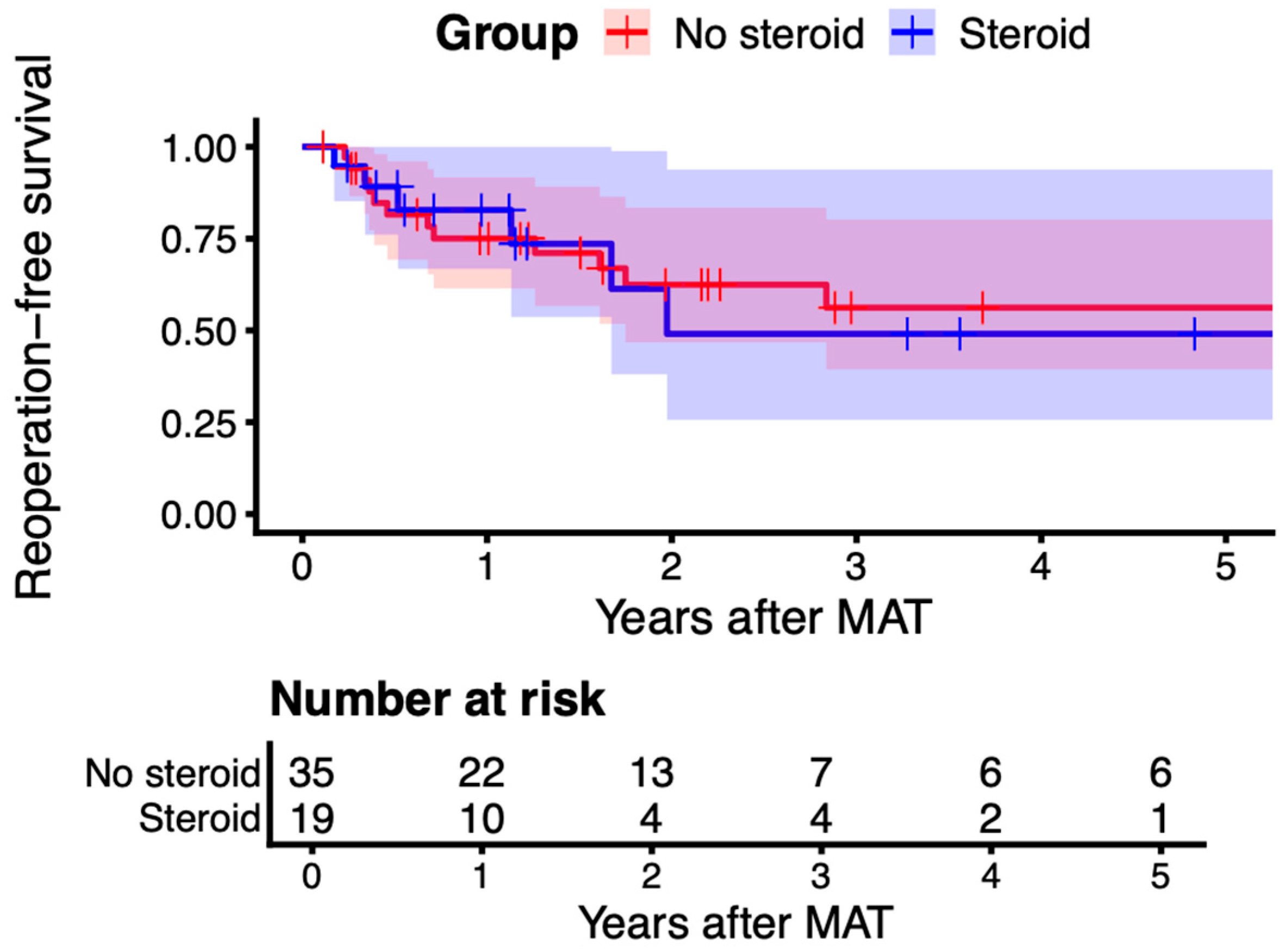
Kaplan–Meier analysis demonstrated no significant difference in reoperation-free survival between groups (Figure 1). Mean reoperation-free survival was 6.6 years (95% CI 4.41–8.8) in the no-steroid group and 6.51 years (95% CI 3.14–9.89) in the steroid group (p = 0.903) (Table 1). Survival rates at 1, 2, and 5 years were similar between groups, with no statistically significant differences observed at any time point.

3.6. Patient-Reported Outcomes Measures and PASS

PROMs were available for 39 patients (26 no steroid, 13 steroid). Patients in the steroid group demonstrated consistently lower scores across all PROM domains; however, no statistically significant differences were observed (Table 4). PASS achievement was numerically lower in the steroid group across all PROMs but did not reach statistical significance (Table 5). Trends toward lower PASS achievement were observed for Lysholm, IKDC, and KOOS subscales, though all comparisons were non-significant.

4. Discussion

In this propensity matched cohort, intra-articular corticosteroids injections (CSIs) were not associated with inferior clinical outcomes following MAT. Patients who received CSIs demonstrated similar reoperation rates, reoperation-free survival, PROMs, and PASS achievement compared with those without injection. To our knowledge, this is the first study to evaluate the relationship between preoperative CSIs and MAT outcomes.
A common concern surrounding the use of intra-articular steroids injections relates to the idea that CSIs may negatively affect tissue healing, potentially increasing the risk of graft failure. While this association has not been studied specifically in MAT, several authors have examined it in the context of rotator cuff repair. Feng et al. compared patients who received a CSI prior to rotator cuff repair with those who did not and found no differences in retear rates or tendon integrity between groups [14]. Similarly, Smith et al. reported that receiving a CSI within one year of rotator cuff repair did not increase the odds of reoperation at two-year follow-up [15]. These findings suggest that preoperative CSIs are not associated with an increased risk of graft failure nor reoperation following MAT.
Our findings should be interpreted in the broader context of MAT survivorship reported in the literature. In the present study, reoperation rates were comparable between groups (31.6% vs. 37.1%). On adjusted analysis, there was no significant difference in major reoperations (15.8% vs. 17.1.0%) or minor reoperations (10.5% vs. 20.0%) in the steroid vs. no-steroid group. Although the difference in minor reoperation rates between groups appeared numerically notable (20.0% in the no-steroid group vs. 10.5% in the steroid group), the present study was underpowered to detect statistically significant differences for relatively infrequent outcomes such as minor reoperations. Post hoc power analysis demonstrated that substantially larger cohorts would be required to adequately assess these smaller subgroup differences. The overall reoperation rate in our cohort was consistent with the prior literature. McCormick et al. reported a 32% overall reoperation rate in 172 patients following MAT, with simple arthroscopic debridement being the most common surgical treatment [16]. Reoperation-free survival was comparable between patients who received preoperative corticosteroid injections and those who did not, with 1-, 2- and 5-year survival estimates nearly identical across groups (82.8 versus 75% at 1 year, 59.1 versus 62.5% at 2 years, and 49.2 versus 56.2% at 5 years). The similarity of our survival estimates may indicate that preoperative corticosteroid injections do not negatively affect MAT durability, further reinforcing the procedure’s ability to provide long-term pain relief and functional improvement for most patients.
A novel aspect of this analysis was the incorporation of preoperative cartilage status using the ICRS grading system. We found that across grades 0–3, cartilage lesions were evenly distributed between steroid and no-steroid groups; however, no patients in the steroid group demonstrated grade 4 lesions, compared with 25.7% in the no-steroid group. This imbalance is likely explained by surgical selection and treatment patterns. Many of the ICRS 4 lesions in our cohort were isolated, focal full-thickness defects that were often addressed with a concomitant cartilage procedure at the time of MAT including OCA and MACI. Despite this greater burden of advanced chondral pathology, patients in the non-steroid cohort demonstrated higher PROM scores than those in the steroid cohort. This finding may suggest that factors other than cartilage severity alone influenced postoperative subjective outcomes, including baseline symptom perception, patient selection, or unmeasured confounding variables. Additionally, it is possible that patients receiving corticosteroid injections represented a cohort with greater preoperative symptom burden or inflammation not fully captured by cartilage grading alone, which may have contributed to comparatively lower PROMs despite less severe chondral degeneration. These patients were more likely straightforward surgical candidates and thus more likely to be fast-tracked to surgery rather than trialed with a preoperative CSI. In contrast, injections are typically used as a temporizing measure, where short-term symptomatic benefit may delay surgical intervention [17,18]. Insurance requirements and surgeon practice style may further reinforce this pattern [19].
Given the small number of patients who had received a preoperative CSI in our cohort (n = 19), the absence of ICRS 4 lesions in this group may also reflect underrepresentation rather than a true biologic difference. On a mechanistic level, experimental and animal studies suggest that corticosteroids exert time- and dose-dependent effects on cartilage: when given intermittently or in small doses, they may mitigate inflammation and slow cartilage breakdown, whereas repeated or high-dose injections accelerate matrix degradation and chondrocyte apoptosis [20,21]. In knee osteoarthritis cohorts, longitudinal MRI studies have demonstrated dose-dependent cartilage thinning with corticosteroid use, though some cohorts reported neutral findings, leaving the literature inconclusive [22,23]. These findings align with broader OA literature showing that intra-articular corticosteroid injections provide only modest, short-lived relief and may be associated with accelerated cartilage loss when repeated [24,25,26]. In this study 89.5% of patients received a single preoperative CSIs, whereas 10.5% received multiple injections.
We also found no significant differences in postoperative PROMs and PASS achievement between the CSI and control group, suggesting that preoperative CSIs do not affect functional outcomes after MAT. While the CSI group demonstrated slightly worse scores for KOOS, Lysholm, and IKDC, these differences were not statistically significant. It is possible that patients who received CSIs were more symptomatic at baseline, which may have influenced these scores. Consistent with our findings, the aforementioned rotator cuff repair study also found no relationship between preoperative CSIs and PROMs [15]. However, comparisons between rotator cuff repair and meniscal allograft transplantation should be interpreted cautiously, as rotator cuff repair does not involve implantation of allograft tissue and therefore may not reflect the same biologic healing environment, graft incorporation processes, or immunologic considerations relevant to MAT.

5. Limitations

This study has several limitations. First, its retrospective design introduces the potential for selection and reporting bias. Second, MAT is a relatively uncommon procedure, resulting in a modest sample size that may have limited our power to detect clinically meaningful differences between groups, raising the possibility of a type II error. Third, corticosteroid exposure was recorded only as a binary variable (yes/no) because documentation of injection timing, number, and frequency and dose was inconsistent. We did not evaluate a possible dose-dependent relationship which is an important limitation, as prior studies suggest that while a single preoperative CSI may not influence outcomes, multiple injections can negatively impact surgical success [27]. Fourth, there was a wide range in timing when the injection was administered before surgery which may have influenced our outcomes. This limitation is important because injections administered closer to surgery have been associated with greater risk than those performed at longer intervals [28,29]. Lastly surgical technique was not standardized, and factors such as graft sizing, positioning, and preparation were not captured, introducing potential confounding. Future prospective and larger, multicenter studies with extended follow-up are warranted to provide a more comprehensive understanding of patient-specific risk profiles.

6. Conclusions

Preoperative corticosteroid injections showed no association with increased reoperation risk, reduced survivorship, or inferior PROMs or PASS following knee MAT. However, given the study’s limited power, lack of detailed injection characteristics, and the use of a heterogeneous complication outcome, these findings should be interpreted cautiously, as further investigation is warranted.

Author Contributions

R.K.C., I.J., C.P. and V.S. all contributed to writing—original draft preparation, writing—review and editing, data curation, validation, formal analysis, investigation, and methodology. G.G.-L., E.J.S., L.M.J. and K.A.C. contributed to writing—review and editing, visualization, supervision, resources, project administration, methodology, investigation, and conceptualization. All authors have read and agreed to the published version of the manuscript.

Funding

This research received no external funding.

Institutional Review Board Statement

This study was conducted in accordance with the Declaration of Helsinki, and the protocol was approved by the Ethics committee of NYU Langone Health Institutional Review Board, study number: i19-01430 on 27 September 2019.

Informed Consent Statement

Informed consent for participation is not required as per local legislation by the United States Department of Health and Human Services.

Data Availability Statement

The data that support the findings of this study are available from the corresponding author upon reasonable request.

Acknowledgments

All authors contributed to writing—review and editing, data curation, formal analysis, investigation, methodology and conceptualization. The authors want to thank the clinical research coordinators, statisticians and administrative staff at the Department of Orthopaedic Surgery for their assistance with data collection, data analysis and chart review which made this retrospective analysis possible.

Conflicts of Interest

The authors declare no conflicts of interest.

Abbreviations

The following abbreviations are used in this manuscript:
ACLRAnterior Cruciate Ligament Reconstruction
BMIBody Mass Index
CIConfidence Interval
CSIsCorticosteroid Injections
IKDCInternational Knee Documentation Committee Subjective Score
I &DIrrigation and Debridement
IRBInstitutional Review Board
KOOSKnee Injury and Osteoarthritis Outcome Score
LOALysis of Adhesions
MATMeniscal Allograft Transplantation
MUAManipulation Under Anesthesia
OCAOsteochondral Allograft Transplantation
OROdds Ratio
PASSPatient Acceptable Symptom State
PROMsPatient-Reported Outcome Measures
TKATotal Knee Arthroplasty
VASVisual Analog Scale

References

  1. Rosso, F.; Bisicchia, S.; Bonasia, D.E.; Amendola, A. Meniscal allograft transplantation: A systematic review. Am. J. Sports Med. 2015, 43, 998–1007. [Google Scholar] [CrossRef] [PubMed]
  2. Wang, D.Y.; Jiang, D.; Yu, J.K. Editorial Commentary: Meniscal Allograft Transplantation Results in Both Pain Relief and Chondroprotection. Arthroscopy 2024, 40, 1575–1577. [Google Scholar] [CrossRef] [PubMed]
  3. Husen, M.; Poudel, K.; Wang, A.; Saul, D.; Stuart, M.J.; Levy, B.A.; Saris, D.B.; Krych, A.J. Survivorship of 157 Arthroscopic Meniscal Allograft Transplants Using Bone Fixation at a Mean of 7 Years and Prognostic Factors Analysis. Am. J. Sports Med. 2024, 52, 96–108. [Google Scholar] [CrossRef] [PubMed]
  4. Wagner, K.R.; Kaiser, J.T.; Hevesi, M.; Cotter, E.J.; Gilat, R.; Meeker, Z.D.; Frazier, L.P.; Yanke, A.B.; Cole, B.J. Minimum 10-Year Clinical Outcomes and Survivorship of Meniscal Allograft Transplantation with Fresh-Frozen Allografts Using the Bridge-in-Slot Technique. Am. J. Sports Med. 2023, 51, 2954–2963. [Google Scholar] [CrossRef] [PubMed]
  5. Lee, D.H.; Kim, S.B.; Kim, T.H.; Cha, E.J.; Bin, S.I. Midterm Outcomes after Meniscal Allograft Transplantation. Am. J. Sports Med. 2010, 38, 247–254. [Google Scholar] [CrossRef] [PubMed]
  6. Mahmoud, A.; Young, J.; Bullock-Saxton, J.; Myers, P. Meniscal Allograft Transplantation: The Effect of Cartilage Status on Survivorship and Clinical Outcome. Arthroscopy 2018, 34, 1871–1876.e1. [Google Scholar] [CrossRef] [PubMed]
  7. Frank, R.; Gilat, R.; Haunschild, E.D.; Huddleston, H.; Patel, S.; Evuarherhe, A.; Knapik, D.M.; Drager, J.; Yanke, A.B.; Cole, B.J. Do Outcomes of Meniscal Allograft Transplantation Differ Based on Age and Sex? A Comparative Group Analysis. Arthroscopy 2022, 38, 452–465.e3. [Google Scholar] [CrossRef] [PubMed]
  8. Zaffagnini, S.; Grassi, A.; Macchiarola, L.; Stefanelli, F.; Coco, V.; Marcacci, M.; Andriolo, L.; Filardo, G. Meniscal Allograft Transplantation Is an Effective Treatment in Patients Older Than 50 Years but Yields Inferior Results Compared with Younger Patients: A Case-Control Study. Arthroscopy 2019, 35, 2448–2458. [Google Scholar] [CrossRef] [PubMed]
  9. Novaretti, J.V.; Patel, N.K.; Lian, J.; Vaswani, R.; de Sa, D.; Getgood, A.; Musahl, V. Long-Term Survival Analysis and Outcomes of Meniscal Allograft Transplantation with Minimum 10-Year Follow-Up: A Systematic Review. Arthroscopy 2019, 35, 659–667. [Google Scholar] [CrossRef] [PubMed]
  10. Fanelli, D.; Mercurio, M.; Gasparini, G.; Galasso, O. Predictors of Meniscal Allograft Transplantation Outcome: A Systematic Review. J. Knee Surg. 2021, 34, 303–321. [Google Scholar] [CrossRef] [PubMed]
  11. Gilat, R.; Cole, B.J. Meniscal Allograft Transplantation: Indications, Techniques, Outcomes. Arthroscopy 2020, 36, 938–939. [Google Scholar] [CrossRef] [PubMed]
  12. Wang, Z.; Credille, K.; Swindell, H.; McCormick, J.R.; Darbandi, A.; Alzein, M.; Dandu, N.; Cole, B.J.; Yanke, A.B. Concomitant Treatment of High-Grade Cartilage Lesions Mitigates Risk of Meniscal Allograft Transplant Failure. Arthroscopy 2024, 40, 1703–1713.e2. [Google Scholar] [CrossRef] [PubMed]
  13. Wagner, K.R.; Kaiser, J.T.; Knapik, D.M.; Condron, N.B.; Gilat, R.; Meeker, Z.D.; Sivasundaram, L.; Yanke, A.B.; Cole, B.J. Patient-Specific Variables Associated with Failure to Achieve Clinically Significant Outcomes After Meniscal Allograft Transplantation at Minimum 5 Year Follow-Up. Arthroscopy 2023, 39, 2327–2338. [Google Scholar] [CrossRef] [PubMed]
  14. Feng, S.; Li, H.; Zhong, Y.; Xie, Y.; Chen, J.; Chen, Y.; Chen, S. Functional and Structural Outcomes After Arthroscopic Rotator Cuff Repair with or Without Preoperative Corticosteroid Injections. Am. J. Sports Med. 2023, 51, 733–742. [Google Scholar] [CrossRef] [PubMed]
  15. Smith, J.T.; Pill, S.G.; Eggert, K.A.; Brignull, C.G.; Adams, K.J.; Wyland, D.J.; Tolan, S.J.; Thigpen, C.A.; Kissenberth, M.J. Corticosteroid injection prior to surgery had no effect on 2-year outcomes following arthroscopic rotator cuff repair. JSES Int. 2024, 8, 75–79. [Google Scholar] [CrossRef] [PubMed]
  16. McCormick, F.; Harris, J.D.; Abrams, G.D.; Hussey, K.E.; Wilson, H.; Frank, R.; Gupta, A.K.; Bach, B.R.; Cole, B.J. Survival and reoperation rates after meniscal allograft transplantation: Analysis of failures for 172 consecutive transplants at a minimum 2-year follow-up. Am. J. Sports Med. 2014, 42, 892–897. [Google Scholar] [CrossRef] [PubMed]
  17. Seah, K.T.M.; Neufeld, M.E.; Howard, L.C.; Garbuz, D.S.; Masri, B.A. Injection-Based Therapies for the Management of Hip and Knee Osteoarthritis. J. Bone Jt. Surg. Am. 2025, 107, 2437–2446. [Google Scholar] [CrossRef] [PubMed]
  18. Bensa, A.; Salerno, M.; Moraca, G.; Boffa, A.; McIlwraith, C.W.; Filardo, G. Intra-articular corticosteroids for the treatment of osteoarthritis: A systematic review and meta-analysis on the comparison of different molecules and doses. J. Exp. Orthop. 2024, 11, e12060. [Google Scholar] [CrossRef] [PubMed]
  19. Benzon, H.T.; Provenzano, D.A.; Nagpal, A.; Souza, D.; Eckmann, M.S.; Nelson, A.M.; Mina, M.; Abd-Elsayed, A.; Elmofty, D.; Chadwick, A.L.; et al. Use and safety of corticosteroid injections in joints and musculoskeletal soft tissue: Guidelines from the American Society of Regional Anesthesia and Pain Medicine, the American Academy of Pain Medicine, the American Society of Interventional Pain Physicians, and the International Pain and Spine Intervention Society. Reg. Anesth. Pain Med. 2025. Epub ahead of print. [Google Scholar] [CrossRef] [PubMed]
  20. Warner, T.; Lowenstein, N.; Mazzocca, J.; Collins, J.; Matzkin, E. Arthroscopic Partial Meniscectomy in Patients with Kellgren-Lawrence Grade 3 Osteoarthritis Shows Clinically Meaningful Improvement in Outcomes. Arthrosc. Sports Med. Rehabil. 2024, 6, 100926. [Google Scholar] [CrossRef] [PubMed]
  21. Wernecke, C.; Braun, H.J.; Dragoo, J.L. The Effect of Intra-articular Corticosteroids on Articular Cartilage. Orthop. J. Sports Med. 2015, 3, 2325967115581163. [Google Scholar] [CrossRef] [PubMed]
  22. Guermazi, A.; Hunter, D.J.; Kloppenburg, M. Debate: Intra-articular steroid injections for osteoarthritis—Harmful or helpful? Osteoarthr. Imaging 2023, 3, 100163. [Google Scholar] [CrossRef] [PubMed]
  23. McAlindon, T.E.; LaValley, M.P.; Harvey, W.F.; Price, L.L.; Driban, J.B.; Zhang, M.; Ward, R.J. Effect of Intra-articular Triamcinolone vs Saline on Knee Cartilage Volume and Pain in Patients with Knee Osteoarthritis. JAMA 2017, 317, 1967. [Google Scholar] [CrossRef] [PubMed]
  24. Bensa, A.; Sangiorgio, A.; Boffa, A.; Salerno, M.; Moraca, G.; Filardo, G. Corticosteroid injections for knee osteoarthritis offer clinical benefits similar to hyaluronic acid and lower than platelet-rich plasma: A systematic review and meta-analysis. EFORT Open Rev. 2024, 9, 883–895. [Google Scholar] [CrossRef] [PubMed]
  25. Baker, J.F.; Olave, M.; Leach, W.; Doherty, C.R.; Gillcrist, R.L.; White, D.K.; Ogdie, A.; England, B.R.; Wysham, K.; Quinones, M.; et al. Corticosteroid Injections for Symptomatic Treatment of Osteoarthritis of the Knee: A Pilot Blinded Randomized Trial. ACR Open Rheumatol. 2023, 5, 529–535. [Google Scholar] [CrossRef] [PubMed]
  26. Wang, Q.; Mol, M.F.; Bos, P.K.; Dorleijn, D.M.J.; Vis, M.; Gussekloo, J.; Bindels, P.J.E.; Runhaar, J.; Bierma-Zeinstra, S.M.A. Effect of Intramuscular vs Intra-articular Glucocorticoid Injection on Pain Among Adults with Knee Osteoarthritis. JAMA Netw. Open 2022, 5, e224852. [Google Scholar] [CrossRef] [PubMed]
  27. Desai, V.S.; Camp, C.L.; Cancienne, J.M.; Dines, J.S.; Brockmeier, S.F.; Werner, B.C. Increasing Numbers of Pre-operative Shoulder Injections are Associated with a Higher Rate of Subsequent Revision Rotator Cuff Surgery. Orthop. J. Sports Med. 2018, 6, 2325967118S00081. [Google Scholar] [CrossRef]
  28. Forsythe, B.; Berlinberg, E.J.; Forlenza, E.M.; Oeding, J.F.; Patel, H.H.; Mascarenhas, R. Corticosteroid injections 2 months before arthroscopic meniscectomy increases the rate of postoperative infections requiring surgical irrigation and debridement. Knee Surg. Sports Traumatol. Arthrosc. 2022, 30, 3796–3804. [Google Scholar] [CrossRef] [PubMed]
  29. Wainwright, J.D.; Gay, S.S.; Nguyen, A.; Weiss, W.M.; Wenke, J.C. Corticosteroid Injection up to 8 Weeks Before Anterior Cruciate Ligament Reconstruction Doubles the Incidence of Postoperative Infection. Arthroscopy 2025, 41, 4021–4025.e1. [Google Scholar] [CrossRef] [PubMed]
Figure 1. Kaplan–Meier Analysis of Reoperation-Free Survival Following MAT by Preoperative Corticosteroid Injection Status. Kaplan–Meier curves showing reoperation-free survival after meniscal allograft transplantation stratified by preoperative corticosteroid injection. Shaded areas represent 95% CIs and tick marks indicate censoring. Numbers at risk are shown below.
Surgeries 07 00075 g001
Table 1. Matched cohort characteristics, operative details, reoperation outcomes, and Kaplan–Meier survivorship.
VariableNo Steroid (n = 35)Steroid (n = 19)p Value
Age (years)32.2 ± 9.034.0 ± 10.60.6
Sex (% male) 0.8
Female51%47%
Male49%53%
BMI (kg/m2)27.9 ± 4.727.2 ± 6.00.5
Follow-up time (years)7.6 ± 3.56.59 ± 3.20.3
Operative technique, n (%)
Bone bridge14 (40.0%)7 (36.8%)1.00
Bone plug14 (40.0%)8 (42.1%)1.00
Suture-only7 (20.0%)4 (21.1%)1.00
Procedure type, n (%)
Concomitant15 (42.9%)8 (42.1%)1.00
Isolated20 (57.1%)8 (57.9%)1.00
Compartment, n (%)
Medial15 (42.9%)8 (42.1%)1.00
Lateral20 (57.1%)8 (57.9%)1.00
Overall reoperation, n (%)13 (37.1%)6 (31.6%)0.771
Major reoperation, n (%)6 (17.1%)3 (15.8%)1.000
Total knee arthroplasty, n (%)1 (2.9%)1 (5.3%)1.000
Meniscectomy, n (%)1 (2.9%)2 (10.5%)0.280
Meniscus repair, n (%)2 (5.7%)0 (0%)0.535
Revision MAT, n (%)1 (2.9%)0 (0%)1.000
ACLR, n (%)2 (5.7%)0 (0%)0.535
OCA, n (%)1 (2.9%)0 (0%)1.000
Minor reoperation, n (%)7 (20.0%)2 (10.5%)0.468
LOA/MUA, n (%)6 (17.1%)1 (5.3%)0.400
Chondroplasty, n (%)0 (0%)0 (0%)1.000
I&D, n (%)0 (0%)0 (0%)1.000
Hardware removal, n (%)0 (0%)1 (5.3%)0.352
Synovectomy, n (%)1 (2.9%)0 (0%)1.000
Kaplan–Meier mean reoperation-free survival (years)6.6 [95% CI 4.41–8.8]6.51 [95% CI 3.14–9.89]0.903
1-year survival (%)75% [95% CI 56.2–86.7]82.8% [95% CI 55.4–94.2]-
2-year survival (%)62.5% [95% CI 41.9–77.5]59.1% [95% CI 29.3–75.1]-
5-year survival (%)56.2% [95% CI 34.4–73.3]49.2% [95% CI 23.4–65.2]-
Table 1 showing a comparison of demographic characteristics, operative details, and postoperative outcomes between patients who received preoperative corticosteroids injection and those who did not. Continuous variables are reported as mean ± standard deviation; categorical variables are reported as n (%). Survival estimates are presented with 95% confidence intervals. p-values indicate between-group comparisons. Statistical significance was set at p < 0.05. Abbreviations: CI, confidence interval; MAT, meniscal allograft transplantation; LOA, lysis of adhesions; MUA, manipulation under anesthesia; OCA, osteochondral allograft; ACLR, anterior cruciate ligament reconstruction.
Table 2. Standardized mean differences before and after propensity score matching.
CovariateSMD BeforeSMD After
Age at surgery−0.060−0.016
Male sex−0.130−0.212
Body mass index−0.079−0.100
Lateral compartment0.0150.000
Isolated MAT0.015−0.054
Suture-only fixation0.0260.066
Bone plug fixation0.0430.054
Bone bridge fixation−0.065−0.108
Propensity score0.1980.283
Table 3. Distribution of ICRS grades (0–4) by Preoperative Corticosteroid Injection Status.
ICRS GradeNo Steroid (n = 35)Steroid (n = 19)p Value
010 (28.6%)4 (21.1%)
18 (22.9%)6 (31.6%)
26 (17.1%)6 (31.6%)
32 (5.7%)3 (15.8%)
49 (25.7%)0 (0.0%)0.019 *
Table 3 showing a comparison of the distribution of ICRS grades (0–4) in both corticosteroid and non-corticosteroid group. * Statistical significance was set at p < 0.05. Abbreviations: ICRS, International Cartilage Repair Society.
Table 4. Comparison of patient-reported outcome measures between patients with and without preoperative corticosteroid injections after MAT.
MeasureNo Steroid (n = 26)Steroid (n = 13)β (95% CI)p Value
VAS Pain30.3 ± 26.122.3 ± 27.1−7.99 (−23.38–7.40)0.302
KOOS Symptoms61.7 ± 31.146.2 ± 39.4−14.17 (−33.83–5.49)0.154
KOOS Pain67.7 ± 36.050.9 ± 40.4−14.70 (−35.99–6.60)0.172
KOOS ADL73.6 ± 38.356.9 ± 42.6−14.01 (−36.35–8.33)0.214
KOOS Sport/Rec48.4 ± 33.339.2 ± 37.6−7.43 (−27.29–12.42)0.456
KOOS QOL45.4 ± 31.829.9 ± 30.9−14.11 (−32.19–3.97)0.123
KOOS Total50.3 ± 34.439.0 ± 34.8−9.36 (−28.99–10.27)0.343
Pre Tegner5.2 ± 3.04.3 ± 3.8−0.71 (−2.57–1.16)0.449
Post Tegner3.5 ± 2.32.9 ± 2.4−0.52 (−1.88–0.84)0.446
Lysholm63.1 ± 33.145.7 ± 38.1−15.07 (−34.70–4.56)0.129
IKDC62.3 ± 32.947.7 ± 38.5−13.19 (−33.26–6.88)0.193
Table 4 showing comparison of patient-reported outcome measures between patients with and without preoperative corticosteroid injection following meniscal allograft transplantation. Values are reported as mean ± standard deviation. No statistically significant differences were observed between groups across all measured patient-reported outcome domains. Effect sizes reported as adjusted mean differences (β) with 95% confidence intervals. Statistical significance was set at p < 0.05. Abbreviations: MAT, meniscal allograft transplantation; KOOS, Knee injury and Osteoarthritis Outcome Score; ADL, activities of daily living; QOL, quality of life; IKDC, International Knee Documentation Committee, CI, Confidence Interval.
Table 5. PASS Achievement Rates % by Preoperative Corticosteroid Injection Status.
PROMPASS ThresholdNo Steroid (n = 35)Steroid (n = 19)OR (95% CI)p Value
Lysholm61.523/35 (65.7%)7/19 (36.8%)3.29 (1.03–10.53)0.051
IKDC59.724/35 (68.6%)9/19 (47.4%)2.42 (0.77–7.65)0.153
KOOS Symptoms51.827/35 (77.1%)10/19 (52.6%)3.04 (0.92–10.06)0.076
KOOS Pain79.223/35 (65.7%)7/19 (36.8%)3.29 (1.03–10.53)0.051
KOOS ADL87.522/35 (62.9%)8/19 (42.1%)2.33 (0.74–7.28)0.164
KOOS Sport57.516/35 (45.7%)8/19 (42.1%)1.16 (0.37–3.58)1.000
KOOS QOL59.413/35 (37.1%)4/19 (21.1%)2.22 (0.60–8.12)0.358
Table 5 showing comparison of patient acceptable symptom state (PASS) achievement between patients with and without preoperative corticosteroid injection following meniscal allograft transplantation. Values are reported as percentages (%). No statistically significant differences were observed between groups across all measured patient-reported outcome domains. PASS thresholds were based on minimum 5-year MAT benchmarks reported by Wagner KR et al. [13] Statistical significance was set at p < 0.05. Abbreviations: MAT, meniscal allograft transplantation; KOOS, Knee injury and Osteoarthritis Outcome Score; ADL, activities of daily living; QOL, quality of life; IKDC, International Knee Documentation Committee, CI, Confidence Interval, OR, Odds ratio.
Disclaimer/Publisher’s Note: The statements, opinions and data contained in all publications are solely those of the individual author(s) and contributor(s) and not of MDPI and/or the editor(s). MDPI and/or the editor(s) disclaim responsibility for any injury to people or property resulting from any ideas, methods, instructions or products referred to in the content.