Article

Trapeziectomy with Ligament Reconstruction and Tendon Interposition Versus Transosseous Suture Suspensionplasty for Thumb Trapeziometacarpal Osteoarthritis: A Retrospective Comparative Study


by
Morena Anna Basso
1,*,
Simona Scarpa
1,
Alessio Bernasconi
1,
Andrea Poggetti
2,
Lucian Lior Marcovici
3 and
Francesco Smeraglia
1
1
Department of Public Health, Trauma and Orthopaedics, University of Naples Federico II, 80131 Naples, Italy
2
Hand and Reconstructive Microsurgery Unit, AOU Careggi, Largo Palagi 2, 50134 Florence, Italy
3
Hand & Microsurgery Unit, Jewish Hospital of Rome, 00186 Rome, Italy
*
Author to whom correspondence should be addressed.
Surgeries 2026, 7(2), 58; https://doi.org/10.3390/surgeries7020058
Submission received: 3 March 2026 / Revised: 20 April 2026 / Accepted: 4 May 2026 / Published: 7 May 2026
(This article belongs to the Section Hand Surgery and Research)

Abstract

Background: Several surgical techniques are available for the treatment of thumb trapeziometacarpal (TMC) osteoarthritis. Trapeziectomy with ligament reconstruction and tendon interposition (LRTI) is a widely accepted procedure, while suspensionplasty techniques have been introduced to improve first metacarpal stability after trapeziectomy. A simplified transosseous suture suspensionplasty (SUSP) has recently been introduced as an alternative to implant-based constructs, but comparative clinical data remain limited. This study aimed to compare the clinical and functional outcomes between LRTI and SUSP techniques in patients with TMC osteoarthritis. Methods: A retrospective comparative study was conducted on 54 consecutive patients treated surgically for TMC osteoarthritis between 2018 and 2022. Thirty-three patients underwent trapeziectomy with ligament reconstruction and tendon interposition (LRTI group), and 21 underwent trapeziectomy with transosseous suture suspensionplasty (SUSP group). At a minimum follow-up of 2 years, 44 patients were available for evaluation. Assessments were performed using DASH, 10 cm VAS, key pinch strength, Kapandji score, and radial/palmar abduction. Results: At 2 years, there were no significant between-group differences in DASH (median 4 vs. 16.5; p = 0.190), VAS (2.0 ± 2.1 vs. 2.9 ± 2.3; p = 0.235), key pinch (median 4 vs. 3 kg; p = 0.136), Kapandji score, or abduction. Both groups improved significantly over time in DASH and VAS (p < 0.001). Key pinch increased progressively in LRTI group (p < 0.001) but showed less consistent change in SUSP group. Conclusions: Both techniques provided comparable mid-term clinical and functional outcomes in patients with TMC osteoarthritis. No clear clinical advantage of suspensionplasty over tendon interposition was demonstrated. Transosseous suture suspensionplasty represents a valid alternative, while tendon interposition arthroplasty remains a reliable reference technique.

1. Introduction

Trapeziometacarpal (TMC) osteoarthritis is a frequent cause of thumb-base pain, loss of strength, and limitation in hand function. When nonoperative treatment fails, several surgical options are available, including trapeziectomy alone, trapeziectomy combined with ligament reconstruction and/or tendon interposition, different suspensionplasty constructs, and prosthetic arthroplasty [1,2,3,4]. Despite the variety of procedures, no technique has shown consistently superior outcomes across studies, and trapeziectomy with ligament reconstruction and tendon interposition (LRTI) remains widely performed because it is technically reproducible and has a well-known complication profile [1,2,3]. A relevant issue after trapeziectomy-based surgery is proximal migration of the first metacarpal, which may affect thumb stability and key pinch performance [5]. For this reason, multiple suspensionplasty techniques have been proposed to mitigate metacarpal subsidence. Suture-button (SB) suspensionplasty has gained popularity because it offers immediate internal stabilization and may facilitate earlier mobilization; however, implant-related adverse events and higher costs have questioned its routine use [6,7,8,9,10,11]. As an implant-free alternative to SB constructs, Carozzo et al. [12] recently described a simplified suspensionplasty using a transosseous No. 2 braided polyester (Ethibond, Ethicon, Raritan, NJ, USA) suture. Early reports suggest satisfactory short-term outcomes, but direct comparative evidence against established techniques remains limited. The aim of this study was to compare clinical and functional outcomes after trapeziectomy with tendon interposition versus trapeziectomy combined with transosseous suture suspensionplasty in patients treated for thumb TMC osteoarthritis.

2. Materials and Methods

2.1. Study Design and Eligibility Criteria

This retrospective comparative study evaluated two surgical approaches for the treatment of TMC osteoarthritis. Between September 2018 and April 2022, 54 consecutive patients underwent surgery. Thirty-three patients were treated with trapeziectomy with ligament reconstruction and tendon interposition arthroplasty (LRTI group), whereas 21 patients underwent trapeziectomy with transosseous suture suspensionplasty (SUSP group). Inclusion criteria were persistent pain at the TMC joint despite at least 6 months of conservative management and radiographic Eaton–Littler stage II–IV osteoarthritis. All procedures were performed by the same hand surgeon (Tang level V) [13]. Given the retrospective design, treatment allocation was non-randomized. The choice of technique reflected the surgeon’s practice during the study period, with transosseous SUSP progressively adopted as an alternative to LRTI. The study was conducted in accordance with the Declaration of Helsinki (2013 revision). According to institutional policy, formal ethics committee approval was not required for this retrospective observational study. Written informed consent for surgery and for the use of anonymized clinical data was obtained from all patients. No external funding was received.

2.2. Clinical Assessment

Patients were evaluated preoperatively (T0) and postoperatively at 3 months (T1), 6 months (T2), 1 year (T3), and 2 years (T4). Outcome measures included the Disabilities of the Arm, Shoulder and Hand (DASH) score, pain assessed with a 10 cm visual analog scale (VAS), thumb opposition measured with the Kapandji score, and key pinch strength (kg) measured with a Jamar pinch dynamometer (FEI, Irvington, NY, USA). Radial and palmar thumb abduction (ABD-R and ABD-P) were measured using a standard goniometer. All assessments were performed by a single senior orthopaedic resident trained in hand surgery to minimize interobserver variability. Perioperative complications and any subsequent reoperations were prospectively recorded. Preoperative radiographic staging was determined using the Eaton–Littler classification [14]. Postoperative radiographs were obtained at 3 months to verify metacarpal alignment and exclude major complications; however, a standardized radiographic protocol for quantitative outcomes (e.g., trapezial height or subsidence) was not performed at all follow-up time points, and radiographic variables were therefore not included as study outcomes.

2.3. Surgical Technique

All procedures were performed under brachial plexus block with an upper-arm tourniquet inflated to 250 mmHg.

2.3.1. Ligament Reconstruction and Tendon Interposition Group (LRTI)

A curved dorsal incision centered over the TMC joint was used. Superficial branches of the radial nerve and the radial artery were identified and protected. After capsular exposure, a distally based V-shaped capsulotomy was performed, and the trapezium was excised completely together with marginal osteophytes, while preserving the flexor carpi radialis (FCR) tendon within its groove. A proximally harvested slip of the abductor pollicis longus (APL) tendon was used to create the suspension/interposition construct. The tendon slip was looped around the FCR tendon near its insertion at the base of the second metacarpal and secured to the capsular remnants, providing soft-tissue interposition and stabilization of the first metacarpal, as described by Ceruso et al. [15]. Postoperatively, the thumb was immobilized in a thumb-spica cast for 4 weeks. After cast removal, patients followed a structured rehabilitation program with progressive range-of-motion and strengthening exercises under the supervision of a certified hand therapist.

2.3.2. Transosseous Suture Suspensionplasty Group (SUSP)

After trapeziectomy through a dorsal approach and longitudinal capsulotomy, first-metacarpal suspension was obtained using a transosseous suture technique as described by Carozzo et al. [12]. Two temporary 1.0 mm Kirschner wires were placed between the radial base of the first metacarpal and the dorsoulnar metaphyseal region of the second metacarpal to define the tunnel trajectory. A small dorsal incision over the second metacarpal was used to expose and protect the superficial radial nerve branches. Two transosseous tunnels were created along the K-wire paths using 14-gauge needles, and the wires were then removed Figure 1A. A doubled No. 2 braided polyester suture (Ethibond) was passed through the tunnels from the first to the second metacarpal and back. Figure 1B Suspension was achieved by applying longitudinal traction to the thumb and tying the suture securely between the first and second metacarpals. Figure 1C Postoperatively, immobilization was maintained in a thumb-spica cast for 2 weeks, followed by a standardized rehabilitation protocol with gradual mobilization and strengthening supervised by a certified hand therapist.

2.4. Statistical Analysis

Continuous variables were reported as mean and standard deviation (SD) or mean with 95% confidence interval (95% CI) for normally distributed data, and as median with interquartile range (IQR) for non-normally distributed data. Data normality was assessed using the Shapiro–Wilk test. Within-group comparisons over time were performed using repeated-measures analysis of variance (ANOVA), with Bonferroni correction applied for post hoc pairwise comparisons to evaluate changes in DASH, VAS, Kapandji score, radial and palmar abduction (ABD-R and ABD-P), and key pinch strength at the different time points (T0–T4) within each group. Between-group comparisons of baseline demographic variables (age, sex, side affected, and Eaton–Littler stage) were performed using independent-samples t tests for continuous variables and chi-square or Fisher’s exact tests for categorical variables, as appropriate. Clinical outcome measures were compared between groups at baseline and at follow-up using the Wilcoxon rank-sum (Mann–Whitney U) test. All statistical analyses were performed using STATA software (version 12.0; StataCorp, College Station, TX, USA). Statistical significance was set at p < 0.05. A sex-adjusted regression would have required stable covariate distributions and sufficient events per variable; these assumptions were not met in the present cohort.

3. Results

Of the 54 consecutive patients treated surgically during the study period, 44 (81%) were available for clinical evaluation at a minimum follow-up of 2 years (LRTI: 26; SUSP: 18). The remaining 10 patients declined follow-up visits. Analyses were performed on available data No significant differences were observed between groups at baseline regarding age, side of surgery, or Eaton–Littler stage. A significant difference in sex distribution was found, with a higher proportion of male patients in the SUSP group (p = 0.002) (Table 1). Given this imbalance and the limited number of male patients, no covariate-adjusted (sex-adjusted) modeling was performed; results are therefore presented as unadjusted between-group comparisons.
Baseline clinical outcome measures, including DASH score, VAS pain, and key pinch strength, were comparable between groups, with no statistically significant differences observed (Table 2).
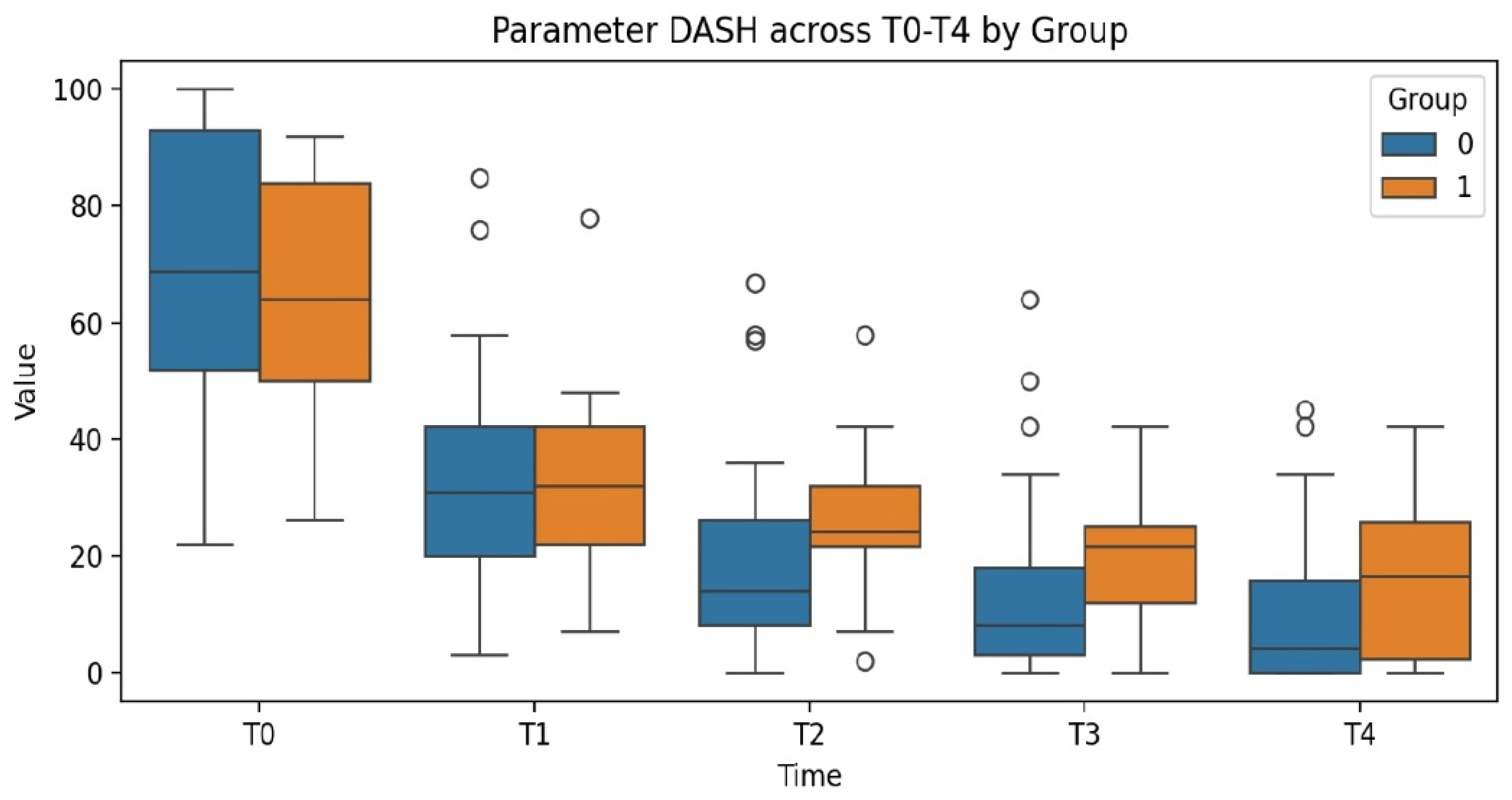
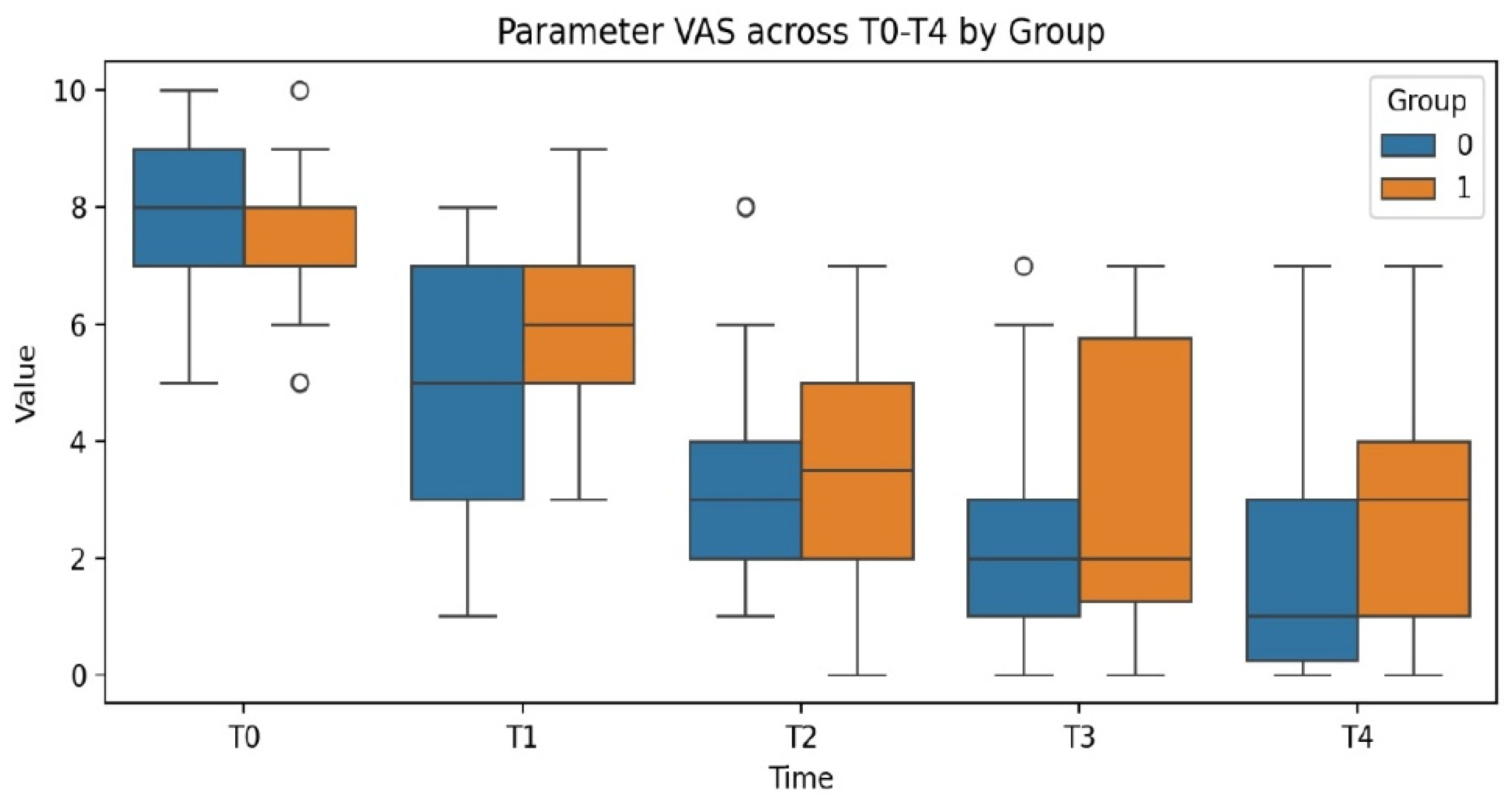
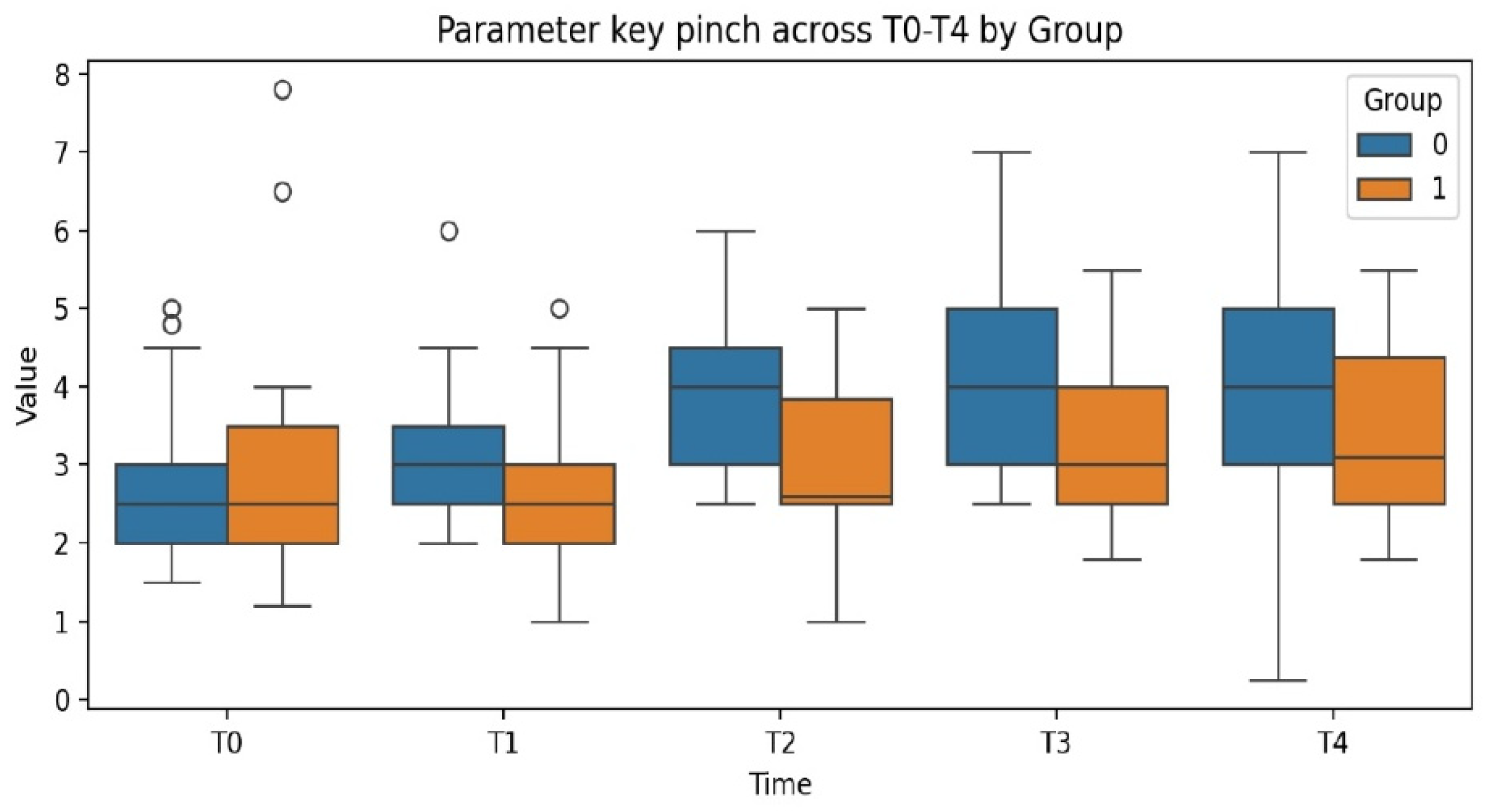
Between-group comparisons at each postoperative time point (T1–T4) did not demonstrate statistically significant differences between LRTI and SUSP for DASH, VAS, Kapandji score, key pinch strength, and radial/palmar abduction (all p > 0.05; Table S1). A non-significant trend toward lower disability in the LRTI group was observed at 1 year (DASH T3, p = 0.057), and a similar trend toward lower early pain was observed at 3 months (VAS T1, p = 0.069). At final follow-up (T4), no statistically significant differences were found between groups for DASH (median 4 vs. 16.5; p = 0.190), VAS (2.0 ± 2.1 vs. 2.9 ± 2.3; p = 0.240), or key pinch strength (median 4 vs. 3 kg; p = 0.136).” (Figure 2, Figure 3 and Figure 4).
Within-group analysis demonstrated significant clinical improvement over time in both groups. In the LRTI group, DASH and VAS scores improved progressively across follow-up evaluations (p < 0.001), with a continuous increase in key pinch strength throughout the study period (p < 0.001). In the SUSP group, significant improvements were also observed in DASH and VAS scores over time (p < 0.001), while changes in key pinch strength were less consistent (Table 3 and Table 4).
Thumb opposition assessed using the Kapandji score, and radial and palmar abduction improved over time in both groups, without statistically significant differences between groups at final follow-up: Kapandji score (9.3 ± 0.9 vs. 9.2 ± 1.0; p = 0.755), ABD-R (70.0 ± 11.1° vs. 63.3 ± 13.0°; p = 0.126), or ABD-P (64.0 ± 9.4° vs. 63.7 ± 9.3°; p = 0.875). Regarding complications, no intraoperative complications occurred in the LRTI group. One intraoperative complication was recorded in the SUSP group, consisting of a fracture at the base of the second metacarpal, which healed uneventfully without the need for revision surgery. Postoperative transient superficial radial nerve neurapraxia occurred in three patients in the LRTI group and two patients in the SUSP group, resolving spontaneously within 6–8 weeks. No reoperations were required, and no clinically symptomatic subsidence was observed during follow-up; however, quantitative radiographic assessment of metacarpal subsidence was not performed.

4. Discussion

In this comparative study, trapeziectomy with ligament reconstruction and tendon interposition (LRTI) and trapeziectomy with transosseous suture suspensionplasty (SUSP) produced largely similar mid-term outcomes in patients with thumb TMC osteoarthritis. At final follow-up, we found no significant between-group differences in patient-reported disability, pain, or key pinch strength. These results are in line with prior reports indicating that trapeziectomy combined with tendon interposition provides dependable and reproducible clinical improvement and therefore remains widely used [1,3,16]. Suspensionplasty was developed to enhance first-metacarpal support after trapeziectomy and, potentially, to speed early functional recovery. Nevertheless, comparative investigations have not consistently shown that suspension constructs yield superior long-term pain relief or function compared with established trapeziectomy-based procedures [8,9]. Against this background, our findings suggest that both LRTI and SUSP can achieve comparable patient-centered benefits when performed appropriately, despite differences in the reconstructive strategy. Postoperative immobilization is another practical variable that may influence recovery. In our protocol, SUSP was followed by a shorter immobilization period than LRTI. Although shorter casting is often presumed to promote earlier return of function [17], we did not observe a clear early advantage for the SUSP group. If anything, we noted a tendency toward earlier improvement in DASH scores in the LRTI group, without reaching strong statistical significance. This pattern may indicate that early recovery is driven not only by immobilization duration but also by factors inherent to the reconstruction and soft-tissue healing [18]. However, timepoint-by-timepoint between-group comparisons did not reach statistical significance (Table S1). Therefore, any apparent trend should be interpreted as hypothesis-generating rather than confirmatory. Among suspension techniques, the Arthrex Mini TightRope® (Arthrex, Naples, FL, USA) suture-button has become a common alternative to tendon-based reconstructions, largely because it avoids tendon harvest, permits early mobilization, and can help maintain trapezial space height [7]. Clinical series have reported satisfactory short- and mid-term outcomes that are broadly comparable to those of LRTI, particularly in the early postoperative period [8,9]. However, implant-based constructs increase direct costs and introduce device-specific complications, including second-metacarpal fracture and symptomatic hardware [19,20]. These concerns have fueled interest in simpler approaches that preserve the concept of metacarpal stabilization while minimizing implant-related morbidity and expense. In this setting, transosseous suture suspensionplasty offers an implant-free, low-cost option that uses standard materials and provides immediate stabilization after trapeziectomy [12]. From a health-system standpoint, such solutions may be especially appealing in publicly funded environments and routine primary cases where reproducibility and cost containment are important. We did not perform a standardized radiographic analysis of metacarpal subsidence. Clinically, however, we did not identify symptoms suggestive of problematic subsidence, and no patient required revision surgery during the follow-up period. This observation is consistent with the literature questioning the clinical importance of radiographic loss of metacarpal height after trapeziectomy-based procedures [21,22,23]. Even when suspensionplasty reduces early radiographic subsidence, this does not necessarily translate into better patient-reported outcomes or objective function [9]. Our results further support the view that radiographic parameters alone should not be considered surrogate markers of clinical success in TMC osteoarthritis surgery. Finally, the demographic profile of our cohort may reflect changing epidemiology. Although TMC osteoarthritis has traditionally been described as more common in postmenopausal women, we observed a relatively higher proportion of men undergoing surgery, particularly in the SUSP group. This imbalance may represent a source of confounding and should be taken into account when interpreting comparisons between groups; however, it is consistent with recent data suggesting an increasing prevalence among men [24,25]. This study has several limitations. Its retrospective design and relatively small sample size limit statistical power and the ability to detect small between-group differences. The study was non-randomized, and groups differed in sex distribution; due to the small sample size and the limited number of male patients, sex-adjusted multivariable analyses were not performed, and residual confounding cannot be excluded. In addition, radiographic assessment of first metacarpal subsidence was not performed systematically, precluding correlation between radiographic findings and clinical outcomes. Finally, although all procedures were performed by a single experienced surgeon, ensuring technical consistency, this may limit the generalizability of the results to other surgical settings.

5. Conclusions

Both tendon interposition arthroplasty and transosseous suture suspensionplasty provided significant clinical improvement and comparable medium-term outcomes in patients with trapeziometacarpal osteoarthritis. No statistically significant between-group differences were detected at 2 years. Given its reproducibility, technical simplicity, and consistent results, tendon interposition arthroplasty remains a reliable reference technique, while transosseous suture suspensionplasty represents a valid and cost-effective alternative in selected cases. These findings should be interpreted in light of the retrospective design, limited sample size, and potential residual confounding due to baseline imbalances, including sex distribution. Further prospective studies with larger cohorts are needed to better define the optimal role of suspension techniques in the surgical management of this condition.

Supplementary Materials

The following supporting information can be downloaded at: https://www.mdpi.com/article/10.3390/surgeries7020058/s1, Table S1: Between-group comparisons (LRTI vs. SUSP) at each time point (T0–T4).

Author Contributions

Conceptualization, M.A.B. and F.S.; methodology, M.A.B., F.S. and A.B.; validation, A.P. and L.L.M.; formal analysis, A.B. and L.L.M.; investigation, S.S. and M.A.B.; resources, S.S.; data curation, M.A.B. and A.B.; writing—original draft preparation, M.A.B.; writing—review and editing, F.S. and A.P.; visualization, A.P.; supervision, A.P. and L.L.M. All authors have read and agreed to the published version of the manuscript.

Funding

This research received no external funding.

Institutional Review Board Statement

The study was conducted in accordance with the Declaration of Helsinki (2013 revision). According to institutional policy, formal ethics committee approval was not required for this retrospective observational study.

Informed Consent Statement

Informed consent was obtained from all subjects involved in the study.

Data Availability Statement

The data presented in this study are available on request from the corresponding author due to privacy and ethical restrictions, as they contain sensitive clinical information. An anonymized dataset may be provided upon reasonable request and subject to approval by the relevant institutional bodies.

Conflicts of Interest

The authors declare no conflicts of interest.

References

  1. Knightly, N.; Sullivan, P. Surgery for trapeziometacarpal joint osteoarthritis: A meta-analysis on efficacy and safety. J. Hand Surg. Asian Pac. Vol. 2021, 26, 245–264. [Google Scholar]
  2. Vermeulen, G.M.; Slijper, H.; Feitz, R.; Hovius, S.E.R.; Moojen, T.M.; Selles, R.W. Surgical management of primary thumb carpometacarpal osteoarthritis: A systematic review. J. Hand Surg. Am. 2011, 36, 157–169. [Google Scholar] [CrossRef] [Scilit]
  3. Gangopadhyay, S.; McKenna, H.; Burke, F.D.; Davis, T.R.C. Five- to 18-year follow-up for treatment of trapeziometacarpal osteoarthritis: A prospective comparison of excision, tendon interposition, and ligament reconstruction and tendon interposition. J. Hand Surg. Am. 2012, 37, 411–417. [Google Scholar] [CrossRef] [Scilit] [PubMed]
  4. Smeraglia, F.; Basso, M.A.; Famiglietti, G.; Cozzolino, A.; Balato, G.; Bernasconi, A. Pyrocardan® interpositional arthroplasty for trapeziometacarpal osteoarthritis: A minimum four year follow-up. Int. Orthop. 2022, 46, 1803–1810. [Google Scholar] [CrossRef] [Scilit]
  5. Yang, S.S.; Weiland, A.J. First metacarpal subsidence during pinch after ligament reconstruction and tendon interposition basal joint arthroplasty of the thumb. J. Hand Surg. Am. 1998, 23, 879–883. [Google Scholar] [CrossRef] [Scilit]
  6. Cox, C.A.; Zlotolow, D.A.; Yao, J. Suture button suspensionplasty after arthroscopic hemitrapeziectomy for the treatment of thumb carpometacarpal arthritis. Arthroscopy 2010, 26, 1395–1403. [Google Scholar] [CrossRef] [Scilit]
  7. Yao, J.; Cheah, A.E.J. Mean 5-year follow-up for suture button suspensionplasty in the treatment of thumb carpometacarpal joint osteoarthritis. J. Hand Surg. Am. 2017, 42, 569.e1–569.e11. [Google Scholar] [CrossRef] [Scilit] [PubMed]
  8. Avant, K.R.; Nydick, J.A.; White, B.D.; Vaccaro, L.; Hess, A.V.; Stone, J.D. Basal joint osteoarthritis of the thumb: Comparison of suture button versus abductor pollicis longus suspensionplasty. Hand 2015, 10, 80–84. [Google Scholar] [CrossRef] [Scilit]
  9. Shonuga, O.; Nicholson, K.; Abboudi, J.; Gallant, G.; Jones, C.; Kirkpatrick, W.; Liss, F.; Takei, R.R.; Wang, M.; Ilyas, A.M. Thumb-basal joint arthroplasty outcomes and metacarpal subsidence: A prospective cohort analysis of trapeziectomy with suture button suspensionplasty versus ligament reconstruction with tendon interposition. Hand 2023, 18, 98–104. [Google Scholar] [CrossRef] [Scilit] [PubMed]
  10. Landes, G.; Gaspar, M.P.; Goljan, P. Arthroscopic trapeziectomy with suture button suspensionplasty: A retrospective review of 153 cases. Hand 2016, 11, 232–237. [Google Scholar] [CrossRef] [Scilit]
  11. Cavit, A.; Civan, O.; Ozcanli, H. Technical trick in suture-button suspensionplasty for the treatment of thumb carpometacarpal arthritis. Handchir. Mikrochir. Plast. Chir. 2022, 54, 87–91. [Google Scholar] [CrossRef] [Scilit]
  12. Carozzo, M.; Pajardi, G.; Basso, M.A.; Cirillo, D.; Balato, G.; Smeraglia, F. Transosseous cannula suture suspensionplasty for thumb basal joint arthritis: A novel technique. Tech. Hand Surg. 2023, 27, 140–147. [Google Scholar] [CrossRef] [Scilit]
  13. Tang, J.B.; Giddins, G. Why and how to report surgeons’ level of expertise. J. Hand Surg. Eur. 2016, 41, 365–366. [Google Scholar] [CrossRef] [Scilit]
  14. Eaton, R.G.; Littler, J.W. A study of the basal joint of the thumb. Treatment of its disabilities by fusion. J. Bone Jt. Surg. Am. 1969, 51, 661–668. [Google Scholar] [CrossRef] [Scilit]
  15. Ceruso, M.; Innocenti, M.; Angeloni, R.; Lauri, G.; Bufalini, C. L’artrosi del 1° raggio digitale. Riv. Chir. Mano 1991, 28, 67–75. [Google Scholar]
  16. Smeraglia, F.; Mariconda, M.; Balato, G.; Di Donato, S.L.; Criscuolo, G.; Maffulli, N. Dubious space for Artelon joint resurfacing for basal thumb (trapeziometacarpal joint) osteoarthritis. A systematic review. Br. Med. Bull. 2018, 126, 79–84. [Google Scholar] [CrossRef] [Scilit] [PubMed]
  17. Smeraglia, F.; Carità, E.; Frittella, G.; Tamborini, F.; Diaz, L.; Donadelli, A.; Guzzini, M. Intra-patient comparison of trapeziectomy with LRTI and dual mobility prosthesis for trapeziometacarpal osteoarthritis: A multicenter observational study. Eur. J. Orthop. Surg. Traumatol. 2025, 35, 329. [Google Scholar] [CrossRef] [Scilit] [PubMed]
  18. Walter, N.; Duncan, E.; Roskosky, M.; Smith, T.B.; Shuler, M.S. Suture Button Suspensionplasty in the Treatment of Carpometacarpal Arthritis: A Retrospective Analysis of One Surgeon’s Experience Over 9 Years. J. Hand Surg. Glob. Online 2020, 2, 25–30. [Google Scholar] [CrossRef] [Scilit]
  19. Graham, J.G.; Rivlin, M.; Abboudi, J.; Lutsky, K.; Beredjiklian, P.K. Delayed, Atraumatic Index Metacarpal Fracture After Trapeziectomy and Suture-Button Suspensionplasty for Thumb Carpometacarpal Osteoarthritis: A Report of Three Cases. J. Hand Surg. Am. 2019, 44, 344.e1–344.e5. [Google Scholar] [CrossRef] [Scilit]
  20. Khalid, M.; Jones, M.L. Index metacarpal fracture after tightrope suspension following trapeziectomy: Case report. J. Hand Surg. Am. 2012, 37, 418–422. [Google Scholar] [CrossRef] [Scilit]
  21. Davis, T.R.C.; Brady, O.; Barton, N.J.; Lunn, P.G.; Burke, F.D. Trapeziectomy alone, with tendon interposition or with ligament reconstruction? J. Hand Surg. Br. 1997, 22, 689–694. [Google Scholar] [CrossRef] [Scilit]
  22. Martou, G.; Veltri, K.; Thoma, A. Surgical treatment of trapeziometacarpal arthritis: A systematic review. Plast. Reconstr. Surg. 2004, 114, 421–432. [Google Scholar] [CrossRef] [Scilit]
  23. Vermeulen, G.M.; Brink, S.M.; Sluiter, J.; Elias, S.G.; Hovius, S.E.R.; Moojen, T.M. Ligament reconstruction arthroplasty for primary thumb carpometacarpal osteoarthritis (Weilby technique): Prospective cohort study. J. Hand Surg. Am. 2014, 39, 360–366. [Google Scholar] [CrossRef] [Scilit]
  24. Haugen, I.K.; Englund, M.; Aliabadi, P.; Niu, J.; Clancy, M.; Kvien, T.K.; Felson, D.T. Prevalence, incidence and progression of hand osteoarthritis in the general population: The Framingham Osteoarthritis Study. Ann. Rheum. Dis. 2011, 70, 1581–1586. [Google Scholar] [CrossRef] [Scilit]
  25. Wolf, J.M.; Turkiewicz, A.; Atroshi, I.; Englund, M. Prevalence of doctor-diagnosed thumb carpometacarpal joint osteoarthritis: An analysis of Swedish health care. Arthritis Care Res. 2014, 66, 961–965. [Google Scholar] [CrossRef] [Scilit]
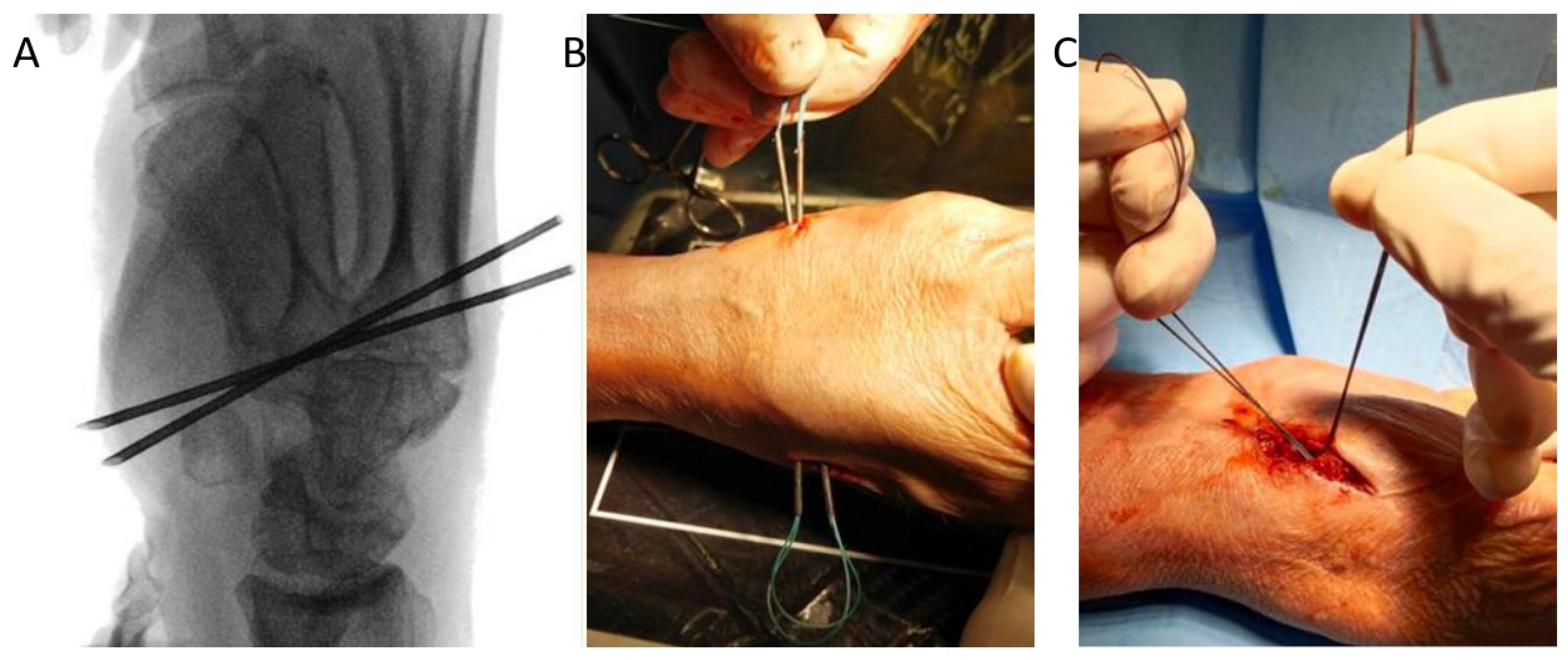
Figure 1. Key steps of transosseous suture suspensionplasty (SUSP): (A) creation of transosseous tunnels between the first and second metacarpals; (B) passage of a doubled braided polyester suture through the tunnels; (C) suspension achieved by tying the suture with longitudinal traction applied to the thumb. Adapted from permission from Ref. [12] under the Creative Commons Attribution 4.0 License (CC BY 4.0).
Surgeries 07 00058 g001
Figure 2. Box-and-whisker plots comparing the DASH before surgery (T0) and after LRTI or SUSP surgery at T1 (3 months), T2 (6 months), T3 (1 year) and latest follow-up T4 (2 years). For each box, the middle value of the dataset represents the median, while the lower and upper extremities correspond to the first and third quartile, respectively. The minimum and maximum values are displayed with whiskers. Outliers are shown as individual points. Group 0 = LRTI group; Group 1 = SUSP group.
Surgeries 07 00058 g002
Figure 3. Box-and-whisker plots comparing the VAS score before surgery (T0) and after LRTI or SUSP surgery at T1 (3 months), T2 (6 months), T3 (1 year) and latest follow-up T4 (2 years). For each box, the middle value of the dataset represents the means, while the lower and upper extremities correspond to the standard deviations. The minimum and maximum values are displayed with whiskers. Outliers are shown as individual points. Group 0 = LRTI group; Group 1 = SUSP group.
Surgeries 07 00058 g003
Figure 4. Box-and-whisker plots comparing the Key Pinch strength before surgery (T0) and after LRTI or SUSP surgery at T1 (3 months), T2 (6 months), T3 (1 year) and latest follow-up T4 (2 years). For each box, the middle value of the dataset represents the means, while the lower and upper extremities correspond to the standard deviations. The minimum and maximum values are displayed with whiskers. Outliers are shown as individual points. Group 0 = LRTI group; Group 1 = SUSP group.
Surgeries 07 00058 g004
Table 1. Baseline demographic characteristics (T0).
CharacteristicLRTI Group 0 (n = 33)SUSP Group (n = 21)p-Value
Age (mean ± SD)59.7 ± 7.859.0 ± 9.60.708
Sex (F/M)32 F/1 M14 F/7 M0.002
Side of surgery (R/L)19 R/14 L11 R/10 L0.708
Eaton stage13 (2)/20 (3)4 (2)/17 (3)0.117
Table 2. Baseline clinical outcome measures (T0).
Outcomes MeasureLRTI GroupSUSP Groupp-Value
DASH, median (IQR)69 (52–93)64 (50–84)0.174
VAS, mean ± SD8 ± 1.47.5 ± 1.30.167
Kapandji, mean ± SD8 ± 1.58.3 ± 1.20.662
Key pinch (Kg), median (IQR)2.5 (2–3)2.5 (2–3.5)0.835
ABD-R (°), mean ± SD48.3 ± 11.151 ± 13.00.431
ABD-P (°), mean ± SD64 ± 9.463.7 ± 9.30.875
Table 3. Clinical parameter scores (means and medians) for all the patients of the LRTI group at T0 (pre-operative), T1 (3 months), T2 (6 months), T3 (1 years), T4 (2 years). Multi-comparison tests were performed with the ANOVA test for repeated measures into groups, and the Bonferroni correction (B) of p-values was used in pairwise comparison into groups between two consecutive control points.
T0 (n = 33)T1 (n = 33)T2 (n = 30)T3 (n = 27)T4 (n = 26)
parameter
DASH score
p value
69 (52–93 IQR)31 (20–42 IQR)
T0 vs. T1: <0.001
14 (8–26 IQR)
T0 vs. T2: <0.001
8 (3–18 IQR)
T0 vs. T3: <0.001
4 (0–16 IQR)
T0 vs. T4: <0.001
VAS score
p value
8.0 ± 1.45 ± 2.2
T0 vs. T1: <0.001
3.4 ± 1.9
T0 vs. T2: <0.001
2.2 ± 1.7
T0 vs. T3: <0.001
2 ± 2.1
T0 vs. T4: <0.001
Kapandji score
p value
8.1 ± 1.58.3 ± 1
T0 vs. T1: 1
9 ± 1
T0 vs. T2: =0.006
9.3 ± 1
T0 vs. T3: <0.001
9.3 ± 0.9
T0 vs. T4: <0.001
Key Pinch strength (Kg)
p value
2.5 (2–3 IQR)3 (2.5–3.5 IQR)
T0 vs. T1: 1
4 (3–4.5 IQR)
T0 vs. T2: <0.001
4 (3–5 IQR)
T0 vs. T3: <0.001
4 (3–5 IQR)
T0 vs. T4: <0.001
ABD-R (°)
p value
48.3 ± 11.157 ± 11
T0 vs. T1: =0.023
65 ± 11.6
T0 vs. T2: <0.001
68 ± 11
T0 vs. T3: <0.001
70.0 ± 11.1
T0 vs. T4: <0.001
ABD-P (°)
p value
48.9 ± 11.2°55 ± 11
T0 vs. T1: =0.09
61 ± 10
T0 vs. T2: <0.001
64 ± 9
T0 vs. T3: <0.001
64 ± 9.4
T0 vs. T4: <0.001
Table 4. Clinical parameter scores (means and medians) for all the patients of the SUSP group at T0 (pre-operative), T1 (3 months), T2 (6 months), T3 (1 years), T4 (2 years). Multi-comparison tests were performed with the ANOVA test for repeated measures into groups, and the Bonferroni correction (B) of p-values was used in pairwise comparison into groups between two consecutive control points.
T0 (n = 21)T1 (n = 21)T2 (n = 20)T3 (n = 18)T4 (n = 18)
parameter
DASH score
p value
64 (50–84 IQR)32 (22–42 IQR)
T0 vs. T1: <0.001
24 (21–32 IQR)
T0 vs. T2: <0.001
21 (12–25 IQR)
T0 vs. T3: <0.001
16 (2–26 IQR)
T0 vs. T4: <0.001
VAS score
p value
7.4 ± 1.36 ± 1.6
T0 vs. T1: =0.3
4 ± 1.8
T0 vs. T2: <0.001
3 ± 2.3
T0 vs. T3: <0.001
3 ± 2.3
T0 vs. T4: <0.001
Kapandji test
p value
8.3 ± 1.18.3 ± 1.1
T0 vs. T1: =1
9 ± 1
T0 vs. T2: =0.6
9.2 ± 0.9
T0 vs. T3: =0.1
9.2 ± 1
T0 vs. T4: =0.2
Key Pinch strength (Kg)
p value
2.5 (2–3.5 IQR)2.5 (2–3 IQR)
T0 vs. T1: =1
2.6 (2.5–4 IQR)
T0 vs. T2: =1
3 (2.5–4 IQR)
T0 vs. T3: =1
3 (2.5–4.5 IQR)
T0 vs. T4: =1
ABD-R (°)
p value
51 ± 1356 ± 9
T0 vs. T1: =1
61 ± 11
T0 vs. T2: =0.07
61 ± 11
T0 vs. T3 =0.14
63 ± 13
T0 vs. T1: =0.023
ABD-P (°)
p value
53 ± 12°55 ± 11
T0 vs. T1: =1
58 ± 9
T0 vs. T2: =0.9
60 ± 10
T0 vs. T3: =0.4
63 ± 9.3
T0 vs. T4: =0.03
Disclaimer/Publisher’s Note: The statements, opinions and data contained in all publications are solely those of the individual author(s) and contributor(s) and not of MDPI and/or the editor(s). MDPI and/or the editor(s) disclaim responsibility for any injury to people or property resulting from any ideas, methods, instructions or products referred to in the content.