1. Introduction
The reform of EU sustainability reporting has significantly expanded the role of non-financial information in corporate accountability, transparency, and decision-making. At the center of this transformation stands the Corporate Sustainability Reporting Directive (CSRD), which broadens the scope of reporting entities, strengthens assurance expectations, and reinforces the digital usability of sustainability disclosures within the management report. Within this evolving framework, digitalization is embedded in the regulatory logic itself, as sustainability information is expected to become more findable, comparable, and machine-readable through standardized electronic formats and taxonomy-based mark-up. These developments affect not only large undertakings directly subject to mandatory reporting, but also smaller firms that increasingly face sustainability-related data requests from customers, lenders, investors, and public authorities [
1,
2]. Alongside CSRD and ESRS, the broader EU sustainable finance architecture, including the Taxonomy Regulation, further reinforces the strategic importance of sustainability-related information [
3].
This indirect extension of reporting pressures to SMEs is particularly relevant in the context of the circular economy transition. Although many SMEs remain outside the formal scope of mandatory ESRS-based reporting, they are progressively drawn into sustainability data provision through value chain relations and market expectations [
4,
5,
6,
7]. This “cascade effect” creates a practical challenge: smaller firms are expected to generate decision-useful ESG and circular economy information without the internal systems, professional resources, or digital infrastructure typically available to larger companies [
8]. The problem may be further intensified for some women-led SMEs depending on contextual factors such as access to finance, digital capabilities, business networks, and institutional environment [
9,
10,
11]. The study does not assume that women-led SMEs face fundamentally different sustainability reporting obligations, but rather that general SME reporting challenges may become more difficult to manage under specific structural constraints. At the same time, the study recognizes the heterogeneity of women-led SMEs across sectors, countries, organizational capacities, and levels of digital maturity.
This article is positioned within a broader regional context of sustainable circular transition in the Danube Region. The study is also contextualized within the WE. Circular project, an Interreg Danube Region Programme initiative (2024–2026) focused on strengthening the digital and circular transition capacity of women-led SMEs through sustainability-oriented support, digital enablement, and cross-regional cooperation mechanisms. The project identifies key barriers such as digital capability gaps, underrepresentation of women in entrepreneurship and selected circular economy activities, and fragmented policy support. These challenges are particularly pronounced in the Danube macro-region, which includes 14 countries with diverse institutional conditions and uneven levels of digital and reporting maturity. The present study does not aim to provide comprehensive regional representativeness across all Danube countries, but rather to develop an analytical framework supported by illustrative contextual examples. In this context, scalable and low-burden approaches to ESG and circular reporting are essential [
12,
13].
The present study does not seek to provide statistically representative evidence for the entire Danube Region, but rather develops an analytical and conceptual framework supported by selected illustrative contextual examples.
The existing research field provides valuable but still fragmented insights. Prior studies have examined the increasing complexity of sustainability reporting regulation, the implementation burden for SMEs, and the role of digital tools in improving data collection, traceability, and reporting efficiency [
6,
7,
14,
15,
16,
17,
18]. At the same time, research on digital enablers of the circular economy has expanded rapidly, while gender-explicit perspectives remain limited [
9,
10,
11,
19]. Bibliometric evidence indicates that women entrepreneurship appears only sporadically within the digital circular economy literature, revealing a gap between policy priorities and academic visibility [
19]. Moreover, existing studies rarely organize these issues through an explicitly accounting-centered analytical structure capable of linking reporting requirements, accounting implementation challenges, digital capabilities, and SME-specific constraints within a unified conceptual framework. In particular, limited attention has been given to how sustainability reporting challenges relate to management accounting practices, environmental management accounting tools, assurance readiness, internal controls, and digitally supported auditability in SME contexts.
Recent studies have also emphasized the growing importance of assurance readiness, digital interoperability, and SME-oriented sustainability reporting proportionality within the evolving European reporting environment [
7,
17,
20,
21,
22].
The literature also reveals several points of tension. Digitalization is often presented as a solution capable of reducing reporting costs and improving data quality and assurance readiness [
14,
16,
17]. However, emerging research emphasizes that digital tools do not automatically simplify reporting unless firms possess the accounting capabilities and professional judgment required to transform data into reliable and decision-useful disclosures [
14,
16,
23,
24]. A further tension concerns the balance between standardization and proportionality: while harmonized reporting formats can enhance comparability, they may impose disproportionate burdens on SMEs unless supported by simplification frameworks, training, and appropriate infrastructure [
4,
5,
6,
7,
22]. Recent studies further suggest that SMEs frequently experience a disconnect between expanding sustainability disclosure expectations and the limited availability of internal accounting expertise, structured ESG datasets, and interoperable digital reporting systems [
7,
17,
20,
21]. These tensions are particularly relevant for women-led SMEs, for whom sustainability reporting may represent both an opportunity for strategic visibility and an additional compliance burden.
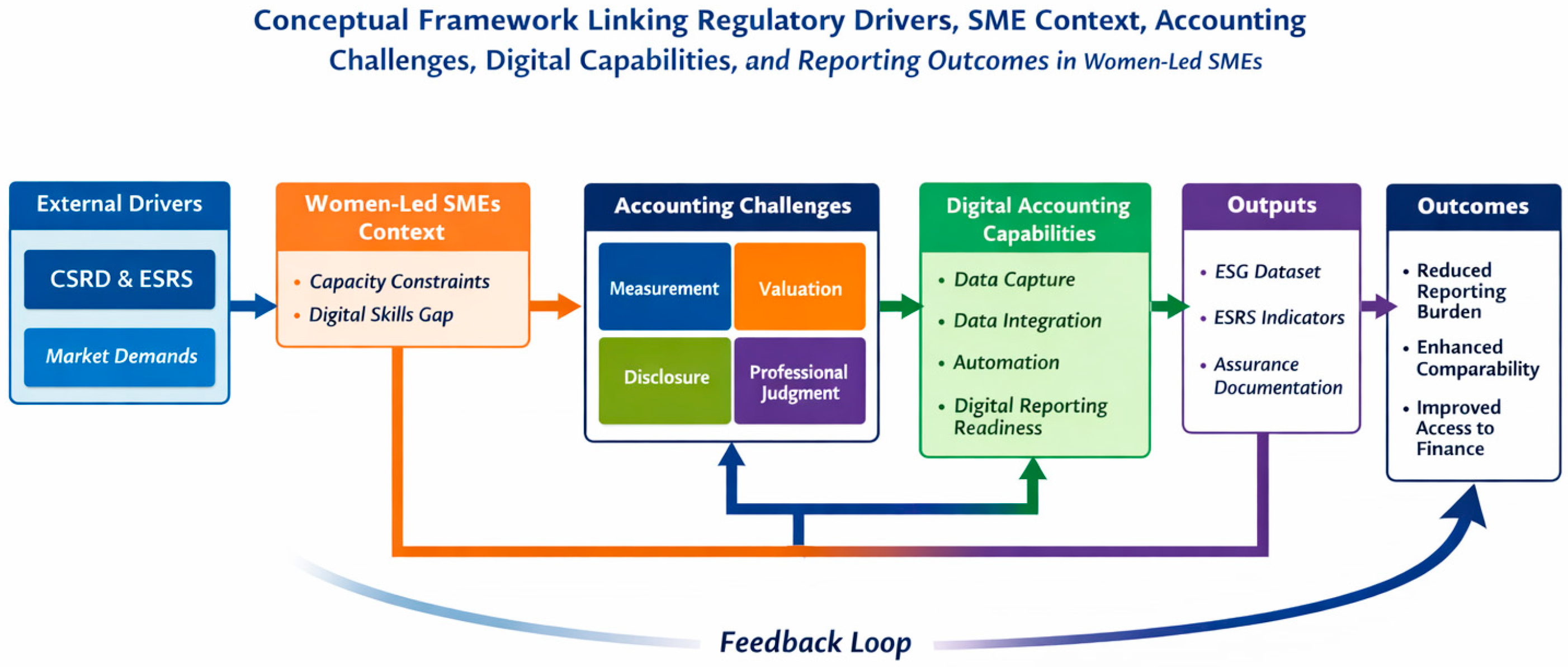
Against this background, the present study examines the accounting challenges associated with ESG and circular economy reporting in women-led SMEs and the potential role of digital accounting capabilities in supporting more feasible reporting practices under the CSRD/ESRS environment. To address these issues, the paper develops a conceptual accounting framework at the intersection of EU sustainability regulation, SME reporting practice, circular economy disclosure requirements, and digital enablement.
The framework is accounting-centered and is structured around four core reporting domains: measurement, valuation, disclosure, and professional judgment.
The study addresses two interconnected research questions:
RQ1: What are the principal accounting challenges that women-led SMEs face in operationalizing ESG and circular economy reporting under the evolving CSRD/ESRS framework?
RQ2: How can digital accounting capabilities support more feasible, proportionate, and scalable sustainability reporting practices for women-led SMEs?
The study develops a conceptual accounting framework supported by an exploratory and illustrative public data analysis to explain how sustainability reporting pressures translate into four core accounting challenge domains—measurement, valuation, disclosure, and professional judgment—for women-led SMEs. Accordingly, the exploratory empirical component should be interpreted as an analytical contextualization layer rather than as a statistically representative or hypothesis-testing research design. Building on this structure, the framework serves three analytically connected purposes: to advance conceptual understanding within the accounting literature on SME sustainability reporting, to provide a practitioner-oriented model for staged digital adoption, and to inform policy discussions on proportional support mechanisms in regional SME contexts. These objectives are sequentially connected, moving from identification of accounting challenges toward digital implementation logic and finally toward practitioner-oriented and policy-relevant implications.
The study proposes that digitalization should be understood not simply as a compliance technology, but as an accounting enabler supporting more reliable measurement routines, stronger audit trails, greater reporting comparability, and more accessible ESG and circular economy disclosures for resource-constrained firms. The paper further explores how staged, low-burden digital reporting approaches may support more feasible and proportionate ESG and circular economy reporting practices for women-led SMEs.
The study makes three principal contributions. First, it reframes ESG and circular economy reporting challenges in women-led SMEs through an accounting-centered perspective organized around measurement, valuation, disclosure, and professional judgment. Second, it integrates sustainability reporting, digitalization, circular economy disclosure, and gender-sensitive SME constraints within a unified analytical framework. Third, it develops an implementation-oriented conceptual structure linking accounting challenges with feasible digital reporting responses and SME-oriented policy implications.
2. Literature Review
The transformation of corporate reporting in the European Union is strongly driven by the introduction of the Corporate Sustainability Reporting Directive (CSRD) and the European Sustainability Reporting Standards (ESRS), which significantly extend the scope, depth, and assurance of sustainability disclosures. In the context of this study, ESG reporting is understood as the structured disclosure of environmental, social, and governance-related information relevant to stakeholders, while circular economy reporting refers to the communication of resource use, reuse, recovery, and value-retention practices linked to sustainability performance. The CSRD amends the EU accounting framework by embedding sustainability reporting within the management report, supported by assurance requirements and digital reporting infrastructure. The reporting timeline is phased, beginning with large public-interest entities and extending to other large undertakings and listed SMEs, the latter entering the scope for financial years starting on or after 1 January 2026. ESRS Set 1 further operationalizes this framework, including ESRS E5 on resource use and circular economy, which introduces circularity-related metrics and reinforces the principle of double materiality [
1,
2].
Recognizing the disproportionate burden that such requirements may impose on smaller firms, European policy has increasingly emphasized SME-oriented simplification mechanisms. The European Financial Reporting Advisory Group (EFRAG) has developed the Voluntary Sustainability Reporting Standard for SMEs (VSME), while EU institutions promote harmonized sustainability data requests across value chains. This approach is particularly relevant in the context of women-led SMEs, which are often more vulnerable to fragmented reporting demands and limited administrative capacity [
4,
5,
6,
7,
9,
10,
11].
Within circular economy accounting, a key challenge lies in translating broad conceptual frameworks into measurable and reportable indicators. The literature highlights that the circular economy lacks a single operational definition, encompassing diverse strategies such as reuse, recycling, and resource efficiency, which complicates measurement and comparability. Accounting systems must therefore capture both physical resource flows and financial implications across extended value chains, often requiring explicit boundary-setting decisions and methodological assumptions. Environmental management accounting tools, such as material flow cost accounting (MFCA), have been proposed as mechanisms to bridge physical and monetary data, supporting both decision-making and reporting [
23,
25,
26,
27,
28]. These approaches are particularly relevant because they connect physical resource flows with accounting-based cost allocation, reporting consistency, and decision-support processes.
Digitalization emerges as a critical enabler in this context, particularly in relation to data collection, processing, and reporting. From an accounting perspective, digital transformation supports traceability, documentation consistency, structured data governance, workflow control, and audit trail creation within sustainability reporting processes. Within this paper, digitalization is conceptualized primarily as a set of digital accounting and reporting capabilities supporting data capture, processing, traceability, standardization, and reporting coordination. The CSRD explicitly mandates digital reporting formats and taxonomy-based tagging, reinforcing the integration of digital tools into sustainability reporting processes. Existing literature associates digital transformation with improved data availability, automation, and traceability, which can enhance the reliability and auditability of ESG disclosures. However, the literature increasingly recognizes that digital transformation alone does not guarantee reporting quality, as the effectiveness of digital systems depends heavily on accounting competencies, organizational routines, and the interpretive capacity of SMEs [
14,
16,
17,
23,
24]. At the same time, studies emphasize that digital transformation requires complementary organizational capabilities, including accounting expertise and professional judgment, to ensure meaningful interpretation and disclosure of sustainability data [
1,
2,
14,
16,
22,
24].
Recent accounting literature increasingly associates digital reporting infrastructures with auditability, interoperability, and structured ESG data governance, particularly in SME reporting environments [
14,
16,
17,
22,
24].
Despite the growing body of research on digital circular economy transitions, gender perspectives remain underexplored. Recent bibliometric evidence indicates that women entrepreneurship is only marginally represented in the digital circular economy literature, suggesting a gap between policy priorities and academic research. Broader studies on gender and entrepreneurship suggest that structural inequalities related to finance, networks, and digital capabilities may influence the ability of women-led firms to participate effectively in sustainability transitions and reporting processes [
9,
10,
11,
18]. Within this perspective, the relevance of the gender-sensitive approach lies not in assuming distinct accounting obligations, but in examining how existing reporting pressures may have uneven implementation effects across SME populations.
These concepts are strongly interconnected. ESG and circular economy reporting generate new accounting and disclosure requirements, while digitalization functions as a supporting infrastructure enabling SMEs to operationalize sustainability-related information in more structured and scalable ways. At the same time, gender-related structural constraints influence the feasibility and proportionality of these reporting processes in women-led SMEs.
Within the present study, these reporting challenges are interpreted primarily through an accounting perspective focused on measurement, valuation, disclosure, and professional judgment.
Within the framework, the concepts of ‘measurement’ and ‘valuation’ are interpreted through a broader sustainability accounting and environmental management accounting perspective rather than through their narrower traditional financial accounting meanings. In this context, measurement refers primarily to the identification and quantification of sustainability-related operational data, resource flows, and circularity indicators, while valuation refers to the assessment of resource efficiency, circular activities, and sustainability-related accounting implications.
Overall, the literature reveals a convergence of regulatory pressure, conceptual ambiguity, and technological opportunity. However, it also exposes a more specific theoretical and implementation-oriented gap. Although prior studies discuss SME reporting burden, digital transformation, circular economy disclosure, and gender-related entrepreneurial constraints, these themes are typically examined in isolation. Existing research rarely integrates them within an explicitly accounting-centered analytical structure capable of linking reporting requirements, accounting implementation challenges, digital capabilities, and gender-sensitive SME constraints within a unified conceptual framework. Addressing this gap constitutes the central contribution of the present study [
6,
7,
9,
14,
22,
23,
25]. The study therefore contributes not only by integrating fragmented literature streams, but also by translating them into an accounting-oriented implementation framework applicable to SME reporting practice.
This fragmentation remains visible even in recent sustainability accounting and digital transformation studies, where accounting implementation, SME proportionality, and gender-sensitive reporting challenges are typically examined separately [
6,
7,
9,
10,
11,
17,
18,
22,
23,
24].
3. Materials and Methods
This study adopts a conceptual and interpretive analytical design aimed at developing an accounting-oriented framework for ESG and circular economy reporting in women-led SMEs. The manuscript is structured in accordance with MDPI article organization principles, including separate sections for literature review, methodology, results, discussion, implications, limitations, and conclusions. The study does not rely on primary analytical data collection or large-scale datasets. Instead, it combines regulatory analysis, purposive review of relevant academic literature, and selected bibliometric insights used as contextual input. The methodological objective is to provide analytical transparency in how reporting challenges are identified, grouped, and linked to potential digital responses. Given the conceptual and interpretive nature of the study, the paper does not formulate formal statistical hypotheses. Instead, the analysis is guided by two interconnected research questions aimed at framework development and analytical integration.
3.1. Research Design and Sources
The research design combines three complementary sources of evidence:
EU regulatory and standard-setting documents, including the Corporate Sustainability Reporting Directive (CSRD), European Sustainability Reporting Standards (ESRS Set 1, including ESRS E5), and SME-oriented initiatives such as the Voluntary Sustainability Reporting Standard for SMEs (VSME) [
1,
2,
4,
5];
established academic literature on circular economy accounting, environmental management accounting, and ESG reporting [
6,
7,
14,
15,
16,
17,
18,
22,
23,
24,
25,
26,
27,
28,
29]; and
previously published bibliometric and gender-inclusive analysis conducted by the authors (2015–2025), used here only as a contextual input for identifying underexplored thematic linkages, particularly the limited visibility of gender-sensitive perspectives in the digital circular economy literature [
19].
Academic sources were selected purposively based on direct relevance to the study objectives. Selection was guided by direct relevance to four thematic areas central to the study: SME sustainability reporting, circular economy accounting and disclosure, digitalization in accounting and reporting processes, and gender-related constraints affecting women-led enterprises. Priority was given to peer-reviewed academic publications, policy-relevant conceptual studies, and sources that directly informed the intersection of reporting requirements, accounting practice, and digital enablement.
Within the academic literature, emphasis was placed on sources that directly addressed accounting treatment, reporting implementation, SME proportionality, or digital reporting infrastructure, rather than on broader sustainability-transition literature lacking explicit reporting relevance.
All materials used in the study are publicly available and can be accessed through official EU institutional repositories, standard-setting bodies, and academic databases (e.g., Scopus-indexed literature). No proprietary datasets, confidential information, or restricted access materials were employed.
The study is positioned as a conceptual framework paper aimed at clarifying how regulatory pressures, accounting challenges, and digital responses can be analytically connected in the context of women-led SMEs. Its contribution lies in conceptual integration and implementation-oriented interpretation.
To provide an exploratory public data illustration, the study also incorporates a secondary analysis of publicly available documents and illustrative cases of selected women-led SMEs from the Danube Region. The purpose of this additional exploratory layer is analytical triangulation and practical contextualization of the proposed framework. The empirical extension is therefore illustrative in nature and is not intended to empirically validate the proposed conceptual framework. The document corpus includes EU regulatory texts, SME-oriented reporting standards, public supplier sustainability questionnaires, finance-related ESG guidance, and WE. Circular support materials. The cases were identified through publicly accessible WE. Circular-related materials, company websites, public business profiles, and sustainability-oriented communication channels. The selection followed a purposive and variation-oriented logic aimed at capturing diversity across sectors, digital maturity levels, circular economy practices, and visibility of ESG-related communication and reporting-related pressures. The analytical objective was not representativeness, but the construction of a heterogeneous illustrative sample capable of capturing contextual variation across sectors, digital maturity levels, circular economy business models, and ESG-related communication practices within women-led SMEs in the Danube Region. This purposive and variation-oriented selection strategy is consistent with established exploratory and interpretive research designs, in which small, purposively selected and information-rich samples are used to maximize contextual variation and analytical insight rather than statistical representativeness [
30,
31,
32]. Accordingly, the selected cases are intended to serve as an analytical contextualization of the proposed framework rather than empirical generalization and should therefore be interpreted as analytical illustrations rather than regionally representative evidence. Alternative cases could also have been included, as the purpose of the selection process was analytical variation and contextual diversity rather than exhaustiveness or statistical representativeness. Their role is to illustrate the practical visibility and contextual manifestation of the identified accounting challenge domains rather than to confirm causal relationships or validate the framework empirically.
3.2. Analytical Procedure
The review process was purposive and thematic. Rather than applying a formal systematic review protocol, the study organized the source base around recurring analytical themes emerging at the intersection of regulation, accounting practice, SME constraints, and digital enablement. The analytical process involved iterative thematic and accounting-functional grouping and comparative mapping across regulatory, conceptual, and practice-oriented sources. Regulatory provisions, literature-based problem descriptions, and digitally enabled response options were compared across sources and then synthesized into a matrix linking challenge domains, accounting implications, and feasible digital responses.
The methodology follows a structured analytical procedure designed to improve transparency and analytical traceability:
Step 1: Regulatory Mapping. A structured review of EU sustainability reporting regulation was conducted to identify key reporting requirements relevant to SMEs. This includes (a) mandatory disclosure logic under CSRD, (b) ESRS-based reporting structures, including circular economy metrics under ESRS E5, and (c) digital reporting requirements such as electronic formats and taxonomy-based tagging [
1,
2,
4,
5].
Step 2: Bibliometric-Based Conceptual Synthesis. Insights from a prior bibliometric and gender-inclusive study are incorporated only as a supporting interpretive layer, used to contextualize thematic gaps in the literature rather than to generate the main analytical structure of the present paper. The original dataset, methodology, and results of this bibliometric analysis are fully documented in the referenced publication. In the present study, these findings are used only to identify dominant research themes (e.g., digital enablers, traceability technologies) and to highlight the limited integration of gender perspectives in circular economy research [
19].
Step 3: Accounting Problem Structuring. Based on an iterative comparative reading of EU sustainability reporting requirements, environmental management accounting literature, sustainability accounting studies, and SME reporting implementation research, the study developed an “accounting challenge matrix” designed to organize recurring ESG and circular economy reporting problems into analytically coherent accounting domains. This classification provides the central analytical structure of the manuscript. The four domains—measurement, valuation, disclosure, and professional judgment—were derived through iterative grouping of recurring reporting problems identified across the source base. The grouping logic followed a functional accounting perspective, according to which reporting problems were classified based on their primary accounting implication rather than their regulatory source or sustainability topic. More specifically, issues related to the quantification of resource flows and indicators were grouped under measurement; issues concerning monetary attribution, costing, and recognition under valuation; issues related to presentation, comparability, and reporting coherence under disclosure; and issues involving materiality assessment, assumptions, estimates, and boundary-setting under professional judgment. The classification is grounded in established accounting frameworks and environmental management accounting tools, including material flow cost accounting [
7,
14,
15,
23,
24,
28,
29]. In this sense, the framework interprets ESG and circular economy reporting primarily as an accounting coordination and implementation problem rather than solely as a sustainability management issue.
The framework therefore approaches ESG and circular economy reporting not only as a sustainability management issue, but also as an accounting coordination and reporting problem.
In addition, the analysis explicitly differentiates between challenges that are structurally inherent to SMEs and those that are contextually intensified in women-led enterprises. This distinction is introduced at the interpretation stage, where literature on gender and entrepreneurship is used to identify mechanisms through which general reporting constraints may be amplified, including access to finance, digital capability gaps, and network participation [
9,
10,
11]. This accounting-oriented structuring enabled the subsequent mapping of accounting challenges to corresponding digital responses and policy-support mechanisms.
Step 4: Solution Mapping. Each identified accounting challenge is systematically linked to feasible digital solutions (e.g., data capture systems, automation tools, digital reporting infrastructure) and corresponding policy actions (e.g., harmonized data requests, training, subsidized infrastructure). This mapping reflects practical implementation pathways aligned with SME constraints and the broader Danube regional setting [
14,
16,
17,
22].
Step 5: Exploratory Public Data Illustration. To complement the conceptual analysis, the study applies a secondary public data layer consisting of (a) document analysis and (b) comparative illustrative cases. The document analysis covers publicly available regulatory, standard-setting, finance-related, and market-facing materials relevant to SME sustainability reporting, including guidance documents, public questionnaires, and support resources. In parallel, seven illustrative women-led SMEs from selected Danube Region countries were selected on the basis of publicly visible information regarding their sector, digital presence, circular or sustainability-related business model, and externally visible reporting or communication practices. The inclusion criterion was the availability of sufficiently visible public information allowing exploratory interpretation across the selected accounting and reporting dimensions. The limited number of cases reflects the exploratory and illustrative purpose of the analytical contextualization rather than an attempt to achieve statistical representativeness. Each case was coded using a simple visibility-based scale (0 = not visible in public materials; 1 = indirectly or partially visible; 2 = clearly visible and repeated in public materials) across five analytical dimensions: measurement, valuation, disclosure, professional judgment, and digital readiness. A score of 0 indicated the absence of observable evidence related to the selected accounting or reporting dimension in publicly accessible materials; a score of 1 indicated indirect, partial, isolated, or weakly articulated visibility; and a score of 2 reflected clearly visible, repeated, or explicitly communicated evidence across multiple publicly available sources or communication elements. For example, repeated references to measurable waste reduction practices, structured circularity indicators, or visible use of digital traceability and reporting tools across company websites and public communication materials were interpreted as stronger visibility (‘2’). By contrast, isolated narrative references to sustainability, circularity, or environmental orientation without observable reporting structure, measurable indicators, or repeated disclosure patterns were interpreted as partial visibility (‘1’). The coding procedure was designed to improve analytical consistency across heterogeneous public data sources. The visibility-based coding criteria were applied uniformly across all selected cases using the same analytical dimensions and interpretive criteria in order to improve comparability within the exploratory illustration. The cases and coding outcomes were jointly reviewed and discussed by the authors to improve interpretive consistency and reduce subjective bias during the exploratory classification process. In addition, the case review recorded sector, visible digital tools or readiness, ESG/circular disclosures present, evidence of challenge-domain visibility, and visible external reporting pressure. The coding captures the visibility of accounting-related reporting elements in publicly accessible materials. The coding approach should therefore be interpreted as a structured exploratory analytical device rather than as a formal qualitative content analysis or statistically validated measurement instrument. The coding results should therefore be interpreted as exploratory visibility indicators rather than as measures of actual ESG reporting quality or regional comparability.
The analytical procedure was designed to improve conceptual traceability between regulatory requirements, accounting implications, digital capabilities, and resulting reporting outcomes.
3.3. Reproducibility and Data Availability
The analytical process is designed to be transparent and traceable in its use of publicly accessible regulatory, academic, and case-related materials. The analytical extension relies exclusively on publicly available documents and company-facing materials obtained from official institutional repositories, standard-setting bodies, project platforms, and publicly accessible company websites. No proprietary or confidential materials were employed. Because the study does not involve human participants or personal data, ethical approval was not required. As the study relies on publicly accessible materials, the exploratory illustration reflects externally visible reporting and communication practices rather than internal accounting systems or verified ESG performance.
Accordingly, the study should be interpreted as a conceptual and analytical framework paper supported by exploratory public data contextualization rather than as statistically representative empirical research.
4. Results: Accounting Challenges in ESG and Circular Economy Reporting for Women-Led SMEs
The results are structured according to the four accounting domains identified in the analytical framework. The results of the structured conceptual analysis are presented through four core accounting challenge domains: measurement, valuation, disclosure, and professional judgment. These domains emerge from the interaction between ESRS requirements, circular economy accounting complexity, and SME-specific constraints, particularly in the context of women-led enterprises.
While these domains are relevant to SMEs more broadly, the analysis in this section also highlights how their practical implications may be intensified in the context of women-led enterprises. However, the degree of intensification may vary substantially depending on sectoral conditions, organizational capabilities, access to resources, and institutional context.
4.1. Exploratory Public Data Illustration Based on Publicly Available Documents and Cases
To complement the conceptual framework, an exploratory analytical illustration was conducted using two public data layers. First, a document analysis covered the CSRD/ESRS framework, the VSME standard, public supplier sustainability questionnaires, finance-related ESG guidance, and WE. Circular support materials. This document corpus indicates that SME-facing sustainability pressures are transmitted not only through regulation, but also through market-based questionnaires, financial sector expectations, and capacity-building initiatives.
Second, seven illustrative women-led SME cases from selected Danube Region countries were examined using publicly available evidence on sector, digital readiness, ESG/circular disclosures, challenge-domain visibility, and externally visible reporting pressure.
The selected cases provide an illustrative overview of how selected women-led SMEs from Danube Region countries operationalize circular economy practices and communicate sustainability-related information in publicly accessible materials. The cases are not intended to be statistically representative, but rather to capture variation across sectors, levels of digital maturity, and visibility of ESG-related practices.
Table 1 summarizes the key characteristics of the selected SMEs, including sectoral positioning, observable digital tools, the presence of ESG or circular disclosures, and the visibility of external reporting pressures.
As shown in
Table 1, the selected cases exhibit substantial variation in terms of sector, digitalization level, and visibility of sustainability-related practices. While some firms—such as SizeSense and Neworn—demonstrate advanced digital integration and platform-based models, others rely on more basic digital infrastructures and communication channels.
Across the seven exploratory cases, disclosure is the most publicly visible dimension, as nearly all firms communicate circularity, reuse, waste reduction, or sustainability-related value propositions in outward-facing materials. However, these disclosures are predominantly descriptive and narrative-driven, rather than systematically linked to formal accounting structures.
By contrast, more accounting-intensive domains—particularly valuation and professional judgment—are less directly observable in public-facing sources, even where circular business models are clearly present. This pattern indicates that public visibility tends to privilege sustainability narratives over the underlying accounting routines that support measurement, valuation, and decision-making.
To further structure the public-data illustration, the selected cases were systematically coded using a simplified visibility-based scale across the four accounting domains—measurement, valuation, disclosure, and professional judgment—alongside an additional dimension capturing digital readiness. The coding scale ranges from 0 (not visible in publicly available materials), through 1 (partially or indirectly visible), to 2 (clearly visible and repeatedly evidenced).
This approach does not aim to assess the internal quality or accuracy of ESG reporting, but rather to identify the extent to which accounting-relevant elements can be observed in publicly accessible information. By translating qualitative observations into a comparable structure, the coding enables the identification of recurring patterns across cases.
Table 2 presents the results of this comparative coding.
The comparative coding suggests three recurring patterns. First, digital readiness is most visible in platform-based or technology-intensive cases such as SizeSense and Neworn, indicating a stronger capacity for structured data processing and reporting. Second, measurement-related elements are more evident in cases built on waste recovery, material transformation, or secondary raw materials, such as OilRight and AuTerra Materials, where physical resource flows are central to the business model. Third, valuation and professional judgment remain comparatively underexposed in publicly available materials, despite their likely operational importance.
This pattern indicates that digitalization can enhance the visibility and organization of disclosure, while more complex accounting domains—particularly those requiring estimation, valuation, and interpretive judgment—remain less externally observable and more difficult to structure in smaller firms. This finding supports the paper’s broader argument that digitalization may improve reporting accessibility but does not automatically resolve deeper accounting challenges.
Although exploratory in scope, the selected cases were intentionally diversified across sectors, digital maturity levels, and circular economy practices in order to improve analytical variation within the illustrative contextualization. Consequently, the findings derived from the public data illustration should be interpreted as analytically supportive and contextually informative rather than as empirically generalizable.
4.2. Measurement Challenge: From Circular Practices to Auditable Indicators
The introduction of ESRS E5 formalizes “resource use and circular economy” as a standardized disclosure area, requiring firms to report comparable and, increasingly, machine-readable indicators [
2]. For women-led SMEs, the primary challenge lies in translating heterogeneous circular practices—such as reuse, repair, remanufacturing, and waste reduction—into consistent, auditable metrics.
Measurement difficulties arise in four main areas: (i) tracking physical resource inflows and outflows; (ii) defining system boundaries (organizational versus value chain scope); (iii) ensuring data consistency over time; and (iv) linking operational data to accounting systems. These challenges are intensified by the lack of standardized circular indicators and by the diversity of circular economy strategies documented in the literature [
25,
26,
27].
From an accounting perspective, measurement becomes feasible when physical resource tracking is embedded into existing accounting or inventory systems. Tools such as material flow cost accounting (MFCA) provide a practical starting point, enabling SMEs to quantify material losses and connect them to monetary values [
28]. However, without digital support—such as structured data capture and automated tracking—measurement remains fragmented and difficult to scale [
24,
29].
Overall, the findings suggest that measurement-related challenges are strongly linked to data availability, standardization, and digital integration capacity.
4.3. Valuation Challenge: Assigning Monetary Meaning to Circular Activities
The transition to circular economy models introduces significant valuation complexity [
23]. Traditional accounting systems are not designed to fully capture the economic implications of circular activities, such as reuse, refurbishment, or waste reduction. As a result, many circular practices remain partially or inconsistently reflected in financial statements.
Key valuation challenges include: (i) assigning value to waste and by-products; (ii) determining the cost and profitability of refurbished or circular products; (iii) recognizing circular investments and transition-related expenditures; and (iv) dealing with uncertainty due to the absence of stable market prices for secondary materials [
23,
27].
For women-led SMEs, valuation challenges are closely linked to access to finance [
11,
18]. Inconsistent or non-transparent valuation practices may reduce the credibility of sustainability claims in interactions with lenders, investors, or supply chain partners. Consequently, valuation is not merely a technical issue but a strategic factor influencing financial inclusion and business opportunities.
The findings suggest that simplified, rule-based valuation approaches—combined with digital tools for cost tracking and documentation—can significantly improve consistency and transparency without imposing excessive burden [
21,
24,
29].
These findings indicate that valuation difficulties remain among the least standardized dimensions of circular economy accounting in SMEs.
4.4. Disclosure Challenge: Connectivity, Comparability, and Reporting Fragmentation
The CSRD and ESRS framework fundamentally reshapes disclosure by requiring sustainability information to be integrated within the management report and aligned with financial reporting [
1,
2]. This creates a “system-level” challenge for SMEs, which must ensure consistency, comparability, and connectivity across different types of information.
In practice, SMEs face three major disclosure-related problems:
Women-led SMEs are particularly affected by these issues due to resource constraints and weaker access to specialized expertise [
9,
10,
11]. The absence of harmonized reporting frameworks increases administrative costs and the risk of inconsistent disclosures.
The analysis highlights the importance of the Voluntary Sustainability Reporting Standard for SMEs (VSME) as a coordination mechanism [
4,
5]. When used as a common reference point, VSME can reduce duplication, may improve comparability, and support more efficient reporting processes.
Digitalization plays a central role in addressing disclosure challenges by enabling centralized data management, automated reporting outputs, and preparation for future digital tagging requirements [
14,
16,
17,
24].
Consequently, disclosure-related burden emerges as both a reporting and coordination problem for SMEs operating under fragmented stakeholder expectations.
4.5. Professional Judgment Challenge: Materiality, Estimation, and Assurance Readiness
Professional judgment is a critical component of ESG and circular economy reporting, particularly under the ESRS framework, which is grounded in the concept of double materiality [
2]. SMEs must assess which impacts, risks, and opportunities are material, often under conditions of uncertainty and limited data availability.
Three main areas of judgment emerge: (i) materiality assessment and prioritization of ESG topics; (ii) estimation of indicators where direct measurement is not feasible; and (iii) definition of value chain boundaries and data sources.
These challenges are amplified by increasing assurance expectations, as EU-level limited assurance standards are expected to apply in the near future [
1,
2,
20]. SMEs lacking structured documentation, internal controls, and audit trails face higher risks of non-compliance and credibility gaps.
For women-led SMEs, the burden of professional judgment may be disproportionately high due to digital skill gaps and limited access to advisory services. This creates a potential “reporting inequality,” where firms with weaker capabilities incur higher costs and risks [
9,
10,
11].
The results indicate that digital tools—such as assumption registers, workflow approvals, and version control systems—can significantly improve the transparency and defensibility of professional judgments [
14,
16,
17,
24]. These tools transform judgment from an implicit process into a documented and auditable component of reporting.
Overall, the findings suggest that professional judgment remains a central but under-structured component of ESG and circular economy reporting in SMEs.
6. Discussion
6.1. Digitalization as an Accounting Capability
The Discussion is organized around the two research questions formulated in the Introduction and interprets the findings through the four accounting challenge domains identified in the analytical framework.
This study seeks to contribute to the growing body of research on ESG and circular economy reporting by introducing an accounting-centered and gender-sensitive perspective on digital reporting infrastructure in SMEs. While prior literature has widely emphasized the role of digital technologies as enablers of circular economy transitions, the findings of this study suggest that digitalization becomes effective only when embedded within structured accounting processes capable of supporting measurement, valuation, disclosure, and professional judgment [
14,
16,
17,
23,
24,
29].
The results reinforce existing research highlighting the complexity of sustainability reporting for SMEs, particularly under expanding regulatory frameworks such as the CSRD and ESRS. Consistent with prior studies, the analysis suggests that SMEs face significant challenges in translating abstract sustainability concepts into measurable, comparable, and decision-useful information. However, this study adds to the literature by proposing that these challenges are fundamentally accounting-related, rather than purely technical or regulatory. In this sense, the paper shifts the focus from “reporting compliance” toward “accounting capability,” positioning accounting systems as the core infrastructure for sustainability reporting [
6,
7,
15,
20,
21,
23]. This includes the role of internal controls, auditability, documentation consistency, and digitally supported reporting traceability within emerging ESG reporting environments.
The findings contribute to the ongoing debate on the role of digitalization in sustainability reporting. While many studies present digital tools as efficiency-enhancing solutions, the present analysis highlights a critical limitation: digitalization alone does not reduce reporting burden unless it is aligned with accounting logic and organizational routines. The analysis therefore reinforces the importance of accounting coordination, reporting logic, and professional judgment in ESG disclosure implementation. This finding supports and refines prior arguments that emphasize the need for integration between digital technologies and accounting systems. The findings are broadly consistent with prior studies emphasizing that digital accounting infrastructures improve ESG data traceability and reporting coordination, while simultaneously confirming that technology alone cannot compensate for limited accounting expertise and fragmented reporting practices in SMEs [
14,
16,
17,
23,
24]. The conceptual framework developed in this study explicitly captures this relationship by positioning digital accounting capabilities as an enabling layer rather than a standalone solution [
14,
16,
17,
22].
In particular, the findings are consistent with recent studies emphasizing that sustainability reporting quality depends not only on technological adoption, but also on organizational accounting capabilities and structured reporting processes [
14,
16,
17,
24].
However, it is important to acknowledge that digitalization also introduces implementation constraints, particularly in resource-constrained SME contexts. The adoption of digital reporting systems may involve substantial costs related to software, customization, and staff training, which can be difficult for smaller firms to absorb. In addition, interoperability problems between reporting systems and stakeholder platforms may increase complexity and reduce efficiency. Digitalization also raises concerns related to cybersecurity, data governance, and the protection of sensitive business information. Finally, there is a risk that digital reporting requirements may unintentionally reinforce existing inequalities, as firms with stronger digital capabilities are generally better positioned to comply efficiently with sustainability reporting expectations [
16,
22,
24].
In this sense, digital reporting infrastructure should not be interpreted as an inherently equalizing force, but rather as a capability-dependent mechanism whose benefits depend on access to resources, skills, and institutional support. A balanced approach therefore requires not only technological adoption, but also targeted capacity-building and proportional policy design [
17,
22].
The study therefore contributes to sustainability accounting research by linking ESG reporting implementation to accounting functionality, digital auditability, and environmental management accounting logic within SME contexts.
6.2. Gender-Sensitive Intensification of Reporting Challenges
The analysis further extends this perspective by incorporating a gender-sensitive dimension into the interpretation of ESG and circular economy reporting challenges [
9,
10,
11,
19]. Existing bibliometric and conceptual research indicates that gender-related aspects remain underrepresented in studies on digital circular economy transitions. By focusing on women-led SMEs, this paper illustrates that sustainability reporting is not a neutral technical process, but one that interacts with structural inequalities, including access to finance, digital skills, and professional networks. The findings suggest that reporting requirements and assurance expectations may have distributional effects, potentially amplifying existing disparities if not accompanied by targeted support mechanisms.
A further analytical distinction should be made between challenges that are common to SMEs in general and those that are specifically intensified in women-led enterprises. The four accounting domains identified in this study—measurement, valuation, disclosure, and professional judgment—represent structural reporting challenges that affect SMEs regardless of ownership characteristics. These challenges arise from limited resources, lack of standardized data, and increasing regulatory and market pressures. This observation aligns with recent literature arguing that sustainability reporting proportionality remains one of the central unresolved tensions within the evolving European ESG reporting environment [
6,
7,
20,
21,
22].
The gender-sensitive contribution of the paper therefore lies in explaining intensification mechanisms rather than in claiming fundamentally different reporting obligations for women-led SMEs. The analytical relevance of this perspective therefore derives from differences in reporting capacity, resource access, and implementation conditions rather than from differences in formal regulatory treatment.
Three interrelated mechanisms appear particularly relevant. These mechanisms should not be interpreted as uniformly applicable to all women-led SMEs, but rather as context-dependent factors that may influence reporting capacity and implementation conditions to varying degrees. First, women-led enterprises may face greater constraints in access to finance and specialized advisory services, limiting their ability to support complex accounting and reporting tasks. Second, documented digital skill gaps and lower participation in technology-intensive sectors may slow the adoption of digital reporting tools, increasing reliance on manual processes and reducing data consistency. Third, weaker integration into formal business networks and value chains may expose these firms to more fragmented and non-standardized ESG data requests, thereby increasing administrative burden [
9,
10,
11,
18].
In this sense, the gender-sensitive perspective adopted in this study does not imply a separate category of accounting challenges, but rather highlights how existing reporting requirements may have uneven effects across SME populations. This distinction is important for both analytical clarity and policy design, as it suggests that proportional support measures should address not only firm size, but also structural inequalities affecting specific groups of enterprises. The findings therefore support previous gender-sensitive entrepreneurship research showing that digital capability gaps and restricted access to specialized advisory networks may intensify sustainability reporting burdens for women-led firms [
9,
10,
11,
18].
As shown in
Table 3, this differentiation is not based on distinct categories of accounting challenges, but on differences in their practical intensity and manageability [
9,
10,
11]. This perspective reinforces the argument that gender-sensitive analysis in sustainability reporting should focus on differential capacity, access, and exposure rather than on fundamentally distinct reporting requirements.
6.3. Standardization Versus Proportionality
The results highlight a key tension between standardization and proportionality in sustainability reporting. On the one hand, harmonized frameworks such as the Corporate Sustainability Reporting Directive (CSRD) and the European Sustainability Reporting Standards (ESRS) may improve comparability, transparency, and consistency across sustainability disclosures. On the other hand, these frameworks may impose disproportionate administrative, technical, and financial burdens on SMEs, particularly enterprises with limited reporting capacity, constrained digital infrastructure, and restricted access to specialized expertise. This concern is increasingly reflected in the recent literature on SME sustainability reporting implementation and reporting burden management [
6,
7,
20,
21].
The analysis suggests that initiatives such as the Voluntary Sustainability Reporting Standard for SMEs (VSME) can play an important role in balancing these objectives by providing simplified, scalable, and coordinated reporting structures better aligned with SME proportionality requirements. Within this context, digitalization may support proportionality by enabling low-burden and resource-sensitive reporting solutions adapted to SME capabilities and implementation conditions [
2,
4,
5,
6,
7].
From an accounting and implementation perspective, the findings indicate that SMEs may benefit from the development of a “minimum viable ESG and circular dataset” designed to support basic sustainability-related reporting coordination without replicating the complexity of full ESRS-based reporting systems. In practical terms, such a dataset may include simplified indicators related to energy consumption, material inputs, waste generation, recycled or reused materials, supplier or customer ESG information requests, basic emissions-related proxies, and circular product or service characteristics. These elements may serve as an initial accounting-oriented reporting foundation capable of supporting traceability, documentation consistency, and progressive digital integration.
Importantly, the objective of such simplified datasets is not to reduce sustainability reporting to a minimal compliance exercise, but rather to provide SMEs with a feasible and proportionate entry point for sustainability-related data collection, documentation, internal coordination, and future reporting development. In this regard, proportionality should be interpreted not as a reduction in reporting relevance, but as a mechanism for improving practical feasibility, implementation inclusiveness, and long-term reporting sustainability within heterogeneous SME environments.
6.4. Circular Economy Accounting Implications
The study contributes to the emerging literature on circular economy accounting by emphasizing the need to integrate physical resource flows with financial information. Consistent with prior research on environmental management accounting and material flow cost accounting, the findings show that circular economy reporting requires accounting systems capable of capturing resource efficiency, material losses, and value retention across extended value chains. The proposed framework advances this perspective by linking these requirements to digital capabilities that facilitate data capture, integration, and traceability [
23,
28,
29].
Overall, the discussion suggests that the effectiveness of ESG and circular economy reporting in SMEs depends on the alignment of three elements: regulatory expectations, accounting capabilities, and digital infrastructure. Digitalization appears to play an important enabling role in this alignment, but its impact is contingent upon the existence of coherent accounting practices and institutional support. The study therefore advances the literature by conceptualizing digitalization not as an end in itself, but as a means of operationalizing sustainability reporting in a way that is both technically feasible and socially inclusive [
14,
16,
17,
22,
23].
In doing so, the paper provides a bridge between regulatory developments, accounting theory, and SME practice. It also highlights the importance of designing sustainability reporting frameworks that are sensitive to firm size, resource constraints, and gender-related structural conditions. These insights are particularly relevant in the context of the Danube Region and related regional initiatives, where digital capacity building and inclusive entrepreneurship are central policy priorities [
12,
13].
6.5. Future Research Directions
The exploratory public data illustration presented in this study provides an initial exploratory contextualization of the proposed framework, but future research should test these mechanisms more directly through case studies, interviews, surveys, or mixed-method designs focused on internal reporting practices and implementation outcomes.
Future research should empirically test the proposed framework across different SME contexts and regulatory environments. Comparative cross-country studies within the Danube Region may be particularly valuable. Future research may also examine sector-specific differences, assurance readiness practices, and the long-term effects of digital reporting infrastructures on SME sustainability reporting quality. Such studies could further test the broader applicability and contextual variability of the conceptual relationships proposed in this paper.
8. Limitations
The study has several limitations that should be acknowledged. First, although the study incorporates an exploratory public data illustration based on publicly available documents and illustrative cases, it does not rely on primary analytical data. The findings should therefore be interpreted with appropriate caution regarding broader analytical and contextual applicability.
Second, the regulatory environment is evolving, with ongoing discussions on simplification measures and SME-specific reporting guidance. As such, some of the assumptions underlying the framework may require adjustment as new standards, interpretations, or implementation practices emerge. Continuous monitoring of regulatory developments is therefore necessary [
4,
5,
20].
In addition, the exploratory case illustration included a limited number of purposively selected SMEs and therefore cannot support statistical generalization at the regional level. However, methodological literature recognizes that small purposive samples may generate meaningful analytical insights in exploratory and interpretive studies when selected to maximize contextual diversity and theoretical relevance rather than representativeness [
30,
31]. In addition, the purposive selection strategy may have excluded other potentially relevant women-led SMEs with less visible digital or sustainability communication practices. The exploratory illustration should therefore be interpreted primarily as an analytical contextualization tool rather than as confirmatory evidence. Future research could extend the framework through surveys, interviews, longitudinal SME analyses, and broader comparative cross-country datasets.
Third, women-led SMEs are not a homogeneous group. Accordingly, the proposed framework should be interpreted as analytically adaptable to different contextual and organizational conditions rather than universally applicable in identical form across all women-led SMEs. Differences across sectors, countries, and institutional contexts—particularly within the diverse Danube macro-region—may influence the applicability of the proposed framework. Future research should explore these variations and examine how local conditions affect digital adoption and reporting practices [
11,
12,
13].
Finally, further investigation is needed into the potential distributional effects of sustainability reporting requirements [
9,
10,
11,
18]. Future research may further examine the potential distributional effects of digitalization and standardized reporting frameworks on women-led SMEs.
9. Conclusions
This study has shown that the sustainability reporting challenges faced by women-led SMEs in the CSRD/ESRS environment can be interpreted most productively through an accounting lens. Rather than treating ESG and circular economy reporting as a purely regulatory or technological issue, the paper demonstrates that the core implementation difficulties cluster around four interrelated domains: measurement, valuation, disclosure, and professional judgment. Within this structure, digitalization functions not as an isolated solution, but as an enabling accounting infrastructure that may improve traceability, comparability, auditability, and implementation feasibility. The study’s main contribution is the development of a conceptual framework linking regulatory pressures, SME-specific constraints, digital accounting capabilities, and reporting outcomes within a coherent accounting-oriented and practice-relevant model. The framework is intended primarily as an analytical and implementation-oriented structure designed to support future empirical testing, validation, and comparative SME reporting research. The illustrative case evidence should therefore be interpreted as exploratory contextualization rather than as a basis for broad empirical generalization. Accordingly, the findings should be interpreted as conceptually grounded and exploratory rather than as causally validated empirical evidence. Future empirical studies based on primary data collection and statistically representative SME samples could further test and operationalize the conceptual relationships proposed in this framework.
The study also advances the literature by incorporating a gender-sensitive perspective, highlighting how structural constraints faced by women-led SMEs may influence their ability to comply with sustainability reporting requirements and to benefit from emerging opportunities. This perspective should be interpreted primarily through differences in implementation capacity and structural constraints rather than through fundamentally different reporting obligations. In this regard, digitalization is shown to have the potential not only to improve reporting efficiency, but also to reduce inequalities by enabling more accessible and standardized reporting processes. In doing so, the paper responds to recent calls for more integrated and implementation-oriented sustainability accounting frameworks for SMEs operating under evolving ESG reporting requirements [
6,
7,
17,
18,
20,
21,
22,
23].
From a practical and policy standpoint, the results suggest that scalable, low-burden reporting approaches—such as minimum viable ESG datasets and VSME-aligned disclosures—are essential to ensuring that sustainability reporting remains both feasible and inclusive. At the same time, investments in digital capabilities, training, and harmonized data frameworks are necessary to support SMEs in this transition.
In conclusion, the paper argues that the effectiveness of ESG and circular economy reporting for SMEs depends on the alignment of regulatory frameworks, accounting practices, and digital infrastructure. By providing an integrated and application-oriented perspective, this study contributes to bridging the gap between regulatory expectations and practical implementation, particularly in the context of women-led SMEs operating within regional transition and capacity-building environments.
Overall, the study positions ESG and circular economy reporting challenges primarily as accounting and reporting coordination issues shaped by regulatory complexity, digital capability, and SME-specific constraints.