1. Introduction
Against a global landscape of escalating risks, including climate change, economic volatility, and geopolitical conflicts, rural communities worldwide are increasingly exposed to complex shocks and pressures. As the fundamental units and primary stakeholders within rural systems, farm households bear the brunt of these disturbances. This vulnerability is particularly acute among smallholders whose limited resource endowments render traditional agricultural models insufficient for maintaining stable livelihoods. Consequently, enhancing the capacity of households for rapid recovery and adaptation, often conceptualized as the strengthening of livelihood resilience, has emerged as a critical challenge for achieving sustainable development [
1,
2]. In the Chinese context, these challenges are further amplified by the rigid dual urban–rural structure and the continued dominance of small-scale agriculture, which constrain the ability of farmers to cope with external shocks and limit their integration into higher value-added industrial chains. In recent years, building resilience has become a core strategic objective for many developing nations striving to meet global sustainability goals [
3]. Against this backdrop, Rural Industrial Integration (RII) has been proposed as a vital strategy to promote agricultural transformation and enhance adaptive capacity by strengthening linkages across the primary, secondary, and tertiary industries, thereby providing a crucial entry point for addressing livelihood vulnerability in the face of increasing uncertainties.
Livelihood resilience represents a comprehensive integration of livelihood and resilience theories, serving as a critical lens for addressing risk management, sustainability science, and human well-being [
4]. Within academic circles, it is generally defined as the capacity of farming households to adjust internal structures, reallocate resources, and adapt to environmental shifts while maintaining or enhancing their living standards [
3]. Currently, the literature identifies two primary methodological approaches to measuring this construct. The first perspective, rooted in welfare economics, treats livelihood resilience as a normative condition that can be quantified through the conditional probability that households achieve specific welfare standards [
5]. The second approach involves the construction of a theoretical analytical framework based on the specific dimensions of resilience. Notably, Speranza et al. [
1] developed an evaluation index system that assesses resilience through three pillars, namely buffering capacity, self-organizing capacity, and learning capacity. This multidimensional methodology has gained widespread recognition and has been applied to diverse contexts, including world heritage sites [
6], indigenous forest households [
7], and farming households in mountainous areas [
4]. However, while these studies provide a robust foundation for measurement, they primarily focus on characterizing the current state of resilience rather than uncovering the dynamic causal mechanisms that drive its evolution. Furthermore, recent scholarship has expanded its focus toward the determinants of livelihood resilience. Initial research emphasized the impact of exogenous factors such as global climate change [
8] and natural disaster shocks [
9]. Subsequently, this scope has broadened to encompass the effects of policy interventions and institutional implementation [
10,
11], with specific attention paid to relocation programs [
12], poverty alleviation policies [
13], and the emerging influence of the digital economy [
14,
15]. Despite these advancements, a significant research gap remains regarding how systemic organizational shifts, particularly through rural industrial integration, reconfigure household resilience. Existing literature often overlooks the complex interactions between different integration models and the heterogeneous roles of various organizational entities, leaving the specific pathways through which industrial integration enhances adaptive capacity insufficiently explored.
As one of the world’s largest developing nations and major agricultural powers, China is deeply committed to identifying strategies that promote rural development and improve farmers’ livelihoods. However, many rural regions remain constrained by traditional agricultural development models and a characteristic dualistic urban-rural structure, leading to a continued reliance on crop cultivation as the primary industry [
16]. These areas often lack the support of high-value-added industrial chains within the secondary and tertiary sectors. To address these challenges, the Chinese government introduced the concept of Rural Industrial Integration (RII) in 2015. This policy aims to foster deep integration between agriculture and other industries while expanding their spatial reach. By connecting internal and external resources through cross-sectoral means, RII seeks to transform rural industries and ultimately enhance farmers’ livelihoods. Despite its role as a cornerstone of rural revitalization, the specific impact of industrial integration on the resilience of farm households’ livelihoods remains underexplored. While existing literature has examined the effects of RII on welfare outcomes and confirmed its positive role in enhancing income levels [
17], optimizing consumption structures [
18], and promoting agricultural production efficiency [
19], relatively limited attention has been paid to its contribution to livelihood resilience from the perspective of sustainable livelihoods. Existing studies mainly focus on economic performance and short-term welfare improvement, while insufficiently exploring how RII affects the long-term adaptive capacity of households, particularly across the three dimensions of learning capacity, buffering capacity, and self-organizing capacity. Moreover, although Wang et al. [
3] suggested that rural industrial development can bolster livelihood capabilities and thus strengthen resilience, their analysis treated rural industry primarily as a general contributing factor rather than systematically examining the causal effects and transmission mechanisms of RII at the micro-household level. In addition, the heterogeneity across different integration models and organizational forms, such as industrial chain extension, technology penetration, cooperatives, and leading enterprises, remains underexplored. Therefore, the impact effects and internal mechanisms of rural industrial integration on household livelihood resilience have not yet been systematically unraveled.
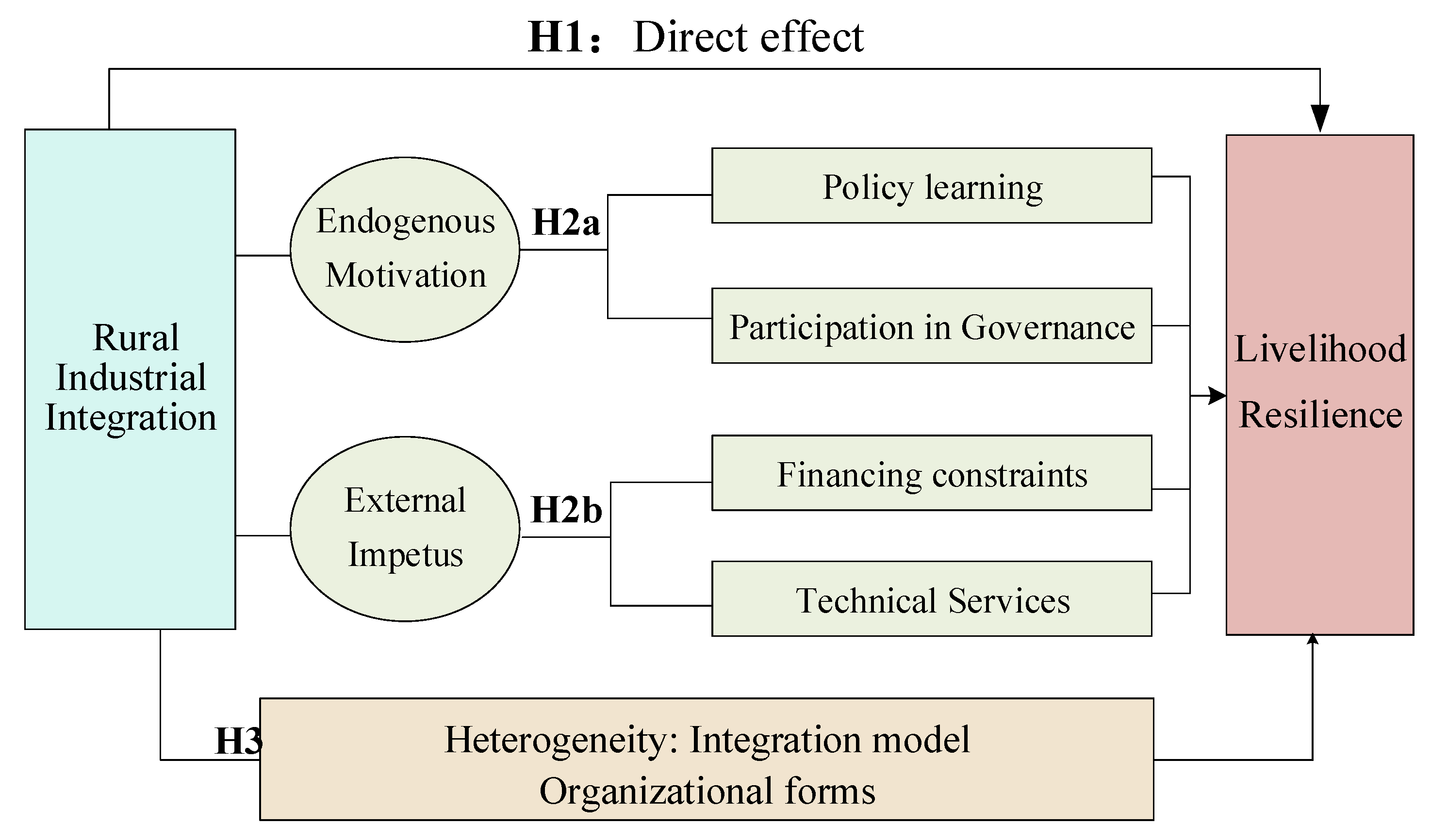
Based on these considerations, this study aims to answer three key research questions. First, does rural industrial integration significantly improve farmers’ livelihood resilience? Second, through what endogenous and exogenous mechanisms does RII affect livelihood resilience? Third, do different industrial integration models and organizational forms generate heterogeneous effects on farmers’ livelihood resilience? To address these questions, this study utilizes microdata from the China Land Economics Survey (CLES) to construct an econometric model for empirical testing from a micro perspective.
Compared with existing research, this paper contributes in three primary ways. First, it shifts the analytical focus of rural industrial integration research from income growth and welfare improvement to livelihood resilience, thereby extending the theoretical connection between industrial economics and sustainable livelihoods. Second, drawing on data from 1111 households across the 2020 and 2022 CLES databases, this study employs robust empirical methods such as the Conditional Mixed Process (CMP) and Propensity Score Matching (PSM). Third, constructs an integrated analytical framework that combines endogenous motivation and exogenous impetus, clarifies the differential impacts of various integration models and organizational forms, and provides more targeted policy implications for promoting sustainable rural development.
3. Materials and Methods
3.1. Source of Data
The empirical analysis in this study is based on the China Land Economic Survey (CLES) database. Initiated by the Division of Humanities and Social Sciences of Nanjing Agricultural University and the Jin Shanbao Institute of Agricultural Modernization and Development, the CLES is a comprehensive micro-survey conducted in Jiangsu Province. The database covers 13 prefecture-level cities, 26 counties, and 52 administrative villages, capturing granular information on rural industrial development, village governance, household production, and demographic characteristics. These multi-dimensional datasets provide robust empirical support for exploring the impact of industrial integration on farm households’ livelihood resilience from a micro perspective. As a typical province with a high level of agricultural modernization and rural industrial integration in China, Jiangsu Province embodies the dual characteristics of both traditional agricultural regions and economically developed areas. It demonstrates strong representativeness in practices such as rural industrial integration, the cultivation of agricultural business entities, and the innovation of rural governance mechanisms. On the one hand, Jiangsu possesses a solid agricultural foundation where smallholder farmers coexist with new types of agricultural business entities, which effectively reflects the realistic characteristics of China’s current rural industrial integration. On the other hand, Jiangsu is at the forefront of the country in promoting the integration of primary, secondary, and tertiary industries, particularly in developing models of agricultural industrial chain extension and technology diffusion. This provides an ideal observational sample for studying the impact of industrial integration on the livelihood resilience of farm households.
For this research, data from the 2020 and 2022 survey waves were selected to construct a pooled cross-sectional dataset. The final sample consists of 1111 valid observations, obtained after a rigorous data cleaning process that involved removing outliers, handling missing values, and winsorizing key continuous variables, such as income, to mitigate the influence of extreme values.
3.2. Variable Selection
3.2.1. Dependent Variable: Livelihood Resilience
Drawing on established theoretical frameworks and existing scholarship [
13,
31,
32,
33], and accounting for the specific characteristics of the study area and data availability, this paper constructs an evaluation index system to measure livelihood resilience across three dimensions: learning capacity, buffering capacity, and self-organizing capacity (
Table 1).
Specifically, learning capacity reflects the initiative and educational attainment of farmers, which are crucial for mitigating risks during external shocks. This dimension is further categorized into three sub-dimensions: learning mechanisms, livelihood diversification, and cultural reserves. Buffering capacity refers to a household’s ability to withstand pressures through its resource endowment. In addition to conventional financial, human, and physical capital, psychological capital is recognized as a vital component of resilience [
34,
35]. Consequently, psychological capital is incorporated to ensure a more holistic measurement. Finally, self-organizing capacity denotes the ability of households to coordinate, evolve, and organize collectively when facing uncertainty. This is measured through indicators related to cooperative network expansion, autonomous management, and social security. This study employs the entropy weight method to assign weights and aggregate these indicators. A higher composite index value indicates a more robust level of livelihood resilience.
3.2.2. Core Independent Variable: Farmers’ Participation in the Integrated Development of Rural Industries
Rural industrial integration involves merging traditional agricultural production with modern industrial practices. By integrating resources and optimizing spatial layouts, RII fosters deep synergy between the primary, secondary, and tertiary sectors, resulting in diverse industrial forms and business models. Drawing on existing literature [
36,
37], RII in this study is categorized into four distinct modes: internal integration, industry chain extension, multifunctional expansion, and technology penetration. Specifically, internal integration includes modern ecological models such as forest-based poultry farming and rice-duck symbiosis systems. Industry chain extension primarily focuses on the processing of agricultural products. Multifunctional expansion integrates traditional agriculture with tourism, catering, and cultural services. Technology penetration leverages the Internet and modern information technologies to develop rural e-commerce. In this paper, the identification of RII involves a two-step process. First, village-level and household-level questionnaires are utilized to determine whether any of the four aforementioned modes exist within the region. Second, household participation is further confirmed at the farm-household level. A value of 1 is assigned if a household participates in at least one integration mode; otherwise, a value of 0 is assigned. Descriptive statistics in
Table 2 indicate that the current participation rate in RII remains relatively low among the surveyed households.
3.2.3. Mechanism Variables
As established in the theoretical framework, this study selects mechanism variables to represent both exogenous impetus and endogenous momentum. The exogenous impetus dimension includes two variables: access to formal credit and access to agricultural technology services. These are measured by the total loan amount received from formal financial institutions (e.g., banks) and the number of types of agricultural technology services accessed, respectively. The endogenous momentum dimension comprises two variables: farmers’ awareness of rural governance policies, specifically regarding habitat improvement and waste sorting, and their active participation in rural governance activities.
3.2.4. Control Variables
To improve model accuracy and mitigate estimation bias, this study incorporates several control variables reflecting household personnel characteristics [
6], risk preferences [
19], external shocks [
22], and village development status [
2,
3]. At the household level, variables include population size, dependency ratios, and the risk appetite and time preference of the household head. Notably, departing from traditional approaches that focus solely on the household head, this study selects the personal characteristics of the actual household decision-maker, such as gender and age, as control variables. This choice is grounded in the premise that the primary decision-maker exerts a more significant influence on the household’s production strategies and lifestyle. At the village level, the model controls for village size, economic development level, and distance to the nearest county seat. Detailed descriptive statistics for all variables are presented in
Table 2.
3.3. Regression Model Setup
1. Ordinary Least Squares (OLS). To examine whether participation in rural industrial integration enhances the livelihood resilience of farm households, this study constructs the following baseline econometric model:
where
represents the level of livelihood resilience of the
-th farm household;
is the core independent variable indicating whether the household participates in industrial integration;
denotes a set of control variables encompassing household and village characteristics;
is the constant term; and
is the random error term. Model (1) is initially estimated using Ordinary Least Squares (OLS).
2. Propensity Score Matching (PSM). Given that a farm household’s decision to participate in rural industrial integration (RII) is a self-selecting behavior influenced by a combination of individual, familial, and social factors, it cannot be treated as a purely random variable. Although the baseline regression controls for the average effect of observed covariates, the results may still be susceptible to sample self-selection bias. To address this concern, this study employs the Propensity Score Matching (PSM) method for further validation.
Following the framework of Propensity Score Matching (PSM), variables influencing both household livelihood resilience and participation in rural industrial integration, including the individual decision-maker, household, and village characteristics described above, are incorporated into the model as extensively as possible to satisfy the ignorability assumption and minimize estimation bias. Subsequently, a binary decision model is constructed to estimate the propensity scores for RII participation using a Logit regression:
In this specification,
denotes the individual household,
represents households participating in rural industrial integration,
represents non-participants, and
signifies the vector of covariates. To ensure the robustness of the empirical results, this study follows established literature by employing three matching algorithms for verification: caliper matching, kernel matching, and linear regression matching. Finally, the Average Treatment Effect on the Treated (ATT) is calculated to quantify the impact of industrial integration participation on farmers’ livelihood resilience:
Within this framework, represents the livelihood resilience of participating households, which is directly observable, while denotes the counterfactual outcome, representing the resilience level these same households would have achieved had they not participated in industrial integration, which remains unobservable.
3. Conditional Mixed Process (CMP). However, the baseline results may be biased due to potential endogeneity issues such as omitted variable bias and reverse causality. Specifically, while this study incorporates an extensive range of control variables to mitigate omitted variable bias—further validated by the Oster test—the problem of reverse causality persists. For instance, households with higher inherent livelihood resilience may possess greater capacity or resources to participate in industrial integration. To address these endogeneity concerns, this study follows existing research by selecting the proportion of other farmers participating in industrial integration within the same village as an instrumental variable. First, rural society is characterized by prominent acquaintance-based social networks, where farmers typically exhibit significant peer and demonstration effects in their production and management decisions. The participation of neighboring farmers in industrial integration influences the decision-making of the sample household through information dissemination, experience sharing, and social interaction, thereby increasing the probability of their own participation. Particularly in the context of strong regional commonalities and similarities in agricultural production, farmers are more inclined to refer to the production choices and business models of others in the same village. Consequently, a strong correlation exists between the participation rate of other villagers and the sample household’s participation, satisfying the relevance requirement of an instrumental variable. Second, the participation rate of other farmers reflects collective decision-making and peer effects at the village level. While it influences the participation decision of the sample household through peer effects, it does not directly act upon their livelihood resilience. The enhancement of livelihood resilience primarily depends on internal factors such as household resource endowments, income structures, production and management capacities, and risk-coping abilities, whereas the behavior of other farmers does not directly alter these internal determinants. Furthermore, the model controls for village-level heterogeneity, such as economic development levels and village size, thereby excluding confounding factors that might simultaneously determine the participation rate of others and the individual household’s livelihood resilience. This further ensures the exogeneity of the instrument. In summary, this variable appropriately meets the relevance and exogeneity requirements of an instrumental variable.
Given that the core explanatory variable is a binary dummy variable, traditional Two-Stage Least Squares (2SLS) or IV-Probit models may be less efficient when the endogenous variable is discrete. Consequently, this study utilizes the Conditional Mixed Process (CMP) estimation method proposed by Roodman [
38]. This method is based on the Seemingly Unrelated Regression (SUR) framework and utilizes the Maximum Likelihood Estimation (MLE) to construct a recursive equation system. The CMP approach allows for different model specifications within the system; specifically, this study employs an OLS model for the primary equation and a Probit model for the auxiliary equation. This integration ensures more consistent and efficient estimates than traditional IV methods in the presence of binary endogenous variables.
4. Results
4.1. ANOVA and Correlation Analysis
Prior to the formal empirical analysis, an Analysis of Variance (ANOVA) is performed to investigate whether the involvement of households in rural industrial integration results in statistically significant differences in livelihood resilience. By identifying the sources of variation within the sample, this analysis clarifies the statistical significance of participation effects. The results presented in
Table 3 indicate that households participating in rural industrial integration achieve higher mean scores in livelihood resilience compared to non-participants, with these differences being significant at the 1% level. This provides initial evidence that rural industrial integration contributes to the enhancement of farmers’ livelihood resilience.
Furthermore, to maintain the scientific integrity of the regression results, Pearson’s correlation is applied to test the associations between the explanatory and dependent variables. As summarized in
Table 4, rural industrial integration displays a significant positive correlation with overall livelihood resilience and its constituent dimensions. The correlation with buffering capacity is the most prominent, implying that households participating in rural industrial integration are more likely to possess robust buffering capabilities and higher total resilience.
4.2. Benchmark Regression
Based on Equation (1), OLS estimation was employed to assess the impact of rural industrial integration (RII) on farm households’ livelihood resilience. Robust standard errors were utilized to address potential heteroskedasticity. The regression results presented in
Table 5 indicate that the effect of RII on livelihood resilience is positive and statistically significant at the 5% level. Specifically, the livelihood resilience of farmers participating in RII is, on average, 17.7% higher than that of those who do not participate. Compared to existing case studies [
3,
6], these results enrich current research findings through statistical evidence and provide greater clarity. Furthermore, when compared to recent empirical studies concerning the impact of modern agricultural linkages [
28] and e-commerce development [
39] on livelihood resilience, the promotion effect of rural industrial integration on household livelihood resilience is found to be relatively higher. From the perspective of economic significance, such a substantial improvement implies that RII serves as a critical institutional buffer; for a typical rural household in China, a 17.7% increase in resilience suggests a significantly reduced probability of falling back into poverty when confronted with equivalent external shocks, such as natural disasters or market fluctuations. This effect size demonstrates that industrial integration provides a more robust structural support system than fragmented policy interventions. Columns (2)–(4) of
Table 3 further delineate the impact of RII across the three specific dimensions of resilience. The results demonstrate that the regression coefficients for learning capacity, buffering capacity, and self-organizing capacity are all significant at the 5% level, suggesting that RII fosters resilience through multiple pathways.
The underlying mechanisms suggest that RII generates substantial spillover effects that bolster household capabilities. First, the development of integrated industries allows farmers to seek off-farm employment within their local vicinity, thereby diversifying and broadening their income streams. However, the magnitude of this employment effect may vary depending on a household’s initial human capital endowment, as those with higher education levels are often better positioned to capture high-value roles. Second, RII facilitates the innovation and upgrading of agricultural technologies [
17]. As farmers learn and apply these new technologies, their agricultural productivity and learning capacity improve synchronously, leading to enhanced overall resilience. Nevertheless, the efficiency of this technological spillover is contingent upon the accessibility of local extension services and the digital literacy of the farmers. Finally, participation in RII strengthens the ties and cooperation between households and their communities. This heightened community cohesion, often manifested as increased social capital, enables farmers to collectively navigate and mitigate the impact of external shocks. While these findings provide robust support for Hypothesis H1, we acknowledge that potential residual bias from unobserved factors remains a challenge. To mitigate this, we have employed rigorous econometric tests to ensure that the estimated relationship is not driven by self-selection or omitted variable bias. In summary, these empirical results provide robust initial support for Hypothesis H1.
Other control variables also exhibit significant correlations with farmers’ livelihood resilience. Framed within the Sustainable Livelihood Framework (SLF), these variables reflect key dimensions of household capital endowment and behavioral responses that jointly shape livelihood outcomes. From the perspective of household characteristics, both population size and pension insurance exert a significant positive impact on resilience. Larger households typically possess more current or potential labor participants, which enhances their human capital stock and leads to more diversified information channels and income sources. This finding aligns with previous empirical studies [
21,
39] indicating that household size provides a labor-based safety net in rural economies. Simultaneously, pension insurance acts as a form of formal financial capital that alleviates the financial burden of elderly care, providing a stable institutional guarantee that enhances overall household security. In terms of behavioral preferences, the results are consistent with intertemporal choice theory. Regarding behavioral preferences, the results reveal a compelling trend: households favoring high-risk, high-return strategies exhibit higher livelihood resilience compared to their risk-averse counterparts. Similarly, farmers who prioritize future returns over immediate consumption tend to possess greater resilience. Several factors may explain these phenomena. On one hand, risk-tolerant farmers often possess a higher inherent psychological threshold for disturbances. This orientation necessitates the proactive accumulation of livelihood assets to hedge against potential losses. To secure higher future returns, these farmers also prioritize the long-term construction and maintenance of various capitals, actively engaging in social networks to secure critical information and support. Such capital accumulation serves as a fundamental pillar of resilience. On the other hand, high-risk endeavors are frequently associated with greater environmental complexity and uncertainty. To successfully navigate these challenges and realize long-term gains, farmers are more inclined to experiment with innovative skills and production methods. This proactive adaptation fosters continuous learning and technological upgrading, which in turn strengthens the multidimensional resilience of their livelihoods. These findings are broadly consistent with behavioral theory and prior empirical research, which suggest that forward-looking and risk-tolerant households are more likely to invest in capacity-building activities that enhance long-term adaptive resilience.
4.3. Robustness Tests and Endogenous Analysis
4.3.1. Replace the Propensity Score Matching Model for a Robustness Test
Table 6 reports the Average Treatment Effect on the Treated (ATT) derived from three distinct matching techniques: caliper matching, kernel matching, and local linear regression matching. The results indicate that the treatment effects obtained across these methods are remarkably consistent, suggesting that the sample data possess highly robust. This consistency further confirms that RII exerts a significant positive influence on farmers’ livelihood resilience, providing additional empirical support for Hypothesis H1.
After accounting for sample selectivity bias through PSM counterfactual estimation, the average treatment effect of RII on household livelihood resilience is 0.157. This suggests that participation in industrial integration leads to a 15.7% increase in the livelihood resilience of farm households compared to the counterfactual scenario. Regarding specific sub-dimensions, the enhancement effects on learning capacity, buffering capacity, and self-organizing capacity are 14.1%, 1.1%, and 0.6%, respectively. These findings demonstrate that while RII influences all dimensions of resilience, the most pronounced impact is observed in the enhancement of learning capacity. This hierarchy of effects is consistent with the baseline regression results, further reinforcing the reliability and robustness of the study’s primary conclusions.
4.3.2. The Cross-Sectional Entropy Method Was Used to Measure the Livelihood Resilience of Farm Households
In the baseline analysis, the livelihood resilience index was constructed using the entropy weight method to assign weights across the pooled dataset. However, the choice of weighting schemes can inherently influence measurement outcomes. To ensure the accuracy and stability of the baseline estimates, this section employs a cross-sectional entropy method to re-measure household livelihood resilience. Specifically, instead of a single weight for the entire period, the weights for each indicator are calculated separately for each survey year to account for temporal variations in the relative importance of different factors. This approach provides a more nuanced reflection of the shifting economic environment, although we acknowledge that no weighting method can completely eliminate the subjective influence of initial indicator selection. Columns (1)–(4) of
Table 7 present the estimation results using the re-measured indices for overall livelihood resilience, learning capacity, buffering capacity, and self-organizing capacity as dependent variables. The results demonstrate that after replacing the resilience measures, rural industrial integration (RII) continues to exert a significant positive impact on both the composite livelihood resilience index and its various sub-dimensions. This consistency indicates that the empirical findings are not sensitive to the specific weighting methodology employed. Nevertheless, while this test addresses technical weighting issues, potential limitations such as measurement errors in self-reported survey data or unobserved heterogeneity—including individual psychological traits and local cultural norms—may still persist. Future research should consider more advanced panel data techniques to further isolate these unobserved factors. In summary, these results further reinforce the robustness of the baseline regression results.
4.3.3. Oster Test for Omitted Variables
Undeniably, numerous factors influence farm households’ livelihood resilience. Although this study incorporates an extensive range of control variables to address potential biases, the baseline regression results may still be affected by omitted variables that are either unknown or difficult to measure. To examine the potential impact of such unobservable factors, this study employs the omitted variable bias estimation method developed by Oster [
40]. The core of this methodology involves analyzing the proportional selection relationship between unobservable and observable variables while accounting for changes in both the regression coefficients and the model’s goodness-of-fit
R2. According to Oster’s definition, consistent estimates of the true coefficients in the presence of unobservable variables can be obtained through the following relationship:
=
.
Where
denotes the selection ratio and
represents the hypothetical maximum
if all unobservable variables were included, which is ideally valued at 1. Following the suggestions of Oster (2019) [
40], this study adopts two specific criteria to test the robustness of the baseline results. First, with
set to 1 and
set to 1.3 times the current regression goodness-of-fit (0.217), the estimates are considered robust if the identified set
=
does not contain zero or if
falls within the 95% confidence interval of the baseline regression coefficient. Second, by keeping
at zero, the value of
is calculated. If the absolute value of
is greater than 1, it implies that the influence of unobservable factors would need to be significantly larger than that of the observable variables to invalidate the results, thereby confirming robustness. The results of the Oster test, based on OLS estimations, are presented in
Table 8. The findings indicate that the results from both criteria demonstrate the high robustness of the baseline regression. Consequently, it can be concluded that the model is unlikely to suffer from significant omitted variable bias, reinforcing the reliability of our findings.
4.3.4. Endogenous Treatment
While the Oster test effectively addresses the concern of omitted variable bias, the relationship between rural industrial integration (RII) and livelihood resilience may still be susceptible to reverse causality. Furthermore, given the absence of a universal standard for measuring resilience and potential data constraints, measurement errors in the evaluation index system could further exacerbate endogeneity issues. To rigorously address these problems, this study employs an instrumental variable approach. Before proceeding with the Conditional Mixed Process (CMP) estimation, the validity of the instrumental variable—the proportion of other farm households participating in RII within the same village—must be rigorously tested. First, the underidentification test yields a Kleibergen-Paap rk LM statistic of 81.731, which is significant at the 1% level, confirming that the model is identified. Second, the weak instrumental variable test produces an F-statistic of 164.15, significantly exceeding the critical value at the 10% bias level. These results allow us to reject the null hypothesis of weak instruments, affirming that the selected instrumental variable is both relevant and plausibly exogenous. The CMP estimation results are presented in
Table 9. The endogeneity test parameter,
, is statistically significant at the 1% level, confirming the presence of endogeneity in the baseline OLS model and justifying the use of the CMP method. After controlling for relevant variables, the impact of RII on both the composite livelihood resilience index and its sub-dimensions remains significantly positive. Notably, the estimated coefficients in
Table 9 are larger than those in the baseline regression (
Table 5). This divergence suggests that the OLS model tends to underestimate the true impact of industrial integration on livelihood resilience. This divergence can be attributed to two potential factors. First, it may stem from negative selection bias, whereby households with lower initial resilience or more vulnerable livelihood conditions are more motivated to participate in RII as a strategic response to mitigate risks. If this endogenous selection is not fully accounted for, OLS estimates would be biased downward. Second, the discrepancy may arise from measurement errors in the self-reported participation of RII, which typically lead to an attenuation bias towards zero in OLS estimations. By employing the IV approach, we effectively mitigate these biases, providing a more consistent and robust identification of causality. This finding implies that the marginal benefit of RII for enhancing resilience is even more substantial than previously estimated.
4.4. Mechanism Analysis
To test the hypothesis that participation in rural industrial integration (RII) enhances livelihood resilience by strengthening both exogenous and endogenous motivations, this study conducts a mechanism analysis. The estimation results, presented in
Table 10, delineate the specific transmission pathways through which RII exerts its influence.
Columns (1)–(2) reveal that the impact of RII on agricultural technical services and formal credit availability is significantly positive at the 1% level. These findings indicate that farmers effectively benefit from the technological spillover effects of industrial integration and enhance their livelihood resilience by alleviating financing constraints. A plausible explanation is that smallholder farmers traditionally face structural barriers to formal credit, such as a lack of eligible collateral and a mismatch between financial products and agricultural cycles. By participating in RII and leveraging the pivotal role of leading industrial entities, farmers can utilize the organizational credibility of these enterprises to broaden their credit access, thereby strengthening their financial buffer against risks. Columns (3)–(4) report the results for endogenous motivation as a mechanism variable. The estimates show that farmers’ participation in RII significantly improves their policy learning capacity and rural governance participation at the 5% and 1% levels, respectively. This suggests that industrial integration stimulates farmers’ endogenous motivation and agency, which are critical for long-term resilience. The relative agglomeration of households during the integration process facilitates the rapid dissemination and popularization of rural development policies. As farmers become more attuned to policy requirements and institutional shifts, their sense of belonging and collective identity are reinforced. Consequently, this heightened subjectivity encourages active participation in village governance, creating a synergistic effect that further bolsters their livelihood resilience. In summary, the empirical evidence confirms that RII promotes resilience through a dual-track mechanism of external support and internal empowerment, thereby providing robust support for Hypotheses H2a and H2b.
While the empirical results confirm that both endogenous mechanisms, including policy learning and governance participation, and exogenous mechanisms, such as formal credit and technical services, significantly enhance farmers’ livelihood resilience, it should be noted that the effectiveness of these mechanisms may not be uniformly distributed across all households. In practice, farmers differ substantially in terms of human capital, social capital, asset endowment, and institutional embeddedness, factors that collectively shape their capacity to access and benefit from these pathways. For instance, households with higher educational attainment are often more capable of absorbing policy information and technical training, while those with stronger social networks are more likely to obtain formal credit and participate in rural governance activities. Similarly, households with superior initial resource endowments may face fewer barriers in engaging with cooperatives or accessing agricultural extension services.
This implies the existence of potential selection effects, whereby certain households are systematically more likely to benefit from rural industrial integration than others. Consequently, the estimated mechanism effects in this study should be interpreted as average treatment effects rather than universally homogeneous impacts. Due to data limitations, this study does not further distinguish the heterogeneous mechanism effects across different household groups. Future research could incorporate subgroup analysis based on household resource endowment, social capital, and regional institutional conditions to better identify the differentiated pathways through which rural industrial integration enhances livelihood resilience.
4.5. Further Analysis
While participation in rural industrial integration (RII) generally enhances livelihood resilience, the diverse modes and organizational structures involved may yield varying impacts. Based on the characteristics of the sample, this study conducts group regressions categorized by integration modes and organizational forms. To ensure the reliability of the findings, both OLS and Propensity Score Matching (PSM) are utilized for estimation. The specific results are presented in
Table 11.
Different industrial integration models emphasize distinct functions and developmental priorities. Specifically, internal integration focuses on reducing production costs, industry chain extension increases the value-added of agricultural products, multifunctional expansion broadens income channels, and technology penetration improves production and transaction efficiency [
36,
41]. Consequently, the impact on livelihood resilience varies across these modes. Empirical results indicate that all modes of industrial integration exert a positive influence on resilience, with industry chain extension and technology penetration exhibiting the most pronounced effects, significant at the 1% level. The superiority of these two models may be attributed to their direct alignment with China’s current ‘Digital Rural’ and ‘Industrial Upgrading’ strategies, which prioritize high-value-added processing and digital empowerment. By extending the value chain and integrating smart agricultural technologies, households can secure more stable price premiums and significantly reduce market transaction costs, thereby building a more robust economic buffer than that provided by simpler internal circular models. Conversely, participation in internal integration does not show a statistically significant impact on resilience. A plausible explanation is that internal integration centers on circular agricultural models, such as crop-livestock integration, which prioritize environmental externalities by reducing chemical inputs and lowering feed costs. While these models offer long-term sustainability, they require high risk tolerance from operators [
41]. Given that most farmers are risk-averse and the data in this study are cross-sectional, the long-term benefits of internal integration may not be observable in the short term, leading to an insignificant coefficient.
Due to constraints in production scale and development capacity, smallholder farmers often rely on new agricultural management entities to lead the integration process. As shown in
Table 11, only the cooperative model significantly enhances livelihood resilience. This divergence can be further elucidated through the lens of collective action and institutional governance. From a collective action perspective, cooperatives function as a formal platform for resource pooling, which reduces the marginal cost of technology adoption and strengthens farmers’ bargaining power through horizontal coordination. Unlike leading enterprises that may prioritize profit maximization and create asymmetrical power dynamics, cooperatives often utilize internal benefit-sharing mechanisms that protect the residual claimancy of smallholders. Consequently, the higher degree of trust and institutional belonging within cooperatives encourages proactive participation, which is a critical prerequisite for the successful transformation of external integration opportunities into internal livelihood resilience. In summary, the effectiveness of enterprise-led models is often restricted when farmers occupy a passive position in land transfers, whereas the cooperative model fosters a more equitable distribution of integration dividends.
5. Discussion
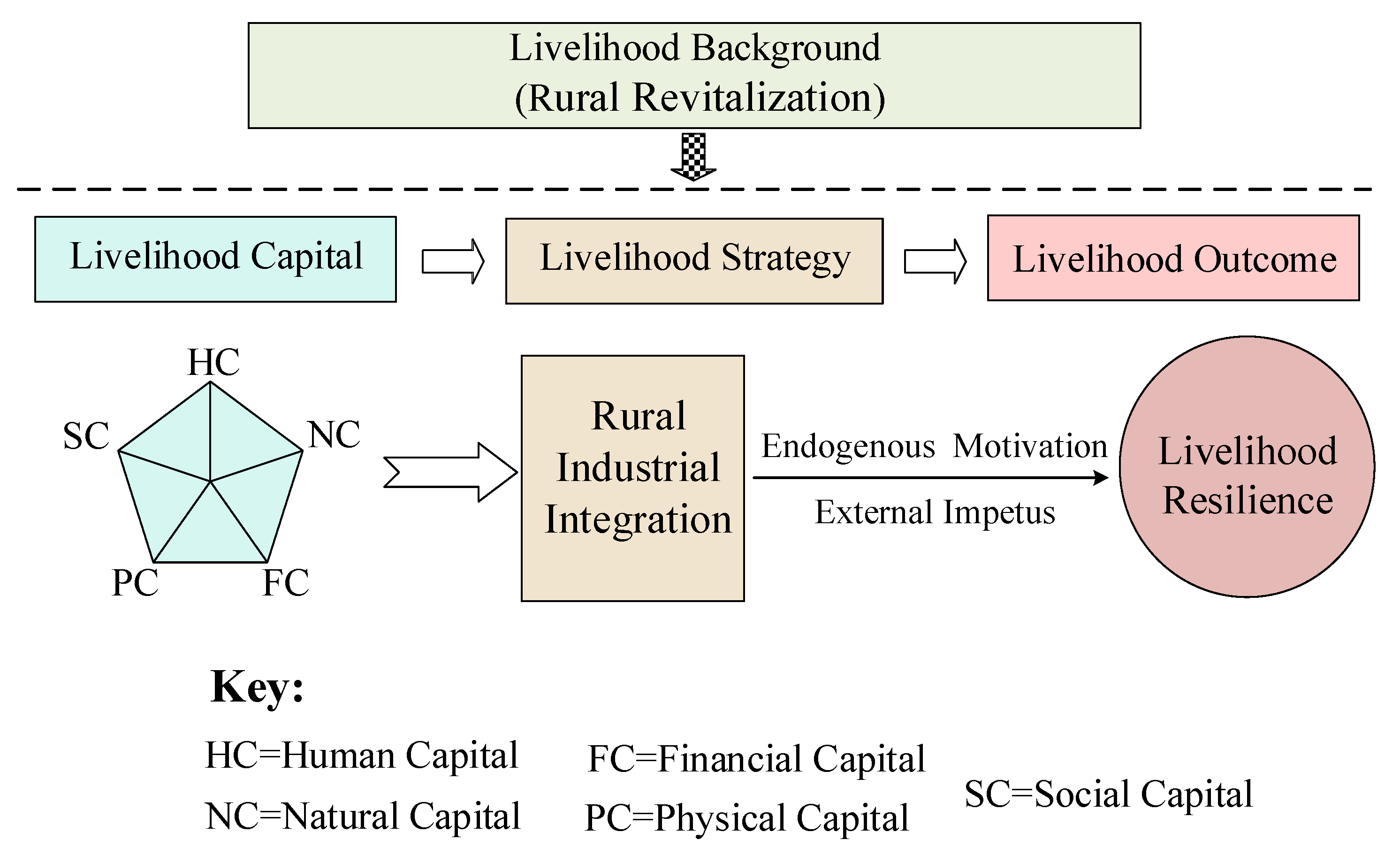
This study empirically examines the relationship between rural industrial integration (RII) and farm household livelihood resilience using micro-level survey data from Jiangsu Province, China. The findings offer several key insights that contribute to the existing literature on sustainable rural development and livelihood resilience. From a theoretical perspective, this study builds upon the Sustainable Livelihood Framework (SLF) by linking livelihood capital, strategies, and outcomes to the process of rural industrial transformation. However, unlike the standard SLF—which primarily emphasizes resource endowments and subsistence-oriented adaptation—this study highlights the role of market-based integration processes in shaping livelihood resilience, thereby extending the framework to better capture the dynamics of value chain participation and structural transformation in rural economies.
First, our results demonstrate a significant positive association between RII and farm household livelihood resilience, with an estimated coefficient of 0.171 (
p < 0.05). This indicates that RII serves as a critical driver for enhancing the sustainability and adaptive capacity of smallholder households. This finding confirms the structural importance of industrial synergy, yet it goes beyond traditional studies by demonstrating that the 17.1% resilience gain is substantial compared to single-sector interventions, which typically yield lower marginal returns. However, the effects of RII exhibit a clear hierarchy across different resilience dimensions. Specifically, the magnitude of improvement is most pronounced in learning capacity, followed by buffering capacity and self-organizing capacity. This pattern can be explained by the fact that industrial integration dismantles the inherent isolation of village economies and mitigates the “obscured subjectivity” of farmers [
24,
25]. By exposing farmers to diversified industrial knowledge and advanced technological applications, RII directly and substantially enhances their learning capacity. While RII improves both current income and future expectations [
17,
42], the conversion of these economic gains into a robust buffering capacity often necessitates a prior accumulation of human capital, which may explain the relatively moderated effect on the buffering dimension. Furthermore, self-organizing capacity—which fundamentally depends on collective coordination and interpersonal trust—is enhanced less directly than learning capacity, as the latter is primarily driven by individual willingness to acquire new knowledge. This finding not only corroborates prior studies emphasizing the importance of human capital accumulation but also extends the literature by revealing a differentiated transmission mechanism across resilience dimensions, suggesting that learning capacity may function as a primary entry point through which external structural changes are translated into broader livelihood resilience.
Second, the mechanism analysis reveals that the role of endogenous motivation in strengthening livelihood resilience is more significant than that of external impetus (
Table 10). This finding aligns with the perspective of Yang and Pan [
8], who argued that optimizing rural industrial structures can activate farmers’ internal drive. Crucially, our study moves beyond treating these as independent pathways by identifying a synergistic feedback loop between them. External impetus, such as government subsidies or infrastructure, provides the necessary ‘enabling environment’ or platform. Once this threshold is met, it triggers endogenous motivation, which acts as the ‘internal engine’ that determines the efficiency of resource utilization. Similarly, Wang and Zhao [
3] highlighted that endogenous dynamics facilitate flexible adaptation to external shocks and the absorption of resources to achieve sustainable livelihood outcomes [
43,
44]. These results suggest that policies aimed at promoting RII should prioritize stimulating farmers’ initiative and capacity-building rather than relying exclusively on top-down interventions. However, we must reflect on the limitations of the standard SLF applied here. While SLF effectively links capitals and strategies, it often struggles to capture the complexities of market-based integration processes, particularly the power asymmetries and transaction costs inherent in the ‘new quality productive forces’ of modern agriculture.
Finally, we identify significant heterogeneity in the effects of different integration models and organizational forms. Regarding integration models, industrial chain extension and technology diffusion exhibit the most substantial positive impacts. Specifically, digital technology—embedded within technology diffusion—enables farmers to better access production resources [
45] and enhances resilience through employment integration and income diversification [
14]. In terms of organizational forms, cooperatives prove more effective than leading enterprises in bolstering resilience. This result corroborates the study by Lin and Du [
46], who found that cooperative participation significantly strengthens farmers’ resilience, particularly through self-organized structures. This reflects farmers’ rational decision-making behavior [
46] and their ability to adopt livelihood strategies consistent with their household development goals. This difference is theoretically grounded in collective action theory. Cooperatives reduce information asymmetry and protect residual claimancy for smallholders, whereas enterprise-led models may lead to passive participation in land transfers, limiting the long-term adaptive capacity of households.
Despite these contributions, this study has several limitations. First, due to data availability, our analysis is confined to Jiangsu Province and does not fully capture the dynamic trajectory of RII’s impact. It should also be recognized that, as a relatively developed eastern coastal region, Jiangsu Province exhibits certain differences in economic development, institutional environment, and resource endowments compared to the central and western regions; therefore, caution should be exercised when generalizing the research conclusions to a national scope, particularly to less developed areas. Future research could further incorporate samples from the central and western regions to conduct cross-regional comparative analyses, utilizing panel data to trace temporal changes in resilience to improve the generalizability and external explanatory power of the research findings. Second, while we distinguish between endogenous and exogenous mechanisms, future studies could further examine these as moderating variables to clarify the boundary conditions under which RII most effectively enhances resilience. Finally, given the complexity of both RII and livelihood resilience, future studies should emphasize forecasting livelihood trends under different development models and conducting policy simulations to optimize integration pathways.
6. Conclusions
This research demonstrates that rural industrial integration significantly enhances the livelihood resilience of farm households, with learning capacity being the most prominent dimension. The results indicate that endogenous mechanisms consisting of policy learning and governance participation, along with exogenous mechanisms such as formal credit and technical services, play essential roles in bolstering household resilience. Furthermore, the findings show that models involving industrial chain extension and technology penetration exert more substantial impacts, while cooperatives contribute more effectively to resilience than enterprise-led models.
However, it is important to recognize that cooperatives and leading enterprises are not necessarily substitutes in practice. Although cooperatives show higher effectiveness in enhancing farmers’ resilience through their advantages in trust building and collective action, they frequently depend on leading enterprises for market access, brand development, and value chain expansion. Leading enterprises provide necessary sales channels and technical standards, whereas cooperatives serve as a vital organizational bridge that improves participation efficiency and organizes smallholders. Consequently, the synergy between these two organizational forms represents a more robust and sustainable path for strengthening the long-term adaptive capacity of rural households.
Based on these findings, several policy implications are proposed. Efforts should be made to actively promote rural industrial integration and optimize integration models. Heterogeneity analysis indicates that the vertical industrial chain extension model has a more significant strengthening effect on livelihood resilience. Accordingly, regions should avoid the blind expansion of the breadth of industrial integration and instead focus on enhancing its depth. Leading agricultural enterprises should be encouraged to establish deep-seated interest linkage mechanisms with farmers, such as supporting farmers’ participation in high-value-added stages, including deep processing, cold chain logistics, and e-commerce sales, rather than remaining confined to horizontal expansion at the production stage. Second, policy should focus on enhancing learning capacity and constructing a precision-based human capital cultivation system. Empirical results demonstrate that industrial integration has the most significant impact on the enhancement of farmers’ learning capacity. Therefore, policy formulation should shift from pure industrial support to human-oriented empowerment. The government should increase specialized skills training for farmers participating in industrial integration, particularly multi-level education centered on digital agricultural management, agricultural brand marketing, and the cultivation of professional farmers. By establishing peer-to-peer learning mechanisms between enterprises and households, the diffusion of advanced agricultural technologies and modern management concepts from business entities to ordinary farmers can be facilitated, thereby strengthening the self-evolution and continuous improvement capabilities of farmers’ livelihoods. Third, internal and external support mechanisms should be improved to reinforce the dual-path drive for livelihood resilience. Regarding the dual influence paths of external push and endogenous pull, the government could continue to improve rural infrastructure and financial support systems, focusing on financial instruments such as low-interest loans and risk compensation funds to lower the threshold and cost for farmers to participate in industrial integration, thus leveraging external factors. Simultaneously, institutional designs should be employed to stimulate farmers’ intrinsic willingness to participate. For instance, by improving the land contractual rights transfer market and profit-sharing systems, it can be ensured that farmers share the premium benefits generated by industrial integration, thereby motivating them to spontaneously adjust livelihood strategies and enhance their self-organization capacities.