1. Introduction
The rapid diffusion of artificial intelligence (AI) across organizational contexts has intensified scholarly interest in the role of leadership in enabling innovation and transformation [
1,
2]. Existing research largely assumes that AI adoption, when supported by effective leadership, enhances organizational performance through improved decision-making, efficiency, and knowledge generation [
3,
4]. Yet, this assumption rests on an implicit view of artificial intelligence as an inherently innovation-enabling technology, a premise that remains theoretically underexamined. AI systems primarily generate outputs through the recombination, pattern recognition, and extrapolation of existing data, rather than through the creation of fundamentally novel knowledge structures. As a result, while AI may enhance efficiency and support incremental innovation, it may simultaneously constrain radical novelty by reinforcing path dependence, standardization, and data-driven convergence. In such contexts, AI does not function solely as an enabler of innovation but may also be associated with structural constraints, shaping the boundaries within which innovation can occur. Within this stream, leadership is typically conceptualized as a facilitating mechanism that aligns technological capabilities with organizational goals, thereby supporting innovation processes and outcomes [
5,
6,
7]. At the same time, parallel research emphasizes the importance of maintaining human-centered capabilities, such as autonomy, critical thinking, and creativity, particularly in environments characterized by increasing algorithmic influence [
8,
9].
Despite these advances, existing research systematically overestimates the effectiveness of AI leadership by implicitly assuming functional alignment between AI systems, leadership practices, and human-centered capabilities [
10,
11]. Much of the existing literature is grounded in a linear and inherently optimistic assumption that AI leadership is associated with positive outcomes through a coherent chain of relationships [
12,
13,
14]. Emerging critical perspectives suggest that digital leadership is also associated with unintended consequences, including forms of control, dependency, and reduced autonomy, thereby challenging overly optimistic assumptions about its effectiveness [
15]. This assumption remains largely untested, with empirical evidence limited and fragmented, particularly in structurally misaligned organizational contexts [
16,
17]. Moreover, existing research rarely considers the possibility that these relationships may not hold at all, particularly in contexts where AI systems and human-centered practices are not effectively integrated [
18]. In particular, prior studies have yet to examine whether the coexistence of different leadership approaches—such as innovation-oriented and governance-oriented AI leadership—results in their effective integration at the organizational level [
19,
20].
This gap is especially evident in the absence of research that conceptualizes misalignment—not alignment—as a normal, structurally embedded condition in AI-enabled organizations [
21]. This study addresses this gap by reorienting the analytical focus from the assumed effectiveness of AI leadership to the structural conditions under which such effectiveness may fail to materialize. In doing so, the study proposes the AI-Human Misalignment Framework as a novel theoretical framework, suggesting that innovation failure is associated with structural disconnection between AI-oriented leadership, human-centered capabilities, and organizational processes. Unlike dominant linear models that assume alignment as given [
22,
23], the proposed framework treats misalignment as a structural condition that can emerge in AI-enabled environments. The findings indicate that the coexistence of AI-driven leadership and human-centered independence does not ensure integration but is associated with structural fragmentation and weak—or even negative—innovation outcomes. In this sense, leadership is interpreted not as an inherently beneficial driver of innovation but as a contingent and context-dependent capability whose effectiveness may depend on alignment mechanisms rather than its mere presence.
Although leadership is often treated as a unifying force [
24], there is limited understanding of situations in which leadership practices fail to translate into operational changes or performance improvements [
25]. Similarly, the role of human-centered independence is typically assumed to be inherently beneficial [
26], without critically examining the conditions under which it may become disconnected from technological systems [
27].
To operationalize this framework, the study develops and empirically tests a model that integrates two complementary dimensions of AI leadership—AI-driven innovation leadership (Sun dimension) and reflective AI governance leadership (Moon dimension)—with human-centered independence and organizational innovation performance. While the hypotheses are formulated in line with dominant assumptions in the literature, the study explicitly allows for their rejection. By doing so, the study moves beyond single-dimensional conceptualizations of leadership [
28] and examines how different leadership logics interact within AI-enabled environments. The significance of this research lies in its direct challenge to dominant linear assumptions in the AI leadership [
29] and innovation literature [
30]. Rather than examining whether AI leadership is associated with improved performance, this study questions whether such relationships emerge at all under conditions of structural disconnection. By showing that leadership, human-centered capabilities, and innovation processes may coexist without functional integration, the study explains why substantial investments in AI-driven transformation do not necessarily correspond to improved innovation outcomes. In contrast to the organizational misfit literature, which conceptualizes misalignment as a deviation requiring correction, the proposed framework treats misalignment as a stable and analytically relevant condition rather than a problem to be resolved.
From a theoretical perspective, this study contributes by demonstrating that expected leadership—performance relationships may not emerge empirically, despite strong theoretical assumptions. Building on this, the study proposes the AI-Human Misalignment Framework as a novel mid-range theoretical framework for understanding these findings. As a mid-range theoretical framework, the proposed framework explains empirically observable patterns of structural misalignment between AI-oriented leadership, human-centered capabilities, and innovation outcomes within organizational contexts, consistent with the role of mid-range theories in linking empirical observation with theoretical explanation [
31,
32].
Unlike existing socio-technical and dynamic capability approaches, which generally assume that alignment between technological, organizational, and human capabilities can be achieved or restored, the proposed framework explains the persistence of non-alignment even when these elements are simultaneously present. In this sense, misalignment is conceptualized not as a temporary deviation or implementation failure but as a structural condition of AI-enabled organizational systems. By doing so, the framework explains the empirical absence of expected leadership-performance relationships, highlighting conditions under which such relationships fail to materialize. This reconceptualization shifts the focus from capability presence to capability coherence, demonstrating that the effects of leadership, technology, and human capability on innovation outcomes depend on the degree of alignment across these domains. Rather than offering additional explanatory power, the study contributes by empirically demonstrating the absence of expected relationships and by identifying the structural conditions under which dominant assumptions about AI leadership fail.
2. Literature Review and Hypothesis Development
The growing integration of artificial intelligence into organizational processes has repositioned leadership as a central mechanism for linking technological potential with innovation processes and outcomes [
33]. Within this context, AI leadership is increasingly conceptualized as a multidimensional construct that combines externally oriented innovation dynamics with internally oriented governance and control mechanisms [
34,
35,
36]. This duality reflects the need to balance exploratory and exploitative processes, often framed as complementary organizational capabilities in innovation systems [
37]. The AI-driven innovation leadership (Sun dimension) captures the outward-facing, opportunity-seeking role of leadership, emphasizing idea generation, experimentation, and the strategic use of AI to identify emerging trends and innovation opportunities [
38,
39,
40]. Prior research has consistently highlighted the role of leadership in supporting innovation through resource mobilization, creativity, and experimentation [
41]. In digitally intensive environments, AI is often associated with enhanced capabilities by accelerating information processing, enabling predictive insights, and expanding the creative potential of teams [
42,
43]. As a result, leaders who actively integrate AI into innovation processes are expected to be associated with innovation outputs and with changes in how employees engage with knowledge and problem-solving tasks [
44]. This assumption is also supported by prior empirical SEM-based studies that examine leadership—innovation relationships in digital and technology-intensive contexts [
45].
At the same time, the reflective AI governance leadership (Moon dimension) represents the inward-facing, evaluative role of leadership, focusing on critical assessment, ethical considerations, and risk management in the use of AI [
46]. This dimension aligns with emerging discussions on responsible AI and governance structures, which emphasize the importance of human oversight, accountability, and ethical reflection in algorithmic decision-making [
47,
48,
49]. Rather than simply enabling innovation, this form of leadership is associated with maintaining alignment of AI-driven processes with organizational values and strategic objectives [
50,
51]. By structuring how AI is evaluated and implemented, reflective leadership is expected to be associated with decision quality and long-term innovation sustainability. Empirical SEM-based research similarly suggests that governance-oriented leadership can influence organizational outcomes through structured decision-making and control mechanisms [
52].
The interaction between these two leadership dimensions is particularly relevant when considering human-centered independence, conceptualized as the organization’s ability to maintain critical thinking, autonomy, and operational capability independently of AI systems. While the digital transformation literature often emphasizes technological augmentation [
53], parallel streams of research highlight the importance of preserving human agency and cognitive autonomy in increasingly automated environments [
54]. Human-centered independence reflects this balance, capturing the capacity of employees to operate without over-reliance on AI while still engaging with technologically supported processes [
55,
56].
2.1. Alignment and Misalignment in Organizational Systems
From a broader theoretical perspective, the relationship between technological systems and human capabilities has long been conceptualized through the lens of alignment. Socio-technical systems theory posits that organizational performance depends on the joint optimization of social and technical subsystems, where technology and human actors are expected to function as mutually reinforcing components of a coherent system. Within this framework, misalignment emerges when technological structures and human capabilities evolve at different speeds or follow divergent logics, resulting in reduced effectiveness and coordination. This perspective is further developed in the literature on organizational fit and misfit, which emphasizes that the effectiveness of organizational arrangements depends on the degree of consistency between strategy, structure, and operational processes. Misalignment, in this context, is not treated as an anomaly but as a structural condition that can arise when new technologies disrupt established organizational configurations. In digitally intensive environments, the integration of AI introduces additional complexity by embedding decision-making processes within algorithmic systems that may not fully align with human cognitive and behavioral patterns.
The dynamic capabilities framework provides an additional lens for understanding these processes. Organizations are expected to continuously sense, seize, and transform in response to environmental and technological changes. However, the rapid integration of AI may create imbalances between these capabilities, particularly when technological sensing and seizing outpace the organization’s ability to transform human competencies accordingly. In such cases, AI adoption may lead not to capability enhancement but to capability misalignment, where technological advancement is decoupled from human skill development and organizational adaptation. Empirical studies using SEM approaches further show that misalignment between organizational components may weaken or disrupt expected performance relationships [
57,
58].
2.2. Limitations of Linear AI—Innovation Assumptions
A substantial portion of the existing literature implicitly assumes a positive and linear relationship between AI integration and innovation performance. Within this dominant perspective, AI is treated as a capability-enhancing tool that improves decision-making, accelerates knowledge processing, and expands innovation potential. As a result, leadership approaches that promote AI adoption are generally expected to produce uniformly positive outcomes across organizational processes. However, this assumption overlooks important structural and cognitive constraints associated with AI-driven systems. AI primarily operates through data-driven pattern recognition and recombination, which may reinforce existing knowledge structures rather than generate fundamentally novel ideas. Consequently, AI-supported processes may favor convergence and optimization over divergence and exploration, potentially limiting radical innovation. At the same time, governance-oriented leadership, while necessary for risk management and ethical alignment, may introduce additional layers of control that constrain flexibility and experimentation.
These limitations suggest that the relationship between AI, leadership, and innovation is not inherently linear or uniformly positive. Instead, it may be contingent on the degree to which technological systems and human capabilities remain aligned. Under conditions where AI substitutes rather than complements human agency, innovation processes may become structurally misaligned, resulting in weakened or even negative relationships between leadership, human capabilities, and innovation outcomes. This perspective provides the basis for re-examining the assumed relationships within AI-enabled organizational environments. Recent empirical research also indicates that relationships between leadership, technology, and performance may be non-linear or contingent, particularly in digitally intensive environments [
59].
2.3. Hypothesis Development
From a theoretical perspective, leadership is expected to shape such capabilities by influencing both organizational culture and individual behavior [
60]. Leaders who promote AI-driven innovation may simultaneously encourage employees to develop complementary skills, ensuring that human expertise remains relevant in AI-augmented contexts [
61,
62]. Similarly, leaders who emphasize governance and critical evaluation of AI are likely to reinforce independent thinking and responsible use of technology [
63,
64]. Based on these arguments, both leadership dimensions are expected to influence human-centered independence through their role in shaping the alignment between technological systems and human capabilities. From a dynamic capabilities perspective, leadership may facilitate the integration of AI into organizational processes while simultaneously supporting the development of complementary human skills. However, this relationship depends on whether AI adoption is accompanied by sufficient transformation of human competencies. In cases where technological integration outpaces capability development, leadership may contribute to structural misalignment, potentially weakening rather than strengthening human-centered independence. Therefore, the expected relationship reflects not only a directional effect but also an underlying alignment mechanism between AI systems and human agency.
At the same time, this relationship may not be uniformly positive. While AI-oriented leadership can encourage the development of complementary human capabilities, it may also reduce autonomy by increasing reliance on algorithmic systems, standardized decision processes, and data-driven guidance. In such contexts, employees may shift from independent problem-solving toward AI-assisted execution, potentially weakening critical thinking and reducing the need for autonomous judgment. As a result, AI leadership may simultaneously enable and constrain human-centered independence, depending on the extent to which human capabilities are integrated with, rather than substituted by, AI systems. Accordingly, the following hypotheses are formulated based on the dominant assumption of positive relationships, while acknowledging that such relationships may not hold under conditions of misalignment:
H1. AI-driven innovation leadership is positively associated with human-centered independence in organizations.
H2. Reflective AI governance leadership is positively associated with human-centered independence in organizations.
Beyond human capability development, leadership is widely recognized as a key determinant of organizational innovation performance. Innovation performance reflects the organization’s ability to generate, implement, and sustain new ideas, processes, and products [
65]. In the context of AI integration, leadership is often conceptualized as playing a role in orchestrating technological and human resources to achieve innovation processes and outcomes. AI-driven innovation leadership is expected to be associated with innovation performance through its role in orchestrating sensing and seizing activities within the dynamic capabilities framework. By leveraging AI for information processing and opportunity identification, leadership may accelerate innovation processes [
66,
67]. However, this effect depends on the extent to which these technological capabilities are aligned with organizational transformation processes. This alignment reflects the balance between sensing, seizing, and transforming capabilities, where technological advancement must be matched by the parallel development of human competencies and organizational structures.
When AI-driven sensing and seizing are not matched by corresponding adaptation of human capabilities, innovation processes may become structurally misaligned, potentially limiting performance outcomes. A similar logic applies to reflective AI governance leadership, which may enhance decision quality and reduce risk but may also introduce constraints that affect the balance between control and flexibility. Reflective AI governance leadership is associated with innovation performance by reducing risks, ensuring ethical alignment, and improving the quality of decisions [
68]. From an alignment perspective, these governance mechanisms contribute to innovation performance when they maintain coherence between technological systems, organizational processes, and human capabilities. In this sense, reflective leadership may reduce the risk of structural misalignment by ensuring that AI-driven processes remain interpretable, controllable, and consistent with organizational objectives. However, excessive emphasis on control and evaluation may also constrain experimentation and slow down adaptive responses, particularly in dynamic environments where flexibility is required. Therefore, the effect of governance-oriented leadership on innovation performance depends on its ability to balance alignment with adaptability, rather than simply enforcing control. Together, these dimensions represent complementary pathways through which leadership can influence innovation processes and outcomes, contingent on the degree to which technological capabilities, human competencies, and organizational structures remain aligned. Under conditions of misalignment, these relationships may weaken, reverse, or become structurally decoupled, indicating that leadership effects on innovation performance are not inherently linear but dependent on the coherence of the underlying organizational system.
The assumption that AI leadership inherently enhances innovation performance warrants critical reconsideration. AI systems primarily operate through data-driven pattern recognition, recombination, and extrapolation, which may favor incremental improvements over fundamentally novel or radical innovation. While such capabilities can accelerate idea generation and optimization, they may also reinforce existing knowledge structures, limit cognitive diversity, and constrain exploratory thinking. In this sense, AI-driven processes may lead to convergence rather than divergence in innovation trajectories. Similarly, governance-oriented leadership, while reducing risks and ensuring ethical alignment, may introduce additional layers of control and evaluation that slow down experimentation and reduce flexibility. Consequently, AI leadership may not always be associated with improved innovation performance, particularly in contexts where data-driven standardization and governance constraints limit the emergence of novel ideas. Prior SEM-based studies have consistently modeled leadership-performance relationships as direct and positive, forming the empirical basis for the following hypotheses [
69]:
H3. AI-driven innovation leadership is associated with organizational innovation performance.
H4. Reflective AI governance leadership is associated with organizational innovation performance.
In addition to leadership effects, human-centered independence is commonly associated with innovation through its links to creativity, problem-solving, and adaptive capacity [
70]. Research on creativity and innovation suggests that autonomy and independent thinking are critical drivers of novel idea generation and implementation [
71]. In this sense, organizations that maintain strong human capabilities are expected to support innovation through enhanced creativity and problem-solving. However, from a socio-technical perspective, the effectiveness of human-centered independence depends on its alignment with AI-supported processes. When human autonomy operates in coordination with technological systems, it may reinforce innovation. In contrast, when it operates independently of or in tension with AI-driven workflows, it may create organizational misfit, reducing efficiency and limiting the ability to leverage data-driven insights. This suggests that the relationship between human-centered independence and innovation performance is contingent on alignment rather than inherently positive:
H5. Human-centered independence is positively associated with organizational innovation performance.
Finally, the relationship between leadership and innovation performance is often conceptualized as indirect, operating through intermediate organizational capabilities [
72]. In this framework, human-centered independence may function as a mediating mechanism through which leadership influences performance. AI-driven innovation leadership may enhance performance by strengthening human capabilities, while reflective AI governance leadership may support performance through improved decision-making and critical evaluation processes [
73]. This suggests that leadership does not only act directly but also indirectly through its impact on human-centered independence:
H6. Human-centered independence is associated with the indirect relationship between AI-driven innovation leadership (Sun dimension) and organizational innovation performance.
H7. Human-centered independence is associated with the indirect relationship between reflective AI governance leadership (Moon dimension) and organizational innovation performance.
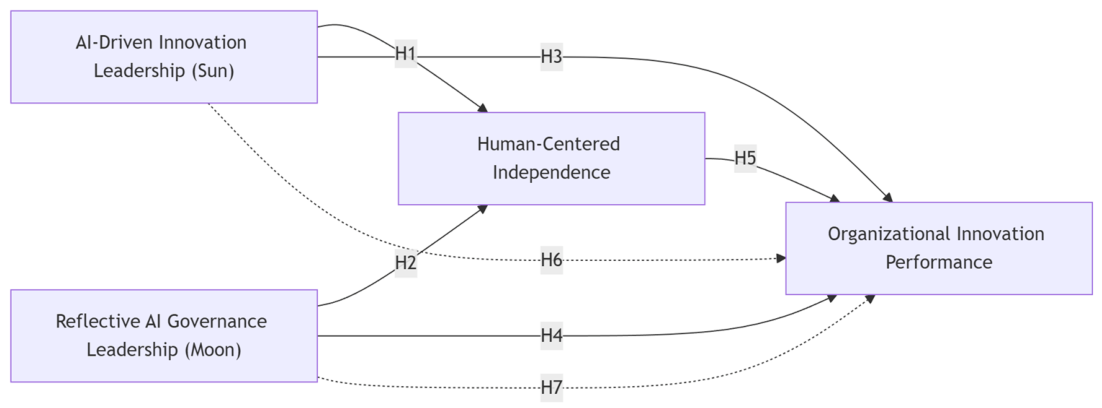
This perspective implicitly assumes that these elements are functionally aligned and mutually reinforcing, an assumption that remains largely untested in AI-enabled organizational contexts. Rather than proposing a new standalone theory, this study extends socio-technical and dynamic capability perspectives by conceptualizing AI-driven misalignment as a structural condition under which innovation processes may become decoupled from human agency. Therefore, while prior research predominantly assumes positive and linear relationships between AI leadership, human capabilities, and innovation outcomes, these relationships may be contingent, non-linear, or even absent under conditions of structural misalignment. Taken together, this framework reflects a linear and integrative view of AI leadership, in which leadership is associated with human capability, which in turn is associated with innovation performance. Yet, as the subsequent analysis demonstrates, these assumed relationships may not hold in practice, highlighting the need to reconsider how AI and human-centered leadership interact within contemporary organizational environments. The proposed model consists of four latent constructs: AI-Driven Innovation Leadership (Sun), Reflective AI Governance Leadership (Moon), Human-Centered Independence (Working Without AI) (HCI), and Organizational Innovation Performance (OIP), which together capture the interplay between leadership, human capability, and innovation processes and outcomes in AI-enabled organizational environments.
The conceptual model guiding this study is presented in
Figure 1. The model illustrates the hypothesized relationships between AI-driven innovation leadership (Sun dimension), reflective AI governance leadership (Moon dimension), human-centered independence, and organizational innovation performance. It includes both direct relationships (H1–H5) and indirect (mediated) relationships (H6–H7), with human-centered independence specified as the mediating construct linking leadership dimensions to innovation performance.
Solid lines represent direct relationships (H1–H5), while dashed lines indicate indirect relationships (H6–H7).
3. Materials and Methods
A total of 2754 respondents participated in the study, recruited through the Prolific platform between March 2025 and March 2026. The relatively extended data collection period reflects the targeted recruitment strategy and the need to obtain a large and relevant sample of respondents with direct experience in AI-enabled organizational environments. The sample includes respondents from diverse countries and industry sectors, reflecting a broad range of organizational and institutional contexts. Given the specific screening criteria applied, data collection was conducted over a longer period to ensure sufficient sample size and data quality. Importantly, the study does not focus on specific generative AI tools or rapidly evolving technological features but rather on broader perceptions of AI-driven leadership, governance practices, and human-centered organizational capabilities. These constructs are conceptualized as relatively stable organizational and cognitive orientations, which are less sensitive to short-term technological changes. Therefore, the duration of data collection is not expected to significantly affect the validity or consistency of the findings.
The survey was administered online using a structured questionnaire. Participation was voluntary and anonymous, and respondents were informed about the purpose of the study prior to completing the questionnaire. To ensure data quality, attention checks and response consistency controls were embedded in the survey, and incomplete or invalid responses were excluded from the final dataset. To ensure the relevance and validity of responses, a screening (filter) question was applied at the beginning of the survey. Only respondents who confirmed that they were currently employed in organizations where artificial intelligence tools are used in work processes were allowed to proceed. This approach ensured that all participants had direct or indirect experience with AI-enabled organizational environments. The original questionnaire consisted of 35 items distributed across four constructs: AI-Driven Innovation Leadership (Sun dimension), Reflective AI Governance Leadership (Moon dimension), Human-Centered Independence (Working Without AI), and Organizational Innovation Performance. All items were measured using a five-point Likert scale (1 = strongly disagree, 5 = strongly agree).
Following data screening and measurement validation procedures, including exploratory and confirmatory factor analysis, the measurement model was refined as part of standard measurement validation procedures, resulting in a final set of 21 items. The final measurement instrument, including all retained items and their sources, is provided in
Appendix A. Items with factor loadings below 0.50 and/or cross-loadings exceeding 0.30 were removed to ensure a clear factor structure and adequate discriminant validity. The retained items demonstrated satisfactory psychometric properties and were used in subsequent structural equation modeling. The conceptualization and operationalization of the constructs were informed by established theoretical foundations in leadership, innovation, and human-centered capability research. The constructs were intentionally defined to capture distinct but theoretically connected dimensions, including leadership orientations (Sun and Moon), human capability (human-centered independence), and organizational outcomes (innovation performance), in order to examine their assumed integration within a single structural framework. The AI-Driven Innovation Leadership dimension draws on the Dynamic Capabilities perspective [
39], emphasizing the role of leadership in sensing, seizing, and transforming organizational opportunities. The Reflective AI Governance Leadership dimension is grounded in the emerging literature on responsible AI and organizational governance, particularly in relation to human oversight and ethical decision-making [
74].
Human-Centered Independence is conceptually linked to research on autonomy, creativity, and intrinsic motivation, particularly the work of Teresa Amabile [
71], which highlights the role of independent thinking and human judgment in innovation processes. In this study, Human-Centered Independence is conceptualized as a higher-order construct reflecting the organization’s capacity to maintain autonomy, critical thinking, and operational capability in relation to AI systems. Empirically, this construct is captured through the factor labeled “Working Without AI,” which represents its operational manifestation and includes dimensions such as AI-free work, dependency prevention, and the preservation of human-driven decision-making processes. Finally, Organizational Innovation Performance builds on the established innovation performance literature, capturing the organization’s ability to generate, implement, and sustain innovation outcomes. Prior to analysis, the dataset was screened to ensure its suitability for multivariate techniques. Missing data were minimal and handled using listwise deletion. The distribution of variables was examined, and no severe deviations from normality were detected. Additionally, no extreme outliers were identified that could distort the results. These procedures confirmed that the data met the assumptions required for factor analysis and structural equation modeling.
Given the cross-sectional nature of the data, the analysis does not permit causal inference. The estimated relationships should therefore be interpreted as statistical associations rather than causal effects. Although the structural model specifies directional paths based on theoretical assumptions, these paths do not imply causality but represent hypothesized relationships among constructs. The analytical procedure is grounded in structural equation modeling (SEM), which was used to simultaneously assess the measurement and structural components of the model. SEM was selected as the most appropriate analytical approach because it enables the simultaneous estimation of multiple interrelated dependence relationships among latent constructs, allowing for the assessment of both direct and indirect effects within a theoretically specified model. This is particularly relevant given the study’s focus on complex relationships between leadership dimensions, human-centered capabilities, and innovation outcomes.
Prior to SEM estimation, the dataset was evaluated for factorability using the Kaiser-Meyer-Olkin measure and Bartlett’s Test of Sphericity, followed by maximum likelihood exploratory factor analysis with oblimin rotation to identify the underlying factor structure. The resulting four-factor solution was subsequently validated through confirmatory factor analysis, indicating satisfactory model fit and supporting the assessment of reliability and convergent validity. Discriminant validity was confirmed using the Fornell-Larcker criterion and the HTMT ratio. In addition, criterion-related validity was assessed within the SEM framework by examining the relationships between the proposed constructs and organizational innovation performance. As a theoretically grounded outcome variable, organizational innovation performance serves as an external criterion for evaluating the predictive relevance of the constructs, consistent with established SEM-based validation approaches. In addition, future research should extend this approach by incorporating established validated scales to enable direct comparison and further strengthen criterion validity. To assess the potential impact of common method variance, Harman’s single-factor test was conducted. The results indicated that the first factor accounted for 19.95% of the total variance, suggesting that common method bias is unlikely to pose a serious concern in this study. In addition, procedural remedies such as respondent anonymity and careful questionnaire design were applied to further reduce potential common method bias.
Within the SEM framework, both direct and indirect relationships were estimated to test the hypothesized relationships. Although the overall model fit indices indicate a well-specified model, the structural paths are predominantly non-significant and the explained variance remains negligible, suggesting that the proposed theoretical structure is not empirically supported in the observed data. Given the large sample size and the robustness of the measurement model, non-significant structural relationships are interpreted as substantive findings rather than as indications of insufficient statistical power. The absence of significant effects may reflect the nature of the constructs included in the model, where leadership orientations and human-centered independence capture relatively stable organizational and perceptual dimensions, while innovation performance represents an outcome-level variable. This structural distinction may provide a possible methodological explanation for the observed negative effect of human-centered independence on innovation performance, suggesting that, in the absence of integration with AI-supported processes, human autonomy may be interpreted as operating as a substitutive rather than complementary capability within the model specification. In contexts where these domains are not effectively integrated within organizational processes, the relationships between them may not manifest as statistically significant, despite their theoretical relevance.
In addition, the possibility of model misspecification should be considered. The proposed model is based on a linear structural logic that assumes coherent and interdependent relationships between leadership, human-centered independence, and innovation performance. However, such an assumption may not fully reflect the complexity of AI-enabled organizational environments, where these constructs may not operate as a unified or sequential system. Instead, the relationships between them may be non-linear, conditional, or weakly connected, which may limit the ability of a linear SEM specification to capture their interactions.
Furthermore, a potential source of attenuated relationships may lie in the difference in construct levels. The independent variables in the model—AI leadership dimensions and human-centered independence—capture perceptual and structural orientations within the organization, whereas organizational innovation performance reflects an outcome-level variable. This distinction implies that relationships between these constructs depend on their translation into operational processes. In cases where such translation is weak or absent, the observed relationships may be attenuated or fail to reach statistical significance, despite the underlying theoretical relevance.
Despite the lack of significant structural relationships, the robustness of the findings is supported by the large sample size and the strong measurement properties of the model, including satisfactory factor loadings, reliability, and discriminant validity. These characteristics indicate that the observed pattern of results is unlikely to be driven by insufficient statistical power or measurement error but instead reflects a stable empirical configuration within the analyzed data. It is important to note that all variables in this study are measured at the individual level and reflect respondents’ perceptions of organizational leadership, AI usage, and innovation processes. Accordingly, the findings should be interpreted as perceptual representations of organizational phenomena rather than objective firm-level measures. As such, caution is required when generalizing the results to the organizational level, and future research should incorporate multi-level or firm-level data to validate the observed relationships.
4. Results
As shown in
Table 1, the sample (N = 2754) reflects a structurally diverse and digitally engaged workforce, providing a robust empirical basis for examining human-centered AI leadership. The balanced gender distribution and concentration in early and mid-career stages (63.0% aged 18–40) indicate a population actively involved in adaptive and innovation-driven organizational contexts. The educational profile is notably advanced, with 77.9% of respondents holding at least a bachelor’s degree, supporting the cognitive and analytical capacities required for both exploratory (Sun) and evaluative (Moon) leadership functions. Organizational roles are predominantly situated at operational and mid-management levels (64.8%), where the interaction between idea generation and structured implementation is most pronounced, aligning with the dual leadership logic proposed in the study. As presented in
Table 1, the sectoral distribution spans both digitally intensive (IT, e-commerce) and traditional industries (manufacturing, telecommunications), enabling the observation of AI governance across heterogeneous organizational environments. Importantly, AI adoption is largely situated at moderate to advanced levels, with 69.7% of organizations reporting at least moderate use and 11.8% identifying AI as a core strategic technology. Taken together, these characteristics indicate that the sample captures organizations operating at different stages of AI integration, where the balance between outward-oriented (Sun) and inward-oriented (Moon) leadership becomes critical for translating AI governance into innovation processes and outcomes.
Kaiser-Meyer-Olkin (KMO) measure of sampling adequacy is 0.952, indicating a very high level of shared variance among variables and confirming that the dataset is suitable for factor analysis. Bartlett’s Test of Sphericity is statistically significant (χ2 = 55,464.510; df = 465; p < 0.001), rejecting the null hypothesis that the correlation matrix is an identity matrix. These results jointly support the appropriateness of proceeding with exploratory factor analysis.
As shown in
Table 2, four factors with eigenvalues greater than 1 were retained, collectively explaining 62.794% of the total variance after extraction. The first factor accounts for 16.845% of variance, followed by the second (16.343%), third (15.829%), and fourth factor (13.777%), indicating a relatively balanced contribution across dimensions. The initial eigenvalues confirm a clear four-factor solution, while the sharp drop after the fourth factor supports the decision to exclude subsequent components. Rotation results further indicate a stable factor structure, with variance distributed across the retained dimensions, suggesting a well-defined latent construct configuration.
As presented in
Table 3, the pattern matrix obtained through oblimin rotation reveals a clear and theoretically consistent four-factor structure. The use of oblimin rotation is appropriate given the assumption that latent constructs are correlated, which is consistent with the conceptual model of interrelated leadership dimensions and innovation processes and outcomes.
The first factor, labeled Working Without AI (Human-Centered Independence), is defined by high loadings of items such as Human Capability (0.800), Independent Thinking (0.801), Dual Training (0.800), AI-Free Work (0.807), and Dependency Prevention (0.799). These results indicate a coherent construct capturing the preservation of human autonomy and capability in AI-supported environments. The second factor, corresponding to the Moon dimension, includes strong loadings for Critical Evaluation (0.801), Ethical Reflection (0.798), Human Responsibility (0.801), Risk Assessment (0.801), Reflective Analysis (0.796), and Support Tool (0.793). This factor reflects a governance-oriented and evaluative approach to AI, emphasizing oversight, ethics, and analytical control. The third factor, representing the Sun dimension, is characterized by high loadings of Trend Detection (0.784), AI Integration (0.785), Decision Support (0.790), Creative Expansion (0.784), and Strategic AI (0.794). This dimension captures the proactive and opportunity-driven use of AI in innovation processes. The fourth factor, Organizational Innovation Performance, is defined by Innovation Output (0.806), Adaptive Innovation (0.795), Process Innovation (0.789), Innovation Effectiveness (0.791), and Opportunity Discovery (0.798), indicating a strong and coherent outcome construct related to innovation results. Cross-loadings are minimal and all primary loadings exceed the recommended threshold of 0.70, confirming strong item-factor associations and good discriminant validity at the exploratory stage. Overall, the results in
Table 3 support a stable and well-defined four-factor solution aligned with the proposed theoretical framework.
The results indicate that the measurement model shows a good fit to the data. The chi-square is non-significant (χ
2 = 199.534; df = 183;
p = 0.191) and CMIN/DF = 1.090, supporting model adequacy. Fit indices are high (GFI = 0.993; CFI = 0.999; TLI = 0.999), while RMR is low (0.011). RMSEA is 0.006 (PCLOSE = 1.000), indicating minimal approximation error. Parsimony indices are acceptable, confirming that the model is both well-fitting and efficient. As shown in
Table 4, all constructs demonstrate satisfactory internal consistency, with Composite Reliability (CR) values exceeding the recommended threshold of 0.70. Convergent validity is also supported, as all Average Variance Extracted (AVE) values are above 0.50. These results indicate that the measurement model achieves adequate reliability and that the indicators consistently represent their respective latent constructs.
As shown in
Table 5, the square root of AVE for each construct exceeds its correlations with other constructs, satisfying the Fornell-Larcker criterion and confirming discriminant validity. The extremely low inter-construct correlations observed in the model should not be interpreted solely as evidence of discriminant validity but may also indicate limited empirical association among the examined constructs. Rather than reflecting measurement independence alone, these near-zero relationships suggest that AI-oriented leadership, human-centered independence, and innovation processes may operate as weakly connected domains within the observed data. This pattern is consistent with the possibility that these elements are not strongly related within the specified model.
Table 6 further supports discriminant validity, as all HTMT values are substantially below the conservative threshold of 0.85. These results indicate that the constructs are empirically distinct and that the measurement model demonstrates strong discriminant validity. However, the extremely low magnitude of these correlations extends beyond standard discriminant validity and warrants further theoretical interpretation.
The results indicate that the structural model demonstrates a good model fit to the data. The chi-square is non-significant (χ
2 = 199.536; df = 184;
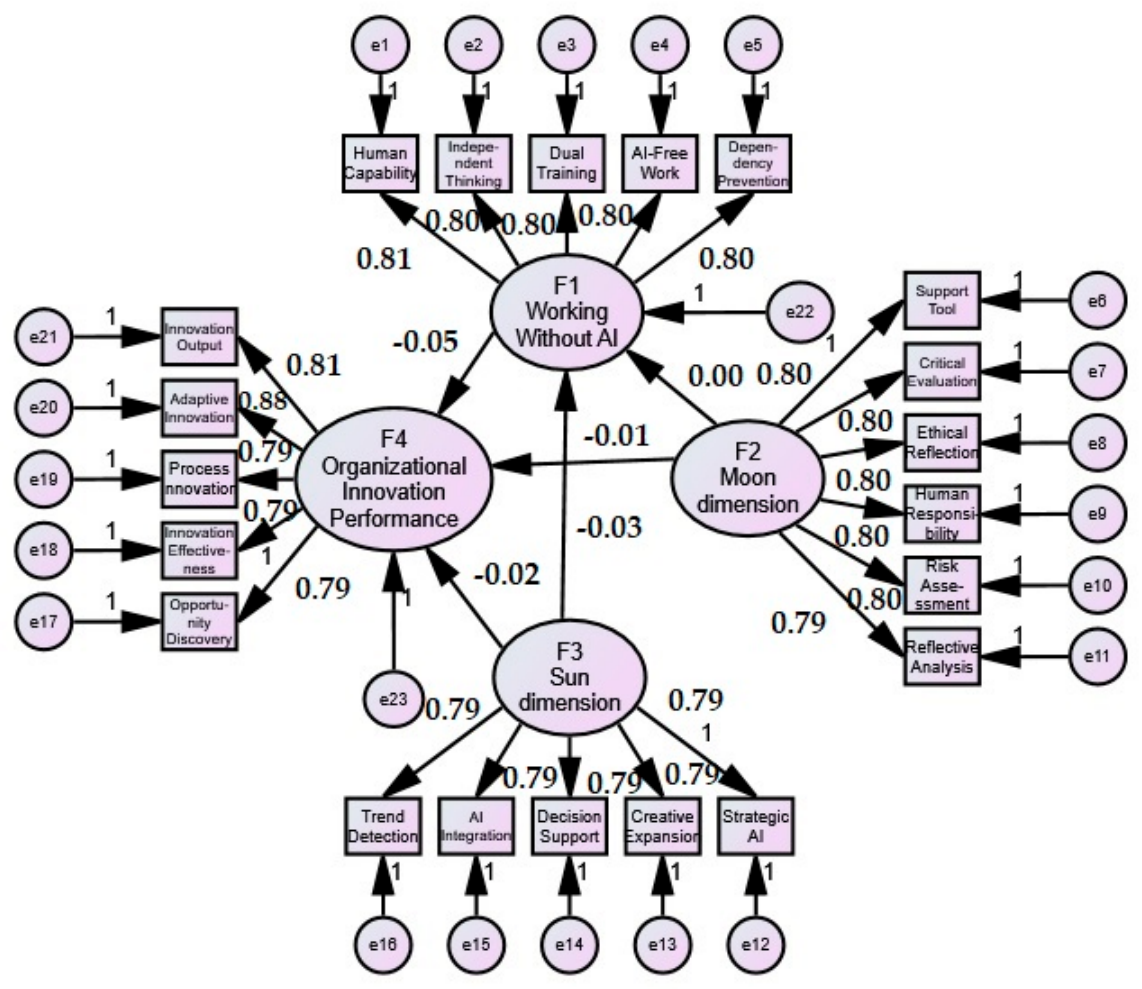
p = 0.205), with a low CMIN/DF ratio (1.084), supporting model adequacy. Fit indices are high (GFI = 0.993; AGFI = 0.991; CFI = 1.000; TLI = 0.999), while RMR is low (0.011). RMSEA is 0.006 (PCLOSE = 1.000), indicating minimal approximation error. Parsimony indices (PNFI = 0.871; PCFI = 0.876) confirm that the model achieves good fit without unnecessary complexity. The model is suitable for hypothesis testing. As shown in
Figure 2, the structural model reveals an uneven distribution of effects among the constructs. The Sun dimension (F3) shows no statistically significant relationship with organizational innovation performance (F4), whereas its relationship with Working Without AI (F1) is negligible. The Moon dimension (F2) shows no statistically significant relationships on either F1 or F4. The path from Working Without AI (F1) to innovation performance (F4) is weak, indicating that human-centered independence is not significantly associated with innovation processes and outcomes in this model. The mediating role of F1 is not observed. The results point to an asymmetric structure in which innovation performance is not meaningfully associated with any of the examined leadership dimensions, while other relationships remain weak or non-significant.
As shown in
Table 7, none of the hypothesized relationships are supported. The relationships of both the Sun (F3) and Moon (F2) dimensions on Working Without AI (F1) and organizational innovation performance (F4) are non-significant. Although the path from F1 to F4 is statistically significant (
p = 0.022), the effect size is very small (β = −0.048), indicating limited practical significance. Its negative direction contradicts the hypothesized positive relationship, leading to the rejection of H5. These findings indicate that the proposed positive relationships among constructs are not empirically confirmed in the structural model.
For clarity, a summary of hypothesis testing results is presented in
Table 8.
As shown in
Table 9, the indirect relationships of both the Sun (F3) and Moon (F2) dimensions for organizational innovation performance (F4) through Working Without AI (F1) are negligible and not statistically significant. The confidence intervals include zero, indicating the absence of mediation. These findings indicate that human-centered independence does not mediate the relationship between AI leadership dimensions and innovation performance.
As shown in
Table 10, the explained variance (R
2) for both endogenous constructs is negligible. Rather than indicating a limitation of the model, this finding may also reflect the weak empirical association among the examined constructs. The near-zero variance suggests that the constructs included in the model do not exhibit strong explanatory relationships within the specified structural framework, and they may operate as loosely connected domains in the observed data. This pattern may indicate a limited degree of integration among the examined variables within the model specification.
Taken together, these results indicate a consistent pattern of weak empirical relationships across all levels of analysis. The near-zero inter-construct correlations, negligible explained variance (R2), and non-significant structural paths suggest that the examined constructs do not form a strongly integrated causal structure within the specified model. Instead, AI-driven leadership (Sun), reflective AI governance (Moon), human-centered independence, and innovation performance appear to operate as loosely connected domains in the observed data. This pattern may indicate a potential structural disconnection; however, alternative explanations—such as model specification, measurement limitations, or differences in levels of analysis—cannot be excluded. Consequently, the findings should be interpreted cautiously, as one plausible interpretation among several, rather than as conclusive evidence of a fully established misalignment framework. This is particularly relevant for the observed negative relationship, where the magnitude of the effect remains very small despite statistical significance.
5. Discussion
The findings challenge the dominant assumption of linear and positive relationships between AI leadership, human-centered independence, and innovation performance, revealing instead a structurally fragmented configuration in which these elements do not operate as an integrated system. Rather than confirming the expected pathways, the results indicate that AI-oriented leadership, human capabilities, and innovation processes suggest the possibility of underlying structural misalignment within AI-enabled organizational environments. These findings point to a more complex and conditional relationship between leadership, human agency, and innovation outcomes than previously assumed.
Given the cross-sectional design of the study, the findings should be interpreted as statistical associations rather than causal relationships. These findings are in line with the theoretical perspective advanced in this study, which conceptualizes artificial intelligence not only as an enabler of innovation but also as a potential structural constraint. While the prior literature predominantly emphasizes the enabling role of AI in enhancing efficiency, decision-making, and innovation capacity, the present findings suggest that AI-driven processes may be associated with limitations in novelty through data-driven patterns and path dependence [
22,
30]. Rather than confirming direct positive effects, the results reveal a lack of significant relationships between both leadership dimensions (Sun and Moon) and the examined organizational outcomes. Importantly, the contribution of this study does not lie in explanatory power but in demonstrating the empirical absence of expected relationships and, in doing so, exposing the limits of dominant linear and performance-oriented assumptions in AI leadership research.
These findings do not indicate the absence of effects but rather show that AI-oriented leadership, human-centered capabilities, and innovation processes fail to translate into coherent organizational outcomes, suggesting the possibility of structural misalignment across these domains. While the findings are consistent with this interpretation, misalignment is not directly measured in this study and should therefore be interpreted with caution. At the same time, alternative explanations—such as model misspecification, measurement constraints, or differences in construct levels—should be considered as equally plausible interpretations of the observed lack of significant relationships. Accordingly, AI leadership should not be conceptualized as a straightforward driver of either human capability development or innovation performance.
The absence of significant relationships in H1 and H2 indicates that neither AI-driven innovation leadership (Sun dimension) nor reflective AI governance leadership (Moon dimension) is significantly associated with human-centered independence (Working Without AI) (F1). However, it is important to distinguish conceptually between independence from AI (i.e., operating without AI support) and complementarity with AI (i.e., the integration of human and algorithmic capabilities). The operationalization used in this study (“Working Without AI”) primarily captures independence from AI rather than this broader relational dynamic. This suggests that leadership engagement with AI does not necessarily translate into changes in how employees think, act, or develop capabilities. In line with institutional theory, formal leadership orientations may remain decoupled from everyday organizational practices [
75], and are associated with limited influence on operational-level human behavior [
21,
27].
Similarly, the lack of support for H3 and H4 shows that neither leadership dimension exerts a significant direct effect on organizational innovation performance (F4). This challenges dominant assumptions in innovation and digital transformation research that position leadership as a central mechanism for driving performance outcomes [
39]. In contrast to prior SEM-based studies that report significant positive relationships between leadership and performance outcomes, the present findings suggest that such relationships may not hold under conditions of limited alignment [
58,
69].
From a dynamic capabilities perspective, these findings suggest that neither organizational capabilities nor AI-oriented leadership—whether focused on innovation (Sun) or governance (Moon)—are sufficient in isolation; their effectiveness depends on orchestration, alignment, and integration within organizational processes. Without such integration, both capabilities and leadership orientations remain latent and fail to translate into measurable innovation processes and outcomes. This finding can be further interpreted through the dual-mechanism perspective on AI. While AI leadership is expected to enhance innovation through increased speed, data processing, and predictive capabilities, these same mechanisms may constrain the emergence of novel ideas by privileging recombination over originality and reinforcing existing knowledge structures. As a result, the absence of significant effects may reflect not a lack of leadership influence per se but the coexistence of enabling and constraining forces that offset each other within AI-driven organizational environments.
These findings point to a gap between strategic leadership intent and its translation into organizational processes. The results related to H5 provide additional insight into this pattern. While the hypothesis assumed a positive relationship, the empirical findings indicate a statistically significant but very small negative effect of human-centered independence (Working Without AI) (F1) on innovation performance (F4) (β = −0.048). This suggests limited practical significance, and the relationship should therefore be interpreted with caution. Importantly, this does not imply that human-centered leadership is inherently ineffective. Rather, it indicates that human-centered independence, when operating in isolation from AI-supported processes, may be associated with misalignment with the requirements of innovation in technologically intensive environments [
8,
18]. This pattern may also be influenced by the operationalization of human-centered independence, which emphasizes the absence of AI use rather than its integration with human capabilities, potentially biasing the observed relationship toward negative effects by emphasizing absence over integration.
In such contexts, innovation increasingly depends on the integration of human judgment with algorithmic support, data-driven insights, and automated processes [
68]. This aligns with the complementarity perspective, which argues that value from digital technologies emerges only when technological and human capabilities are jointly aligned and mutually reinforcing, rather than operating in isolation. When organizations emphasize working without AI, they may unintentionally limit their capacity to exploit these technological advantages. This result is consistent with the theoretical argument that human-centered independence, when decoupled from AI-supported processes, may operate as a substitutive rather than complementary capability. In such cases, the absence of integration between human judgment and algorithmic support may reduce the system’s overall capacity for innovation, particularly in environments where data-driven insights are central to value creation.
The lack of mediation effects in H6 and H7 further reinforces this interpretation. Human-centered independence is not observed as a mechanism through which AI leadership is associated with innovation performance. The absence of both direct and indirect effects suggests that the assumed linear pathway linking leadership, human capability, and performance is not empirically supported. This points to a structural disconnect within the organizational system. The proposed logic of balanced AI leadership—where the combination of AI-driven innovation (Sun) and reflective governance (Moon) enhances human autonomy and, subsequently, innovation performance—is not supported by the empirical results. The findings show that the presence of both leadership dimensions does not lead to meaningful changes in human-centered independence, nor does it improve innovation processes and outcomes. This suggests that balance alone does not ensure integration.
The co-existence of different leadership approaches does not guarantee their integration at the operational level, indicating a lack of functional alignment between leadership practices, human capabilities, and innovation processes. In other words, these elements coexist without effective integration, reinforcing the interpretation that organizational innovation depends not on their presence but on their alignment and coordinated deployment. Taken together, these findings can be interpreted through the lens of AI-human misalignment. The negative effect of human-centered independence (F1), combined with the non-significant effects of the Sun (F3) and Moon (F2) dimensions, suggests that neither human autonomy nor AI-oriented leadership alone is sufficient to be associated with innovation outcomes processes and outcomes.
These findings are consistent with the dual-mechanism view of AI introduced in the theoretical framework. This leads to the identification of an AI leadership paradox: organizations invest in AI-oriented leadership practices while simultaneously maintaining human-centered approaches, yet these elements remain structurally disconnected, being associated with limited or potentially counterproductive innovation outcomes. Innovation, therefore, does not emerge from the dominance of either human autonomy or technological leadership but from their alignment within organizational processes. By linking the empirical findings to the tested hypotheses, the study contributes to a more nuanced understanding of AI leadership. The rejection of H1–H4, the reversed effect in H5, and the absence of mediation in H6 and H7 suggest that future research should move beyond linear models and focus on the conditions under which AI and human-centered leadership become mutually reinforcing.
This shifts the analytical focus from whether AI leadership works to the conditions under which its integration with human capabilities produces meaningful innovation processes and outcomes. These findings also highlight important limitations related to model specification. The use of a linear SEM framework assumes stable, additive relationships between constructs, which may systematically fail to capture the complexity of AI-enabled organizational systems. In such contexts, relationships between leadership, human capabilities, and innovation outcomes are likely to be conditional, non-linear, and potentially configurational. For instance, the effects of AI leadership may depend on factors such as digital literacy, organizational context, or the degree of human-AI integration, rather than operating as direct linear relationships. Future research should therefore employ alternative analytical approaches, including moderation analysis, configurational methods such as fsQCA, and multi-level modeling, to better capture the complexity of AI-driven organizational dynamics. Rather than providing evidence of strong predictive relationships, the findings contribute by revealing when and why such relationships fail to emerge.
5.1. Theoretical Implications: Misalignment as a Structural Condition
The findings extend existing theoretical perspectives by suggesting that misalignment between technological systems and human capabilities should not be treated as a temporary inefficiency or implementation gap but as a structural condition that can emerge in AI-enabled organizational environments. Rather than confirming the dominant assumption that leadership, human capability, and innovation performance are inherently aligned, the results indicate that these elements may operate as functionally decoupled domains. From a socio-technical perspective, this challenges the assumption of joint optimization by suggesting that the integration of advanced AI systems may disrupt the balance between social and technical subsystems. In parallel, the findings extend the dynamic capabilities framework by suggesting that sensing and seizing capabilities enabled by AI may outpace the organization’s ability to transform human competencies, potentially resulting in capability-level misalignment. Under such conditions, technological advancement may not translate into performance outcomes, and may instead contribute to fragmentation within the organizational system.
Importantly, this study conceptualizes the AI-Human Misalignment Framework as a mid-range theoretical framework that explains the structural conditions under which expected relationships between leadership, human capabilities, and innovation performance fail to emerge. The framework builds on and extends socio-technical and dynamic capability perspectives by introducing AI-driven misalignment as a structural condition that explains contexts in which innovation processes become decoupled from human agency. This reconceptualization shifts the focus from capability presence to capability coherence, emphasizing that the effectiveness of AI leadership depends not on the adoption of technology or leadership orientation alone but on the degree of alignment between technological, human, and organizational elements.
Based on these findings, the study introduces the concept of an “AI-Human Misalignment Framework,” conceptualized as a structural condition in which AI-oriented leadership, human-centered capabilities, and innovation processes coexist without functional integration and therefore fail to produce coherent organizational outcomes [
8,
21]. The proposed framework is not based on a direct measurement of misalignment but is inferred from the observed pattern of weak, non-significant, and contradictory relationships among the examined constructs. Rather than representing a temporary implementation gap, misalignment is understood as a systemic configuration emerging when technological advancement, leadership orientation, and human capability development evolve at different speeds or according to divergent logics. The framework identifies three analytically distinct but interrelated domains: (1) AI-oriented leadership, encompassing both innovation-driven (Sun) and governance-oriented (Moon) dimensions; (2) human-centered capabilities, reflecting autonomy, critical thinking, and independent problem-solving; and (3) innovation processes and outcomes, capturing the organization’s capacity to generate and implement novel solutions. The core proposition of the framework is that these domains do not automatically converge into a unified system but require active alignment to produce meaningful innovation outcomes.
By conceptualizing misalignment as a structural condition rather than an anomaly, the framework extends socio-technical and dynamic capability perspectives by suggesting that the presence of advanced technological capabilities and leadership orientations does not guarantee performance effects. Instead, innovation outcomes emerge only when these elements are coherently integrated. In this sense, AI leadership is reframed not as a direct driver of performance but as a context-dependent capability whose effectiveness is contingent on the alignment between technological systems, human competencies, and organizational processes.
From a managerial perspective, the findings suggest that organizations should move beyond investing in AI technologies or leadership structures in isolation and instead focus on designing integrative mechanisms that align AI systems with human capabilities and innovation processes. Without such alignment, investments in AI leadership may not be associated with the expected innovation benefits. In this sense, the absence of significant effects represents a substantive empirical finding rather than a methodological limitation, highlighting that the absence of alignment—rather than the absence of capabilities— helps explain the observed patterns and defines the primary constraint on AI-driven innovation.
5.2. Theoretical Positioning of the AI-Human Misalignment Framework
Existing theoretical approaches provide important but partial explanations of the relationship between technology, leadership, and organizational outcomes. Socio-technical systems theory primarily explains how social and technical subsystems can be jointly optimized to achieve organizational effectiveness, assuming that alignment is both achievable and desirable. Similarly, the dynamic capabilities perspective focuses on how organizations sense, seize, and transform in response to technological change, emphasizing adaptation and integration as key drivers of performance. In parallel, the organizational misfit literature conceptualizes misalignment as a deviation from optimal configurations, typically framed as a problem requiring correction.
In contrast, the AI-Human Misalignment Framework explains the conditions under which alignment does not emerge despite the simultaneous presence of technological capabilities, leadership structures, and human competencies. As a mid-range theoretical framework, it provides an empirically grounded explanation, consistent with the role of mid-range theories in linking empirical observation with theoretical explanation [
31,
76,
77], of how structural misalignment manifests through weak, non-significant, or contradictory relationships between leadership, human capabilities, and innovation outcomes. Rather than treating misalignment as a temporary inefficiency or implementation failure, the framework conceptualizes it as a stable structural condition that may persist even in advanced organizational systems. In doing so, the framework shifts the analytical focus from adaptation and fit to the absence of integration, offering an explanation for why expected leadership—performance relationships may fail to materialize empirically. Unlike existing theoretical approaches that assume alignment as an achievable or desirable outcome, the proposed framework explains the persistence of non-alignment despite the presence of relevant capabilities and leadership structures.
6. Conclusions
This study examines the relationship between AI leadership, human-centered independence, and organizational innovation performance based on the widely accepted assumption that leadership-driven AI integration is associated with enhanced human capabilities and improved innovation processes and outcomes. However, the empirical results do not support this linear logic. None of the hypothesized positive relationships between AI leadership dimensions and organizational outcomes are confirmed, while the only statistically significant relationship—between human-centered independence and innovation performance—is negative. These findings provide an initial empirical indication that the presence of AI-oriented leadership and human-centered capabilities is not automatically associated with improved innovation processes and outcomes. Rather than indicating the absence of relationships, these findings suggest the presence of structural misalignment between AI leadership, human-centered capabilities, and innovation processes.
This suggests that innovation outcomes may be associated not only with a lack of leadership or resources but also with the absence of integration mechanisms that align technological and human systems. Instead, the results indicate a structural disconnect between leadership practices, human autonomy, and performance. These findings challenge the dominant assumption in the literature that leadership, capabilities, and performance are sequentially and positively linked. Building on the observed non-significant relationships, this study contributes by proposing the AI-Human Misalignment Framework as a novel mid-range theoretical framework that accounts for why the coexistence of AI-driven leadership and human-centered approaches is not associated with expected innovation outcomes. The contribution of the study therefore lies not in explaining variance but in identifying the limits of prevailing assumptions and revealing conditions under which expected relationships do not materialize. The framework conceptualizes the persistence of non-alignment between AI-oriented leadership, human-centered capabilities, and innovation processes, even when these elements are simultaneously present.
Rather than acting as complementary forces, these elements may remain structurally disconnected when not effectively integrated within organizational processes. In such conditions, human-centered independence can become detached from technological systems, while AI leadership remains confined to the strategic level without operational impact. The findings shift the focus from leadership and capabilities to their alignment. Innovation is not associated with AI or human-centered leadership in isolation but depends on their coordinated interaction. This perspective challenges prevailing assumptions in both leadership and innovation research and highlights the importance of examining integration mechanisms rather than individual components.
From a practical standpoint, the results suggest that organizations may need to move beyond simply adopting AI or promoting human autonomy, and instead focus on aligning these elements within everyday work processes. Without such alignment, investments in AI leadership may not be associated with meaningful innovation processes and outcomes. Future research should further explore the conditions under which alignment between AI systems and human capabilities can be achieved, including organizational design, cultural factors, and process integration mechanisms. By doing so, future research can extend the proposed framework and contribute to a more comprehensive understanding of AI-driven transformation.
Overall, the study shifts the analytical focus from leadership and capabilities to the structural conditions under which their alignment is associated with meaningful innovation outcomes. It is important to note that misalignment was not directly measured in this study but was interpreted based on the observed pattern of relationships and should therefore be treated with caution. In addition, the operationalization of human-centered independence (“Working Without AI”) captures primarily independence from AI rather than its complementarity with AI, which may bias the observed relationships toward negative effects. Future research should explicitly operationalize and test misalignment to further validate and refine the proposed framework. In addition, the study is based on individual-level survey data and reflects respondents’ perceptions of organizational processes, rather than objective firm-level measures. Therefore, the findings should be interpreted with caution when generalizing to the organizational level, and future research should incorporate multi-level or firm-level data to strengthen external validity. As the data were collected using a single self-report survey at one point in time, the possibility of common method bias cannot be fully excluded, despite the procedural and statistical remedies applied in this study.