
Beyond Exposure: Vulnerability, Adaptive Capacity, and Climate-Resilient WASH in Rural Cambodia


Abstract
1. Introduction
2. Literature Review
2.1. Climate Change and Its Impact on WASH Access and Use in Cambodia
2.2. Climate Change Adaptation on WASH in Cambodia
3. Vulnerability–Exposure–Adaptive Capacity (VEAC) Framework
4. Methods
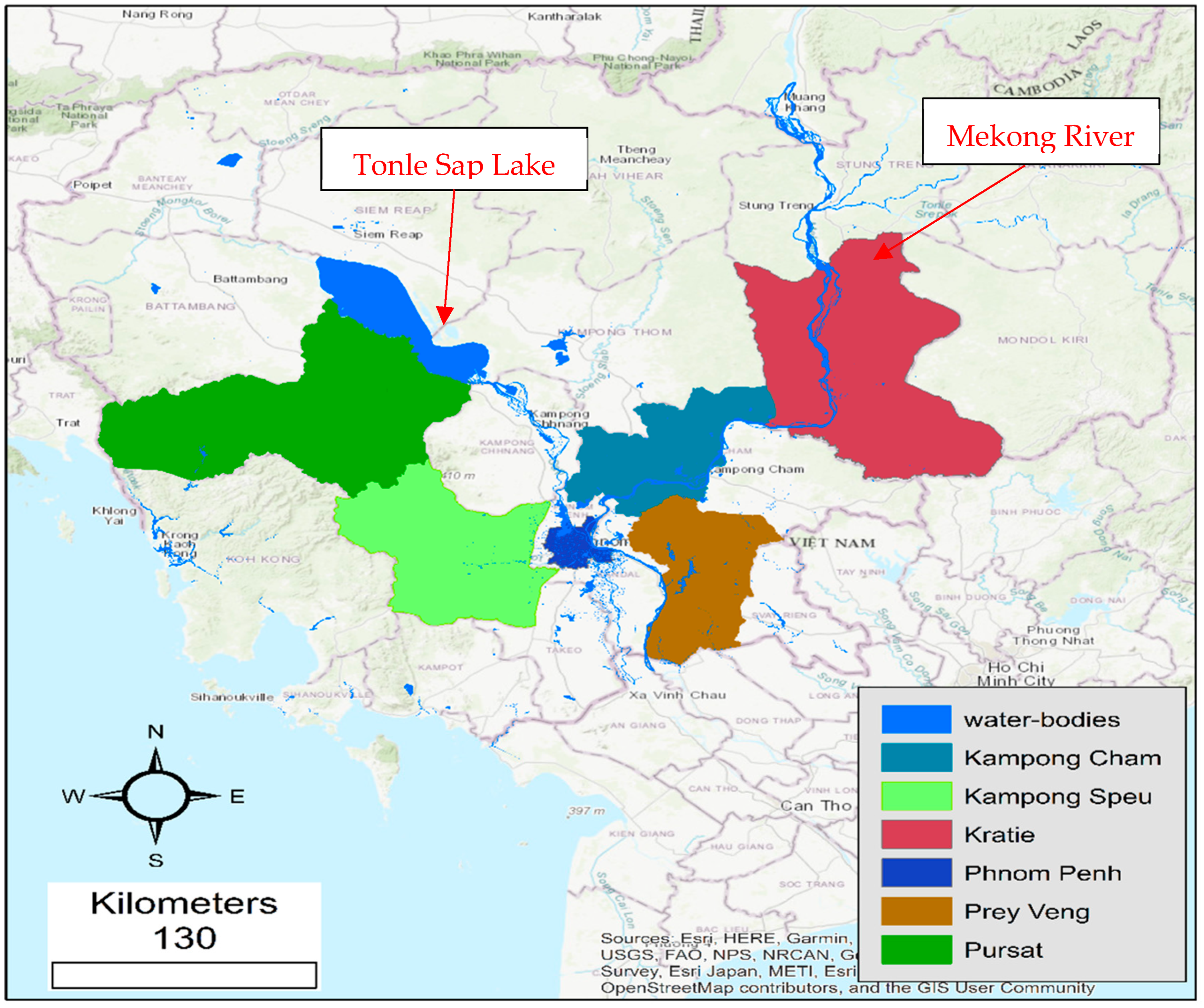
4.1. Study Design and Respondent Characteristics
4.2. Survey Instrument, Administration, and Analysis
5. Results
5.1. Exposure
5.1.1. Experience of Flooding and Reported Flood-Related Impacts
5.1.2. Experience of Drought and Perceived Drought-Related Impacts
5.2. Adaptation: Awareness, Uptake, and Differentiated Responses
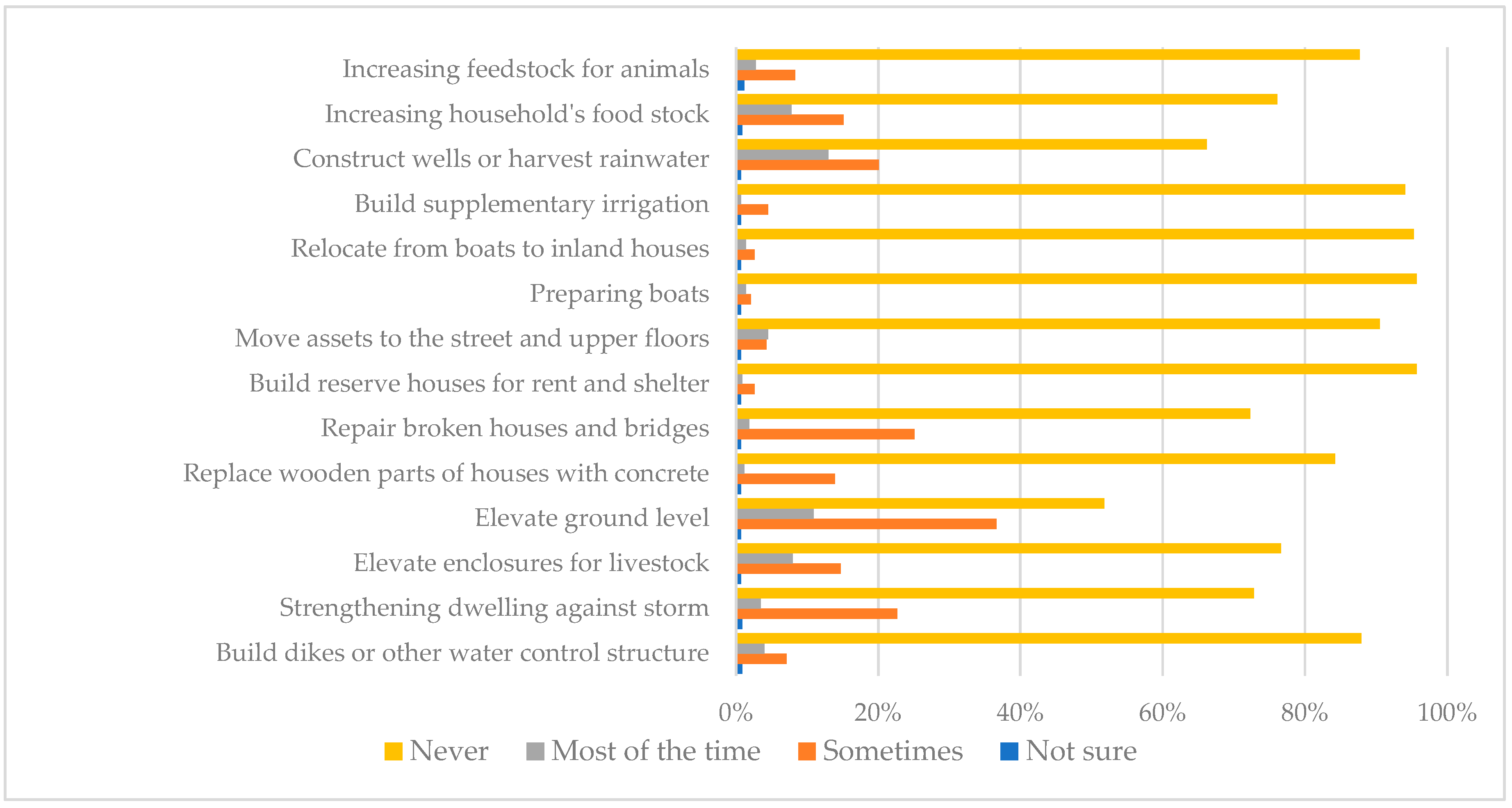
5.2.1. Households
5.2.2. Local Authorities
5.3. Vulnerability
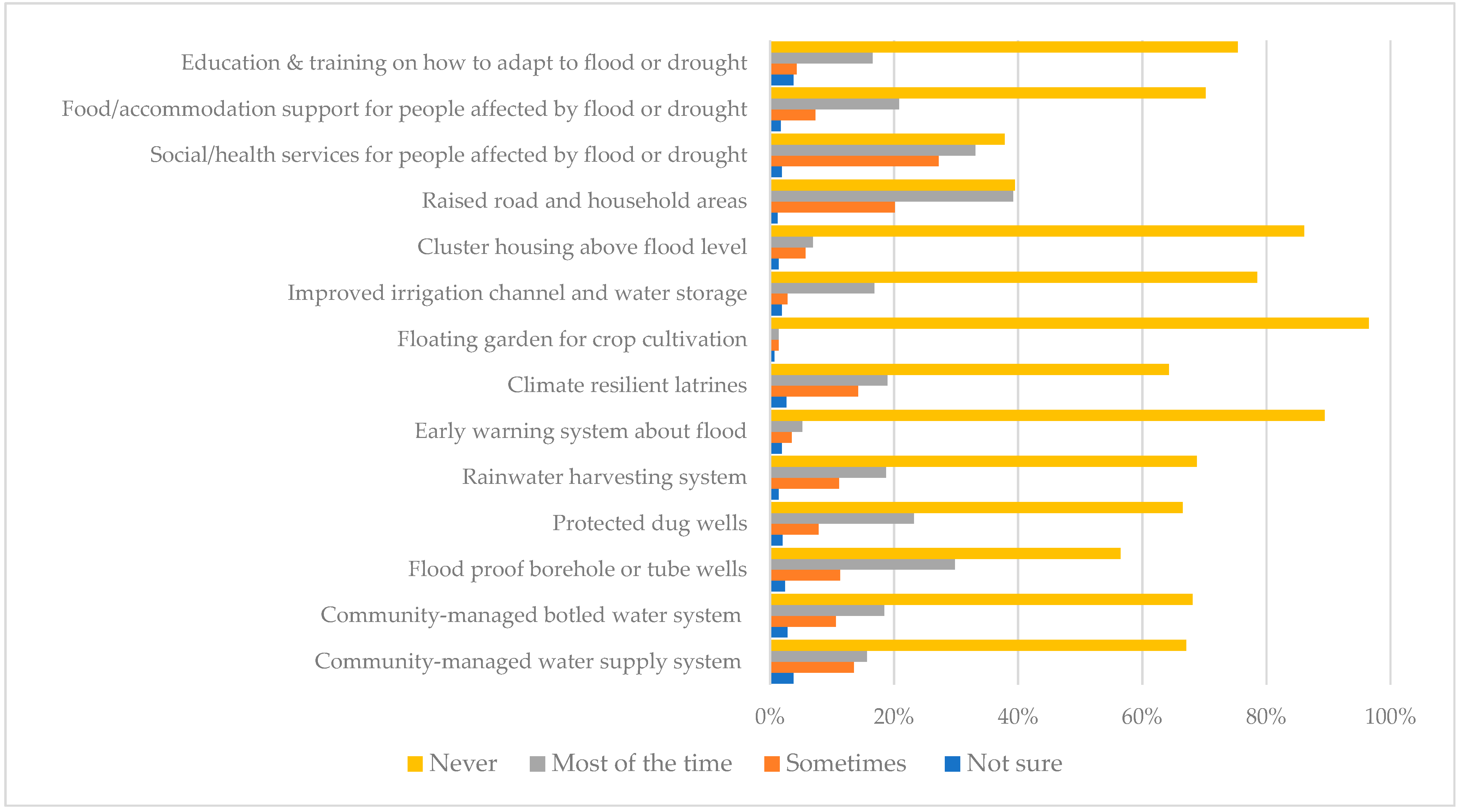
5.3.1. Infrastructure Vulnerability in WASH Systems
5.3.2. Determinants of Adaptation: Social, Economic, and Geographic Factors
6. Discussion
6.1. Vulnerability: Access as a Structural Precondition for Risk
6.2. Exposure: Floods as Acute Shocks and Drought as Chronic Stress
6.3. Adaptive Capacity: Determinants and Divergent Pathways
7. Conclusions
Supplementary Materials
Funding
Institutional Review Board Statement
Informed Consent Statement
Data Availability Statement
Conflicts of Interest
References
- Eckstein, D.; Kunzel, V.; Schafer, L. Global Climate Risk Index 2020: Who Suffers Most from Extreme Weather Events? Weather-Related Loss Events in 2018 and 1999 to 2018; Germanwatch: Bonn, Germany, 2021; Available online: https://www.germanwatch.org/sites/default/files/Global%20Climate%20Risk%20Index%202021_2.pdf (accessed on 6 February 2026).
- United Nations Children’s Fund (UNICEF) Cambodia. Climate Rationale for Water, Sanitation and Hygiene Services in Cambodia; UNICEF Cambodia: Phnom Penh, Cambodia, 2024; Available online: https://www.unicef.org/cambodia/media/8741/file/Climate%20rationale_WASH_Cambodia_full%20report_ENG_2024.pdf (accessed on 6 February 2026).
- Sanitation and Water for All. Cambodia Country Overview: Water and Sanitation Vulnerability to Climate Change; Sanitation and Water for All: New York, NY, USA, 2022; Available online: https://www.sanitationandwaterforall.org/sites/default/files/2022-07/2022%20Country%20Overview_Cambodia.pdf (accessed on 6 February 2026).
- The World Bank Group. Climate Risk Profile: Cambodia (2024); World Bank: Washington, DC, USA, 2024; Available online: http://hdl.handle.net/10986/36380 (accessed on 6 February 2026).
- World Bank. Cambodia Country Water Security Diagnostic: Ensuring Water Security for Sustainable Growth and Poverty Reduction; World Bank Group: Washington, DC, USA, 2022; Available online: https://documents1.worldbank.org/curated/en/099124511122431814/pdf/IDU1fa8a4c3a1fd8c14810194851fb785b73d02d.pdf (accessed on 6 February 2026).
- World Health Organization (WHO); United Nations Children’s Fund (UNICEF). Guidelines on Sanitation Health Geneva; WHO: Washington, DC, USA, 2022; Available online: https://www.who.int/publications/i/item/9789241514705 (accessed on 6 February 2026).
- Fujihara, J.; Ly, B.; Xaisomkhan, T.; Prom, V.; Inoue, E. Humanitarian assistance to decreasing vulnerability in flood-prone villages: A case study in Kampong Thom Province, Cambodia. Int. J. Environ. Rural. Dev. 2019, 10, 1–8. Available online: https://elibrary.maff.gov.kh/assets/files/books/df856eb24443744d74517321f990486e1652259064.pdf (accessed on 6 February 2026).
- Flower, B.; Fortnam, M.; Kol, L.; Sasin, P.; Wood, R.G. Using participatory methods to uncover interacting urban risks: A case study of three informal settlements in Phnom Penh, Cambodia. Environ. Urban. 2018, 30, 301–316. [Google Scholar] [CrossRef]
- Howard, G.; Bartram, J. Vision 2030: The Resilience of Water Supply and Sanitation in the Face of Climate Change; World Health Organization: Geneva, Switzerland, 2010; Available online: https://www.who.int/publications/i/item/WHO-HSE-WSH-10.01 (accessed on 6 February 2026).
- Peal, A.; Evans, B.; Blackett, I.; Hawkins, P.; Heymans, C. Faecal sludge management: A comparative analysis of 12 cities. J. Water Sanit. Hyg. Dev. 2020, 10, 733–747. [Google Scholar]
- Hyde-Smith, L.; Gambrill Martin, P. The Global Sanitation Crisis: A Systems Approach to Resilient Citywide Inclusive Sanitation; World Bank: Washington, DC, USA, 2026; Available online: http://hdl.handle.net/10986/44254 (accessed on 6 February 2026).
- Mclver, L.J.; Chan, V.S.; Bowen, K.J.; Idding, S.N.; Hero, K.; RaingSey, P.P. Review of Climate Change and Water-Related Diseases in Cambodia and Findings from Stakeholder Knowledge Assessments. Asia-Pac. J. Public Health 2014, 28, 49S–58S. [Google Scholar] [CrossRef] [PubMed]
- Levy, K.; Woster, A.P.; Goldstein, R.S.; Carlton, E.J. Untangling the Impacts of Climate Change on Waterborne Diseases: A Systematic Review of Relationships between Diarrheal Diseases and Temperature, Rainfall, Flooding, and Drought. Environ. Sci. Technol. 2016, 50, 4905–4922. [Google Scholar] [CrossRef] [PubMed]
- Ebi, K.L.; Vanos, J.; Baldwin, J.W.; Bell, J.E.; Hondula, D.M.; Errett, N.A.; Hayes, K.; Reid, C.E.; Saha, S. Extreme weather and climate change: Population health and health system implications. Annu. Rev. Public Health 2021, 42, 293–315. [Google Scholar] [CrossRef] [PubMed]
- Royal Government of Cambodia. National Adaptation Programme of Action to Climate Change (NAPA); Ministry of Environment Headquarters: Phnom Penh, Cambodia, 2006. Available online: https://www.adaptation-undp.org/resources/assessments-and-background-documents/cambodia-national-adaptation-programme-action-napa (accessed on 6 February 2026).
- Dany, V.; Bowen, K.J.; Miller, F. Assessing the institutional capacity to adapt to climate change: A case study in the Cambodian health and water sectors. Clim. Policy 2015, 15, 388–409. [Google Scholar] [CrossRef]
- Dany, V.; Bajracharya, B.; Lebel, L.; Rega, M.; Taplin, R. Narrowing gaps between research and policy development in climate change adaptation work in the water resources and agriculture sectors of Cambodia. Clim. Policy 2016, 16, 237–252. [Google Scholar] [CrossRef]
- Sarun, H. Mitigation and Adaptation to Climate Change in Cambodia: Policies, Challenges, and Pathways Forward. J. Agric. Environ. 2025. [Google Scholar] [CrossRef]
- WaterAid Cambodia. WaterAid Cambodia Country Strategy 2020–2023; WaterAid Cambodia: Phnom Penh, Cambodia, 2020; Available online: https://www.wateraid.org/au/publications/wateraid-cambodia-country-strategy-2020-2023 (accessed on 6 February 2026).
- Yang, J.; Andriesse, A.E. Cumulative adaptation and linkages among adaptation, coping and vulnerability: A case of riverside slum households in Phnom Penh, Cambodia. Environ. Urban. 2020, 33, 539–559. [Google Scholar] [CrossRef]
- Shaw, R.; Nguyen, N.H.; Prabhakar, S.V.R.K.; Provash, M. Drought Management Considerations for Climate Change Adaptation: Focus on the Mekong Region—Cambodia Report; Oxfam Cambodia, Graduate School of Global Environmental Studies, Kyoto University: Kyoto, Japan, 2008; Available online: https://ciaotest.cc.columbia.edu/pbei/oxfam/0015668/f_0015668_13669.pdf (accessed on 6 February 2026).
- Intergovernmental Panel on Climate Change (IPCC). Climate Change 2007: Impacts Adaptation and Vulnerability; Contribution of Working Group II to the Fourth Assessment Report of the Intergovernmental Panel on Climate Change; IPCC: Geneva, Switzerland; Cambridge University Press: Cambridge, UK, 2007; Available online: https://www.ipcc.ch/site/assets/uploads/2018/03/ar4_wg2_full_report.pdf (accessed on 6 February 2026).
- Intergovernmental Panel on Climate Change (IPCC). Climate Change 2014: Impacts Adaptation and Vulnerability; Contribution of Working Group II to the Fifth Assessment Report of the Intergovernmental Panel on Climate Change; IPCC: Geneva, Switzerland; Cambridge University Press: Cambridge, UK, 2014; Available online: https://www.ipcc.ch/report/ar5/wg2/ (accessed on 6 February 2026).
- Intergovernmental Panel on Climate Change (IPCC). Climate Change 2022: Impacts Adaptation and Vulnerability; Contribution of Working Group II to the Sixth Assessment Report of the Intergovernmental Panel on Climate Change; IPCC: Geneva, Switzerland; Cambridge University Press: Cambridge, UK, 2022; Available online: https://www.ipcc.ch/report/ar6/wg2/ (accessed on 6 February 2026).
- Intergovernmental Panel on Climate Change (IPCC). AR6 Synthesis Report: Climate Change 2023; Contribution of Working Groups I, II and III to the Sixth Assessment Report of the Intergovernmental Panel on Climate Change; IPCC: Geneva, Switzerland, 2023; Available online: https://www.ipcc.ch/report/ar6/syr/ (accessed on 6 February 2026).
- Adger, W.N. Vulnerability. Glob. Environ. Change 2006, 16, 268–281. [Google Scholar] [CrossRef]
- Turner, B.L., II; Kasperson, R.E.; Matson, P.A.; McCarthy, J.J.; Corell, R.W.; Christensen, L.; Eckley, N.; Kasperson, J.X.; Luers, A.; Martello, M.L.; et al. A framework for vulnerability analysis in sustainability science. Proc. Natl. Acad. Sci. USA 2003, 100, 8074–8079. [Google Scholar] [CrossRef] [PubMed]
- Brooks, N.; Adger, W.N.; Kelly, P.M. The determinants of vulnerability and adaptive capacity at the national level and the implications for adaptation. Glob. Environ. Change 2005, 15, 151–163. [Google Scholar] [CrossRef]
- Eriksen, S.H.; Kelly, P.M. Developing credible vulnerability indicators for climate adaptation policy assessment. Mitig. Adapt. Strateg. Glob. Change 2007, 12, 495–524. [Google Scholar] [CrossRef]
- Yusuf, A.A.; Francisco, H.A. Climate Change Vulnerability Mapping for Southeast Asia; Economy and Environment Program for Southeast Asia (EEPSEA): Singapore, 2009; Available online: https://www.preventionweb.net/files/7865_12324196651MappingReport1.pdf?startDownload=true (accessed on 6 February 2026).
- Mekong River Commission. State of the Basin Report 2003; Mekong River Commission: Phnom Penh, Cambodia, 2003; Available online: https://www.mrcmekong.org/publications/state-of-the-basin-report-2003-executive-summary/ (accessed on 6 February 2026).
- Howard, G.; Charles, K.; Pond, K.; Brookshaw, A.; Hossain, R.; Bartram, J. Securing water safety and sanitation services in the face of climate change. Clim. Change 2016, 134, 193–205. [Google Scholar]



| Characteristic | Percentage (%) |
|---|---|
| Socio-economic status | |
| Poor | 27.6 |
| Non-poor | 25.7 |
| Poor and socially vulnerable | 21.0 |
| Non-poor and socially vulnerable | 25.7 |
| Total | 100 |
| Gender of respondent | |
| Female | 71.4 |
| Male | 28.6 |
| Total | 100 |
| Household size | |
| 1–3 members | 28.8 |
| 4–6 members | 55.6 |
| 7–10 members | 13.0 |
| ≥11 members | 2.6 |
| Total | 100 |
| Education (highest level attained) | |
| No formal schooling | 20.0 |
| Primary education | 39.1 |
| Secondary education | 25.3 |
| Upper secondary education | 12.3 |
| Vocational/university | 3.3 |
| Total | 100 |
| Monthly household income | |
| <USD 50 | 13.0 |
| USD 50–100 | 31.0 |
| USD 100–150 | 14.2 |
| Irregular income | 1.4 |
| No income | 40.4 |
| Total | 100 |
Disclaimer/Publisher’s Note: The statements, opinions and data contained in all publications are solely those of the individual author(s) and contributor(s) and not of MDPI and/or the editor(s). MDPI and/or the editor(s) disclaim responsibility for any injury to people or property resulting from any ideas, methods, instructions or products referred to in the content. |
© 2026 by the author. Licensee MDPI, Basel, Switzerland. This article is an open access article distributed under the terms and conditions of the Creative Commons Attribution (CC BY) license.
Share and Cite
Pham, L. Beyond Exposure: Vulnerability, Adaptive Capacity, and Climate-Resilient WASH in Rural Cambodia. World 2026, 7, 58. https://doi.org/10.3390/world7040058
Pham L. Beyond Exposure: Vulnerability, Adaptive Capacity, and Climate-Resilient WASH in Rural Cambodia. World. 2026; 7(4):58. https://doi.org/10.3390/world7040058
Chicago/Turabian StylePham, Lien. 2026. "Beyond Exposure: Vulnerability, Adaptive Capacity, and Climate-Resilient WASH in Rural Cambodia" World 7, no. 4: 58. https://doi.org/10.3390/world7040058
APA StylePham, L. (2026). Beyond Exposure: Vulnerability, Adaptive Capacity, and Climate-Resilient WASH in Rural Cambodia. World, 7(4), 58. https://doi.org/10.3390/world7040058