1. Introduction
Economic convergence has long occupied a central position in growth theory, beginning with the neoclassical contributions of Solow and Swan [
1,
2], which predict that poorer economies should grow faster than richer ones due to diminishing returns to capital. Subsequent empirical research has provided substantial support for conditional β-convergence, particularly when structural characteristics such as human capital, macroeconomic stability, and openness are taken into account. However, cross-country evidence consistently reveals substantial heterogeneity in growth trajectories and convergence speeds, suggesting that deeper structural factors may condition the income catch-up process.
Among these structural determinants, institutional quality has emerged as a fundamental driver of long-run economic performance. Voice and accountability, political stability, governance effectiveness, rule of law, regulatory quality, and corruption control shape the incentive structures that influence investment decisions, innovation, fiscal credibility, and macroeconomic stability. In the European context, institutional reform has been especially salient following transition processes and successive waves of European Union enlargement. While many Central and Eastern European economies experienced accelerated income convergence after institutional consolidation and integration into European regulatory frameworks, other regions—most notably parts of Southeastern Europe and the Western Balkans—continue to display structural governance constraints and more volatile growth patterns.
Despite broad consensus regarding the importance of institutions for growth, the precise manner in which institutional quality interacts with convergence dynamics remains unsettled. A substantial share of the literature assumes linear effects, whereby incremental improvements in governance proportionally enhance economic performance. An alternative strand suggests that institutional development may generate nonlinear or regime-dependent dynamics, potentially operating through threshold mechanisms. Under such a framework, institutional quality could fundamentally alter the speed of convergence once a critical governance level is reached.
Empirical evidence on institutional thresholds, however, remains mixed. While some studies report regime-type nonlinearities, others find that institutional effects are gradual and do not produce statistically robust structural breaks in convergence parameters. This ambiguity raises an important empirical question: do institutions fundamentally change the speed of convergence across regimes, or do they instead act as conditioning factors that shape the stability and robustness of income catch-up without generating discrete regime shifts?
The distinction between regime-dependent convergence and gradual institutional conditioning is not merely empirical but has important theoretical and policy implications. If institutional quality generates discrete convergence regimes, economic adjustment becomes contingent upon surpassing critical governance thresholds. Such a mechanism is consistent with theoretical models of multiple equilibria and poverty traps, where structural thresholds may separate divergent growth paths [
3,
4]. In this framework, countries trapped below critical institutional thresholds may experience persistent divergence despite improvements in structural fundamentals. Conversely, if institutions primarily function as conditioning factors, their influence operates through the stabilization of growth dynamics, the reduction in macroeconomic volatility, and the enhancement of policy credibility [
5,
6], thereby supporting a more continuous and predictable process of income catch-up.
Understanding which of these mechanisms dominates is particularly relevant in the European context, where economies differ substantially in institutional maturity, integration depth, and exposure to common shocks. Identifying whether institutional improvements lead to nonlinear regime shifts or instead reinforce gradual convergence trajectories provides important insights for the design of cohesion policies, institutional reforms, and long-term development strategies.
This paper addresses this question by examining income convergence across European economies over the period 2004–2023, integrating both EU member states and Western Balkan countries within a unified panel framework. The empirical strategy combines a fixed-effects β-convergence model with a spline-based specification that allows the convergence parameter to vary across endogenously determined institutional levels. Importantly, the analysis does not rely solely on model fit comparisons but formally evaluates the statistical significance of any estimated institutional breakpoint through Wald and bootstrap-based threshold inference.
Based on the theoretical and empirical discussion, the study evaluates the following hypotheses:
H1: European economies exhibit conditional β-convergence over the sample period.
H2: Institutional quality conditions the convergence process, potentially allowing for statistically distinguishable variation in the convergence parameter across institutional regimes.
The results confirm the presence of conditional convergence in the full sample and across regional subgroups. While an institutional breakpoint can be statistically identified in terms of model fit, formal threshold tests do not provide strong evidence of a structural break in the convergence parameter. The speed of convergence remains broadly stable across institutional regimes. These findings suggest that institutional quality does not operate as a binary activation threshold but rather functions as a conditioning factor that shapes the environment within which convergence unfolds.
This study contributes to the convergence literature in several specific ways. First, it provides a unified empirical assessment of income convergence dynamics across three heterogeneous European groups—EU Core economies, New Member States, and Western Balkan countries—thereby enabling a structured comparison of institutional conditioning effects within a single analytical framework. Second, the analysis complements the conventional linear interaction approach by explicitly examining whether institutional quality is associated with nonlinear regime-type patterns or instead operates as a gradual structural conditioning factor of convergence. Third, by combining spline-based threshold estimation with formal structural break testing, the study provides an additional and methodologically transparent evaluation of potential institutional nonlinearities.
In doing so, the paper does not aim to resolve the broader institutional–convergence debate, but rather to contribute further empirical evidence on how governance quality may be related to the stability, persistence, and heterogeneity of income catch-up processes in European economies.
2. Literature Review
Economic convergence has remained a central theme in growth theory since the seminal contributions of Solow [
1] and Swan [
2], whose neoclassical framework predicts that economies converge toward their steady-state income levels under diminishing returns to capital. Early empirical support for this hypothesis was provided by Baumol [
7], while Barro and Sala-i-Martin [
5,
8,
9] formalized the β-convergence framework and extended its empirical application across broader country samples. The augmented Solow model introduced by Mankiw, Romer, and Weil [
10] incorporated human capital, strengthening the case for conditional convergence. Panel-data approaches further refined estimation techniques by controlling for unobserved heterogeneity [
11], whereas robustness analyses emphasized the sensitivity of growth regressions to specification choices [
12,
13]. At the same time, distributional perspectives highlighted the possibility of convergence clubs and persistent divergence [
14], suggesting that structural heterogeneity plays a decisive role in shaping income dynamics.
The recognition of persistent heterogeneity gradually shifted attention toward institutional determinants of growth. Institutions, conceptualized as the formal and informal rules governing economic interaction [
15], have been widely associated with differences in long-run development performance [
6,
16,
17,
18]. Secure property rights, regulatory quality, governance effectiveness, and corruption control are increasingly viewed as structural prerequisites for sustained economic performance [
19,
20]. Rather than acting as peripheral controls, institutions shape the incentive structure underlying investment, innovation, fiscal credibility, and macroeconomic stability.
Despite broad agreement on the importance of institutions, the functional form of their influence on convergence remains debated. Many empirical studies assume linear and monotonic effects, whereby incremental improvements in institutional quality proportionally enhance growth outcomes [
21]. However, theoretical arguments grounded in multiple equilibria, path dependence, and structural heterogeneity suggest that institutional development may generate nonlinear or regime-dependent dynamics [
22]. Empirical methodologies allowing for transitional heterogeneity, such as convergence-club approaches, further challenge the assumption of uniform adjustment paths [
23,
24]. These perspectives open the possibility that institutions may condition not only steady-state income levels but also the speed and stability of the convergence process itself, though without necessarily implying discrete structural breaks. Consequently, empirical findings remain mixed regarding whether institutional effects primarily operate through discrete regime shifts or through gradual conditioning mechanisms that influence the pace and resilience of convergence.
The European context provides a particularly informative setting for examining these issues. Convergence within the European Union has been closely associated with enlargement waves, structural reforms, and institutional harmonization [
25,
26,
27]. Research on Central and Eastern Europe underscores that post-transition institutional reforms significantly shaped growth trajectories and income catch-up patterns [
28,
29,
30,
31]. Institutional consolidation, fiscal discipline, and regulatory modernization have been shown to influence medium-term convergence dynamics [
32,
33]. These developments highlight that convergence dynamics within Europe have unfolded unevenly across institutional and structural contexts, reinforcing the relevance of examining heterogeneous adjustment paths.
At the same time, Southeastern European economies continue to face structural governance constraints, including weaker fiscal frameworks, slower administrative reform, and higher macroeconomic vulnerability [
34,
35,
36]. Empirical analyses emphasize that fiscal sustainability, public expenditure efficiency, and macroeconomic stabilization frameworks are critical for strengthening institutional credibility and growth resilience [
37,
38]. Moreover, institutional harmonization and cross-border policy coordination have been identified as important mechanisms supporting deeper integration and convergence within Europe [
39], while governance transparency and regulatory disclosure contribute to reinforcing institutional trust and financial stability [
40]. Taken together, these findings suggest that institutional quality may be related not only to long-run income performance but also to macroeconomic resilience and the stability of convergence trajectories.
Recent studies have begun to explore whether institutional thresholds may condition convergence outcomes [
41,
42]. Some findings suggest regime-type nonlinearities and emphasize the relevance of accounting for potential structural breaks in convergence dynamics, whereas others report more gradual institutional effects without statistically robust threshold behavior [
43]. These mixed results highlight the context-dependent nature of nonlinear convergence evidence and underscore the importance of cautious empirical identification strategies. Importantly, the empirical identification of threshold effects in growth and convergence dynamics may be sensitive to model specification, sample composition, and inference procedures, as emphasized in the nonlinear panel and multiple-regime growth literature [
4,
44,
45,
46]. These considerations suggest the need for cautious interpretation of regime-based results. At the same time, evidence on structural breaks in convergence dynamics remains context-dependent, with Beyaert [
43] showing that failing to account for structural changes may lead to misleading inferences regarding divergence patterns.
Two interrelated gaps therefore emerge in the literature. First, although institutions are frequently incorporated into convergence regressions as control variables, relatively few studies allow the convergence parameter itself to vary endogenously across institutional regimes while formally testing the statistical significance of such variation. Second, comparative analyses integrating EU Core, EU New, and Western Balkan economies within a unified nonlinear framework remain relatively limited. Most empirical contributions focus either on advanced EU members or on transition economies separately, without jointly assessing the full spectrum of institutional heterogeneity across Europe. Evidence based on club convergence approaches also indicates that convergence dynamics within the European Union have varied across country groups and subperiods, reflecting structural and institutional heterogeneity [
47], thereby reinforcing the relevance of examining convergence processes within a broader and more integrated empirical setting.
Addressing these gaps requires an empirical strategy capable of identifying potential regime-dependent convergence dynamics without imposing arbitrary structural breaks or presuming strong nonlinear effects ex ante. By employing a spline-based fixed-effects panel framework and endogenously identifying the institutional breakpoint while conducting formal threshold inference, the study provides additional empirical evidence on whether institutional quality is associated with regime-dependent convergence dynamics or instead acts as a gradual conditioning factor influencing the stability and persistence of income convergence across European economies.
3. Data and Variables
The empirical analysis relies on an unbalanced panel dataset covering 32 European economies over the period 2004–2023. This time span captures several distinct macroeconomic episodes, including the pre-crisis expansion, the global financial crisis, the euro area sovereign debt crisis, the COVID-19 shock, and the subsequent recovery phase. Incorporating these episodes is essential for assessing the robustness and stability of convergence dynamics under varying macroeconomic conditions.
The sample integrates economies characterized by different historical integration paths, levels of development, and institutional maturity. It includes long-standing EU member states, post-transition Central and Eastern European economies, and Western Balkan countries. This broad coverage ensures substantial institutional heterogeneity within a unified European framework, thereby allowing for a comparative assessment of how governance conditions interact with income convergence across structurally diverse economies.
Macroeconomic variables are obtained from the World Bank’s World Development Indicators (WDIs), ensuring cross-country comparability across the entire sample. The dataset includes real GDP per capita (constant prices), annual GDP per capita growth rates, foreign direct investment inflows expressed as a percentage of GDP, and tertiary education attainment. Real GDP per capita serves as the core variable in the convergence framework. The annual growth rate of real GDP per capita, measured as the first difference in the logarithm of GDP per capita, constitutes the dependent variable in the β-convergence analysis.
Institutional quality is summarized using Principal Component Analysis (PCA) applied to the six WGI dimensions: Voice and Accountability, Political Stability, Government Effectiveness, Regulatory Quality, Rule of Law, and Control of Corruption. All variables are standardized prior to estimation. The first principal component explains approximately 89.5 percent of the total variance and exhibits uniformly positive and similarly sized loadings across all dimensions (see
Table 1), indicating that it captures a broad common governance factor rather than being driven by a single institutional component. This component is retained as the composite institutional index used in the empirical analysis.
Within the convergence specification, the key explanatory variable is the lagged logarithm of real GDP per capita, reflecting the standard β-convergence mechanism whereby economies with lower initial income levels are expected to grow faster, conditional on structural characteristics. Foreign direct investment and tertiary education attainment are incorporated as structural controls commonly employed in growth regressions, accounting for differences in capital accumulation, human capital development, and long-run steady-state paths.
Institutional quality enters the empirical framework not merely as an additional control variable but as a conditioning dimension potentially interacting with the convergence parameter. Rather than imposing a priori discrete institutional regimes, the empirical strategy allows the convergence coefficient to vary flexibly across institutional levels through a spline-based specification. This approach permits the data to determine whether institutional dispersion meaningfully modifies the speed of convergence, while avoiding arbitrary classification of countries into predefined institutional groups.
The resulting dataset thus combines macroeconomic performance indicators with a synthetic governance index within a unified panel structure. This integrated framework enables a systematic assessment of whether institutional quality fundamentally alters convergence dynamics or instead conditions the stability and robustness of income catch-up across European economies.
As an additional robustness exercise, extended model specifications including macroeconomic stability and investment indicators, namely inflation and gross capital formation, were estimated. These variables are commonly employed in empirical growth analyses to account for short-term macroeconomic fluctuations and investment dynamics. The extended specifications do not alter the qualitative convergence conclusions of the study.
4. Methodology
The empirical strategy follows the standard panel data convergence framework widely applied in the growth literature. Fixed-effects estimators are employed to control for unobserved country-specific heterogeneity [
5,
11]. To allow for potential nonlinear institutional conditioning effects, the analysis incorporates spline-based threshold specifications and formal structural break testing following the nonlinear panel methodology developed by Hansen [
44].
The empirical strategy is grounded in the standard β-convergence framework, according to which economies with lower initial income levels are expected to grow faster than wealthier ones, conditional on structural characteristics. The baseline fixed-effects panel specification takes the following form:
where
denotes the annual growth rate of real GDP per capita,
represents country-specific fixed effects capturing time-invariant heterogeneity,
denotes common time effects accounting for macroeconomic shocks,
is the lagged logarithm of real GDP per capita, and
is a vector of control variables including foreign direct investment and tertiary education attainment. A negative and statistically significant β coefficient indicates β-convergence.
While the linear specification assumes a constant convergence parameter across institutional environments, it may conceal potential heterogeneity in how governance conditions interact with growth dynamics. To allow for institutional conditioning without imposing ex ante structural breaks, the model is extended using a spline-based specification in which the convergence parameter is allowed to vary across institutional levels.
Let
denote the composite institutional index. The spline specification is defined as:
where I(⋅) is an indicator function and τ represents the institutional breakpoint. The coefficients
and
capture the speed of convergence below and above the institutional cutoff, respectively.
The threshold value τ is determined endogenously through a grid-search procedure. Specifically, candidate values within the central range of the institutional index distribution are evaluated, and for each candidate value the model is estimated and the residual sum of squares (RSS) computed. The optimal threshold is selected as:
where Ω denotes the admissible set of institutional values. This procedure ensures that the institutional breakpoint is determined by model fit rather than imposed arbitrarily.
However, improvements in model fit do not necessarily imply the existence of a statistically meaningful structural break. To formally assess whether institutional regimes significantly alter the convergence parameter, two complementary inference procedures are implemented.
First, a Wald test is conducted to evaluate the null hypothesis:
Rejection of the null would indicate that institutional quality generates distinct convergence regimes.
The Wald test evaluates parameter equality conditional on the estimated breakpoint. However, rejection of parameter equality does not necessarily imply the existence of a statistically significant structural threshold. Therefore, a Hansen-type [
44] bootstrap procedure is additionally employed to test whether the threshold model itself significantly improves model fit relative to the linear specification.
Second, a bootstrap-based likelihood ratio test following Hansen’s threshold methodology is employed to evaluate the statistical significance of the estimated breakpoint. Because the threshold parameter is not identified under the null hypothesis of no threshold effect, conventional asymptotic inference is invalid. The bootstrap procedure therefore generates empirical critical values for the likelihood ratio statistic by repeatedly resampling residuals and re-estimating the model. The bootstrap p-value provides formal evidence on whether the estimated threshold reflects a genuine structural break or merely a sample-specific improvement in fit.
All models are estimated using fixed-effects panel techniques to control for unobserved country-specific heterogeneity. Time effects are included to account for common macroeconomic shocks. Robust standard errors are employed to address potential heteroskedasticity and serial correlation. The empirical analysis is conducted using R with the plm framework.
By combining a flexible spline specification with formal threshold inference, the methodological framework enables an empirical assessment of whether institutional quality is associated with changes in the speed of convergence or instead operates as a conditioning factor influencing the stability of income dynamics across European economies.
5. Results
5.1. Baseline Conditional Convergence
The empirical estimations reported below implement the panel convergence framework specified in
Section 4, beginning with the baseline two-way fixed-effects model and subsequently extending it to alternative specifications and nonlinear threshold formulations. The empirical analysis begins with the estimation of the standard two-way fixed-effects β-convergence model for the full sample of European economies over the observed period. The results are presented in
Table 2.
The coefficient on lagged income is negative and statistically significant (β = −0.087, p < 0.001), providing robust evidence of conditional β-convergence across the European sample. The magnitude of the coefficient indicates economically meaningful year-to-year convergence dynamics after controlling for country-specific heterogeneity and common macroeconomic shocks. This finding is fully consistent with the neoclassical convergence framework and confirms Hypothesis 1.
Foreign direct investment does not display a statistically significant association with annual growth once fixed effects are included, suggesting that contemporaneous associations with annual growth outcomes are not systematically driven by capital inflows in this specification. In contrast, tertiary education exhibits a statistically significant negative coefficient. This result likely reflects short-run adjustment effects and structural reallocation rather than a long-term negative role of human capital. The within R2 equals 0.087, which is consistent with annual panel growth regressions characterized by high cyclical variability.
To further assess the robustness of the baseline convergence results, an extended specification is estimated by incorporating additional institutional and macroeconomic controls. This specification allows evaluating whether the observed convergence mechanism remains stable once broader structural determinants of growth are considered. The corresponding estimates are reported in
Table 3.
The extended specification confirms the general convergence pattern identified in the baseline model. Although the magnitude of the convergence coefficient remains broadly comparable, the inclusion of additional controls slightly modifies its statistical precision. Importantly, capital formation emerges as a significant growth determinant, while institutional quality does not exert a strong direct short-run effect. These results suggest that convergence dynamics in European economies are influenced primarily by structural investment conditions rather than by immediate institutional improvements.
As an additional robustness check, the analysis considers a specification including lagged institutional quality in order to account for potential delayed transmission effects between governance improvements and economic growth. The results, reported in Table limitation in the
Appendix A, indicate that the main convergence findings remain qualitatively unchanged. In particular, the convergence coefficient retains its sign and general magnitude, while lagged institutional variables do not exert a statistically significant impact on short-term growth dynamics.
Overall, the baseline model establishes a clear and statistically robust convergence mechanism operating across European economies.
5.2. Institutional Conditioning in the Full Sample
To assess whether institutional quality modifies the convergence mechanism, a spline-based threshold specification is estimated in which the convergence parameter is allowed to vary across institutional regimes. The institutional breakpoint is determined endogenously through a grid-search procedure.
The results of the spline model for the full sample are reported in
Table 4.
Both regime-specific convergence coefficients remain negative and statistically significant. The estimated coefficient below the institutional threshold equals −0.082, while the coefficient above the threshold equals −0.085. The close similarity in magnitude suggests only limited variation in convergence dynamics across institutional regimes. Although the specification allows for nonlinear adjustment, the empirical evidence points to broadly comparable annual convergence patterns rather than strong regime-dependent shifts.
The model fit improves modestly relative to the linear specification (within R2 = 0.103), indicating that institutional conditioning contributes to explaining variation in growth dynamics, albeit without generating sharp regime differentiation.
These findings suggest that institutional quality operates more as a stabilizing and conditioning factor than as a discrete activation threshold for convergence.
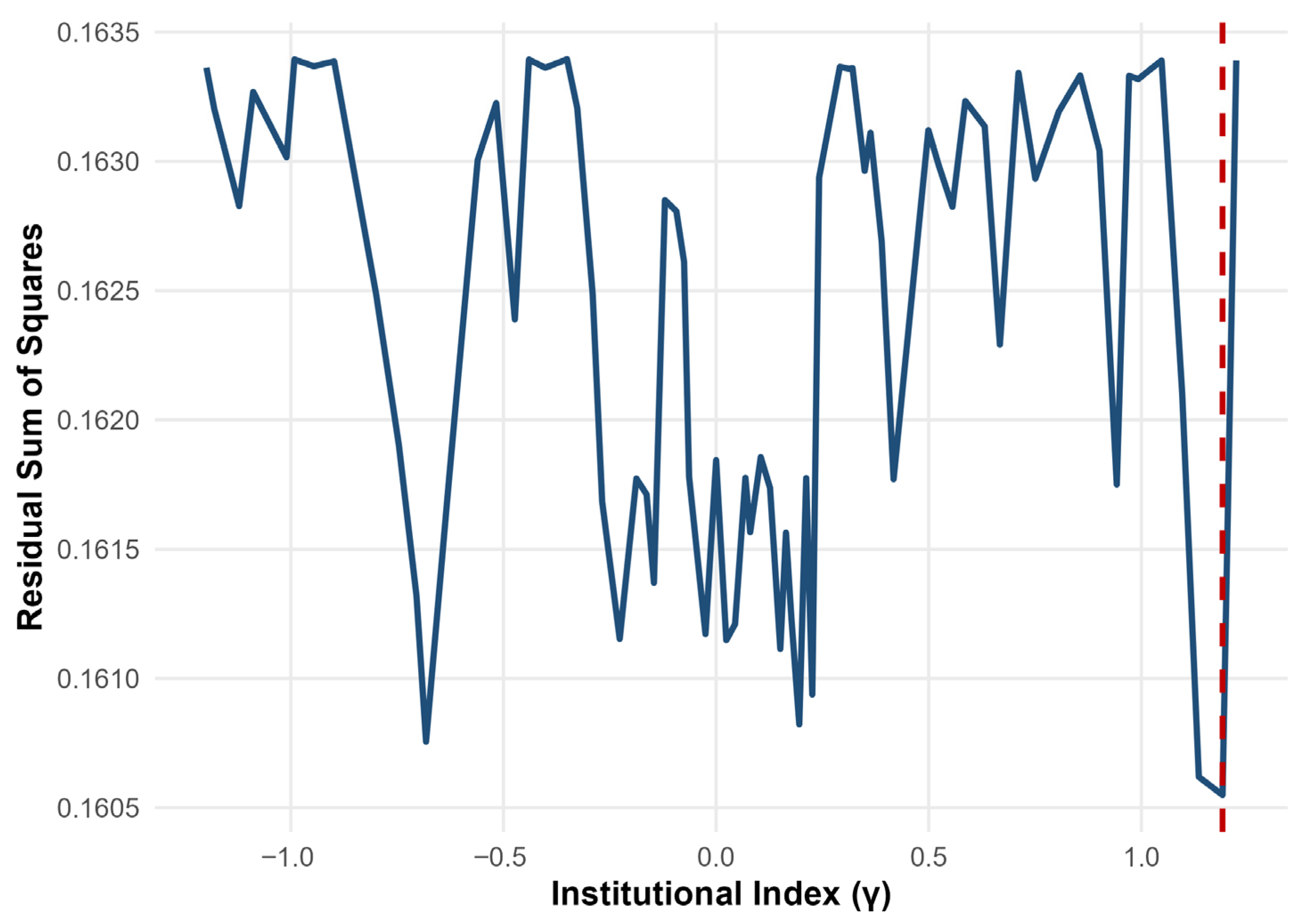
Figure 1 presents the residual sum of squares (RSS) profile across candidate threshold values. The minimum of the RSS function identifies the optimal institutional cutoff used in the subsequent spline estimation.
5.3. Regional Heterogeneity
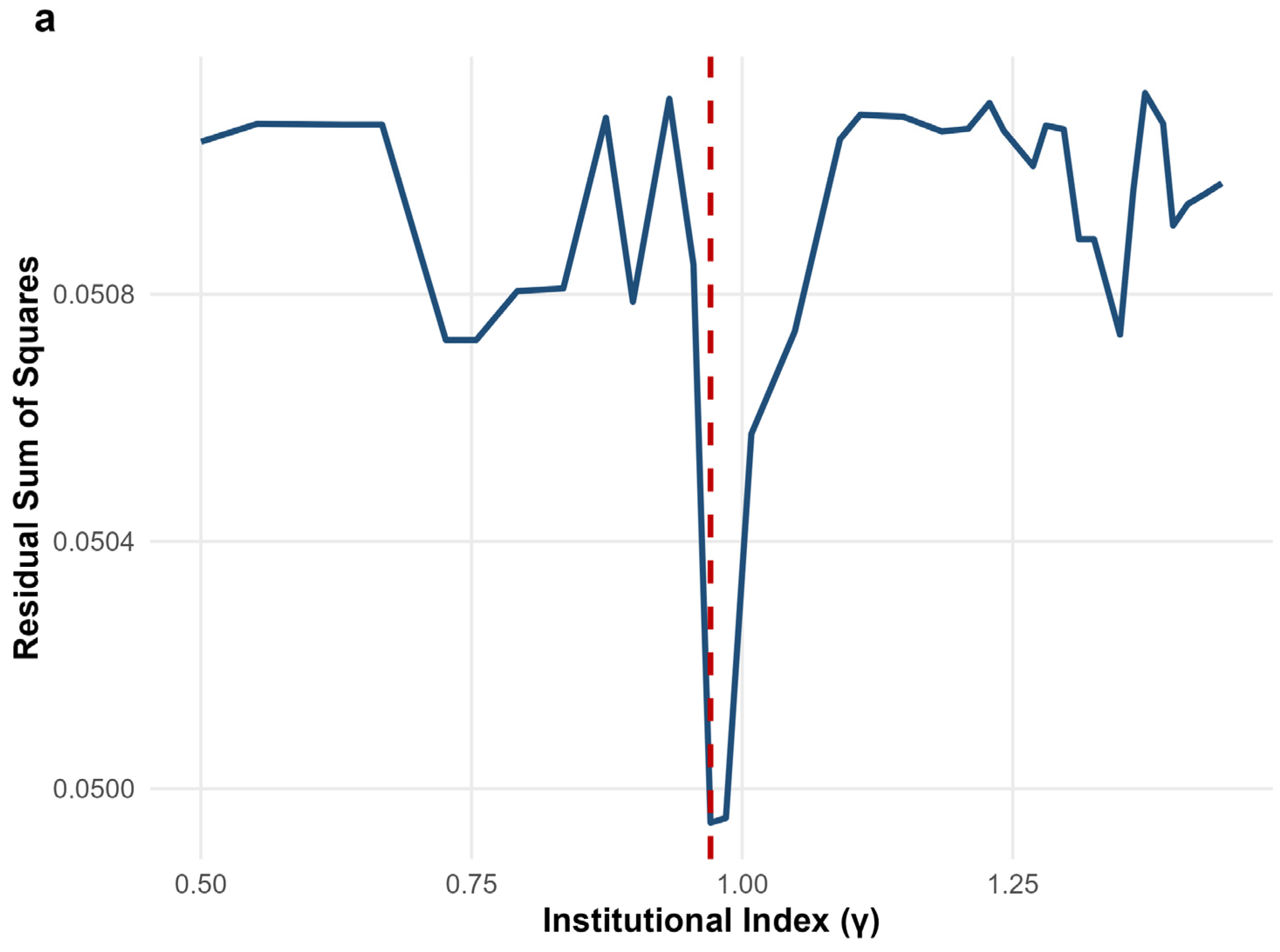
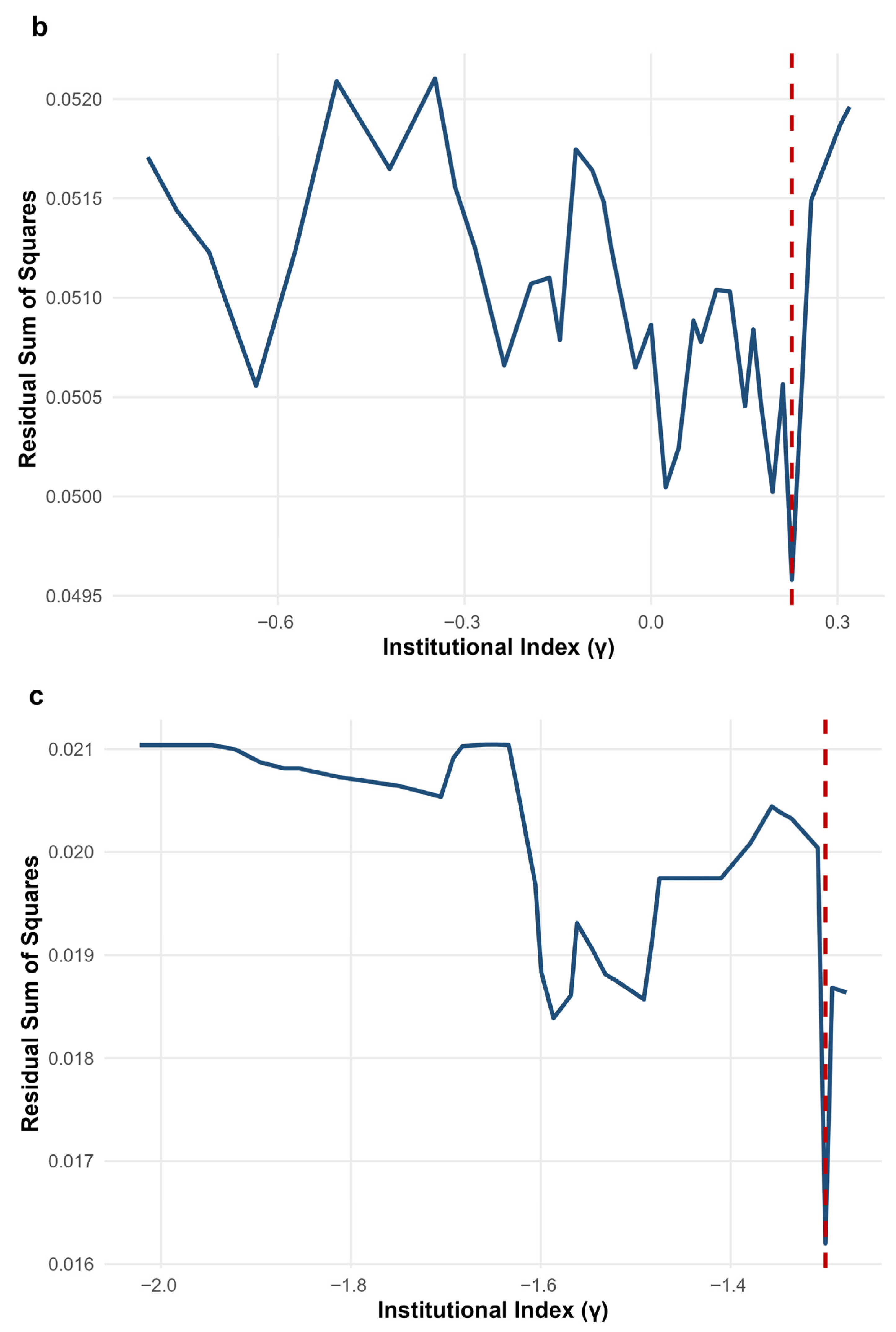
To further examine heterogeneity, the spline specification is estimated separately for EU Core, EU New, and Western Balkan economies. The corresponding threshold profiles are illustrated in
Figure 2a–c, while the regression results are summarized in
Table 5.
For EU Core economies, both regime-specific convergence coefficients are negative, statistically significant, and very similar in magnitude (−0.106 and −0.105). This pattern suggests broadly comparable annual convergence dynamics across institutional regimes within advanced EU members. Institutional quality therefore appears to be associated with convergence stability rather than with pronounced differences in convergence speed.
For EU New member states, the estimated convergence coefficients are larger in absolute value (−0.138 and −0.139) compared to the full-sample specification and remain statistically significant across regimes. This finding is consistent with relatively faster annual income convergence within this subgroup during the observed period. At the same time, the close similarity of regime-specific estimates suggests that institutional differences within the subgroup do not translate into sharply distinct convergence regimes. One possible interpretation is that post-accession institutional alignment and regulatory harmonization may have reduced the dispersion of governance conditions across these economies, thereby contributing to more comparable convergence dynamics across estimated institutional intervals. In this sense, the results provide stronger support for gradual institutional conditioning than for discrete threshold effects.
In contrast, Western Balkan economies exhibit negative but statistically insignificant regime-specific convergence coefficients. This result may partly reflect greater macroeconomic volatility, heterogeneous adjustment paths, and shorter effective time series coverage within the subgroup. Overall, convergence dynamics in this region appear less precisely estimated and more heterogeneous compared to EU member states.
5.4. Formal Threshold Testing
To formally assess whether institutional regimes generate statistically distinct convergence dynamics, an additional threshold specification is estimated in which the convergence coefficient is allowed to differ between lower and higher institutional environments. The threshold level is determined endogenously using a grid-search procedure that minimizes the residual sum of squares. The corresponding estimation results are reported in
Table 6.
The results presented in
Table 6 do not indicate statistically significant differences in the convergence coefficient across institutional regimes. Although the estimated regime-specific coefficients remain negative, the Wald test fails to reject the null hypothesis of coefficient equality. These findings suggest that convergence dynamics across European economies do not exhibit statistically robust regime-dependent differences in convergence dynamics with respect to institutional quality levels. Nevertheless, the institutional index itself exhibits a statistically significant effect on growth outcomes, indicating that suggesting that institutional quality is associated with growth performance independently of nonlinear convergence regime effects of economic performance rather than as nonlinear modifiers of convergence speed.
The threshold significance tests reported in
Table 7 refer to the baseline spline specification, whereas the alternative threshold estimates in
Table 6 are based on the extended model including additional macroeconomic controls. To formally assess whether institutional regimes significantly modify the convergence parameter, both Wald and Hansen bootstrap threshold tests are conducted. The results are reported in
Table 7.
The Wald test rejects the null hypothesis of equality between regime-specific coefficients (χ2 = 5.60, p = 0.018), suggesting statistical differences between β1 and β2 within the spline specification. However, the Hansen bootstrap test yields a bootstrap p-value of 0.094, which does not provide strong evidence for a structural threshold at conventional significance levels.
Differences in the Wald statistics across specifications may reflect variations in model composition and effective sample size. In particular, the inclusion of additional macroeconomic controls, such as capital formation and inflation, as well as broader data coverage, affects the estimation of regime-specific convergence coefficients and their covariance structure. Given the sensitivity of threshold inference to specification choices, greater weight is therefore placed on the bootstrap-based test, which provides more reliable evidence regarding the presence of a structural breakpoint.
The combined interpretation of these tests indicates that while mild regime differentiation may be present, there is no robust support for a sharp institutional breakpoint. Instead, institutional quality appears to condition convergence dynamics in a continuous manner rather than generating abrupt structural shifts.
Overall, the threshold evidence remains specification-sensitive and provides only limited support for sharp institutional regime shifts in European convergence dynamics.
6. Discussion
The empirical findings of this study provide a nuanced perspective on the role of institutional quality in shaping income convergence across European economies. While the baseline specification confirms the presence of conditional β-convergence, the nonlinear analysis reveals that institutional quality operates primarily as a conditioning factor rather than as a discrete structural threshold.
First, the robust and statistically significant negative coefficient on lagged income across the full sample reaffirms the validity of the neoclassical convergence mechanism within the European context. Even after controlling for country-specific heterogeneity and time effects, lower-income economies exhibit systematically higher growth rates. This result aligns with the broader convergence literature and suggests that capital deepening and structural adjustment remain active forces within the European growth process.
Second, the spline-based threshold analysis indicates that allowing the convergence parameter to vary across institutional regimes produces only marginal differences in coefficient magnitude. Although the Wald test suggests statistical differentiation between regime-specific coefficients, the Hansen bootstrap procedure does not provide strong support for the existence of a sharp institutional breakpoint. The bootstrap p-value, which directly addresses the presence of threshold nonlinearity, remains above conventional significance levels.
This divergence between Wald and Hansen results is economically meaningful. The Wald test evaluates parameter equality conditional on a given threshold, whereas the Hansen test evaluates whether the threshold model itself significantly improves model fit relative to the linear specification. The absence of strong bootstrap evidence implies that institutional quality does not generate a structural discontinuity in convergence dynamics. Instead, institutional variation appears to modify the stability and precision of the convergence process in a gradual manner.
These findings are broadly consistent with recent empirical research emphasizing heterogeneous and specification-sensitive convergence dynamics in Europe. For instance, evidence based on panel growth models suggests that institutional quality often influences convergence indirectly through structural channels rather than by generating clearly identifiable regime shifts. Recent comparative analyses of European convergence patterns also highlight substantial regional heterogeneity and the importance of institutional and structural factors in shaping income catch-up trajectories. In particular, studies using similar datasets and panel methodologies report that convergence processes across EU and Western Balkan economies remain conditional, uneven, and sensitive to model specification and sample composition [
48,
49].
The regional analysis reinforces this interpretation, although it should be considered in light of the broader literature documenting persistent divergence and convergence clubs within Europe [
14,
23]. In both EU Core and EU New member states, convergence coefficients remain statistically significant and display limited variation across institutional regimes. Rather than indicating the absence of institutional heterogeneity, this pattern may reflect the effects of institutional harmonization and regulatory alignment associated with European integration processes. While prior research emphasizes heterogeneous adjustment paths and the possibility of club formation, the present findings suggest that, within sufficiently consolidated governance frameworks, institutional dispersion may be less likely to generate distinct regime-based convergence dynamics. In this context, institutional quality appears to reinforce convergence stability rather than to trigger acceleration effects once a minimum level of governance consolidation has been achieved.
In contrast, the Western Balkan subgroup exhibits weaker and statistically insignificant convergence coefficients. This result is consistent with ongoing structural fragilities, smaller sample size, and greater macroeconomic volatility. Rather than demonstrating a distinct institutional threshold, the Western Balkan case reflects incomplete institutional consolidation and higher structural uncertainty. The absence of statistical significance does not contradict the convergence hypothesis; rather, it highlights the conditional and potentially fragile nature of convergence in environments characterized by governance instability.
Taken together, the results suggest that institutions function more as structural stabilizers than as activation mechanisms. This interpretation aligns with empirical research emphasizing the credibility-enhancing and volatility-reducing role of governance quality [
15,
18,
50]. Institutional quality enhances policy consistency, reduces macroeconomic uncertainty, and strengthens investor confidence, thereby reinforcing more stable and predictable convergence dynamics rather than triggering discrete regime-dependent shifts in growth performance.
This interpretation aligns with a growing strand of the convergence literature emphasizing the credibility-enhancing and volatility-reducing role of institutional quality rather than its function as a discrete growth accelerator. Empirical growth studies highlight that institutional improvements tend to influence convergence dynamics through gradual structural adjustments and enhanced macroeconomic stability rather than through abrupt regime shifts [
5,
22]. Similarly, nonlinear panel methodologies stress that threshold-type results may be sensitive to model specification and sample composition [
44]. Evidence from European integration research further indicates that institutional harmonization contributes to more stable and resilient convergence trajectories, although without necessarily generating sharp changes in convergence speed [
47]. Recent empirical contributions using comparable datasets and panel approaches also support the view that institutional quality operates primarily as a conditioning factor shaping convergence sustainability rather than as a trigger of regime-switching growth dynamics.
This interpretation contributes to the ongoing debate in the literature regarding nonlinear institutional effects. While some studies argue for threshold-type nonlinearity and multiple growth equilibria [
3,
4,
44], the present findings provide only limited empirical support for sharp institutional breakpoints within the European context. Institutional improvements matter, but they do not generate abrupt changes in convergence speed. Instead, they operate through gradual reinforcement of macroeconomic stability and growth sustainability.
From a policy perspective, the results imply that European integration and institutional harmonization may be more important for ensuring convergence robustness than for accelerating convergence per se. For advanced EU members, institutional quality appears sufficiently consolidated to sustain steady convergence dynamics. For Western Balkan economies, the priority remains deep institutional consolidation rather than expecting threshold-driven growth acceleration.
Overall, the evidence supports a reinterpretation of institutional thresholds in the European context: institutions shape the quality and resilience of convergence rather than defining discrete regime boundaries.
7. Conclusions
This study examined whether institutional quality acts as a structural threshold or as a conditioning factor in the income convergence process across European economies over the period 2004–2023. By combining a two-way fixed-effects panel framework with an endogenously determined spline specification, the analysis allowed the convergence parameter itself to vary across institutional regimes.
The results confirm the presence of conditional β-convergence across the full European sample. Economies with lower initial income levels grow faster once country-specific heterogeneity and common macroeconomic shocks are controlled for. Introducing institutional conditioning through a spline threshold specification improves model fit but does not generate strong evidence of a structural regime break. Although mild parameter differentiation emerges under conventional Wald testing, the Hansen bootstrap procedure does not support the existence of a sharp institutional threshold.
Regional estimations further reinforce this conclusion. Convergence dynamics are robust and statistically significant within EU Core and EU New member states, with little variation across institutional regimes. In contrast, Western Balkan economies display weaker and statistically imprecise convergence patterns, reflecting ongoing structural and governance fragilities. These findings are consistent with the interpretation that institutional quality may contribute to more stable convergence dynamics and improved macroeconomic policy environments.
The main contribution of this study lies in clarifying the functional role of institutions in the European convergence process. Rather than triggering nonlinear regime shifts, institutional quality appears to condition the resilience and consistency of convergence dynamics. This interpretation bridges the gap between linear convergence models and threshold-based institutional theories by demonstrating that institutional effects may be continuous and reinforcing rather than discontinuous.
From a policy perspective, the results imply that sustained institutional consolidation and regulatory harmonization remain essential for ensuring stable convergence, particularly in economies undergoing structural transformation. For Western Balkan countries, deeper governance reforms may enhance the credibility and robustness of convergence trajectories, even if immediate threshold-type growth acceleration is unlikely.
Several limitations should be acknowledged. First, the analysis relies on composite institutional indicators, which may mask heterogeneity across specific governance dimensions. Second, annual panel data capture short- to medium-term dynamics but may not fully reflect long-run structural adjustments. Future research could extend the framework by examining alternative institutional measures, sector-specific convergence patterns, or dynamic panel specifications incorporating endogenous institutional evolution.
Another limitation concerns the potential endogeneity between institutional quality and economic growth. While the present analysis treats institutional indicators as conditioning variables within the convergence framework, the possibility of reverse causality—whereby economic development may itself contribute to institutional improvement—cannot be fully excluded. Addressing this issue would require alternative empirical strategies, such as instrumental variable approaches or dynamic panel estimators, which remain a promising avenue for future research.
Overall, the evidence suggests that institutional quality matters for convergence, but primarily through gradual conditioning effects rather than through discrete structural thresholds. More broadly, the results suggest that institutional reforms in Europe may contribute more to convergence sustainability than to convergence acceleration.