
Digital Twin-Based MPC for Industrial MIMO Automation: Intelligent Algorithms




Abstract
1. Introduction
- (1)
- high computational complexity required for real-time simulation;
- (2)
- difficulties in scaling solutions for industrial objects;
- (3)
- (1)
- a generalizable digital twin architecture integrated with MPC and AI modules for MIMO system control is proposed;
- (2)
- a two-branch GA + NN hybrid scheme was implemented, where GA performs global search for optimal control moves in the predictive branch, and a compact NN provides bounded nonlinear residual compensation in the corrective branch;
- (3)
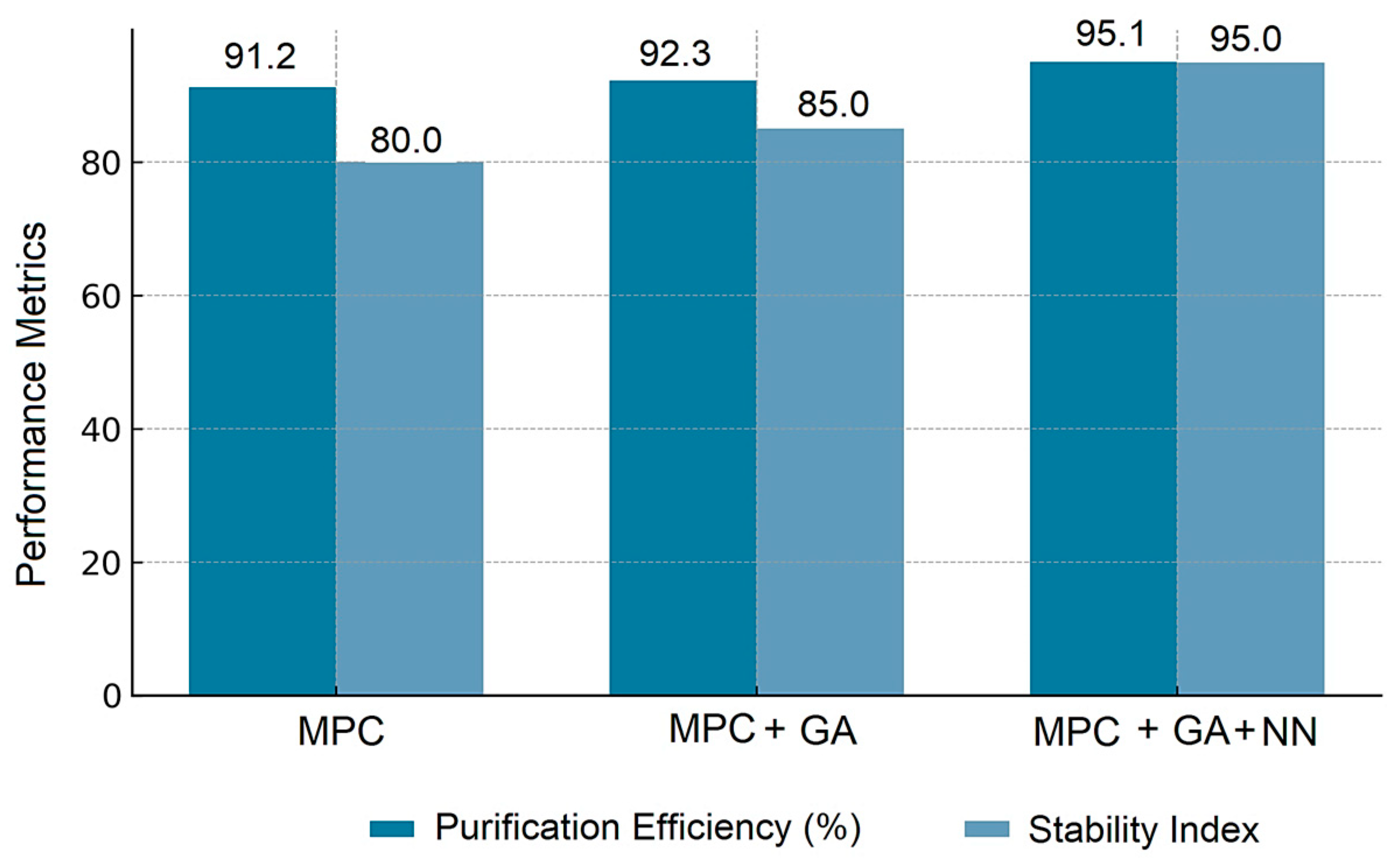
- an experimental validation was conducted using the example of the process of phosphoric acid purification, confirming an improvement in the control performance.
2. Literature Review

| Study | Research Focus and Objectives | Challenges, Limitations, and Drawbacks |
|---|---|---|
| Hu et al. (2025) [3] | Digital Twin-based fault diagnosis of electric machines | Difficulties in real-time synchronization and handling multivariable interactions |
| Ren et al. (2022) [8] | Ontology-based data governance for DT lifecycle management | High data evolution complexity; need for robust semantic architectures |
| Leng et al. (2021) [4] | Review of DT-based smart manufacturing systems in Industry 4.0 | Issues of data consistency, integration, and industrial scalability |
| Santander et al. (2023) [17] | Deep Learning integrated into MPC frameworks | Scalability for large-scale systems; high computational demand |
| El Hakim et al. (2025) [20] | AI-enhanced MPC for nonlinear LPG processes | Limited generalizability; requires validation on broader chemical systems |
| Herrera et al. (2023) [32] | Hybrid controller for long-time delays in chemical processes | Complexity of tuning; sensitivity to parameter uncertainty |
| Teng et al. (2021) [7] | DT infrastructures for industrial energy efficiency | Sensor calibration issues; high demand for real-time processing |
| Chen et al. (2025) [18] | DT-enabled MPC with deep neural networks for real-time control in additive manufacturing | High computational load; sensitivity to data drift; scalability for large-scale MIMO processes |
| This work | Hybrid DT and MPC + GA + NN controller for nonlinear MIMO process automation | Hybrid control increases modeling and computational accuracy; real-time hardware implementation and long-term robustness testing represent the next steps of development |
3. Methodology of Proposed Efficient Control Algorithm
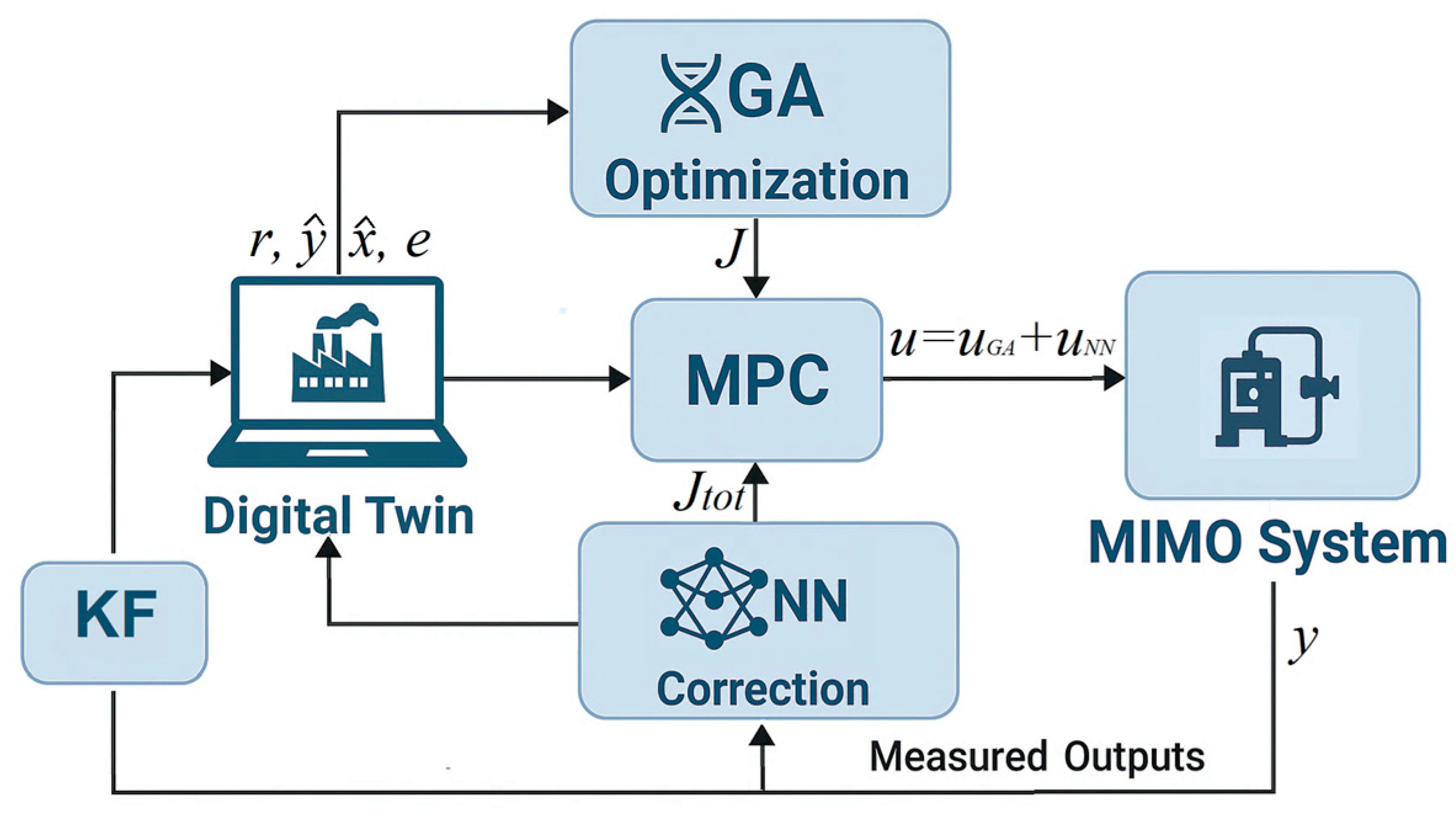
- Input System Data, ISD—formation and pre-processing of input data: collection of measurements, normalization, filtering and preparation for modeling;
- Modeling and Learning, ML—building a mathematical model and training a neural network on prepared data, followed by integration into a digital twin to improve the accuracy of predictions;
- Optimization Process, OP—forecasting the dynamics of the system, calculating the optimal trajectory of control actions taking into account constraints; decomposing control into the main and corrective components;
- Feedback and Performance Adjustment, FPA—applying control signals to an object, updating the state of the digital twin, shifting the forecast horizon and adjusting parameters based on the actual error.
3.1. Data Entry and Pre-Processing Stage (ISD)
- Scaling (normalization) of all variables into a unified numerical range (for example, [0, 1]), which is necessary to ensure the correct operation of neural network components and the stability of numerical optimization procedures;
- Filtering noise and outliers in measured data, allowing for increased forecast accuracy and stability of control actions;
- Validation and verification of data completeness, including checking for omissions, outliers, and consistency between measurement channels.
3.2. Mathematical Model and Forecast with Neural Network Correction (ML)
| Algorithm 1 Data Preparation and Model Linearization Procedure for MPC with Digital Twin |
| Input: states , inputs , outputs , sampling period , historical dataset Output: cleaned and normalized dataset , linearized discrete-time model , digital twin dataset for training NN and predictive control Begin:
|
3.3. Optimization Process (OP)
3.4. Feedback and Performance (FPA)
3.5. Steps of the Hybrid Efficient Control Algorithm
| Algorithm 2 Hybrid MPC with Genetic Algorithm and Neural Network Correction |
| Input: Discrete-time state-space model matrices ; prediction horizon (with ); control horizon ; weights ; NN regularization weights ; constraints , GA parameters (population size, crossover and mutation rates, elitism factor); trained NN policy ; previous input ; reference trajectory available on the horizon. Output: Applied control input ; predicted trajectory ; total cost . Initialization: 1. Define the plant state-space model (1); 2. Specify the MPC cost over horizons (6); extend to (9); 3. Initialize NN (architecture, weights ); train offline on historical data; 4. Set GA parameters and hard constraints for inputs and input increments; 5. Initialize observer (KF/EKF/UKF) if the full state is not measured. Repeat at each time step :
|
3.6. Digital Twin Implementation
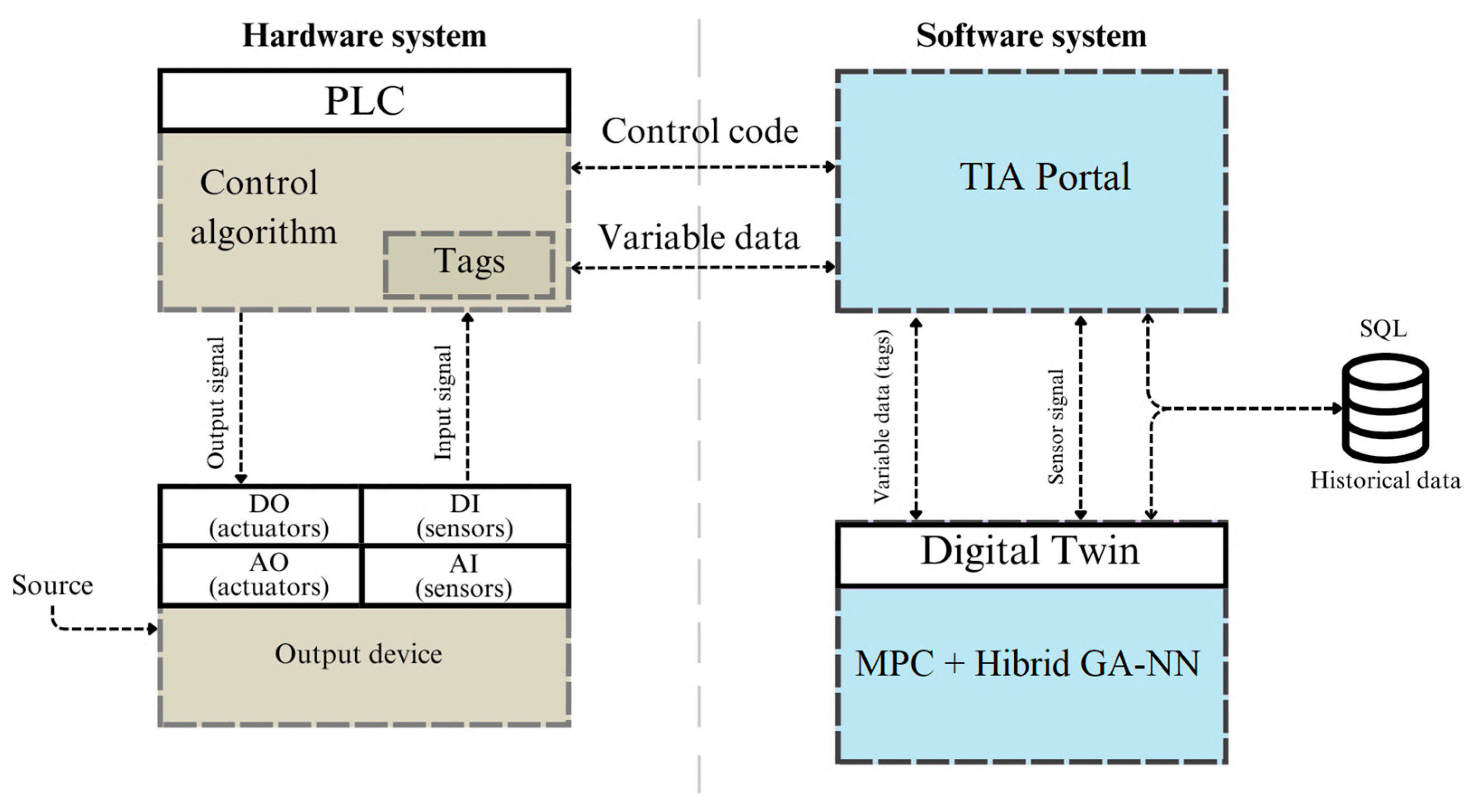
- At the ISD stage, the digital twin receives real data from sensors via PLC and tags, performs normalization and validation;
- At the OP stage, the digital twin uses a predictive model, a neural network correction module, and a genetic algorithm to compute optimal control actions taking into account constraints;
- At the FPA stage, only the first element of the optimal sequence is fed to the physical plant, after which the digital twin updates the state of the model and initiates a new optimization cycle.
4. Results and Discussion
4.1. Process: Experimental Setup
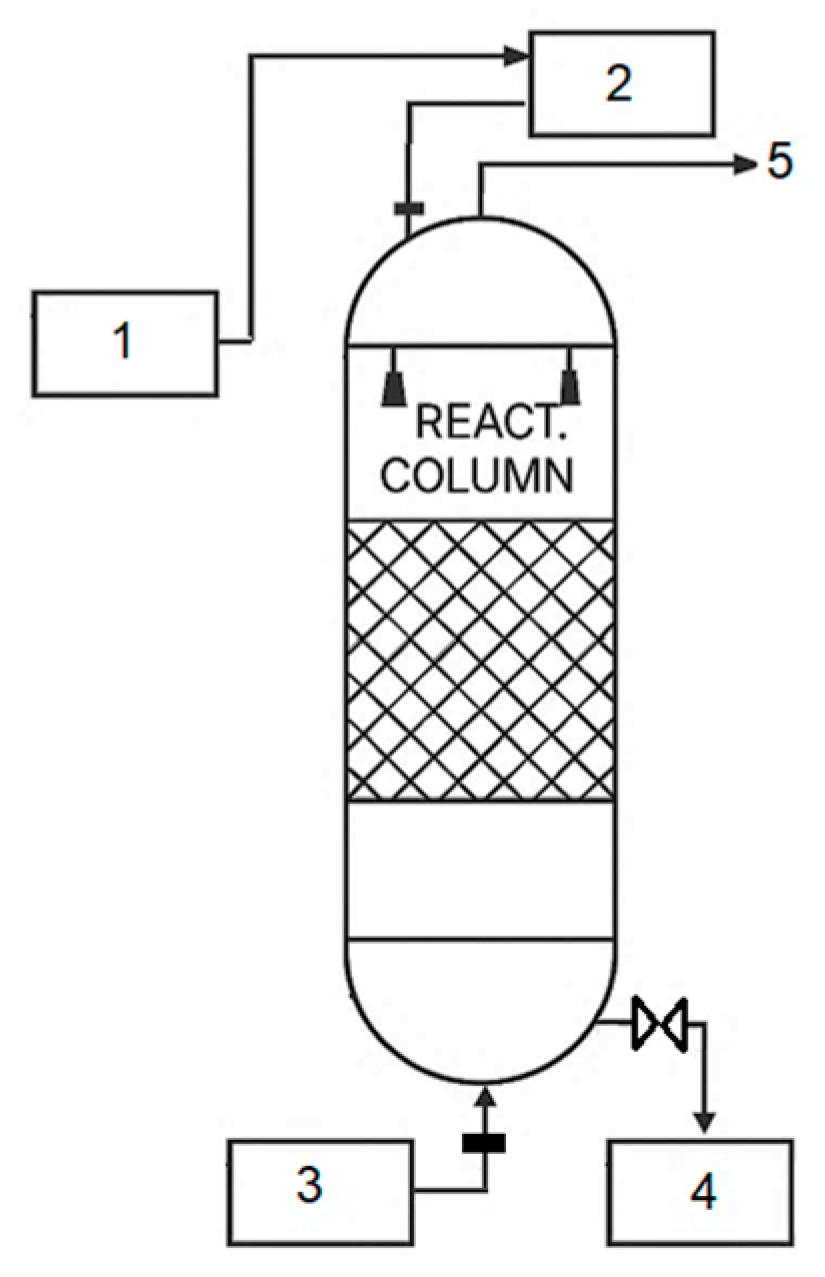
- States are the concentrations of the key components of the solution and the volume (or level) at the bottom of the column.
- Controls are the flow rate of the initial acid, the flow rate of the solution, flow rate, or discharge of the suspension, as well as the effect on the vacuum system or auxiliary control actions.
- The measured outputs are process quality indicators used as key performance indicators. Specifically, to monitor purification quality, the output variables characterizing the concentrations of As(III), As(V) and Pb(II), as well as are the current volume or level of the solution—are selected.
- State variables, process outputs and control actions are presented in Table 2.
4.2. Results of Applying the Algorithm
4.2.1. Initialization of the Algorithm
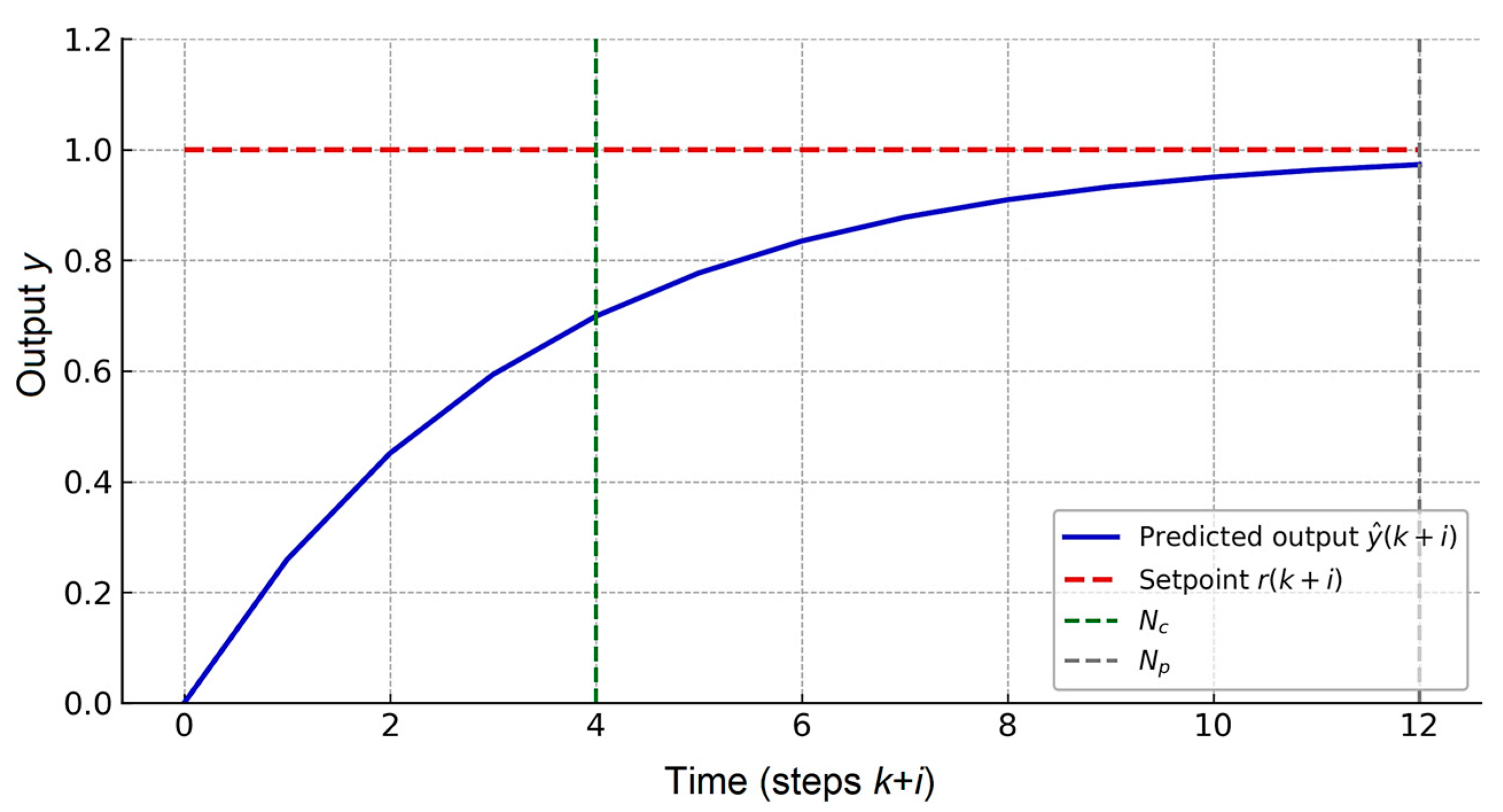
4.2.2. MPC Cost Function Specification
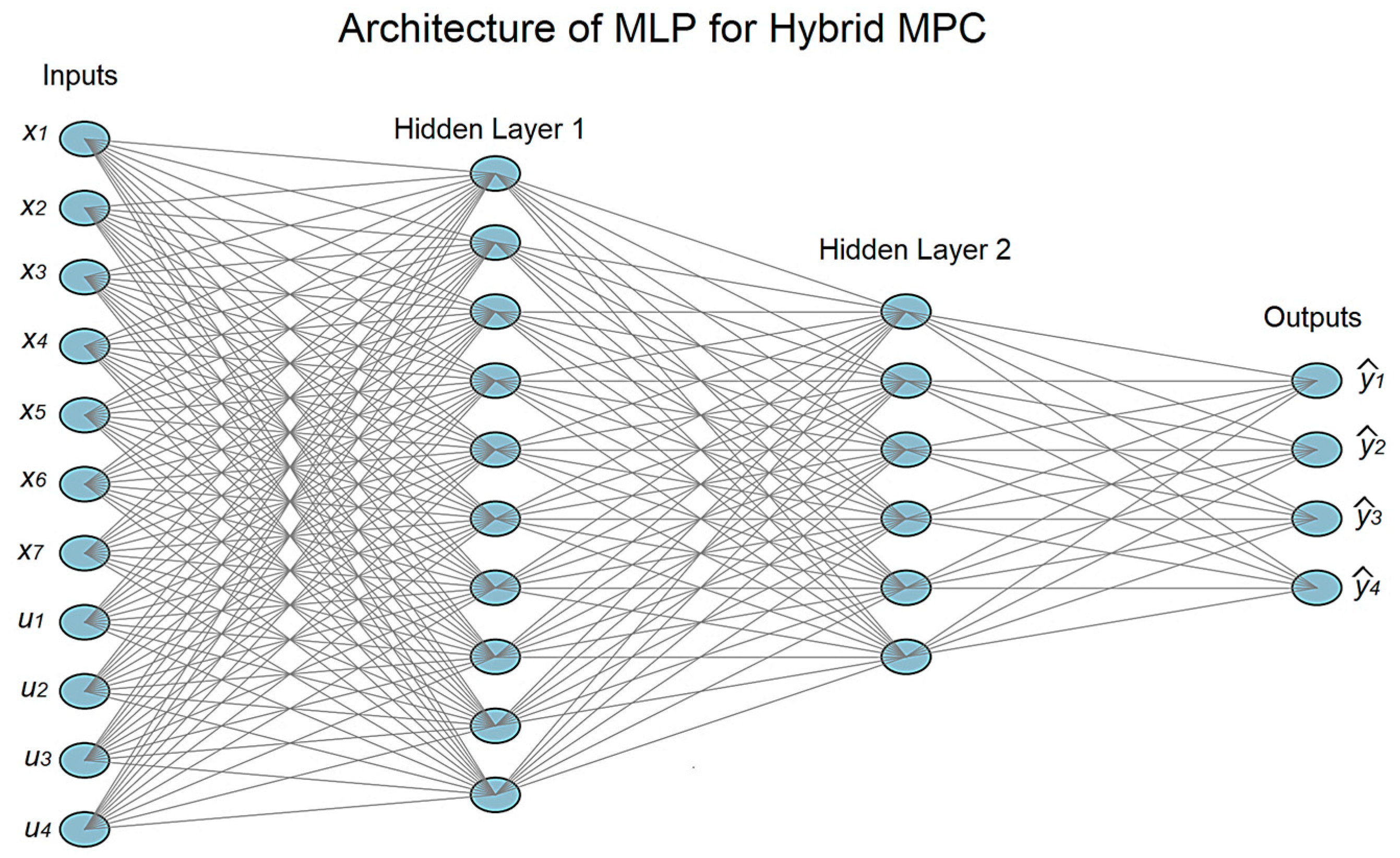
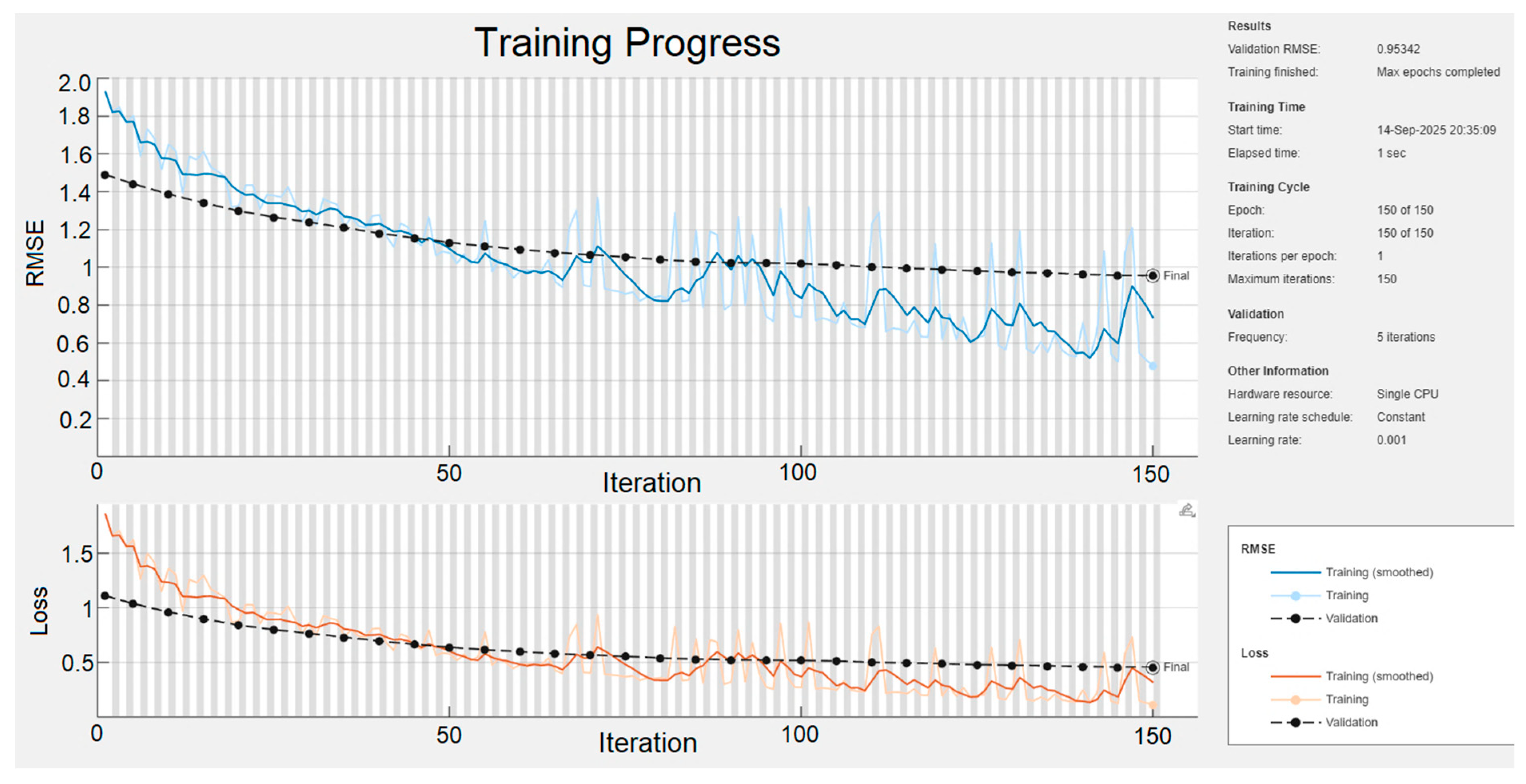
4.2.3. Neural Network Initialization and Training
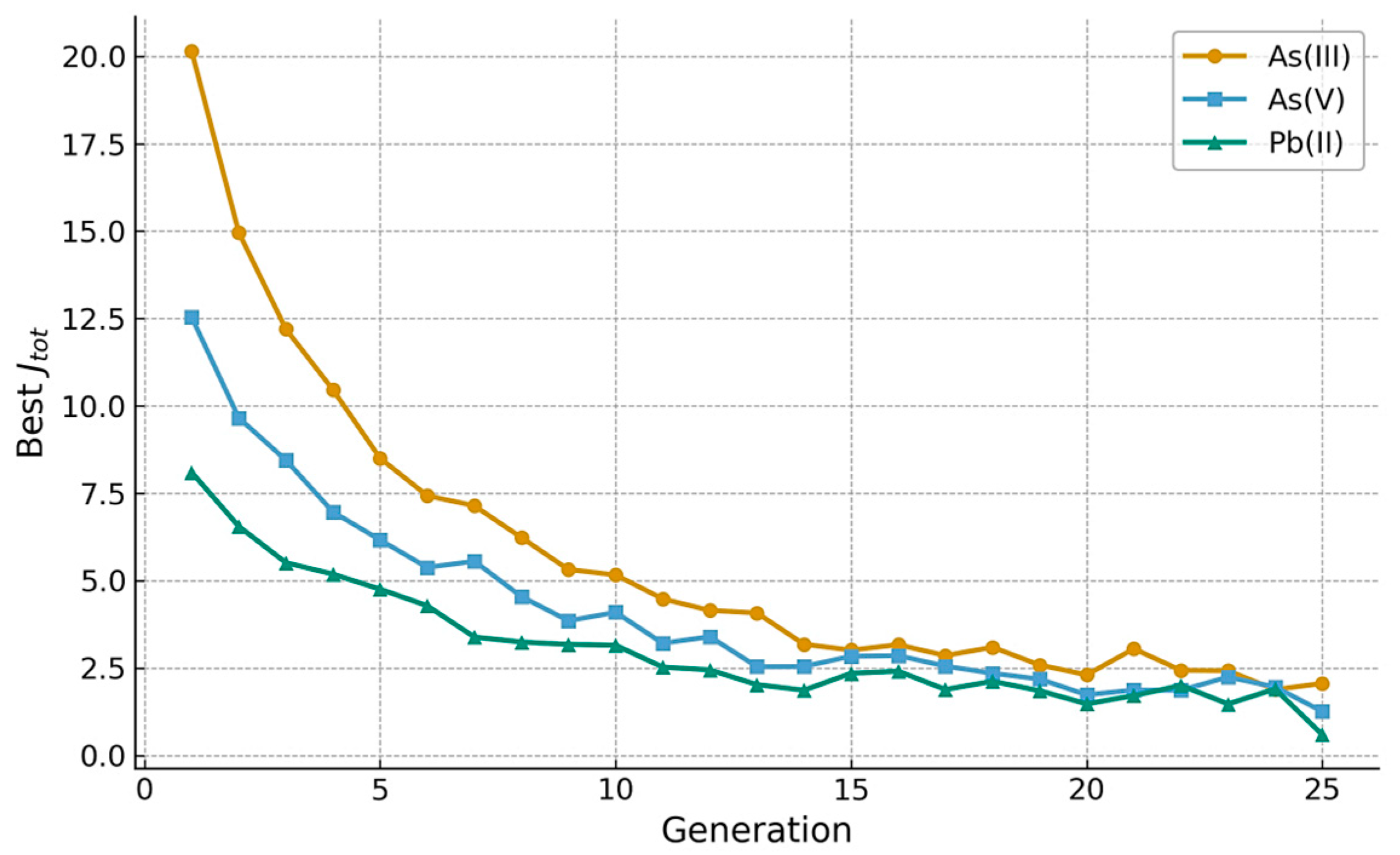
4.3. Control Results and Performance
5. Conclusions
Author Contributions
Funding
Institutional Review Board Statement
Informed Consent Statement
Data Availability Statement
Conflicts of Interest
Appendix A
References
- Feng, X.; Wang, C. Adaptive Tracking Control for a Class of Uncertain MIMO Nonlinear Systems with Input Constraints. J. Intell. Robot. Syst. 2025, 111, 9. [Google Scholar] [CrossRef]
- Lee, J.; Davari, H.; Singh, J.; Pandhare, V. Industrial Artificial Intelligence for Industry 4.0-based Manufacturing Systems. Manuf. Lett. 2018, 18, 20–23. [Google Scholar] [CrossRef]
- Hu, J.; Xiao, H.; Ye, Z.; Luo, N.; Zhou, M. Research and Prospects of Digital Twin-Based Fault Diagnosis of Electric Machines. Sensors 2025, 25, 2625. [Google Scholar] [CrossRef]
- Leng, J.; Wang, D.; Shen, W.; Li, X.; Liu, Q.; Chen, X. Digital twins-based smart manufacturing system design in Industry 4.0: A review. J. Manuf. Syst. 2021, 60, 119–137. [Google Scholar] [CrossRef]
- Noh, W.; Park, S.; Kim, S.; Lee, I. A hybrid framework of first-principles model and machine learning for optimizing control parameters in chemical processes. J. Ind. Eng. Chem. 2025, 141, 582–596. [Google Scholar] [CrossRef]
- Fang, Y.; Wang, P.; Gao, S.; Sun, B.; Zhang, Q.; Zhang, Y. Trajectory Tracking Control of Intelligent Vehicles with Adaptive Model Predictive Control and Reinforcement Learning Under Variable Curvature Roads. Technologies 2025, 13, 394. [Google Scholar] [CrossRef]
- Teng, S.Y.; Touš, M.; Leong, W.D.; How, B.S.; Lam, H.L.; Máša, V. Recent advances on industrial data-driven energy savings: Digital twins and infrastructures. Renew. Sustain. Energy Rev. 2021, 135, 110208. [Google Scholar] [CrossRef]
- Ren, Z.; Shi, J.; Imran, M. Data Evolution Governance for Ontology-Based Digital Twin Product Lifecycle Management. IEEE Trans. Ind. Inform. 2022, 19, 1791–1802. [Google Scholar] [CrossRef]
- Ba, L.; Tangour, F.; El Abbassi, I.; Absi, R. Analysis of Digital Twin Applications in Energy Efficiency: A Systematic Review. Sustainability 2025, 17, 3560. [Google Scholar] [CrossRef]
- Ludwig, S.; Karrenbauer, M.; Fellan, A.; Schotten, H.D.; Buhr, H.; Seetaraman, S.; Niebert, N.; Bernardy, A.; Seelmann, V.; Stich, V.; et al. A 5G architecture for the factory of the future. In Proceedings of the 2018 IEEE 23rd International Conference on Emerging Technologies and Factory Automation, Turin, Italy, 4–7 September 2018; pp. 1409–1416. [Google Scholar] [CrossRef]
- Syafrudin, M.; Alfian, G.; Fitriyani, N.L.; Rhee, J. Performance analysis of IoT-based sensor, big data processing, and machine learning model for real-time monitoring system in automotive manufacturing. Sensors 2018, 18, 2946. [Google Scholar] [CrossRef]
- Nti, I.K.; Adekoya, A.F.; Weyori, B.A.; Nyarko-Boateng, O. Applications of artificial intelligence in engineering and manufacturing: A systematic review. J. Intell. Manuf. 2022, 33, 1581–1601. [Google Scholar] [CrossRef]
- Evjemo, L.D.; Gjerstad, T.; Grøtli, E.I.; Sziebig, G. Trends in Smart Manufacturing: Role of Humans and Industrial Robots in Smart Factories. Curr. Robot. Rep. 2020, 1, 35–41. [Google Scholar] [CrossRef]
- Tao, F.; Cheng, J.; Qi, Q.; Zhang, M.; Zhang, H.; Sui, F. Digital twin-driven product design, manufacturing and service with big data. Int. J. Adv. Manuf. Technol. 2017, 94, 3563–3576. [Google Scholar] [CrossRef]
- Wang, J.; Ma, Y.; Zhang, L.; Gao, R.X.; Wu, D. Deep learning for smart manufacturing: Methods and applications. J. Manuf. Syst. 2018, 48, 144–156. [Google Scholar] [CrossRef]
- Chen, B.; Wan, J.; Celesti, A.; Li, D.; Abbas, H.; Zhang, Q. Edge computing in IoT-based manufacturing. IEEE Commun. Mag. 2018, 56, 103–109. [Google Scholar] [CrossRef]
- Santander, O.; Kuppuraj, V.; Harrison, C.A.; Baldea, M. Deep Learning Model Predictive Control Frameworks: Application to a Fluid Catalytic Cracker–Fractionator Process. Ind. Eng. Chem. Res. 2023, 62, 11110–11122. [Google Scholar] [CrossRef]
- Chen, Y.-P.; Karkaria, V.; Tsai, Y.-K.; Rolark, F.; Quispe, D.; Gao, R.X.; Cao, J.; Chen, W. Real-Time Decision-Making for Digital Twin in Additive Manufacturing with MPC using Time-Series Deep Neural Networks. J. Manuf. Syst. 2025, 80, 412–424. [Google Scholar] [CrossRef]
- Salehi Sarbijan, M.; Behnamian, J. Multi-fleet feeder vehicle routing problem using hybrid metaheuristic. Comput. Oper. Res. 2022, 141, 105696. [Google Scholar] [CrossRef]
- El Hakim, B.A.; Abdel-Goad, M.A.-H.; Awad, M.E.; Shoaib, A.M. AI enhanced model predictive control for optimizing LPG recovery through integrated computational modeling design of experiments and multivariate regression. Sci. Rep. 2025, 15, 29249. [Google Scholar] [CrossRef]
- Chen, B.; Liu, Y.; Zhang, C.; Wang, Z. Time series data for equipment reliability analysis with deep learning. IEEE Access 2020, 8, 105484–105493. [Google Scholar] [CrossRef]
- Yan, H.; Duan, Z. Tube-based model predictive control using multidimensional Taylor network for nonlinear time-delay systems. IEEE Trans. Autom. Control 2020, 66, 2099–2114. [Google Scholar] [CrossRef]
- Michailidis, P.; Michailidis, I.; Minelli, F.; Coban, H.H.; Kosmatopoulos, E. Model Predictive Control for Smart Buildings: Applications and Innovations in Energy Management. Buildings 2025, 15, 3298. [Google Scholar] [CrossRef]
- Stadler, P.; Girardin, L.; Ashouri, A.; Maréchal, F. Contribution of Model Predictive Control in the Integration of Renewable Energy Sources within the Built Environment. Front. Energy Res. 2018, 6, 22. [Google Scholar] [CrossRef]
- Fu, C.; Zhang, Y. Research and Application of Predictive Control Method Based on Deep Reinforcement Learning for HVAC Systems. IEEE Access 2021, 9, 130845–130852. [Google Scholar] [CrossRef]
- Wang, F.; Mei, X.; Rodriguez, J.; Kennel, R. Model predictive control for electrical drive systems-an overview. CES Trans. Electr. Mach. Syst. 2017, 1, 219–230. [Google Scholar] [CrossRef]
- Wang, Q.; Shi, H.; Ye, C.; Zhou, H. Synergizing Metaheuristic Optimization and Model Predictive Control: A Comprehensive Review for Advanced Motor Drives. Energies 2025, 18, 4831. [Google Scholar] [CrossRef]
- Lü, X.; Li, S.; He, X.; Xie, C.; He, S.; Xu, Y.; Fang, J.; Zhang, M.; Yang, X. Hybrid electric vehicles: A review of energy management strategies based on model predictive control. J. Energy Storage 2022, 56, 106112. [Google Scholar] [CrossRef]
- Song, C.; Kim, K.; Sung, D.; Kim, K.; Yang, H.; Lee, H.; Cho, G.Y.; Cha, S.W. A Review of Optimal Energy Management Strategies Using Machine Learning Techniques for Hybrid Electric Vehicles. Int. J. Automot. Technol. 2021, 22, 1437–1452. [Google Scholar] [CrossRef]
- Amar, A.; Yusupov, Z. Real-Time Capable MPC-Based Energy Management of Hybrid Microgrid. Processes 2025, 13, 2883. [Google Scholar] [CrossRef]
- Schwenzer, M.; Ay, M.; Bergs, T.; Abel, D. Review on model predictive control: An engineering perspective. Int. J. Adv. Manuf. Technol. 2021, 117, 1327–1349. [Google Scholar] [CrossRef]
- Herrera, M.; Benítez, D.; Pérez-Pérez, N.; Di Teodoro, A.; Camacho, O. Hybrid Controller Based on Numerical Methods for Chemical Processes with a Long Time Delay. ACS Omega 2023, 8, 25236–25253. [Google Scholar] [CrossRef]
- Qiu, H.; Al-Nussairi, A.K.J.; Sadeghi Chevinli, Z.; Singh, N.S.S.; Chyad, M.H.; Yu, J.; Maesoumi, M. Integrating digital twins with neural networks for adaptive control of automotive suspension systems. Sci. Rep. 2025, 15, 11078. [Google Scholar] [CrossRef]
- Khan, B.; Ali, S.M.; Ullah, Z. Deep Learning Based Digital Twins Augmented Reality: Model Predictive Control for Battery and Storage Optimization in Renewable Energy Prosumers Districts. J. Energy Storage 2025, 131, 117565. [Google Scholar] [CrossRef]
- Ates, C.; Bicat, D.; Yankov, R.; Arweiler, J.; Koch, R.; Bauer, H.-J. Model Predictive Evolutionary Temperature Control via Neural-Network-Based Digital Twins. Algorithms 2023, 16, 387. [Google Scholar] [CrossRef]
- Xue, Y.; Zhang, B.; Su, K.; Li, Y.; Zhu, H.; Pan, H. A preliminary study of digital twin for nuclear reactor dynamics: A synergy of machine learning and model predictive control. Eng. Appl. Artif. Intell. 2025, 153, 110940. [Google Scholar] [CrossRef]
- Qin, S.; Badgwell, T. A survey of industrial model predictive control technology. Control Eng. Pract. 2003, 11, 733–764. [Google Scholar] [CrossRef]
- Kafarov, V.V.; Mayorga, B.; Dallos, C. Mathematical method for analysis of dynamic processes in chemical reactors. Chem. Eng. Sci. 1999, 54, 4669–4678. [Google Scholar] [CrossRef]
- Joyce, R.M. Experiment optimization in chemistry and chemical engineering, S. Akhnazarova and V. Kafarov, Mir Publishers, Moscow and Chicago, 1982, 312 pp. Price: $9.95. J. Polym. Sci. Polym. Lett. Ed. 1984, 22, 372. [Google Scholar] [CrossRef]


| Category | Symbols | Explanation | Unit | |
|---|---|---|---|---|
| states variables | concentration of orthophosphoric acid in the volume of solution | % | ||
| concentration of hydrogen sulfide in solution | kg·h−1 | |||
| concentration of sodium sulfide in the volume of solution | % | |||
| concentration of arsenious acid in the volume of solution | % | |||
| concentration of arsenic acid in solution | % | |||
| concentration of lead ions in solution | % | |||
| solution volume fraction at column bottom | – | |||
| controls | feed mass flow rate of phosphoric acid from tank 1 to the column | kg·h−1 | ||
| flow rate of , supplied to the bottom of the column | kg·h−1 | |||
| flow rate of suspension from the bottom of the column | kg·h−1 | |||
| vacuum at the top of the column | Pa | |||
| coefficients | reaction rate constant (1) | – | ||
| precipitation constants (2)–(4) | – | |||
| vacuum influence coefficients (2)–(4) | – | |||
Disclaimer/Publisher’s Note: The statements, opinions and data contained in all publications are solely those of the individual author(s) and contributor(s) and not of MDPI and/or the editor(s). MDPI and/or the editor(s) disclaim responsibility for any injury to people or property resulting from any ideas, methods, instructions or products referred to in the content. |
© 2026 by the authors. Licensee MDPI, Basel, Switzerland. This article is an open access article distributed under the terms and conditions of the Creative Commons Attribution (CC BY) license.
Share and Cite
Suleimenov, B.; Shiryayeva, O.; Gorbunov, D. Digital Twin-Based MPC for Industrial MIMO Automation: Intelligent Algorithms. Automation 2026, 7, 8. https://doi.org/10.3390/automation7010008
Suleimenov B, Shiryayeva O, Gorbunov D. Digital Twin-Based MPC for Industrial MIMO Automation: Intelligent Algorithms. Automation. 2026; 7(1):8. https://doi.org/10.3390/automation7010008
Chicago/Turabian StyleSuleimenov, Batyrbek, Olga Shiryayeva, and Dmitriy Gorbunov. 2026. "Digital Twin-Based MPC for Industrial MIMO Automation: Intelligent Algorithms" Automation 7, no. 1: 8. https://doi.org/10.3390/automation7010008
APA StyleSuleimenov, B., Shiryayeva, O., & Gorbunov, D. (2026). Digital Twin-Based MPC for Industrial MIMO Automation: Intelligent Algorithms. Automation, 7(1), 8. https://doi.org/10.3390/automation7010008