Article

Offboard Fault Diagnosis for Large UAV Fleets Using Laser Doppler Vibrometer and Deep Extreme Learning


by
Mohamed A. A. Ismail
1,2,*,
Saadi Turied Kurdi
3,
Mohammad S. Albaraj
2 and
Christian Rembe
4
1
Interdisciplinary Research Center for Aviation and Space Exploration, King Fahd University of Petroleum & Minerals, Dhahran 31261, Saudi Arabia
2
Aerospace Engineering Department, King Fahd University of Petroleum & Minerals, Dhahran 31261, Saudi Arabia
3
College of Engineering, Al-Bayan University, Baghdad 2268, Iraq
4
Institute of Electrical Information Technology, Clausthal University of Technology, 38678 Clausthal-Zellerfeld, Germany
*
Author to whom correspondence should be addressed.
Automation 2026, 7(1), 6; https://doi.org/10.3390/automation7010006 (registering DOI)
Submission received: 22 November 2025 / Revised: 27 December 2025 / Accepted: 29 December 2025 / Published: 31 December 2025

Abstract

Unmanned Aerial Vehicles (UAVs) have become integral to modern applications, including smart agricultural robotics, where reliability is essential to ensure safe and efficient operation. It is commonly recognized that traditional fault diagnosis approaches usually rely on vibration and noise measurements acquired via onboard sensors or similar methods, which typically require continuous data acquisition and non-negligible onboard computational resources. This study presents a portable Laser Doppler Vibrometer (LDV)-based system designed for noncontact, offboard, and high-sensitivity measurement of UAV vibration signatures. The LDV measurements are analyzed using a Deep Extreme Learning-based Neural Network (DeepELM-DNN) capable of identifying both propeller fault type and severity from a single 1 s measurement. Experimental validation on a commercial quadcopter using 50 datasets across multiple induced fault types and severity levels demonstrates a classification accuracy of 97.9%. Compared to conventional onboard sensor-based approaches, the proposed framework shows strong potential for reduced computational effort while maintaining high diagnostic accuracy, owing to its short measurement duration and closed-form learning structure. The proposed LDV setup and DeepELM-DNN framework enable noncontact fault inspection while minimizing or eliminating the need for additional onboard sensing hardware. This approach offers a practical and scalable diagnostic solution for large UAV fleets and next-generation smart agricultural and industrial aerial robotics.

1. Introduction

The growing adoption of UAVs in smart agriculture—including crop monitoring [1,2], precision spraying [3,4], livestock inspection [5], and soil health assessment [6,7]—has intensified the need for reliable and autonomous health-monitoring systems. Drones and fleet UAVs that operate for agricultural purposes often face harsh environments, such as those involving sand and heavy winds. UAV failures can generally be managed either through redundant design of critical components [8,9] or by employing efficient fault diagnosis methods, which constitute the main focus of this paper. UAVs are always subjected to propeller failure due to some crack that originated previously or a misalignment in the motor that happened due to an impact or otherwise [10,11,12,13,14,15,16,17]. To address the scalability, hardware, and consistency limitations inherent to onboard fault diagnosis approaches in large UAV fleets, this study introduces Laser Doppler Vibrometry (LDV) as a noncontact, offboard sensing solution capable of delivering high-sensitivity vibration measurements without reliance on onboard resources.
In response to the popularity of UAVs and drones, it is important to detect small-scale errors within a drone or UAV before setting it for operations that involve agricultural purposes and robotics. In this way, it is important to diagnose these faults using artificial intelligence (AI) and other Machine Learning (ML) approaches [18]. Specifically speaking, LDVs can dramatically improve operations in a safety- and sustainability-friendly environment [19]. This study aims to address this gap by proposing an LDV-based AI framework that enables fast, yet accurate and hardware-free UAV fault detection for modern smart-farming ecosystems.
To progress further into the scope of the methodology, Table 1 summarizes recent state-of-the-art approaches that involved AI and ML specifically in the operational fault diagnosis of drones.
Researchers are increasingly mounting LDV systems on or integrating them with UAVs to perform noncontact vibration/displacement measurements in remote or hard-to-access environments such as large civil structures, specifically bridges and towers [34,35,36]. There are also advanced applications for Vibroacoustic Intelligence [37] and drone payload estimation [38]. The LDV-UAV combination enables full-field or scanning vibration data acquisition without physical contact and without mass-loading the target, which is especially beneficial for lightweight or sensitive structures [39]. Studies demonstrate acceptable accuracy in field tests: for example, a UAS-LDV system measuring bridge displacements achieved ~10% peak error and ~8% RMS error compared to conventional displacement sensors [39]. In addition, miniaturized or lightweight laser vibrometer modules are now being developed specifically for UAV payloads that enable mobilized platforms to carry the sensor and conduct operational modal analysis or structural health monitoring [40]. Table 2 below makes a short-path summary for the previously discussed literature on LDV in UAVs.
As summarized in Table 3, conventional UAV fault detection methods are predominantly onboard-based, relying on IMU or flight dynamics signals processed within the UAV’s limited computational architecture. In contrast, the proposed offboard LDV-based approach removes the dependency on onboard hardware and closed-system architectures, enabling the same diagnostic equipment to be deployed efficiently across large UAV fleets. This comparison clearly demonstrates the novelty and industrial relevance of offboard fault diagnosis, particularly for degradation-type faults in commercial drones where onboard AI integration is impractical.
Building on the identified limitations in existing onboard fault diagnosis approaches, this study addresses the specific problem of early-stage propeller fault detection in agricultural UAVs without reliance on onboard sensors or computational hardware. To this end, a portable LDV is employed as a noncontact, offboard sensing solution, and the acquired vibration signatures are analyzed using a Deep Extreme Learning-based Neural Network (DeepELM-DNN) for fault type and severity classification. The primary contribution of this work lies in the following:
  • This study is the first to introduce a portable LDV as a standalone diagnostic tool for UAV propeller health monitoring for a remote and hardware-free inspection without requiring any onboard sensors or flight-controller access.
  • A novel DeepELM-DNN is developed to classify both propeller fault type and severity from a single 1 s LDV measurement. The architecture combines multi-layer ELM transformations with deep nonlinear layers.
  • The proposed AirScanner system provides higher sensitivity than traditional onboard sensors for early detection of small or emerging propeller defects. This capability addresses a critical gap in smart agricultural robotics for safe operations.

2. Methodology

The methodology is explained within Figure 1 below, which shows that the current study involves the use of different approaches. The number of hidden layers was set to 4 based on preliminary experiments showing optimal tradeoff between accuracy and overfitting across architectures. As the UAV operates, different faults are introduced in order to distinguish between healthy and faulty operational conditions. Traditional statistical features are extracted to reduce computational complexity and provide interpretable inputs for model training, while also enabling future comparative studies with handcrafted features. The DeepELM-DNN framework is then introduced, where the data is trained and tested based on four DNNs of different neurons but with constant hidden layers. These DNNs are chosen to show the effect of neurons on different hidden layers and this method is owed to previous studies [41,42]. The fault is finally detected with its type; this eases the work for predictive maintenance and opens another door for smart agricultural UAV health monitoring.
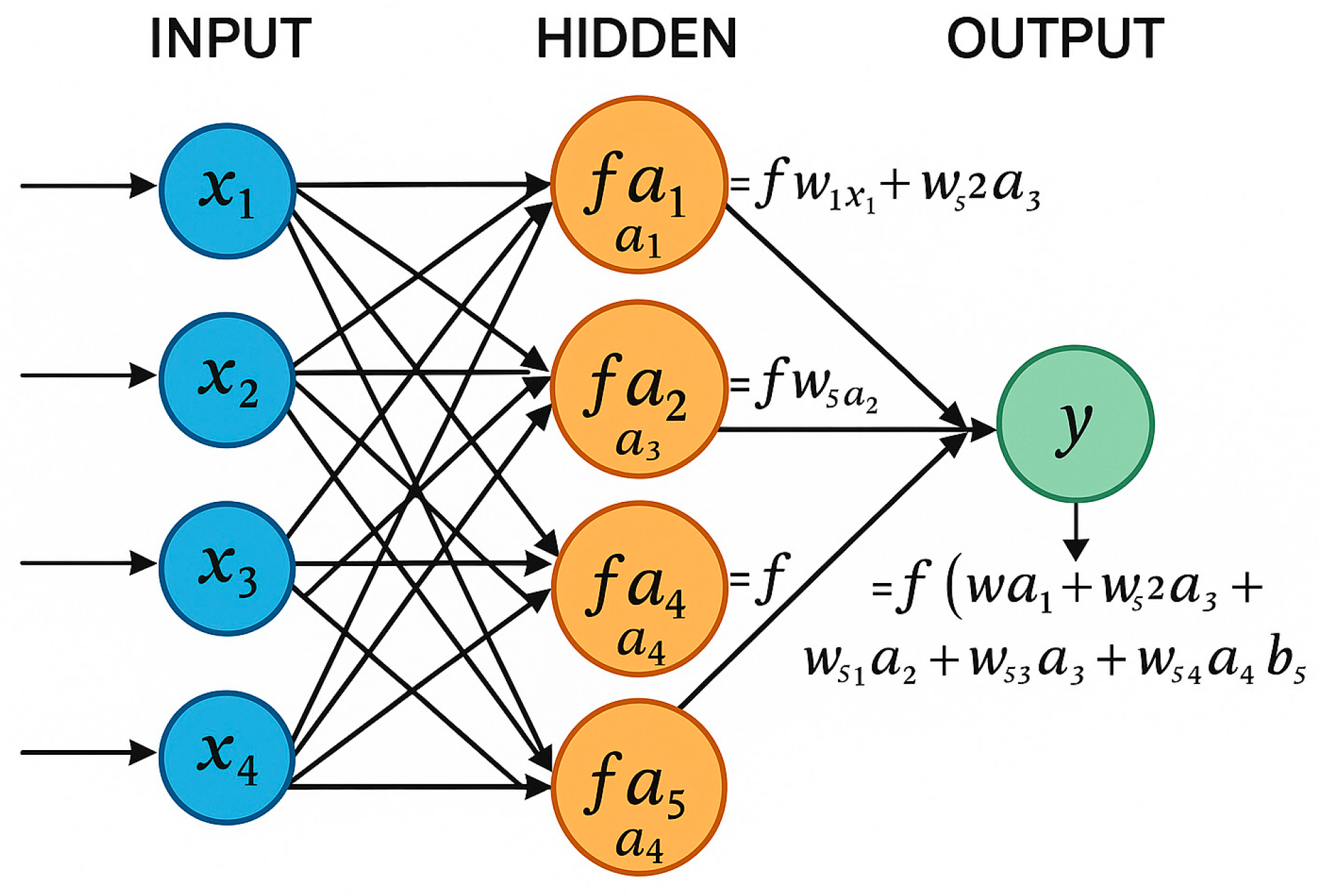
As stated earlier, the methodology adopts the use of AI and ML for fault diagnosis, as previous applications of interest have done [43,44,45]. Four DNNs with four hidden layers each were constructed using an extreme learning machine (ELM) approach, where the number of neurons per layer was varied to study the effect of architecture on performance. As shown in Figure 2, the DeepELM-DNN processes the LDV vibration inputs through multiple hidden transformations to produce final predictions of propeller fault type and severity.
To further elaborate on the training and testing parameters of the DeepELM-DNN model, Table 4 is constructed. Four different DNNs were used, with different labels of A, B, C, and D. Each of the four DNNs consists of 4 hidden layers and different neurons in order to understand the nature of extreme learning. A ReLU activation function is used for the hidden layers while a Softmax function is used for the output. The network is trained using a hybrid ELM–gradient approach, in which randomly initialized ELM-style hidden layers are fixed initially, followed by limited backpropagation fine-tuning using the Adam optimizer to enhance classification performance. The dataset was split into 80% for training and 20% for testing. Model performance was evaluated on the test set to assess generalizability.
Model evaluation was performed using a stratified hold-out validation strategy, where 80% of the available instances were used for training and the remaining 20% were reserved exclusively for testing. This procedure ensures that all operational states are proportionally represented in both subsets as it provides an unbiased assessment of generalized performance without data leakage.
The traditional statistical vibration features extracted from each LDV measurement are summarized in Table 5, as the table represents widely used descriptors for vibration-based UAV fault diagnosis. The evaluation of the DeepELM-DNN models was performed using standard ML performance indicators, summarized in Table 6.

3. The Experimental Work

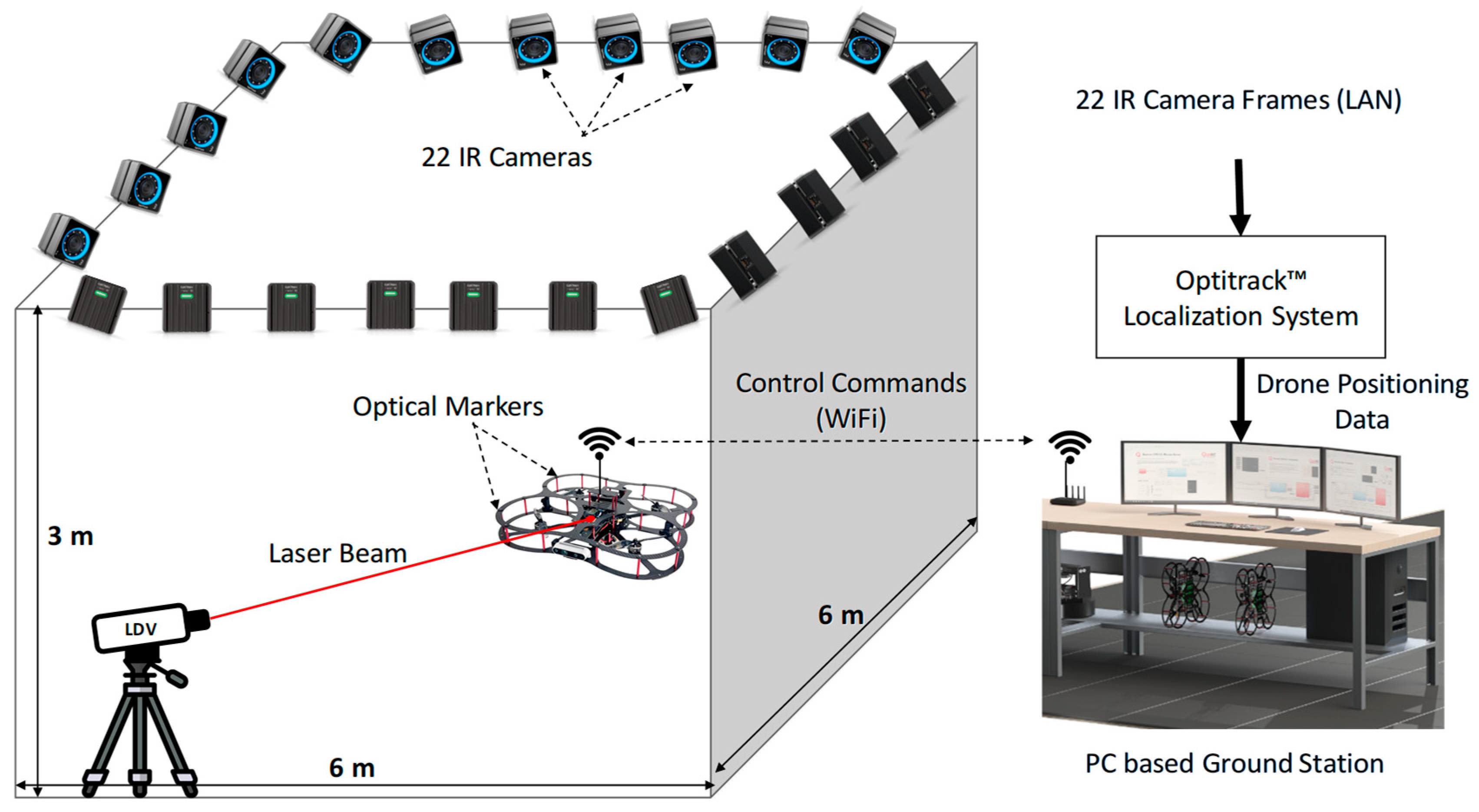
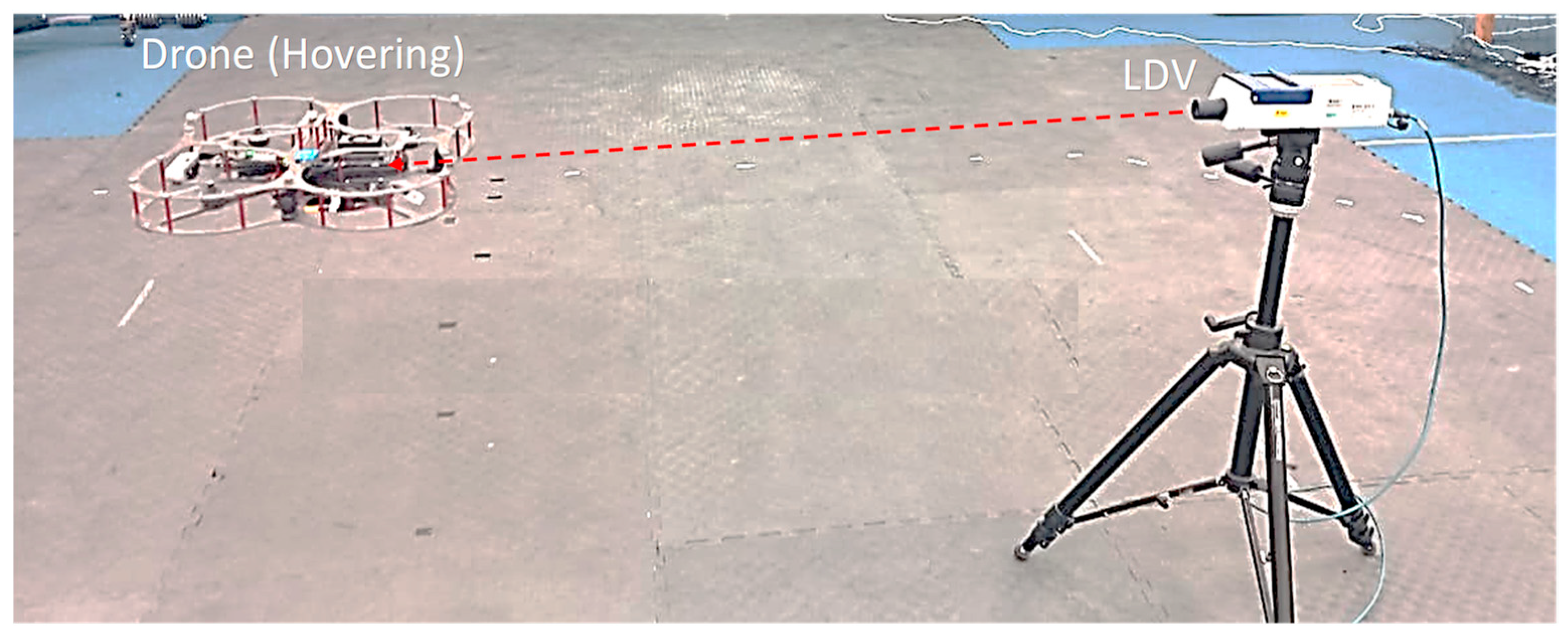
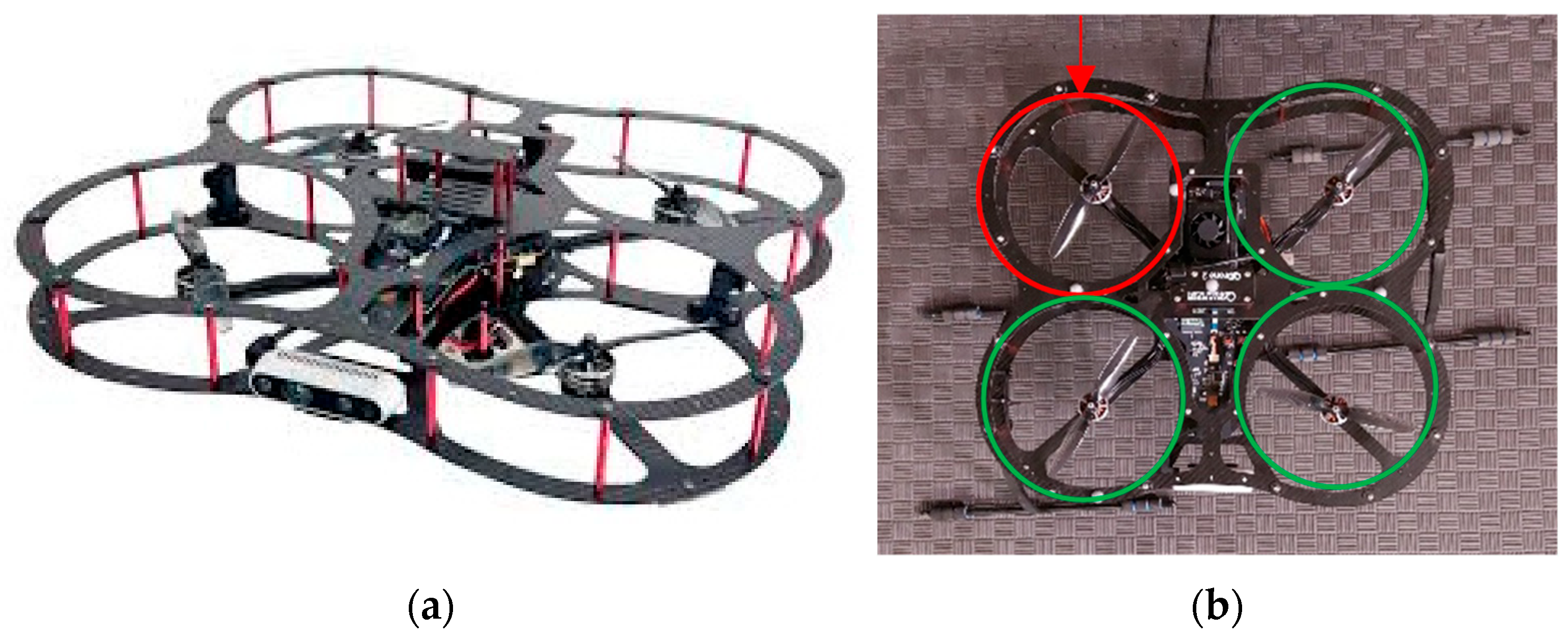
The experimental setup (Figure 3 and Figure 4) was based on Quanser Autonomous Vehicles Research Studio (AVRS), a comprehensive platform for the development and evaluation of multicopter UAVs. The AVRS includes a MATLAB 2025a-based ground control station integrated with an OptiTrack vision system consisting of 22 infrared cameras and optical markers placed on the drones, providing positional accuracy of ±3 mm along the X, Y, and Z axes. The experiments employed the Quanser QDrone 2 (Figure 5), which features a maximum takeoff weight of 1.5 kg and a hover endurance of approximately 8 min as listed in Table 7. A commercial LDV model VibroGo [46] from Polytec was used in this setup. VibroGo measures vibration velocity, displacement, and frequency across a broad frequency range (up to 320 kHz) with high precision and real-time data acquisition for remote objects of 30 m. Here, we considered a frequency range of 5 kHz and a maximum range of 0.2 m/s, which is sufficient for drone faults.
The experiments were conducted under operating conditions representative of commercial industrial UAV deployments, where drones are routinely required to hover at fixed positions for inspection and monitoring tasks. The employed platform provides a hovering accuracy of approximately 2 cm, comparable to RTK-enabled industrial UAVs that achieve 1–3 cm positional stability even in outdoor environments. To mitigate wind influence, inspections were either performed in a hangar environment with negligible airflow or conducted outdoors only under predefined wind speed limits approved by the industrial partner.
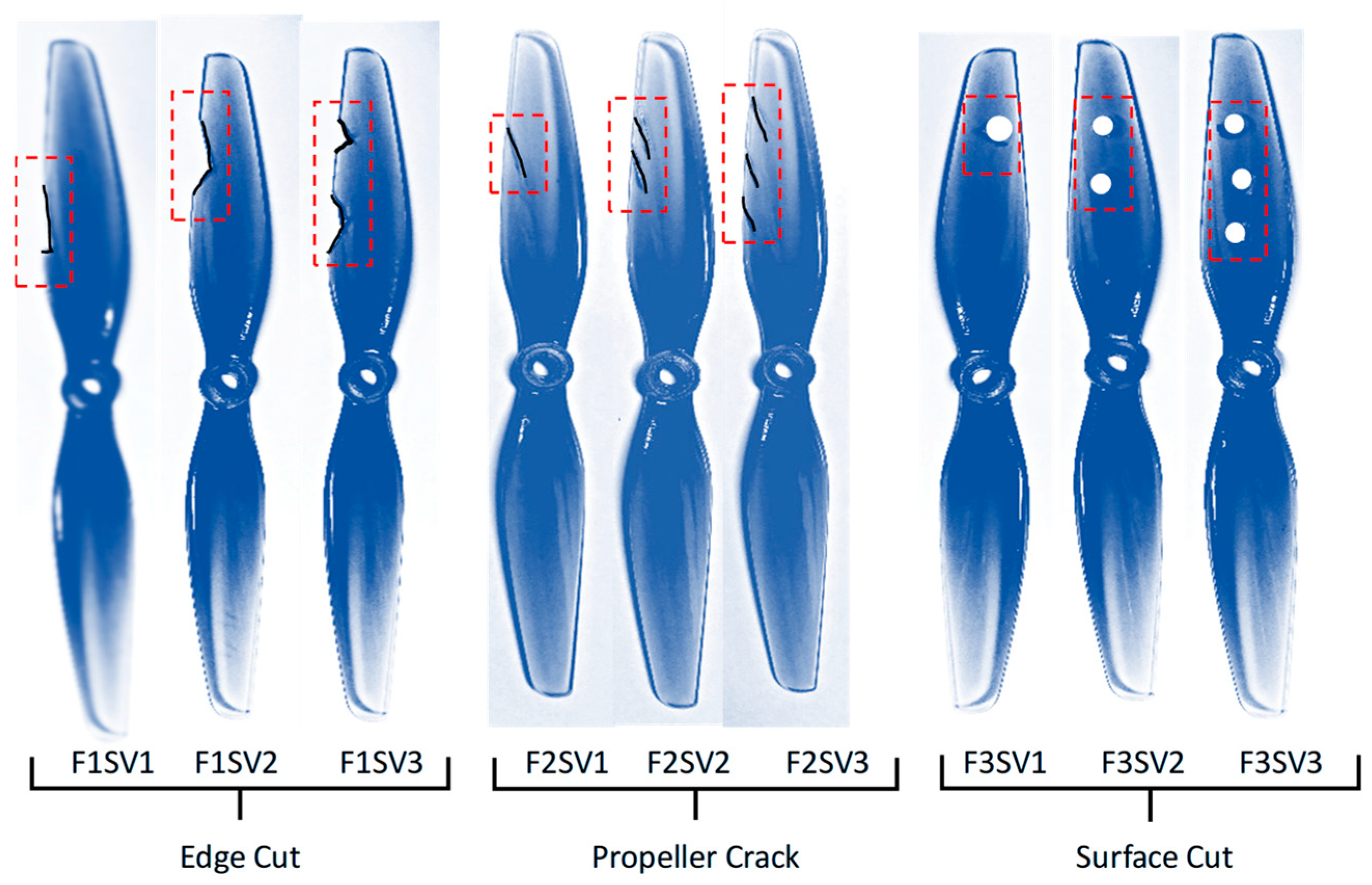
The propellers used in this study were HQ Durable Prop 7 × 4.5 Light Grey models [47], manufactured from polycarbonate and optimized for high-performance drone applications. Three fault types were introduced for investigation: edge-cut, crack, and unbalance faults as listed in Table 8. Each fault category was examined at three severity levels—low, medium, and high—defined by their physical dimensions as shown in Figure 6. The faults were imposed while the UAV operated under nominal hovering conditions. Edge-cut faults were emulated by trimming material from the propeller blade edges, altering the airflow and increasing vibrational stress. The severity levels corresponded to a 2 mm single cut, a 5 mm single cut, and two 5 mm edge cuts. Crack faults were produced by introducing inclined surface fractures to mimic structural degradation at high rotational speeds, defined by one, two, or three cracks, each 10 mm long. Unbalance faults were generated by drilling holes in one blade to induce mass asymmetry, using one, two, or three holes of 6 mm diameter to represent increasing severity. The LDV was manually aimed at the drone under inspection for a duration of one second. During this period, the drones maintained a stable hover using the OptiTrack-based motion control system.
In addition to the previous statements, it is important to point out that these propeller faults have been analyzed for UAV dynamics-based fault diagnosis in [48,49], and the corresponding onboard datasets, including position and acceleration measurements, are available in a public data repository as reported in [50].

4. Results and Discussion

4.1. Experimental Data Visualization

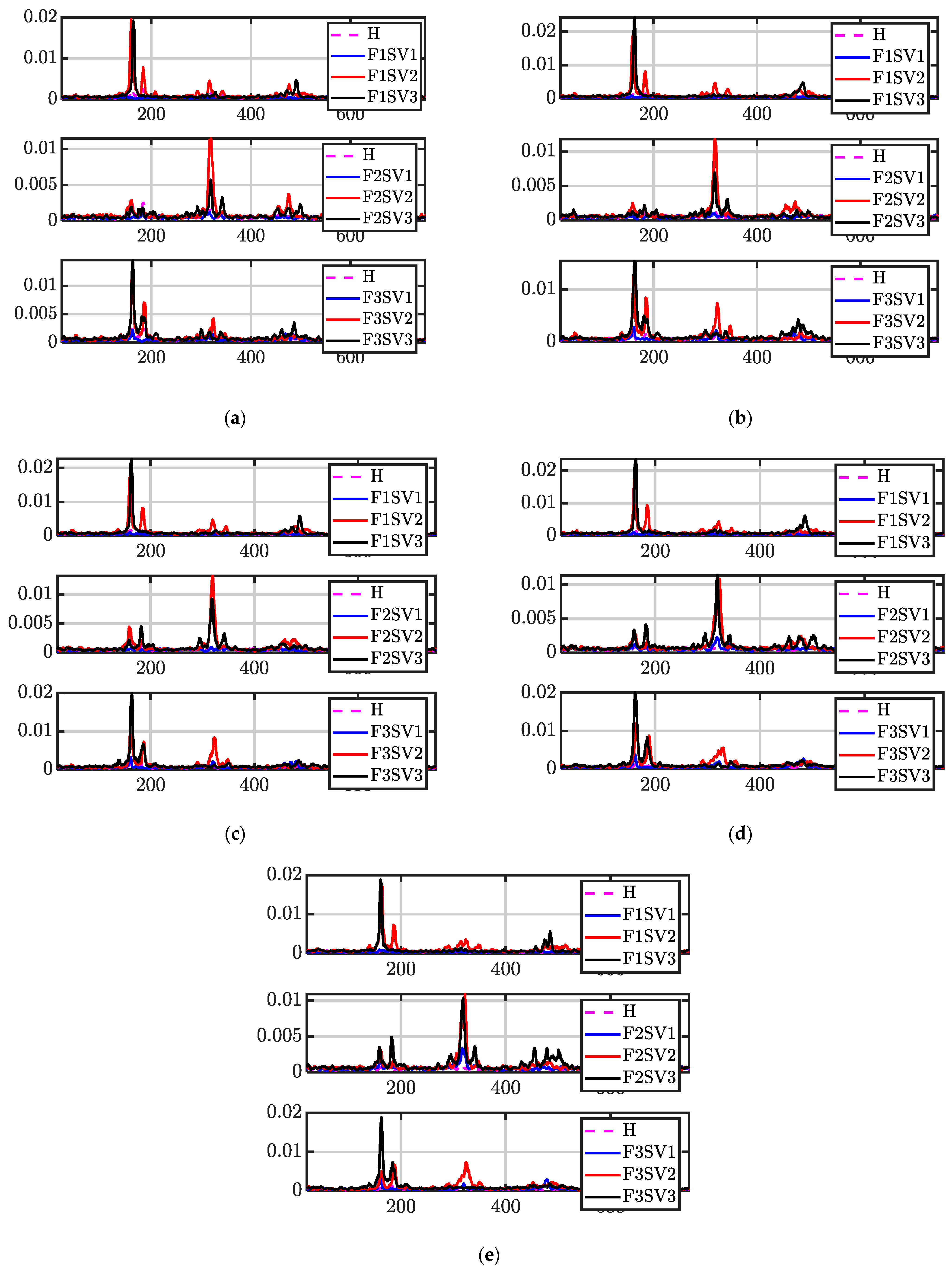
Figure 7 provides an initial visual assessment of the LDV vibration signatures for all ten operational states, including the healthy condition and the nine induced fault cases. Each subplot corresponds to one measurement channel and shows the first 800 samples of the 1 s waveform (selected from the full 4410-sample signal for improved clarity). Across all five measurement segments, a consistent trend is observed: the low-severity cases (F1SV1, F2SV1, and F3SV1) exhibit the smallest vibration amplitudes, remaining close to the baseline with only minor peaks and subtle fluctuations. Their waveforms remain largely compact, indicating limited structural disturbance at the early stage of edge-cutting, cracking, or unbalance. The y-axis amplitude remains within 0–0.02 m/s and this is purely represented in the measured LDV vibration instantaneous velocity, while the x-axis shows the sample index rather than physical time, given the 4410 Hz sampling rate.
As fault severity increases, the visual patterns become progressively more pronounced. The medium-severity cases (F1SV2, F2SV2, and F3SV2) exhibit noticeably higher peak responses and more irregular waveform shapes, reflecting deeper material removal, longer cracks, or greater mass asymmetry on the propeller blade. The large-severity cases (F1SV3, F2SV3, and F3SV3) consistently produce the highest peaks among all conditions, with more energetic oscillations and sharper amplitude transitions throughout the segment. This escalation across severities validates the physical intuition that greater blade damage leads to stronger vibrational disturbances. The separation between low, medium, and high severity is clearly distinguishable in all channels and hence this actually supports the suitability of LDV signals for fault detection. That said, this will subsequently form the basis for the high classification accuracy achieved by the DeepELM-DNN in later results.
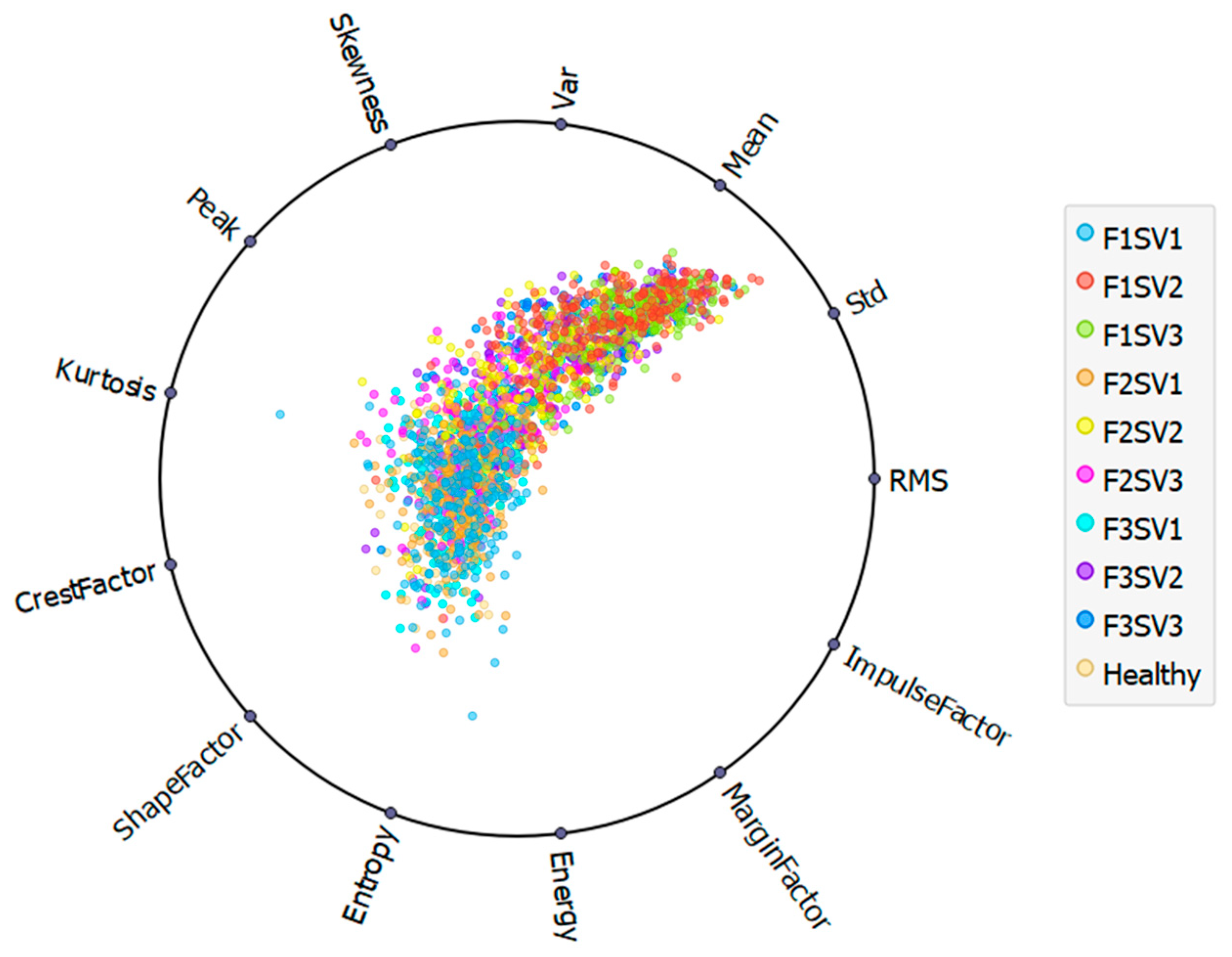
All five LDV vibration measurements collected for each operational state were first combined into a single continuous signal to ensure full representation of the UAV’s dynamic response. The unified signal for each state was then segmented into 100 equal-length windows, from which statistical features were extracted. This process yielded approximately 221 new feature instances per operational state in order to form a balanced dataset suitable for training and evaluating the DeepELM-DNN fault diagnosis models. The resulting 221 instances were yielded due to the fact that the dataset was made up of 2210 instances for each reading. The distribution and separability of the extracted statistical features across all operational states are illustrated in Figure 8, which presents a radial visualization of the feature space. Radial visualization was selected to illustrate feature separability because it preserves the original statistical feature structure and class-wise magnitude relationships without dimensionality reduction, unlike PCA or t-SNE, which may distort inter-feature contributions and are sensitive to parameter selection. The statistical feature dataset was analyzed using Orange Data Mining, a visual machine learning toolkit built on top of the Python 3.7 ecosystem.

4.2. AI and ML Approach Results

Generally speaking, it is necessary to select the types of features that are to be progressed into an AI or ML model, but this study did not. Traditional factors require no feature importance ranking, as all are progressed since the novelty of the work lies within the experimental datasets. Consequently, the current study applied no feature importance analysis, yet this study recommends future work including that. The assessment metrics of the four DNNs trained under the DeepELM framework are listed within Table 9 below, where the four DNNs show different values depending on the differently trained networks.
Interestingly, DNN-C demonstrates the highest overall effectiveness as it achieved an accuracy of 97.9%, a precision of 98.3%, a recall of 98.7%, an F1-score of 98.5%, a specificity of 97.6%, and an AUC–ROC of 0.987. DNN-A follows closely, with accuracy, precision, and recall values of 96.8%, 96.1%, and 97.0%, respectively. DNN-B achieves slightly lower scores, with 95.9% accuracy, 95.4% precision, and 96.2% recall. DNN-D records the lowest performance among the four models, with an accuracy of 94.2%, a precision of 93.5%, a recall of 94.1%, and a specificity of 92.3%. These numerical differences clearly illustrate the superiority of DNN-C in both classification strength and robustness, while DNN-D trails with the weakest performance. This is owed to the fact that the DeepELM-DNN framework shows how different neurons act when subjected to extreme learning.
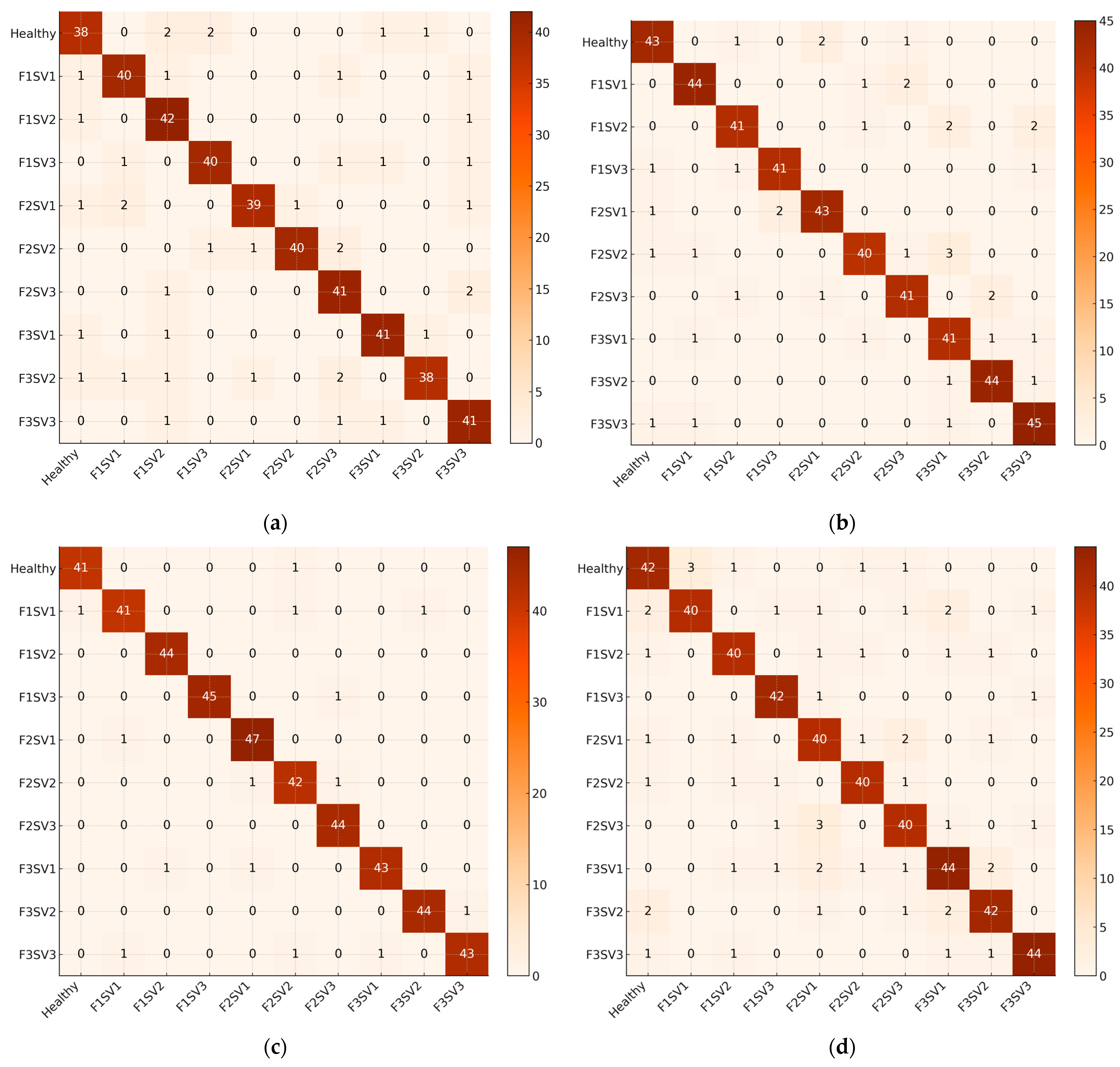
As stated earlier, the dataset was partitioned using an 80/20 training–testing split and this means that approximately 80% of all feature instances were used to train the DeepELM-DNN models, while the remaining 20% were exclusively used for testing, and the confusion matrices in Figure 9 were generated solely from these held-out test samples to ensure unbiased evaluation.
As shown in Figure 9a, DNN-A demonstrates strong classification performance with the majority of its predictions concentrated along the diagonal. The model correctly classifies most instances, with diagonal values ranging from approximately 38 to 42 correct predictions per class, aligning with its overall accuracy of 96.8%. The off-diagonal misclassifications remain low, typically between 0 and 3 instances, which is consistent with the reported precision of 96.1% and recall of 97.0%. These small misclassification counts reflect the model’s reliable ability to distinguish between closely related fault types such as F1SV1 vs. F1SV2 or F3SV2 vs. F3SV3. The structure of the matrix confirms that DNN-A maintains robust detection capabilities across all ten operational states. Moreover, in Figure 9b, the confusion matrix for DNN-B shows a slight increase in misclassification compared to DNN-A, which aligns with its lower accuracy of 95.9%. Correct classifications along the diagonal typically range from 37 to 41 per class, while off-diagonal elements occasionally reach 2–4 misclassifications, particularly between mid-severity and high-severity faults. These numerical patterns correspond with the precision of 95.4% and recall of 96.2%, indicating that while DNN-B maintains solid performance, it occasionally confuses fault types with similar vibrational characteristics—especially within the F2 and F3 categories.
As illustrated in Figure 9c, DNN-C achieves the cleanest and most concentrated diagonal among all models, with correct prediction counts consistently between 40 and 44 samples per class. Off-diagonal misclassification is minimal, often 0 or 1, rarely reaching 2, demonstrating excellent fault separation. These numerical observations mirror the superior metrics of 97.9% accuracy, 98.3% precision, 98.7% recall, and an exceptional AUC–ROC of 0.987. The matrix visually confirms DNN-C’s ability to discriminate even the most subtle differences among the ten operational states, explaining why this model achieves the highest F1-score of 98.5%. This makes DNN-C the most reliable and robust classifier in the framework. Finally, Figure 9d shows the confusion matrix for DNN-D, which has the highest level of dispersion among the four models. While diagonal values remain moderately strong at 36 to 40 correct predictions per class, the off-diagonal misclassification values are more frequent, sometimes reaching 3 to 5 errors per class. These numbers reflect DNN-D’s lower accuracy of 94.2%, precision of 93.5%, and specificity of 92.3%, confirming that this model is more prone to confusion between adjacent severity levels. The matrix clearly aligns with the numerical metrics and reinforces that DNN-D performs adequately but significantly below the higher-capacity models.
Unlike onboard sensor-based fault diagnosis approaches that rely on predefined fault models tied to control or inertial variables, the proposed LDV-based framework operates as a fault-agnostic mechanical observer. By directly capturing vibration responses at the propeller–motor–structure level, the method enables the detection of a broad range of fault mechanisms—including mass imbalance, structural degradation, motor-related anomalies, and control-induced oscillations—without requiring explicit fault modeling or onboard system access. This generality makes the approach particularly suitable for early-stage degradation monitoring in commercial UAV fleets.
The proposed LDV-based AI inspection system directly aligns with the focus of the intelligent automation for agricultural robotics, as UAVs are increasingly deployed as autonomous agents in modern precision-farming workflows. By enabling remote, non-intrusive, and highly sensitive fault diagnosis, the developed DeepELM-DNN framework supports safer, smarter, and more reliable agricultural UAV operations—ultimately improving field monitoring, crop analysis, and robotic coordination in data-driven farming environments.
While several recent studies define UAV faults primarily in terms of loss of thrust effectiveness, motor-speed deviation, or control-performance degradation, such definitions remain inherently tied to onboard sensing and control variables. In contrast, the proposed LDV-based approach targets the mechanical manifestation of faults at the propeller–motor–shaft level, which remains observable regardless of whether the root cause originates from mass imbalance, motor degradation, bearing wear, or control-induced anomalies. Even in cases where faults are defined as thrust loss or control effectiveness reduction, such conditions inevitably introduce changes in vibration energy distribution, spectral content, and impulsive behavior that can be captured by high-bandwidth LDV measurements. Therefore, the proposed offboard LDV framework does not contradict thrust-based fault definitions but rather complements them by providing an early-stage, noncontact mechanical observability layer, particularly suited for industrial UAVs where onboard access is restricted or unavailable, as also discussed in recent thrust loss-oriented fault diagnosis studies [51,52].
Future research will extend the proposed offboard LDV-based diagnostic framework toward secure and resilient UAV operations, including fault diagnosis and control under False Data Injection (FDI) attacks and communication-aware fault-tolerant strategies [53,54]. Investigating the interaction between offboard fault diagnosis, adaptive cooperative control, and communication resource conservation represents a promising direction, particularly for large UAV fleets operating in networked environments. Furthermore, the generated LDV dataset can be leveraged to evaluate additional machine learning and deep learning classifiers previously applied to UAV fault diagnosis—such as ensemble learning, attention-based networks, hybrid signal–learning frameworks, and lightweight models—allowing comprehensive benchmarking against existing state-of-the-art approaches [55,56].

5. Conclusions

This study presented AirScanner, a remote Laser Doppler Vibrometer (LDV)-based UAV fault diagnosis framework integrating statistical vibration features with four DeepELM-DNN architectures. The proposed methodology combined five LDV measurements per operating condition, applied structured signal segmentation to generate 221 instances for each UAV state, and evaluated diagnostic performance using six complementary classification metrics.
Experimental testing on ten UAV operational states revealed that DNN-C delivered the strongest classification performance, achieving an overall accuracy of 97.9%. Specifically, DNN-C attained 98.3% precision, 98.7% recall, 98.5% F1-score, 97.6% specificity, and an AUC–ROC of 0.987, which confirms its superior diagnostic capability. These consistently high metrics indicate robust fault separability across multiple fault types and severity levels, confirming the effectiveness of the DeepELM-based learning strategy when applied to LDV vibration signatures. In this context, the proposed LDV-based framework supports a generalized fault diagnosis paradigm as it enables nonintrusive detection of diverse mechanically observable fault mechanisms without dependence on onboard sensors or predefined fault models.
Most importantly, the results highlight the significance of LDV as a noncontact, nonintrusive, and offboard alternative to onboard sensing, enabling high-sensitivity propeller fault detection without requiring onboard computational or sensor modifications. This capability makes the proposed framework particularly suitable for scalable UAV fleet maintenance in smart agriculture, as well as broader industrial inspection and automated robotic monitoring applications.
Future work will expand the diagnostic pipeline by incorporating advanced feature engineering, including time–frequency and non-linear statistical descriptors, as well as automatic feature-selection algorithms to enhance robustness under noisy or mixed operating conditions. Additional experiments will explore diverse AI and machine learning classifiers, including attention-based networks, ensemble methods, and meta-learning frameworks. Integrating real-time LDV acquisition, edge-device deployment, and multi-sensor fusion will further strengthen the scalability of AirScanner for large-scale agricultural robotic fleets and autonomous field-operation scenarios.

Author Contributions

LDV-based conceptual design and principles, M.A.A.I.; investigating AI-diagnostic method, S.T.K.; conducting fault diagnosis tests, M.S.A.; results analysis and co-interpretation, C.R.; writing—original draft preparation, M.A.A.I., S.T.K., M.S.A. and C.R. All authors have read and agreed to the published version of the manuscript.

Funding

This research was funded by the Interdisciplinary Research Center for Aviation and Space Exploration, King Fahd University of Petroleum & Minerals, project number no. INAE2404.

Data Availability Statement

The original contributions presented in this study are included in the article. Further inquiries can be directed to the corresponding author.

Acknowledgments

The authors would like to thank the Interdisciplinary Research Center for Aviation and Space Exploration at KFUPM for supporting the experimental work of this research.

Conflicts of Interest

The authors declare no conflicts of interest.

References

  1. Du, Z.; Liu, S.; Liao, Y.; Tang, Y.; Liu, Y.; Xing, H.; Zhang, Z.; Zhang, D. UniHSFormer X for Hyperspectral Crop Classification with Prototype-Routed Semantic Structuring. Agriculture 2025, 15, 1427. [Google Scholar] [CrossRef]
  2. Ruwanpathirana, P.P.; Sakai, K.; Jayasinghe, G.Y.; Nakandakari, T.; Yuge, K.; Wijekoon, W.M.C.J.; Priyankara, A.C.P.; Samaraweera, M.D.S.; Madushanka, P.L.A. Evaluation of Sugarcane Crop Growth Monitoring Using Vegetation Indices Derived from RGB-Based UAV Images and Machine Learning Models. Agronomy 2024, 14, 2059. [Google Scholar] [CrossRef]
  3. Li, W.; Luo, Y.; Jiang, P.; Dong, X.; Tang, K.; Liang, Z.; Shi, Y. A sustainable crop protection through integrated technologies: UAV-based detection, real-time pesticide mixing, and adaptive spraying. Sci. Rep. 2025, 15, 35748. [Google Scholar] [CrossRef] [PubMed]
  4. Lan, Y. Spraying Technology in Precision Agriculture Aviation. In Precision Agricultural Aviation Application Technology; Lan, Y., Ed.; Springer Nature Switzerland AG: Cham, Switzerland, 2025; pp. 293–392. [Google Scholar]
  5. Rajat, K.; Shekhar, K.S.; Tanti, H.A.; Datta, A. UAV Based Farm Inspection using Deep Learning. In Proceedings of the 2025 IEEE International Conference on Emerging Technologies and Applications (MPSec ICETA), Gwalior, India, 21–23 February 2025; pp. 1–5. [Google Scholar]
  6. Haque, K.M.S.; Joshi, P.; Subedi, N. Integrating UAV-based multispectral imaging with ground-truth soil nitrogen content for precision agriculture: A case study on paddy field yield estimation using machine learning and plant height monitoring. Smart Agric. Technol. 2025, 12, 101542. [Google Scholar] [CrossRef]
  7. Wang, J.; Huang, H.; Ariyasena, H.; Zhao, J.; Zhang, X.; Gao, X.; Zhao, X.; Zhao, Y. A UAV-based method for root zone soil moisture modeling of different farmland scale with grain and economic crops. Agric. Water Manag. 2025, 321, 109932. [Google Scholar] [CrossRef]
  8. Bosch, C.; Hajek, M.; Ismail, M.A. Preliminary Safety Assessment for Electro-mechanical Actuation Architectures for Unmanned Aerial Vehicles. In Proceedings of the 2021 5th International Conference on Control and Fault-Tolerant Systems (SysTol), Saint-Raphael, France, 29 September 2021–1 October 2021; pp. 133–138. [Google Scholar]
  9. Ismail, M.A.A.; Wiedemann, S.; Bosch, C.; Stuckmann, C. Design and Evaluation of Fault-Tolerant Electro-Mechanical Actuators for Flight Controls of Unmanned Aerial Vehicles. Actuators 2021, 10, 175. [Google Scholar] [CrossRef]
  10. Al-Khafaji, A.J.D.; Al-Haddad, L.A. Parametric aerodynamic characterization of tail geometry variations in fixed-wing UAVs. Aerosp. Syst. 2025, 1–16. [Google Scholar] [CrossRef]
  11. Al-Haddad, L.A.; Jaber, A.A. Improved UAV blade unbalance prediction based on machine learning and ReliefF supreme feature ranking method. J. Braz. Soc. Mech. Sci. Eng. 2023, 45, 463. [Google Scholar] [CrossRef]
  12. Al-Haddad, L.A.; Jaber, A.A.; Neranon, P.; Al-Haddad, S.A. Investigation of Frequency-Domain-Based Vibration Signal Analysis for UAV Unbalance Fault Classification. Eng. Technol. J. 2023, 41, 915–923. [Google Scholar] [CrossRef]
  13. Al-Haddad, L.A.; Jaber, A.A. An Intelligent Quadcopter Unbalance Classification Method Based on Stochastic Gradient Descent Logistic Regression. In Proceedings of the 2022 3rd Information Technology to Enhance e-Learning and Other Application (IT-ELA), Baghdad, Iraq, 27–28 December 2022; pp. 152–156. [Google Scholar]
  14. Al-Haddad, L.A.; Jaber, A.A. Influence of Operationally Consumed Propellers on Multirotor UAVs Airworthiness: Finite Element and Experimental Approach. IEEE Sens. J. 2023, 23, 11738–11745. [Google Scholar] [CrossRef]
  15. Al-Haddad, L.A.; Jaber, A.A.; Mahdi, N.M.; Al-Haddad, S.A.; Al-Karkhi, M.I.; Al-Sharify, Z.T.; Ogaili, A.A.F. Protocol for UAV fault diagnosis using signal processing and machine learning. STAR Protoc. 2024, 5, 103351. [Google Scholar] [CrossRef]
  16. Adaika, Z.; Al-Haddad, L.A.; Giernacki, W.; Jaber, A.A.; Boumehraz, M.; Hamzah, M.N.; Flayyih, M.A. Fault Detection and Diagnosis Methodologies for Unmanned Aerial Vehicles: State-of-the-Art. J. Intell. Robot. Syst. 2025, 111, 63. [Google Scholar] [CrossRef]
  17. Al-Haddad, L.A.; Jaber, A.A.; Hamzah, M.N.; Kraiem, H.; Al-Karkhi, M.I.; Flah, A. Multiaxial vibration data for blade fault diagnosis in multirotor unmanned aerial vehicles. Sci. Data 2025, 12, 1383. [Google Scholar] [CrossRef]
  18. Al-Haddad, L.A.; Jaber, A. Applications of Machine Learning Techniques for Fault Diagnosis of UAVs. SYSTEM 2022, 19–25. [Google Scholar]
  19. Zhang, Y.; Zhang, Z.; Xiong, M.; Chen, Z. Vision-based displacement estimation of short- to medium-span bridges using two-stage UAV motion correction. Measurement 2025, 256, 118145. [Google Scholar] [CrossRef]
  20. Li, G.; Gui, H.; Lu, J.; Tang, X.; Gao, X. Multi-scale feature fusion network with temporal dynamic graphs for small-sample FW-UAV fault diagnosis. Knowl.-Based Syst. 2025, 330, 114605. [Google Scholar] [CrossRef]
  21. Shang, X.; Li, W.; Yuan, F.; Zhi, H.; Gao, Z.; Guo, M.; Xin, B. Research on Fault Diagnosis of UAV Rotor Motor Bearings Based on WPT-CEEMD-CNN-LSTM. Machines 2025, 13, 287. [Google Scholar] [CrossRef]
  22. Ai, S.; Song, J.; Cai, G.; Zhao, K. Active Fault-Tolerant Control for Quadrotor UAV against Sensor Fault Diagnosed by the Auto Sequential Random Forest. Aerospace 2022, 9, 518. [Google Scholar] [CrossRef]
  23. Gong, W.; Li, B.; Ahn, C.K.; Yang, Y. Prescribed-time extended state observer and prescribed performance control of quadrotor UAVs against actuator faults. Aerosp. Sci. Technol. 2023, 138, 108322. [Google Scholar] [CrossRef]
  24. Al-Haddad, L.A.; Giernacki, W.; Shandookh, A.A.; Jaber, A.A.; Puchalski, R. Vibration Signal Processing for Multirotor UAVs Fault Diagnosis: Filtering or Multiresolution Analysis? Eksploat. Niezawodn.–Maint. Reliab. 2023, 26, 176318. [Google Scholar] [CrossRef]
  25. Al-Haddad, L.A.; Jaber, A.A.; Al-Haddad, S.A.; Al-Muslim, Y.M. Fault diagnosis of actuator damage in UAVs using embedded recorded data and stacked machine learning models. J. Supercomput. 2023, 80, 3005–3024. [Google Scholar] [CrossRef]
  26. Kołodziejczak, M.; Puchalski, R.; Bondyra, A.; Sladic, S.; Giernacki, W. Toward lightweight acoustic fault detection and identification of UAV rotors. In Proceedings of the 2023 International Conference on Unmanned Aircraft Systems (ICUAS), Warsaw, Poland, 6–9 June 2023; pp. 990–997. [Google Scholar]
  27. Al-Haddad, L.A.; Jaber, A.A. An Intelligent Fault Diagnosis Approach for Multirotor UAVs Based on Deep Neural Network of Multi-Resolution Transform Features. Drones 2023, 7, 82. [Google Scholar] [CrossRef]
  28. Al-Haddad, L.A.; Giernacki, W.; Basem, A.; Khan, Z.H.; Jaber, A.A.; Al-Haddad, S.A. UAV propeller fault diagnosis using deep learning of non-traditional χ2-selected Taguchi method-tested Lempel–Ziv complexity and Teager–Kaiser energy features. Sci. Rep. 2024, 14, 18599. [Google Scholar] [CrossRef] [PubMed]
  29. Jaber, A.A.; Al-Haddad, L.A. Integration of Discrete Wavelet and Fast Fourier Transforms for Quadcopter Fault Diagnosis. Exp. Tech. 2024, 48, 865–876. [Google Scholar] [CrossRef]
  30. Liang, S.; Yu, J.; Tang, D.; Ke, X. Interpretable attention-based prototype network for UAV fault diagnosis under small sample conditions. Reliab. Eng. Syst. Saf. 2025, 265, 111601. [Google Scholar] [CrossRef]
  31. Yang, J.; Chu, H.; Guo, L.; Ge, X. A Weighted-Transfer Domain-Adaptation Network Applied to Unmanned Aerial Vehicle Fault Diagnosis. Sensors 2025, 25, 1924. [Google Scholar] [CrossRef] [PubMed]
  32. Li, Y.; Jia, Z.; Liu, J.; Wang, K.; Zhao, P.; Liu, X.; Liu, Z. An Integrated Strategy for Interpretable Fault Diagnosis of UAV EHA DC Drive Circuits Under Early Fault and Imbalanced Data Conditions. Drones 2025, 9, 189. [Google Scholar] [CrossRef]
  33. He, Y.; Fang, H.; Yan, J.; Yang, C.; Zhai, Y. Computationally efficient UAV fault diagnosis with adaptive vibration denoising: A signal processing approach for rotorcraft systems. Mech. Syst. Signal Process. 2025, 240, 113413. [Google Scholar] [CrossRef]
  34. Rembe, C.; Halkon, B.J.; Ismail, M.A. Measuring Vibrations in Large Structures with Laser-Doppler Vibrometry and Unmanned Aerial Systems: A Review and Outlook. Adv. Devices Instrum. 2025, 6, 0103. [Google Scholar] [CrossRef]
  35. Schewe, M.; Ismail, M.A.A.; Zimmermann, R.; Durak, U.; Rembe, C. Flyable Mirror: Airborne laser Doppler vibrometer for large engineering structures. In Journal of Physics: Conference Series, Proceedings of the 15th International AIVELA Conference on Vibration Measurements by Laser and Noncontact Techniques, Ancona, Italy, 21–23 June 2023; IOP Publishing: Bristol, UK, 2024; Volume 2698, p. 012007. [Google Scholar]
  36. Schewe, M.; Ismail, M.A.A.; Rembe, C. Towards airborne laser Doppler vibrometry for structural health monitoring of large and curved structures. Insight–Non-Destr. Test. Cond. Monit. 2021, 63, 280–282. [Google Scholar] [CrossRef]
  37. Richmond, J.L.; Halkon, B.J. Speaker Diarisation of Vibroacoustic Intelligence from Drone Mounted Laser Doppler Vibrometers. In Journal of Physics: Conference Series, Proceedings of the 14th International AIVELA Conference on Vibration Measurements by Laser and Noncontact Techniques, Ancona, Italy, 28–29 June 2021; IOP Publishing: Bristol, UK, 2024. [Google Scholar]
  38. Ismail, M.A.; Bierig, A. Identifying drone-related security risks by a laser vibrometer-based payload identification system. In Proceedings of the Laser Radar Technology and Applications XXIII, Orlando, FL, USA, 10 May 2018; International Society for Optics and Photonics: Bellingham, WA, USA, 2018; Volume 10636, p. 1063603. [Google Scholar] [CrossRef]
  39. Garg, P.; Nasimi, R.; Ozdagli, A.; Zhang, S.; Mascarenas, D.D.L.; Taha, M.R.; Moreu, F. Measuring Transverse Displacements Using Unmanned Aerial Systems Laser Doppler Vibrometer (UAS-LDV): Development and Field Validation. Sensors 2020, 20, 6051. [Google Scholar] [CrossRef]
  40. Yuan, K.; Zhu, Z.; Chen, W.; Zhu, W. Development and Validation of a New Type of Displacement-Based Miniatured Laser Vibrometers. Sensors 2024, 24, 5230. [Google Scholar] [CrossRef]
  41. Al-Haddad, S.A.; Al-Haddad, L.A.; Jaber, A.A. Environmental engineering solutions for efficient soil classification in southern Syria: A clustering-correlation extreme learning approach. Int. J. Environ. Sci. Technol. 2024, 22, 2177–2190. [Google Scholar] [CrossRef]
  42. Al-Haddad, L.A.; Alawee, W.H.; Basem, A. Advancing task recognition towards artificial limbs control with ReliefF-based deep neural network extreme learning. Comput. Biol. Med. 2023, 169, 107894. [Google Scholar] [CrossRef] [PubMed]
  43. Gou, J.; He, X.; Du, L.; Zhang, W.; Ou, W. Deep class-weighted and class-shared dictionary learning for image classification. Expert Syst. Appl. 2025, 299, 130042. [Google Scholar] [CrossRef]
  44. Noon, S.K.; Noor, A.H.; Mannan, A.; Arshad, M.; Haider, T.; Abdullah, M. Real-Time Vehicle Sticker Recognition for Smart Gate Control with YOLOv8 and Raspberry Pi 4. Automation 2025, 6, 63. [Google Scholar] [CrossRef]
  45. El Desouky, N.; Torky, A.A.; Elbheiri, M.; Eid, M.S.; Ibrahim, M. Toward Autonomous Pavement Inspection: An End-to-End Vision-Based Framework for PCI Computation and Robotic Deployment. Automation 2025, 6, 67. [Google Scholar] [CrossRef]
  46. Polytec GmbH. VibroGo® Truly Portable Laser Vibration Measurement—Product Brochure and Datasheet; Polytec GmbH: Waldbronn, Germany. Available online: https://www.polytec.com/fileadmin/website/vibrometry/pdf/OM_PB_VibroGo_E_52042.pdf (accessed on 1 November 2025).
  47. HQProp Hq Durable 7 × 4.5 Propeller Datasheet. Available online: https://www.hqprop.com/hqdurable-prop-7×45-light-grey-2cw2ccw-poly-carbonate-popo-p0205.html (accessed on 1 November 2025).
  48. Elshaar, M.E.; Ismail, M.A.A.; Abdallah, A.M.; Alqutub, A.M.; Takeyeldein, M.M.; Quan, Q. UAV Propeller: Fault Detection, Characterization, and Calibration: A Comprehensive Study. IEEE Access 2025, 13, 187564–187583. [Google Scholar] [CrossRef]
  49. Elshaar, M.E.; Ismail, M.A.; Abdullah, A.M.; Quan, Q. Fault Diagnosis of Drone Propellers using Inner Loop Dynamics. In Proceedings of the 2025 International Conference on Control, Automation and Diagnosis (ICCAD), Barcelona, Spain, 1–3 July 2025; pp. 1–6. [Google Scholar]
  50. Ismail, M.A.; Elshaar, M.E.; Abdallah, A.; Quan, Q. DronePropA: Motion trajectories dataset for defective drones. Data Brief 2025, 60, 111589. [Google Scholar] [CrossRef] [PubMed]
  51. Khaneghaei, M.; Asadi, D.; Mowla, N.; Dişken, G. Experimental motor fault detection and identification of a quadrotor UAV using a hybrid deep learning approach. Int. J. Dyn. Control. 2025, 13, 281. [Google Scholar] [CrossRef]
  52. Mowla, N.; Asadi, D.; Sohel, F. Real-time fault detection in multirotor UAVs using lightweight deep learning and high-fidelity simulation data with single and double fault magnitudes. Complex Intell. Syst. 2025. [Google Scholar] [CrossRef]
  53. Liu, G.; Liang, H.; Wang, R.; Sui, Z.; Sun, Q. Adaptive Event-Triggered Output Feedback Control for Nonlinear Multiagent Systems Using Output Information Only. IEEE Trans. Syst. Man, Cybern. Syst. 2025, 55, 7639–7650. [Google Scholar] [CrossRef]
  54. Liu, G.; Sun, Q.; Su, H.; Wang, M. Adaptive Cooperative Fault-Tolerant Control for Output-Constrained Nonlinear Multi-Agent Systems Under Stochastic FDI Attacks. IEEE Trans. Circuits Syst. I Regul. Pap. 2025, 72, 6025–6036. [Google Scholar] [CrossRef]
  55. Al-Haddad, L.A.; Mahdi, N.M. Efficient multidisciplinary modeling of aircraft undercarriage landing gear using data-driven Naïve Bayes and finite element analysis. Multiscale Multidiscip. Model. Exp. Des. 2024, 7, 3187–3199. [Google Scholar] [CrossRef]
  56. Al-Haddad, L.A.; Łukaszewicz, A.; Majdi, H.S.; Holovatyy, A.; Jaber, A.A.; Al-Karkhi, M.I.; Giernacki, W. Energy consumption and efficiency degradation predictive analysis in unmanned aerial vehicle batteries using deep neural networks. Adv. Sci. Technol. Res. J. 2025, 19, 21–30. [Google Scholar] [CrossRef]
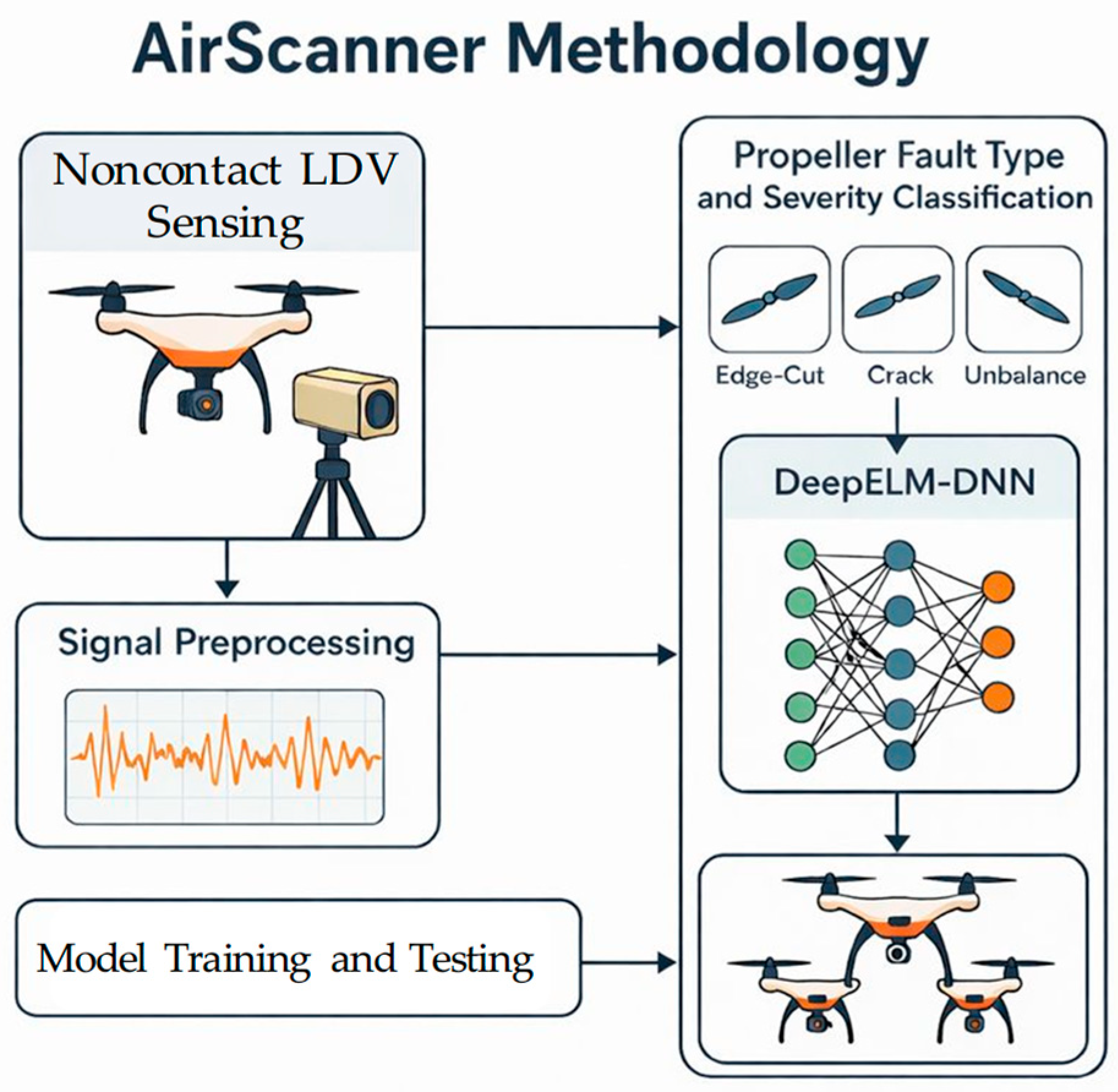
Figure 1. Methodology overview of the proposed AirScanner framework: noncontact LDV sensing of smart agricultural UAVs, signal preprocessing, and DeepELM-DNN-based propeller fault classification for fleet health monitoring.
Automation 07 00006 g001
Figure 2. Structure of the DeepELM-DNN architecture for UAV propeller fault diagnosis.
Automation 07 00006 g002
Figure 3. Experimental setup based on VibroGo LDV and Quanser AVRS.
Automation 07 00006 g003
Figure 4. Photograph for QDrone 2 in the hovering flight phase and LDV.
Automation 07 00006 g004
Figure 5. Utilized drones: (a) photograph for Quanser QDrone 2 with a carbon fiber frame; (b) the fault injection approach is based on a single propeller, shown in a red circle on the image.
Automation 07 00006 g005
Figure 6. Schematic representation of the three induced fault types.
Automation 07 00006 g006
Figure 7. Data visualization of all nine states of operation in addition to the healthy one: (a) first measurement; (b) second measurement; (c) third measurement; (d) fourth measurement; (e) fifth measurement.
Automation 07 00006 g007
Figure 8. Radial visualization of the previously stated statistics and different operational states.
Automation 07 00006 g008
Figure 9. Confusion matrix of (a) DNN-A; (b) DNN-B; (c) DNN-C; and (d) DNN-D.
Automation 07 00006 g009
Table 1. Summary of state-of-the-art AI-based UAV fault diagnosis approaches.
Ref.Methodology/ApplicationAI ApproachKey Result/Limitation
[20]Small-sample fixed-wing UAV fault diagnosis using spatio-temporal modelingMulti-Scale Feature Fusion + Temporal Dynamic Graph + LSTMAchieved +8% accuracy improvement under limited data; complex architecture requires expensive computation
[21]Rotor motor bearing fault diagnosis under noisy vibration conditionsWPT + CEEMD for denoising, CNN–LSTM hybrid network96.67% accuracy; strong generalization but relies on multi-stage signal preprocessing
[22]Quadrotor control with robustness to sensor degradationAuto Sequential Random ForestDemonstrated reliable detection for rotor sensor faults; feature-dependent and sensitive to noise
[23]Actuator fault diagnosis with guaranteed performance boundsPrescribed-Time ES Observer + Prescribed Performance ControlHigh tracking accuracy under actuator faults; observer gains difficult to tune for varied flight conditions
[24]Vibration analysis for multirotor UAV fault identificationFiltering vs. Multi-Resolution Analysis comparisonShowed superiority of multi-resolution methods; lacks modern deep learning integration
[25]Actuator damage diagnosis using onboard telemetryStacked ML models (RF, SVM, KNN ensembles)High accuracy using embedded data; limited interpretability and moderate computational load
[26]Acoustic-based UAV rotor fault detectionLightweight ML framework for acoustic signaturesEnables low-cost airborne acoustic diagnosis; sensitive to ambient environmental noise
[27]UAV fault diagnosis using wavelet-based multi-resolution featuresDeep Neural Network on transformed featuresImproved classification accuracy; feature extraction still hand-crafted
[28]UAV propeller fault diagnosis using non-traditional statistical complexity measuresDeep Learning on Taguchi-tested Lempel–Ziv + Teager–Kaiser featuresHigh robustness to non-stationary signals; requires computationally heavy feature engineering
[29]UAV diagnosis using hybrid time–frequency domain analysisDiscrete Wavelet + FFT integrationEnhanced resolution of fault signatures; lacks end-to-end learning capability
[30]Small-sample UAV diagnosis with interpretabilityAttention-based Prototype NetworkImproves transparency under limited datasets; accuracy depends on properly chosen prototypes
[31]Cross-domain UAV fault diagnosisWeighted-Transfer Domain-Adaptation NetworkStrong transferability to unseen domains; requires source–target similarity for optimal performance
[32]Early fault detection in UAV EHA DC drive circuitsIntegrated Boosting + Bayesian Network interpretabilityExcellent performance on imbalanced and early-stage faults; requires engineered features
[33]Robust diagnosis under mixed Gaussian–impulsive noiseADTCWT + KCDCS optimization + DAW-GBE96.1% accuracy and strong noise robustness; preprocessing pipeline is computationally intensive
Table 2. Summary of the recent LDV-UAV research.
StudyScopeRef.
C. Rembe et al. (2025)Structure Health Monitoring[34]
M. Ismail et al. (2023) Vibration Measurement[35,36]
J. Richmond and B. Halkon (2021)Vibroacoustic Intelligence[37]
P. Garg et al. (2020)Displacement Measurement [39]
M. Ismail and A. Bierig (2018)Drone Payload Estimation [38]
Table 3. Comparison of UAV onboard and offboard fault detection methods.
StudyScopeRef.
ConceptBased on IMU signals or flight dynamics data processed in real time onboard the UAV or analyzed after landing.Based on external hardware and sensors, such as ground-based testing equipment or portable LDV, as proposed in this paper.
AdvantagesIt is relatively easy to implement when onboard resources are available. It also does not require additional external hardware or sensors.The same equipment can be used across a large fleet of drones. No dedicated onboard computational resources are required for non-critical (degradation-type) fault detection. It is applicable to a wide range of commercial drones, independent of closed onboard architectures.
LimitationsRequires additional onboard hardware resources (memory and processing capability, e.g., AI boards). Most commercial drones have closed hardware architectures that do not support third-party fault detection algorithms.Primarily suited for degradation faults that are not safety-critical. Safety-critical faults must still be detected and managed onboard. Fault detection is not available during all flight phases, which may limit early detection.
Table 4. Training parameters of the DNN models with four hidden layers.
ParameterDNN-ADNN-BDNN-CDNN-D
Number of Hidden Layers4444
Neurons per Hidden Layer (Layer 1–4)256–128–64–32300–150–75–30200–140–80–40180–120–60–20
Activation FunctionsReLU (hidden), Softmax (output)
Weight InitializationRandomized (ELM)
Bias InitializationRandom uniform
Training TypeELM-based closed-form output weights
Optimizer (Fine-Tuning)Adam
Learning Rate0.001
Batch Size32
Epochs50
Loss FunctionCategorical Cross-Entropy
Input Dimension5000-sample LDV segment
Output Classes10
RegularizationDropout 0.2
Validation Split80/20
Validation StrategyStratified Hold-Out (80% Training/20% Testing)
Table 5. Statistical features extracted from LDV vibration signals.
Feature NameDescription of the Feature
MeanAverage amplitude of the vibration signal; indicates overall signal level.
Root Mean Square (RMS)Energy-related measure reflecting the effective vibration intensity.
Standard DeviationMeasures signal variability around the mean.
VarianceRepresents signal dispersion and noise distribution.
Peak ValueMaximum absolute amplitude within the signal segment.
Crest FactorRatio of peak to RMS; identifies impulsive events and cracks.
SkewnessMeasures asymmetry of the signal distribution.
KurtosisReflects the “peakedness” of the distribution—sensitive to faults.
Shape FactorRMS divided by mean absolute value.
Impulse FactorRatio of peak value to mean absolute amplitude; highlights sudden high-intensity impulses typical of edge-cut or crack faults.
Margin FactorDetects abrupt high-amplitude deviations.
EnergyTotal signal energy; increases under unbalance or cracks.
EntropyIrregularity and complexity of the vibration waveform.
Table 6. Assessment metrics used for model evaluation.
MetricDescription and Purpose of Use
AccuracyOverall proportion of correctly classified samples.
PrecisionProbability that predicted faults are correct; measures false-alarm control.
RecallAbility to detect actual faults; controls missed detections.
F1-ScoreHarmonic mean of precision and recall; balances both error types.
SpecificityAbility to correctly classify healthy samples.
AUC–ROCProbability that the model ranks a random fault higher than a random non-fault.
Table 7. Drone specifications.
SpecificationValueUnit
Frame Size50 × 50 × 15Cm
MTOW1.504Kg
Payload0.3Kg
Endurance7Min
PropellerHQ Durable Prop 7 × 4.5-
Battery4S 14.8 V LiPo/3700 mAh-
Table 8. Fault characterization and classification data.
Fault TypeSeverity Levels and CodeDimension
Edge = CutLow–F1SV11 × 2 mm arc
Medium–F1SV21 × 5 mm arc
Large–F1SV3 2 × 5 mm arc
CrackLow–F2SV11 × 10 mm crack
Medium–F2SV22 × 10 mm crack
Large–F2SV3 3 × 10 mm crack
Surface UnbalanceLow–F3SV11 × 6 mm hole
Medium–F3SV22 × 4 mm hole
Large–F3SV3 3 × 4 mm hole
Table 9. Performance comparison of the four DeepELM-DNN models using the extracted statistical features.
MetricDNN-ADNN-BDNN-CDNN-D
Accuracy (%)96.895.997.994.2
Precision (%)96.195.498.393.5
Recall (%)97.096.298.794.1
F1-Score (%)96.595.898.593.8
Specificity (%)95.494.797.692.3
AUC–ROC0.9720.9630.9870.948
Disclaimer/Publisher’s Note: The statements, opinions and data contained in all publications are solely those of the individual author(s) and contributor(s) and not of MDPI and/or the editor(s). MDPI and/or the editor(s) disclaim responsibility for any injury to people or property resulting from any ideas, methods, instructions or products referred to in the content.