
Marine-Biomass-Derived Melanin–Chitosan Composites as Natural Black Hair Colorants: Charge Reversal and Electrostatic Deposition Mechanism

Abstract
1. Introduction
2. Materials and Methods
2.1. Materials
2.2. Preparation of SIP–Chitosan Mixtures
2.3. Hair Coloring Test Procedure
2.4. Characterization
2.4.1. pH Measurement
2.4.2. Dynamic Light Scattering (DLS)
2.4.3. Zeta Potential Measurement
2.4.4. Ultraviolet–Visible (UV–Vis) Spectroscopy
2.4.5. Scanning Electron Microscopy (SEM)
2.4.6. Color Measurement
3. Results
4. Discussion
4.1. Electrostatic Complexation Between SIPs and Chitosan
4.2. pH-Controlled Aggregation and Dispersion Behavior
4.3. Preservation of Melanin Optical Properties
4.4. Deposition Mechanism onto Hair Surfaces
4.5. Optimization of the SIP:Chitosan Weight Ratio and pH
4.6. Implications for Marine Biomass–Derived Functional Materials
4.7. Design Rule for Cosmetic Deposition
5. Conclusions
Supplementary Materials
Author Contributions
Funding
Data Availability Statement
Acknowledgments
Conflicts of Interest
Abbreviations
| SIP | size-controlled ink particles |
| DLS | dynamic light scattering |
| SEM | scanning electron microscopy |
| UV–Vis | ultraviolet–visible |
| DHICA | 5,6-dihydroxyindole-2-carboxylic acid |
| FAO | Food and Agriculture Organization of the United Nations |
References
- Kim, K.; Kabir, E.; Jahan, S.A. The Use of Personal Hair Dye and Its Implications for Human Health. Environ. Int. 2016, 89–90, 222–227. [Google Scholar] [CrossRef] [Scilit] [PubMed]
- Statista Research Department. Global Hair Coloring Market Size 2022 & 2029. Available online: https://www.statista.com/statistics/972997/global-hair-color-market-value/ (accessed on 24 February 2026).
- Nohynek, G.J.; Fautz, R.; Benech-Kieffer, F.; Toutain, H. Toxicity and Human Health Risk of Hair Dyes. Food Chem. Toxicol. 2004, 42, 517–543. [Google Scholar] [CrossRef] [Scilit] [PubMed]
- Mukkanna, K.S.; Stone, N.M.; Ingram, J.R. Para-Phenylenediamine Allergy: Current Perspectives on Diagnosis and Management. J. Asthma Allergy 2017, 10, 9–15. [Google Scholar] [CrossRef] [Scilit]
- Tkaczyk, A.; Mitrowska, K.; Posyniak, A. Synthetic Organic Dyes as Contaminants of the Aquatic Environment and Their Implications for Ecosystems: A Review. Sci. Total Environ. 2020, 717, 137222. [Google Scholar] [CrossRef] [Scilit]
- Cui, H.; Xie, W.; Hua, Z.; Cao, L.; Xiong, Z.; Tang, Y.; Yuan, Z. Recent Advancements in Natural Plant Colorants Used for Hair Dye Applications: A Review. Molecules 2022, 27, 8062. [Google Scholar] [CrossRef] [Scilit]
- Kalita, H.; Mohanty, J.P.; Pokhrel, G. Formulation and Evaluation of Natural Herbal Hair Dye Gel Using Lawsonia inermis (Henna Leaves) and Skin Irritation Studies in Albino Rats. J. Pharm. Pharmacol. 2022, 10, 18–24. [Google Scholar] [CrossRef] [Scilit]
- Boga, C.; Delpivo, C.; Ballarin, B.; Morigi, M.; Galli, S.; Micheletti, G.; Tozzi, S. Investigation on the Dyeing Power of Some Organic Natural Compounds for a Green Approach to Hair Dyeing. Dye. Pigment. 2013, 97, 9–18. [Google Scholar] [CrossRef] [Scilit]
- Slominski, A.; Tobin, D.J.; Shibahara, S.; Wortsman, J. Melanin Pigmentation in Mammalian Skin and Its Hormonal Regulation. Physiol. Rev. 2004, 84, 1155–1228. [Google Scholar] [CrossRef] [Scilit]
- Menichetti, A.; Mordini, D.; Vicenzi, S.; Montalti, M. Melanin for Photoprotection and Hair Coloration in the Emerging Era of Nanocosmetics. Int. J. Mol. Sci. 2024, 25, 5862. [Google Scholar] [CrossRef] [Scilit] [PubMed]
- Nguyen, L.; Do, X.; Pham, H.; Duy-Thanh, D.; Than, U.; Nguyen, T.; Nguyen, V.; Le, D.; Nguyen, D.; Kieu, K.; et al. Different Biocompatibility and Radioprotective Activity of Squid Melanin Nanoparticles on Human Stromal Cells. ACS Omega 2024, 9, 36926–36938. [Google Scholar] [CrossRef] [Scilit]
- Solano, F. Melanin and Melanin-Related Polymers as Materials with Biomedical and Biotechnological Applications—Cuttlefish Ink and Mussel Foot Proteins as Inspired Biomolecules. Int. J. Mol. Sci. 2017, 18, 1561. [Google Scholar] [CrossRef] [Scilit] [PubMed]
- Brenner, M.; Hearing, V.J. The Protective Role of Melanin Against UV Damage in Human Skin. Photochem. Photobiol. 2008, 84, 539–549. [Google Scholar] [CrossRef] [Scilit]
- Meredith, P.; Sarna, T. The Physical and Chemical Properties of Eumelanin. Pigm. Cell Res. 2006, 19, 572–594. [Google Scholar] [CrossRef] [Scilit]
- Derby, C. Cephalopod Ink: Production, Chemistry, Functions and Applications. Mar. Drugs 2014, 12, 2700–2730. [Google Scholar] [CrossRef] [Scilit]
- Food and Agriculture Organization of the United Nations (FAO). The State of World Fisheries and Aquaculture 2024: Towards Blue Transformation; FAO: Rome, Italy, 2024; Available online: https://openknowledge.fao.org/handle/20.500.14283/cd0683en (accessed on 24 February 2026).
- Xie, W.; Pakdel, E.; Liu, D.; Sun, L.; Wang, X. Natural Eumelanin and Its Derivatives as Multifunctional Materials for Bioinspired Applications: A Review. Biomacromolecules 2019, 20, 4312–4331. [Google Scholar] [CrossRef] [Scilit]
- Matsuura, T.; Hino, M.; Akutagawa, S.; Shimoyama, Y.; Kobayashi, T.; Taya, Y.; Ueno, T. Optical and Paramagnetic Properties of Size-Controlled Ink Particles Isolated from Sepia officinalis. Biosci. Biotechnol. Biochem. 2009, 73, 2790–2792. [Google Scholar] [CrossRef] [Scilit]
- Matsuura, T.; Watanabe, S.; Akutagawa, S.; Shimoyama, Y.; Kobayashi, T.; Taya, Y.; Ueno, T. Electron Spin Resonance Spectroscopic Study of Size-Controlled Ink Particles Isolated from Sepia officinalis. Jpn. J. Appl. Phys. 2010, 49, 06GJ11. [Google Scholar] [CrossRef] [Scilit]
- Matsuura, T.; Shimoyama, Y.; Kobayashi, T.; Taya, Y.; Ueno, T. Paramagnetic Properties of Size-Controlled Squid Ink Particles Dispersed in Water. Jpn. J. Appl. Phys. 2011, 50, 06GH13. [Google Scholar] [CrossRef] [Scilit]
- Matsuura, T.; Kato, T.; Horii, M.; Todo, S.; Minato, K.; Ueno, T. Size Estimation of Biological Ink Particles Dispersed in Liquids Using Atomic Force Microscopy. Jpn. J. Appl. Phys. Conf. Proc. 2013, 1, 011003. [Google Scholar] [CrossRef] [Scilit]
- Micillo, R.; Panzella, L.; Koike, K.; Monfrecola, G.; Napolitano, A.; d’Ischia, M. “Fifty Shades” of Black and Red or How Carboxyl Groups Fine Tune Eumelanin and Pheomelanin Properties. Int. J. Mol. Sci. 2016, 17, 746. [Google Scholar] [CrossRef] [Scilit]
- Wortmann, F.J.; Wortmann, G.; Schulze zur Wiesche, E. Spatial Probing of the Properties of the Human Hair Surface Using Wilhelmy Force Profiles. Langmuir 2010, 26, 7365–7369. [Google Scholar] [CrossRef] [Scilit]
- Maddar, F.M.; Perry, D.; Brooks, R.; Page, A.; Unwin, P.R. Nanoscale Surface Charge Visualization of Human Hair. Anal. Chem. 2019, 91, 4632–4639. [Google Scholar] [CrossRef] [Scilit] [PubMed]
- Mani, I.; Sharma, V.; Tamboli, I.; Raman, G. Interaction of Melanin with Proteins—The Importance of an Acidic Intramelanosomal pH. Pigment Cell Res. 2001, 14, 170–179. [Google Scholar] [CrossRef] [Scilit]
- Matsuura, T.; Sugawara, A.; Nishimura, M.; Neichi, T.; Minato, K.; Ueno, T. Surface Modification of Natural Ink Particles for Hair Coloring. Jpn. J. Appl. Phys. 2019, 58, SIIB02. [Google Scholar] [CrossRef] [Scilit]
- Rinaudo, M. Chitin and Chitosan: Properties and Applications. Prog. Polym. Sci. 2006, 31, 603–632. [Google Scholar] [CrossRef] [Scilit]
- Guzmán, E.; Ortega, F.; Rubio, R.G. Chitosan: A Promising Multifunctional Cosmetic Ingredient for Skin and Hair Care. Cosmetics 2022, 9, 99. [Google Scholar] [CrossRef] [Scilit]
- Aranaz, I.; Acosta, N.; Civera, C.; Elorza, B.; Mingo, J.; Castro, C.; Gandía, M.D.L.L.; Caballero, A.H. Cosmetics and Cosmeceutical Applications of Chitin, Chitosan and Their Derivatives. Polymers 2018, 10, 213. [Google Scholar] [CrossRef] [Scilit] [PubMed]
- Sionkowska, A.; Kaczmarek, B.; Michalska, M.; Lewandowska, K.; Grabska, S. Preparation and Characterization of Collagen/Chitosan/Hyaluronic Acid Thin Films for Application in Hair Care Cosmetics. Pure Appl. Chem. 2017, 89, 1829–1839. [Google Scholar] [CrossRef] [Scilit]
- Ueno, T.; Taya, Y.; Shimono, I. Method for Manufacturing Cuttlefish Ink Pigment Particle. Japan Patent 4605354, 15 October 2010. [Google Scholar]
- Morita, T.; Matsuura, T.; Izawa, H.; Kishikawa, K.; Kohri, M. Melanin Upcycling: Creation of Polymeric Materials from Melanin Decomposition Products. ACS Sustain. Chem. Eng. 2024, 12, 7115–7125. [Google Scholar] [CrossRef] [Scilit]
- Bernsmann, F.; Frisch, B.; Ringwald, C.; Ball, V. Protein Adsorption on Dopamine-Melanin Films: Role of Electrostatic Interactions Inferred from Zeta-Potential Measurements versus Chemisorption. J. Colloid Interface Sci. 2010, 344, 54–60. [Google Scholar] [CrossRef] [Scilit]
- Gregory, J.; Barany, S. Adsorption and Flocculation by Polymers and Polymer Mixtures. Adv. Colloid Interface Sci. 2011, 169, 1–12. [Google Scholar] [CrossRef] [Scilit]
- Szilagyi, I.; Trefalt, G.; Tiraferri, A.; Maroni, P.; Borkovec, M. Polyelectrolyte Adsorption, Interparticle Forces, and Colloidal Aggregation. Soft Matter 2014, 10, 2479–2502. [Google Scholar] [CrossRef] [Scilit] [PubMed]
- Wang, Q.Z.; Chen, X.G.; Liu, N.; Wang, S.X.; Liu, C.S.; Meng, X.H.; Liu, C.G. Protonation Constants of Chitosan with Different Molecular Weight and Degree of Deacetylation. Carbohydr. Polym. 2006, 65, 194–201. [Google Scholar] [CrossRef] [Scilit]
- Karlsson, O.; Lindquist, N.G. Melanin and Neuromelanin Binding of Drugs and Chemicals: Toxicological Implications. Arch. Toxicol. 2016, 90, 1883–1891. [Google Scholar] [CrossRef] [Scilit] [PubMed]
- Khayrova, A.; Lopatin, S.; Varlamov, V. Obtaining Chitin, Chitosan and Their Melanin Complexes from Insects. Int. J. Biol. Macromol. 2021, 167, 1319–1328. [Google Scholar] [CrossRef] [Scilit]
- Dias, M.F.R.G. Hair Cosmetics: An Overview. Int. J. Trichol. 2015, 7, 2–15. [Google Scholar] [CrossRef] [Scilit] [PubMed]
- Sargsyan, L.; Hippe, T.; Manneck, H.; Vill, V. Tannin-Mordant Coloration with Matcha (Camelia sinensis) and Iron(II)-Lactate on Human Hair Tresses. Molecules 2021, 26, 829. [Google Scholar] [CrossRef] [Scilit]
- Cui, H.; Cai, R.; Hua, Z.; Tang, Y. Plant Colorants for Natural Hair Coloration: Dyeing Optimization and Photostability Assessment. Sustain. Chem. Pharm. 2023, 36, 101285. [Google Scholar] [CrossRef] [Scilit]
- Khairova, A.S.; Lopatin, S.A.; Varlamov, V.P.; Bogdanova, S.A.; Shigabieva, Y.A.; Knyazev, A.A. Chitosan–Melanin Polymer Complex: A Promising Ingredient in Emulsion Compositions. Polym. Sci. Ser. D 2022, 15, 295–299. [Google Scholar] [CrossRef] [Scilit]



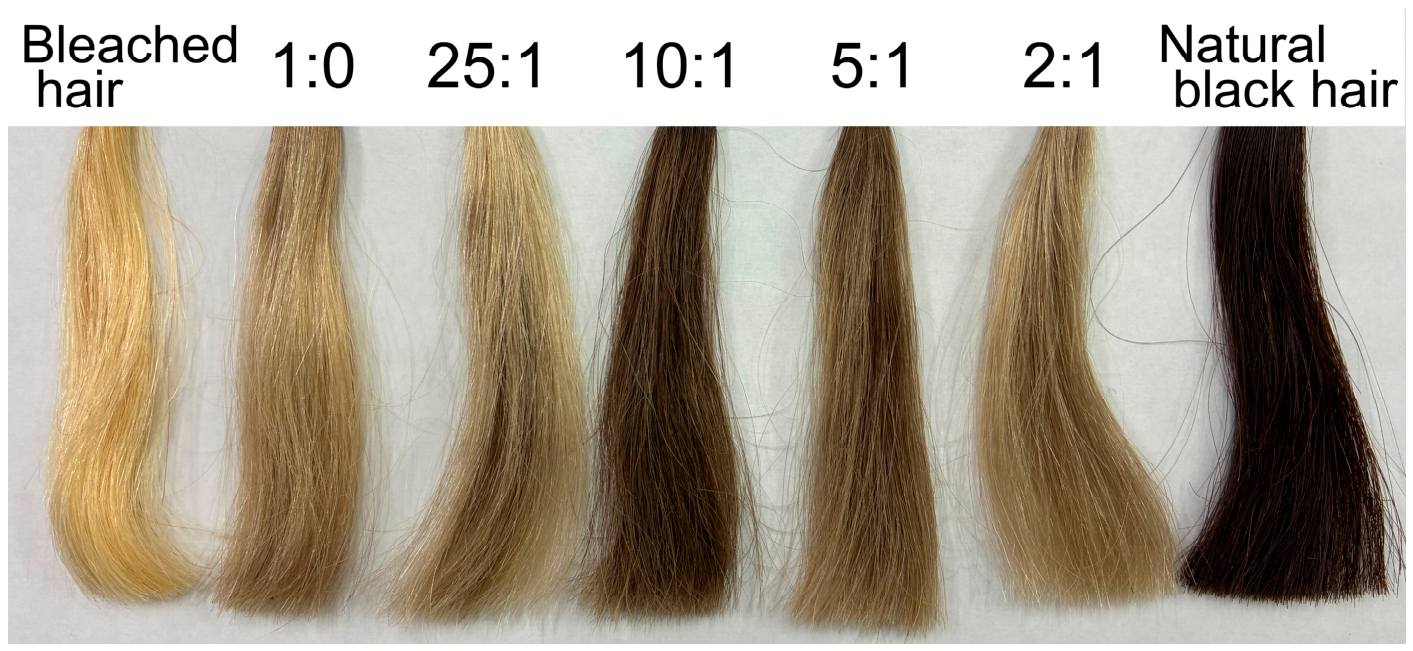
| Weight Ratio (SIP:chitosan) | L* | a* | b* | ΔL* | ΔE*ab |
|---|---|---|---|---|---|
| Untreated (bleached) | 85.18 ± 2.19 | 26.12 ± 5.86 | 18.62 ± 3.13 | ||
| 1:0 (SIPs alone) | 70.77 ± 4.87 | 16.97 ± 2.60 | 14.46 ± 0.64 | −14.41 ± 4.87 | 17.67 ± 5.19 |
| 25:1 | 57.70 ± 6.67 | 12.02 ± 2.87 | 12.27 ± 1.32 | −27.48 ± 6.67 | 31.60 ± 7.03 |
| 10:1 | 32.89 ± 0.87 | 8.77 ± 0.33 | 9.26 ± 0.22 | −52.29 ± 0.87 | 55.89 ± 0.85 |
| 5:1 | 51.56 ± 1.95 | 10.66 ± 0.91 | 11.70 ± 0.33 | −33.62 ± 1.95 | 37.67 ± 1.68 |
| 2:1 | 69.33 ± 2.27 | 16.18 ± 3.24 | 11.09 ± 0.89 | −15.85 ± 2.27 | 20.36 ± 2.75 |
| Reference (natural black hair) | 24.40 ± 1.17 | 6.90 ± 0.78 | 3.48 ± 0.46 | −60.78 ± 1.17 | 65.52 ± 1.31 |
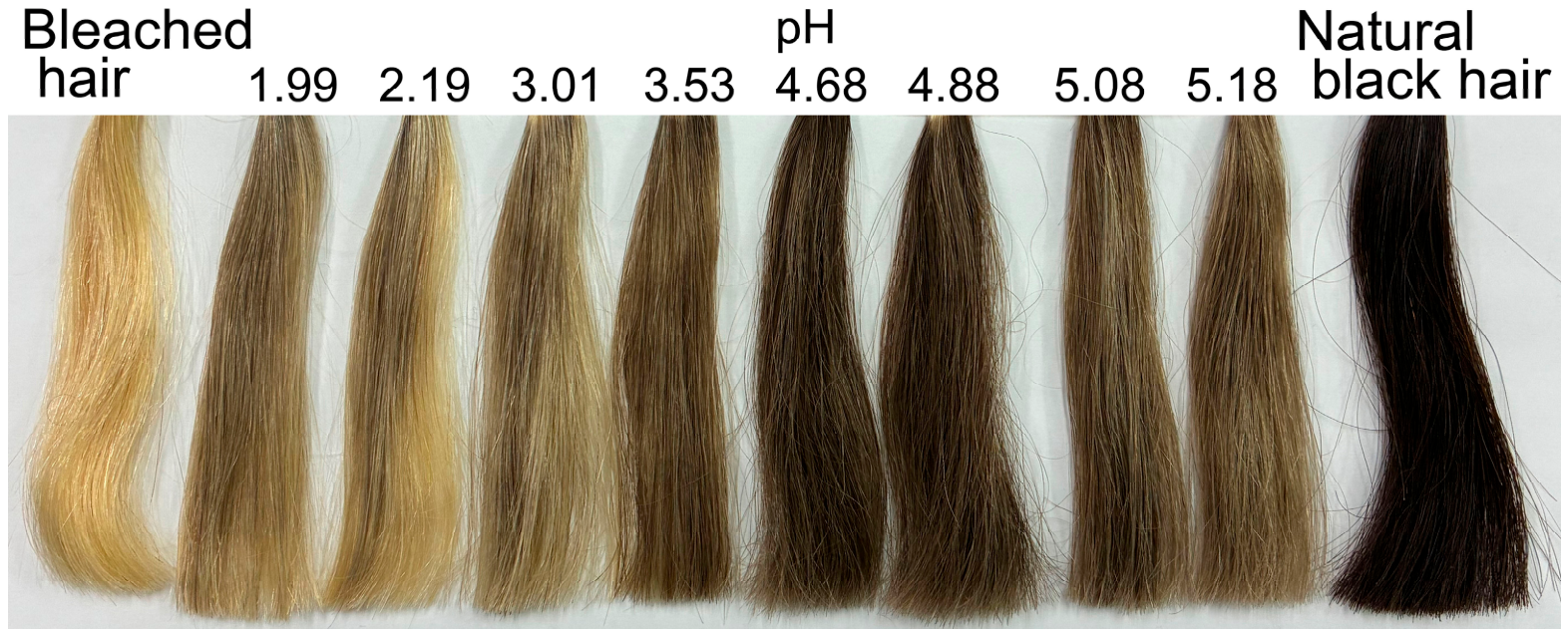
| pH | L* | a* | b* | ΔL* | ΔE*ab |
|---|---|---|---|---|---|
| 1.99 | 67.84 ± 3.30 | 15.98 ± 3.67 | 14.67 ± 1.10 | −17.34 ± 3.30 | 20.71 ± 3.77 |
| 2.19 | 66.61 ± 7.81 | 15.16 ± 3.29 | 14.69 ± 1.00 | −18.57 ± 7.81 | 22.11 ± 7.96 |
| 3.01 | 67.56 ± 8.37 | 14.31 ± 3.48 | 14.19 ± 1.04 | −17.62 ± 8.37 | 22.08 ± 7.95 |
| 3.53 | 60.21 ± 8.21 | 12.90 ± 3.40 | 13.02 ± 1.40 | −24.97 ± 8.21 | 29.22 ± 7.35 |
| 4.68 | 32.96 ± 1.02 | 8.58 ± 0.32 | 9.31 ± 0.21 | −52.22 ± 1.02 | 55.87 ± 0.95 |
| 4.88 | 38.25 ± 1.32 | 9.75 ± 0.72 | 10.92 ± 0.21 | −46.93 ± 1.32 | 50.30 ± 1.38 |
| 5.08 | 50.27 ± 2.08 | 10.40 ± 0.98 | 11.37 ± 0.51 | −34.91 ± 2.08 | 38.97 ± 2.16 |
| 5.18 | 52.93 ± 4.02 | 11.75 ± 0.96 | 12.51 ± 0.63 | −32.25 ± 4.02 | 35.88 ± 3.72 |
Disclaimer/Publisher’s Note: The statements, opinions and data contained in all publications are solely those of the individual author(s) and contributor(s) and not of MDPI and/or the editor(s). MDPI and/or the editor(s) disclaim responsibility for any injury to people or property resulting from any ideas, methods, instructions or products referred to in the content. |
© 2026 by the authors. Licensee MDPI, Basel, Switzerland. This article is an open access article distributed under the terms and conditions of the Creative Commons Attribution (CC BY) license.
Share and Cite
Matsuura, T.; Nakajima, A. Marine-Biomass-Derived Melanin–Chitosan Composites as Natural Black Hair Colorants: Charge Reversal and Electrostatic Deposition Mechanism. Organics 2026, 7, 23. https://doi.org/10.3390/org7020023
Matsuura T, Nakajima A. Marine-Biomass-Derived Melanin–Chitosan Composites as Natural Black Hair Colorants: Charge Reversal and Electrostatic Deposition Mechanism. Organics. 2026; 7(2):23. https://doi.org/10.3390/org7020023
Chicago/Turabian StyleMatsuura, Toshihiko, and Airi Nakajima. 2026. "Marine-Biomass-Derived Melanin–Chitosan Composites as Natural Black Hair Colorants: Charge Reversal and Electrostatic Deposition Mechanism" Organics 7, no. 2: 23. https://doi.org/10.3390/org7020023
APA StyleMatsuura, T., & Nakajima, A. (2026). Marine-Biomass-Derived Melanin–Chitosan Composites as Natural Black Hair Colorants: Charge Reversal and Electrostatic Deposition Mechanism. Organics, 7(2), 23. https://doi.org/10.3390/org7020023