Article

Aqueous Radical Photopolymerization Catalyzed by Resorufin

1
School of Polymer Science and Polymer Engineering, University of Akron, Akron, OH 44325, USA
2
Department of Chemistry, University of Akron, Akron, OH 44325, USA
*
Author to whom correspondence should be addressed.
Organics 2026, 7(1), 5; https://doi.org/10.3390/org7010005 (registering DOI)
Submission received: 15 October 2025 / Revised: 25 December 2025 / Accepted: 8 January 2026 / Published: 15 January 2026

Abstract

Commercially available resorufin was shown to function as an organic photocatalyst for visible-light-induced aqueous radical polymerization under low-irradiance illumination. Polymers with narrow molecular weight distributions and high monomer conversions were successfully synthesized from acrylate and acrylamide monomers. The photopolymerization catalyzed by resorufin was consistent with a reductive quenching mechanism. Good temporal control of the reaction was achieved by toggling visible light irradiation.

1. Introduction

Photopolymerization has experienced rapid advancements over recent decades, generating increased interest in both industry and academia [1,2,3,4,5,6]. Compared with conventional thermal processes that typically require high temperatures, photopolymerization can reduce energy input and enable spatiotemporal control, aligning with key goals of green chemistry [6,7,8,9,10,11,12,13]. Light-activated polymerization can proceed through two general types: free-radical polymerization and ionic polymerization, with free-radical mechanisms dominating for vinyl monomers [2,14,15]. Owing to the broad monomer scope and rapid kinetics, radical photopolymerization is widely used in practical applications, including coatings, biomaterials, and 3D printing [4,5,6,7,16,17,18,19,20,21,22,23].
The photoinitiating system (PIS) plays a central role in radical photopolymerization [2,24]. Early photoinitiating systems predominantly employed Type I initiators, which undergo unimolecular bond cleavage to generate radicals directly with high initiation efficiency. Historically, many classic Type I initiators were optimized for UV irradiation (and, in some cases, for short-wavelength visible light) and are most commonly applied in organic media [2,24,25,26,27,28]. Type II initiators were later introduced, which extend the accessible spectral range and improve light-harvesting efficiency. These systems rely on bimolecular interactions between photosensitizers and electron/hydrogen donors, but often suffer from reduced quantum efficiency due to back electron transfer, solvent cage effects, the formation of non-initiating radical species, and other competitive processes [26,29,30,31,32,33,34,35,36]. By incorporating an additional redox additive, three-component systems (TCSs, also referred to as Type III initiators) were developed. These multi-component initiating systems enable dye regeneration and suppress recombination losses, thereby improving light utilization efficiency and enabling polymerization under low-intensity irradiation [20,21,35,37,38,39,40].
The use of photopolymerization processes requires an appropriate PIS, depending on the requirements of the intended application, which extends beyond initiation efficiency to additional criteria, including commercial availability, ease of preparation, compatibility with monomer solubility, and suitability for the wavelength and power of the light sources [1,2,41]. Water is an attractive solvent owing to its low toxicity, low cost, and wide availability. For biomedical and biomaterial-related applications, the PIS is often expected to be water-soluble, have low cytotoxicity, and minimize photodamage [1,41,42].
Visible light sources are broadly available, cost-effective, energy-efficient, and can proceed at ambient temperature with low energy input, which is attractive from a sustainability perspective [34,43,44]. Compared with UV, visible light has longer wavelengths and lower photon energy, reducing photodamage concerns thus improving operational safety [40,45]. However, many visible light PISs are still tailored to blue/violet light, which increases the risk of blue-light hazard (BLH) and can cause photochemical retinal injury [46]. Meanwhile, the green-light-responsive PISs remain comparatively underexplored with far fewer reports to date [26,32].
Phenoxazine-based dyes have attracted increasing attention as visible light photoinitiators, particularly in controlled and/or aqueous photopolymerization [26,27,30,31,36,47,48,49,50,51,52,53]. Resorufin is a water-soluble phenoxazine dye exhibiting strong absorption in the green region [54,55,56]. Resorufin has also been widely used as fluorescent probes and for live-cell viability/cytotoxicity, which thus has potential applications as reported in [54,57,58,59,60]. In addition, resorufin is commercially available, which lowers the practical barrier to adoption compared with many organic photoredox catalysts that require multistep synthesis and tuning [48]. Motivated by these considerations, this work investigated resorufin as a photocatalyst for radical photopolymerization under low-irradiance green light in aqueous media, which has potential in application scenarios that often require stringent, multi-criteria constraints, such as in situ polymerization, targeted drug delivery, and cell encapsulation [1,61].

2. Experimental Section

2.1. Materials

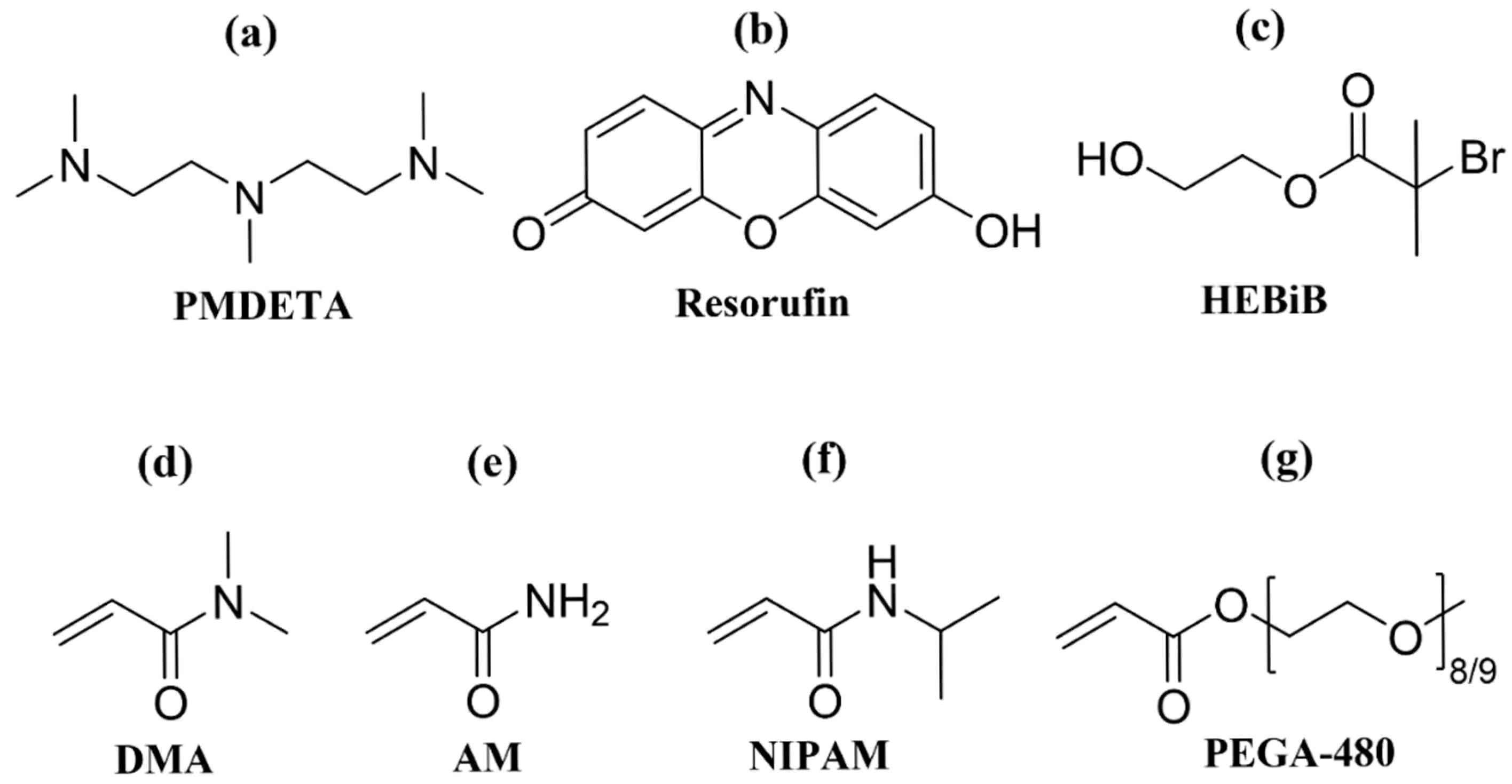
The structures of the chemicals used in this work are shown in Figure 1. N,N-Dimethylacrylamide (DMA, 99%, Sigma-Aldrich, St. Louis, MO, USA), acrylamide (AM, 99%, Sigma-Aldrich.), and poly (ethylene glycol) methyl ether acrylate (PEGA-480, Sigma-Aldrich) were used after passing through an alumina column (aluminum oxide, Al2O3, for chromatography, Acros Organics, Bridgewater, NJ, USA) to remove the inhibitors. Isopropylacrylamide (NIPAM, 97%, Sigma-Aldrich) was purified after recrystallization. N,N,N′,N″,N″-Pentamethyl-diethylenetriamine (PMDETA, 99%, Tokyo Chemical Industry Co., Ltd., Tokyo, Japan) and 2-hydroxyethyl 2-bromoisobutyrate (HEBiB, 95%, Sigma-Aldrich) were used after distillation. Chloroform-D (CDCl3, 99.8%, Cambridge Isotopes Laboratories, Inc., Tewksbury, MA, USA), deuterium oxide (D2O, 99.9%, Cambridge Isotopes Laboratories, Inc.), lithium bromide (LiBr, 99%, Sigma-Aldrich), N,N-dimethylformamide (DMF, HPLC grade, 99.9%, Sigma-Aldrich), and resorufin (Marker Gene Technologies, Inc., Eugene, OR, USA) were used as received. Milli-Q water (0.04 μS/cm) was obtained from the MilliporeSigma™ Direct-Q™ 3 water purification system (Fisher Scientific™, Pittsburgh, PA, USA).

2.2. Characterizations

Nuclear magnetic resonance spectra (NMR). 1H NMR spectra were recorded in deuterium oxide (D2O) or deuterated chloroform (CDCl3) at room temperature at 500 MHz using an Agilent NMRS (500 MHz) spectrometer (Agilent Technologies Inc., Santa Clara, CA, USA). 1H NMR of the on-off experiment were recorded in deuterium oxide (D2O) at room temperature at 300 MHz using an Agilent Mercury (300 MHz) spectrometer (Agilent Technologies Inc.). All chemical shifts were recorded in parts per million (ppm) relative to the reference peak solvent at δ = 4.79 ppm for D2O and δ = 7.26 ppm for CDCl3.
Size-exclusion chromatography (SEC). The relative number average molar masses (Mn) and the molar mass distributions (Đ) were obtained from a Tosoh EcoSEC HLC-8320GPC system with TSKgel GMHHR-M columns and a refractive index detector (RI) inside (Tosoh, Tokyo, Japan). HPLC-grade DMF with 0.1 M LiBr was used as an eluent at a flow rate of 1.0 mL min−1 at 30 °C. The system was calibrated using polystyrene standards with a narrow molecular weight distribution. Data was analyzed using EcoSEC GPC System Workstation software.
Fluorometer. The fluorescence spectra of the solutions were measured using an AgilentCary Eclipse fluorescence spectrometer (Agilent Technologies Inc.) with a disposable plastic cuvette (Semimicro style, PMMA, 10 mm light path, 1.5 mL capacity) at room temperature. The excitation wavelength was fixed at 530 nm. The excitation and emission slit widths were set at 1.5 nm for resorufin solution and reaction mixtures. The excitation and emission slit widths were set at 5 nm.

2.3. Photopolymerization

General procedure for photopolymerization. The structures of the chemicals used in this work are shown in Figure 1. HEBiB, PMDETA, and resorufin (photocatalyst) were mixed in water with a certain molar ratio, and the concentration of the monomer was kept at 1 M. Before exposure to visible light, the mixture was degassed by at least three freeze–pump–thaw cycles to remove O2 and then backfilled with N2. The reaction mixture was illuminated constantly by the green LED during the reaction (Figure S1). After a predetermined time, the reaction was terminated by introducing air into the vial. The reaction solution was dialyzed in water using a dialysis membrane (Spectra/Por®, 3500 Dalton, 54 mm flat width, Cole-Parmer, Vernon Hills, IL, USA) to remove the small molecules, and the purified product was dried under vacuum to remove the solvent. The conversion of monomer was determined by the 1H NMR spectrum of the final reaction mixture, with trioxane as the internal standard. The molecular weight and molecular weight distribution were determined by size-exclusion chromatography (SEC).
Temporal control experiment. The temporal control (on-off) experiment was performed in the NMR tube in situ. The setup is shown in Figure S2. A total of 1 mL of D2O solution from the reaction mixture was placed in an NMR tube with a J. Youngs valve (Bel-Art™ SP Scienceware™ Wilmad™ Low Pressure Vacuum Tube, Fisher Scientific™, Waltham, MA, USA). Before exposure to visible light, the mixture was degassed by at least three freeze–pump–thaw cycles to remove O2 and then backfilled with N2. Trioxane was added to the reaction mixture as the internal standard before the reaction. The conversion of monomers was monitored using NMR spectra of the reaction mixture.
Irradiation Sources. The illumination was provided by a green (530 nm) LED light (M530L3-C1, Thorlabs, Inc., Newton, NJ, USA). The light intensity was measured to be 7.0 mW/cm2 using the optical power and energy meter (PM100D, Thorlabs, Inc.).

3. Results and Discussions

3.1. Photocatalytic Activity of Resorufin

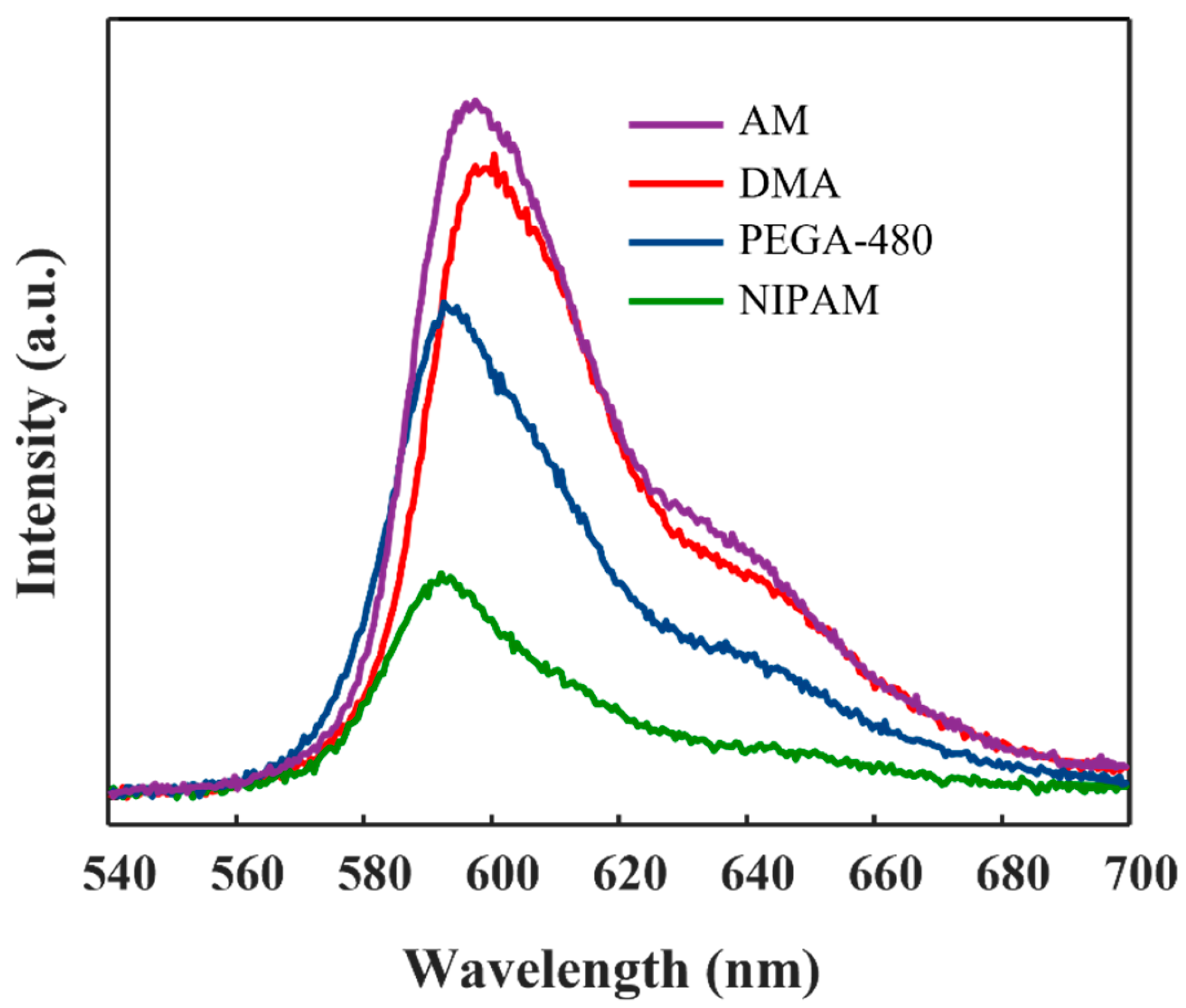
The photophysical properties of resorufin, such as the absorption and fluorescence properties, are known to be sensitive to the environment [56,62]. Figure S3 shows the fluorescence properties of resorufin are pH sensitive in aqueous environments. To check the photocatalytic activity of resorufin in the reaction mixtures, we checked the fluorescence spectra before running the polymerizations. As shown in Figure 2, under 530 nm excitation, the resorufin showed a fluorescence peak around 590 nm. And the fluorescence peaks were obvious in all the reaction mixtures with different monomers, when the monomer, HEBiB (initiator), PMDETA, and resorufin were mixed with 200:1:0.1:0.01 molar ratio (the monomer concentration was kept at 1 M).

3.2. Photopolymerization of DMA Catalyzed by Resorufin

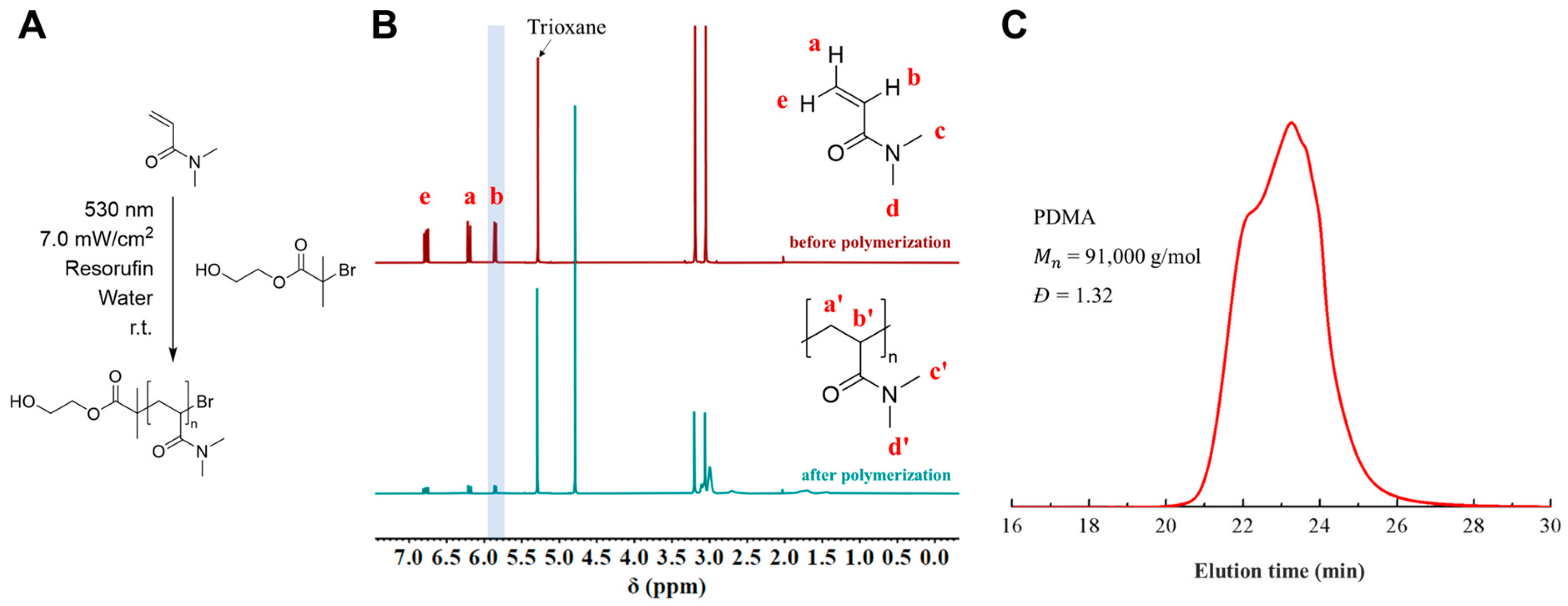
First, the photocatalytic activity of resorufin in the polymerization of DMA was evaluated (Figure 3A). The polymerization reactions were conducted for 6 h under constant green light illumination, and the results are summarized in Table 1. In entry 1, DMA (monomer), HEBiB (initiator), PMDETA, and resorufin were mixed with 200:1:0.1:0.01 molar ratio. The NMR spectra of reaction mixture before and after the reaction are shown in Figure 3B. After the reaction, the peaks of the vinyl hydrogens of the DMA monomer (d, 5.84 ppm) clearly decreased with reference to the peak of the internal reference, trioxane (s, 5.28 ppm). And the formation of PDMA polymers was confirmed by the appearance of peaks of the hydrogens on the polymer backbone around 1–3 ppm (Figure S4). The conversion of monomers was ~78%, which was calculated based on the peak area of the vinyl hydrogens of the DMA monomer (d, 5.84 ppm) relative to the peak area of trioxane (s, 5.28 ppm). The number-average molecular weight M n , SEC and the polydispersity Đ were ~91 k and ~1.32, determined by SEC after dialysis (Figure 3C). The initiation efficiency of HEBiB ( I * ) was ~17%, based on the ratio between the measured number-average molecular weight M n , SEC and the theoretical number-average molecular weight M n , th .
In the control experiments without either green light illumination (entry 2) or resorufin (entry 3), no polymer was obtained. These results indicate that the photoexcited resorufin was the key component for polymer growth, because resorufin was the only species in the system that can absorb green light. Since ~17% of initiators were activated under a 1:0.01 initiator to resorufin molar ratio, this means 1 resorufin molecule activated 17 initiators on average. Thus, resorufin should have functioned as the photocatalyst instead of the photoinitiator.
To elucidate the quenching mechanism, we also performed control experiments in the absence of the HEBiB initiator (entry 4) or PMDETA (entry 5). In entry 4, no polymer was obtained without the HEBiB initiator, indicating that polymer growth should follow a radical mechanism initiated by radicals generated from HEBiB. In entry 5, no polymer was obtained in the absence of PMDETA, suggesting that photoexcited resorufin (Res*) cannot efficiently generate active radical species directly from HEBiB without PMDETA. Instead, PMDETA is required to produce the active radicals. In photocatalysis, radicals can be generated via either oxidative or reductive quenching of the photoexcited photocatalyst (PC*) [42,63,64,65,66,67]. Since PMDETA acts as a reducing agent and is essential for radical generation, the resorufin-catalyzed photopolymerization most likely proceeds through a reductive quenching mechanism.
To further support the quenching mechanism, the fluorescence of resorufin was measured at different PMDETA concentrations (Figure S5). The emission intensity decreases systematically with increasing PMDETA concentration under 530 nm excitation, while the emission maximum remains essentially unchanged. The corresponding Stern–Volmer plot is approximately linear over the examined range, indicating efficient quenching of Res* by PMDETA. These results are consistent with the proposed reductive quenching pathway.
In addition, the polymerization catalyzed by resorufin was found to be oxygen sensitive (entry 6). Oxygen is known to inhibit free-radical polymerization by reducing both effective radical generation and chain propagation. Oxygen can scavenge carbon-centered radicals to form less-propagating peroxyl radicals. In dye-mediated systems, oxygen can also quench the excited state, further reducing productive radical generation.
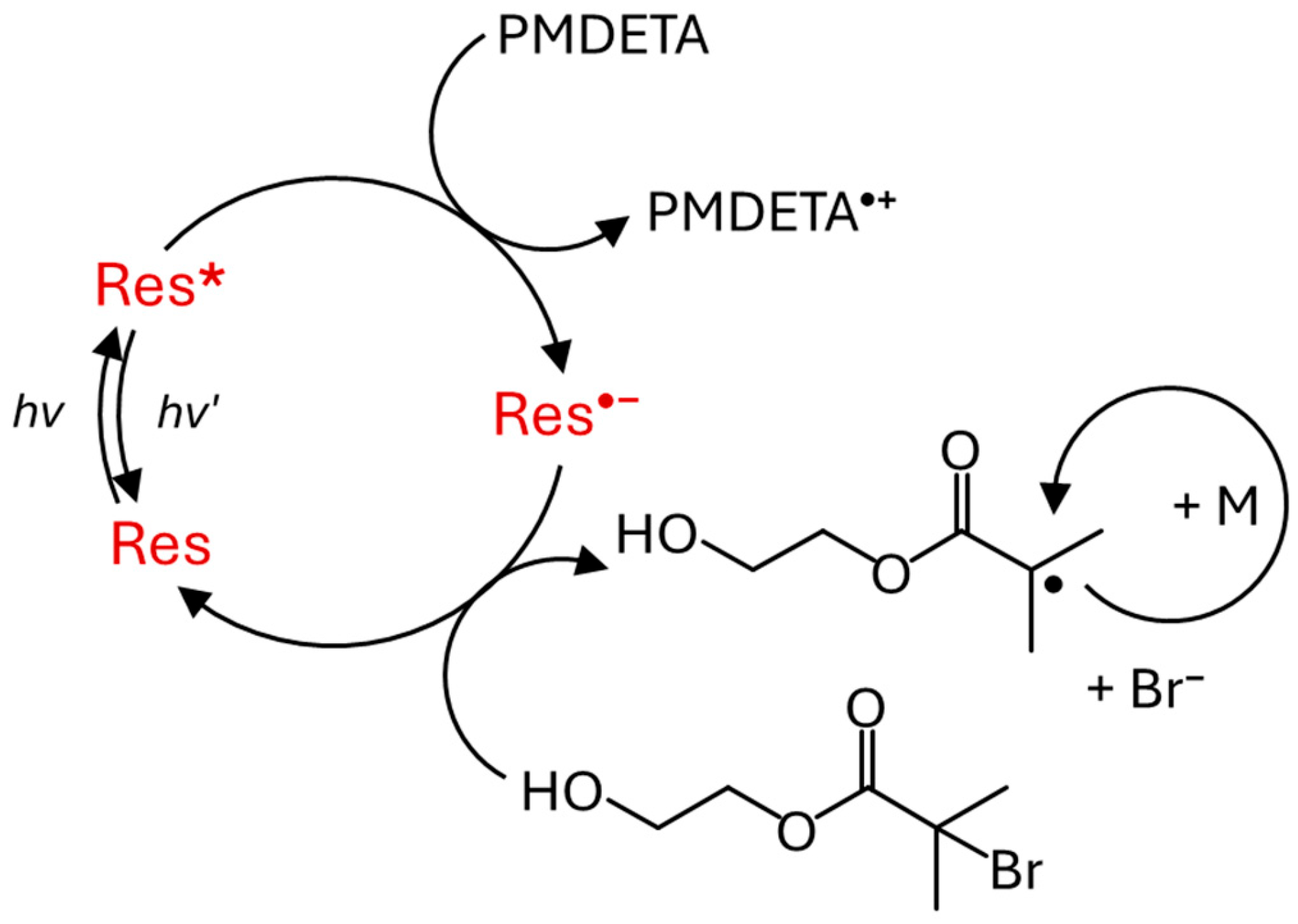
Based on the results in Table 1, we can conclude that the photopolymerization catalyzed by resorufin should follow the reductive quenching mechanism (Figure 4): the photoexcited resorufin (Res*) is first reduced by PMDETA to the anion radical (Res•−), which then reacts with HEBiB initiator to generate the propagating radical for polymer growth.

3.3. Effect of PMDETA on Photopolymerization of DMA Catalyzed by Resorufin

In addition, we studied the effect of PMDETA concentration on the photocatalytic polymerization of DMA catalyzed by resorufin. Based on the proposed mechanism (Figure 4), higher PMDETA concentration should increase the concentrations of the resorufin anion radical (Res•−). As shown in Table 2, compared to entry 1, the M n , SEC was double in entry 7 with the same reaction time, while the concentration of PMDETA was increased by 10 times compared to entry 1. However, the conversion of monomers was nearly unchanged, the polydispersity Đ was increased, and the initiation efficiency I * was decreased. These indicate that the high concentration of PDMETA makes the radical polymerization less controlled. The doubling of Mn and increase in Đ compared to entry 1 were probably due to the bi-molecular terminations or irreversible chain transfers, and the drop of I * indicated that a large portion of the resorufin anion radical (Res•−) did not react with the initiators. In entries 8 and 9, where the PMDETA concentration was even higher, the Mn and monomer conversion further dropped significantly compared to entry 7, and the Đ and I * were similar to entry 7. These results suggest that higher PMDETA concentration will make polymerization less controlled.

3.4. Temporal Control of Aqueous Radical Photopolymerization Catalyzed by Resorufin

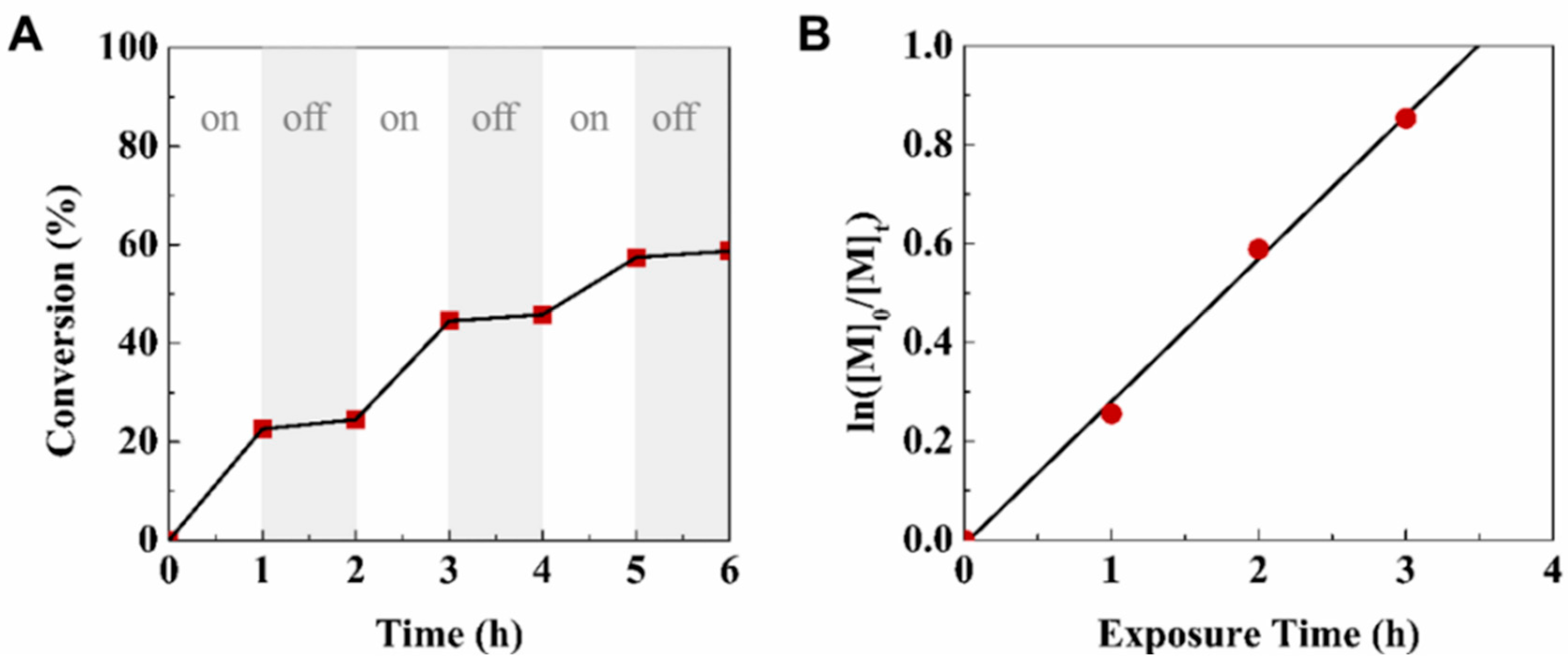
We performed the in situ on-off experiment using DMA monomer (Figure 5). The molar ratio of the reactants was the same as entry 1 ([M]:[I]:[PMDETA]:[R] = 200:1:0.1:0.01). The green light illumination of the reaction mixture was switched on for 1 h and then off for 1 h alternately, and the on/off switching cycle was repeated three times. The composition of the reaction mixture was determined hourly by 1H NMR (Figure S6). The conversion of monomer was calculated based on the peak area of the vinyl hydrogens of DMA monomer (d, 5.84 ppm) relative to the peak area of trioxane (s, 5.28 ppm) on the NMR spectrum of the reaction mixture (Figure S7) [68].
As shown in Figure 5A, the conversion of monomers shows a corresponding response to the absence and presence of light. The monomer conversion increased persistently in the presence of light, while it was almost unchanged or increased very slowly during the dark period. The repeated response demonstrates reproducible temporal control over multiple cycles, supporting the precision of light-regulated initiation. Such robust light responsiveness provides a basis for future spatiotemporal control under mild, aqueous conditions.
Figure 5B shows the semi-log kinetic plot of monomer conversion vs. cumulative time for the on-off experiment. ln M 0 / M t increased linearly with cumulative illumination time, indicating well-behaved kinetic behavior and reliable light-gated progression, which was not influenced by intermittent light illumination. Monomer conversion increased, supporting that light is required to turn on the polymerization under these conditions. Consistently, polymer growth took place predominantly during the illuminated periods, which further proved that light is the essential factor to switch the polymerization on and off. This temporal control behavior is consistent with the proposed mechanism, in which the photoexcitation of resorufin was essential for generating the active species. Without light illumination, the resorufin could not be photoexcited, and the productions of the resorufin anion radicals and the active species to initiate polymerization were also stopped. Importantly, polymerization resumes promptly upon re-irradiation, and the conversion continues to increase mainly during the illuminated intervals, indicating that radical generation is effectively gated by light.

3.5. Photopolymerization of Other Water-Soluble Monomers

In the end, we demonstrated the activity of resorufin in catalyzing the polymerizations of other water-soluble monomers (Table 3). The formation of polymers was proven by NMR spectra (Figures S8–S10), where the peaks between 1 and 2 ppm correspond to the hydrogens on the polymer backbones. The conversions of PEGA-480 (entry 10), NIPAM (entry 11), and AM (entry 12) were above 40% after 6 h of reaction, and the polydispersity of the polymer products was as narrow, as in the case of DMA (entry 1). These results suggest that resorufin was active in catalyzing the polymerizations of acrylamide and acrylate monomers in water.
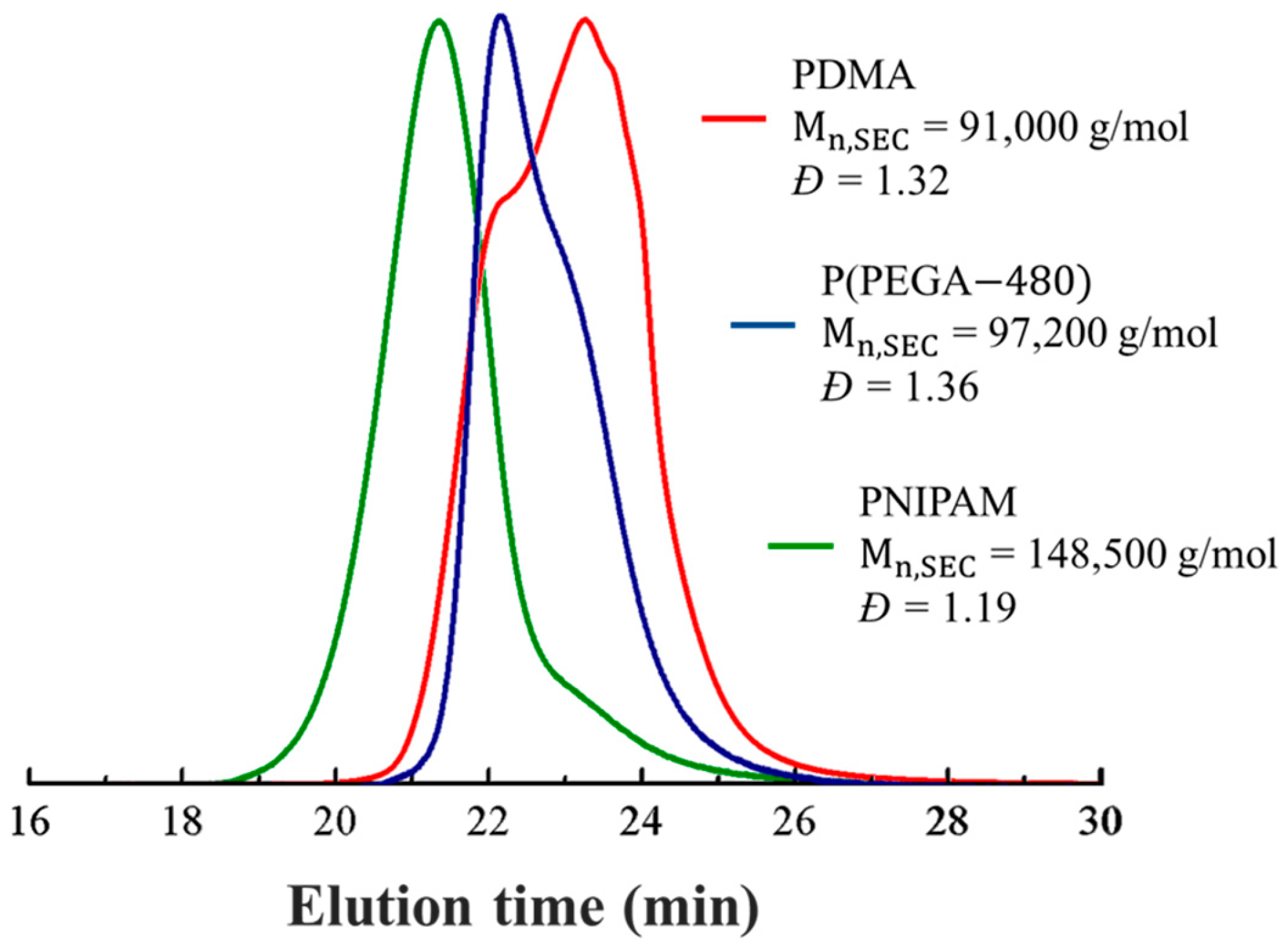
We also noticed that the initiation efficiencies I * show differences for different types of monomers. The initiation efficiencies were ~10–20% for the acrylamides (DMA, NIPAM) and ~50% for the acrylate (PEGA-480). The results were reasonable, because the reactivity or stability of the active end should be determined by the monomer structure after the addition of the first monomer to the initiator in the first step. This indicates that the resorufin anion radical was more reactive towards acrylates than acrylamides. Another noticeable feature was that the SEC spectra of all the polymers showed two peaks (Figure 3C and Figure 6). Since the polymers were purified by dialysis before SEC measurements, it is unlikely to be from residual monomers or small molecules. So far, we have not figured out the reasons for the feature. One of the potential explanations is that resorufin has been reported to be reduced to dihydroresorufin by a two-electron process [69]. If this reaction becomes competitive, it could alter the distribution of active redox states and introduce heterogeneity in activation/deactivation, which may contribute to more than one chain population.

4. Conclusions

In conclusion, resorufin was demonstrated as an organic photocatalyst for visible-light-induced aqueous radical photopolymerization under low-irradiance green light at ambient temperature. Polymers with narrow molecular weight distributions using acrylate and acrylamide monomers were successfully synthesized. The results are consistent with a reductive quenching pathway and show efficient temporal response through repeated light on–off switching. Future work will expand the study to additional initiators and electron donors, with formulation optimization and deeper mechanistic/kinetic studies across more monomers. If feasible, evaluation in biologically relevant environments will also be considered.

Supplementary Materials

The following supporting information can be downloaded at: https://www.mdpi.com/article/10.3390/org7010005/s1, Figure S1. Photograph of the experimental setup for radical photopolymerization; Figure S2. Photograph of the experimental setup for the on-off experiment; Figure S3. Effect of pH on the fluorescence of resorufin ([Resorufin] = 0.02 mg/mL); Figure S4. (A) 1H NMR spectrum of purified PDMA. (B) 1H NMR spectrum of the reaction solution before and after radical photopolymerization; Figure S5. Quenching of resorufin fluorescence by PMDETA. (A) Fluorescence spectra of resorufin under 530 nm excitation in different concentrations of PMDETA. The concentration of resorufin was 4.5 × 10⁻⁶ M. (B) Plot of resorufin fluorescence intensity (I0/I) vs. PMDETA concentration based on the spectra in A; Figure S6. 1H NMR spectrum of the on-off experiment of DMA; Figure S7. 1H NMR spectrum of the on-off experiment of DMA with integrated peak areas; Figure S8. (A) 1H NMR spectrum of purified PNIPAM. (B) 1H NMR spectrum of the reaction solution before and after radical photopolymerization; Figure S9. (A) 1H NMR spectrum of purified P(PEGA-480). (B) 1H NMR spectrum of the reaction solution before and after radical photopolymerization; Figure S10. (A) 1H NMR spectrum of purified PAM. (B) 1H NMR spectrum of the reaction solution before and after radical photopolymerization.

Author Contributions

Conceptualization, W.Z. and C.L.; Methodology, W.Z. and C.L.; Validation, W.Z. and C.L.; Formal analysis, W.Z.; Writing—original draft, W.Z.; Writing—review & editing, W.Z. and C.L.; Supervision, C.L.; Project administration, C.L. All authors have read and agreed to the published version of the manuscript.

Funding

This research received no external funding.

Data Availability Statement

The original contributions presented in this study are included in the article/Supplementary Materials. Further inquiries can be directed at the corresponding author.

Acknowledgments

We thank the funding support provided by the University of Akron.

Conflicts of Interest

The authors declare no conflicts of interest.

References

  1. Tomal, W.; Ortyl, J. Water-soluble photoinitiators in biomedical applications. Polymers 2020, 12, 1073. [Google Scholar] [CrossRef] [PubMed]
  2. Yagci, Y.; Jockusch, S.; Turro, N.J. Photoinitiated polymerization: Advances, challenges, and opportunities. Macromolecules 2010, 43, 6245–6260. [Google Scholar] [CrossRef]
  3. Zhao, X.; Zhao, Y.; Li, M.-D.; Li, Z.A.; Peng, H.; Xie, T.; Xie, X. Efficient 3D printing via photooxidation of ketocoumarin based photopolymerization. Nat. Commun. 2021, 12, 2873. [Google Scholar] [CrossRef] [PubMed]
  4. Bagheri, A.; Jin, J. Photopolymerization in 3D printing. ACS Appl. Polym. Mater. 2019, 1, 593–611. [Google Scholar] [CrossRef]
  5. Ribas-Massonis, A.; Cicujano, M.; Duran, J.; Besalú, E.; Poater, A. Free-radical photopolymerization for curing products for refinish coatings market. Polymers 2022, 14, 2856. [Google Scholar] [CrossRef]
  6. Corrigan, N.; Boyer, C. In the Limelight: 2D and 3D Materials via Photo-Controlled Radical Polymerization. Trends Chem. 2020, 2, 689–706. [Google Scholar] [CrossRef]
  7. Chen, M.; Zhong, M.; Johnson, J.A. Light-Controlled Radical Polymerization: Mechanisms, Methods, and Applications. Chem. Rev. 2016, 116, 10167–10211. [Google Scholar] [CrossRef]
  8. Fors, B.P.; Hawker, C.J. Control of a Living Radical Polymerization of Methacrylates by Light. Angew. Chem. Int. Ed. 2012, 51, 8850–8853. [Google Scholar] [CrossRef]
  9. Kottisch, V.; Michaudel, Q.; Fors, B.P. Photocontrolled Interconversion of Cationic and Radical Polymerizations. J. Am. Chem. Soc. 2017, 139, 10665–10668. [Google Scholar] [CrossRef]
  10. Pan, X.C.; Tasdelen, M.A.; Laun, J.; Junkers, T.; Yagci, Y.; Matyjaszewski, K. Photomediated controlled radical polymerization. Prog. Polym. Sci. 2016, 62, 73–125. [Google Scholar] [CrossRef]
  11. Peterson, B.M.; Kottisch, V.; Supej, M.J.; Fors, B.P. On Demand Switching of Polymerization Mechanism and Monomer Selectivity with Orthogonal Stimuli. ACS Cent. Sci. 2018, 4, 1228–1234. [Google Scholar] [CrossRef] [PubMed]
  12. Shanmugam, S.; Xu, J.; Boyer, C. Photocontrolled living polymerization systems with reversible deactivations through electron and energy transfer. Macromol. Rapid Commun. 2017, 38, 1700143. [Google Scholar] [CrossRef] [PubMed]
  13. Ohtsuki, A.; Lei, L.; Tanishima, M.; Goto, A.; Kaji, H. Photocontrolled Organocatalyzed Living Radical Polymerization Feasible over a Wide Range of Wavelengths. J. Am. Chem. Soc. 2015, 137, 5610–5617. [Google Scholar] [CrossRef] [PubMed]
  14. Wang, Z.; Cui, F.; Sui, Y.; Yan, J. Radical chemistry in polymer science: An overview and recent advances. Beilstein J. Org. Chem. 2023, 19, 1580–1603. [Google Scholar] [CrossRef]
  15. Bongiovanni, R.; Vacche, S.D.; Vitale, A. Photoinduced Processes as a Way to Sustainable Polymers and Innovation in Polymeric Materials. Polymers 2021, 13, 2293. [Google Scholar] [CrossRef]
  16. Bian, C.; Zhou, Y.-N.; Guo, J.-K.; Luo, Z.-H. Aqueous metal-free atom transfer radical polymerization: Experiments and model-based approach for mechanistic understanding. Macromolecules 2018, 51, 2367–2376. [Google Scholar] [CrossRef]
  17. Corbin, D.A.; Miyake, G.M. Photoinduced Organocatalyzed Atom Transfer Radical Polymerization (O-ATRP): Precision Polymer Synthesis Using Organic Photoredox Catalysis. Chem. Rev. 2022, 122, 1830–1874. [Google Scholar] [CrossRef]
  18. Matsui, J.K.; Lang, S.B.; Heitz, D.R.; Molander, G.A. Photoredox-mediated routes to radicals: The value of catalytic radical generation in synthetic methods development. ACS Catal. 2017, 7, 2563–2575. [Google Scholar] [CrossRef]
  19. Wei, D.; Xu, Y.; Liu, C.; Zhai, Y.; Chen, H.; Bai, L.; Yang, H.; Yang, L.; Wang, W.; Niu, Y. Visible light-induced metal-free atom transfer radical polymerization: An efficient approach to polyacrylonitrile. J. Polym. Sci. Part A Polym. Chem. 2019, 57, 1265–1269. [Google Scholar] [CrossRef]
  20. You, J.; Du, Y.; Xue, T.; Bao, B.; Hu, T.; Ye, Y.; Wang, T. The three-component photoinitiating systems based on flavonol sulfonate and application in 3D printing. Dye. Pigment. 2022, 197, 109899. [Google Scholar] [CrossRef]
  21. Ibrahim, A.; Stefano, L.D.; Tarzi, O.; Tar, H.; Ley, C.; Allonas, X. High-Performance Photoinitiating Systems for Free Radical Photopolymerization. Application to Holographic Recording. Photochem. Photobiol. 2013, 89, 1283–1290. [Google Scholar] [CrossRef]
  22. Bao, Y. Recent trends in advanced photoinitiators for vat photopolymerization 3D printing. Macromol. Rapid Commun. 2022, 43, 2200202. [Google Scholar] [CrossRef]
  23. Ibrahim, A.; Allonas, X.; Ley, C.; Kawamura, K.; Berneth, H.; Bruder, F.K.; Fäcke, T.; Hagen, R.; Hönel, D.; Rölle, T. High performance photoinitiating systems for holography recording: Need for a full control of primary processes. Chem. A Eur. J. 2014, 20, 15102–15107. [Google Scholar] [CrossRef] [PubMed]
  24. Fouassier, J.P.; Lalevée, J. Photoinitiators for Polymer Synthesis. Scope, Reactivity, and Efficiency; John Wiley & Sons: Hoboken, NJ, USA, 2012; Volume 125. [Google Scholar]
  25. Müller, S.M.; Schlögl, S.; Wiesner, T.; Haas, M.; Griesser, T. Recent advances in type I photoinitiators for visible light induced photopolymerization. ChemPhotoChem 2022, 6, e202200091. [Google Scholar] [CrossRef]
  26. Shao, J.; Huang, Y.; Fan, Q. Visible light initiating systems for photopolymerization: Status, development and challenges. Polym. Chem. 2014, 5, 4195–4210. [Google Scholar] [CrossRef]
  27. Tehfe, M.-A.; Dumur, F.; Graff, B.; Clément, J.-L.; Gigmes, D.; Morlet-Savary, F.; Fouassier, J.-P.; Lalevée, J. New Cleavable Photoinitiator Architecture with Huge Molar Extinction Coefficients for Polymerization in the 340–450 nm Range. Macromolecules 2013, 46, 736–746. [Google Scholar] [CrossRef]
  28. Nitti, A.; Martinelli, A.; Batteux, F.; Protti, S.; Fagnoni, M.; Pasini, D. Blue light driven free-radical polymerization using arylazo sulfones as initiators. Polym. Chem. 2021, 12, 5747–5751. [Google Scholar] [CrossRef]
  29. Balcerak, A.; Kabatc-Borcz, J.; Czech, Z.; Bartkowiak, M. Latest Advances in Highly Efficient Dye-Based Photoinitiating Systems for Radical Polymerization. Polymers 2023, 15, 1148. [Google Scholar] [CrossRef]
  30. Dumur, F. Recent advances on visible light Phenothiazine-based photoinitiators of polymerization. Eur. Polym. J. 2022, 165, 110999. [Google Scholar] [CrossRef]
  31. Gómez, M.L.; Previtali, C.M.; Montejano, H.A.; Bertolotti, S.G. Photoreaction and photopolymerization studies on phenoxazin dyes/diphenyliodonium chloride salt. J. Photochem. Photobiol. A Chem. 2007, 188, 83–89. [Google Scholar] [CrossRef]
  32. Sun, K.; Xiao, P.; Dumur, F.; Lalevée, J. Organic dye-based photoinitiating systems for visible-light-induced photopolymerization. J. Polym. Sci. 2021, 59, 1338–1389. [Google Scholar] [CrossRef]
  33. Fouassier, J.-P.; Morlet-Savary, F.; Lalevée, J.; Allonas, X.; Ley, C. Dyes as photoinitiators or photosensitizers of polymerization reactions. Materials 2010, 3, 5130–5142. [Google Scholar] [CrossRef] [PubMed]
  34. Liu, S.; Borjigin, T.; Schmitt, M.; Morlet-Savary, F.; Xiao, P.; Lalevée, J. High-Performance Photoinitiating Systems for LED-Induced Photopolymerization. Polymers 2023, 15, 342. [Google Scholar] [CrossRef] [PubMed]
  35. Shao, Y.; He, X.; Xin, Y.; Zhang, Y.; Zhang, D.; Duan, L.; Zou, Y. New application of multiresonance organic delayed fluorescence dyes: High-performance photoinitiating systems for acrylate and epoxy photopolymerization and photoluminescent pattern Preparation. ACS Appl. Mater. Interfaces 2024, 16, 30344–30354. [Google Scholar] [CrossRef]
  36. Villegas, L.; Encinas, M.; Rufs, A.; Bueno, C.; Bertolotti, S.; Previtali, C. Aqueous photopolymerization with visible-light photoinitiators: Acrylamide polymerization photoinitiated with a phenoxazine dye/amine system. J. Polym. Sci. Part A Polym. Chem. 2001, 39, 4074–4082. [Google Scholar] [CrossRef]
  37. Christmann, J.; Ley, C.; Allonas, X. Comprehensive Study of the Synergistic Effect in Photocyclic Three-Component Initiating System for Radical Polymerization. Macromolecules 2025, 58, 5444–5455. [Google Scholar] [CrossRef]
  38. Berneth, H.; Bruder, F.K.; Fäcke, T.; Hansen, S.; Kawamura, K.; Pitzer, L.; Kern, S.; Wewer, B.; Rölle, T. A new three-component photo-initiating system for visible light recording of volume holograms with single-pulsed laser. Polymers 2021, 13, 3517. [Google Scholar] [CrossRef]
  39. Fouassier, J.-P.; Lalevée, J. Photoinitiators: Structures, Reactivity and Applications in Polymerization; John Wiley & Sons: Hoboken, NJ, USA, 2021. [Google Scholar]
  40. Fouassier, J.; Allonas, X.; Burget, D. Photopolymerization reactions under visible lights: Principle, mechanisms and examples of applications. Prog. Org. Coat. 2003, 47, 16–36. [Google Scholar] [CrossRef]
  41. Chen, H.; Zhu, D.; Kavalli, T.; Xiao, P.; Schmitt, M.; Lalevée, J. Photopolymerization using bio-sourced photoinitiators. Polym. Chem. 2023, 14, 3543–3568. [Google Scholar] [CrossRef]
  42. Zeng, Z.; Zeng, Y.; Zhang, F.-A.; Xu, X. Aqueous metal-free atom transfer radical polymerization with biocompatible photocatalyst: Controlled synthesis of thermo-responsive PDMA in water. Polym. Chem. 2017, 8, 1972–1977. [Google Scholar]
  43. Lang, M.; Hirner, S.; Wiesbrock, F.; Fuchs, P. A Review on Modeling Cure Kinetics and Mechanisms of Photopolymerization. Polymers 2022, 14, 2074. [Google Scholar] [CrossRef]
  44. Tehfe, M.A.; Louradour, F.; Lalevée, J.; Fouassier, J.-P. Photopolymerization Reactions: On the Way to a Green and Sustainable Chemistry. Appl. Sci. 2013, 3, 490–514. [Google Scholar] [CrossRef]
  45. Behar-Cohen, F.; Baillet, G.; de Ayguavives, T.; Garcia, P.O.; Krutmann, J.; Peña-García, P.; Reme, C.; Wolffsohn, J.S. Ultraviolet damage to the eye revisited: Eye-sun protection factor (E-SPF®), a new ultraviolet protection label for eyewear. Clin. Ophthalmol. 2014, 8, 87–104. [Google Scholar] [CrossRef] [PubMed]
  46. Françon, A.; Behar-Cohen, F.; Torriglia, A. The blue light hazard and its use on the evaluation of photochemical risk for domestic lighting. An in vivo study. Environ. Int. 2024, 184, 108471. [Google Scholar] [CrossRef] [PubMed]
  47. Sadhu, C.; Mitra, A.K. Synthetic, biological and optoelectronic properties of phenoxazine and its derivatives: A state of the art review. Mol. Divers. 2024, 28, 965–1007. [Google Scholar] [CrossRef]
  48. Pearson, R.M.; Lim, C.H.; McCarthy, B.G.; Musgrave, C.B.; Miyake, G.M. Organocatalyzed Atom Transfer Radical Polymerization Using N-Aryl Phenoxazines as Photoredox Catalysts. J. Am. Chem. Soc. 2016, 138, 11399–11407. [Google Scholar] [CrossRef]
  49. Bian, C.; Zhou, Y.-N.; Deetz, J.D.; Luo, Z.-H. Experimental and computational investigation of oxidative quenching governed aqueous organocatalyzed atom transfer radical polymerization. Chem. Eng. J. 2019, 362, 721–730. [Google Scholar] [CrossRef]
  50. Bian, C.; Zhou, Y.-N.; Guo, J.-K.; Luo, Z.-H. Visible light induced organocatalyzed atom transfer radical polymerization in aqueous media. Polym. Chem. 2021, 12, 3401–3408. [Google Scholar]
  51. McCarthy, B.G.; Pearson, R.M.; Lim, C.-H.; Sartor, S.M.; Damrauer, N.H.; Miyake, G.M. Structure-Property Relationships for Tailoring Phenoxazines as Reducing Photoredox Catalysts. J. Am. Chem. Soc. 2018, 140, 5088–5101. [Google Scholar] [CrossRef]
  52. Park, G.S.; Back, J.; Choi, E.M.; Lee, E.; Son, K.-s. Visible light-mediated metal-free atom transfer radical polymerization with N-trifluoromethylphenyl phenoxazines. Eur. Polym. J. 2019, 117, 347–352. [Google Scholar] [CrossRef]
  53. Zhang, Z.; Chen, W.; Zhang, Y.; Wang, Y.; Tian, Y.; Fang, L.; Ba, X. Photoredox Organocatalysts with Thermally Activated Delayed Fluorescence for Visible-Light-Driven Atom Transfer Radical Polymerization. Macromolecules 2021, 54, 4633–4640. [Google Scholar] [CrossRef]
  54. Glass, R.H.; Ericsson, S.A.; Ericsson, R.J.; Drouin, M.T.; Marcoux, L.J.; Sullivan, H. The resazurin reduction test provides an assessment of sperm activity. Fertil. Steril. 1991, 56, 743–746. [Google Scholar] [CrossRef] [PubMed]
  55. Ibanez, D.; Izquierdo-Bote, D.; Perez-Junquera, A.; González-García, M.B.; Hernandez-Santos, D.; Fanjul-Bolado, P. Raman and fluorescence spectroelectrochemical monitoring of resazurin-resorufin fluorogenic system. Dye. Pigment. 2020, 172, 107848. [Google Scholar] [CrossRef]
  56. Bueno, C.; Villegas, M.L.; Bertolotti, S.G.; Previtali, C.M.; Neumann, M.G.; Encinas, M.V. The excited-state interaction of resazurin and resorufin with aminesin aqueous solutions. Photophysics and photochemical reaction. Photochem. Photobiol. 2002, 76, 385–390. [Google Scholar] [CrossRef]
  57. Borra, R.C.; Lotufo, M.A.; Gagioti, S.M.; Barros Fde, M.; Andrade, P.M. A simple method to measure cell viability in proliferation and cytotoxicity assays. Braz. Oral. Res. 2009, 23, 255–262. [Google Scholar] [CrossRef] [PubMed]
  58. O’brien, J.; Wilson, I.; Orton, T.; Pognan, F. Investigation of the Alamar Blue (resazurin) fluorescent dye for the assessment of mammalian cell cytotoxicity. Eur. J. Biochem. 2000, 267, 5421–5426. [Google Scholar] [CrossRef]
  59. Vieira-da-Silva, B.; Castanho, M.A. Resazurin reduction-based assays revisited: Guidelines for accurate reporting of relative differences on metabolic status. Molecules 2023, 28, 2283. [Google Scholar] [CrossRef]
  60. Cao, X.; Song, Y.; Fan, S.; Kai, J.; Yang, X.; Chen, L. Optimization of Ethoxyresorufin-O-deethylase Determination in the Microsomes of Earthworms and Its Induction by Polycyclic Aromatic Hydrocarbons. CLEAN–Soil. Air Water 2014, 42, 1121–1125. [Google Scholar] [CrossRef]
  61. Dzwonkowska-Zarzycka, M.; Sionkowska, A. Photoinitiators for Medical Applications—The Latest Advances. Molecules 2024, 29, 3898. [Google Scholar] [CrossRef]
  62. Ruccolo, S.; Qin, Y.; Schnedermann, C.; Nocera, D.G. General Strategy for Improving the Quantum Efficiency of Photoredox Hydroamidation Catalysis. J. Am. Chem. Soc. 2018, 140, 14926–14937. [Google Scholar] [CrossRef]
  63. Feng, W.; Zhu, S.; Luo, X.; Zhang, F.; Zhu, J. Aqueous synthesis of multiblock copolymers via light mediated copper(II)-catalyzed polymerization without external deoxygenation. Polymer 2021, 219, 123537. [Google Scholar]
  64. Liu, L.; Yi, Y. Photo-mediated metal free atom transfer radical polymerization of acrylamide in water. J. Appl. Polym. Sci. 2018, 135, 46567. [Google Scholar] [CrossRef]
  65. Lopez, V.; Boyer, S.G.; Zhu, J.; Xu, J.; Boyer, C. Additive-free visible-light-induced metal-free atom transfer radical polymerization in water by naturally occurring chlorophyll a. Polym. Chem. 2016, 7, 4784–4790. [Google Scholar]
  66. Xu, X.; Xu, X.; Zeng, Y.; Zhang, F.-A. Oxygen-tolerant photo-induced metal-free atom transfer radical polymerization. J. Photochem. Photobiol. A Chem. 2021, 411, 113191. [Google Scholar] [CrossRef]
  67. Liu, X.; Zhang, L.; Cheng, Z.; Zhu, X. Metal-free photoinduced electron transfer–atom transfer radical polymerization (PET–ATRP) via a visible light organic photocatalyst. Polym. Chem. 2016, 7, 689–700. [Google Scholar] [CrossRef]
  68. Carmean, R.N.; Becker, T.E.; Sims, M.B.; Sumerlin, B.S. Ultra-high molecular weights via aqueous reversible-deactivation radical polymerization. Chem 2017, 2, 93–101. [Google Scholar] [CrossRef]
  69. Oja, S.M.; Guerrette, J.P.; David, M.R.; Zhang, B. Fluorescence-Enabled Electrochemical Microscopy with Dihydroresorufin as a Fluorogenic Indicator. Anal. Chem. 2014, 86, 6040–6048. [Google Scholar] [CrossRef]
Figure 1. Abbreviations and chemical structures of (a) the electron donor, (b) the resorufin, (c) the initiator, and (dg) the monomers used in this study.
Organics 07 00005 g001
Figure 2. The fluorescence spectra of resorufin in the reaction mixtures. Conditions: HEBiB (1 equiv), monomer (200 equiv), resorufin (0.01 equiv), and electric donor PMDETA (0.1 equiv). [M] = 1 M.
Organics 07 00005 g002
Figure 3. (A) Reaction scheme of radical photopolymerization of DMA catalyzed by resorufin. (B) 1H NMR spectra of the reaction mixture before polymerization (top) and after polymerization for 6 h (bottom). Trioxane was added as the internal standard. (C) SEC of the PDMA product.
Organics 07 00005 g003
Figure 4. The proposed mechanism of radical photopolymerization catalyzed by resorufin. Res: ground-state resorufin; Res*: photoexcited resorufin; Res•−: resorufin anion radical; PMDETA•+: PMDETA cation radical; M: monomer.
Organics 07 00005 g004
Figure 5. The in situ on-off experiment of the aqueous radical photopolymerization of DMA catalyzed by resorufin (red squares and red dots are experimental data). (A) The plot of monomer conversion by switching light on (white regions) and light off (gray regions). (B) Semi-log kinetic plot of monomer conversion vs. time for the on-off experiment. [DMA]:[HEBiB]:[PMDETA]:[Resorufin] = 200:1:0.1:0.01 and [DMA]0 = 1 M in D2O.
Organics 07 00005 g005
Figure 6. SEC spectra of PDMA, PNIPAM, and P(PEGA-480).
Organics 07 00005 g006
Table 1. The effect of reaction conditions on the aqueous radical photopolymerization of DMA catalyzed by resorufin.
Entry[M]:[I]:[PMDETA]:[Res]Conv. (%) b M n , th (kg/mol) M n , SEC (kg/mol) aĐ a I * (%)
1200:1:0.1:0.0178.315.591.01.3217.0
2 c200:1:0.1:0.01-----
3200:1:0.1:02.2----
4200:0:0.1:0.011.9----
5200:1:0:0.010.5----
6 d200:1:0.1:0.010.5----
M: monomer ( M = 1   M ); I: initiator; Res: resorufin; M n , SEC : the number-average molecular weight determined by SEC; Đ: polydispersity; Conv.: the monomer conversion percentage; M n , th : the theoretical number average molecular weight, M n , th = M / I × M monomer × C o n v . ; and I * : the initiation efficiency, I * = M n , th / M n , SEC × 100 % . a: Determined by size exclusion chromatography (SEC) in DMF, using polystyrene as a calibration standard. b: Determined by 1H NMR in D2O. c: Reaction run in the dark. d: Reaction run without freeze–pump–thaw. The reaction time for every entry was 6 h.
Table 2. The effect of PMDETA on the aqueous radical photopolymerization of DMA catalyzed by resorufin.
Entry[M]:[I]:[PMDETA]:[Res]Conv. (%) b M n , th (kg/mol) M n , SEC (kg/mol) aĐ a I * (%)
1200:1:0.1:0.0178.315.591.01.3217.0
7200:1:1:0.0177.115.3195.81.607.8
8200:1:3: 0.0123.34.662.41.697.4
9200:1:5: 0.0118.73.750.61.517.3
M: monomer ( M = 1   M ); I: initiator; Res: resorufin. The reaction time for every entry was 6 h. M n , SEC : the number-average molecular weight; Đ: polydispersity; Conv.: the monomer conversion percentage; M n , th : the theoretical number average molecular weight, M n , th = M / I × M monomer × C o n v . ; and I * : the initiation efficiency, I * = M n , th / M n , SEC × 100 % . a: Determined by size exclusion chromatography (SEC) in DMF, using polystyrene as a calibration standard. b: Determined by 1H NMR in D2O.
Table 3. The radical photopolymerization of different monomers in aqueous solution catalyzed by resorufin.
EntryMonomerConv. (%) b M n , th (kg/mol) M n , SEC (kg/mol) aĐ a I * (%)
1DMA78.3015.591.01.3217.0
10PEGA-48046.7944.997.21.3646.2
11 cNIPAM40.359.2148.51.196.2
12 dAM41.675.9---
Reaction conditions: [Monomer]:[Initiator]:[PMDETA]:[Resorufin] = 200:1:0.1:0.01. The reaction time for every entry was 6 h. M n , SEC : the number-average molecular weight; Đ: polydispersity; Conv.: the monomer conversion percentage; M n , th : the theoretical number average molecular weight, M n , th = M / I × M monomer × C o n v . ; and I * : the initiation efficiency, I * = M n , th / M n , SEC × 100 % . a: Determined by size exclusion chromatography (SEC) in DMF, using polystyrene as a calibration standard. b: Determined by 1H NMR in D2O. c: The reaction was run at 5 °C to prevent the coil-to-globule transition. d: The SEC result was unavailable due to the low solubility of PAM in DMF.
Disclaimer/Publisher’s Note: The statements, opinions and data contained in all publications are solely those of the individual author(s) and contributor(s) and not of MDPI and/or the editor(s). MDPI and/or the editor(s) disclaim responsibility for any injury to people or property resulting from any ideas, methods, instructions or products referred to in the content.