Article

Metalloenzyme-like Catalytic System for the Epoxidation of Olefins with Dioxygen Under Ambient Conditions


School of Chemistry, Guangdong University of Petrochemical Technology, Maoming 525000, China
*
Author to whom correspondence should be addressed.
Organics 2026, 7(1), 4; https://doi.org/10.3390/org7010004
Submission received: 9 December 2025 / Revised: 4 January 2026 / Accepted: 4 January 2026 / Published: 7 January 2026

Abstract

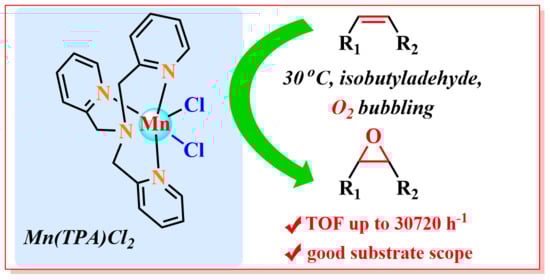
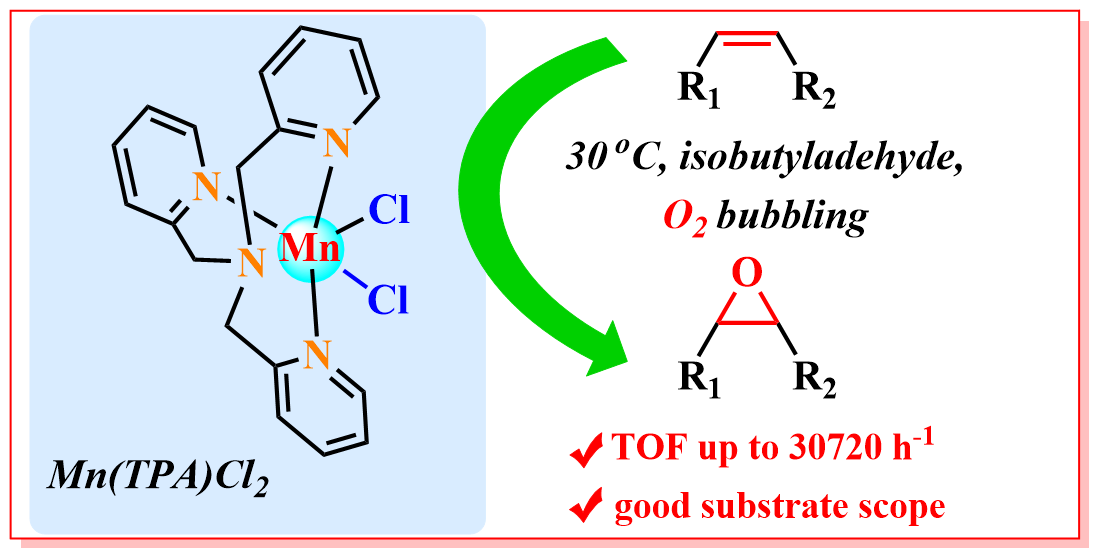
The development of a metalloenzyme-like catalytic system for the efficient oxidation of olefins under a dioxygen (O2) atmosphere at room temperature is of significant interest in the field of catalysis. Herein, we present a highly active and selective aerobic epoxidation of olefins using metalloenzyme-like catalysts based on a non-heme ligand, tris(2-pyridylmethyl)amine (TPA). Notably, manganese chloride complexed with TPA (Mn(TPA)Cl2) demonstrated excellent activity for the epoxidation of trans-stilbene using O2 as the oxidant in the presence of a co-reductant at 30 °C. A quantitative conversion of 99% and high yield of 98%, as determined by gas chromatography using an external standard method, were achieved under optimum reaction conditions. Furthermore, Mn(TPA)Cl2 exhibited a good substrate tolerance to styrene derivatives with electron-withdrawing or electron-donating groups, cyclic olefins with different substituents and substitution degrees, as well as long-chain olefins. Coupled with a high turnover frequency (TOF) of up to 30,720 h−1, these results underscore the potential of Mn(TPA)Cl2 as a promising metalloenzyme-like catalytic platform for the aerobic synthesis of diverse epoxides from olefins under ambient conditions.

Graphical Abstract

1. Introduction

Olefin epoxidation is a fundamental reaction in organic synthesis, serving as a cornerstone for the production of a wide range of fine chemicals, pharmaceuticals, and polymers [1,2,3,4]. Traditional methodologies for this transformation typically rely on stoichiometric amounts of organic peroxides or peracids, which not only generate substantial amounts of waste but also raise significant environmental and safety concerns [5,6]. Consequently, the development of catalytic systems that utilize dioxygen (O2) as the oxidant represents a more sustainable and environmentally friendly alternative, aligning with the principles of green chemistry [7,8,9,10]. Nature has evolved sophisticated mechanisms for the selective activation of inert C–H bonds through metalloenzymes [11]. Oxidation reactions catalyzed by metalloenzymes often proceed with remarkable efficiency under mild conditions and demonstrate remarkable selectivity [12]. Metalloenzymes such as cytochrome P-450 and monooxygenase have been extensively investigated for their ability to activate molecular oxygen, providing critical foundations for the design of biomimetic catalytic platforms [13,14,15].
For the past years, the development of metalloenzyme-catalyzed aerobic oxidation reactions has attracted significant attention. Metalloporphyrins, recognized as metalloenzyme-like motifs, are often referred to as heme metal complexes due to their active sites resembling those found in cytochrome P450 enzymes. As a result, they have been widely employed in a variety of aerobic oxidation reactions [16,17,18,19]. For instance, Gröger and coworkers reported a water-soluble iron(III) porphyrin for in situ regeneration of oxidized cofactors through the activation and reduction of molecular oxygen [20]. Hosseini-Monfared and coworkers presented a graphene-supported Mn-porphyrin catalyst (GO-[Mn(TPyP)tart]) [21]. GO-[Mn(TPyP)tart] displayed high activity for the enantioselective epoxidation of unfunctionalized olefins with O2 using isobutyraldehyde as the co-reductant. Zhou and coworkers developed an attractive approach for the aerobic oxidation of alcohols using manganese porphyrin as a biomimetic catalyst in the presence of cyclohexene [22]. Recently, Guo and coworkers conducted the first extensive investigation on the intramolecular H-bonding effect within heme systems, confirming that this effect enhances the reactivity of iron(IV)-oxo porphyrin species in oxidation reactions [23]. The significant progress made by heme metalloenzymes in oxidation reactions inspired scientists to design advanced bioinspired synthetic catalytic systems. Non-heme metalloenzymes also represent important classes of metalloenzymes capable of utilizing O2 or H2O2 as the terminal oxidant to achieve diverse oxidation reactions [24,25,26,27,28]. The diversity of metal centers and polydentate ligands having N- and O-based donors, combined with the variable electronic properties, makes these metalloenzyme-like complexes highly attractive, particularly those incorporating transition metals such as iron, manganese and cobalt [29,30,31]. A diiron(III) complex of the dinucleating ligand HPTP(N,N,N,N-tetrakis(2-pyridylmethyl)-2-hydroxy-1,3-diaminopropane) and a mononuclear iron(III) complex of the BPMEN(N,N-dimethyl-N,N-bis-2-pyridinylmethyl)-1,2-ethanediamine) were synthesized and utilized for the catalytic oxidation of sulfide with H2O2 [32]. Nam and coworkers reported a mononuclear non-heme high-spin iron(III)-acylperoxo complex bearing an N-methylated cyclam ligand for the olefin epoxidation and alkane hydroxylation [33]. They proposed that metal−oxo species acted as reactive intermediates in oxidation reactions [34]. Undoubtedly, remarkable progress has been achieved in the development of heme- and non-heme metal complexes as metalloenzyme-like catalysts. However, most of the non-heme catalytic oxidation systems use peroxides such as hydrogen peroxide as the oxidizing agents. In fact, catalytic systems that use oxygen or air directly as the oxidant are more attractive. Recently, a cobalt(III) tert-butylperoxo complex was designed for the selective aerobic peroxidation of styrene in the presence of O2 [35]. Therefore, there is an urgent need for further exploration of more high-efficiency non-heme metalloenzyme-like catalytic systems for aerobic oxidation reactions under mild conditions.
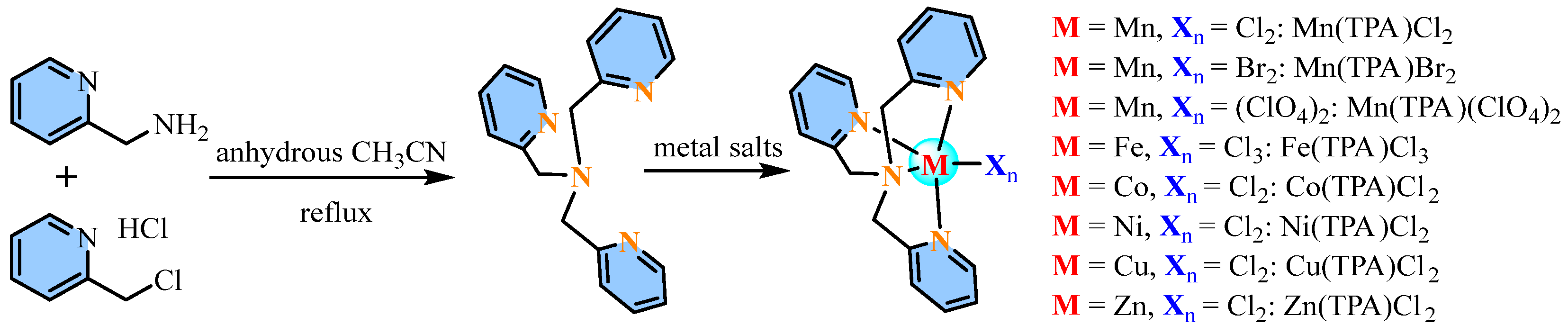
The design of metalloenzyme-like catalysts often involves ligands capable of stabilizing high-valent metal species and facilitating the activation of reactants. Tris(2-pyridylmethyl)amine (TPA) is a particularly attractive ligand due to its ability to form stable complexes with a variety of transition metals and its potential to mimic the coordination environment of metalloenzymes. Herein, we report a metalloenzyme-like catalytic system based on TPA-ligated transition metal complexes for the epoxidation of olefins using O2 as the oxidant in the presence of a co-reductant under ambient conditions. The synthesis of the TPA-ligated metalloenzyme-like catalysts is as described in Scheme 1. After investigating the influence of the metal center and the anions on the epoxidation of trans-stilbene, Mn(TPA)Cl2 was proven to be the optimal catalyst. Then, the effect of solvent, catalyst concentration, co-reductant and reaction time was systematically investigated. To further exploit the potential of Mn(TPA)Cl2, the substrate scope of this metalloenzyme-like was assessed by performing the epoxidation of various olefins with O2 under the optimal reaction conditions.

2. Materials and Methods

2.1. General Experimental Information

2-(Aminomethyl)pyridine and 2-(chloromethyl)pyridine hydrochloride were obtained from J&K Scientific Ltd. (Beijing, China). Metal salts were used as received from Energy Chemical. Aldehydes and olefins were purchased from TCI. TPA, [Mn(TPA)X2](X = Cl, Br, ClO4), [Fe(TPA)Cl3], [Co(TPA)Cl2], [Ni(TPA)Cl2], [Cu (TPA)Cl2] and [Zn(TPA)Cl2] were synthesized according to published procedures [36,37,38,39,40], with further details provided in the Supplementary Materials. Other commercially available chemicals were laboratory-grade reagents from local suppliers. Unless otherwise noted, all reagents and solvents were purchased from commercial sources and used as received.
1H NMR and 13C NMR spectra were recorded on a Bruker Avance III HD 400 MHz spectrometer (Bruker Corporation, Billerica, MA, USA) at ambient temperature in CDCl3 with tetramethylsilane as internal reference. Elemental analysis (C, N and H) of the samples was carried out on a Vario EL cube elemental analyzer made in Germany (Elementar Analysensysteme GmbH, Langenselbold, Germany). Electrospray ionization mass (ESI-MS) spectra were performed on a Shimadzu LC-MS 2010 (Shimadzu Corporation, Kyoto Japan) (in methanol) in negative mode. Ultra-violet-visible light (UV–vis) spectra were recorded on Shimadzu UV-2450 spectrometer (Shimadzu Corporation, Kyoto, Japan) (dichloromethane as the solvent and reference). Fourier transform infrared spectroscopy (FT-IR) of the materials was recorded using a Nicolet 6700 spectrometer (Thermo Fisher Scientific Inc., Waltham, MA, USA) using KBr pellets with a resolution of 4 cm−1 in the range of 400–4000 cm−1. The conversions and yields were measured by a Shimadzu GC2030 gas (Shimadzu Corporation, Kyoto, Japan) chromatograph (external standard method) equipped with a hydrogen flame ionization detector and the Rtx-5 column (30 m × 0.32 mm × 0.25 μm) using N2 as the carrier gas at a flow rate of 1 mL min−1.

2.2. Typical Procedures for the Epoxidation Reaction

In a general procedure, a tailored three-neck tube equipped with a magnetic stirrer and low-temperature condensation reflux system was charged with the catalyst (0.005 mol% in 5 mL dichloromethane), isobutyraldehyde (5.0 mmol), and trans-stilbene (1.0 mmol). Oxygen gas was fed to the mixture by bubbling (10 mL/min). Then, the reaction was operated in water bath at 30 °C for 50 min. After the reaction was completed, the mixture was diluted with chloromethane (5 mL) and analyzed by gas chromatography to determine the conversion and yield. All the experiments were carried out in parallel three times.

3. Results and Discussion

The epoxidation of trans-stilbene with O2 using isobutyraldehyde as the co-reductant in acetonitrile was selected as a model reaction to evaluate the catalytic performance of various as-prepared metalloenzyme-like catalysts. The results are summarized in Table 1.
In the absence of a catalyst, this reaction yielded a negligible conversion of 4% to 2,3-diphenyloxirane at 30 °C within 50 min (entry 1). Then, several metalloenzyme-like catalysts were introduced into the reaction system under the same reaction conditions. Zn(TPA)Cl2, Ni(TPA)Cl2, Co(TPA)Cl2 and Fe(TPA)Cl3 showed significantly lower activities (entries 2–5), while Cu(TPA)Cl2 produced 35% yield of 2,3-diphenyloxirane (entry 6). The enhanced catalytic activity of Cu(TPA)Cl2 may be attributed to the fact that in this catalytic system, the presence of oxygen molecules leads to a significant increase in the chemistry of copper catalysis, as oxygen is capable of either acting as an electron sink (exhibiting oxidase activity), serving as a source of oxygen atoms that are incorporated into the target product (exhibiting oxygenase activity), or fulfilling both functions concurrently. The oxidation of copper by molecular oxygen is a facile process—it not only enables efficient catalytic turnover in net oxidative reactions but also provides ready access to the higher Cu(III) oxidation state [41]. Moreover, Mn(TPA)Cl2 exhibited the highest catalytic activity, achieving a high conversion of 99% and a yield of 98% under the same reaction conditions (entry 7). This result highlights the critical role of the metal center in determining the catalytic performance of the complexes. The high activity of Mn(TPA)Cl2 can be attributed to several factors: (1) the Mn(II) center in Mn(TPA)Cl2 is capable of undergoing redox cycling, facilitating the activation of molecular oxygen and the formation of reactive oxygen species; (2) the TPA ligand provides a stable coordination environment for the Mn(II) center, preventing its deactivation through dimerization or aggregation [24]; (3) the presence of the co-reductant, isobutyraldehyde, enhances the catalytic activity of Mn(TPA)Cl2 by facilitating the formation of a reactive Mn-oxo species via a redox-neutral mechanism. Additionally, we examined the effect of anions, including Cl, Br and ClO4, on the catalytic performance of Mn-based complexes. In this catalytic system, the activity of them was insensitive to the type of anion, with all of them yielding nearly quantitative conversions of trans-stilbene (entries 7–9). Therefore, Mn(TPA)Cl2 was identified as the optimal catalyst for this transformation. Then, we investigated the high efficiency of Mn(TPA)Cl2 by reducing the amount of catalyst to 0.0025 mol%, and a high TOF value of 30,720 h−1 was obtained (entry 10). This result highlights the outstanding activity of Mn(TPA)Cl2 as a metalloenzyme-like catalyst. During the aforementioned catalytic process, the main by-product observed was benzaldehyde.
Subsequently, the effects of the reaction parameter, such as solvent, co-reductant, catalyst concentration and reaction time, on the aerobic epoxidation of trans-stilbene were also examined for the Mn(TPA)Cl2 catalyst. As shown in Table 2, the yield of 2,3-diphenyloxirane was strongly affected by the solvent. Polar protic solvents, such as methanol or 2-propanol, led to lower activities (entry 1), whereas the aprotic polar solvent acetone enhanced the activity to achieve a conversion of 62% (entry 2). Other aprotic polar solvents (acetonitrile, dichloromethane and toluene) and nonpolar cyclohexane provided excellent conversions (92–99%) and yields (85–98%). Obviously, in this epoxidation reaction, the catalytic activity is presumably influenced not only by solvent polarity but also by the solvent’s coordination ability and steric hindrance effects. Although acetone exhibits an intermediate polarity between acetonitrile and dichloromethane, its stronger coordination capacity and larger steric bulk exert a certain inhibitory effect on the activity of the metal active sites. Consequently, the epoxidation yield achieved with acetone is lower than that obtained using acetonitrile or dichloromethane as the solvent. Among these, dichloromethane emerged as the favored solvent due to the superior catalytic property achieved in it. The quantitative conversion achieved in these non-protic solvents or cyclohexane may be attributed to their solubility, which promotes this epoxidation. Similar results have also been reported [42]. This indicates the broad solvent compatibility of this metalloenzyme-like catalyst.
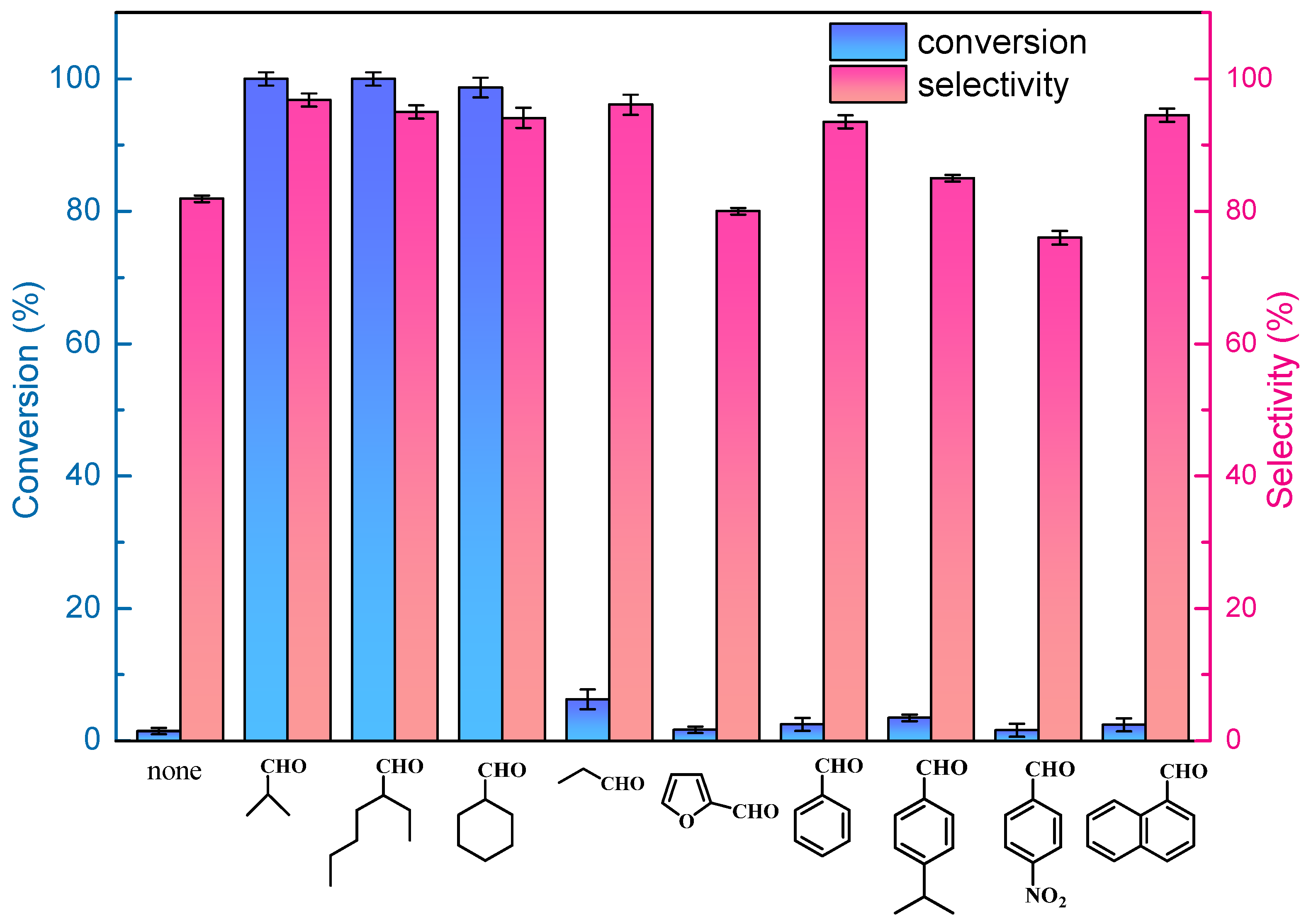
As shown in Figure 1, the catalytic performance is notably influenced by the type of aldehyde employed as the co-reductant. Minimal conversion was observed in the absence of any aldehydes. When isobutyraldehyde, 2-ethylhexanal or cyclohexanecarbaldehyde was employed as the co-reductant, the activity was significantly augmented, achieving >98% conversion of trans-stilbene with high selectivity. However, low conversions (<7%) were obtained in the presence of the propionaldehyde and aromatic aldehydes (2-furaldehyde, benzaldehyde, p-isopropylbenzaldehyde, 4-nitrobenzaldehyde, 1-aphthaldehyde). Considering its low cost and readily available nature, isobutyraldehyde was identified as the optimal choice for this catalytic project.
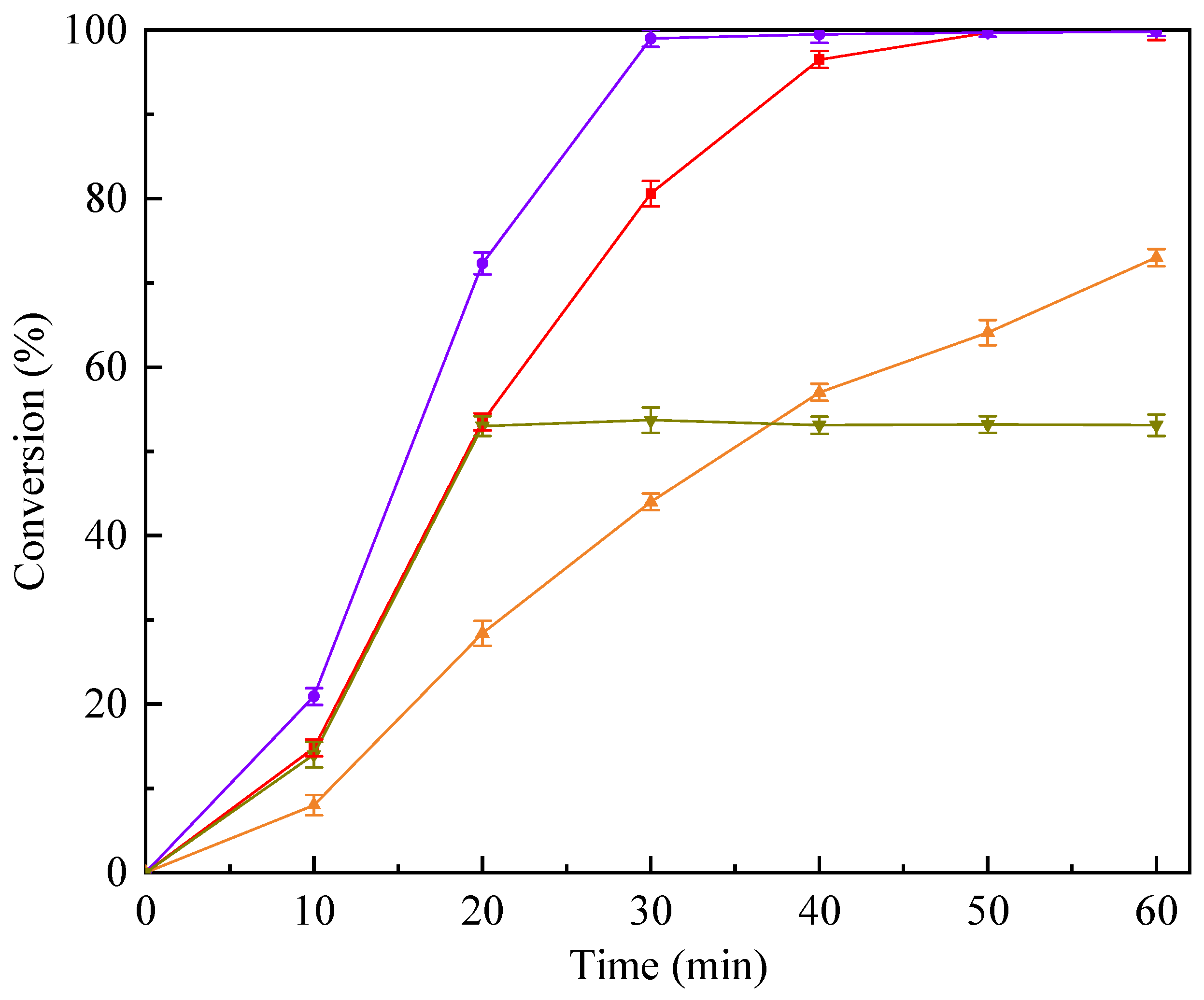
Figure 2 illustrates the influence of catalyst concentration and reaction time on the catalytic activity of Mn(TPA)Cl2. With the increasing catalyst concentration from 0.0025 to 0.005 mol%, the trans-stilbene conversions rose from 64% to 99% within 50 min, correspondingly. The results clearly indicate that the reaction activity exhibits a positive correlation with catalyst concentration within a specific range. In terms of the kinetics of the catalytic reaction, the reaction rate is limited by the availability of active sites at low catalyst concentrations. An increase in catalyst concentration enhances the number of active sites, thereby accelerating the reaction rate. Notably, further increasing the catalyst concentration to 0.01 mol% significantly reduced the reaction time required to achieve complete conversion (100%). Additionally, the isobutyraldehyde/O2-mediated epoxidation reaction has been reported to proceed via a free radical chain mechanism [43,44]. To verify whether the developed catalytic system operates via a free radical pathway, we introduced 3,5-di-tert-butyl-p-hydroxytoluene, a radical inhibitor, into the reaction after 20 min. Obviously, extending the reaction time resulted in a plateau with a corresponding conversion of approximately 53%. The significant variation observed in the results with and without the radical inhibitor indicates that this reaction system likely involves radical species.
Encouraged by these findings, the scope of substrates for the epoxidation reaction was investigated at 30 °C using 0.005 mol% Mn(TPA)Cl2 as the catalyst (Table 3). Three categories of olefins were selected as representatives, including aromatic terminal and internal olefins (styrene, 4-methylstyrene, 4-chlorostyrene, trans-1-methyl-2-phenylethene and trans-stilbene), cyclic olefins (cycloheptene, cyclooctene, norbornene, 2,6,6-trimethylbicyclo [3.1.1]hept-2-ene and 2,3,4,5-tetrahydro-1,1’-biphenyl) and aliphatic terminal olefins (1-octene and 1-decene). Obviously, the developed catalytic protocol demonstrated applicability across all selected substrates, particularly for aromatic terminal and internal olefins, where Mn(TPA)Cl2 exhibited excellent conversion exceeding 99% (entries 1–5). For example, styrene was nearly quantitatively converted to styrene oxide within 50 min. In addition, this catalytic system was effective for both electron-donating (Me) and electron-withdrawing (Cl) p-substituted styrene (entries 2 and 3). As for the aromatic internal olefins, Mn(TPA)Cl2 achieved quantitative yields of the desired epoxides under identical conditions, even with bulkier phenyl substitutions (entries 4 and 5). To our delight, similar high conversions (>90%) were also observed for cyclic olefins (entries 6–9). However, when trisubstituted cyclic olefins were tested under the same conditions, a sharp decline in product yield was observed, likely due to the significant steric hindrance. Nevertheless, extending the reaction time to 120 min resulted in a yield of 97% for the desired product (entry 10). These suggest that the catalytic system is not highly sensitive to the electronic or steric properties of the substrates, further highlighting its versatility and potential for application in a wide range of olefin epoxidation reactions. For the more challenging substrates, 1-octene and 1-decene, higher activation energies are typically required for successful epoxidation. Mn(TPA)Cl2 still achieved moderate conversions of 47 and 57%, respectively, after prolonging the reaction time to 120 min (entries 11 and 12). Overall, this catalytic system demonstrates excellent substrate scope, with the target product selectivity consistently maintaining above 95%, and only trace amounts of aldehyde by-products formed.

4. Conclusions

In summary, a series of non-heme ligand tris(2-pyridylmethyl)amine (TPA)-based metalloenzyme-like catalysts were synthesized and applied to the epoxidation of olefins under atmospheric pressure of O2 and 30 °C. Among these non-heme metal complexes, [Mn(TPA)X2](X = Cl, Br, ClO4) gave a significantly enhanced conversion for trans-stilbene (>98%) and high yield for 2,3-diphenyloxirane (up to 98%) in the presence of co-reductant isobutyraldehyde within 50 min. The catalytic activities were meticulously investigated by controlling the solvent, catalyst concentration, co-reductant and reaction time. Notably, a remarkable TOF of 30,720 h−1 was obtained for Mn(TPA)Cl2, highlighting its enzyme-like catalytic properties. More importantly, this catalytic protocol is compatible with a wide range of substrates, including aromatic terminal and internal olefins, cyclic olefins and aliphatic terminal olefins. The corresponding epoxide products were obtained in moderate to excellent yields (45−99%). These results illustrate the effectiveness of a metalloenzyme-like catalytic system in facilitating the aerobic oxidation of olefins to epoxides under 1 atm of O2 at room temperature. Our ongoing research is focused on elucidating the catalytic mechanism and extending this strategy to other oxidation reactions.

Supplementary Materials

The following supporting information can be downloaded at https://www.mdpi.com/article/10.3390/org7010004/s1, [36,37,38,39,40].

Author Contributions

Writing—original draft, investigation, methodology, visualization, L.L.; investigation, data curation, L.W.; software, formal analysis, Y.Q.; conceptualization, writing—original draft preparation, writing—review and editing, funding acquisition, Y.C. All authors have read and agreed to the published version of the manuscript.

Funding

This research was funded by Young Top-Notch Talents of Guangdong Special Support Plan, grant number 2023TQ07C022, and Innovative Team Project of Guangdong Ordinary University, grant number 2019KCXTD002.

Data Availability Statement

The original contributions presented in this study are included in the article/Supplementary Material. Further inquiries can be directed to the corresponding author.

Conflicts of Interest

The authors declare no conflicts of interest.

References

  1. Schmidt, F.; Cokoja, M. Supramolecular concepts for the biphasic epoxidation of olefins using aqueous hydrogen peroxide. Green Chem. 2021, 23, 708–722. [Google Scholar] [CrossRef]
  2. Philip, R.M.; Radhika, S.; Abdulla, C.M.A.; Anilkumar, G. Recent trends and prospects in homogeneous manganese-catalysed epoxidation. Adv. Synth. Catal. 2021, 363, 1272–1289. [Google Scholar] [CrossRef]
  3. Sathicq, Á.G.; Pizzio, L.R.; Vázquez, P.G.; Tundo, P.; Aricò, F.; Romanelli, G.P. Keggin heteropolyacid as catalyst for olefin epoxidation: A multiphase approach. Sustain. Chem. Pharm. 2020, 15, 100201. [Google Scholar] [CrossRef]
  4. Qi, Y.; Tuo, Y.; Zhu, Y.; Wei, W.; Wang, M.; Zhao, Y.; Chen, D.; Feng, X. Advances in catalyst design for electrocatalytic epoxidation of olefins. Chem. Eng. Sci. 2025, 306, 121273. [Google Scholar] [CrossRef]
  5. Jiao, M.; Matsunaga, H.; Ishizuka, T. A simple, iron-catalyzed, pyridine-assisted hydrogen peroxide epoxidation system. Chem. Pharm. Bull. 2011, 59, 799–801. [Google Scholar] [CrossRef]
  6. Hu, L.; Shi, L.; Hong, H.; Li, M.; Bao, Q.; Tang, J.; Ge, J.; Lu, J.; Cao, X.; Gu, H. Catalytic epoxidation of stilbene with FePt@Cu nanowires and molecular oxygen. Chem. Commun. 2010, 46, 8591–8593. [Google Scholar] [CrossRef]
  7. Guo, M.; Corona, T.; Ray, K.; Nam, W. Heme and nonheme high-valent iron and manganese oxo cores in biological and abiological oxidation reactions. ACS Cent. Sci. 2019, 5, 13–28. [Google Scholar] [CrossRef]
  8. Bryliakov, K.P. Catalytic asymmetric oxygenations with the environmentally benign oxidants H2O2 and O2. Chem. Rev. 2017, 117, 11406–11459. [Google Scholar] [CrossRef] [PubMed]
  9. Hill, A.G.; Castillo, M.C.; Bacsa, J.; Otte, K.S.; Soper, J.D. Redox-active ligands permit multielectron O2 homolysis and O-atom transfer at exceptionally high-valent vanadyl complexes. J. Am. Chem. Soc. 2025, 147, 13356–13369. [Google Scholar] [CrossRef]
  10. Yamaguchi, K.; Uemura, Y.; Sugimoto, H.; Ito, R.; Morimoto, Y.; Itoh, S. Mechanistic studies on catalytic alkane oxidation by Murahashi’s O2/copper(II)/aldehyde system. Catal. Sci. Technol. 2023, 13, 5859–5867. [Google Scholar] [CrossRef]
  11. Vicens, L.; Olivo, G.; Costas, M. Rational design of bioinspired catalysts for selective oxidations. ACS Catal. 2020, 10, 8611–8631. [Google Scholar] [CrossRef]
  12. Rebilly, J.N.; Colasson, B.; Bistri, O.; Over, D.; Reinaud, O. Biomimetic cavity-based metal complexes. Chem. Soc. Rev. 2015, 44, 467–489. [Google Scholar] [CrossRef]
  13. Zhao, P.; Chen, J.; Ma, N.C.; Chen, J.; Qin, X.; Liu, C.; Yao, F.; Yao, L.; Jin, L.; Cong, Z. Enabling highly (R)-enantioselective epoxidation of styrene by engineering unique non-natural P450 peroxygenases. Chem. Sci. 2021, 12, 6307–6314. [Google Scholar] [CrossRef]
  14. Ghosh, S.; Baltussen, M.G.; Ivanov, N.M.; Haije, R.; Jakštaitė, M.; Zhou, T.; Huck, W.T.S. Exploring emergent properties in enzymatic reaction networks: Design and control of dynamic functional systems. Chem. Rev. 2024, 124, 2553–2582. [Google Scholar] [CrossRef] [PubMed]
  15. Lin, H.; Fang, S.; Gao, H.; Qin, Z.; Fan, D.; Li, N.; Wu, Z.; Chen, H. Mechanistic insights into enantiocontrolling of styrene monooxygenase-catalyzed epoxidation of olefins. ACS Catal. 2024, 14, 2246–2251. [Google Scholar] [CrossRef]
  16. Estrada-Montaño, A.S.; Gómez-Benítez, V.; Camacho-Dávila, A.; Rivera, E.; Morales-Morales, D.; Zaragoza-Galán, G. Metalloporphyrins: Ideal catalysts for olefin epoxidations. J. Porphyr. Phthalocya. 2022, 26, 821–836. [Google Scholar] [CrossRef]
  17. Zhao, M.; Wu, C.-D. Synthesis and post-metalation of a covalent-porphyrinic framework for highly efficient aerobic epoxidation of olefins. Catal. Commun. 2017, 99, 146–149. [Google Scholar] [CrossRef]
  18. Pereira, M.M.; Dias, L.D.; Calvete, M.J.F. Metalloporphyrins: Bioinspired oxidation catalysts. ACS Catal. 2018, 8, 10784–10808. [Google Scholar] [CrossRef]
  19. Ahmad, I.; Shagufta; Rehman, S. Metal-porphyrin in epoxidation of olefins: Recent advances. Tetrahedron 2022, 104, 132604. [Google Scholar] [CrossRef]
  20. Maid, H.; Bohm, P.; Huber, S.M.; Bauer, W.; Hummel, W.; Jux, N.; Groger, H. Iron catalysis for in situ regeneration of oxidized cofactors by activation and reduction of molecular oxygen: A synthetic metalloporphyrin as a biomimetic NAD(P)H oxidase. Angew. Chem. Int. Ed. 2011, 50, 2397–2400. [Google Scholar] [CrossRef]
  21. Berijani, K.; Farokhi, A.; Hosseini-Monfared, H.; Janiak, C. Enhanced enantioselective oxidation of olefins catalyzed by Mn-porphyrin immobilized on graphene oxide. Tetrahedron 2018, 74, 2202–2210. [Google Scholar] [CrossRef]
  22. Liu, X.H.; Yu, H.Y.; Xue, C.; Zhou, X.T.; Ji, H.B. Cyclohexene promoted efficient biomimetic oxidation of alcohols to carbonyl compounds catalyzed by manganese porphyrin under mild conditions. Chin. J. Chem. 2020, 38, 458–464. [Google Scholar] [CrossRef]
  23. Gong, Z.; Wang, L.; Xu, Y.; Xie, D.; Qi, X.; Nam, W.; Guo, M. Enhanced reactivities of iron(IV)-oxo porphyrin species in oxidation reactions promoted by intramolecular hydrogen-Bonding. Adv. Sci. 2024, 11, e2310333. [Google Scholar] [CrossRef] [PubMed]
  24. Chen, J.; Jiang, Z.; Fukuzumi, S.; Nam, W.; Wang, B. Artificial nonheme iron and manganese oxygenases for enantioselective olefin epoxidation and alkane hydroxylation reactions. Coordin. Chem. Rev. 2020, 421, 213443. [Google Scholar] [CrossRef]
  25. Chatterjee, S.; Paine, T.K. Dioxygen reduction and bioinspired oxidations by non-heme iron(II)-α-hydroxy acid complexes. Acc. Chem. Res. 2023, 56, 3175–3187. [Google Scholar] [CrossRef]
  26. Biswas, J.P.; Ansari, M.; Paik, A.; Sasmal, S.; Paul, S.; Rana, S.; Rajaraman, G.; Maiti, D. Effect of the ligand backbone on the reactivity and mechanistic paradigm of non-heme iron(IV)-oxo during olefin epoxidation. Angew. Chem. Int. Ed. 2021, 60, 14030–14039. [Google Scholar] [CrossRef] [PubMed]
  27. Ottenbacher, R.V.; Bryliakova, A.A.; Kurganskii, V.I.; Prikhodchenko, P.V.; Medvedev, A.G.; Bryliakov, K.P. Bioinspired non-heme Mn catalysts for regio- and stereoselective oxyfunctionalizations with H2O2. Chem. Eur. J. 2023, 29, e202302772. [Google Scholar] [CrossRef]
  28. Yadav, O.; Kumar, M.; Mohapatra, R.K.; Gupta, M.K.; Ansari, M.; Ansari, A. Mechanistic insights on the epoxidation of alkenes by high-valent non-heme Fe(IV) and Fe(v) oxidants: A comparative theoretical study. New J. Chem. 2024, 48, 6132–6141. [Google Scholar] [CrossRef]
  29. Kal, S.; Xu, S.; Que, L., Jr. Bio-inspired nonheme iron oxidation catalysis: Involvement of oxoiron(V) oxidants in cleaving strong C-H bonds. Angew. Chem. Int. Ed. 2020, 59, 7332–7349. [Google Scholar] [CrossRef]
  30. Bryliakov, K.P. Mechanisms of C(sp3)–H and C=C selective oxidative heterofunctionalizations by non-heme Fe and Mn mimics of oxygenase enzymes. Coord. Chem. Rev. 2024, 508, 215793. [Google Scholar] [CrossRef]
  31. Li, Y.Y.; Li, X.H.; An, Z.X.; Chu, Y.; Wang, X.L. Room-temperature olefin epoxidation reaction by two 2D cobalt metal-organic complexes under O2 atmosphere: Coordination and structural regulation. Chin. Chem. Lett. 2025, 36, 109716. [Google Scholar] [CrossRef]
  32. Trehoux, A.; Roux, Y.; Guillot, R.; Mahy, J.P.; Avenier, F. Catalytic oxidation of dibenzothiophene and thioanisole by a diiron(III) complex and hydrogen peroxide. J. Mol. Catal. A Chem. 2015, 396, 40–46. [Google Scholar] [CrossRef]
  33. Wang, B.; Lee, Y.M.; Clémancey, M.; Seo, M.S.; Sarangi, R.; Latour, J.M.; Nam, W. Mononuclear nonheme high-spin iron(III)-acylperoxo complexes in olefin epoxidation and alkane hydroxylation reactions. J. Am. Chem. Soc. 2016, 138, 2426–2436. [Google Scholar] [CrossRef]
  34. Devi, T.; Lee, Y.-M.; Nam, W.; Fukuzumi, S. Metal ion-coupled electron-transfer reactions of metal-oxygen complexes. Coordin. Chem. Rev. 2020, 410, 213219. [Google Scholar] [CrossRef]
  35. Chen, Y.; Song, H.; Hao, Y.; Lui, M.Y.; Wong, W.L.; Lam, W.W.Y.; Chan, B.; Shi, H.; Man, W.L. Selective aerobic peroxidation of styrene catalyzed by a cobalt tert-butylperoxo complex. JACS Au 2025, 5, 1090–1095. [Google Scholar] [CrossRef]
  36. Ward, A.L.; Elbaz, L.; Kerr, J.B.; Arnold, J. Nonprecious metal catalysts for fuel cell applications: Electrochemical dioxygen activation by a series of first row transition metal tris(2-pyridylmethyl)amine complexes. Inorg. Chem. 2012, 51, 4694–4706. [Google Scholar] [CrossRef] [PubMed]
  37. Liu, Y.; Xiang, R.; Du, X.; Ding, Y.; Ma, B. An efficient oxygen evolving catalyst based on a μ-O diiron coordination complex. Chem. Commun. 2014, 50, 12779–12782. [Google Scholar] [CrossRef] [PubMed]
  38. Lei, L.; Chen, Y.; Feng, Z.; Deng, C.; Xiao, Y. Bioinspired manganese complex for room-temperature oxidation of primary amines to imines by t-butyl hydroperoxide. Inorg. Chim. Acta 2021, 519, 120282. [Google Scholar] [CrossRef]
  39. Shin, B.-K.; Kim, Y.; Kim, M.; Han, J. Synthesis, structure and catalase activity of the [TPA2Mn2(μ-Cl)2]2+ complex. Polyhedron 2007, 26, 4557–4566. [Google Scholar] [CrossRef]
  40. He, Z.; Craig, D.C.; Colbran, S.B. Structures and properties of 6-aryl substituted tris(2-pyridylmethyl)amine transition metal complexes. J. Chem. Soc., Dalton Trans. 2002, 22, 4224–4235. [Google Scholar] [CrossRef]
  41. Allen, S.E.; Walvoord, R.R.; Padilla-Salinas, R.; Kozlowski, M.C. Aerobic copper-catalyzed organic reactions. Chem. Rev. 2013, 113, 6234–6458. [Google Scholar] [CrossRef]
  42. Jia, Y.; Alothman, Z.A.; Liang, R.; Cha, S.; Li, X.; Ouyang, W.; Zheng, A.; Osman, S.M.; Luque, R.; Sun, Y. Immobilization of (tartrate-salen)Mn(III) polymer complexes into SBA-15 for catalytic asymmetric epoxidation of alkenes. Mol. Catal. 2020, 495, 111146. [Google Scholar] [CrossRef]
  43. He, X.; Chen, L.; He, Q.; Xiao, H.; Zhou, X.; Ji, H. Self-assembled metalloporphyrins-inorganic hybrid flowers and their application to efficient epoxidation of olefins. J. Chem. Technol. Biotechnol. 2017, 92, 2594–2605. [Google Scholar] [CrossRef]
  44. Chen, L.; Yang, Y.; Guo, Z.; Jiang, D. Highly efficient activation of molecular oxygen with nanoporous metalloporphyrin frameworks in heterogeneous systems. Adv. Mater. 2011, 23, 3149–3154. [Google Scholar] [CrossRef] [PubMed]
Scheme 1. Synthetic process of the TPA-ligated metalloenzyme-like catalysts.
Organics 07 00004 sch001
Figure 1. Effect of various aldehydes on the aerobic epoxidation of trans-stilbene. Reaction conditions: trans-Stilbene (1.0 mmol), isobutyraldehyde (5.0 mmol), Mn(TPA)Cl2 (0.005 mol%), O2 bubbling (10 mL min−1), CH2Cl2 (5 mL), 30 °C.
Organics 07 00004 g001
Figure 2. Influence of catalyst concentration on the conversion of trans-stilbene. ●: 0.01 mol%, ■: 0.005 mol%, ▲: 0.0025 mol%, ▼: 0.005 mol% (added 0.2 mmol 3,5-di-tert-butyl-p-hydroxytoluene as radical scavenger at 20 min). Reaction conditions: trans-stilbene (1.0 mmol), isobutyraldehyde (5.0 mmol), Mn(TPA)Cl2 (0.005 mol%), O2 bubbling (10 mL min−1), CH2Cl2 (5 mL), 30 °C.
Organics 07 00004 g002
Table 1. Aerobic epoxidation of trans-stilbene catalyzed by various metalloenzyme-like catalysts a.
Organics 07 00004 i001
EntryCatalystConversion b (%)Yield b (%)TOF c (h−1)
1-44-
2Zn(TPA)Cl2541200
3Ni(TPA)Cl2661440
4Co(TPA)Cl21092400
5Fe(TPA)Cl315153600
6Cu(TPA)Cl236358640
7Mn(TPA)Cl2999823,760
8Mn(TPA)Br2989423,520
9Mn(TPA)(ClO4)2999523,760
10 dMn(TPA)Cl2646330,720
a trans-Stilbene (1.0 mmol), isobutyraldehyde (5.0 mmol), catalyst loading (0.005 mol%, based on the mole of trans-stilbene), O2 bubbling (10 mL min−1), CH2Cl2 (5 mL), 30 °C, 50 min. b Determined by GC using external standard method. c Turnover frequency (TOF) = moles of synthesized product per mole of catalyst per hour. d 0.0025 mol%.
Table 2. Effect of various solvents on the aerobic epoxidation of trans-stilbene a.
EntrySolventConversion b (%)Yield b (%)
1methanol55
22-propanol33
3acetonitrile9993
4acetone6256
5dichloromethane9998
6toluene9285
7cyclohexane9487
a trans-Stilbene (1.0 mmol), isobutyraldehyde (5.0 mmol), Mn(TPA)Cl2 (0.005 mol%), O2 bubbling (10 mL min−1), solvent (5 mL), 30 °C, 50 min. b The same as Table 1.
Table 3. Aerobic epoxidation of various olefins catalyzed by Mn(TPA)Cl2 a.
Organics 07 00004 i002
EntryOlefinEpoxideConversion b (%)Yield b
(%)
1Organics 07 00004 i003Organics 07 00004 i0049998
2Organics 07 00004 i005Organics 07 00004 i0069997
3Organics 07 00004 i007Organics 07 00004 i0089998
4Organics 07 00004 i009Organics 07 00004 i0109999
5Organics 07 00004 i011Organics 07 00004 i0129998
6Organics 07 00004 i013Organics 07 00004 i0149090
7Organics 07 00004 i015Organics 07 00004 i0169896
8Organics 07 00004 i017Organics 07 00004 i0189998
9Organics 07 00004 i019Organics 07 00004 i0209896
10 cOrganics 07 00004 i021Organics 07 00004 i0229997
11 cOrganics 07 00004 i023Organics 07 00004 i0244745
12 cOrganics 07 00004 i025Organics 07 00004 i0265755
a Olefin (1.0 mmol), isobutyraldehyde (5.0 mmol), catalyst loading (0.005 mol%, based on the mole of olefin), O2 bubbling (10 mL min−1), CH2Cl2 (5 mL), 30 °C, 50 min. b The same as Table 1. c The reaction time has been extended to 120 min.
Disclaimer/Publisher’s Note: The statements, opinions and data contained in all publications are solely those of the individual author(s) and contributor(s) and not of MDPI and/or the editor(s). MDPI and/or the editor(s) disclaim responsibility for any injury to people or property resulting from any ideas, methods, instructions or products referred to in the content.