Article

Systematic Investigation of the Solvation Structure in THF-Based Localized High-Concentration Electrolytes


1
Department of Chemistry, Sungshin Women’s University, 55 Dobong-ro 76 ga-gil, Gangbuk-gu, Seoul 01133, Republic of Korea
2
School of Chemistry and Energy, Sungshin Women’s University, 55 Dobong-ro 76 ga-gil, Gangbuk-gu, Seoul 01133, Republic of Korea
3
Center for NanoBio Applied Technology, Sungshin Women’s University, 55 Dobong-ro 76 ga-gil, Gangbuk-gu, Seoul 01133, Republic of Korea
*
Author to whom correspondence should be addressed.
These authors contributed equally to the work.
Organics 2026, 7(1), 10; https://doi.org/10.3390/org7010010
Submission received: 31 December 2025 / Revised: 23 January 2026 / Accepted: 12 February 2026 / Published: 14 February 2026

Abstract

Understanding Li+ solvation structure is critical for the rational design of high- and localized high-concentration electrolytes. Here, we present a systematic investigation of tetrahydrofuran (THF)-based electrolytes with lithium bis(trifluoromethanesulfonyl)imide (LiTFSI) using Raman spectroscopy and 7Li nuclear magnetic resonance to investigate the local solvation structures. By varying the THF:LiTFSI molar ratio, we observed a transition of Li+ solvation from solvent-separated ion pairs to contact ion pairs and aggregates, accompanied by increased structural heterogeneity and constrained local dynamics. Raman spectroscopy captures the evolution of Li+–anion coordination with increasing salt concentration, while 7Li NMR chemical shifts, line widths, and relaxation times provide complementary insight into changes in the electronic environment and symmetry of Li+ coordination. Electrolyte structure is further examined by introducing a hydrofluoroether co-solvent into a concentrated (THF)2–LiTFSI electrolyte. Raman results show that the local Li+–TFSI coordination structure is preserved upon 1,1,2,2-tetrafluoroethyl-2,2,3,3-tetrafluoropropyl ether (TTE) addition, whereas NMR reveals subtle modifications of the ion-rich solvation clusters. These results provide fundamental insight into Li+ solvation and electrolyte localization, offering general design principles for advanced electrolyte systems.

1. Introduction

High- and localized high-concentration electrolytes (HCEs and LHCEs) have been widely investigated as an effective electrolyte design strategy to regulate solvation structures and interfacial chemistry in lithium-based battery systems [1,2,3,4]. In contrast to conventional dilute electrolytes, increasing the Li salt concentration fundamentally reconstructs the local coordination environment of Li+, shifting it from solvent-dominated solvation to ion-pair-rich structures involving contact ion pairs (CIPs) and aggregates (AGGs) [5,6,7,8,9]. This restructuring substantially reduces the population of free solvent molecules and has been shown to promote preferential anion reduction during initial interfacial reactions [10,11,12,13]. As a result, HCE-based electrolytes typically form stable, inorganic-rich solid electrolyte interphases (SEIs), which suppress parasitic solvent decomposition and enhance the stability of lithium metal electrodes [13,14,15,16,17]. Building on this concept, LHCEs introduce non-coordinating or weakly coordinating diluents as co-solvents to preserve the localized high-concentration solvation environment while mitigating the high viscosity and limited ion transport commonly associated with HCEs. To date, most LHCE studies have focused primarily on linear ether-based solvent systems, such as dimethoxyethane (DME), dioxolane (DOL), and glymes [18,19,20,21].
THF is a small heterocyclic ether solvent containing a single ethereal oxygen atom per molecule, which inherently requires a smaller amount of lithium salt to form stoichiometric coordination complexes. Moreover, THF exhibits higher stability against lithium metal than other mono-donor oxygen- or nitrogen-containing solvents, such as acetonitrile [22,23,24]. Recently, THF–LiTFSI-based electrolytes combined with aromatic diluents have been demonstrated to enable quasi-solid-state reaction pathways in lithium–sulfur batteries, highlighting the promise of THF-based concentrated electrolytes [25]. To extend this electrolyte concept beyond lithium–sulfur systems to a broader range of lithium-based battery chemistries, a systematic understanding of how Li+ coordination evolves with electrolyte composition and localization is essential. Accordingly, a systematic investigation of the solvation structure in THF-based high- and localized high-concentration electrolytes is required to establish clear structure–property–performance relationships beyond application-specific observations.
In addition, the small molecular size and single donor site of THF enable access to near-stoichiometric solvation regimes, allowing the continuous evolution of Li+ coordination from solvent-separated ion pairs to contact ion pairs and aggregates to be resolved. The reduced conformational flexibility of THF further simplifies the solvation landscape, making changes in Li+–anion interactions directly observable by complementary Raman and 7Li NMR spectroscopy.
In THF-based HCE and LHCE systems, the solvation environment of Li+, and the overall electrolyte structure evolve continuously with electrolyte composition. This evolution encompasses changes in the primary coordination shell of Li+ as well as transitions in ion-pairing states, ranging from solvent-separated ion pairs (SSIPs) to contact ion pairs and aggregates. At higher levels of electrolyte localization, these local coordination changes further give rise to mesoscopic structural organization within the liquid phase. Together, these hierarchical solvation features govern ion transport behavior and interfacial reactions at electrode surfaces, thereby influencing electrochemical performance. Without a systematic framework that separates composition-driven solvation effects from localization-induced structural heterogeneity, establishing clear structure–performance relationships remains challenging.
In this work, we present a systematic investigation of the solvation structure in THF-based high- and localized high-concentration electrolytes. A series of THF–LiTFSI electrolytes with precisely controlled molar ratios, (THF)n–LiTFSI (n = 21.49, 9.79, 5.90, 3.95, 2.78, 2.00, and 1.60), were first prepared to capture the continuous evolution of Li+ coordination from dilute to highly concentrated regimes. Localized high-concentration electrolytes were subsequently constructed by introducing a hydrofluoroether diluent, 1,1,2,2-tetrafluoroethyl-2,2,3,3-tetrafluoropropyl ether (TTE), into the concentrated (THF)2–LiTFSI electrolyte at controlled volume ratios. The resulting solvation structures were systematically characterized using complementary spectroscopic techniques, including Raman spectroscopy and 7Li nuclear magnetic resonance (NMR), which are particularly sensitive to coordination-induced changes in anion, solvent, and Li+ environments. Through this multi-dimensional analysis, we directly correlate local Li+ solvation structures with electrolyte microdomain formation upon electrolyte localization. This work provides a unified framework to understand how local solvation structures propagate into mesoscopic electrolyte organization in THF-based localized high-concentration electrolytes.

2. Materials and Methods

2.1. Electrolyte Preparation

Lithium bis(trifluoromethylsulfonyl)imide (LiTFSI, 99.95% trace metal basis) was purchased from Sigma-Aldrich (St. Louis, MO, USA) and dried in a vacuum at 130 °C for 8 h prior to use. Anhydrous tetrahydrofuran (THF) was obtained from a solvent-dispensing system, and 1,1,2,2-tetrafluoroethyl 2,2,3,3-tetrafluoropropyl ether (TTE, 99%, Synquest Laboratories, Alachua, Florida, USA) was dried over activated alumina for at least 7 days. The (THF)n–LiTFSI electrolytes were prepared by mixing THF and LiTFSI at stoichiometric ratios corresponding to n moles of THF per mole of LiTFSI (n = 21.49, 9.79, 5.90, 3.95, 2.78, 2.00, and 1.60). The resulting electrolyte solutions were stirred overnight until complete dissolution was achieved, with no visible residual solids observed. Localized high-concentration electrolytes were prepared by diluting the concentrated (THF)2–LiTFSI electrolyte with TTE to obtain (THF)2–LiTFSI:TTE mixtures at volume ratios of 2:1, 1:1, and 1:2. Among the investigated concentrated electrolytes, (THF)2–LiTFSI was selected for the electrolyte localization study because further dilution of the more concentrated (THF)1.6–LiTFSI composition with TTE led to partial precipitation and phase separation, whereas (THF)2–LiTFSI remained single-phase over the investigated dilution range. All electrolyte preparation steps were carried out in an argon-filled glovebox.

2.2. Electrolyte Characterizations

Raman measurements were performed using a DXR Raman Microscope (Thermo Scientific, Waltham, MA, USA). Electrolyte samples were prepared inside an argon-filled glovebox and loaded into sealed glass capillaries with an inner diameter of 2.5 mm. Raman spectra were collected with an acquisition time of 2 s per scan and accumulated over 240 scans to achieve a good signal-to-noise (S/N) ratio. Spectral deconvolution was carried out using Gaussian line-shape functions to quantitatively determine peak areas. 7Li NMR spectra were acquired on a 600 MHz Varian spectrometer using 5 mm screw-cap NMR tubes. An external reference was introduced into each sample in the form of a sealed coaxial capillary containing 10 M LiCl in D2O. The resonance of the 10 M LiCl in D2O was calibrated against 1 M LiCl in D2O, and all reported 7Li chemical shifts were referenced to 1 M LiCl. The 90° pulse width was determined individually for each sample. The 7Li longitudinal relaxation time (T1) was measured using a standard inversion–recovery pulse sequence. The T1 values were obtained by fitting the peak intensities as a function of relaxation delay using an exponential function. Following T1 determination, 7Li NMR spectra were collected using the calibrated 90° pulse, a relaxation delay set to five times the measured T1.

3. Results and Discussion

3.1. Raman Spectroscopy

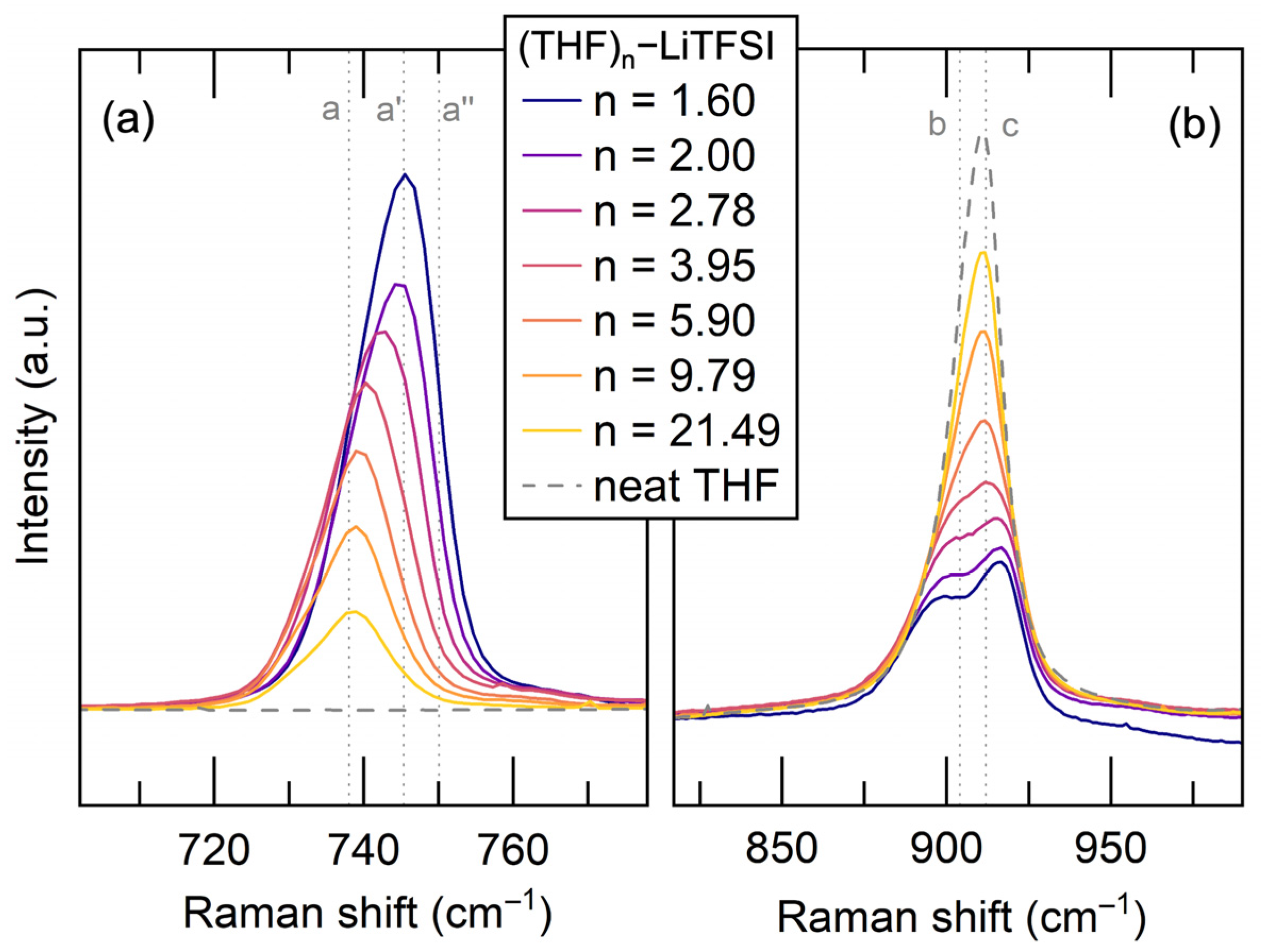
To examine the evolution of the Li+ coordination environment with electrolyte composition, a series of electrolyte solutions with systematically varied THF:LiTFSI molar ratios were analyzed by Raman spectroscopy. Figure 1 presents the Raman spectra of (THF)n–LiTFSI electrolytes with different amounts of THF per mole of LiTFSI, together with that of neat THF. The vibrational features associated with the TFSI anion and THF solvent are shown in Figure 1a and Figure 1b, respectively, both of which are highly sensitive to changes in Li+ coordination. The coordination behavior of the TFSI anion is discussed first.
The TFSI anion exhibits a prominent vibrational band in the range of 720–770 cm−1, corresponding to the collective expansion and contraction of the anion framework, which is particularly sensitive to ionic interactions with cations [26,27]. In the absence of direct coordination, the TFSI band appears at approximately 738 cm−1 (mode a). Upon coordination to Li+, this mode shifts to higher wavenumbers, giving rise to a new peak at higher wavenumbers (mode a′ and a″), which is associated with the formation of contact ion pairs and aggregates (Figure 1a) [27,28]. At low LiTFSI concentrations, where excess THF is present, the TFSI spectrum is dominated by mode a, indicating that the majority of TFSI anions exist as solvent-separated ion pairs. As the LiTFSI concentration increases, corresponding to a decrease in the THF:LiTFSI ratio, the Raman band progressively shifts toward higher wavenumbers due to the increasing contribution of mode a′ and a″ at the expense of mode a. These observations indicate that highly concentrated THF-based electrolytes are characterized by the predominance of contact ion pairs or aggregated species, in which TFSI anions are directly coordinated to Li+ rather than being separated by solvent molecules. Notably, the Raman band of (THF)1.6–LiTFSI is further shifted to higher wavenumbers compared to that of (THF)2–LiTFSI, suggesting a higher degree of TFSI coordination to Li+ at the lowest THF content investigated.
The coordination behavior of THF was analyzed by focusing on the most intense THF-related Raman feature centered near 910 cm−1, as shown in Figure 1b. The Raman spectrum of neat THF displays a strong band composed of two overlapping vibrational modes at 904 cm−1 (mode b) and 912 cm−1 (mode c), which correspond to C–O stretching and C–C stretching vibrations, respectively [29]. These modes are known to be sensitive to ionic interactions and therefore serve as useful probes of THF coordination [30]. Coordination of THF to Li+ occurs through the ether oxygen atom, leading to elongation of the C–O bond and contraction of the C–C bond. As a result, mode b undergoes a red shift, while mode c shifts to higher wavenumbers (Figure 1b). Previous studies have shown that coordination of THF to highly charged cations, such as Al3+, induces the appearance of new vibrational modes with large wavenumber shifts relative to neat THF [29]. In contrast, coordination to Li+ results in relatively modest shifts of approximately 4–5 cm−1 for both modes b and c, rendering the deconvolution of coordinated and uncoordinated THF contributions more challenging. Nevertheless, Figure 1b clearly demonstrates that decreasing the THF:LiTFSI ratio leads to systematic shifts of mode b toward lower wavenumbers and mode c toward higher wavenumbers, accompanied by increased splitting of the two modes. These spectral changes indicate an increasing fraction of THF molecules coordinated to Li+ at higher salt concentrations, concomitantly reducing the proportion of free THF in the electrolyte.
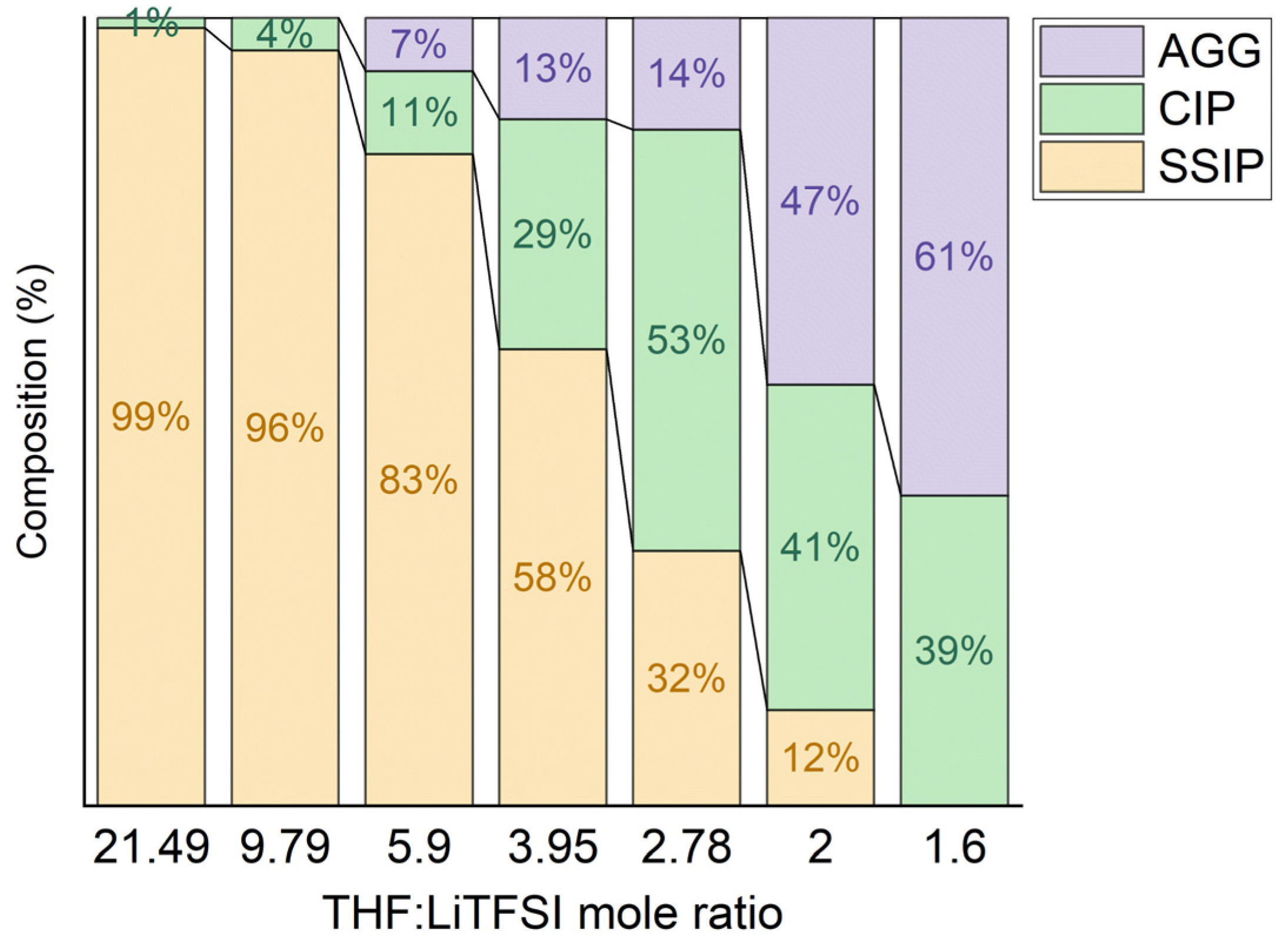
While the systematic shifts observed in the TFSI vibrational bands in Figure 1 qualitatively indicate an evolution of ion-pairing with electrolyte composition, a quantitative assessment of the relative populations of uncoordinated and Li+-coordinated TFSI species is required to elucidate the underlying solvation structure. To this end, the TFSI symmetric stretching region was deconvoluted into distinct spectral components, and the corresponding fitting results are summarized in Figure 2. A representative example of the Raman band deconvolution is provided in Figure S1.
Figure 2 summarizes the relative populations of SSIPs, CIPs, and AGGs in (THF)n–LiTFSI electrolytes, as determined from Raman spectral deconvolution of the TFSI mode. At the lowest salt concentration investigated (n = 21.49), the solvation structure is dominated by SSIP species, which account for 98.8% of the total population, while the combined fraction of CIPs and AGGs remains limited to 1.2%. As the THF content decreases with increasing salt concentration, the fraction of SSIP species progressively decreases, accompanied by a corresponding increase in Li+–TFSI contact species. At the highest salt concentration (n = 1.6), the electrolyte exhibits a markedly different solvation environment, with CIP and AGG species accounting for 39.4%, and 60.6%, respectively. These results quantitatively demonstrate a continuous shift from an SSIP-dominated regime to one characterized by an increased prevalence of contact ion pairs and aggregates. The increasing degree of Li+–TFSI ion pairing promotes the formation of clustered, ion-rich local electrolyte structures as the salt concentration increases.

3.2. NMR Spectroscopy

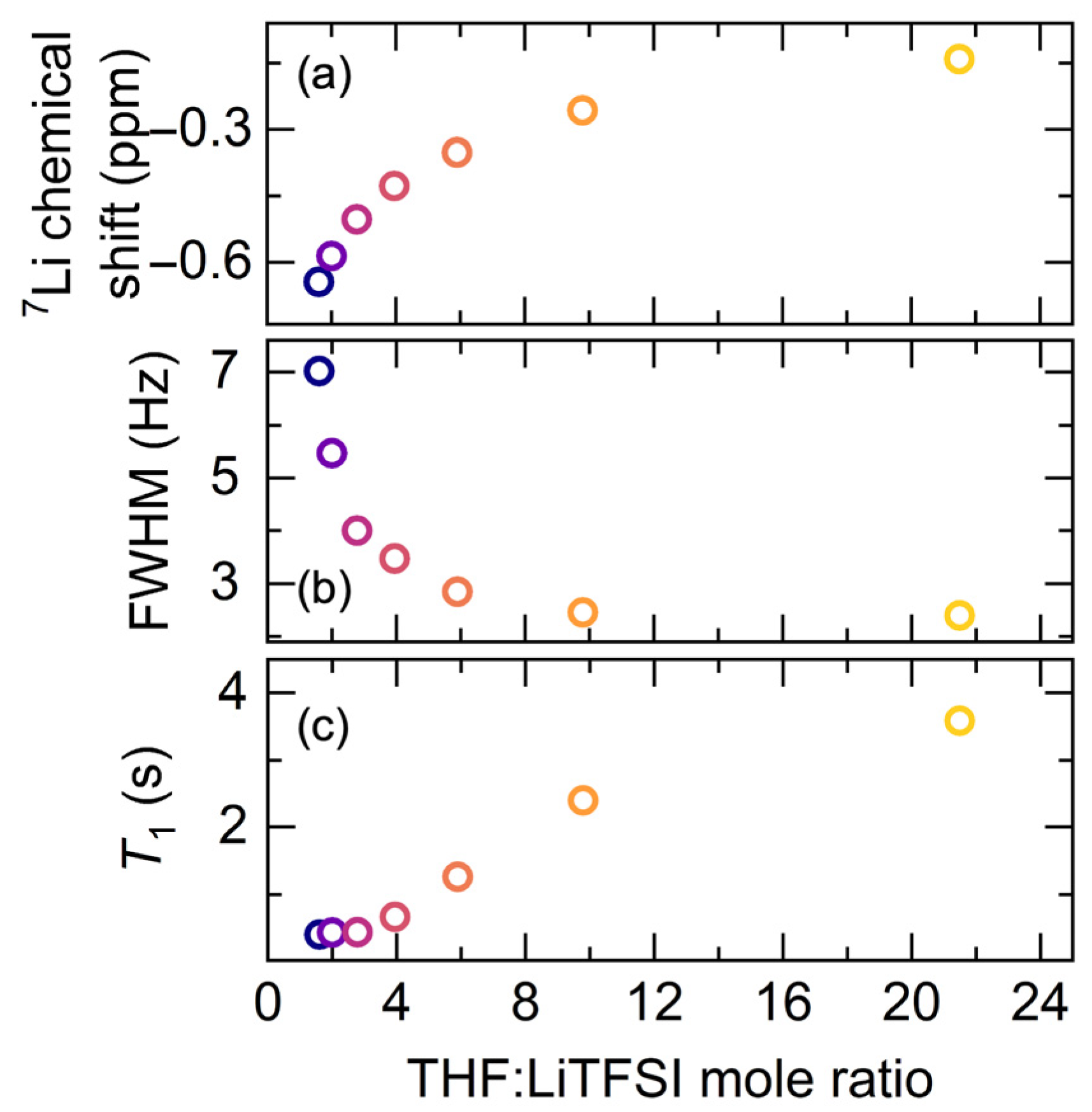
To gain further insight into how the ion-pairing evolution revealed by Raman analysis influences the local Li+ environment, 7Li NMR spectroscopy was employed. While Raman spectroscopy provides insights into anion coordination and ion-pair populations, 7Li NMR directly reflects changes in the electronic and dynamic environment surrounding Li+. Accordingly, systematic variations in the 7Li chemical shift, line width, and longitudinal relaxation behavior were analyzed as a function of electrolyte composition, as shown in Figure 3 and Figure 4.
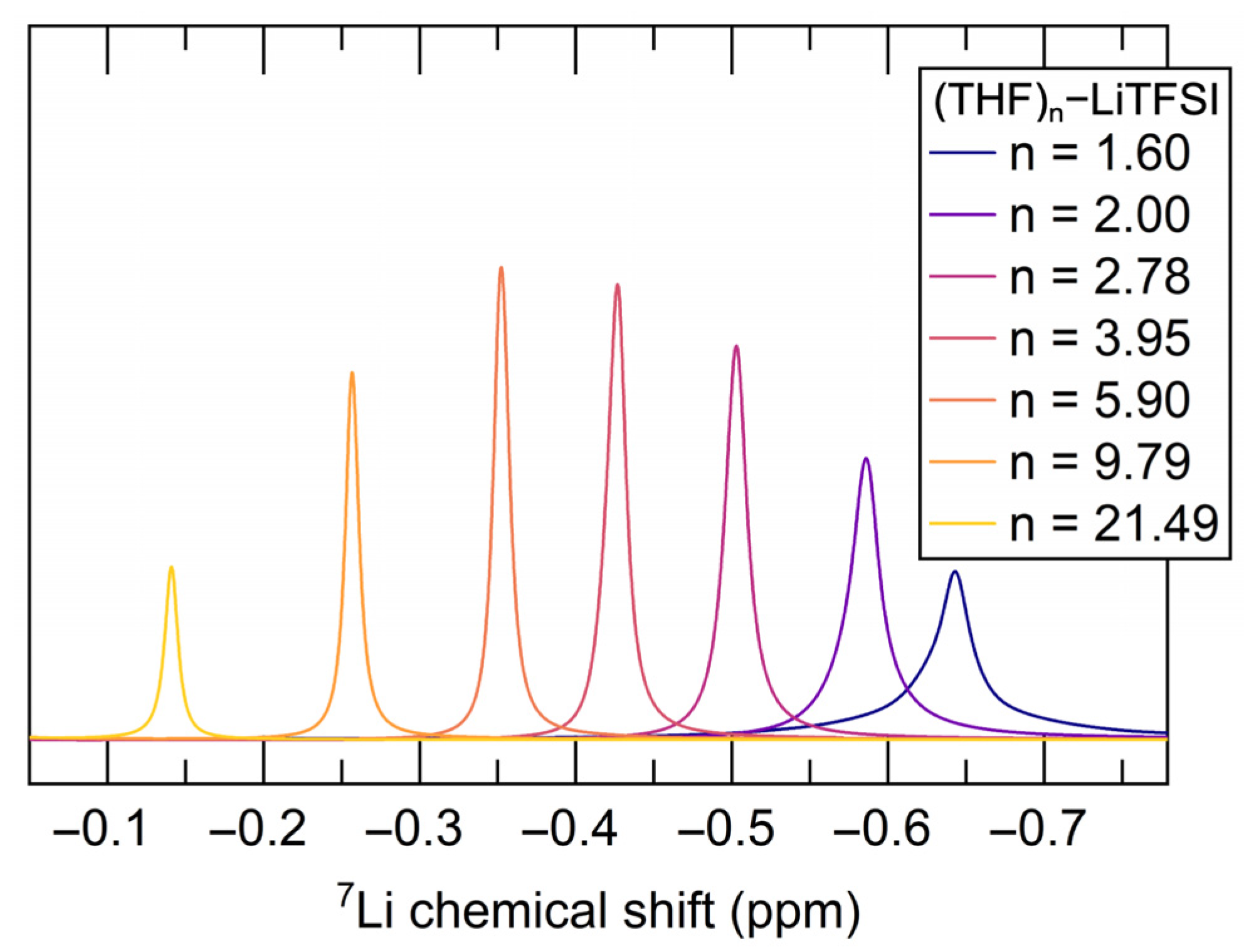
Figure 3 shows the 7Li NMR spectra of (THF)n–LiTFSI electrolytes with varying THF contents. As n decreases, corresponding to an increase in Li salt concentration, the 7Li resonance exhibits a systematic upfield shift. This behavior indicates increased electronic shielding around Li+, which arises from enhanced Li+–TFSI ion pairing at higher salt concentrations. As the solvation structure evolves from solvent-separated ion pairs toward contact ion pairs and aggregates, negatively charged TFSI anions are positioned in closer proximity to Li+, increasing the local electron density surrounding the Li+ nucleus. The resulting enhancement in electronic shielding leads to the observed upfield shift of the 7Li chemical shift. These results demonstrate that the progressive increase in ion pairing inferred from Raman analysis directly manifests in the local electronic environment of Li+. This systematic dependence of the 7Li chemical shift on the THF:LiTFSI molar ratio is further illustrated in the plot shown in Figure 4a.
Beyond the average electronic environment, the line width of the 7Li resonance provides information on the local structural heterogeneity surrounding Li+. Because 7Li is a quadrupolar nucleus with spin I = 3 / 2 , its resonance line width is highly sensitive to the symmetry of the local bonding environment. Highly symmetric and dynamically averaged solvation environments result in relatively narrow resonances, whereas locally defined and anisotropic coordination structures lead to significant line broadening. As shown in Figure 3 and Figure 4b, the full width at half-maximum (FWHM) of the 7Li signal increases markedly with decreasing THF:LiTFSI ratio. This progressive broadening reflects the emergence of contact ion pairs and aggregates at higher salt concentrations, which restrict the rotational and translational freedom of species within the first solvation shell and give rise to a distribution of non-equivalent Li+ environments.
Additional insight into the local symmetry and dynamics of Li+ coordination is provided by the longitudinal relaxation time (T1). For quadrupolar nuclei such as 7Li, nuclear relaxation is dominated by quadrupolar mechanisms that are particularly sensitive to fluctuations in the local electric field gradient [31,32]. Consequently, T1 serves as an effective probe of the symmetry of the Li+ bonding environment. As shown in Figure 4c, T1 decreases systematically with decreasing THF:LiTFSI ratio, indicating that the Li+ environment becomes increasingly asymmetric and locally constrained in more concentrated electrolytes. Together with the observed changes in chemical shift and line width, the T1 trend supports a picture in which increasing salt concentration drives the formation of clustered, ion-rich solvation structures characterized by strong ion pairing and reduced dynamic averaging.
Taken together, the Raman and 7Li NMR results consistently reveal a continuous evolution of the Li+ solvation structure with electrolyte concentration in the (THF)n–LiTFSI series. Raman analysis demonstrates a progressive shift from solvent-separated ion pairs to contact ion pairs and aggregates as the THF content decreases, indicating enhanced Li+–TFSI ion pairing and the development of clustered, ion-rich local structures. These structural changes are directly reflected in the 7Li NMR response, where decreasing THF:LiTFSI ratios lead to an upfield shift of the 7Li resonance, increased line broadening, and shortened T1 values. Collectively, these trends indicate that increasing salt concentration drives a transition toward more asymmetric, locally defined, and dynamically constrained Li+ environments.
Having established how Li+ solvation structure and local dynamics evolve with electrolyte concentration in the (THF)n–LiTFSI system, we next examine the effect of electrolyte localization induced by the addition of a non-coordinating diluent. Specifically, hydrofluoroether TTE is introduced into the concentrated (THF)2–LiTFSI electrolyte to form localized high-concentration electrolytes, and the resulting changes in solvation structure are discussed in Figure 5.

3.3. Effect of Electrolyte Localization via TTE Addition

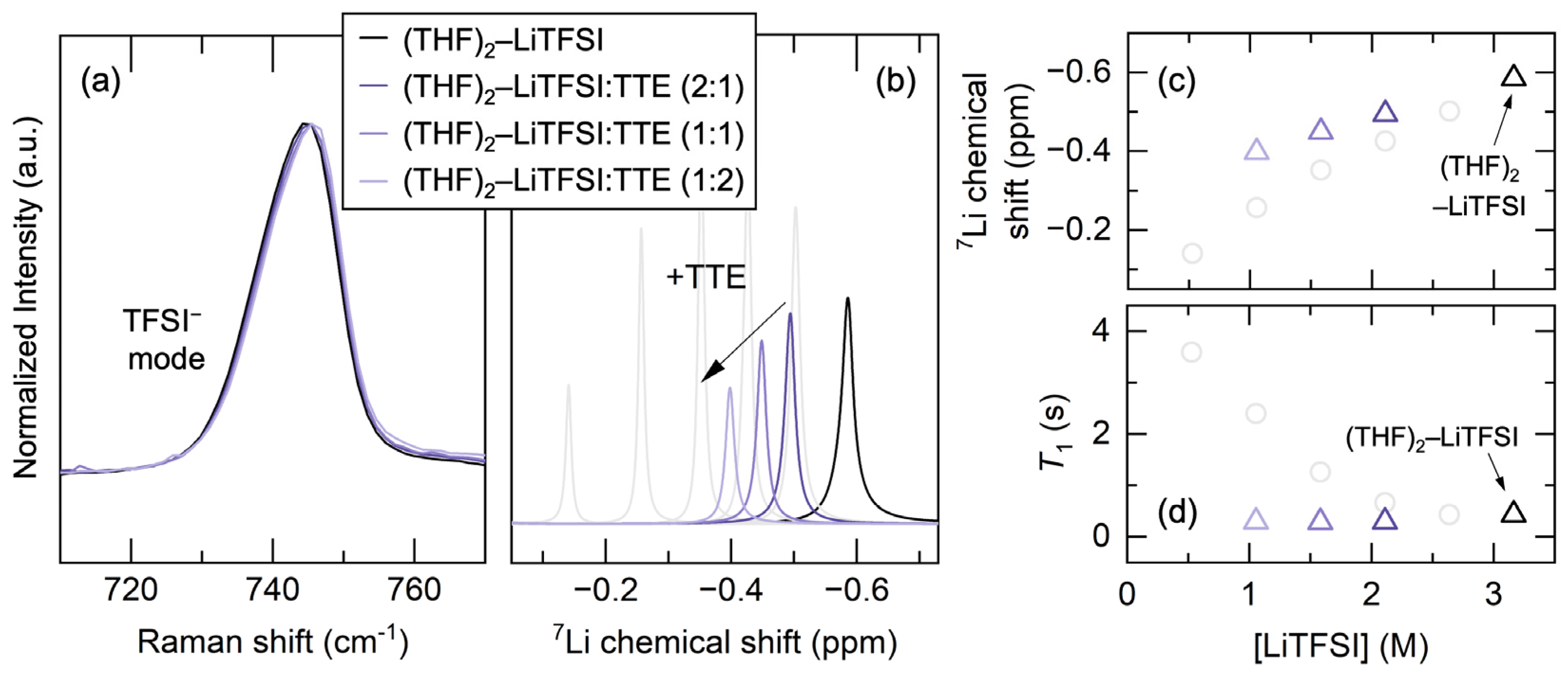
Figure 5a compares the normalized Raman spectra of the TFSI vibrational mode for the concentrated (THF)2–LiTFSI electrolyte and its TTE-added counterparts with volume ratios of 2:1, 1:1, and 1:2. Although the absolute Raman intensity decreases with increasing TTE content due to dilution of LiTFSI, normalization of the spectra reveals that the overall band shape and peak position of the TFSI mode remain essentially unchanged across all compositions. In particular, no discernible shift or redistribution of the TFSI vibrational features are observed upon TTE addition.
The invariance of the normalized TFSI Raman spectra indicates that the local Li+–TFSI coordination environment characteristic of the highly concentrated (THF)2–LiTFSI electrolyte is preserved despite the introduction of TTE. This observation suggests that TTE does not directly participate in Li+ coordination and instead acts as a non-coordinating diluent, spatially separating pre-existing Li+–TFSI solvation clusters without disrupting their internal structure. Consequently, the fundamental Li+–TFSI coordination structures established in the concentrated electrolyte are preserved, providing spectroscopic evidence for electrolyte localization rather than simple dilution upon TTE addition.
As shown in Figure 5b, the 7Li NMR spectra of TTE-added electrolytes exhibit a gradual downfield (deshielding) shift with increasing TTE content. This trend is confirmed in Figure 5c, where the 7Li chemical shift is plotted as a function of LiTFSI concentration in the presence of TTE. Importantly, this deshielding behavior occurs despite the invariance of the TFSI Raman spectral features upon TTE addition (Figure 5a), indicating that the primary Li+–TFSI coordination structure characteristic of the highly concentrated electrolyte is largely preserved. The observed chemical shift therefore suggests that the changes in the 7Li NMR response are not driven by disruption of local ion pairing, but rather by modifications to the average electronic environment surrounding Li+, such as changes in the local dielectric environment and spatial organization of Li+–TFSI-rich solvation clusters induced by electrolyte localization.
By contrast, when compared at comparable LiTFSI concentrations, TTE-added electrolytes exhibit more upfield 7Li chemical shifts than their THF-only counterparts (shown in gray circles), indicating enhanced electronic shielding around Li+. This observation suggests that electrolyte localization induced by TTE promotes a more anion-rich local solvation environment, even at similar bulk salt concentrations.
The effect of TTE addition on the local symmetry and dynamics of the Li+ environment is further reflected in the 7Li T1 measurements, as shown in Figure 5d. Overall, the T1 values remain within a similar range across the investigated compositions, indicating that the primary Li+ solvation structure is largely preserved upon TTE addition. Nevertheless, a modest decrease in T1 is observed, with T1 decreasing from 0.43 s for (THF)2–LiTFSI electrolyte to 0.29 s for (THF)2–LiTFSI:TTE (1:2). This reduction in T1 suggests a slight increase in local asymmetry around Li+ upon TTE addition, likely arising from subtle reorganization of the solvation environment, including changes in the local cluster surroundings and the formation of spatially segregated subdomains. Overall, Figure 5 shows that TTE induces electrolyte localization by maintaining local Li+–TFSI coordination while subtly reorganizing the surrounding solvation environment.

4. Conclusions

In this work, we systematically investigated the solvation structure of THF-based high- and localized high-concentration electrolytes using Raman spectroscopy and 7Li NMR. By systematically decreasing the THF:LiTFSI molar ratio, we observed a progressive change in Li+ solvation from solvent-separated ion pairs to contact ion pairs and aggregates, accompanied by increased structural heterogeneity. Introduction of the non-coordinating diluent TTE enabled electrolyte localization, preserving the local Li+–TFSI coordination structure characteristic of concentrated electrolytes while inducing subtle reorganization of the surrounding solvation environment. Together, these results establish a unified structural framework describing how Li+ solvation and electrolyte organization evolve in THF-based localized high-concentration electrolytes.
The insights obtained in this study also have direct implications for practical electrolyte design in lithium-based batteries. By controlling Li+ solvation and ion pairing through concentration and electrolyte localization, the local electrolyte structure can be tuned in ways that influence interfacial chemistry and the speciation of electrochemically active species. Establishing direct correlations between these structural regimes and electrochemical responses will be an important direction for future electrochemical investigations.

Supplementary Materials

The following supporting information can be downloaded at https://www.mdpi.com/article/10.3390/org7010010/s1. Figure S1: Deconvolution of the TFSI Raman band for the (THF)3.95–LiTFSI electrolyte, illustrating the contributions of SSIP, CIP, and AGG species.

Author Contributions

Conceptualization, M.S.; formal analysis, Y.H., Y.J.A. and S.S.; investigation, Y.H., Y.J.A. and S.S.; data curation, Y.H., Y.J.A. and S.S.; writing—original draft preparation, M.S.; writing—review and editing, M.S.; visualization, M.S.; supervision, M.S.; project administration, M.S.; funding acquisition, M.S. All authors have read and agreed to the published version of the manuscript.

Funding

This work was supported by the Sungshin Women’s University Research Grant of H20220026.

Data Availability Statement

The raw data supporting the conclusions of this article will be made available by the authors on request.

Conflicts of Interest

The authors declare no conflicts of interest.

References

  1. Ren, X.; Zou, L.; Jiao, S.; Mei, D.; Engelhard, M.H.; Li, Q.; Lee, H.; Niu, C.; Adams, B.D.; Wang, C.; et al. High-concentration ether electrolytes for stable high-voltage lithium metal batteries. ACS Energy Lett. 2019, 4, 896–902. [Google Scholar] [CrossRef]
  2. Efaw, C.M.; Wu, Q.; Gao, N.; Zhang, Y.; Zhu, H.; Gering, K.; Hurley, M.F.; Xiong, H.; Hu, E.; Cao, X.; et al. Localized high-concentration electrolytes get more localized through micelle-like structures. Nat. Mater. 2023, 22, 1531–1539. [Google Scholar] [CrossRef]
  3. Cao, X.; Jia, H.; Xu, W.; Zhang, J.-G. Localized high-concentration electrolytes for lithium batteries. J. Electrochem. Soc. 2021, 168, 010522. [Google Scholar] [CrossRef]
  4. Zheng, Y.; Soto, F.A.; Ponce, V.; Seminario, J.M.; Cao, X.; Zhang, J.-G.; Balbuena, P.B. Localized high concentration electrolyte behavior near a lithium–metal anode surface. J. Mater. Chem. A 2019, 7, 25047–25055. [Google Scholar] [CrossRef]
  5. Sun, J.; Yao, Y.; Cui, X.; Luo, J.; Zhang, J.; Zhao, Y.; Wang, H.; Zhou, J.; Zhu, J.; Wang, Y.; et al. Improving Low-Temperature Tolerance of a Lithium-Ion Battery by a Localized High-Concentration Electrolyte Based on the Weak Solvation Effect. Batter. Energy 2025, 4, e20240106. [Google Scholar] [CrossRef]
  6. Hossain, J.; Wu, Q.; Bernardez, E.J.M.; Quilty, C.D.; Marschilok, A.C.; Takeuchi, E.S.; Bock, D.C.; Takeuchi, K.J.; Qi, Y. The relationship between ionic conductivity and solvation structures of localized high-concentration fluorinated electrolytes for lithium-ion batteries. J. Phys. Chem. Lett. 2023, 14, 7718–7731. [Google Scholar] [CrossRef] [PubMed]
  7. van Ekeren, W.; Hall, A.; Lahtinen, K.; Younesi, R. The solvation structure of localized high concentration electrolytes. ChemElectroChem 2024, 11, e202400050. [Google Scholar] [CrossRef]
  8. Ren, F.; Li, Z.; Chen, J.; Huguet, P.; Peng, Z.; Deabate, S. Solvent–diluent interaction-mediated solvation structure of localized high-concentration electrolytes. ACS Appl. Mater. Interfaces 2022, 14, 4211–4219. [Google Scholar] [CrossRef] [PubMed]
  9. Kim, Y.M.; Park, B.K.; Kang, S.; Yang, S.J.; Choi, S.H.; Yoo, D.; Kim, K.J. Bespoke Dual-Layered Interface Enabled by Cyclic Ether in Localized High-Concentration Electrolytes for Lithium Metal Batteries. Adv. Funct. Mater. 2024, 34, 2408365. [Google Scholar] [CrossRef]
  10. Seo, D.M.; Boyle, P.D.; Sommer, R.D.; Daubert, J.S.; Borodin, O.; Henderson, W.A. Solvate structures and spectroscopic characterization of LiTFSI electrolytes. J. Phys. Chem. B 2014, 118, 13601–13608. [Google Scholar] [CrossRef]
  11. Jiang, G.; Li, F.; Wang, H.; Wu, M.; Qi, S.; Liu, X.; Yang, S.; Ma, J. Perspective on high-concentration electrolytes for lithium metal batteries. Small Struct. 2021, 2, 2000122. [Google Scholar] [CrossRef]
  12. Chen, X.; Meng, Y.; Xiao, D.; Wu, Y.; Qin, L. Tunning solvation structure in non-flammable, localized high-concentration electrolytes with enhanced stability towards all aluminum substrate-based K batteries. Energy Storage Mater. 2023, 61, 102923. [Google Scholar] [CrossRef]
  13. Ren, X.; Chen, S.; Lee, H.; Mei, D.; Engelhard, M.H.; Burton, S.D.; Zhao, W.; Zheng, J.; Li, Q.; Ding, M.S.; et al. Localized high-concentration sulfone electrolytes for high-efficiency lithium-metal batteries. Chem 2018, 4, 1877–1892. [Google Scholar] [CrossRef]
  14. Wang, Z.; He, Z.; Wang, Z.; Yang, J.; Long, K.; Wu, Z.; Zhou, G.; Mei, L.; Chen, L. A nitrile solvent structure induced stable solid electrolyte interphase for wide-temperature lithium-ion batteries. Chem. Sci. 2024, 15, 13768–13778. [Google Scholar] [CrossRef] [PubMed]
  15. Lin, S.; Hua, H.; Lai, P.; Zhao, J. A multifunctional dual-salt localized high-concentration electrolyte for fast dynamic high-voltage lithium battery in wide temperature range. Adv. Energy Mater. 2021, 11, 2101775. [Google Scholar] [CrossRef]
  16. Cai, W.; Deng, Y.; Deng, Z.; Jia, Y.; Li, Z.; Zhang, X.; Xu, C.; Zhang, X.; Zhang, Y.; Zhang, Q. Quasi-localized high-concentration electrolytes for high-voltage lithium metal batteries. Adv. Energy Mater. 2023, 13, 2301396. [Google Scholar] [CrossRef]
  17. Piao, Z.; Gao, R.; Liu, Y.; Zhou, G.; Cheng, H. A review on regulating Li+ solvation structures in carbonate electrolytes for lithium metal batteries. Adv. Mater. 2023, 35, 2206009. [Google Scholar] [CrossRef] [PubMed]
  18. Cui, Z.; Jia, Z.; Ruan, D.; Nian, Q.; Fan, J.; Chen, S.; He, Z.; Wang, D.; Jiang, J.; Ma, J.; et al. Molecular anchoring of free solvents for high-voltage and high-safety lithium metal batteries. Nat. Commun. 2024, 15, 2033. [Google Scholar] [CrossRef] [PubMed]
  19. Amine, R.; Liu, J.; Acznik, I.; Sheng, T.; Lota, K.; Sun, H.; Sun, C.; Fic, K.; Zuo, X.; Ren, Y.; et al. Regulating the hidden solvation-ion-exchange in concentrated electrolytes for stable and safe lithium metal batteries. Adv. Energy Mater. 2020, 10, 2000901. [Google Scholar] [CrossRef]
  20. Ren, X.; Zou, L.; Cao, X.; Engelhard, M.H.; Liu, W.; Burton, S.D.; Lee, H.; Niu, C.; Matthews, B.E.; Zhu, Z.; et al. Enabling high-voltage lithium-metal batteries under practical conditions. Joule 2019, 3, 1662–1676. [Google Scholar] [CrossRef]
  21. Pang, Q.; Shyamsunder, A.; Narayanan, B.; Kwok, C.Y.; Curtiss, L.A.; Nazar, L.F. Tuning the electrolyte network structure to invoke quasi-solid state sulfur conversion and suppress lithium dendrite formation in Li–S batteries. Nat. Energy 2018, 3, 783–791. [Google Scholar] [CrossRef]
  22. Xu, R.; Ding, J.; Ma, X.; Yan, C.; Yao, Y.; Huang, J. Designing and demystifying the lithium metal interface toward highly reversible batteries. Adv. Mater. 2021, 33, 2105962. [Google Scholar] [CrossRef]
  23. Wang, C.; Zhuang, Y.; Qin, Y.; Dong, Y.; Liu, L.; Zhang, L.; Du, J. Design and eco-efficiency analysis of sustainable extractive distillation process combining preconcentration and solvent recovery functions for separating the tetrahydrofuran/ethanol/water ternary multi-azeotropic mixture. Process. Saf. Environ. Prot. 2022, 159, 795–808. [Google Scholar] [CrossRef]
  24. Park, H.; Lim, H.-D.; Lim, H.-K.; Seong, W.M.; Moon, S.; Ko, Y.; Lee, B.; Bae, Y.; Kim, H.; Kang, K. High-efficiency and high-power rechargeable lithium–sulfur dioxide batteries exploiting conventional carbonate-based electrolytes. Nat. Commun. 2017, 8, 14989. [Google Scholar] [CrossRef] [PubMed]
  25. Liu, Y.; Xu, L.; Yu, Y.; He, M.; Zhang, H.; Tang, Y.; Xiong, F.; Gao, S.; Li, A.; Wang, J.; et al. Stabilized Li-S batteries with anti-solvent-tamed quasi-solid-state reaction. Joule 2023, 7, 2074–2091. [Google Scholar] [CrossRef]
  26. Fawdon, J.; Ihli, J.; La Mantia, F.; Pasta, M. Characterising lithium-ion electrolytes via operando Raman microspectroscopy. Nat. Commun. 2021, 12, 4053. [Google Scholar] [CrossRef] [PubMed]
  27. Piacentini, V.; Simari, C.; Mangiacapre, E.; Pierini, A.; Gentile, A.; Marchionna, S.; Nicotera, I.; Brutti, S.; Bodo, E. Aprotic Electrolytes Beyond Organic Carbonates: Transport Properties of LiTFSI Solutions in S-Based Solvents. ChemSusChem 2025, 18, e202402273. [Google Scholar] [CrossRef] [PubMed]
  28. Li, Y.; Wang, Z.; Lin, W.; Wei, B.; Chen, D. A concentrated electrolyte of LiTFSI and dimethyl carbonate for high-voltage Li batteries. ACS Appl. Energy Mater. 2023, 6, 9337–9346. [Google Scholar] [CrossRef]
  29. Alves, C.C.; Campos, T.B.; Alves, W.A. FT-Raman spectroscopic analysis of the most probable structures in aluminum chloride and tetrahydrofuran solutions. Spectrochim. Acta Part A Mol. Biomol. Spectrosc. 2012, 97, 1085–1088. [Google Scholar] [CrossRef]
  30. Pham, T.D.; Bin Faheem, A.; Lee, K. Design of a LiF-rich solid electrolyte interphase layer through highly concentrated LiFSI–THF electrolyte for stable lithium metal batteries. Small 2021, 17, 2103375. [Google Scholar] [CrossRef]
  31. Nanda, R.; Damodaran, K. A review of NMR methods used in the study of the structure and dynamics of ionic liquids. Magn. Reson. Chem. 2018, 56, 62–72. [Google Scholar] [CrossRef] [PubMed]
  32. Sanders, K.J.; Ciezki, A.A.; Berno, A.; Halalay, I.C.; Goward, G.R. Quantitative operando 7Li NMR investigations of silicon anode evolution during fast charging and extended cycling. J. Am. Chem. Soc. 2023, 145, 21502–21513. [Google Scholar] [CrossRef] [PubMed]
Figure 1. Raman spectra of (THF)n–LiTFSI electrolytes with varying numbers of THF molecules per LiTFSI. (a) Symmetric stretching mode of the TFSI anion. (b) Spectral region associated with THF vibrational modes.
Organics 07 00010 g001
Figure 2. Relative proportions of SSIPs, CIPs, and AGGs in (THF)n–LiTFSI electrolytes, quantified from Raman spectral deconvolution of the TFSI symmetric stretching region. The fractions were extracted from the fitted peak areas corresponding to each coordination state.
Organics 07 00010 g002
Figure 3. 7Li NMR spectra of (THF)n–LiTFSI electrolytes with varying numbers of THF molecules per LiTFSI.
Organics 07 00010 g003
Figure 4. (a) 7Li chemical shift, (b) full width at half-maximum (FWHM), and (c) longitudinal relaxation time (T1) plotted as a function of the THF:LiTFSI molar ratio.
Organics 07 00010 g004
Figure 5. Raman and 7Li NMR characterization of TTE-added electrolytes based on the concentrated (THF)2–LiTFSI system. (a) Normalized Raman spectra of the TFSI vibrational mode, (b) 7Li NMR spectra, (c) 7Li chemical shift values, and (d) longitudinal relaxation times (T1) plotted as a function of LiTFSI concentration. Gray curves and symbols denote THF-only electrolytes without TTE, which are included for comparison.
Organics 07 00010 g005
Disclaimer/Publisher’s Note: The statements, opinions and data contained in all publications are solely those of the individual author(s) and contributor(s) and not of MDPI and/or the editor(s). MDPI and/or the editor(s) disclaim responsibility for any injury to people or property resulting from any ideas, methods, instructions or products referred to in the content.