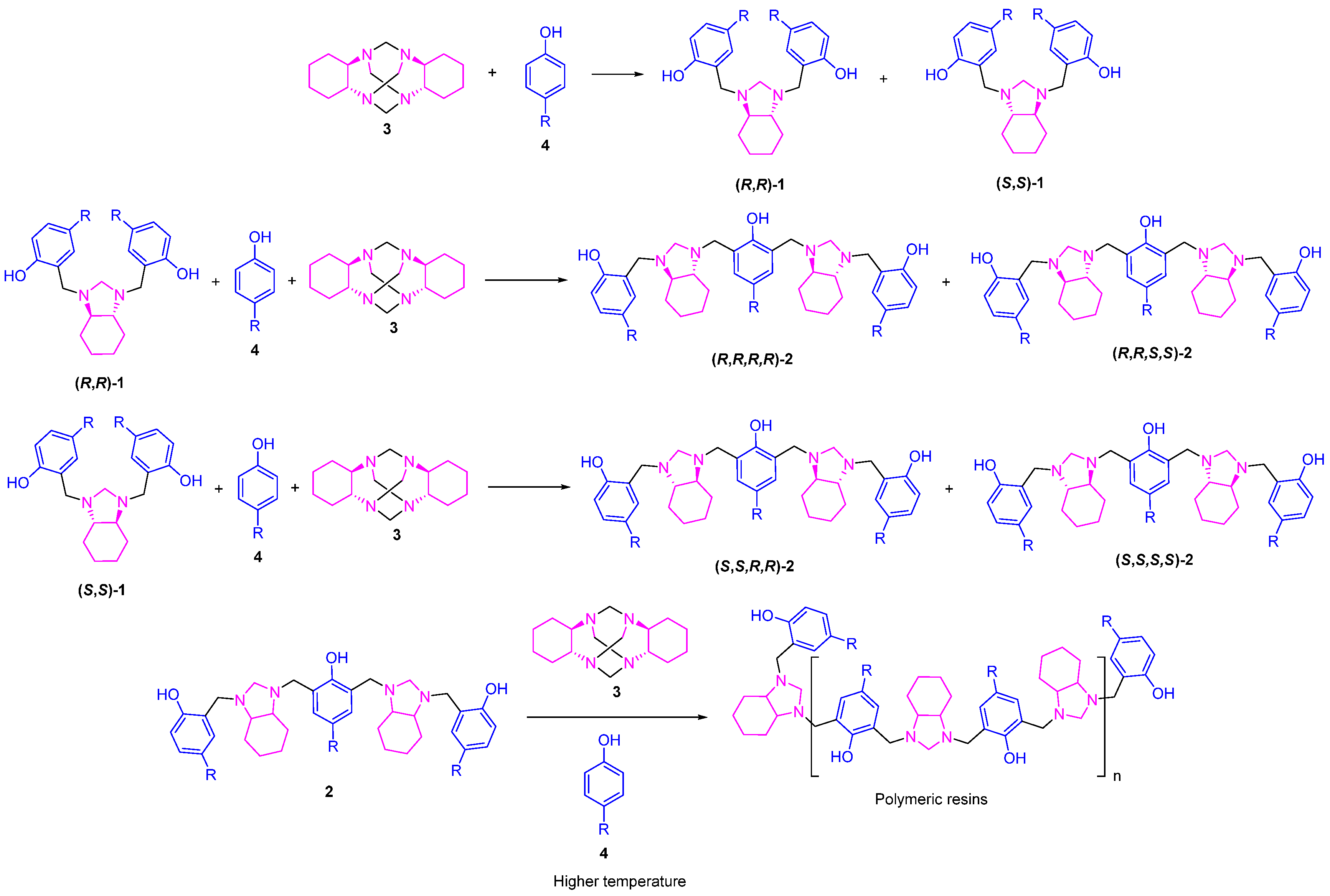

Influence of MW Irradiation on the Reaction Between (2R,7R,11S,16S)-1,8,10,17-tetraazapentacyclo[8.8.1.1.8,170.2,70.11,16]icosane and p-Substituted Phenols



Abstract
Share and Cite
Quiroga, D.; Ríos-Motta, J.; Rivera, A. Influence of MW Irradiation on the Reaction Between (2R,7R,11S,16S)-1,8,10,17-tetraazapentacyclo[8.8.1.1.8,170.2,70.11,16]icosane and p-Substituted Phenols. Organics 2025, 6, 44. https://doi.org/10.3390/org6040044
Quiroga D, Ríos-Motta J, Rivera A. Influence of MW Irradiation on the Reaction Between (2R,7R,11S,16S)-1,8,10,17-tetraazapentacyclo[8.8.1.1.8,170.2,70.11,16]icosane and p-Substituted Phenols. Organics. 2025; 6(4):44. https://doi.org/10.3390/org6040044
Chicago/Turabian StyleQuiroga, Diego, Jaime Ríos-Motta, and Augusto Rivera. 2025. "Influence of MW Irradiation on the Reaction Between (2R,7R,11S,16S)-1,8,10,17-tetraazapentacyclo[8.8.1.1.8,170.2,70.11,16]icosane and p-Substituted Phenols" Organics 6, no. 4: 44. https://doi.org/10.3390/org6040044
APA StyleQuiroga, D., Ríos-Motta, J., & Rivera, A. (2025). Influence of MW Irradiation on the Reaction Between (2R,7R,11S,16S)-1,8,10,17-tetraazapentacyclo[8.8.1.1.8,170.2,70.11,16]icosane and p-Substituted Phenols. Organics, 6(4), 44. https://doi.org/10.3390/org6040044