1. Introduction
Wireless cellular communication networks (e.g., 4G and 5G) have become indispensable, not only for personal communication, but also increasingly serve as the backbone of critical applications such as Internet of Things (IoT) [
1], manufacturing [
2], and health services [
3]. Hence, a cell outage, which results in the unavailability of network services in a cell or sector of a mobile network [
4], is a highly undesirable event. Its impact may not be limited to revenue loss and customer dissatisfaction; it may also cause the disruption of critical services. Nevertheless, cell outages are still experienced regularly in deployed cellular networks [
5]. Self-organising network (SON) approaches, such as cell outage detection (COD) and cell outage compensation (COC), are conventionally proposed to automatically detect and mitigate cell outage, respectively.
Traditional COC techniques require neighbouring cells belonging to an outage-affected operator to adjust radio transmission parameters, such as transmit power, antenna gain, height or tilt, to extend coverage into the outage zone [
6,
7]. This approach is best suited for urban centres with dense base station deployments and coverage overlaps, which makes it easy for neighbouring base stations to help outage-affected base stations. However, in suburban areas with sparser deployment of macrocell base stations and large inter-site distances, sometimes approaching 2 km, the transmit-parameter-adjustment approach of the COC techniques is less effective. This is because, unlike in urban areas, same-operator neighbouring base stations are fewer and farther away, and overcoming the path loss involved, while achieving the data rates typical for suburban areas, will require transmit power that would cause significant interference and consume excessive energy. Hence, a more effective approach for handling cell outage in suburban areas is desirable.
National roaming offers a viable solution in the suburban context. It involves a mobile operator providing network services for the subscribers of another mobile operator, especially when it does not have coverage in the area concerned [
8]. National roaming is often used to enable new operators to quickly have a broad national spread. However, it is recently being investigated for inter-operator cooperation, even where all operators have coverage, to mitigate cell outages during disasters or isolated base station failures [
9,
10,
11,
12]. In suburban areas, where multiple operators co-exist, outage-affected operators can be assisted by exploiting national roaming to extend network service to affected areas through resource sharing and cooperation among operators.
This approach does not require increasing transmit power or adjusting antenna tilt, since the overlapping coverage of other operators can be exploited in the outage-affected areas. When normal service is restored in the outage-affected areas, the roaming of users into visited networks triggered by short-term cell outages can be halted, so that the adverse impact of roaming on the incumbent subscribers of the visited operators can also be avoided. Under this short-term cell outage context, unlike during major disasters, national roaming can be exploited as a form of temporary roaming, where outage-affected users are allowed to roam into the network of co-located operators while the outage persists and restored to their own operator when normal service resumes. This form of temporary roaming occasioned by short-term cell outages due to isolated base station failures that can be resolved quickly (in order of hours or a few days) is the focus of this paper.
Previous studies have examined the benefits of national roaming in multi-operator environments in the context of energy efficiency [
13,
14,
15,
16,
17], spectrum utilisation and user satisfaction [
18,
19], resilience to outages or disasters [
9,
10,
11,
12], reduction in capital expenditure (CAPEX) or operational expenditure (OPEX) [
18,
20], and increased revenue [
19]. The studies on resilience to outages or disasters, the most relevant to this paper, evaluate performance in nationwide networks [
9,
10], dense urban environments [
11], or private networks [
12]. In these works, roaming users are typically granted access to a visited operator’s resources when the coverage or capacity threshold conditions are satisfied. In addition, their focus is primarily on the overall benefit of national roaming to the aggregate user population across all operators or roaming users of outage-affected operators.
However, to the best of our knowledge, no study provides explicit resource block partitioning for protecting the QoS of primary users of the visited operator, nor quantitatively evaluates the impact of national roaming on these primary users in a suburban macrocell environment under short-term cell outage conditions.This paper addresses these gaps by proposing a Resource-Constrained Temporary Roaming (RCTR) scheme that grants roaming users access to only a fraction C of the available radio resources (Physical Resource Blocks (PRBs) in this study) of the visited operator to protect the QoS of the primary users. The performance of the proposed RCTR scheme is evaluated against two baseline schemes: the No Roaming scheme, under which roaming users are denied access to all PRBs of the visited operator, and the Unconstrained Roaming scheme, which grants roaming users access to all available PRBs. The blocking probability, throughput, and spectral efficiency performance of the three schemes are compared through system-level simulations under one-sector and three-sector outage conditions for the combined user population of the outage-affected and visited operator. In addition, the impact of temporary roaming on the QoS of roaming users and primary users is evaluated in terms of blocking probability and throughput.
The main contributions of this paper are as follows:
We propose a novel RCTR scheme to mitigate cell outages in suburban macrocells by enabling subscribers of an outage-affected operator to access only a fraction C of available PRBs in order to protect the QoS of the primary users of the visited operator.
We conduct a detailed quantitative evaluation and comparison of the performance gains of the RCTR scheme against two baseline schemes (No Roaming and Unconstrained Roaming) in terms of blocking probability, throughput, and spectral efficiency for roaming users, primary users, and the combined user population under one-sector and three-sector outage conditions.
We show that the RCTR scheme balances relief for roaming users with protection of primary users’ QoS better than the baseline schemes. We also demonstrate that for the aggregate user population, all performance metrics improve with increasing C, but gains exhibit diminishing returns as C approaches one. In addition, we show that roaming users’ QoS consistently improves with increasing C, whereas primary users’ QoS is insensitive to C at low traffic loads, but degrades with increasing C at higher traffic loads. Hence, QoS protection for primary users depends on the appropriate selection of C across traffic intensities.
The rest of this paper is organised as follows.
Section 2 reviews related work on national roaming, especially in the context of cost reduction, energy efficiency, user satisfaction, spectrum utilisation, and resilience; virtualised infrastructure sharing in network slicing and neutral host contexts; and resource partitioning in spectrum sharing and network slicing domains.
Section 3 discusses the method employed in the study. The results obtained from the study are presented and discussed in
Section 4. Finally, the conclusions of the paper are provided in
Section 5.
2. Related Works
National roaming was originally utilised as a framework for extending coverage to locations where new operators do not have infrastructure by leveraging the infrastructure of incumbent operators. However, this concept has been extended to scenarios where an operator has infrastructure in place, but it is faulty or damaged, and when an operator cannot offer some of its users their desired QoS. These concepts have led to the exploitation of national roaming and multi-operator network sharing to improve network capacity, reduce CAPEX or OPEX, increase revenue, enhance energy efficiency, improve user satisfaction and spectrum utilisation, mitigate cell outages, and boost fault resilience.
Many studies on national roaming and multi-operator network sharing target network capacity, spectrum utilisation, user satisfaction and cost reduction, typically at a large scale over a city, region, or nation. Studies by Di Francesco et al. [
20] and Ukyab et al. [
18] show how sharing capacity can reduce the cost of deploying networks for collaborating operators. The potential of national roaming to achieve up to 30–40% infrastructure savings, while ensuring better spectrum utilisation, higher network availability and better user performance, is particularly demonstrated by Ukyab et al. [
18] in an urban area. Di Francesco et al. [
20] studied the pathway operators can follow for the future evolution of their networks over a nation, while leveraging capacity sharing and adhering to regulatory constraints on competition. The study reveals that sharing leads to substantial OPEX savings and a reduction in redundant capacity. In [
21], different strategies for sharing physical and virtual cellular resources—capacity, spectrum and base stations—are investigated over a large area containing up to 38 base stations owned by two operators. The capacity sharing option is shown to be the most effective in improving user satisfaction. In [
19], an ad hoc payment model is proposed that enables a roaming user to access any available operator without an existing roaming agreement. The payment model and accompanying resource management strategy, when compared to the conventional roaming approach, lead to higher spectrum utilisation and increased revenue for the visited operator, without degradation of the satisfaction level of primary users.
National roaming in these contexts is treated as a voluntary steady-state sharing. The frameworks typically allow users to attach to whichever operator provides the best signal or capacity. Such models are typically effective for long-term coverage and capacity planning, better user experience or CAPEX/OPEX savings, but do not consider short-term, outage-driven surges in displaced users or the explicit protection of the QoS of primary users of visited operators during network failures or disasters.
Another prominent line of research on national roaming focuses on energy-efficient infrastructure sharing, where roaming is used to consolidate traffic onto a subset of base stations so that redundant stations can be switched off. Game-theoretic models [
13,
17,
22] and cooperative schemes [
16] have been developed to optimise which base stations are turned off and when they are turned off. Using real operator data, Magalhães et al. [
14] show that full or partial national roaming can significantly reduce power consumption while maintaining or even improving user satisfaction and coverage metrics. However, these energy-saving schemes typically assume low-traffic periods, such as night-time, and design user association primarily to minimise power, not to manage sudden outage-induced load in busy hours. Furthermore, they usually allow roaming users to utilise the full capacity of the active network, without reserving a protected portion of RBs for incumbent primary users, so the tradeoff between roaming relief and degradation of primary users’ QoS at the cell or sector level is not explicitly controlled.
Research direction on national roaming is shifting from voluntary roaming solely for economic, capacity and energy optimisation to involuntary roaming for fault resilience and disaster mitigation. In [
23], an AI model is proposed to promptly detect faults across different operators, while roaming solutions specifically for 5G private networks are proposed in [
12]. For public networks, Ni et al. [
11] show how network sharing through national roaming can hide base station downtime from users of outage-affected operators in a dense urban environment. In this work, the roaming strategy permits a healthy base station of another operator to admit traffic from an outage-affected user if the additional traffic does not cause the base station to exceed a predefined capacity threshold. However, roaming users have unconstrained access to the resources of the healthy base station if this capacity threshold is satisfied. Furthermore, performance was measured in terms of metrics, such as the fraction of time faults are concealed and the fraction of traffic that is denied service for roaming users. These metrics show the benefit of national roaming in providing relief to the roaming users.
Additionally, Weedage et al. [
9,
10] show that enabling national roaming as a resilience mechanism can substantially reduce the fraction of disconnected users and increase the fraction of satisfied users under random or geographically correlated infrastructure outages. These studies highlight that resilience gains depend strongly on geography (urban vs. rural), operator footprints and technology mix, and they recommend prioritising certain regions or radio technologies when activating roaming. Nevertheless, roaming is typically modelled as unconstrained access to surviving infrastructure, where all operators effectively behave as a single national operator during a cell outage event, and an outage-affected user can connect to a healthy base station of another operator as long as it can achieve a minimum allowable received signal level that ascertains coverage. As a result, displaced users are generally allowed unconstrained access to surviving networks, and the performance of visited operators’ primary users is captured only in aggregate coverage/capacity metrics such as fraction of satisfied population, not as a separately protected QoS class. In addition, the analysis is typically carried out at national, regional or city granularity involving many base stations and does not resolve cell- or sector-level resource allocation decisions in suburban macrocell topologies.
Despite these advances in roaming for resilience, major gaps remain. Existing studies focus on private networks, dense urban environments, or large networks of base stations covering cities, regions or nations. However, none have considered a suburban environment exclusively. The suburban environment is unique. It is characterised by larger coverage areas and sparser base station distributions than urban areas, but significantly higher mobile subscriber population compared to rural communities. In such an environment, many users will be impacted by cell outages, as base station coverage overlap for a single operator is limited. Moreover, in the suburban area, the few healthy base stations of a visited operator in the vicinity of an outage-affected base station of another operator must be managed appropriately to protect the QoS of the long-term customers (primary users) of the visited operator from degradation, potentially from massive Unconstrained Roaming user traffic.
Furthermore, existing studies evaluate the performance of national roaming strategies in terms of metrics that either reflect the benefit of roaming to the aggregate user population of cooperating operators or to the roaming user group. The impact of national roaming on the QoS of the primary users of the visited operators in a short-term cell outage scenario has not been studied in the literature. Hence, the tradeoff between relief for roaming users and QoS degradation for primary users is not characterised or quantified in existing studies.
In addition, existing resilience-oriented national roaming strategies typically grant unconstrained access to the visited operator’s resources if certain coverage or capacity threshold criteria are satisfied. They do not directly control the contention for resources between the primary and roaming users by reserving a portion of the radio resources for the exclusive use of the primary users. This intentional reservation of resources for primary users facilitates a constrained roaming mechanism that explicitly protects the QoS of primary users from degradation due to massive roaming traffic.
Beyond conventional national roaming, 5G-related studies have increasingly examined virtualised infrastructure sharing approaches, particularly network slicing and neutral host architectures [
24,
25,
26,
27]. In 5G, network slicing allows multiple logical networks to share a common physical infrastructure while supporting distinct service requirements, tenant configurations, and service-level objectives [
24,
25,
28,
29,
30]. 3GPP has formalised this concept in the 5G system architecture and slice-management specifications, where slices and slice subnets can be managed across the radio access, core, and transport domains [
28,
29]. Moreover, slicing has been widely investigated for diverse vertical services with heterogeneous latency, reliability, and bandwidth requirements over shared infrastructure [
24,
25,
28,
29,
30]. Neutral host models extend this sharing paradigm by enabling a common infrastructure provider to serve multiple operator and non-operator tenants across radio, edge, transport, and, where applicable, core resources [
26,
27]. Recent studies have validated city-wide neutral host frameworks and broader sharing architectures that combine virtualisation and slicing to support traffic isolation and multi-tenant service delivery [
26,
27].
Furthermore, resource partitioning has been well studied in the network slicing domain [
31,
32,
33,
34,
35], as well as the spectrum sharing context [
21,
36,
37,
38,
39,
40], including pricing-based strategies, artificial intelligence (AI)/machine learning (ML) techniques, and optimisation approaches. Nevertheless, the RCTR scheme differs architecturally from existing resource partitioning frameworks in some key respects. In network slicing, resources are typically partitioned into logically isolated slices, with each slice allocated dedicated radio resources (such as Physical Resource Blocks (PRBs)) to meet its Quality of Service (QoS) requirements [
31,
41,
42]. Similarly, in multi-operator spectrum sharing scenarios, resource partitioning approaches may divide the available spectrum into distinct portions under inter-operator agreements [
21,
37,
39,
40]. Each portion is typically allocated to serve an active operator’s own users or those of other active operators and is governed independently through predefined policies in either static or dynamic configurations. Within this framework, resource usage is largely isolated across partitions. Operators may additionally coordinate or manage access to shared or pooled resources to improve spectrum utilisation and satisfy user QoS requirements.
In contrast, the proposed RCTR scheme introduces an outage-driven resource allocation framework, where an outage-affected operator does not participate in runtime resource allocation decisions. Under this outage condition, RCTR differs from existing resource partitioning approaches in three key ways. First, it introduces an asymmetric and non-isolated PRB access model, where primary users have access to the full PRB resource pool of the visited operator, while roaming users are restricted to a configurable subset defined by the parameter C. Primary users can opportunistically utilise the roaming-accessible resources under congestion conditions, thereby relaxing strict isolation between the two user classes. Second, it employs a single-entity control framework, where all admission and scheduling decisions are executed solely by the visited operator during the resource allocation process. This removes the need for inter-operator coordination, core network orchestration, or distributed resource management typically associated with multi-operator spectrum sharing and network slicing frameworks [
21,
37,
41]. Third, it is formulated for a temporary short-term cell outage scenario, where resource allocation is performed under outage-induced network degradation conditions, rather than the steady-state multi-slice or multi-operator coexistence characteristic of existing resource partitioning frameworks.
This study fills the gaps in the national roaming for the resilience literature by proposing a novel framework for mitigating short-term cell outages in suburban environments that is different from existing national roaming and resource partitioning strategies. The framework is centred around the RCTR scheme, which adopts an asymmetric, non-isolated access model to partition the radio resources (PRBs) of the base station of a visited operator co-located with an outage-affected operator in a suburban macrocell, permitting roaming users access to only a fraction C of the available radio resources. This creates a constrained roaming strategy where the available resources are partitioned into a roaming-restricted PRB group for the exclusive use of primary users and a roaming-accessible PRB group that roaming users can use, but face contention with primary users during congestion periods. C serves as a tunable parameter that defines the size of each PRB group and can be adjusted to balance relief for roaming users with primary user QoS protection. Furthermore, in this framework, the visited operator is a single-entity decision maker, solely handling resource partitioning, admission control, and resource allocation, thereby avoiding the signalling overhead associated with inter-operator coordination or core network orchestration in spectrum sharing and network slicing frameworks. Finally, unlike previous resilience-oriented national roaming studies, this work explicitly evaluates the impact of national roaming on the QoS of primary users in terms of blocking probability and throughput, and quantitatively characterises the tradeoff between the provision of roaming relief to outage-affected users and the deterioration of primary users’ QoS.
3. Methodology
In this section, the methodology used to investigate the impact of temporary roaming on network performance in a suburban macrocell in the event of a short-term cell outage is outlined. Central to the investigation is the proposed RCTR scheme, a novel RRM strategy that is designed to allocate resources to both roaming users and primary users, with particular focus on protecting the QoS of the latter.
The RCTR scheme introduces a tunable resource constraint parameter, C, which defines the fixed fraction of the visited operator’s radio resource (PRBs) accessible to roaming users. Under the RCTR scheme, this parameter lies in the bounds 0 < C < 1. The proposed scheme is termed interchangeably as the RCTR scheme or the Constrained Roaming scheme.
When C takes its extreme values, i.e., C = 0 and C = 1, the outcomes correspond to the two baseline RRM schemes: No Roaming and Unconstrained Roaming schemes, respectively. The performances of these three schemes—RCTR, No Roaming, Unconstrained Roaming—are evaluated in a suburban macrocell with two co-located operators under two cell outage scenarios, considering the combined user population, roaming users and primary users.
A detailed description of the system model, including the Evolved Node B (eNodeB) and User Equipment (UE) distributions, the frequency plans, channel models, and antenna patterns, is provided subsequently in this section. This is followed by the mathematical description of the RCTR scheme and the description of system-level simulations carried out to evaluate performance metrics for the three RRM schemes.
3.1. System Model
The uplink traffic in a 4G Orthogonal Frequency Division Multiplexing (OFDM)-based suburban macrocell with a radius of 1000 m is considered in this study. Although cellular networks have evolved to 5G, 4G base stations are still widely deployed in suburban areas worldwide and especially dominant in developing countries. Moreover, 5G New Radio (NR) uses OFDM-based waveforms as well. Thus, the results and insights obtained in this study can be extended to 5G and future OFDM-based networks, since both LTE and 5G sub-6 GHz systems share similar propagation characteristics and OFDM-based transmission. Although 5G introduces advanced features such as massive MIMO and beamforming, these enhancements primarily improve link efficiency without fundamentally altering the underlying link budget structure, the derived link budget and associated insights remain applicable with appropriate parameter scaling.
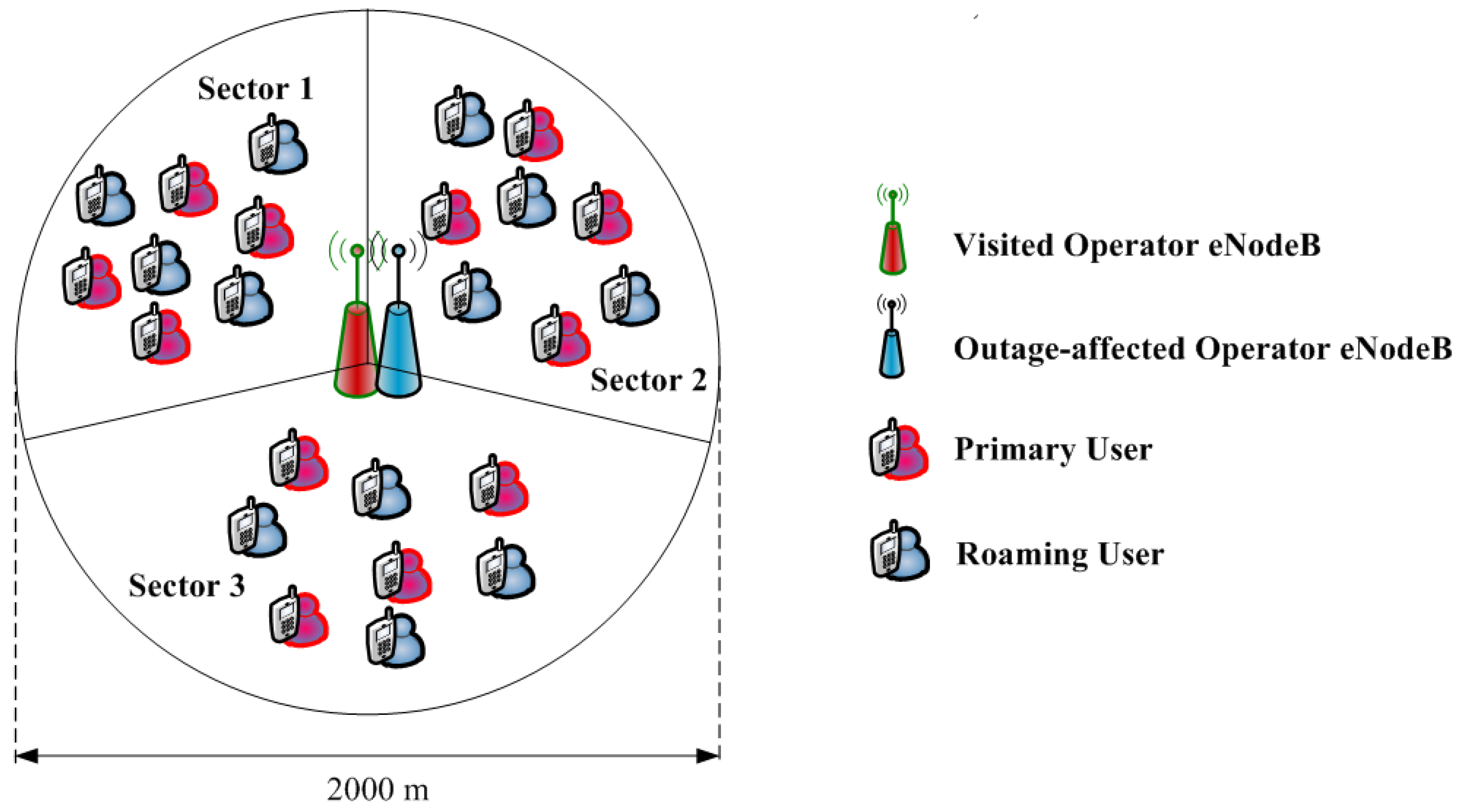
As shown in
Figure 1, two eNodeBs from different operators are co-located at the centre of the macrocell, and their coverage areas are assumed to perfectly overlap. The co-location assumption corresponds to independent operators sharing the same site (passive infrastructure sharing); however, each operator maintains separate antennas, transceivers, baseband, spectrum, radio resources, and backhaul. It is important to note that even in cases when the two operators only have partial coverage overlap due to different cellular footprints, the proposed RCTR scheme can still provide relief for roaming users. In such cases, the roaming users that would have been located within the coverage of a single eNodeB of the visited operator in the complete overlap scenario will now be spread across the coverage area of multiple eNodeBs of the visited operator. Each eNodeB can run the RCTR scheme locally to provide relief for the roaming users within its coverage.
UEs of the operators are uniformly distributed over the coverage area. When one of the operators experiences an outage in the coverage area, its UEs may roam to the network of the second operator. The operator experiencing an outage is referred to as the outage-affected operator, and its UEs are called roaming users in the other operator’s network. The operator unaffected by the outage is referred to as the visited operator, and its own UEs are referred to as the primary users.
Each eNodeB supports three-sector antennas that are spaced 120 degrees apart, and each antenna serves a unique sector of the cell. A bandwidth of 10 MHz, equivalent to 50 PRBs in 4G, is allocated to each sector of each operator for uplink data transmission. This implies that each operator has 30 MHz bandwidth available under normal cell operations. PRB allocation to UEs is done by the eNodeBs. The assumption of similar resources across co-located operators reflects independent network deployments in real-world multi-operator contexts; such deployments inherently provide avenues for dynamic load balancing and built-in redundancy that can be exploited for resilience against network outage. The proposed RCTR scheme converts this redundancy into an efficient, controlled, resource-sharing mechanism.
Non-line of Sight (NLOS) propagation is assumed for transmission between UEs and eNodeBs. The channel between a UE and an eNodeB is modelled using the Winner II C1 NLOS path loss model [
43] given by the following equation:
where
is the path loss,
is the distance between the UE and the eNodeB in metres,
is the carrier frequency in GHz,
is the height of the eNodeB antenna in metres. Under this model, shadowing is represented as a normal distribution (in dB) with a zero mean and a standard deviation of 8 dB under NLOS conditions. Flow-level modelling is adopted for file transmission, focusing on average link quality from the start to the end of transmission. Only large-scale propagation effects, including path loss and shadowing, are considered; small-scale effects like multipath fading are excluded.
The antenna pattern,
, of the sector antennas is estimated by the following equation specified by the Third Generation Partnership Project (3GPP) in the technical report 3GPP TR 25.814 V7.1.0 (2006-09) for 4G [
44]:
is the azimuth angle between the line passing through the bore sight of the antenna and the line joining the eNodeB location to the UE location.
denotes the 3 dB beamwidth and
.
is the front-to-back ratio of the sector antenna [
45] and
. The antenna gain,
, from a sector antenna to a UE location is given by:
is the maximum gain of the antenna and
is used in this study. UE antennas are omnidirectional with gains of 0 dBi in all directions.
In this work, a UE selects the sector with the highest downlink signal-to-noise ratio (SNR) as its serving sector. We focus on a single macrocell and do not consider interference from other cells. The results obtained can be seen as an upper bound for the performance metrics, with consideration of interference resulting in lower values without affecting the comparative performance of various roaming strategies.
An uplink request from a UE is admitted by an eNodeB if the uplink SNR is greater than or equal to the user admission SNR threshold. The data rate,
, over the allocated channel (PRB) is estimated using the Truncated Shannon Bound (TSB) [
46]:
where α is the attenuation factor,
is the minimum SNR required for admission into the network, and
is the SNR at which the maximum throughput can be attained. α = 0.65,
= 1.8 dB,
= 21 dB and
= 4.54 bps/Hz. These parameter values were obtained through link-to-system mapping in [
47]. In this work, only one UE utilises a PRB at a particular instant, and for easy comparison of the schemes, UEs are allocated one PRB per time.
Under the No Roaming scheme, a UE can only connect to the sectors of its own operator’s eNodeB; when all the sectors are in outage, it would not be able to access cellular network services. In contrast, under the Constrained and Unconstrained Roaming schemes, a UE can still access cellular network services through the sectors of another operator (the visited operator) even when all sectors of its own operator are in outage. However, this is conditioned on the fraction of resources available to the roaming users. Both the Constrained and Unconstrained Roaming schemes assume the existence of a national roaming agreement between the outage-affected operator and the visited operator. With such an agreement in place, and both networks configured to authenticate roaming users during cell outages, the schemes can allocate resources to the affected users. National roaming functionality is enabled through key network interfaces such as the S6a interface and inter-operator IPX/GRX connectivity [
48]. These interfaces support subscriber authentication, mobility management, and data exchange between an outage-affected operator and a visited operator. A detailed flow diagram and description of the associated inter-operator signalling exchanges are beyond the scope of this work and are left for future work.
Under the flow-level modelling approach applied in this study, once a user is admitted into the system and allocated a PRB, the file occupies the channel until transmission is completed. Resource allocation is therefore not performed on a time-slot basis, and dynamic reassociation between sectors or operators during an active session is not modelled. Both the Constrained and Unconstrained Roaming schemes permit inter-operator roaming exclusively during cell outage periods. Roaming is triggered by a cell outage event affecting the native operator, and roaming users are served by their own operator once normal service is restored. Since inter-operator handover is not permitted under normal operating conditions and roaming is confined to the outage period, ping-pong effects between the native and visited operator do not arise within this model.
The performance metrics evaluated under the different schemes are blocking probability, throughput, and spectral efficiency. A UE is blocked when no suitable PRB is available to allocate to it. Only user-information-bearing bits are considered in the estimation of throughput; overhead bits like packet headers and error detection bits are not included. In the calculation of spectral efficiency, only the bandwidths of active sectors are included.
3.2. The Resource-Constrained Temporary Roaming Scheme
Conventionally, operators configure eNodeBs to allocate resources solely to their own subscribers, not to subscribers of other operators. However, with a national roaming agreement and a framework for authenticating roaming users from other operators in place, an eNodeB can serve external subscribers. The RCTR scheme is based on this foundation of an existing national roaming agreement and authentication framework between participating operators. Furthermore, this scheme is focused on temporary roaming of users to a visited operator during short-term cell outages. Roaming is terminated when normal service is restored in the outage-affected operator.
The RCTR scheme enables an eNodeB to allocate its resources to roaming users according to a predefined resource constraint condition. This condition restricts roaming users to only a fraction C of available radio resources in a sector to mitigate the impact of roaming on the primary users, who are the incumbent subscribers of the visited operator. The level of resource restriction is determined by the resource constraint parameter, C. C can be varied to control the fraction of resources accessible to roaming users. When 0 < C < 1, it defines the Constrained Roaming scheme, which permits a fraction of the available radio resources to be accessible to roaming users, while the remaining portion (1 − C) is reserved exclusively for the primary users. When C takes its extreme values, we obtain the two baseline schemes. When C = 0, it defines a No Roaming scheme, which does not allow the outage-affected users access to any radio resources of the visited operator. Under the No Roaming schemes, users can only be served by their own operators. When C = 1, it defines an Unconstrained Roaming scheme, which allows roaming users access to all radio resources of the visited operator.
Based on the description of C, if the total number of PRBs in a sector is m, then roaming users can have access to a total of PRBs. The remaining PRBs are strictly for the primary users. However, the RCTR scheme permits primary users access to all available PRBs. When the portion reserved strictly for them is fully occupied, they can utilise PRBs within the portion accessible to roaming users. In this work, roaming users are granted access to a specific subset of PRBs determined by the value of C. Rather than permitting roaming users to access any PRBs scattered across the resource grid, they are restricted to either the first or the last contiguous PRBs. It is, however, possible to configure the RCTR scheme to enforce only a total numerical PRB limit, without imposing constraints on the spatial location of the PRBs within the grid. The set of PRBs accessible to roaming users is designated as the roaming-accessible PRB group, while the complementary set is referred to as the roaming-restricted PRB group. Primary users can access PRBs in both groups under the RCTR scheme. As stated earlier, the Constrained Roaming scheme is used interchangeably with the RCTR scheme.
In resource allocation decisions, apart from the prevailing resource constraint condition, the uplink SNRs of UEs on PRBs are also considered for user admission. Under the Unconstrained Roaming scheme, a new uplink request from either a primary or roaming user is admitted if there is a free PRB in any location in the resource grid and the uplink SNR on that PRB satisfies the threshold condition SNR ≥ 1.8 dB. Under the Constrained Roaming scheme, the admission condition for primary users follows the same SNR criterion as in the Unconstrained case. However, the roaming-restricted PRB group is first utilised, and only after it is fully occupied, PRBs in the roaming-accessible PRB group are allocated to primary users. Roaming users are allocated PRBs in the roaming-accessible PRB group only under the Constrained Roaming scheme. For both primary and roaming users, admission is granted only if the considered RB satisfies the threshold condition, uplink SNR ≥ 1.8 dB. For all three RRM schemes, if a UE has several candidate PRBs that can be allocated to it, they would have similar SNR, since only large-scale effects (path loss and shadowing) are considered. In such cases, the PRB with the lowest index is allocated to the UE.
The proposed RCTR scheme is implemented as follows:
We consider a sector where two operators are co-located. One operator (the outage-affected operator) is experiencing an outage, while the second operator (the visited operator) is in normal working condition. Let represent the vector of primary users, where n is the total number of primary users and represent the ith primary user (). Similarly, let represent the vector of roaming users, where t is the total number of roaming users and represent the jth roaming user (). It is assumed that the roaming users of the outage-affected operator can be authenticated and connected to the visited operator.
Let represent the vector of PRBs of the visited operator available in the sector, where m is the total number of PRBs and represent the hth PRB (. The resource constraint parameter defines the maximum fraction of PRBs accessible to roaming users. If k and q are the total number of contiguous PRBs in the roaming-accessible and roaming-restricted PRB groups, respectively, then and If we define the roaming-restricted PRB group as the first q contiguous PRBs in the resource grid, then R can be partitioned into and , the vectors of PRBs restricted from roaming access and vectors of PRBs accessible to the roaming users, respectively. Hence, and . Hence, the PRBs in and the PRBs in , constitute the roaming-restricted and the roaming-access RB groups, respectively.
Furthermore, let represent the SNR threshold for admission of a new UE uplink request, while represent the vector of uplink SNR of the UE on the m PRBs of the visited operator. Let denote the vector of usage status of the m PRBs. If PRB is occupied by a UE, ; but if it is idle, Also, if represents the vector of suitable PRBs for uplink transmission for a UE, then for primary users will include all in R ( that satisfies the conditions: and . For roaming users, will include all in ( that satisfies the conditions: and . If for a particular UE, the uplink request is blocked.
The pseudocode for a snapshot implementation of the RCTR algorithm without the channel modelling, Poisson arrival process and performance metrics computation is shown in Algorithm 1.
and
represent the instantaneous total iterations and the maximum number of iterations, respectively. In the resource allocation decisions for primary users, the roaming-restricted PRB group (
to
) is first checked for a free PRB by checking the usage statuses (
to
) of all the PRBs. Each PRB with a usage state
= 0 is free, while one with
= 1 is busy. If there is no free PRB in this group, the roaming-accessible PRB group (
to
) is then checked for a free PRB, by also checking the usage statuses (
to
) of the PRBs in the group. In the case of roaming users, only the roaming-accessible PRB group is checked for a free PRB in the resource allocation process. This approach ensures the reservation of the roaming-restricted PRB group exclusively for primary users, while still permitting them access to the roaming-accessible PRB group during congestion periods. The unrestricted access to all PRBs given to primary users, unlike roaming users, when combined with an appropriate choice of C, can ensure QoS protection for primary users even under massive roaming traffic. However, this results in QoS differentiation, where primary users’ QoS is explicitly protected, while roaming users’ QoS is subject to degradation during congestion periods, particularly at high traffic intensities.
| Algorithm 1: RCTR Algorithm |
- 1:
Initialise all the elements of S and U to zero, , and Itotal = 0 - 2:
Input: C, m, SNRth, Imax - 3:
k = - 4:
q = m − k - 5:
While Itotal < Imax do - 6:
Generate randomly a new transmitting UE - 7:
Determine user type: or ? - 8:
Itotal = Itotal + 1 - 9:
if UE type is then//primary user resource allocation - 10:
for h = 1 to q do//free roaming-restricted PRBs check - 11:
if = 0 then - 12:
Compute the uplink SNR of the resource block - 13:
if ≥ SNRth then - 14:
Update with new element - 15:
end - 16:
end - 17:
end - 18:
if then//No free roaming-restricted PRB confirmation - 19:
for h = q + 1 to m do/free roaming-accessible PRBs check - 20:
if = 0 then - 21:
Compute the uplink SNR of the resource block - 22:
if ≥ SNRth then - 23:
Update with new element - 24:
end - 25:
end - 26:
end - 27:
end - 28:
if then - 29:
Block UE transmission - 30:
elseif then - 31:
Allocate first element of as resource block for new UE’s data transmission - 32:
Update U to account for new resource block allocation - 33:
Set for next resource allocation - 34:
end - 35:
elseif UE type is then//roaming user resource allocation - 36:
for w = q + 1 to m do//free roaming-accessible PRBs check - 37:
if = 0 then - 38:
Compute the uplink SNR of the resource block - 39:
if ≥ SNRth then - 40:
Update with new element - 41:
end - 42:
end - 43:
end - 44:
if then - 45:
Block UE transmission - 46:
elseif then - 47:
Allocate first element of as resource block for new UE’s data transmission - 48:
Update U to account for new resource block allocation - 49:
Set for next resource allocation - 50:
end - 51:
end - 52:
end
|
The RCTR allocation decision has low computational complexity because it only requires a linear scan of the PRBs available in a sector. For each new UE request, a free PRB search for a primary user involves at most all m PRBs, while for a roaming user, it involves only the roaming-accessible subset . The initialisation stage, which constructs the PRB usage and SNR vectors, has complexity of , while the final PRB selection and allocation decision, including system state updates, has constant-time complexity O(1). Hence, the worst-case complexity per UE admission decision is , and the complexity of a full simulation run with arrivals is . The memory requirement is also , mainly for storing the PRB-usage vector, SNR vector, and temporary candidate-resource list. In the 4G configuration considered in this work, PRBs per sector; therefore, each online allocation decision requires at most 50 PRB checks. The 50,000 iterations used in the simulations correspond to offline Monte-Carlo performance evaluation, not the runtime of a single online allocation decision.
Since each decision consists only of simple availability checks over a fixed and small PRB set, the computational burden is compatible with the transmission time interval (TTI) 1 ms scheduling constraint of 4G systems. Therefore, the RCTR algorithm is computationally lightweight and suitable for real-time implementation at the sector scheduler level in conventional eNodeB architectures.
The performance evaluation is conducted using a flow-level simulation model, where each uplink file transmission is served continuously until completion. However, the flow-level nature of the simulation does not preclude the applicability of the proposed RCTR scheme to practical schedulers based on time-slot resource allocation, since the same allocation logic can be executed at each transmission time interval (TTI) in standard 4G scheduling frameworks.
3.3. System-Level Simulations
The performances of the RCTR scheme and the two baseline schemes are evaluated through Monte-Carlo system-level simulations in MATLAB (R2020a). Each simulation run is ended after 50,000 iterations, which is sufficient to enable convergence of evaluated performance metrics with minimal variance. Two eNodeBs belonging to two different operators are deployed at the centre of a circular suburban macrocell with a radius of 1000 m. The coverage areas of both eNodeBs perfectly overlap. Each eNodeB supports three-sector antennas spaced apart, and the coverage area is divided into three equal sectors. One eNodeB belongs to the visited operator, and it never experiences an outage in any of its sectors during any simulation run. The second eNodeB belongs to the outage-affected operator, and one-sector and three-sector outage conditions are considered for this eNodeB.
A total of 2000 users are deployed uniformly over the common coverage area. Half of this population are subscribers of the visited operator, while the other half are subscribers of the outage-affected operator. Resource allocation is done on a per-sector basis. Each sector supports a bandwidth of 10 MHz, equivalent to 50 PRBs in the 4G standard. In each sector where the outage-affected operator suffers an outage, its subscribers become roaming users to the visited operator, while the subscribers of the visited operator are the primary users. Although 2000 users are deployed in the coverage area considered, the traffic intensity is determined by the arrival rate of uplink user requests. At no time are all 2000 users concurrently active. The simulation parameters are provided in
Table 1.
A user connects to the sector with the strongest downlink SNR signal. In a sector where neither operator experiences an outage, users are served by their own eNodeBs. In contrast, in a sector where the outage-affected operator suffers an outage, access of roaming users to PRBs is governed by the roaming scheme adopted: no access at all under the No Roaming scheme (C = 0), access to only the roaming-accessible RB group under the Constrained Roaming scheme (0 < C < 1), and full access to all PRBs under the Unconstrained Roaming (C = 1). Primary users can access any available PRBs, though the roaming-restricted PRB group is prioritised over the roaming-accessible PRB group for resource allocation. It is only when roaming-restricted PRBs are fully occupied that the roaming-accessible PRBs are allocated to primary users. When users are unable to get a free PRB, they are blocked, and the request is cleared from the system completely. Hence, queues are not considered in this work. Furthermore, as C determines the number of roaming users that can be admitted and thus the QoS experienced by primary users, under the Constrained Roaming scheme, it is varied to understand how it affects both the provision of relief for roaming users and the QoS of primary users at different traffic intensities. This will enable us to discover how to select C to balance relief for roaming users and the QoS of primary users at different traffic intensities.
Furthermore, the Unconstrained Roaming baseline scheme is equivalent to the roaming strategies utilised in state-of-the-art national roaming for resilience studies [
9,
10,
11], where the roaming decision is binary, i.e., if capacity or coverage conditions are satisfied, roaming users are given unconstrained access to all radio resources; however, if these conditions are not satisfied, roaming access is denied. The evaluations of the Constrained Roaming (or RCTR) scheme at different values of C (C = 0.2, C = 0.4, and C = 0.5) represent variants of the RCTR scheme as a static resource reservation approach, effectively covering static resource reservation as an implicit baseline within the existing evaluation. The RCTR scheme also incorporates implicit QoS differentiation through its PRB partitioning mechanism, where primary users can access the full PRB pool while roaming users are restricted to a fraction C of available resources, thereby achieving QoS protection for primary users without explicit QoS-aware admission control.
Each user (a subscriber of either operator) arrives in the co-located network with a request to upload a file of 2 MB. User arrival constitutes a Poisson arrival process with a mean arrival rate Conventionally, file sizes can be larger and variable, and service types can be diverse; however, we have used a fixed file size of 2 MB and a common service type of file upload to have a simple, consistent basis for relative comparisons of the different schemes.
The number of files that arrive per second (arrival rate measured in files/s) represents the offered traffic load to the system, where each file arrival corresponds to an uplink transmission request from a user. The actual throughput per user is dependent on the achievable SNR and the corresponding uplink data rate. The 2 MB file size used in this work is representative of typical short uplink data transfers, such as image and multimedia uploads in messaging and social media applications. Compared to the 2 MB file size, a larger file size may lead to higher throughput at lower arrival rates, with system capacity not yet exceeded. At higher arrival rates, when the system reaches its capacity, larger file sizes cannot result in higher throughput, as the maximum throughput is capped by system capacity. Our model does not consider queues, so larger files will lead to higher blocking probability as the system capacity is approached, since longer active sessions reduce the availability of free PRBs for new arrivals. However, these effects will not alter the relative performance trends of the three schemes, as the way the schemes handle access to PRBs is independent of per-session file size.
Furthermore, in practical systems, users typically upload varying file sizes following a statistical distribution, and they may be allocated multiple PRBs rather than a single PRB, depending on service requirements and channel conditions. These factors may affect the absolute values of throughput and blocking probability, but they do not fundamentally change the way RCTR and the baseline schemes control the access of roaming traffic to the radio resources of the visited operator. As such, they do not alter the operation of the proposed RCTR scheme in constraining the access of roaming users to a limited portion of the available radio resources of the visited operator or the two baseline schemes’ roaming rules. Hence, the relative performance trends of the proposed RCTR scheme and baseline schemes are expected to generalise to scenarios with variable traffic patterns and multi-PRB allocations.
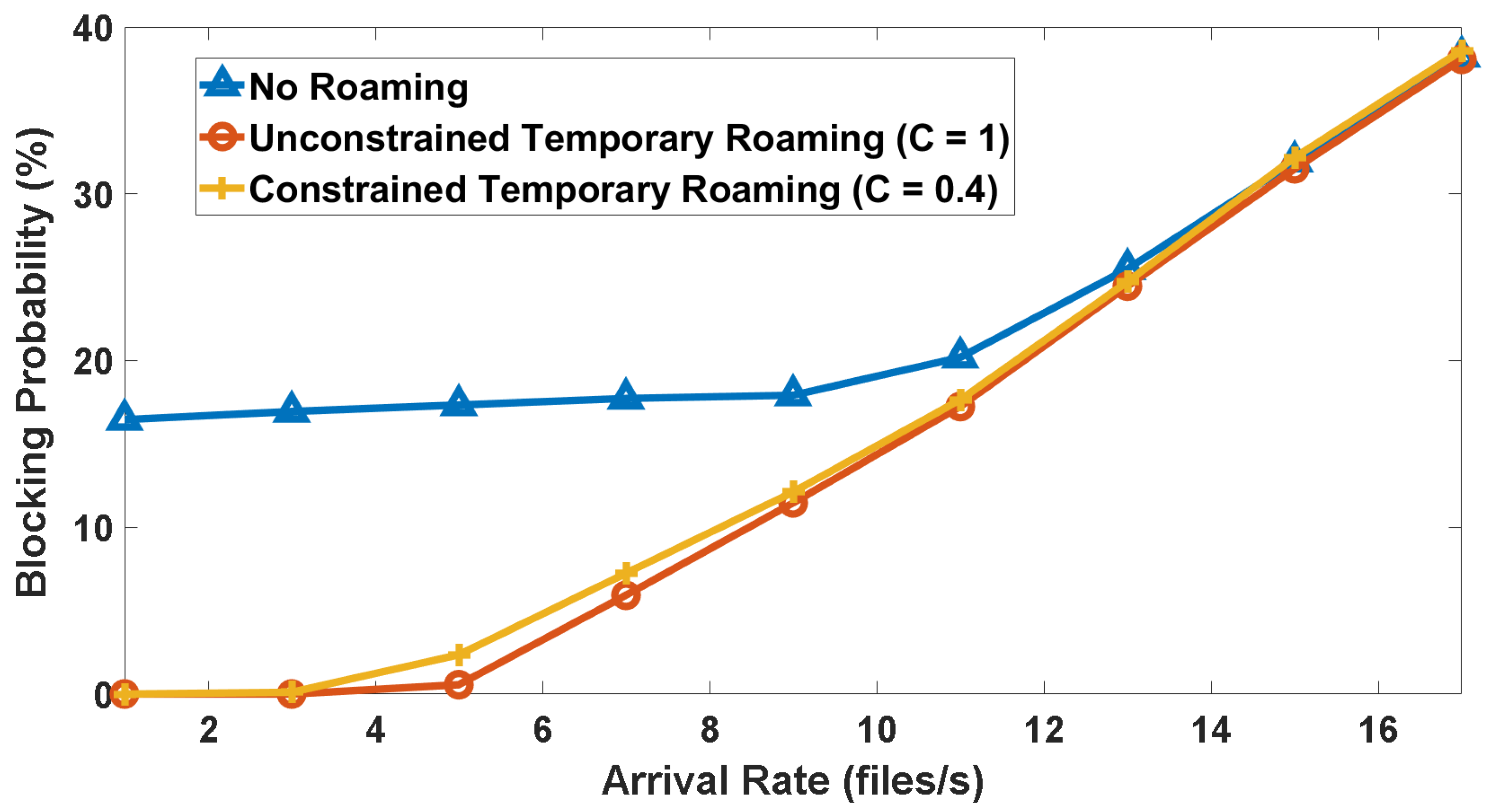
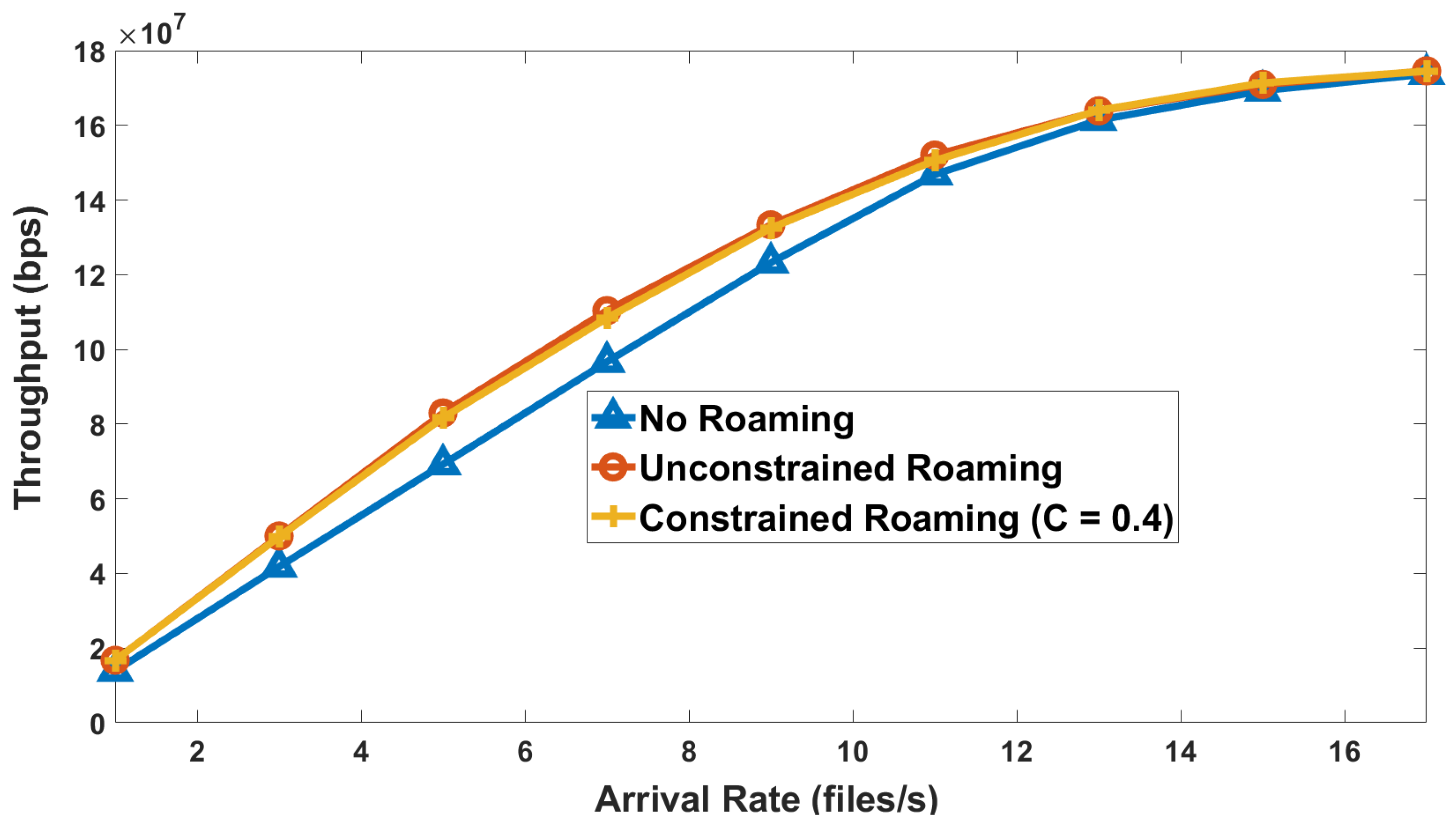
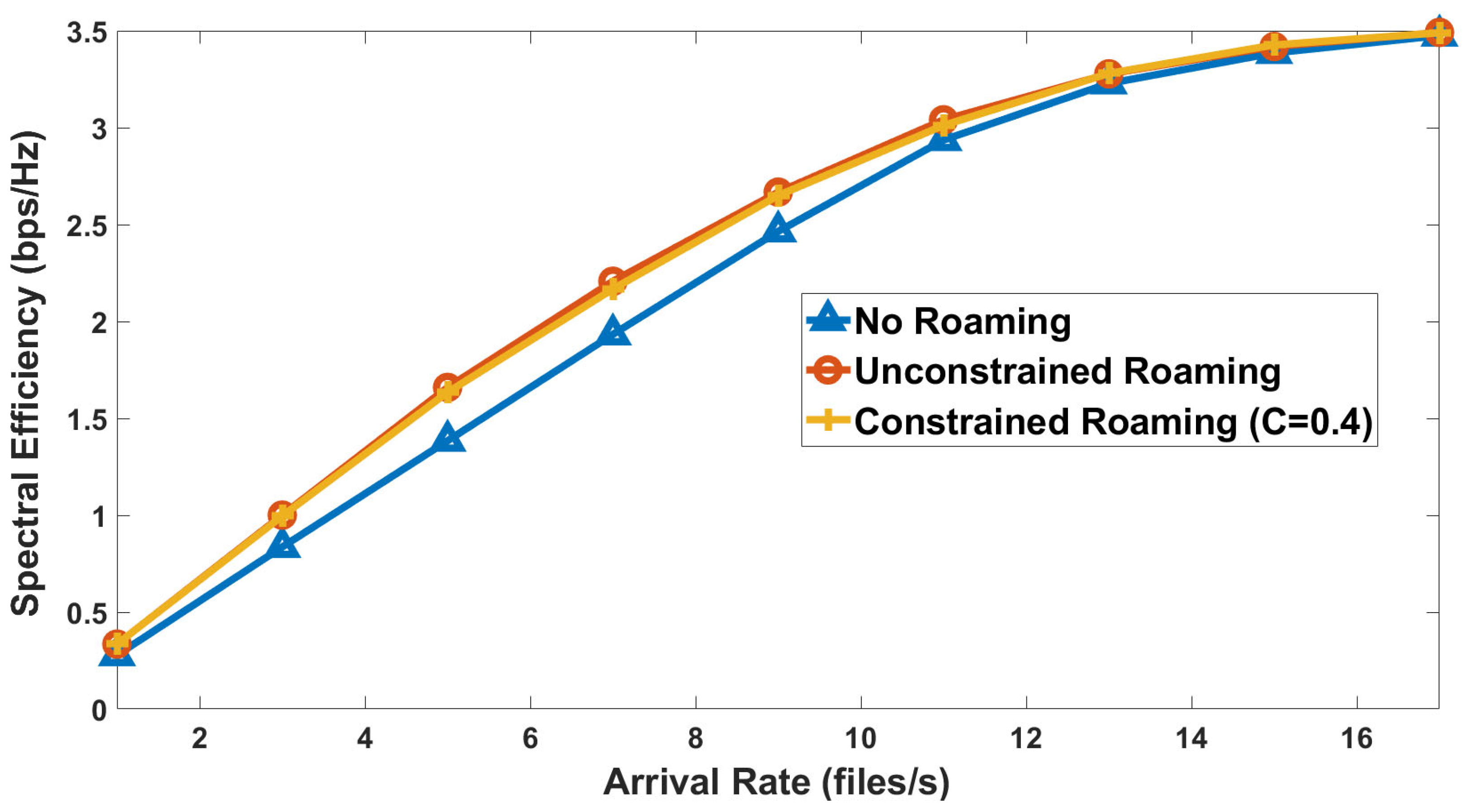
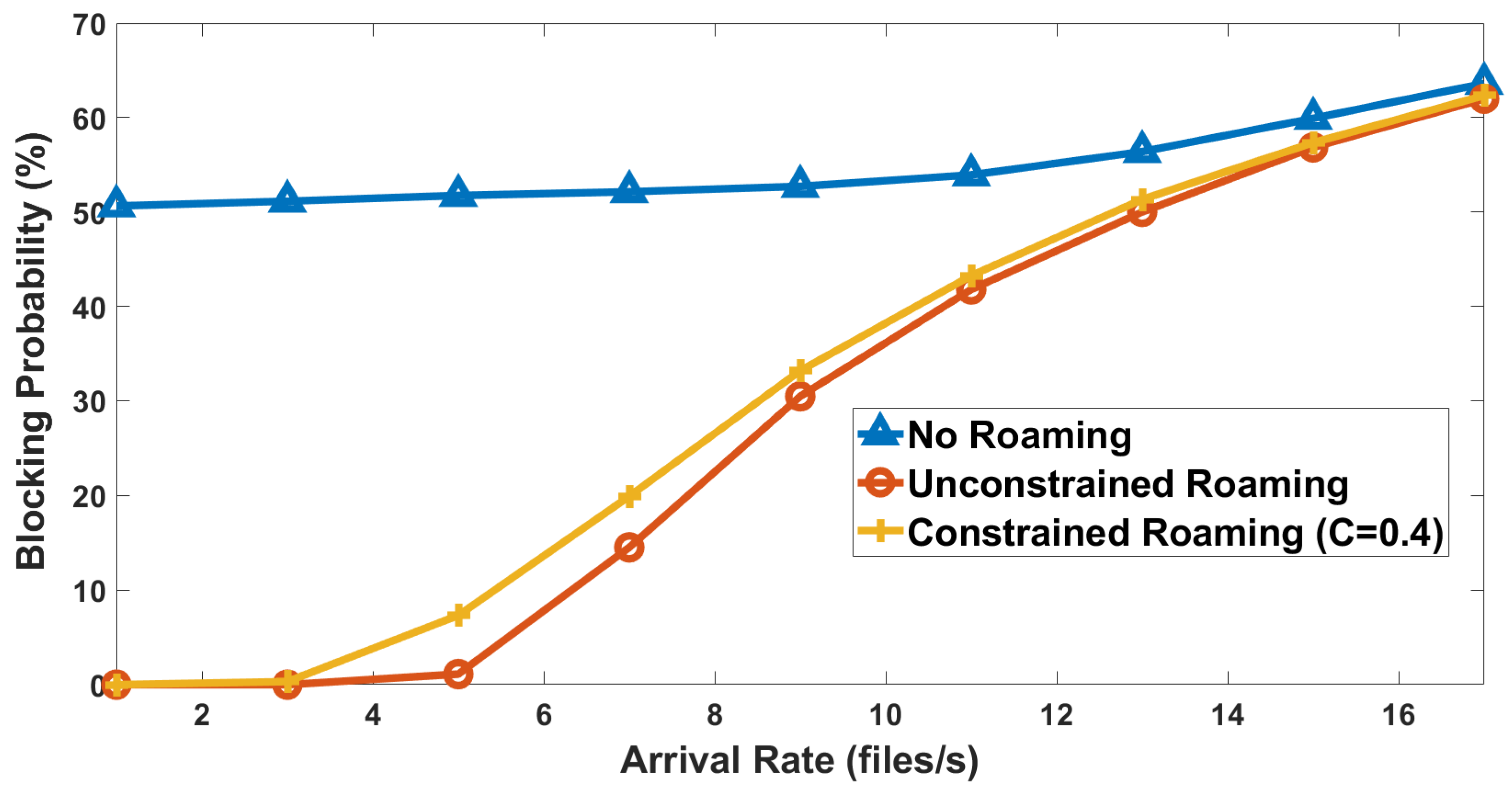
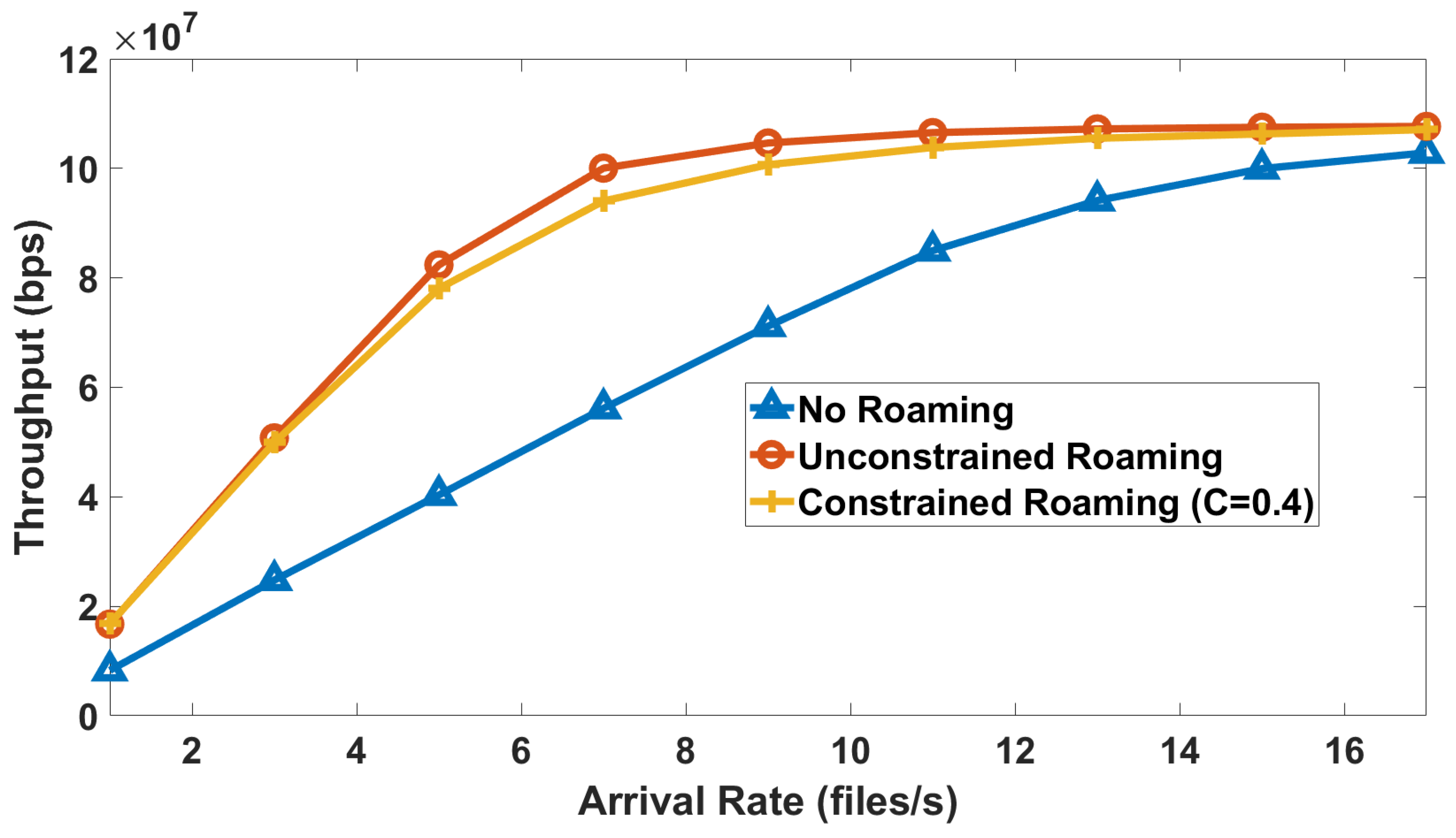
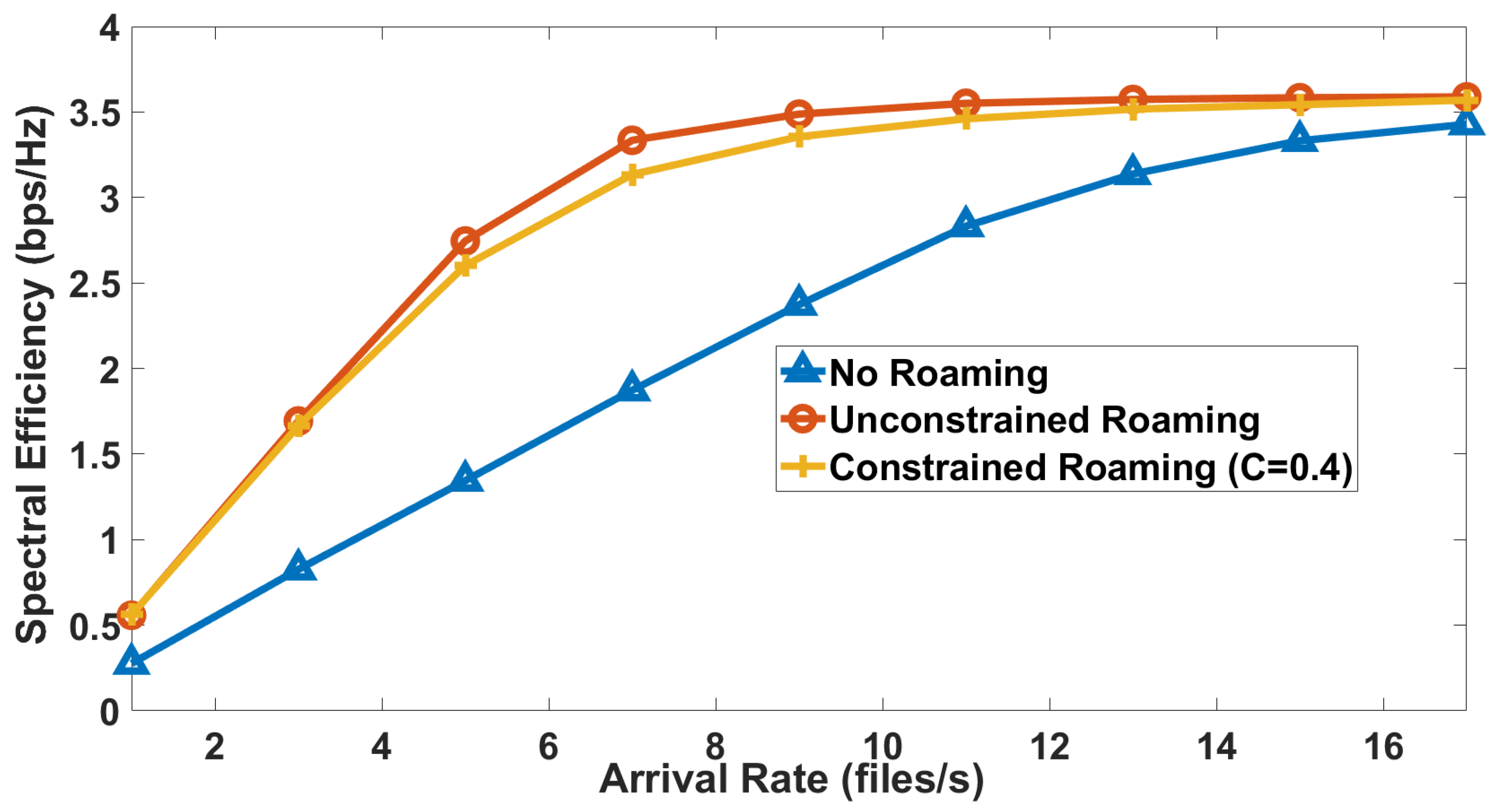
Two cell outage scenarios are considered: one sector and all three sectors of the outage-affected operator experiencing outage. For the one-sector outage scenario, the blocking probability, throughput, and spectral efficiency performances of the No Roaming, Constrained Roaming (at C = 0.4), and Unconstrained Roaming schemes are evaluated and compared for the combined user population of the two operators. Four different subcases are considered for the three-sector outage case.
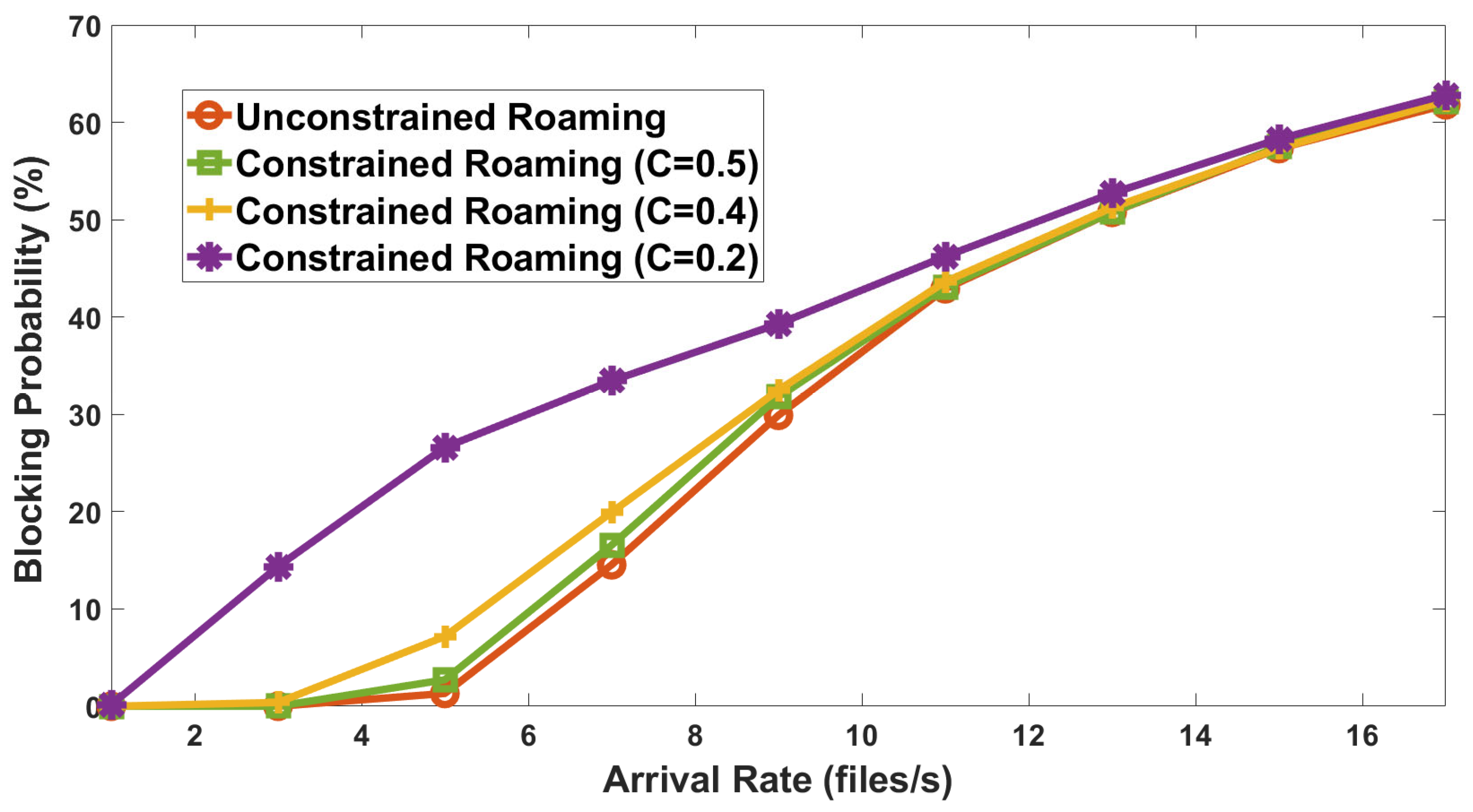
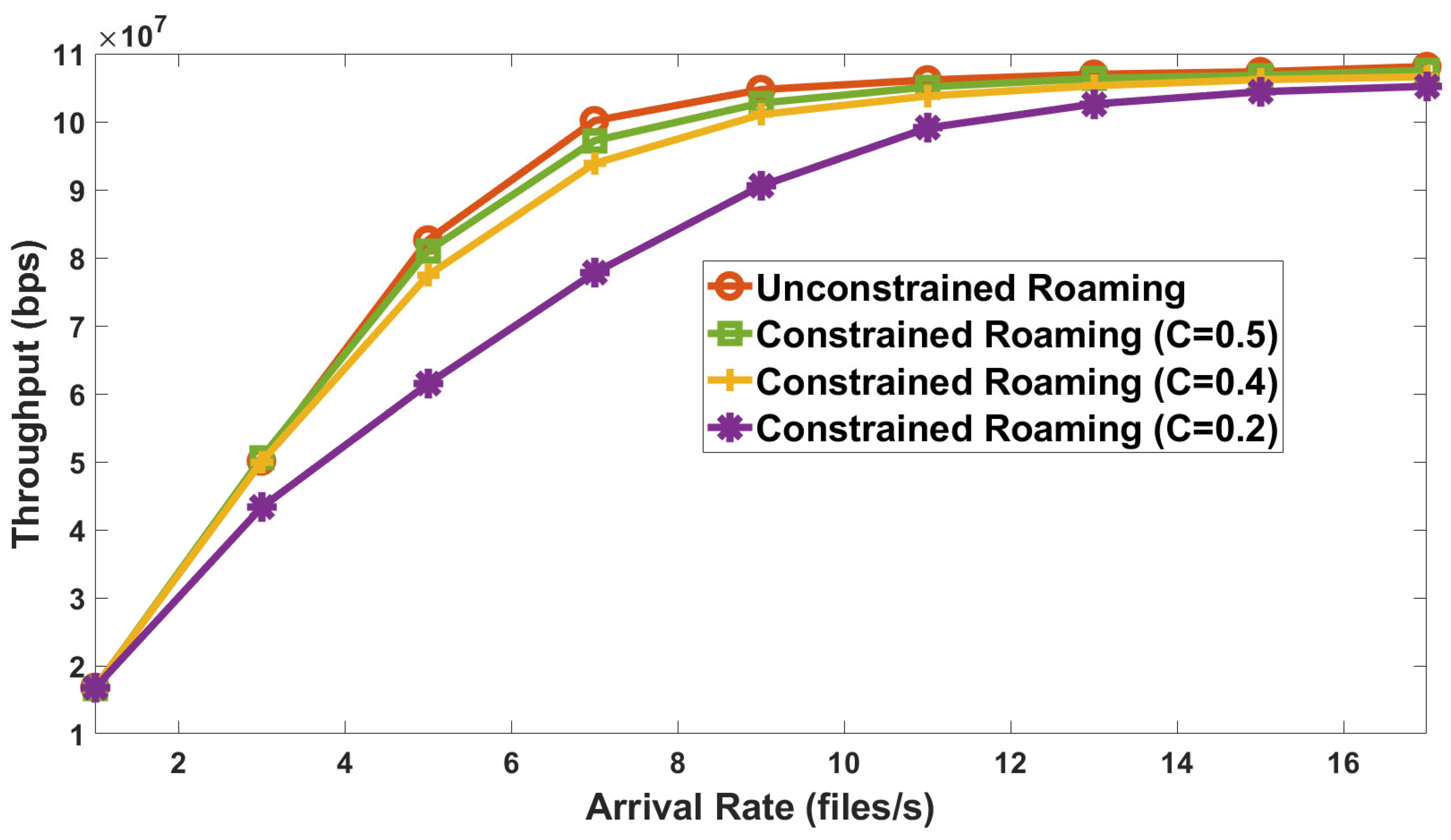
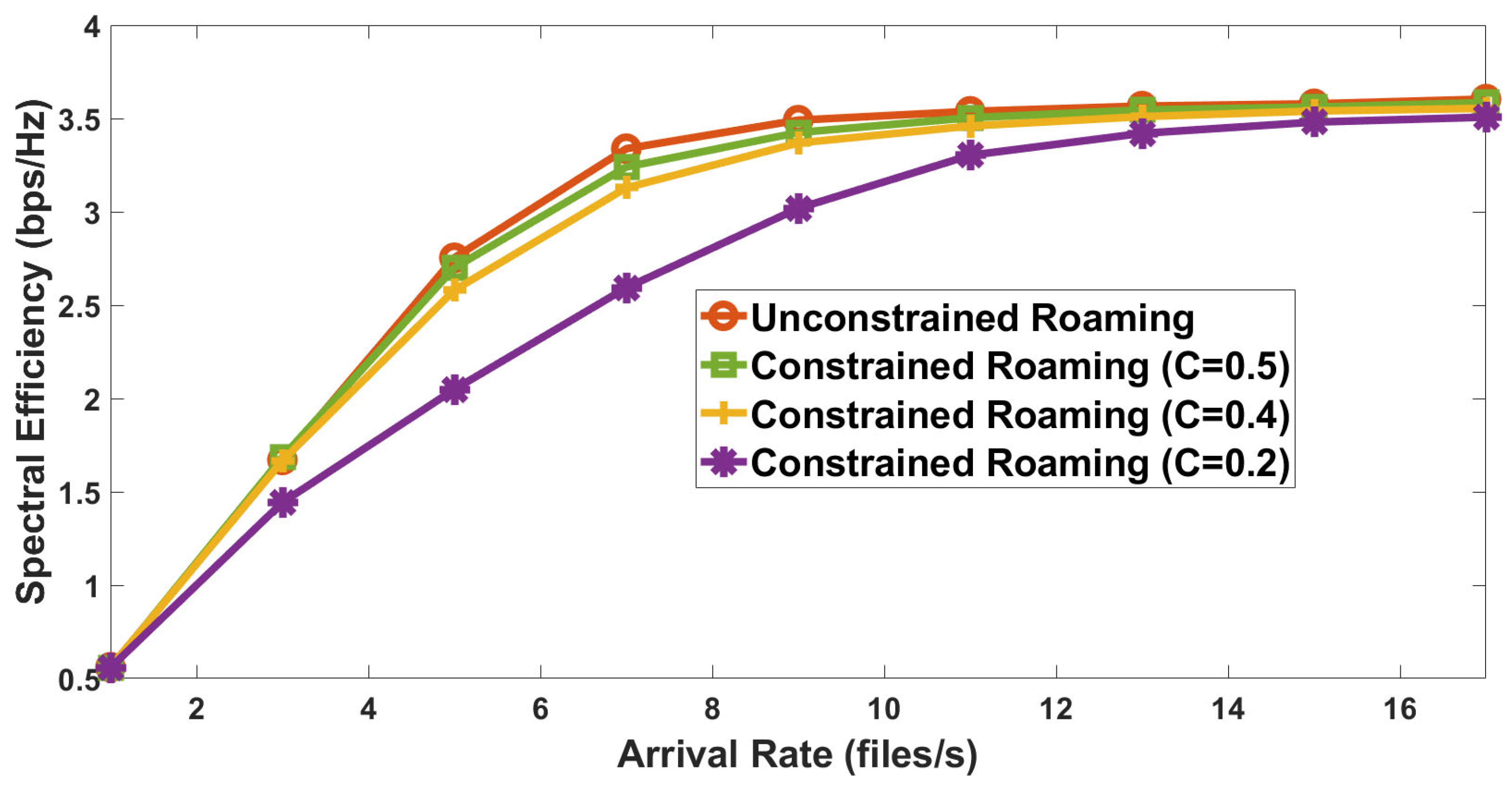
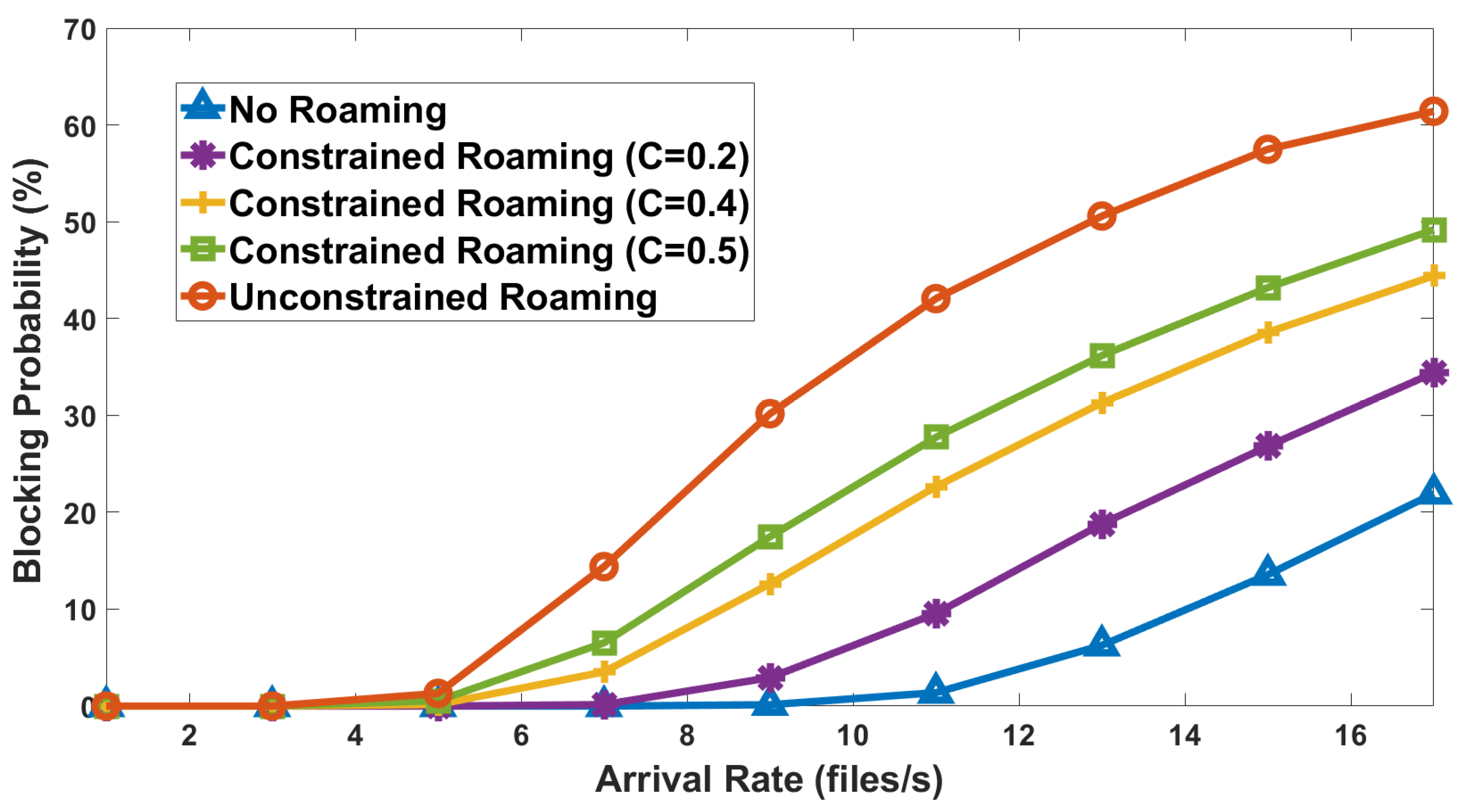
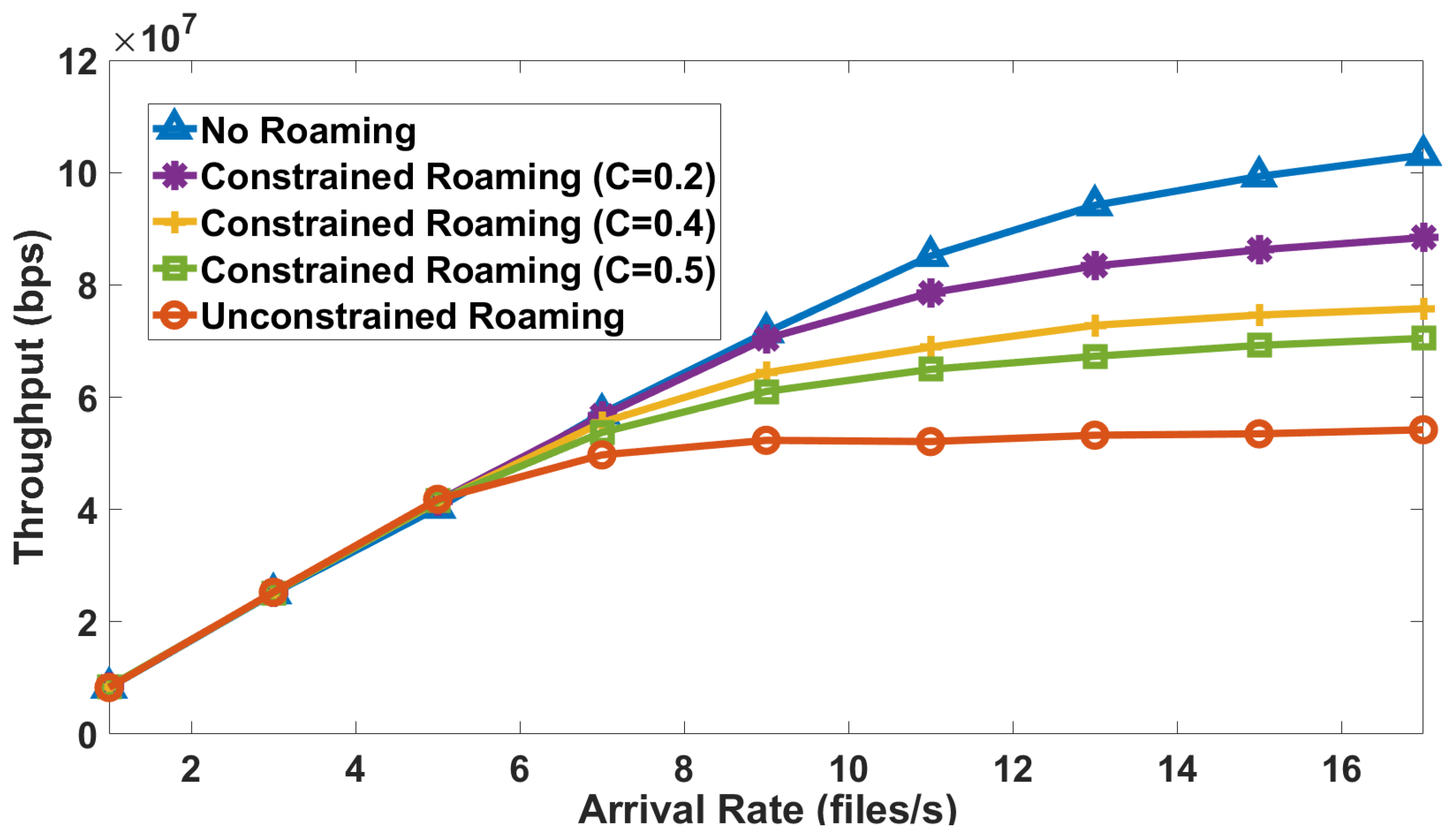
First, just like in the one-sector outage scenario, the blocking probability, throughput, and spectral efficiency performances of the No Roaming, Constrained Roaming (at C = 0.4), and Unconstrained Roaming schemes are evaluated and compared for the combined user population, with all three sectors of the outage-affected operator in outage. Second, the sensitivity of the resource constraint parameter C is analysed. The blocking probability, throughput, and spectral efficiency performances of the Unconstrained Roaming (C = 1) and Constrained Roaming at C = 0.2, C = 0.4, and C = 0.5 are evaluated and compared for the combined user population. C > 0.5 was not considered under Constrained Roaming for reasons of fairness to the primary users.
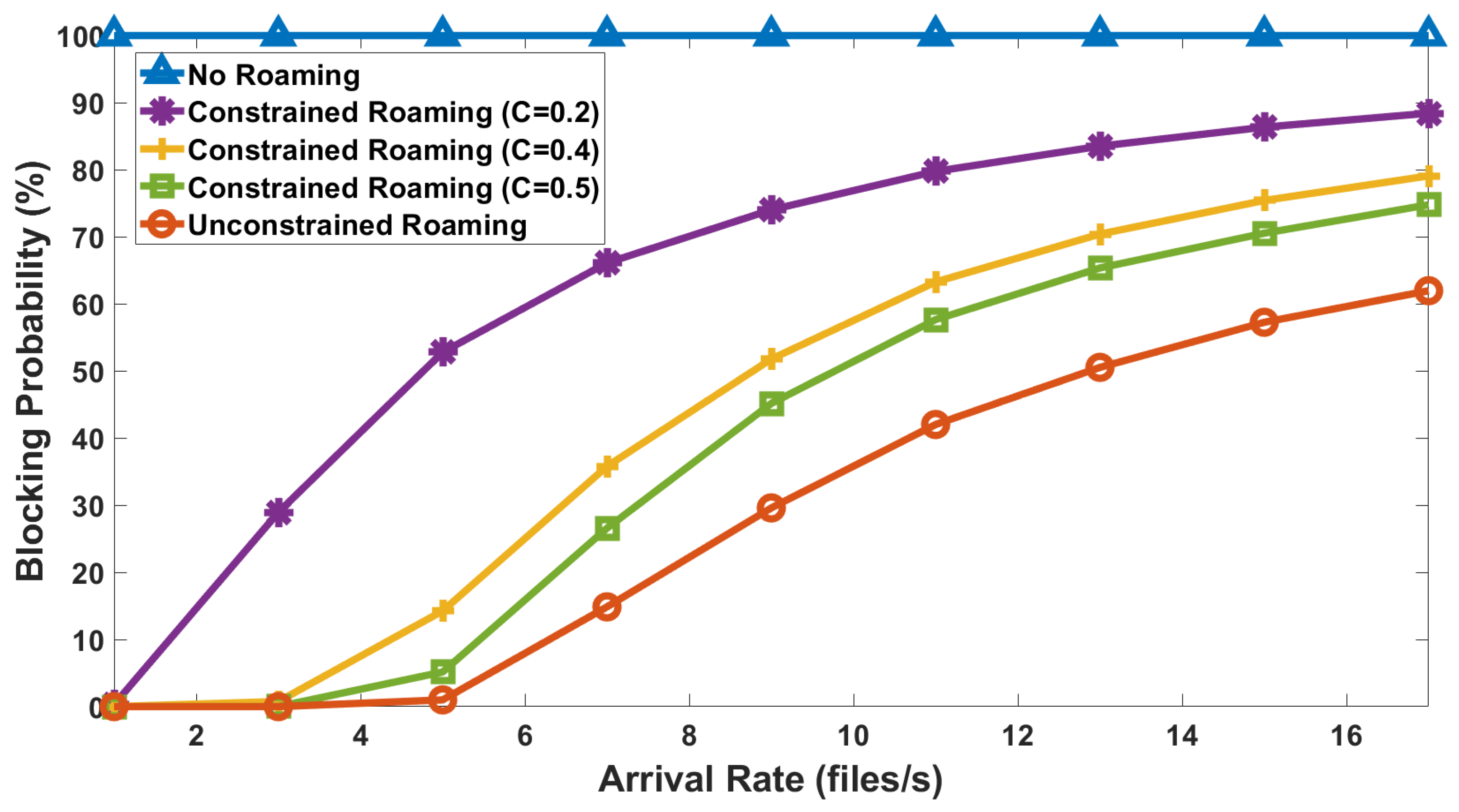
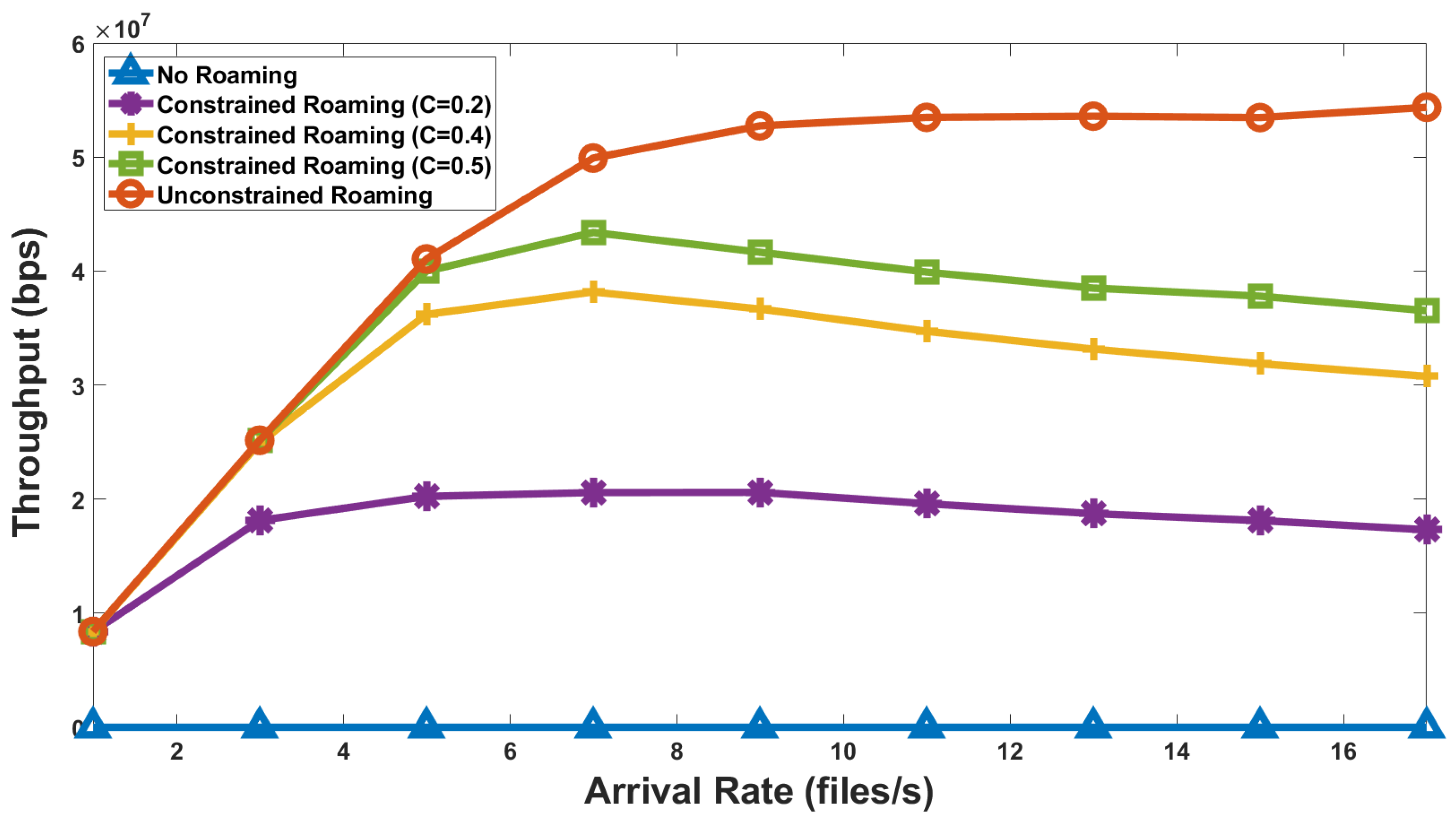
The other two subcases focused on the impact of roaming on the QoS of the roaming and primary users under the three-sector outage condition. Specifically, the blocking probability and throughput performances of the No Roaming, Unconstrained Roaming (C = 1), and Constrained Roaming at C = 0.2, C = 0.4, and C = 0.5 are evaluated and compared for the roaming users alone, with all three sectors of the outage-affected operator in outage. Then, this same procedure is repeated for the primary users alone.
5. Conclusions
In this paper, a novel Resource-Constrained Temporary Roaming (RCTR) scheme is proposed to mitigate short-term cell outages in suburban macrocells by permitting roaming users to access only a fraction C of available PRBs of a visited operator to protect the QoS of primary users. Under the RCTR scheme, the resource constraint parameter C lies in the bounds 0 < C < 1. When C takes its extreme values, i.e., C = 0 and C = 1, the outcomes correspond to the two baseline schemes: No Roaming and Unconstrained Roaming schemes, respectively. The performances of these three schemes—the Constrained Roaming (used interchangeably with RCTR), No Roaming, Unconstrained Roaming—are evaluated in a suburban macrocell with two co-located operators under two outage conditions, considering the combined user population, roaming users and primary users.
The blocking probability, throughput, and spectral efficiency performance of the No Roaming, Constrained Roaming (at C = 0.4), and Unconstrained Roaming schemes are evaluated and compared under one-sector and three-sector outage conditions for the combined user population of the outage-affected and visited operators. The Constrained Roaming (at C = 0.4) and Unconstrained Roaming schemes are shown to mitigate cell outage and lead to significant improvements in all performance metrics relative to the No Roaming scheme. Generally, the Unconstrained Roaming scheme achieves slightly better performance than the Constrained Roaming scheme, but at the expense of severe degradation of the primary users’ QoS as revealed by other results.
Sensitivity analysis of the resource constraint parameter C is also evaluated based on the three performance metrics under the three-sector outage condition for the combined user population. Specifically, the performance of the Constrained Roaming scheme at C = 0.2, C = 0.4, and C = 0.5, as well as the Unconstrained Roaming scheme (C = 1) for the combined user population, is evaluated. Overall, the performance metrics demonstrate improved gains with increasing C, but the gains exhibit diminishing returns as C approaches one.
The impact of temporary roaming on the QoS of roaming users and primary users is also evaluated. Specifically, blocking probability and throughput performances of the No Roaming scheme, Constrained Roaming scheme at C = 0.2, C = 0.4, and C = 0.5, and the Unconstrained Roaming scheme (C = 1) are evaluated for roaming users and primary users separately under the three-sector outage condition. The Constrained Roaming scheme is shown to mitigate outage-induced 100% blocking and zero throughput experienced by roaming users under the No Roaming scheme, with blocking probability dropping below 10% at low load and significant throughput achieved across various traffic intensities. Although the Unconstrained Roaming scheme achieves significantly better QoS performances than the Constrained Roaming scheme for the roaming users, the gains in performance come at the cost of severe degradation of the primary users’ QoS. For primary users, the blocking probability and throughput performances of all the schemes are similar at low traffic intensities. However, at medium and high traffic intensities, the blocking probability and throughput performances degrade with increasing values of C. The Unconstrained Roaming scheme leads to the worst QoS performance for primary users at higher traffic intensities.
Since primary users can tolerate a high value of C at low traffic intensities, but experience worsening QoS performance with increasing values of C at medium and high traffic intensities, running the RCTR scheme at a fixed value of C across different traffic intensities is suboptimal. Instead, C can be dynamically tuned as traffic intensity changes to meet a target QoS requirement. This dynamic tuning of C with traffic intensity can be achieved through self-optimisation techniques or machine learning-based strategies. A dynamic RCTR scheme that modifies C as traffic intensity changes will therefore be investigated in future work. Furthermore, with some fundamental properties of the RCTR scheme and the associated resource constraint parameter C established in this foundational work, more complex system settings will be explored in future work. This can include extension to a multicell scenario with the consideration of inter-cell interference, larger file sizes and diverse user applications, more complex PRB allocations beyond the single PRB per user, and roaming price-based resource-sharing strategies.