Article

A Wide-Range High-Efficiency Rectifier for Wireless Power Transfer in Battery-Free IoT Networks

1
School of Electronics and Information Engineering, Sichuan University, Chengdu 610064, China
2
Yibin Industrial Technology Research Institute, Sichuan University, Yibin 644000, China
*
Author to whom correspondence should be addressed.
Telecom 2026, 7(3), 67; https://doi.org/10.3390/telecom7030067
Submission received: 4 March 2026 / Revised: 24 April 2026 / Accepted: 20 May 2026 / Published: 3 June 2026

Abstract

Microwave wireless power transfer (MWPT) is a promising technology for powering dedicated industrial Internet of Things (IoT) devices, enabling battery-free operation. However, in realistic MWPT deployments, the received RF signals fluctuate drastically due to varying transmission distances and multipath fading. Additionally, the equivalent impedance of sensor nodes varies significantly during duty cycles, shifting between a low-resistance active state and a high-resistance sleep state. Consequently, maintaining high rectification efficiency under these dynamic conditions remains a critical challenge. This paper proposes a high-efficiency rectifier with a wide input power and load range based on the suppression of second and third harmonics. The rectifier adopts a dual-diode parallel configuration. By leveraging the impedance compensation characteristics of two short-circuited stubs with distinct electrical lengths, it simultaneously achieves fundamental-frequency impedance matching and harmonic suppression without the need for an additional matching network. Validated through theoretical derivation, simulation analysis, and physical prototype testing, the proposed 2.45 GHz rectifier realizes high-efficiency rectification over a wide dynamic range. Experimental results demonstrate that the power dynamic range reaches 10 dB when the rectification efficiency exceeds 70%, and extends to 17 dB when the efficiency is above 60%. Furthermore, the rectification efficiency is insensitive to load variations (100–1200 Ω), making it highly suitable for powering wireless sensor nodes with varying operating modes in complex electromagnetic environments.

1. Introduction

With the exponential growth of the Internet of Things (IoT), billions of wireless sensors are being deployed in industrial, medical, and environmental monitoring applications [1,2,3]. Conventionally, these distributed nodes are powered by batteries. However, the limited lifespan of batteries and the high cost of replacement pose significant maintenance challenges, especially for large-scale or inaccessible networks. To address this bottleneck, Microwave Wireless Power Transfer (MWPT) has emerged as a promising solution to enable “Green IoT” and battery-free sensor networks [4,5,6]. Recent reviews further highlight the rapid expansion of WPT technologies across diverse IoT ecosystems, ranging from self-powered cyber–physical systems to emerging flexible and wearable electronics [7,8]. In an MWPT system, the rectifier circuit is the core module responsible for converting the beamed RF energy into DC power. Its performance directly determines the overall efficiency and stability of the energy supply [9,10,11].
However, designing a rectifier for real-world IoT applications faces two primary difficulties. The first challenge is the fluctuating input power caused by varying distances between the transmitter and receiver, alongside path loss and multipath fading [12,13]. In dedicated industrial MWPT systems utilizing high-gain beamforming or UAV-based close-range charging, the received RF power at the node can reach elevated levels (e.g., 10 to 30 dBm) and fluctuate significantly. A rectifier optimized for a single power level will suffer severe efficiency degradation when the signal strength changes drastically depending on the sensor’s physical placement. The second challenge is the varying load impedance. IoT sensors typically operate in duty cycles, alternating between a high-impedance “sleep mode” and a low-impedance “active mode” [14,15]. Standard rectifiers are sensitive to these variations, leading to impedance mismatch and power reflection during state transitions.
Current research on rectifier circuits focuses on broadband/multi-band operation [16,17,18], wide-input power range adaptation [19,20,21], and wide load range compatibility [22,23,24]. For instance, to achieve broadband performance, Wu et al. [16] proposed a frequency-selective diode array that integrates low- and high-band rectifying branches without additional input matching networks. By utilizing short-circuit stubs to isolate the two cells based on operating frequency, this topology achieves an octave bandwidth (1.75–3.55 GHz) with a power conversion efficiency (PCE) exceeding 70%. Alternatively, focusing on impedance characteristics, He et al. [18] introduced a coupled transmission line (CTLIN) in series with the diode to compensate for its parasitic capacitive reactance. This method effectively compresses the diode’s impedance variation across a wide frequency range, resulting in a compact design with a 54.5% fractional bandwidth for efficiency greater than 70%. To address the challenges of input impedance variation under fluctuating power levels, Guo et al. [19] integrated a varactor diode into the matching network to provide dynamic impedance compensation. By utilizing a self-biased topology where the varactor voltage is derived directly from the rectification output, this design maintains a power conversion efficiency (PCE) exceeding 50% across an input range of 2.4–20.9 dBm, even when cascaded with a dc-dc boost converter. In a different approach, He et al. [20] implemented an adaptive power division strategy using parallel rectifying branches configured for different power levels. By manipulating the input conductance through transmission lines, this architecture automatically routes RF energy to the optimal branch, achieving a remarkable 24.5 dB dynamic range (5–29.5 dBm) with efficiency maintained above 60%. To mitigate performance degradation caused by load variations, Wu et al. [22] proposed a compact rectifier utilizing a self-bias impedance compensation (SBIC) topology. By introducing a compensation branch that dynamically adjusts the circuit’s impedance in response to load changes, this design achieves a remarkable load range ratio of 22 for efficiencies greater than 50%, significantly outperforming conventional single-diode structures. From a system-level perspective, Huang et al. [24] addressed this challenge by integrating a dc-dc converter to actively track the optimal operating point. This architecture effectively isolates the rectifier from the load, maintaining a constant efficiency of over 60% across an extremely wide load resistance range from 100 Ω to 5000 Ω. However, simultaneously achieving a compact size, high peak efficiency, and robustness against both power and load variations still remains a design challenge.
This paper proposes a compact RF rectifier utilizing a hybrid topology of λ/8 and λ/12 short-circuited stubs. By leveraging the distinct frequency-dependent impedance characteristics of these two stubs, the proposed design simultaneously achieves impedance matching at the fundamental frequency and effective suppression of higher-order harmonics, thereby eliminating the need for complex external matching networks. Compared to traditional rectifiers, this architecture demonstrates superior robustness against fluctuations in both input power and load impedance while maintaining high efficiency. Consequently, it provides a miniaturized and highly adaptive RF energy receiver suitable for the dynamic operating conditions of battery-free IoT systems.

2. Rectifier Circuit Design

2.1. Principle of RF Rectifiers

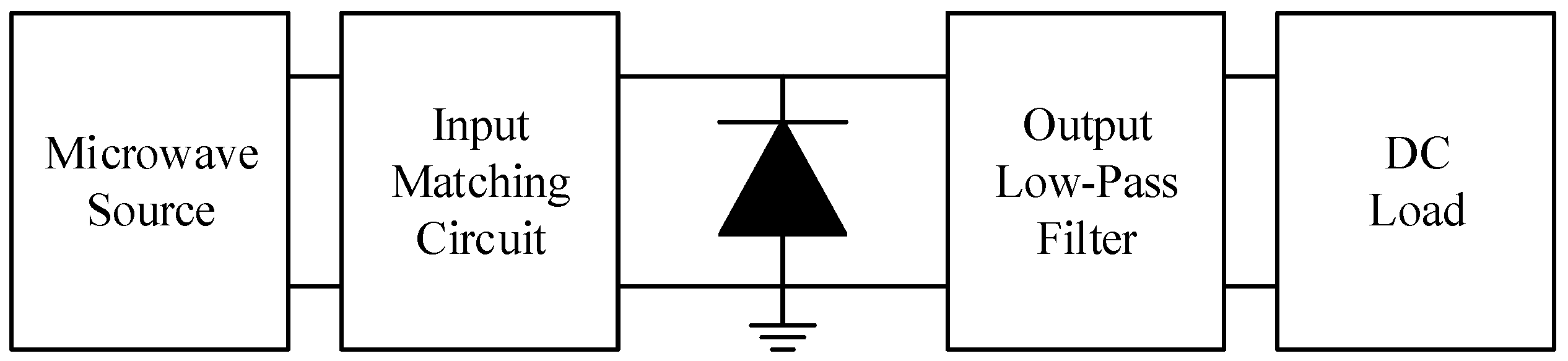
As illustrated in Figure 1, a typical RF rectifier architecture comprises four essential stages: an input matching network (IMN), a rectifying element (diode), an output low-pass filter (LPF), and a DC load. The IMN functions as a passive two-port network with band-pass characteristics. Its primary role is to ensure impedance matching between the RF source and the rectifier at the fundamental frequency, while simultaneously suppressing higher-order harmonics generated by the diode’s non-linear behavior. The Schottky diode, selected for its high cutoff frequency and low turn-on voltage, serves as the core component for converting the incident RF energy (fundamental and reflected harmonics) into DC power. The power conversion efficiency (PCE), denoted as η, is defined as:
η = V D C 2 R L P i n × 100 %
where VDC is the rectified voltage across the load RL, and Pin is the incident RF power at the rectifier input.

2.2. Diode Impedance Characteristics

The input impedance of the Schottky diode (Zdiode) is determined primarily by its junction capacitance (Cj) and junction resistance (Rj), which vary non-linearly with input power, frequency, and load conditions [25]. To quantify these characteristics for the selected Avago HSMS-282C diode (Broadcom Inc., Palo Alto, CA, USA), harmonic balance simulations were conducted using Keysight Advanced Design System 2025(ADS) under conditions mimicking actual IoT usage scenarios.
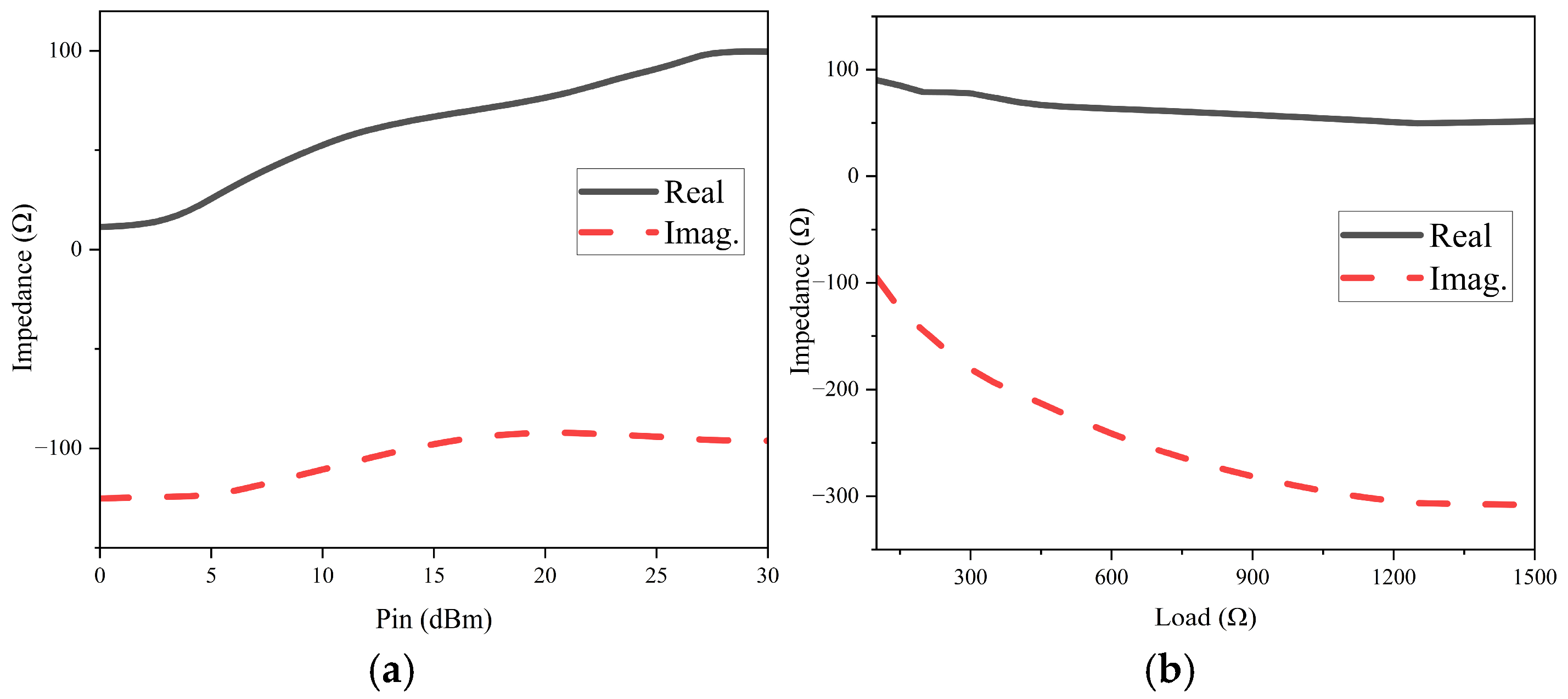
As illustrated in Figure 2a, the impedance varies significantly with input power, simulating the fluctuating signal strength typical of multipath fading environments. Similarly, Figure 2b depicts the impedance response to load variations, corresponding to the distinct duty cycles of a sensor node. The significant impedance shifts observed in both graphs highlight the critical need for a rectifier design that is robust against both environmental signal changes and device operating states.

2.3. Wide-Range Rectifier Design

The input impedance of a transmission line with arbitrary load impedance can be calculated using the transmission line equation [26]:
Z i n = Z 0 Z L + j Z 0 tan β l Z 0 + j Z L tan β l
where Z0 is the characteristic impedance of the transmission line, ZL is the load impedance, β is the phase constant, and l is the length of the transmission line.
Using a λ/8 short-circuited transmission line as a series band-stop structure is a proven method for efficient impedance matching [27]. The input impedance of this stub at DC, the fundamental frequency, and higher-order harmonics is given by:
Z i n = j Z 0 tan ( π 4 ω ω 0 ) = 0 , ω = 0 j Z 0 , ω = ω 0 , ω = 2 ω 0 j Z 0 , ω = 3 ω 0
where Z0 is the characteristic impedance of the short-circuited stub.
In the DC state, the equivalent impedance is zero, providing a necessary DC path. At the fundamental frequency, it presents an inductive impedance to compensate for the diode’s capacitive reactance, thereby achieving impedance matching. At the second harmonic, it presents an open circuit, blocking the harmonic and reflecting it back to the diode for power recycling.
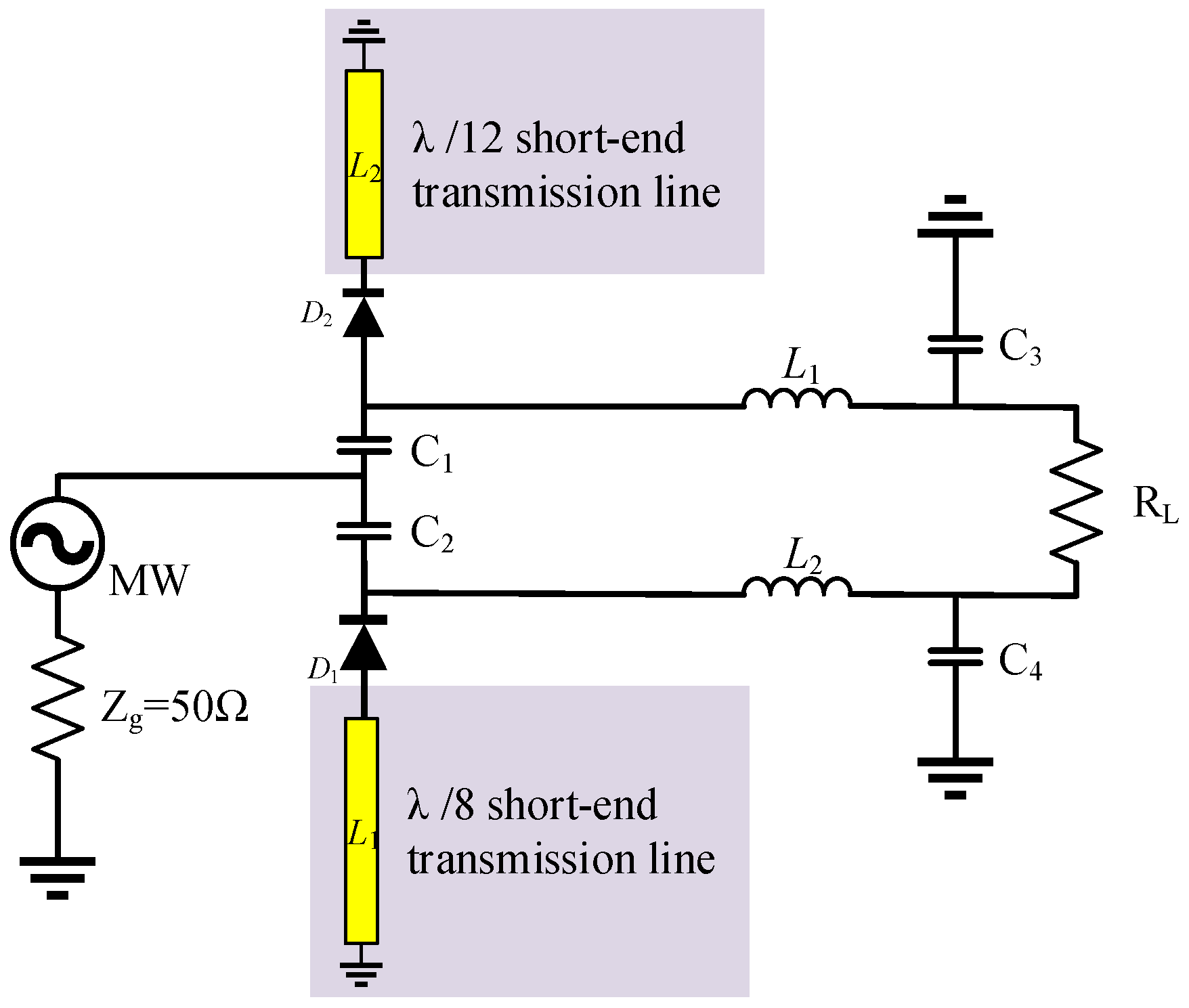
Based on these characteristics, this paper proposes a rectifier topology capable of operating over wide power and load ranges, as illustrated in Figure 3. The structure employs a dual-diode parallel configuration, where a λ/8 short-circuited stub and a λ/12 short-circuited stub are connected in series with their respective diodes to compensate for the capacitive reactance. C1 and C2 serve as DC-blocking capacitors, while L1/C3 and L2/C4 form two output low-pass filters. The core advantage of this rectifier lies in its simplicity: by adjusting only the characteristic impedance of the two short-circuited stubs, impedance matching can be achieved across wide input power and load ranges, significantly simplifying the tuning process and reducing the circuit size.
To verify the feasibility of this topology, further analysis was conducted for a design frequency of 2.45 GHz. The input impedance of the λ/12 short-circuited transmission line at DC, the fundamental frequency, and higher-order harmonics is:
Z i n = j Z 1 tan ( π 6 ω ω 0 ) = 0 , ω = 0 0.58 j Z 1 , ω = ω 0 1.73 j Z 1 , ω = 2 ω 0 , ω = 3 ω 0
where Z1 is the characteristic impedance of the short-circuited stub. Similarly to the λ/8 stub, the λ/12 stub provides a DC path at zero frequency and compensates for the diode’s capacitive impedance at the fundamental frequency. Crucially, it presents high impedance at the third harmonic, facilitating harmonic suppression and power recycling.
Based on the simulation of the HSMS-282C diode in Figure 2, when the input power is 25 dBm and the load resistance is 400 Ω, the fundamental input impedance is:
Z D = 90 j 95 ,   f 0 = 2.45   GHz
By setting the characteristic impedance of both stubs to Z0 = 125 Ω, the stubs provide differential inductive compensation:
j Z 0 = j 125   Ω 0.58 j Z 1 = j 73   Ω
Using these parameters, the total input impedance of the circuit with the dual-diode parallel configuration can be calculated as:
Z i n = 1 1 90 + j 30   Ω + 1 90 j 22   Ω = 48.7 + j 1.8   Ω
This allows the parallel combination of the two diode branches to achieve an input impedance very close to the standard source impedance of 50 Ω, eliminating the need for an external matching network.
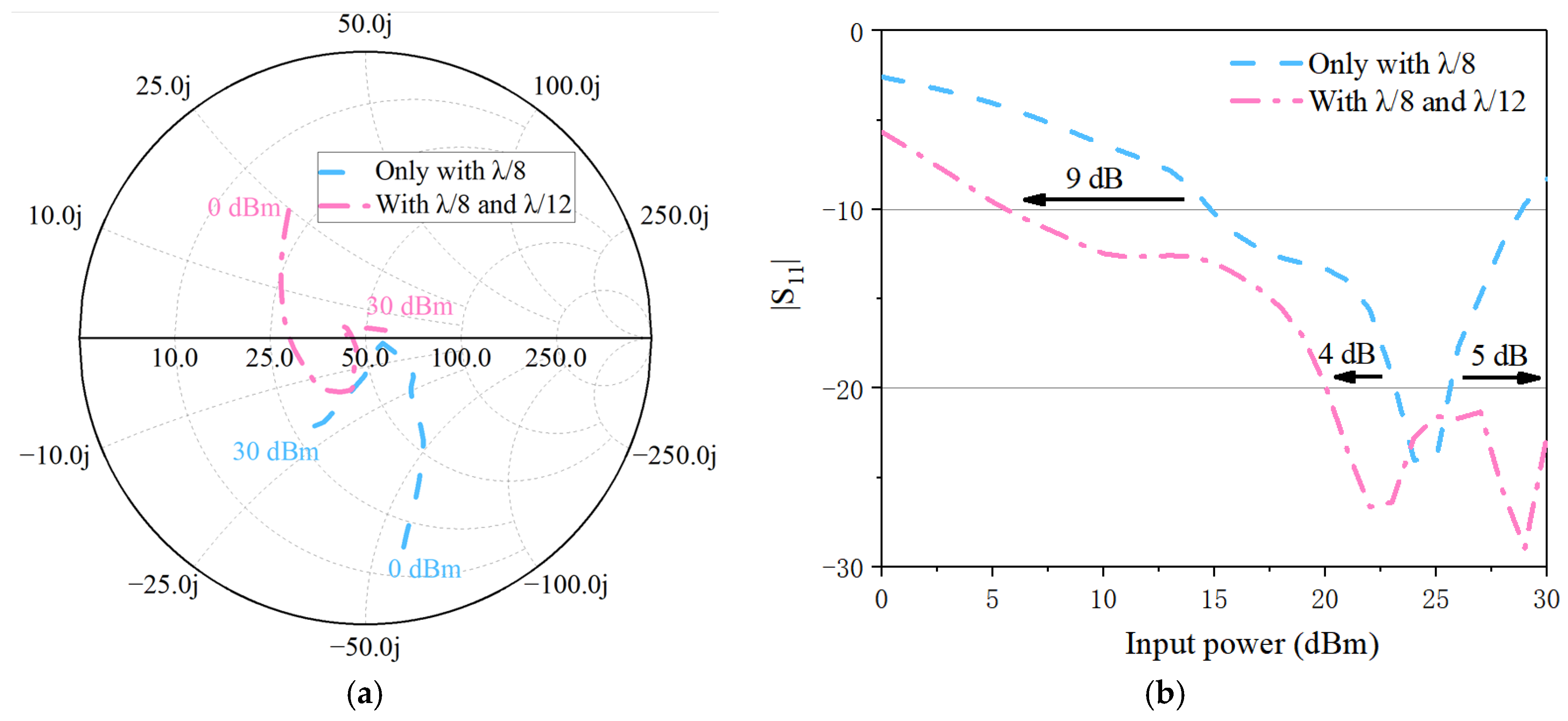
Figure 4 presents a comparison of the impedance matching performance between the proposed hybrid structure and a conventional double λ/8 structure over an input power range of 0 dBm to 30 dBm. As shown in Figure 4a, the impedance trajectory of the conventional design changes significantly and moves away from the center as power increases. In contrast, the proposed hybrid structure keeps the impedance concentrated near the 50 Ω matching point. This indicates that the hybrid topology effectively compensates for the diode’s non-linear capacitance variations. Furthermore, Figure 4b quantifies this improvement in terms of the reflection coefficient. The proposed design maintains a good matching condition (|S11| ≤ −10 dB) over a significantly broader power range compared to the conventional design. These results validate the superior matching capabilities of the proposed hybrid topology for realizing wide-power operations.

3. Measurement Results and Discussion

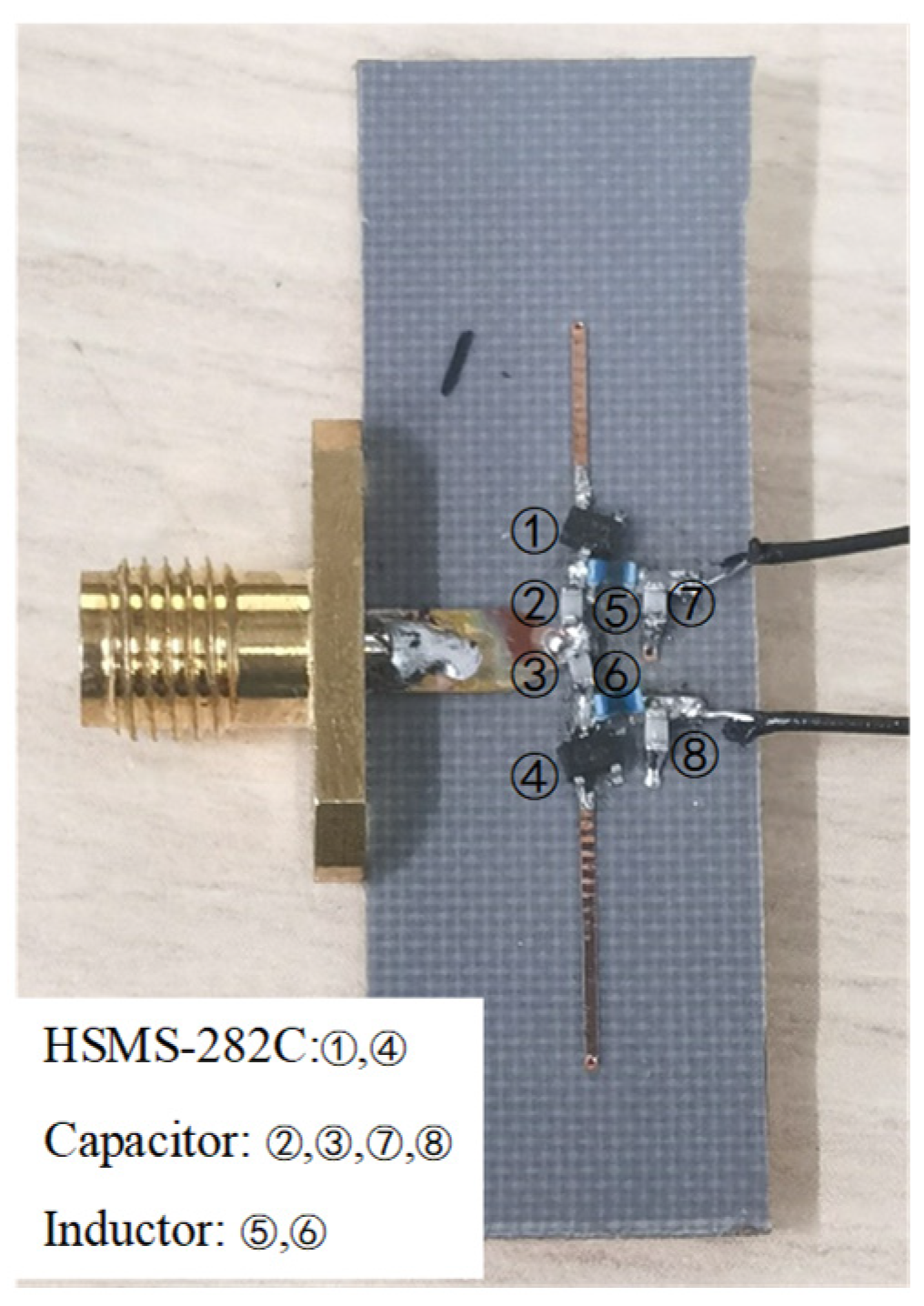
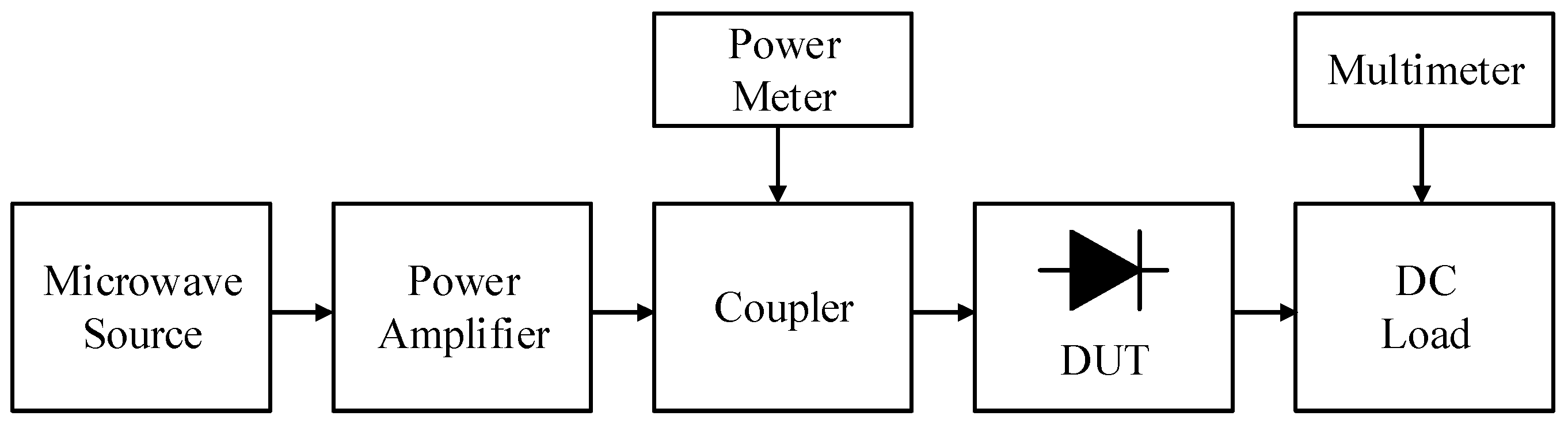
To validate the design strategy, a physical prototype of the 2.45 GHz rectifier is fabricated on an F4B high-frequency substrate with a dielectric constant of 2.65, a loss tangent of 0.002, and a thickness of 1 mm, as depicted in Figure 5. The commercial Schottky diode Avago HSMS-282C is selected for its low turn-on voltage and fast switching characteristics. The experimental setup is depicted in Figure 6. A microwave signal generator (Agilent E8267C, Keysight, Santa Rosa, CA, USA) serves as the RF source. The measurement reference plane is set at the SMA input of the rectifier to accurately evaluate the circuit’s intrinsic performance. This cabled setup eliminates uncertainties from antenna impedance variations in a multipath environment, allowing for precise validation of the proposed topology. The input signal is amplified and subsequently monitored via a 20 dB directional coupler connected to a power meter to ensure precision. Finally, the rectified DC output voltage across the load is recorded using a digital multimeter (UNI-TREND Technology Co., Ltd, Dongguan, China).
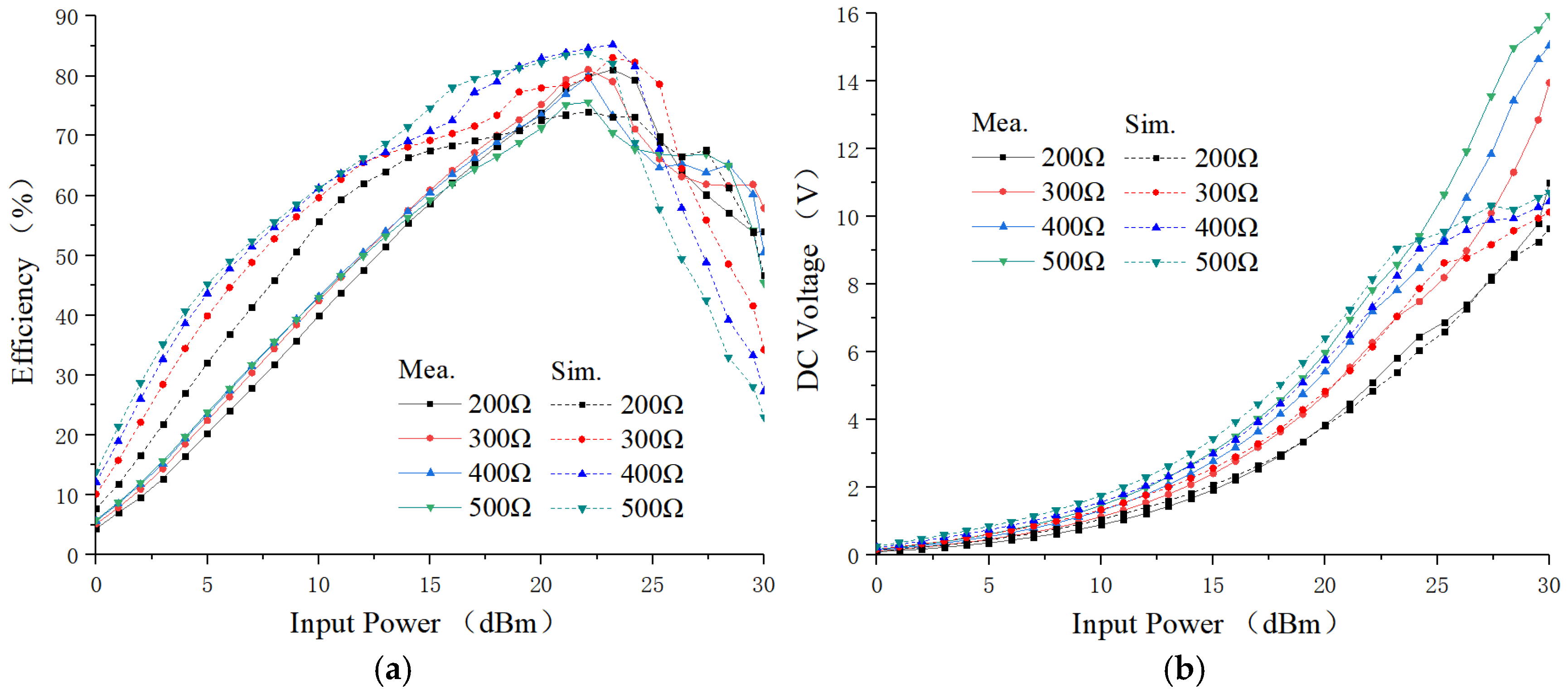
Figure 7a presents the measured rectification efficiency as a function of input power for various load resistances (200–500 Ω). The experimental results indicate that the circuit achieves a peak efficiency of 81.1% at an input power level of 23 dBm. Notably, the proposed rectifier exhibits a substantial high-efficiency operating window: the efficiency remains above 70% across an input power range of 16–26 dBm (a 10 dB dynamic range) and above 60% across a range of 13–30 dBm (a 17 dB dynamic range). This extended dynamic range is particularly advantageous for receiving wireless power in non-line-of-sight (NLoS) IoT environments, effectively mitigating the impact of RF signal fluctuations caused by multipath fading and shadowing.
Figure 7b plots the measured output DC voltage versus input power. The voltage increases monotonically with input power. At the optimal load condition, the circuit is capable of delivering a substantial DC voltage (up to 16 V). In practical battery-free systems, this DC output is typically cascaded with a power management integrated circuit (PMIC) or a DC-DC converter. This configuration provides a stable power supply for most low-power IoT sensors regardless of environmental fluctuations.
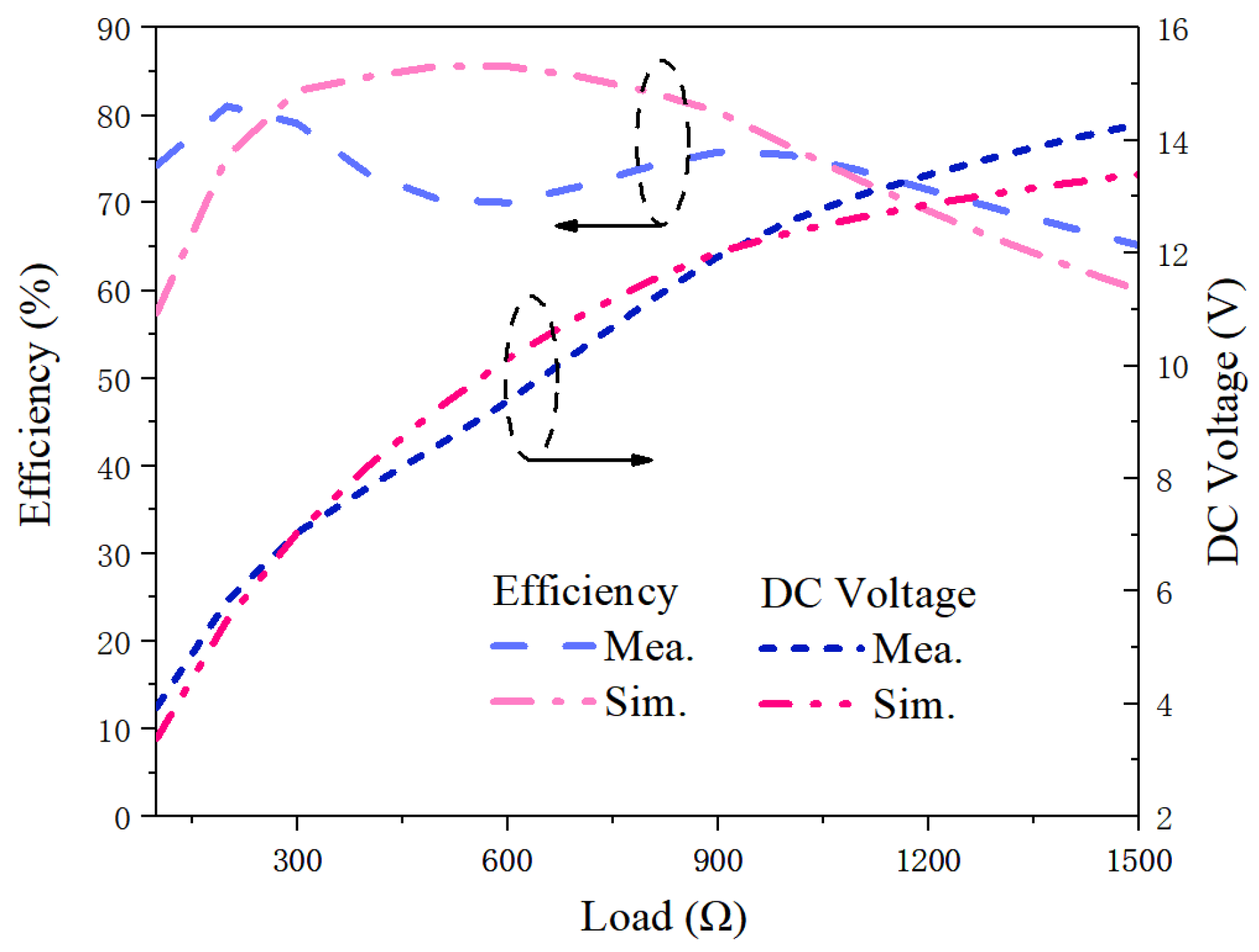
Further characterization is conducted to evaluate the rectifier’s robustness against load variations. With the input power maintained at the peak efficiency point of 23 dBm, the load resistance is swept from 100 Ω to 1500 Ω. This range is selected as it covers the typical operating impedances of IoT nodes, from high-power transmission (low resistance) to low-power sleep modes (high resistance). As illustrated in Figure 8, the efficiency remains consistently above 70% for load resistances ranging from 100 Ω to 1200 Ω, and maintains a level above 65% even when the load is extended to 1500 Ω. This insensitivity to load impedance ensures a stable DC power supply regardless of whether the connected sensor node is in a low-power sleep mode or a high-power transmission mode, effectively preventing system brownouts during state transitions.
Table 1 summarizes the performance comparison between the proposed rectifier and other state-of-the-art wide-range rectifiers. As shown, the proposed design achieves a peak efficiency of 81.1%, which is comparable to the highest values reported in [28,29]. However, this work demonstrates superior adaptability to varying operating conditions. The input power dynamic range for efficiency η ≥ 60% extends to 17 dB (13–30 dBm), which is among the widest in the comparison group. Most notably, the proposed rectifier exhibits an exceptionally wide load range. While designs like [30] rely on specific fixed load resistances (1100 Ω or 850 Ω) to achieve optimal performance, the proposed rectifier maintains an efficiency above 70% across a continuous load range of 1100 Ω (100–1200 Ω). Furthermore, compared to [28,29], which are limited to much narrower effective load ranges (140 Ω and 350 Ω, respectively), this work offers significantly broader coverage. These comparisons validate that the proposed hybrid topology successfully resolves the trade-off between high peak efficiency and wide operating ranges, making it highly suitable for complex IoT applications.

4. Conclusions

This paper presented a compact, high-efficiency rectifier designed to address the challenges of wireless power transfer in battery-free IoT applications. By employing a novel hybrid topology incorporating λ/8 and λ/12 short-circuited transmission lines, the circuit successfully integrated impedance matching with intrinsic second- and third-order harmonic suppression. This approach eliminated the need for bulky external matching networks, resulting in a miniaturized footprint.
The prototype achieved a peak efficiency of 81.1% and maintained high efficiency (>60%) across a wide input power dynamic range of 17 dB (13–30 dBm). The rectifier demonstrated exceptional insensitivity to load variations, maintaining efficiency above 70% across a load resistance range of 100 Ω to 1200 Ω.
In summary, the proposed design offered a balanced solution between high peak efficiency, wide dynamic range, and load adaptability. The proposed rectifier is built with standard F4B substrates and commercially available components. At mass production scale, the hardware cost per unit is estimated to be under $3. Compared to the high battery maintenance costs in large-scale networks, this design offers a more economical and practical solution. These advantages make it a reliable candidate for large-scale deployment in battery-free IoT systems. However, this study is limited to cabled measurements. Future work will focus on integrating wideband antennas for comprehensive testing in realistic multipath environments.

Author Contributions

Conceptualization, Z.H. and Y.Z.; methodology, Y.Z.; software, Y.Z.; validation, Y.Z. and Z.H.; investigation, Y.Z. and Z.H.; resources, C.L.; data curation, Z.H. and Y.Z.; writing—original draft preparation, Y.Z.; writing—review and editing, C.L. and Z.H.; visualization, Z.H.; supervision, C.L.; project administration, Z.H.; funding acquisition, C.L. All authors have read and agreed to the published version of the manuscript.

Funding

This work was supported in part by the National Natural Science Foundation of China under Grant U22A2015 and JCKY, and the Sichuan Science and Technology Program under Grant 2025ZNSFSC1441.

Data Availability Statement

The original contributions presented in this study are included in the article. Further inquiries can be directed to the corresponding author.

Conflicts of Interest

The authors declare no conflicts of interest.

References

  1. Condry, M.W.; Nelson, C.B. Using Smart Edge IoT Devices for Safer, Rapid Response with Industry IoT Control Operations. Proc. IEEE 2016, 104, 938–946. [Google Scholar] [CrossRef]
  2. Jamshed, M.A.; Ali, K.; Abbasi, Q.H.; Imran, M.A.; Ur-Rehman, M. Challenges, Applications, and Future of Wireless Sensors in Internet of Things: A Review. IEEE Sens. J. 2022, 22, 5482–5494. [Google Scholar] [CrossRef]
  3. Chu, Z.; Zhou, F.; Zhu, Z.; Hu, R.Q.; Xiao, P. Wireless Powered Sensor Networks for Internet of Things: Maximum Throughput and Optimal Power Allocation. IEEE Internet Things J. 2018, 5, 310–321. [Google Scholar] [CrossRef]
  4. Shinohara, N. History and Innovation of Wireless Power Transfer via Microwaves. IEEE J. Microw. 2021, 1, 218–228. [Google Scholar] [CrossRef]
  5. Detka, K.; Górecki, K. Wireless Power Transfer—A Review. Energies 2022, 15, 7236. [Google Scholar] [CrossRef]
  6. Arinze, S.N.; Obi, E.R.; Ebenuwa, S.H.; Nwajana, A.O. RF Energy-Harvesting Techniques: Applications, Recent Developments, Challenges, and Future Opportunities. Telecom 2025, 6, 45. [Google Scholar] [CrossRef]
  7. Sasikala, G.; Ranjan, R. Wireless Power Transfer for IoT Applications—A Review. In Self-Powered Cyber Physical Systems; Gatti, R.R., Singh, C., Agrawal, R., Serrao, F.J., Eds.; Wiley: Hoboken, NJ, USA, 2023. [Google Scholar] [CrossRef]
  8. Rahman, S.; Al Haque, M.; Solaiman, M.; Ratul, R.H.; Ahmed, I.; Tabassum, S.; Ciesielska-Wrobel, I. Wireless power transfer using electronic textiles: A comparative review. J. Eng. Res. 2024, 12, 806–824. [Google Scholar] [CrossRef]
  9. Hemour, S.; Wu, K. Radio-Frequency Rectifier for Electromagnetic Energy Harvesting: Development Path and Future Outlook. Proc. IEEE 2014, 102, 1667–1691. [Google Scholar] [CrossRef]
  10. Bougas, I.D.; Papadopoulou, M.S.; Boursianis, A.D.; Kokkinidis, K.; Goudos, S.K. State-of-the-Art Techniques in RF Energy Harvesting Circuits. Telecom 2021, 2, 369–389. [Google Scholar] [CrossRef]
  11. Lu, P.; Huang, K.; Yang, Y.; Zhang, B.; Cheng, F.; Song, C. Space Matching for Highly Efficient Microwave Wireless Power Transmission Systems: Theory, Prototype, and Experiments. IEEE Trans. Microw. Theory Tech. 2021, 69, 1985–1998. [Google Scholar] [CrossRef]
  12. Liu, G.-Y.; Chang, T.-Y.; Chiang, Y.-C.; Lin, P.-C.; Mar, J. Path Loss Measurements of Indoor LTE System for the Internet of Things. Appl. Sci. 2017, 7, 537. [Google Scholar] [CrossRef]
  13. Sehgal, A.; Agrawal, R.; Bhardwaj, R.; Singh, K.K. Reliability Analysis of Wireless Link for IOT Applications Under Shadow-Fading Conditions. Procedia Comput. Sci. 2020, 167, 1515–1523. [Google Scholar] [CrossRef]
  14. Sodhro, A.H.; Pirbhulal, S.; Sodhro, G.H.; Gurtov, A.; Muzammal, M.; Luo, Z. A Joint Transmission Power Control and Duty-Cycle Approach for Smart Healthcare System. IEEE Sens. J. 2019, 19, 8479–8486. [Google Scholar] [CrossRef]
  15. Martins, G.C.; Urso, A.; Mansano, A.; Liu, Y.; Serdijn, W.A. Energy-efficient low-power circuit techniques for wireless energy and data transfer in IoT sensor nodes. arXiv 2017, arXiv:1704.08910. [Google Scholar]
  16. Papadopoulou, M.S.; Boursianis, A.D.; Volos, C.K.; Stouboulos, I.N.; Nikolaidis, S.; Goudos, S.K. High-Efficiency Triple-Band RF-to-DC Rectifier Primary Design for RF Energy-Harvesting Systems. Telecom 2021, 2, 271–284. [Google Scholar] [CrossRef]
  17. Zhang, H.; Li, D.; Wang, Z.; Liu, Y.; Shinohara, N. A General Efficiency Enhancement Method for Compact Broadband Rectifiers. IEEE Trans. Circuits Syst. I Regul. Pap. 2025, 72, 8514–8522. [Google Scholar] [CrossRef]
  18. He, H.; Lin, H.; Wu, P.; Li, Q.; Liu, C. Compact High-Efficiency Broadband Rectifier Based on Coupled Transmission Line. IEEE Trans. Circuits Syst. II Express Briefs 2022, 69, 4404–4408. [Google Scholar] [CrossRef]
  19. Guo, L.; Yan, M.; Li, X.; Guan, K.; Chu, P.; Zhao, Y.; Wu, K. RF Power Harvester with Varactor-Enabled Wide-Power-Range Capability for Wireless Power Transfer Applications. IEEE Trans. Microw. Theory Tech. 2025, 73, 1848–1856. [Google Scholar] [CrossRef]
  20. He, Z.; Yan, L.; Liu, C. An Adaptive Power Division Strategy for Nonlinear Components in Rectification. IEEE Trans. Power Electron. 2024, 39, 15436–15440. [Google Scholar] [CrossRef]
  21. Huang, M.; Lin, Y.L.; Ou, J.-H.; Zhang, X.Y.; Lin, Q.W.; Che, W.; Xue, Q. Single- and Dual-Band RF Rectifiers with Extended Input Power Range Using Automatic Impedance Transforming. IEEE Trans. Microw. Theory Tech. 2019, 67, 1974–1984. [Google Scholar] [CrossRef]
  22. Wu, P.; Li, Y.; Chen, Y.-D.; Yu, P.-Y.; Cheng, Y.; Liu, C. Compact Rectifier with Wide Range of Output Load Based on Self-Bias Impedance Compensation. IEEE Trans. Power Electron. 2025, 40, 4706–4710. [Google Scholar] [CrossRef]
  23. Huang, Y.; Shinohara, N.; Mitani, T. A Constant Efficiency of Rectifying Circuit in an Extremely Wide Load Range. IEEE Trans. Microw. Theory Tech. 2014, 62, 986–993. [Google Scholar] [CrossRef]
  24. Long, H.X.; Liu, J. A Compact Rectifier with Wide Output Load Range Based on High-Voltage-Gain Impedance Matching Network. IEEE Microw. Wirel. Technol. Lett. 2025, 35, 1534–1537. [Google Scholar] [CrossRef]
  25. Hemour, S.; Zhao, Y.; Lorenz, C.H.P.; Houssameddine, D.; Gui, Y.; Hu, C.-M.; Wu, K. Towards Low-Power High-Efficiency RF and Microwave Energy Harvesting. IEEE Trans. Microw. Theory Tech. 2014, 62, 965–976. [Google Scholar] [CrossRef]
  26. Pozar, D.M. Microwave Engineering, 4th ed.; University of Massachusetts: Amherst, MA, USA; John Wiley & Sons, Inc.: Amherst, NY, USA, 2012. [Google Scholar]
  27. Liu, C.; Tan, F.; Zhang, H.; He, Q. A Novel Single-Diode Microwave Rectifier with a Series Band-Stop Structure. IEEE Trans. Microw. Theory Tech. 2017, 65, 600–606. [Google Scholar] [CrossRef]
  28. Zhao, F.; Li, Z.; Wen, G.; Li, J.; Inserra, D.; Huang, Y. A Compact High-Efficiency Watt-Level Microwave Rectifier with a Novel Harmonic Termination Network. IEEE Microw. Wirel. Compon. Lett. 2019, 29, 418–420. [Google Scholar] [CrossRef]
  29. Zhang, X.Y.; Du, Z.X.; Xue, Q. High-Efficiency Broadband Rectifier with Wide Ranges of Input Power and Output Load Based on Branch-Line Coupler. IEEE Trans. Circuits Syst. I Regul. Pap. 2017, 64, 731–739. [Google Scholar] [CrossRef]
  30. Liu, J.; Chen, J.F.; Yang, Z.J.; Xiong, J. A Broadband Rectifier with Wide Input Power Dynamic Range Based on Automatic Power Adaption. 2023 International Conference on Microwave and Millimeter Wave Technology (ICMMT), Qingdao, China, 14–17 May 2023; pp. 1–3. [Google Scholar] [CrossRef]
  31. Peng, C.; Ye, Z.; Wu, J.; Chen, C.; Wang, Z. Design of a Wide-Dynamic RF-DC Rectifier Circuit Based on an Unequal Wilkinson Power Divider. Electronics 2021, 10, 2815. [Google Scholar] [CrossRef]
  32. Xiao, Y.Y.; Ou, J.-H.; Du, Z.-X.; Zhang, X.Y.; Che, W.; Xue, Q. Compact Microwave Rectifier with Wide Input Power Dynamic Range Based on Integrated Impedance Compression Network. IEEE Access 2019, 7, 151878–151887. [Google Scholar] [CrossRef]
  33. Zhao, F.; Inserra, D.; Wen, G.; Li, J.; Huang, Y. A High-Efficiency Inverse Class-F Microwave Rectifier for Wireless Power Transmission. IEEE Microw. Wirel. Compon. Lett. 2019, 29, 725–728. [Google Scholar] [CrossRef]
Figure 1. Schematic of the RF rectifier.
Telecom 07 00067 g001
Figure 2. Simulated input impedance of the Schottky diode (a) under different input powers (RL = 100 Ω), and (b) under different load resistances (Pin = 25 dBm).
Telecom 07 00067 g002
Figure 3. Schematic diagram of the proposed wide-range rectifier.
Telecom 07 00067 g003
Figure 4. Comparison of simulation results between the conventional double λ/8 structure and the proposed λ/8, λ/12 hybrid structure. (a) Input impedance on Smith Chart; (b) Reflection coefficient |S11|.
Telecom 07 00067 g004
Figure 5. Photograph of the proposed wide-range rectifier.
Telecom 07 00067 g005
Figure 6. Diagram of rectifier test system.
Telecom 07 00067 g006
Figure 7. Measured performance of the rectifier versus input power. (a) Efficiency; (b) Output voltage.
Telecom 07 00067 g007
Figure 8. Measured Efficiency of the rectifier versus load resistance.
Telecom 07 00067 g008
Table 1. Performance comparison with other wide-range RF rectifiers.
Ref.Freq.
(GHz)
Peak η
(%)
Pin Range for
η ≥ 70% (dBm)
Pin Range for
η ≥ 60% (dBm)
RL Range for
η ≥ 70% (Ω)
SubstrateDiode
[19]2.170.1N/A4.2–18 (13.8)--HSMS-2860
HSMS-286F
[28]2.4581.326–34 (8)24.5–34 (9.5)80–220 (140)RO4003CHSMS-270B
[29]2.4580.810–18.6 (8.6)6.5–19 (12.5)100–450 (350)AD255HSMS-286F
[30]2.4572.417–20 (3)9–26 (17)-AD255HSMS-2822
HSMS-2862
[31]2.4575.516–20 (4)12–25 (13)260–430 (170)F4BHSMS-2820
HSMS-2860
[32]2.4573.610–16 (6)4.2–17 (12.8)360AD255HSMS-286F
[33]2.3580.46–15 (9)3–16 (13)150–800 (650)F4BHSMS-2860
This work2.4581.116–26 (10)13–30 (17)100–1200 (1100)F4BHSMS-282C
Disclaimer/Publisher’s Note: The statements, opinions and data contained in all publications are solely those of the individual author(s) and contributor(s) and not of MDPI and/or the editor(s). MDPI and/or the editor(s) disclaim responsibility for any injury to people or property resulting from any ideas, methods, instructions or products referred to in the content.