5. Discussion
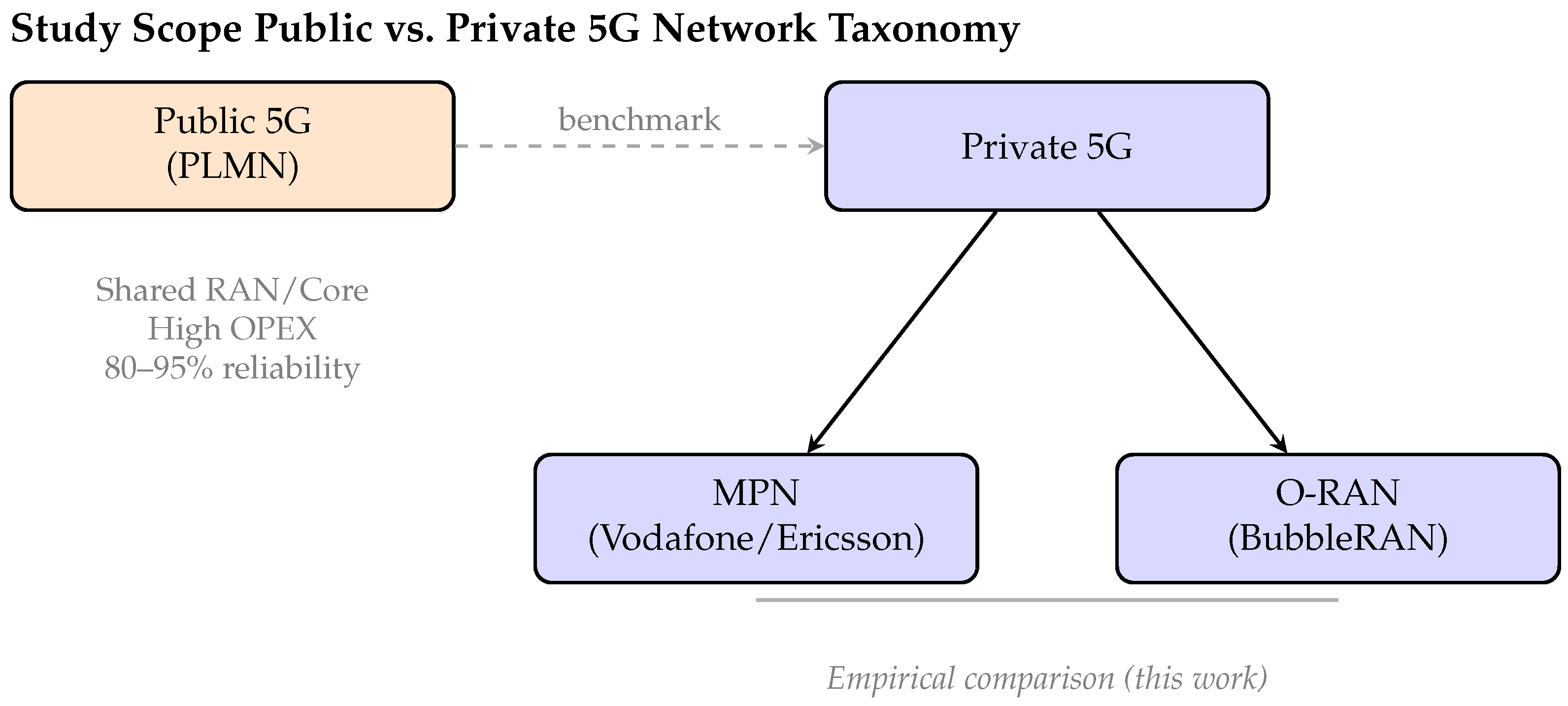
The results indicate that private 5G architectures offer meaningful energy and cost advantages over public deployments under the conditions tested. Before discussing the MPN-versus-O-RAN comparison, it is essential to reiterate the experimental constraints identified in
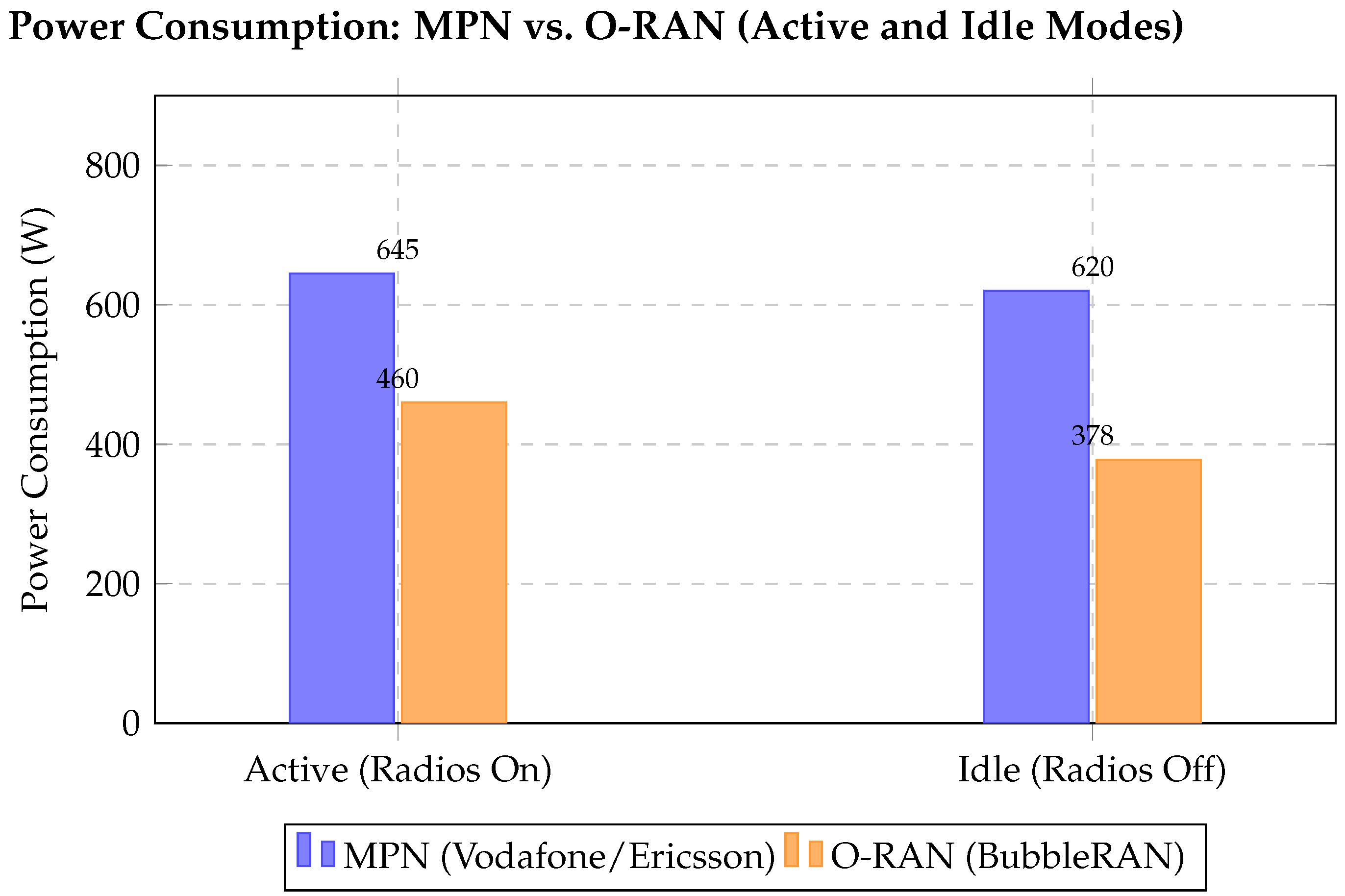
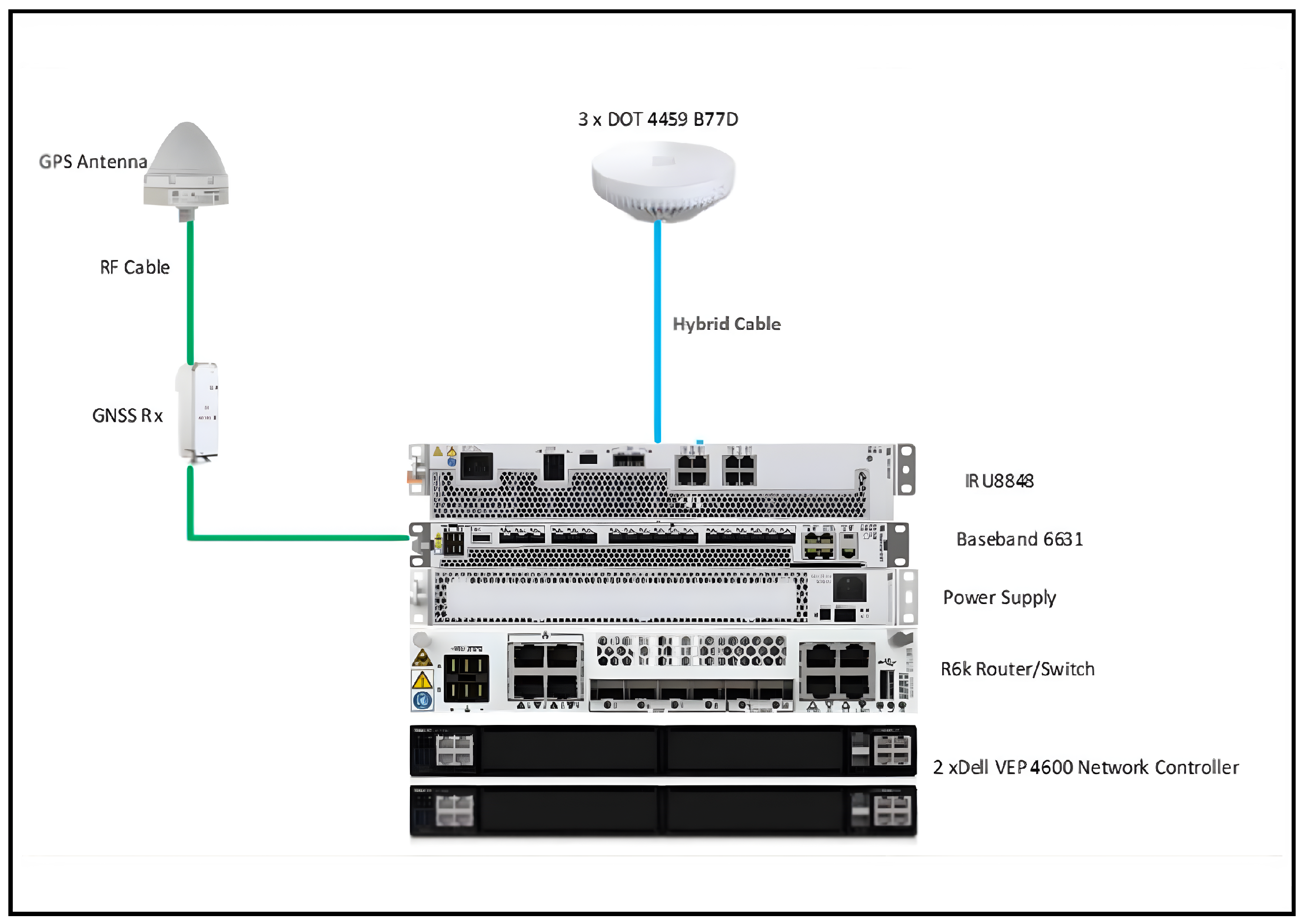
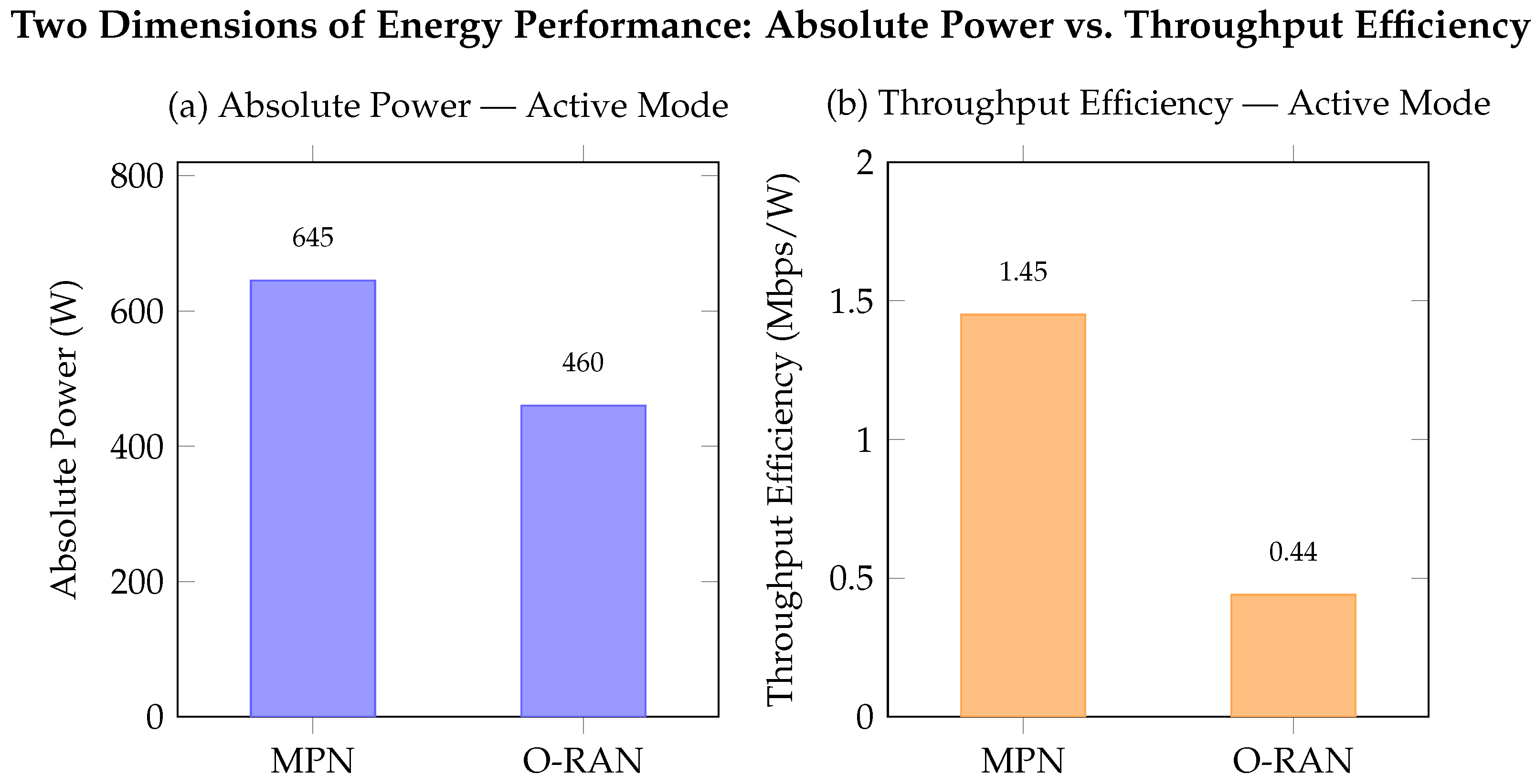
Section 3.3. The two architectures were evaluated under substantially different configurations (936 Mbps vs. 202 Mbps throughput; n77 vs. n78 band; 2 × 2 vs. 4 × 4 MIMO; −36 vs. −58 dBm signal strength), meaning the throughput efficiency difference (1.45 vs. 0.44 Mbps/W) reflects hardware and RF configuration variables as much as architectural ones. The absolute power advantage of the O-RAN (28.7% lower active draw) is more straightforwardly attributable to its lighter, software-defined stack. Both findings are preliminary and should not be interpreted as definitive architectural rankings; they are best understood as initial empirical indicators for the specific enterprise configurations tested. Furthermore, it should be noted that the AI/ML-driven power-saving capabilities of the O-RAN xApp-based sleep management [
7] and dApp-level real-time control [
8] were not active during trials, meaning the O-RAN measurements represent a conservative energy baseline rather than its full sustainability potential.
With this caveat established, the broader economic comparison against public deployments is on firmer ground, as the private-versus-public differential is large enough to be robust to configuration variability. Extending the cost-effectiveness analysis from
Section 4.2 to public base stations (
Table 2), we benchmark annual costs using the UK business electricity rate of 26.3 p/kWh [
32] and a non-leap year (8760 h).
Public micro-cells, suitable for urban densification similar to private enterprise setups, incur £2666 annually under full load (1157 W) and £1991 idle (864 W). Macro-cells, for broad coverage, escalate dramatically to £24,882 active (10.8 kW) and £13,829 idle (6 kW). In contrast, private systems yield markedly lower OPEXs: theMPN at £1486 active (645 W) and £1428 idle (620 W); the O-RAN at £1060 active (460 W) and £871 idle (378 W). This translates to 44% and 60% reductions for active loads relative to micro-cells (MPN and O-RAN, respectively), and 28% and 56% for idle modes.
These savings stem from private networks’ tailored designs, which minimise site proliferation and enable dynamic scaling absent in public infrastructures burdened by ubiquitous coverage mandates [
3]. While public networks benefit from economies of scale in shared maintenance (
Table 1), long-term viability is undermined by their higher per-site power, which is caused by over-provisioning for variable loads, particularly in light of growing electricity costs and net-zero pressures. As shown in
Table 8, private architectures consistently outperform public ones economically, with the O-RAN offering the lowest OPEX for scalable IoT deployments.
Performance-normalised economics further favour the private MPN in this lab setting, with a cost-effectiveness of 0.63 Mbps/GBP (936 Mbps at £1486/year), surpassing measured public Glasgow averages (669 Mbps at £2666/year yields ≈ 0.25 Mbps/GBP for micro-cells [
31]). The O-RAN’s 0.19 Mbps/GBP reflects lab-specific throughput (202 Mbps), but its lower absolute power draw and virtualisation potential make it particularly suited to IoT and low-load scenarios, with the 60% OPEX reduction relative to public micro-cells (active load) derived directly from
Table 8. For enterprises, private architectures thus provide superior ROI in this configuration, reducing total ownership costs by 15–33% through attenuated infrastructure and AI-optimised dormancy [
17], while public deployments suit mass-market scalability at elevated grid strain. Hybrid models could optimise this trade-off, aligning economic efficiency with UK decarbonisation goals.
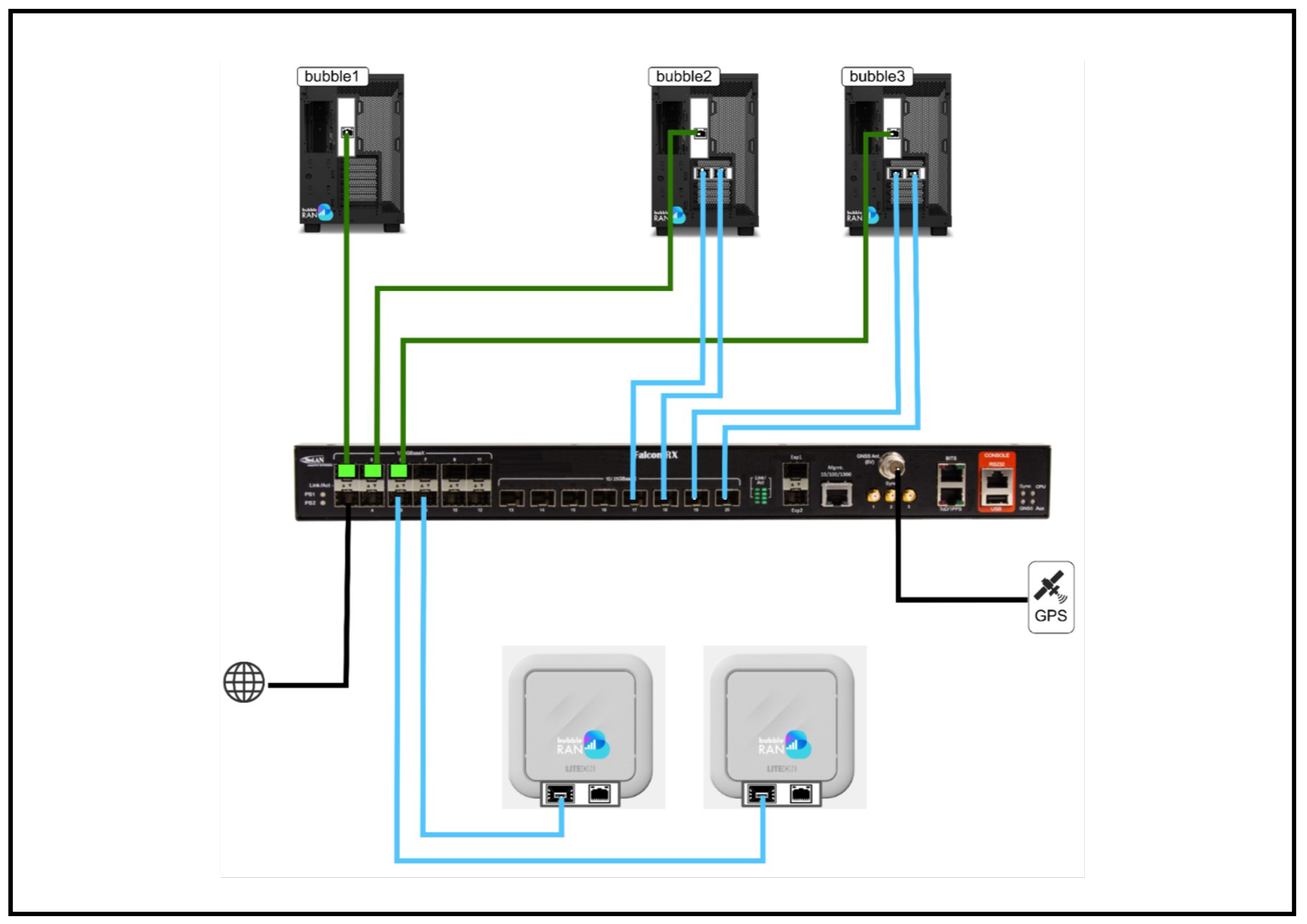
Scope of the Cost Analysis. The analysis above considers only annual electricity expenditure (OPEX) and does not constitute a full Total Cost of Ownership (TCO) assessment. Real-world private 5G deployments also incur capital expenditure (CAPEX) for hardware procurement and site preparation; Ofcom Shared Access Licence fees for the MPN; software licensing; ongoing maintenance; and particularly for O-RAN, compute infrastructure costs associated with virtualised network functions, which scale with deployment size and the number of active slices. The O-RAN architecture’s reliance on cloud-native compute nodes (three MX-PDK nodes in the DCIC testbed) introduces infrastructure costs not reflected in the electricity bill alone. The electricity-cost advantage of O-RAN (£1060 vs. £1486 annually) may therefore be partially or fully offset by higher compute OPEX at scale. A rigorous TCO comparison encompassing CAPEX, maintenance, software licensing, and compute costs is beyond the scope of this controlled laboratory study but is an essential precondition before deployment-level investment decisions can be grounded in this evidence.
Directly Measured versus Literature-Derived Findings. For transparency, the quantities directly measured in this study are: system power consumption (W), download and upload throughput (Mbps), latency (ms), and signal strength (dBm). All other quantitative claims, including CO
2 projections from Cheng et al. [
3], the 15–33% site reduction estimates [
17], the 44–60% OPEX savings relative to public micro-cells (derived by applying the measured private power figures to the literature-reported public baseline), and all sector-level energy saving figures cited in the literature review, are drawn from external sources and were not independently verified in this study. Readers should assign higher confidence to directly measured findings than to literature-derived estimates.
Author Contributions
Conceptualisation, A.H. and H.S.; Methodology, A.H. and H.S.; Validation, A.H. and H.S.; Formal analysis, A.H.; Investigation, A.H. and H.S.; Data curation, A.H.; Writing—original draft, A.H., H.S. and P.M.; Writing—review and editing, A.H., H.S., P.M., P.S.-G. and M.Z.S.; Supervision, P.S.-G. and M.Z.S.; Project administration, P.S.-G. and M.Z.S.; Funding acquisition, M.Z.S. All authors have read and agreed to the published version of the manuscript.
Funding
This research and its open-access publication were supported by the University of the West of Scotland. Private 5G testbed data were funded through The Department for Science, Innovation and Technology’s (DSIT) Ayrshire 5GIR project through the Digital Connectivity and Innovation Centre (DCIC) set up by UWS (no grant number).
Data Availability Statement
The original contributions presented in this study are included in the article. Further inquiries can be directed to the corresponding author.
Conflicts of Interest
The authors declare no conflicts of interest.
Abbreviations
The following abbreviations are used in this manuscript:
| 5G | Fifth Generation |
| AI | Artificial Intelligence |
| CAPEX | Capital Expenditure |
| DCIC | Digital Connectivity and Innovation Centre |
| dApp | Distributed Application (O-RAN) |
| eMBB | Enhanced Mobile Broadband |
| ERP | Effective Radiated Power |
| FL | Federated Learning |
| IoT | Internet of Things |
| IRU | Indoor Radio Unit |
| MEC | Multi-Access Edge Computing |
| MIMO | Multiple Input Multiple Output |
| ML | Machine Learning |
| mMTC | Massive Machine Type Communications |
| MPN | Mobile Private Network |
| NPN | Non-Public Network |
| O-RAN | Open Radio Access Network |
| OPEX | Operational Expenditure |
| O-RU | Open Radio Unit |
| PLMN | Public Land Mobile Network |
| QoS | Quality of Service |
| RAN | Radio Access Network |
| RC | Radio Card |
| RIC | RAN Intelligent Controller |
| ROI | Return on Investment |
| RU | Radio Unit |
| SA | Standalone |
| SDG | Sustainable Development Goal |
| TBL | Triple Bottom Line |
| TCO | Total Cost of Ownership |
| UE | User Equipment |
| UN | United Nations |
| URLLC | Ultra-Reliable Low-Latency Communication |
| xApp | Near-Real-Time RIC Application |
| Throughput efficiency (Mbps/W) |
| Energy per bit (nJ/bit) |
| Idle-to-active power ratio |
| Cost-effectiveness (Mbps/GBP) |
References
- Masoudi, M.; Khafagy, M.G.; Conte, A.; El-Amine, A.; Françoise, B.; Nadjahi, C.; Salem, F.E.; Labidi, W.; Süral, A.; Gati, A.; et al. Green Mobile Networks for 5G and Beyond. IEEE Access 2019, 7, 107270–107299. [Google Scholar] [CrossRef] [Scilit]
- Shehab, M.J.; Kassem, I.; Kutty, A.A.; Kucukvar, M.; Onat, N.C.; Khattab, T. 5G Networks Towards Smart and Sustainable Cities: A Review of Recent Developments, Applications and Future Perspectives. IEEE Access 2022, 10, 2987–3006. [Google Scholar] [CrossRef] [Scilit]
- Cheng, X.; Hu, Y.; Varga, L. 5G network deployment and the associated energy consumption in the UK: A complex systems’ exploration. Technol. Forecast. Soc. Change 2022, 180, 121672. [Google Scholar] [CrossRef] [Scilit]
- Department for Science, Innovation and Technology; Ayrshire Innovation Region. Local Innovation Partnerships Fund: Supporting Evidence, Section 4–Strategic Vision and Priority Cluster; Application Supporting Evidence APP102147; Includes Location Quotient Analysis of Aerospace and Advanced Manufacturing Employment in Ayrshire Relative to Scottish National Averages, Sourced from Business Register and Employment Survey (BRES), Department for Business and Trade (DBT). Cluster Mapping Data Sourced from DSIT Cluster Maps. Available from Ayrshire Innovation Region/LIPF Application Documentation; Department for Science, Innovation and Technology (DSIT): Ayrshire, UK, 2025. [Google Scholar]
- Sturley, H.; Salva-Garcia, P.; Salau, N.; Zhu, Y.; Vichare, P.; Shakir, M.Z. 5G MPN Design and Deployment: Challenges and opportunities for Industrial Use Cases. In Proceedings of the 2025 International Conference on Software, Knowledge, Information Management & Applications (SKIMA), Paisley, UK, 9–11 June 2025; pp. 1–6. [Google Scholar] [CrossRef] [Scilit]
- Wen, M.; Li, Q.; Kim, K.J.; López-Pérez, D.; Dobre, O.A.; Poor, H.V.; Popovski, P.; Tsiftsis, T.A. Private 5G Networks: Concepts, Architectures, and Research Landscape. IEEE J. Sel. Top. Signal Process. 2022, 16, 7–25. [Google Scholar] [CrossRef] [Scilit]
- Liang, X.; Al-Tahmeesschi, A.; Wang, Q.; Chetty, S.; Sun, C.; Ahmadi, H. Enhancing Energy Efficiency in O-RAN Through Intelligent xApps Deployment. In Proceedings of the 2024 11th International Conference on Wireless Networks and Mobile Communications (WINCOM), Leeds, UK, 23–25 July 2024; IEEE: Piscataway, NJ, USA, 2024; pp. 1–6. [Google Scholar] [CrossRef] [Scilit]
- D’Oro, S.; Polese, M.; Bonati, L.; Cheng, H.; Melodia, T. dApps: Distributed Applications for Real-Time Inference and Control in O-RAN. IEEE Commun. Mag. 2022, 60, 52–58. [Google Scholar] [CrossRef] [Scilit]
- Li, X.; Rao, A.; Sundaresan, K.; Henttonen, T.; Tirronen, T. Toward Energy Efficient RAN: From Industry Standards to Trending Practice. IEEE Wirel. Commun. 2025, 32, 36–43. [Google Scholar] [CrossRef] [Scilit]
- Nickerson, C.; Allford, J.; Osman, S.; Stewart, J.; Florez, F.; Weekes, M.; Marlow, D. Report for Department for Digital, Culture, Media and Sport (DCMS) Ensuring Future Wireless Connectivity Needs Are Met; Analysys Mason: London, UK, 2022. [Google Scholar]
- Ericsson. Meeting 5G Promises Using Tailored Connectivity; Ericsson: Stockholm, Sweden, 2024. [Google Scholar]
- OECD. Digital Economy Outlook 2024 (Volume 2); OECD: Paris, France, 2024. [Google Scholar]
- OECD. Digital Economy Papers the Environmental Sustainability of Communication Networks; OECD: Paris, France, 2025. [Google Scholar]
- Williams, L.; Sovacool, B.K.; Foxon, T.J. The energy use implications of 5G: Reviewing whole network operational energy, embodied energy, and indirect effects. Renew. Sustain. Energy Rev. 2022, 157, 112033. [Google Scholar] [CrossRef] [Scilit]
- What Is 5G Energy Consumption? VIAVI Solutions Inc.: Chandler, AZ, USA, 2025.
- 5G Will Prompt Energy Consumption to Grow by Staggering 160% in 10 Years; Datacenter Forum: Mariestad, Sweden, 2021.
- How Private 5G Networks Are Creating a Leaner, Greener Industries; techUK: London, UK, 2025.
- Ericsson. Vodafone UK and Ericsson Trial AI Solutions for Improved 5G Energy Efficiency; Ericsson: Stockholm, Sweden, 2025. [Google Scholar]
- BT Group. Carbon Reduction Plan: Our Targets; BT Group: London, UK, 2021; Available online: https://www.bt.com/bt-plc/assets/documents/digital-impact-and-sustainability/our-approach/our-policies-and-reports/bt-carbon-reduction-plan.pdf (accessed on 24 October 2025).
- Zhu, Y.; Vichare, P.; Shakir, M.Z.; Sturley, H.; Salva-Garcia, P.; Salau, N. 5G Network for Aerospace Sector: An Economic Review. In Proceedings of the 2025 International Conference on Software, Knowledge, Information Management & Applications (SKIMA), Paisley, UK, 9–11 June 2025; pp. 1–7. [Google Scholar] [CrossRef] [Scilit]
- Eswaran, S.; Honnavalli, P. Private 5G networks: A survey on enabling technologies, deployment models, use cases and research directions. Telecommun. Syst. 2022, 82, 3–26. [Google Scholar] [CrossRef] [Scilit] [PubMed]
- Bockelmann, C.; Pratas, N.K.; Wunder, G.; Saur, S.; Navarro, M.; Gregoratti, D.; Vivier, G.; De Carvalho, E.; Ji, Y.; Stefanovic, C.; et al. Towards Massive Connectivity Support for Scalable mMTC Communications in 5G Networks. IEEE Access 2018, 6, 28969–28992. [Google Scholar] [CrossRef] [Scilit]
- Energy Efficiency and Sustainability in Mobile Communications Networks; 5G Americas: Bellevue, WA, USA, 2023.
- Giannopoulos, A.; Levis, G.A.; Kosmatos, E.; Xilouris, G.; Tranoris, C.; Denazis, S. FedRA: A Fully Decentralized Federated Learning Framework for Robust Intelligence Sharing across O-RAN dApps. IEEE Commun. Mag. 2026. Early Access. [Google Scholar] [CrossRef] [Scilit]
- The Sustainable Organization; Springer International Publishing: Berlin/Heidelberg, Germany, 2025. [CrossRef] [Scilit]
- Bachmann, N.; Tripathi, S.; Brunner, M.; Jodlbauer, H. The Contribution of Data-Driven Technologies in Achieving the Sustainable Development Goals. Sustainability 2022, 14, 2497. [Google Scholar] [CrossRef] [Scilit]
- Kaplan, A.D.; Cruit, J.; Endsley, M.; Beers, S.M.; Sawyer, B.D.; Hancock, P.A. The Effects of Virtual Reality, Augmented Reality, and Mixed Reality as Training Enhancement Methods: A Meta-Analysis. Hum. Factors J. Hum. Factors Ergon. Soc. 2020, 63, 706–726. [Google Scholar] [CrossRef] [Scilit] [PubMed]
- Morales Méndez, G.; del Cerro Velázquez, F. Augmented Reality in Industry 4.0 Assistance and Training Areas: A Systematic Literature Review and Bibliometric Analysis. Electronics 2024, 13, 1147. [Google Scholar] [CrossRef] [Scilit]
- Alhulayil, M.; Aqoulah, M.A.; López-Benítez, M.; Al-Mistarihi, M.F.; Alammar, M.; Al Ayidh, A. Integrated THz/mmWave Transmission Method for Enhanced URLLC Communications. IEEE Access 2025, 13, 62914–62929. [Google Scholar] [CrossRef] [Scilit]
- Filho, W.L.; Kautish, S.; Wall, T.; Rewhorn, S.; Paul, S.K. (Eds.) Digital Technologies to Implement the UN Sustainable Development Goals; Springer: Berlin/Heidelberg, Germany, 2024. [Google Scholar] [CrossRef] [Scilit]
- Hart, A.E. Glasgow 5G Dataset 2025; University of the West of Scotland: Paisley, UK, 2026. [Google Scholar] [CrossRef]
- Bolton, P. Gas and Electricity Prices During the ‘Energy Crisis’ and Beyond; The House of Commons Library: London, UK, 2025. [Google Scholar]
| Disclaimer/Publisher’s Note: The statements, opinions and data contained in all publications are solely those of the individual author(s) and contributor(s) and not of MDPI and/or the editor(s). MDPI and/or the editor(s) disclaim responsibility for any injury to people or property resulting from any ideas, methods, instructions or products referred to in the content. |