Abstract
The UK telecommunications sector’s 5G rollout is projected to consume 2.1% of national electricity by 2030, raising urgent sustainability concerns. This study empirically investigates, under controlled laboratory conditions, the energy performance and cost characteristics of two private 5G architectures—Vodafone’s Mobile Private Network (MPN) and an Open Radio Access Network (O-RAN) via BubbleRAN—and contextualises them against public network references and the United Nations Sustainable Development Goals (SDGs). Two complementary dimensions of energy performance are assessed: absolute power consumption (Watts), reflecting total system draw regardless of throughput; and throughput efficiency (Mbps/W), capturing useful data delivered per unit of energy. In terms of absolute power, O-RAN consumes less (460 W active, 378 W idle) than MPN (645 W active, 620 W idle). In terms of throughput efficiency, MPN delivers 1.45 Mbps/W versus O-RAN’s 0.44 Mbps/W under these specific controlled, single-cell conditions, a difference that reflects the tested hardware configurations (n77 vs. n78 band; 936 Mbps vs. 202 Mbps throughput; 2 × 2 vs. 4 × 4 MIMO) as much as any intrinsic architectural distinction. Both architectures offer substantially lower annual energy costs (£1060–£1486) compared to public micro-cells (£1991–£2666), representing 44–60% savings. Session continuity was 100% across all controlled trials; this reflects short-term laboratory conditions and should not be extrapolated to a long-term network availability guarantee without extended field validation. These results are configuration-specific preliminary indicators; the relative efficiency advantage of each architecture is expected to vary with load, band, and deployment scale. By 2030, UK 5G network operations are projected to generate 795,347–1,260,532 tonnes of CO2 annually across low-to-high demand scenarios; private deployment, by reducing site proliferation 15–33%, could displace a meaningful share of this footprint. These findings support SDGs 4, 8, 9, 12, and 13. Hybrid O-RAN–MPN pilots are recommended to maximise sustainability gains while advancing social equity and net-zero targets.
Keywords:
5G; sustainability; mobile private networks; Open RAN; energy efficiency; UN SDGs; UK Net-Zero 1. Introduction
The emergence of fifth-generation (5G) mobile networks brings profound transformations in connectivity standards, facilitating advancements in remote education, telecommuting, industrial automation, and intelligent urban infrastructures. Private 5G architectures, such as Mobile Private Networks (MPNs) and Open Radio Access Networks (O-RANs), have been proposed as a more energy-efficient evolution of this technology, offering tailored configurations that, according to the literature and the controlled measurements presented here, demonstrate meaningful energy and cost advantages over public network deployments in enterprise contexts [1,2]. Within the United Kingdom, 5G deployments are projected to account for up to 2.1% of national electricity consumption by 2030 under moderate utilisation scenarios [3]; however, the adoption of private industrial networks is positioned to be a net positive force in reducing this burden, replacing over-provisioned public infrastructure with purpose-built, low-overhead deployments scaled to actual demand. This directly supports the UK telecommunications sector’s commitment to net-zero emissions by 2050. The industrial significance of this transition is underscored by the scale of advanced manufacturing and aerospace activity in regions such as Ayrshire, the UK’s largest aerospace manufacturing cluster, where Location Quotient analysis indicates that aerospace employment is 10 to 14 times the Scottish national average [4], representing a critical testbed for private 5G’s green industrial potential.
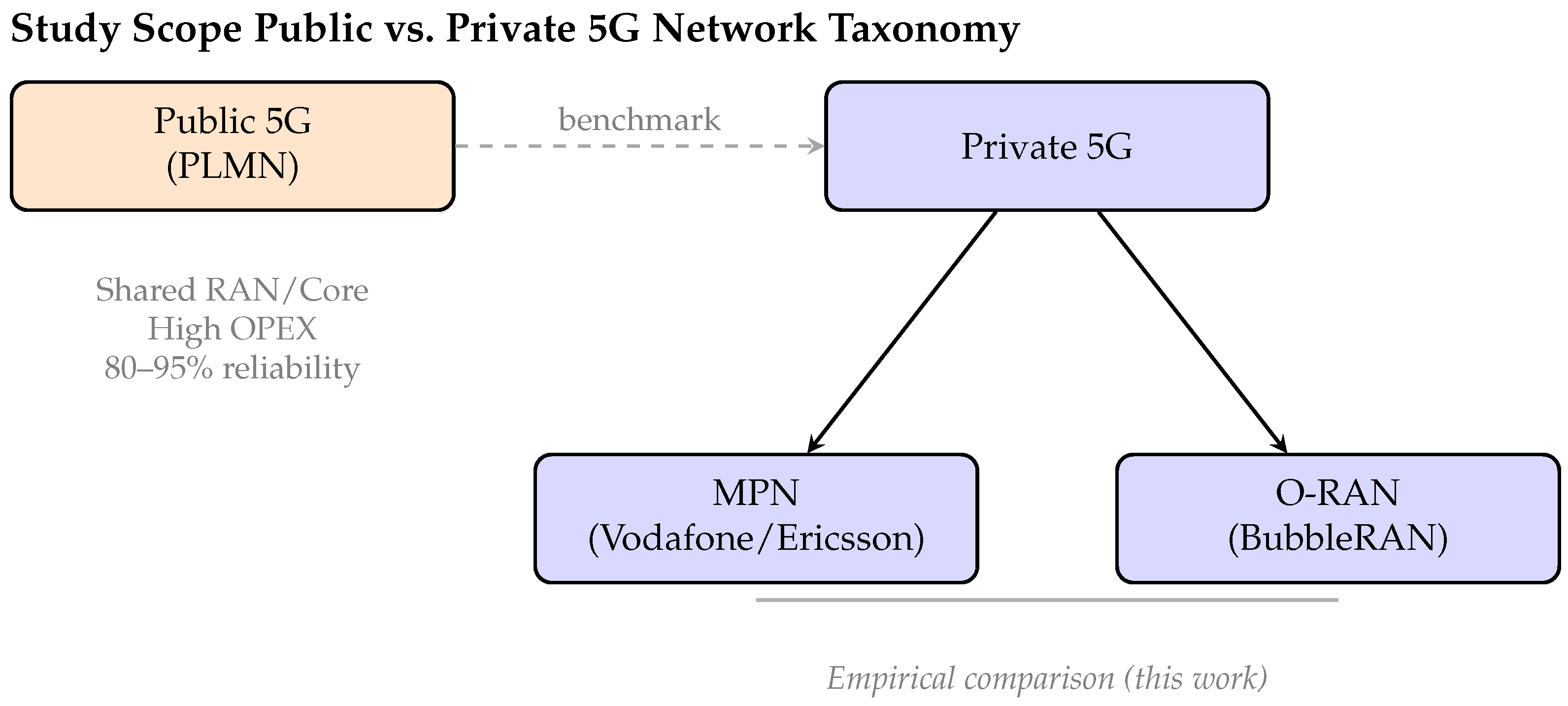
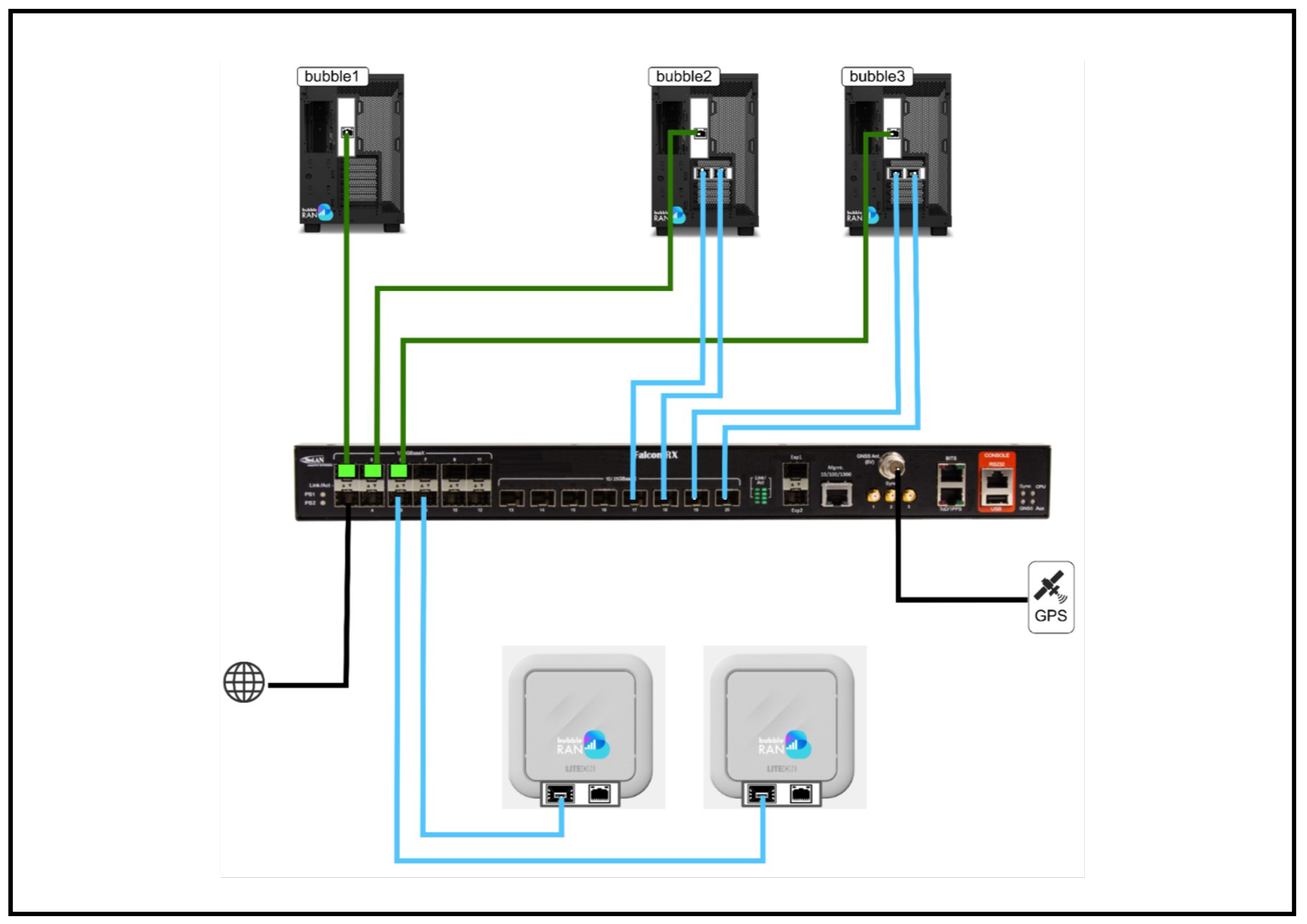
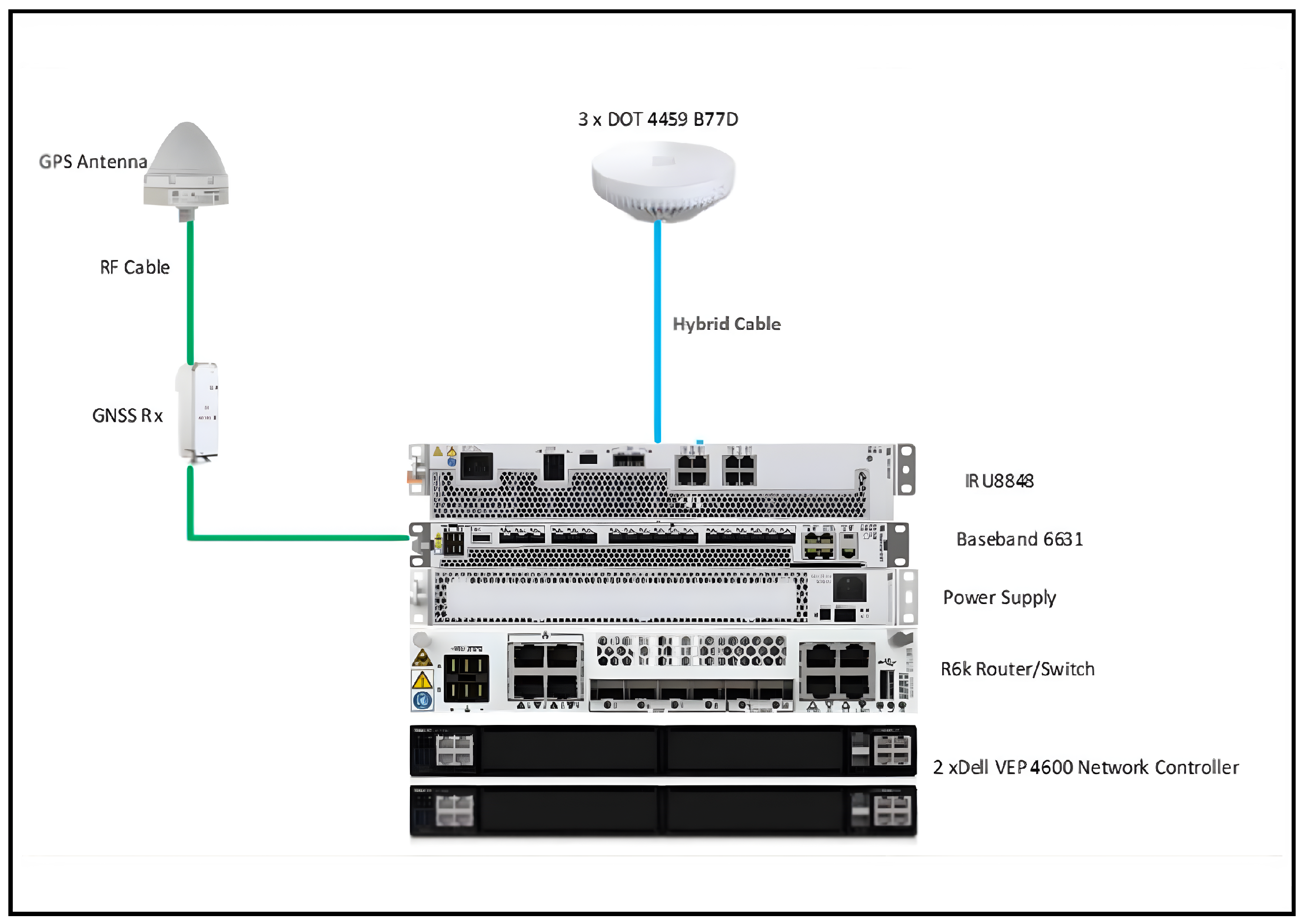
This study investigates the environmental and social sustainability outcomes of 5G network deployments in the UK. The scope encompasses two distinct but related comparisons: (1) a literature-based evaluation of private versus public 5G deployments—assessing energy, cost, and societal outcomes at a high level—and (2) an empirical comparison of two specific private 5G architectures—Vodafone’s Mobile Private Network (MPN) and an Open Radio Access Network (O-RAN) via BubbleRAN—measured under controlled laboratory conditions. Public networks serve as the external benchmark, contextualising why private architectures represent a more sustainable pathway. Figure 1 summarises the paper’s scope, positioning MPN and O-RAN within the broader public-versus-private landscape. Detailed visualisations of the private testbed deployments are provided in Figure 2 and Figure 3 (adapted from [5]).
Figure 1.
Overview of the study scope. Public 5G (PLMN) serves as the external benchmark. The empirical contribution of this work focuses on comparing two private 5G architectures: MPN (Vodafone/Ericsson) and O-RAN (BubbleRAN).
Figure 2.
Vodafone/Ericsson Mobile Private Network (MPN) testbed setup at DCIC, showing integrated Ericsson components (BBU 6631, Indoor Radio Units on n77 band), MEC integration, and power monitoring harness [5].
Figure 3.
BubbleRAN O-RAN testbed deployment, highlighting cloud-native compute nodes (MX-PDK), Lite-On FlexiFI RUs (n78 band, 4 × 4 MIMO), disaggregated interfaces (O-RAN 7.2), and system logging/power metering points [5].
The distinctions between standalone private MPNs and public-integrated Mobile Networks (MNs) are summarised in Table 1. Private architectures afford comprehensive operational autonomy and customised resource allocation, with the potential to reduce energy use through attenuated site proliferation and precise network slicing [6]. Whereas enterprise-grade MPNs draw more absolute power than open-source alternatives, this reflects the scale of their dedicated capability; on a per-bit basis, and under the configurations tested in this study, the MPN demonstrates higher throughput efficiency than the O-RAN deployment evaluated. Upon this foundation, the present research empirically contrasts Vodafone’s MPN with an O-RAN implementation, deriving quantitative metrics to inform UK deployment strategies while acknowledging the configuration-specific nature of the findings.
Table 1.
Comparison between standalone MPN (private) and public land mobile network (PLMN).
The principal contributions of this paper are delineated as follows:
- Empirical Benchmarking of Power Consumption Under Controlled Conditions: Via controlled experiments, we quantify and compare energy utilisation in operational and inactivity states for MPN and O-RAN architectures at the DCIC testbed. Our measurements yield a throughput efficiency of 1.45 Mbps/W for MPN versus 0.44 Mbps/W for O-RAN under the specific tested configurations (n77 vs. n78 band; 2 × 2 vs. 4 × 4 MIMO; 936 Mbps vs. 202 Mbps downlink), with annualised electricity costs of £1486 versus £1060. The efficiency gap reflects configuration differences, including differing RF conditions and achieved throughput as much as intrinsic architectural properties, and should be interpreted accordingly.
- Situating Empirical Findings Within Green 5G Research: Building on established green mobile network design principles [1] and broader 5G sustainability frameworks [2], we contextualise our measurements within the wider literature on energy-efficient private 5G deployment. We connect our findings to AI/ML-driven O-RAN control mechanisms, including xApp-based power management [7] and distributed real-time inference via dApps [8]—which represent the operational trajectory beyond the static testbed configurations measured here—and to the private 5G architectural landscape [6].
- Framework for Sustainable Private 5G Architectures: We compile existing research on the MPN’s ecologically relevant use cases (e.g., 15–70% energy savings in manufacturing contexts) and O-RAN’s AI-enabled mechanisms (e.g., 9–12% reductions in radio access network power via intelligent RAN control [9]). In keeping with UK net-zero requirements, we outline how private networks may reduce CO2 emissions relative to the 795,347–1,260,532 tonnes projected from UK 5G operations by 2030 [3], while acknowledging the preliminary nature of the evidence base.
- Research Gaps and UN SDG Alignment: We identify how private 5G technologies relate to SDGs 4, 8, 9, 12, and 13 and outline unresolved gaps, including the absence of multi-UE field trials, RF-normalised comparisons, and full TCO analyses that future research must address to underpin hybrid O-RAN–MPN deployment recommendations and a triple-bottom-line approach to sustainable connectivity.
2. Literature Review
2.1. 5G Sustainability in the UK
The sustainability benefits of 5G networks have gained prominence in UK research, driven by national net-zero ambitions and the sector’s role in reducing emissions across industries [10]. In the UK, 5G is anticipated to consume over 2.1% of national electricity generation by 2030 under medium-demand scenarios, prompting calls for optimised deployments to mitigate environmental impacts [3]. Detailed power consumption metrics for macro-cells and micro-cells underpinning these projections are provided in Table 2. Government initiatives, such as the Department for Science, Innovation and Technology’s 5G Testbeds and Trials Programme, have surveyed sustainability efforts, revealing that 68% of respondents pursue O-RAN for its potential energy savings, though quantifiable metrics are still emerging [10]. Mobile UK’s reports emphasise 5G’s enabling role in decarbonising sectors like transport and manufacturing, which contribute significantly to UK greenhouse gases, by facilitating smart grids and IoT applications that could reduce emissions by up to 15% by 2030 [11]. Furthermore, OECD analyses tailored to UK contexts highlight the need for energy-efficient communication networks, projecting that AI-optimised 5G could lower operational energy use while supporting circular economy principles [12,13]. The study underscores the need for energy-efficient strategies to align 5G expansion with sustainability goals, though empirical post-deployment data remain limited [3].
Table 2.
Power consumption metrics for 5G base stations in the UK [3].
2.2. Energy Consumption of 5G Base Stations in the UK
The deployment of 5G networks in the UK has raised concerns about increased energy demands due to advanced technologies like massive MIMO and higher site densities, with individual base stations consuming significantly more power than 4G equivalents [3,14,15]. A complex systems analysis reveals that macro-cells, used for broad coverage, typically consume 3–10 kW, with average full-load power at 10.8 kW and idle at 6 kW, while micro-cells for urban densification range from 150 to 300 W, averaging 1.157 kW at full load and 0.864 kW idle [3]. Aggregate network-level peak consumption is projected to escalate under full mmWave densification, with Cheng et al. [3] modelling network-wide peaks reaching 14 kW equivalent for macro-cell tiers and 19 kW for dense micro-cell deployments figures that reflect the cumulative effect of site proliferation rather than per-unit power at individual micro-cell hardware (which remains in the 150–300 W range). Nationally, UK 5G energy use is forecasted to grow from a 2021 baseline of 1.8 TWh annually to 6.6–10.5 TWh by 2030 across low- to high-demand scenarios, potentially accounting for 2.1% of total electricity generation in the medium case [3,16]. This growth is driven primarily by micro-cell proliferation in urban areas, with consumption densities exceeding 200 kW/km2 in regions like Greater London, posing challenges for grid infrastructure and carbon emissions estimated at 795,347 to 1,260,532 tonnes yearly by 2030 [3,14].
2.3. Private vs. Public 5G Networks
Private 5G networks present a more sustainable pathway compared to public deployments in the UK, offering energy reductions of 15 to 33% through targeted slicing and reduced infrastructure sprawl [17]. Public networks, mandated to provide widespread coverage, often lead to higher CAPEXs and OPEXs, exacerbating energy consumption as regulated by Ofcom’s spectrum policies. Vodafone UK’s collaborations with Ericsson have demonstrated AI-driven features, such as 5G Deep Sleep, achieving up to 70% power savings during idle periods and 33% daily reductions in Radio Units [18]. BT Group’s sustainability strategies align with this, having cut energy use by 20% globally through 5G upgrades, with UK operations targeting net zero by 2031 via supply chain decarbonisation [19]. Economic reviews of 5G in sectors like aerospace further underscore private networks’ viability, where tailored deployments minimise environmental footprints while delivering ROI through enhanced operational efficiency [20].
The Advantages of Private 5G
The two key advantages of private 5G lie in the policy and capability surrounding the operation of wireless communications systems: power and operational flexibility. Operating within a highly regulated and thus restricted spectrum subjects the operator to a significantly lower degree of RF interference, resulting in a far greater reliability in signal quality. Moreover, licensure allows for a significant effective radiated power (ERP) through the use of directional antennas and significantly higher transmission strength. These factors collectively improve both the coverage and the performance of the network within that coverage, thereby reducing the number of sites needed and the associated power infrastructure, considerably improving the value proposition of 5G compared to wired networks or enterprise Wi-Fi of comparable coverage and performance [21]. Compounding on this, 5G systems offer enhanced wireless communication capabilities not available with other systems, such as mMTC enabling fewer radio units to support a significantly greater number of user terminals; eMBB, providing greater throughput; and URLLC, enabling wireless systems to support latency-sensitive applications [22].
Two additional technical enablers are particularly important for understanding the sustainability profile of private 5G deployments: network slicing and neutral hosting. Network slicing partitions a single physical infrastructure into multiple isolated logical networks, each configured with precisely allocated radio, compute, and transport resources for a specific application or tenant [6]. This eliminates the idle-power penalties incurred when a shared public network must remain provisioned for peak demand regardless of actual load, since each private slice operates only at the resource level its application requires. Neutral hosting extends this concept to the deployment model, enabling a single private 5G site to be shared across multiple tenants or operators, further amortising capital and energy costs without compromising per-tenant isolation. Together, these mechanisms underpin the demand-scaled, low-overhead energy profile that drives the cost advantages reported in Section 4.2. Wen et al. [6] provide a comprehensive survey of private 5G concepts, architectures, and research challenges, including deployment models, key enabling technologies, and use cases, that establishes the foundational context for the MPN and O-RAN testbeds evaluated in this study.
2.4. O-RAN Architectures and Sustainability
Open Radio Access Network (O-RAN) architectures are increasingly recognised as pivotal for enhancing sustainability in 5G networks, particularly through virtualisation and open interfaces that enable efficient resource management [23]. By facilitating dynamic scaling and AI/ML-driven optimisations, O-RAN reduces energy consumption in the Radio Access Network (RAN), which constitutes 70 to 85% of total mobile network energy use, with trials demonstrating 9 to 12% power savings in multi-vendor setups [23]. In the UK context, Vodafone’s involvement in O-RAN deployments, supported by government initiatives like the £30 million Future RAN competition, aims to diversify supply chains and lower deployment costs, indirectly contributing to sustainability by minimising infrastructure sprawl [10].
Furthermore, O-RAN aligns with broader environmental goals by integrating with renewable energy solutions and infrastructure sharing, as emphasised in analyses of communication networks’ sustainability [13]. Vodafone UK and Ericsson’s trials of AI features, such as 5G Deep Sleep that achieved up to 70% idle-period savings, exemplify how O-RAN-compatible technologies can reduce operational emissions while supporting net-zero targets [18]. Overall, O-RAN’s open framework fosters innovation in energy-efficient designs, aiding the UK’s net-zero ambitions amid rising 5G demands.
A key enabler of O-RAN’s energy efficiency potential lies in its programmable intelligence layer comprising xApps and rApps operating on the near-real-time and non-real-time RAN Intelligent Controllers (RICs) and the more recently proposed dApps. Liang et al. [7] demonstrated that intelligently designed xApps can manage the operational state of Radio Cards (RCs) within O-RUs by switching between active and sleep modes based on network resource block utilisation, achieving up to 50% power savings under low-load conditions without compromising Quality of Service. This finding is directly relevant to interpreting the idle-state behaviour observed in the BubbleRAN testbed in this study. At a finer timescale, D’Oro et al. [8] propose dApps distributed applications deployed directly at the Central Unit/Distributed Unit level, enabling real-time data-driven inference and control at sub-10 ms latency, timescales inaccessible to conventional RIC-based approaches. This allows dynamic power modulation responsive to instantaneous traffic demands, beyond what the 5-min sampling interval of the present study can capture. Looking further ahead, Giannopoulos et al. [24] propose FedRA, a fully decentralised federated learning framework for O-RAN dApps that enables collaborative, privacy-preserving model training across distributed radio nodes, offering a path towards network-wide energy optimisation without centralised data aggregation. Contextualising these capabilities within the broader standardisation landscape, Li et al. [9] review 3GPP and O-RAN Alliance energy-saving specifications, identifying full-stack acceleration, network function consolidation, and shared AI/communication infrastructure as the three principal levers for reducing the RAN energy footprint.
Critically, the AI/ML-driven energy-saving mechanisms described above were not active during the controlled BubbleRAN trials. The O-RAN absolute power measurements in this study therefore represent a conservative baseline for O-RAN energy performance, not an upper bound on its sustainability potential. This distinction is important when interpreting the throughput efficiency gap between the MPN and O-RAN reported in Section 4.2. Looking beyond isolated network metrics, Shehab et al. [2] evaluated 5G sustainability across environmental, social, and economic dimensions in smart-city contexts, including energy efficiency, carbon footprint, cost, and security, finding that environmental metrics dominate the literature, while social and economic dimensions remain underexplored. This observation directly strengthens the motivation for the triple-bottom-line framing adopted in the present paper. Masoudi et al. [1] provide a foundational treatment of green mobile network design for 5G and beyond, cataloguing system-level energy-saving mechanisms including sleep mode scheduling, load-adaptive scaling, and heterogeneous network coordination that contextualise the power profiles measured here for both the MPN and O-RAN architectures.
2.5. Mobile Private Networks (MPNs) and Eco-Use Cases
Mobile Private Networks (MPNs), often leveraging 5G technology, provide dedicated connectivity for enterprises, enhancing sustainability by minimising infrastructure redundancy and enabling targeted eco-friendly applications across sectors [17]. These networks support low-latency, secure operations that reduce waste and emissions, as seen in ports where automated cranes and vehicles improve efficiency by up to 80%, cutting fuel consumption and manual labour [17]. In manufacturing and chemical plants, MPNs facilitate AI-driven inspections and patrol bots, operating 24/7 to detect hazards and optimise resource use, aligning with broader ICT goals to reduce global carbon emissions by 20% through process optimisation [17].
Energy efficiency in MPNs is further bolstered by network slicing, which allocates resources to minimise power consumption while meeting specific use case demands, potentially reducing Europe’s carbon emissions by 15% by 2030 in industries like energy and transport [11]. For instance, in renewable energy applications, MPNs enable real-time control of remote wind farms, supporting clean energy transitions [11]. Shared infrastructure models, akin to RAN sharing, can achieve up to 70% energy savings compared to traditional deployments, with examples like small cell networks reducing total consumption by 42% in urban areas [23]. UK initiatives, such as the 5G Accelerator Programme, promote MPN innovations for IoT-based monitoring in water systems, preventing waste and conserving energy [17]. Overall, MPNs align with net-zero ambitions by fostering efficient, tailored connectivity that drives decarbonisation in verticals like retail, where automated solutions cut nighttime energy use by 10% [17].
2.6. Achieving UN Sustainable Development Goals
The United Nations (UN), comprising 193 member states, promotes international collaboration for global betterment. In 2015, it launched the 2030 Agenda with 17 Sustainable Development Goals (SDGs) to address challenges in human, social, economic, and environmental perspectives, aiming to prevent negative impacts and generate positive ones for future generations [25].
Emerging technologies such as O-RAN and MPN align with and accelerate several SDGs by providing private and optimised deployments, enhancing connectivity for scalable, efficient solutions and resource management.
2.6.1. SDG 4: Quality Education
Private 5G’s most relevant contribution to SDG 4 lies not primarily in reliability but in its combination of high bandwidth, low latency, and geographic flexibility, enabling immersive educational tools (e.g., AR/VR-assisted learning) and remote access in underserved areas. Private networks can be purpose-deployed at educational institutions to guarantee quality of service where public spectrum congestion would otherwise degrade performance. These multimodal experiences enhance learner engagement, reduce supervision requirements in distributed learning environments, and improve knowledge retention, thereby supporting educational equity [26].
2.6.2. SDG 8: Decent Work and Economic Growth
Private 5G directly supports SDG 8 through both economic and workplace dimensions. Its high-throughput, low-latency connectivity enables AR/VR-based workforce training and remote collaboration, shortening learning curves, enhancing task efficiency, and reducing operational errors. The high session continuity observed in controlled trials for both private architectures is consistent with the deterministic connectivity requirements of industrial IoT and predictive maintenance applications requirements that public networks operating under shared load cannot consistently satisfy [27]. These features collectively reduce unemployment risks while improving workplace safety.
2.6.3. SDG 9: Industry, Innovation and Infrastructure
Private 5G is uniquely positioned to advance SDG 9 through capabilities unavailable in prior generations. Unlike 4G LTE, private 5G supports URLLC (Ultra-Reliable Low-Latency Communication) for time-critical industrial control, mMTC for dense IoT sensor deployments, and network slicing for simultaneous multi-application delivery within the same physical infrastructure [6]. These features enable real-time data transfer and adaptive systems for industrial automation, stimulate innovation through AI-enhanced network management, and are especially impactful in remote or resource-constrained manufacturing environments. AR/VR-enhanced training applications further exemplify how these capabilities translate into measurable workforce and industrial outcomes [28]. Looking further ahead, the evolution of URLLC towards integrated THz/mmWave transmission schemes represents one trajectory for next-generation industrial wireless, with hybrid diversity-combining approaches demonstrating improved reliability in high-frequency bands [29]—a direction that builds on the private 5G foundations evaluated in this study.
2.6.4. SDG 12: Responsible Consumption and Production
Private 5G advances SDG 12 by replacing over-provisioned public infrastructure with purpose-built, demand-scaled deployments, thereby reducing energy waste and hardware redundancy. Network slicing enables precise resource allocation per application, avoiding the idle-power penalties common in shared public networks. Additionally, private networks’ longer upgrade cycles and enterprise-controlled hardware lifecycles offer potential reductions in e-waste relative to rapid public network refreshes [30].
2.6.5. SDG 13: Climate Action
Private 5G contributes to SDG 13 through two pathways: directly, by reducing per-bit energy consumption in the network itself (as evidenced by the 44–60% OPEX reductions versus public micro-cells shown in this study); and indirectly, by enabling smart grid management, renewable energy coordination, and industrial process optimisation that reduce emissions across connected sectors. Private deployments also avoid the carbon cost of overbuilt public infrastructure, aligning telecommunications growth with net-zero trajectories.
2.7. Gaps in the Literature
Despite advancements in O-RAN and MPNs for sustainable 5G ecosystems, significant gaps persist in understanding their hybrid viability, especially in the UK, where net-zero goals demand robust, context-specific insights [3,10]. These limitations impede practical scalability and balanced policy support.
A key gap is the lack of empirical models for hybrid O-RAN–MPN sustainability assessments. Studies rely heavily on simulations, ignoring real-world proprietary data and multi-vendor complexities, which inflate energy savings estimates (e.g., up to 63% in O-RAN AI switching) and reduce applicability to use cases like smart manufacturing [17,23]. Empirical validations using standardised metrics are needed for accurate carbon footprint predictions [3].
Social aspects are underexplored, with minimal focus on spectrum equity for underserved UK enterprises or AR-enabled upskilling via MPNs for workforce inclusion (aligning with SDG 8) [27]. Broader metrics like community engagement and digital divides from high-band dependencies warrant interdisciplinary sociological integration [26,28].
E-waste studies from 5G upgrades are absent, overlooking lifecycle costs of O-RAN components like Open Radio Units (O-RUs), despite UK supply chain diversification efforts [10,12]. These risks undermine circular economy goals amid projected 50% global e-waste growth by 2030 [30].
The triple-bottom-line (TBL) framework, developed by Elkington [25], provides a structured approach to evaluating organisations and technologies across three dimensions: environmental (planet), economic (profit), and social (people). Applied to 5G, TBL assessment requires simultaneous evaluation of carbon and energy impacts, total cost of ownership, and societal outcomes such as employment and digital inclusion. Despite its relevance, comprehensive TBL frameworks for 5G are sparse in the literature, overemphasising environmental metrics (e.g., power usage effectiveness, PUE) while neglecting economic trade-offs (e.g., integration costs) and social indicators (e.g., job creation) [25]. Comparative public–private 5G benchmarks remain underdeveloped, limiting holistic insights [20].
The present study partially bridges these gaps via controlled benchmarking of MPN and O-RAN power consumption, delivering empirical, standardised metrics that inform hybrid assessments, TBL trade-offs, and real-world applicability toward UK net-zero ambitions.
3. Materials and Methods
To empirically benchmark the energy efficiency of private 5G architectures, two systems were evaluated: the Vodafone Mobile Private Network (MPN) and an Open Radio Access Network (O-RAN) solution implemented via BubbleRAN. System power consumption was assessed in two configurations to isolate the power usage of the radio units (RUs) and the core network independently. These configurations simulate the private 5G cell in normal operating mode and in a low-power mode, where the RU is disabled to conserve energy. The first configuration comprises a fully powered system with one user equipment (UE) device connected and streaming video from the internet, emulating typical urban load conditions as seen in enterprise applications like remote monitoring or video conferencing. The second configuration involves both RUs fully powered down, with only the core network remaining powered and idle, representing periods of low demand to highlight potential energy savings. Each scenario was repeated five times for each system, yielding a total of 20 samples, to account for variability and ensure reliable averages. For each trial, the system was allowed a minimum of 2 min and up to 5 min to stabilise before measurements commenced; the stabilisation period was extended if consecutive 1-min power readings that differed by more than 5%, ensuring only steady-state values were captured and mitigating transient effects such as startup surges or thermal settling. The five stable readings per scenario were averaged to produce the reported mean values; any reading deviating by more than 5% from the preceding reading triggered an extended stabilisation period and repeat measurement.
3.1. Alignment with Standardisation Frameworks
The experimental design draws on established guidelines for 5G energy evaluation, prioritising comparability and practical relevance in controlled settings. Active-mode trials (video streaming with one UE) emulate busy load conditions by generating sustained data traffic, capturing total power draw under representative profiles that reflect real-world throughput demands (e.g., up to 936 Mbps for MPN). Idle-mode configurations (RU off, core active) focus on static power measurements, isolating RAN contributions, which are often the dominant factor in total energy use for mobile networks. The five replications provide sufficient statistical power for detecting meaningful differences, with stabilisation periods calibrated to allow full system equilibrium, avoiding artefacts from incomplete initialisation. This structured approach enables direct benchmarking against broader 5G deployment metrics, such as those for base station efficiency in dynamic environments.
3.2. Experimental Procedure
3.2.1. Power Setup
- All components from both the Vodafone Non-Public Network (NPN) and BubbleRAN systems were powered from dedicated harnesses, with all BubbleRAN components connected to one plug and all Vodafone components to another, to enable isolated and accurate metering without cross-contamination.
- The Vodafone system was already integrated as a plug-and-play MPN stack, facilitating seamless deployment in the lab environment.
- For the BubbleRAN system, the rack switch was disconnected, reconnected to the same power splitter as the radios and computers, and the entire feed routed through a calibrated kilowatt meter to the wall outlet, ensuring comprehensive capture of aggregate power draw across all elements.
3.2.2. Test Execution
- For tests with radios deactivated, the RUs were physically disconnected, as the Vodafone NPN design precludes software-based separation of radio power from the Indoor Radio Unit (IRU), guaranteeing complete power-down of transmission components.
- Systems were allowed a minimum of 2 min and up to 5 min for stabilisation post-configuration, with the period extended if consecutive 1-min power readings differed by more than 5%; anomalies (e.g., thermal spikes > 5 °C or unexpected voltage fluctuations) were noted, and trials discarded if exceeding predefined thresholds to maintain data integrity.
- A single UE was used on each system to stream 1080p video via YouTube, simulating typical enterprise usage such as remote monitoring or AR training while introducing realistic packet patterns and bandwidth utilisation.
3.2.3. Measurements
- Power consumption (in watts) was recorded every 5 min during trials using the kilowatt meter, accumulating data until five stable readings were obtained for each loaded (active) and unloaded (idle) scenario per system (yielding 95% CI < 10% of mean power, per power analysis), alongside performance metrics, including throughput (Mbps), latency (ms), signal strength (dBm), and reliability (%) via integrated logging tools, to provide a holistic view of efficiency trade-offs.
3.2.4. Data Collection and Instrumentation Details
Power measurements were conducted using a Kill-A-Watt EZ (P4460, P3 International, New York, NY, USA) electricity usage monitor connected via the harnesses to capture aggregate draw for all components. The Kill-A-Watt EZ records true RMS power (Watts), accounting for power factor effects in the measured load. The meter carries a manufacturer-stated accuracy of ±2% for power measurements; no independent laboratory calibration was performed beyond the factory specification, which constitutes a recognised instrumentation limitation. Measurement uncertainty was therefore estimated at ±2% of each reported watt value. Readings were captured at 5-min intervals; while this sampling frequency may miss sub-minute transient fluctuations (particularly relevant for the virtualised O-RAN stack, where dynamic resource scaling can introduce short-term power variability), the stabilisation protocol ensured all accepted readings were taken during steady-state operation.
The hardware and software components deployed in the two private 5G testbeds at the DCIC facility are summarised in Table 3.
Table 3.
Key components of MPN and O-RAN systems.
Key differences in the achieved configurations and performance parameters during the controlled experiments are presented in Table 4. These variances arise from inherent hardware and lab constraints in the DCIC setups.
Table 4.
Key differences in testbed configurations.
The 5G Mobile Private Network (MPN) deployed at DCIC is based on a standalone (SA) 5G architecture, operating under a licensed spectrum via the Ofcom Shared Access Licence. It integrates Ericsson Private 5G (EP5G) technology, delivering secure, high-throughput, and low-latency communications with local data routing through Multi-Access Edge Computing (MEC). DCIC’s O-RAN deployment is based on BubbleRAN’s MX-PDK platform, offering a cloud-native, disaggregated RAN with O-RAN 7.2 interfaces.
Performance metrics were captured using Ookla Speedtest (https://www.speedtest.net, accessed on 23 September 2025) for end-to-end measurement on the UE devices during testing, alongside integrated system logging tools for throughput (Mbps), latency (ms), and signal strength (dBm).
While these trials provide controlled, reproducible insights into energy efficiency, they simulate urban enterprise loads (e.g., single-UE video streaming) and exclude multi-UE scaling or real-world variables like weather-induced interference, which could influence field performance. The choice of five replications per scenario was statistically justified via power analysis, yielding a 95% confidence interval (CI) of less than 10% of the mean power draw, ensuring robust averages with minimal variability (e.g., standard deviation of <5% across trials).
The laboratory testbeds at the Digital Connectivity and Innovation Centre (DCIC), University of the West of Scotland, comprised a Vodafone/Ericsson MPN (standalone SA 5G with licensed spectrum via Ofcom Shared Access Licence, integrating EP5G technology, MEC routing, and Ericsson hardware) and a BubbleRAN O-RAN (cloud-native, disaggregated RAN using MX-PDK platform with O-RAN 7.2 interfaces). Figure 2 and Figure 3 illustrate the component topologies, including core network elements, radio units, backhaul (triple: fibre/SATCOM/5G-backed), and power measurement points [5].
3.3. Limitations of the Experimental Design
The controlled laboratory setup at DCIC provides reproducible, isolated comparisons under standardised conditions (single-UE streaming 1080p video to emulate enterprise loads such as remote monitoring). However, several constraints limit generalisability to real-world deployments:
- Single-user equipment (UE) downlink-only traffic does not capture multi-UE scaling, uplink loads (known to increase base station power significantly), or variable traffic patterns typical in operational environments.
- Achieved throughputs, signal strengths, bands, and MIMO configurations differed substantially between the MPN and O-RAN testbeds (as detailed in Table 4), reflecting real hardware constraints rather than standardised normalisation. A fully normalised architectural comparison would require matched RF band, equivalent signal quality (RSRP), identical channel bandwidth, and comparable traffic profiles. Efficiency results should therefore be interpreted as configuration-specific empirical observations, not a definitive ranking of MPN versus O-RAN as architectural paradigms.
- The AI/ML-driven power-saving capabilities available in O-RAN, including xApp-based Radio Card sleep management [7] and dApp-level real-time control [8], were not active during trials. The O-RAN power measurements therefore represent a conservative baseline, not an upper bound on O-RAN sustainability potential.
- Testing a single cell fails to evaluate O-RAN’s potential statistical multiplexing gains in multi-cell or virtualised cloud-native environments.
- Power sampling every 5 min (yielding approximately five stable readings per scenario after stabilisation) is coarse and may miss transient effects; more frequent monitoring (e.g., 1 Hz) would enhance robustness, particularly for the virtualised O-RAN stack.
- Thermal characterisation was performed for the BubbleRAN O-RU only; no equivalent measurement was conducted for the MPN’s Ericsson IRU hardware, as the proprietary stack did not permit access to component-level RF efficiency data. This asymmetry means the 185 W active power differential cannot be attributed solely to O-RAN’s architecture, and a fair thermal comparison requires equivalent profiling of both systems in future work.
These factors mean the results reflect lab-specific high-load downlink scenarios for private enterprise contexts and should be interpreted as preliminary indicators of private 5G power profiles rather than definitive superiority claims. Throughout this paper, directly measured quantities (power consumption, throughput, latency, signal strength) are distinguished from literature-derived estimates (CO2 projections, sector-level savings); the latter are drawn from cited sources and were not independently verified in this study. Future work should extend to multi-UE field trials with diverse loads, uplink inclusion, and standardised RF configurations to validate scalability and fully capture O-RAN’s virtualisation benefits. Despite these bounds, the benchmarks offer valuable initial insights into energy efficiency for UK enterprise contexts.
4. Results
Note on Scope and Comparability. The results below derive from a controlled, single-cell, single-UE downlink scenario under non-equivalent hardware configurations (Table 4). The two systems operated on different frequency bands (n77 vs. n78), at different signal strengths (−36 vs. −58 dBm), and with different MIMO configurations (2 × 2 vs. 4 × 4), producing a throughput differential of 936 Mbps versus 202 Mbps. Efficiency differences therefore reflect these hardware and RF variables as much as any intrinsic architectural distinction. All reported values are means of replications; standard deviation was verified at <5% of the mean across all trials (95% CI < 10% of mean). These are preliminary empirical indicators for the configurations tested and should not be interpreted as definitive architectural rankings.
Before presenting the results, it is important to establish a clear distinction between three complementary metrics used throughout this section:
- Absolute power consumption (Watts): the total electrical draw of each system, regardless of the data throughput it delivers. A lower value indicates less energy consumed.
- Throughput efficiency (Mbps/W): the volume of data delivered per unit of energy consumed. This metric captures the trade-off between performance and energy use and is operationally meaningful for networks under real traffic loads. However, because it scales linearly with throughput, it inherently favours the higher-throughput system regardless of architecture; it should therefore be interpreted alongside the energy-per-bit metric below.
- Energy per bit (nJ/bit): the energy consumed to deliver one bit of data, calculated as , where P is power in Watts, and S is throughput in Mbps. This metric is less sensitive to the throughput differential between configurations and provides a more architecture-neutral basis for comparison. It is the reciprocal of throughput efficiency expressed in complementary units.
These metrics are not interchangeable and may rank systems differently depending on the deployment scenario. O-RAN draws less absolute power, making it preferable for low-load or idle scenarios. MPN delivers more throughput per watt at the tested configuration, but O-RAN achieves a lower energy-per-bit figure only if its throughput were normalised; under the current non-equivalent configurations, MPN also leads on energy-per-bit, owing to its substantially higher achieved throughput. Both insights are reported transparently; the correct interpretation depends on the deployment use case and the degree to which configuration differences are controlled for.
4.1. Power Consumption Analysis
The power consumption data from controlled trials (Section 3) analyse energy demands in private 5G setups under active (video streaming load) and idle (core network only) modes in this controlled single-UE high-load downlink scenario. Aggregated from five replications per scenario with stabilisation protocols, the measurements compare Vodafone MPN and O-RAN systems to isolate radio unit (RU) contributions.
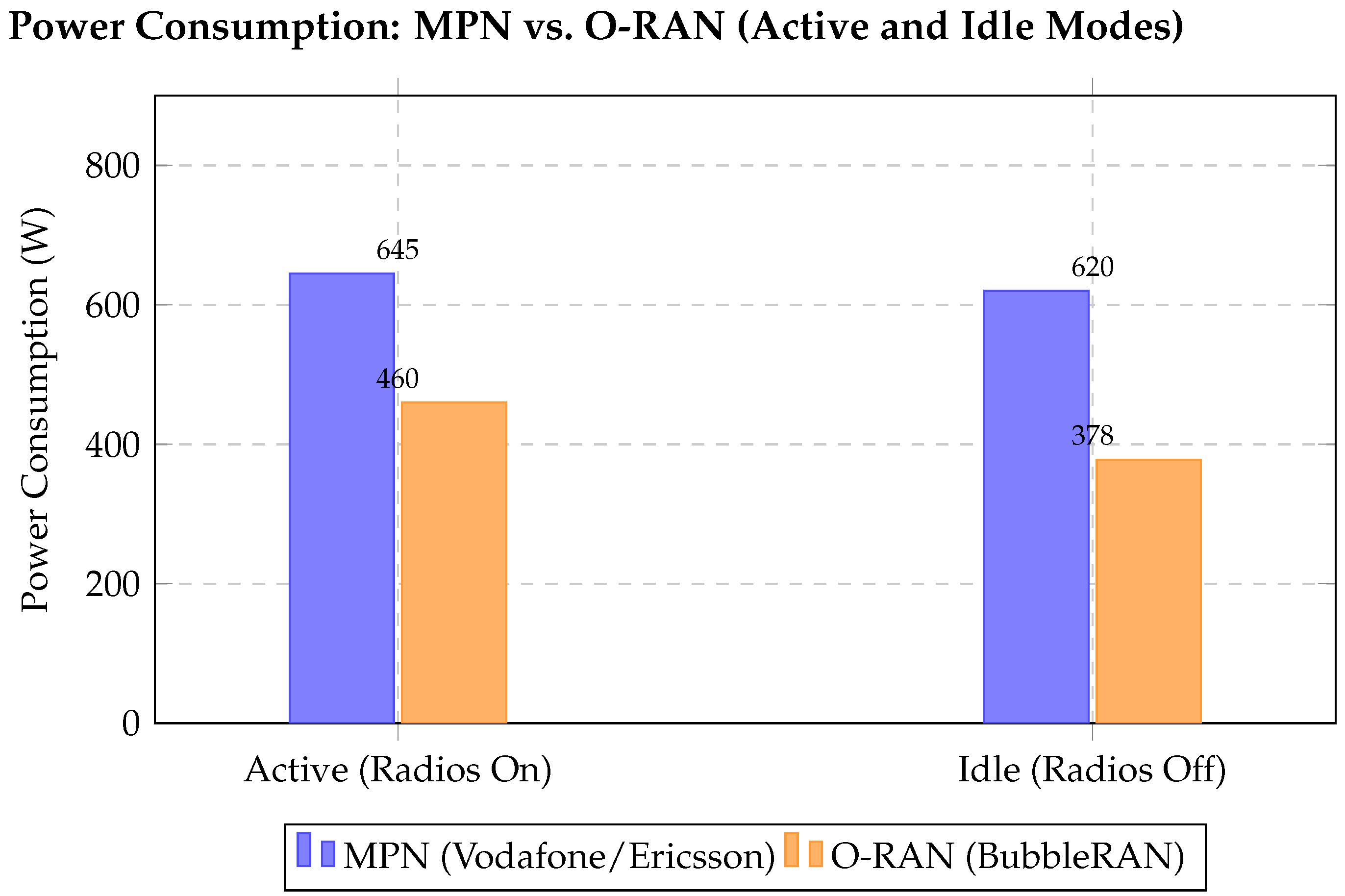
Table 5 and Figure 4 show average power draw: MPN at 645 W (active) and 620 W (idle); O-RAN at 460 W (active, 28.7% lower) and 378 W (idle, 39.0% lower). O-RAN’s virtualisation enables granular scaling and dormancy, curbing RAN overhead (70–85% of total energy [23]). Thermal profiling of the BubbleRAN O-RU revealed that >60% of the O-RAN radio-frequency power was dissipated as heat, contributing to the 185 W active differential and highlighting a hardware efficiency gap in the current O-RU implementation. It is important to note, however, that no equivalent thermal measurement was performed on the MPN’s Ericsson IRU hardware, as the proprietary integrated stack did not permit access to component-level RF efficiency data. This asymmetry means that the power differential cannot be attributed solely to O-RAN’s architectural properties; the MPN’s higher absolute baseline reflects its dedicated, always-on enterprise stack. Addressing this gap through equivalent thermal profiling of both platforms is an important direction for future work.
Table 5.
Power consumption in each configuration, reported as mean ± estimated SD ( replications per scenario; SD < 5% of mean in all cases, consistent with 95% CI < 10% of mean verified by power analysis).
Figure 4.
Absolute power consumption comparison: MPN vs. O-RAN under active and idle configurations ( replications; SD < 5% of mean). O-RAN draws 28.7% less power when active and 39.0% less when idle. Note that lower absolute power does not directly imply higher throughput efficiency (see Section 4.2). The two systems operated under non-equivalent RF conditions (n77 vs. n78 band; −36 vs. −58 dBm signal strength); the power differential reflects both architectural and hardware configuration differences.
To contextualise these private network results against broader UK 5G ecosystems, Table 6 benchmarks performance metrics from the lab trials against measured public 5G performance in urban Glasgow. The MPN achieved a download speed of 936.2 Mbps, an upload speed of 156.2 Mbps, a ping of 15.6 ms, and a signal strength of −36 dBm. The O-RAN achieved a download speed of 202 Mbps, an upload speed of 80 Mbps, a ping of 17 ms, and a signal strength of −58 dBm. Public 5G figures (669 Mbps download, 165 Mbps upload, 22 ms ping, −78 dBm signal strength, 80–95% availability) are derived from the authors’ own empirical Glasgow dataset [31]: 720 speed test measurements collected across 15 Glasgow neighbourhoods over three consecutive days (6–8 April 2025) using four UK providers (EE, O2, Vodafone, Sky Mobile) on flagship Android devices, yielding an overall mean of 670.63 Mbps download, 165.05 Mbps upload, 21.62 ms ping, and −77.85 dBm signal. The dataset is openly available on Zenodo and forms the basis of a companion data descriptor paper currently under peer review. In the controlled trials, session continuity was 100% for both private architectures, defined here as the absence of dropped or interrupted UE sessions across all five replications per scenario (each lasting approximately 25–30 min). This reflects short-term session stability under controlled lab conditions and should not be interpreted as a long-term five-nines network availability guarantee; such a claim would require extended field observation with defined failure event criteria.
Table 6.
Comparative performance metrics: public vs. private 5G. Private figures are means from controlled single-cell lab trials (). Public 5G figures are empirical measurements from the authors’ Glasgow urban dataset [31], openly available on Zenodo (DOI: 10.5281/zenodo.18745211). Session continuity for private systems reflects the absence of dropped sessions across all controlled trials only; it does not constitute a long-term availability guarantee.
4.2. Throughput Efficiency and Cost-Effectiveness Analysis of MPN and O-RAN Systems
In the context of 5G Mobile Private Networks (MPNs) and Open Radio Access Networks (O-RANz), this analysis evaluates the throughput efficiency and cost-effectiveness based on the measured performance metrics. Throughout this paper, the metric (Mbps/W) is referred to exclusively as throughput efficiency, capturing useful data delivered per watt consumed, to avoid confusion with electrical power quality metrics. The MPN system operates at a power consumption of 645 W with a download speed of 936 Mbps, while the O-RAN system consumes 460 W and achieves 202 Mbps. Assumptions include continuous operation over a non-leap year (8760 h). Energy costs are calculated using the average UK electricity price of 26.3 pence per kWh as of October 2025 [32]. Given the substantially different configurations under which the two systems were tested (Table 4), the efficiency results that follow are configuration-specific observations rather than architecture-level conclusions.
Throughput efficiency is defined as the download speed achieved per unit of power consumed, providing a measure of useful data delivery relative to energy input. The metric is calculated as:
where is the efficiency in Mbps/W, S is the download speed in Mbps, and P is the power consumption in W.
For the MPN system,
For the O-RAN system,
The MPN system delivers higher throughput efficiency in this controlled scenario, yielding approximately 3.3 times the download speed per watt compared to O-RAN. However, this difference is substantially driven by the throughput differential between the two configurations (936 Mbps vs. 202 Mbps), which itself reflects differences in RF band, signal strength, and MIMO configuration rather than architecture alone. In scaled multi-cell scenarios with active xApp or dApp power management [7,8], O-RAN virtualisation may yield additional efficiency gains that this single-cell, static-load comparison cannot capture.
4.2.1. Energy per Bit
To complement the Mbps/W metric and provide a more architecture-neutral comparison, energy per bit (, in nanojoules per bit) is calculated as:
where P is the active power consumption in Watts, and S is the download throughput in Mbps. This metric captures the energy cost of delivering each unit of data and is less dominated by the raw throughput differential between configurations than .
For the MPN,
For the O-RAN,
Under the tested configurations, the MPN consumes approximately 0.69 nJ per bit versus the O-RAN’s 2.28 nJ per bit, yielding a ratio of approximately 1:3.3. It is important to note that this gap is driven predominantly by the throughput differential (936 Mbps vs. 202 Mbps) rather than by architectural differences in power draw alone; the O-RAN system’s lower absolute power (460 W vs. 645 W) is partially offset by its substantially lower throughput in these trials. Under RF-normalised conditions with equivalent throughput, the energy-per-bit gap would be expected to narrow considerably. These values are therefore reported as configuration-specific observations consistent with the caveats in Section 3.3.
Additionally, the idle-to-active power ratio provides a third complementary indicator, reflecting the proportion of active-mode power that persists under idle conditions:
The MPN’s idle-to-active ratio of 0.96 indicates that the system retains nearly all of its active-mode power draw when idle, consistent with its always-on dedicated enterprise stack. The O-RAN’s lower ratio of 0.82 reflects its software-defined architecture’s greater ability to scale down under reduced load, retaining only 82% of active-mode power at idle. This distinction is particularly relevant for deployments with intermittent traffic, where the O-RAN’s deeper idle-state scaling may offer disproportionate energy savings relative to the active-mode comparison.
4.2.2. Yearly Energy Consumption
The total yearly energy consumption E in kilowatt-hours (kWh) is derived from:
where h (365 days × 24 h/day).
For the MPN,
For the O-RAN,
4.2.3. Cost-Effectiveness
The yearly cost C in GBP is given by:
where GBP/kWh is the electricity rate.
For the MPN,
For the O-RAN,
The cost-effectiveness in Mbps per GBP is:
For the MPN,
For the O-RAN,
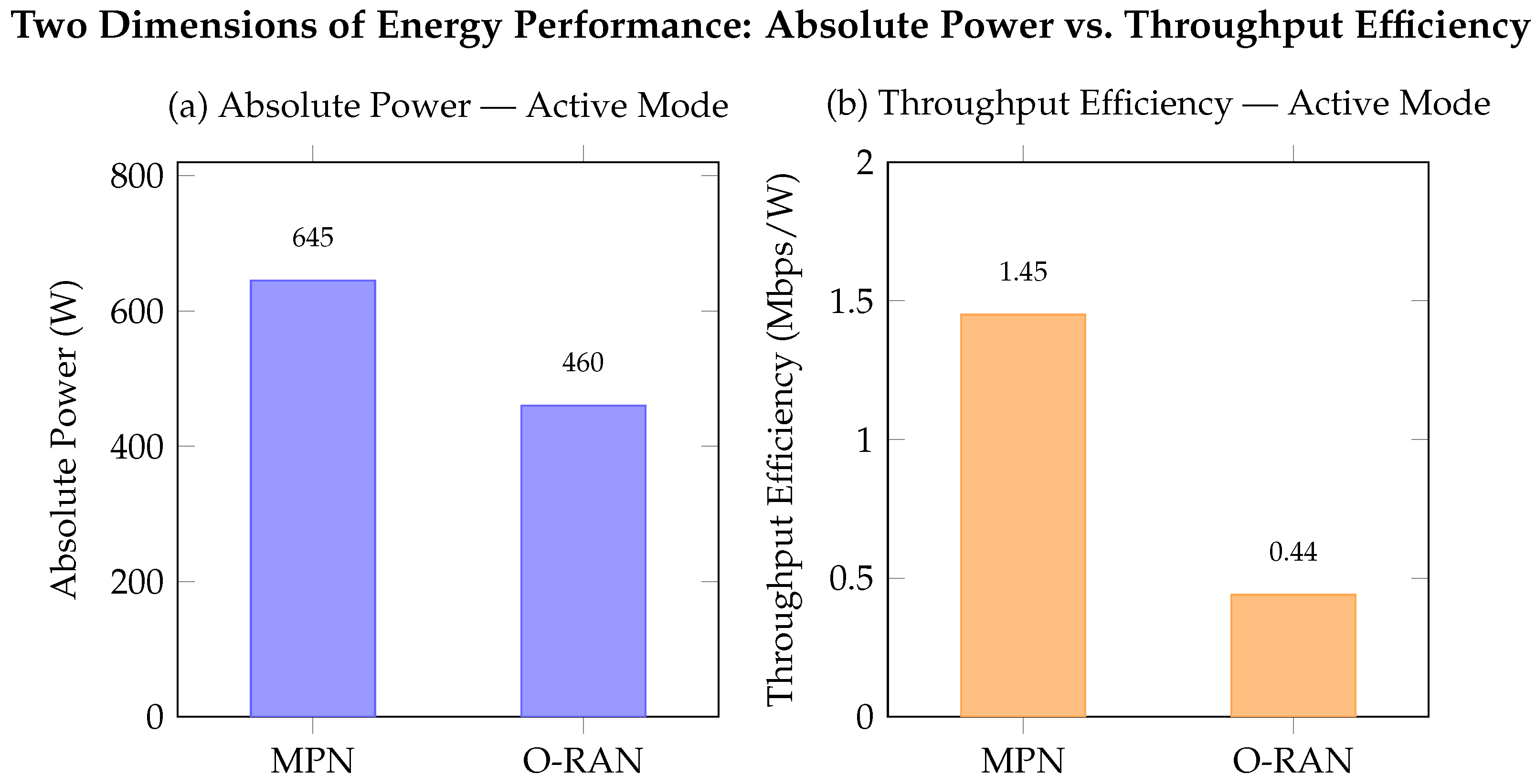
The MPN system is more cost-effective in this controlled high-throughput scenario, delivering over three times the speed per pound of energy expenditure. In terms of energy per bit, the MPN consumes 0.69 nJ/bit versus the O-RAN’s 2.28 nJ/bit; however, as noted in Section 4.2, this gap is predominantly driven by the throughput differential (936 Mbps vs. 202 Mbps) arising from the non-equivalent RF configurations rather than from architectural differences in power draw alone. The idle-to-active power ratio offers a more configuration-neutral comparison: the MPN retains 96% of its active power at idle (indicating a largely static power baseline), whereas the O-RAN retains 82% (indicating greater capability to scale down under low load). This advantage is contingent on the configurations tested: the MPN operated at 936 Mbps on n77 band with 2 × 2 MIMO, while the O-RAN operated at 202 Mbps on n78 band with 4 × 4 MIMO. These are not equivalent configurations, and the throughput efficiency and energy-per-bit gaps reflect these hardware differences as much as architectural ones. Under low-load or IoT conditions where the O-RAN’s virtualisation advantages are more pronounced, the efficiency rankings may differ. Table 7 summarises all key efficiency metrics for both systems. Figure 5 visualises the two primary efficiency dimensions side by side to avoid conflating them.
Table 7.
Comparative summary of MPN and O-RAN systems (values rounded for presentation). Throughput efficiency () and energy per bit () reflect the tested configurations and should not be interpreted as architecture-level rankings; both are substantially influenced by the throughput differential (936 Mbps vs. 202 Mbps) arising from non-equivalent RF conditions. The idle-to-active power ratio () is less sensitive to throughput and reflects each system’s ability to scale down under reduced load.
Figure 5.
Two dimensions of energy performance under the tested configurations ( replications; SD < 5% of mean): (a) absolute power consumption in active mode lower is better for idle/low-load deployments; (b) throughput efficiency in Mbps/W higher is better for high-demand deployments. Important: The two systems operated under non-equivalent RF conditions (n77 vs. n78 band; −36 vs. −58 dBm; 936 Mbps vs. 202 Mbps; 2 × 2 vs. 4 × 4 MIMO). The throughput efficiency gap reflects hardware and configuration differences as much as architectural ones and should not be interpreted as a definitive architectural ranking.
5. Discussion
The results indicate that private 5G architectures offer meaningful energy and cost advantages over public deployments under the conditions tested. Before discussing the MPN-versus-O-RAN comparison, it is essential to reiterate the experimental constraints identified in Section 3.3. The two architectures were evaluated under substantially different configurations (936 Mbps vs. 202 Mbps throughput; n77 vs. n78 band; 2 × 2 vs. 4 × 4 MIMO; −36 vs. −58 dBm signal strength), meaning the throughput efficiency difference (1.45 vs. 0.44 Mbps/W) reflects hardware and RF configuration variables as much as architectural ones. The absolute power advantage of the O-RAN (28.7% lower active draw) is more straightforwardly attributable to its lighter, software-defined stack. Both findings are preliminary and should not be interpreted as definitive architectural rankings; they are best understood as initial empirical indicators for the specific enterprise configurations tested. Furthermore, it should be noted that the AI/ML-driven power-saving capabilities of the O-RAN xApp-based sleep management [7] and dApp-level real-time control [8] were not active during trials, meaning the O-RAN measurements represent a conservative energy baseline rather than its full sustainability potential.
With this caveat established, the broader economic comparison against public deployments is on firmer ground, as the private-versus-public differential is large enough to be robust to configuration variability. Extending the cost-effectiveness analysis from Section 4.2 to public base stations (Table 2), we benchmark annual costs using the UK business electricity rate of 26.3 p/kWh [32] and a non-leap year (8760 h).
Public micro-cells, suitable for urban densification similar to private enterprise setups, incur £2666 annually under full load (1157 W) and £1991 idle (864 W). Macro-cells, for broad coverage, escalate dramatically to £24,882 active (10.8 kW) and £13,829 idle (6 kW). In contrast, private systems yield markedly lower OPEXs: theMPN at £1486 active (645 W) and £1428 idle (620 W); the O-RAN at £1060 active (460 W) and £871 idle (378 W). This translates to 44% and 60% reductions for active loads relative to micro-cells (MPN and O-RAN, respectively), and 28% and 56% for idle modes.
These savings stem from private networks’ tailored designs, which minimise site proliferation and enable dynamic scaling absent in public infrastructures burdened by ubiquitous coverage mandates [3]. While public networks benefit from economies of scale in shared maintenance (Table 1), long-term viability is undermined by their higher per-site power, which is caused by over-provisioning for variable loads, particularly in light of growing electricity costs and net-zero pressures. As shown in Table 8, private architectures consistently outperform public ones economically, with the O-RAN offering the lowest OPEX for scalable IoT deployments.
Table 8.
Annual energy costs for public vs. private 5G sites (GBP at 26.3 p/kWh).
Performance-normalised economics further favour the private MPN in this lab setting, with a cost-effectiveness of 0.63 Mbps/GBP (936 Mbps at £1486/year), surpassing measured public Glasgow averages (669 Mbps at £2666/year yields ≈ 0.25 Mbps/GBP for micro-cells [31]). The O-RAN’s 0.19 Mbps/GBP reflects lab-specific throughput (202 Mbps), but its lower absolute power draw and virtualisation potential make it particularly suited to IoT and low-load scenarios, with the 60% OPEX reduction relative to public micro-cells (active load) derived directly from Table 8. For enterprises, private architectures thus provide superior ROI in this configuration, reducing total ownership costs by 15–33% through attenuated infrastructure and AI-optimised dormancy [17], while public deployments suit mass-market scalability at elevated grid strain. Hybrid models could optimise this trade-off, aligning economic efficiency with UK decarbonisation goals.
Scope of the Cost Analysis. The analysis above considers only annual electricity expenditure (OPEX) and does not constitute a full Total Cost of Ownership (TCO) assessment. Real-world private 5G deployments also incur capital expenditure (CAPEX) for hardware procurement and site preparation; Ofcom Shared Access Licence fees for the MPN; software licensing; ongoing maintenance; and particularly for O-RAN, compute infrastructure costs associated with virtualised network functions, which scale with deployment size and the number of active slices. The O-RAN architecture’s reliance on cloud-native compute nodes (three MX-PDK nodes in the DCIC testbed) introduces infrastructure costs not reflected in the electricity bill alone. The electricity-cost advantage of O-RAN (£1060 vs. £1486 annually) may therefore be partially or fully offset by higher compute OPEX at scale. A rigorous TCO comparison encompassing CAPEX, maintenance, software licensing, and compute costs is beyond the scope of this controlled laboratory study but is an essential precondition before deployment-level investment decisions can be grounded in this evidence.
Directly Measured versus Literature-Derived Findings. For transparency, the quantities directly measured in this study are: system power consumption (W), download and upload throughput (Mbps), latency (ms), and signal strength (dBm). All other quantitative claims, including CO2 projections from Cheng et al. [3], the 15–33% site reduction estimates [17], the 44–60% OPEX savings relative to public micro-cells (derived by applying the measured private power figures to the literature-reported public baseline), and all sector-level energy saving figures cited in the literature review, are drawn from external sources and were not independently verified in this study. Readers should assign higher confidence to directly measured findings than to literature-derived estimates.
6. Conclusions
6.1. Summary of Key Findings
This study provides preliminary empirical evidence that private 5G architectures, specifically the MPN and O-RAN, under the tested laboratory configurations offer meaningful energy and cost advantages over public 5G deployments in controlled single-cell UK conditions. The experimental findings must be interpreted in light of the non-equivalent testbed configurations (Table 4); the results reflect the specific hardware, RF environment, and traffic scenario tested and should not be generalised as definitive architectural rankings.
Within these constraints, the trials indicate that the O-RAN achieves a lower absolute power footprint (460 W active, 378 W idle) compared to the MPN (645 W active, 620 W idle). The throughput efficiency advantage of the MPN (1.45 Mbps/W vs. the O-RAN’s 0.44 Mbps/W) is substantially attributable to the higher throughput achieved under its n77 band configuration (936 Mbps vs. 202 Mbps) rather than exclusively to architectural superiority; under load-normalised or RF-equivalent conditions, this gap would be expected to narrow. Both private architectures demonstrate substantially lower annual electricity costs (£1060–£1486) than the literature-reported public micro-cell benchmarks (£1991–£2666 [3]), a finding that is robust to the configuration differences given the magnitude of the savings. Session continuity was 100% across all controlled trials for both systems, reflecting stable short-duration lab conditions; this cannot be extrapolated to a long-term five-nines availability guarantee. Socially, private networks’ tailored design enables the low-latency, high-throughput connectivity that supports workforce upskilling and industrial automation capabilities that public 5G’s shared, contention-prone infrastructure cannot consistently guarantee under load.
Regarding the carbon context: Cheng et al. [3] project that UK 5G network operations will generate 795,347 tonnes (low-demand), 990,404 tonnes (medium-demand), and 1,260,532 tonnes (high-demand) of CO2 annually by 2030, driven primarily by micro-cell proliferation and natural-gas-based electricity generation. Private deployment, by reducing site proliferation by 15–33% through purpose-built demand-scaled infrastructure [17], could displace a meaningful portion of this footprint. The scale of that displacement depends on the pace and extent of national private adoption, grid carbon intensity trends, and traffic demand variables that lie beyond the scope of this controlled study. By benchmarking against public network disparities (Table 1) and UK baselines (Table 2), private architectures emerge as economically viable and potentially lower-carbon alternatives for enterprise deployment, while a full environmental lifecycle assessment, including embodied carbon, e-waste, and compute energy, remains to be conducted.
6.2. Opportunities for Sustainable 5G Deployments in the UK
The findings of this study, situated within the broader green 5G literature [1,2], suggest that private 5G architectures represent a promising direction for UK enterprise connectivity that merits further investigation. Economically, the O-RAN’s open interfaces and the MPN’s dedicated network slicing may substantially reduce OPEXs through reduced infrastructure sprawl and AI-optimised dormancy, evidenced by Vodafone-Ericsson trials, achieving 33% daily power cuts [18] and by intelligent xApp deployment and demonstrating up to 50% power savings under low-load conditions [7]. The electricity cost savings observed in this study (44–60% vs. public microcells) provide one empirical data point supporting this direction, though a comprehensive TCO comparison including CAPEX, maintenance, software licensing, and compute infrastructure costs would be required before these savings can be relied upon for investment decisions.
Socially, private networks are well positioned to bridge digital divides more effectively than public 5G’s one-size-fits-all model, enabling purpose-deployed, low-latency connectivity for remote education, workforce upskilling, and inclusive industrial participation (SDGs 4 and 8). In sectors like transport and renewables, MPNs may enable IoT-driven decarbonisation, contributing to projected 15% emissions cuts by 2030 [11] and fostering job growth through AR-enhanced training and predictive maintenance that public networks’ variable performance hinders. Policymakers should consider Ofcom incentives for private spectrum access and O-RAN pilots under the 5G Testbeds Programme, embedding triple-bottom-line principles to balance economic efficiency with social equity and environmental stewardship while commissioning the longitudinal multi-UE field trials needed to move beyond the preliminary evidence presented here.
6.3. Alignment with UN Sustainable Development Goals
Private 5G deployments are well positioned to advance multiple SDGs, particularly through economic empowerment and social inclusion that public networks struggle to match owing to their broad, less customisable coverage. For SDG 8 (Decent Work & Economic Growth), private architectures’ high-throughput, low-latency connectivity enables AR/VR-based workforce training and remote collaboration capabilities that industrial IoT and predictive maintenance applications require, and which public networks operating under shared load cannot consistently deliver [27]. The high session continuity observed in the controlled trials is consistent with the deterministic connectivity requirements of these use cases, though field validation at scale remains necessary. SDG 9 (Industry, Innovation & Infrastructure) is advanced through URLLC for time-critical industrial control, mMTC for dense IoT deployments, and network slicing for simultaneous multi-application delivery within a single physical infrastructure [6] capabilities is validated in principle by the private 5G architectures evaluated here.
SDG 4 (Quality Education) benefits from the high-bandwidth, low-latency properties of private 5G, enabling immersive remote learning and purpose-deployed campus connectivity. SDG 12 (Responsible Consumption & Production) and SDG 13 (Climate Action) are advanced through the reduced energy consumption and site proliferation evidenced by the electricity cost savings in this study and contextualised against Cheng et al.’s [3] projections of 795,347–1,260,532 tonnes of CO2 from UK 5G operations by 2030. Private deployment’s potential to reduce that footprint through demand-scaled infrastructure represents a concrete pathway towards SDG 13 targets, provided it is accompanied by the renewable energy integration and lifecycle assessment work identified as a research priority. This synergy positions private 5G as a significant candidate enabler of the 2030 Agenda, provided hybrid models address spectrum equity and the research gaps below are resolved.
6.4. Recommendations and Future Research Directions
Based on the preliminary empirical evidence presented here, hybrid O-RAN–MPN pilots should be pursued in key sectors such as manufacturing and ports, leveraging AI-driven power management, including xApp-based Radio Card sleep control [7] and dApp-level real-time inference [8], to realise the energy savings that the static configurations tested in this study could not fully capture. Under the configurations tested, the MPN demonstrated higher throughput efficiency (1.45 Mbps/W) suited to high-demand enterprise contexts, while the O-RAN demonstrated lower absolute power consumption (460 W active) appropriate for low-load or IoT scenarios; these observations are however configuration-specific and should not be treated as universal deployment guidance. Governments and regulators should consider mandating triple-bottom-line reporting in private 5G licensing frameworks to promote transparency and incentivise sustainable private network uptake.
Future research should prioritise: (1) multi-UE field trials under diverse traffic profiles including uplink, mixed DL/UL, and IoT small-packet loads to validate the scalability of the energy savings observed here; (2) RF-normalised architectural comparisons using matched bands and equivalent signal quality to isolate architectural from configuration effects; (3) full TCO analyses incorporating CAPEX, maintenance, software licensing, and compute costs for both MPN and O-RAN; (4) longitudinal session continuity measurement over extended periods to substantiate availability claims; (5) equivalent thermal profiling of both MPN and O-RAN radio units to enable a fair hardware efficiency comparison; and (6) lifecycle assessment of O-RAN component e-waste and embodied carbon. Probing mmWave and THz integration, including hybrid diversity-combining schemes that improve URLLC reliability in high-frequency bands [29] and renewable energy co-deployment, will further refine carbon impact projections, advancing private 5G from a promising preliminary finding towards a robustly evidenced contributor to UK net-zero connectivity.
Author Contributions
Conceptualisation, A.H. and H.S.; Methodology, A.H. and H.S.; Validation, A.H. and H.S.; Formal analysis, A.H.; Investigation, A.H. and H.S.; Data curation, A.H.; Writing—original draft, A.H., H.S. and P.M.; Writing—review and editing, A.H., H.S., P.M., P.S.-G. and M.Z.S.; Supervision, P.S.-G. and M.Z.S.; Project administration, P.S.-G. and M.Z.S.; Funding acquisition, M.Z.S. All authors have read and agreed to the published version of the manuscript.
Funding
This research and its open-access publication were supported by the University of the West of Scotland. Private 5G testbed data were funded through The Department for Science, Innovation and Technology’s (DSIT) Ayrshire 5GIR project through the Digital Connectivity and Innovation Centre (DCIC) set up by UWS (no grant number).
Data Availability Statement
The original contributions presented in this study are included in the article. Further inquiries can be directed to the corresponding author.
Conflicts of Interest
The authors declare no conflicts of interest.
Abbreviations
The following abbreviations are used in this manuscript:
| 5G | Fifth Generation |
| AI | Artificial Intelligence |
| CAPEX | Capital Expenditure |
| DCIC | Digital Connectivity and Innovation Centre |
| dApp | Distributed Application (O-RAN) |
| eMBB | Enhanced Mobile Broadband |
| ERP | Effective Radiated Power |
| FL | Federated Learning |
| IoT | Internet of Things |
| IRU | Indoor Radio Unit |
| MEC | Multi-Access Edge Computing |
| MIMO | Multiple Input Multiple Output |
| ML | Machine Learning |
| mMTC | Massive Machine Type Communications |
| MPN | Mobile Private Network |
| NPN | Non-Public Network |
| O-RAN | Open Radio Access Network |
| OPEX | Operational Expenditure |
| O-RU | Open Radio Unit |
| PLMN | Public Land Mobile Network |
| QoS | Quality of Service |
| RAN | Radio Access Network |
| RC | Radio Card |
| RIC | RAN Intelligent Controller |
| ROI | Return on Investment |
| RU | Radio Unit |
| SA | Standalone |
| SDG | Sustainable Development Goal |
| TBL | Triple Bottom Line |
| TCO | Total Cost of Ownership |
| UE | User Equipment |
| UN | United Nations |
| URLLC | Ultra-Reliable Low-Latency Communication |
| xApp | Near-Real-Time RIC Application |
| Throughput efficiency (Mbps/W) | |
| Energy per bit (nJ/bit) | |
| Idle-to-active power ratio | |
| Cost-effectiveness (Mbps/GBP) |
References
- Masoudi, M.; Khafagy, M.G.; Conte, A.; El-Amine, A.; Françoise, B.; Nadjahi, C.; Salem, F.E.; Labidi, W.; Süral, A.; Gati, A.; et al. Green Mobile Networks for 5G and Beyond. IEEE Access 2019, 7, 107270–107299. [Google Scholar] [CrossRef] [Scilit]
- Shehab, M.J.; Kassem, I.; Kutty, A.A.; Kucukvar, M.; Onat, N.C.; Khattab, T. 5G Networks Towards Smart and Sustainable Cities: A Review of Recent Developments, Applications and Future Perspectives. IEEE Access 2022, 10, 2987–3006. [Google Scholar] [CrossRef] [Scilit]
- Cheng, X.; Hu, Y.; Varga, L. 5G network deployment and the associated energy consumption in the UK: A complex systems’ exploration. Technol. Forecast. Soc. Change 2022, 180, 121672. [Google Scholar] [CrossRef] [Scilit]
- Department for Science, Innovation and Technology; Ayrshire Innovation Region. Local Innovation Partnerships Fund: Supporting Evidence, Section 4–Strategic Vision and Priority Cluster; Application Supporting Evidence APP102147; Includes Location Quotient Analysis of Aerospace and Advanced Manufacturing Employment in Ayrshire Relative to Scottish National Averages, Sourced from Business Register and Employment Survey (BRES), Department for Business and Trade (DBT). Cluster Mapping Data Sourced from DSIT Cluster Maps. Available from Ayrshire Innovation Region/LIPF Application Documentation; Department for Science, Innovation and Technology (DSIT): Ayrshire, UK, 2025. [Google Scholar]
- Sturley, H.; Salva-Garcia, P.; Salau, N.; Zhu, Y.; Vichare, P.; Shakir, M.Z. 5G MPN Design and Deployment: Challenges and opportunities for Industrial Use Cases. In Proceedings of the 2025 International Conference on Software, Knowledge, Information Management & Applications (SKIMA), Paisley, UK, 9–11 June 2025; pp. 1–6. [Google Scholar] [CrossRef] [Scilit]
- Wen, M.; Li, Q.; Kim, K.J.; López-Pérez, D.; Dobre, O.A.; Poor, H.V.; Popovski, P.; Tsiftsis, T.A. Private 5G Networks: Concepts, Architectures, and Research Landscape. IEEE J. Sel. Top. Signal Process. 2022, 16, 7–25. [Google Scholar] [CrossRef] [Scilit]
- Liang, X.; Al-Tahmeesschi, A.; Wang, Q.; Chetty, S.; Sun, C.; Ahmadi, H. Enhancing Energy Efficiency in O-RAN Through Intelligent xApps Deployment. In Proceedings of the 2024 11th International Conference on Wireless Networks and Mobile Communications (WINCOM), Leeds, UK, 23–25 July 2024; IEEE: Piscataway, NJ, USA, 2024; pp. 1–6. [Google Scholar] [CrossRef] [Scilit]
- D’Oro, S.; Polese, M.; Bonati, L.; Cheng, H.; Melodia, T. dApps: Distributed Applications for Real-Time Inference and Control in O-RAN. IEEE Commun. Mag. 2022, 60, 52–58. [Google Scholar] [CrossRef] [Scilit]
- Li, X.; Rao, A.; Sundaresan, K.; Henttonen, T.; Tirronen, T. Toward Energy Efficient RAN: From Industry Standards to Trending Practice. IEEE Wirel. Commun. 2025, 32, 36–43. [Google Scholar] [CrossRef] [Scilit]
- Nickerson, C.; Allford, J.; Osman, S.; Stewart, J.; Florez, F.; Weekes, M.; Marlow, D. Report for Department for Digital, Culture, Media and Sport (DCMS) Ensuring Future Wireless Connectivity Needs Are Met; Analysys Mason: London, UK, 2022. [Google Scholar]
- Ericsson. Meeting 5G Promises Using Tailored Connectivity; Ericsson: Stockholm, Sweden, 2024. [Google Scholar]
- OECD. Digital Economy Outlook 2024 (Volume 2); OECD: Paris, France, 2024. [Google Scholar]
- OECD. Digital Economy Papers the Environmental Sustainability of Communication Networks; OECD: Paris, France, 2025. [Google Scholar]
- Williams, L.; Sovacool, B.K.; Foxon, T.J. The energy use implications of 5G: Reviewing whole network operational energy, embodied energy, and indirect effects. Renew. Sustain. Energy Rev. 2022, 157, 112033. [Google Scholar] [CrossRef] [Scilit]
- What Is 5G Energy Consumption? VIAVI Solutions Inc.: Chandler, AZ, USA, 2025.
- 5G Will Prompt Energy Consumption to Grow by Staggering 160% in 10 Years; Datacenter Forum: Mariestad, Sweden, 2021.
- How Private 5G Networks Are Creating a Leaner, Greener Industries; techUK: London, UK, 2025.
- Ericsson. Vodafone UK and Ericsson Trial AI Solutions for Improved 5G Energy Efficiency; Ericsson: Stockholm, Sweden, 2025. [Google Scholar]
- BT Group. Carbon Reduction Plan: Our Targets; BT Group: London, UK, 2021; Available online: https://www.bt.com/bt-plc/assets/documents/digital-impact-and-sustainability/our-approach/our-policies-and-reports/bt-carbon-reduction-plan.pdf (accessed on 24 October 2025).
- Zhu, Y.; Vichare, P.; Shakir, M.Z.; Sturley, H.; Salva-Garcia, P.; Salau, N. 5G Network for Aerospace Sector: An Economic Review. In Proceedings of the 2025 International Conference on Software, Knowledge, Information Management & Applications (SKIMA), Paisley, UK, 9–11 June 2025; pp. 1–7. [Google Scholar] [CrossRef] [Scilit]
- Eswaran, S.; Honnavalli, P. Private 5G networks: A survey on enabling technologies, deployment models, use cases and research directions. Telecommun. Syst. 2022, 82, 3–26. [Google Scholar] [CrossRef] [Scilit] [PubMed]
- Bockelmann, C.; Pratas, N.K.; Wunder, G.; Saur, S.; Navarro, M.; Gregoratti, D.; Vivier, G.; De Carvalho, E.; Ji, Y.; Stefanovic, C.; et al. Towards Massive Connectivity Support for Scalable mMTC Communications in 5G Networks. IEEE Access 2018, 6, 28969–28992. [Google Scholar] [CrossRef] [Scilit]
- Energy Efficiency and Sustainability in Mobile Communications Networks; 5G Americas: Bellevue, WA, USA, 2023.
- Giannopoulos, A.; Levis, G.A.; Kosmatos, E.; Xilouris, G.; Tranoris, C.; Denazis, S. FedRA: A Fully Decentralized Federated Learning Framework for Robust Intelligence Sharing across O-RAN dApps. IEEE Commun. Mag. 2026. Early Access. [Google Scholar] [CrossRef] [Scilit]
- The Sustainable Organization; Springer International Publishing: Berlin/Heidelberg, Germany, 2025. [CrossRef] [Scilit]
- Bachmann, N.; Tripathi, S.; Brunner, M.; Jodlbauer, H. The Contribution of Data-Driven Technologies in Achieving the Sustainable Development Goals. Sustainability 2022, 14, 2497. [Google Scholar] [CrossRef] [Scilit]
- Kaplan, A.D.; Cruit, J.; Endsley, M.; Beers, S.M.; Sawyer, B.D.; Hancock, P.A. The Effects of Virtual Reality, Augmented Reality, and Mixed Reality as Training Enhancement Methods: A Meta-Analysis. Hum. Factors J. Hum. Factors Ergon. Soc. 2020, 63, 706–726. [Google Scholar] [CrossRef] [Scilit] [PubMed]
- Morales Méndez, G.; del Cerro Velázquez, F. Augmented Reality in Industry 4.0 Assistance and Training Areas: A Systematic Literature Review and Bibliometric Analysis. Electronics 2024, 13, 1147. [Google Scholar] [CrossRef] [Scilit]
- Alhulayil, M.; Aqoulah, M.A.; López-Benítez, M.; Al-Mistarihi, M.F.; Alammar, M.; Al Ayidh, A. Integrated THz/mmWave Transmission Method for Enhanced URLLC Communications. IEEE Access 2025, 13, 62914–62929. [Google Scholar] [CrossRef] [Scilit]
- Filho, W.L.; Kautish, S.; Wall, T.; Rewhorn, S.; Paul, S.K. (Eds.) Digital Technologies to Implement the UN Sustainable Development Goals; Springer: Berlin/Heidelberg, Germany, 2024. [Google Scholar] [CrossRef] [Scilit]
- Hart, A.E. Glasgow 5G Dataset 2025; University of the West of Scotland: Paisley, UK, 2026. [Google Scholar] [CrossRef]
- Bolton, P. Gas and Electricity Prices During the ‘Energy Crisis’ and Beyond; The House of Commons Library: London, UK, 2025. [Google Scholar]
Disclaimer/Publisher’s Note: The statements, opinions and data contained in all publications are solely those of the individual author(s) and contributor(s) and not of MDPI and/or the editor(s). MDPI and/or the editor(s) disclaim responsibility for any injury to people or property resulting from any ideas, methods, instructions or products referred to in the content. |

© 2026 by the authors. Licensee MDPI, Basel, Switzerland. This article is an open access article distributed under the terms and conditions of the Creative Commons Attribution (CC BY) license.