Article

Characterization of a Bow-Tie Antenna Integrated UTC-Photodiode on Silicon Carbide for Terahertz Wave Generation


1
Graduate School of Information Science and Electrical Engineering, Kyushu University, Fukuoka 819-0395, Japan
2
School of Engineering and Technology, Soroti University, Soroti P.O. Box 211, Uganda
3
National Institute of Advanced Industrial Science and Technology (AIST), Tsukuba 305-8565, Japan
*
Author to whom correspondence should be addressed.
Submission received: 26 November 2025 / Revised: 26 December 2025 / Accepted: 7 January 2026 / Published: 12 January 2026

Abstract

This work presents the fabrication and characterization of a bow-tie antenna integrated uni-traveling carrier photodiode (UTC-PD) on a silicon carbide (SiC) substrate for efficient terahertz (THz) wave generation. The proposed device exploits the superior thermal conductivity and mechanical robustness of SiC to overcome the self-heating limitations associated with conventional indium phosphide (InP)-based photodiodes. An epitaxial layer transfer technique was utilized to bond InP/InGaAs UTC-PD structures onto SiC. The study systematically examines the influence of critical geometric parameters, specifically the mesa diameter and length between the antenna arms, on the emitted THz intensity in the 300 GHz frequency band. Experimental results show that the THz radiation efficiency is primarily governed by the mesa diameter, reflecting the trade-off between light absorption, device capacitance, and bandwidth, while the length between the antenna arms exhibits only a weak influence within the investigated parameter range. The fabricated device demonstrates strong linearity between photocurrent and THz output power up to 7.5 mA, after which saturation occurs due to space-charge effects. This work provides crucial insights for optimizing SiC-based bow-tie antenna integrated UTC-PD devices to realize robust, high-power THz sources vital for future high-data-rate wireless communication systems such as beyond 5G and 6G networks.

1. Introduction

The terahertz (THz) spectrum occupies a unique region of the electromagnetic spectrum situated between the microwave and infrared bands, spanning approximately from 0.1 to 10 THz. This unique spectral region has garnered significant attention from both academic and industrial sectors, particularly for its transformative potential in next-generation wireless communication systems, including Beyond 5G and 6G networks [1,2,3,4,5,6]. The paramount appeal of THz frequencies lies in their exceptionally wide bandwidth, which is a critical enabler for the ultra-high data transmission rates demanded by future wireless infrastructures. Over the past two decades, remarkable experimental progress has solidified the promise of THz frequencies for communication systems, with data rates already surpassing 100 Gbit/s. These groundbreaking achievements have been realized through the evolution of diverse device technologies. These include III-V heterojunction bipolar transistors (HBTs) [7,8], high-electron mobility transistors (HEMTs) [9,10], complementary metal-oxide-semiconductor (CMOS) circuits [11,12], and advanced photonic transmitters [13,14,15,16,17,18].
Among these, photonic transmitters, particularly those employing photomixing techniques [19,20,21,22], stand out as a highly promising avenue for THz wave generation. Photomixing operates on the principle of combining two optical waves with slightly different frequencies within an optical coupler, which results in the generation of an optical beat signal at the desired THz frequency. This optical beat is then converted into a corresponding alternating electrical current by a photomixer device, such as a photodiode. This method offers several distinct advantages, including broad frequency tunability, exceptionally narrow spectral linewidth, and excellent frequency stability, alongside the capability for low-loss signal transmission via flexible optical fibers. Furthermore, the utilization of long-wavelength light (~1.55 µm) is particularly beneficial. This choice allows for seamless integration with a vast array of readily available optical components originally developed for conventional optical communication systems, thereby significantly enhancing the cost-effectiveness and practicality of the overall setup. However, the successful implementation of such a system critically hinges on the availability of a photomixer that combines both high-speed response and substantial output current capabilities. The uni-traveling carrier photodiode (UTC-PD) emerges as an ideal candidate, fulfilling these stringent requirements with its broad 3-dB bandwidth and impressive saturation output current [23,24,25,26,27].
Moreover, to radiate the generated THz signal into free space, the UTC-PD is commonly integrated with either a rectangular waveguide or a planar antenna structure such as microstrip, slot, log-periodic, or bow-tie antennas depending on the desired operating frequency and application requirements. Furthermore, conventional UTC-PDs are typically fabricated on indium phosphide (InP) substrates since its lattice matched to materials used in the active regions of UTC-PDs, thereby reducing defects and dislocations in the crystal structure. However, InP suffers from a significant drawback of relatively low thermal conductivity (68 W/m/K). This inherent limitation often restricts the maximum achievable photocurrent and output power due to the detrimental effects of self-heating, which can degrade device performance and reliability. To circumvent the thermal bottleneck posed by InP, researchers have increasingly explored high thermal conductivity substrates, with silicon carbide (SiC) presenting itself as a compelling alternative heat sink for integrated III-V photonic devices for terahertz communication [28,29,30,31,32]. SiC boasts a remarkable thermal conductivity of approximately 490 W/m/K, enabling highly efficient heat dissipation and paving the way for significantly higher power operation. Beyond its superior thermal properties, SiC also offers enhanced mechanical robustness [33], making it an excellent foundation for high-performance THz devices operating under demanding conditions. Table 1 compares the key material properties of InP and SiC.
In this article, we present a detailed account of the fabrication and characterization of a UTC-PD monolithically integrated with a bow-tie antenna, on a SiC substrate. Our approach leverages an innovative epitaxial layer transfer technique, moving active layers from InP to SiC using wafer bonding. This meticulous process ensures the preservation of the intrinsic high-speed characteristics of the UTC-PD while simultaneously achieving a substantial enhancement in its thermal performance. The central focus of our investigation is to systematically analyze the influence of critical device parameters, specifically the device mesa diameter and the length between the antenna arms, on the power of the generated THz waves. Through this comprehensive characterization, we aim to provide crucial insights into optimizing the device geometry for efficient and powerful operation specifically around the 300 GHz frequency band. This work represents a significant step towards realizing robust, high-power THz sources for next generation wireless communication applications.

2. Device Design and Fabrication

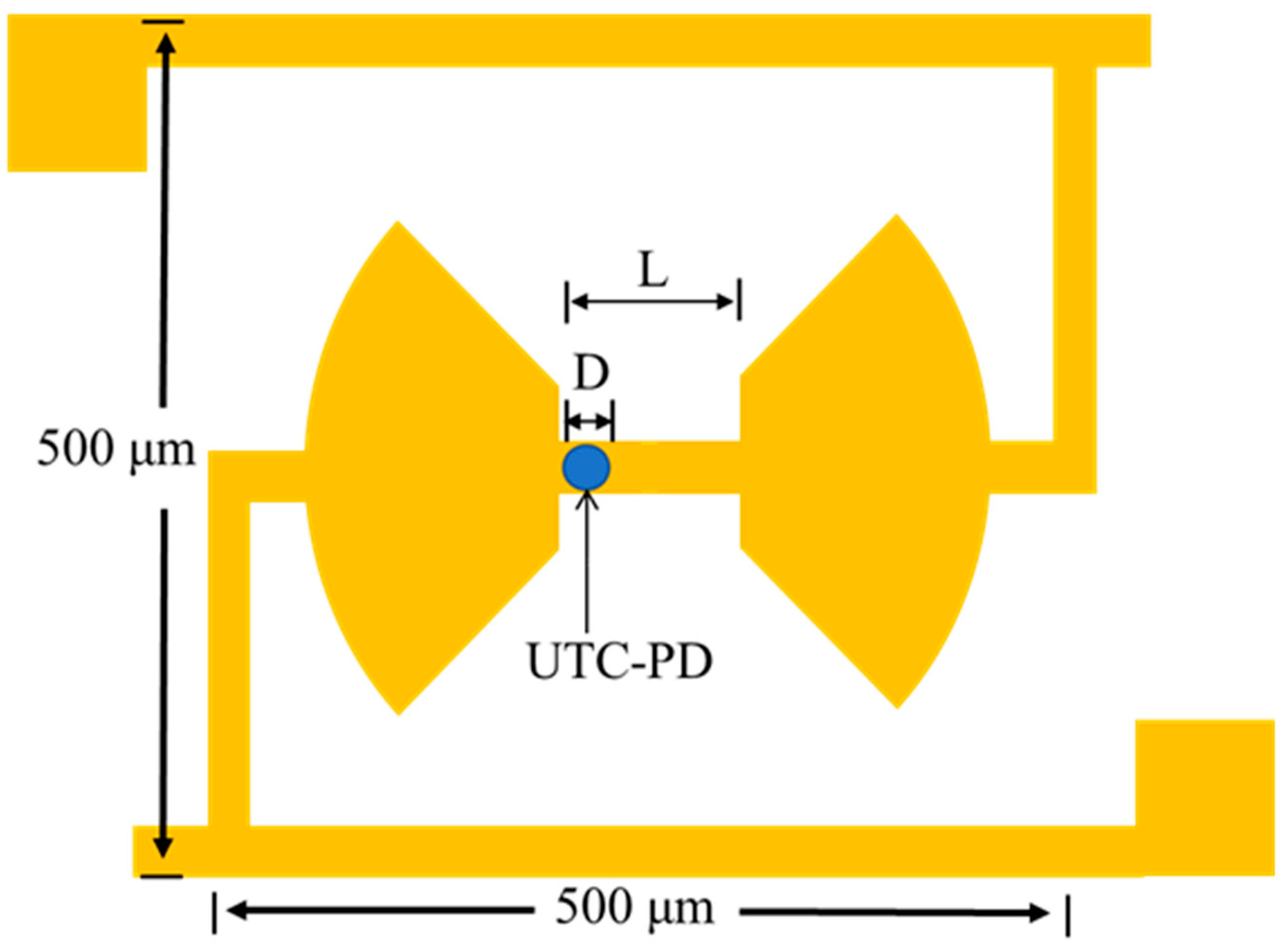
The bow-tie antenna for this work was designed to operate around 300 GHz, corresponding to a half-wavelength of approximately 500 µm. The antenna arms were symmetrically positioned with respect to the UTC-PD mesa located at the feed gap as illustrated in Figure 1. The length between the antenna arms (L) and the mesa diameter (D) which define the device area of the UTC-PD were varied to study their effects on frequency response and output power.
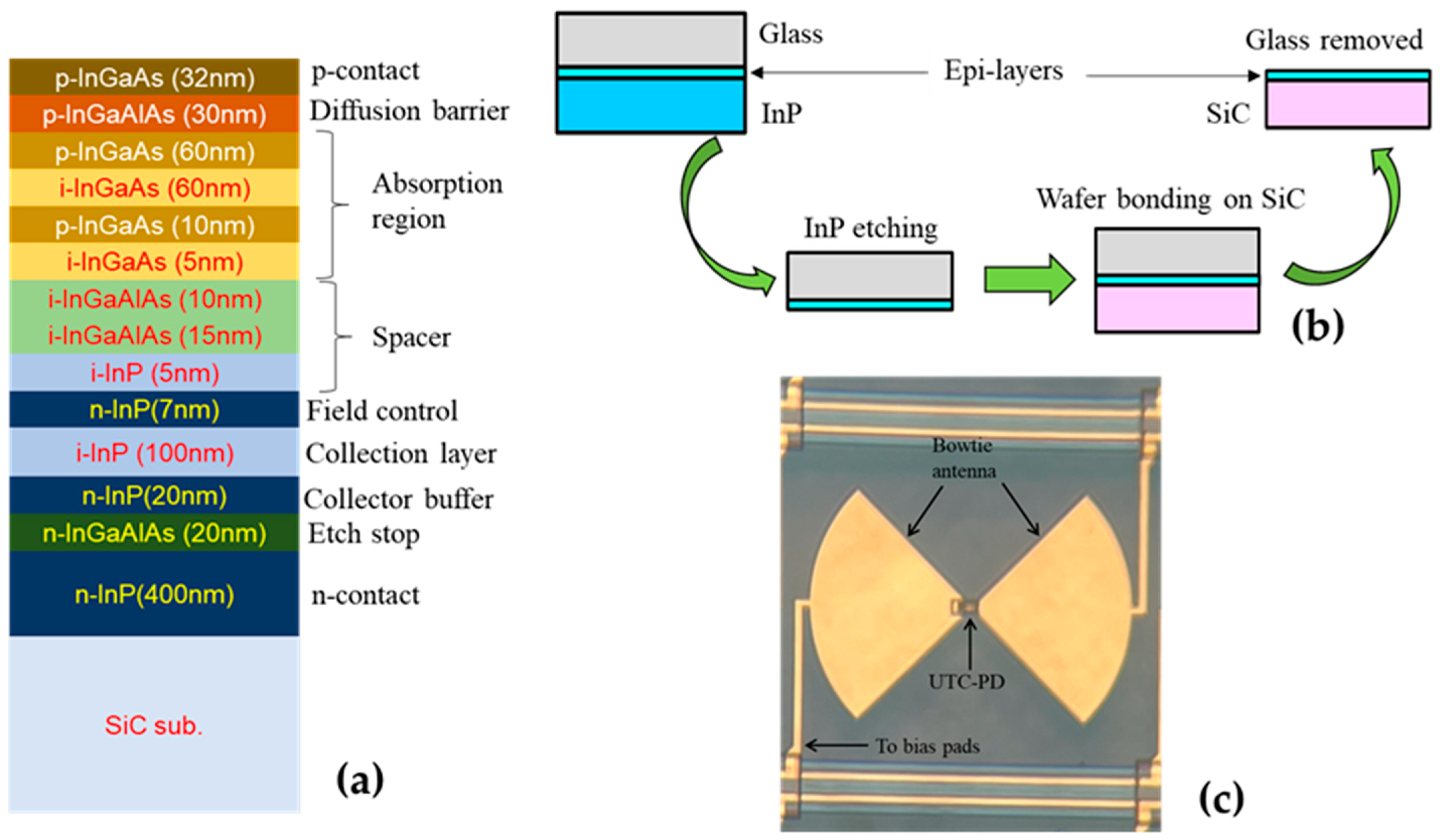
The InP/InGaAs UTC-PD epitaxial layers as shown in Figure 2a were grown by metal–organic chemical vapor deposition (MOCVD) on a semi-insulating InP (100) substrate. The epitaxial structure comprises multiple graded and field-control layers designed to minimize transit time and maximize bandwidth. After growth, the epitaxial wafer was bonded to a SiC substrate at room temperature under high pressure (~20 MPa). The InP substrate was subsequently removed via mechano-chemical polishing and selective chemical etching, leaving the epitaxial layers intact on the SiC substrate as illustrated in Figure 2b.
Following substrate transfer, standard photolithography and metallization processes were used to define the device. The p- and n-type ohmic contacts were formed using Ti/Pt/Au metallization. Mesa structures were defined by wet etching to control the absorption area. To reduce leakage current and improve surface passivation, 5 nm of Al2O3 and 200 nm of SiO2 were deposited by atomic layer deposition (ALD) and plasma-enhanced chemical vapor deposition (CVD), respectively. A planarization layer of benzocyclobutene (BCB) was applied before forming the bow-tie antenna as shown in Figure 2c by electron beam evaporation and lift-off.

3. Experimental Setup

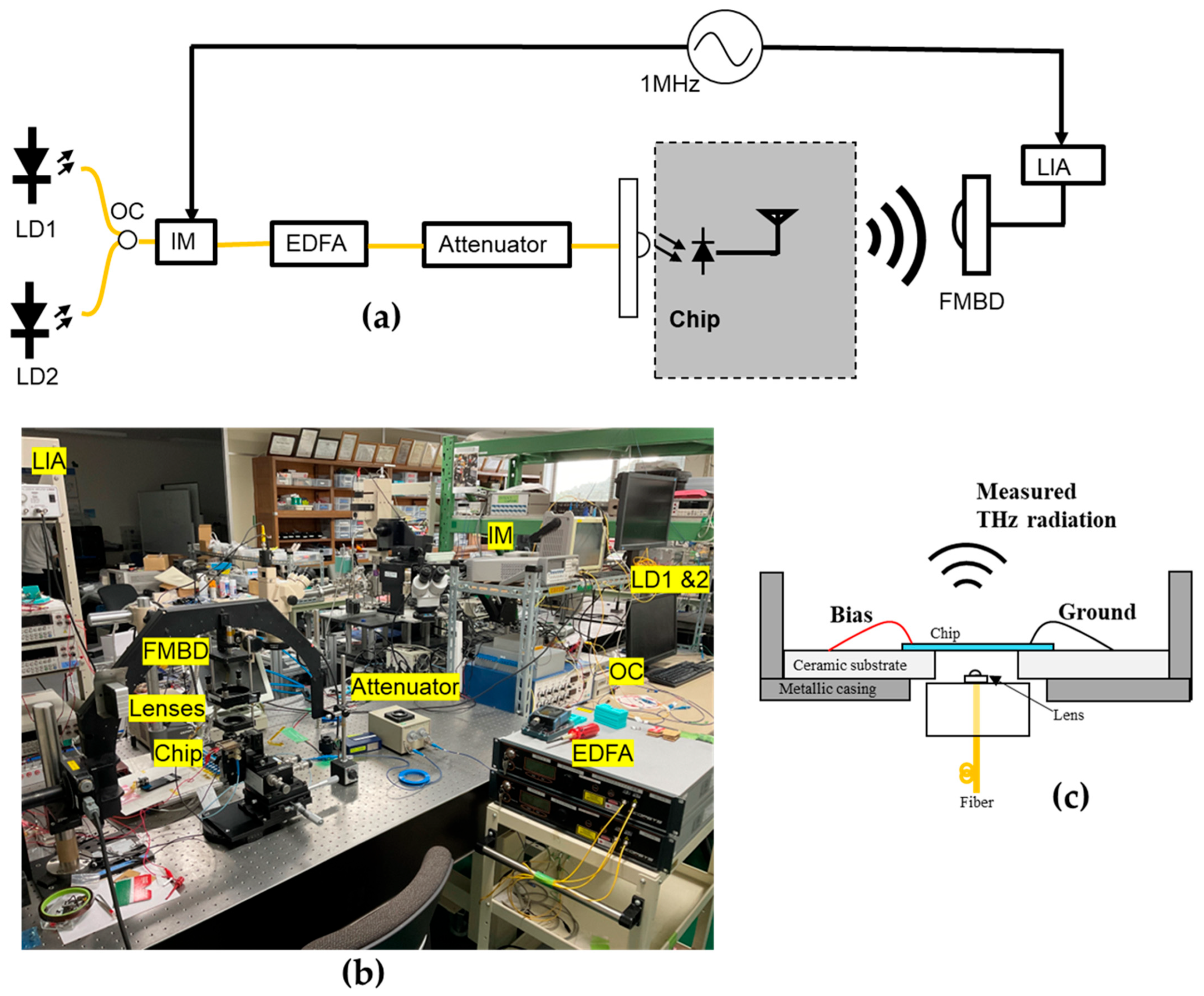
The experimental configuration employed for the characterization of the device is illustrated in Figure 3. Two wavelength-tunable laser diodes, LD1 and LD2, were used to generate optical signals with an output power of 10 dBm. These two optical signals were first combined using an optical coupler (OC) to generate an optical beat signal with a frequency equal to the frequency difference in the two optical signals and subsequently modulated at a frequency of 1 MHz through an intensity modulator (IM). To ensure sufficient optical power for device excitation, the modulated beat signal was further amplified by an Erbium-Doped Fiber Amplifier (EDFA). A variable optical attenuator was then employed to control the incident optical power directed toward the UTC-PD. The optical signal was precisely focused onto the UTC-PD chip using a coupling lens. The UTC-PD then generated an alternating current (AC) signal at a frequency that is equal to the beat signal frequency. The emitted THz radiation was detected by a Fermi-level Managed Barrier Diode (FMBD) [34,35] equipped with two THz lenses having 25 mm aperture positioned 30 mm above the chip. The relative amplitude of the 1 MHz component of the detected THz signal was accurately measured using a lock-in amplifier (LIA) to enhance signal sensitivity and reduce noise.
In this work, back illumination of the UTC-PD was adopted and THz emission from the upward direction was measured. Although the lower side of the chip can also radiate stronger THz power, the upward-emitted intensity was sufficient for the intended analysis. To enable back illumination, the chip was mounted on a gold-coated glass substrate with a thickness of 150 µm and incorporated a narrow slit of approximately 0.3 mm, as depicted in Figure 3c.

4. Results and Discussion

4.1. Frequency Response

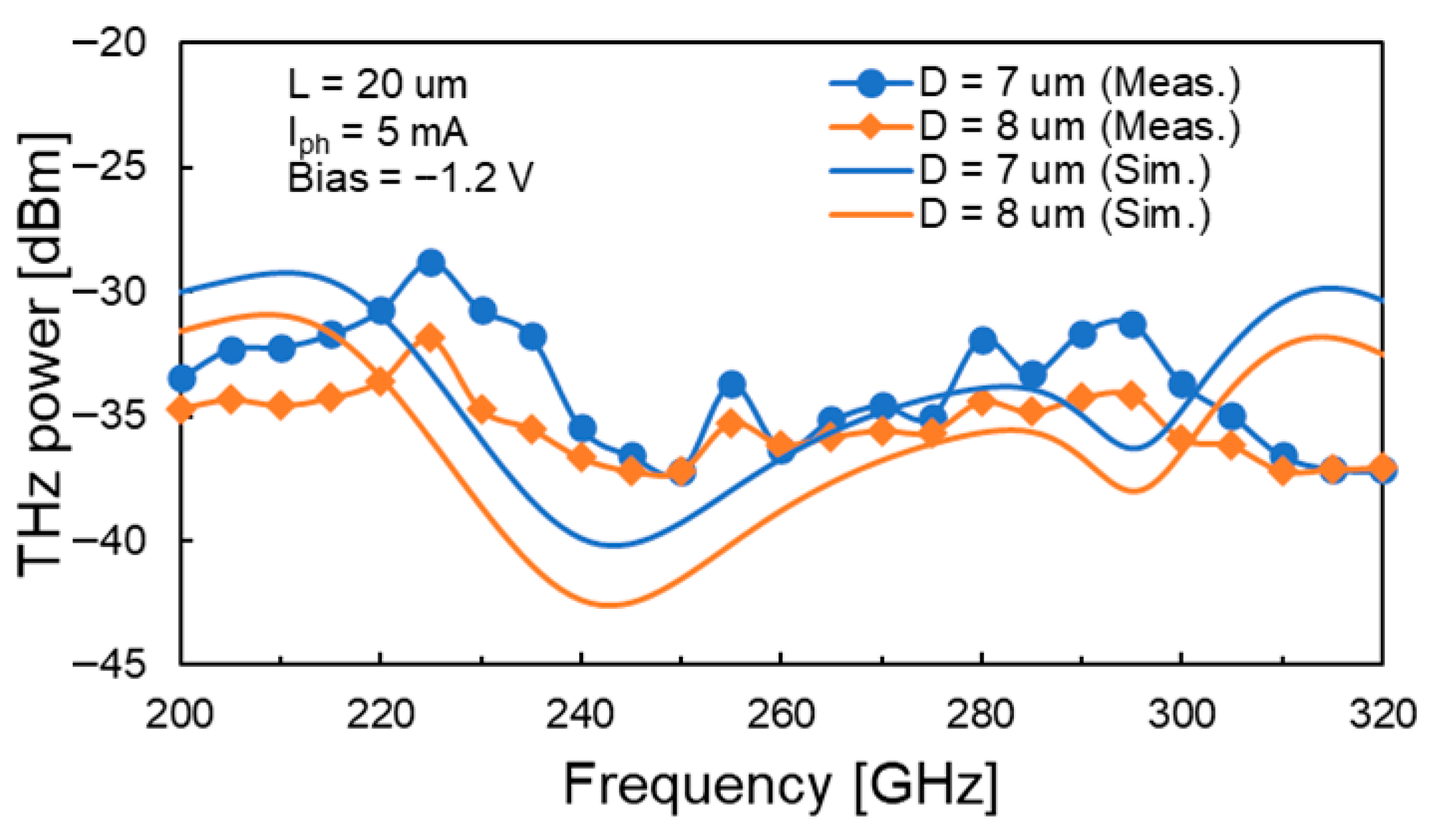
First, the frequency response of the device within the range of 220 GHz to 320 GHz was measured for devices with mesa diameters (D) of 7 µm and 8 µm as shown in Figure 4. These measurements were conducted under a bias voltage of −1.2 V and a photocurrent (Iph) of 5 mA, with L = 20 µm and the detected THz power by the FMBD and LIA is its equivalent absolute value by PM5B power meter calibration without correction for system-level losses.
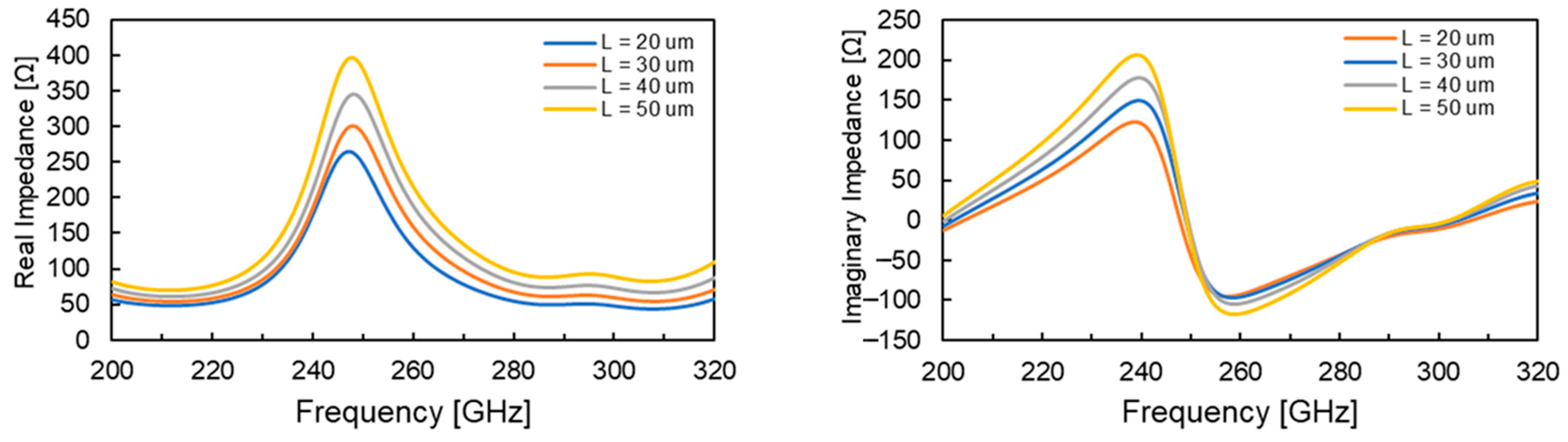
The radiated power from the antenna is largely determined by how efficiently energy is transferred from the driving source to the antenna. Maximum power transfer is achieved when the antenna impedance matches the complex conjugate of the source impedance [36,37]. Therefore, pronounced peaks in the emitted power are expected at frequencies where the reactive components of both the source and antenna impedances possess equal magnitudes but opposite signs, while their real parts are comparable. The simulated antenna input impedance on a 350 μm SiC substrate for different length between the antenna arms L using Ansys HFSS is illustrated in Figure 5.
Several equivalent circuit models for UTC-PDs have been reported in the literature [37,38,39]. Although these models vary in their level of complexity, they consistently incorporate two essential elements: a series resistance and a junction capacitance. When the operating photocurrent is significantly lower than the saturation photocurrent, the resistance Rs and capacitance Cj can respectively be estimated as [40]
Rs = d/(qμAn0),
Cj = (ε0εrA)/d.
Assuming a depletion width d = 0.212 µm, electron charge q = 1.6 × 10⁻¹⁹ C, electron mobility µ = 5000 cm2/Vs, carrier concentration n0 ≈ 1016 cm−3, ε0 = 8.85 × 10⁻¹² F/m and εr = 12, the resulting resistance and capacitance values listed in Table 2 were used in the simulations. While a more accurate model could be obtained by directly measuring the UTC-PD impedance, such measurements were not performed in this study.
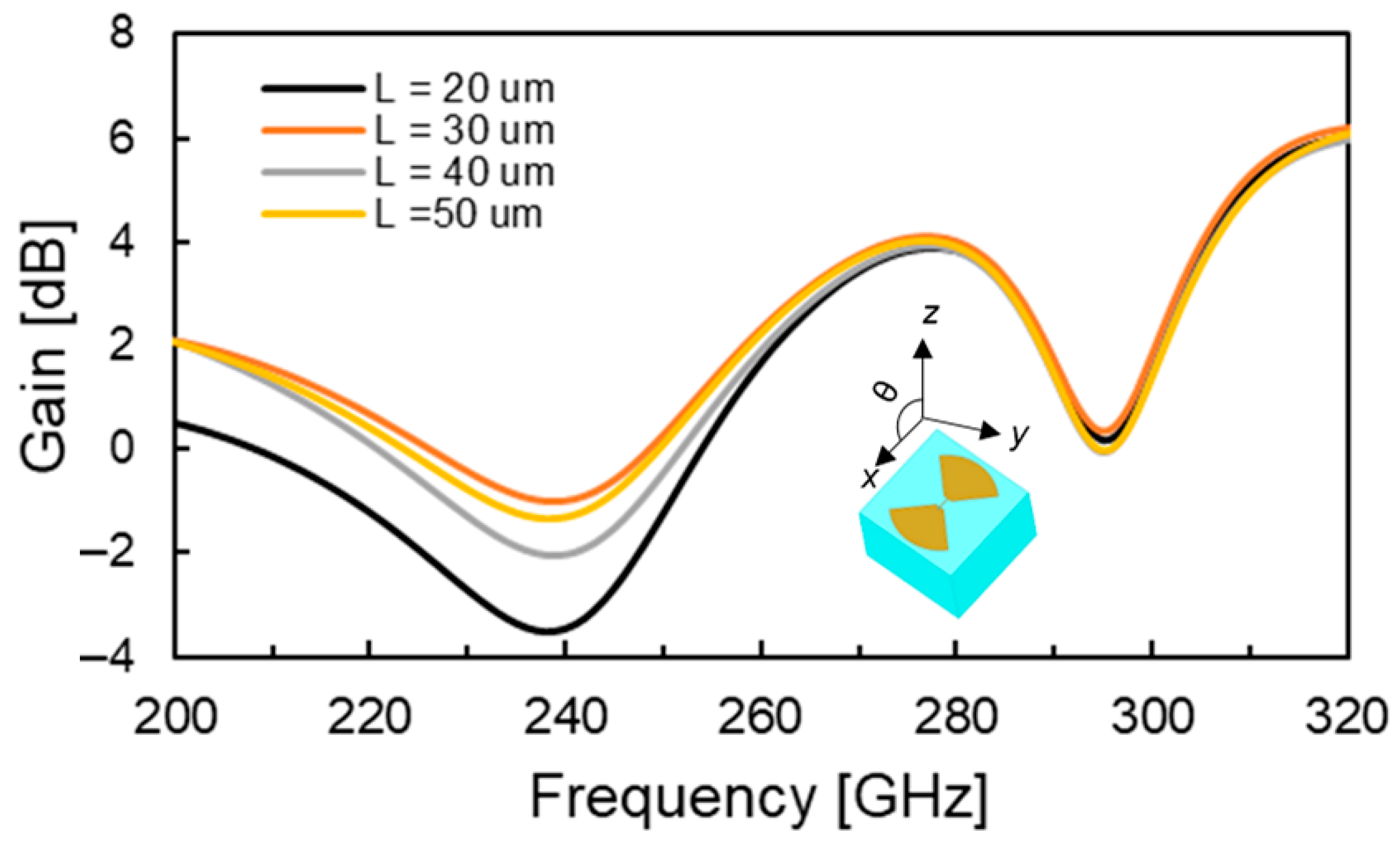
As shown in Figure 4, the simulated spectral peaks at 215 GHz, 283 GHz, and 312 GHz closely correspond to the experimentally observed peaks at 225 GHz, 280 GHz, and 295 GHz, respectively. The simulated antenna gain at 0° in both the XZ (θ) and YZ planes is illustrated in Figure 6. The receiver system consists of two lenses that provide an additional gain of approximately 25 dB, as determined through comparative measurements conducted with and without the lenses. Taking into account fabrication tolerances, random measurement uncertainties such as optical and electrical coupling, alignment sensitivity between the emitted THz beam and the detector, as well as modeling simplifications, the simulated absolute power shows good agreement with the measured results, demonstrating strong predictive reliability. Furthermore, it was observed that the device with D = 7 µm exhibited a stronger emission intensity compared to the D = 8 µm device. This enhancement can be attributed to the smaller device’s reduced capacitance, as will be elaborated upon in the subsequent discussion.

4.2. Effect of Device Mesa Diameter and Length Between Antenna Arms

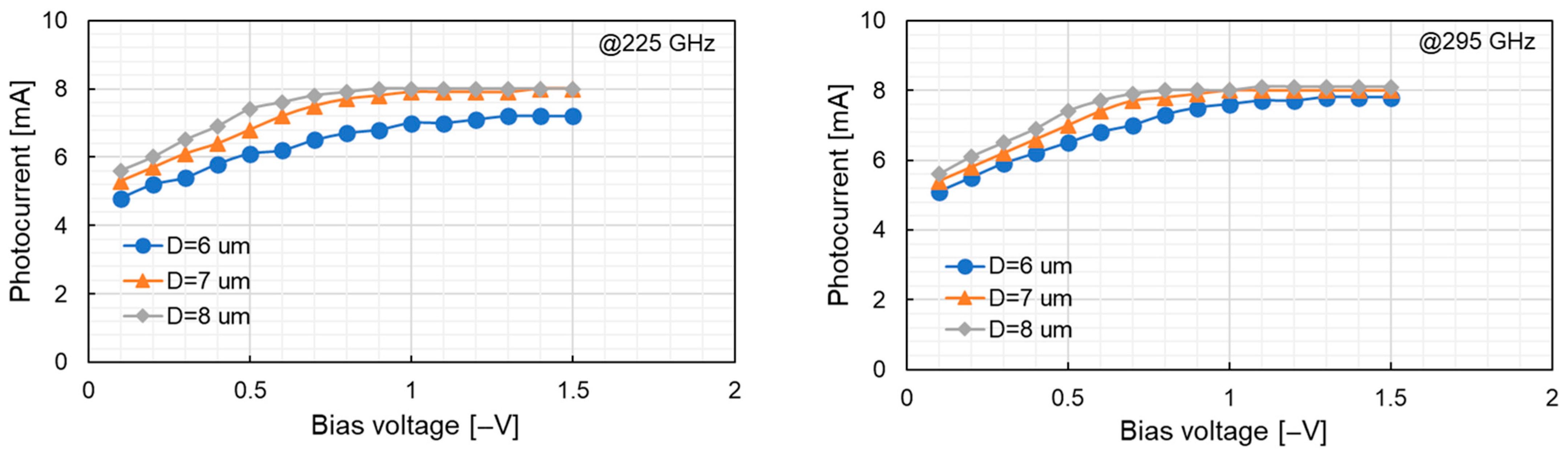
The mesa diameter of the photodiode structure evidently plays a crucial role in determining the device’s optical and electrical performance. For a circular mesa structure, as the diameter increases, the active absorption region expands proportionally, enabling a greater amount of incident light to be absorbed. This results in a higher generation rate of electron–hole pairs and consequently enhances the overall photocurrent output. Figure 7 illustrates the measured photocurrent responses at frequencies of 225 GHz and 295 GHz for mesa diameters of 6, 7, and 8 μm with a fixed length between the antenna arms of L = 20 µm. It can also be observed that the photocurrent exhibits a saturation behavior at bias voltages beyond −1 V, which is primarily attributed to space-charge effects. At this point, the electron drift velocity reaches its limit, and further increase in the electric field do not result in higher carrier velocities.
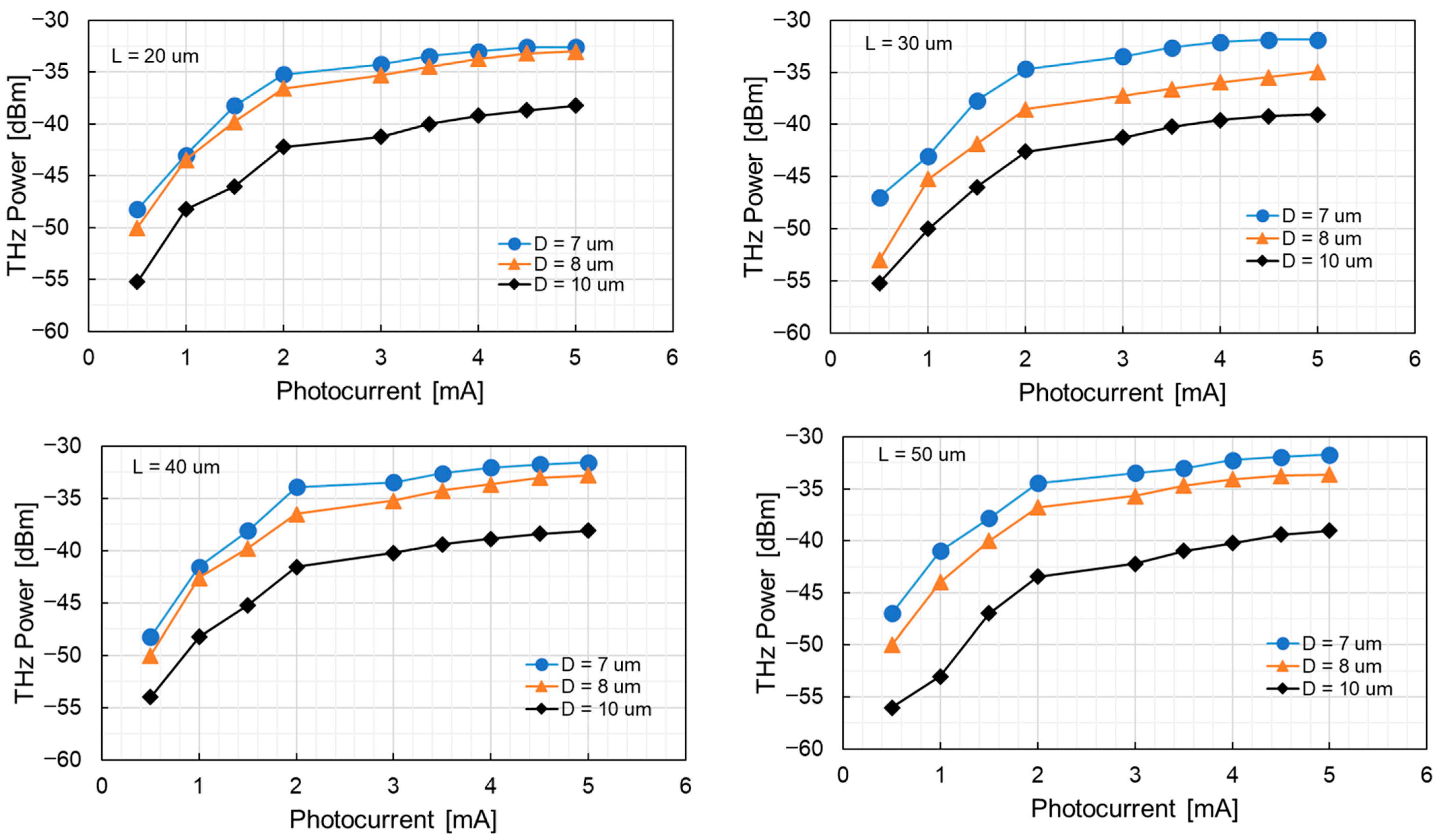
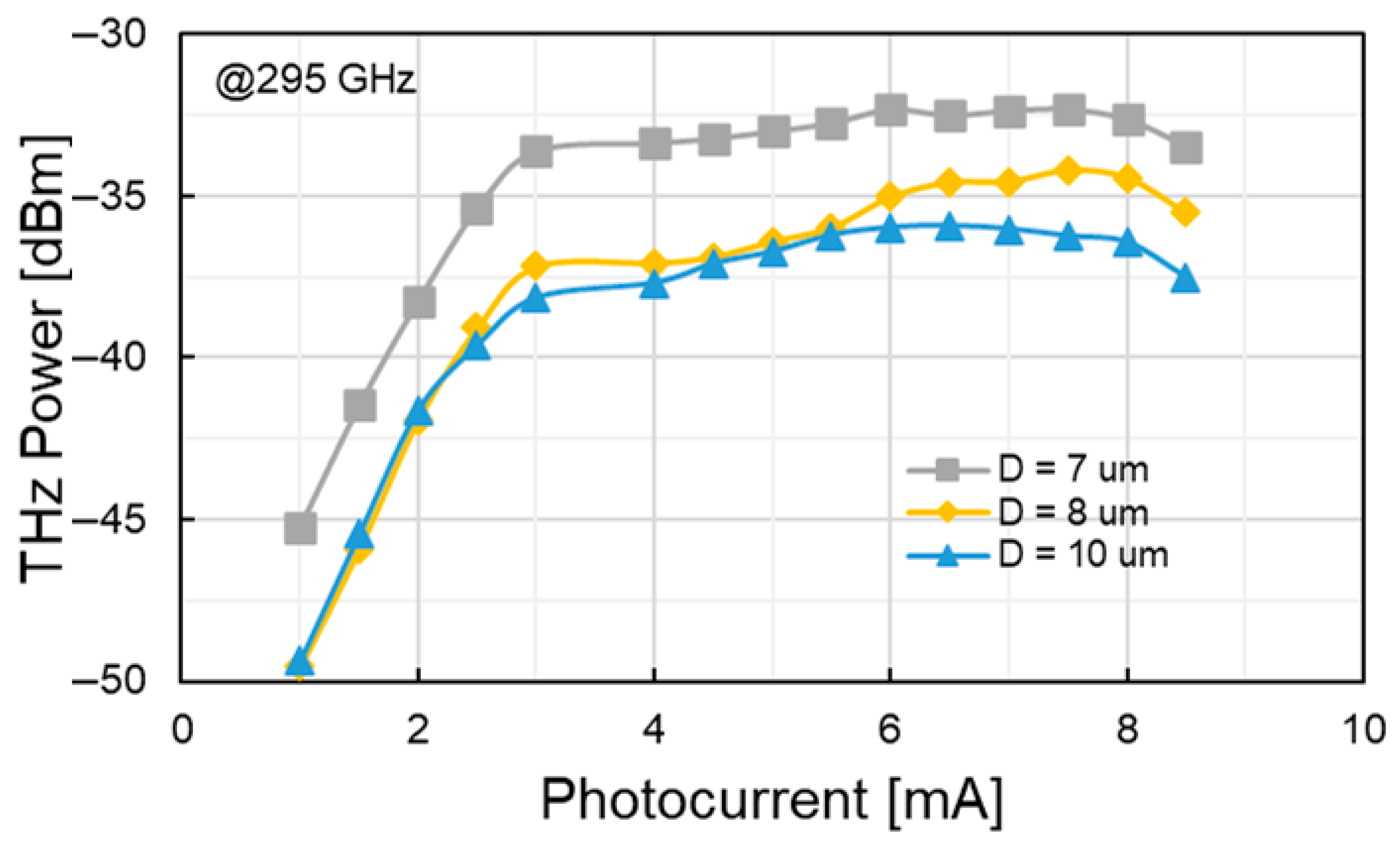
In addition to optical absorption, the overall performance of a UTC-PD is strongly influenced by the RC time constant arising from the junction capacitance and the effective load resistance. The device bandwidth is inversely proportional to this RC time constant and therefore degrades as the capacitance increases. Since the junction capacitance scales approximately linearly with the active device area, increasing the mesa diameter leads to a larger capacitance. While a larger mesa enhances optical absorption and thus increases the generated photocurrent, the accompanying increase in capacitance slows the electrical response of the device. At high frequencies, this increased capacitance results in stronger RC-induced roll-off, which suppresses the available THz power delivered to the load. Consequently, even though the total photocurrent increases with mesa diameter, the usable high-frequency current and hence the THz intensity decreases. This behavior is evident in the measurements shown in Figure 8 at 295 GHz under a bias voltage of −1.2 V, where devices with larger mesa diameters exhibit reduced THz output power. The observed reduction is therefore attributed to RC-limited high-frequency performance rather than insufficient photocarrier generation. These results highlight the intrinsic trade-off in UTC-PD design: increasing the mesa size improves optical absorption and DC photocurrent but simultaneously degrades high-frequency efficiency due to increased junction capacitance. An optimal mesa diameter is thus required to balance these competing effects and maximize THz output power.
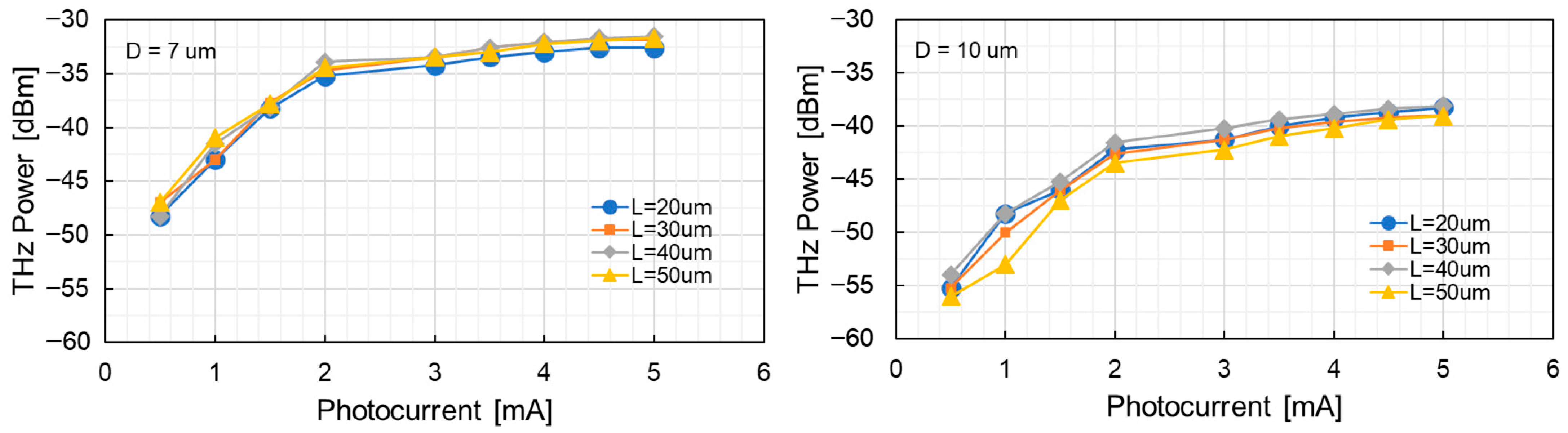
Furthermore, the influence of the length between the antenna arms L on device performance was examined as it can affect the antenna impedance and, consequently, the source–load matching between the UTC-PD and the antenna, which can influence the frequency response. Figure 9 presents the measured absolute THz power at 295 GHz under a bias voltage of −1.2 V for L = 20, 30, 40, and 50 µm and mesa diameters of 7 µm and 10 µm. The results show that the measured THz power variation for different L is about 1 dB, indicating no significant dependence on the length between the antenna arms within the investigated geometrical range.
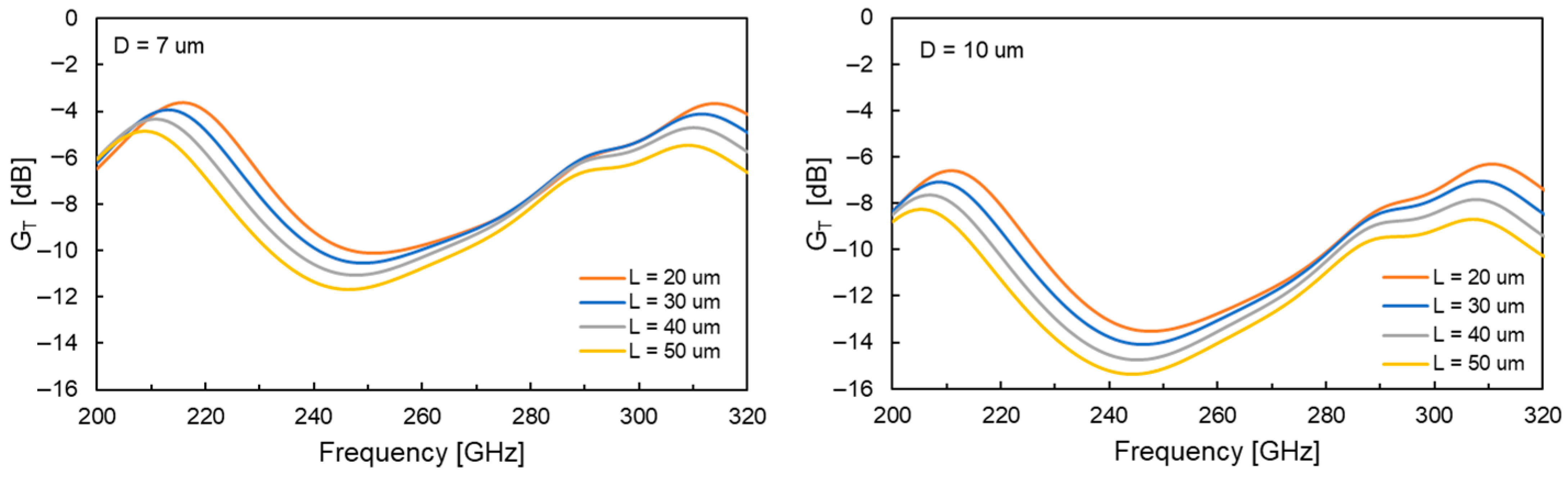
To further support this observation, simulations of the antenna transducer gain (GT), defined as the fraction of available source power delivered to the antenna, were performed over the frequency range from 200 GHz to 320 GHz as shown in Figure 10. The simulated results exhibit variations of less than 2.5 dB across all lengths between the antenna arms, consistent with the experimental measurements. These findings suggest that, within the studied frequency band and geometrical range, the length between the antenna arms has a relatively minor impact on the overall THz power. The results indicate that the device performance is relatively robust against moderate variations in length between the antenna arms, while the mesa diameter play a more dominant role.

4.3. Device Output Linearity

The linearity of the device output was evaluated by examining how the photocurrent varied with the generated output power under a constant DC bias voltage of −1.2 V, extending the measurement until the onset of saturation. Figure 11 presents the results obtained at 295 GHz for devices of mesa diameters of 7, 8, and 10 μm, all with L = 40 μm.
The observed data reveal that the output power increases linearly with the photocurrent up to approximately 7.5 mA, provided that the alternating current component maintains proportionality with the direct current. Minor deviations from ideal linearity can however be attributed to the bias-dependent characteristics of the UTC photodiodes. As the photocurrent changes, these dependencies can slightly alter the actual internal bias experienced by the photodiodes, even when the applied external bias remains constant. When the total photocurrent exceeds about 7.5 mA, the device exhibit clear saturation behavior. This phenomenon arises from the space-charge effect, in which the elevated photocurrent density within the depletion region approaches a critical threshold (Jmax). Beyond this point, the intensified charge accumulation modifies the internal electric field distribution, resulting in a nonlinear device response and eventual saturation of the output power.

5. Conclusions

This research successfully demonstrates the fabrication and comprehensive characterization of a high-performance UTC-PD monolithically integrated with a bow-tie antenna on a SiC substrate for THz wave generation. The systematic investigation into the influence of key geometric parameters, such as the UTC-PD mesa diameter and the length between the antenna arms, provided critical insights into optimizing device performance around the 300 GHz frequency band. Our findings reveal that optimizing the mesa diameter is crucial, with smaller diameters exhibiting superior THz emission intensity due to reduced device capacitance. Furthermore, experimental measurements and supporting simulations indicate that the THz output power is relatively insensitive to variations in lengths between the antenna arms within the studied range, demonstrating a robust device performance against moderate antenna geometry changes. The device’s linearity was validated up to a photocurrent of approximately 7.5 mA, beyond which saturation occurs due to space-charge effects. This work represents a significant advancement in the development of robust, high-power THz sources, offering a promising solution for the demanding requirements of future wireless communication systems, including Beyond 5G and 6G networks.

Author Contributions

Conceptualization, H.S., T.M. and K.K.; methodology, H.S., Y.K. and K.K.; validation, H.S. and Y.K.; formal analysis, H.S.; investigation, H.S., Y.K. and K.K.; resources, T.M. and K.K.; data curation, H.S. and Y.K.; writing—original draft preparation, H.S.; writing—review and editing, H.S. and K.K.; visualization, H.S., Y.K. and K.K.; supervision, K.K.; project administration, T.M. and K.K.; funding acquisition, T.M. and K.K. All authors have read and agreed to the published version of the manuscript.

Funding

This research was funded by Japan Science and Technology Agency CRONOS, grant number JPMJCS24N5; MIC/FORWARD, grant number JPMI241010003; National Institute of Information and Communications Technology, grant numbers JPJ012368C00901, JPJ012368C02801; Japan Society for the Promotion of Science KAKENHI, grant numbers 23K17751, 24K17324.

Data Availability Statement

The data supporting the findings of this study is available within the article. Further inquiries can be directed to the corresponding author.

Conflicts of Interest

The authors declare no conflicts of interest.

References

  1. Dang, S.; Amin, O.; Shihada, B.; Alouini, M.-S. What should 6G be? Nat. Electron. 2020, 3, 20–29. [Google Scholar] [CrossRef]
  2. Song, H.-J.; Lee, N. Terahertz Communications: Challenges in the Next Decade. IEEE Trans. Terahertz Sci. Technol. 2022, 12, 105–117. [Google Scholar] [CrossRef]
  3. Rappaport, T.S.; Xing, Y.; Kanhere, O.; Ju, S.; Madanayake, A.; Mandal, S.; Alkhateeb, A.; Trichopoulos, G.C. Wireless communications and applications above 100 GHz: Opportunities and challenges for 6G and beyond. IEEE Access 2019, 7, 78729–78757. [Google Scholar] [CrossRef]
  4. Yang, P.; Xiao, Y.; Xiao, M.; Li, S. 6G Wireless communications: Vision and potential techniques. IEEE Netw. 2019, 33, 70–75. [Google Scholar] [CrossRef]
  5. Heydari, P.; Wang, H.; Mohammadnezhad, H.; Nazari, P. Energy efficient 100+ GHz transceivers enabling beyond-5G wireless communications. IEEE Wirel. Commun. 2021, 28, 144–151. [Google Scholar] [CrossRef]
  6. Akyildiz, I.F.; Kak, A.; Nie, S. 6G and Beyond: The Future of Wireless Communications Systems. IEEE Access 2020, 8, 133995–134030. [Google Scholar] [CrossRef]
  7. Hu, Z.; Kaynak, M.; Han, R. High-power radiation at 1 THz in silicon: A fully scalable array using a multi-functional radiating mesh structure. IEEE J. Solid-State Circuits 2018, 53, 1313–1327. [Google Scholar] [CrossRef]
  8. Heinemann, B.; Rucker, H.; Barth, R.; Barwolf, F.; Drews, J.; Fischer, G.G.; Fox, A.; Fursenko, O.; Grabolla, T.; Herzel, F.; et al. SiGe HBT with fx/fmax of 505 GHz/720 GHz. In Proceedings of the IEEE International Electron Devices Meeting (IEDM), San Francisco, CA, USA, 3–7 December 2016. [Google Scholar] [CrossRef]
  9. Khamaisi, B.; Jameson, S.; Socher, E. 0.61 THz radiating source with on-chip antenna on 65nm CMOS. In Proceedings of the 11th European Microwave Integrated Circuits Conference (EuMIC), London, UK, 3–4 October 2016. [Google Scholar] [CrossRef]
  10. Aghasi, H.; Cathelin, A.; Afshari, E. A 0.92-thz SiGe power radiator based on a nonlinear theory for harmonic generation. IEEE J. Solid-State Circuits 2017, 52, 406–422. [Google Scholar] [CrossRef]
  11. Mei, X.; Yoshida, W.; Lange, M.; Lee, J.; Zhou, J.; Liu, P.-H.; Leong, K.; Zamora, A.; Padilla, J.; Sarkozy, S.; et al. First demonstration of amplification at 1 THz using 25-nm InP high electron mobility transistor process. IEEE Electron Device Lett. 2015, 36, 327–329. [Google Scholar] [CrossRef]
  12. Deal, W.; Leong, K.; Zamora, A.; Radisic, V.; Mei, X.B. Recent progress in scaling InP HEMT TMIC technology to 850 GHz. In Proceedings of the IEEE MTT-S International Microwave Symposium (IMS2014), Tampa, FL, USA, 1–6 June 2014. [Google Scholar] [CrossRef]
  13. Dan, I.; Szriftgiser, P.; Harati, P.; Antes, J.; Tessmann, A.; Wagner, S.; Kuri, M.; Weber, R.; Massler, H.; Leuther, A.; et al. A 300-GHz wireless link employing a photonic transmitter and an active electronic receiver with a transmission bandwidth of 54 GHz. IEEE Trans. Terahertz Sci. Technol. 2020, 10, 271–281. [Google Scholar] [CrossRef]
  14. Puerta, R.; Yu, J.; Li, X.; Xu, Y.; Vegas Olmos, J.J.; Tafur Monroy, I. Demonstration of 352 Gbit/s photonically-enabled D-Band wireless delivery in one 2×2 MIMO system. In Proceedings of the Optical Fiber Communication Conference and Exhibition (OFC 2017), Los Angeles, CA, USA, 19–23 March 2017; Paper Tu3B.3. pp. 1–3. [Google Scholar] [CrossRef]
  15. Kanno, A.; Kuri, T.; Morohashi, I.; Hosako, I.; Kawanishi, T.; Yoshida, Y.; Kitayama, K.–I. Coherent terahertz wireless signal transmission using advanced optical fiber communication technology. J. Infrared Millim. THz Waves 2015, 36, 180–197. [Google Scholar] [CrossRef]
  16. Ducournau, G.; Szriftgiser, P.; Beck, A.; Bacquet, D.; Pavanello, F.; Peytavit, E.; Zaknoune, M.; Akalin, T.; Lampin, J.–F. Ultrawide-bandwidth single-channel 0.4-THz wireless link combining broadband quasi-optic photomixer and coherent detection. IEEE Trans. Terahertz Sci. Technol. 2014, 4, 328–337. [Google Scholar] [CrossRef]
  17. Nagatsuma, T.; Horiguchi, S.; Minamikata, Y.; Yoshimizu, Y.; Hisatake, S.; Kuwano, S.; Yoshimoto, N.; Terada, J.; Takahashi, H. Terahertz wireless communications based on photonics technologies. Opt. Express 2013, 21, 23736–23747. [Google Scholar] [CrossRef]
  18. Shams, H.; Fice, M.J.; Balakier, K.; Renaud, C.C.; van Dijk, F.; Seeds, A.J. Photonic generation for multichannel THz wireless communication. Opt. Express 2014, 22, 23465–23472. [Google Scholar] [CrossRef]
  19. Peru, S.; Döhler, D.H.; Malzer, S.; Wang, J.L.; Gossard, A.C. Tunable, continuous-wave terahertz photomixer sources and applications. J. Appl. Phys. 2011, 109, 061301. [Google Scholar] [CrossRef]
  20. Safian, R.; Ghazi, G.; Mohammadian, N. Review of photomixing continuous-wave terahertz systems and current application trends in terahertz domain. Opt. Eng. 2019, 58, 110901. [Google Scholar] [CrossRef]
  21. Kato, K. Photonics-Assisted Terahertz-Wave Beam Steering and Its Application in SecuredWireless Communication. Photonics 2022, 9, 9. [Google Scholar] [CrossRef]
  22. Ssali, H.; Kamiura, Y.; Doi, R.; Agemori, H.; Che, M.; Mikami, Y.; Kato, K. THz Wave Power Enhancement Using a Microstrip Line-Based Combiner Integrated with Arrayed UTC-PDs. Electronics 2024, 13, 2661. [Google Scholar] [CrossRef]
  23. Ishibashi, T.; Shimizu, N.; Kodama, S.; Ito, H.; Nagatsuma, T.; Furuta, T. Uni-Traveling-Carrier Photodiodes. In Proceedings of the Ultrafast Electronics and Optoelectronics, Incline Village, NV, USA, 17–19 March 1997; Volume 13. [Google Scholar] [CrossRef]
  24. Ishibashi, T.; Muramoto, Y.; Yoshimatsu, T.; Ito, H. Unitraveling-Carrier Photodiodes for Terahertz Applications. IEEE J. Sel. Top. Quantum Electron. 2014, 20, 79–88. [Google Scholar] [CrossRef]
  25. Ishibashi, T.; Ito, H. Uni-traveling-carrier photodiodes. J. Appl. Phys. 2020, 127, 031101. [Google Scholar] [CrossRef]
  26. Ishibashi, T.; Ito, H. Uni-Traveling Carrier Photodiodes: Development and Prospects. IEEE J. Sel. Top. Quantum Electron. 2022, 28, 1–6. [Google Scholar] [CrossRef]
  27. Dong, X.; Liu, K.; Huang, Y.; Duan, X.; Wang, Q.; Ren, X. Design of High-Speed UTC-PD With Optimization of Its Electron Transit Performance and Parasitic Capacitance. IEEE Photon. J. 2023, 15, 1–9. [Google Scholar] [CrossRef]
  28. Sanjoh, T.; Sekine, N.; Kato, K.; Takagi, S.; Takenaka, M. Thermal properties of III–V on a SiC platform for photonic integrated circuits. Jpn. J. Appl. Phys. 2019, 58, SBBE06. [Google Scholar] [CrossRef]
  29. Ito, H.; Shibata, N.; Nagatsuma, T.; Ishibashi, T. Terahertz-Wave Detector on Silicon Carbide Platform. Appl. Phys. Express 2022, 15, 026501. [Google Scholar] [CrossRef]
  30. Nagatsuma, T.; Nagatsuma, T.; Gao, W.; Kawamoto, Y.; Ohara, T.; Ito, H.; Ishibashi, T. InP-Based Integrated Circuits on SiC/Si Substrates for Terahertz Communications. J. Light. Technol. 2025, 43, 9765–9774. [Google Scholar] [CrossRef]
  31. Shiratori, Y.; Hoshi, T.; Ida, M.; Higurashi, E.; Matsuzaki, H. High-Speed InP/InGaAsSb DHBT on High Thermal-Conductivity SiC Substrate. IEEE Electron. Device Lett. 2018, 39, 807–810. [Google Scholar] [CrossRef]
  32. Takenaka, M.; Takagi, S. InP-based photonic integrated circuit platform on SiC wafer. Opt. Express 2017, 25, 29993–30000. [Google Scholar] [CrossRef]
  33. Mehregany, M.; Zorman, C.A. SiC MEMS: Opportunities and challenges for applications in harsh environments. Thin Solid Films 1999, 355, 518–524. [Google Scholar] [CrossRef]
  34. Ito, H.; Ishibashi, T. InP/InGaAs fermi-level managed barrier diode for broadband and low-noise terahertz-wave detection. Jpn. J. Appl. Phys. 2016, 56, 014101. [Google Scholar] [CrossRef]
  35. Ito, H.; Ishibashi, T. Fermi-level managed barrier diode for broadband and low-noise terahertz-wave detection. Electron. Lett. 2015, 51, 1440. [Google Scholar] [CrossRef]
  36. Natrella, M.; Liu, C.–P.; Graham, C.; van Dijk, F.; Liu, H.; Renaud, C.C.; Seeds, A.J. Modelling and measurement of the absolute level of power radiated by antenna integrated THz UTC photodiodes. Opt. Express 2016, 24, 11793–11807. [Google Scholar] [CrossRef]
  37. Renaud, C.C.; Natrella, M.; Graham, C.; Seddon, J.; van Dijk, F.; Seeds, A.J. Antenna integrated THz uni-travelling carrier photodiodes. IEEE J. Sel. Top. Quantum Electron. 2018, 24, 8500111. [Google Scholar] [CrossRef]
  38. Natrella, M.; Liu, C.-P.; Graham, C.; van Dijk, F.; Liu, H.; Renaud, C.C.; Seeds, A.J. Accurate equivalent circuit model for millimetre-wave UTC photodiodes. Opt. Express 2016, 24, 4698–4713. [Google Scholar] [CrossRef] [PubMed]
  39. Wu, Y.-S.; Shi, J.-W.; Chiu, P.-H. Analytical modeling of a high-performance near-ballistic uni-traveling-carrier photodiode at a 1.55-μm wavelength. IEEE Photon. Technol. Lett. 2006, 18, 938–940. [Google Scholar] [CrossRef]
  40. Li, J.; Xiong, B.; Sun, C.; Miao, D.; Luo, Y. Analysis of frequency response of high power MUTC photodiodes based on photocurrent-dependent equivalent circuit model. Opt. Express 2015, 23, 21615–21623. [Google Scholar] [CrossRef]
Figure 1. Bow tie antenna integrated device schematic.
Telecom 07 00009 g001
Figure 2. Device Fabrication: (a) UTC-PD epi-layer structure. (b) Epi-layers transfer from InP to SiC. (c) One of the fabricated devices.
Telecom 07 00009 g002
Figure 3. Experimental setup: (a) Setup schematic; (b) Setup sideview photo (c) Chip irradiation configuration.
Telecom 07 00009 g003
Figure 4. Device frequency response.
Telecom 07 00009 g004
Figure 5. Simulated antenna input impedance.
Telecom 07 00009 g005
Figure 6. Simulated antenna gain for different lengths between antenna arms.
Telecom 07 00009 g006
Figure 7. Measured photocurrent against bias voltage for different device mesa diameters at 225 GHz and 295 GHz.
Telecom 07 00009 g007
Figure 8. Measured THz wave intensity against photocurrent for different mesa diameters for L = 20 µm, 40 µm and 50 µm at 295 GHz with a bias voltage of −1.2 V.
Telecom 07 00009 g008
Figure 9. Measured THz wave intensity against photocurrent for different L for D = 7 µm and 10 µm at 295 GHz with a bias voltage of −1.2 V.
Telecom 07 00009 g009
Figure 10. Simulated antenna transducer gain (GT).
Telecom 07 00009 g010
Figure 11. Measured THz wave intensity against photocurrent for different mesa diameters for L = 40 µm to determine the saturation photocurrent at 295 GHz with a bias voltage of −1.2 V.
Telecom 07 00009 g011
Table 1. Key material properties of InP and SiC.
Material PropertiesInPSiC
Thermal conductivity68 W/(m·K)490 W/(m·K)
Loss tangent9 × 10−3<1 × 10⁻³
Dielectric constant~12.4~9.6
Table 2. Calculated resistance and capacitance values for different device mesa diameters.
Mesa Diameter (µm)Resistance (Ω)Capacitance (fF)
513.59.8
69.414.2
76.919.3
85.325.2
103.439.3
Disclaimer/Publisher’s Note: The statements, opinions and data contained in all publications are solely those of the individual author(s) and contributor(s) and not of MDPI and/or the editor(s). MDPI and/or the editor(s) disclaim responsibility for any injury to people or property resulting from any ideas, methods, instructions or products referred to in the content.