
Article

Intelligent Vehicle Repeater for Satellite Networks: A Promising Device for Tourists and Explorers Without Terrestrial Networks

by
Yitao Li
* and
Conglu Huang
School of Automation and Information Engineering, Sichuan University of Science and Engineering, Yibin 644000, China
*
Author to whom correspondence should be addressed.
Submission received: 30 November 2025 / Revised: 25 December 2025 / Accepted: 5 January 2026 / Published: 7 January 2026

Abstract

Existing vehicle-mounted satellite terminals primarily rely on mechanical or purely analog electronically steered antennas. They lack protocol-level relay capability and usually provide only short-range hotspot connectivity. These limitations make it difficult for such systems to deliver stable, high-throughput satellite access for personal mobile devices in dynamic vehicular environments, especially in remote regions without terrestrial networks. This paper proposes an intelligent vehicle repeater for satellite networks (IVRSN) that builds a dedicated satellite–vehicle–device relay architecture. It enables reliable broadband connectivity for conventional mobile terminals without requiring specialized satellite hardware. The IVRSN consists of three key technical components. Firstly, a dual-mode relay coverage mechanism is designed to support energy-efficient in-vehicle access and extended out-of-vehicle coverage. Secondly, a DoA-assisted, attitude-compensated hybrid beamforming scheme is developed. It combines subspace-based direction estimation with inertial sensor measurements to maintain high-precision satellite pointing under vehicle dynamics. Finally, a bidirectional protocol conversion module is introduced to ensure compatibility between ground wireless protocols and satellite link-layer formats with integrity-checked data forwarding. Compared to existing solutions, the proposed IVRSN provides higher stability and broader device compatibility, making it a feasible solution for high-speed, high-quality communications in remote or disaster regions.

1. Introduction

Tourists, explorers, and vehicle teams operating in remote or uninhabited regions, such as deserts, mountainous areas, or disaster-stricken zones, are out of terrestrial mobile network coverage due to insufficient power grid and communication infrastructure. These regions are crucial for emergency rescues, field scientific expeditions, and resource explorations, all of which require reliable communications to ensure operational efficiency and personnel safety [1]. Satellite mobile communications offer a viable solution to this problem. They provide global coverage and do not rely on terrestrial infrastructure [2,3,4]. However, existing vehicle-mounted satellite communication systems face significant limitations when supporting personal portable devices. First, direct-access satellite terminals typically require specialized hardware and are not designed to provide protocol-level relaying for heterogeneous terrestrial devices. Second, handheld devices cannot directly maintain stable satellite links due to insufficient antenna gain, mobility-induced pointing errors, and protocol mismatches between terrestrial and satellite air interfaces [5]. Third, modern satellite-on-the-move (SOTM) terminals use mechanically or electronically steered antennas to maintain alignment under mobility. However, they generally operate as standalone terminals and lack the capability to adaptively serve multiple nearby user devices. These limitations restrict the feasibility of broadband vehicular satellite access for conventional portable terminals in dynamic and infrastructure-limited environments. Table 1 lists the acronyms used throughout this paper.
Existing technologies for vehicle-mounted satellite communication systems can be categorized into three types. The first category consists of specialized satellite network terminals, such as the Starlink user terminals. These devices can provide high-speed broadband access over LEO constellations and have been widely deployed in static or quasi-static scenarios [6].
The second category includes vehicle-mounted satellite phones designed primarily for voice-oriented services. A recent example is Huawei’s Galaxy Communication Intelligent Vehicle Communication System released in 2025. Vehicles can use basic functions such as phone calls and text messaging through satellite connectivity. Their data services remain limited in scope and do not support high-volume data transmission for multiple users.
The third category comprises SOTM terminals designed for high-mobility scenarios such as vehicles, ships, and aircraft. These terminals typically employ electronically steered antennas (ESA) or stabilized flat-panel antennas [7]. A summary of representative SOTM products is provided in Table 2. Although these systems provide broadband satellite connectivity under mobility, they operate as direct-access terminals rather than relay nodes. They mainly offer hotspot-style connectivity and do not support protocol-layer relay or extended coverage.
To address the limitations of existing vehicle-mounted satellite communication systems, we propose an Intelligent Vehicle Repeater for Satellite Networks (IVRSN) that enhances link stability in dynamic environments and enables reliable high-quality personal communications in remote and high-mobility scenarios [8]. Existing vehicle-mounted SOTM systems are designed as user terminals. They establish a direct satellite link and mainly provide on-vehicle hotspot-style connectivity. In contrast, an IVRSN treats the vehicle as a relay node. It integrates DoA-assisted beam control, protocol-layer relay, and adaptive sensing coverage management to extend satellite coverage beyond the vehicle and to support multi-vehicle networking. The main contributions are summarized as follows:
  • A dual-mode relay coverage mechanism that supports low-power in-vehicle access and extended outside-vehicle coverage (up to 50 m), allowing for connectivity for multiple nearby users or small convoys.
  • A DoA-assisted, attitude-compensated hybrid beamforming scheme that fuses inertial sensor measurements with subspace-based direction estimation to maintain accurate satellite alignment under vehicular mobility.
  • A protocol-layer relay architecture that enables terrestrial devices to access satellite links without specialized hardware. It integrates protocol decapsulation, lightweight Layer-2/Layer-3 adaptation, and re-encapsulation for seamless satellite–vehicle–device interoperability.
This paper focuses on the architectural design and key technologies of the proposed IVRSN, and evaluates its feasibility via numerical simulations. The remainder of this paper is organized as follows: Section 2 introduces the IVRSN architecture and the relay coverage mechanism. Section 3 presents the key technologies and reports the simulation setup and results. Section 4 discusses potential research directions. Section 5 outlines future application prospects. Finally, Section 6 concludes this paper.

2. Intelligent Vehicle Repeater for Satellite Networks

2.1. System Model

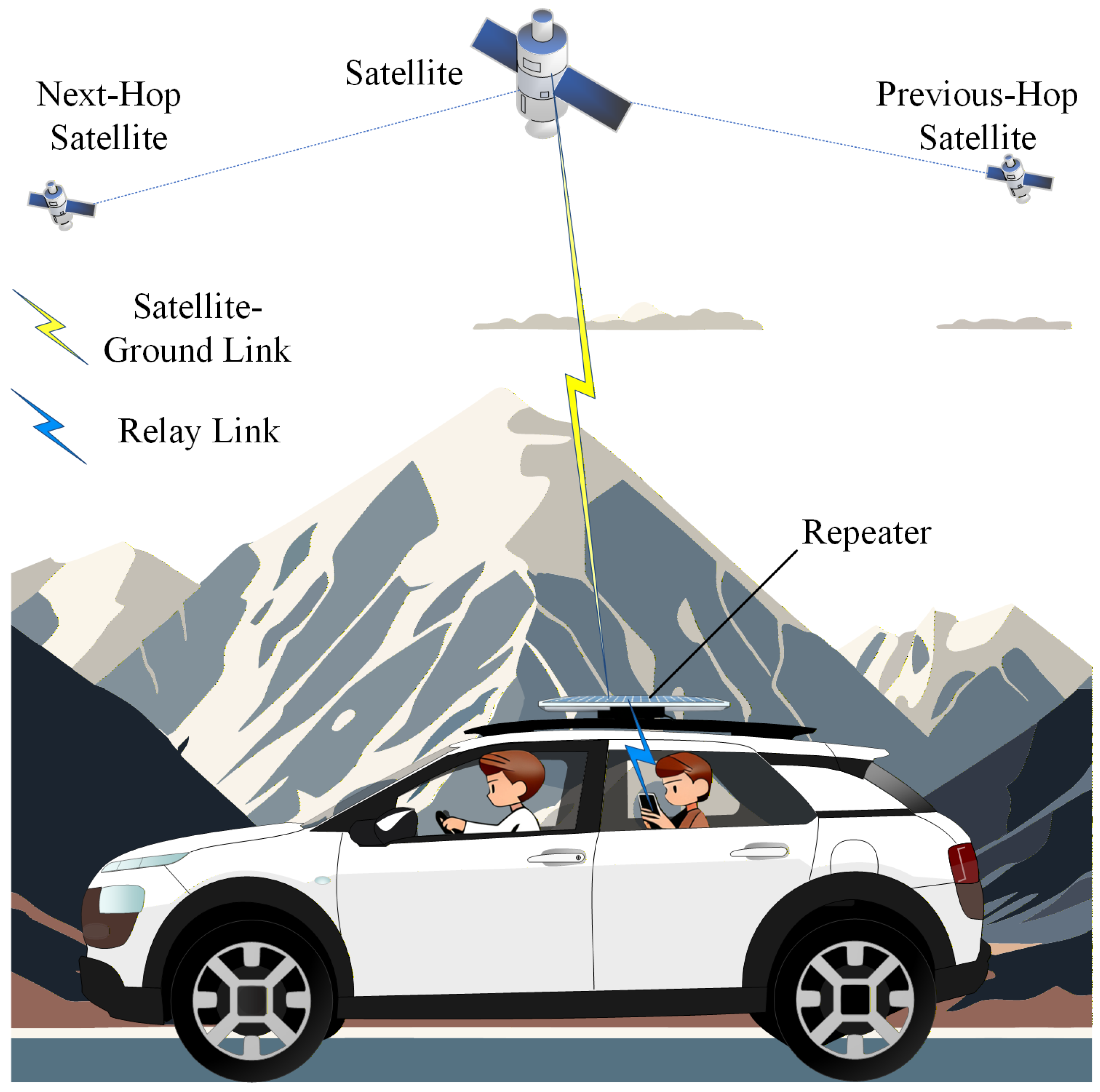
In the proposed IVRSN system, three types of network entities are involved: the satellite S, the vehicle-mounted relay node R, and multiple user terminals U carried by passengers. As shown in Figure 1, the overall communication architecture consists of two wireless links: the satellite–vehicle link (SR) and the relay access link between the IVRSN and user terminals (RU). The satellite–vehicle link serves as the backhaul path providing long-distance connectivity, while the relay access link acts as the local access network for terrestrial devices.
To support diverse user scenarios, the IVRSN adopts two adaptive coverage modes for the ground relay link. The first mode provides low-power in-vehicle coverage with a radius of less than 5 m, mainly used when the vehicle is in motion. The second mode enables extended outside-vehicle coverage with a radius of up to 50 m, which can serve a small convoy near the vehicle.
The IVRSN consists of three core modules: (1) the ground relay link communication module, (2) the satellite ground link communication module equipped with attitude-aware adaptive antennas, and (3) the protocol compatibility and conversion module. The relay link module provides flexible wireless access for mobile terminals and supports automatic mode switching based on vehicle motion. The satellite ground link module utilizes integrated sensors to dynamically adjust the antenna beamwidth, ensuring stable satellite alignment during vehicle movement. The protocol conversion module provides reliable terrestrial–satellite interoperability through layered protocol adaptation. All modules are coordinated through a data and signal processing unit responsible for modulation, attitude analysis, and error-checked protocol operations.
The following subsections introduce in detail the implementation of satellite to IVRSN communications, mobile terminal coverage, protocol conversions, and data processing, respectively.

2.2. Communications with Satellites

The satellite–vehicle communication module adopts frequency-division duplexing (FDD), allowing for simultaneous uplink and downlink transmission [9]. The use of FDD helps maintain a stable satellite link despite vehicle vibrations and attitude changes on uneven terrain. It is equipped with an antenna tracking module to align with satellites in real-time. This adjustment leverages signal direction estimation techniques to ensure the antenna remains aligned with the satellite. Integrated gyroscopes and accelerometers capture vehicle motion data, enabling dynamic beamwidth adjustment. Narrow beams are used to communicate with satellite under stable road conditions to maximize signal gain, and wide beams are used under rough terrains to overcome the negative effect of vehicle shakings and bouncings.
For downlink signals, the radio frequency (RF) module performs downconversion, filtering, and analog-to-digital conversion to produce digital signals for processing [10]. For uplink signals, user data is modulated, upconverted to RF, and amplified to counteract large path loss. A duplexer isolates the uplink and downlink signals to prevent interference. The module enables high-throughput and low-latency communications with satellites.

2.3. Coverage for Mobile Terminals

The ground relay link communication module provides wireless coverage for portable mobile terminals within and around the vehicle, enabling these devices to seamlessly access satellite networks without requiring specialized hardware. This module supports two adaptive coverage modes to balance energy efficiency and access range. The first mode is a small-range energy-saving configuration designed for in-vehicle terminals, where coverage is limited to the vehicle’s interior with low transmission power to minimize energy consumption. In this mode, terminals can connect freely, making it ideal for passengers during travels. The second mode provides large-range coverage with a radius of up to 50 m around the vehicle, making it suitable for serving external user devices or even a small convoy consisting of several vehicles.
Mode switching is automated based on vehicle motion detected by onboard sensors. When significant movement is detected, the relay defaults to the in-vehicle mode to improve link robustness and reduce unnecessary power consumption. When the vehicle remains stationary, the system may enable directional or omnidirectional extended coverage depending on the access requirements. Through this adaptive mechanism, the ground relay link maintains robust user connectivity while achieving energy-efficient operation in diverse vehicular environments.

2.4. Network Protocols Conversions and Compatibilities

To bridge protocol incompatibilities between terrestrial networks (e.g., WiFi or LTE) and satellite communication systems, the designed IVRSN employs a communication protocol compatibility and conversion method. This method converts data formats from one protocol to another, enabling seamless interoperability and reliable data exchange in mixed environments.
The protocol compatibility and conversion method consists of two components: the protocol conversion and data forwarding module (PCDFM) and the data storage and processing module (DSPM). The PCDFM handles the core conversion and forwarding tasks by maintaining protocol mapping rules that describe different layered architectures. After receiving data, the PCDFM first identifies the incoming protocol. It then processes the data layer by layer. At each layer, it reads the header, verifies integrity, and unpacks the payload. For example, if a user’s smartphone sends a WiFi packet containing a video stream request, the PCDFM would strip away WiFi-specific layers to retrieve the raw request data.
Error checking at the data link layer ensures transmission accuracy. If an error is detected during verification, the PCDFM signals the DSPM to re-process the affected packet. Otherwise, the extracted original data is temporarily cached in the DSPM for efficiency. This caching allows for quick access if errors occur later during repackaging. Next, the data is re-modulated and encapsulated layer by layer according to the target protocol. After final verification, a success signal prompts the DSPM to delete the cache, and the converted data is forwarded toward the satellite uplink.
In the downlink, frames from the satellite undergo similar processing. They are decapsulated, verified, cached when necessary, and re-encapsulated into WiFi- or LTE-compatible packets.
In addition, ongoing 3GPP non-terrestrial network (NTN) standardization activities provide general architectural frameworks for integrating satellite and terrestrial communication links [11]. While the proposed IVRSN focuses on lightweight data-layer adaptation, its conversion and forwarding procedures are conceptually consistent with the user-plane handling approaches outlined in these standards, supporting compatibility with future satellite–terrestrial integrated networks.

2.5. Data and Signal Processing

The data and signal processing module serves as the central coordinator for the IVRSN, integrating satellite ground communications, relay link coverage, and protocol conversions to enable robust data exchange for mobile terminals. It processes incoming satellite signals received through the planar circular antenna array, performing essential steps such as downconversion to lower the signal frequency, bandpass filtering to suppress out-of-band interference, and analog-to-digital conversions to generate clean digital signals ready for further analysis [12].
Attitude data from integrated gyroscopes and accelerometers are analyzed to compute vehicle displacement and angular offsets, allowing for real-time adjustments to the antenna beam for stable satellite alignment. For protocol conversion support, the module manages data caching to facilitate re-processing in case of verification errors during layered processing, as well as signal processing to determine current system states and send control signals to the attitude-aware antenna module for enhanced transmission stability. By coordinating these functions, the module maintains seamless data flow across terrestrial and satellite links, supporting reliable communication.

3. Key Technical Issues

The antenna pointing accuracy directly determines satellite link stability. In this section, we analyze the key technical issues of the designed IVRSN, including orientation perceptions and predictions, and intelligent antenna techniques.

3.1. Orientation Perceptions and Predictions

The attitude sensors measure the vehicle’s directional and angular accelerations, which are combined with speed information. These inertial measurements are fused to estimate short-term orientation changes, enabling real-time computation of antenna-pointing offsets. Such offsets compensate for deviations from the desired pointing direction, ensuring that the antenna remains aligned with the satellite even during rapid vehicle motion. The system updates the compensation at predefined intervals to maintain high-precision real-time tracking.
The system also predicts the vehicle’s driving environment using data from equipped sensors. If the vehicle is traveling over rough terrain, the beam width is expanded to increase the coverage directions of the directional beam to satellite. It minimizes the impact of vehicle attitude changes on beam direction. On the other hand, if the road conditions are smooth and stable, the beam width is reduced to reduce interference and improve signal quality. This approach increases the received signal strength at the satellite receiver, achieving greater communication reliability and rates.

3.2. Intelligent Antenna Techniques

Based on the satellite ground communication module described in Section 2, the intelligent antenna subsystem of the IVRSN is designed to maintain a stable satellite link despite continuous changes in vehicle posture and motion. To achieve this, the system adopts a hybrid analog–digital beamforming structure, where analog phase control provides low-power coarse steering, while digital beamforming is used to adjust array weights for precise alignment [13]. The weights are continuously updated using direction-of-arrival (DoA) tracking, which serves as the primary input for fine-grained beam control [14]. The received satellite signals are first downconverted to baseband through standard RF front-end processing. The antenna array then collects time-domain snapshots for spatial processing. A sample covariance matrix is estimated from these snapshots, followed by eigen-decomposition to extract the noise subspace. In the considered vehicular satellite communication scenario, a single dominant line-of-sight satellite signal is typically observed and the link operates with high directional gain. Under these conditions, the MUSIC algorithm provides high-resolution DoA estimation and is therefore adopted for fine beam alignment. A 1-D azimuth search is used assuming elevation is pre-estimated. The MUSIC pseudospectrum is evaluated across candidate angles, and the peak location is selected as the estimated DoA [15]. This method provides high angular resolution. It is also robust to noise and to small variations in vehicle orientation.
To verify the effectiveness of the DoA estimate used in the IVRSN antenna subsystem, we evaluate three representative pointing strategies: (i) Sensor-only pointing, which uses the vehicle’s IMU-derived attitude angles to steer the antenna. This method does not rely on array signal processing, but its accuracy is limited by sensor noise and vehicle motion [16]; (ii) Conventional Beamforming (CBF), which estimates the direction by scanning the beamformed power and selecting the angle with maximum response; (iii) MUSIC-based DoA estimation, which exploits the orthogonality between the signal and noise subspaces to achieve high angular resolution and is adopted in the proposed IVRSN for fine beam alignment.
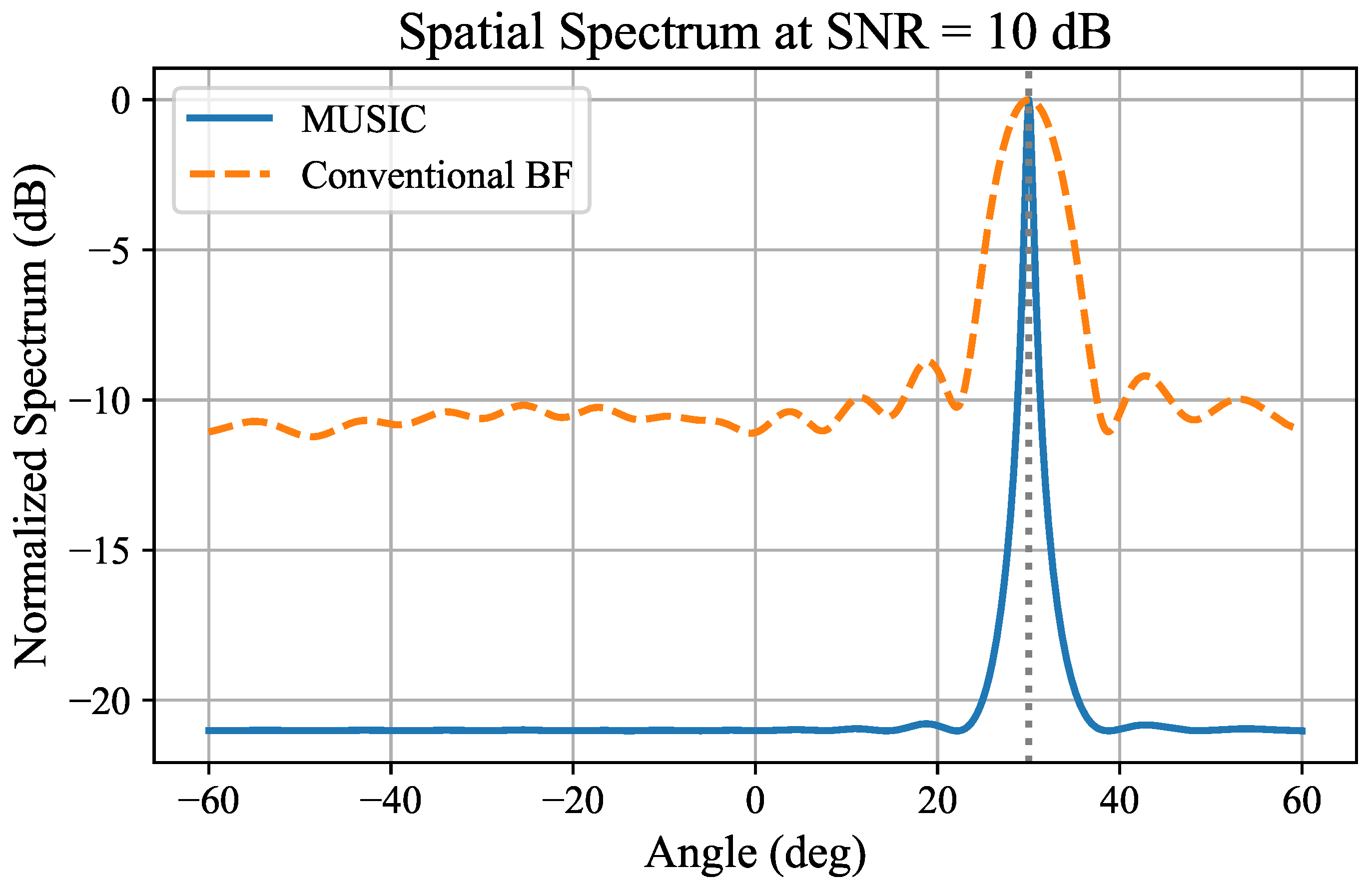
The simulation results were generated in Python 3.10.14, using NumPy 1.23.5 for numerical computation and Matplotlib 3.7.2 for plotting. The environment uses a 16-element uniform linear array (ULA) with half-wavelength spacing. For each SNR level, narrowband array snapshots are generated and the sample covariance matrix is formed from 200 snapshots. In addition, 200 Monte Carlo runs are carried out at each SNR value to obtain statistically reliable RMSE estimates. For both CBF and MUSIC, a 1-D azimuth scan is performed over [ 60 ° , 60 ° ] with 721 grid points, and the peak location is selected as the estimated DoA. Figure 2 shows the spatial spectra of MUSIC and CBF at an SNR of 10 dB. MUSIC produces a sharp and distinct peak at the true direction, while CBF results in a broader peak with higher sidelobes, making it difficult to accurately localize the satellite direction. This demonstrates the superior resolving capability of the MUSIC estimator.
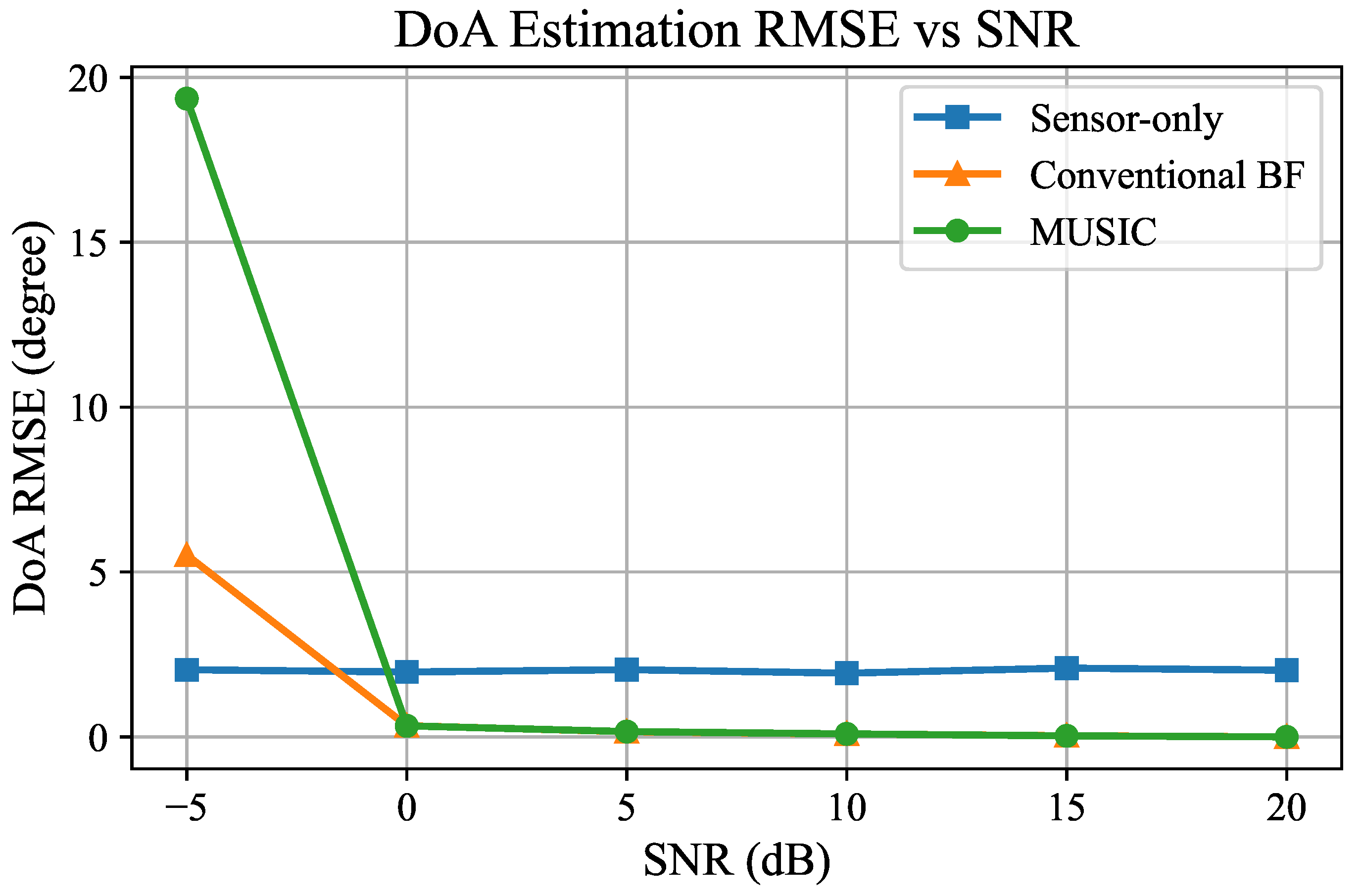
To quantify the performance under different SNR conditions, Monte Carlo simulations are conducted to compute the root-mean-square error (RMSE) between the estimated and true angles. In the simulation, the sensor-only baseline is modeled as a zero-mean pointing error with a standard deviation of 2 ° to reflect IMU noise. Figure 3 presents the RMSE results of the three methods. The results show an SNR-independent RMSE floor of roughly 2 ° for the sensor-only scheme. The conventional beamforming method exhibits large errors at low SNR and improves to about 1 ° when SNR exceeds 0 dB, yet its accuracy remains inadequate for narrow-beam operation. By comparison, the MUSIC estimator offers significantly enhanced precision, achieving sub- 0.4 ° accuracy at 0 dB and approximately 0.1 ° for SNR values above 5 dB, thereby meeting the pointing requirements of high-gain satellite antennas.
To further evaluate how DoA estimation accuracy affects the antenna performance of IVRSN, we analyze the array gain loss caused by pointing errors. For a uniform linear array, the normalized array gain under a steering offset Δ θ is given by:
G ( Δ θ ) = 1 M m = 0 M 1 e j m k d sin θ 0 sin ( θ 0 + Δ θ ) 2 ,
which follows the classical ULA array factor model [17]. Here, M is the number of antenna elements, k = 2 π / λ is the wavenumber, d is the element spacing, θ 0 is the intended steering direction, and Δ θ denotes the pointing error. This expression characterizes the sensitivity of narrow-beam satellite antennas to small misalignment angles.
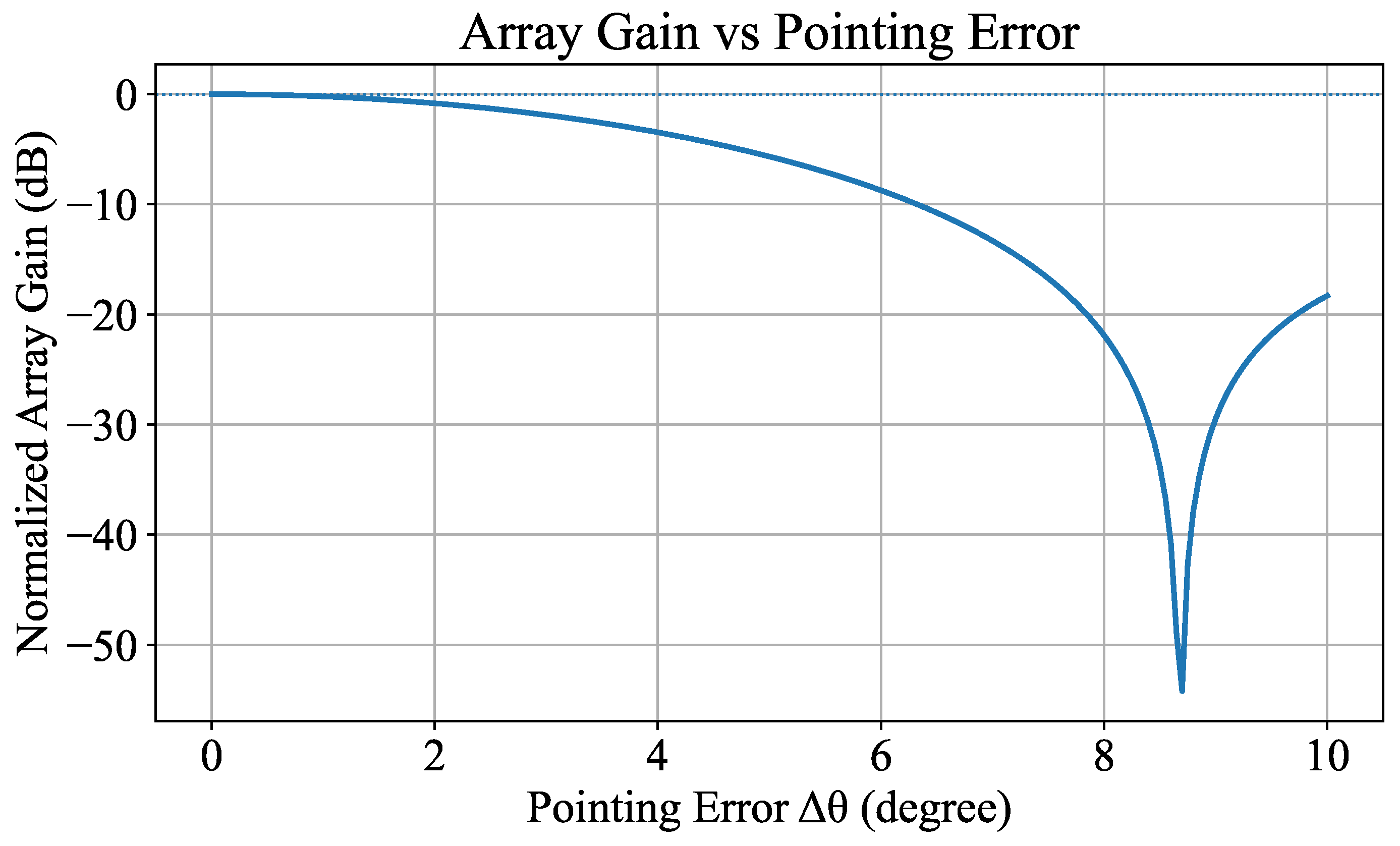
Figure 4 illustrates the array gain degradation as a function of Δ θ for a 16-element half-wavelength ULA. As shown in the figure, a pointing error of 0.1 ° results in almost negligible gain loss, while errors within 1 ° produce only moderate degradation. However, when the misalignment exceeds approximately 5 ° , the array gain drops sharply, indicating that high-gain satellite links are extremely sensitive to pointing errors.
Combining the results in Figure 3 and Figure 4, we observe that the sub- 0.1 ° accuracy achieved by the MUSIC estimator at practical SNR levels translates into minimal beam misalignment and hence negligible gain degradation. In contrast, the 2 ° error of the sensor-only method and the 1 ° error of CBF lead to noticeable array gain loss, which may compromise link reliability under narrow-beam operation.
These results clearly indicate that IMU-only steering cannot meet the pointing accuracy required for stable satellite communication, and conventional BF performs poorly under low-to-moderate SNR conditions. In contrast, MUSIC provides the fine angular resolution necessary for narrow-beam tracking and enables the IVRSN to maintain a robust satellite connection under dynamic vehicular motion. This validates the need and effectiveness of incorporating DoA-assisted beam control in the proposed IVRSN architecture.
In addition to beam alignment performance, we characterize the throughput and latency of the proposed relay architecture from a user device to the satellite link interface. The achievable end-to-end(E2E) throughput is bounded by the bottleneck hop, which can be expressed as follows:
R E 2 E ( 1 η ) min ( R acc , R sat ) ,
where R acc and R sat denote the achievable data rates of the device–vehicle access link and the vehicle–satellite link, respectively, and η accounts for protocol encapsulation/decapsulation overhead in the relay. In many practical deployments, R acc can exceed R sat , and thus the satellite hop often limits R E 2 E . The one-way E2E latency from the user device to the satellite interface can be expressed as follows:
T E 2 E T acc + T proc + T prop ,
where T acc is the access-link delay, T proc is the relay processing delay, and T prop is the propagation delay on the vehicle–satellite path. For LEO links, T prop typically dominates and is on the order of several milliseconds (depending on slant range), while T acc and T proc are comparatively small. Therefore, the proposed protocol-layer relay enables multi-user access with limited additional latency and modest throughput overhead.
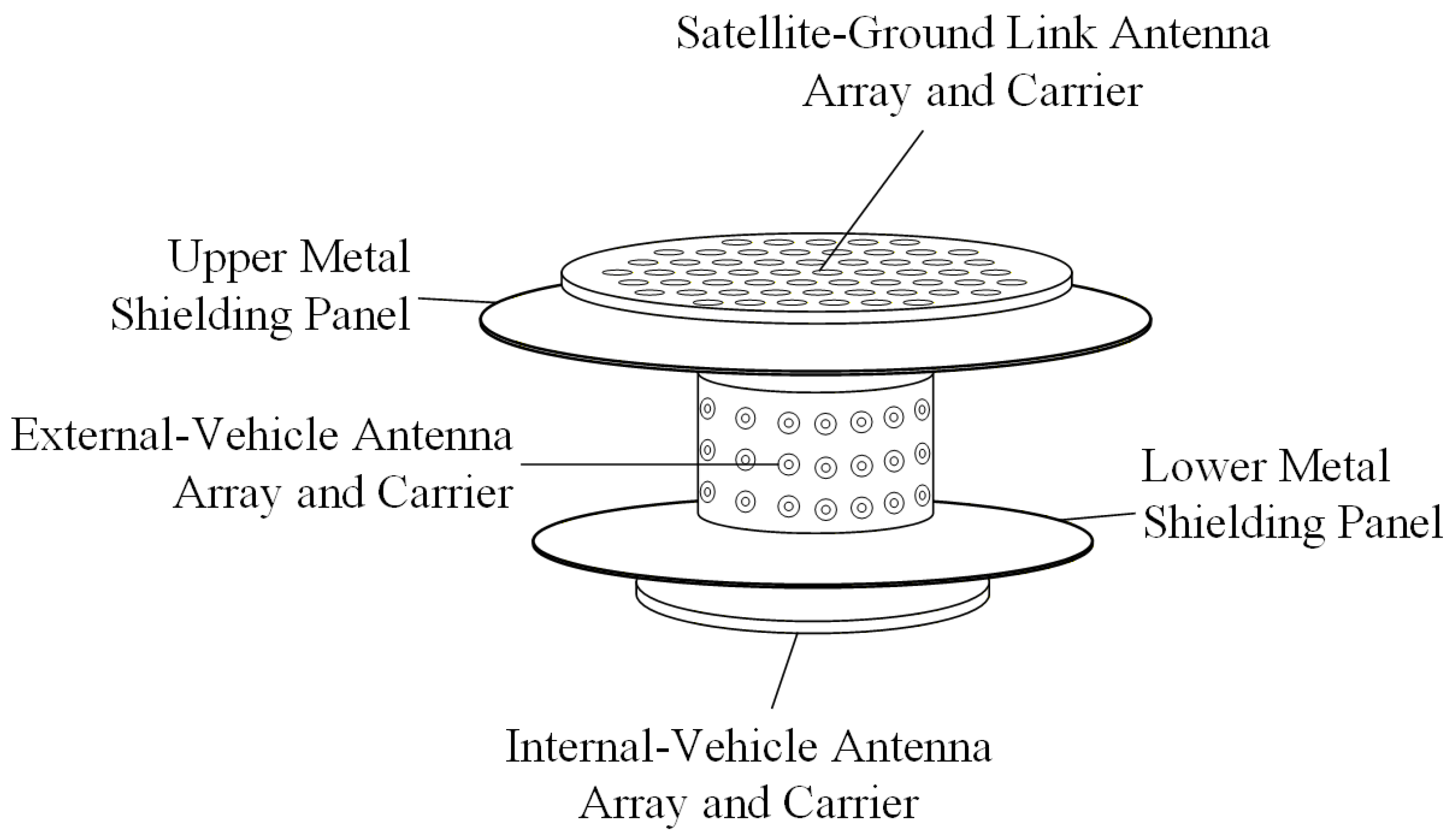
The antenna module integrates three isolated arrays: one upward-facing array for satellite access and two downward-facing arrays for in-vehicle and near-vehicle coverage. Metal shielding plates are placed between arrays to minimize coupling and prevent interference between the satellite and user links, as depicted in Figure 5.
Through the synergy of hybrid beamforming, accurate DoA-assisted tracking, and the isolated multi-array structure, the IVRSN antenna subsystem maintains a robust satellite connection even in rapidly changing vehicular conditions. These results establish the technical feasibility of the proposed relay architecture and provide a strong foundation for further system enhancements.

4. Potential Research Directions

In this section, we provide and analyze some potential research directions for future researchers based on the proposed IVRSN, including advanced sensor technology, AI-based orientation perceptions and predictions, and intelligent antenna control methods.

4.1. Advanced Intelligent Sensor Techniques

The performance of the equipped sensors is very important for the communication quality of the designed IVRSN because the algorithms are based on the precise and real-time results of the basic gyroscopes and accelerometers. In the future, a high-precision inertial measurement unit, which combines multiple sensors, such as magnetometers and barometers, should be considered to provide more real-time and complete information on the vehicle’s positions, orientations, and even altitude changes [18]. Another potential research direction lies in the intelligent fast algorithms on the high-precision inertial measurement unit to increase the performance. Finally, the information fusion and integrations between the high-precision inertial measurement unit and navigation systems can be considered as the effective solutions to optimize system performance.

4.2. AI-Based Orientation Perceptions and Predictions

Existing methods for vehicle posture and orientation perceptions are precise enough but not timely enough, which makes it hard for the subsequent steps and algorithms to follow the real-time performance. Real-time orientation perceptions and predictions are needed. Artificial intelligence is a promising solution to enhance its predictive ability in dynamic environments [19]. By training AI models with real-world environment inputs and driving data, including data from sensors such as gyroscopes, accelerometers, and GPS, AI-based methods can predict vehicle movement, reduce the beam width when the vehicle is traveling smoothly, and automatically increase the beam width when the vehicle is traveling violently to prevent signal loss. Moreover, the AI-based methods can predict the driving direction and actively compensate for antenna adjustments, enhancing the efficiency of signal tracking.

4.3. Intelligent Antenna Controls

While the IVRSN already employs DoA-assisted hybrid beamforming to achieve accurate and fast satellite alignment, future research may focus on further enhancing the autonomy and robustness of the antenna control process under more challenging mobility conditions. One direction is to design higher-level beam control strategies that enable the antenna to anticipate link degradation or blockage and proactively adjust its steering behavior. Such strategies may incorporate environmental cues, satellite trajectory information, or historical link variation patterns to support predictive beam-steering decisions beyond instantaneous DoA estimation. Another potential direction is to explore deep learning technology to optimize beamforming algorithms and achieve adaptive beam adjustment through reinforcement learning to cope with dynamic changes in communication requirements and resource allocation [20].

5. Future Applications Prospects

The designed IVRSN has the following three advantages. Firstly, for explorers and tourists in remote regions, their portable mobile terminals can communicate with satellite networks through IVRSN without specialized hardware, to surf the Internet and ensure their personal safety. Secondly, the designed IVRSN system provides high-speed and stable communication services to passengers while the vehicle is moving at high speed in remote regions. Finally, the designed IVRSN system automatically switches the beam coverage when the vehicle is moving or stationary, optimizing energy efficiency and ensuring high-quality communications for field personnel.
The designed IVRSN can be equipped in all kinds of vehicles to provide necessary network coverage and crucial safety assurance for future explorers and tourists in remote regions. It will also play an important role in the future space air ground integrated networks, especially in regions with limited terrestrial infrastructure.

6. Conclusions

This paper presents an Intelligent Vehicle Repeater for Satellite Networks (IVRSN) designed to enable broadband satellite connectivity for conventional mobile terminals in remote or infrastructure-limited environments. The proposed system integrates a protocol-layer relay architecture, a dual-mode vehicular coverage mechanism, and a DoA-assisted, attitude-compensated hybrid beamforming scheme to address the challenges of mobility, protocol heterogeneity, and variable user coverage. The analysis and evaluations demonstrate that the IVRSN framework effectively improves satellite link stability, alignment accuracy, and relay-layer adaptability under vehicular motion. These results highlight the feasibility of deploying dedicated vehicular satellite relays to extend high-quality connectivity to personal portable devices in regions lacking terrestrial network coverage. Future work will focus on advanced sensor fusion, learning-assisted orientation prediction, and intelligent antenna control, as well as in-vehicle experiments and field trials to further validate the proposed architecture under realistic vehicular conditions.

Author Contributions

Conceptualization, Y.L.; Methodology, Y.L.; Validation, C.H.; Investigation, C.H.; Writing—original draft, C.H.; Writing—review and editing, Y.L.; Visualization, C.H. All authors have read and agreed to the published version of the manuscript.

Funding

This research received no external funding.

Data Availability Statement

The original contributions presented in this study are included in this article. Further inquiries can be directed to the corresponding author.

Conflicts of Interest

The authors declare no conflicts of interest.

References

  1. Xu, J.; Kishk, M.A.; Alouini, M.S. Space-air-ground-sea integrated networks: Modeling and coverage analysis. IEEE Trans. Wirel. Commun. 2023, 22, 6298–6313. [Google Scholar] [CrossRef]
  2. Wang, F.; Jiang, D.; Wang, Z.; Chen, J.; Quek, T.Q. Seamless handover in LEO based non-terrestrial networks: Service continuity and optimization. IEEE Trans. Commun. 2022, 71, 1008–1023. [Google Scholar] [CrossRef]
  3. Abdelsadek, M.Y.; Chaudhry, A.U.; Darwish, T.; Erdogan, E.; Karabulut-Kurt, G.; Madoery, P.G.; Yahia, O.B.; Yanikomeroglu, H. Future space networks: Toward the next giant leap for humankind. IEEE Trans. Commun. 2022, 71, 949–1007. [Google Scholar] [CrossRef]
  4. Li, X.; Shi, W. Hybrid satellite-UAV-terrestrial maritime networks: Network selection for users on a vessel optimized with transmit power and UAV position. China Commun. 2022, 19, 37–46. [Google Scholar] [CrossRef]
  5. Zhang, H.; Lu, S.; Zhang, X. Key technologies for networking in satellite-terrestrial integrated network. Chin. J. Aeronaut. 2025, 38, 103641. [Google Scholar] [CrossRef]
  6. Bakhsh, Z.M.; Omid, Y.; Chen, G.; Kayhan, F.; Ma, Y.; Tafazolli, R. Multi-satellite MIMO systems for direct satellite-to-device communications: A survey. IEEE Commun. Surv. Tutor. 2024, 27, 1536–1564. [Google Scholar] [CrossRef]
  7. Al-Hraishawi, H.; Chougrani, H.; Kisseleff, S.; Lagunas, E.; Chatzinotas, S. A survey on nongeostationary satellite systems: The communication perspective. IEEE Commun. Surv. Tutor. 2022, 25, 101–132. [Google Scholar] [CrossRef]
  8. Ullah, M.A.; Mikhaylov, K.; Alves, H. Massive machine-type communication and satellite integration for remote areas. IEEE Wirel. Commun. 2021, 28, 74–80. [Google Scholar] [CrossRef]
  9. Maral, G.; Bousquet, M.; Sun, Z. Satellite Communications Systems: Systems, Techniques and Technology; John Wiley & Sons: Hoboken, NJ, USA, 2020. [Google Scholar]
  10. Zhang, X.; Qin, X.; Wang, Y.; Xu, Y.; Zhou, H.; Zhuang, W. Robust Downlink Data Transmission in LEO Satellite-Terrestrial Networks: A Rate-Splitting Multiple Access Approach. IEEE Internet Things J. 2025, 12, 27364–27378. [Google Scholar] [CrossRef]
  11. Araniti, G.; Iera, A.; Pizzi, S.; Rinaldi, F. Toward 6G non-terrestrial networks. IEEE Netw. 2021, 36, 113–120. [Google Scholar] [CrossRef]
  12. Wei, Q.; Chen, X.; Ni, Z.; Jiang, C.; Huang, Z.; Zhang, S. Integrated Doppler positioning in a narrowband satellite system: Performance bound, parameter estimation, and receiver architecture. IEEE Internet Things J. 2023, 11, 10893–10910. [Google Scholar] [CrossRef]
  13. Wang, H.; Li, Y.; Zhou, D.; Zhang, Z. A Mode Steering Antenna for Vehicular to LEO Satellite Communication. IEEE Trans. Veh. Technol. 2025, 74, 19859–19863. [Google Scholar] [CrossRef]
  14. Chen, Z.; Chen, P.; Zheng, L.; Zhang, Y. DNN-DANM: A high-accuracy two-dimensional DOA estimation method using practical RIS. IEEE Trans. Veh. Technol. 2023, 73, 1792–1802. [Google Scholar] [CrossRef]
  15. Schmidt, R. Multiple emitter location and signal parameter estimation. IEEE Trans. Antennas Propag. 1986, 34, 276–280. [Google Scholar] [CrossRef]
  16. Li, X.; Chen, W.; Chan, C.; Li, B.; Song, X. Multi-sensor fusion methodology for enhanced land vehicle positioning. Inf. Fusion 2019, 46, 51–62. [Google Scholar] [CrossRef]
  17. Balanis, C.A. Antenna Theory: Analysis and Design; John Wiley & Sons: Hoboken, NJ, USA, 2016. [Google Scholar]
  18. Shen, Z.; Li, X.; Li, X. Advancing high-precision navigation: Leveraging homogeneous sensors in tightly coupled PPP-RTK/IMU integration. IEEE Trans. Ind. Electron. 2024, 71, 15100–15110. [Google Scholar] [CrossRef]
  19. Mozaffari, S.; Al-Jarrah, O.Y.; Dianati, M.; Jennings, P.; Mouzakitis, A. Deep learning-based vehicle behavior prediction for autonomous driving applications: A review. IEEE Trans. Intell. Transp. Syst. 2020, 23, 33–47. [Google Scholar] [CrossRef]
  20. Zhang, Y.; Liu, A.; Li, P.; Jiang, S. Deep learning (DL)-based channel prediction and hybrid beamforming for LEO satellite massive MIMO system. IEEE Internet Things J. 2022, 9, 23705–23715. [Google Scholar] [CrossRef]
Figure 1. System Mode.
Telecom 07 00008 g001
Figure 2. Spatial spectra of MUSIC and CBF for a 16-element half-wavelength ULA at an SNR of 10 dB.
Telecom 07 00008 g002
Figure 3. RMSE comparison of sensor-only steering, CBF, and MUSIC under different SNR conditions. The simulation uses 200 snapshots and 200 Monte Carlo runs per SNR point.
Telecom 07 00008 g003
Figure 4. Normalized array gain of a 16-element half-wavelength ULA as a function of pointing error Δ θ .
Telecom 07 00008 g004
Figure 5. Relay Antenna Module.
Telecom 07 00008 g005
Table 1. List of acronyms used in this paper.
AcronymFull Name
CBFConventional Beamforming
DoADirection of Arrival
DSPMData Storage and Processing Module
E2EEnd-to-End
ESAElectronically Steered Antennas
FDDFrequency-Division Duplexing
IVRSNIntelligent Vehicle Repeater for Satellite Networks
MUSICMultiple Signal Classification
NTNNon-Terrestrial Network
PCDFMProtocol Conversion and Data Forwarding Module
RFRadio Frequency
RMSERoot Mean Square Error
SNRSignal-to-Noise Ratio
SOTMSatellite-On-The-Move
ULAUniform Linear Array
Table 2. Comparison of representative Satellite-On-the-Move (SOTM) products.
SystemTerminal CategoryBroadband DataInternet PerformanceMulti-DeviceMobility SupportRelay CapabilityUser Interface TypeCommercial Availability
SpaceX Starlink AviationBroadband terminalYesHigh (100–250 Mbps)Multi-user in-cabinHigh mobilityNoIn-cabin WiFi hotspotYes
Galaxy SpaceBroadband terminalYesHigh (∼200 Mbps)Multi-user in-vehicleHigh mobilityNoIn-vehicle WiFi hotspotNo
Ruoson RUV-900Broadband terminalYesMid (5–46 Mbps)Multi-user in-vehicleHigh mobilityNoIn-vehicle WiFi hotspotYes
Huawei Vehicle Satellite SystemSatellite telephonyNoLow (voice only)Short-range sharingLow mobilityNoIn-vehicle WiFi hotspotYes
Proposed IVRSNIntelligent satellite relay nodeYesHighLong-range (up to 50 m)High mobilityYesWiFi/LTE relay accessNo
Disclaimer/Publisher’s Note: The statements, opinions and data contained in all publications are solely those of the individual author(s) and contributor(s) and not of MDPI and/or the editor(s). MDPI and/or the editor(s) disclaim responsibility for any injury to people or property resulting from any ideas, methods, instructions or products referred to in the content.