



Energy Efficient Neighbor Discovery Protocol for Wireless Sensor Networks Using Coprime Numbers

Abstract
1. Introduction
- Energy efficiency: As shown in Theorem 2, the worst-case discovery latency of ECNDP will be bounded by when two neighboring sensors use the same odd number k for constructing their discovery schedule and the number of active slots in the schedule is set to . ECNDP can adjust the number of active slots—which is closely tied to an NDP’s energy consumption—to further reduce energy usage during the discovery phase.
- Superior performance: The proposed approach is more energy efficient. One key metric for comparing NDP protocols is the -product, and as shown in Table 1, the proposed method outperforms others in this aspect.
- Greater flexibility: U-Connect generates discovery schedules of length where p is the selected prime. On the other hand, the proposed method can offer greater flexibility because its discovery schedules are constrained to , where k is odd number and n is any positive number (See Table 2 and Table 3 for the set of duty cycles that can be constructed using the proposed method).
- In Theorem 3, we used the Chinese Remainder Theorem (CRT) [22] to demonstrate that overlapping active slot is established any two ECNDP discovery schedules when two distinct coprime numbers k and i. U-Connect relies on prime numbers to construct discovery schedules, whereas our proposed method uses coprime numbers. As a result, ECNDP can generate a wider variety of schedules than U-Connect.
2. Related Works
3. Extend Coprime Based NDP
3.1. Background Knowledge
3.2. Extended Coprime Based Scheduling
- Case 1: Clock drift d is in .
- Case 2: Clock drift d is in .
- Case 3: Clock drift d is in .
- Case 4: Clock drift d is in .
4. Numerical Analysis

| Protocol | Parameters (-) | Product (-) | Normalized (-) |
|---|---|---|---|
| Quorum | n | 1 | |
| Disco | 1 | ||
| U-Connect | p | ||
| ECNDP |
| k (-) | Duty Cycle (%) |
|---|---|
| 3 | 34, 35, 36, 37, 38, 40, 41, 44, 50 |
| 5 | 21, 22, 23, 24, 25, 26, 28, 30, 33, 40 |
| 7 | 15, 16, 17, 18, 19, 20, 21, 22, 25, 28, 35 |
| 11 | 10, 11, 12, 13, 14, 15, 16, 18, 20, 24, 31 |
| 13 | 9, 10, 11, 12, 13, 14, 15, 16, 19, 23, 30 |
| 17 | 7, 8, 9, 10, 11, 12, 13, 15, 17, 21, 29 |
| 19 | 6, 7, 8, 9, 10, 11, 12, 13, 14, 17, 21, 28 |
| 23 | 5, 6, 7, 8, 9, 10, 11, 12, 13, 16, 20, 28 |
| 29 | 4, 5, 6, 7, 8 |
| 31 | 4, 5, 6, 7, 8 |
| 41 | 3, 4, 5, 6, 7 |
| 47 | 3, 4, 5 |
| U-Connect | ECNDP | |||||||
|---|---|---|---|---|---|---|---|---|
| DC (%) | (-) | Num. Active Slots (Slots) | Length (Slots) | DC (%) | (-) | (-) | Num. Active Slots (Slots) | Length (Slots) |
| 11.83% | 13 | 20 | 169 | 11.53% | 13 | 12 | 18 | 156 |
| 11.24% | 13 | 13 | 19 | 169 | ||||
| 11.76% | 17 | 8 | 16 | 136 | ||||
| 11.11% | 17 | 9 | 17 | 153 | ||||
| 5.23% | 29 | 44 | 841 | 5.11% | 29 | 29 | 43 | 841 |
| 5.16% | 31 | 25 | 40 | 775 | ||||
| 5.08% | 31 | 26 | 41 | 806 | ||||
| 5.02% | 31 | 27 | 42 | 837 | ||||
| 5.14% | 41 | 18 | 38 | 738 | ||||
| 5.00% | 41 | 19 | 39 | 779 | ||||
| 4.87% | 41 | 20 | 40 | 820 | ||||
| 2.06% | 73 | 110 | 5329 | 2.06% | 73 | 71 | 107 | 5183 |
| 2.05% | 73 | 72 | 108 | 5256 | ||||
| 2.04% | 73 | 73 | 109 | 5329 | ||||
| 2.06% | 79 | 62 | 101 | 4898 | ||||
| 2.03% | 79 | 64 | 103 | 5056 | ||||
| 2.02% | 79 | 65 | 104 | 5135 | ||||
| 2.01% | 79 | 66 | 105 | 5214 | ||||
| 2.00% | 79 | 67 | 106 | 5293 | ||||
| 0.99% | 151 | 227 | 22,801 | 0.99% | 151 | 150 | 225 | 22,650 |
| 0.99% | 151 | 151 | 226 | 22,801 | ||||
| 0.99% | 157 | 139 | 217 | 21,823 | ||||
| 0.99% | 157 | 140 | 218 | 21,980 | ||||
| 0.98% | 157 | 141 | 219 | 22,137 | ||||
| 0.98% | 157 | 142 | 220 | 22,294 | ||||
| 0.98% | 157 | 143 | 221 | 22,451 | ||||
| 0.98% | 157 | 144 | 222 | 22,608 | ||||
| 0.97% | 157 | 145 | 223 | 22,765 | ||||
5. Experimental Analysis
6. Discussion and Conclusions
Author Contributions
Funding
Data Availability Statement
Conflicts of Interest
References
- Wei, L.; Chen, Y.; Zhang, Y.; Zhao, L.; Chen, L. PSPL: A generalized model to convert existing neighbor discovery algorithms to highly efficient asymmetric ones for heterogeneous IoT devices. IEEE Internet Things J. 2020, 7, 7207–7219. [Google Scholar] [CrossRef]
- Sun, H.; Meng, Z.; Wang, D.; Li, H. Fedab: A low-latency energy-efficient proactive neighbor discovery protocol in MLDC-WSN. IEEE Access 2023, 11, 22843–22854. [Google Scholar] [CrossRef]
- Shen, Z.; Yang, Q.; Jiang, H. Multichannel neighbor discovery in bluetooth low energy networks: Modeling and performance analysis. IEEE Trans. Mob. Comput. 2023, 22, 2262–2280. [Google Scholar] [CrossRef]
- Han, K.; Luo, J.; Liu, Y.; Vasilakos, A.V. Algorithm design for data communications in duty-cycled wireless sensor networks: A survey. IEEE Commun. Mag. 2013, 51, 107–113. [Google Scholar] [CrossRef]
- Pozza, R.; Nati, M.; Georgoulas, S.; Moessner, K.; Gluhak, A. Neighbor discovery for opportunistic networking in internet of things scenarios: A survey. IEEE Access 2015, 3, 1101–1131. [Google Scholar] [CrossRef]
- Mehmood, G.; Khan, M.S.; Waheed, A.; Zareei, M.; Fayaz, M.; Sadad, T.; Nazri, K.; Azmi, A. An efficient and secure session key management scheme in wireless sensor network. Complexity 2021, 2021, 6577492. [Google Scholar] [CrossRef]
- Huan, X.; He, H.; Wang, T.; Wu, Q.; Hu, H. A timestamp-free time synchronization scheme based on reverse asymmetric framework for practical resource-constrained wireless sensor networks. IEEE Trans. Commun. 2022, 70, 6109–6121. [Google Scholar] [CrossRef]
- Meng, C.; Yan, X.; Guo, L.; Sun, Z.; Wang, P. An energy-efficient asynchronous neighbor discovery algorithm based on cyclic difference set in duty-cycle wireless sensor networks. J. Netw. Comput. Appl. 2024, 226, 103854. [Google Scholar] [CrossRef]
- Dutta, P.; Culler, D. Practical asynchronous neighbor discovery and rendezvous for mobile sensing applications. In Proceedings of the 6th ACM Conference on Embedded Network Sensor Systems, Raleigh, NC, USA, 5–7 November 2008; pp. 71–84. [Google Scholar]
- Kandhalu, A.; Lakshmanan, K.; Rajkumar, R. U-connect: A low-latency energy-efficient asynchronous neighbor discovery protocol. In Proceedings of the 9th ACM/IEEE International Conference on Information Processing in Sensor Networks, Stockholm, Sweden, 12–16 April 2010; pp. 350–361. [Google Scholar]
- Mehmood, G.; Khan, M.Z.; Bashir, A.K.; Al-Otaibi, Y.D.; Khan, S. An efficient QoS-based multi-path routing scheme for smart healthcare monitoring in wireless body area networks. Comput. Electr. Eng. 2023, 109, 108517. [Google Scholar] [CrossRef]
- Khan, S.; Iqbal, W.; Waheed, A.; Mehmood, G.; Khan, S.; Zareei, M.; Biswal, R.R. An efficient and secure revocation-enabled attribute-based access control for eHealth in smart society. Sensors 2022, 22, 336. [Google Scholar] [CrossRef] [PubMed]
- Huan, X.; Chen, W.; Wang, T.; Hu, H. A Microsecond energy-efficient LoRa time synchronization based on low-layer timestamping and asymmetric time translation. IEEE Trans. Veh. Technol. 2024, 73, 7328–7332. [Google Scholar]
- Lee, W.; Youn, J.-H.; Song, T.-S. Asymmetric wake-up scheduling based on block designs for Internet of Things. Ad Hoc Netw. 2024, 162, 103530. [Google Scholar] [CrossRef]
- Chen, W.; Tang; Cui, F.; Chen, C. Research on Energy Harvesting Mechanism and Low Power Technology in Wireless Sensor Network. Sensors 2024, 24, 47. [Google Scholar] [CrossRef] [PubMed]
- Dogra, R.; Rani, S.; Gianini, G. REERP: A Region-Based Energy-Efficient Routing Protocol for IoT Wireless Sensor Networks. Energies 2023, 16, 6248. [Google Scholar] [CrossRef]
- Zheng, R.; Hou, J.C.; Sha, L. Optimal block design for asynchronous wake-up schedules and its applications in multihop wireless networks. IEEE Trans. Mob. Comput. 2006, 5, 1228–1241. [Google Scholar] [CrossRef]
- Jiang, J.; Tseng, Y.-C.; Hsu, C.-S.; Lai, T. Quorum-based asynchronous power-saving protocols for IEEE 802.11 ad hoc networks. Mob. Netw. Appl. 2005, 10, 169–181. [Google Scholar] [CrossRef]
- Shah, S.M.; Sun, Z.; Zaman, K.; Hussain, A.; Ullah, I.; Ghadi, Y.Y.; Khan, M.A.; Nasimov, R. Advancements in Neighboring-Based Energy-Efficient Routing Protocol (NBEER) for Underwater Wireless Sensor Networks. Sensors 2023, 23, 6025. [Google Scholar] [CrossRef] [PubMed]
- Tseng, Y.-C.; Hsu, C.-S.; Hsieh, T.-Y. Power-saving protocols for IEEE 802.11-based multi-hop ad hoc networks. In Proceedings of the Twenty-First Annual Joint Conference of the IEEE Computer and Communications Societies, New York, NY, USA, 23–27 June 2002; pp. 200–209. [Google Scholar]
- Zheng, R.; Hou, J.C.; Sha, L. Asynchronous wakeup for ad hoc networks. In Proceedings of the 4th ACM International Symposium on Mobile Ad Hoc Networking Computing, Annapolis, MD, USA, 1–3 June 2003; pp. 35–45. [Google Scholar]
- Niven, H.L.I.; Zuckerman, H.S. An Introduction to the Theory of Numbers; John Wiley and Sons: Hoboken, NJ, USA, 1991. [Google Scholar]
- OMNeT++ Home Page. Available online: http://www.omnetpp.org (accessed on 10 August 2024).
- Kochhar, A.; Kumar, N. Wireless sensor networks for greenhouses: An end-to-end review. Comput. Electron. Agric. 2019, 163, 104877. [Google Scholar] [CrossRef]


| DC (%) | (-) | Len. (Slots) | p (-) | Len. (Slots) | (-) | Len. (Slots) | Disco:ECNDP (-) | U-Connect:ECNDP (-) |
|---|---|---|---|---|---|---|---|---|
| 10% | 17, 23 | 391 | 13 | 169 | 17, 8 | 136 | 1:0.35 | 1:0.80 |
| 5% | 37, 43 | 1591 | 29 | 841 | 41, 18 | 738 | 1:0.46 | 1:0.88 |
| 2% | 93, 103 | 9579 | 73 | 5329 | 79, 64 | 5056 | 1:0.35 | 1:0.95 |
| 1% | 197, 199 | 39,203 | 151 | 22,801 | 157, 139 | 21,823 | 1:0.56 | 1:0.96 |
| Average | - | - | - | - | - | - | 1:0.47 | 1:0.90 |
| Mode | INET Parameter Name | Default Value |
|---|---|---|
| Listening | Receiver Idle Power Consumption | 0.005 mW |
| Receiving | Receiver Receiving Power Consumption | 50 mW |
| Transmitting | Transmitter Transmitting Power Consumption | 75 mW |
| Division | Configuration Setting Value |
|---|---|
| Topology | Random deployment (indoor environment) |
| Network size | (indoor floor plan scale) |
| Transmission range | (indoor) [24] |
| Number of nodes | 50 nodes |
| PHY & Radio model | IEEE802154NarrowbandScalarRadio |
| Center frequency | 2450 MHz (2.4 GHz ISM band) |
| Transmit power | 1 mW (0 dBm) |
| Receiver sensitivity | dBm |
| Path loss model | LogNormalShadowing (, dB) |
| Noise floor | dBm (IsotropicScalarBackgroundNoise) |
| MAC Protocol | IEEE 802.15.4 CSMA/CA |
| Duty cycle (DC) | 10%, 5%, 2%, 1% |
| Simulator | OMNeT++ 6.0.2 + INET Framework |
| Algorithms evaluated | Disco, Quorum, U-Connect, ECNDP |
| Protocol | 10% (-) | 5% (-) | 2% (-) | 1% (-) |
|---|---|---|---|---|
| ECNDP | , | , | , | , |
| U-Connect | ||||
| Disco | , | , | , | , |
| Quorum |
| Protocol | Num. of Observations (-) | Mean (ms) | Variance (ms2) |
|---|---|---|---|
| ECNDP | 10 | 1514.153 | 23,817.13216 |
| U-Connect | 10 | 1587.73 | 6882.080511 |
| DISCO | 10 | 1485.305 | 31,754.07827 |
| QUORUM | 10 | 1880.178 | 104,459.8424 |
| Source of Variation | Sum of Squares (ms2) | df (-) | Mean Square (ms2) | F-Value (-) | p-Value (-) | F-Critical (-) |
|---|---|---|---|---|---|---|
| Treatment | 980,403.7053 | 3 | 326,801.2351 | 7.8316 | 0.000377 | 2.8663 |
| Error | 1,502,218.2000 | 36 | 41,728.2833 | |||
| Total | 2,482,621.9050 | 39 |
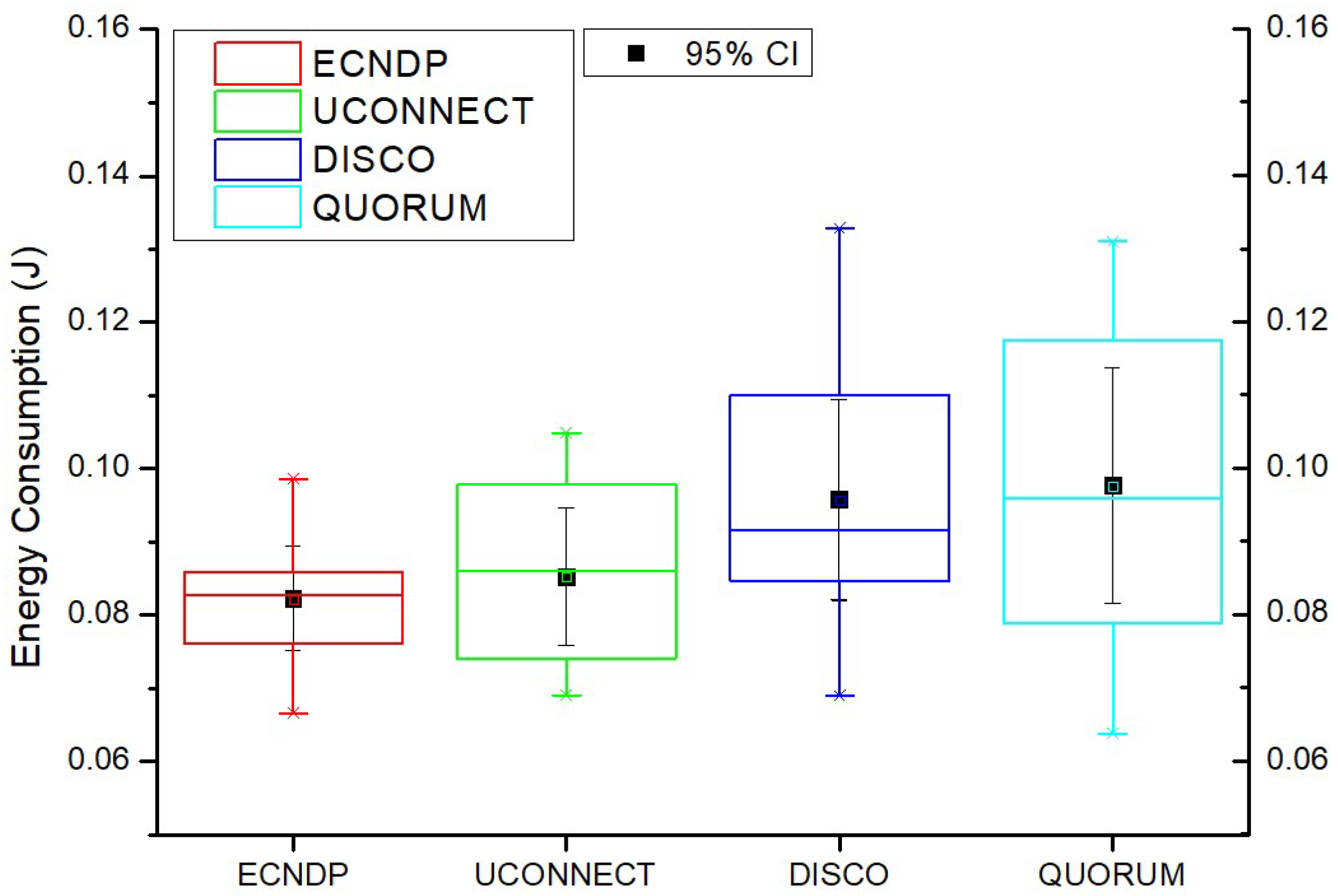
| Protocol | Num. of Observations (-) | Mean (J) | Variance () |
|---|---|---|---|
| ECNDP | 10 | 0.082192152 | 0.000098133 |
| U-Connect | 10 | 0.085189234 | 0.000170357 |
| DISCO | 10 | 0.095677964 | 0.000367021 |
| QUORUM | 10 | 0.097628508 | 0.00050448 |
| Source of Variation | Sum of Squares (J2) | df (-) | Mean Square (J2) | F-Value (-) | p-Value (-) | F-Critical (-) |
|---|---|---|---|---|---|---|
| Treatment | 0.001744 | 3 | 0.000581 | 2.0400 | 0.1256 | 2.8663 |
| Error | 0.010260 | 36 | 0.000285 | |||
| Total | 0.012004 | 39 |
Disclaimer/Publisher’s Note: The statements, opinions and data contained in all publications are solely those of the individual author(s) and contributor(s) and not of MDPI and/or the editor(s). MDPI and/or the editor(s) disclaim responsibility for any injury to people or property resulting from any ideas, methods, instructions or products referred to in the content. |
© 2025 by the authors. Licensee MDPI, Basel, Switzerland. This article is an open access article distributed under the terms and conditions of the Creative Commons Attribution (CC BY) license (https://creativecommons.org/licenses/by/4.0/).
Share and Cite
Youn, J.-H.; Lee, W.; Song, T.-S. Energy Efficient Neighbor Discovery Protocol for Wireless Sensor Networks Using Coprime Numbers. Telecom 2025, 6, 99. https://doi.org/10.3390/telecom6040099
Youn J-H, Lee W, Song T-S. Energy Efficient Neighbor Discovery Protocol for Wireless Sensor Networks Using Coprime Numbers. Telecom. 2025; 6(4):99. https://doi.org/10.3390/telecom6040099
Chicago/Turabian StyleYoun, Jong-Hoon, Woosik Lee, and Teuk-Seob Song. 2025. "Energy Efficient Neighbor Discovery Protocol for Wireless Sensor Networks Using Coprime Numbers" Telecom 6, no. 4: 99. https://doi.org/10.3390/telecom6040099
APA StyleYoun, J.-H., Lee, W., & Song, T.-S. (2025). Energy Efficient Neighbor Discovery Protocol for Wireless Sensor Networks Using Coprime Numbers. Telecom, 6(4), 99. https://doi.org/10.3390/telecom6040099

