Article

An Emergency Message Routing Protocol for Improved Congestion Management in Hybrid RF/VLC VANETs

1
Department of Electrical, Computer and Biomedical Engineering, Toronto Metropolitan University, Toronto, ON M5B 2K3, Canada
2
Department of Computer Science, Toronto Metropolitan University, Toronto, ON M5B 2K3, Canada
*
Author to whom correspondence should be addressed.
Telecom 2024, 5(1), 21-47; https://doi.org/10.3390/telecom5010002

Submission received: 25 October 2023 / Revised: 18 December 2023 / Accepted: 20 December 2023 / Published: 25 December 2023

Abstract

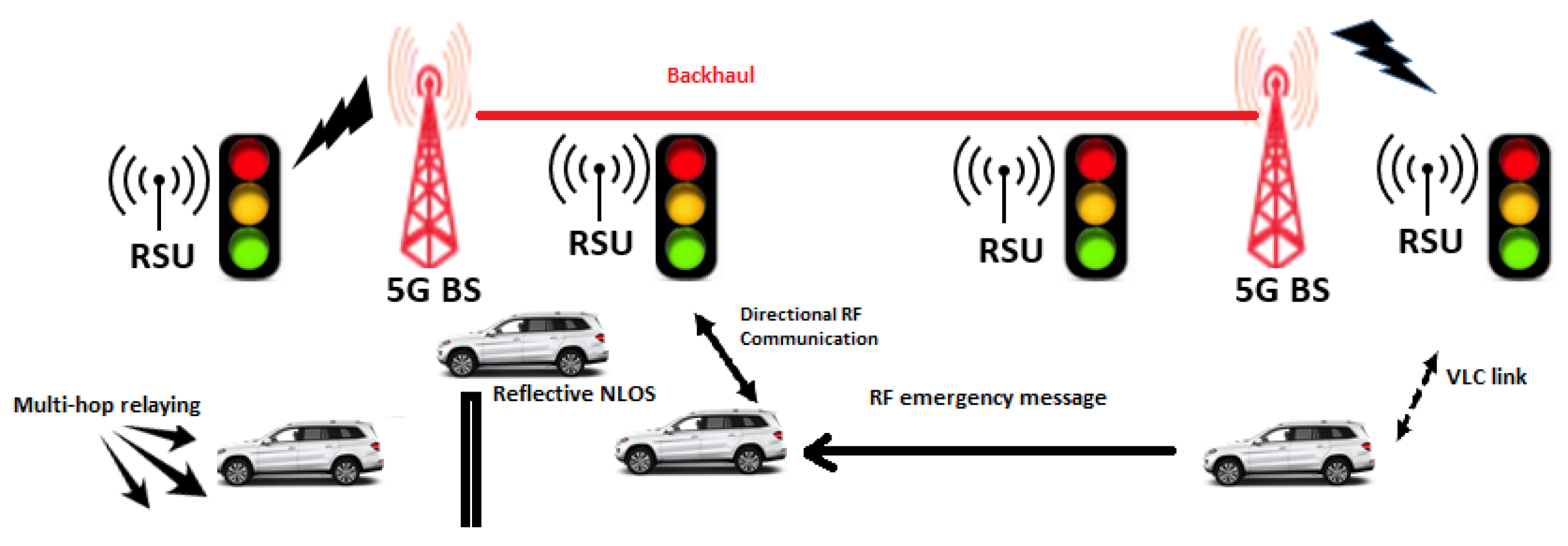
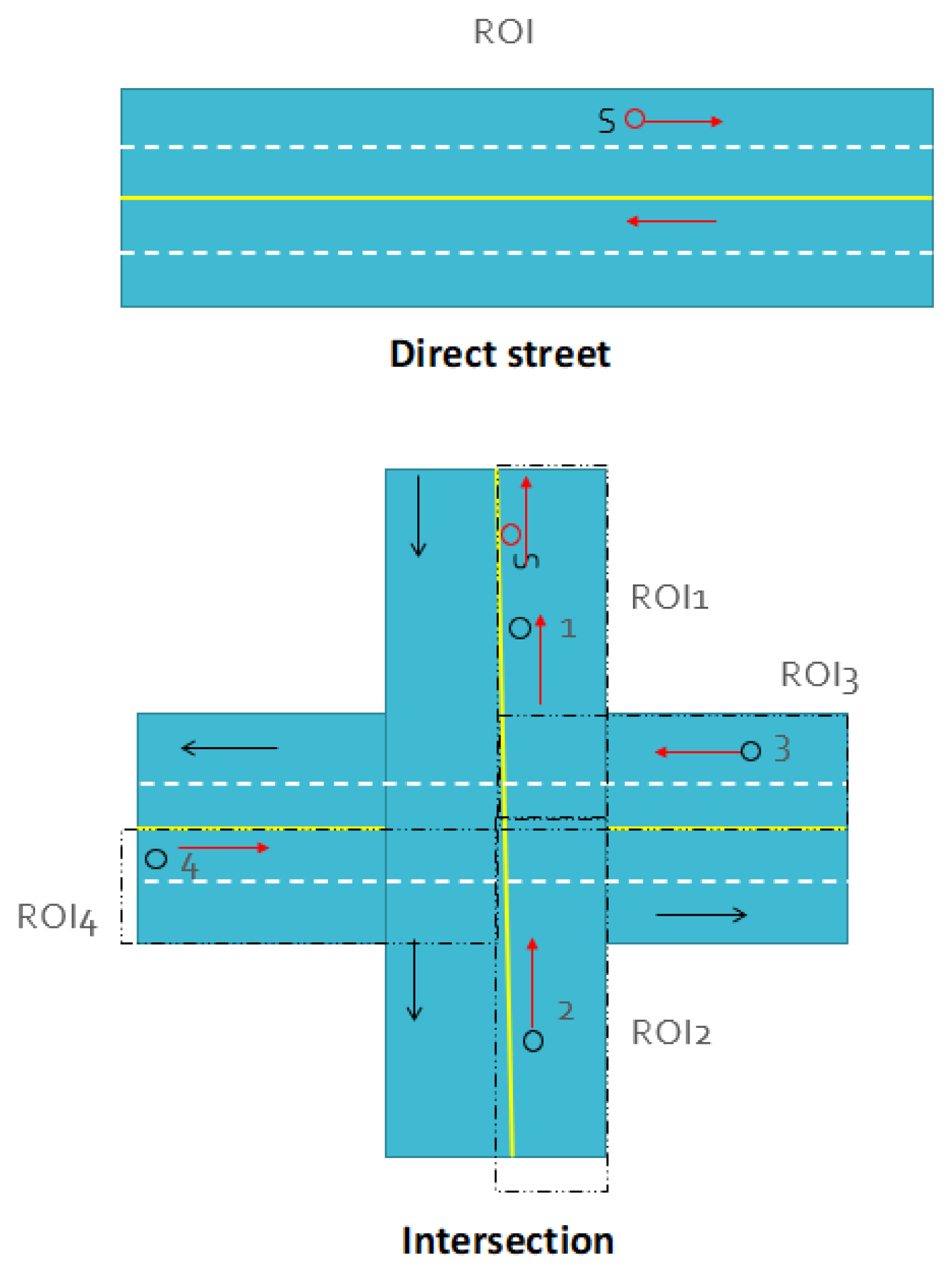
Unexpected traffic incidents cause safety concerns and intense traffic congestion on crowded urban road networks. Vehicular ad-hoc network (VANET)-aided Intelligent Transport Systems (ITS) aim to mitigate these risks through timely dissemination of alert messages. However, conventional Radio frequency (RF) mobile ad-hoc routing protocols are ill-suited for dynamic VANET environments due to high mutual interference, packet collisions, high end-to-end delay from frequent route discoveries, and periodic beaconing requirements. Fortunately, the quickly emerging Visible Light Communications (VLC) provide complementary short-range connectivity with high bandwidth and low interference. This paper proposes an efficient adaptive routing protocol for emergency messages in dense VANET scenarios leveraging a hybrid RF/VLC system. When an incident or congestion happens, the source vehicle disseminates the information to the incoming vehicles as quickly as possible using a combination of VLC and RF communication networks. Multi-hop relays extend the connectivity if the direct links are blocked. The coverage area is partitioned into zones based on road segments, intersections, and traffic flows. The Road Side Units (RSU)s are intelligently assigned to zones and they analyze the historical traffic data to characterize each zone and decide a response strategy. We also propose a congestion detection scheme that utilizes traffic simulations to forecast the clearance times under different response strategies. The highest-scoring strategy is selected based on the predicted impacts on travel time, emissions, and driver stress levels. The proposed algorithm adaptively uses the selected strategy to proactively alleviate the predicted congestion through optimized routing and control. Overall, the protocol maximizes safety and efficiency during emergencies by leveraging the hybrid RF/VLC, incorporating real-time congestion forecasting and dynamic rerouting into the response strategies.
Keywords: VANET; hybrid RF-VLC; emergency routing protocol; message type; congestion management VANET; hybrid RF-VLC; emergency routing protocol; message type; congestion management